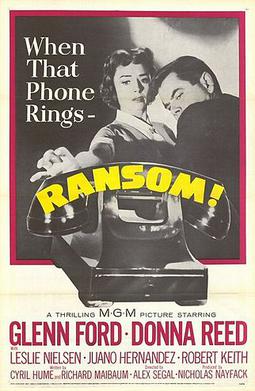
In an age of remakes, sequels, prequels, series and what not, it can be fun sometimes to stumble across an original you didn't even know existed. I can't remember for sure if I saw 1996's Ransom as I was growing up, but I've always been aware of it if nothing else. Well, I can also say I wasn't aware of its predecessor, 1956's Ransom! Forty years apart, is it enough time between original and remake?
A very well-to-do executive of a vacuum cleaner company, Dave Stannard (Glenn Ford) has created quite a life for himself with his beautiful wife, Edith (Donna Reed) and eight-year old son, Andy (Bobby Clark). Their idyllic home life is broken up one day when Andy doesn't return home from school. His teacher tells Edith that a nurse took him from school that morning, claiming to go to the doctor's office. The doctor though has no knowledge of Andy's whereabouts, leaving Dave and Edith to fear for the worst. The call comes later that night....Andy has been kidnapped, and his kidnappers are asking for $500,000. With some help from the police, including Chief Backett (Robert Keith), Dave and Edith discuss what to do. Should they come up with the ransom? Do the police have any chance of catching the kidnappers? As they weigh their options though, Andy is more at risk with each passing hour.
I was really worried about this movie for about 10-15 minutes, worried to the point I was wavering over whether to stick with it. The opening 15 minutes presents that idyllic Leave It to Beaver/Happy Days family life that is so sugary sweet it's almost impossible to take. Andy is the precocious kid who's always up to some shenanigans, but goshdarnit! His parents love him! Aw shucks, he stole slats from all the beds in the house to build a fort?!? What a crazy kid! I'm assuming the goal early on was to show what a good life Dave has from his wife and son to his house to his highly successful job. The problem is, it's so aggressively happy that it made me laugh, and I'm betting that wasn't the goal here. If I'm wrong, so be it, but I don't think I am.
But because I like reviewing movies, I stuck with it, wanting to give it a fair shot. I'm glad I stuck with it. In a way that most 1950s just didn't seem capable of, 'Ransom' is dark in a way I would associate more with the late 1960s or throughout the 1970s. Director Alex Segal turns in quite the thriller, low-key in terms of action but very high strung in terms of the personal level, in terms of an emotional attachment to the situation. The scenes where Dave and Edith begin to put two and two together are unsettling to say the least, some odd, unanswered questions turning into every parent's worst fear, someone has taken their child. Segal films in black and white, much of his story relegated to indoor sets for the Stannard's house as the ransom/kidnapping and case develop.
Why does it work so well? Mostly, it's the personal involvement. Other than a brief shot from behind a kidnapper watching TV, we don't see the kidnappers in the least. We don't know how many there are, what their motivations are, what drove them to do this. It's a gutsy decision in telling a story, one that works because it puts the spotlight entirely on Dave and Edith and those helping them. One of my favorite actors, Ford does a fine job as Stannard, an everyman type of father who loves his family more than anything. He has a good chemistry with Reed (similarly very good), including an early scene I'm assuming is one of the earliest mentions of a "quickie" in movie history. Seriously, it's there. Mostly though, we see their disintegration as parents, as adults, their world crumbling around them. Edith loses it, Dave doing the same but trying to keep a hold on reality, anything that will help bring his son back. His plea on TV is an effective scene, probably the movie's most effective scene.
The rest of the cast is solid too. The cast benefits from Segal and the script from Cyril Hume and Richard Maibaum showing how the community responds, from the police to the curious onlookers and everyone in between. Making his screen debut, Leslie Nielsen is very good as Charlie Telfer, the hardened journalist who has an in for the case and is allowed in the Stannard house. Juano Hernandez plays Jesse Chapman, the Stannard's longtime servant. He's called Uncle Jesse so just a little on the politically incorrect meter. Keith as Chief Backett is interesting because he's not just a pure cop. He's also worrying about his reelection coming up too. Ainslie Pryor plays Al, Dave's brother who begins to question his brother's thinking once the ransom demands are made.
If you've watched any police shows since 1956, from Perry Mason to Law and Order and everything in between, you've no doubt seen at least a show or two dealing with ransom. What have we learned? Just because the family pays the ransom doesn't mean they'll be getting their loved one back. I'm guessing though that in 1956, this was a new concept for moviegoers. This information provides an interesting twist in the second half of the movie as Ford's Stannard learns the possibilities of what could happen. I wasn't sure exactly which ending this flick would go for, but it's a decent enough ending. It could have been one epic ending, but it works, capping off a tense, uncomfortable 1950s thriller.
Ransom! (1956): ***/****
The Sons of Katie Elder
"First, we reunite, then find Ma and Pa's killer...then read some reviews."
Showing posts with label Juano Hernandez. Show all posts
Friday, August 23, 2013
Sunday, August 19, 2012
Trial
The system at its purest should always work. Yes, a pretentious "message" lede that I apologize for, but I've got nothing else. Government, politics and and the right to a fair trial are all ideal in their execution. It's when the human element is added that things get tricky, like 1955's Trial, a solid if somewhat meandering look at not only a courtroom case, but the sinister, sniveling grab for power in the background far from the court.
A law professor at a California university, David Blake (Glenn Ford) is in a jam. He's never actually had a court case so his superiors demand that if he wants to keep his job he must get some actual courtroom experience. Every lawyer and firm in town slams a door in his face except one, that of Barney Castle (Arthur Kennedy) who takes him on for an upcoming controversial murder case. A Mexican teenager, Angel Chavez (Rafael Campos), has been accused of murdering a white teenage girl, and things don't look good. Looking for experience and genuinely believing in the boy's innocence, David takes the case only to discover there's much more to the judicial system than knowing a law book.
What impressed me most about this Mark Robson-directed courtroom drama is that for much of its 105-minute running time, 'Trial' is less than interested in whether or not Angel actually committed the crime. His guilt or innocence is almost secondary. This is a story about the inner-workings of the system, how things get done not by what's right, but by who is able to tweak the system to their advantage. While obviously dealing with different subjects, 'Trial' reminds me in tone of Billy Wilder's Ace in the Hole. Not quite as dark -- especially in the ending here -- it still has a cynical, dark and jaded look at the people involved, at the individual and how simple and easy it is to manipulate the system.
Maybe in 2012, none of this should come as a surprise, but Robson's film is at its most effective in those very moments. When we meet Kennedy's Barney, he seems like a genuinely good guy willing to fight for the underdog and give this inexperienced lawyer a shot. Yeah, not even close. Everything in this world is a selfish, me-first type attitude. Robert Middleton's A.A. 'Fat Stamps, the county sheriff, will say and do anything that helps him get re-elected. Supremacist groups make the possible murder into a race riot, not a simple encounter gone wrong. Barney stirs up the masses wherever he goes, almost making Angel into a martyr before his guilt is decided. He manipulates Angel's mother (Katy Jurado) to embrace her Mexican culture for a sympathetic plea. The actual guilt or innocence steps to the forefront late, but the movie is at its best leading up to that.
Unfortunately a little more than halfway through 'Trial,' a big old curveball is thrown at us as an audience. It's timely for 1955, but overbearing and heavy-handed now. Yes, you guessed it. COMMUNISM!!!!! I won't go into specifics here as to how communism is involved, but there are ulterior motives working all over the place, all of them hamstringing an otherwise very solid courtroom drama. The last 45 minutes are slowed down significantly as communism rears its ugly head. We get it, Red Scare, Stalin, evil Russkies, but it feels overly forced here. On top of that, the ending forces a nice, happy conclusion on us, one that seems far-fetched for the story and out of left field.
Thankfully through all that craziness, the cast is uniformly above average. Chalk up another positive part for Glenn Ford, his David Blake an idealist who believes and has faith in the judicial system. When he sees it for what it really is? He's not naive anymore, just pissed. Like most of his roles, it comes across naturally, a tortured individual weighing all his options. His relationship with Barney's assistant, Abbe (Dorothy McGuire), is a bright spot too. Kennedy does what he does best, sneers and snivels and is generally as slimy as humanly possible. John Hodiak is Armstrong, the district attorney primed for bigger and better things down the road, making the most of a smaller, one-note performance. Along with Jurado and Middleton in supporting parts, Juano Hernandez is a scene-stealer as Judge Motley, an African American judge presiding over the case who must deal with prejudices and assumptions of everyone around him, especially on a racially charged case like this.
I've got mixed emotions about this movie. The parts I did like, I really liked. Ford and a deep cast are very watchable are solid throughout, even the portions of the movie that are too timely for their own good. In the end, the negatives prevent it from reaching its potential. Still a very worthwhile movie to seek out, but it never quite reaches the heights it could and should have.
Trial <---TCM clips (1955): ** 1/2 /****
A law professor at a California university, David Blake (Glenn Ford) is in a jam. He's never actually had a court case so his superiors demand that if he wants to keep his job he must get some actual courtroom experience. Every lawyer and firm in town slams a door in his face except one, that of Barney Castle (Arthur Kennedy) who takes him on for an upcoming controversial murder case. A Mexican teenager, Angel Chavez (Rafael Campos), has been accused of murdering a white teenage girl, and things don't look good. Looking for experience and genuinely believing in the boy's innocence, David takes the case only to discover there's much more to the judicial system than knowing a law book.
What impressed me most about this Mark Robson-directed courtroom drama is that for much of its 105-minute running time, 'Trial' is less than interested in whether or not Angel actually committed the crime. His guilt or innocence is almost secondary. This is a story about the inner-workings of the system, how things get done not by what's right, but by who is able to tweak the system to their advantage. While obviously dealing with different subjects, 'Trial' reminds me in tone of Billy Wilder's Ace in the Hole. Not quite as dark -- especially in the ending here -- it still has a cynical, dark and jaded look at the people involved, at the individual and how simple and easy it is to manipulate the system.
Maybe in 2012, none of this should come as a surprise, but Robson's film is at its most effective in those very moments. When we meet Kennedy's Barney, he seems like a genuinely good guy willing to fight for the underdog and give this inexperienced lawyer a shot. Yeah, not even close. Everything in this world is a selfish, me-first type attitude. Robert Middleton's A.A. 'Fat Stamps, the county sheriff, will say and do anything that helps him get re-elected. Supremacist groups make the possible murder into a race riot, not a simple encounter gone wrong. Barney stirs up the masses wherever he goes, almost making Angel into a martyr before his guilt is decided. He manipulates Angel's mother (Katy Jurado) to embrace her Mexican culture for a sympathetic plea. The actual guilt or innocence steps to the forefront late, but the movie is at its best leading up to that.
Unfortunately a little more than halfway through 'Trial,' a big old curveball is thrown at us as an audience. It's timely for 1955, but overbearing and heavy-handed now. Yes, you guessed it. COMMUNISM!!!!! I won't go into specifics here as to how communism is involved, but there are ulterior motives working all over the place, all of them hamstringing an otherwise very solid courtroom drama. The last 45 minutes are slowed down significantly as communism rears its ugly head. We get it, Red Scare, Stalin, evil Russkies, but it feels overly forced here. On top of that, the ending forces a nice, happy conclusion on us, one that seems far-fetched for the story and out of left field.
Thankfully through all that craziness, the cast is uniformly above average. Chalk up another positive part for Glenn Ford, his David Blake an idealist who believes and has faith in the judicial system. When he sees it for what it really is? He's not naive anymore, just pissed. Like most of his roles, it comes across naturally, a tortured individual weighing all his options. His relationship with Barney's assistant, Abbe (Dorothy McGuire), is a bright spot too. Kennedy does what he does best, sneers and snivels and is generally as slimy as humanly possible. John Hodiak is Armstrong, the district attorney primed for bigger and better things down the road, making the most of a smaller, one-note performance. Along with Jurado and Middleton in supporting parts, Juano Hernandez is a scene-stealer as Judge Motley, an African American judge presiding over the case who must deal with prejudices and assumptions of everyone around him, especially on a racially charged case like this.
I've got mixed emotions about this movie. The parts I did like, I really liked. Ford and a deep cast are very watchable are solid throughout, even the portions of the movie that are too timely for their own good. In the end, the negatives prevent it from reaching its potential. Still a very worthwhile movie to seek out, but it never quite reaches the heights it could and should have.
Trial <---TCM clips (1955): ** 1/2 /****
Monday, August 23, 2010
The Sins of Rachel Cade
In the Belgian Congo in 1939, American missionary and nurse Rachel Cade (Dickinson) arrives at a somewhat isolated mission only to have the doctor in charge drop dead from a heart attack. Forced to take over the not so friendly mission, Rachel does her best to offer medical treatment to the African villagers while also trying to teach them the ways of God, Jesus and the Bible from a Christian perspective. Nothing goes smoothly, but it gets more interesting when two different men, local commander Henri Derode (Peter Finch) and a suave doctor (Roger Moore) begin to show interest in the pretty young nurse, forcing her to decide if she can live by the lessons and teachings she gives to the local villagers.
After seeing Dickinson in mostly supporting roles or at least parts that usually relegated her to love interests, it was cool to see actually see her in a starring role. Her Rachel Cade is an interesting character, starting off as innocent, somewhat naive, and in some ways condescending to others' beliefs. I realize as a missionary that is her job, her mission, but she dismisses the beliefs of the villagers who have had those beliefs their whole lives. Still, even as she struggles with some inner demons and hypocritical feelings, it is a fascinating character to watch. Dickinson never gets too high or too low so Rachel is a little too laid back at times, but because we see her develop over several years, that's the character. Relatively calm even when everything around her seems to be falling apart.
Finch and Moore provide some interesting counters, and not just in who they play. Both Englishmen, Finch plays a French officer (thankfully not trying an accent) and a very young-looking Moore plays an American doctor from Boston (still sounding like a Brit). Rachel feels something for both men and ends up getting involved in a very serious way with one -- no SPOILERS today, folks -- that makes her question the morality of what's she doing. Of the two, Finch delivers the better performance, Moore playing his typically suave, ultra-charming character he perfected years later with the James Bond movies. Other good parts include Errol John as Kulu, Rachel's assistant open to embracing a Christian God, Frederick O'Neal as the local chief curious to Rachel's motivations and actions, and Rafer Johnson and Charles Wood as two of Rachel's helpers in the makeshift hospital.
Dealing with conversations about personal religious beliefs and what religion works and doesn't work, I struggled at times with how preachy the story could be. I haven't read the novel the movie was based on so I don't know what director Gordon Douglas was working with, but it is a very one-track story. Christianity good, African beliefs bad, no middle ground. Juano Hernandez plays a local medicine man/chief who may or may not believe in what he preaches, and Woody Strode plays an imposing medicine man who looks more like a witch doctor than anything else. The portrayal -- however true it is, I don't know -- seems very stereotypical to me and full of political incorrectness. Because of that portrayal, it seems obvious that of course Rachel is going to have success with converts to Christianity.
Simply in the moviemaking process, I struggled to get into this movie. It was filmed on an indoor set for this African village/mission Rachel comes to work at. Filming in Africa would have been no doubt rather expensive, but find somewhere outdoors that could have even slightly resembled the African jungle. You're very aware you're watching a movie that was filmed on a studio set and not anywhere on location. Composer Max Steiner's score is all right but doesn't leave much of a lasting impression. I had a hard time really getting into this story, and I don't know why.
The story lacks a certain amount of energy as it finds a rhythm among Rachel's mission, her personal feelings, and all the conflicts going around in the village. When issues do come up with Rachel finally caving in to some of her wants and desires, it is handled in such a PG fashion that it lacks any punch. Were we supposed to be shocked when Rachel reveals she is pregnant? Douglas probably couldn't get away with much by 1961 standards, but watching the movie some 50 years later, it is very noticeable. The whole movie is fairly dated, but some good acting brings it up a notch and at least makes the movie watchable.
The Sins of Rachel Cade <---TCM clip (1961): **/****
Wednesday, July 28, 2010
Sergeant Rutledge
Movie credits before a film starts wouldn't seem like something that would be upsetting, but this one bothered me. And maybe upsetting isn't the right word, but here goes. An actor stars in a movie with the key role, the most important of all the cast, and even has the movie named after that character. Where do you think he should be billed? If you guessed fourth, well, you're nuts. So goes Woody Strode and his performance in 1960's Sergeant Rutledge.
Since I saw him in Spartacus as Kirk Douglas' sparring partner in the gladiator ring, I've been a fan of Woody Strode. An imposing physical presence, the former UCLA football star turned to movies and made a career out of playing roles that typically needed him to be large and imposing while forsaking his actual acting ability. Strode shows off that ability in a career-best performance in this John Ford directed western and somehow gets fourth billing. Maybe it was because he wasn't the biggest star or name actor, but I think it's ridiculous that he's hidden below in the credit sequence at the beginning of the movie. Credits be damned, the performance is a keeper.
For seven years, Lt. Tom Cantrell (Jeffrey Hunter) has served as an officer with the 9th Cavalry on the American frontier, including working often with First Sergeant Braxton Rutledge (Strode), the top soldier in the outfit. Now, Cantrell finds himself defending Rutledge in a trial with a rape and two murder charges pinned against him. But the Lt. knows this man too well to believe what's being said about him, but now he has to prove the man's innocence against a rabid prosecutor (Carleton Young) and the presiding army judge (Willis Bouchey). With everything stacked against him, Cantrell does his best to present the truth through a series of witnesses and flashbacks that show what really happened.
This is quite a departure for Ford that saw movies later in his career try to deliver more of a message about the old west, racism here, myth and legend in 'Liberty Valance,' and Indian mistreatment in Cheyenne Autumn. On top of that, this isn't a typical Ford cavalry western. He takes a crack at doing a courtroom drama with some mixed results, but overall it works. He uses a handful of lighting techniques while shooting the trial, lots of light and pitch-black dark, as the story morphs into flashbacks which split time in some studio sets and Ford's stomping ground, Monument Valley. Of course, it is a Ford movie, and he gets a couple 'Ford-isms' in, like a group of tittering, tottering old ladies led by Billie Burke and then Judson Pratt's drinking, card shark of an officer filling in not so admirably for the recently passed Victor McLaglen. Little things like that are annoying, but not a movie killer.
In terms of story, this is one of Ford's better ventures. He blends the flashback of Rutledge's arrest and the patrol getting him back to the fort with the actual courtroom testimony. The patrol flashback is Ford hitting a home run, scenes where you expect John Wayne to ride in off the horizon. Working with Ford for a third time, Hunter is excellent as Lt. Cantrell, an officer who must balance his personal beliefs with what the army is telling him. Leading the patrol, Cantrell wavers over whether to let Rutledge just ride away rather than face a trial. Constance Towers is along as Mary Beecher, a young woman coming back to visit her father only to find she's traveled into an Apache uprising. Cantrell's patrol includes a fair share of uncredited actors playing the black cavalry troopers -- they're not listed ANYWHERE -- with Juano Hernandez's Sgt. Skidmore the only representative, a good part as a former slave turned cavalry trooper.
Not quite as comfortable as the outdoor patrol scenes is the courtroom drama. For most of the movie, these quick snippets serve as nothing more than a way to get at the patrol storyline. But every so often, we get that Ford humor which drives me nuts, the group of sophisticated older women who gasp and sigh at every other thing said, or Pratt's Lt. character hamming it up as part of the review board. Bouchey's Colonel Fosgate does his best to remain order in a nice supporting part, and Young goes to town as Capt. Shattuck, the possibly racist prosecutor. The last act comes together a little too quickly for my liking -- the reveal of the real killer is almost a throwaway -- as Cantrell pieces it all together. But that's almost gravy, you're sure from the start Strode's Sgt. Rutledge DID NOT kill his commanding officer and rape a white woman.
He's Woody Strode, of course he didn't do those things. Usually relegated to background characters, Strode hits all the right notes here with a part that allows him to show off his skills -- and not just physically. His first introduction is of a rough but capable trooper trying to save Towers' life from two marauding Apache warriors. When questioned in the field, he refuses to cooperate, thinking the noose is waiting for him no matter what he says. The highlight of the performance is Rutledge on the witness stand as the sergeant explains why he comes back. It is a quick outburst but a very moving one. Strode was never better than he was here, his performance making up for any other issues I may have with this western. He certainly delivered higher billing, even if it was only ahead of Burke's annoying performance.
Sergeant Rutledge <----TCM trailer (1960): ***/****
Since I saw him in Spartacus as Kirk Douglas' sparring partner in the gladiator ring, I've been a fan of Woody Strode. An imposing physical presence, the former UCLA football star turned to movies and made a career out of playing roles that typically needed him to be large and imposing while forsaking his actual acting ability. Strode shows off that ability in a career-best performance in this John Ford directed western and somehow gets fourth billing. Maybe it was because he wasn't the biggest star or name actor, but I think it's ridiculous that he's hidden below in the credit sequence at the beginning of the movie. Credits be damned, the performance is a keeper.
For seven years, Lt. Tom Cantrell (Jeffrey Hunter) has served as an officer with the 9th Cavalry on the American frontier, including working often with First Sergeant Braxton Rutledge (Strode), the top soldier in the outfit. Now, Cantrell finds himself defending Rutledge in a trial with a rape and two murder charges pinned against him. But the Lt. knows this man too well to believe what's being said about him, but now he has to prove the man's innocence against a rabid prosecutor (Carleton Young) and the presiding army judge (Willis Bouchey). With everything stacked against him, Cantrell does his best to present the truth through a series of witnesses and flashbacks that show what really happened.
This is quite a departure for Ford that saw movies later in his career try to deliver more of a message about the old west, racism here, myth and legend in 'Liberty Valance,' and Indian mistreatment in Cheyenne Autumn. On top of that, this isn't a typical Ford cavalry western. He takes a crack at doing a courtroom drama with some mixed results, but overall it works. He uses a handful of lighting techniques while shooting the trial, lots of light and pitch-black dark, as the story morphs into flashbacks which split time in some studio sets and Ford's stomping ground, Monument Valley. Of course, it is a Ford movie, and he gets a couple 'Ford-isms' in, like a group of tittering, tottering old ladies led by Billie Burke and then Judson Pratt's drinking, card shark of an officer filling in not so admirably for the recently passed Victor McLaglen. Little things like that are annoying, but not a movie killer.
In terms of story, this is one of Ford's better ventures. He blends the flashback of Rutledge's arrest and the patrol getting him back to the fort with the actual courtroom testimony. The patrol flashback is Ford hitting a home run, scenes where you expect John Wayne to ride in off the horizon. Working with Ford for a third time, Hunter is excellent as Lt. Cantrell, an officer who must balance his personal beliefs with what the army is telling him. Leading the patrol, Cantrell wavers over whether to let Rutledge just ride away rather than face a trial. Constance Towers is along as Mary Beecher, a young woman coming back to visit her father only to find she's traveled into an Apache uprising. Cantrell's patrol includes a fair share of uncredited actors playing the black cavalry troopers -- they're not listed ANYWHERE -- with Juano Hernandez's Sgt. Skidmore the only representative, a good part as a former slave turned cavalry trooper.
Not quite as comfortable as the outdoor patrol scenes is the courtroom drama. For most of the movie, these quick snippets serve as nothing more than a way to get at the patrol storyline. But every so often, we get that Ford humor which drives me nuts, the group of sophisticated older women who gasp and sigh at every other thing said, or Pratt's Lt. character hamming it up as part of the review board. Bouchey's Colonel Fosgate does his best to remain order in a nice supporting part, and Young goes to town as Capt. Shattuck, the possibly racist prosecutor. The last act comes together a little too quickly for my liking -- the reveal of the real killer is almost a throwaway -- as Cantrell pieces it all together. But that's almost gravy, you're sure from the start Strode's Sgt. Rutledge DID NOT kill his commanding officer and rape a white woman.
He's Woody Strode, of course he didn't do those things. Usually relegated to background characters, Strode hits all the right notes here with a part that allows him to show off his skills -- and not just physically. His first introduction is of a rough but capable trooper trying to save Towers' life from two marauding Apache warriors. When questioned in the field, he refuses to cooperate, thinking the noose is waiting for him no matter what he says. The highlight of the performance is Rutledge on the witness stand as the sergeant explains why he comes back. It is a quick outburst but a very moving one. Strode was never better than he was here, his performance making up for any other issues I may have with this western. He certainly delivered higher billing, even if it was only ahead of Burke's annoying performance.
Sergeant Rutledge <----TCM trailer (1960): ***/****
Labels:
1960s,
Constance Towers,
Jeffrey Hunter,
John Ford,
Juano Hernandez,
westerns,
Woody Strode
Thursday, June 24, 2010
Something of Value
Think of a movie star from the 1950s or 1960s. There's a long list of possibilities, but chances are you picked a white actor or actress. Now think of a black movie star from the same period. A handful come to mind, but only one was a huge star and for good reason, Sidney Poitier. For most of 20 years, black characters in movies were there for punchlines or for comic relief, but when Poitier burst onto the scene he opened the door for serious roles, including becoming the first African-American to win an Academy Award.
One reason Poitier is held in such high regard is the caliber of the movie he typically starred in. He rarely went slumming, taking a paycheck for any old role. Look up and down at his filmography and there just aren't many duds in the bunch. Some are clearly better than others, but even the ones that don't reach classic status at least tried something new and different. Movies like The Defiant Ones and In the Heat of the Night are probably his most famous roles, both dealing with racism in one form or another. One that's been generally forgotten and past by dealing with similar topics, 1957's Something of Value.
Having grown up together in Africa, Peter (Rock Hudson) and Kimani (Poitier) are somewhat oblivious to their differences in skin color. They've grown up as friends and even more than that, as brothers. But it's 1945 in Kenya, and the differences start to stare them dead in the face. Kimani's father is sentenced to prison for doing something his culture -- not the British law -- observes. Fed up with the system, Kimani joins a violent revolutionary group called 'Mau Mau' that hopes to take Africa back from the British. As the revolution grows and the body count increases daily, Peter tries to find Kimani, hoping to convince him that the way he has chosen is not the correct one, and that peace is possible. It's been years though, and it may be too late to save either man.
I'm a victim of this as much as anyone, but sometimes I look at movies from the 1950s and think of everything as whitewashed and censored to the point where everything is bland -- a la Leave it to Beaver of Happy Days. Those blanket statements can be helpful at times, but they're almost never true. 'Value' certainly pokes holes in my whitewashed theory in showing a particularly bloody, surprisingly gory depiction of an African uprising. It is filmed in black and white, but that doesn't take away the very visceral feeling you get during the battle scenes. Director Richard Brooks would have been hard-pressed to tell this story in any sense of a whitewashed fashion, but he doesn't take the easy way out telling this story, and the movie is better for that decision.
Based on a novel by Robert Ruark, Brooks' movie is clearly divided into two stories after an opening segment introducing us to Peter and Kimani. Once the story divides itself, it's either one or the other character. Long segments focus exclusively on Peter or Kimani through their lives amidst the chaos of the Mau Mau rebellion. Peter marries his longtime sweetheart (Dana Wynter) and has to deal with the massacre of some of his close family. He tries to move on with sister Elizabeth (Wendy Hiller) and father Henry (Walter Fitzgerald), but the fighting might not let them. Kimani too starts a family as he tries to convince fellow revolutionaries that there is a peaceful way to protest but quickly gets nowhere.
Their stories are obviously on a collision course when the two will meet again, vastly different men than they were in their early 20s. The white settlers (including a bloodthirsty Michael Pate) do their best to wipe out the revolution while the Mau Mau fighters plan on fighting to the last man, except for Kimani who sees how futile continuing the fight would be. The ending caught me off guard in some of the decisions made, but not in a negative 'I hated that decision' way. I haven't read the novel to compare, but Brooks goes for a realistic, depressing ending that still somehow offers a glimpse of hope, of survival in the end.
Some complaints spoke to the casting of Hudson as a British settler, and to be fair, he doesn't even attempt an accent of any sort. Is that really a bad thing though? For me, the casting was one of the strongest parts of the movie, especially Hudson and Poitier who play so well off each other in their few scenes together. Wynter and Hiller play strong female characters trying to survive this hellish life they have, and Fitzgerald is the stout father figure that can't be shaken. Pate plays the straight evil villain to perfection while Juano Hernandez plays Njogu, a sympathetic figure of the revolution who keeps his faith through it all. Also look for Ivan Dixon (Sgt. Kinch in Hogan's Heroes) as Lathela, Peter's right-hand man. Generally forgotten, but definitely worth looking for.
Something of Value <---trailer (1957): ***/****
One reason Poitier is held in such high regard is the caliber of the movie he typically starred in. He rarely went slumming, taking a paycheck for any old role. Look up and down at his filmography and there just aren't many duds in the bunch. Some are clearly better than others, but even the ones that don't reach classic status at least tried something new and different. Movies like The Defiant Ones and In the Heat of the Night are probably his most famous roles, both dealing with racism in one form or another. One that's been generally forgotten and past by dealing with similar topics, 1957's Something of Value.
Having grown up together in Africa, Peter (Rock Hudson) and Kimani (Poitier) are somewhat oblivious to their differences in skin color. They've grown up as friends and even more than that, as brothers. But it's 1945 in Kenya, and the differences start to stare them dead in the face. Kimani's father is sentenced to prison for doing something his culture -- not the British law -- observes. Fed up with the system, Kimani joins a violent revolutionary group called 'Mau Mau' that hopes to take Africa back from the British. As the revolution grows and the body count increases daily, Peter tries to find Kimani, hoping to convince him that the way he has chosen is not the correct one, and that peace is possible. It's been years though, and it may be too late to save either man.
I'm a victim of this as much as anyone, but sometimes I look at movies from the 1950s and think of everything as whitewashed and censored to the point where everything is bland -- a la Leave it to Beaver of Happy Days. Those blanket statements can be helpful at times, but they're almost never true. 'Value' certainly pokes holes in my whitewashed theory in showing a particularly bloody, surprisingly gory depiction of an African uprising. It is filmed in black and white, but that doesn't take away the very visceral feeling you get during the battle scenes. Director Richard Brooks would have been hard-pressed to tell this story in any sense of a whitewashed fashion, but he doesn't take the easy way out telling this story, and the movie is better for that decision.
Based on a novel by Robert Ruark, Brooks' movie is clearly divided into two stories after an opening segment introducing us to Peter and Kimani. Once the story divides itself, it's either one or the other character. Long segments focus exclusively on Peter or Kimani through their lives amidst the chaos of the Mau Mau rebellion. Peter marries his longtime sweetheart (Dana Wynter) and has to deal with the massacre of some of his close family. He tries to move on with sister Elizabeth (Wendy Hiller) and father Henry (Walter Fitzgerald), but the fighting might not let them. Kimani too starts a family as he tries to convince fellow revolutionaries that there is a peaceful way to protest but quickly gets nowhere.
Their stories are obviously on a collision course when the two will meet again, vastly different men than they were in their early 20s. The white settlers (including a bloodthirsty Michael Pate) do their best to wipe out the revolution while the Mau Mau fighters plan on fighting to the last man, except for Kimani who sees how futile continuing the fight would be. The ending caught me off guard in some of the decisions made, but not in a negative 'I hated that decision' way. I haven't read the novel to compare, but Brooks goes for a realistic, depressing ending that still somehow offers a glimpse of hope, of survival in the end.
Some complaints spoke to the casting of Hudson as a British settler, and to be fair, he doesn't even attempt an accent of any sort. Is that really a bad thing though? For me, the casting was one of the strongest parts of the movie, especially Hudson and Poitier who play so well off each other in their few scenes together. Wynter and Hiller play strong female characters trying to survive this hellish life they have, and Fitzgerald is the stout father figure that can't be shaken. Pate plays the straight evil villain to perfection while Juano Hernandez plays Njogu, a sympathetic figure of the revolution who keeps his faith through it all. Also look for Ivan Dixon (Sgt. Kinch in Hogan's Heroes) as Lathela, Peter's right-hand man. Generally forgotten, but definitely worth looking for.
Something of Value <---trailer (1957): ***/****
Labels:
1950s,
Africa,
Juano Hernandez,
Michael Pate,
Richard Brooks,
Rock Hudson,
Sidney Poitier
Subscribe to:
Posts (Atom)