Is there a such thing as a situational western? No, not a large scale story of cavalry vs. Indians or a bandit gang organizing a huge heist. Instead, a story that takes place in a specific amount of time in a semi-confined setting. The big example I can think of is 1952's High Noon. It's a good one but not necessarily my favorite. Well, here's another one, a western I enjoyed a lot, 1951's Rawhide.
At an isolated way station for the Overland Mail and stagecoach line in the Arizona desert, Tom Owens (Tyrone Power) is a week away from moving back east away from his job as the assistant to the grizzled stationmaster, Sam Todd (Edgar Buchanan). News of a stagecoach robbery is making its way up and down the line, forcing one stagecoach passenger, Vinnie Holt (Susan Hayward) and a toddler, to hole up at the station due to company policy. It's only a few hours later when the outlaws behind the robbery arrive, led by escaped convict Rafe Zimmerman (Hugh Marlowe). They put the station in a hostage situation, Zimmerman revealing what his plan is. A stagecoach packed with gold bars is due in the next day, and he intends to get away with all of it. Can the hostages do something in time to stop the robbery and ensure their safety?
Here's a good example of why I love the western so much. From director Henry Hathaway, 'Rawhide' is neither a classic nor it is a dud. To say it's somewhere in between isn't even fair. It's a really good western that I enjoyed throughout and will gladly revisit it in the future. This 1951 small scale western has little to no reputation, but it came along at a different time. The late 1940s and early 1950s were an underrated time for the entire genre before the glossy widescreen (and often white-washed) examples of much of the 1950s. It's just 89 minutes long, was filmed in beautiful black and white and deserves a far more well-known reputation. Western fans will definitely get a kick out of this one.
There is something appealing and charming about the generally confined setting here for this 1951 western. Written by Dudley Nichols, 'Rawhide' has the feel of a stage-based play getting a big screen adaptation. Do you recognize Nichols? I didn't, but I should have. He wrote the screenplay for John Ford's 1939 classic Stagecoach, and 'Rawhide' has a similar feel. The entire story is set at the stagecoach station whether it's in the main building or the barn/corrals out in the middle of the desert. With the Alabama Hills used as a stunning backdrop, the black and white, sparse look of the story is a gem. The entire story takes place over about a 24-hour time period. We spend a lot of time in the expansive main room of the station, the claustrophobic room used as a prison cell or sorts, and then things open up in a big way outside with the mountains in the background. It's a not so flashy but perfectly set little story.
I'm guessing a big reason why 'Rawhide' doesn't have a huge reputation or following is because of the star power, or lack of it. It's a very solid cast (VERY) but there aren't any John Wayne or Henry Fonda waiting in the wings. Power and Hayward are excellent together, strangers forced to pretend they're married for safety reasons. Their kinda Odd Couple dynamic works in a hectic, tense situation. Marlowe is the nasty villain who's cold and calculating with Jack Elam (the psycho), Dean Jagger (the over his head horse thief) and George Tobias (the oafish/loyal enforcer) rounding out his gang. Buchanan is underused as the grizzled stationmaster who could use a bath while Jeff Corey, James Millican, Louis Jean Heydt and Kenneth Tobey make some quick appearances.
'Rawhide' is never slow but does have some relative struggles in getting to the third act. The threat is laid out and really there's only so much you can do before Marlowe's Zimmerman has to either gun somebody down or smack somebody. The ending though, it provides some good twists in dark fashion. The master of the psychotic, possibly unhinged 1950s western bad guy, Jack Elam even outdoes himself when he's in a desperate spot. And what's one of my main complaints about female characters in westerns? The damsel in distress. Not the case here as Hayward's Holt is front and center in the action. Who needs help? Give that woman a gun! An underrated western, one any genre fan should enjoy a lot. Track this one down!
Rawhide (1951): ***/****
The Sons of Katie Elder
"First, we reunite, then find Ma and Pa's killer...then read some reviews."
Showing posts with label Henry Hathaway. Show all posts
Tuesday, November 18, 2014
Wednesday, October 22, 2014
Nevada Smith
Just a few weeks ago, I watched and reviewed 1964's The Carpetbaggers, the story of a business mogul expanding his empire in the 1920s and 1930s. A minor character in the story? An aging cowboy turned western movie star, Nevada Smith. His backstory is explained but not shown. That's for a prequel made two years later, 1966's Nevada Smith.
Working at his father's played-out mine that has recently produced some gold deposits, a young half-breed Max Sand (Steve McQueen) is away from the house when three outlaws (Karl Malden, Arthur Kennedy, Martin Landau) ride up looking for that gold. Max is too late to help though, arriving at the house to find the tortured, mutilated corpses of his parents. The outlaws are nowhere to be found, but their trail is easy enough to follow. Max's biggest problem though? He's capable of caring for himself on the trail, but he has little money and no real experience with guns, especially when it comes to actually using a pistol or rifle on a human being. Desperate and with no supplies left, Max tries to rob a man on the trail. Instead, the man, Jonas Cord (Brian Keith), an experienced trailsman and capable shot, teaches Max all he can in his quest for revenge. His biggest advice though? Abandon his quest for revenge and move on with his life, but Max isn't hearing it.
It had been years since I watched this 1966 western from director Henry Hathaway (a solid western director, True Grit, Sons of Katie Elder). My biggest takeaway? It isn't as good as I remembered. Still good, still enjoyable, but not as good. There's still positives to take away though. 'Nevada' was filmed on-location in Inyo National Forest and the Owens Valley in the Sierra Mountains. Visually, it is a stunningly good-looking film with the mountains as a backdrop to the revenge story. The score from composer Alfred Newman is solid -- especially the main theme -- but isn't necessarily used enough. The best thing going is the revenge motive, a pretty gruesome story at times. Not graphic, just really violent because we know what's happening. Stabbings, drownings, choking, beating, systematic shooting of an unarmed man. It can be pretty rough at times.
So if you watch this 1966 western and come away a little confused, there's a good reason. The Max Sand character is young, really young. I'm assuming a teenager, maybe approaching 20. When the movie was made in 1965, McQueen was...35. And he's a half-breed with a white father and Kiowa mother. So yeah, he doesn't really look like a teenage half-breed (with his blonde hair too) in a pretty obvious case of miscasting. Still, McQueen makes the most of it. With the revenge motive, it is a fascinating character. Max -- later dubbing himself Nevada Smith -- becomes obsessed with killing his parents' murderers no matter what the cost on those who are helping him. McQueen does a good job in a physically demanding part, doing his own stunts while also adding a dimension of pure physicality to the performance. It's not often spoken words, just a sad look here, a drop of his shoulders there. Not ideal casting, but McQueen makes the most of it.
But the rest of the cast? The rest of the cast?!? It's pretty great. Brian Keith has always been one of my favorites, but I think this is one of his bests. His Jonas Cord is only in the movie for about 20-25 minutes but steals every scene he's in. His chemistry with McQueen is pretty perfect, and their scenes together crackle, an experienced hand with a gun trying to teach the younger Max all he can through good and bad. The Jonas/Max dynamic has always been my favorite, the movie's strongest point. With the episodic story, Malden, Kennedy and Landau make the most of their screentime, three particularly nasty villains you can't wait to see get their due. Raf Vallone is good too as Father Zaacardi, a priest who comes across Max and helps him in a time of need. Also look for familiar western faces Gene Evans, Paul Fix, Pat Hingle, John Doucette, Lyle Bettger, Howard Da Silva and Strother Martin in supporting parts.
Where does 'Nevada' go a little off the tracks then? At 130 minutes, it drifts too much with some extremely slow portions involving the episodic story. There just isn't a ton of energy at times. Two semi-love interests are added, Janet Margolin as an Indian dance hall girl and Suzanne Pleshette as a Cajun girl, are meant to show Max's obsession over a possible future with either, but they become repetitive and tedious. Just not a ton happens. The performances are good, the locations cool, but it's missing that special something. Good but not great.
Also worth mentioning is a western nerd moment. Any western fan who's seen any number of 1960s westerns will recognize Chuck Roberson, Chuck Hayward and Jerry Gatlin as background players and supporting parts. 'Nevada' takes that to new levels. Watch closely and you see them all playing multiple parts. In one scene, Roberson is part of Malden's gang, and the next he's Paul Fix's deputy. It's a little much and a little lazy, something Hathaway also did in Sons of Katie Elder. Thus ends this rant.
Nevada Smith (1966): ** 1/2 /****
Working at his father's played-out mine that has recently produced some gold deposits, a young half-breed Max Sand (Steve McQueen) is away from the house when three outlaws (Karl Malden, Arthur Kennedy, Martin Landau) ride up looking for that gold. Max is too late to help though, arriving at the house to find the tortured, mutilated corpses of his parents. The outlaws are nowhere to be found, but their trail is easy enough to follow. Max's biggest problem though? He's capable of caring for himself on the trail, but he has little money and no real experience with guns, especially when it comes to actually using a pistol or rifle on a human being. Desperate and with no supplies left, Max tries to rob a man on the trail. Instead, the man, Jonas Cord (Brian Keith), an experienced trailsman and capable shot, teaches Max all he can in his quest for revenge. His biggest advice though? Abandon his quest for revenge and move on with his life, but Max isn't hearing it.
It had been years since I watched this 1966 western from director Henry Hathaway (a solid western director, True Grit, Sons of Katie Elder). My biggest takeaway? It isn't as good as I remembered. Still good, still enjoyable, but not as good. There's still positives to take away though. 'Nevada' was filmed on-location in Inyo National Forest and the Owens Valley in the Sierra Mountains. Visually, it is a stunningly good-looking film with the mountains as a backdrop to the revenge story. The score from composer Alfred Newman is solid -- especially the main theme -- but isn't necessarily used enough. The best thing going is the revenge motive, a pretty gruesome story at times. Not graphic, just really violent because we know what's happening. Stabbings, drownings, choking, beating, systematic shooting of an unarmed man. It can be pretty rough at times.
So if you watch this 1966 western and come away a little confused, there's a good reason. The Max Sand character is young, really young. I'm assuming a teenager, maybe approaching 20. When the movie was made in 1965, McQueen was...35. And he's a half-breed with a white father and Kiowa mother. So yeah, he doesn't really look like a teenage half-breed (with his blonde hair too) in a pretty obvious case of miscasting. Still, McQueen makes the most of it. With the revenge motive, it is a fascinating character. Max -- later dubbing himself Nevada Smith -- becomes obsessed with killing his parents' murderers no matter what the cost on those who are helping him. McQueen does a good job in a physically demanding part, doing his own stunts while also adding a dimension of pure physicality to the performance. It's not often spoken words, just a sad look here, a drop of his shoulders there. Not ideal casting, but McQueen makes the most of it.
But the rest of the cast? The rest of the cast?!? It's pretty great. Brian Keith has always been one of my favorites, but I think this is one of his bests. His Jonas Cord is only in the movie for about 20-25 minutes but steals every scene he's in. His chemistry with McQueen is pretty perfect, and their scenes together crackle, an experienced hand with a gun trying to teach the younger Max all he can through good and bad. The Jonas/Max dynamic has always been my favorite, the movie's strongest point. With the episodic story, Malden, Kennedy and Landau make the most of their screentime, three particularly nasty villains you can't wait to see get their due. Raf Vallone is good too as Father Zaacardi, a priest who comes across Max and helps him in a time of need. Also look for familiar western faces Gene Evans, Paul Fix, Pat Hingle, John Doucette, Lyle Bettger, Howard Da Silva and Strother Martin in supporting parts.
Where does 'Nevada' go a little off the tracks then? At 130 minutes, it drifts too much with some extremely slow portions involving the episodic story. There just isn't a ton of energy at times. Two semi-love interests are added, Janet Margolin as an Indian dance hall girl and Suzanne Pleshette as a Cajun girl, are meant to show Max's obsession over a possible future with either, but they become repetitive and tedious. Just not a ton happens. The performances are good, the locations cool, but it's missing that special something. Good but not great.
Also worth mentioning is a western nerd moment. Any western fan who's seen any number of 1960s westerns will recognize Chuck Roberson, Chuck Hayward and Jerry Gatlin as background players and supporting parts. 'Nevada' takes that to new levels. Watch closely and you see them all playing multiple parts. In one scene, Roberson is part of Malden's gang, and the next he's Paul Fix's deputy. It's a little much and a little lazy, something Hathaway also did in Sons of Katie Elder. Thus ends this rant.
Nevada Smith (1966): ** 1/2 /****
Thursday, September 18, 2014
The Shepherd of the Hills
With 1939's Stagecoach, John Wayne put himself on the map, shaking off almost a decade of B-westerns and serials that seemed to be at the time, his future. So what to do next? You've gotta find that next successful part. Wayne struggled for a stretch. He was in some pretty good movies but not necessarily great roles for him. One of those in-between flicks? That's 1941's The Shepherd of the Hills.
In a tight-knit mountain community in the Ozarks, families on their farms and their businesses go about their lives as normal. Well, almost normal. High up in the mountains, the Matthews family, including matriarch, Aunt Mollie (Beulah Bondi), and hen-pecked Uncle Matt (James Barton), has quite the reputation over the years, full of hate and anger as they sell their moonshine. A young woman, Sally Lane (Betty Field), living with her father has always been on good terms with the Matthews, especially their nephew, Matt (Wayne), but the delicate balance with the community and the moonshining Matthews could change when a stranger (Harry Carey) arrives in town. The man, Daniel Howitt, wants to buy a piece of land that has the legend of being cursed. Who doesn't want him to buy that land? That would be young Matt Matthews with his own reasons for revenge.
Based on a bestselling novel from author Harold Bell Wright of the same name, 'Shepherd' was aired on Turner Classic Movies in....April as part of a John Wayne tribute. Yeah, it took me a little while to get around to it, but here we are just the same. Reading into comparisons between the film and the novel, it sounds like the only thing in common is the title and setting itself. Director Henry Hathaway's film is content to march to its own tune. Is that a good thing? Eh, we'll get to that (read: No, not especially). What is positive? This is a beautiful film, just drop dead gorgeous. 'Shepherd' was filmed on location in Big Bear Valley, California filling in quite nicely for the Ozarks. Filmed in Technicolor, it is a doozy of a visual film, the colorful, natural landscapes absolutely filling the screen. What a movie to watch, appreciate and enjoy.
Now jumping off from the stunning visual look....well, it doesn't. In an effort to bring the mountain life into 3-D real life, I felt like 'Shepherd' simply tries too hard to make the story, setting and characters authentic. You want to get that backwoods, homespun feel across, but as several other movies have shown, it's tough. Think of Tobacco Road or God's Little Acre, movies that end up making stereotypes of its characters and settings. Yeah, that's pretty much the case here. All the people living in this mountain community are too folksy. They believe in voodoo, crazy grudges and are just too 'Gee golly' for their own good. Stretched out over a 98-minute movie, it all gets to be a little much for my liking. Just present the story and characters and see what happens. When their backwoods folksiness is shoved down our throats, the end result is highly disappointing.
So that John Wayne fella? In an ensemble cast, Wayne ends up being more of a supporting player. His Young Matt Matthews is a key character who simply isn't in the movie much. His reasons for revenge provide the jumping off point that takes quite awhile to get going. Instead, the story focuses on countless different characters, Carey's Daniel at the front of that list as he affects the lives of so many. Carey (Harry Carey Jr.'s father) delivers a solid performance, pleasant and easygoing, trying to buy land in this mountain valley where no one else will. Field is pretty good too as the innocent Sally, trying to introduce Daniel to the community. Bondi is pretty evil as Mollie and she's good at it. Also look for Ward Bond, Marc Lawrence, John Qualen and Tom Fadden in supporting parts.
This is one of the few John Wayne movies I hadn't seen a single second of. From the early 1940s, it's one of his flicks that isn't particularly good or particularly bad. Not especially memorable, 'Shepherd' is okay at best, rough at others and with some wasted potential in others. You especially see the potential in Wayne, still figuring himself as an actor but clearly on the right track. As a movie on the whole, it struggles to find a rhythm, a tone, a pace. A disappointing end result, probably still worthwhile for John Wayne fans to see an early post-Stagecoach entry that doesn't receive much buzz.
The Shepherd of the Hills (1941): **/****
In a tight-knit mountain community in the Ozarks, families on their farms and their businesses go about their lives as normal. Well, almost normal. High up in the mountains, the Matthews family, including matriarch, Aunt Mollie (Beulah Bondi), and hen-pecked Uncle Matt (James Barton), has quite the reputation over the years, full of hate and anger as they sell their moonshine. A young woman, Sally Lane (Betty Field), living with her father has always been on good terms with the Matthews, especially their nephew, Matt (Wayne), but the delicate balance with the community and the moonshining Matthews could change when a stranger (Harry Carey) arrives in town. The man, Daniel Howitt, wants to buy a piece of land that has the legend of being cursed. Who doesn't want him to buy that land? That would be young Matt Matthews with his own reasons for revenge.
Based on a bestselling novel from author Harold Bell Wright of the same name, 'Shepherd' was aired on Turner Classic Movies in....April as part of a John Wayne tribute. Yeah, it took me a little while to get around to it, but here we are just the same. Reading into comparisons between the film and the novel, it sounds like the only thing in common is the title and setting itself. Director Henry Hathaway's film is content to march to its own tune. Is that a good thing? Eh, we'll get to that (read: No, not especially). What is positive? This is a beautiful film, just drop dead gorgeous. 'Shepherd' was filmed on location in Big Bear Valley, California filling in quite nicely for the Ozarks. Filmed in Technicolor, it is a doozy of a visual film, the colorful, natural landscapes absolutely filling the screen. What a movie to watch, appreciate and enjoy.
Now jumping off from the stunning visual look....well, it doesn't. In an effort to bring the mountain life into 3-D real life, I felt like 'Shepherd' simply tries too hard to make the story, setting and characters authentic. You want to get that backwoods, homespun feel across, but as several other movies have shown, it's tough. Think of Tobacco Road or God's Little Acre, movies that end up making stereotypes of its characters and settings. Yeah, that's pretty much the case here. All the people living in this mountain community are too folksy. They believe in voodoo, crazy grudges and are just too 'Gee golly' for their own good. Stretched out over a 98-minute movie, it all gets to be a little much for my liking. Just present the story and characters and see what happens. When their backwoods folksiness is shoved down our throats, the end result is highly disappointing.
So that John Wayne fella? In an ensemble cast, Wayne ends up being more of a supporting player. His Young Matt Matthews is a key character who simply isn't in the movie much. His reasons for revenge provide the jumping off point that takes quite awhile to get going. Instead, the story focuses on countless different characters, Carey's Daniel at the front of that list as he affects the lives of so many. Carey (Harry Carey Jr.'s father) delivers a solid performance, pleasant and easygoing, trying to buy land in this mountain valley where no one else will. Field is pretty good too as the innocent Sally, trying to introduce Daniel to the community. Bondi is pretty evil as Mollie and she's good at it. Also look for Ward Bond, Marc Lawrence, John Qualen and Tom Fadden in supporting parts.
This is one of the few John Wayne movies I hadn't seen a single second of. From the early 1940s, it's one of his flicks that isn't particularly good or particularly bad. Not especially memorable, 'Shepherd' is okay at best, rough at others and with some wasted potential in others. You especially see the potential in Wayne, still figuring himself as an actor but clearly on the right track. As a movie on the whole, it struggles to find a rhythm, a tone, a pace. A disappointing end result, probably still worthwhile for John Wayne fans to see an early post-Stagecoach entry that doesn't receive much buzz.
The Shepherd of the Hills (1941): **/****
Labels:
1940s,
Beulah Bondi,
Henry Hathaway,
John Qualen,
John Wayne,
Ward Bond
Monday, April 21, 2014
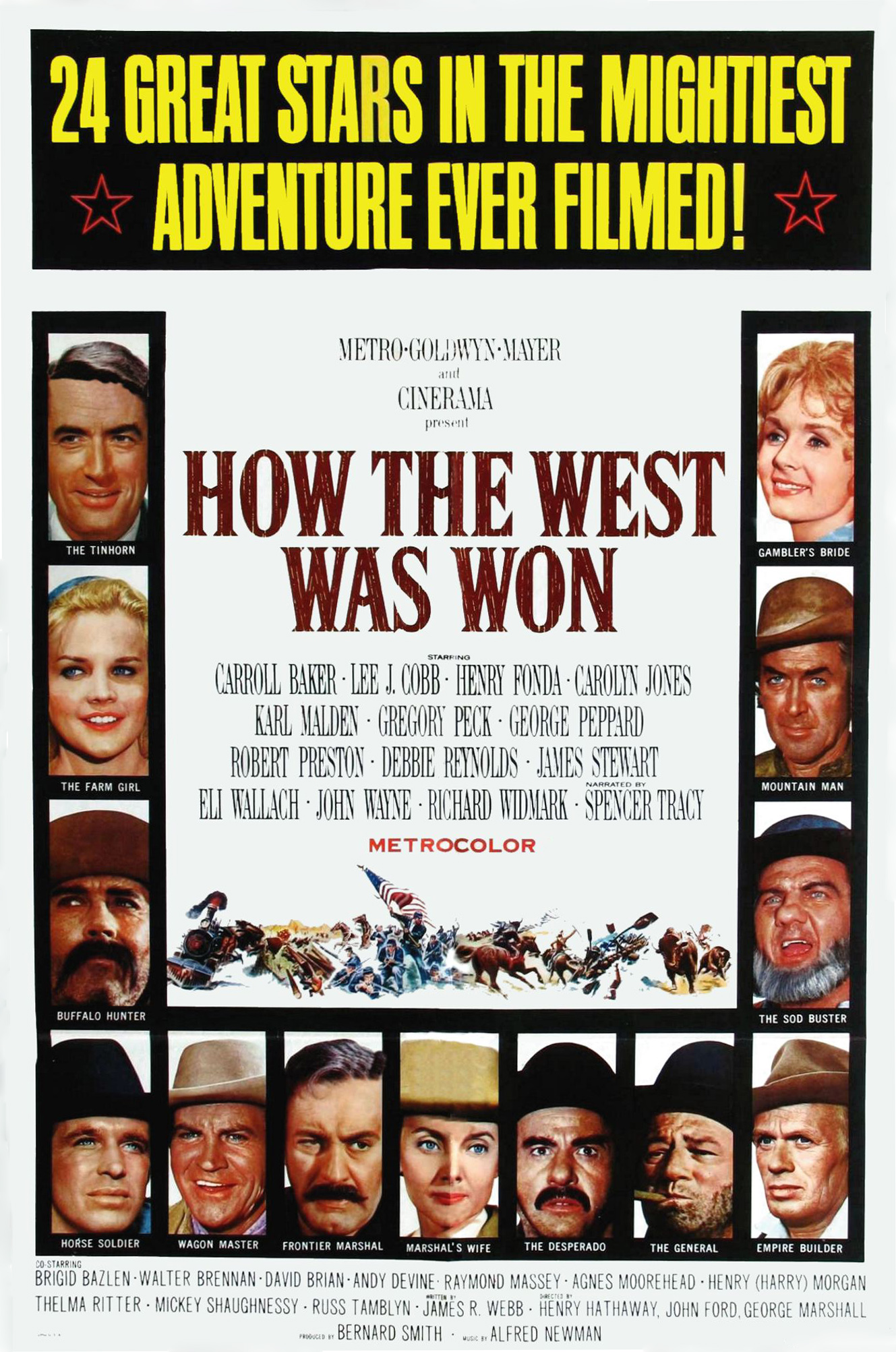
How the West Was Won
In the age of the epics -- the 1950s and 1960s -- some just stand above the rest. It's the stories, the cast, the scope. I don't love 1962's How the West Was Won but as far as epics go, there are very few in its neighborhood. There are obvious flaws, but when it works, it works in a big way. An impressive all-star cast, a story about the development of the American west and a shooting technique that is must-see. That's a winning formula.
A 162-minute film is broken up into five separate segments, the story following the Prescott-Rawlings family as it moves west and settles between the 1840s and the 1880s. It was directed by three different directors and covers a ton of ground. And away we go!
1. The Rivers (directed by Henry Hathaway): It's the 1840s, and the Prescott family, led by patriarch Zebulon (Karl Malden), is moving west and looking for a new life. In Zebulon's family is two daughters, Eve (Carroll Baker), looking for a new life in the west, and Lillith (Debbie Reynolds), wanting to stay in the far-more civilized East. In their dangerous travels on the rivers, they also meet Linus Rawlings (James Stewart), a mountain man with a canoe full of pelts.
Also starring: Lee Van Cleef, Walter Brennan, Agnes Moorehead, Brigid Bazlen.
2. The Plains (directed by Hathaway): Having worked for years on her own as a singer and dancer, Lillith Prescott (Reynolds) has just inherited a gold mine in the wake of the California gold rush. She heads west on a wagon train led by trail driver Richard Morgan (Robert Preston) with a gold-seeking gambler, Cleve Van Valen (Gregory Peck), also along too.
Also starring: Thelma Ritter.
3. The Civil War (directed by John Ford): The war between the states in its early months, young Zeb Rawlings (George Peppard) leaves home with the blessing of his mother, Eve, to join the Ohio volunteers in the fighting. Like so many others, he thinks the war will be full of glory and be over quickly. Zeb finds out how very wrong he is at the bloody battle of Shiloh.
Also starring: John Wayne (as General Sherman), Russ Tamblyn (as a Confederate deserter), Harry Morgan (as General Grant), Andy Devine, Ken Curtis, Raymond Massey (as Abraham Lincoln).
4. The Railroad (directed by George Marshall): In the years following the Civil War, railroad companies race across the U.S. to link the two coasts. Now in the cavalry, Zeb Rawlings (Peppard) finds himself balancing out what his duty requires of him with what he knows is right, the railroad, including brutal supervisor Mike King (Richard Widmark), pushing the Arapahoes to their limit.
Also starring: Henry Fonda as Jethro Stuart, a former mountain man.
5. The Outlaws (directed by Hathaway): Having left the cavalry behind, Zeb Rawlings is now a family man with two kids, now trying to leave his profession as a lawman behind. He receives a letter from his aunt, Lillith (Reynolds), and readies the family to move. As they travel though, Zeb runs into Charlie Gant (Eli Wallach), a notorious outlaw gunning for Zeb.
Also starring: Lee J. Cobb, Carolyn Jones.
This is a movie that's simply put, BIG. It was filmed in Cinerama, three cameras filming each scene and then splicing the action together. The result? An immense look at the expansion of the west. Shots look like panoramic paintings, putting a whole new scope on the growth and development of the American west. It is a beautiful movie. Certain sequences especially stand out -- the camera on a raft trying to survive river rapids, an Indian attack on a wagon train, a stampeding buffalo herd trampling a railroad camp, a runaway train during an attempted robbery -- over the course of the movie, but visually there just isn't a weak spot. I love composer Alfred Newman's score -- listen to an extended sample HERE -- as it gives a moving background to the story. Countless gorgeous filming locations, providing a great backdrop while also transitioning from segment to segment.
It had been years since I watched this movie straight through in one sitting before my recent revisit of this 1962 epic. As you compare the five separate segments, I don't think it's really in question which one is the strongest. It's John Ford's Civil War segment, doing in 20 minutes what entire movies couldn't do in bringing the Civil War to life. Quick, dark, visually striking and unsettling, it is a gem of a sequence, especially Peppard meeting Tamblyn's Confederate deserter after the battle. The second strongest segment for me is the opening 'Rivers' with Stewart, Baker, Reynolds and Malden all leaving a positive impression. All five segments could be stretched out to a feature length film on their own, but these two especially stand out. They get their message across in a quick window and in both cases left me wanting more. Kudos to Ford and Hathaway for their work here.
What struck me more on the rewatch was the other three segments. They are by no means bad segments, but they're just not as good as the other two. I've always thought the weakest was the Plains segment, things feeling too rushed in general. The same qualifies for the Railroad and Outlaws portions. By the time you take away the Entr'Acte, intermission, and Finale music, we're looking at a movie with five segments covered in about 150 minutes (give or take). None of these three are given a chance to breathe to the point they feel downright rushed. As for some other positives? I loved the transitional scenes -- narrated by Spencer Tracy, directed in uncredited fashion by Richard Thorpe -- that set things up, explaining how America has changed, how its people change. These quick montages provide the heart of the movie, almost like a documentary in some ways. Like any movie that tries to accomplish so much, there's good and bad. The positives -- especially the Civil War middle -- is enough to outweigh the negatives thankfully.
One of my biggest worries in reviewing this 1962 epic was that the cast is too big. There's no way I was gonna be able to get all those names tagged with a 200-character limit. Who stands out? Stewart i excellent as Linus Rawlings, Fonda is good in a quick part as Jethro Stuart, and Baker is very strong too. The best parts though are Debbie Reynolds as Lillith and George Peppard as Zeb, the two hearts of the family. One or both is in every segment, the audience seeing them age, learn and adapt as America grows with them. Their scenes together in the Outlaws portion ring especially true. However you cut it though, just an impressive cast from top to bottom, one of the best ever assembled for a Hollywood film.
A doozy of a movie for what it's trying to accomplish. It falls short at times, but this is a movie worth watching for what it represents alone. This is a throwback film, a true epic that strives to be something great. If it doesn't live up those high hopes, so be it. The effort is admirable, a fascinating story of America growing up over an extremely turbulent portion of its history. Oh, and Debbie Reynolds singing A Home in the Meadow (listen HERE) is a truly beautiful song, a fitting one for the movie.
How the West Was Won (1962): ***/****
A 162-minute film is broken up into five separate segments, the story following the Prescott-Rawlings family as it moves west and settles between the 1840s and the 1880s. It was directed by three different directors and covers a ton of ground. And away we go!
1. The Rivers (directed by Henry Hathaway): It's the 1840s, and the Prescott family, led by patriarch Zebulon (Karl Malden), is moving west and looking for a new life. In Zebulon's family is two daughters, Eve (Carroll Baker), looking for a new life in the west, and Lillith (Debbie Reynolds), wanting to stay in the far-more civilized East. In their dangerous travels on the rivers, they also meet Linus Rawlings (James Stewart), a mountain man with a canoe full of pelts.
Also starring: Lee Van Cleef, Walter Brennan, Agnes Moorehead, Brigid Bazlen.
2. The Plains (directed by Hathaway): Having worked for years on her own as a singer and dancer, Lillith Prescott (Reynolds) has just inherited a gold mine in the wake of the California gold rush. She heads west on a wagon train led by trail driver Richard Morgan (Robert Preston) with a gold-seeking gambler, Cleve Van Valen (Gregory Peck), also along too.
Also starring: Thelma Ritter.
3. The Civil War (directed by John Ford): The war between the states in its early months, young Zeb Rawlings (George Peppard) leaves home with the blessing of his mother, Eve, to join the Ohio volunteers in the fighting. Like so many others, he thinks the war will be full of glory and be over quickly. Zeb finds out how very wrong he is at the bloody battle of Shiloh.
Also starring: John Wayne (as General Sherman), Russ Tamblyn (as a Confederate deserter), Harry Morgan (as General Grant), Andy Devine, Ken Curtis, Raymond Massey (as Abraham Lincoln).
4. The Railroad (directed by George Marshall): In the years following the Civil War, railroad companies race across the U.S. to link the two coasts. Now in the cavalry, Zeb Rawlings (Peppard) finds himself balancing out what his duty requires of him with what he knows is right, the railroad, including brutal supervisor Mike King (Richard Widmark), pushing the Arapahoes to their limit.
Also starring: Henry Fonda as Jethro Stuart, a former mountain man.
5. The Outlaws (directed by Hathaway): Having left the cavalry behind, Zeb Rawlings is now a family man with two kids, now trying to leave his profession as a lawman behind. He receives a letter from his aunt, Lillith (Reynolds), and readies the family to move. As they travel though, Zeb runs into Charlie Gant (Eli Wallach), a notorious outlaw gunning for Zeb.
Also starring: Lee J. Cobb, Carolyn Jones.
This is a movie that's simply put, BIG. It was filmed in Cinerama, three cameras filming each scene and then splicing the action together. The result? An immense look at the expansion of the west. Shots look like panoramic paintings, putting a whole new scope on the growth and development of the American west. It is a beautiful movie. Certain sequences especially stand out -- the camera on a raft trying to survive river rapids, an Indian attack on a wagon train, a stampeding buffalo herd trampling a railroad camp, a runaway train during an attempted robbery -- over the course of the movie, but visually there just isn't a weak spot. I love composer Alfred Newman's score -- listen to an extended sample HERE -- as it gives a moving background to the story. Countless gorgeous filming locations, providing a great backdrop while also transitioning from segment to segment.
It had been years since I watched this movie straight through in one sitting before my recent revisit of this 1962 epic. As you compare the five separate segments, I don't think it's really in question which one is the strongest. It's John Ford's Civil War segment, doing in 20 minutes what entire movies couldn't do in bringing the Civil War to life. Quick, dark, visually striking and unsettling, it is a gem of a sequence, especially Peppard meeting Tamblyn's Confederate deserter after the battle. The second strongest segment for me is the opening 'Rivers' with Stewart, Baker, Reynolds and Malden all leaving a positive impression. All five segments could be stretched out to a feature length film on their own, but these two especially stand out. They get their message across in a quick window and in both cases left me wanting more. Kudos to Ford and Hathaway for their work here.
What struck me more on the rewatch was the other three segments. They are by no means bad segments, but they're just not as good as the other two. I've always thought the weakest was the Plains segment, things feeling too rushed in general. The same qualifies for the Railroad and Outlaws portions. By the time you take away the Entr'Acte, intermission, and Finale music, we're looking at a movie with five segments covered in about 150 minutes (give or take). None of these three are given a chance to breathe to the point they feel downright rushed. As for some other positives? I loved the transitional scenes -- narrated by Spencer Tracy, directed in uncredited fashion by Richard Thorpe -- that set things up, explaining how America has changed, how its people change. These quick montages provide the heart of the movie, almost like a documentary in some ways. Like any movie that tries to accomplish so much, there's good and bad. The positives -- especially the Civil War middle -- is enough to outweigh the negatives thankfully.
One of my biggest worries in reviewing this 1962 epic was that the cast is too big. There's no way I was gonna be able to get all those names tagged with a 200-character limit. Who stands out? Stewart i excellent as Linus Rawlings, Fonda is good in a quick part as Jethro Stuart, and Baker is very strong too. The best parts though are Debbie Reynolds as Lillith and George Peppard as Zeb, the two hearts of the family. One or both is in every segment, the audience seeing them age, learn and adapt as America grows with them. Their scenes together in the Outlaws portion ring especially true. However you cut it though, just an impressive cast from top to bottom, one of the best ever assembled for a Hollywood film.
A doozy of a movie for what it's trying to accomplish. It falls short at times, but this is a movie worth watching for what it represents alone. This is a throwback film, a true epic that strives to be something great. If it doesn't live up those high hopes, so be it. The effort is admirable, a fascinating story of America growing up over an extremely turbulent portion of its history. Oh, and Debbie Reynolds singing A Home in the Meadow (listen HERE) is a truly beautiful song, a fitting one for the movie.
How the West Was Won (1962): ***/****
Thursday, October 25, 2012
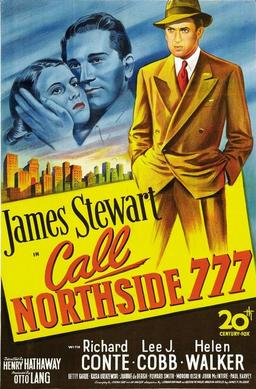
Call Northside 777
This is going to sound simple, but certain movies make me think of the message. Watching old films from basically any Hollywood film is one of my favorite things to do. It can give a window into times long since past. We see towns and cities as they were, not as they are. An all-around solid quasi-documentary, film noir-ish mystery, 1948's Call Northside 777 is a gem.
A reporter for the Chicago Times newspaper, reporter P.J. McNeal (James Stewart) is given a new assignment. An 11-year old murder case from 1932 is in the news, both Frank Wiciek (Richard Conte) and Tomek Zaleska (an uncredited George Tyne) serving 99-year prison sentences for the murder of a Chicago police officer. Wiciek's mother, Tillie (Kasia Orzazewski), a blue collar worker if there ever was, has offered a $5,000 reward for finding the real murder, exonerating her son. McNeal writes the mother's story, but it grabs attention of readers who want more of this story leaving McNeal to explore the long-retired murder case. Ever the suspicious reporter, McNeal goes along but questions the case. Could Frank actually be guilty?
Based on a true story involving the murder of a Chicago police officer (read about it HERE, SPOILERS obviously), 'Call' is an interesting movie for all the right reasons. From director Henry Hathaway, it is part documentary, part investigative procedural, part film noir. The good thing? It moves among those three different genres effortlessly. Clocking in at 112 minutes, it isn't always the quickest-paced flick, but it moves around a lot so that's excusable. A story in the shadows, taking advantage of the black and white photography, it's a great movie to watch.
For me though, this movie is worthwhile for two reasons. One, Hathaway filmed on location in Chicago. This is a great window into late 1940s Chicago. Trivia question and answer for you, but this was the first Hollywood feature film to film on location in Chicago. Where so many films from the 1940s would limit themselves to Hollywood sets, 'Call' gets a whole lot of points for filming in downtown Chicago, but the suburbs as well. Curious what the Windy City looked like 60-plus years ago? This is your movie. The other reason; as a writer who's written for the Chicago Sun-Times, it's a great precursor for All the President's Men. We see how journalists and investigators worked in a pre-Internet age, doing their investigating the old-fashioned way. It's the little things, ain't it?
Already an established star by 1947, Stewart does a solid, workmanlike job as reporter P.J. McNeal. Cynical to a point because the job requires it, McNeal is skeptical of the whole case but takes it on because it's a decent story that readers are curious about it. As the real story comes out though, he starts to question even more, giving Stewart a good chance to flex a little dramatically. Go crusading journalist! Conte is solid in a supporting role as the possibly falsely-convicted Frank while Orzazewski is a scene-stealer as his mother, Tillie. Usually a tough guy actor, Lee J. Cobb plays Kelly, McNeal's editor at the Chicago Times. Joanne De Bergh has a small but essential part as Helen, Frank's wife who supports his innocence. Also look for John McIntire as a former state's attorney trying to cover his butt and an uncredited E.G. Marshall in a small part.
There are some oddities here I feel I have to point out. For a story that's built on the small details, the little pieces of evidence, the movie itself.....isn't. Several rather key questions go unanswered in the end. We find out what happens to Conte's Frank, but what about his supposed partner, Tyne's Tomek? Why is Cobb's editor so dead-set on following this story up? A backstory is hinted at, but never dealt with. The ending is effective, but with a 112-minute movie, it comes together a little quickly, almost like Hathaway ran out of time or money. Still, these are problems but not ones that can ruin a movie. Highly recommend checking this one out.
Call Northside 777 <---trailer (1948): ***/****
A reporter for the Chicago Times newspaper, reporter P.J. McNeal (James Stewart) is given a new assignment. An 11-year old murder case from 1932 is in the news, both Frank Wiciek (Richard Conte) and Tomek Zaleska (an uncredited George Tyne) serving 99-year prison sentences for the murder of a Chicago police officer. Wiciek's mother, Tillie (Kasia Orzazewski), a blue collar worker if there ever was, has offered a $5,000 reward for finding the real murder, exonerating her son. McNeal writes the mother's story, but it grabs attention of readers who want more of this story leaving McNeal to explore the long-retired murder case. Ever the suspicious reporter, McNeal goes along but questions the case. Could Frank actually be guilty?
Based on a true story involving the murder of a Chicago police officer (read about it HERE, SPOILERS obviously), 'Call' is an interesting movie for all the right reasons. From director Henry Hathaway, it is part documentary, part investigative procedural, part film noir. The good thing? It moves among those three different genres effortlessly. Clocking in at 112 minutes, it isn't always the quickest-paced flick, but it moves around a lot so that's excusable. A story in the shadows, taking advantage of the black and white photography, it's a great movie to watch.
For me though, this movie is worthwhile for two reasons. One, Hathaway filmed on location in Chicago. This is a great window into late 1940s Chicago. Trivia question and answer for you, but this was the first Hollywood feature film to film on location in Chicago. Where so many films from the 1940s would limit themselves to Hollywood sets, 'Call' gets a whole lot of points for filming in downtown Chicago, but the suburbs as well. Curious what the Windy City looked like 60-plus years ago? This is your movie. The other reason; as a writer who's written for the Chicago Sun-Times, it's a great precursor for All the President's Men. We see how journalists and investigators worked in a pre-Internet age, doing their investigating the old-fashioned way. It's the little things, ain't it?
Already an established star by 1947, Stewart does a solid, workmanlike job as reporter P.J. McNeal. Cynical to a point because the job requires it, McNeal is skeptical of the whole case but takes it on because it's a decent story that readers are curious about it. As the real story comes out though, he starts to question even more, giving Stewart a good chance to flex a little dramatically. Go crusading journalist! Conte is solid in a supporting role as the possibly falsely-convicted Frank while Orzazewski is a scene-stealer as his mother, Tillie. Usually a tough guy actor, Lee J. Cobb plays Kelly, McNeal's editor at the Chicago Times. Joanne De Bergh has a small but essential part as Helen, Frank's wife who supports his innocence. Also look for John McIntire as a former state's attorney trying to cover his butt and an uncredited E.G. Marshall in a small part.
There are some oddities here I feel I have to point out. For a story that's built on the small details, the little pieces of evidence, the movie itself.....isn't. Several rather key questions go unanswered in the end. We find out what happens to Conte's Frank, but what about his supposed partner, Tyne's Tomek? Why is Cobb's editor so dead-set on following this story up? A backstory is hinted at, but never dealt with. The ending is effective, but with a 112-minute movie, it comes together a little quickly, almost like Hathaway ran out of time or money. Still, these are problems but not ones that can ruin a movie. Highly recommend checking this one out.
Call Northside 777 <---trailer (1948): ***/****
Labels:
1940s,
E.G. Marshall,
Film Noir,
Henry Hathaway,
James Stewart,
Lee J. Cobb,
Richard Conte
Wednesday, October 12, 2011
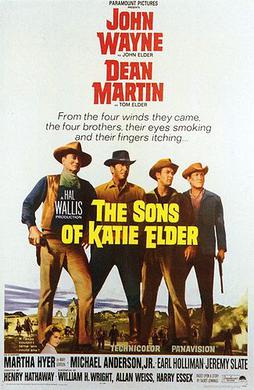
The Sons of Katie Elder
It's been 10 years since gunfighter John Elder (Wayne) has returned home to Clearwater, Texas, but when news reaches him that his mother, Kate, has died, he returns home. There he finds his three younger brothers, Tom (Dean Martin), a gambler, Matt (Earl Holliman), a hardware store owner, and Bud (Michael Anderson Jr.), the youngest. Dealing with the guilt of not having seen his mother in years, John and his brothers find out their father was killed just six months earlier under suspicious circumstances. The Elder ranch is now owned by Morgan Hastings (James Gregory), but no one is quite sure how he came to be the owner. The Elders want some answers as to what exactly happened, but mostly they're trying to do something for their long-suffering mother. John intends to do a right, proving that Kate's faith in her sons was well founded.
Coming back from cancer (although it would eventually kill him), this 1965 film marked a big of a turning point for the Duke. From here on in through the end of his career, Wayne could be accused more of playing himself repeatedly in more viewer-friendly, cookie-cutter movies. He knew what his fans liked, and he intended to give it to them. Take none of that as a negative, I love many of the post-1965 movies Wayne made. They're fun to watch and easy to digest. There are good guys and bad guys with little middle ground. You know how it will end before it even starts. Once again, the movie equivalent of comfort food. 'Sons' has a ton going for it, ranging from Elmer Bernstein composing one of his most underrated and memorable scores ever (listen to the main theme HERE) to the location shooting in Durango, Mexico and along the Rio Grande. It's the little things that count.
There are better, more iconic westerns, but I think 'Sons' would be a fitting introduction to someone who either isn't a fan or just doesn't care for westerns. Above all else, this is a movie -- not just a western -- about family, in this case a family coming back together after years apart. Wayne is the oldest brother, John, a gunfighter who's name precedes him wherever he goes. Martin is the wily gambler, Holliman the button-down businessman, and Anderson Jr. the college dropout. The movie's best moments come from the quartet of brothers reuniting, talking, fighting, working to make the Elder name something to be proud of in their Ma's name. There isn't a weak performance in the bunch. The chemistry is spot-on, the dialogue crackles like four brothers actually would talk -- in love and fighting -- and when the time comes they put aside their differences to work together.
Who ends up being one of the more memorable characters is the never seen Katie Elder. We hear a lot about her from anyone who ever met her, not one person having something negative to say about her. Martha Hyer's Mary Gordon, the boarding house owner, gives a great monologue about Katie lying about her boys, telling the town they always sent money, always wrote to check in. Some of the best parts of Bernstein's score come in these quieter moments as both the Elders and the population of Clearwater reflect on Katie's passing. All she leaves behind is two worn dresses, a rocking chair, and a "legacy" of her four boys. The movie's final shot is a touching one, surprising for a western oater.
Not enough yet? Still haven't sold you on this one? 'Sons' has one of the best supporting casts to come out of a 1960s western. Start with Gregory as Hastings, the businessman looking to put Clearwater on the map, no morals needed. A young Dennis Hopper plays Hastings' squirrelly son, Dave. Western vet and character actor Paul Fix is a scene-stealer as Sheriff Billy Wilson, an old friend of the Elders trying to keep peace in his town with fiery deputy, Ben Latta (Jeremy Slate in a solid supporting role), at his side. In a small but key role, George Kennedy is particularly intimidating as Curley, a hired gun working for Hastings. Also look for John Doucette, John Qualen, Sheldon Allman, and Strother Martin in supporting roles.
From director Henry Hathaway, 'Sons' is never listed as one of the all-time western greats or even among John Wayne's best. Why? I'm not sure. There isn't a ton of action, most of the gunplay saved for the last 30 minutes, including a high tension shootout in El Saltito, Mexico, a gorgeous and familiar location for western fans. The story is very much more interested in characters and their dynamic than making a shoot 'em up flick. It's a wise choice. The script is about as perfect as a western can get, and the cast beyond perfect. Underrated in any number of categories, and one all movie fans should be able to enjoy -- western or not.
P.S. Watch the movie and tell me otherwise. I'm convinced Dean Martin's Tom is supposed to die in the end. One throwaway line saves him, but it always felt tacked on to me. Any opinions?
The Sons of Katie Elder <---trailer (1965): ****/****
Thursday, March 10, 2011
Seven Thieves
The key of course is to bring something new to the table, anything at all. A twist you didn't see coming, a character that keeps everyone around them suspicious to their motives. We're not talking rewriting the formula here, just tweaking it to something a little different, a little more exciting. So now in 2011, the movies have had their chance to expand on the formula. But in 1960, it was still something new when bad guys and crooks were allowed to be the main characters far more often than during Hollywood's Golden Era. Unfortunately for 1960's Seven Thieves, every cliche, every stereotype, every genre convention is used in this often dull, disappointing heist flick.
Visiting the French Riviera, discredited American professor Theo Wilkins (Edward G. Robinson) sends for a friend from his past to come visit him. Paul Mason (Rod Steiger) obliges his old friend, visiting Theo in Monte Carlo and Cannes. The aged professor has a plan for the convict just recently released from a 3-year prison sentence, one that could likely land him back in prison. Theo has assembled a small team to pull of a dangerous heist in the Monte Carlo Casino, but he trusts none of them and needs help from Paul in leading and organizing the job, all the little details that so many others would forget about. Wary of actually being able to pull off the job, Paul agrees almost exclusively as a favor to his old friend, and starts working on how exactly how to put it all together, a huge lump sum of money waiting at the end.
Movies slip through the cracks over the years, and even with the impressive cast here, Seven Thieves couldn't avoid that fate. Generally forgotten, the cast is still worth mentioning and was the main reason I stumbled across it on Netflix. Steiger is always watchable in a weird, eccentric way, and Robinson is a consummate pro no matter the depth of the project he's working on. Joining his team are Joan Collins as Melanie, a dancer/stripper in a cheap Cannes club, Eli Wallach as Pancho, Melanie's protective guardian, Alexander Scourby as Raymond, the inside man at the casino, Michael Dante as Louis, all-around ladies man and safecracker, and Berry Kroeger as Hugo, the strong man and unpredictable muscle.
Robinson assembles this team, but something feels like it was missing in the process. For one, their parts in the actual heist seem sketchy at best. Other than wearing slinky outfits and generally being sexy (watch her "scandalous" dance scene HERE), Collins' main role in the job is to open a window. Wallach's Pancho has no real use other than pretending to be a Baron which he ends up failing at. Scourby looks nervous, Dante struggles with heights, and Kroeger is capable of who knows what. Something doesn't add up with director Henry Hathaway not hitting the right notes at all with this team of specialists.
I guess my biggest problem here is that the movie is just plain dull. There's no sense of urgency, no feeling of danger. The crew is never really dealing with the threat of being captured. The job itself is criminally simple compared relative to the security they're facing. Are there no guards in this casino at all? More than that, this is a visually dull movie. Hathaway films in black and white, giving it a romantic, throwback feel to the story. But that's it. The cast clearly never went to France (Monte Carlo or Cannes), instead relying on long establishing shots that zoom in to green-screen shots of the actual cast "enjoying" beautiful France. Hathaway's filming style isn't so much a style either with the veteran director simply placing his camera in front of the cast and letting them go to work. I'm all for a build-up of tension, but there's nothing here. Just long, uninterrupted shots of the cast talking.
A saving grace for even the crappiest of heist movies can be what everyone wants to see...the actual heist. Compared to the rest of the movie, 'Seven''s heist is nothing special, too simplistic, just too easy after all the build-up about how difficult the job will be. The Ocean's 11 remake channels it in a way, improving on it by leaps and bounds. A bad heist is one thing, but Hathaway drops the ball in the finale. Wallach's Pancho is supposed to take a pill that will knock him out, mimicking death. He falters, Robinson injects him, and then pockets the still-pristine pill. SPOILERS STOP READING SPOILERS Robinson actually dies of a heart attack, and I'm thinking "Oh, here we go, big twist." He took the pill, faked his death and will now steal away with the winnings. Yeah, I wish. There's no twist, and Seven Thieves features one of the stupidest endings I can think of in a story/movie of this nature. It limps to the finish, content to go back into the forgotten closet of movies that could have been so much better.
Seven Thieves <---trailer (1960): **/****
Wednesday, January 5, 2011
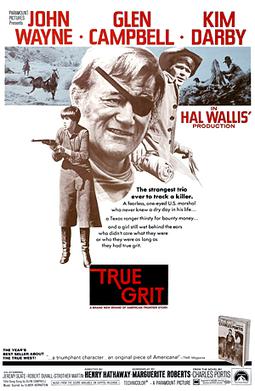
True Grit (1969)
Recently this flick has been in the news because the Coen brothers remade it with their movie hitting theaters in the last few weeks. My worry was that it was a movie that didn't need to be remade so why touch it? Honestly, the 1969 version isn't a great western, but it is remembered so fondly because of what it meant for John Wayne, his career and his fans. It's a pretty standard oater and a good example of the type of movies Wayne made at this later point in his career. Familiar story, good vs. bad, lots of recognizable faces, and nothing really groundbreaking. But in the end, it's entertaining and a pleasant enough way to pass a couple of hours.
For those not familiar with the story, here's a basic description. The 1969 and 2010 versions are pretty identical story-wise, but here goes. Teenager Mattie Ross (Kim Darby) travels to Fort Smith, Arkansas in 1880 looking for help in tracking down the man, Tom Chaney (Jeff Corey), who gunned down her father in cold blood. She finds no takers other than U.S. Marshal Rooster Cogburn (Wayne), a one-eyed, drunk who is a few years past his prime. With a Texas Ranger, La Beouf (country singer Glen Campbell), Mattie and Rooster head into the Indian territory to hunt down Chaney and bring him back, hearing rumors he has joined up with outlaw Lucky Ned Pepper (Robert Duvall) and his gang.
Call it his best performance if you want (I don't think it's even close, he had much better) but this may be the one Wayne is most remembered for. Criticisms aside, and I don't have many, but he had better parts that showed off his ability, Wayne does deliver a great performance and one that he fully deserved his Oscar for. To a certain point, he is playing a caricature of himself. He later joked that if he knew all it would take to win an Oscar was put on an eye patch he would have done it years before. Wayne was an underrated comedic actor, and his Rueben 'Rooster' J. Cogburn shows that off. He's rough and ready but has a softer side to when it comes to Mattie who can both drive him nuts and have him develop a fatherly bond with her at the same time. Watch his Oscar acceptance speech HERE for a simple, effective and very moving look at Wayne and this part which finally earned him some Academy Award consideration.
So Wayne is obviously the biggest selling point here, but the problem is what else is there to sell? As good as Wayne is as Rooster, his two main supporting parts are about as awful as they can be. The Mattie character is key, and as was the case with the remake, annoying but endearing in an odd way. You're supposed to root for in spite of how ridiculously annoying, how brutally honest she is. Darby just can't manage it in one of the most grating performances I've ever come across. You just can't get behind this character. A similar problem exists for Campbell as Texas Ranger La Beouf. First, this country singer can't act a lick. His character is supposed to be the polar opposite of Rooster, but just like Darby's Mattie it's hard to find a reason to like him. If nothing else, his character redeems himself in the end...twice actually. Still, it's not enough to save the part. Check out the remake for how these characters should and could have been played.
Having watched both versions in little less than a week, I had to laugh at the idea that the Coen brothers did something vastly different with their version. Working off the Charles Portis novel, whole scenes, whole exchanges of dialogue are exactly the same between the two movies. The tone is obviously different -- more light-hearted here -- and the only huge difference is the period authentic dress, dialogue, and accuracy in general. Director Henry Hathaway films this story in Mexico, California and Colorado and ends up with a beautifully photographed film that looks absolutely nothing like the setting it takes place in, but that's just a minor detail, right? Elmer Bernstein's score sounds like a mix of a lot of his movies, but not necessarily in a bad way. You'll notice a lot of familiar notes if you're familiar with his work at all, but the main theme is a good one.
You can't help but compare the two, and all I could come up with involving both was that the story itself is lacking something. Portis was known for straightforward stories that didn't pull punches. If anything, True Grit is too simplistic, too straightforward. At times, it's even a little dull. This is a movie about characters, and for the most part they're interesting even if we don't like them. Story gets lost in the shuffle at times, but sit back and enjoy getting to know the main characters. Of the rest of the cast, Duvall makes basically a small cameo, Jeremy Slate and Dennis Hopper are two of his gang, and Strother Martin is a haggling horse trader who incurs Mattie's wrath.
True Grit <---trailer (1969): ***/****
Thursday, July 1, 2010
13 Rue Madeleine
A week or so ago I reviewed my first James Cagney movie, a story of IRA fighters in Ireland struggling to fight for their freedom. I always thought of Cagney as too cartoonish, almost a caricature of well...himself. So as I look through the rest of his filmography, I'll just have to look for characters that were a little more peaceful, little more calm instead of the stick of dynamite one good shake away from blowing up. Years ago I saw part of 1947's 13 Rue Madeleine, and now I finally caught up and saw the whole movie. Well worth the wait, mostly because of Cagney's performance.
Released two years after the conclusion of WWII, 'Rue' picks a good time to tell a story of Allied agents and their efforts to help the war effort. The war was obviously fresh on people's minds, but because the war had been won stories of heroism and bravery had started to filter out. During the war, lives would have been put at risk if anyone knew what these Allied agents were up to, but with the war behind them it became more acceptable to finally give them the attention and credit they fully deserved. Director Henry Hathaway films his movie with a distinct feel of a documentary, a wise decision that doesn't allow too much wasted effort in a slick spy movie.
As the U.S. is thrust into WWII following the attack on Pearl Harbor, the government is forced to build an intelligence agency from the ground up. Leading that charge is Charles Gibson (Walter Abel) who begins to assemble groups of agents who will learn the ins and outs of surviving working behind enemy lines. One of those groups, 077, is led by a veteran agent and former soldier, Bob Sharkey (Cagney), who goes about teaching his 20 trainees all he knows. Gibson approaches Bob though with a warning, they think one of his agents is a German agent. Can they utilize this though to have the agent send false information to the German High Command? It's a risky move, but one that could help convince the Germans of a second front away from the upcoming D-Day invasion. It could work, but at what cost?
With voiceover narration moving the action along, the first 45 minutes -- maybe even the 1st hour -- do feel like a documentary about the forming of the intelligence system designed to advance the Allied war effort. We meet three agents in Sharkey's team, Suzanna de Beaumont (French actress Annabella), a French widow, Bill O'Connell (Richard Conte), a card shark and cocky son of a gun, and Jeff Lassiter (Frank Latimore), a naive but headstrong American. Their training sequences are handled well, always at a quick pace as they learn how to handle weapons and radios while also improving their skills of observation, cunning and deception -- including several in the field experiments. Some of these scenes might seem old-hat because they've been used in countless movies since, but a certain energy keeps them interesting.
About the halfway point though, 'Rue' becomes Cagney's movie. After serving as a stern but fair instructor to his agents, Sharkey is forced to parachute into France when a mission goes under. No one else can be brought in to fix the problem and continue to trick the Germans so Sharkey steps up and volunteers to undertake the mission. Now, Cagney doesn't exactly make the most believable Frenchman, but would you question someone who glared back at you like Cagney does? This is the star at his best; tough, driven and motivated to do whatever it takes to get the job done. Overall, the ending shows what some of his agents had to sacrifice to accomplish their missions so it doesn't qualify as a happy ending per se, but it's a good one nonetheless.
My question through the second half of the movie goes toward the choice to reveal the German agent disguised as an American. Could Hathaway have kept us guessing a little longer? Probably. But with the reveal, all the mystery goes out the window. Granted, it puts a face on the enemy and gives the viewer someone to root against, but that's just me if I'm making the movie. I won't spoil it here as to who it is, but toward the end you're rooting for Cagney's Sharkey to get a moment alone with the German agent. It never really comes, but the solution is beyond perfect and should remind you of another ending to a Cagney movie.
Cagney and the actor/actress playing the German agent are the only ones that really register as strong characters among the agents, but Cagney's star power is more than enough. Sam Jaffe has a good part as a French mayor working with the resistance, and Melville Cooper is solid as 077's handler. Handling his directing duties, Hathaway always keeps the movie on the point and turns in a quick-paced 95-minute finished product. He filmed in Canada for some 'German locations' and shoots in black and white to add one more hard-edge to the movie. You can watch it at Youtbe starting with Part 1 of 10.
13 Rue Madeleine <----trailer (1947): ***/****
Released two years after the conclusion of WWII, 'Rue' picks a good time to tell a story of Allied agents and their efforts to help the war effort. The war was obviously fresh on people's minds, but because the war had been won stories of heroism and bravery had started to filter out. During the war, lives would have been put at risk if anyone knew what these Allied agents were up to, but with the war behind them it became more acceptable to finally give them the attention and credit they fully deserved. Director Henry Hathaway films his movie with a distinct feel of a documentary, a wise decision that doesn't allow too much wasted effort in a slick spy movie.
As the U.S. is thrust into WWII following the attack on Pearl Harbor, the government is forced to build an intelligence agency from the ground up. Leading that charge is Charles Gibson (Walter Abel) who begins to assemble groups of agents who will learn the ins and outs of surviving working behind enemy lines. One of those groups, 077, is led by a veteran agent and former soldier, Bob Sharkey (Cagney), who goes about teaching his 20 trainees all he knows. Gibson approaches Bob though with a warning, they think one of his agents is a German agent. Can they utilize this though to have the agent send false information to the German High Command? It's a risky move, but one that could help convince the Germans of a second front away from the upcoming D-Day invasion. It could work, but at what cost?
With voiceover narration moving the action along, the first 45 minutes -- maybe even the 1st hour -- do feel like a documentary about the forming of the intelligence system designed to advance the Allied war effort. We meet three agents in Sharkey's team, Suzanna de Beaumont (French actress Annabella), a French widow, Bill O'Connell (Richard Conte), a card shark and cocky son of a gun, and Jeff Lassiter (Frank Latimore), a naive but headstrong American. Their training sequences are handled well, always at a quick pace as they learn how to handle weapons and radios while also improving their skills of observation, cunning and deception -- including several in the field experiments. Some of these scenes might seem old-hat because they've been used in countless movies since, but a certain energy keeps them interesting.
About the halfway point though, 'Rue' becomes Cagney's movie. After serving as a stern but fair instructor to his agents, Sharkey is forced to parachute into France when a mission goes under. No one else can be brought in to fix the problem and continue to trick the Germans so Sharkey steps up and volunteers to undertake the mission. Now, Cagney doesn't exactly make the most believable Frenchman, but would you question someone who glared back at you like Cagney does? This is the star at his best; tough, driven and motivated to do whatever it takes to get the job done. Overall, the ending shows what some of his agents had to sacrifice to accomplish their missions so it doesn't qualify as a happy ending per se, but it's a good one nonetheless.
My question through the second half of the movie goes toward the choice to reveal the German agent disguised as an American. Could Hathaway have kept us guessing a little longer? Probably. But with the reveal, all the mystery goes out the window. Granted, it puts a face on the enemy and gives the viewer someone to root against, but that's just me if I'm making the movie. I won't spoil it here as to who it is, but toward the end you're rooting for Cagney's Sharkey to get a moment alone with the German agent. It never really comes, but the solution is beyond perfect and should remind you of another ending to a Cagney movie.
Cagney and the actor/actress playing the German agent are the only ones that really register as strong characters among the agents, but Cagney's star power is more than enough. Sam Jaffe has a good part as a French mayor working with the resistance, and Melville Cooper is solid as 077's handler. Handling his directing duties, Hathaway always keeps the movie on the point and turns in a quick-paced 95-minute finished product. He filmed in Canada for some 'German locations' and shoots in black and white to add one more hard-edge to the movie. You can watch it at Youtbe starting with Part 1 of 10.
13 Rue Madeleine <----trailer (1947): ***/****
Labels:
1940s,
Henry Hathaway,
James Cagney,
Richard Conte,
WWII
Saturday, February 13, 2010
Kiss of Death
Most actors have to pay their due before they make it as a big star. Maybe do some low-budget movies, a TV show, Broadway plays. I'm hard pressed to think of many who make the jump from complete anonymity to instant stardom. Only two really come to mind, Burt Lancaster and Richard Widmark.A veteran of stage and radio, Widmark made the jump to movies in 1947 in a film noir classic called Kiss of Death. Making his screen debut, the 33-year old actor received fourth billing as a supporting character with three more established actors taking the lead roles. Even with a role that has him on-screen for maybe 20-25 minutes of a 98 minute movie, Widmark steals the film with a part that catapulted him to stardom and almost threatened to typecast him early in his Hollywood career.
Given a lengthy prison sentence for a jewel heist, low-level hood Nick Bianco (Victor Mature) refuses to squeal about the other men who took part on the job and accepts his sentence. Several years pass and then Bianco finds out his wife has killed herself and his two daughters have been sent to an orphanage. Cutting a deal with the assistant district attorney, Louis D'Angelo (Brian Donlevy), Bianco agrees to be a snitch for the cases D'Angelo is trying to put away. Bianco's first case? Get evidence on a suspected killer and a previous acquaintance, Tommy Udo (Widmark). Bianco gets the evidence and even testifies in court, but a jury acquits Udo and he quickly eludes his tail. Now living with his wife (Coleen Gray) and his two daughters, Bianco knows it's only a matter of time before Udo shows up looking for revenge.
With Mature and Donlevy taking the starring roles, Widmark leaves an instant impression as psychotic, cackling killer Tommy Udo. Mention 'Kiss of Death' and most people will associate Widmark with the movie, and more specifically one scene. Looking to catch a snitch, Udo infamously ties an old woman into her wheelchair and pushes her to her death down a flight of stairs, watch it HERE starting at the 2:40 mark. Widmark's Udo seems to revel and delight in administering punishment and death. His distinct giggle sends chills down your back, and hard to place accent with his low voice just add layers and personality to this character who is impossible to take your eyes off of.
In fact, Widmark was so good in the part that over the next three or four years, he was only offered similar roles, deranged psychos and villains in film noirish type movies. Granted, no actor wants to be typecast, but he's incredible in this part. The rest of the movie is entertaining enough, but when he's not onscreen it does lag in places. After the wheelchair incident, you're just not quite sure what he's capable of. Apparently audiences and critics agreed, Widmark was given his only Oscar nomination -- as best supporting actor -- for the part. On the irony meter, this one gets a 10. He lost to Edmund Gwenn who played Kris Kringle in Miracle on 34th Street. The most villainous guy around vs. the sweetest guy ever, too perfect.
The story takes a little while to develop, but the momentum picks up once Mature's Bianco cuts his deal with Donlevy's D'Angelo. Mature could be a little stiff in certain parts, but this is one of his stronger parts. Bianco has never really amounted to much and has spent several years behind bars, but when his daughters are in trouble he decides to do anything he can to make their lives better. Coleen Gray's Nettie used to babysit the girls and then marries Nick -- which has some creepy undertones as we see their marriage. Donlevy has a thankless role as the district attorney but always a professional still makes the character interesting. Also look for Karl Malden in a small part working with Donlevy.
The highlight of the movie is by the last 30 minutes following Udo's acquittal. The black and white shadows of film noir come to life and Henry Hathaway's direction creates an incredible mood, a sense of impending doom about to be unleashed. Mature sits in his home waiting for Udo to show up, only to decide he'll go on the offensive and seek out Udo instead. There's a great confrontation between Mature and Widmark in the finale although the climax does have a bit of a cop-out.
An above average, very professionally made film noir. Mature, Donlevy and Gray are decent enough with their respective leading parts, but this movie belongs to Richard Widmark in his screen debut. He'd go on to play more heroic parts, but this may be his most well-known role. Check the whole movie out at Youtube, starting with Part 1 of 10.
Kiss of Death <----trailer (1947): ***/****
Labels:
1940s,
Brian Donlevy,
Film Noir,
Henry Hathaway,
Richard Widmark,
Victor Mature
Sunday, November 8, 2009
Fourteen Hours
Combining a documentary-like filming style and an impressive list of character actors given a chance to step into the limelight, 'Fourteen' tries to do a lot of things. The premise -- a man standing on a ledge on the 15th floor of a New York hotel and ready to jump -- doesn't seem to bode well for a feature-length film. But that's for later because I've got some complaints about that man out on the ledge.
Delivering breakfast to a 15th floor room at the Rodney Hotel, a waiter (Frank Faylen) loses track of where the hotel guest is in the room. Looking around, he notices the curtains blowing all over the room. Sticking his head out the window, he sees the guest (Richard Basehart) standing on the window ledge. Far down below on the empty New York streets, traffic cop Charlie Dunnigan (Paul Douglas) spots the man on the ledge and races inside the hotel to try and help. So starts a day-long media event as Dunnigan and seemingly all of the NY police force try to talk the man down, first trying to find the man's name and then looking into his background.
That sort of storyline opens the door for a long list of possibilities. At the heart of the movie is Basehart's man on the ledge and Douglas' flat-footed traffic cop, the only man Basehart will talk to. But feet away in the hotel room and the adjacent hallway is a throng of people, cops, reporters, hanger-ons trying to help or hurt the situation. Far below on the streets, NY turns into gridlock as crowds gather to see whether the man will jump to his death. A group of cab drivers place bets on which hour he will jump while waiting for the traffic to clear. Additions like that reminded me of 'Ace' in its cynicism of human nature, but 'Fourteen' balances that out with a love story between two strangers, Jeffrey Hunter's Danny and Debra Paget's Ruth.
As the man on the ledge and the average Joe cop trying to talk him down, Basehart and Douglas dominate the screentime, but that doesn't mean a long list of varying characters is left behind. Agnes Morehead and Robert Keith play the man's overbearing mother and the father who abandoned his family, Howard Da Silva as police commander Moskar who leads the rescue effort from the hotel room, Martin Gabel as Dr. Strauss, a psychiatrist trying to figure out Basehart's background and mental make-up, Grace Kelly in her screen debut as a divorcee watching the proceedings from a nearby building, and Ossie Davis and Harvey Lembeck as two on-looking cab drivers looking to make a buck.
The premise -- as interesting and tense as it is -- has some holes that probably needed to be dealt with. First, the biggie, Basehart gets out on that ledge early in the morning and stands there for (like the title says) 14 hours. But once Douglas' cop shows up, the man starts asking for cigarettes, glasses of water and coffee. Whenever any effort is made to bring him down from the ledge, he starts freaking out, screaming 'Get back or I'll jump!' Basically, that's my problem with the character who, credit going to Basehart, comes across a whiny, shrill, not mentally all there individual. I'm not sure what it says about me, but after the fifth or sixth freakout at seeing a cop or net, I was rooting for him to jump. And on the reality meter, he's up there 14 hours and drinking water and coffee. The dude's gonna have to use the bathroom at some point. Come on now.
My complaints aren't enough to not recommend this movie, just enough to detract overall from a worthy story and bring down an above average movie to an average flick. Great cast, some very cool uses of New York as the story's backdrop, and an interesting premise that for the most part delivers. Look for 14 Hours, but also track down Wilder's Ace in the Hole, a forgotten classic from a great director.
Fourteen Hours <---- typically overdramatic 1950s trailer (1951): **/****
Subscribe to:
Posts (Atom)