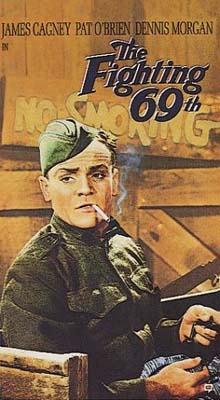
A famous military unit -- the 69th New York --, the most decorated cleric in U.S. military history -- Father Francis Duffy -- and a movie star at the height of his game. Throw those three things together and what do you get? A sometimes overdone, mostly effective and definitely a product of its time, 1940's The Fighting 69th.
As the United States enters the fighting in 1917 in World War I, units are assembled all over the country, including the 69th New York, a regiment dating back to its fighting with the Union in the Civil War. At the head of the unit is Major Wild Bill Donovan (George Brent) who intends to shape up his regiment composed almost entirely of Irishmen from all over the state, and he does so with the help of Catholic priest Father Duffy (Pat O'Brien). Among the new recruits though is a troublemaker, Jerry Plunkett (James Cagney), a spark plug of a man with no real regard for authority who only wants to get to Europe and kill his fair share of Germans.
From director William Keighley, this 1940 war picture rises above a fair share of limitations while using the concept of a 'unit picture' as a jumping off point. It takes a group of men -- in this case the very Irish 69th New York -- and takes us through their training and/or bonding, deployment in war, and then the actual battles. Even with a 1940 release, 'Fighting' does a good job portraying the horrors of WWI. Trench warfare produced some of the nastiest fighting the world has ever seen, and it's easy to see why here. Certain shots and scenes stuck with me, including close-up shots of feet walking by the crude wooden crosses marking muddy graves, the shots of terror of artillery raining down on men in trenches, and of course the suicidal charges across no man's land into German machine guns.
Very much an established star by 1940, Cagney is both good and bad here. At times, he resorts back to stereotypical Cagney; loud and aggressive, boisterous because he can be, annoying to the point you want to rip your ears off and punch him in the face. Other times? You admire the character he's created; a blowhard of a man who really isn't all that confident but puts up a false front just the same. The antics become a little too much at times to the point it feels like the movie is just piling on. Whether or not you'll be able to enjoy this movie will no doubt revolve around being able to sift through the grating at times to get through to the real performance. In the end, it's worth it.
A solid supporting cast backs Cagney up. One thing I can say as an Irishman....don't mess with the Irish. Portraying the real-life hero Father Duffy, O'Brien delivers a saintly performance, one meant to honor the famous priest. No flaws, no mistakes, just a hero. It's an okay performance if laid on a little thick. Brent is all right as Donovan, the stiff-jawed commander of the 69th. Alan Hale is very good as Sgt. Wynn, the drill sergeant trying to toughen up his men while Jeffrey Lynn is a scene-stealer as Sgt. Joyce Kilmer, a poet/writer who should be an officer and leader, not just a little Indian. Also look for a grating comedic performance from Frank McHugh, Dennis Morgan as the selfless Lt. Ames, and Guinn Williams as Pvt. Dolan, the sort-of slow but well-meaning brute of a soldier.
Without any real sense of subtlety, 'Fighting' tried its best to drive me nuts, and there were parts I just couldn't stand. The brawling Irishmen, the very broad humor, the antics from Plunkett, they all tried to make this a difficult movie to enjoy. But in the end, I was very moved by the finale (and that's knowing what's coming if you've got two working brain cells). Even then, the battle scenes go too far, Cagney's Plunkett sending mortars at a German position with cries of "That's for Brooklyn!" or "Take that, you Krauts!" but it still manages to be effective. There's that part of me that wants to rip this movie, but I just can't too much. I liked it almost in spite of itself. Maybe it's the Irish in me.
The Fighting 69th <---trailer (1940): ***/****
The Sons of Katie Elder
"First, we reunite, then find Ma and Pa's killer...then read some reviews."
Showing posts with label James Cagney. Show all posts
Monday, October 8, 2012
Friday, November 19, 2010
White Heat
I've written before that Cagney as a movie star was never one of my favorites, his acting style very theatrical and over the top. I've come around some as I've seen in him a few of his more subdued parts. The one movie I was told I had to give a chance was this one, White Heat. If I didn't like it, I was in the free and clear and should probably steer clear of his lesser efforts. Well, no problem there. Cagney's performance is theatrical and over the top but it is a part that demands he be both of those things. Considered his best acting job for a reason, this is a perfect introduction for anyone looking to get to know one of Hollywood's biggest stars of the 1930s and 1940s.
Running his brutal gang, Cody Jarrett (Cagney) faces a difficult decision. After a highly successful train robbery that netted over $300,000 but also produced four dead bodies, Jarrett is feeling the heat as FBI agent Philip Evans (John Archer) leads the manhunt to bring him to justice. Cody takes a lesser rap for a heist he didn't actually take part in, but it gives him an alibi for the job that would have sent him to the electric chair. Evans knows he's been duped with Jarrett taking a short sentence that will have him out on the streets in 2 years. He brings in one of his best undercover agents, Vic Pardo (Edmond O'Brien), and plants him in Jarrett's cell as a convict. Notoriously hot-tempered, Jarrett still takes to Vic and takes him under his wing almost like a little brother. Evans' plan works as Jarrett organizes a daring escape with Vic as the newest member of his dangerous gang.
Director Raoul Walsh wastes about four minutes post-credits before showing that his main character Cody Jarrett is one of the nastiest gangsters you're ever going to come across in a movie. In the opening heist of a train carrying a Wells Fargo shipment of cash, Jarrett callously guns down the engineer and his assistant at the very mention of his name (Henry Fonda had a similar reaction some 19 years later in Once Upon a Time in the West). That was part of the appeal of this movie, it's not a conventional 1940s flick where you can predict everything coming 15 or 20 minutes before it happens. The characters aren't particularly likable -- no redeeming qualities in sight for the most part -- and the attitudes toward sex and violence are far more lenient than most movies that came out of this stage in Hollywood's history. Of course, there is that Cagney guy leading the way.
In my messed up head watching movies about the bad guys (simplistic description, but it gets the idea across), I typically find myself rooting for said bad guys. Cagney pushes my tolerance for rooting for the bad guy because Cody Jarrett is one nasty dude. However, the fact that I was even contemplating being in this guy's corner is a testament to not only Cagney's acting ability but the strength of the screenplay. It digs into this character and really fleshes him out. He's the definition of a mama's boy with Ma Jarrett (Margaret Wycherly) doting on her son as she helps him run his gang. It is 1949 though so while certain things are hinted at (cough Oedipus complex cough) the hint is as far as things go. Then there's Cody's slutty wife Verna (Virginia Mayo) who latches on to whoever can get her the farthest in life with as much money and worldly possessions as possible.
So throw all this together along with a gang of murderers and cutthroats, and you kinda see where Cody's coming from. Not rationalizing here, just explaining. He has to be the nastiest S.O.B around or else he would get taken down in minutes by the wolves nipping at his heels. It's always refreshing to see a character fleshed out as much as this. There are moments where you are disgusted by his actions, but then you see him looking out for O'Brien's Vic like a little brother, and you feel for him. Of course, from the moment this character is introduced, you know what fate he's going to meet. It's never in doubt. Cody Jarrett is going out in a blaze of glory like no other. The ending -- as Jarrett, Pardo and the gang knock off a payroll at a chemical plant -- is a whopper of a finish, leading to the oft-repeated line 'Top of the world.' A finale that's about as good as they get.
I'm not sure how Cagney wasn't nominated in some way for his part as homicidal Cody Jarrett, but the lead performance is just one of many rock-solid acting jobs pulled here. Wycherly as Ma Jarrett is the picture of a devoted mother who knows her son is doomed but can't stop him, Mayo the femme fatale, Steve Cochrane as treacherous Big Ed Somers, and O'Brien especially as Pardo. In a similar way to the viewer, Pardo has this unexplainable connection to Jarrett. That's the movie in a nutshell. You're drawn in by this character you should despise but just can't come around. A must-see.
White Heat <---trailer (1949): *** 1/2 /****
Labels:
1940s,
Edmond O'Brien,
Film Noir,
James Cagney,
Raoul Walsh,
Virginia Mayo
Thursday, July 1, 2010
13 Rue Madeleine
A week or so ago I reviewed my first James Cagney movie, a story of IRA fighters in Ireland struggling to fight for their freedom. I always thought of Cagney as too cartoonish, almost a caricature of well...himself. So as I look through the rest of his filmography, I'll just have to look for characters that were a little more peaceful, little more calm instead of the stick of dynamite one good shake away from blowing up. Years ago I saw part of 1947's 13 Rue Madeleine, and now I finally caught up and saw the whole movie. Well worth the wait, mostly because of Cagney's performance.
Released two years after the conclusion of WWII, 'Rue' picks a good time to tell a story of Allied agents and their efforts to help the war effort. The war was obviously fresh on people's minds, but because the war had been won stories of heroism and bravery had started to filter out. During the war, lives would have been put at risk if anyone knew what these Allied agents were up to, but with the war behind them it became more acceptable to finally give them the attention and credit they fully deserved. Director Henry Hathaway films his movie with a distinct feel of a documentary, a wise decision that doesn't allow too much wasted effort in a slick spy movie.
As the U.S. is thrust into WWII following the attack on Pearl Harbor, the government is forced to build an intelligence agency from the ground up. Leading that charge is Charles Gibson (Walter Abel) who begins to assemble groups of agents who will learn the ins and outs of surviving working behind enemy lines. One of those groups, 077, is led by a veteran agent and former soldier, Bob Sharkey (Cagney), who goes about teaching his 20 trainees all he knows. Gibson approaches Bob though with a warning, they think one of his agents is a German agent. Can they utilize this though to have the agent send false information to the German High Command? It's a risky move, but one that could help convince the Germans of a second front away from the upcoming D-Day invasion. It could work, but at what cost?
With voiceover narration moving the action along, the first 45 minutes -- maybe even the 1st hour -- do feel like a documentary about the forming of the intelligence system designed to advance the Allied war effort. We meet three agents in Sharkey's team, Suzanna de Beaumont (French actress Annabella), a French widow, Bill O'Connell (Richard Conte), a card shark and cocky son of a gun, and Jeff Lassiter (Frank Latimore), a naive but headstrong American. Their training sequences are handled well, always at a quick pace as they learn how to handle weapons and radios while also improving their skills of observation, cunning and deception -- including several in the field experiments. Some of these scenes might seem old-hat because they've been used in countless movies since, but a certain energy keeps them interesting.
About the halfway point though, 'Rue' becomes Cagney's movie. After serving as a stern but fair instructor to his agents, Sharkey is forced to parachute into France when a mission goes under. No one else can be brought in to fix the problem and continue to trick the Germans so Sharkey steps up and volunteers to undertake the mission. Now, Cagney doesn't exactly make the most believable Frenchman, but would you question someone who glared back at you like Cagney does? This is the star at his best; tough, driven and motivated to do whatever it takes to get the job done. Overall, the ending shows what some of his agents had to sacrifice to accomplish their missions so it doesn't qualify as a happy ending per se, but it's a good one nonetheless.
My question through the second half of the movie goes toward the choice to reveal the German agent disguised as an American. Could Hathaway have kept us guessing a little longer? Probably. But with the reveal, all the mystery goes out the window. Granted, it puts a face on the enemy and gives the viewer someone to root against, but that's just me if I'm making the movie. I won't spoil it here as to who it is, but toward the end you're rooting for Cagney's Sharkey to get a moment alone with the German agent. It never really comes, but the solution is beyond perfect and should remind you of another ending to a Cagney movie.
Cagney and the actor/actress playing the German agent are the only ones that really register as strong characters among the agents, but Cagney's star power is more than enough. Sam Jaffe has a good part as a French mayor working with the resistance, and Melville Cooper is solid as 077's handler. Handling his directing duties, Hathaway always keeps the movie on the point and turns in a quick-paced 95-minute finished product. He filmed in Canada for some 'German locations' and shoots in black and white to add one more hard-edge to the movie. You can watch it at Youtbe starting with Part 1 of 10.
13 Rue Madeleine <----trailer (1947): ***/****
Released two years after the conclusion of WWII, 'Rue' picks a good time to tell a story of Allied agents and their efforts to help the war effort. The war was obviously fresh on people's minds, but because the war had been won stories of heroism and bravery had started to filter out. During the war, lives would have been put at risk if anyone knew what these Allied agents were up to, but with the war behind them it became more acceptable to finally give them the attention and credit they fully deserved. Director Henry Hathaway films his movie with a distinct feel of a documentary, a wise decision that doesn't allow too much wasted effort in a slick spy movie.
As the U.S. is thrust into WWII following the attack on Pearl Harbor, the government is forced to build an intelligence agency from the ground up. Leading that charge is Charles Gibson (Walter Abel) who begins to assemble groups of agents who will learn the ins and outs of surviving working behind enemy lines. One of those groups, 077, is led by a veteran agent and former soldier, Bob Sharkey (Cagney), who goes about teaching his 20 trainees all he knows. Gibson approaches Bob though with a warning, they think one of his agents is a German agent. Can they utilize this though to have the agent send false information to the German High Command? It's a risky move, but one that could help convince the Germans of a second front away from the upcoming D-Day invasion. It could work, but at what cost?
With voiceover narration moving the action along, the first 45 minutes -- maybe even the 1st hour -- do feel like a documentary about the forming of the intelligence system designed to advance the Allied war effort. We meet three agents in Sharkey's team, Suzanna de Beaumont (French actress Annabella), a French widow, Bill O'Connell (Richard Conte), a card shark and cocky son of a gun, and Jeff Lassiter (Frank Latimore), a naive but headstrong American. Their training sequences are handled well, always at a quick pace as they learn how to handle weapons and radios while also improving their skills of observation, cunning and deception -- including several in the field experiments. Some of these scenes might seem old-hat because they've been used in countless movies since, but a certain energy keeps them interesting.
About the halfway point though, 'Rue' becomes Cagney's movie. After serving as a stern but fair instructor to his agents, Sharkey is forced to parachute into France when a mission goes under. No one else can be brought in to fix the problem and continue to trick the Germans so Sharkey steps up and volunteers to undertake the mission. Now, Cagney doesn't exactly make the most believable Frenchman, but would you question someone who glared back at you like Cagney does? This is the star at his best; tough, driven and motivated to do whatever it takes to get the job done. Overall, the ending shows what some of his agents had to sacrifice to accomplish their missions so it doesn't qualify as a happy ending per se, but it's a good one nonetheless.
My question through the second half of the movie goes toward the choice to reveal the German agent disguised as an American. Could Hathaway have kept us guessing a little longer? Probably. But with the reveal, all the mystery goes out the window. Granted, it puts a face on the enemy and gives the viewer someone to root against, but that's just me if I'm making the movie. I won't spoil it here as to who it is, but toward the end you're rooting for Cagney's Sharkey to get a moment alone with the German agent. It never really comes, but the solution is beyond perfect and should remind you of another ending to a Cagney movie.
Cagney and the actor/actress playing the German agent are the only ones that really register as strong characters among the agents, but Cagney's star power is more than enough. Sam Jaffe has a good part as a French mayor working with the resistance, and Melville Cooper is solid as 077's handler. Handling his directing duties, Hathaway always keeps the movie on the point and turns in a quick-paced 95-minute finished product. He filmed in Canada for some 'German locations' and shoots in black and white to add one more hard-edge to the movie. You can watch it at Youtbe starting with Part 1 of 10.
13 Rue Madeleine <----trailer (1947): ***/****
Labels:
1940s,
Henry Hathaway,
James Cagney,
Richard Conte,
WWII
Saturday, June 26, 2010
Shake Hands With the Devil
Growing up watching older movies, I came to embrace just about any tough guy movie star from John Wayne to Clint Eastwood and everyone in between. But having seen nothing more than a clip here and there and reading about his other movies, I was never able to embrace James Cagney, one of Hollywood's first stars and possibly the most famous in the 1930s and 1940s. It wasn't that I actively disliked Cagney or his movies, but the over the top, fast-talking little tough guy never appealed to me. So having seen only two Cagney movies, I'm giving him a try and seeing what he's all about.
The most recent one I've watched is one of his later pictures, 1959's Shake Hands With the Devil. Cagney was nearing 60 years old when he made this British production, but he shows no signs of slowing down. His character goes through quite an arc from beginning to end, starting off as a heroic freedom fighter and ending up as an obsessed quasi-villain. But through it all, the focus and attention is on him, especially with a second-billed star who just can't keep up with him.
It's 1921 in Ireland and American veteran of WWI Kerry O'Shea (Don Murray) is studying at a surgeon school to become a doctor. With the IRA battling the Black and Tans in hopes of making their country a free republic, Ireland is up for grabs with violence in the streets on every corner. O'Shea is walking home late one night with a friend when he's forced to take action against the Black and Tans, making him a marked man. He's supposed to be smuggled out of Ireland, but ends up joining an IRA squad, led by Sean Linehan (Cagney), his professor at the medical school. O'Shea joins the effort with the squad's sights set on one man, a brutal local commander, but the effort begins to take a toll on the men, especially Linehan at the top.
A story that focuses on a bloody, often incredibly brutal fight for independence has to tread a fine line in how it tells the story. Both the IRA and the Black and Tans committed atrocities during the fighting for Irish independence from British rule. Director Michael Anderson does not paint either side as completely heroic or completely villainous to his credit. Both sides have flaws and are willing to murder, maim and sabotage, whatever it takes to get their side to win. Obviously focusing on the Irish Republican Army more than their opponents the viewer will get more depth and background from one side, but even then it's not always positive, most of that coming from Cagney's Linehan.
It's obvious early on that Cagney is not just making a cameo appearance as an Irishman teaching at a medical school so it does not come as much of a surprise when he's revealed to be an IRA commandant with years of experience and know-how. Once O'Shea joins the group, Linehan is a strong, sturdy leader who is committed to his men and to the fight, more than ready to give his life if the cause demands it. But as the fighting continues, Linehan begins to crack a bit and his personal issues begin to emerge, especially with a young barmaid (Glynis Johns) who hangs around with his men, and the ever-present threat from traitors and informers. Even when it seems the fighting is nearing its end, Linehan refuses to give up, wanting to continue the fight.
As his counter though, Murray's Terry O'Shea starts off as an interesting character, but he fades into the background midway through the movie. He's a WWI vet sick of killing and violence and just wants to move on to a new life as a doctor when he's thrust into this fight for independence. His father a former freedom fighter, O'Shea has to live up to certain expectations, but by the end he's fallen in love with a young English girl (Dana Wynter) who he met about 10 minutes ago. Thankfully the rest of the cast steps up, including Michael Redgrave as the General, an IRA leader, Cyril Cusack as Chris Noonan, poet turned IRA gunman, and even Richard Harris in just his second movie playing Terrence O'Brien, a self-assured but capable member of Lenihan's squad.
Filming in Ireland, Anderson made the choice to film in black and white as opposed to color. It is a decision that makes sense because of the tone and mood of the story. If he had chosen a color format, 'Shake Hands' would look like The Quiet Man. But lush green fields and soft rolling hills would seem out of place with a story focusing on such a dark subject. Full of shadows, Anderson made the right choice going with black and white instead of color. It's an interesting movie with a controversial topic and worth watching if you can track it down.
Shake Hands With the Devil (1959): ** 1/2 /****
The most recent one I've watched is one of his later pictures, 1959's Shake Hands With the Devil. Cagney was nearing 60 years old when he made this British production, but he shows no signs of slowing down. His character goes through quite an arc from beginning to end, starting off as a heroic freedom fighter and ending up as an obsessed quasi-villain. But through it all, the focus and attention is on him, especially with a second-billed star who just can't keep up with him.
It's 1921 in Ireland and American veteran of WWI Kerry O'Shea (Don Murray) is studying at a surgeon school to become a doctor. With the IRA battling the Black and Tans in hopes of making their country a free republic, Ireland is up for grabs with violence in the streets on every corner. O'Shea is walking home late one night with a friend when he's forced to take action against the Black and Tans, making him a marked man. He's supposed to be smuggled out of Ireland, but ends up joining an IRA squad, led by Sean Linehan (Cagney), his professor at the medical school. O'Shea joins the effort with the squad's sights set on one man, a brutal local commander, but the effort begins to take a toll on the men, especially Linehan at the top.
A story that focuses on a bloody, often incredibly brutal fight for independence has to tread a fine line in how it tells the story. Both the IRA and the Black and Tans committed atrocities during the fighting for Irish independence from British rule. Director Michael Anderson does not paint either side as completely heroic or completely villainous to his credit. Both sides have flaws and are willing to murder, maim and sabotage, whatever it takes to get their side to win. Obviously focusing on the Irish Republican Army more than their opponents the viewer will get more depth and background from one side, but even then it's not always positive, most of that coming from Cagney's Linehan.
It's obvious early on that Cagney is not just making a cameo appearance as an Irishman teaching at a medical school so it does not come as much of a surprise when he's revealed to be an IRA commandant with years of experience and know-how. Once O'Shea joins the group, Linehan is a strong, sturdy leader who is committed to his men and to the fight, more than ready to give his life if the cause demands it. But as the fighting continues, Linehan begins to crack a bit and his personal issues begin to emerge, especially with a young barmaid (Glynis Johns) who hangs around with his men, and the ever-present threat from traitors and informers. Even when it seems the fighting is nearing its end, Linehan refuses to give up, wanting to continue the fight.
As his counter though, Murray's Terry O'Shea starts off as an interesting character, but he fades into the background midway through the movie. He's a WWI vet sick of killing and violence and just wants to move on to a new life as a doctor when he's thrust into this fight for independence. His father a former freedom fighter, O'Shea has to live up to certain expectations, but by the end he's fallen in love with a young English girl (Dana Wynter) who he met about 10 minutes ago. Thankfully the rest of the cast steps up, including Michael Redgrave as the General, an IRA leader, Cyril Cusack as Chris Noonan, poet turned IRA gunman, and even Richard Harris in just his second movie playing Terrence O'Brien, a self-assured but capable member of Lenihan's squad.
Filming in Ireland, Anderson made the choice to film in black and white as opposed to color. It is a decision that makes sense because of the tone and mood of the story. If he had chosen a color format, 'Shake Hands' would look like The Quiet Man. But lush green fields and soft rolling hills would seem out of place with a story focusing on such a dark subject. Full of shadows, Anderson made the right choice going with black and white instead of color. It's an interesting movie with a controversial topic and worth watching if you can track it down.
Shake Hands With the Devil (1959): ** 1/2 /****
Subscribe to:
Posts (Atom)
