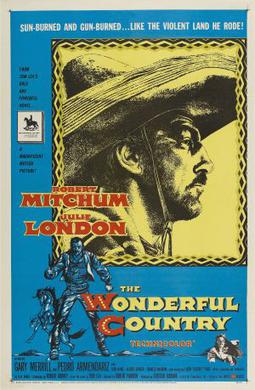
Compared to the 1960's, the 1950's just doesn't stand up for me when it comes to the western genre. Movies were too much soap opera, not enough wild west. Sure, there were plenty of good to great to classic entries, but the following decade was a stretch of a genre at its best. Closing out the decade strong though was a 1957 western that's been generally forgotten over the years, The Wonderful Country.
Working for the powerful Castro family in Mexico, gunfighter and hired gun Martin Brady (Robert Mitchum) is crossing the Rio Grande and entering the United States. An incident from his past drastically changed his life, forcing him to retreat into Mexico where he developed a name for himself as quite the dangerous pistolero. Now, he's on a mission from the Castros to pick up an illegal shipment of repeating rifles and ammunition. It isn't soon after crossing the border that his horse throws him, breaking Martin's leg. He can't ride so he's forced to wait and heal in the border town, shipping the guns and ammunition back to Mexico without him. So with nothing to do but wait, Martin sits back and heals but doesn't quite know what awaits him. People from his past, new acquaintances, and those who want to see him dead, they all await in the coming weeks, especially when news reaches town that the gun shipment has been stolen. But by who?
What an interesting, genuinely odd, even offbeat movie. I watched this western from director Robert Parrish years ago and revisited it recently when it popped up on MGM-HD. I liked it a lot then, and a second viewing produced the same result...albeit with the same response. This is an odd movie, no doubt about it. There are touches of an almost art-house film sprinkled throughout. The story is disjointed to say the least, covering months (and maybe more) from beginning to end but with no real sense of the passage of time. But coursing through it all, an odd energy hangs in the air that I found appealing. A bit of a mess but a good mess to watch.
Robert Mitchum was the best. He had no rivals, a rogue in Hollywood before it was cool to be a rogue. He was one of the first anti-heroes too, the tortured hero who transitioned into bigger and better. One of his specialties? As I've mentioned before, Mitchum was drawn to Mexico including this film but also The Wrath of God, Villa Rides, 5 Card Stud, Bandido and probably several more I'm forgetting. Who better then to play an expatriate American who embraced the Mexican lifestyle almost entirely? I can't think of anyone.
Mitchum's Martin Brady is the one constant through all the craziness and winding story. Yeah, his accent is a little rough at times, but when he speaks Spanish, this isn't an actor remembering his lines. He speaks it fluently. But the character as a whole is interesting because it feels so ahead of its time. This is the somber, even doomed gunfighter running from his past but not really knowing what the future holds for him. All he's known is his pistol, but his ability with the gun has him tied down so he can't escape. From the look of the character -- the immense sombrero, the stubble, the vaquero attire -- to the potentially doomed development, it's a more than worthwhile lead performance.
The rest of the cast is more of an ensemble with a few bright spots. Julie London plays Helen Colton, the wife of the local army outpost commander, Major Stark Colton (Gary Merrill), a generally ineffective officer. Helen has a past and is drawn to Mitchum's Brady but she may have other ideas. But then things get weird in almost variety show ensemble territory, including Albert Dekker (a Texas Ranger captain), Jack Oakie (a well-meaning railroad man), scene-stealing Charles McGraw (an amiable doctor), former Negro League/MLB pitcher Satchel Paige (a cavalryman, a Buffalo Soldier), Anthony Caruso (a Mexican farmer), Mike Kellin (a Mexican pistolero), Victor Manuel Mendoza (the army officer) and his brother, the Governor (Pedro Armendariz), John Banner (the German store owner), Jay Novello (a Mexican soldier and Brady's friend) and Max Slaten (his naive visiting nephew). Enough for you? McGraw is especially good, as is Armendariz in a smaller part.
Definitely worth mentioning is the visual appeal of the movie. 'Country' filmed on-location in Mexico, making the movie look almost like a country's tour guide. Some locations are familiar from other like-minded westerns, but for the most part, you're seeing a country as it is, not done up for the sake of a movie. With a Mexican-themed score combined with that beautiful countryside serving as a backdrop, we've got a winner in the technical department. Sure, the story drifts along too much, bouncing from one character and situation to the next almost without warning, but this is a movie that's very enjoyable if you drift along with it. Not a classic, but a pretty darn good western.
The Wonderful Country (1959): ***/****
The Sons of Katie Elder
"First, we reunite, then find Ma and Pa's killer...then read some reviews."
Showing posts with label Charles McGraw. Show all posts
Friday, December 18, 2015
Thursday, April 23, 2015
His Kind of Woman
Occasionally I have some genuine freak-out moments. Case in point? I’ve been writing movie reviews here with Just Hit Play since January 2009. I must be getting old! I’ve mentioned before though the timing of starting some of these reviews. I watched some good, even great, movies in the months right before I started this site but never reviewed them, not feeling confident enough to review months later from memory. That’s today’s review, a film noir from 1951, His Kind of Woman, that’s one of my favorites.
A down on his luck gambler living in Los Angeles, Dan Milner (Robert Mitchum) is drifting along with the clothes on his back and very little money in his pocket. Then, his luck turns on a dime, but it seems so easy. A mysterious man with underworld connections offers him a huge payday if he’ll simply leave the country and visit Mexico. There’s a catch though. He can’t know why, only get to a remote hotel on the Baja California peninsula and wait. From there, he won’t be able to return to the United States for at least a year. Suspicious but in need of the money, Milner takes the deal and heads to Mexico. There at the hotel, he meets a beautiful singer, Lenore (Jane Russell), in pursuit of a popular Hollywood actor, Mark Cardigan (Vincent Price), and an odd assortment of guests and locals. Milner sits back and waits for what’s heading his way. What has he gotten himself into exactly?
I saw this 1951 film noir in November 2008, two months before I started writing these reviews. Talk about bad timing, huh? I loved it, something pulling me in and keeping me interested throughout its two-hour running time. It comes from bazillionaire Howard Hughes and had a whole bunch of production problems that become evident in the final act. Now that said, there’s something charming and fun about it from beginning to end. It hasn’t been distributed much, if at all, since its release and ‘Kind’ doesn’t have a huge following. The moral of the story is simple. It should. I highly recommend it.
To say this is a film noir is limiting. It is to be sure, but it tries to do a lot more and generally, succeeds on most of those fronts. Director John Farrow (and an uncredited Richard Fleischer when Hughes didn’t like Farrow’s work) is at the helm of an equal parts film noir, love story, comedy with some action and shootouts thrown in. It isn’t always perfect, but the script makes a mostly successful go at it. Six different people are listed at the IMDB page for this movie as having written part of ‘Kind’ (again reflecting the behind the scenes drama). It’s smart. The dialogue crackles. The story is sorta kinda there, relying on the actors to bring the at-times slow story to life. I think the biggest compliment I can say is that it almost plays like a spoof of the film noir genre itself…but never truly becomes a spoof. Now that takes some doing. Not too light, not too heavy-handed, but more importantly and more successfully, somewhere in between.
Just a few weeks ago, I reviewed 1952’s Macao, another pairing of stars Robert Mitchum and Jane Russell. I watched ‘Kind’ back in 2008 in my Jane Russell phase. I’d never seen her films but fell hard for her right away, and this was only my second Russell film I believe. Again, talk about an on-screen match made in heaven. It’s easy to say Mitchum does the same thing movie in and movie out – that laconic, loner anti-hero – but he brings a different edge and energy with each passing film. I loved his Milner character, a man who knows he’s in trouble but keeps going along to figure out what’s up. The same for Russell’s Lenore, a young woman looking for love but with a fair share of failed attempts behind her. The duo just WORKS so well together. Their scenes are pretty pitch perfect throughout. They’re believable, you like them, and they seem to like each other. How can you go wrong?
What surprised me about the movie’s general unknown quality is the cast. With the cast assembled, how does it not have more of a reputation even by accident? Mitchum and Russell are excellent, but it’s Vincent Price who steals the show. His Mark Cardigan is an Errol Flynn-like movie star, a swashbuckler who’s looking for his movie star life to become his real life. A little too much at times, but very funny. Still not enough? There’s also Tim Holt as an investigating cop, Charles McGraw as a thug and enforcer, Raymond Burr as a mobster trying to get back into the U.S., Jim Backus as a talkative investment banker, Philip Van Zandt as the hotel owner, and an uncredited Anthony Caruso a brooding sidekick to Burr. Not bad at all.
An additional character worth mentioning is the hotel set on the Baja California peninsula. It’s so 1940s/1950s stylish with its bungalows and pool and just some really cool architecture. The sets date the movie a bit, but it truly becomes an additional character. The ending? Yeah, things fall apart a bit as the last 40 minutes get a little too kooky. Even when it goes off the tracks though, ‘Kind’ is still a really fun movie. Definitely worth seeking out, the 1951 film noir popping up occasionally on Turner Classic Movie’s schedule.
His Kind of Woman (1951): *** 1/2 /****
Tuesday, March 17, 2015
Thunder Over the Plains
Ever heard of a carpetbagger? It is a particularly nasty piece of American history. Following the Civil War, they were northerners who moved into the south looking to make a profit off the Reconstruction Era. You see them briefly in Gone With the Wind, even a John Wayne western like The Undefeated, but because it was such a despicable profession of sorts...well, we're not going to see a whole lot of movies about them. When we do, like 1953's Thunder Over the Plains, they're the easiest of villains to root against.
It's 1869, some four years removed from the end of the Civil War, and the wounds are still fresh from the war. Texas has not yet been readmitted to the Union as a state with tensions high as carpetbaggers ravage the Texans trying to get back on their feet with corruption and high taxes. A Robin Hood-like bandit, Ben Westman (Charles McGraw), has stepped forward and with a small, loyal gang wreaks havoc on the carpetbaggers' efforts to earn their ill-got profits. A Texan who fought on the Union side and remains in the cavalry, Capt. David Porter (Randolph Scott) finds himself in a sticky situation. He tends to agree with Westman's actions, but he's honor-bound by duty to try and bring Westman to justice. All sides are pulling at the captain, both inward and outward, as he deals with pressure from his own commander, his wife, his fellow officers and the $-for-eyes carpetbaggers.
By the 1950s, star Randolph Scott was doing westerns exclusively. From 1945 on, Scott only made two non-western films. Think about that. This was a man who knew what he wanted, what he liked doing at work, and what audiences wanted to see him do. John Wayne would take a similar approach in the latter stages of his legendary career. The issue becomes that other than Scott's pairings with director Budd Boetticher (7 different films) and later Sam Peckinpah (Ride the High Country), his 1950s westerns are typically okay at best and dull and far too familiar at worst. Unfortunately, 'Thunder' falls into that category. While it has some potential and Scott is reliable as ever, it's just missing that special something and ends up going off the rails near the halfway point.
That ends up being the most frustrating part in this western from director Andre de Toth. 'Thunder' has a ton of potential. For a 1953 western, it's surprisingly dark. The post-Civil War setting in Texas during Reconstruction isn't exactly commonplace in the genre. There is a variety of characters with some great heroes and equally awful villains. But in a movie that runs just 82 minutes, it can't sustain that energy. The story begins to meander near the 45-minute mark and limps to the finish. One pretty major subplot isn't even addressed or given a worthwhile resolution....so yeah, that kinda sucks. Everything gets all jumbled together with too many characters and twists and secondary plots, and the ship never rights itself. A western that could have been pretty good ends up being disappointing and below average.
So while I'm not a huge fan of Randolph Scott's western, I am a big fan of Scott himself. This is a part he specialized in, the resolute, loyal and tough as nails western hero who's going to do what's right no matter what it takes. A sheriff, a cavalry officer, a drifter, he played tweak versions on this throughout the last 17 years of his career and did it well. He's undone by a script that has his Capt. Porter simply trying to keep too many plates spinning. At home, his wife (Phyllis Kirk) incessantly talks about leaving for a different post. At the fort, his friend and commander (Henry Hull) nags and nags without actually offering any help. As well, a new officer arrives in the form of Capt. Bill Hodges (Lex Barker), who resents the posting, isn't too partial about using his new silver pistol and has his eyes set on Mrs. Porter. It's not Scott's fault. All the way, he's going for it. A true pro even in one of his lesser efforts.
Who else to look for? Buried deep in the credits are Hugh Sanders and Elisha Cook Jr. as the corrupt carpetbagger and the the equally corrupt tax commissioner sticking it to recovering Texas. In the familiar face department, look for Lane Chandler, James Brown and a very young Fess Parker in supporting roles.
I wish I liked this one more. Scott is excellent, and McGraw's Ben Westman is a very cool character that is underutilized. I would have loved to see a movie that focused far more on those two characters and their very interesting dynamic. As is, 'Thunder' disappoints. It has potential, but it never delivers unfortunately.
Thunder Over the Plains (1953): **/****
It's 1869, some four years removed from the end of the Civil War, and the wounds are still fresh from the war. Texas has not yet been readmitted to the Union as a state with tensions high as carpetbaggers ravage the Texans trying to get back on their feet with corruption and high taxes. A Robin Hood-like bandit, Ben Westman (Charles McGraw), has stepped forward and with a small, loyal gang wreaks havoc on the carpetbaggers' efforts to earn their ill-got profits. A Texan who fought on the Union side and remains in the cavalry, Capt. David Porter (Randolph Scott) finds himself in a sticky situation. He tends to agree with Westman's actions, but he's honor-bound by duty to try and bring Westman to justice. All sides are pulling at the captain, both inward and outward, as he deals with pressure from his own commander, his wife, his fellow officers and the $-for-eyes carpetbaggers.
By the 1950s, star Randolph Scott was doing westerns exclusively. From 1945 on, Scott only made two non-western films. Think about that. This was a man who knew what he wanted, what he liked doing at work, and what audiences wanted to see him do. John Wayne would take a similar approach in the latter stages of his legendary career. The issue becomes that other than Scott's pairings with director Budd Boetticher (7 different films) and later Sam Peckinpah (Ride the High Country), his 1950s westerns are typically okay at best and dull and far too familiar at worst. Unfortunately, 'Thunder' falls into that category. While it has some potential and Scott is reliable as ever, it's just missing that special something and ends up going off the rails near the halfway point.
That ends up being the most frustrating part in this western from director Andre de Toth. 'Thunder' has a ton of potential. For a 1953 western, it's surprisingly dark. The post-Civil War setting in Texas during Reconstruction isn't exactly commonplace in the genre. There is a variety of characters with some great heroes and equally awful villains. But in a movie that runs just 82 minutes, it can't sustain that energy. The story begins to meander near the 45-minute mark and limps to the finish. One pretty major subplot isn't even addressed or given a worthwhile resolution....so yeah, that kinda sucks. Everything gets all jumbled together with too many characters and twists and secondary plots, and the ship never rights itself. A western that could have been pretty good ends up being disappointing and below average.
So while I'm not a huge fan of Randolph Scott's western, I am a big fan of Scott himself. This is a part he specialized in, the resolute, loyal and tough as nails western hero who's going to do what's right no matter what it takes. A sheriff, a cavalry officer, a drifter, he played tweak versions on this throughout the last 17 years of his career and did it well. He's undone by a script that has his Capt. Porter simply trying to keep too many plates spinning. At home, his wife (Phyllis Kirk) incessantly talks about leaving for a different post. At the fort, his friend and commander (Henry Hull) nags and nags without actually offering any help. As well, a new officer arrives in the form of Capt. Bill Hodges (Lex Barker), who resents the posting, isn't too partial about using his new silver pistol and has his eyes set on Mrs. Porter. It's not Scott's fault. All the way, he's going for it. A true pro even in one of his lesser efforts.
Who else to look for? Buried deep in the credits are Hugh Sanders and Elisha Cook Jr. as the corrupt carpetbagger and the the equally corrupt tax commissioner sticking it to recovering Texas. In the familiar face department, look for Lane Chandler, James Brown and a very young Fess Parker in supporting roles.
I wish I liked this one more. Scott is excellent, and McGraw's Ben Westman is a very cool character that is underutilized. I would have loved to see a movie that focused far more on those two characters and their very interesting dynamic. As is, 'Thunder' disappoints. It has potential, but it never delivers unfortunately.
Thunder Over the Plains (1953): **/****
Wednesday, July 30, 2014
Spartacus
I've been in Spartacus mode for about six months now. This spring I watched the entire run of Starz's Spartacus, I caught up with Howard Fast's novel Spartacus, found a couple non-fiction books about the famous slave turned gladiator at the library and then bought the TV miniseries that aired about 10 years ago. So what is there left? Naturally I tried to save the best for last, catching up recently with one of Hollywood's great historical epics, 1960's Spartacus.
It's the 70s B.C. in Rome when a Thracian slave named Spartacus (Kirk Douglas) is bought from a Libyan mine and sold to a gladiator school in Capua, Italy, several days ride from the city of Rome. The popularity of gladiators is growing ever stronger, Spartacus thrust into training to become hopefully one of the best. He shows promise but also resents the life, the hatred beginning to grow at Rome's brutal, cruel insistence on slaves and slavery itself. Months into his training, Spartacus incites a brutal takeover, his fellow gladiators joining him in a bloody attack that gives them power and allows them to escape. At first content to be a roving band of marauding bandits, Spartacus organizes his fellow escaped gladiators into an army. They can be more than bandits. They can be an army. An army that with growth and training could challenge Rome itself. His name grows, his army increases with each passing day. In Rome, a powerful Senator and businessman, Marcus Crassus (Laurence Olivier), watches the effect the gladiator slave general has and braces for a reply...if it's not too late.
Wowza, what a good movie, the definition of a historical epic that dominated Hollywood through the 1950s and into the early 1960s. A somewhat checkered production had some issues, a 30-year old Stanley Kubrick replacing Anthony Mann just a week or so into filming. Oddly enough, it is a movie that Kubrick doesn't consider one of his own, not including it in the canon of his films. It is an epic, a smart, well-written, beautifully shot movie with an impressive cast. Composer Alex North turns in a perfect score, large in scale but also very emotional in the quieter moments. I was always a fan of the score, but it really resonated with me on the most recent viewing. There isn't a weakness here, author Howard Fast's novel come to life in truly epic form.
One of the biggest stars working in Hollywood at the time, Kirk Douglas was firmly behind this movie, helping ramrod it right into production and is listed as executive producer. I've always thought this is one of his strongest, if underappreciated, performances. As slave turned gladiator turned general, Douglas is Spartacus. He has several effective so-called "bigger scenes" but the more effective moments are the quiet ones. When he touches the hand of the woman he loves, the rage in his eyes as he's addressed by his superiors, the pride when his army stands up for him, this is an actor doing his absolute best. He brings a real-life character to life, and it's easy to see why so many followed him against Rome. Douglas is charismatic and welcoming from beginning to end. He's furious and full of hate at the Roman system that enlists hundreds of thousands of slaves. Ultimately, he's pushed too far, and his response is something that shakes the world. Just a great performance from a Hollywood legend.
What this flick is able to do so well is to blend so many different moving pieces together. It is an epic with a true ensemble cast, all of the assembled talent given a chance to shine. In one of the best love stories I can think of, Douglas has a great chemistry with Jean Simmons, playing Varinia, a slave from Brittania who becomes Spartacus' wife, friend and confidant. They just work. They're perfect together. There's one of the great actors of all-time, Laurence Olivier, relishing the part of Crassus, a criminally smooth, brilliant manipulator who yearns for power in all forms. There's Tony Curtis in one of his best roles, here as Antoninus, an educated slave who escapes from Olivier's Crassus and joins Spartacus' army. Opposites in most ways, the uneducated leader and the younger, educated fighter become very close, a father-son, brotherly relationship. There's Charles Laughton as Gracchus, the Roman senator with a long, distinguished career behind him, now opposing Crassus, and John Gavin as Caesar, the young and upcoming senator, both giving Rome's perspective as Spartacus' revolt grows and grows. Oh, and there's a scene-stealing Peter Ustinov as Batiatus, the owner of the gladiatoral school that Spartacus escapes from, an Oscar-winning part for Ustinov.
Oh, but there's more. Herbert Lom plays Tigranes, an oily pirate negotiating with Spartacus to get his army out of Italy. As for the gladiators turned army command, look for an underused John Ireland as Crixus with Harold J. Stone and Nick Dennis also standing out from the crowd with smaller supporting parts. One of three performances in 1960 that helped make him more than a physical presence, Woody Strode plays Draba, an experienced gladiator worn down by the constant killing in the arena. A small part but a key one to propel the story forward. And last but not least, gravelly-voiced Charles McGraw as Marcellus, the brutal gladiator instructor, a man tasked with turning slaves into killing machines intended for the gladiator ring. Strength from top to bottom, not a weak link in one of the great casts ever put together.
This is a thinking man's epic, not a true sword and sandal epic. The script from blacklisted author/writer Dalton Trumbo is a gem, giving a window into the politics of the time. The story moves amongst the ensemble from the gladiator school in Capua, to the streets and halls of the Roman Senate, to Spartacus' base at Mount Vesuvius to his camps moving across Italy. Trumbo's script is an idea-script, one about freedom and corruption, living life to its fullest even if the means seem impossible. We see the inner-workings of the Roman senate, of Spartacus' inner circle. You get a feeling of what the times were like in ancient Rome. Just a beautifully written script, Douglas saying "Screw it" to the blacklist that prevented Trumbo from writing for years.
'Spartacus' has moments both big and small here, both working seamlessly. The arena fight between Spartacus and Draba is a gem. Not drawn out but incredibly intense, including a great twist near its conclusion. The revolt in the school is quick and hard-hitting, the tension finally boiling to an unbearable point. As the rebellion grows -- the real-life history was called the Third Servile War -- Spartacus realizes the fight can be as big as his army wants it to be. The entire movie is a treat to watch, but I've always found the second half the film's strongest, especially when the tide turns against the slave army. Maybe the most iconic scene, "I'm Spartacus!," has become a punchline in pop culture, but in context, it is one of the most beautifully constructed, emotionally perfect scenes ever, the camera lingering on Douglas as an ideal conclusion. Watch it HERE with obvious spoilers. The same for a late scene between Spartacus and Antoninus discussing the impact of what they've done, Spartacus willing to Crassus "He'll come back and he'll be millions." Too many great moments to mention.
This isn't an action-heavy movie so beware going in if you're expecting 3 hours of battle scenes. Supposedly more battle scenes were filmed but never used, all in hopes of making the one major battle late in the film far more effective. It is, but this is not a movie interested in the scope and scale of battle. This is a story about the people. We see scenes with literally thousands of extras, but the camera zooms in on the faces, people we see popping up throughout the second half of the movie. Old and young, mothers and fathers, teenagers, kids, thin and fat. The moment where Spartacus walks through his camp on the eve of battle is perfect, the former slave truly realizing the scope of what his army has accomplished. The post-battle scene is that much more gut-wrenching as is the finale itself.
Just a classic. Enjoy it.
Spartacus (1960): ****/****
It's the 70s B.C. in Rome when a Thracian slave named Spartacus (Kirk Douglas) is bought from a Libyan mine and sold to a gladiator school in Capua, Italy, several days ride from the city of Rome. The popularity of gladiators is growing ever stronger, Spartacus thrust into training to become hopefully one of the best. He shows promise but also resents the life, the hatred beginning to grow at Rome's brutal, cruel insistence on slaves and slavery itself. Months into his training, Spartacus incites a brutal takeover, his fellow gladiators joining him in a bloody attack that gives them power and allows them to escape. At first content to be a roving band of marauding bandits, Spartacus organizes his fellow escaped gladiators into an army. They can be more than bandits. They can be an army. An army that with growth and training could challenge Rome itself. His name grows, his army increases with each passing day. In Rome, a powerful Senator and businessman, Marcus Crassus (Laurence Olivier), watches the effect the gladiator slave general has and braces for a reply...if it's not too late.
Wowza, what a good movie, the definition of a historical epic that dominated Hollywood through the 1950s and into the early 1960s. A somewhat checkered production had some issues, a 30-year old Stanley Kubrick replacing Anthony Mann just a week or so into filming. Oddly enough, it is a movie that Kubrick doesn't consider one of his own, not including it in the canon of his films. It is an epic, a smart, well-written, beautifully shot movie with an impressive cast. Composer Alex North turns in a perfect score, large in scale but also very emotional in the quieter moments. I was always a fan of the score, but it really resonated with me on the most recent viewing. There isn't a weakness here, author Howard Fast's novel come to life in truly epic form.
One of the biggest stars working in Hollywood at the time, Kirk Douglas was firmly behind this movie, helping ramrod it right into production and is listed as executive producer. I've always thought this is one of his strongest, if underappreciated, performances. As slave turned gladiator turned general, Douglas is Spartacus. He has several effective so-called "bigger scenes" but the more effective moments are the quiet ones. When he touches the hand of the woman he loves, the rage in his eyes as he's addressed by his superiors, the pride when his army stands up for him, this is an actor doing his absolute best. He brings a real-life character to life, and it's easy to see why so many followed him against Rome. Douglas is charismatic and welcoming from beginning to end. He's furious and full of hate at the Roman system that enlists hundreds of thousands of slaves. Ultimately, he's pushed too far, and his response is something that shakes the world. Just a great performance from a Hollywood legend.
What this flick is able to do so well is to blend so many different moving pieces together. It is an epic with a true ensemble cast, all of the assembled talent given a chance to shine. In one of the best love stories I can think of, Douglas has a great chemistry with Jean Simmons, playing Varinia, a slave from Brittania who becomes Spartacus' wife, friend and confidant. They just work. They're perfect together. There's one of the great actors of all-time, Laurence Olivier, relishing the part of Crassus, a criminally smooth, brilliant manipulator who yearns for power in all forms. There's Tony Curtis in one of his best roles, here as Antoninus, an educated slave who escapes from Olivier's Crassus and joins Spartacus' army. Opposites in most ways, the uneducated leader and the younger, educated fighter become very close, a father-son, brotherly relationship. There's Charles Laughton as Gracchus, the Roman senator with a long, distinguished career behind him, now opposing Crassus, and John Gavin as Caesar, the young and upcoming senator, both giving Rome's perspective as Spartacus' revolt grows and grows. Oh, and there's a scene-stealing Peter Ustinov as Batiatus, the owner of the gladiatoral school that Spartacus escapes from, an Oscar-winning part for Ustinov.
Oh, but there's more. Herbert Lom plays Tigranes, an oily pirate negotiating with Spartacus to get his army out of Italy. As for the gladiators turned army command, look for an underused John Ireland as Crixus with Harold J. Stone and Nick Dennis also standing out from the crowd with smaller supporting parts. One of three performances in 1960 that helped make him more than a physical presence, Woody Strode plays Draba, an experienced gladiator worn down by the constant killing in the arena. A small part but a key one to propel the story forward. And last but not least, gravelly-voiced Charles McGraw as Marcellus, the brutal gladiator instructor, a man tasked with turning slaves into killing machines intended for the gladiator ring. Strength from top to bottom, not a weak link in one of the great casts ever put together.
This is a thinking man's epic, not a true sword and sandal epic. The script from blacklisted author/writer Dalton Trumbo is a gem, giving a window into the politics of the time. The story moves amongst the ensemble from the gladiator school in Capua, to the streets and halls of the Roman Senate, to Spartacus' base at Mount Vesuvius to his camps moving across Italy. Trumbo's script is an idea-script, one about freedom and corruption, living life to its fullest even if the means seem impossible. We see the inner-workings of the Roman senate, of Spartacus' inner circle. You get a feeling of what the times were like in ancient Rome. Just a beautifully written script, Douglas saying "Screw it" to the blacklist that prevented Trumbo from writing for years.
'Spartacus' has moments both big and small here, both working seamlessly. The arena fight between Spartacus and Draba is a gem. Not drawn out but incredibly intense, including a great twist near its conclusion. The revolt in the school is quick and hard-hitting, the tension finally boiling to an unbearable point. As the rebellion grows -- the real-life history was called the Third Servile War -- Spartacus realizes the fight can be as big as his army wants it to be. The entire movie is a treat to watch, but I've always found the second half the film's strongest, especially when the tide turns against the slave army. Maybe the most iconic scene, "I'm Spartacus!," has become a punchline in pop culture, but in context, it is one of the most beautifully constructed, emotionally perfect scenes ever, the camera lingering on Douglas as an ideal conclusion. Watch it HERE with obvious spoilers. The same for a late scene between Spartacus and Antoninus discussing the impact of what they've done, Spartacus willing to Crassus "He'll come back and he'll be millions." Too many great moments to mention.
This isn't an action-heavy movie so beware going in if you're expecting 3 hours of battle scenes. Supposedly more battle scenes were filmed but never used, all in hopes of making the one major battle late in the film far more effective. It is, but this is not a movie interested in the scope and scale of battle. This is a story about the people. We see scenes with literally thousands of extras, but the camera zooms in on the faces, people we see popping up throughout the second half of the movie. Old and young, mothers and fathers, teenagers, kids, thin and fat. The moment where Spartacus walks through his camp on the eve of battle is perfect, the former slave truly realizing the scope of what his army has accomplished. The post-battle scene is that much more gut-wrenching as is the finale itself.
Just a classic. Enjoy it.
Spartacus (1960): ****/****
Tuesday, January 8, 2013
One Minute to Zero
It's early in the fighting between the North and South Koreans and WWII Army vets Colonel Steve Janowski (Robert Mitchum) and Sgt. Baker (Charles McGraw) are training South Korean troops to ready them for combat. As the fighting intensifies though, Janowski and Baker are tasked with a bigger mission. The North Koreans are sneaking through American lines disguised as refugees, even forcing the refugees to hide guns and ammunition. Janowski meets an American woman, Linda (Ann Blyth), working with the United Nations, but their new relationship is threatened by the increasing conflict all around them.
Released right in the middle of the Korean War, 'Zero' is guilty of being a little heavy-handed at times. It's understandable. The goal was likely to convince American viewers that the American forces were in the right. We see the evil Communist North Koreans holding guns on South Korean refugees (babies and all), we see executed American troops, we see McGraw's Sgt. Baker teaching little kids how to blow bubbles with their bubble gum. North Korean troops are basically nastiness and evil incarnate while the Americans are for the most part, always in the right. Thankfully, director Tay Garnett doesn't go too far with his message. It's there, and yes, it can be heavy-handed, but it's never truly painful to watch like some propaganda war films.
'Zero' handles its story the right way in juggling a war story and a love story. In that way, it reminded me a lot of a film made seven years later, 1959's Never So Few. Neither film focuses exclusively on the war or love angle, and that's a good thing. For the most part, it bounces back and forth between the two. Mitchum's Colonel Janowski is a longtime vet who's risen through the ranks. He's used to fighting, but not quite like what he's seeing in Korea. As the love interest, Blyth's Linda is still coping with the loss of her husband late in WWII. She has genuine feelings for Steve, but she doesn't want to see another love ripped away from her again in war. As a bonus, Linda isn't a damsel in distress. She's working near the front lines with the United Nations at aid stations. She too sees the horrors of war.
Joining the fighting in Korea early on, Mitchum's Janowski works with an American infantry battalion, including Captain Ralston (Richard Egan), a capable officer who focuses on the mission but also watches out for his men as best as possible. Ralston's men include Wally Cassell, Hal Baylor, Alvin Greenman, and Lalo Rios. William Talman has a strong supporting part as Colonel Parker, Janowski's long-time friend and an Air Force pilot with Margaret Sheridan as his wife.
While there are moments nearing cringe-inducing territory, there are others that are equally effective in the opposite direction. Janowski and Baker teaching South Koreans how to take out a Russian tank is a gem early on in the story. I thought the best sequence though has Janowski, Ralston and Baker deciding what to do with a road crammed for miles with Korean refugees. It is know that North Korean guerrillas are hiding amidst the refugees, but something has to be done. The refugees are let through a checkpoint, but Janowski calls in artillery fire that drops closer and closer to the refugees. He hopes to call their bluff with the guerrillas revealing themselves. It is an incredibly intense sequence with a surprising end result, especially considering this would have been shown to a 1952 audience.
The highlight though was the finale as Janowski, Baker, Ralston and an infantry battalion head far behind North Korean lines to slow up a military convoy delivering badly need supplies to the front. They're forced to hold a position for considerably longer than planned, and supplies begin to dwindle as North Korean forces move in for the kill. It's an impressive extended sequence that is more effective in showing the sacrifices made by soldiers than any far more obvious flag-waving scene. Maybe it is a flag-waving scene, but it works extremely well just the same. It takes a little while for this Korean War love/war story to get going, but once it does, it doesn't slow. Well worth sticking with it through the end.
One Minute to Zero (1952): ***/****
Labels:
1950s,
Charles McGraw,
Korean War,
Richard Egan,
Robert Mitchum
Monday, July 16, 2012
Cimarron (1960)
My typical stance on an epic film is 'Bring it on.' You can't have too many of them, especially from the age of the epics, the 1950s through the 1960s. These are big, big movies. Then, I think of my favorite genre; the western. I can't name many quality epic, classic westerns. One exception is How the West Was Won, but I'm drawing a blank as to others. One that aspires to be an epic but ultimately fails is 1960's Cimarron.
Having put his wild cowboy drifting days behind him, Yancy 'Cimarron' Cravat (Glenn Ford) hopes to settle down with his newlywed bride, Sabra (Maria Schell). Yancy's plan starts with an impossible offer from the government, one that seems too good to be true. The Oklahoma territory and its millions of acres will be open to anyone who can stake a claim (the 1889 Land Run, read HERE), and Yancy has a spot all picked out to start a family with Sabra. Things don't go quite as planned though, forcing the couple to improvise and adjust. Setting up a small newspaper in Osage, Oklahoma, Yancy and Sabra are to become part of an era in American history full of drastic and modern change.
From director Anthony Mann, this is an appropriately big epic. The scale is impressive with scenes of hundreds of extras filling the screen behind the biggest names in the cast. None is more impressive than the depiction of the Oklahoma land rush. Literally hundreds of riders and wagons fill the screen from edge to edge as all these hopeful land owners race to stake a claim to their own land. Scenes like this make you appreciate what an epic is in all of its glory on such a large scale. The look of the movie is a beauty from the open prairies of the 1880s to the settled cityscapes of the 1910s. But that is where the positives end unfortunately.
Even with a movie clocking in at 149 minutes, it feels like Cimarron tackles too much. The story covers 25-plus years, but doesn't cover any of those years adequately. The script has jumps in times that come fast and furious, jumping a few months one time and then ten years the next. An episodic, somewhat drifting story can be a necessity dealing with a film of this scale, but at some point it has to be interesting even just a little bit. The tinier episodes here lack any of that interest with an exception here and there. Mann was at his best with smaller scale stories -- The Naked Spur, The Man from Laramie -- but struggles with stories of this magnitude. There's little heart, little emotion, and little interest to see a budding America growing from the wild west to the modern world.
That lack of emotion can be chalked up to any number of things, but the most glaring mistake was the casting. From top to bottom, 'Cimarron' lacks the huge star power of other epics, but that's not a deal breaker. It is though when almost to a man the characters are miscast. Ford and Schell don't have a great chemistry; a problem when these two characters are magnetically drawn together by their unexplained love. Ford's Yancy is trying to put a somewhat checkered past behind him, but that past is never even remotely dealt with, only hinted at. His character ends up being this icon of a growing America, and I'm thinking 'Really?' He bails on his wife for five years at one point, ten years at another. Schell too is trying here, but a character that could -- and probably should -- have been sympathetic comes across as shrill and whiny. When the two leads aren't especially likable, we could be in for a long ride.
The rest of the cast is hit or miss, and as is the case with epics gone bad, it's not always their fault. The ones given more screentime include Arthur O'Connell and Mercedes McCambridge as Tom and Sarah Wyatt, parents of a brood of eight trying to start a new life, a family that befriends Yancy and Sabra. Russ Tamblyn is a scene-stealer as the Cherokee Kid, a troubled youth Yancy tries to help with Vic Morrow as part of his gang. Anne Baxter is wasted as Dixie, a former love of Yancy's who now holds a grudge against him, a businesswoman who opens a whorehouse (a classy one at least). Potential for a cool character, but she's gone halfway through the movie. Also throw in Robert Keith, Charles McGraw, Harry Morgan, Edgar Buchanan, L.Q. Jones and David Opatoshu in supporting parts, some gone in a flash so don't blink. The problem is not the actors, but the lack of any character development. They drift in as needed and disappear as quickly as they appeared. Lots of potential for some very interesting characters, but nothing comes of it as Yancy and Sabra's story develops.
Once again, this won't sound like it makes a whole lot of sense, but there's both too much and not enough going on in a 149-minute movie. It's dull. The story moves along far too fast, glazing over significant portions of the story. I can't think of an epic with characters as unsympathetic as the ones here. I didn't care for most of the characters or how things ended up, and in the end, nothing comes of it. The resolution (using that term loosely) is disappointing and seemingly hypocritical for what we've seen up to this point. An epic attempt, but ultimately a disappointing failure.
Cimarron <---TCM trailer (1960): **/****
Having put his wild cowboy drifting days behind him, Yancy 'Cimarron' Cravat (Glenn Ford) hopes to settle down with his newlywed bride, Sabra (Maria Schell). Yancy's plan starts with an impossible offer from the government, one that seems too good to be true. The Oklahoma territory and its millions of acres will be open to anyone who can stake a claim (the 1889 Land Run, read HERE), and Yancy has a spot all picked out to start a family with Sabra. Things don't go quite as planned though, forcing the couple to improvise and adjust. Setting up a small newspaper in Osage, Oklahoma, Yancy and Sabra are to become part of an era in American history full of drastic and modern change.
From director Anthony Mann, this is an appropriately big epic. The scale is impressive with scenes of hundreds of extras filling the screen behind the biggest names in the cast. None is more impressive than the depiction of the Oklahoma land rush. Literally hundreds of riders and wagons fill the screen from edge to edge as all these hopeful land owners race to stake a claim to their own land. Scenes like this make you appreciate what an epic is in all of its glory on such a large scale. The look of the movie is a beauty from the open prairies of the 1880s to the settled cityscapes of the 1910s. But that is where the positives end unfortunately.
Even with a movie clocking in at 149 minutes, it feels like Cimarron tackles too much. The story covers 25-plus years, but doesn't cover any of those years adequately. The script has jumps in times that come fast and furious, jumping a few months one time and then ten years the next. An episodic, somewhat drifting story can be a necessity dealing with a film of this scale, but at some point it has to be interesting even just a little bit. The tinier episodes here lack any of that interest with an exception here and there. Mann was at his best with smaller scale stories -- The Naked Spur, The Man from Laramie -- but struggles with stories of this magnitude. There's little heart, little emotion, and little interest to see a budding America growing from the wild west to the modern world.
That lack of emotion can be chalked up to any number of things, but the most glaring mistake was the casting. From top to bottom, 'Cimarron' lacks the huge star power of other epics, but that's not a deal breaker. It is though when almost to a man the characters are miscast. Ford and Schell don't have a great chemistry; a problem when these two characters are magnetically drawn together by their unexplained love. Ford's Yancy is trying to put a somewhat checkered past behind him, but that past is never even remotely dealt with, only hinted at. His character ends up being this icon of a growing America, and I'm thinking 'Really?' He bails on his wife for five years at one point, ten years at another. Schell too is trying here, but a character that could -- and probably should -- have been sympathetic comes across as shrill and whiny. When the two leads aren't especially likable, we could be in for a long ride.
The rest of the cast is hit or miss, and as is the case with epics gone bad, it's not always their fault. The ones given more screentime include Arthur O'Connell and Mercedes McCambridge as Tom and Sarah Wyatt, parents of a brood of eight trying to start a new life, a family that befriends Yancy and Sabra. Russ Tamblyn is a scene-stealer as the Cherokee Kid, a troubled youth Yancy tries to help with Vic Morrow as part of his gang. Anne Baxter is wasted as Dixie, a former love of Yancy's who now holds a grudge against him, a businesswoman who opens a whorehouse (a classy one at least). Potential for a cool character, but she's gone halfway through the movie. Also throw in Robert Keith, Charles McGraw, Harry Morgan, Edgar Buchanan, L.Q. Jones and David Opatoshu in supporting parts, some gone in a flash so don't blink. The problem is not the actors, but the lack of any character development. They drift in as needed and disappear as quickly as they appeared. Lots of potential for some very interesting characters, but nothing comes of it as Yancy and Sabra's story develops.
Once again, this won't sound like it makes a whole lot of sense, but there's both too much and not enough going on in a 149-minute movie. It's dull. The story moves along far too fast, glazing over significant portions of the story. I can't think of an epic with characters as unsympathetic as the ones here. I didn't care for most of the characters or how things ended up, and in the end, nothing comes of it. The resolution (using that term loosely) is disappointing and seemingly hypocritical for what we've seen up to this point. An epic attempt, but ultimately a disappointing failure.
Cimarron <---TCM trailer (1960): **/****
Tuesday, April 20, 2010
Blood on the Moon
In a biography I read and reviewed last spring about Robert Mitchum, the Hollywood star and one of the first bad-boy movie stars said he never really thought he was much of an actor. He said it came easy to him, and typically, he never watched his movies once he was done making them. Maybe it was easy for him, but there is a constant through almost all of Mitchum's movies. He is smooth on-screen like few others, and as the title of the biography said 'Baby, I don't care.' If you didn't like him or his movies, Mitchum just didn't care.
Early in his career, Mitchum was signed with RKO Studios and was usually stuck making low-budget westerns and film noirs that over 60 years later have generally withstood the test of time. 1948's Blood on the Moon is typical of the movies he made during his RKO days, but it has a trump card on most of those other movies. The cast here is ridiculously good starting with Mitchum in the lead and trickling down through all the supporting parts. It is a late 40s western that blends the western and film noir genres, falling somewhere in between. Different for sure, and worth a watch.
Drifter Jim Garry (Mitchum) rides into a peaceful-looking valley and quickly finds out everything is not so peaceful as it appears. There are two factions in the valley, both fighting for control of the land. On one side is John Lufton (Tom Tully), a rancher trying to sell his cattle to the nearest Indian reservation. On the opposition is a group of small homesteaders led by a gunfighter, Tate Riding (Robert Preston), and an old, wily homesteader, Kris Barden (Walter Brennan), who is just looking out for the land he's lived on for years. Throwing a wrench into the situation is Lufton's daugther (Phyllis Thaxter) who has fallen in love with Riding. Lufton's other daughter, Amy (Barbara Del Geddes) isn't quite sure what to make of Garry who himself doesn't know exactly what's he gotten himself into.
Blood on the Moon is based on a novel by western author Luke Short who over a 30-year span wrote more than 50 western novels. It does use some well worn western cliches, but it's handled so smoothly it's not even worth complaining about. The mysterious drifter is as old as westerns themselves, and the ranchers vs. the homesteaders is certainly nothing new in terms of storytelling. But thanks to his strong cast and some great camera work in black and white, director Robert Wise turns in a solid effort all around.
As the mysterious drifter who only one person really knows, Mitchum does what he does best; the strong, silent type ready with a crack when needed or an equally effective and well-placed punch. Opposed to a lot of stars in westerns, Mitchum looks comfortable in the saddle, and more than that he looks the part of a cowboy who's spent too long on the trail. His Garry is a decent enough fellow looking to make some cash, but even he has his limits as to what he'll do to get it. The subplot with Bel Geddes isn't that great mostly because the two don't have a ton of chemistry together. Well, maybe they do, but it's hard to see after his pairings with Jane Greer and Jane Russell.
What works so well for the supporting cast is that for much of the movie there isn't good and bad, just varying shades of gray. Everyone has their reasons, their motives, and even Preston -- who does end up being the villain -- isn't just a cold-blooded killer. He's a poor homesteader turned gunfighter trying to carve a life out for himself and fiance. Preston's Riling is that character though you know isn't quite right because it's Preston playing him, and he made a career out of parts like this. Brennan is solid as a homesteader wavering on what's right and wrong. Then, also look out for gravelly-voiced Charles McGraw as a hired gun and Frank Faylen as an Indian agent looking to make a buck, both good supporting parts.
While the story does use some wild west cliches -- they are tried and true for a reason -- Wise's movie sets itself apart from the rest because of its one. Gunfighters, hired killers are looked upon as a scourge of society so Mitchum's Garry isn't exactly well liked upon his arrival. Westerns often dealt with this issue, but in 1948, this dark tone is more than a little surprising. The same goes for the violence which isn't graphic but is always realistic, especially a knock-down, drag 'em out saloon brawl between Mitchum and Preston. With some great shadowy outdoor filming in California and Arizona, this 1948 western has all the elements.
Blood on the Moon <---trailer (1948): ***/****
Labels:
1940s,
Charles McGraw,
Robert Mitchum,
Robert Preston,
Robert Wise,
Walter Brennan,
westerns
Saturday, September 19, 2009
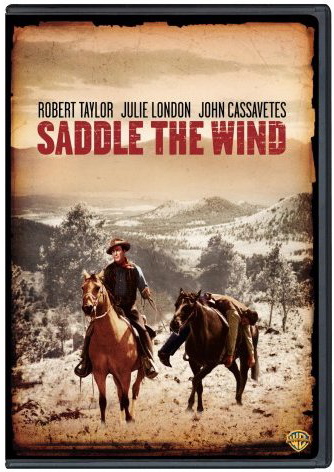
Saddle the Wind
The key to pulling off that transformation from Greek tragedy to the wild west is in the relationships. 'Saddle' has this in a quasi-love triangle between two brothers who own a ranch in a mountain valley and the saloon girl one of the brothers brings home to be his wife. It's the type of story that if you can't predict how it ends, you definitely have not seen enough movies or read enough books. Director Robert Parrish and writer Rod Serling of The Twilight Zone do just enough with the story though to make it different, including a twist on the ending you can see coming a mile off.
In a lush, green mountain valley, two ranch owners live peacefully, Dennis Deneen (Donald Crisp), a grizzled old rancher who has come to despise violence and everything it brings, and Steve Sinclair (Robert Taylor), a reformed gunfighter trying to move on from his checkered, bloody past. Coming back from selling part of their herd, Steve's younger brother Tony (John Cassavetes) returns home with a fiance in tow, a saloon girl, Joan Blake (Julie London) who supposedly sees a better life than she's used to. Tony has also purchased a new pistol with a hair-trigger to boot.
Everything seems fine at the Sinclair's Double S ranch but in the span of a few days, two people arrive in town, both causing trouble in their own way. There's Larry Venables (Charles McGraw), a gunslinger as fast as Steve's ever seen gunning for the older Sinclair, and Clay Ellison (Royal Dano), a former Union soldier who says part of the valley rightfully belongs to him. Steve is forced to deal not only with these two problems, but also from Deneen and then his hot-tempered younger brother.
The family conflict comes across as authentic with a nice dynamic between Taylor and Cassavetes. Steve grew up caring for his younger brother, who in the process started to idolize his gunfighting older brother and now that he's full grown, he intends to be just as fast with a six-gun as Steve. Tony's intentions are good, he just wants to protect his brother (who doesn't wear a gun now), but caught up in the moment, a new side of him is revealed. Thrown into the mix is London's saloon girl who quickly sees maybe she didn't make a wise decision siding with fiery Tony.
Except for his lead role in Bataan, I've never been a huge fan of Taylor. He comes across as too wooden sometimes, but his role as Steve is the best I've seen yet. The reformed gunslinger is nothing new in a western, but Taylor brings humanity to the part as a man who genuinely regrets his past actions. As for Tony, who better to play hot-tempered, quick on the trigger brother than Cassavetes? Bordering on the obsessed with his drive, Cassavetes is the anger to Taylor's calm. London plays a strong woman, too often left behind in westerns, and even gets to serenade Cassavetes in an awkward, out of place scene.
There aren't any true villains here, but McGraw and Dano at least provide the lighter fluid for this fire. Gravelly voiced McGraw is intimidating and gruff as the new gunslinger in town and Dano as the beaten-down farmer looking to make something for his family provide strong support. Crisp makes the most of his part as the stodgy old ranch owner while recognizable character actors Richard Erdman, Ray Teal, and Douglas Spencer round out the supporting cast.
As is the case with the more story-oriented westerns, the action/gunplay is left by the wayside for most of the movie. Two gunfights are high on tension, but they're over in the blink of an eye, and the final shootout isn't much of a shootout at all. This isn't a complaint, I just felt the need to point it out so anyone watching the movie isn't expecting 100 minutes of western shootouts. It's a well-told story though with believable characters and good performances from Taylor, Cassavetes, and London. I couldn't find a trailer, but here's two scenes from later in the movie with semi-SPOILERS, one and two.
Saddle the Wind (1958): ***/****
Wednesday, January 28, 2009
Netflix Review 2: Hang 'Em High
After the huge success of Sergio Leone's Dollars trilogy, Clint Eastwood returned to the US and quickly made an American western, Hang 'Em High, that bears quite a resemblance to the basic style of the spaghetti westerns. I've avoided watching Hang 'Em High for years for a couple reasons, I always figured it could never live up to the Dollars movies, and reviews were always mixed. While I enjoyed the movie, my worries were pretty dead on. It was an average western that would not be remembered if Eastwood wasn't starring.
Eastwood is Jed Cooper, a small rancher who has recently bought 100 head of cattle. As he's driving the herd home, Cooper is stopped by a nine-man posse who say he stole the cattle and murdered the rancher even though he's got a bill of sale. They string Cooper up and leave without making sure he's dead. A marshal happens to be riding by and cuts the man down before he dies. After his innocence is proved, Cooper takes a job as a marshal in the Oklahoma territory and starts to hunt the men down one-by-one.
Very much influenced by spaghetti westerns, this movie just doesn't live up to what it could have been. Looking at the cast, I was blown away by all the names, but I guess I should have learned by now. Big cast full of big names: characters aren't developed much at all. Ed Begley plays Capt. Wilson, the leader of the posse who is terrified of Cooper's revenge, but he basically disappears for huge chunks of the movie. Inger Stevens is the obligatory love interest, a woman with a past who's also looking for revenge. Stevens is gorgeous, but her part is as bland as they come.
The rest of the posse is similarly underwhelming despite some big names including L.Q. Jones, Bruce Dern, Alan Hale JR, and Bob Steele. These parts could have been great, add Strother Martin, Dub Taylor, and Warren Oates and you've got a perfect posse.
Three parts, along with Eastwood, stand out. Pat Hingle, always a good slimy villain, is an ideal counterpart to Cooper as Judge Fenton, a power-hungry official who wants statehood for the territory no matter what he has to do. He becomes so obsessed with justice you're not sure if his mind is all there. Ben Johnson, a real-life cowboy, makes a brief appearace as Dave Bliss, the marshal that rescues Cooper. Just by being in the movie, Johnson gives it credibility. Gravelly-voiced Charles McGraw plays Sheriff Ray Calhoun, a peace officer who may be working both sides.
But that's just three supporting roles, Dennis Hopper makes a bizarre one-scene cameo as the Prophet, a crazed, bearded prisoner, and James MacArthur shows up to lead a crowd in prayer at a hanging as the Preacher. It's just all too weird. The movie tries too hard to be a great western. The music is overdone and loud, although some good parts sound like Morricone's soundtracks, but it takes away from the movie overall.
The DVD is cheap with a somewhat grainy widescreen presentation and a trailer I've included the link for that's pretty revealing. Don't watch it if you haven't seen the movie. Overall, I was disappointed with this 1968 western, but there's enough to recommend, especially Eastwood, Hingle, and Ben Johnson.
Hang 'Em High (1968): **/****
Subscribe to:
Posts (Atom)