Ah, the gimmick. When it works, it can be great. When it doesn't, that blasted thing can ruin an entire movie single-handed. I was skeptical of the gimmick/premise from 1989's See No Evil, Hear No Evil, but the talent involved was too much to pass up. And throwing in that I've never heard of the movie and never heard anyone talk about it, I went in with a clean slate.
Running his newstand in a downtown NYC skyscraper, Dave Lyons (Gene Wilder) goes about his day-to-day work like nothing's going on. Well, there is. He's deaf, but Dave is pretty smooth as long as he can read the person's lips he's talking to. One day, he hires Wally Karew (Richard Pryor), the two having some struggle communicating almost immediately. Why exactly? Wally is blind. How can they make it work? They do, finding a way and a rhythm, but it is relatively short-lived. One morning, a man walks in demanding to see Karew but before anything can be resolved....the man is shot. Dave never gets a good look at the killer -- only seeing her legs as she walks away -- while Wally only smells her perfume as she walks away scot-free. That's one problem but just the start. The police walk in to find Dave and Wally perched over the body. They're suspects No. 1 and No. 2.
Okay, about that gimmick thing. There's more than one. A couple actually in this Arthur Hiller-directed comedy. In the third of four pairings between Pryor and Wilder, the laughs are there from beginning to end in a 103-minute movie. Critics ripped it apart pretty good for those gimmicks. One works better than the other. The one that doesn't? A blind guy who's good friends with a deaf guy sounds almost sophomoric, but nope, that works. What doesn't work is the pretty forced, overdone way to get the duo into some kooky situations. The murder isn't even the dumb part, but what comes after it. None of it is a deal-breaker, but you can't help but shake your head at it at times, especially the MacGuffin that ties it all together.
It isn't something that kills the movie because, well, because Richard Pryor and Gene Wilder are a comedy match made in heaven. Having already worked together on Silver Streak and Stir Crazy, they team up again here with similarly successful results. Say what you want about the movie itself, but their on-screen chemistry and banter are above any criticism. Like the best comedy teams from Laurel and Hardy to The Three Stooges, the Marx Brothers, Abbott and Costello to Dean Martin and Jerry Lewis, chemistry is key above it all. They make it look easy scene-in and scene-out, raising the sometimes forced story above its average roots. No matter how goofy or downright stupid the story is, it's fun to watch this duo do their thing.
Simply put, Pryor and Wilder commit to the gimmick, a blind man and a deaf man forced to work together. It works because it is simple. Pryor's Wally can't see, liking to pretend he can. Wilder's Dave can't hear, but he's an expert at lip-reading (except for some tough sound-alikes). There are too many great little set pieces and running jokes to even mention, but here's a few. Drinking at a bar, they get into a fistfight, the blind man punching while the deaf man calls out where to punch as if it was a clock. My favorite has the duo arrested and taking mug shots. Dave can't see the photographer's face (so he can't hear her), requiring Wally to tell him what to do, but he can't see that Dave isn't in the right position. Watch it HERE. Just more proof you don't need something big and obvious and over the top to be funny. Sometimes it's the littlest things that produce the biggest laughs. I don't want to spoil too many of the best bits, but know this. It's genuinely funny. I laughed out loud throughout, and hopefully you will too.
You don't really need too much else in the cast department, but there's some other parts worth mentioning. The beautiful Joan Severance plays Eve, the real killer who's working with her partner, Kirgo, played by Kevin Spacey sporting a well-manicured pencil mustache and a British accent. Both of them are working for a mysterious man, Sutherland (Anthony Zerbe), who has a twist/surprise of his own in the final act. Alan North and Louis Giambalvo play two NYC detectives forced to deal with our blind/deaf duo and progressively losing it while Kirsten Childs plays Wally's sister, Adele, brought into the craziness.
Downright dumb at times with plenty of laughs. You wouldn't expect anything else from a comedy starring Richard Pryor and Gene Wilder. Turn off your brain for a couple hours and sit back and enjoy the laughs.
See No Evil, Hear No Evil (1989): ***/****
The Sons of Katie Elder
"First, we reunite, then find Ma and Pa's killer...then read some reviews."
Showing posts with label Anthony Zerbe. Show all posts
Friday, June 6, 2014
Friday, April 18, 2014
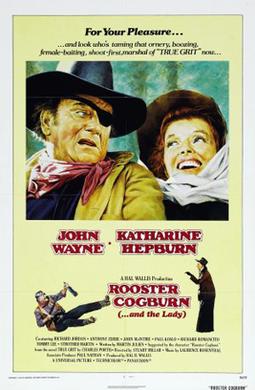
Rooster Cogburn
By the 1970s, there weren't too many bigger and better Hollywood legends than John Wayne and Katharine Hepburn. Both stars had been just that, stars, non-stop since the 1930s and by the mid 1970s were in the later parts of their careers. But even with all those classics films, classic roles and interesting pairings of stars, the duo had never worked together...until 1975's Rooster Cogburn, also known as Rooster Cogburn...and the Lady.
Still working as a U.S. Marshal, Rooster Cogburn (Wayne) is up to his old tricks again. Not too interested in how the law says he should bring suspects in, Cogburn has been suspended for his overzealous ways...for now. He's given his badge and title back if he promises to bring in a dangerous gang of killers led by a maniacal outlaw, Hawk (Richard Jordan). The outlaw's gang murdered an army convoy carrying nitroglycerin, shipments of rifles and a Gatling gun. Their goal? Knock off a federal depository up in the mountains. Cogburn is on their trail quickly, but he's got a problem. In Hawk's wake, the marshal finds an older woman, a missionary of sorts, Eula Goodnight (Hepburn), who saw her father and his mission almost wiped out by the gang. Cogburn hopes to bring her back to safety, but Eula has other plans. She intends to go with, helping bring her father's killers to justice.
I'm usually completely against sequels, especially when the first movie wraps up everything so nicely. That's the case with 1969's True Grit, a western that brought Wayne his only Oscar win for a long, distinguished career. It isn't a great western, but it has stood the test of time because of Wayne's scene-stealing part as Marshal Rooster Cogburn. This 1975 follow-up from director Stuart Millar takes the formula and takes it a step forward, pairing Wayne with Hepburn in a similarly scene-stealing part. Much the same way 'Grit' resonates, so does 'Rooster.' It's typical of many other late Wayne entries, straightforward and entertaining, likable, fun good guys versus dastardly bad guys, and just a lot of fun throughout. Laurence Rosenthal's score is solid, tweaking Elmer Bernstein's score from the original. Listen HERE for the theme. The Oregon locations go a long way too, the backgrounds for the shots providing a stunningly good-looking backdrop to the story.
Who are we kidding though? This is a movie that exists solely to put John Wayne and Katharine Hepburn together. The wait was worth it, the two Hollywood legends stepping to the plate in a big way. They make it look effortless. We learn some more about Rooster (including his first name), but he's still the same fat, one-eyed marshal who likes a good drink and is a tough as nails peace officer. Hepburn is not quite a spinster, but an older woman who looks to religion for answers, nagging Rooster about his drinking, his language, his boasting, a little bit of everything. The chemistry is on display from their first scene until the final scene. They argue, they bond, they talk about their pasts, finding there's plenty of differences between them, but there's also more similarities than they would have originally thought. Along for the trip is Wolf (Richard Romancito), an Indian boy in his teenage years, a capable rider who looks up to Rooster.
If you're going to have a great hero to lead the way, you need an equally bad villain to put in his way. In steps Richard Jordan, an underrated actor who never became a huge star. His Hawk is beyond intense, his upcoming robbery of a gold depository becoming almost an obsession. In some nice touches with Hawk and his gang, we learn about some past meetings with Cogburn. In his gang, look for Anthony Zerbe as Breed, a tracker/scout who used to ride with Rooster, now on the outlaw trail, and Hawk's maligned right-hand man, Luke, played by 1970s tough guy Paul Koslo. John McIntire makes a quick but memorable appearance as Judge Parker, the court representative who always has to deal with Rooster. Strother Martin hams it up in a one-scene appearance as McCoy, a cantankerous veteran of the sea now renting his raft for river crossings.
Heading into this movie, if you're looking for any sort of groundbreaking western, you're going to be disappointed. The focus is clearly on Wayne and Hepburn, the highpoints their scenes sitting around a campfire, talking while riding on a wagon, moving along the trail. The potential was there for a darker western with more shoot 'em up and gunplay, but for the most part Jordan as Hawk is underused. This is a good, old-fashioned western that plays like comfort food. Just sit back and enjoy this one.
Rooster Cogburn (1975): ***/****
Still working as a U.S. Marshal, Rooster Cogburn (Wayne) is up to his old tricks again. Not too interested in how the law says he should bring suspects in, Cogburn has been suspended for his overzealous ways...for now. He's given his badge and title back if he promises to bring in a dangerous gang of killers led by a maniacal outlaw, Hawk (Richard Jordan). The outlaw's gang murdered an army convoy carrying nitroglycerin, shipments of rifles and a Gatling gun. Their goal? Knock off a federal depository up in the mountains. Cogburn is on their trail quickly, but he's got a problem. In Hawk's wake, the marshal finds an older woman, a missionary of sorts, Eula Goodnight (Hepburn), who saw her father and his mission almost wiped out by the gang. Cogburn hopes to bring her back to safety, but Eula has other plans. She intends to go with, helping bring her father's killers to justice.
I'm usually completely against sequels, especially when the first movie wraps up everything so nicely. That's the case with 1969's True Grit, a western that brought Wayne his only Oscar win for a long, distinguished career. It isn't a great western, but it has stood the test of time because of Wayne's scene-stealing part as Marshal Rooster Cogburn. This 1975 follow-up from director Stuart Millar takes the formula and takes it a step forward, pairing Wayne with Hepburn in a similarly scene-stealing part. Much the same way 'Grit' resonates, so does 'Rooster.' It's typical of many other late Wayne entries, straightforward and entertaining, likable, fun good guys versus dastardly bad guys, and just a lot of fun throughout. Laurence Rosenthal's score is solid, tweaking Elmer Bernstein's score from the original. Listen HERE for the theme. The Oregon locations go a long way too, the backgrounds for the shots providing a stunningly good-looking backdrop to the story.
Who are we kidding though? This is a movie that exists solely to put John Wayne and Katharine Hepburn together. The wait was worth it, the two Hollywood legends stepping to the plate in a big way. They make it look effortless. We learn some more about Rooster (including his first name), but he's still the same fat, one-eyed marshal who likes a good drink and is a tough as nails peace officer. Hepburn is not quite a spinster, but an older woman who looks to religion for answers, nagging Rooster about his drinking, his language, his boasting, a little bit of everything. The chemistry is on display from their first scene until the final scene. They argue, they bond, they talk about their pasts, finding there's plenty of differences between them, but there's also more similarities than they would have originally thought. Along for the trip is Wolf (Richard Romancito), an Indian boy in his teenage years, a capable rider who looks up to Rooster.
If you're going to have a great hero to lead the way, you need an equally bad villain to put in his way. In steps Richard Jordan, an underrated actor who never became a huge star. His Hawk is beyond intense, his upcoming robbery of a gold depository becoming almost an obsession. In some nice touches with Hawk and his gang, we learn about some past meetings with Cogburn. In his gang, look for Anthony Zerbe as Breed, a tracker/scout who used to ride with Rooster, now on the outlaw trail, and Hawk's maligned right-hand man, Luke, played by 1970s tough guy Paul Koslo. John McIntire makes a quick but memorable appearance as Judge Parker, the court representative who always has to deal with Rooster. Strother Martin hams it up in a one-scene appearance as McCoy, a cantankerous veteran of the sea now renting his raft for river crossings.
Heading into this movie, if you're looking for any sort of groundbreaking western, you're going to be disappointed. The focus is clearly on Wayne and Hepburn, the highpoints their scenes sitting around a campfire, talking while riding on a wagon, moving along the trail. The potential was there for a darker western with more shoot 'em up and gunplay, but for the most part Jordan as Hawk is underused. This is a good, old-fashioned western that plays like comfort food. Just sit back and enjoy this one.
Rooster Cogburn (1975): ***/****
Friday, January 3, 2014
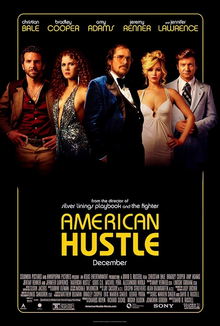
American Hustle
Although he worked semi-regularly in Hollywood since the late 1990s, director David O. Russell has definitely put his name on the map over the last few years, starting with 2010's The Fighter. He followed it up with the halfway decent Silver Linings Playbook, picking up an Oscar nomination while not winning, and if the buzz is right, he'll pick up another nomination for 2013's American Hustle. Will he? Will he win this time around? Only time will tell.
A self-made businessman, Irving Rosenfeld (Christian Bale) owns a string of dry cleaners in New Jersey, but that's just a front for his far more lucrative job. Working as a con artist, he sells forged art, pulls shady deals, but mostly he embezzles money from desperate men who can't do a thing because they're so desperate when they realize they've been fleeced. One day at a Christmas party he meets Sydney (Amy Adams), a goal-oriented young woman without the means to reach those goals. Polar opposites, they hit it off immediately, Sydney becoming an involved part of Irving's running cons, the money rolling in in piles. Well, it does for quite awhile at least. They've caught the eye of an FBI agent, Richie DiMaso (Bradley Cooper), who rather than have them serve a jail sentence, enlists them in helping him run his own operation, taking down corrupt politicians looking to take bribes. Irving and Sydney know the plan isn't so simple, but they're left with no other alternatives. None of them know how far this plan could really go.
Two things came to mind when watching this Russell-directed flick, working off a script written by Russell and Eric Singer. One, it pays tributes to films like it from the past, embracing a throwback, retro style that plays well from the opening credits. Those credits are the old studio credits that a movie from the 1970s would have used, not the polished ones greeting audiences now in 2013. The style is everywhere, the big hair, the ridiculously awesome-looking suits as style changed in a big way between the 1970s and 1980s, the giant, spacious cars, the great soundtrack featuring everything from folk rock to soft jazz and everything in between, just the general look of 'Hustle.' It's like a modern period piece, if a quick trip to the past in the 70s/80s. It feels like we're in that fun to watch, visual and a very fun trip in a time capsule. Russell clearly spared no expense, and it shows, the atmosphere, the look (even in the background) all adding another layer to the story.
As for that second thing, it's the casting, a very talented cast from top to bottom. Having worked with Russell last year in 'Playbook,' both Bradley Cooper and Jennifer Lawrence return here, both of them leaving their mark. Lawrence plays Irving's wife, Rosalyn, more than a little kooky in her conversations, beliefs and generally....yeah, everything she does. With Adams (vamping it up), Bale (chubbing it up), Lawrence (crazying it up) and Cooper (perming it up with an awesome hairdo), you've got an ensemble that should be able to carry any and all movies. And don't be fooled, this is the definition of an ensemble cast. Each of those actors are more than capable of carrying a movie on their shoulders, and they have so seeing their ample talents together in a single movie, it's a treat. Oh, and there's more. Also look for Jeremy Renner, comedian Louis C.K., Michael Pena, Shea Whigham, Anthony Zerbe, Elisabeth Rohm, Jack Huston, Alessandro Nivola and some actor named Robert De Niro appearing in a brutally efficient, uncredited one-scene cameo. Yeah, I guess that's a decent cast.
Heading into this movie, I had a general idea of what the story was about, an ever-moving story based somewhat loosely on a true story, dubbed Abscam. I don't want to give too much away, Russell's film covering a ton of ground in its 138-minute running time. It is a smart, well-written script that gives the cast a chance to show off their talents. Why does it work so well? It's simple; that story. Too often movies have to be about a gimmick, a message, about explosions, violence or sex. 'Hustle' instead chooses to focus on a crazy situation that keeps on getting crazy, all the cast getting their opportunities to step into the spotlight. It was refreshing to see a movie that's content to be just that; a good movie. The humor is never overdone, and there's a lot of it. I was surprised how funny the movie actually is, one laugh after another as this blackmail/entrapment scheme gets more and more complicated.
I can't pinpoint a weak acting performance in Russell's film, but for me, it's more than easy to identity the strongest performance here, and that goes to Christian Bale. Having already won a Best Supporting Actor Oscar for his part in Russell's The Fighter (also co-starring Adams), Bale leaves another lasting impression with his most recent part. First of all, physically he put on a fair amount of weight, giving himself a nice little gut, while also favoring a truly amazing combover. In a weird way, Bale just commits to his Irving's goofy, gentlemanly style, but it's more than that. He makes Irving a real flesh and blood character, and oddly enough, one of the more sympathetic characters around because he's such an accomplished con man. Backed into a corner, Irving is worrying about maybe 13 different plates spinning all around him, also planning 15 or 16 moves ahead so he's always in control, even if it doesn't seem that way. It isn't necessarily a showy role, but that's what I liked it. Subtle in his delivery, letting his physical appearance add some laughs. It could be a busy Oscar season, but I'm betting money that Bale gets a Best Acting nomination. I hope he does.
If there is a weakness, it's that Russell's film covers so much ground with so many characters that by the end, it drags in parts. They all know what the ending will be, what it will offer and how it affects all the characters, but there are stretches getting to that point that slow things down needlessly. By no means is any of that complaint a dealbreaker. 'Hustle' is still an incredibly easy film to recommend. Could it use some tightening up? Probably, but you'll no doubt enjoy this one. Lots of talent, lots of fun.
American Hustle (2013): ***/****
A self-made businessman, Irving Rosenfeld (Christian Bale) owns a string of dry cleaners in New Jersey, but that's just a front for his far more lucrative job. Working as a con artist, he sells forged art, pulls shady deals, but mostly he embezzles money from desperate men who can't do a thing because they're so desperate when they realize they've been fleeced. One day at a Christmas party he meets Sydney (Amy Adams), a goal-oriented young woman without the means to reach those goals. Polar opposites, they hit it off immediately, Sydney becoming an involved part of Irving's running cons, the money rolling in in piles. Well, it does for quite awhile at least. They've caught the eye of an FBI agent, Richie DiMaso (Bradley Cooper), who rather than have them serve a jail sentence, enlists them in helping him run his own operation, taking down corrupt politicians looking to take bribes. Irving and Sydney know the plan isn't so simple, but they're left with no other alternatives. None of them know how far this plan could really go.
Two things came to mind when watching this Russell-directed flick, working off a script written by Russell and Eric Singer. One, it pays tributes to films like it from the past, embracing a throwback, retro style that plays well from the opening credits. Those credits are the old studio credits that a movie from the 1970s would have used, not the polished ones greeting audiences now in 2013. The style is everywhere, the big hair, the ridiculously awesome-looking suits as style changed in a big way between the 1970s and 1980s, the giant, spacious cars, the great soundtrack featuring everything from folk rock to soft jazz and everything in between, just the general look of 'Hustle.' It's like a modern period piece, if a quick trip to the past in the 70s/80s. It feels like we're in that fun to watch, visual and a very fun trip in a time capsule. Russell clearly spared no expense, and it shows, the atmosphere, the look (even in the background) all adding another layer to the story.
As for that second thing, it's the casting, a very talented cast from top to bottom. Having worked with Russell last year in 'Playbook,' both Bradley Cooper and Jennifer Lawrence return here, both of them leaving their mark. Lawrence plays Irving's wife, Rosalyn, more than a little kooky in her conversations, beliefs and generally....yeah, everything she does. With Adams (vamping it up), Bale (chubbing it up), Lawrence (crazying it up) and Cooper (perming it up with an awesome hairdo), you've got an ensemble that should be able to carry any and all movies. And don't be fooled, this is the definition of an ensemble cast. Each of those actors are more than capable of carrying a movie on their shoulders, and they have so seeing their ample talents together in a single movie, it's a treat. Oh, and there's more. Also look for Jeremy Renner, comedian Louis C.K., Michael Pena, Shea Whigham, Anthony Zerbe, Elisabeth Rohm, Jack Huston, Alessandro Nivola and some actor named Robert De Niro appearing in a brutally efficient, uncredited one-scene cameo. Yeah, I guess that's a decent cast.
Heading into this movie, I had a general idea of what the story was about, an ever-moving story based somewhat loosely on a true story, dubbed Abscam. I don't want to give too much away, Russell's film covering a ton of ground in its 138-minute running time. It is a smart, well-written script that gives the cast a chance to show off their talents. Why does it work so well? It's simple; that story. Too often movies have to be about a gimmick, a message, about explosions, violence or sex. 'Hustle' instead chooses to focus on a crazy situation that keeps on getting crazy, all the cast getting their opportunities to step into the spotlight. It was refreshing to see a movie that's content to be just that; a good movie. The humor is never overdone, and there's a lot of it. I was surprised how funny the movie actually is, one laugh after another as this blackmail/entrapment scheme gets more and more complicated.
I can't pinpoint a weak acting performance in Russell's film, but for me, it's more than easy to identity the strongest performance here, and that goes to Christian Bale. Having already won a Best Supporting Actor Oscar for his part in Russell's The Fighter (also co-starring Adams), Bale leaves another lasting impression with his most recent part. First of all, physically he put on a fair amount of weight, giving himself a nice little gut, while also favoring a truly amazing combover. In a weird way, Bale just commits to his Irving's goofy, gentlemanly style, but it's more than that. He makes Irving a real flesh and blood character, and oddly enough, one of the more sympathetic characters around because he's such an accomplished con man. Backed into a corner, Irving is worrying about maybe 13 different plates spinning all around him, also planning 15 or 16 moves ahead so he's always in control, even if it doesn't seem that way. It isn't necessarily a showy role, but that's what I liked it. Subtle in his delivery, letting his physical appearance add some laughs. It could be a busy Oscar season, but I'm betting money that Bale gets a Best Acting nomination. I hope he does.
If there is a weakness, it's that Russell's film covers so much ground with so many characters that by the end, it drags in parts. They all know what the ending will be, what it will offer and how it affects all the characters, but there are stretches getting to that point that slow things down needlessly. By no means is any of that complaint a dealbreaker. 'Hustle' is still an incredibly easy film to recommend. Could it use some tightening up? Probably, but you'll no doubt enjoy this one. Lots of talent, lots of fun.
American Hustle (2013): ***/****
Thursday, June 21, 2012
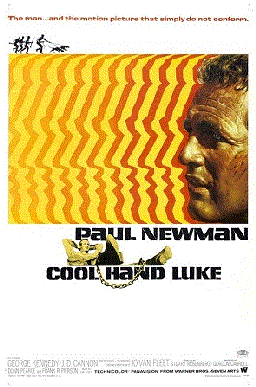
Cool Hand Luke
Heroes are supposed to be noble, loyal, honor-bound and always do what's right. But in the 1960s and its increased cynicism from the audience, was that concept of a hero really going to fly? The idea of an anti-hero started popping up in the 1950s thanks to James Dean and Marlon Brando among others, but for me, the one that kicked the door open in the 1960s was Paul Newman in 1967's Cool Hand Luke.
Having taken the heads off of a long row of parking meters, a drunken Lucas Jackson (Newman) is arrested and sentenced to a two-year sentence on a chain gang in Florida. He meets the Captain (Strother Martin) and his bevy of guards who keep their prison camp roster of 50 prisoners busy on the roads six days a week, but this camp has had nothing like Luke. Easy going enough early on in his sentence, he begins to bristle at being imprisoned, at being told what he's supposed to do. He becomes a hero to his other prisoners, forming a friendship with head honcho, Dragline (George Kennedy), but Luke can only take being held down for so long, and he wants out now.
Paul Newman is one of my all-time favorites, and this is HIS iconic part. Butch Cassidy, The Hustler, The Sting, and many others, all memorable roles, but nothing quite like this one. Want a face for a 1960s audience looking for something different? In steps Lucas Jackson, a man who has little regard for what society says he should do with his life, even less regard for any sort of authority hovering over him. Newman makes Luke -- dubbed 'Cool Hand' for a bluff in poker -- a charming, likable individual, his easy-going, natural smile disarming you in a second. We learn a lot about this character with little background (a veteran, countless jobs, a drifter), finding out that no one and no thing will slow him down. He will do things on his terms, and anyone else can be damned. Newman at his best.
With Newman's Oscar-nominated part at the head, 'Cool' has become one of the seminal movies of the late 1960s, ranking up there with The Wild Bunch, The Graduate, Bonnie and Clyde and several others I'm missing. This is a movie made for a late 1960s audience that isn't content with the status quo. No respect for authority or the so-called 'system'? Check. An anti-hero that wants to do things and live his life his way? Double check. The system are Martin's quiet but intense Captain, Boss Godfrey (Morgan Woodward), the silent guard who wears his ever-present aviator glasses, along with steely-eyed Luke Askew, Richard Donner and John McLiam. The system is the villain here, imprisoning and breaking the individual down to conform. It's easy to see the appeal in 1967, and just as easy to see now 45 years later in 2012. The thinker, the free spirit, the intelligent rebel, it's an appealing character and premise to root for.
Because Newman's performance is so strong at the top, another part of the film gets lost in the shuffle, and that's the ensemble cast all around him from Martin and Kennedy to the guards to the prisoners. Martin is perfect in his few scenes, including muttering the iconic 'What we have here is failure to communicate.' Kennedy won an Oscar for his part as Dragline, an illiterate but intelligent and fast-talking prisoner who all the other prisoners look up to. Newman and Kennedy play off each other impeccably, the subtle, underplayed Luke with the showier, aggressive and funny Dragline. Other prisoners include J.D. Cannon, Lou Antonio, Robert Drivas, Harry Dean Stanton, Dennis Hopper, Wayne Rogers, Ralph Waite, Joe Don Baker, Dick Davalos and Buck Kartalian among others. Clifton James and Anthony Zerbe are good as prisoners turned associates who help the guards.
Like any movie that lives on so many years after its release, there's got to be something to make it memorable, and director Stuart Rosenberg doesn't disappoint. The most obvious is Luke stating he can eat 50 eggs in an hour, a classic sequence in its humor, but there's so much more. Luke singing Plastic Jesus -- watch HERE -- after receiving some distressing news is an all-time great. There's Luke earning everyone's respect in a brutal, knock-down boxing match (watch HERE), refusing to go down even when he's beat. There's a teenager washing a car, driving the on-looking prisoners wild (HERE), and up there with Plastic Jesus for the most moving scene, Luke talking with his dying mother, Arletta (Jo Van Fleet). Almost scene-to-scene is aided by composer Lalo Schifrin's amazingly spot-on music, especially the main theme which you can listen to HERE.
What struck me most in my latest viewing was the darkness of the story. The first hour is generally light-hearted, introducing characters, backgrounds and interactions, setting us up by liking Newman's Luke so much in spite of his bullheaded stubbornness. I'd forgotten then how intensely dark and at times uncomfortable the second half of the movie is. From the start, we know Luke is heading down a bad road, but that unbearable tension and impending sense of doom keeps building. The movie still has its lighter touches -- Luke's escapes provide some unlikely humor -- but there will not be a truly happy ending here. In the end though, one of the final shots shows that free spirits might not always win, but that also doesn't mean the system, authority and power positions will win either. The symbolism can be a little obvious, a little heavy-handed, but the message still strikes a chord.
A classic from beginning to end. End of story.
Cool Hand Luke <---trailer (1967): ****/****
Having taken the heads off of a long row of parking meters, a drunken Lucas Jackson (Newman) is arrested and sentenced to a two-year sentence on a chain gang in Florida. He meets the Captain (Strother Martin) and his bevy of guards who keep their prison camp roster of 50 prisoners busy on the roads six days a week, but this camp has had nothing like Luke. Easy going enough early on in his sentence, he begins to bristle at being imprisoned, at being told what he's supposed to do. He becomes a hero to his other prisoners, forming a friendship with head honcho, Dragline (George Kennedy), but Luke can only take being held down for so long, and he wants out now.
Paul Newman is one of my all-time favorites, and this is HIS iconic part. Butch Cassidy, The Hustler, The Sting, and many others, all memorable roles, but nothing quite like this one. Want a face for a 1960s audience looking for something different? In steps Lucas Jackson, a man who has little regard for what society says he should do with his life, even less regard for any sort of authority hovering over him. Newman makes Luke -- dubbed 'Cool Hand' for a bluff in poker -- a charming, likable individual, his easy-going, natural smile disarming you in a second. We learn a lot about this character with little background (a veteran, countless jobs, a drifter), finding out that no one and no thing will slow him down. He will do things on his terms, and anyone else can be damned. Newman at his best.
With Newman's Oscar-nominated part at the head, 'Cool' has become one of the seminal movies of the late 1960s, ranking up there with The Wild Bunch, The Graduate, Bonnie and Clyde and several others I'm missing. This is a movie made for a late 1960s audience that isn't content with the status quo. No respect for authority or the so-called 'system'? Check. An anti-hero that wants to do things and live his life his way? Double check. The system are Martin's quiet but intense Captain, Boss Godfrey (Morgan Woodward), the silent guard who wears his ever-present aviator glasses, along with steely-eyed Luke Askew, Richard Donner and John McLiam. The system is the villain here, imprisoning and breaking the individual down to conform. It's easy to see the appeal in 1967, and just as easy to see now 45 years later in 2012. The thinker, the free spirit, the intelligent rebel, it's an appealing character and premise to root for.
Because Newman's performance is so strong at the top, another part of the film gets lost in the shuffle, and that's the ensemble cast all around him from Martin and Kennedy to the guards to the prisoners. Martin is perfect in his few scenes, including muttering the iconic 'What we have here is failure to communicate.' Kennedy won an Oscar for his part as Dragline, an illiterate but intelligent and fast-talking prisoner who all the other prisoners look up to. Newman and Kennedy play off each other impeccably, the subtle, underplayed Luke with the showier, aggressive and funny Dragline. Other prisoners include J.D. Cannon, Lou Antonio, Robert Drivas, Harry Dean Stanton, Dennis Hopper, Wayne Rogers, Ralph Waite, Joe Don Baker, Dick Davalos and Buck Kartalian among others. Clifton James and Anthony Zerbe are good as prisoners turned associates who help the guards.
Like any movie that lives on so many years after its release, there's got to be something to make it memorable, and director Stuart Rosenberg doesn't disappoint. The most obvious is Luke stating he can eat 50 eggs in an hour, a classic sequence in its humor, but there's so much more. Luke singing Plastic Jesus -- watch HERE -- after receiving some distressing news is an all-time great. There's Luke earning everyone's respect in a brutal, knock-down boxing match (watch HERE), refusing to go down even when he's beat. There's a teenager washing a car, driving the on-looking prisoners wild (HERE), and up there with Plastic Jesus for the most moving scene, Luke talking with his dying mother, Arletta (Jo Van Fleet). Almost scene-to-scene is aided by composer Lalo Schifrin's amazingly spot-on music, especially the main theme which you can listen to HERE.
What struck me most in my latest viewing was the darkness of the story. The first hour is generally light-hearted, introducing characters, backgrounds and interactions, setting us up by liking Newman's Luke so much in spite of his bullheaded stubbornness. I'd forgotten then how intensely dark and at times uncomfortable the second half of the movie is. From the start, we know Luke is heading down a bad road, but that unbearable tension and impending sense of doom keeps building. The movie still has its lighter touches -- Luke's escapes provide some unlikely humor -- but there will not be a truly happy ending here. In the end though, one of the final shots shows that free spirits might not always win, but that also doesn't mean the system, authority and power positions will win either. The symbolism can be a little obvious, a little heavy-handed, but the message still strikes a chord.
A classic from beginning to end. End of story.
Cool Hand Luke <---trailer (1967): ****/****
Tuesday, December 14, 2010
The Life and Times of Judge Roy Bean
When people get more cynical, so do their movies. In the 1930s, westerns portrayed good guys wearing white hats and bad guys in black duds. By the time Clint Eastwood came along in the spaghetti westerns gunning down anything that would net him a buck, things were up for grabs. Then in the late 1960s and 1970s, somebody decided to put a new spin on the old west, stories that were more cynical in nature that attempted to show what the west was really like. Goodbye romantic, hello cynicism. Say howdy to the revisionist western.
If you look at the list of westerns included in the Wikipedia entry, there are some good entries, but for the most part I don't necessarily like revisionist westerns. They try much too hard to show you that what you've been watching all these years is garbage. Take 1972's The Life and Times of Judge Roy Bean, directed by one of my favorites, John Huston. In telling the story of real-life Roy Bean, this western blends some really awkward comedic moments, overlong sub-plots that go nowhere, some hypocritical views on just about everything (can't decide if that was intended), and in general a waste of a very strong cast.
Sometime around the turn of the century, "outlaw" Roy Bean (Paul Newman) rides into west Texas past the Pecos River, an area notorious for hiding bandits and criminals. At one saloon, they turn on him and leave him for dead only to have the wounded man come back and gun them all down. Disgusted by what he's seen, Bean sets up shop as a judge, administering his unique brand of justice to anyone and everyone looking for trouble. Word spreads and soon he even has deputies who help him out, all in the name of Texas and Lilly Langtry (Ava Gardner), a stage actress from the east, a woman Bean has always been in love with. But Bean's style of justice may catch up with him as civilization follows him around every corner, and his time may be running out.
I don't know where to start with this one because to be fair, Huston doesn't know where to start either. Roy Bean was a real-life judge in west Texas who ended up becoming a legendary figure after he died. So with this revisionist western instead of telling a story that showed what the actual man was like, Huston goes for the ridiculous legend. At a run-time of 120 minutes (a very long 120 minutes), 'Life' is all over the place with no sense of where it's going. The tone ranges from slapstick comedy that produces its fair share of groans -- it did from me at least -- to an oddly serious finale. It tries to be funny while also delivering a hacked up message about the changing times and the last few years of the wild west. Pick one or the other and go with it, but don't waver between the two.
A bright spot not surprisingly is Newman in the titular role, rising above materiel that at times is just beneath him. Newman's parts in the 1970s typically covered a wide variety of movies, and this surely doesn't disappoint. What works is that he commits so fully to this part. His beliefs are ridiculously hypocritical, and he'll string anyone up at the drop of a hat if he disagrees with what's been said or done. If you're loyal to him, he'll be loyal to you, but for heaven's sake don't turn on him. This isn't a part on par with his best performances like Butch Cassidy or Lucas Jackson, but it's a quality one. Even when the movie is dull to watch, it's worthwhile to check out Newman.
So with a story that is light on story and heavy on non-related vignettes, we get a chance to see a long list of actors play small parts (some being on-screen no more than a few seconds). Gardner makes an appearance in the movie's final scene in a moving scene that comes along a little too late. Anthony Perkins is a scene-stealer as a traveling preacher who realizes Newman's Bean may be a little off his rocker but doesn't want to get shot bringing the topic up. Ned Beatty, Matt Clark, Jim Burk, Bill McKinney, and Steve Kanaly are underused but all solid as Bean's loyal deputies. Also watch for Victoria Principal, Tab Hunter, Huston as a grizzled old mountain man, Stacy Keach as an albino gunman, Roddy McDowall, Anthony Zerbe, and Jacqueline Bisset in parts that range from bad to good, your decision on where they fall.
I will give Huston credit for trying new things. Early on, we get narration from Perkins and Hunter, but instead of just hearing it, the camera is placed right in front of them as they ride into town. They're looking right at the audience, addressing us in a cool change of pace, a unique little technique. But then the narration resorts to been there, done that voiceovers. It's just an odd movie overall, one with plenty of flaws but enough positives to give it a mild recommendation.
The Life and Times of Judge Roy Bean <---trailer (1972): **/****
If you look at the list of westerns included in the Wikipedia entry, there are some good entries, but for the most part I don't necessarily like revisionist westerns. They try much too hard to show you that what you've been watching all these years is garbage. Take 1972's The Life and Times of Judge Roy Bean, directed by one of my favorites, John Huston. In telling the story of real-life Roy Bean, this western blends some really awkward comedic moments, overlong sub-plots that go nowhere, some hypocritical views on just about everything (can't decide if that was intended), and in general a waste of a very strong cast.
Sometime around the turn of the century, "outlaw" Roy Bean (Paul Newman) rides into west Texas past the Pecos River, an area notorious for hiding bandits and criminals. At one saloon, they turn on him and leave him for dead only to have the wounded man come back and gun them all down. Disgusted by what he's seen, Bean sets up shop as a judge, administering his unique brand of justice to anyone and everyone looking for trouble. Word spreads and soon he even has deputies who help him out, all in the name of Texas and Lilly Langtry (Ava Gardner), a stage actress from the east, a woman Bean has always been in love with. But Bean's style of justice may catch up with him as civilization follows him around every corner, and his time may be running out.
I don't know where to start with this one because to be fair, Huston doesn't know where to start either. Roy Bean was a real-life judge in west Texas who ended up becoming a legendary figure after he died. So with this revisionist western instead of telling a story that showed what the actual man was like, Huston goes for the ridiculous legend. At a run-time of 120 minutes (a very long 120 minutes), 'Life' is all over the place with no sense of where it's going. The tone ranges from slapstick comedy that produces its fair share of groans -- it did from me at least -- to an oddly serious finale. It tries to be funny while also delivering a hacked up message about the changing times and the last few years of the wild west. Pick one or the other and go with it, but don't waver between the two.
A bright spot not surprisingly is Newman in the titular role, rising above materiel that at times is just beneath him. Newman's parts in the 1970s typically covered a wide variety of movies, and this surely doesn't disappoint. What works is that he commits so fully to this part. His beliefs are ridiculously hypocritical, and he'll string anyone up at the drop of a hat if he disagrees with what's been said or done. If you're loyal to him, he'll be loyal to you, but for heaven's sake don't turn on him. This isn't a part on par with his best performances like Butch Cassidy or Lucas Jackson, but it's a quality one. Even when the movie is dull to watch, it's worthwhile to check out Newman.
So with a story that is light on story and heavy on non-related vignettes, we get a chance to see a long list of actors play small parts (some being on-screen no more than a few seconds). Gardner makes an appearance in the movie's final scene in a moving scene that comes along a little too late. Anthony Perkins is a scene-stealer as a traveling preacher who realizes Newman's Bean may be a little off his rocker but doesn't want to get shot bringing the topic up. Ned Beatty, Matt Clark, Jim Burk, Bill McKinney, and Steve Kanaly are underused but all solid as Bean's loyal deputies. Also watch for Victoria Principal, Tab Hunter, Huston as a grizzled old mountain man, Stacy Keach as an albino gunman, Roddy McDowall, Anthony Zerbe, and Jacqueline Bisset in parts that range from bad to good, your decision on where they fall.
I will give Huston credit for trying new things. Early on, we get narration from Perkins and Hunter, but instead of just hearing it, the camera is placed right in front of them as they ride into town. They're looking right at the audience, addressing us in a cool change of pace, a unique little technique. But then the narration resorts to been there, done that voiceovers. It's just an odd movie overall, one with plenty of flaws but enough positives to give it a mild recommendation.
The Life and Times of Judge Roy Bean <---trailer (1972): **/****
Saturday, December 4, 2010
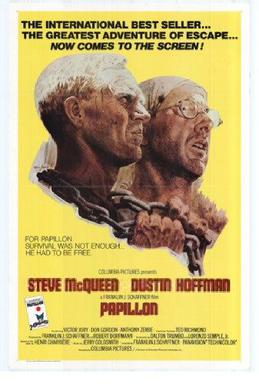
Papillon
I think it's a ridiculous claim for all three stars, especially McQueen. When I've talked to people who think he wasn't much of an actor -- more of a presence than anything -- the first movie I usually bring up is 1973's Papillon (with The Sand Pebbles close behind). Based on the real-life exploits of Henri Charriere, the deeply brooding, incredibly dark movie gives McQueen a chance to get deep into his own personal demons in a performance that you can't take your eyes off of. There are extended scenes and sequences that could serve as an example of how to dominate a movie doing very little at all. It is by no means an easy movie to sit through, one that makes you incredibly uncomfortable at times, but one worth watching.
Convicted in a French court for the murder of a pimp, Frenchman Henri Charriere (McQueen) is sentenced to life in prison in the French Guiana prison system in South America, a notorious system where diseases, horrific conditions, sadistic guards, and a short life expectancy await him. Aboard the ship bound for the prison, Henri -- known as Papillon because of the butterfly tattoo on his chest -- meets Louis Dega (Dustin Hoffman), a fellow Frenchman and an infamous forger responsible for thousands of families losing their life savings. For a price, Papillon offers to serve as Dega's bodyguard because the little forger is a target for his money. The two form an unlikely friendship as they near French Guiana, but no matter what awaits them, Papillon -- still claiming his innocence -- has no intention of staying long. Escape is on his mind, and no matter what the system does to him, he intends to make it out.
Charriere's autobiography is an extremely difficult book to read (I've tried twice and gotten no further than 100 pages) so formerly blacklisted screenwriter Dalton Trumbo has his work cut out for him. With a movie that clocks in at 151 minutes, his screenplay gets a chance to breathe. It is still at times a frustrating movie because not everything is spelled out for us as viewers. There are jumps in story, characters drift in and out, and over a decade has to be covered in the two and a half hours. But it's all part of the package here with a finished movie that leaves you wanting more. It is an eerily beautiful movie through all its depictions of what the human body and mind can survive when pushed to its absolute limit.
Up to this point in his career, McQueen had made a name for himself by playing the loner, the rebel, the anti-hero so it isn't a stretch for him to play a convicted murderer desperately trying to escape prison. But that's too simplistic a description because this performance is so much more. Charriere is a French safecracker who acquired a reputation in the Paris underworld as a man who could be trusted. As he prepares for this new phase in his life though, he not only looks ahead in preparation for awaits him but what he's leaving behind. Two quick dream sequences -- incredibly moody, unsettling scenes -- show a man who regrets how he got to this point, including one perfect line reading when a court says he's been found guilty of a wasted life. Watch it HERE. McQueen's face drops, knowing the statement is true, and says softly 'Guilty.'
While his whole performance is worth watching and recommending over and over again, one specific scene comes to mind. Captured after a failed escape attempt, Papillon is sentenced to two years in solitary confinement. Watch part of it HERE. From 5:25 on, watch a true actor do his job as good as humanly possible. In a cell about four feet across and eight feet long, there is nothing to distract from McQueen in the scene. This is a man at his absolute lowest who just won't give up, won't stop trying to survive when it would be so much easier to just lie down and stop. We're watching a man slowly losing his mind, slowly disintegrating right in front of us, and it is tragic to witness it. As good as McQueen was in The Sand Pebbles, I don't know if he was ever stronger than he was right there in that solitary cell in Papillon.
So McQueen's great, and that's it, right? Not so fast. In a role that could have been easy for him to get tossed aside, Dustin Hoffman delivers a subtle, very moving part as Louis Dega, the smallish in stature but incredibly intelligent forger who becomes friends with Papillon. Hoffman was on his way to being one of Hollywood's strongest, most gifted actors, and this part is definitely one that allows him to show off his many talents. As for the rest of the cast, Don Gordon, Anthony Zerbe, Woodrow Parfrey, and Robert Deman all impress too with smaller parts. I also have to mention Jerry Goldsmith's musical score, especially the main theme (listen HERE), one of the composer's all-time best scores.
Papillon <---trailer (1973): ****/****
Labels:
1970s,
Anthony Zerbe,
Don Gordon,
Dustin Hoffman,
Steve McQueen
Saturday, March 20, 2010
The Omega Man
I've written before how Charlton Heston was made to be in historical epics, you pick the era. I'm going to amend that very broad statement to say that Heston was made to be in BIG movies, regardless the genre. Along with historical epics, he starred in westerns, disaster movies, and also science fiction like Planet of the Apes, Soylent Green, and 1971's The Omega Man.
This 1971 sci-fi movie is the second of three incarnations of Richard Matheson's classic novel I Am Legend, coming after The Last Man on Earth starring Vincent Price and followed almost 40 years later by Will Smith in I Am Legend. The novel is a classic and one of my all-time favorite books, and in one way or another the movies have put their own spin on the story. Why they decided they needed to do that I'll never know. The premise of being the last surviving human on Earth is a great jumping off point with all sorts of possibilities.
Germ warfare has wiped out mankind, killing millions and turning any of the few survivors into mutants who are blinded by light and only come out during the night hours. For the two years since the plague hit, Robert Neville (Heston) has survived on his own in a fortified house in Los Angeles believing he is the last man on Earth. He spends days looking for supplies in the abandoned city, anything that will help him survive. Neville's searches are limited to the daytime though because a group of mutants called the Family, led by a man named Matthias (Anthony Zerbe), comes out at night with the intent to capture and kill Neville. The doctor soon finds out he's not alone when he meets Lisa (Rosalind Cash) and Dutch (Paul Koslo) leading a small group of children. Neville discovers the cure to bringing humans back may be in his own blood, but can he figure it out before Matthias finally captures him?
Seeing a role like this must make actors happy; no rivals for screentime, long stretches of monologues, and basically a movie all to themselves. For the first 50 minutes -- when The Omega Man is at its best -- that's what Heston gets to do. This may be his best acting role in a career of great parts. He brings Neville to life, showing what two years living by yourself in an empty world would do to someone's psyche. He goes to the movies and recites them line for line, he plays chess with a Julius Caesar headpiece, and spends much of the days talking to himself. At other times, Neville is sane, trying to figure out how to develop a serum to reverse the affects of the plague and germ warfare -- which he is already immune to.
Like 2008's I Am Legend though, The Omega Man isn't content to let the story be about the last man on Earth. The best parts are Neville exploring the city (in some great shots of a vacant L.A.) looking for anything of value while trying to keep his sanity during the day and fighting for his life at night. Then unfortunately, new characters are introduced. Cash is doing her best Black Power Foxy Brown impression -- and not a good one at that. Is a romantic subplot really needed in a story like this? There is this great storyline with all these possibilities to deal with, but instead we get Neville schmoozing with Cash's Lisa all so we get some gratuitous 70s nudity (Cash thankfully, not Heston).
Because of the detour in the story, the last 40 minutes can't live up to the strengths of the first hour. That's not to say it's not an interesting ending, but Heston so dominates his time that when other characters are introduced, his Neville somehow gets lost in the shuffle. The movie is at its best when it stick to Matheson's novel and slows down when it drifts away from the source. Too bad because Zerbe (as always) is a fine villain as he leads the Family, a small army of albino mutants wearing monk-like hoodies and sunglasses. The movie has the look of a low budget flick but in a good, campy way. Some of the movie was shot in L.A. while other scenes are clearly on an outdoor set.
The movie does have a lot going for it though, in spite of those already mentioned flaws. Along with Heston and Zerbe, Koslo is strong in a supporting role as Dutch, a brilliant student of medicine now left behind to help the human race survive as the leader of a group of children. Some exciting action scenes blend well with the story, including one escape via motorcycle through Dodger Stadium with mutants all around. The ending sticks pretty close to the novel's ending, and although the final shot is a little heavy-handed (no subtlety here) it works in its symbolism. Composer Ron Grainer's score is solid too (sample HERE), a nice blend of a lot of different musical types ranging from jazz to classical to a few parts that sounded like they were from a spaghetti western.
A good, not great sci-fi movie, that could have been better. Definitely check out Matheson's novel I Am Legend, it's a cant-miss book. The Omega Man is a good companion to the book, and even with the changes that have been made, the heart of the story and the main ideas are there.
The Omega Man <----trailer (1971): ***/****
This 1971 sci-fi movie is the second of three incarnations of Richard Matheson's classic novel I Am Legend, coming after The Last Man on Earth starring Vincent Price and followed almost 40 years later by Will Smith in I Am Legend. The novel is a classic and one of my all-time favorite books, and in one way or another the movies have put their own spin on the story. Why they decided they needed to do that I'll never know. The premise of being the last surviving human on Earth is a great jumping off point with all sorts of possibilities.
Germ warfare has wiped out mankind, killing millions and turning any of the few survivors into mutants who are blinded by light and only come out during the night hours. For the two years since the plague hit, Robert Neville (Heston) has survived on his own in a fortified house in Los Angeles believing he is the last man on Earth. He spends days looking for supplies in the abandoned city, anything that will help him survive. Neville's searches are limited to the daytime though because a group of mutants called the Family, led by a man named Matthias (Anthony Zerbe), comes out at night with the intent to capture and kill Neville. The doctor soon finds out he's not alone when he meets Lisa (Rosalind Cash) and Dutch (Paul Koslo) leading a small group of children. Neville discovers the cure to bringing humans back may be in his own blood, but can he figure it out before Matthias finally captures him?
Seeing a role like this must make actors happy; no rivals for screentime, long stretches of monologues, and basically a movie all to themselves. For the first 50 minutes -- when The Omega Man is at its best -- that's what Heston gets to do. This may be his best acting role in a career of great parts. He brings Neville to life, showing what two years living by yourself in an empty world would do to someone's psyche. He goes to the movies and recites them line for line, he plays chess with a Julius Caesar headpiece, and spends much of the days talking to himself. At other times, Neville is sane, trying to figure out how to develop a serum to reverse the affects of the plague and germ warfare -- which he is already immune to.
Like 2008's I Am Legend though, The Omega Man isn't content to let the story be about the last man on Earth. The best parts are Neville exploring the city (in some great shots of a vacant L.A.) looking for anything of value while trying to keep his sanity during the day and fighting for his life at night. Then unfortunately, new characters are introduced. Cash is doing her best Black Power Foxy Brown impression -- and not a good one at that. Is a romantic subplot really needed in a story like this? There is this great storyline with all these possibilities to deal with, but instead we get Neville schmoozing with Cash's Lisa all so we get some gratuitous 70s nudity (Cash thankfully, not Heston).
Because of the detour in the story, the last 40 minutes can't live up to the strengths of the first hour. That's not to say it's not an interesting ending, but Heston so dominates his time that when other characters are introduced, his Neville somehow gets lost in the shuffle. The movie is at its best when it stick to Matheson's novel and slows down when it drifts away from the source. Too bad because Zerbe (as always) is a fine villain as he leads the Family, a small army of albino mutants wearing monk-like hoodies and sunglasses. The movie has the look of a low budget flick but in a good, campy way. Some of the movie was shot in L.A. while other scenes are clearly on an outdoor set.
The movie does have a lot going for it though, in spite of those already mentioned flaws. Along with Heston and Zerbe, Koslo is strong in a supporting role as Dutch, a brilliant student of medicine now left behind to help the human race survive as the leader of a group of children. Some exciting action scenes blend well with the story, including one escape via motorcycle through Dodger Stadium with mutants all around. The ending sticks pretty close to the novel's ending, and although the final shot is a little heavy-handed (no subtlety here) it works in its symbolism. Composer Ron Grainer's score is solid too (sample HERE), a nice blend of a lot of different musical types ranging from jazz to classical to a few parts that sounded like they were from a spaghetti western.
A good, not great sci-fi movie, that could have been better. Definitely check out Matheson's novel I Am Legend, it's a cant-miss book. The Omega Man is a good companion to the book, and even with the changes that have been made, the heart of the story and the main ideas are there.
The Omega Man <----trailer (1971): ***/****
Labels:
1970s,
Anthony Zerbe,
Charlton Heston,
Paul Koslo,
Sci-Fi
Wednesday, July 1, 2009
Netflix review #24: License to Kill
It's official, I've seen every James Bond movie from Dr. No to Quantum of Solace. I haven't watched the Pierce Brosnan entries straight through since their initial release so I won't rank them all just yet, but with 1989's License to Kill now checked off, I've seen 'em all.
What set the two Timothy Dalton Bond movies apart from the rest was that they weren't content to go with the status quo. The Moore movies started off strong but got too jokey, too satirical by the end of the run. The Living Daylights righted the ship with a great action/spy movie, and LtK expands on the James Bond character. Several posts at IMDB talk about LtK as a sort of spiritual sequel to On Her Majesty's Secret Service, and it's hard to disagree with.
Bond is on the vengeance trail here, going up against a drug dealer, not Ernst Blofeld trying to ransom off the world. On the way to old CIA buddy Felix Leiter's wedding, Bond joins Leiter (David Hedison) in an effort with the DEA to scoop up infamous drug kingpin Franz Sanchez (Robert Davi) who comes into jurisdiction for a quick snatch and grab job. Watch it here if curious. But when Sanchez is caught, he offers $2 million to anyone who can help him escape. Of course, there's a treacherous agent in the midst who helps Sanchez escape. The drug dealer begins his own path of revenge, maiming Leiter and killing his new wife.
Looking to avenge his friend and wife, Bond resigns from MI6 when he's told to take no part in the case against Sanchez. With no limits on his actions, Bond can move freely and act as viciously as the men he's chasing. It's good to see Bond go out on his own here instead of being tied down by MI6's rules and regulations. To a certan point we've seen similar stories in other movies, like Quantum of Solace, but this is the first time he's completely on his own although Q (Desmond Llewelyn) does show up and offer his support with a few gadgets. It's always great to see Q, especially here where he's allowed out of his lab.
On the vengeance trail, Bond tries to infiltrate Sanchez's inner circle, pitting the dealer against his most loyal men. It's as he gets closer to him that Bond discovers a bigger plan at work, a system of organizing the drug cartels from the east and west. They've developed a new way of transporting heroin, a system that makes the drug impossible to detect. It does provide for a great closing sequence with four oil tankers transporting the heroin racing down a mountain road, Bond doing his best to slow them down.
As Sanchez, Davi is a good if not great villain. He's not a maniacal hothead, instead a businessman with a plan to make millions. Sanchez insists on loyalty from his men and pays well to get it so when Bond shows up saying his men are looking to betray him the obvious problems arise. As for his henchmen, they're some of the best. Always a reliable bad guy/sidekick, Don Stroud is Heller, a mysterious American with a past in the armed forces, and a young Benicio Del Toro makes a frightening appearance as Dario, an ex-contra who does Sanchez's dirty work. Del Toro is only in a handful of scenes, but with some crazy eyes and his maniacal laughing makes the most of his smaller part.
On to the Bond girls, one good, one not so good. A pre-Law and Order Carrie Lowell plays Pam Bouvier, a former Army pilot who worked as one of Leiter's informants. Somewhat wooden in the part, Lowell is good in the part because she's not the helpless Bond girl who constantly needs 007 to save her. She's tough, able to handle herself, although when it comes down to it, she's got the hots for Bond. As for the not so good, Talisa Soto plays Lupe, Sanchez's girlfriend who wants out. Does she look good? Of course. Does her character serve a purpose? Not really. Others in the supporting cast include Anthony Zerbe and for the must-have odd casting in a Bond movie, Wayne Newton.
Unfortunately for the Bond series, this was the last movie in the bunch for six years until 1995's Goldeneye with Pierce Brosnan taking over the title role. LtK wasn't received that well in the U.S. at the box office, but I enjoyed it as much for a change of pace as anything. I went into the two Timothy Dalton movies with somewhat low expectations, but I can say now I think he's one of the better Bonds behind Connery and Craig.
License to Kill, <----trailer (1989): ***/****
What set the two Timothy Dalton Bond movies apart from the rest was that they weren't content to go with the status quo. The Moore movies started off strong but got too jokey, too satirical by the end of the run. The Living Daylights righted the ship with a great action/spy movie, and LtK expands on the James Bond character. Several posts at IMDB talk about LtK as a sort of spiritual sequel to On Her Majesty's Secret Service, and it's hard to disagree with.
Bond is on the vengeance trail here, going up against a drug dealer, not Ernst Blofeld trying to ransom off the world. On the way to old CIA buddy Felix Leiter's wedding, Bond joins Leiter (David Hedison) in an effort with the DEA to scoop up infamous drug kingpin Franz Sanchez (Robert Davi) who comes into jurisdiction for a quick snatch and grab job. Watch it here if curious. But when Sanchez is caught, he offers $2 million to anyone who can help him escape. Of course, there's a treacherous agent in the midst who helps Sanchez escape. The drug dealer begins his own path of revenge, maiming Leiter and killing his new wife.
Looking to avenge his friend and wife, Bond resigns from MI6 when he's told to take no part in the case against Sanchez. With no limits on his actions, Bond can move freely and act as viciously as the men he's chasing. It's good to see Bond go out on his own here instead of being tied down by MI6's rules and regulations. To a certan point we've seen similar stories in other movies, like Quantum of Solace, but this is the first time he's completely on his own although Q (Desmond Llewelyn) does show up and offer his support with a few gadgets. It's always great to see Q, especially here where he's allowed out of his lab.
On the vengeance trail, Bond tries to infiltrate Sanchez's inner circle, pitting the dealer against his most loyal men. It's as he gets closer to him that Bond discovers a bigger plan at work, a system of organizing the drug cartels from the east and west. They've developed a new way of transporting heroin, a system that makes the drug impossible to detect. It does provide for a great closing sequence with four oil tankers transporting the heroin racing down a mountain road, Bond doing his best to slow them down.
As Sanchez, Davi is a good if not great villain. He's not a maniacal hothead, instead a businessman with a plan to make millions. Sanchez insists on loyalty from his men and pays well to get it so when Bond shows up saying his men are looking to betray him the obvious problems arise. As for his henchmen, they're some of the best. Always a reliable bad guy/sidekick, Don Stroud is Heller, a mysterious American with a past in the armed forces, and a young Benicio Del Toro makes a frightening appearance as Dario, an ex-contra who does Sanchez's dirty work. Del Toro is only in a handful of scenes, but with some crazy eyes and his maniacal laughing makes the most of his smaller part.
On to the Bond girls, one good, one not so good. A pre-Law and Order Carrie Lowell plays Pam Bouvier, a former Army pilot who worked as one of Leiter's informants. Somewhat wooden in the part, Lowell is good in the part because she's not the helpless Bond girl who constantly needs 007 to save her. She's tough, able to handle herself, although when it comes down to it, she's got the hots for Bond. As for the not so good, Talisa Soto plays Lupe, Sanchez's girlfriend who wants out. Does she look good? Of course. Does her character serve a purpose? Not really. Others in the supporting cast include Anthony Zerbe and for the must-have odd casting in a Bond movie, Wayne Newton.
Unfortunately for the Bond series, this was the last movie in the bunch for six years until 1995's Goldeneye with Pierce Brosnan taking over the title role. LtK wasn't received that well in the U.S. at the box office, but I enjoyed it as much for a change of pace as anything. I went into the two Timothy Dalton movies with somewhat low expectations, but I can say now I think he's one of the better Bonds behind Connery and Craig.
License to Kill, <----trailer (1989): ***/****
Labels:
1980s,
Anthony Zerbe,
Benicio Del Toro,
James Bond,
Timothy Dalton
Subscribe to:
Posts (Atom)