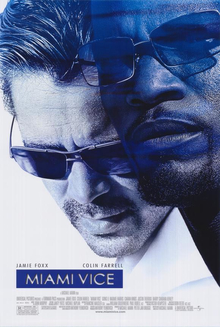
Running for five seasons and 111 episodes on NBC between 1984 and 1990, Miami Vice was a show that helped rewrite the cop television show. Splashy, stylish and colorful, it not only rewrote the genre but more importantly helped re-energize the genre. The impact is easily seen in just about any police procedural released in the years since. So what's the follow-up? Well, naturally an unnecessary film adaptation, 2006's Miami Vice.
Working on a sting operation of a prostitution ring, Miami-Dade police officers Sonny Crockett (Colin Farrell) and Ricardo Tubbs (Jamie Foxx) are called away suddenly when a former informant they've used calls them, talking wildly of a case among all sorts of nasty folks has gone seriously wrong. That case -- with FBI, DEA, drug cartels, Aryan Brothers, and many more involved -- goes poorly quickly, but Crockett and Tubbs get pulled into it as well, the longtime friends and detectives choosing to go deep undercover to hopefully pick up where the previously botched case left off. Can they somehow pull it off? The odds are stacked against them, and if things go poorly again, they've no one to get them out of the situation but themselves. And with all sorts of unsavory sorts involved -- including a potential leak within a government agency -- nothing is easy about this undercover case.
What a mess of a movie....and that's coming from someone who likes the finished product almost in spite of itself. This 2006 adaptation comes from director (and writer/producer) Michael Mann, an executive producer of the original television show and the director of Heat, Collateral, Ali, Last of the Mohicans and several others to his name. The film went way over budget, filming was less than pleasant with some cast drama, and it received middling to poor reviews. The criticisms are all valid with the main one being pretty obvious. Mann wrote the script...if it existed. It's hard to tell. Slow-moving scenes broken up by some intense staring and then a shootout extraordinaire finale. And yes, to repeat, I like this movie.
Story is overrated to the point of being unnecessary in Mann's film. Above all else, S-T-Y-L-E is key. He filmed in digital, giving 'Vice' an equal parts gritty, in your face look with a more polished, clean look. Filming locations in Florida, the Caribbean, Uruguay, Paraguay, they look phenomenal. This is a movie that doesn't have that overall clean, blockbuster feel. It is shot in the darkness and shadows like we're watching the real thing take place. You add in an eclectic soundtrack with everything from Audioslave to Moby and a lot of others mixed in along with a soft, almost trance-like score from composer John Murphy, and the little things come together nicely. Mann's ability as a visual director is never in question in my book. His movies look great and he composes shots with ease and talent, making it look almost effortless. The problem is when it is all style and basically no story.
I've seen a handful of the original Miami Vice episodes -- my parents watched it -- but I know the gist of the show. Mann decided to go out on a limb in many ways, but most importantly, in terms of character. Crockett and Tubbs are friends, buddies, partners in arms. Farrell and Foxx's version? There's decent chemistry between the two Miami-Dade detectives, but we're given no character/relationship background at any point so it's hard to root for them. Farrell gets far more screen-time (rarely a bad thing) as apparently Foxx was incredibly difficult to work with on-set, but it doesn't amount to much. Instead of flesh and blood characters, we get stylish anti-heroes, cops who know how to look cool, how to do a slow-motion walk like a champ, how to walk away from an explosion, how to have menacing conversations where nothing of said is of actual significance. Oh, and yes, I still liked this movie.
This ain't a cop story. It's a stylish, quasi-artsy cop movie with some odd detours, especially Farrell's Crockett falling hard for Isabella (Li Gong), an international drug dealer's right-hand woman. They go to Cuba, dance, drink and make sweet, passionate love in an extended sequence that accomplishes little. Meanwhile, Tubbs watches out for Trudy (Naomie Harris), his girlfriend and member of the team. Cue shower and sex scene! There is some charm in the Crockett/Isabella story, a doomed relationship that you know won't end well. Mann knows a doomed anti-hero better than anyone and Farrell embraces that character, the moody, almost sullen cop who begins to question what he's doing and the lengths he'll have to go to. I just wish there had been even a little character development other than passionate dance scenes and lots of meaningful looks and intense glances among characters.
Who else to look for? Along with Harris, the Crockett and Tubbs' team includes Justin Theroux, Elizabeth Rodriguez and Domenick Lombardozzi with Ciaran Hinds and Barry Shabaka Henley as two key superior officers. John Ortiz is excellent as Jose Yero, a cartel middle-man who suspects Crockett and Tubbs aren't what they're claiming with Luis Tosar as the drug czar hidden away in the Central American jungle. Also look for John Hawkes and Eddie Marsan in small parts.
So in the end, what can I say? I liked the movie. It's cool. Even though it takes itself far too seriously and has absolutely no sense of humor (there's maybe 3 smiles in the entire movie), it is fun. I thought Farrell was pretty good and carries things through its slower portions, especially with his dreamy hair and epic mustache. The style is cool, Mann assembling it all with ease in almost effortless fashion, albeit at the expense of the story. Things build nicely to a bone-thudding finale as an all-out war breaks out on a dock in the dead of night with heavy-duty automatic weapons tearing the silence open. The ending itself is weak, just kinda ends and boom, CREDITS! It isn't a very good movie -- more Blackhat than Heat unfortunately -- but I found myself entertained throughout. A measured final say.
Miami Vice (2006): ** 1/2 /****
The Sons of Katie Elder
"First, we reunite, then find Ma and Pa's killer...then read some reviews."
Showing posts with label Cops. Show all posts
Sunday, November 22, 2015
Wednesday, September 16, 2015
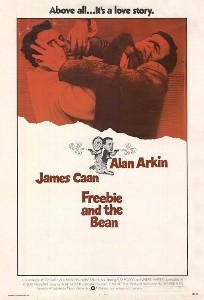
Freebie and the Bean
Let's get down to business. And I mean business. The buddy cop genre is the greatest genre in the history of cinema. Go ahead. I dare you to identify one that is better. See? You simply can-not. There were sprinklings before here and there, but the genre took off in the 1980's. One of those early sprinklings? An oddball, off-the-wall, politically incorrect comedy from 1974's Freebie and the Bean.
Longtime partners working the Intelligence Unit in San Francisco, Bean (Alan Arkin) and Freebie (James Caan) usually get the job done, sometimes in spite of themselves with their constant bickering. Their latest target? The duo has long sought to put well-known and long successful racketeer Red Meyers (Jack Kruschen) behind bars. After most of a year investigating, they've got the evidence -- finally -- but the key witness can't be put into custody for three more days. The solution? Freebie and Bean must shadow Meyers and make sure nothing goes wrong before they can officially arrest him. There are problems of course. Many people would be in trouble should Meyers testify so a hit man from Detroit (maybe more) has been dispatched to finish him. Oh, and it's Super Bowl week. Oh, and Freebie and Bean might kill each other in the process. What could possibly go wrong?
Reading some reviews and message boards about this 1974 buddy cop flick, I saw a lot of people questioning why this is a movie just about completely forgotten over the years. I'm glad I wasn't the only one to think of that issue. I love James Caan and Alan Arkin, and I'd never even vaguely, remotely even kinda heard of it. Why is that? Well, it's not a classic, but it's pretty good. It is kooky, completely without a story, has tonal shifts left and right, is especially goofy and is incredibly politically incorrect. There are flaws, but my goodness, is it a fun ride.
Arkin and Caan. Caan and Arkin. How can you possibly go wrong? You can't here. Two of my favorite actors working together make it look effortless. As you expect from any buddy cop pairing, the duo has to bitch and moan and criticize and ridicule...even though they're the best of friends. Arkin is Bean, a Mexican officer, all business, no nonsense. Caan is Freebie, wild and all over the place and not one to turn down a free gift here and there (hence the nickname). The story drifts as needed, and you get a sense the script was a couple set pieces, an outline of a story, and just blank sports for Arkin and Caan to improvise, to fire lightning fast insults and jokes and one-liners for as long as they could. Too many classic lines to mention -- most of them foul-mouthed, racist, sexist and generally inappropriate -- but quite the Batman and Batman (no Robin here) to lead the way.
'Freebie/Bean' comes from director Richard Rush and comes as a bit of fresh air considering the time it was released. We're talking cynical cop flicks like French Connection, Bullitt, the Dirty Harry movies and plenty others. It's just a funny movie. That's all and that's it. That's not a bad thing. You sit back and enjoy it because there isn't any messages in sight or anything dark or hard-hitting. These are two cops who are friends and fight like an old married couple bombing their way through San Francisco who stop at nothing to put their case together. If half the city should be destroyed in the process....well, so be it. We had a good time. San Francisco looks great as a backdrop as well, an interesting choice considering so many cop movies were shot on-location there. Moral of the story? As much as I love those previously mentioned flicks, it's cool to see a cop movie do a complete 180.
Who else to look for? Some fun, familiar faces. Kruschen has a ton of fun as Meyers, the racketeer who can't believe how stupid the cops pursuing him really are. Loretta Swit of MASH fame plays his pretty young wife. Also look for Alex Rocco as the conviction rate-minded district attorney, Mike Kellin as the boys' lieutenant, Paul Koslo and Christopher Morley as a couple witnesses, and a scene-stealing Valerie Harper as Bean's possibly cheating wife, Consuelo.
So there's gotta be something wrong...right? It's the bizarre, often out of left field shifts in tone. It's dark and funny and politically incorrect, and then a complete direction change into a never-ending car and motorcycle chase (had...HAD to be an influence on The Blues Brothers) that relies on sight gags and Keystone Cops-esque humor. There's little warning too as things shift, especially toward the end with more than a few crazy twists, some that work, some that are shocking, and one that almost had me questioning the whole movie. Thankfully, it was a twist within a twist in a mystery surrounded by a paradox. Anyhoo, this is all complaining to complain. The movie is a ton of fun with one laugh after another. It's James Caan and Alan Arkin basically spending 2 hours causing collateral damage and bitching at each other in their downtime. If that's not a recipe for success, I don't know what is.
Freebie and the Bean (1974): ***/****
Longtime partners working the Intelligence Unit in San Francisco, Bean (Alan Arkin) and Freebie (James Caan) usually get the job done, sometimes in spite of themselves with their constant bickering. Their latest target? The duo has long sought to put well-known and long successful racketeer Red Meyers (Jack Kruschen) behind bars. After most of a year investigating, they've got the evidence -- finally -- but the key witness can't be put into custody for three more days. The solution? Freebie and Bean must shadow Meyers and make sure nothing goes wrong before they can officially arrest him. There are problems of course. Many people would be in trouble should Meyers testify so a hit man from Detroit (maybe more) has been dispatched to finish him. Oh, and it's Super Bowl week. Oh, and Freebie and Bean might kill each other in the process. What could possibly go wrong?
Reading some reviews and message boards about this 1974 buddy cop flick, I saw a lot of people questioning why this is a movie just about completely forgotten over the years. I'm glad I wasn't the only one to think of that issue. I love James Caan and Alan Arkin, and I'd never even vaguely, remotely even kinda heard of it. Why is that? Well, it's not a classic, but it's pretty good. It is kooky, completely without a story, has tonal shifts left and right, is especially goofy and is incredibly politically incorrect. There are flaws, but my goodness, is it a fun ride.
Arkin and Caan. Caan and Arkin. How can you possibly go wrong? You can't here. Two of my favorite actors working together make it look effortless. As you expect from any buddy cop pairing, the duo has to bitch and moan and criticize and ridicule...even though they're the best of friends. Arkin is Bean, a Mexican officer, all business, no nonsense. Caan is Freebie, wild and all over the place and not one to turn down a free gift here and there (hence the nickname). The story drifts as needed, and you get a sense the script was a couple set pieces, an outline of a story, and just blank sports for Arkin and Caan to improvise, to fire lightning fast insults and jokes and one-liners for as long as they could. Too many classic lines to mention -- most of them foul-mouthed, racist, sexist and generally inappropriate -- but quite the Batman and Batman (no Robin here) to lead the way.
'Freebie/Bean' comes from director Richard Rush and comes as a bit of fresh air considering the time it was released. We're talking cynical cop flicks like French Connection, Bullitt, the Dirty Harry movies and plenty others. It's just a funny movie. That's all and that's it. That's not a bad thing. You sit back and enjoy it because there isn't any messages in sight or anything dark or hard-hitting. These are two cops who are friends and fight like an old married couple bombing their way through San Francisco who stop at nothing to put their case together. If half the city should be destroyed in the process....well, so be it. We had a good time. San Francisco looks great as a backdrop as well, an interesting choice considering so many cop movies were shot on-location there. Moral of the story? As much as I love those previously mentioned flicks, it's cool to see a cop movie do a complete 180.
Who else to look for? Some fun, familiar faces. Kruschen has a ton of fun as Meyers, the racketeer who can't believe how stupid the cops pursuing him really are. Loretta Swit of MASH fame plays his pretty young wife. Also look for Alex Rocco as the conviction rate-minded district attorney, Mike Kellin as the boys' lieutenant, Paul Koslo and Christopher Morley as a couple witnesses, and a scene-stealing Valerie Harper as Bean's possibly cheating wife, Consuelo.
So there's gotta be something wrong...right? It's the bizarre, often out of left field shifts in tone. It's dark and funny and politically incorrect, and then a complete direction change into a never-ending car and motorcycle chase (had...HAD to be an influence on The Blues Brothers) that relies on sight gags and Keystone Cops-esque humor. There's little warning too as things shift, especially toward the end with more than a few crazy twists, some that work, some that are shocking, and one that almost had me questioning the whole movie. Thankfully, it was a twist within a twist in a mystery surrounded by a paradox. Anyhoo, this is all complaining to complain. The movie is a ton of fun with one laugh after another. It's James Caan and Alan Arkin basically spending 2 hours causing collateral damage and bitching at each other in their downtime. If that's not a recipe for success, I don't know what is.
Freebie and the Bean (1974): ***/****
Labels:
1970s,
Alan Arkin,
Alex Rocco,
Comedy,
Cops,
Jack Kruschen,
James Caan,
Mike Kellin,
Paul Koslo
Monday, August 17, 2015
To Live and Die in L.A.
I don't know what to say sometimes. I watch a movie and hmm, I just don't know where to start. When facing that issue, it's usually a bad thing, a movie so awful, so horrifically bad the words or criticisms just ain't there. Other times....yeah, this is the other time. A weird, scary, off-beat, violent and overall, just a damn excellent flick, 1985's To Live and Die in L.A.
Working out of the Los Angeles field office, Secret Service agent Richard Chance (William Petersen) is about to be without a partner as his longtime fellow agent (Michael Greene) is only days away from retirement. The partner instead turns up dead at a remote desert warehouse, and Chance knows who he was investigating, a professional counterfeiter, Eric Masters (Willem Dafoe), who they have long been after. Swearing to put away his friend and partner's killer, Chance will stop at nothing -- NOTHING -- to get Masters who has proved very elusive when it comes to proving his guilt. Saddled with a new partner, the more button-down John Vukovich (John Pankow), Chance follows the evidence where it may lead, but Masters has some trouble of his own. Who can get to the other one first? How far will either man go to get what they want?
With 1971's The French Connection and 1973's The Exorcist, director William Friedkin had one of the most impressive one-two punches of back-to-back films...well, ever. He followed them up with a string of movies that struggled -- for whatever reason -- to get any footing to the point that this 1975 cop thriller/drama is considered by some as his comeback of sorts. What a comeback it is. It works because of all its moving pieces. Stylish and innovative, it is very 1980's. It is equal parts dark, gritty, brutally violent and uncomfortable at times. And then for good measure, 'Live and Die' has a little art-house in its story and characters. Quite the mix, ain't it? This is the sort of movie that shouldn't work, but does it ever, almost in spite of flaws that would cripple most other movies.
Through his previous movies, Friedkin had shown his ability not just as a director, but as an auteur. He made films, not always movies. He was willing to try something different, to reach for something difficult, to not settle for the status quo. 'Live and Die' is a case in point. It's like a procedural cop drama/thriller...on steroids and cocaine with some LSD thrown in. Friedkin freaking GOES FOR IT. The style is schizophrenic, the score from Wang Chung incredibly 1980's, the violence in your face, and even some frontal male nudity, not to mention a whole lot of guy butt. Stylized, computer title cards show the progression of time, and Los Angeles ends up becoming an additional character, a charged-up backdrop to the ever-crazy story developments. How far will it go? How far will Petersen's Chance go? Getting there is more than half the fun. It is the definition of an unpredictable movie, and that is rarely a bad thing.
I grew up and will always associate William Petersen with O-N-E part...that of CSI's Gil Grissom. This was his first starring role, starting a handful of late 80's/early 90's flicks that seemed to indicate Petersen was going to be a star, a big one. It never quite came together, but my goodness, what a starring debut. The rogue cop who plays by his rules -- laws, procedures and protocol BE DAMNED -- is absolutely nothing new to the genre, but Petersen injects a ridiculous amount of energy to Agent Chance. He brings balls. He brings swagger. He brings uber-confidence. How good? At a certain point, you're not even rooting for him anymore to the point he's unlikable but you just can't look away. Chance is manipulative, intimidating, not above breaking the law, and callously disinterested in anything that doesn't affect the case.
Part of it is the look. It is the mid 1980's, and Peterson's Chance wears tight jeans at all times, badass sunglasses, badass boots, badass leather jacket and...well...badass. He reeks of cool. He's an adrenaline junkie. He pushes his partner too far. He basically blackmails a parolee/informant (Darlanne Fluegel) into a sexual relationship. He threatens lives left and right, some being claimed. I keep coming back to swagger. There is a physicality to the part, Petersen running like a maniac through chases scenes, brimming with energy in interrogations, intimidatingly subtle when he wants something. What a part. What a performance. Clearly impacted by those cop movies before him (French Connection, Bullitt, Dirty Harry) and clearly an impact on those still to come.
Dafoe is terrifying just because he's Willem Dafoe and looks and appears terrifying. He's a villain. That's it. No real background or motivation, his Masters is just a supremely talented counterfeiter looking to make one big payday after another. Quite the match-up of stars, quite the cat and mouse game (but who's who?). Along with Fluegel and Pankow (an excellent supporting part of a conscious-riddled cop), look for John Turturro, Debra Feuer, and Dean Stockwell as a high-class, scumbag lawyer in key supporting parts.
When filming the famous French Connection car chase, Friedkin apparently wanted to do bigger and better but simply ran out of time. The run-off falls to this flick, and it does not disappoint. Chase and his new partner kidnap someone for reasons because of a case (Just Watch It) and things go horribly wrong in a bullet-riddled chase and shootout through Los Angeles' backroads, highways and of course, the Los Angeles River. The capper is an incredible driving sequence as Chase drives into incoming traffic in hopes of getting away relatively unscathed. It is an absolutely insanely tension-packed extended sequence, expertly shot, cut and edited by Friedkin and his crew that belongs on the same level as similar chases in Bullitt, French Connection and so many more I'm forgetting. An amazing sequence to watch.
What a crazy movie. I have a picture of Friedkin filming and editing his film, basically flipping the bird to anyone and everyone in front of him. I kept thinking while watching this thriller that 'Live and Die' was Friedkin as a renegade director before Quentin Tarantino and Robert Rodriguez took over that notion in the 1990's. Friedkin is -- simply put -- at the top of his game here. It's days later, and I'm still thinking about this one. It keeps building and building to one of the most surprising, trippiest finales I've ever seen. Genuine shock value on several different levels. Can't recommend this one enough. Also, one movie kept popping into my head as I watched this 1985 film as having a huge, profound impact on said newer film. That movie? Drive with Ryan Gosling. Watch both and tell me they couldn't be impeccable companion pieces.
To Live and Die in L.A. (1985): *** 1/2 /****
Working out of the Los Angeles field office, Secret Service agent Richard Chance (William Petersen) is about to be without a partner as his longtime fellow agent (Michael Greene) is only days away from retirement. The partner instead turns up dead at a remote desert warehouse, and Chance knows who he was investigating, a professional counterfeiter, Eric Masters (Willem Dafoe), who they have long been after. Swearing to put away his friend and partner's killer, Chance will stop at nothing -- NOTHING -- to get Masters who has proved very elusive when it comes to proving his guilt. Saddled with a new partner, the more button-down John Vukovich (John Pankow), Chance follows the evidence where it may lead, but Masters has some trouble of his own. Who can get to the other one first? How far will either man go to get what they want?
With 1971's The French Connection and 1973's The Exorcist, director William Friedkin had one of the most impressive one-two punches of back-to-back films...well, ever. He followed them up with a string of movies that struggled -- for whatever reason -- to get any footing to the point that this 1975 cop thriller/drama is considered by some as his comeback of sorts. What a comeback it is. It works because of all its moving pieces. Stylish and innovative, it is very 1980's. It is equal parts dark, gritty, brutally violent and uncomfortable at times. And then for good measure, 'Live and Die' has a little art-house in its story and characters. Quite the mix, ain't it? This is the sort of movie that shouldn't work, but does it ever, almost in spite of flaws that would cripple most other movies.
Through his previous movies, Friedkin had shown his ability not just as a director, but as an auteur. He made films, not always movies. He was willing to try something different, to reach for something difficult, to not settle for the status quo. 'Live and Die' is a case in point. It's like a procedural cop drama/thriller...on steroids and cocaine with some LSD thrown in. Friedkin freaking GOES FOR IT. The style is schizophrenic, the score from Wang Chung incredibly 1980's, the violence in your face, and even some frontal male nudity, not to mention a whole lot of guy butt. Stylized, computer title cards show the progression of time, and Los Angeles ends up becoming an additional character, a charged-up backdrop to the ever-crazy story developments. How far will it go? How far will Petersen's Chance go? Getting there is more than half the fun. It is the definition of an unpredictable movie, and that is rarely a bad thing.
I grew up and will always associate William Petersen with O-N-E part...that of CSI's Gil Grissom. This was his first starring role, starting a handful of late 80's/early 90's flicks that seemed to indicate Petersen was going to be a star, a big one. It never quite came together, but my goodness, what a starring debut. The rogue cop who plays by his rules -- laws, procedures and protocol BE DAMNED -- is absolutely nothing new to the genre, but Petersen injects a ridiculous amount of energy to Agent Chance. He brings balls. He brings swagger. He brings uber-confidence. How good? At a certain point, you're not even rooting for him anymore to the point he's unlikable but you just can't look away. Chance is manipulative, intimidating, not above breaking the law, and callously disinterested in anything that doesn't affect the case.
Part of it is the look. It is the mid 1980's, and Peterson's Chance wears tight jeans at all times, badass sunglasses, badass boots, badass leather jacket and...well...badass. He reeks of cool. He's an adrenaline junkie. He pushes his partner too far. He basically blackmails a parolee/informant (Darlanne Fluegel) into a sexual relationship. He threatens lives left and right, some being claimed. I keep coming back to swagger. There is a physicality to the part, Petersen running like a maniac through chases scenes, brimming with energy in interrogations, intimidatingly subtle when he wants something. What a part. What a performance. Clearly impacted by those cop movies before him (French Connection, Bullitt, Dirty Harry) and clearly an impact on those still to come.
Dafoe is terrifying just because he's Willem Dafoe and looks and appears terrifying. He's a villain. That's it. No real background or motivation, his Masters is just a supremely talented counterfeiter looking to make one big payday after another. Quite the match-up of stars, quite the cat and mouse game (but who's who?). Along with Fluegel and Pankow (an excellent supporting part of a conscious-riddled cop), look for John Turturro, Debra Feuer, and Dean Stockwell as a high-class, scumbag lawyer in key supporting parts.
When filming the famous French Connection car chase, Friedkin apparently wanted to do bigger and better but simply ran out of time. The run-off falls to this flick, and it does not disappoint. Chase and his new partner kidnap someone for reasons because of a case (Just Watch It) and things go horribly wrong in a bullet-riddled chase and shootout through Los Angeles' backroads, highways and of course, the Los Angeles River. The capper is an incredible driving sequence as Chase drives into incoming traffic in hopes of getting away relatively unscathed. It is an absolutely insanely tension-packed extended sequence, expertly shot, cut and edited by Friedkin and his crew that belongs on the same level as similar chases in Bullitt, French Connection and so many more I'm forgetting. An amazing sequence to watch.
What a crazy movie. I have a picture of Friedkin filming and editing his film, basically flipping the bird to anyone and everyone in front of him. I kept thinking while watching this thriller that 'Live and Die' was Friedkin as a renegade director before Quentin Tarantino and Robert Rodriguez took over that notion in the 1990's. Friedkin is -- simply put -- at the top of his game here. It's days later, and I'm still thinking about this one. It keeps building and building to one of the most surprising, trippiest finales I've ever seen. Genuine shock value on several different levels. Can't recommend this one enough. Also, one movie kept popping into my head as I watched this 1985 film as having a huge, profound impact on said newer film. That movie? Drive with Ryan Gosling. Watch both and tell me they couldn't be impeccable companion pieces.
To Live and Die in L.A. (1985): *** 1/2 /****
Labels:
1980s,
Cops,
John Turturro,
Willem Dafoe,
William Friedkin,
William Petersen
Friday, August 14, 2015
Brannigan
Let's give him points. John Wayne could admit a mistake when he made one. Offered the part of San Francisco detective Harry Callahan -- better known as Dirty Harry -- in the late 1960's, Wayne turned down the part only to see the cop series blow up in a big way for star Clint Eastwood. It took him a couple years to answer, but Wayne turned to the cop genre himself, first with 1974's McQ, and a year later with 1975's Brannigan.
A longtime Chicago cop, Lt. Jim Brannigan (Wayne) has built up quite a reputation for himself over the years, both for good and bad. He's always done his job well but built up quite a list of enemies in the process, especially Ben Larkin (John Vernon), a gangster with a whole lot of knowledge about a whole lot of mob money. With the district attorney's case against Larkin finally coming together, the mobster bails and heads for London on the run. The Chicago police are well aware of the move and with Scotland Yard have Larkin under full surveillance. The catch? They need somebody tough to bring him back. Who better than the man who's been on his case for years, Brannigan himself. The veteran cop heads to England, but what starts as a simple pick-up is quickly thrown out the window when Larkin is kidnapped and ransomed off. Can Brannigan and London police track him down before someone else finishes him off?
As Wikipedia is quick to point out, this 1975 cop drama/thriller follows in the footsteps of Coogan's Bluff (also starring Mr. Eastwood) in terms of the cop as the fish out of water. This isn't fast, brutal Chicago where police work doesn't always play by the rules. This is London, an almost gentlemanly situation where guns are forbidden and rules are made to be followed. Who better than John Wayne to mess that world up? I submit that NO ONE would have been more suited to it. From director Douglas Hickox, 'Brannigan' is a solid if unspectacular cop story, benefiting from Wayne's presence, some solid supporting cast members and very cool on-location shooting in both Chicago (too briefly) and London. Like McQ, it's no classic, but there's enough to recommend.
If you've poked around my reviews these past years, you can tell I kinda like John Wayne. Through good and bad, I'll give his movies a watch. By the 1970's as his health took a turn for the worse (again), he made movies that weren't ground-breaking or world-shattering. Instead, these are movies and roles that are fun. That are entertaining, and in a way, serve as a sort of comfort food. In a way, they were almost a Farewell Tour for one of Hollywood's all-time greats. Much like McQ, Wayne is able to fill the screen with his larger-than-life persona, a gruff, aging cop while still allowing the script to have some fun with his senior citizen status. I've lived in Chicago my whole life, and let me tell you, there's no 68-year old cops running around. From what I've read, Wayne was very much struggling with health concerns during filming, but it doesn't show.
He brings that John Wayne energy in all his scenes, whether he's interrogating a suspect, working with his appointed British partner (Judy Geeson), or going toe-to-toe with his British Scotland Yard counterpart, the very Commander Swann (Richard Attenborough). Health concerns or not (the Duke would only make two more films), Wayne brings that familiar energy to the screen. He has some great chemistry with Geeson in some flirty scenes that aren't pushed too far or too cheesy. The same for his alpha male showdowns with Attenborough's Swann. These are two guys used to doing things their way and getting things done their way. It was very cool to see two pros like Wayne and Attenborough play off each other so effortlessly, one scene ready to murder each other, the next cops doing whatever it takes to get the job done. Some fun parts for surely.
Three years away from his most famous, iconic role in Animal House, Vernon is excellent -- as always -- as the slimy, smooth villain, although he's underused as his characters gets twisted and turned around. Still, it's John Vernon as a bad guy. Hard to pass that up. Mel Ferrer gets to have some fun as Larkin's equally slimy lawyer, forced to work with the cops when the ransom negotiation begins. Also look for Ralph Meeker as Brannigan's commanding officer (a very quick part), Daniel Pilon as a hired killer tasked with offing Brannigan, John Stride as Traven, one of Swann's officers, and James Booth (of Zulu fame) as one of Larkin's sneering kidnappers.
'McQ' had its fair share of flaws, but overall, it was a pretty decent cop flick. I put Brannigan a touch below it. The story and running time feels a little bloated, like 10 or 15 minutes could have been edited here and there. The action is solid -- especially a car chase through London -- and packs quite a punch. It's fun especially seeing Wayne when he does get to unleash all his fury in some interrogation scenes. There are too many times though the story simply drifts. Even the ending disappoints a little, a pretty decent twist livening things up thankfully. It's not a classic and maybe it's not very good at all, but I enjoyed it for what it is.
You only get so many flicks from your favorite actors so enjoy them and focus on the positive. It ain't a classic, but it's entertaining.
Brannigan (1975): ** 1/2 /****
A longtime Chicago cop, Lt. Jim Brannigan (Wayne) has built up quite a reputation for himself over the years, both for good and bad. He's always done his job well but built up quite a list of enemies in the process, especially Ben Larkin (John Vernon), a gangster with a whole lot of knowledge about a whole lot of mob money. With the district attorney's case against Larkin finally coming together, the mobster bails and heads for London on the run. The Chicago police are well aware of the move and with Scotland Yard have Larkin under full surveillance. The catch? They need somebody tough to bring him back. Who better than the man who's been on his case for years, Brannigan himself. The veteran cop heads to England, but what starts as a simple pick-up is quickly thrown out the window when Larkin is kidnapped and ransomed off. Can Brannigan and London police track him down before someone else finishes him off?
As Wikipedia is quick to point out, this 1975 cop drama/thriller follows in the footsteps of Coogan's Bluff (also starring Mr. Eastwood) in terms of the cop as the fish out of water. This isn't fast, brutal Chicago where police work doesn't always play by the rules. This is London, an almost gentlemanly situation where guns are forbidden and rules are made to be followed. Who better than John Wayne to mess that world up? I submit that NO ONE would have been more suited to it. From director Douglas Hickox, 'Brannigan' is a solid if unspectacular cop story, benefiting from Wayne's presence, some solid supporting cast members and very cool on-location shooting in both Chicago (too briefly) and London. Like McQ, it's no classic, but there's enough to recommend.
If you've poked around my reviews these past years, you can tell I kinda like John Wayne. Through good and bad, I'll give his movies a watch. By the 1970's as his health took a turn for the worse (again), he made movies that weren't ground-breaking or world-shattering. Instead, these are movies and roles that are fun. That are entertaining, and in a way, serve as a sort of comfort food. In a way, they were almost a Farewell Tour for one of Hollywood's all-time greats. Much like McQ, Wayne is able to fill the screen with his larger-than-life persona, a gruff, aging cop while still allowing the script to have some fun with his senior citizen status. I've lived in Chicago my whole life, and let me tell you, there's no 68-year old cops running around. From what I've read, Wayne was very much struggling with health concerns during filming, but it doesn't show.
He brings that John Wayne energy in all his scenes, whether he's interrogating a suspect, working with his appointed British partner (Judy Geeson), or going toe-to-toe with his British Scotland Yard counterpart, the very Commander Swann (Richard Attenborough). Health concerns or not (the Duke would only make two more films), Wayne brings that familiar energy to the screen. He has some great chemistry with Geeson in some flirty scenes that aren't pushed too far or too cheesy. The same for his alpha male showdowns with Attenborough's Swann. These are two guys used to doing things their way and getting things done their way. It was very cool to see two pros like Wayne and Attenborough play off each other so effortlessly, one scene ready to murder each other, the next cops doing whatever it takes to get the job done. Some fun parts for surely.
Three years away from his most famous, iconic role in Animal House, Vernon is excellent -- as always -- as the slimy, smooth villain, although he's underused as his characters gets twisted and turned around. Still, it's John Vernon as a bad guy. Hard to pass that up. Mel Ferrer gets to have some fun as Larkin's equally slimy lawyer, forced to work with the cops when the ransom negotiation begins. Also look for Ralph Meeker as Brannigan's commanding officer (a very quick part), Daniel Pilon as a hired killer tasked with offing Brannigan, John Stride as Traven, one of Swann's officers, and James Booth (of Zulu fame) as one of Larkin's sneering kidnappers.
'McQ' had its fair share of flaws, but overall, it was a pretty decent cop flick. I put Brannigan a touch below it. The story and running time feels a little bloated, like 10 or 15 minutes could have been edited here and there. The action is solid -- especially a car chase through London -- and packs quite a punch. It's fun especially seeing Wayne when he does get to unleash all his fury in some interrogation scenes. There are too many times though the story simply drifts. Even the ending disappoints a little, a pretty decent twist livening things up thankfully. It's not a classic and maybe it's not very good at all, but I enjoyed it for what it is.
You only get so many flicks from your favorite actors so enjoy them and focus on the positive. It ain't a classic, but it's entertaining.
Brannigan (1975): ** 1/2 /****
Labels:
1970s,
Cops,
John Vernon,
John Wayne,
Mel Ferrer,
Ralph Meeker,
Richard Attenborough
Monday, August 3, 2015
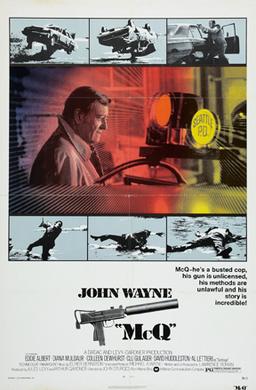
McQ
By the mid 1960's John Wayne wasn't just John Wayne anymore. He was the Duke, an icon and a star. He came to represent something bigger, something Wayne thought people needed to look up to. Because of that sentiment, he turned down some roles that he thought were too much against type. The two big ones? The Major Reisman part from The Dirty Dozen and the role of a famous rogue cop named....Dirty Harry. Wayne regretted not taking the part made famous by Clint Eastwood and went about fixing the issue. The result? Two cop movies, starting with 1974's McQ and following a year later with Brannigan (soon to be reviewed).
A longtime detective on the Seattle police force, Lieutenant Lon 'McQ' McHugh (Wayne) has seen everything there is to be seen. After years on the force, he's sick of the politicians and the glad-handing and all the garbage. He's interested in putting the crooks away, but now one attempted murder hits too close to home when his partner, Lt. Stan Boyle (William Bryant), is shot in the back with a shotgun with no witnesses. Boyle's chances aren't too good, but McQ intends to do something about it. Who shot his partner? The clues are there, and McQ begins to suspect there's a whole lot more going on than meets the eye. He begins to find evidence that could point to any number of trails worth following, from a high-level drug supplier to corruption within the police force. Can he piece it all together before those people he's chasing get him instead?
I've been a huge John Wayne fan for as long as I can remember. If he's starring in a movie, I'll give it a shot. Mostly, they're winners but occasionally there's a dud here and there. I'm looking at you The Conqueror. In this last portion of his career -- mostly the late 1960's and into the 1970's -- Wayne was making movies he wanted to make, movies he figured his fans and audiences wanted to see. Are they classics? With the exception of True Grit and The Shootist, no. On the other hand, they're F-U-N, movies like Big Jake, The Train Robbers, Chisum, The Cowboys and several others. So regretting not taking the Harry Callahan role (a big thank you from Eastwood), Wayne dove headfirst into the renegade cop genre. The winners? Us. McQ and Brannigan aren't classics, but man, are they ever fun.
The rogue/renegade cop movies of the 60's and 70's were everywhere, ranging from Bullitt to Dirty Harry to Magnum Force to The French Connection with plenty more in between. The crime thriller as a whole was at its absolute best. But a John Wayne take on the genre? Yes. Yes. The script gives him some nice touches to show he's a cool cop, like his houseboat, his Pontiac trans am, his efforts to stay involved in his daughter's life, even though ex-wife Julie Adams just couldn't take their marriage anymore. By 1974, Wayne was 66 years old, a little thicker around the midsection and sporting a toupee but you know what? He makes it look effortless. That no-nonsense, all-business attitude plays well as the frustrated cop role. Rules? Meh. Hippies? Don't bug him about them. Getting the crooks behind bars? NOW you're talking.
It doesn't matter the genre. It doesn't matter the script really. It's John Wayne, and he's going to make the most of it. The cast across the board is pretty cool. Eddie Albert gets to glare and snare as Kosterman, McQ's commanding officer who's sick of his take no prisoners attitude, and has some great scenes, two pros going toe to toe. Diana Muldaur plays Boyle's wife, always close with McQ, while Colleen Dewhurst plays Myra, an informant, waitress and drug addict who McQ milks for dirt. Among the cops on the case, also look for Clu Gulager, David Huddleston, and Julian Christopher while Roger E. Mosley plays a pimp/snitch, quite the one-two punch. And last but not least, Al Lettieri does what he does best...in be a slimy 1970's villain, this one a drug supplier with a checkered history with McQ so you know that's going to end well. Some fun parts to back up the Duke throughout.
If you're a fan of Bullitt, the Dirty Harry movies, or assorted other 1960's/1970's cop movies, you'll like this one. Director John Sturges does a good job using his on-location shoots in Seattle to give the story that sense of authenticity, and composer Elmer Bernstein turns in a cool, funky, jazzy score...that's still very clearly an Elmer Bernstein score (and that's a good thing). There's a really cool car chase through and around Seattle's highways about halfway through (just like Bullitt), and the shootout finale on oceanfront beach is very well-done as three 1970's boats, um, I mean "cars," tear after each other. Oh, and John Wayne gets to unleash a heavy-duty automatic machine gun.
Is it a classic? No way, but it is a heck of a lot of fun with a story that never really slows down and has some fun with twists you think you'll see. More than enough to recommend, and John Wayne is having some fun from beginning to end. What would it have been like if Wayne took the Dirty Harry role? We'll never know, but it seemed to turn out generally okay for everyone involved. I guess. Right, Mr. Eastwood?
McQ (1974): ***/****
A longtime detective on the Seattle police force, Lieutenant Lon 'McQ' McHugh (Wayne) has seen everything there is to be seen. After years on the force, he's sick of the politicians and the glad-handing and all the garbage. He's interested in putting the crooks away, but now one attempted murder hits too close to home when his partner, Lt. Stan Boyle (William Bryant), is shot in the back with a shotgun with no witnesses. Boyle's chances aren't too good, but McQ intends to do something about it. Who shot his partner? The clues are there, and McQ begins to suspect there's a whole lot more going on than meets the eye. He begins to find evidence that could point to any number of trails worth following, from a high-level drug supplier to corruption within the police force. Can he piece it all together before those people he's chasing get him instead?
I've been a huge John Wayne fan for as long as I can remember. If he's starring in a movie, I'll give it a shot. Mostly, they're winners but occasionally there's a dud here and there. I'm looking at you The Conqueror. In this last portion of his career -- mostly the late 1960's and into the 1970's -- Wayne was making movies he wanted to make, movies he figured his fans and audiences wanted to see. Are they classics? With the exception of True Grit and The Shootist, no. On the other hand, they're F-U-N, movies like Big Jake, The Train Robbers, Chisum, The Cowboys and several others. So regretting not taking the Harry Callahan role (a big thank you from Eastwood), Wayne dove headfirst into the renegade cop genre. The winners? Us. McQ and Brannigan aren't classics, but man, are they ever fun.
The rogue/renegade cop movies of the 60's and 70's were everywhere, ranging from Bullitt to Dirty Harry to Magnum Force to The French Connection with plenty more in between. The crime thriller as a whole was at its absolute best. But a John Wayne take on the genre? Yes. Yes. The script gives him some nice touches to show he's a cool cop, like his houseboat, his Pontiac trans am, his efforts to stay involved in his daughter's life, even though ex-wife Julie Adams just couldn't take their marriage anymore. By 1974, Wayne was 66 years old, a little thicker around the midsection and sporting a toupee but you know what? He makes it look effortless. That no-nonsense, all-business attitude plays well as the frustrated cop role. Rules? Meh. Hippies? Don't bug him about them. Getting the crooks behind bars? NOW you're talking.
It doesn't matter the genre. It doesn't matter the script really. It's John Wayne, and he's going to make the most of it. The cast across the board is pretty cool. Eddie Albert gets to glare and snare as Kosterman, McQ's commanding officer who's sick of his take no prisoners attitude, and has some great scenes, two pros going toe to toe. Diana Muldaur plays Boyle's wife, always close with McQ, while Colleen Dewhurst plays Myra, an informant, waitress and drug addict who McQ milks for dirt. Among the cops on the case, also look for Clu Gulager, David Huddleston, and Julian Christopher while Roger E. Mosley plays a pimp/snitch, quite the one-two punch. And last but not least, Al Lettieri does what he does best...in be a slimy 1970's villain, this one a drug supplier with a checkered history with McQ so you know that's going to end well. Some fun parts to back up the Duke throughout.
If you're a fan of Bullitt, the Dirty Harry movies, or assorted other 1960's/1970's cop movies, you'll like this one. Director John Sturges does a good job using his on-location shoots in Seattle to give the story that sense of authenticity, and composer Elmer Bernstein turns in a cool, funky, jazzy score...that's still very clearly an Elmer Bernstein score (and that's a good thing). There's a really cool car chase through and around Seattle's highways about halfway through (just like Bullitt), and the shootout finale on oceanfront beach is very well-done as three 1970's boats, um, I mean "cars," tear after each other. Oh, and John Wayne gets to unleash a heavy-duty automatic machine gun.
Is it a classic? No way, but it is a heck of a lot of fun with a story that never really slows down and has some fun with twists you think you'll see. More than enough to recommend, and John Wayne is having some fun from beginning to end. What would it have been like if Wayne took the Dirty Harry role? We'll never know, but it seemed to turn out generally okay for everyone involved. I guess. Right, Mr. Eastwood?
McQ (1974): ***/****
Labels:
1970s,
Al Lettieri,
Cops,
Eddie Albert,
John Sturges,
John Wayne,
Julie Adams
Wednesday, September 10, 2014
Detective Story
The police procedural in 2014 is a tried and true formula. It's gotten a genre reboot of sorts thanks to HBO's highly successful True Detective, but there's also been Law and Order, Dragnet, Hawaii Five-O, The Streets of San Francisco and countless others. As familiar as the genre can be, it can be fun to go back and see where things started...all the way back in the 1950s!!! Here's 1951's Detective Story.
It's a warm summer day in New York City and things are going about as normal at the 21st Precinct with its crew of detectives and seemingly never-ending stream of criminals, some petty crooks and others looking at a stiff prison sentence. Among the officers on duty is Detective Jim McCleod (Kirk Douglas), a hard-boiled officer who always gets his man, albeit with some less than legal methods. Now he has to deal with a case from his past, a doctor, Schneider (George Macready), who has built a reputation for all the wrong reasons. In previous run-ins, McCleod has never been able to close the case on the doctor through a variety of coincidences that certainly smell fishy. He's become almost obsessed with sending Schneider to jail no matter the case, no matter by what means he can do it. Will McCleod go too far this time around?
From director William Wyler, 'Detective' is based off a play by Sidney Kingsley. Wyler's film picked up four Oscar nominations but ultimately winning none. I've long tried to track it down, Netflix taunting me with the DVD that never seemed to be available. Well, I win Netflix! I found it on Turner Classic Movie's schedule! And in the end, it was well worth the wait. The stage-based roots pay huge dividends, almost the entire 103-minute running time spent in the 21st Precinct's bullpen and offices. It's busy, claustrophobic and a great backdrop to the ensemble story and long list of characters. It is a simple, straightforward technique that works in pretty effortless fashion. There isn't anything particularly flashy about Wyler's film, but it's realistic, tough and often enough ahead of its time mentality, 'Detective' is an easy recommend.
Just 35 years old at the time, it's crazy to think what Douglas accomplished in his first five years in Hollywood. Talk about a guy who hit the ground running, Douglas having Champion, Out of the Past and Ace in the Hole to his name. Add his performance here as Detective Jim McCleod to an impressive list for a young actor. There are times late where things get a little over-dramatic, but Douglas knows just where to stop where things could be considered a little hammy. McCleod is absolutely dripping with rage and fury, his job tearing him apart, not to mention some inner demons coursing through him. We see he's a good cop, pushing and pushing to catch the crooks, knowing all their tricks, but it's also a job that's pushed him to a state where he is hanging on the verge of absolutely losing his mind. Brimming with intensity, this is quite a performance for Douglas. Surprisingly enough, he wasn't nominated for an Oscar here, two other performances picking up nods.
Rounding out the cast is a solid ensemble starting with Eleanor Parker (picking up a Best Actress nomination) as Mary, McCleod's wife. She's a cop's wife, knowing her husband pushes himself while trying not to involve her too much in the horrors of what he sees. As for the other 21st Precinct detectives, look for William Bendix as McCleod's partner, Lou Brody, with Horace McMahon as Lt. Monahan, and Frank Faylen, Bert Freed, Grandon Rhodes and William Phillips rounding out the crew. Other folks to watch out for, Lee Grant as a first-time pickpocket, observing all that goes on in prison (and picking up an Oscar nomination?!?), a young man (Craig Hill) who robbed $400-plus from his boss but his girlfriend's sister (Cathy O'Donnell) wants to help him, and two crooks (Joseph Wiseman in just his second film, Michael Strong) trying not to turn on each other for their long list of burglaries. It's a cool ensemble, all the different responses from both sides of the law as the day develops.
There are weaknesses, but none are deal-breakers. Wiseman hams it up like his life depended on it. Grant's cute pickpocket comes across as more annoying than anything. It is a tad slow-moving at times. That said? It's a gem of a movie. Ahead of its time in dealing with an abortion doctor (in a 1950s film at that!), the story gets uncomfortable and very real as certain elements of the script come to life. The ending is not so surprisingly downbeat. Pay attention with some quick cues within several other scenes, and you should see where it's going. Well worth a watch. Highly recommended.
Detective Story (1951): *** 1/2 /****
It's a warm summer day in New York City and things are going about as normal at the 21st Precinct with its crew of detectives and seemingly never-ending stream of criminals, some petty crooks and others looking at a stiff prison sentence. Among the officers on duty is Detective Jim McCleod (Kirk Douglas), a hard-boiled officer who always gets his man, albeit with some less than legal methods. Now he has to deal with a case from his past, a doctor, Schneider (George Macready), who has built a reputation for all the wrong reasons. In previous run-ins, McCleod has never been able to close the case on the doctor through a variety of coincidences that certainly smell fishy. He's become almost obsessed with sending Schneider to jail no matter the case, no matter by what means he can do it. Will McCleod go too far this time around?
From director William Wyler, 'Detective' is based off a play by Sidney Kingsley. Wyler's film picked up four Oscar nominations but ultimately winning none. I've long tried to track it down, Netflix taunting me with the DVD that never seemed to be available. Well, I win Netflix! I found it on Turner Classic Movie's schedule! And in the end, it was well worth the wait. The stage-based roots pay huge dividends, almost the entire 103-minute running time spent in the 21st Precinct's bullpen and offices. It's busy, claustrophobic and a great backdrop to the ensemble story and long list of characters. It is a simple, straightforward technique that works in pretty effortless fashion. There isn't anything particularly flashy about Wyler's film, but it's realistic, tough and often enough ahead of its time mentality, 'Detective' is an easy recommend.
Just 35 years old at the time, it's crazy to think what Douglas accomplished in his first five years in Hollywood. Talk about a guy who hit the ground running, Douglas having Champion, Out of the Past and Ace in the Hole to his name. Add his performance here as Detective Jim McCleod to an impressive list for a young actor. There are times late where things get a little over-dramatic, but Douglas knows just where to stop where things could be considered a little hammy. McCleod is absolutely dripping with rage and fury, his job tearing him apart, not to mention some inner demons coursing through him. We see he's a good cop, pushing and pushing to catch the crooks, knowing all their tricks, but it's also a job that's pushed him to a state where he is hanging on the verge of absolutely losing his mind. Brimming with intensity, this is quite a performance for Douglas. Surprisingly enough, he wasn't nominated for an Oscar here, two other performances picking up nods.
Rounding out the cast is a solid ensemble starting with Eleanor Parker (picking up a Best Actress nomination) as Mary, McCleod's wife. She's a cop's wife, knowing her husband pushes himself while trying not to involve her too much in the horrors of what he sees. As for the other 21st Precinct detectives, look for William Bendix as McCleod's partner, Lou Brody, with Horace McMahon as Lt. Monahan, and Frank Faylen, Bert Freed, Grandon Rhodes and William Phillips rounding out the crew. Other folks to watch out for, Lee Grant as a first-time pickpocket, observing all that goes on in prison (and picking up an Oscar nomination?!?), a young man (Craig Hill) who robbed $400-plus from his boss but his girlfriend's sister (Cathy O'Donnell) wants to help him, and two crooks (Joseph Wiseman in just his second film, Michael Strong) trying not to turn on each other for their long list of burglaries. It's a cool ensemble, all the different responses from both sides of the law as the day develops.
There are weaknesses, but none are deal-breakers. Wiseman hams it up like his life depended on it. Grant's cute pickpocket comes across as more annoying than anything. It is a tad slow-moving at times. That said? It's a gem of a movie. Ahead of its time in dealing with an abortion doctor (in a 1950s film at that!), the story gets uncomfortable and very real as certain elements of the script come to life. The ending is not so surprisingly downbeat. Pay attention with some quick cues within several other scenes, and you should see where it's going. Well worth a watch. Highly recommended.
Detective Story (1951): *** 1/2 /****
Labels:
1950s,
Cops,
Frank Faylen,
Joseph Wiseman,
Kirk Douglas,
William Bendix,
William Wyler
Friday, August 15, 2014
Marlowe
One of the most underrated actors from both film and television going back to the late 1950s, James Garner passed away in mid-July at the age of 86. The star of TV's Maverick and The Rockford Files, he's also a scene-stealing member of a great ensemble in one of my two favorite movies, The Great Escape. In a tribute to Garner's impressive career, Turner Classic Movies aired a 24-hour marathon of some of Garner's best -- but NOT The Great Escape -- allowing me to catch up with 1969's Marlowe, a flick I'd never even heard of.
A private detective working in Los Angeles, Phillip Marlowe (Garner) will take just about any case that presents itself in his office. His most recent case though is providing some problems, but not the one he would think. A small-town Oklahoma girl, Orfamay Quest (Sharon Farrell), is worried that something happened to her brother who's gone missing for first a few days and then more than a week. Marlowe looks into the case but doesn't think there's too much to look into, telling Orfamay to go back to Oklahoma and things will figure themselves out. They don't though. Looking into one last lead, Marlowe finds a man he interviewed with an ice pick buried deep in his neck. The next day, another source turns up dead via the exact same fashion. What exactly has Marlowe gotten himself into? Has he gone too far?
From famed noir author Raymond Chandler, the character Phillip Marlowe is synonymous with tough, hard-edged film noirs, both written and on the big screen. The name became even more recognizable when Humphrey Bogart played Marlowe in 1946's The Big Sleep. It is a great, lasting character that's been played by several famous actors. Made 15 years after the heyday of the film noir genre, 'Marlowe' then is an interesting development for the character. Movies by the late 1960s could get away with more and in far more aggressive fashion. But all that said, is this 1969 neo-noir from director Paul Bogart and based off a Chandler novel any good? Well, I'm not a huge fan.
When you look at James Garner's career filmography, I can't really identify one singular role. Yes, he's excellent in The Great Escape. He was good to very good to great in more than a few movies, but he didn't have that one AMAZING performance in a classic film. None of that is a negative. This was a reliable, steady actor who was almost always incredibly likable on screen, and I'm always glad to see him pop up in credits. That's what type of performance this is. His Marlowe is a little worn-out, but still stubborn to a fault and always looking for answers. He's not below some under-handed shenanigans to get the job done and let it be known, he's very good at being a private detective. As the story develops, Garner's Marlowe becomes almost the straight man to all the craziness that he discovers. It's a part that sure seems like a big influence on The Rockford Files, Garner always ready with a quick, disarming and charming smile that can quickly turn into a disgusted shrug.
Beyond Garner though, the movie is a bit of a mess. The supporting players are recognizable but not necessarily interesting unfortunately. One of the first suspects Marlowe starts to look into is a rising TV sitcom star and all-around sex symbol Gayle Hunnicutt who looks worried all the time and refuses to cooperate. There's also Farrell as the shrill, whiny country girl who keeps after Marlowe. In the more interesting department, Rita Moreno plays Dolores, a high-class dancer/stripper, friend of Hunnicutt's and possibly interested in Marlowe. Her striptease at the end is pretty scandalous for the times and ends up being a somewhat reasonable reason to stick with this one. Because we need someone stupid to make Marlowe look good, Carroll O'Connor and Kenneth Tobey play detectives always one step behind the case. Also look for future Mr. Feeney, William Daniels, in a small part and Bruce Lee even gets a chance to show off his athleticism and karate ability as a henchman sent to intimidate Marlowe.
For all the good things that could have been though, they just don't add up. I liked the locations, but there wasn't enough of them. The tone of the story is all over the place from a phone routine that seems more appropriate for a James Garner/Doris Day flick than a hard-boiled 1969 film noir. The same for a fight scene when Marlowe dispatches a villainous killer after him. The payoff is almost laughable, playing like a comedy spoof as opposed to what it is. As the story develops, one layer of the onion is revealed one after another to the point I wasn't sure who did what and to whom by the end of the movie. There's a twist, a reveal, a payoff, and I felt like I missed it entirely. Who killed who for goodness sake?!?
So, Mr. Garner, I'm sorry to see you go. You were one of my favorites. Onto The Great Escape!
Marlowe (1969): **/****
A private detective working in Los Angeles, Phillip Marlowe (Garner) will take just about any case that presents itself in his office. His most recent case though is providing some problems, but not the one he would think. A small-town Oklahoma girl, Orfamay Quest (Sharon Farrell), is worried that something happened to her brother who's gone missing for first a few days and then more than a week. Marlowe looks into the case but doesn't think there's too much to look into, telling Orfamay to go back to Oklahoma and things will figure themselves out. They don't though. Looking into one last lead, Marlowe finds a man he interviewed with an ice pick buried deep in his neck. The next day, another source turns up dead via the exact same fashion. What exactly has Marlowe gotten himself into? Has he gone too far?
From famed noir author Raymond Chandler, the character Phillip Marlowe is synonymous with tough, hard-edged film noirs, both written and on the big screen. The name became even more recognizable when Humphrey Bogart played Marlowe in 1946's The Big Sleep. It is a great, lasting character that's been played by several famous actors. Made 15 years after the heyday of the film noir genre, 'Marlowe' then is an interesting development for the character. Movies by the late 1960s could get away with more and in far more aggressive fashion. But all that said, is this 1969 neo-noir from director Paul Bogart and based off a Chandler novel any good? Well, I'm not a huge fan.
When you look at James Garner's career filmography, I can't really identify one singular role. Yes, he's excellent in The Great Escape. He was good to very good to great in more than a few movies, but he didn't have that one AMAZING performance in a classic film. None of that is a negative. This was a reliable, steady actor who was almost always incredibly likable on screen, and I'm always glad to see him pop up in credits. That's what type of performance this is. His Marlowe is a little worn-out, but still stubborn to a fault and always looking for answers. He's not below some under-handed shenanigans to get the job done and let it be known, he's very good at being a private detective. As the story develops, Garner's Marlowe becomes almost the straight man to all the craziness that he discovers. It's a part that sure seems like a big influence on The Rockford Files, Garner always ready with a quick, disarming and charming smile that can quickly turn into a disgusted shrug.
Beyond Garner though, the movie is a bit of a mess. The supporting players are recognizable but not necessarily interesting unfortunately. One of the first suspects Marlowe starts to look into is a rising TV sitcom star and all-around sex symbol Gayle Hunnicutt who looks worried all the time and refuses to cooperate. There's also Farrell as the shrill, whiny country girl who keeps after Marlowe. In the more interesting department, Rita Moreno plays Dolores, a high-class dancer/stripper, friend of Hunnicutt's and possibly interested in Marlowe. Her striptease at the end is pretty scandalous for the times and ends up being a somewhat reasonable reason to stick with this one. Because we need someone stupid to make Marlowe look good, Carroll O'Connor and Kenneth Tobey play detectives always one step behind the case. Also look for future Mr. Feeney, William Daniels, in a small part and Bruce Lee even gets a chance to show off his athleticism and karate ability as a henchman sent to intimidate Marlowe.
For all the good things that could have been though, they just don't add up. I liked the locations, but there wasn't enough of them. The tone of the story is all over the place from a phone routine that seems more appropriate for a James Garner/Doris Day flick than a hard-boiled 1969 film noir. The same for a fight scene when Marlowe dispatches a villainous killer after him. The payoff is almost laughable, playing like a comedy spoof as opposed to what it is. As the story develops, one layer of the onion is revealed one after another to the point I wasn't sure who did what and to whom by the end of the movie. There's a twist, a reveal, a payoff, and I felt like I missed it entirely. Who killed who for goodness sake?!?
So, Mr. Garner, I'm sorry to see you go. You were one of my favorites. Onto The Great Escape!
Marlowe (1969): **/****
Labels:
1960s,
Bruce Lee,
Carroll O'Connor,
Cops,
James Garner,
Kenneth Tobey
Wednesday, April 9, 2014
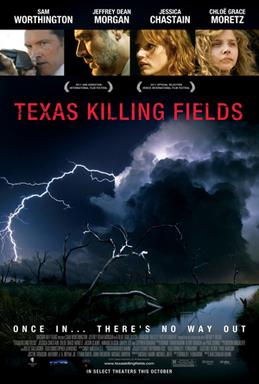
Texas Killing Fields
I'm gonna be honest here. I was aware of this movie, even thought it looked pretty decent despite some middling reviews. I liked the cast and was curious what it would off. But then it sat there on Netflix glaring back at me for quite awhile. What changed my mind? I fell hard for HBO's True Detective -- still working my way through Season 1 -- and wanted to watch a gritty police procedural, hence our sitdown with 2011's Texas Killing Fields.
In Texas City, Texas, a darkness hangs in the air. Unsolved mysteries seem to plague the police department, dead bodies turning up far too often in the maze-like, trance-like bayous that surround the oil fields to the point the area is dubbed 'the Killing Fields.' Two detectives, Mike Souder (Sam Worthington) and Brian Heigh (Jeffrey Dean Morgan), are called in to investigate when a dead body turns up, a teenage girl who may have had ties with drugs and prostitution. A former NYC cop, Heigh is still adjusting to a different style, a different way of investigating while Souder grew up learning the system. The clues don't seem to lead anywhere and everywhere at the same time. Heigh begins to suspect they may be dealing with a serial killer, but can the two detectives put it all together? When they receive a call from the killer as he executes a victim, their motivations become amped up even more.
This movie should have been better. There, I said it. 'Fields' comes from director Ami Canaan Mann -- daughter of Michael Mann -- and certainly has a lot of potential. The story is loosely based on a true story of the murders of many women along a stretch of road in Texas along the I-45 corridor. I really liked the style, the darkness, the sense of doom that hangs in the air. Cinematographer Stuart Dryburgh films a story that is uncomfortable, dark and eerie, like evil is hanging in the air, composer Dickon Hinchliffe's score aiding the cause in creating that ever so dark mood. The bayous just have something dark about them, these expansive yet claustrophobic fields holding all sorts of doom and evil. It doesn't have much of a positive outlook on life, evil waiting to descend on all of us. Hard to beat that in a police procedural where the detectives are pushed to their absolute limits to find the murderer.
With some obvious dark drama, the variation here is on the buddy cop flick (hold the laughs of course). I'm a fan of both Jeffrey Dean Morgan and Sam Worthington so it was cool to see them paired up as two very different cops. Their differences, their dynamic works well. Morgan's Brian is the crusader, wanting to save everyone and anyone he can, becoming obsessed with the cases that cross his desk. Worthington's Mike similarly wants to solve each case, but he's also been worn down by the region he's worked in for so long. Murder is far from accepted, but there's also little surprise in this veteran cop when new bodies pop up. Their differing outlooks clash, their arguments fueling the case. Brian sees the potential that the newest victim is tied in with other unsolved murders. Mike simply wants to find the murderer as it impacts his jurisdiction. Two solid if unspectacular performances.
Because the case drama isn't enough, we need some personal drama. Mike's ex-wife and a detective from the state police is played by Jessica Chastain in a wasted part, the drama never really clicking. Chloe Grace Moretz is good as little Anne, a teenage girl who Brian keeps helping because her mother works as a prostitute at home. Jason Clarke, Stephen Graham, James Hebert and Jon Eyez play possible suspects in the case.
So style to burn, stock characters who are still interesting, what's missing? Simply put...the story. It's so convoluted that nothing ever clicks together. There's the one victim, then there's others, then there are others that may have been from other murderers. Who are we looking for? Are the killers those ones or these ones? Sure, I'm convinced that's what actual police and detective work is really like. Leads that don't go anywhere, leads and clues that are misleading, suspects who can't be convicted. It's all there. But in a 105-minute movie why pack all this in there? I was never quite sure what was going on, a huge red herring going absolutely nowhere. Realistic? Most likely. Good for the sake of the story? Nope. A disappointing end result.
Texas Killing Fields (2011): **/****
In Texas City, Texas, a darkness hangs in the air. Unsolved mysteries seem to plague the police department, dead bodies turning up far too often in the maze-like, trance-like bayous that surround the oil fields to the point the area is dubbed 'the Killing Fields.' Two detectives, Mike Souder (Sam Worthington) and Brian Heigh (Jeffrey Dean Morgan), are called in to investigate when a dead body turns up, a teenage girl who may have had ties with drugs and prostitution. A former NYC cop, Heigh is still adjusting to a different style, a different way of investigating while Souder grew up learning the system. The clues don't seem to lead anywhere and everywhere at the same time. Heigh begins to suspect they may be dealing with a serial killer, but can the two detectives put it all together? When they receive a call from the killer as he executes a victim, their motivations become amped up even more.
This movie should have been better. There, I said it. 'Fields' comes from director Ami Canaan Mann -- daughter of Michael Mann -- and certainly has a lot of potential. The story is loosely based on a true story of the murders of many women along a stretch of road in Texas along the I-45 corridor. I really liked the style, the darkness, the sense of doom that hangs in the air. Cinematographer Stuart Dryburgh films a story that is uncomfortable, dark and eerie, like evil is hanging in the air, composer Dickon Hinchliffe's score aiding the cause in creating that ever so dark mood. The bayous just have something dark about them, these expansive yet claustrophobic fields holding all sorts of doom and evil. It doesn't have much of a positive outlook on life, evil waiting to descend on all of us. Hard to beat that in a police procedural where the detectives are pushed to their absolute limits to find the murderer.
With some obvious dark drama, the variation here is on the buddy cop flick (hold the laughs of course). I'm a fan of both Jeffrey Dean Morgan and Sam Worthington so it was cool to see them paired up as two very different cops. Their differences, their dynamic works well. Morgan's Brian is the crusader, wanting to save everyone and anyone he can, becoming obsessed with the cases that cross his desk. Worthington's Mike similarly wants to solve each case, but he's also been worn down by the region he's worked in for so long. Murder is far from accepted, but there's also little surprise in this veteran cop when new bodies pop up. Their differing outlooks clash, their arguments fueling the case. Brian sees the potential that the newest victim is tied in with other unsolved murders. Mike simply wants to find the murderer as it impacts his jurisdiction. Two solid if unspectacular performances.
Because the case drama isn't enough, we need some personal drama. Mike's ex-wife and a detective from the state police is played by Jessica Chastain in a wasted part, the drama never really clicking. Chloe Grace Moretz is good as little Anne, a teenage girl who Brian keeps helping because her mother works as a prostitute at home. Jason Clarke, Stephen Graham, James Hebert and Jon Eyez play possible suspects in the case.
So style to burn, stock characters who are still interesting, what's missing? Simply put...the story. It's so convoluted that nothing ever clicks together. There's the one victim, then there's others, then there are others that may have been from other murderers. Who are we looking for? Are the killers those ones or these ones? Sure, I'm convinced that's what actual police and detective work is really like. Leads that don't go anywhere, leads and clues that are misleading, suspects who can't be convicted. It's all there. But in a 105-minute movie why pack all this in there? I was never quite sure what was going on, a huge red herring going absolutely nowhere. Realistic? Most likely. Good for the sake of the story? Nope. A disappointing end result.
Texas Killing Fields (2011): **/****
Wednesday, April 2, 2014
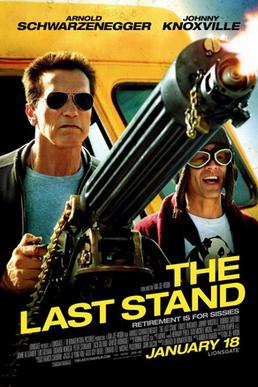
The Last Stand
It's good to have Arnold Schwarzenegger back. That is all. Elected Governor of California in 2003, the action star served two terms, putting his film career on hold for the time being. He returned to movies with The Expendables, a slightly bigger part in its sequel and officially took a key supporting role in last year's Escape Plan. But now, it's time for a leading role in a good, old-fashioned shoot 'em up, 2013's The Last Stand.
In the quiet border town of Sommerset Junction in Arizona, Sheriff Ray Towns (Schwarzenegger) enjoys a peaceful, restful life after years of serving in the L.A.P.D. Narcotics and Tactical Division. Well, that idyllic, peaceful life is about to get thrown a curve. With much of the town following the high school football team on a road game, Towns gets a call that someone has been murdered. His deputies stumble upon something in the desert, heavily armed ex-military firing on the deputies. At the same time, Towns gets another call, this time from FBI agent Bannister (Forest Whitaker), with a warning. A highly dangerous leader of a powerful drug cartel, Gabriel Cortez (Eduardo Noriega), has led a bloody escape and is making a beeline for Mexico in a modified, souped-up sports car. Bannister believes Cortez is heading right to Sommerset Junction. Towns figures Cortez's plan out, ex-military and all, but can he and his motley crew of deputies stop Cortez?
Ah, action movies, how I love you. This flick didn't do much business last year in theaters -- netting a little over $48 million -- but I remember catching the first trailer for this and being intrigued. This wasn't a movie I was dying to see, that I needed to see, but could it be good? Oh, you bet, and that's what it is in the end. From director Kim Jee-woon, 'Stand' is an entertaining, well-done action movie that's cheesy and goofy, blending some fun characters with one-liners, lots of bloody action and a straightforward good guys vs. bad guys premise. It isn't interested in rewriting the genre, and that's fine. In a lot of ways, it reminded me of last year's 2 Guns, a type of crime action movie that was really popular in the 1970s, especially with the U.S./Mexico border setting. Just enjoy it. Don't overthink it.
Schwarzenegger!!! It's fun to see one of Hollywood's all-time great action stars getting back to business. I got a taste of his return in Escape Plan (his parts in the Expendables are cameos as part of an ensemble, nothing more), but this is where it's at, the Governator in a lead role. Working off a script from Andrew Knauer, Schwarzenegger makes it look easy, even effortless, but he's always got that energy for the action. In other words, there's never a sense that he is phoning it in. Sure, the script has some fun with the 67-year old action star, but it's all in good fun. My favorite? "Sheriff, how are you?" to which Towns answers "Old" having crashed through a window. His backstory is handled in a quick explanatory scene, giving some depth to the small town country sheriff that's pretty familiar in action movies. How does Andy Taylor, um, uh....Arnold Schwarzenegger respond? With a whole lot of shootouts, gunfights and knock-down fist fights, as we've come to expect.
Who else to watch out for? Whitaker does his best as the city boy, the FBI agent who doesn't think a country sheriff could possibly know what he's talking about....even though the polished FBI agent just let a death row prisoner escape. Whitaker disappears in the second half as the action escalates, reappearing late. Johnny Knoxville has the comedic relief as Lewis Dinkum, the town kook with a warehouse full of guns, a part that's just right, not overused or overdone. Jaimie Alexander and Luiz Guzman are Towns' deputies, Rodrigo Santoro playing a town resident who teams up with the crew for the fight. Noriega is a more than worthy villain, his Cortez dripping with intensity and absolutely no fear, Genesis Rodriguez his "unwilling hostage." And because every cartel villain needs an over the top henchman, we get Peter Stormare as Burrell, the leader of the ex-military setting the ground work for Cortez's escape over the border. Also, look for Hollywood veteran and great character actor Harry Dean Stanton in a small uncredited part early.
With a movie that clocks in at 107 minutes, we're never long in between action scenes (and take away 6, 7 minutes for a long credit sequence). Cortez's escape is a good start -- reminding me somewhat of 2003's S.W.A.T. -- as the FBI scrambles to get him back. The highlight comes at the hour-mark, Cortez's advance crew descending on Sommerton where Towns and his deputies are waiting. It's entertaining and bloody and all over the place, bad guys dispatched with a head shot and a cool one-liner. Towns' entrance into the shootout is pretty epic too, Santoro driving a school bus, Schwarzenegger and Knoxville in the back with a seemingly ancient Vickers machine gun. The action is almost non-stop, but it's basically one sequence on top of another over the last hour. The finale between Towns and Cortez at the border is a whopper too, preceded by an epic car chase through a cornfield because....well, because car chases are cool.
Just a fun movie with some familiar touches, even the 1959 classic Rio Bravo. Sit back and enjoy it, welcoming back Aaaahnold.
The Last Stand (2013): ***/****
In the quiet border town of Sommerset Junction in Arizona, Sheriff Ray Towns (Schwarzenegger) enjoys a peaceful, restful life after years of serving in the L.A.P.D. Narcotics and Tactical Division. Well, that idyllic, peaceful life is about to get thrown a curve. With much of the town following the high school football team on a road game, Towns gets a call that someone has been murdered. His deputies stumble upon something in the desert, heavily armed ex-military firing on the deputies. At the same time, Towns gets another call, this time from FBI agent Bannister (Forest Whitaker), with a warning. A highly dangerous leader of a powerful drug cartel, Gabriel Cortez (Eduardo Noriega), has led a bloody escape and is making a beeline for Mexico in a modified, souped-up sports car. Bannister believes Cortez is heading right to Sommerset Junction. Towns figures Cortez's plan out, ex-military and all, but can he and his motley crew of deputies stop Cortez?
Ah, action movies, how I love you. This flick didn't do much business last year in theaters -- netting a little over $48 million -- but I remember catching the first trailer for this and being intrigued. This wasn't a movie I was dying to see, that I needed to see, but could it be good? Oh, you bet, and that's what it is in the end. From director Kim Jee-woon, 'Stand' is an entertaining, well-done action movie that's cheesy and goofy, blending some fun characters with one-liners, lots of bloody action and a straightforward good guys vs. bad guys premise. It isn't interested in rewriting the genre, and that's fine. In a lot of ways, it reminded me of last year's 2 Guns, a type of crime action movie that was really popular in the 1970s, especially with the U.S./Mexico border setting. Just enjoy it. Don't overthink it.
Schwarzenegger!!! It's fun to see one of Hollywood's all-time great action stars getting back to business. I got a taste of his return in Escape Plan (his parts in the Expendables are cameos as part of an ensemble, nothing more), but this is where it's at, the Governator in a lead role. Working off a script from Andrew Knauer, Schwarzenegger makes it look easy, even effortless, but he's always got that energy for the action. In other words, there's never a sense that he is phoning it in. Sure, the script has some fun with the 67-year old action star, but it's all in good fun. My favorite? "Sheriff, how are you?" to which Towns answers "Old" having crashed through a window. His backstory is handled in a quick explanatory scene, giving some depth to the small town country sheriff that's pretty familiar in action movies. How does Andy Taylor, um, uh....Arnold Schwarzenegger respond? With a whole lot of shootouts, gunfights and knock-down fist fights, as we've come to expect.
Who else to watch out for? Whitaker does his best as the city boy, the FBI agent who doesn't think a country sheriff could possibly know what he's talking about....even though the polished FBI agent just let a death row prisoner escape. Whitaker disappears in the second half as the action escalates, reappearing late. Johnny Knoxville has the comedic relief as Lewis Dinkum, the town kook with a warehouse full of guns, a part that's just right, not overused or overdone. Jaimie Alexander and Luiz Guzman are Towns' deputies, Rodrigo Santoro playing a town resident who teams up with the crew for the fight. Noriega is a more than worthy villain, his Cortez dripping with intensity and absolutely no fear, Genesis Rodriguez his "unwilling hostage." And because every cartel villain needs an over the top henchman, we get Peter Stormare as Burrell, the leader of the ex-military setting the ground work for Cortez's escape over the border. Also, look for Hollywood veteran and great character actor Harry Dean Stanton in a small uncredited part early.
With a movie that clocks in at 107 minutes, we're never long in between action scenes (and take away 6, 7 minutes for a long credit sequence). Cortez's escape is a good start -- reminding me somewhat of 2003's S.W.A.T. -- as the FBI scrambles to get him back. The highlight comes at the hour-mark, Cortez's advance crew descending on Sommerton where Towns and his deputies are waiting. It's entertaining and bloody and all over the place, bad guys dispatched with a head shot and a cool one-liner. Towns' entrance into the shootout is pretty epic too, Santoro driving a school bus, Schwarzenegger and Knoxville in the back with a seemingly ancient Vickers machine gun. The action is almost non-stop, but it's basically one sequence on top of another over the last hour. The finale between Towns and Cortez at the border is a whopper too, preceded by an epic car chase through a cornfield because....well, because car chases are cool.
Just a fun movie with some familiar touches, even the 1959 classic Rio Bravo. Sit back and enjoy it, welcoming back Aaaahnold.
The Last Stand (2013): ***/****
Wednesday, December 18, 2013
Welcome to the Punch
You would recognize the face if not the name. Mark Strong has been working in film and television since the late 1980s, early 1990s, but over the last four years he's become a far more recognizable face, a talented actor who's finally getting his due. This year, he even starred in an AMC cop drama, Low Winter Sun. I've become a big fan of Strong, and it's been more than cool to see him get some starring roles in film too, like 2013's Welcome to the Punch.
A young, motivated detective in London, Max Lewinsky (James McAvoy) has been working a case for months, desperately trying to catch infamous bank robber and thief Jacob Sternwood (Strong). Following one successful robbery, Sternwood is even cornered by Lewinsky but shoots him in the leg and manages to escape, the police unable to find him. Three years pass, and a 20-something who turns out to be Sternwood's son is caught on a tarmac with a gunshot wound. How did he get there? Who did it to him? With one phone call, he calls his father, the police following the clues to his hideout in Iceland. Now, Sternwood's son is in intensive care, Lewinsky suggesting they make that fact known through the criminal underground. The bait has been laid out for Sternwood's return, Lewinsky waiting to strike. As things come together though, the rivals realize they may need to work together to take out a common enemy.
Ever hear of this one? Yeah, me neither. According to IMDB, 'Punch' was released in theaters in the U.S. on four screens over two weekends last spring. It grossed a whopping $6,787 over that two-week release. Not bad, huh? So yeah, that's why we've never heard of it. I only stumbled on it at Netflix, and I'm glad I did. From director/writer Eran Creevy, 'Punch' borrows from some previous crime thrillers (British and otherwise), sampling everything from Michael Mann to Guy Ritchie. It's only 99-minutes long, but covers a lot of ground in that short(ish) running time. Very stylish, much of the story taking place at night, filmed in the shadows, dark clubs, dank alleyways, with some cool characters (even if they're familiar, seen them in other movies), a twisting story and some ridiculously stylized, cool action scenes.
If there is a complaint, it's easy to peg. Creevy's script tries to accomplish a lot. Sampling from the crime thriller genre, there's a lot of familiar characters, lots of familiar situations and not enough time to deal with it all. We get police partner drama, Lewinsky working through some personal drama with his partner, Sarah Hawks (Andrea Riseborough, of Oblivion). We get police corruption, Lewinsky having to decide who among the force (David Morrissey, Daniel Mays, Jason Flemyng, Daniel Kaluuya) who is clean and who is corrupt. Oh, there's also conspiracies involving an upcoming election, a social issue about police in England working unarmed, and a huge international corporation who may or may not be involved with the election. To say it is slightly convoluted would be slightly underselling the story, but it does all come together in the end. Just bear with it at times and go with it.
Not so surprising is that the best part is the focus on the rivalry between McAvoy's Lewinsky and Strong's Sternwood. The young, driven cop and the experienced, grizzled criminal are archetypal characters in the crime thriller genre, and more than that, those two different characters being forced to work together is a whole sub-genre from 48 Hours to Midnight Run and many others. They're familiar characters, but McAvoy and Strong breathe some life into them, giving the twisting and turning story some sort of base to come back to. McAvoy's Lewinsky has spent years brewing over the showdown that Sternwood that didn't go his way. Strong's Sternwood has left his past behind, only to be thrust back into it when his son gets involved in a crime where the details are more than fuzzy. I liked both characters -- and that goes a long way -- and liked it more when they're forced to put their differences aside and work together to take out a common enemy. Familiar but good.
Now onto something that may come out of left field. I like action scenes. I know...blew me away too. There's got to be something appealing about an action scene -- shootout, car chase, fist fight -- to make it memorable. The biggest thing going here? Composer Harry Escott's score is ridiculously appropriate for the action, the characters and the story. It's big...real BIG and not subtle at all. Listen to the entire soundtrack HERE. It makes the action -- more than solid in itself -- an experience to watch. There's some quick, hyper editing I typically don't go for, some epically slow motion sequences, all things we've seen before, but it Just Works here. The word that kept coming up was 'visceral.' These action scenes make you feel the action, a shiver up your spine, a goosebump on your arm. It's that cool factor that's just hard to explain, but hits you in the right way.
Without rewriting the genre, 'Punch' is able to be its own film. I liked it a lot, partially because I love police dramas and crime thrillers, but also because it is a genuinely good movie. Definitely worth checking out.
Welcome to the Punch (2013): ***/****
A young, motivated detective in London, Max Lewinsky (James McAvoy) has been working a case for months, desperately trying to catch infamous bank robber and thief Jacob Sternwood (Strong). Following one successful robbery, Sternwood is even cornered by Lewinsky but shoots him in the leg and manages to escape, the police unable to find him. Three years pass, and a 20-something who turns out to be Sternwood's son is caught on a tarmac with a gunshot wound. How did he get there? Who did it to him? With one phone call, he calls his father, the police following the clues to his hideout in Iceland. Now, Sternwood's son is in intensive care, Lewinsky suggesting they make that fact known through the criminal underground. The bait has been laid out for Sternwood's return, Lewinsky waiting to strike. As things come together though, the rivals realize they may need to work together to take out a common enemy.
Ever hear of this one? Yeah, me neither. According to IMDB, 'Punch' was released in theaters in the U.S. on four screens over two weekends last spring. It grossed a whopping $6,787 over that two-week release. Not bad, huh? So yeah, that's why we've never heard of it. I only stumbled on it at Netflix, and I'm glad I did. From director/writer Eran Creevy, 'Punch' borrows from some previous crime thrillers (British and otherwise), sampling everything from Michael Mann to Guy Ritchie. It's only 99-minutes long, but covers a lot of ground in that short(ish) running time. Very stylish, much of the story taking place at night, filmed in the shadows, dark clubs, dank alleyways, with some cool characters (even if they're familiar, seen them in other movies), a twisting story and some ridiculously stylized, cool action scenes.
If there is a complaint, it's easy to peg. Creevy's script tries to accomplish a lot. Sampling from the crime thriller genre, there's a lot of familiar characters, lots of familiar situations and not enough time to deal with it all. We get police partner drama, Lewinsky working through some personal drama with his partner, Sarah Hawks (Andrea Riseborough, of Oblivion). We get police corruption, Lewinsky having to decide who among the force (David Morrissey, Daniel Mays, Jason Flemyng, Daniel Kaluuya) who is clean and who is corrupt. Oh, there's also conspiracies involving an upcoming election, a social issue about police in England working unarmed, and a huge international corporation who may or may not be involved with the election. To say it is slightly convoluted would be slightly underselling the story, but it does all come together in the end. Just bear with it at times and go with it.
Not so surprising is that the best part is the focus on the rivalry between McAvoy's Lewinsky and Strong's Sternwood. The young, driven cop and the experienced, grizzled criminal are archetypal characters in the crime thriller genre, and more than that, those two different characters being forced to work together is a whole sub-genre from 48 Hours to Midnight Run and many others. They're familiar characters, but McAvoy and Strong breathe some life into them, giving the twisting and turning story some sort of base to come back to. McAvoy's Lewinsky has spent years brewing over the showdown that Sternwood that didn't go his way. Strong's Sternwood has left his past behind, only to be thrust back into it when his son gets involved in a crime where the details are more than fuzzy. I liked both characters -- and that goes a long way -- and liked it more when they're forced to put their differences aside and work together to take out a common enemy. Familiar but good.
Now onto something that may come out of left field. I like action scenes. I know...blew me away too. There's got to be something appealing about an action scene -- shootout, car chase, fist fight -- to make it memorable. The biggest thing going here? Composer Harry Escott's score is ridiculously appropriate for the action, the characters and the story. It's big...real BIG and not subtle at all. Listen to the entire soundtrack HERE. It makes the action -- more than solid in itself -- an experience to watch. There's some quick, hyper editing I typically don't go for, some epically slow motion sequences, all things we've seen before, but it Just Works here. The word that kept coming up was 'visceral.' These action scenes make you feel the action, a shiver up your spine, a goosebump on your arm. It's that cool factor that's just hard to explain, but hits you in the right way.
Without rewriting the genre, 'Punch' is able to be its own film. I liked it a lot, partially because I love police dramas and crime thrillers, but also because it is a genuinely good movie. Definitely worth checking out.
Welcome to the Punch (2013): ***/****
Labels:
2010s,
British crime,
Cops,
James McAvoy,
Jason Flemyng,
Mark Strong
Wednesday, December 4, 2013
The Detective
Movie star, actor, singer and entertainer, Frank Sinatra was able to pick and choose his roles as he saw fit by 1968. He picked movies he wanted to do, not just for the sake of doing a movie. With 1968's The Detective, Sinatra was at the helm of a police drama that was ahead of its time and helped kick the door open for where the genre would go at the end of the 1960s and into the 1970s.
A veteran detective with years of experience in New York City, Joe Leland (Sinatra) has seen it all, and it's starting to wear on him more than a little bit. He's been called in to investigate a particularly gruesome murder, the son of a rich businessman killed and disfigured. Rumor has it the dead man was gay, Leland and his fellow detectives forced to explore the gay sub-culture (its the 1960s, just go with it) to see if they can track down the murderer. The case has gained notoriety in the headlines, putting Leland and the precinct in the spotlight to solve it and solve it quickly. It's the kind of case that can make or break a police officer. Solve it and quickly rise through the ranks? Don't? Well, a scapegoat will be needed. It's not the only case on the docket though, crimes -- murders and more -- rolling in on a daily basis. Hopefully, Leland can keep it together long enough to find his man.
The appeal in this police drama from director Gordon Douglas is obvious. Made during one of the most turbulent times in Hollywood history (and American history at that point), 'Detective' embraces the sharp-edged, rougher mindset perpetuating the minds of the audiences. It isn't interested in being politically correct...at all. A gay man being murdered (with his penis cut off) provides quite the jumping off point, constant mention of "fags" and "homos," as well as an almost laughable portrayal of a homosexual meeting point. Beyond that though, it's a brutally realistic story in terms of the storytelling. Sex, violence, one-night stands, drugs, city corruption, 'Detective' is ready, willing and able to dive in head first and get dirty.
For all the positives though, there's the obvious counter of the negatives. In a movie that runs 114 minutes, I thought too much time was spent getting to know Sinatra's Leland via a series of flashbacks. It serves to give some cool background, but there's a limit. We see Leland meet Karen (Lee Remick) who he eventually marries. If cop movies have taught us anything though, it's that a cop's marriage has never gone smoothly in the history of law enforcement. The subject matter may have seemed ahead of its time in 1968, but it makes the story lag. We hear Joe talk about all the women he's been with, we hear Karen discuss her troubled past, her series of one-night stands, her inability to hold a relationship. A little bawdy if you ask me (that's sarcasm by the way). Seeing Remick's Karen say 'Let me make love to you this time' is a little scandalous for the time, but when the murder cases are far more interesting, those wavy-screened flashbacks kill the momentum.
I've always thought Sinatra was an underrated actor. Was he a great actor? No, but he was far better than people remember him. He does a no-nonsense tough guy like nobody's business. As we see with his dating/marrying Karen, Joe is exceptionally smooth, looking like he's almost bored with the process. He's that cool. More than that though, I appreciated the human side of Sinatra's part as longtime detective Joe Leland. The job is beating him down as he sees the lowest of lows, what people can do to each other in day-to-day life. He comes from a family of police officers and does it because it's in his blood, not because he loves it. Joe is good at what he does, but as he sees the violence and corruption, he begins to question how much more he can take. Uninterested in being a PR police man, he wants to do his job. An underrated part, Sinatra is the best part of this one.
Give Sinatra credit when it's due. Other actors wanted to work with the guy. Including Remick, the cast is pretty impressive. The list of Leland's fellow detectives include Robert Duvall, Jack Klugman, Ralph Meeker and Al Freeman Jr, Horace McMahon playing the precinct commander. Jacqueline Bisset plays a widow who approaches Leland with a case involving her dead husband, supposedly by suicide but she believes otherwise. Also look for Tony Musante, Lloyd Bochner and William Windom as possible suspects in the cases Leland is pursuing.
I wanted to like this one more, mostly because there was so much potential for a really good to maybe even near-classic status. The flaws are pretty big though, especially the intense focus on Leland's personal life. I thought the twists in the movie's last act were pretty solid too, catching me by surprise, but even in that aspect, the execution is pretty weak as the film limps to the finish. Really good performance from Sinatra and a solid cast overall, but it never lives up to what it could have been.
The Detective (1968): **/****
A veteran detective with years of experience in New York City, Joe Leland (Sinatra) has seen it all, and it's starting to wear on him more than a little bit. He's been called in to investigate a particularly gruesome murder, the son of a rich businessman killed and disfigured. Rumor has it the dead man was gay, Leland and his fellow detectives forced to explore the gay sub-culture (its the 1960s, just go with it) to see if they can track down the murderer. The case has gained notoriety in the headlines, putting Leland and the precinct in the spotlight to solve it and solve it quickly. It's the kind of case that can make or break a police officer. Solve it and quickly rise through the ranks? Don't? Well, a scapegoat will be needed. It's not the only case on the docket though, crimes -- murders and more -- rolling in on a daily basis. Hopefully, Leland can keep it together long enough to find his man.
The appeal in this police drama from director Gordon Douglas is obvious. Made during one of the most turbulent times in Hollywood history (and American history at that point), 'Detective' embraces the sharp-edged, rougher mindset perpetuating the minds of the audiences. It isn't interested in being politically correct...at all. A gay man being murdered (with his penis cut off) provides quite the jumping off point, constant mention of "fags" and "homos," as well as an almost laughable portrayal of a homosexual meeting point. Beyond that though, it's a brutally realistic story in terms of the storytelling. Sex, violence, one-night stands, drugs, city corruption, 'Detective' is ready, willing and able to dive in head first and get dirty.
For all the positives though, there's the obvious counter of the negatives. In a movie that runs 114 minutes, I thought too much time was spent getting to know Sinatra's Leland via a series of flashbacks. It serves to give some cool background, but there's a limit. We see Leland meet Karen (Lee Remick) who he eventually marries. If cop movies have taught us anything though, it's that a cop's marriage has never gone smoothly in the history of law enforcement. The subject matter may have seemed ahead of its time in 1968, but it makes the story lag. We hear Joe talk about all the women he's been with, we hear Karen discuss her troubled past, her series of one-night stands, her inability to hold a relationship. A little bawdy if you ask me (that's sarcasm by the way). Seeing Remick's Karen say 'Let me make love to you this time' is a little scandalous for the time, but when the murder cases are far more interesting, those wavy-screened flashbacks kill the momentum.
I've always thought Sinatra was an underrated actor. Was he a great actor? No, but he was far better than people remember him. He does a no-nonsense tough guy like nobody's business. As we see with his dating/marrying Karen, Joe is exceptionally smooth, looking like he's almost bored with the process. He's that cool. More than that though, I appreciated the human side of Sinatra's part as longtime detective Joe Leland. The job is beating him down as he sees the lowest of lows, what people can do to each other in day-to-day life. He comes from a family of police officers and does it because it's in his blood, not because he loves it. Joe is good at what he does, but as he sees the violence and corruption, he begins to question how much more he can take. Uninterested in being a PR police man, he wants to do his job. An underrated part, Sinatra is the best part of this one.
Give Sinatra credit when it's due. Other actors wanted to work with the guy. Including Remick, the cast is pretty impressive. The list of Leland's fellow detectives include Robert Duvall, Jack Klugman, Ralph Meeker and Al Freeman Jr, Horace McMahon playing the precinct commander. Jacqueline Bisset plays a widow who approaches Leland with a case involving her dead husband, supposedly by suicide but she believes otherwise. Also look for Tony Musante, Lloyd Bochner and William Windom as possible suspects in the cases Leland is pursuing.
I wanted to like this one more, mostly because there was so much potential for a really good to maybe even near-classic status. The flaws are pretty big though, especially the intense focus on Leland's personal life. I thought the twists in the movie's last act were pretty solid too, catching me by surprise, but even in that aspect, the execution is pretty weak as the film limps to the finish. Really good performance from Sinatra and a solid cast overall, but it never lives up to what it could have been.
The Detective (1968): **/****
Wednesday, October 9, 2013
The Heat
Right or wrong, what do you think of when you hear 'buddy cop'? I think of Mel Gibson and Danny Glover in the Lethal Weapon series, Will Smith and Martin Lawrence in Bad Boys, Eddie Murphy and Nick Nolte in 48 Hrs. What's the common link? For lack of a better description......it's usually dude buddy cop movies. Until now that is!!! Here we go with 2013's The Heat.
Working out of the branch office, FBI agent Sarah Ashburn (Sandra Bullock) is a very capable agent who's closed her fair share of cases, but all her fellow agents despise her. A supervisor position has opened up, and Ashburn wants nothing more than that promotion but because of her all-around popularity her chances of getting is are slim. She's tasked with going to Boston to help take down a new drug supplier on the scene, a man with no witnesses against him and little evidence. Where to start? Ashburn meets Shannon Mullins (Melissa McCarthy), a hard-edged police officer not too interested in physical appearance or...well, following the rules most police officers live by. Ashburn wants to do things her way but Mullins knows Boston, her sources and the streets. Forming an unlikely partnership that's more of a rivalry, they jump head first into the case, if they don't kill each other first.
Is it a bad thing if you call a movie 'predictable'? I suppose it can be depending on the description, but I don't intend it here. This buddy cop movie with female cops from director Paul Feig (written by Katie Dippold) is very good, very funny and very entertaining from beginning to end. Audiences certainly liked it this past summer, 'Heat' earning over $200 million in theaters. It is R-rated so in the vein of Bridesmaids -- also starring McCarthy -- we get a darker, filthier and far more foul-mouthed comedy with female actresses and comedians getting a chance to be funny. Novel concept, isn't it? There's cursing, raunchiness, some surprising (if not truly graphic) violence and plenty of laughs along the way. Went in hoping for a funny movie if nothing else but came away impressed with a very funny movie with lots of memorable bits and lines.
It is a buddy cop flick though so let's talk about some buddy cops. That type of movie -- male, female, monkeys -- and their successes or failures depend almost entirely on the casting and chemistry. Do you like the buddies? It's hard not to like the pairing here, Bullock and McCarthy showing off that effortless back and forth banter that elevates Dippold's script a notch or two just by their line deliveries. Bullock's Ashburn is the buttoned-down, suit-wearing, all business, all professional agent who does things by the book. McCarthy's Mullins is all about results, wears sweat pants at basically all times, lives in a filthy apartment, isn't worried about making people happy, and generally just has fun with life. Yes, the Odd Couple of Cops. You can tell they like working together, and that's nothing but a positive. The duo is in virtually every scene together so that ain't bad either.
My issue with previous McCarthy parts has nothing to do with whether she's funny or not. She is. She's hilarious. But in Identity Thief and her supporting part in This is 40, it just goes too far. Her improvised bits go on to the point that it's painful to watch. That being said.........ready for a 180 degree change.......'Heat' avoids all those issues. Sure, a fair share of jokes are in horrific taste, but with the right dosage, horrific taste can be funny. McCarthy is as good at physical comedy as just delivering a line, a real double comedic threat. The story is predictable because we know they'll butt heads, see they have to work together, and then become the unlikeliest of friends. The jokes keep things moving in an episodic story that follows the case. The end game, the twist, the reveal, it's all pretty unnecessary. We know where things are going. The jokes are funny, and the purpose is to let Bullock and McCarthy have a ton of fun together. Do we really care who the drug dealer is? Nah, just go along for the ride.
The rest of the cast is solid if unspectacular, filling in the parts around our buddy cop duo in the spotlight. Demian Bichir is Hale, Ashburn's FBI supervisor, with Marlon Wayans playing an FBI agent in Boston aiding the case. Dan Bakkedahl and Taran Killam are two DEA agents following their own evidence on the case, Spoken Reasons is Rojas, a dealer Mullins keeps running into, Michael McDonald is Julian, the right-hand man to the drug supplier, Jane Curtin (underused) and Michael Rapaport as some of Mullins' family, and Thomas F. Wilson as Captain Woods, Mullins' much-maligned precinct commander.
Just a good funny movie. If it doesn't rewrite the comedy or buddy cop genre, so be it. Sit back and enjoy Bullock and McCarthy having a ton of fun together.
The Heat (2013): ***/****
Working out of the branch office, FBI agent Sarah Ashburn (Sandra Bullock) is a very capable agent who's closed her fair share of cases, but all her fellow agents despise her. A supervisor position has opened up, and Ashburn wants nothing more than that promotion but because of her all-around popularity her chances of getting is are slim. She's tasked with going to Boston to help take down a new drug supplier on the scene, a man with no witnesses against him and little evidence. Where to start? Ashburn meets Shannon Mullins (Melissa McCarthy), a hard-edged police officer not too interested in physical appearance or...well, following the rules most police officers live by. Ashburn wants to do things her way but Mullins knows Boston, her sources and the streets. Forming an unlikely partnership that's more of a rivalry, they jump head first into the case, if they don't kill each other first.
Is it a bad thing if you call a movie 'predictable'? I suppose it can be depending on the description, but I don't intend it here. This buddy cop movie with female cops from director Paul Feig (written by Katie Dippold) is very good, very funny and very entertaining from beginning to end. Audiences certainly liked it this past summer, 'Heat' earning over $200 million in theaters. It is R-rated so in the vein of Bridesmaids -- also starring McCarthy -- we get a darker, filthier and far more foul-mouthed comedy with female actresses and comedians getting a chance to be funny. Novel concept, isn't it? There's cursing, raunchiness, some surprising (if not truly graphic) violence and plenty of laughs along the way. Went in hoping for a funny movie if nothing else but came away impressed with a very funny movie with lots of memorable bits and lines.
It is a buddy cop flick though so let's talk about some buddy cops. That type of movie -- male, female, monkeys -- and their successes or failures depend almost entirely on the casting and chemistry. Do you like the buddies? It's hard not to like the pairing here, Bullock and McCarthy showing off that effortless back and forth banter that elevates Dippold's script a notch or two just by their line deliveries. Bullock's Ashburn is the buttoned-down, suit-wearing, all business, all professional agent who does things by the book. McCarthy's Mullins is all about results, wears sweat pants at basically all times, lives in a filthy apartment, isn't worried about making people happy, and generally just has fun with life. Yes, the Odd Couple of Cops. You can tell they like working together, and that's nothing but a positive. The duo is in virtually every scene together so that ain't bad either.
My issue with previous McCarthy parts has nothing to do with whether she's funny or not. She is. She's hilarious. But in Identity Thief and her supporting part in This is 40, it just goes too far. Her improvised bits go on to the point that it's painful to watch. That being said.........ready for a 180 degree change.......'Heat' avoids all those issues. Sure, a fair share of jokes are in horrific taste, but with the right dosage, horrific taste can be funny. McCarthy is as good at physical comedy as just delivering a line, a real double comedic threat. The story is predictable because we know they'll butt heads, see they have to work together, and then become the unlikeliest of friends. The jokes keep things moving in an episodic story that follows the case. The end game, the twist, the reveal, it's all pretty unnecessary. We know where things are going. The jokes are funny, and the purpose is to let Bullock and McCarthy have a ton of fun together. Do we really care who the drug dealer is? Nah, just go along for the ride.
The rest of the cast is solid if unspectacular, filling in the parts around our buddy cop duo in the spotlight. Demian Bichir is Hale, Ashburn's FBI supervisor, with Marlon Wayans playing an FBI agent in Boston aiding the case. Dan Bakkedahl and Taran Killam are two DEA agents following their own evidence on the case, Spoken Reasons is Rojas, a dealer Mullins keeps running into, Michael McDonald is Julian, the right-hand man to the drug supplier, Jane Curtin (underused) and Michael Rapaport as some of Mullins' family, and Thomas F. Wilson as Captain Woods, Mullins' much-maligned precinct commander.
Just a good funny movie. If it doesn't rewrite the comedy or buddy cop genre, so be it. Sit back and enjoy Bullock and McCarthy having a ton of fun together.
The Heat (2013): ***/****
Labels:
2010s,
Comedy,
Cops,
Demian Bichir,
Melissa McCarthy,
Sandra Bullock
Wednesday, July 17, 2013
Broken City
When you find something you're good at, stick with it, right? Actors can find their niche, that genre where audiences love seeing them in no matter how many times they come back to the well. For me, I've always been a Mark Wahlberg fan, an actor who finds himself playing a police officer in The Other Guys, The Departed, Max Payne, We Own the Night, and The Corruptor. We have a new entry to the listing, 2013's Broken City.
A veteran detective in New York City, Billy Taggart (Wahlberg) is exonerated for the murder of a young Latino man accused of rape and murder. The trial creates all sorts of waves though amongst the population, forcing NYC Mayor Nicholas Hostetler (Russell Crowe) to ask for his resignation. Taggart is stunned but goes along with it, starting up his own P.I. agency. Seven years go by, Billy struggling along to keep the business afloat as he dates his longtime girlfriend (Natalie Martinez). Preparing for another election, Hostetler asks Taggart to take a job for him, investigating the mayor's wife (Catherine Zeta-Jones) who he suspects of having an affair. Promised an impressive payday, Billy takes the job but quickly realizes he hasn't been told everything that's going on. Big business, billions of dollars and even murder is just some of what the ex-cop has stumbled into.
Politics are bad and/or corrupt, the police can be caught up in some shady, criminal stuff, and people in general tend to be pretty greedy and will do anything for a payday and to protect their own behinds. Nothing too crazy, out of left field in that statement, huh? Crime movies use all three premises as jumping off points to the point that they become ultra-familiar. Using all three, 'Broken' doesn't have much new going for it. It adds little to the crime-political thriller that we haven't seen before, but I found myself liking it just the same. Go figure. There is a familiar comfort zone with the story, recognizable characters and a story that does its best to keep us guessing (even if it's never too hard to see where it's going). It struggled in theaters thanks to some less than positive reviews, but it's a movie that genre fans will hopefully get some enjoyment out of.
As a movie fan, it doesn't take much to get me interested in a movie. Case in point? Wahlberg vs. Crowe, two of my favorite actors going toe to toe. Wahlberg is playing that familiar role, the everyman cop who's had some trouble/demons in his past but has seemed to gotten a grasp on his life. Crowe is a hammy scene-stealer as the longtime NYC Mayo who knows the ins and outs of City Hall, NYC and all the city has to offer. It's cool to see him as a bad guy -- albeit a pretty smooth one. Their scenes together are solid, two toughs bouncing off each other well. Wahlberg's part unfortunately goes a little too cliched, his fiery relationship with longtime girlfriend screaming Cop Cliche, especially as it develops in the second half. As the evil, manipulative politician, Crowe's Hostetler doesn't offer much new, but there's talent here to appreciate.
Director Allen Hughes has quite a cast beyond his two leads too, starting with Zeta-Jones in more of a window dressing part as Hostetler's disgruntled wife Kathleen. Also look for Jeffrey Wright as Taggart, the police commissioner who has a less than pleasant working relationship with the mayor, Barry Pepper as the opposing mayoral candidate trying to take down the longtime mayor with Kyle Chandler playing his campaign manager, Alona Tal as Kate, Billy's lone employee and assistant and Michael Beach as Taggart's former partner who has risen through the ranks in the NYPD.
For the most part, this crime-political thriller kept me entertained throughout. It develops through the first hour about the way you would expect. It's near the halfway point that things get thrown for a loop. A twist is thrown our way that I didn't see coming, and then another and another. 'Broken' barely manages to tread that fine line between trying too hard to surprise us and just delivering a good story. It gets a little too dramatic, a little too intense, but the NYC shooting locations provide a good backdrop and composers Atticus Ross, Leopold Ross and Claudia Sarne turn in a good, New Wave-ish musical score.Good, not great and a little cliched crooked cops and politicians story.
Broken City (2013): ***/****
A veteran detective in New York City, Billy Taggart (Wahlberg) is exonerated for the murder of a young Latino man accused of rape and murder. The trial creates all sorts of waves though amongst the population, forcing NYC Mayor Nicholas Hostetler (Russell Crowe) to ask for his resignation. Taggart is stunned but goes along with it, starting up his own P.I. agency. Seven years go by, Billy struggling along to keep the business afloat as he dates his longtime girlfriend (Natalie Martinez). Preparing for another election, Hostetler asks Taggart to take a job for him, investigating the mayor's wife (Catherine Zeta-Jones) who he suspects of having an affair. Promised an impressive payday, Billy takes the job but quickly realizes he hasn't been told everything that's going on. Big business, billions of dollars and even murder is just some of what the ex-cop has stumbled into.
Politics are bad and/or corrupt, the police can be caught up in some shady, criminal stuff, and people in general tend to be pretty greedy and will do anything for a payday and to protect their own behinds. Nothing too crazy, out of left field in that statement, huh? Crime movies use all three premises as jumping off points to the point that they become ultra-familiar. Using all three, 'Broken' doesn't have much new going for it. It adds little to the crime-political thriller that we haven't seen before, but I found myself liking it just the same. Go figure. There is a familiar comfort zone with the story, recognizable characters and a story that does its best to keep us guessing (even if it's never too hard to see where it's going). It struggled in theaters thanks to some less than positive reviews, but it's a movie that genre fans will hopefully get some enjoyment out of.
As a movie fan, it doesn't take much to get me interested in a movie. Case in point? Wahlberg vs. Crowe, two of my favorite actors going toe to toe. Wahlberg is playing that familiar role, the everyman cop who's had some trouble/demons in his past but has seemed to gotten a grasp on his life. Crowe is a hammy scene-stealer as the longtime NYC Mayo who knows the ins and outs of City Hall, NYC and all the city has to offer. It's cool to see him as a bad guy -- albeit a pretty smooth one. Their scenes together are solid, two toughs bouncing off each other well. Wahlberg's part unfortunately goes a little too cliched, his fiery relationship with longtime girlfriend screaming Cop Cliche, especially as it develops in the second half. As the evil, manipulative politician, Crowe's Hostetler doesn't offer much new, but there's talent here to appreciate.
Director Allen Hughes has quite a cast beyond his two leads too, starting with Zeta-Jones in more of a window dressing part as Hostetler's disgruntled wife Kathleen. Also look for Jeffrey Wright as Taggart, the police commissioner who has a less than pleasant working relationship with the mayor, Barry Pepper as the opposing mayoral candidate trying to take down the longtime mayor with Kyle Chandler playing his campaign manager, Alona Tal as Kate, Billy's lone employee and assistant and Michael Beach as Taggart's former partner who has risen through the ranks in the NYPD.
For the most part, this crime-political thriller kept me entertained throughout. It develops through the first hour about the way you would expect. It's near the halfway point that things get thrown for a loop. A twist is thrown our way that I didn't see coming, and then another and another. 'Broken' barely manages to tread that fine line between trying too hard to surprise us and just delivering a good story. It gets a little too dramatic, a little too intense, but the NYC shooting locations provide a good backdrop and composers Atticus Ross, Leopold Ross and Claudia Sarne turn in a good, New Wave-ish musical score.Good, not great and a little cliched crooked cops and politicians story.
Broken City (2013): ***/****
Monday, July 1, 2013
The New Centurions
Police movies seem to be about a dime a dozen these days. I just reviewed a few recently, from End of Watch to Bullitt, Crime Wave to The Offence and many more. I'd wager a majority of those films are about the detectives, the supervisors, the special investigators. On the other hand, it is the beat cops who usually play supporting roles. Well, not always (End of Watch is another exception). They get their shot at the spotlight in 1972's The New Centurions.
Fresh out of the police academy, Roy Fehler (Stacy Keach) and a new batch or rookies are assigned to precincts and departments across Los Angeles. A hopeful law student with a wife and daughter, Roy has become a cop in hopes of making some money and learning the business while studying for his law degree. He is paired with veteran beat cop Andy Silvinski (George C. Scott), a police officer who's seen everything good and bad the streets have to offer. They bond immediately and become fast friends, the veteran introducing the rookie to the ins and outs of the job, teaching how to handle anything that might present itself. As he gets used to the job though, Roy starts to realize he likes doing it, and that it's not just a job. His wife, Dorothy (Jane Alexander), wants him to leave the force, but he may be in too deep at this point. What to decide on? Your career or your family?
My above comment about police movies being a dime a dozen is not intended as a dig or insult. I very much like all those movies. Naturally, I was more than a little surprised then when I found this film from director Richard Fleischer at Netflix having heard absolutely nothing about it....ever. In an era when everyone and their mother was making police movies -- Bullitt, Dirty Harry, Branningan among many others -- it's refreshing to see one that isn't interested in the high profile cases, the so-called 'glamour' of the position. 'Centurions' focuses almost solely on the beat cops, their day-to-day jobs around the department, on patrol and in the streets, and most importantly in Roy's case, how the job affects all the other aspects of life. It's better because it is a more personal story, nothing big picture about the scandal/corruption in the force or a major case that leads the news every night.
On that personal level, the story leans toward the episodic and for the better. A movie that runs about 103 minutes covers a lot of ground, following Roy from his rookie days to his reassignment on the force to his return to the department where he started. It never feels rushed, but the story does keep moving and jumping from incident to incident. These scenes know when to cut things off, laying things out, showing us what's happening and then moves on, never overstaying their welcome. The best moments are Roy, Andy and the other departmental officers on night patrol, dealing with thieves and hookers to domestic disturbances and drunks. At times, things get a little too sunshine happy (an incident with six or seven hookers comes to mind), and composer Quincy Jones' score is a tad too 1970s funky at times, but for the most part, the positives are there.
In the late 1970s and into the 1980s, buddy cop movies were everywhere, usually pairing a goofball newbie with a chiseled, no-nonsense veteran. Obviously, that's not the case here. I love the easy-going dynamic between Keach and Scott in every one of their scenes. Their dialogue never feels forced, their friendship anything but fake. It's natural throughout. On the force, we also meet veteran officers Clifton James and Ed Lauter to pair with a couple of newbies, Scott Wilson and a pre-CHIPs Erik Estrada. James Sikking plays a glory-hunting Vice squad officer as well.
I had an inkling where the story was going here, but I wasn't quite sure. As good as Scott is as the veteran cop, the focus is on Keach, and he doesn't disappoint. We see his struggles at home with his wife and later how he meets another woman, Lorrie (Rosalind Cash), a nurse who once patched him up following a shooting. Realistic throughout, the story takes a dark turn -- not surprisingly -- in the final act. The ending is quick, brutal and highly effective. It's a hidden gem among the cop genre, one that has that early 70s charm with a good cast and a not so typical story in a familiar genre. Well worth seeking out.
The New Centurions (1972): ***/****
Fresh out of the police academy, Roy Fehler (Stacy Keach) and a new batch or rookies are assigned to precincts and departments across Los Angeles. A hopeful law student with a wife and daughter, Roy has become a cop in hopes of making some money and learning the business while studying for his law degree. He is paired with veteran beat cop Andy Silvinski (George C. Scott), a police officer who's seen everything good and bad the streets have to offer. They bond immediately and become fast friends, the veteran introducing the rookie to the ins and outs of the job, teaching how to handle anything that might present itself. As he gets used to the job though, Roy starts to realize he likes doing it, and that it's not just a job. His wife, Dorothy (Jane Alexander), wants him to leave the force, but he may be in too deep at this point. What to decide on? Your career or your family?
My above comment about police movies being a dime a dozen is not intended as a dig or insult. I very much like all those movies. Naturally, I was more than a little surprised then when I found this film from director Richard Fleischer at Netflix having heard absolutely nothing about it....ever. In an era when everyone and their mother was making police movies -- Bullitt, Dirty Harry, Branningan among many others -- it's refreshing to see one that isn't interested in the high profile cases, the so-called 'glamour' of the position. 'Centurions' focuses almost solely on the beat cops, their day-to-day jobs around the department, on patrol and in the streets, and most importantly in Roy's case, how the job affects all the other aspects of life. It's better because it is a more personal story, nothing big picture about the scandal/corruption in the force or a major case that leads the news every night.
On that personal level, the story leans toward the episodic and for the better. A movie that runs about 103 minutes covers a lot of ground, following Roy from his rookie days to his reassignment on the force to his return to the department where he started. It never feels rushed, but the story does keep moving and jumping from incident to incident. These scenes know when to cut things off, laying things out, showing us what's happening and then moves on, never overstaying their welcome. The best moments are Roy, Andy and the other departmental officers on night patrol, dealing with thieves and hookers to domestic disturbances and drunks. At times, things get a little too sunshine happy (an incident with six or seven hookers comes to mind), and composer Quincy Jones' score is a tad too 1970s funky at times, but for the most part, the positives are there.
In the late 1970s and into the 1980s, buddy cop movies were everywhere, usually pairing a goofball newbie with a chiseled, no-nonsense veteran. Obviously, that's not the case here. I love the easy-going dynamic between Keach and Scott in every one of their scenes. Their dialogue never feels forced, their friendship anything but fake. It's natural throughout. On the force, we also meet veteran officers Clifton James and Ed Lauter to pair with a couple of newbies, Scott Wilson and a pre-CHIPs Erik Estrada. James Sikking plays a glory-hunting Vice squad officer as well.
I had an inkling where the story was going here, but I wasn't quite sure. As good as Scott is as the veteran cop, the focus is on Keach, and he doesn't disappoint. We see his struggles at home with his wife and later how he meets another woman, Lorrie (Rosalind Cash), a nurse who once patched him up following a shooting. Realistic throughout, the story takes a dark turn -- not surprisingly -- in the final act. The ending is quick, brutal and highly effective. It's a hidden gem among the cop genre, one that has that early 70s charm with a good cast and a not so typical story in a familiar genre. Well worth seeking out.
The New Centurions (1972): ***/****
Labels:
1970s,
Clifton James,
Cops,
Ed Lauter,
George C Scott,
Scott Wilson,
Stacy Keach
Monday, June 3, 2013
The Offence
From beat cops to detectives, the police see things on a daily basis that must question any faith in humanity they have left. Murder, rape, beatings, they see it all. I'm assuming it would wear on most people, right? You can only see so much of the nastiness before it just takes you down. From director Sidney Lumet, that's 1972's The Offence.
Police are on constant alert in pursuit of a child rapist who has managed to evade their arrest efforts. Among the pursuing officers is Detective Sergeant Johnson (Sean Connery), a 20-year veteran of the police force. As the police continue the search, another crime is called in, the young girl still missing. Combing the area she was last seen, Johnson stumbles upon her in the woods. As the search continues for the rapist, a suspect, a man named Baxter (Ian Bannen) is brought in. Even under intense interrogation, Baxter gives up nothing even though circumstantial evidence seems to point to him being the guilty party. Watching the interrogation produce nothing but frustration, Johnson decides to have a go for himself, but the veteran cop has had enough. He throws policy out the window and goes to work on the suspect.
From director Lumet comes this crime/police drama that is uncomfortable and unsettling to watch from the very start. Everything about it is dark and dreary, but that in itself isn't a bad thing. A movie about the police efforts to arrest a child rapist is obviously going to be insanely, appropriately dark. It isn't quite the movie I thought it would be either, not by a long shot. We even see a huge plot twist in the opening, slow motion heavy intro without actually knowing what it is or what's going on. As it develops though, it becomes too dark for its own good. It becomes so downbeat and uncomfortable that it ceases to be a movie I enjoyed watching. I wasn't expecting a happy-go-lucky police investigation story, but this was so dark it pushed me away in the end.
A year removed from his last official James Bond entry (he'd return with the unofficial Never Say Never Again), Connery picks the perfect part to avoid being typecast as he entered a new phase in his career. This is the perfect anti-007. Too often, people think Connery couldn't act and was solely able to play everyone's favorite secret agent. This part will certainly turn some opinions, or it should. Playing Sgt. Johnson, this is one impressive part that is authentic, intimidating and frightening in its realness. This is a man who's come unhinged from reality. Year after year of horrific crime after horrific crime has worn him down to the point where he can't handle the brutality of the world he's become so (unfortunately) familiar with. A scene with his beleaguered wife (Vivien Merchant) is beyond uncomfortable to watch as he takes his aggressions out on her via one horrific putdown after another. It's one of Connery's greatest performances, unfortunately one that's not remembered as one.
Stylistically, Lumet leaves his personal touch all over this film, for good and bad. At 110 minutes, 'Offence' is both innovative in its style and sluggish. Lumet has some scenes that go on for far too long. A conversation is wrapped up, a character leaves a room, and the camera lingers with no movement. This happens repeatedly and serves no real purpose. The storytelling technique is impressive, showing us what happened, and then retreating back to the background of what's just happened. Ah, but that's not enough. We see what happened -- we think -- and things move on, but there's more to it. In another flashback, we see it again as Connery's Johnson interrogates Bannen's Baxter. It all comes together nicely. A solid montage of Johnson remembering all the horrors he's seen on the job (watch it HERE) sets the stage for his complete deterioration as a police officer, his confrontation with his wife bringing it all to the surface as she asks if she can help him work through his internal struggles.
Among all these pretty solid techniques and acting is a mess of a movie though. Once things get going as we see Johnson's struggles become a reality, it doesn't quite know how to get to the finale. A really cheesy, over the top scene with police superintendent Trevor Howard feels out of place and forced as Connery and Howard scream at each other in trying to find the truth. No doubt about it, this is a smart movie that presents a change of pace story from the usual police drama. It doesn't always deliver though, and in the process, presents a lot of questions and what-ifs that are never dealt with. Much of the movie works, but the parts that don't really flop. Gotta go right down the middle here.
The Offence (1972): ** 1/2 /****
Police are on constant alert in pursuit of a child rapist who has managed to evade their arrest efforts. Among the pursuing officers is Detective Sergeant Johnson (Sean Connery), a 20-year veteran of the police force. As the police continue the search, another crime is called in, the young girl still missing. Combing the area she was last seen, Johnson stumbles upon her in the woods. As the search continues for the rapist, a suspect, a man named Baxter (Ian Bannen) is brought in. Even under intense interrogation, Baxter gives up nothing even though circumstantial evidence seems to point to him being the guilty party. Watching the interrogation produce nothing but frustration, Johnson decides to have a go for himself, but the veteran cop has had enough. He throws policy out the window and goes to work on the suspect.
From director Lumet comes this crime/police drama that is uncomfortable and unsettling to watch from the very start. Everything about it is dark and dreary, but that in itself isn't a bad thing. A movie about the police efforts to arrest a child rapist is obviously going to be insanely, appropriately dark. It isn't quite the movie I thought it would be either, not by a long shot. We even see a huge plot twist in the opening, slow motion heavy intro without actually knowing what it is or what's going on. As it develops though, it becomes too dark for its own good. It becomes so downbeat and uncomfortable that it ceases to be a movie I enjoyed watching. I wasn't expecting a happy-go-lucky police investigation story, but this was so dark it pushed me away in the end.
A year removed from his last official James Bond entry (he'd return with the unofficial Never Say Never Again), Connery picks the perfect part to avoid being typecast as he entered a new phase in his career. This is the perfect anti-007. Too often, people think Connery couldn't act and was solely able to play everyone's favorite secret agent. This part will certainly turn some opinions, or it should. Playing Sgt. Johnson, this is one impressive part that is authentic, intimidating and frightening in its realness. This is a man who's come unhinged from reality. Year after year of horrific crime after horrific crime has worn him down to the point where he can't handle the brutality of the world he's become so (unfortunately) familiar with. A scene with his beleaguered wife (Vivien Merchant) is beyond uncomfortable to watch as he takes his aggressions out on her via one horrific putdown after another. It's one of Connery's greatest performances, unfortunately one that's not remembered as one.
Stylistically, Lumet leaves his personal touch all over this film, for good and bad. At 110 minutes, 'Offence' is both innovative in its style and sluggish. Lumet has some scenes that go on for far too long. A conversation is wrapped up, a character leaves a room, and the camera lingers with no movement. This happens repeatedly and serves no real purpose. The storytelling technique is impressive, showing us what happened, and then retreating back to the background of what's just happened. Ah, but that's not enough. We see what happened -- we think -- and things move on, but there's more to it. In another flashback, we see it again as Connery's Johnson interrogates Bannen's Baxter. It all comes together nicely. A solid montage of Johnson remembering all the horrors he's seen on the job (watch it HERE) sets the stage for his complete deterioration as a police officer, his confrontation with his wife bringing it all to the surface as she asks if she can help him work through his internal struggles.
Among all these pretty solid techniques and acting is a mess of a movie though. Once things get going as we see Johnson's struggles become a reality, it doesn't quite know how to get to the finale. A really cheesy, over the top scene with police superintendent Trevor Howard feels out of place and forced as Connery and Howard scream at each other in trying to find the truth. No doubt about it, this is a smart movie that presents a change of pace story from the usual police drama. It doesn't always deliver though, and in the process, presents a lot of questions and what-ifs that are never dealt with. Much of the movie works, but the parts that don't really flop. Gotta go right down the middle here.
The Offence (1972): ** 1/2 /****
Labels:
1970s,
Cops,
Ian Bannen,
Sean Connery,
Sidney Lumet,
Trevor Howard
Subscribe to:
Posts (Atom)


.jpg)