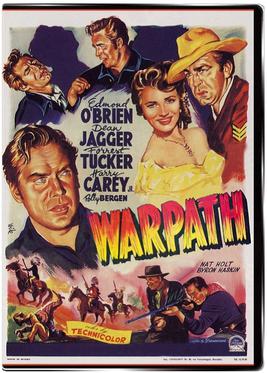
Coursing through one story after another, the concept of good, old-fashioned bloody revenge/vengeance seems quite at home in the western genre. Don't it? And sometimes, that's all you need for a good story. Take 1951's Warpath, a decent little western that could have been pretty good. If it had just stuck to its revenge-driven guns...
Riding into a dusty, wind-swept town in the west, a man named John Vickers (Edmond O'Brien) gets off a stagecoach and promptly runs into the man's he long been after. He prods him into drawing first and shoots him dead, but not before getting some information out of the dying man. Vickers is looking for two other men and has been doing so for the previous eight years, always on their trail, always one step too slow. Now, he's got to take it one step further. Those two men he's pursuing have joined the cavalry. What to do? Driven solely by revenge, Vickers joins up too, knowing the regiment the duo enlisted with. That outfit? The infamous Seventh Cavalry, commanded by General George Armstrong Custer. Vickers hopes he can finish his mission, but has he bitten off more than he can chew?
I'm always on the lookout for new westerns, especially harder-to-find B-westerns like this entry from director Byron Haskin. Nothing too fancy here, a pretty straightforward revenge story that's undone by some story choices. It brings together all sorts of genre conventions, throws them in a mixer and you get to watch the finished product, a western clocking in at about 100 minutes that has a somewhat disjointed feel. Not especially good, not especially bad, but worth a watch for genre fans.
Edmond O'Brien is criminally underrated. Westerns, film noirs, dramas, thrillers, this guy could and did do it all. His John Vickers manages to hold things together throughout all the bouncing balls. He's a Civil War veteran hellbent on revenge, looking to avenge the death of his fiance who was shot and paralyzed as an innocent bystander during a bank robbery. He watched her die slowly, wilt away, and intends to exact revenge no matter where it takes him. It's a good part for O'Brien, simmering with rage and intensity as he puts himself through all sorts of trials and tribulations to exact that revenge, often putting himself at great danger to do so. Or is that his plan and has been all along? Hmm, interesting. Something to think about, huh? :)
The cast has some familiar names and faces, helping smooth out the rough patches. Among the cavalry soldiers O'Brien's Vickers finds in the Seventh Cavalry, there's Forrest Tucker, Paul Fix, Wallace Ford, and the always welcome Harry Carey Jr. Also at the fort, Vickers meets the comely daughter (Polly Bergen) of the owner of the general store (Dean Jagger). Wouldn't you know it? She likes Vickers...but she also likes another soldier! Oh, no! Yeah, the story goes down that path. A story that already bounces around too much grinds to a halt in those oh so painful moments. If you're a western fan, the solid supporting cast overall should pull you in. It did for me!
There's enough here to recommend. It's a solid B-western from the early 1950's, but it certainly has an edge to it. It's a kinda leisurely revenge-seeking trip -- how does it take 8 years to track 3 people down when you seemingly are always on their tail? -- and O'Brien's Vickers seems to take quite a risk enlisting in the army in the hopes of finding two men in an entire cavalry regiment. And as mentioned, the forced love interest never really takes off.
Still, 'Warpath' does take some risks that pay off. It's clearly made on the cheap, including an art insert of the fort walls as the cavalry troops ride in and out. Helping cancel things out are a combination of some western notables. A midway action scene has a twist on the Battle of Beecher's Island, one of the more fascinating, little-known battles in the wild west. Then, the finale is set against the backdrop of Custer's Last Stand, maybe the most iconic moment in American history in the wild west. So yeah, if the ending is a little abrupt -- oh, right, Custer and the whole regiment are dead! -- so be it. It's a fun little western.
Warpath (1951): ** 1/2 /****
The Sons of Katie Elder
"First, we reunite, then find Ma and Pa's killer...then read some reviews."
Showing posts with label Edmond O'Brien. Show all posts
Thursday, April 14, 2016
Monday, December 28, 2015
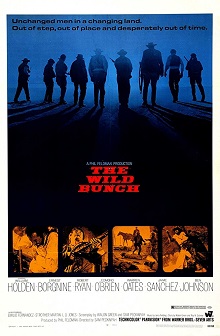
The Wild Bunch
By 1969, director Sam Peckinpah had worked on several TV series and several film productions, including The Deadly Companions, Ride the High Country and Major Dundee. He was an incredibly talented director but one whose fiery personality and personal demons could potentially derail any film he worked on. But in 1969, it all came together, Peckinpah making his classic, his all-time great film, one of the best westerns ever and best films ever in general, 1969's The Wild Bunch.
It's 1913 in a small border town near the Rio Grande, and a gang of outlaws, led by the infamous Pike Bishop (William Holden), disguised as soldiers ride in to rob the bank of a rumored silver shipment. The robbery is an epic disaster as a posse of bounty hunters, led by Deke Thornton (Robert Ryan), a paroled outlaw who used to ride with Pike, is waiting in ambush. Many of Pike's gang is killed in the robbery that nets them NO money. The remaining members of the gang, including Dutch Engstrom (Ernest Borgnine), retreat into Mexico. They need a new job, a new robbery, a new chance to earn some money. Pike especially knows that time is running out, that times are changing, and their chances at surviving as outlaws is becoming ever more unlikely. It doesn't help that Deke and his bounty hunters have followed them into Mexico, looking to collect the bounties on these infamous outlaws. With time running out, what do they do?
What a movie. Every so often, each and EVERY thing involved in the making of a film comes together and forms that perfect symmetry. 'Bunch' is an all-timer, not just a movie I love but a great movie in terms of storytelling and in technical terms. Appropriate for the time it was released (the late 1960's), it is cynical, horrifically violent, brutally honest and generally downbeat. This is a western and film ahead of its time, helping set the tone where films would go in the coming years. This is Peckinpah at the top of his game. He would have other good to great to classic films, but this is his Great film. Just a gem.
There is little to nothing to criticize here. While the filming process sounds incredibly interesting (a film in itself), the choice to film in Mexico pays off huge dividends. Cinematographer Lucien Ballard shoots a beautiful movie with the Mexican countryside and desert as a backdrop. The locations are phenomenal. You feel like you're watching the actual settings of the Mexican Revolution to our story. Composer Jerry Fielding turns in quite the memorable score as well, appropriately epic at times and equally quiet and emotional as necessary in other scenes. Listen to a sample HERE. As for the story itself, Peckinpah and writer Walon Green turn in a screenplay that's just a gem. It isn't a movie in a rush, letting things breathe and allow the viewer to get to know the characters -- for good or bad -- over its 145-minute running time. Sit back and take it in. You shan't be disappointed!
Many westerns have dealt with the death of the old west, the end of an era, but none better than The Wild Bunch. It's 1913 and there's no place for these outlaws, killers and gunfighters anymore. The world is changing, and civilization (of sorts) is moving in to replace them. We follow a gang of those outlaws, robbers, killers/murderers as they try to pull off their one last job and step away, and it's a testament to the acting on display and screenplay that we feel any sympathy at all to these men. Like few movies I've ever seen, there is a doomed quality to these men who are working with limited time on their hands. They know the door is closing on them, more than likely a bloody death awaiting them if they don't figure out something soon.
Where Peckinpah's screenplay is so strong is in its characterization and its depth. There's a whole lot of acting talent on display in 'Bunch,' and for much of the cast, this is their all-time best performance or certainly one of their best. Holden's Pike Bishop is one of the most fascinating characters ever in my book, an aging outlaw who's outlived his time but doesn't know what else to do. Borgnine too is excellent as Dutch, his right-hand man who can also see the writing on the wall. Their scene together after the early botched robbery is essential, two men who potentially know what awaits them but go into things willingly because maybe that ending is what's supposed to happen. On the counter, Ryan's Deke Thornton is equally tragic. He's riding after his old partner, Bishop, and would much rather be riding with them than chasing them. But as the script relies on, your word is your word, and these men live by that coda.
One of the many things Peckinpah loved to touch on in his films was that bond of men under fire who come through while others don't. Holden's Pike is the mouthpiece for that concept, of giving your word and sticking by it even when it'd be far easier to tuck your tail and run. We see that again and again with the bunch, including Pike, Dutch, old, grizzled Sykes (Edmond O'Brien), the crass, unsavory Gorch brothers, Lyle (Warren Oates) and Tector (Ben Johnson), and Angel (Jaime Sanchez), the youngest of the group, a fiery Mexican. What's interesting is that though Pike and the bunch claim to live by this coda, they continue to fall short of actually living up to it. It's when they realize their faults in that department that the story takes a far more tragic turn toward the inevitable ending that you just knew was coming.
Because the already-mentioned star power wasn't enough, here's some more! Along with Ryan, look for scene-chewing Strother Martin and L.Q. Jones as two scummy bounty hunters with Albert Dekker as the railroad magnate "employing" them. Emilio Fernandez is perfectly slimy as Mapache, the Mexican general claiming to be some sort of freedom fighter but it seems it is all for show, for more power, with Jorge Russek and Alfonso Arau (El Guapo in Three Amigos) as his subordinate officers. Also look for Bo Hopkins, Dub Taylor and Chano Urueta in key (if small) supporting parts.
What 'Bunch' has become synonymous with over the years is its groundbreaking, sometimes horrifying portrayal of on-screen violence. It's not that Peckinpah lingers on the violence for the sake of shock value. Far from it, but instead he makes it into an art form. The idea of a 'dance of death' comes to mind in any portrayal of violence with three main set pieces (1. The opening robbery turned into a bloody shootout 2. A prolonged train robbery and 3. The final, bullet-riddled and blood-splattered gun battle). The editing is ridiculously fast and cut in with perfect uses of slow motion. Simply put, there is an art to Peckinpah's use of violence, both in the editing, in the overwhelming use of slow-motion blood squibs, and the impact of that violence we're seeing. If Bonnie and Clyde opened the door some for its own use of on-screen violence, Peckinpah's The Wild Bunch kicked that door wide open. Almost 50 years later, it still resonates, and it's clear the impact it had on hundreds and thousands of movies released since.
It all builds to maybe the most memorable action sequence of all-time. If it's not No. 1, it certainly belongs in the conversation. In a sequence that's been dubbed "The Battle of Bloody Porch," it all comes together in an extended sequence that has lost none of its edge since its release in 1969. This is a transfixing scene that is equal parts horrifying and startling but you just can't look away. There are too many great moments just in this scene alone to mention, including an improvised walk the Bunch takes on their way to a final showdown (maybe the movie's second-strongest sequence). It is followed by a quick, shocking death, and then an eerie moment of silence that hangs in the air. With one gunshot, it is on, bullets flying thick in the air. Obvious SPOILERS but you can watch it HERE. If you haven't seen the movie, I don't recommend watching the sequence out of context. Watch the movie and soak it all in as part of the whole product. Just a remarkable extended sequence with virtually no music. The focus is the characters, violence and death. Nothing more. Nothing less.
A classic in every sense of the word. I pick something new up with every viewing, and it never loses any of its impact. A film without a weakness.
The Wild Bunch (1969): ****/****
It's 1913 in a small border town near the Rio Grande, and a gang of outlaws, led by the infamous Pike Bishop (William Holden), disguised as soldiers ride in to rob the bank of a rumored silver shipment. The robbery is an epic disaster as a posse of bounty hunters, led by Deke Thornton (Robert Ryan), a paroled outlaw who used to ride with Pike, is waiting in ambush. Many of Pike's gang is killed in the robbery that nets them NO money. The remaining members of the gang, including Dutch Engstrom (Ernest Borgnine), retreat into Mexico. They need a new job, a new robbery, a new chance to earn some money. Pike especially knows that time is running out, that times are changing, and their chances at surviving as outlaws is becoming ever more unlikely. It doesn't help that Deke and his bounty hunters have followed them into Mexico, looking to collect the bounties on these infamous outlaws. With time running out, what do they do?
What a movie. Every so often, each and EVERY thing involved in the making of a film comes together and forms that perfect symmetry. 'Bunch' is an all-timer, not just a movie I love but a great movie in terms of storytelling and in technical terms. Appropriate for the time it was released (the late 1960's), it is cynical, horrifically violent, brutally honest and generally downbeat. This is a western and film ahead of its time, helping set the tone where films would go in the coming years. This is Peckinpah at the top of his game. He would have other good to great to classic films, but this is his Great film. Just a gem.
There is little to nothing to criticize here. While the filming process sounds incredibly interesting (a film in itself), the choice to film in Mexico pays off huge dividends. Cinematographer Lucien Ballard shoots a beautiful movie with the Mexican countryside and desert as a backdrop. The locations are phenomenal. You feel like you're watching the actual settings of the Mexican Revolution to our story. Composer Jerry Fielding turns in quite the memorable score as well, appropriately epic at times and equally quiet and emotional as necessary in other scenes. Listen to a sample HERE. As for the story itself, Peckinpah and writer Walon Green turn in a screenplay that's just a gem. It isn't a movie in a rush, letting things breathe and allow the viewer to get to know the characters -- for good or bad -- over its 145-minute running time. Sit back and take it in. You shan't be disappointed!
Many westerns have dealt with the death of the old west, the end of an era, but none better than The Wild Bunch. It's 1913 and there's no place for these outlaws, killers and gunfighters anymore. The world is changing, and civilization (of sorts) is moving in to replace them. We follow a gang of those outlaws, robbers, killers/murderers as they try to pull off their one last job and step away, and it's a testament to the acting on display and screenplay that we feel any sympathy at all to these men. Like few movies I've ever seen, there is a doomed quality to these men who are working with limited time on their hands. They know the door is closing on them, more than likely a bloody death awaiting them if they don't figure out something soon.
Where Peckinpah's screenplay is so strong is in its characterization and its depth. There's a whole lot of acting talent on display in 'Bunch,' and for much of the cast, this is their all-time best performance or certainly one of their best. Holden's Pike Bishop is one of the most fascinating characters ever in my book, an aging outlaw who's outlived his time but doesn't know what else to do. Borgnine too is excellent as Dutch, his right-hand man who can also see the writing on the wall. Their scene together after the early botched robbery is essential, two men who potentially know what awaits them but go into things willingly because maybe that ending is what's supposed to happen. On the counter, Ryan's Deke Thornton is equally tragic. He's riding after his old partner, Bishop, and would much rather be riding with them than chasing them. But as the script relies on, your word is your word, and these men live by that coda.
One of the many things Peckinpah loved to touch on in his films was that bond of men under fire who come through while others don't. Holden's Pike is the mouthpiece for that concept, of giving your word and sticking by it even when it'd be far easier to tuck your tail and run. We see that again and again with the bunch, including Pike, Dutch, old, grizzled Sykes (Edmond O'Brien), the crass, unsavory Gorch brothers, Lyle (Warren Oates) and Tector (Ben Johnson), and Angel (Jaime Sanchez), the youngest of the group, a fiery Mexican. What's interesting is that though Pike and the bunch claim to live by this coda, they continue to fall short of actually living up to it. It's when they realize their faults in that department that the story takes a far more tragic turn toward the inevitable ending that you just knew was coming.
Because the already-mentioned star power wasn't enough, here's some more! Along with Ryan, look for scene-chewing Strother Martin and L.Q. Jones as two scummy bounty hunters with Albert Dekker as the railroad magnate "employing" them. Emilio Fernandez is perfectly slimy as Mapache, the Mexican general claiming to be some sort of freedom fighter but it seems it is all for show, for more power, with Jorge Russek and Alfonso Arau (El Guapo in Three Amigos) as his subordinate officers. Also look for Bo Hopkins, Dub Taylor and Chano Urueta in key (if small) supporting parts.
What 'Bunch' has become synonymous with over the years is its groundbreaking, sometimes horrifying portrayal of on-screen violence. It's not that Peckinpah lingers on the violence for the sake of shock value. Far from it, but instead he makes it into an art form. The idea of a 'dance of death' comes to mind in any portrayal of violence with three main set pieces (1. The opening robbery turned into a bloody shootout 2. A prolonged train robbery and 3. The final, bullet-riddled and blood-splattered gun battle). The editing is ridiculously fast and cut in with perfect uses of slow motion. Simply put, there is an art to Peckinpah's use of violence, both in the editing, in the overwhelming use of slow-motion blood squibs, and the impact of that violence we're seeing. If Bonnie and Clyde opened the door some for its own use of on-screen violence, Peckinpah's The Wild Bunch kicked that door wide open. Almost 50 years later, it still resonates, and it's clear the impact it had on hundreds and thousands of movies released since.
It all builds to maybe the most memorable action sequence of all-time. If it's not No. 1, it certainly belongs in the conversation. In a sequence that's been dubbed "The Battle of Bloody Porch," it all comes together in an extended sequence that has lost none of its edge since its release in 1969. This is a transfixing scene that is equal parts horrifying and startling but you just can't look away. There are too many great moments just in this scene alone to mention, including an improvised walk the Bunch takes on their way to a final showdown (maybe the movie's second-strongest sequence). It is followed by a quick, shocking death, and then an eerie moment of silence that hangs in the air. With one gunshot, it is on, bullets flying thick in the air. Obvious SPOILERS but you can watch it HERE. If you haven't seen the movie, I don't recommend watching the sequence out of context. Watch the movie and soak it all in as part of the whole product. Just a remarkable extended sequence with virtually no music. The focus is the characters, violence and death. Nothing more. Nothing less.
A classic in every sense of the word. I pick something new up with every viewing, and it never loses any of its impact. A film without a weakness.
The Wild Bunch (1969): ****/****
Tuesday, February 3, 2015
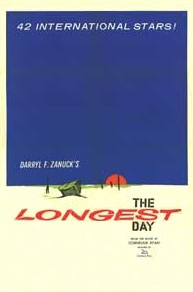
The Longest Day
When you look back through history, certain dates hold a higher place in the history books. It can be someone's birth, someone's death, or just have an amazing historical significance in terms of impact on the world. High up on that list is June 6, 1944, the day Allied forces invaded Normandy, better known as D-Day. In the age of gigantic, sprawling epics, one of the best movies of the 1960s tackles the immense subject, 1962's The Longest Day.
A plot description wouldn't do this flick justice. It's just infeasible. The history will serve as a big enough jumping off point. After four-plus years of war, Allied forces had massed for months, all prepping for the invasion of Europe, hopefully taking back the continent from Adolf Hitler and his Nazi Third Reich. The invasion was months and years in planning, millions of men, millions of tons of equipment, thousands and thousands of ships, trucks, jeeps and tanks waiting to be unleashed at Normandy and in the French countryside. What was the mystery? The Allies tried desperately to keep the location of the invasion -- Normandy -- secret to help save lives and make the invasion smoother. The Germans similarly tried desperately to discover where the attack was coming. The war hung in the balance along with millions of lives, not just those taking part in the attack but all over the world. Not bad for historical significance, huh?
So tackling that premise in movie form seems a rather daunting task if you ask me. In the age of the epic, this one doesn't disappoint. At 178 minutes, 'Longest' covers a ridiculous amount of ground in a story that takes place over about a 36-hour time span. We see the Allies deciding the time is finally right after days of wavering while the Germans decide if this is the actual invasion or just a feint, a distraction to throw them off. Based on the book by Cornelius Ryan, it is told in docu-drama style as we meet all the participants from the high command to the soldiers, paratroopers to resistance fighters, townspeople to priests and everything and everyone in between. This isn't a movie about characters, but instead about the spectacle and immensity of what happened. If the Allied invasion on D-Day didn't work, who knows how the world would have changed?
Just a huge movie but one that never feels rushed or forced. The three-hour running time absolutely flies by. It was filmed in black and white, giving it an appropriately dated look. Maybe color takes away from what's on-screen, but the decision to film in black and white simply put, works. Ken Annakin, Andrew Marton and Bernhard Wicki combine to direct this behemoth epic and to handle it well. Technically speaking, it is a virtually flawless film. Some stock footage is sprinkled here and there, but many of the locations where the actual events took place were used as filming locations. Talk about authenticity, it can be downright eerie watching some of the scenes knowing the locations' history. The score from Maurice Jarre is used in appropriate doses with the main theme (listen HERE) a memorable piece of music that's always stuck with me.
As an epic though, one thing was required more than just about anything else. That requirement? A cast of seemingly thousands. Literally everyone in Hollywood and stars internationally were required to star in this movie. Okay, a slight exaggeration, but you get my point. Most of these parts were nothing more than cameos, but just as a taste of the ridiculous star power on display, we get John Wayne, Robert Mitchum, Robert Ryan, Henry Fonda, Richard Burton, Edmond O'Brien, Rod Steiger, even a pre-James Bond Sean Connery. Many of those parts only required an on-screen appearance of a minute or two -- some for much more -- but their presence alone...just wowza. The scary part? That's only a somewhat small taste of the depth of the cast that truly brings an international flavor to the D-Day proceedings with German, French, British, American and many more brought together.
The Longest Day is an epic, plain and simple, but for every scene where the scope and scale impresses, I loved the quieter, personal and often times, terrifyingly real scenes just as effective and memorable. I loved Richard Todd as a paratrooper commander tasked with landing in France via glider and taking a key bridge and holding until reinforcements arrive...if they can. The scene where American paratroopers, including strung-up Red Buttons, overshoot their landing zone and land in a German town is tragic and moving. One paratrooper (Sal Mineo) making a tragic decision is surprising and intensely real. I especially liked the simplicity of a late scene between Burton's RAF pilot and Richard Beymer's American paratrooper discussing the necessary evil of the day but also the lunacy of it. I think the best, most iconic moment has Hans Christian Blech's German officer finally spotting the invasion force in the English Channel when the fog clears. His face drops and he mumbles 'Die invasion,' all set to Beethoven's Fifth Symphony. Just a ton of great moments like this.
The other counter to those scenes are the BIG moments, and that's where the technical comes into play. One tremendous scene has a German fighter strafing the beaches, all of which we see from the perspective of the plane. Hundreds and thousands of extras scramble for cover underneath in a remarkable visual scene. The same later in 'Longest' when French commandos fight their way up a street in a French town, a helicopter (I think) filming all the action. As well, the scene of the paratroopers coming down on the German-held Sainte-Mere-Eglise is a horrifying scene that utilizes some very cool camerawork. Also look for a cool scene where American Rangers -- including Robert Wagner, George Segal, Paul Anka, Fabian, Tommy Sands -- scale the cliffs of Pointe de Huc, all trying to knock out a key German emplacement. Some especially memorable moments, not all of them action scenes.
Because I don't want to forget anyone but don't want to overdo it describing EVERY character, also look for Eddie Albert, Irina Demick, Mel Ferrer, Steve Forest, Gert Frobe, Leo Genn, Jeffrey Hunter, Curd Jurgens, Peter Lawford, Christian Marquand, Roddy McDowall, Kenneth More, Wolfgang Preiss, Ron Randell, Jean Servais, Norman Rossington, Tom Tryon, Peter van Eyck and Stuart Whitman. Okay, I'll take a breath now.
The Longest Day isn't the best war movie around, but it's one of my favorites. It tries to accomplish a ton and succeeds on just about every level. The history, the scale, the spectacle, the gigantic cast, the moments that resonate amongst all the epic qualities. It also serves as an excellent companion piece to the more recent Saving Private Ryan. Nowhere near as violent, but a more far-reaching story. A gem from the age of epics.
The Longest Day (1962): ****/****
A plot description wouldn't do this flick justice. It's just infeasible. The history will serve as a big enough jumping off point. After four-plus years of war, Allied forces had massed for months, all prepping for the invasion of Europe, hopefully taking back the continent from Adolf Hitler and his Nazi Third Reich. The invasion was months and years in planning, millions of men, millions of tons of equipment, thousands and thousands of ships, trucks, jeeps and tanks waiting to be unleashed at Normandy and in the French countryside. What was the mystery? The Allies tried desperately to keep the location of the invasion -- Normandy -- secret to help save lives and make the invasion smoother. The Germans similarly tried desperately to discover where the attack was coming. The war hung in the balance along with millions of lives, not just those taking part in the attack but all over the world. Not bad for historical significance, huh?
So tackling that premise in movie form seems a rather daunting task if you ask me. In the age of the epic, this one doesn't disappoint. At 178 minutes, 'Longest' covers a ridiculous amount of ground in a story that takes place over about a 36-hour time span. We see the Allies deciding the time is finally right after days of wavering while the Germans decide if this is the actual invasion or just a feint, a distraction to throw them off. Based on the book by Cornelius Ryan, it is told in docu-drama style as we meet all the participants from the high command to the soldiers, paratroopers to resistance fighters, townspeople to priests and everything and everyone in between. This isn't a movie about characters, but instead about the spectacle and immensity of what happened. If the Allied invasion on D-Day didn't work, who knows how the world would have changed?
Just a huge movie but one that never feels rushed or forced. The three-hour running time absolutely flies by. It was filmed in black and white, giving it an appropriately dated look. Maybe color takes away from what's on-screen, but the decision to film in black and white simply put, works. Ken Annakin, Andrew Marton and Bernhard Wicki combine to direct this behemoth epic and to handle it well. Technically speaking, it is a virtually flawless film. Some stock footage is sprinkled here and there, but many of the locations where the actual events took place were used as filming locations. Talk about authenticity, it can be downright eerie watching some of the scenes knowing the locations' history. The score from Maurice Jarre is used in appropriate doses with the main theme (listen HERE) a memorable piece of music that's always stuck with me.
As an epic though, one thing was required more than just about anything else. That requirement? A cast of seemingly thousands. Literally everyone in Hollywood and stars internationally were required to star in this movie. Okay, a slight exaggeration, but you get my point. Most of these parts were nothing more than cameos, but just as a taste of the ridiculous star power on display, we get John Wayne, Robert Mitchum, Robert Ryan, Henry Fonda, Richard Burton, Edmond O'Brien, Rod Steiger, even a pre-James Bond Sean Connery. Many of those parts only required an on-screen appearance of a minute or two -- some for much more -- but their presence alone...just wowza. The scary part? That's only a somewhat small taste of the depth of the cast that truly brings an international flavor to the D-Day proceedings with German, French, British, American and many more brought together.
The Longest Day is an epic, plain and simple, but for every scene where the scope and scale impresses, I loved the quieter, personal and often times, terrifyingly real scenes just as effective and memorable. I loved Richard Todd as a paratrooper commander tasked with landing in France via glider and taking a key bridge and holding until reinforcements arrive...if they can. The scene where American paratroopers, including strung-up Red Buttons, overshoot their landing zone and land in a German town is tragic and moving. One paratrooper (Sal Mineo) making a tragic decision is surprising and intensely real. I especially liked the simplicity of a late scene between Burton's RAF pilot and Richard Beymer's American paratrooper discussing the necessary evil of the day but also the lunacy of it. I think the best, most iconic moment has Hans Christian Blech's German officer finally spotting the invasion force in the English Channel when the fog clears. His face drops and he mumbles 'Die invasion,' all set to Beethoven's Fifth Symphony. Just a ton of great moments like this.
The other counter to those scenes are the BIG moments, and that's where the technical comes into play. One tremendous scene has a German fighter strafing the beaches, all of which we see from the perspective of the plane. Hundreds and thousands of extras scramble for cover underneath in a remarkable visual scene. The same later in 'Longest' when French commandos fight their way up a street in a French town, a helicopter (I think) filming all the action. As well, the scene of the paratroopers coming down on the German-held Sainte-Mere-Eglise is a horrifying scene that utilizes some very cool camerawork. Also look for a cool scene where American Rangers -- including Robert Wagner, George Segal, Paul Anka, Fabian, Tommy Sands -- scale the cliffs of Pointe de Huc, all trying to knock out a key German emplacement. Some especially memorable moments, not all of them action scenes.
Because I don't want to forget anyone but don't want to overdo it describing EVERY character, also look for Eddie Albert, Irina Demick, Mel Ferrer, Steve Forest, Gert Frobe, Leo Genn, Jeffrey Hunter, Curd Jurgens, Peter Lawford, Christian Marquand, Roddy McDowall, Kenneth More, Wolfgang Preiss, Ron Randell, Jean Servais, Norman Rossington, Tom Tryon, Peter van Eyck and Stuart Whitman. Okay, I'll take a breath now.
The Longest Day isn't the best war movie around, but it's one of my favorites. It tries to accomplish a ton and succeeds on just about every level. The history, the scale, the spectacle, the gigantic cast, the moments that resonate amongst all the epic qualities. It also serves as an excellent companion piece to the more recent Saving Private Ryan. Nowhere near as violent, but a more far-reaching story. A gem from the age of epics.
The Longest Day (1962): ****/****
Wednesday, July 16, 2014
The Last Voyage
I don't like ships. I don't like boats. I'm not a big fan of big, wide-open water so yeah....the ocean, bigger lakes, they freak me out. Yeah, psychiatric session instead of a movie review! I digress though as an introduction only. Movies about ships sinking creep me out in a big way. I saw Titanic in theaters twice, but yowza, that scared me. How about an earlier, far less known film about a ship sinking? Enter 1960's The Last Voyage.
The S.S. Claridon is making its way across the Pacific Ocean, sailing from California to Japan. An ocean liner that's been sailing for 38 years, the Claridon is well past its prime and long overdue for a major overhaul. Its captain, Robert Adams (George Sanders), is aware of all of this but isn't concerned when a fire breaks out below deck. His crew is able to stop the fire, but it is only the start, a problem born from a faulty boiler....a boiler that explodes soon after. The crew desperately tries to stop the fire as water flows into a breach in the hull. Can the aging Claridon be saved or is it a doomed ship destined to sink? Among the passengers is the Henderson family, husband Cliff (Robert Stack) trying to save his wife, Laurie (Dorothy Malone), who is pinned under an immense piece of metal wreckage in their berth. Time is slipping away at an alarming rate, the water levels rising ever quicker.
I've seen bits and pieces of this 1960 disaster flick several times, but it was only on my last viewing where I was able to watch the entire film. From director and screenplay writer Andrew L. Stone, 'Voyage' is an excellent early example of a disaster film, a genre that would rise to new heights in the late 1960s, especially in the 1970s. It has a lot of touches that would become all too familiar in the coming years, but none of it feels overdone...thankfully. This is a well-told, well-acted and well-executed disaster film that focuses on a desperate fight for survival, an aging ship groaning as it sinks. The only question becomes how quick will it sink? I liked that 'Voyage' is content to just be an exciting, sometimes uncomfortable story. The 1970s disaster flicks were big, bigger and biggest, one topping the other with a ridiculous premise and an all-star cast. This flick, just a really good movie.
So what makes it that good, that enjoyable? Well, I liked Titanic a lot for all its excesses and spectacle, but at 220 minutes, it is a lllllong movie. That is not a concern here, 'Voyage' clocking in at just 91 minutes. There's no wasted time, no fluff here. As viewers, we're thrust into the fire on Claridon as the credits roll. We don't see how it started, who anyone is, just that there's a fire on-board and it needs to be dealt with NOW. The same for once the boiler goes. This is the situation. Let's deal with it. Even when we meet the characters -- Capt. Adams, the Hendersons, the crew -- they are as we meet them. We get a brief explanation of why the Hendersons are on-board the Claridon, but that's all. This is a movie in the moment about a ship sinking where backstories and motivations and who these people are....it's all extra and unnecessary. A survival disaster movie at its most simple and straightforward.
Who will live? Who will die?!? The true star power isn't there, but we get a handful or so of familiar faces. The Hendersons are more interesting once the ship gets into trouble, Stack, Malone and their daughter, Jill (Tammy Marihugh), the picture of the American family up until that point, all lovey-dovey. But a ship sinking? Let the drama begin! Sanders gets to be the stubborn ship captain, trying to bring the ship into port without any loss of life, in the process putting his passengers, his crew and his ship in danger. I thought the best parts go to Woody Strode and Edmond O'Brien though, Strode as Hank Lawson, a crewman, and O'Brien as Walsh, the second engineer, both men trying to save the ship while the passengers scramble to safety. It was a hell of a year for Strode who turned in scene-stealing memorable parts here, in Spartacus and Sergeant Rutledge. He's an imposing physical presence here, shirtless with a bandana around his neck, sprinting around the ship to help Stack's Cliff. O'Brien too stands out from the sinking ship chaos, balancing saving his crew with those passengers in danger. Also look for Jack Kruschen as the chief engineer.
There's nothing too fancy here from acting to story to effects. 'Voyage' was filmed in very 1960s stylish sets, sets that add a nice throwback feel to the film now as we watch it 50-plus years later. Titanic obviously set the bar ridiculously high, but what's accomplished here without any computer-generated effects is impressive in itself. Stone and his crew used the famous French liner, the SS Ile de France, for the actual scenes showing the water washing over the fast-sinking Claridon, giving a nice sense of what the hellish experience would certainly be like. All of the sinking scenes feel real, that lack of CGI effects actually aiding the cause. None of it feels forced, and it is interesting throughout. An easy movie to recommend, especially for all you diehard Titanic fans out there.
The Last Voyage (1960): ***/****
The S.S. Claridon is making its way across the Pacific Ocean, sailing from California to Japan. An ocean liner that's been sailing for 38 years, the Claridon is well past its prime and long overdue for a major overhaul. Its captain, Robert Adams (George Sanders), is aware of all of this but isn't concerned when a fire breaks out below deck. His crew is able to stop the fire, but it is only the start, a problem born from a faulty boiler....a boiler that explodes soon after. The crew desperately tries to stop the fire as water flows into a breach in the hull. Can the aging Claridon be saved or is it a doomed ship destined to sink? Among the passengers is the Henderson family, husband Cliff (Robert Stack) trying to save his wife, Laurie (Dorothy Malone), who is pinned under an immense piece of metal wreckage in their berth. Time is slipping away at an alarming rate, the water levels rising ever quicker.
I've seen bits and pieces of this 1960 disaster flick several times, but it was only on my last viewing where I was able to watch the entire film. From director and screenplay writer Andrew L. Stone, 'Voyage' is an excellent early example of a disaster film, a genre that would rise to new heights in the late 1960s, especially in the 1970s. It has a lot of touches that would become all too familiar in the coming years, but none of it feels overdone...thankfully. This is a well-told, well-acted and well-executed disaster film that focuses on a desperate fight for survival, an aging ship groaning as it sinks. The only question becomes how quick will it sink? I liked that 'Voyage' is content to just be an exciting, sometimes uncomfortable story. The 1970s disaster flicks were big, bigger and biggest, one topping the other with a ridiculous premise and an all-star cast. This flick, just a really good movie.
So what makes it that good, that enjoyable? Well, I liked Titanic a lot for all its excesses and spectacle, but at 220 minutes, it is a lllllong movie. That is not a concern here, 'Voyage' clocking in at just 91 minutes. There's no wasted time, no fluff here. As viewers, we're thrust into the fire on Claridon as the credits roll. We don't see how it started, who anyone is, just that there's a fire on-board and it needs to be dealt with NOW. The same for once the boiler goes. This is the situation. Let's deal with it. Even when we meet the characters -- Capt. Adams, the Hendersons, the crew -- they are as we meet them. We get a brief explanation of why the Hendersons are on-board the Claridon, but that's all. This is a movie in the moment about a ship sinking where backstories and motivations and who these people are....it's all extra and unnecessary. A survival disaster movie at its most simple and straightforward.
Who will live? Who will die?!? The true star power isn't there, but we get a handful or so of familiar faces. The Hendersons are more interesting once the ship gets into trouble, Stack, Malone and their daughter, Jill (Tammy Marihugh), the picture of the American family up until that point, all lovey-dovey. But a ship sinking? Let the drama begin! Sanders gets to be the stubborn ship captain, trying to bring the ship into port without any loss of life, in the process putting his passengers, his crew and his ship in danger. I thought the best parts go to Woody Strode and Edmond O'Brien though, Strode as Hank Lawson, a crewman, and O'Brien as Walsh, the second engineer, both men trying to save the ship while the passengers scramble to safety. It was a hell of a year for Strode who turned in scene-stealing memorable parts here, in Spartacus and Sergeant Rutledge. He's an imposing physical presence here, shirtless with a bandana around his neck, sprinting around the ship to help Stack's Cliff. O'Brien too stands out from the sinking ship chaos, balancing saving his crew with those passengers in danger. Also look for Jack Kruschen as the chief engineer.
There's nothing too fancy here from acting to story to effects. 'Voyage' was filmed in very 1960s stylish sets, sets that add a nice throwback feel to the film now as we watch it 50-plus years later. Titanic obviously set the bar ridiculously high, but what's accomplished here without any computer-generated effects is impressive in itself. Stone and his crew used the famous French liner, the SS Ile de France, for the actual scenes showing the water washing over the fast-sinking Claridon, giving a nice sense of what the hellish experience would certainly be like. All of the sinking scenes feel real, that lack of CGI effects actually aiding the cause. None of it feels forced, and it is interesting throughout. An easy movie to recommend, especially for all you diehard Titanic fans out there.
The Last Voyage (1960): ***/****
Friday, August 9, 2013
The Hitch-Hiker
You're driving along on a highway and see a man standing there on the side of the road. He's got his thumb up indicating he'd like a ride. What should you do? Well, if you've seen any horror and/or thriller movies EVER, then hit the gas and keep on moving. Back in the 1950s, motorists were far more gullible/nice/trusting and had no issues picking up hitchhikers. I imagine 1953's The Hitch-Hiker went a long way to reversing that trend.
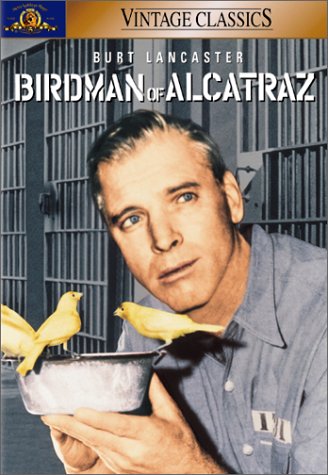
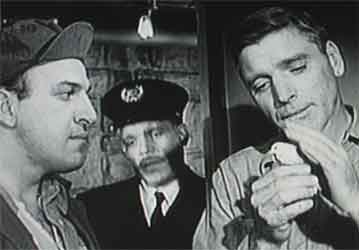
Heading out on a fishing trip, friends Roy Collins (Edmond O'Brien) and Gilbert Bowen (Frank Lovejoy) are driving along on the highway when they spot a man at the side of the road thumbing for a ride. They pull over and pick him up, thinking nothing of it. Within minutes though, the man pulls a gun and begins issuing orders as to where they're going and how they'll get there. Roy and Gilbert hear on the radio that the man is Emmett Myers (William Talman), a convicted killer and a psychopath on the run from the police. With no real alternative to escape with Myers' gun pointed at their heads, the friends are forced to go along with the killer's demands. He tells them to head south into the desert and eventually Mexico. Can they manage to escape before he kills them? Can the police find them in time?
Like the best thrillers, the formula here is simple. Throw something at the audience that could actually happen to them. Yes, this situation depends on you being really dumb and picking up a hitchhiker along the side of the road, but the gist is the same. You're trying to help someone out, and it epically blows up in your face. Upon picking up Myers, Roy and Gilbert are quickly informed that as soon as Myers reaches his destination in Mexico, he's going to kill them both. Does it get scarier/creepier than that? These two friends are actually driving themselves to their own deaths. As a premise, it works. In execution? Eh, not so much.
'Hiker' is now known as the first film noir helmed by a female director, in this case actress turned director Ida Lupino, who took over the film when Elmer Clifton became sick and couldn't continue. Lupino has a knack for putting the right elements into place for a successful flick, but it never gels here. To say this movie is predictable is an understatement. Maybe in 1953, this was fresh for audiences, but watching it for the first time 60 years later, there is little to no energy or urgency. That's not a good thing when death hangs in the air over two main characters. It only runs 73 minutes, but it's basically a series of episodic scenes of Roy and Gilbert progressively losing it while seeing how mentally unbalanced Emmett is. A few scenes pack some punch, but for the most part I was bored.
With a limited cast, the focus is mostly on our lead trio. Even there, I came away disappointed. It's not necessarily any of their fault, just a script that never gives any of them much to do beyond stereotypes. Edmond O'Brien is one of my favorites, but he doesn't have much going here. His sole requirement is looking worried (understandably considering the situation) as he becomes more and more unhinged. As his buddy, Lovejoy fares slightly better, but not much. His Gilbert is eerily, freakishly calm, and his key character trait? He speaks Spanish so he can translate! Yeah! Talman is a relative bright spot as psychotic killer Myers only because he brings some energy to the part, however obviously demented. Really though, with no background or real rooting interest for Roy and Gilbert, it's hard to get behind them and root for them.
Watching a movie released in 1953, it's not hard to see where this story is going. A sadistic killer with no qualms about killing anyone and everyone? Two innocent fishermen? Predictable is one thing, but the ending even manages to find another way to disappoint. I won't give it away here so apologies for no spoilers, but the resolution is beyond unsatisfying. I certainly wanted to like this movie, but it never came together. There is some cool location shooting in the Alabama Hills around Lone, Pine California that does a fine job standing in for the Mexican desert. The story is based on the real-life story of killer Billy Cook, but that real-life drama simply doesn't translate enough to succeed. Watch the full movie HERE.
The Hitch-Hiker (1953): **/****
Heading out on a fishing trip, friends Roy Collins (Edmond O'Brien) and Gilbert Bowen (Frank Lovejoy) are driving along on the highway when they spot a man at the side of the road thumbing for a ride. They pull over and pick him up, thinking nothing of it. Within minutes though, the man pulls a gun and begins issuing orders as to where they're going and how they'll get there. Roy and Gilbert hear on the radio that the man is Emmett Myers (William Talman), a convicted killer and a psychopath on the run from the police. With no real alternative to escape with Myers' gun pointed at their heads, the friends are forced to go along with the killer's demands. He tells them to head south into the desert and eventually Mexico. Can they manage to escape before he kills them? Can the police find them in time?
Like the best thrillers, the formula here is simple. Throw something at the audience that could actually happen to them. Yes, this situation depends on you being really dumb and picking up a hitchhiker along the side of the road, but the gist is the same. You're trying to help someone out, and it epically blows up in your face. Upon picking up Myers, Roy and Gilbert are quickly informed that as soon as Myers reaches his destination in Mexico, he's going to kill them both. Does it get scarier/creepier than that? These two friends are actually driving themselves to their own deaths. As a premise, it works. In execution? Eh, not so much.
'Hiker' is now known as the first film noir helmed by a female director, in this case actress turned director Ida Lupino, who took over the film when Elmer Clifton became sick and couldn't continue. Lupino has a knack for putting the right elements into place for a successful flick, but it never gels here. To say this movie is predictable is an understatement. Maybe in 1953, this was fresh for audiences, but watching it for the first time 60 years later, there is little to no energy or urgency. That's not a good thing when death hangs in the air over two main characters. It only runs 73 minutes, but it's basically a series of episodic scenes of Roy and Gilbert progressively losing it while seeing how mentally unbalanced Emmett is. A few scenes pack some punch, but for the most part I was bored.
With a limited cast, the focus is mostly on our lead trio. Even there, I came away disappointed. It's not necessarily any of their fault, just a script that never gives any of them much to do beyond stereotypes. Edmond O'Brien is one of my favorites, but he doesn't have much going here. His sole requirement is looking worried (understandably considering the situation) as he becomes more and more unhinged. As his buddy, Lovejoy fares slightly better, but not much. His Gilbert is eerily, freakishly calm, and his key character trait? He speaks Spanish so he can translate! Yeah! Talman is a relative bright spot as psychotic killer Myers only because he brings some energy to the part, however obviously demented. Really though, with no background or real rooting interest for Roy and Gilbert, it's hard to get behind them and root for them.
Watching a movie released in 1953, it's not hard to see where this story is going. A sadistic killer with no qualms about killing anyone and everyone? Two innocent fishermen? Predictable is one thing, but the ending even manages to find another way to disappoint. I won't give it away here so apologies for no spoilers, but the resolution is beyond unsatisfying. I certainly wanted to like this movie, but it never came together. There is some cool location shooting in the Alabama Hills around Lone, Pine California that does a fine job standing in for the Mexican desert. The story is based on the real-life story of killer Billy Cook, but that real-life drama simply doesn't translate enough to succeed. Watch the full movie HERE.
The Hitch-Hiker (1953): **/****
Labels:
1950s,
Edmond O'Brien,
Film Noir,
Frank Lovejoy,
Ida Lupino
Wednesday, February 13, 2013
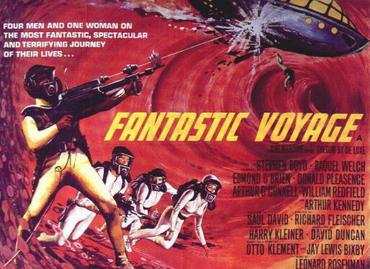
Fantastic Voyage
Groundbreaking doesn't mean groundbreaking for all-time. It qualifies only in the moment, maybe a few months, or even a year in the luckiest of situations. If a movie is considered groundbreaking, it kicks the door open and hundreds of rip-offs and wanna be follow-ups storm through the opening. That kept cycling through my head as I watched 1966's Fantastic Voyage.
A scientist (Jean Del Val) working for the Soviets has defected with American intelligence agencies desperate to help him and bring him to the United States. In the transport though, enemy agents attack, severely wounding him. He's in a coma with an unreachable blood clot on his brain, but he has info that the American government desperately wants. To relieve the pressure of the clot, a new technology will be utilized. A team of surgeons (including Arthur Kennedy and Donald Pleasence), a security officer (Stephen Boyd), and two others will travel via a submarine, be shrunk down to a microscopic size and injected into the scientist's body, traveling through his body and ultimately break up the clot and save his life. There's problems though. The body will most likely do everything it can to slow down the intruders, and they only have 60 minutes to get the job done before they begin to grow back to their normal size, whether they're in the body or not.
From director Richard Fleischer, this science fiction story won two Oscars, one for Best Art Direction and one for Best Special Effects. So while I didn't really care for the movie, I can appreciate the crazy visual on display. A tiny submarine the size of a period with five people inside traveling through a human body? How couldn't that be a great visual experience as a movie? Much of it comes from a green screen visual -- sets of the human body would be rather immense I'm supposing -- and just in terms of color alone, it's a beautiful movie. The little prototype submarine travels through the veins, arteries, lungs, heart, ears and ultimately, the brain.
So what do you think? A trip through the body and all its inner workings is unique, no doubt about that. Why then is this story so dull? I was bored to tears almost the second the submarine went to work. There's plenty of detours that provide some excitement. A miscalculation forces the crew to travel through the heart, but the problem is that the heart beating should tear the submarine apart. The medical staff monitoring the body basically shuts down the heart, giving the crew 60 seconds to travel through it. The premise presents all kinds of impressive, should-be cool situations like that. The crew is told that the body is going to do its best to protect itself, assuming that the submarine is a disease or virus of sorts. Those provide some cool visuals as well, antibodies swarming to the sub and the crew, but it's the weirdest thing. If that wasn't enough, someone involved with the mission is an enemy agent, but even that reveal is disappointing. It's a dull story of a very cool idea.
In a variation on one of my favorite sub-genres, 'Voyage' is a men-on-a-mission movie. Check that; a men-on-a-mission movie with Raquel Welch in a tight white bodysuit. So there it is, a group of specialists working to accomplish a mission. Along with Boyd's security and government agent, Kennedy's extremely talented lead surgeon, and Pleasence's reliable medical officer, there is Welch as Cora, Kennedy's assistant, and William Redfield as Capt. Owens, the Navy officer piloting the prototype submarine. Back at normal size, Edmond O'Brien and Arthur O'Connell play the bickering officers forced to make the difficult command decisions. Also look for a young James Brolin as one of the technicians working in the lab. None are given much in the way of background so instead of characters working to accomplish a dangerous mission, we're watching Stephen Boyd, Arthur Kennedy and Raquel Welch accomplish the mission. In other words, there's little personal investment in accomplishing the mission.
I thought I would enjoy this movie a lot in the early goings. The virtually silent, unexplained opening is a great scene-setter, eerie and unsettling because we don't know what's going on. It reminded me a lot of 1965's The Satan Bug in its simple style. I can't explain it though, but the second the miniaturized mission was presented I lost almost all interest in the story. There are some cool moments, but they didn't add up to a finished product that I enjoyed that much. Sorry to say it because I've long wanted to see it, but I came away disappointed with this 1960s sci-fi classic.
Fantastic Voyage (1966): **/****
A scientist (Jean Del Val) working for the Soviets has defected with American intelligence agencies desperate to help him and bring him to the United States. In the transport though, enemy agents attack, severely wounding him. He's in a coma with an unreachable blood clot on his brain, but he has info that the American government desperately wants. To relieve the pressure of the clot, a new technology will be utilized. A team of surgeons (including Arthur Kennedy and Donald Pleasence), a security officer (Stephen Boyd), and two others will travel via a submarine, be shrunk down to a microscopic size and injected into the scientist's body, traveling through his body and ultimately break up the clot and save his life. There's problems though. The body will most likely do everything it can to slow down the intruders, and they only have 60 minutes to get the job done before they begin to grow back to their normal size, whether they're in the body or not.
From director Richard Fleischer, this science fiction story won two Oscars, one for Best Art Direction and one for Best Special Effects. So while I didn't really care for the movie, I can appreciate the crazy visual on display. A tiny submarine the size of a period with five people inside traveling through a human body? How couldn't that be a great visual experience as a movie? Much of it comes from a green screen visual -- sets of the human body would be rather immense I'm supposing -- and just in terms of color alone, it's a beautiful movie. The little prototype submarine travels through the veins, arteries, lungs, heart, ears and ultimately, the brain.
So what do you think? A trip through the body and all its inner workings is unique, no doubt about that. Why then is this story so dull? I was bored to tears almost the second the submarine went to work. There's plenty of detours that provide some excitement. A miscalculation forces the crew to travel through the heart, but the problem is that the heart beating should tear the submarine apart. The medical staff monitoring the body basically shuts down the heart, giving the crew 60 seconds to travel through it. The premise presents all kinds of impressive, should-be cool situations like that. The crew is told that the body is going to do its best to protect itself, assuming that the submarine is a disease or virus of sorts. Those provide some cool visuals as well, antibodies swarming to the sub and the crew, but it's the weirdest thing. If that wasn't enough, someone involved with the mission is an enemy agent, but even that reveal is disappointing. It's a dull story of a very cool idea.
In a variation on one of my favorite sub-genres, 'Voyage' is a men-on-a-mission movie. Check that; a men-on-a-mission movie with Raquel Welch in a tight white bodysuit. So there it is, a group of specialists working to accomplish a mission. Along with Boyd's security and government agent, Kennedy's extremely talented lead surgeon, and Pleasence's reliable medical officer, there is Welch as Cora, Kennedy's assistant, and William Redfield as Capt. Owens, the Navy officer piloting the prototype submarine. Back at normal size, Edmond O'Brien and Arthur O'Connell play the bickering officers forced to make the difficult command decisions. Also look for a young James Brolin as one of the technicians working in the lab. None are given much in the way of background so instead of characters working to accomplish a dangerous mission, we're watching Stephen Boyd, Arthur Kennedy and Raquel Welch accomplish the mission. In other words, there's little personal investment in accomplishing the mission.
I thought I would enjoy this movie a lot in the early goings. The virtually silent, unexplained opening is a great scene-setter, eerie and unsettling because we don't know what's going on. It reminded me a lot of 1965's The Satan Bug in its simple style. I can't explain it though, but the second the miniaturized mission was presented I lost almost all interest in the story. There are some cool moments, but they didn't add up to a finished product that I enjoyed that much. Sorry to say it because I've long wanted to see it, but I came away disappointed with this 1960s sci-fi classic.
Fantastic Voyage (1966): **/****
Thursday, November 22, 2012
Rio Conchos
No matter what movies will tell you, there was nothing
particularly pleasant about the wild, wild west. Let’s even limit that from the
years immediately following the Civil War right up into the 1890s. Depending on
the western, you’re going to get a different picture of that brutal, plain
nasty survival based time. One of the deepest and darkest? That’s 1964’s RioConchos, an ahead of its time western that still resonates today.
It’s 1867 along the Texas/Mexico border, and a shipment of
2,000 new repeating rifles meant for the undermanned U.S. cavalry has been
stolen without a trace. Jim Lassiter (RichardBoone), a former Confederate officer, is arrested with one of those rifles
soon after brutally shooting down a handful of Apache warriors. Lassiter is
approached to undertake a dangerous mission; find the rifles before they fall
into the wrong hands. He doesn’t want to but agrees to it, an incident from his
past haunting him. Under the command of Capt. Haven (Stuart Whitman) and a cavalry sergeant, Franklin (Jim Brown), and with a shifty bandit,
Rodriguez (Tony Franciosa), along to
“even things out,” Lassiter heads into Mexico. What awaits? A Confederate
officer, Pardee (Edmond O’Brien),
trying to start a second war with an army of Apache warriors.
From the first time I saw this Gordon Douglas-western on a beat-up old VHS, I loved this western.
It’s harder to find although it has received a DVD release the last few years.
It has all the little things going for it. Jerry Goldsmith’s score is a gem (listen HERE), setting the stage for a similar score four
years later with Bandolero! There’s also the location shooting in Arches National Park and Dead Horse State Park in Utah and
that adds that sense of realism that the best desert westerns have. Those
little things, they can make a bad movie mildly acceptable and a decent movie
into a good to great final product. The story as well doesn’t spell everything
out for you. It’s not always clear what some characters’ intentions are, adding
a sense of mystery to the mission.
What appealed to me most about ‘Conchos’ though was the casting.
It’s a men on a mission movie, and a goodie. These aren’t four specially
trained commandos working together. This is a group of four very different men
at that. With his gravelly voice, heavily lined face and generally nasty
demeanor, Boone looks extremely comfortable in the western setting. Lassister’s
background adds some much-needed sympathy to the Lassiter character. Franciosa
especially is a scene-stealer as the shiftless Rodriguez, always ready with a
smile but mostly waiting for a chance to double-cross you. Whitman delivers a
workmanlike performance, lost in the shuffle against Boone and Franciosa. In
his first movie, Brown is a nearly-silent presence, but an imposing one at
that.
The focus is on the back-stabbing quartet, but the supporting
cast also features Wende Wagner as an Apache woman the group picks up along the
way on the trail, Warner Anderson as Colonel Wagner, the Union commander setting up the mission, Rodolfo Acosta as Bloodshirt, a warring Apache
chief, Vito Scotti as a Mexican bandit, and an uncredited Timothy Carey as a
suspicious bartender with few answers. O’Brien as Pardee is nothing more than a
cameo. The character is more important as a name and idea, Pardee finally
showing up in the last 30 minutes. Hearing Boone say ‘Parrrrrr-deeeeeee’ is
worth the price of admission alone.
As for the whole nastiness factor, ‘Conchos’ has plenty of
it and more to spare. We’re introduced to Lassiter callously gunning down five
Apache warriors burying one of their own. Lassiter and Haven hate each other
almost as much as the Apaches. The former Confederate wants revenge for the
death of his wife and daughter at the hands of Apaches, and he sees Indians as
one being; man, woman, child. It doesn’t matter. In a rage, he tries to bash
Wagner’s Sally’s head in. The border setting helps too. It’s a country with
little law or rule. Whoever is fastest with a gun rules.
Now up to this point, you wouldn’t be wrong to think this is
an action-packed western. Ready to be surprised? It isn’t. The action is kept
to quick-hitting scenes that don’t linger. That ends up being a good thing. It
doesn’t overstay its welcome. An encounter with bandits is chaotic and bloody
as is a showdown later with an Apache war party. The nastiness in the action
department comes late when Lassiter and Co. encounter Pardee’s army of ex-Confederate
soldiers, Mexican bandits, and Apaches, enduring some brutal torture at their
hands. The ending still surprises me in its darkness, but it’s an ending that
won’t be easily forgotten. An underrated western, one definitely worth catching
up with.
Rio Conchos <---trailer (1964): *** 1/2 /****
Saturday, November 3, 2012
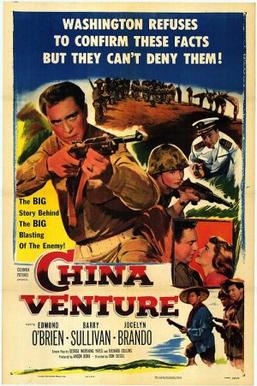
China Venture
Blah. That's all I'm coming up with for 1953's China Venture, a WWII story from director Don Siegel. Blah. Pretty weak, isn't it? It's not even good enough to mildly praise nor horrible enough to rip to pieces. It's just there, wasting away in its 83-minute running time. And away we go!
Leading a small patrol of Marines into China late in 1944, Capt. Matt Reardon (Edmond O'Brien) receives a message from Chinese guerrillas high up in the mountains. A high-ranking Japanese general (Philip Ahn) has crashed in the jungle, and for a price -- $10,000 -- the guerrillas will sell him to the Americans. Radioing for help, Reardon's patrol is "reinforced" by a Navy intelligence officer, Thompson (Barry Sullivan), a doctor (Dayton Lummis) and a nurse (Joceln Brando) to interrogate and care for the general. Heading into the thick jungle, Reardon's patrol is in a race against the clock as Japanese forces close in on the downed general too.
From director Don Siegel, 'Venture' is not meant to be some groundbreaking, innovative WWII story. Made in 1953 and not even breaking the 90-minue mark, it is a no-frills story that blends the men on a mission story with a handful of other familiar genre conventions. None of it really amounts to much, the different conventions working against each other in such a short time. The angle of the fighting in China is always interesting -- Americans, Japanese and Chinese warlords all fighting -- but the story never gets to push the limits. Even 1959's Never So Few (in all its amazing badness) went a little further. The "love story" between O'Brien and Brando is a flop too, slowing things down needlessly.
Where some positives come out is Siegel's tough guy talent behind the camera. At different points, 'Venture' reminded me some of Siegel's underrated WWII gem, 1962's Hell is For Heroes. Shot in black and white, it has the gritty, dirty look of an episode of Combat. The jungle is a gnarly, nasty place, and jungle fighting is full of ambushes, booby traps and all sorts of unpleasantness. While there isn't enough action, what's there is appropriately unpleasant. I just wish there was more of it, but instead we get long, uncut tracking shots of Reardon's patrol walking through the jungle, walking up and down hills. Not exactly adrenaline-pumping action.
Leading the cast, O'Brien has some good and some bad going for him. As the smart-mouth but capable Reardon, he's believable; a tough officer looking out for his men. The romance angle with Brando's Lt. Wilkins is painful to watch at times. Sullivan is solid as Cmdr. Thompson, the Navy Intelligence officer with no jungle-fighting experience. Reardon's squad includes Leo Gordon as the tough Sgt. Janowicz (O'Brien's scenes with him are highlights), Dabbs Greer, Alvy Moore, Wong Atarne and several other completely unlisted actors in the cast listing. The whole 'men on a mission' angle is wasted. Instead the focus is on the bickering between Reardon and Thompson, and the lovey-dovey stuff with Brando's caring nurse.
In the last third of the movie, the chance for some betrayals and actual excitement is there, but even that is mishandled. Leon Askin (later General Burkhalter on Hogan's Heroes) is badly cast as Wu King, the Chinese warlord auctioning off the Japanese general. Stereotypical doesn't begin to describe the part. As the rescuing Japanese forces close in, Reardon and Thompson are forced to make an extremely difficult decision, and the result proves to be the movie's strongest scene. But in the moments after, the finale is rushed. The movie isn't bad or good in the end. There are worse ways to spend 83 minutes, but I can think of a lot of better ways.
China Venture (1953): **/****
Leading a small patrol of Marines into China late in 1944, Capt. Matt Reardon (Edmond O'Brien) receives a message from Chinese guerrillas high up in the mountains. A high-ranking Japanese general (Philip Ahn) has crashed in the jungle, and for a price -- $10,000 -- the guerrillas will sell him to the Americans. Radioing for help, Reardon's patrol is "reinforced" by a Navy intelligence officer, Thompson (Barry Sullivan), a doctor (Dayton Lummis) and a nurse (Joceln Brando) to interrogate and care for the general. Heading into the thick jungle, Reardon's patrol is in a race against the clock as Japanese forces close in on the downed general too.
From director Don Siegel, 'Venture' is not meant to be some groundbreaking, innovative WWII story. Made in 1953 and not even breaking the 90-minue mark, it is a no-frills story that blends the men on a mission story with a handful of other familiar genre conventions. None of it really amounts to much, the different conventions working against each other in such a short time. The angle of the fighting in China is always interesting -- Americans, Japanese and Chinese warlords all fighting -- but the story never gets to push the limits. Even 1959's Never So Few (in all its amazing badness) went a little further. The "love story" between O'Brien and Brando is a flop too, slowing things down needlessly.
Where some positives come out is Siegel's tough guy talent behind the camera. At different points, 'Venture' reminded me some of Siegel's underrated WWII gem, 1962's Hell is For Heroes. Shot in black and white, it has the gritty, dirty look of an episode of Combat. The jungle is a gnarly, nasty place, and jungle fighting is full of ambushes, booby traps and all sorts of unpleasantness. While there isn't enough action, what's there is appropriately unpleasant. I just wish there was more of it, but instead we get long, uncut tracking shots of Reardon's patrol walking through the jungle, walking up and down hills. Not exactly adrenaline-pumping action.
Leading the cast, O'Brien has some good and some bad going for him. As the smart-mouth but capable Reardon, he's believable; a tough officer looking out for his men. The romance angle with Brando's Lt. Wilkins is painful to watch at times. Sullivan is solid as Cmdr. Thompson, the Navy Intelligence officer with no jungle-fighting experience. Reardon's squad includes Leo Gordon as the tough Sgt. Janowicz (O'Brien's scenes with him are highlights), Dabbs Greer, Alvy Moore, Wong Atarne and several other completely unlisted actors in the cast listing. The whole 'men on a mission' angle is wasted. Instead the focus is on the bickering between Reardon and Thompson, and the lovey-dovey stuff with Brando's caring nurse.
In the last third of the movie, the chance for some betrayals and actual excitement is there, but even that is mishandled. Leon Askin (later General Burkhalter on Hogan's Heroes) is badly cast as Wu King, the Chinese warlord auctioning off the Japanese general. Stereotypical doesn't begin to describe the part. As the rescuing Japanese forces close in, Reardon and Thompson are forced to make an extremely difficult decision, and the result proves to be the movie's strongest scene. But in the moments after, the finale is rushed. The movie isn't bad or good in the end. There are worse ways to spend 83 minutes, but I can think of a lot of better ways.
China Venture (1953): **/****
Labels:
1950s,
Barry Sullivan,
Don Siegel,
Edmond O'Brien,
Leo Gordon,
WWII
Sunday, May 27, 2012
Julius Caesar (1953)
So this William Shakespeare guy....pretty talented, huh? A poet and playwright, he is basically the benchmark for everything in literature. And thanks to my upbringing in English classes through high school and college, I basically hate Shakespeare. I was forced to read his writings and resented basically every minute of it. That only partially explains my hate for 1953's Julius Caesar, but it is certainly part of it.
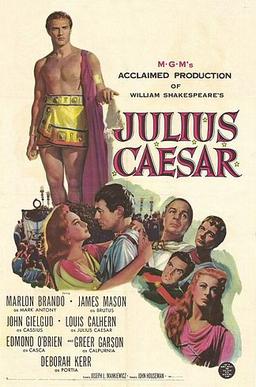
In ancient Rome, senator Julius Caesar (Louis Calhern) returns to an adoring public, many touting him as the future ruler of the Roman empire. Caesar's ambition is feared throughout the Senate, even leading many of his fellow Senators to plot against him, including the idealistic Brutus (James Mason) and cynical, scorned Cassius (John Gielgud). They worry that his ambition, along with close friend and fellow Senator, Mark Antony (Marlon Brando), will spell Rome's doom. They begin to form a plan, one that could change the country's future for years to come.
Now I'm going to say something early and just be done with it. I don't intend this review to sound like a whiny high school student although no doubt it will to a certain point. I can appreciate Shakespeare as an immense talent, but that doesn't mean I like anything about reading his work. I can appreciate that his talents have influenced basically every form of literature written since. But actually reading it? Some of the most difficult experiences I've ever had with the written word. Long, uninterrupted scenes of dialogue/monologues have a knack for putting me to sleep quickly. But....but.....even knowing this, I sought out this 1953 film, mostly because of the extraordinary talent assembled here. Unfortunately, I disliked it as much as I've always disliked Shakespeare's works whether it be in books and plays or film and television.
Where my objection comes from is Shakespeare's style. In writing, it is extremely difficult for me to get through the dialogue, and seeing it in a film didn't help. Well written it most certainly is, but it is stilted, awkward, forced and for me, difficult to follow. It doesn't seem to make a difference who's reciting the lines because the talent in this cast is truly impressive. And yes, I know these are stage-based stories, but seeing actors -- no matter the talent -- stand and wave and yell and recite several minutes of expressive yet still stilted dialogue doesn't scream out 'ENTERTAINING!' to me. Acting is one thing, and method acting a whole other beast, but I've never understood the appeal of loud, verbose, exaggerated stage acting, and that's what this movie is. It's 120 minutes of very talented actors talking and talking and...well, you get the idea.
With so much talent assembled for this film in the cast and director Joseph Mankiewicz behind the camera, I just assumed my issues would go by the wayside. With three movies to his name (Streetcar, The Men, Viva Zapata), Brando is a bright spot as Mark Anthony. His famous address of the Roman people following Caesar's assassination especially stands out. Then throw in Mason, Calhern, Gielgud, Edmond O'Brien, Greer Garson and Deborah Kerr? How could that not be worthwhile? I chalk it up more to Shakespeare's style than anything, but I just didn't care. I know the story, know where it will end up, and who makes it and who doesn't. Also look for Michael Ansara, Michael Pate, John Doucette, Lawrence Dobkin and Rhys Williams in smaller supporting parts.
I'm ready to take all sorts of heat for my dislike of this movie, but I hated it almost from the start. Besides the stilted, overdone stage acting, it is an incredibly dull story to watch. It was filmed in black and white on a soundstage, the camera and focus on the actors, not the huge scale or lavish sets. Bored to tears. There's just only so many ways to hear a classically trained actor speaking in the most prim and proper English ever written. So go ahead, let me have it if you so choose. I'm admitting I don't like Shakespeare. Karma is going to kick me square in the butt at some point.
Julius Caesar <---TCM trailer/clips (1953): */****
In ancient Rome, senator Julius Caesar (Louis Calhern) returns to an adoring public, many touting him as the future ruler of the Roman empire. Caesar's ambition is feared throughout the Senate, even leading many of his fellow Senators to plot against him, including the idealistic Brutus (James Mason) and cynical, scorned Cassius (John Gielgud). They worry that his ambition, along with close friend and fellow Senator, Mark Antony (Marlon Brando), will spell Rome's doom. They begin to form a plan, one that could change the country's future for years to come.
Now I'm going to say something early and just be done with it. I don't intend this review to sound like a whiny high school student although no doubt it will to a certain point. I can appreciate Shakespeare as an immense talent, but that doesn't mean I like anything about reading his work. I can appreciate that his talents have influenced basically every form of literature written since. But actually reading it? Some of the most difficult experiences I've ever had with the written word. Long, uninterrupted scenes of dialogue/monologues have a knack for putting me to sleep quickly. But....but.....even knowing this, I sought out this 1953 film, mostly because of the extraordinary talent assembled here. Unfortunately, I disliked it as much as I've always disliked Shakespeare's works whether it be in books and plays or film and television.
Where my objection comes from is Shakespeare's style. In writing, it is extremely difficult for me to get through the dialogue, and seeing it in a film didn't help. Well written it most certainly is, but it is stilted, awkward, forced and for me, difficult to follow. It doesn't seem to make a difference who's reciting the lines because the talent in this cast is truly impressive. And yes, I know these are stage-based stories, but seeing actors -- no matter the talent -- stand and wave and yell and recite several minutes of expressive yet still stilted dialogue doesn't scream out 'ENTERTAINING!' to me. Acting is one thing, and method acting a whole other beast, but I've never understood the appeal of loud, verbose, exaggerated stage acting, and that's what this movie is. It's 120 minutes of very talented actors talking and talking and...well, you get the idea.
With so much talent assembled for this film in the cast and director Joseph Mankiewicz behind the camera, I just assumed my issues would go by the wayside. With three movies to his name (Streetcar, The Men, Viva Zapata), Brando is a bright spot as Mark Anthony. His famous address of the Roman people following Caesar's assassination especially stands out. Then throw in Mason, Calhern, Gielgud, Edmond O'Brien, Greer Garson and Deborah Kerr? How could that not be worthwhile? I chalk it up more to Shakespeare's style than anything, but I just didn't care. I know the story, know where it will end up, and who makes it and who doesn't. Also look for Michael Ansara, Michael Pate, John Doucette, Lawrence Dobkin and Rhys Williams in smaller supporting parts.
I'm ready to take all sorts of heat for my dislike of this movie, but I hated it almost from the start. Besides the stilted, overdone stage acting, it is an incredibly dull story to watch. It was filmed in black and white on a soundstage, the camera and focus on the actors, not the huge scale or lavish sets. Bored to tears. There's just only so many ways to hear a classically trained actor speaking in the most prim and proper English ever written. So go ahead, let me have it if you so choose. I'm admitting I don't like Shakespeare. Karma is going to kick me square in the butt at some point.
Julius Caesar <---TCM trailer/clips (1953): */****
Sunday, April 10, 2011
Synanon
The Synanon organization was devoted to drug rehabilitation, helping junkies and addicts kick the habit they'd developed. Founded in 1958 in Santa Monica, California by Charles Dederich, the organization existed until the late 1980s before finally going under. They were obviously doing something right to last over 30 years. Their success in the early 1960s was even parlayed into a feature film, 1965's appropriately titled Synanon. Made on location in Santa Monica at the Synanon Home where its patients went through treatment, the movie was made with the support of the organization, which made me wonder. Why didn't they insist on a more positive story, or if nothing else, at least a better written script?
Coming off a heroin high one night on the boardwalk, ex-con and thug Zankie Albo (Alex Cord) finds himself in front of the Synanon House on the beach and checks himself in. At the lowest of lows though, being sober sounds like a good thing. When you're off your high, not so much, and Zankie has to convince the Synanon administration (Edmond O'Brien as Dederich, along with Richard Conte and singer Eartha Kitt) that he's on the up and up. Zankie goes back and forth but decides to stick around, partially because he's got an eye for another patient, Joaney (Stella Stevens), while also dealing with a fellow patient and person from his past, Ben (Chuck Connors). Going along with the program though and genuinely trying to get better, it seems only a matter of time before his demons get the best of him.
The biggest reason I watched this flick was the cast, no huge stars but actors who I'm always glad to see. The performances though are more hit or miss. O'Brien is a one-note character, the tough-talking administrative leader of the house, always glowering down at its patients with his tough love mentality. Conte plays a variation of so many of his performances, a condescending guy who thinks he knows everything. Basically, that asshole everyone knows. Kitt is okay but isn't given a ton to do. Cord, Stevens, and Connors are the best thing going for the movie. All three characters are deeply flawed individuals with their pasts looming over them. What clicks together is that individually or as a group, there's nothing very redeeming about them, but they're still interesting to watch. In the end, one character does get a chance to redeem themselves and move on to something better.
Now if I'm supporting a Hollywood feature film about my organization, I'm making certain demands about how things are going to be portrayed. With an organization like Synanon, that can be trouble because you're dealing with drug rehab (albeit a seemingly white-washed version). If you show it as it is, this is going to be one of the darkest movies ever. If you censor it as it feels like in the film at times, you're not doing the story justice. Director Richard Quine is trapped somewhere in the middle with moments of incredible darkness followed by moments of adoring adulation of the organization. Going back and forth like the story does, that's not the biggest concern. It's a reliance on story conventions that soap operas would be jealous of. Maybe it seemed innovative or ahead of its time in 1965, but now in 2011, it's all been done and seen. Shocking then, but not so much now.
What aids the movie through its ups and downs has little to do with the actual story of this organization trying to aid patients in their drug rehab. It's a very stylish, well-made look at Santa Monica, California, providing a bit of a time capsule for a really cool time period. Filming was done at the original Synanon house on the Santa Monica beach although I'm guessing indoor scenes were filmed on a studio. Other than though, as a viewer we feel like we're there at the house with the patients. Quine shoots on the streets surrounding the house, in and around the seedy bars nearby, and uses some unique angles that take you out of a typical comfort zone. It's not an aggressive style, but it doesn't just settle to put the camera in front of the cast and let them go. With a soft jazz score by Neal Hefti, 'Synanon' gives a window into 1960s California that transports you into the story.
Trying to look past the cliches and stereotypes the script relies on far too much, I was genuinely impressed with the performances by Cord, Stevens and Connors. I've only seen Alex Cord in a handful of really average movies, but I've always liked him as an actor. Besides the ridiculously odd but still cool name -- Zankie Albo -- the character is interesting even if I would have liked a little more background. Stevens plays up her sex kitten image and then throws you for a twist the same way Connors does, shedding his Lucas McCain image from The Rifleman. So overall, while the movie wasn't that good, some of the performances were good enough to give this a slight recommendation.
Synanon <--- TCM clips (1965): ** 1/2 /****
Friday, November 19, 2010
White Heat
I've written before that Cagney as a movie star was never one of my favorites, his acting style very theatrical and over the top. I've come around some as I've seen in him a few of his more subdued parts. The one movie I was told I had to give a chance was this one, White Heat. If I didn't like it, I was in the free and clear and should probably steer clear of his lesser efforts. Well, no problem there. Cagney's performance is theatrical and over the top but it is a part that demands he be both of those things. Considered his best acting job for a reason, this is a perfect introduction for anyone looking to get to know one of Hollywood's biggest stars of the 1930s and 1940s.
Running his brutal gang, Cody Jarrett (Cagney) faces a difficult decision. After a highly successful train robbery that netted over $300,000 but also produced four dead bodies, Jarrett is feeling the heat as FBI agent Philip Evans (John Archer) leads the manhunt to bring him to justice. Cody takes a lesser rap for a heist he didn't actually take part in, but it gives him an alibi for the job that would have sent him to the electric chair. Evans knows he's been duped with Jarrett taking a short sentence that will have him out on the streets in 2 years. He brings in one of his best undercover agents, Vic Pardo (Edmond O'Brien), and plants him in Jarrett's cell as a convict. Notoriously hot-tempered, Jarrett still takes to Vic and takes him under his wing almost like a little brother. Evans' plan works as Jarrett organizes a daring escape with Vic as the newest member of his dangerous gang.
Director Raoul Walsh wastes about four minutes post-credits before showing that his main character Cody Jarrett is one of the nastiest gangsters you're ever going to come across in a movie. In the opening heist of a train carrying a Wells Fargo shipment of cash, Jarrett callously guns down the engineer and his assistant at the very mention of his name (Henry Fonda had a similar reaction some 19 years later in Once Upon a Time in the West). That was part of the appeal of this movie, it's not a conventional 1940s flick where you can predict everything coming 15 or 20 minutes before it happens. The characters aren't particularly likable -- no redeeming qualities in sight for the most part -- and the attitudes toward sex and violence are far more lenient than most movies that came out of this stage in Hollywood's history. Of course, there is that Cagney guy leading the way.
In my messed up head watching movies about the bad guys (simplistic description, but it gets the idea across), I typically find myself rooting for said bad guys. Cagney pushes my tolerance for rooting for the bad guy because Cody Jarrett is one nasty dude. However, the fact that I was even contemplating being in this guy's corner is a testament to not only Cagney's acting ability but the strength of the screenplay. It digs into this character and really fleshes him out. He's the definition of a mama's boy with Ma Jarrett (Margaret Wycherly) doting on her son as she helps him run his gang. It is 1949 though so while certain things are hinted at (cough Oedipus complex cough) the hint is as far as things go. Then there's Cody's slutty wife Verna (Virginia Mayo) who latches on to whoever can get her the farthest in life with as much money and worldly possessions as possible.
So throw all this together along with a gang of murderers and cutthroats, and you kinda see where Cody's coming from. Not rationalizing here, just explaining. He has to be the nastiest S.O.B around or else he would get taken down in minutes by the wolves nipping at his heels. It's always refreshing to see a character fleshed out as much as this. There are moments where you are disgusted by his actions, but then you see him looking out for O'Brien's Vic like a little brother, and you feel for him. Of course, from the moment this character is introduced, you know what fate he's going to meet. It's never in doubt. Cody Jarrett is going out in a blaze of glory like no other. The ending -- as Jarrett, Pardo and the gang knock off a payroll at a chemical plant -- is a whopper of a finish, leading to the oft-repeated line 'Top of the world.' A finale that's about as good as they get.
I'm not sure how Cagney wasn't nominated in some way for his part as homicidal Cody Jarrett, but the lead performance is just one of many rock-solid acting jobs pulled here. Wycherly as Ma Jarrett is the picture of a devoted mother who knows her son is doomed but can't stop him, Mayo the femme fatale, Steve Cochrane as treacherous Big Ed Somers, and O'Brien especially as Pardo. In a similar way to the viewer, Pardo has this unexplainable connection to Jarrett. That's the movie in a nutshell. You're drawn in by this character you should despise but just can't come around. A must-see.
White Heat <---trailer (1949): *** 1/2 /****
Labels:
1940s,
Edmond O'Brien,
Film Noir,
James Cagney,
Raoul Walsh,
Virginia Mayo
Wednesday, December 23, 2009
Birdman of Alcatraz
Seven Days in May and The Train are classics and now I can add Birdman of Alcatraz to that list as Lancaster again turns in a defining performance from his career. Lancaster was able to balance out his roles, those that required more of an action edge, those that needed him to be at the top of his game acting, and those somewhere in the middle. Think of The Train, which required him to do both. As an actor, there's 2 sides to Lancaster that I've been able to piece together. One, there's Elmer Gantry where the actor is loud, boisterious and over the top from the opening scene. Then, there's 'Birdman' where he's quiet, composed and barely cracks a smile the whole movie...and still brings his character to life.
Based on the real life story of convict Robert Stroud, 'Birdman' starts in 1912 as a young Stroud (Lancaster) is sent to Leavenworth prison for killing a man (the victim was beating a prostitute). He clashes with warden Shoemaker (Karl Malden) right away and ends up killing a guard who is preventing his mother from visiting him. He is sentenced to hang but is saved by his mother (Thelma Ritter) who goes all the way to President Woodrow Wilson to save her son. Stroud is saved, but instead of death he's sent to solitary where he'll only have contact with a few guards while never seeing other prisoners.
Basically challenged to survive by Shoemaker, Stroud vows to win out in the end. One day in the yard, he finds a little sparrow who cannot fly and begins to care for it in his cell. So it starts as Stroud's actions impact other inmates who now want birds as cellmates. What starts as one small sparrow snowballs into many more. As the years pass, Stroud becomes an expert on birds and everything about their makeup, including how to treat bird diseases that previously had no cure. But other things are afoot as Shoemaker is now in charge of the Federal Bureau of Prisons which could impact Stroud and his birds.
What was surprising about the movie is how fascinating these sequences with the birds really are. We're talking whole scenes with little to no dialogue as Lancaster's Stroud first treats just one sparrow (which he names Runty) to then trying to figure out what is happening to all the birds that occupy his cell as an unexplained epidemic races through the cages. These are the high points of the movie -- the first 90 minutes or so -- as Stroud learns much about his avian friends while also interacting with guard Bull Ransom (Neville Brand playing against type in a good guy role) and fellow inmate Feto Gomez (Telly Savalas also in an atypical part) who also bonds with birds sent to him by his family.
Really my only issue with the movie is a change that comes about 100 minutes into the story -- and at 149 minutes overall it is a tad long -- when Stroud is transferred to Alcatraz. He is forced to leave all his birds, his studies, his makeshift laboratory behind as he moves to the island prison in San Francisco. So other than the fact that Stroud never had birds at Alcatraz yet he's still dubbed 'the birdman of Alcatraz,' the story gets away from what made the first 90 minutes so strong. Granted, this is a story about a man, not the birds, so the natural progression has to be played out, but the last hour is somewhat dull as this long-time inmate struggles in a new prison. A subplot with a prison riot (with Seinfeld's Uncle Leo leading the riot) seems like it's out of another movie.
What carries the movie through some of it's struggles is the fine cast led by Lancaster and Malden. Malden especially is presented as a good and bad guy, a man trying to do his job who comes down hard sometimes on Stroud, as a viewer it comes across unnecessarily harsh. Brand also delivers one of his best performances in a key supporting role as a guard who unexpected bonds with two-time murderer Stroud, and Savalas gets a chance to play a non-crazy person for a change. Betty Field also makes a strong impression as Robert's wife Stella, and Edmond O'Brien has a bookend cameo as an author who wrote a book about Stroud. Lancaster, Ritter and Savalas were all nominated for their performances. Lancaster deserved to win for this scene with Malden's Shoemaker alone.
Overall though, the strengths of the first half of the movie outweigh the sometimes slow pacing of the second half. Elmer Bernstein's score is a little more understated than his usual booming efforts, and sounds reminiscent of the quieter moments in his Great Escape score. Watch this movie for the performances from Lancaster in the lead to the members of the supporting cast. Maybe Lancaster and Frankenheimer did get on each other's nerves, but if this was the result, it was worth it.
Birdman of Alcatraz <----trailer (1962): *** 1/2 /****
Subscribe to:
Posts (Atom)