The 1950's were a mixed bag when it comes to war films. There's some classics -- The Bridge on the River Kwai, Stalag 17 -- but I've noticed a trend. There are almost-classics (or at least above average) that are undone by unnecessary love stories jammed into a war story. Otherwise good flicks ruined by scenes of passionate hugging and soldiers and the women they love holding each other cheek-to-cheek. Gasp! The horror! Add 1958's The Hunters to the list.
It's 1952 and the Korean War is raging. On the ground, the fighting is the same, infantry going toe-to-toe for every inch of ground. Up in the air though, things have changed with both sides using jets to control the skies. At an Air Force base in Japan, WWII veteran pilot Cleve "Iceman" Saville (Robert Mitchum) is back at it, going through indoctrination before taking over a fighter group. The aerial dogfights are a mess, the Chinese pilots not as skilled but all it takes is luck sometimes to survive the fighting. Among Saville's group are two pilots, both problems for vastly different reasons. Lt. Ed Pell (Robert Wagner) is a hotshot pilot, desperately wanting to be an ace while Lt. Carl Abbott (Lee Philips) is struggling with a drinking problem. Oh, and Saville has the hots for his wife, Kris (May Britt). As if the fighting to curb Communism wasn't enough...
Okay, here we go...Battle Cry, Force of Arms, Darby's Rangers, Never So Few, all war flicks somewhat to completely undone by stories harping on sluggish love stories typically featuring ZILCH in the chemistry department between its love interests. That's just off the top of my head too. There's more. You just know they're out there....
From director and producer Dick Powell, 'Hunters' is a pretty interesting flick. Enough time had passed since the end of the Korean War that viewers would have had a chance to breathe a little bit, put the conflict behind them. The subject matter, while dark, is far from anti-war and the film itself comes across as slightly shallow. There's just not that much meat there in a story that could have had plenty. It is a good-looking movie -- the print shown on Turner Classic Movies looked gorgeous -- with a decent cast, interesting story and some real potential that never quite takes off. If anything, any depth or a story with an edge is left behind in the wake of...
SPECTACLE. This is a movie about flying jets, fighter planes that zip across the sky and do things that no machine should be able to do. Think of it this way. An audience in 1958 would have been dazzled to see the acrobatics, the dogfights, the impressive speed. This was incredibly new to that audience. Now in 2015, it's an incredibly cool time capsule. The aerial footage is genuinely incredible. The stunts, the long shots of seemingly countless jets racing across the sky, well, Cinemascope never looked so good! Even the shots of the cast in the jets doesn't scream out how obvious it could have been. There's at least a semblance of reality that these guys are actually flying. So while the love story does its best to drag things down, these adrenaline-pumping aerial sequences are pretty freaking cool.
A favorite here at Just Hit Play, Mitchum is excellent here as Major Cleve Saville, a pilot from WWII who can't stay away when there's a fight (and he's a damn good pilot too). His Saville is the 'Hunter' of the title, a diehard pilot who has ridiculously keyed-in focus, blocking out all else to go for the kill during a dogfight. Now, some years since WWII has ended, has Saville changed? Has he mellowed? Mitchum is that low-key, laid back anti-hero the movie needs. Is it acting? Does he just not care? Somewhere in the middle most likely, but it's an interesting performance. You see a former hotshot pilot who's matured some and sees the dangers in what he used to be in those pilots now flying with him. I liked Wagner's Pell, a fast-talking, talented pilot who similarly may push too far. Also look for Richard Egan, John Gabriel and Stacy Harris as other pilots at the base.
That damn love story though. It doesn't help that Mitchum and Britt have little to no chemistry, dragging these already sluggish scenes to an even more screeching halt. No chemistry translates to no energy, especially when Philip's whiny Abbott starts to drink and question and get mad that his wife is drawn to a....blah blah blah. It's not good. When 'Hunters' sticks with the war drama, it's a pretty decent movie, especially in the second half as several pilots find themselves fighting through enemy territory after being forced to bail out from their jets. Some real drama, some tension, some nerves, it's all there. If there had been 103 minutes of that instead of what we have, we'd be talking a pretty decent (if somewhat formulaic) final product. So instead, we get a mixed bag.
A slight recommendation because Mitchum is impeccably cool, Wagner is a lot of fun, and those aerial sequences are impressive whether it's 1958 or 2015.
The Hunters (1958): ** 1/2 /****
The Sons of Katie Elder
"First, we reunite, then find Ma and Pa's killer...then read some reviews."
Showing posts with label Robert Wagner. Show all posts
Tuesday, November 17, 2015
Tuesday, February 3, 2015
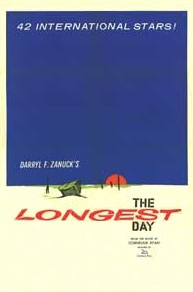
The Longest Day
When you look back through history, certain dates hold a higher place in the history books. It can be someone's birth, someone's death, or just have an amazing historical significance in terms of impact on the world. High up on that list is June 6, 1944, the day Allied forces invaded Normandy, better known as D-Day. In the age of gigantic, sprawling epics, one of the best movies of the 1960s tackles the immense subject, 1962's The Longest Day.
A plot description wouldn't do this flick justice. It's just infeasible. The history will serve as a big enough jumping off point. After four-plus years of war, Allied forces had massed for months, all prepping for the invasion of Europe, hopefully taking back the continent from Adolf Hitler and his Nazi Third Reich. The invasion was months and years in planning, millions of men, millions of tons of equipment, thousands and thousands of ships, trucks, jeeps and tanks waiting to be unleashed at Normandy and in the French countryside. What was the mystery? The Allies tried desperately to keep the location of the invasion -- Normandy -- secret to help save lives and make the invasion smoother. The Germans similarly tried desperately to discover where the attack was coming. The war hung in the balance along with millions of lives, not just those taking part in the attack but all over the world. Not bad for historical significance, huh?
So tackling that premise in movie form seems a rather daunting task if you ask me. In the age of the epic, this one doesn't disappoint. At 178 minutes, 'Longest' covers a ridiculous amount of ground in a story that takes place over about a 36-hour time span. We see the Allies deciding the time is finally right after days of wavering while the Germans decide if this is the actual invasion or just a feint, a distraction to throw them off. Based on the book by Cornelius Ryan, it is told in docu-drama style as we meet all the participants from the high command to the soldiers, paratroopers to resistance fighters, townspeople to priests and everything and everyone in between. This isn't a movie about characters, but instead about the spectacle and immensity of what happened. If the Allied invasion on D-Day didn't work, who knows how the world would have changed?
Just a huge movie but one that never feels rushed or forced. The three-hour running time absolutely flies by. It was filmed in black and white, giving it an appropriately dated look. Maybe color takes away from what's on-screen, but the decision to film in black and white simply put, works. Ken Annakin, Andrew Marton and Bernhard Wicki combine to direct this behemoth epic and to handle it well. Technically speaking, it is a virtually flawless film. Some stock footage is sprinkled here and there, but many of the locations where the actual events took place were used as filming locations. Talk about authenticity, it can be downright eerie watching some of the scenes knowing the locations' history. The score from Maurice Jarre is used in appropriate doses with the main theme (listen HERE) a memorable piece of music that's always stuck with me.
As an epic though, one thing was required more than just about anything else. That requirement? A cast of seemingly thousands. Literally everyone in Hollywood and stars internationally were required to star in this movie. Okay, a slight exaggeration, but you get my point. Most of these parts were nothing more than cameos, but just as a taste of the ridiculous star power on display, we get John Wayne, Robert Mitchum, Robert Ryan, Henry Fonda, Richard Burton, Edmond O'Brien, Rod Steiger, even a pre-James Bond Sean Connery. Many of those parts only required an on-screen appearance of a minute or two -- some for much more -- but their presence alone...just wowza. The scary part? That's only a somewhat small taste of the depth of the cast that truly brings an international flavor to the D-Day proceedings with German, French, British, American and many more brought together.
The Longest Day is an epic, plain and simple, but for every scene where the scope and scale impresses, I loved the quieter, personal and often times, terrifyingly real scenes just as effective and memorable. I loved Richard Todd as a paratrooper commander tasked with landing in France via glider and taking a key bridge and holding until reinforcements arrive...if they can. The scene where American paratroopers, including strung-up Red Buttons, overshoot their landing zone and land in a German town is tragic and moving. One paratrooper (Sal Mineo) making a tragic decision is surprising and intensely real. I especially liked the simplicity of a late scene between Burton's RAF pilot and Richard Beymer's American paratrooper discussing the necessary evil of the day but also the lunacy of it. I think the best, most iconic moment has Hans Christian Blech's German officer finally spotting the invasion force in the English Channel when the fog clears. His face drops and he mumbles 'Die invasion,' all set to Beethoven's Fifth Symphony. Just a ton of great moments like this.
The other counter to those scenes are the BIG moments, and that's where the technical comes into play. One tremendous scene has a German fighter strafing the beaches, all of which we see from the perspective of the plane. Hundreds and thousands of extras scramble for cover underneath in a remarkable visual scene. The same later in 'Longest' when French commandos fight their way up a street in a French town, a helicopter (I think) filming all the action. As well, the scene of the paratroopers coming down on the German-held Sainte-Mere-Eglise is a horrifying scene that utilizes some very cool camerawork. Also look for a cool scene where American Rangers -- including Robert Wagner, George Segal, Paul Anka, Fabian, Tommy Sands -- scale the cliffs of Pointe de Huc, all trying to knock out a key German emplacement. Some especially memorable moments, not all of them action scenes.
Because I don't want to forget anyone but don't want to overdo it describing EVERY character, also look for Eddie Albert, Irina Demick, Mel Ferrer, Steve Forest, Gert Frobe, Leo Genn, Jeffrey Hunter, Curd Jurgens, Peter Lawford, Christian Marquand, Roddy McDowall, Kenneth More, Wolfgang Preiss, Ron Randell, Jean Servais, Norman Rossington, Tom Tryon, Peter van Eyck and Stuart Whitman. Okay, I'll take a breath now.
The Longest Day isn't the best war movie around, but it's one of my favorites. It tries to accomplish a ton and succeeds on just about every level. The history, the scale, the spectacle, the gigantic cast, the moments that resonate amongst all the epic qualities. It also serves as an excellent companion piece to the more recent Saving Private Ryan. Nowhere near as violent, but a more far-reaching story. A gem from the age of epics.
The Longest Day (1962): ****/****
A plot description wouldn't do this flick justice. It's just infeasible. The history will serve as a big enough jumping off point. After four-plus years of war, Allied forces had massed for months, all prepping for the invasion of Europe, hopefully taking back the continent from Adolf Hitler and his Nazi Third Reich. The invasion was months and years in planning, millions of men, millions of tons of equipment, thousands and thousands of ships, trucks, jeeps and tanks waiting to be unleashed at Normandy and in the French countryside. What was the mystery? The Allies tried desperately to keep the location of the invasion -- Normandy -- secret to help save lives and make the invasion smoother. The Germans similarly tried desperately to discover where the attack was coming. The war hung in the balance along with millions of lives, not just those taking part in the attack but all over the world. Not bad for historical significance, huh?
So tackling that premise in movie form seems a rather daunting task if you ask me. In the age of the epic, this one doesn't disappoint. At 178 minutes, 'Longest' covers a ridiculous amount of ground in a story that takes place over about a 36-hour time span. We see the Allies deciding the time is finally right after days of wavering while the Germans decide if this is the actual invasion or just a feint, a distraction to throw them off. Based on the book by Cornelius Ryan, it is told in docu-drama style as we meet all the participants from the high command to the soldiers, paratroopers to resistance fighters, townspeople to priests and everything and everyone in between. This isn't a movie about characters, but instead about the spectacle and immensity of what happened. If the Allied invasion on D-Day didn't work, who knows how the world would have changed?
Just a huge movie but one that never feels rushed or forced. The three-hour running time absolutely flies by. It was filmed in black and white, giving it an appropriately dated look. Maybe color takes away from what's on-screen, but the decision to film in black and white simply put, works. Ken Annakin, Andrew Marton and Bernhard Wicki combine to direct this behemoth epic and to handle it well. Technically speaking, it is a virtually flawless film. Some stock footage is sprinkled here and there, but many of the locations where the actual events took place were used as filming locations. Talk about authenticity, it can be downright eerie watching some of the scenes knowing the locations' history. The score from Maurice Jarre is used in appropriate doses with the main theme (listen HERE) a memorable piece of music that's always stuck with me.
As an epic though, one thing was required more than just about anything else. That requirement? A cast of seemingly thousands. Literally everyone in Hollywood and stars internationally were required to star in this movie. Okay, a slight exaggeration, but you get my point. Most of these parts were nothing more than cameos, but just as a taste of the ridiculous star power on display, we get John Wayne, Robert Mitchum, Robert Ryan, Henry Fonda, Richard Burton, Edmond O'Brien, Rod Steiger, even a pre-James Bond Sean Connery. Many of those parts only required an on-screen appearance of a minute or two -- some for much more -- but their presence alone...just wowza. The scary part? That's only a somewhat small taste of the depth of the cast that truly brings an international flavor to the D-Day proceedings with German, French, British, American and many more brought together.
The Longest Day is an epic, plain and simple, but for every scene where the scope and scale impresses, I loved the quieter, personal and often times, terrifyingly real scenes just as effective and memorable. I loved Richard Todd as a paratrooper commander tasked with landing in France via glider and taking a key bridge and holding until reinforcements arrive...if they can. The scene where American paratroopers, including strung-up Red Buttons, overshoot their landing zone and land in a German town is tragic and moving. One paratrooper (Sal Mineo) making a tragic decision is surprising and intensely real. I especially liked the simplicity of a late scene between Burton's RAF pilot and Richard Beymer's American paratrooper discussing the necessary evil of the day but also the lunacy of it. I think the best, most iconic moment has Hans Christian Blech's German officer finally spotting the invasion force in the English Channel when the fog clears. His face drops and he mumbles 'Die invasion,' all set to Beethoven's Fifth Symphony. Just a ton of great moments like this.
The other counter to those scenes are the BIG moments, and that's where the technical comes into play. One tremendous scene has a German fighter strafing the beaches, all of which we see from the perspective of the plane. Hundreds and thousands of extras scramble for cover underneath in a remarkable visual scene. The same later in 'Longest' when French commandos fight their way up a street in a French town, a helicopter (I think) filming all the action. As well, the scene of the paratroopers coming down on the German-held Sainte-Mere-Eglise is a horrifying scene that utilizes some very cool camerawork. Also look for a cool scene where American Rangers -- including Robert Wagner, George Segal, Paul Anka, Fabian, Tommy Sands -- scale the cliffs of Pointe de Huc, all trying to knock out a key German emplacement. Some especially memorable moments, not all of them action scenes.
Because I don't want to forget anyone but don't want to overdo it describing EVERY character, also look for Eddie Albert, Irina Demick, Mel Ferrer, Steve Forest, Gert Frobe, Leo Genn, Jeffrey Hunter, Curd Jurgens, Peter Lawford, Christian Marquand, Roddy McDowall, Kenneth More, Wolfgang Preiss, Ron Randell, Jean Servais, Norman Rossington, Tom Tryon, Peter van Eyck and Stuart Whitman. Okay, I'll take a breath now.
The Longest Day isn't the best war movie around, but it's one of my favorites. It tries to accomplish a ton and succeeds on just about every level. The history, the scale, the spectacle, the gigantic cast, the moments that resonate amongst all the epic qualities. It also serves as an excellent companion piece to the more recent Saving Private Ryan. Nowhere near as violent, but a more far-reaching story. A gem from the age of epics.
The Longest Day (1962): ****/****
Thursday, September 30, 2010
Harper
The only other Newman flick I've reviewed here was an awful biblical epic, The Silver Chalice, so I don't want it to seem like I'm ragging on the man. Where The Silver Chalice was just all around awful, 1966's Harper is all around bad, but it's not Newman's fault. Anything but really because he's basically the only positive I took away from this convoluted mystery that not surprisingly receives good reviews from fans and has achieved a bit of cult status over the years. It's the type of thing where I finish a movie, read up on it afterward and am completely thrown off by fans' love of the movie. Did I miss something? Maybe, but I don't see myself revisiting this one anytime soon.
Tipped off by a lawyer friend (Arthur Hill) about a possible case, private investigator Lew Harper (Newman) begins to look into the background and evidence. A rich woman (Lauren Bacall) claims her husband has disappeared -- she doesn't really care, just curious -- under some mysterious circumstances and wants to know what happened to him. Harper somewhat unwillingly agrees to the job offer because after all, a payday is a payday, and the rich wife promises to pay handsomely. But with an odd, eccentric cast of characters surrounding the husband in his daily life, Harper quickly figures out that there is more going on than meets the eye. He's stumbled into something that is bigger than he ever thought.
Pretty straightforward plot review, don't you think? It's also one of the most vague reviews I've ever written because this movie just doesn't know where it's going or how to get there. Director Jack Smight has made one of the most convoluted stories I've ever seen. Countless characters are thrown at the screen, and Smight sees if they stick before dispatching them or keeping them involved. Harper follows "the clues" which I never saw and inexplicably pops up in random places, no explanation provided. At 121 minutes, the story had plenty of time to develop somewhat coherently, but that never comes to fruition. As a topper, convoluted isn't enough. It's also dull in its chaos, and still somehow easy to predict. A real doozy of a story.
The saving grace is Newman as Lew Harper, a role he would play once more in a 1970s sequel. Newman is at his best -- for me at least -- when he gets to do the anti-hero with a touch of humor and drama, that feeling of frustration with the world. He's mainstream, but he's got a bit of a rebel streak in him, like Cool Hand Luke, Hud, Butch Cassidy, or John Russel in Hombre. That's what Harper is, a man frustrated where his life has ended up. He's good at the job he does, but what does he ever really accomplish? He tracks down cheating spouses, works in seedy motels, and generally hates what he does. This possible kidnapping/disappearance case is different and maybe could give him a shot at something bigger, something better
I can't add another saving grace (can there be two?) because what I'm about to mention is only partially positive. Newman is the star, and the opening credits proceed to introduce a long alphabetical list of guest stars. Count me in, I'm all for glorified, extended cameos, and this list is impressive. Along with Bacall and Hill, there's Robert Wagner, Shelley Winters, Strother Martin, Pamela Tiffin, Julie Harris, Robert Webber, Harold Gould and Janet Leigh along for the ride. How great is that cast in support of always reliable Newman? Pretty can't miss, right? Well, for the most part this impressive cast is given nothing to do. They drift aimlessly through the story, and Newman's Harper somehow pieces all these weird events together until there's some sort of resolution that didn't really make sense to me. Great cast, sure, but a wasted one.
So what else to say? Not much. This movie is dull, confusing, a waste of the talent involved, and almost completely worth ignoring other than Newman's title role. It took me a handful of viewings to get through it because I struggled sticking with it for more than 15 or 20 minutes at a time. Thank God for the fast forward button. I'd have never made it otherwise.
Harper <---trailer (1966): */****
Thursday, May 14, 2009
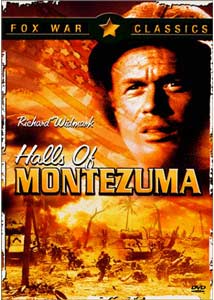
Netflix review #20: Halls of Montezuma
Following the campaigns in the Pacific at Guadalcanal and Tarawa, Lt. Carl Anderson (Richard Widmark) prepares his men for another assault on a Japanese-held island. Anderson's been going through a bit of a breakdown recently as just 7 men from his original platoon have survived. He's torn up inside at the thought of all the men he's lost and gets horrific headaches under stress. It's after the Marines hit the beach and have moved inland that the real trouble starts. The Japanese garrison unleashes hundreds of rockets at the advancing Marines. The problem, no one can spot the rocket emplacements.
Assigned to lead a patrol from his commander, Lt. Colonel Gilfillan (Richard Boone), Anderson must find the rockets and call their location in before a huge push the next day. Among the patrol are the few men Anderson genuinely cares about and wants to see make it through, the original members of the platoon. Leading that group is Pigeon Lane (Jack Palance), a former boxer suckered into the Marines, Coffman (Robert Wagner), the youngster trying to figure out who saved him at Tarawa, Doc Jones (Karl Malden), Anderson's close friend, Cpl. Conroy (Richard Hylton), a former student of Anderson's, Pretty Boy Riley (Skip Homeier), a soldier trying to rise above his past, Slattery (Bert Freed), the best soldier in the bunch and the biggest troublemaker, and Sgt. Zelenko (Neville Brand), the tough sergeant. Then for good measure there's a Japanese translator, a war correspondent (Jack Webb), and a new recruit along.
I've written before about how much I like 'men on a mission' movies, and this certainly qualifies with the cast full of recognizable character actors. But instead of just dropping the viewer into the platoon, we get an interesting technique to get to know the platoon. With a handful of flashbacks, we see their interactions in the group, some while in the unit, others as far back as their civilian days. It helps then when the platoon starts getting picked off by the Japanese. These aren't random, faceless soldiers, we know something about them and their makeup.
For a movie made just 5 years since the end of WWII, director Lewis Milestone tells it pretty straight. These aren't superhero G.I. Joe soldiers. Widmark is close to cracking up, and some of his men aren't too far behind. The more I watch of him, the more I think Widmark is one of the more underrated, underappreciated actors to come out of the late 1940s. As well, the Japanese soldiers aren't presented as stereotypical, one-dimensional soldiers. The whole movie has a clear anti-war stance. The action, while good, is understated. Characters are shot off-screen or hit by shrapnel as they head for a foxhole. And made in 1950 years before blood squibs became commonplace in war movies and westerns, the violence is fairly graphic, including one hand-to-hand encounter with a Japanese sniper.
The DVD has the movie in standard presentation, it was released about 3 years before widescreen was used, a trailer, and a handful of trailers for other Fox war movie DVDs. It's not a great WWII movie, but it's certainly a good one. Widmark leads a strong cast, and in general, Halls of Montezuma was ahead of its time when dealing with some of the deeper issues that war movies would later explore.
Halls of Montezuma (1950): ***/****
I've written before about how much I like 'men on a mission' movies, and this certainly qualifies with the cast full of recognizable character actors. But instead of just dropping the viewer into the platoon, we get an interesting technique to get to know the platoon. With a handful of flashbacks, we see their interactions in the group, some while in the unit, others as far back as their civilian days. It helps then when the platoon starts getting picked off by the Japanese. These aren't random, faceless soldiers, we know something about them and their makeup.
For a movie made just 5 years since the end of WWII, director Lewis Milestone tells it pretty straight. These aren't superhero G.I. Joe soldiers. Widmark is close to cracking up, and some of his men aren't too far behind. The more I watch of him, the more I think Widmark is one of the more underrated, underappreciated actors to come out of the late 1940s. As well, the Japanese soldiers aren't presented as stereotypical, one-dimensional soldiers. The whole movie has a clear anti-war stance. The action, while good, is understated. Characters are shot off-screen or hit by shrapnel as they head for a foxhole. And made in 1950 years before blood squibs became commonplace in war movies and westerns, the violence is fairly graphic, including one hand-to-hand encounter with a Japanese sniper.
The DVD has the movie in standard presentation, it was released about 3 years before widescreen was used, a trailer, and a handful of trailers for other Fox war movie DVDs. It's not a great WWII movie, but it's certainly a good one. Widmark leads a strong cast, and in general, Halls of Montezuma was ahead of its time when dealing with some of the deeper issues that war movies would later explore.
Halls of Montezuma (1950): ***/****
Subscribe to:
Posts (Atom)