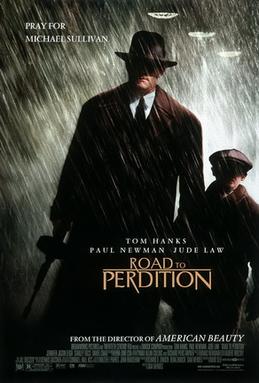
Right up there with pizza, hot dogs, baseball and the Windy City nickname, the city of Chicago is often remembered for....you guessed it. Gangsters! From Al Capone to the Untouchables and a whole lot of violence in between, Chicago's gangster history is well-documented, a feature well covered in film and pop culture. One of the best though? It's not based on a true story, but you can definitely see it happening in real life. Here is the excellent, beautifully told, stylish gangster drama, 2002's Road to Perdition.
It's the late 1920s and young Michael Sullivan (Tyler Hoechlin) is your typical 12-year old. He fights with his younger brother, struggles some at school, and loves reading about heroes of the old west. That relatively peaceful life is about to be thrown for a loop. His father, Michael Sullivan Sr. (Tom Hanks), is a brutally efficient enforcer for an Irish mob boss, John Rooney (Paul Newman), in Rock Island, Illinois. One night, Michael follows his father on a nighttime job and witnesses a hit that he clearly was not supposed to see. The unintentional incident steamrolls into something far bigger and far deadlier than young Michael ever intended. Now, father and son are on the road, hiding out and simply trying to survive, all the while a sinister hired killer, Maguire (Jude Law), hot on their trail. The elder Sullivan is now looking out for himself, his son, the killer hunting them and at the same time enacting a plan to exact vengeance on those who have wronged him.
That's not my best work putting together a plot synopsis. I don't want to give too much away in terms of the story because there are some genuinely good twists that do come as a bit of a shock. A lot going on in terms of storytelling overall, but getting there is half the fun in this 2002 gangster/crime drama.
There are more action-packed gangster flicks, more mainstream than this film, but I don't know if there's too many better. You look at the entire package, and this is one excellent movie, a classic if you ask me. This is director Sam Mendes' follow-up to 1999's American Beauty, and 'Perdition' is a gem. I'll get more specific as we go, but there's just so much going on and it all flows together. The story is exceedingly simple but with complex layers mixed in. It's not always clear where it's going, but Mendes know where it is going, and that's what is most important. The characters, the story, the filming techniques. It is all pretty flawless if you ask me. My recent viewing was the first in many years, and it resonated more now than in previous viewings. Scary to think 'Perdition' is already 13 years old but this is a film that has definitely held up.
This isn't a perfect movie. But judging it solely based on technical features? It's pretty perfect. The cinematography, the set design, the style, the musical score, the scene-to-scene visuals, my goodness, 'Perdition' is on point. Cinematographer Conrad L. Hall (earning an Academy Award win) is at the helm of a gorgeous movie. It's not a colorful movie -- lots of dark tones -- but entire scenes appear almost as if they were lifted out of a painting. You feel like you're in 1930s gangster-dominated Chicago throughout. The cars, the sets -- including Chicago locations -- the wardrobe, everything feels like you've time-traveled. Some movies, they don't call attention to these things. 'Perdition' does it in effortless fashion. It doesn't call attention to its prowess, it just does it and lets you appreciate it all. Also picking up a nomination (albeit without the win) is Thomas Newman for his musical score, a heavily Irish-themed score that elevates the movie in so many scenes, one after another. Give it a sample HERE.
The guts of the story is the father-son relationship between Michael Sr. and Michael Jr., but also between Michael and his surrogate father of sorts, Newman's Rooney. There's also Rooney's tortured relationship with his own son, Connor (Daniel Craig). Hanks plays against type a bit as Sullivan, dubbed the Angel of Death, a hard-edged man who is far from an emotional father. He struggles to be close with his eldest son mostly because he sees so much of himself in his son. Likewise, the son wants to be close to his father but isn't quite sure of how to go about that. Through the most unfortunate of situations, they're forced to become closer on the road, running for their lives, and with Michael trying to exact revenge against his previous employers. Their scenes together are quiet and understated, two individuals getting to really know each other for the first time. An excellent performance from Hanks as well as young Hoechlin who holds his own and then some.
Across the board, there isn't a weak performance in the cast. As John Rooney, Paul Newman is a scene-stealer in an emotional, quiet part. Not a ton of screentime, but he steals those scenes like a true pro. It's cool as well to see a pre-James Bond Daniel Craig as his weaselly son, Connor, always causing trouble that he can't get himself out of. Also in the playing against type department, Law is perfectly creepy as Maguire, the sinister hired killer who's tracking the Sullivans as they're on the run. Yeah, he's efficient and almost emotionless, but he clearly gets some enjoyment out of his horrifically bloody work. Also look for Stanley Tucci as Frank Nitti, an Al Capone underboss in Chicago, Jennifer Jason Leigh as Michael's loving wife, Liam Aiken as Peter, the younger Sullivan brother, and Ciaran Hinds as an underboss for Rooney who may be in some hot water.
For a gangster/mobster movie, the action isn't left and right machine gun pacing. When it comes, the violence is quick and startling but not horrifically graphic. Because it isn't used as much, when it does pop up on-screen, it is far more emotionally effective. One late shootout is easily top 5 most stylish action scenes I've ever watched, silence and darkness lingering in the air. The immediate follow-up is equally memorable, an extended shot following one character through an elegant Chicago hotel with quite the punch of a finale. The ending isn't especially surprising but it is especially effective. A great movie, one I really enjoyed catching up with and can easily and highly recommend.
Oh, and just as a trivia tidbit, my Uncle Bob is an extra in the movie. He's clearly visible in one scene a little over halfway through the movie as Hanks' Michael walks into a bank. Yeah, he steals the movie.
Road to Perdition (2002): ****/****
The Sons of Katie Elder
"First, we reunite, then find Ma and Pa's killer...then read some reviews."
Showing posts with label Gangsters. Show all posts
Thursday, June 11, 2015
Thursday, November 6, 2014
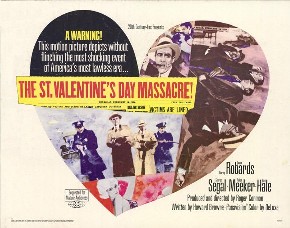
The St. Valentine's Day Massacre
I grew up in Chicago so I love just about everything in the Windy City, all the sports teams, the downtown area, all that great food from Chicago style hot dogs to Chicago style pizza. But that Chicago history? My goodness, there are some dark moments from the Black Sox scandal to the Chicago Fire, the riots at the 1968 Democratic convention and generally all sorts of political corruption and deception. One of the most violent incidents in the city's history? That's told in a 1967 B-movie, The St. Valentine's Day Massacre.
It's early 1929 and the streets of Chicago are filled with warring gangsters from two rival gangs. On one side is Al Capone (Jason Robards), a brutal, possibly maniacal Italian gangster with Mafia ties, who rules Chicago's South Side with an iron fist. Running the city's North side is George 'Bugs' Moran (Ralph Meeker), his Irish gang trying to hold onto their territory. Things across the city are building to an unavoidable confrontation as both sides fight for control of thousands of speakeasies, Prohibition still raging. Capone has grown tired of Moran's gang trying to build up their power and has put into work a plan to execute his rival gang leader. Can one gang win out over the other? Can anyone win with the city's streets riddled with bullets and blood?
Everyone's heard of producer/director extraordinaire Roger Corman? He's one of Hollywood's all-time greats at getting movies made on the cheap so basically the King of B-Movies. That's not a bad thing, and I say it as a compliment. This generally forgotten 1967 gangster flick is one of his best, telling the true story of one of Chicago's darkest moments. It was filmed on studio streets -- cheaper than Chicago's downtown area -- but it works, giving the city a closed in, wintery and claustrophobic effect. This is a flick that works almost like a quasi-documentary, like something you'd see on The History Channel...but darker, much darker. With narrator Paul Frees and his perfectly gravelly voice laying things out, introducing dates, people and times, it all fits together like puzzle pieces.
Where 'Massacre' separates itself from the quasi-documentary feel is that darkness, that gangster world we're thrust into. Low budget though it may be, the movie looks great with countless gangsters wearing impeccably cool suits with fedoras, rocking vicious tommy guns and 1920s boats of cars that look as cool as ever now in 2014 as they would have in 1929. As for the real life gangsters, this isn't The Godfather where you kinda sorta maybe sympathize with the Corleones, however vicious and murdery they are. There ain't a single sympathetic character anywhere in sight. These are nasty, brutal, violent folks interested in making money and killing some rival gangsters in the process. You're not rooting for anybody. You're not hoping these guys come out unscathed. You just wanna see how it all shakes out and who's gonna make it. Let me tell you...not many do.
One of the coolest aspects of 'Massacre' is its ridiculously deep cast. We're not talking a disaster flick type of cast full of aging A-list stars. We're talking a couple very solid movie stars/actors at the top and a cast backing them up absolutely packed to the guts with familiar, recognizable character actors. As for the leads, Robards is terrifyingly hammy as everyone's favorite Chicago gangster, Al Capone. He's got that look in his eye, you just never know what he's going to do next. Meeker is excellent too in a more understated but just as sinister part, Bugs Moran, an Irish gangster and Capone's main rival for power. Also look for a young George Segal in one of his best early roles, playing Peter Gusenberg, one of Moran's enforcers/lieutenants working closely with his brother, another enforcer, Frank (David Canary) while constantly fighting with live-in girlfriend (Jean Hale).
Okay, brace yourself because you're about to get hit with a whole lot of links to actor's IMDB pages. These are all the real-life people involved in the 1920s world of Chicago gang wars, an extremely interesting historical time if you're interested in the subject matter. On the Capone side keep an eye out for Clint Ritchie as the massacre's mastermind, Frank Silvera, Harold J. Stone, Paul Richards, Joe Turkel, Alex Rocco, Leo Gordon, John Agar, and Richard Bakalyan and Jack Nicholson (Yes, that Jack Nicholson) as two hired mafia killers. On the Moran side of things, watch for Bruce Dern, Kurt Kreuger, Tom Reese. Some appearances are quicker than others, but it's cool to see so many people in one movie, even if it is only for a scene or two.
Just an entertaining dark and dirty movie. If you're a fan of history whether it be Chicago or gangsters or anything in between, this gritty, cynical, particularly vicious flick is for you. I loved it.
The St. Valentine's Day Massacre (1967): *** 1/2 /****
It's early 1929 and the streets of Chicago are filled with warring gangsters from two rival gangs. On one side is Al Capone (Jason Robards), a brutal, possibly maniacal Italian gangster with Mafia ties, who rules Chicago's South Side with an iron fist. Running the city's North side is George 'Bugs' Moran (Ralph Meeker), his Irish gang trying to hold onto their territory. Things across the city are building to an unavoidable confrontation as both sides fight for control of thousands of speakeasies, Prohibition still raging. Capone has grown tired of Moran's gang trying to build up their power and has put into work a plan to execute his rival gang leader. Can one gang win out over the other? Can anyone win with the city's streets riddled with bullets and blood?
Everyone's heard of producer/director extraordinaire Roger Corman? He's one of Hollywood's all-time greats at getting movies made on the cheap so basically the King of B-Movies. That's not a bad thing, and I say it as a compliment. This generally forgotten 1967 gangster flick is one of his best, telling the true story of one of Chicago's darkest moments. It was filmed on studio streets -- cheaper than Chicago's downtown area -- but it works, giving the city a closed in, wintery and claustrophobic effect. This is a flick that works almost like a quasi-documentary, like something you'd see on The History Channel...but darker, much darker. With narrator Paul Frees and his perfectly gravelly voice laying things out, introducing dates, people and times, it all fits together like puzzle pieces.
Where 'Massacre' separates itself from the quasi-documentary feel is that darkness, that gangster world we're thrust into. Low budget though it may be, the movie looks great with countless gangsters wearing impeccably cool suits with fedoras, rocking vicious tommy guns and 1920s boats of cars that look as cool as ever now in 2014 as they would have in 1929. As for the real life gangsters, this isn't The Godfather where you kinda sorta maybe sympathize with the Corleones, however vicious and murdery they are. There ain't a single sympathetic character anywhere in sight. These are nasty, brutal, violent folks interested in making money and killing some rival gangsters in the process. You're not rooting for anybody. You're not hoping these guys come out unscathed. You just wanna see how it all shakes out and who's gonna make it. Let me tell you...not many do.
One of the coolest aspects of 'Massacre' is its ridiculously deep cast. We're not talking a disaster flick type of cast full of aging A-list stars. We're talking a couple very solid movie stars/actors at the top and a cast backing them up absolutely packed to the guts with familiar, recognizable character actors. As for the leads, Robards is terrifyingly hammy as everyone's favorite Chicago gangster, Al Capone. He's got that look in his eye, you just never know what he's going to do next. Meeker is excellent too in a more understated but just as sinister part, Bugs Moran, an Irish gangster and Capone's main rival for power. Also look for a young George Segal in one of his best early roles, playing Peter Gusenberg, one of Moran's enforcers/lieutenants working closely with his brother, another enforcer, Frank (David Canary) while constantly fighting with live-in girlfriend (Jean Hale).
Okay, brace yourself because you're about to get hit with a whole lot of links to actor's IMDB pages. These are all the real-life people involved in the 1920s world of Chicago gang wars, an extremely interesting historical time if you're interested in the subject matter. On the Capone side keep an eye out for Clint Ritchie as the massacre's mastermind, Frank Silvera, Harold J. Stone, Paul Richards, Joe Turkel, Alex Rocco, Leo Gordon, John Agar, and Richard Bakalyan and Jack Nicholson (Yes, that Jack Nicholson) as two hired mafia killers. On the Moran side of things, watch for Bruce Dern, Kurt Kreuger, Tom Reese. Some appearances are quicker than others, but it's cool to see so many people in one movie, even if it is only for a scene or two.
Just an entertaining dark and dirty movie. If you're a fan of history whether it be Chicago or gangsters or anything in between, this gritty, cynical, particularly vicious flick is for you. I loved it.
The St. Valentine's Day Massacre (1967): *** 1/2 /****
Wednesday, May 7, 2014
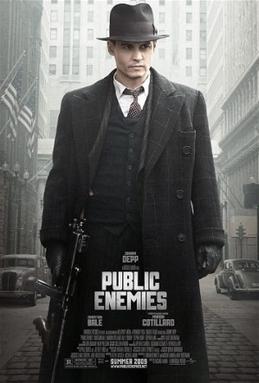
Public Enemies
In
the age of the gangsters, the 1930s in Depression-era America, one name
stands out above the rest. Sure, there's Pretty Boy Floyd, the Barkers,
Baby Face Nelson, Machine Gun Kelly, Alvin Karpis, even Bonnie and
Clyde. But the name John Dillinger
stands out, Public Enemy No. 1, a gangster, bank robber and possible
killer who rose to notoriety in the early 1930s. I reviewed this movie
from 2009 that works as a quasi-biography, but rewatched it recently and
updated the review. Here were go with 2009's Public Enemies.
It's 1933 in Crown Point, Indiana and John Dillinger (Johnny Depp) has been caught and is just being brought to prison, or so his guards think. Instead, the notorious bank robber has arranged a breakout, a group from his gang busting out with him. With his gang back together again, Dillinger goes on a spree, robbing banks all over Chicago and into Indiana and Wisconsin. The gangster feels the noose tighten around his neck, his notoriety forcing the government's hand in bringing him to justice. The Bureau of Investigation (the FBI) is in its infancy, J. Edgar Hoover (Billy Crudup) placing a young but capable agent, Melvin Purvis (Christian Bale), in charge of bringing Dillinger to justice. Using all the technology available to them, Purvis and his agents do everything they can to capture Dillinger, but can the notorious bank robber continue his crime spree?
This 2009 crime thriller is based off a book of the same name, Public Enemies, by author Bryan Burrough. It's a great read, non-fiction at its best. Burrough's book covers a ton of ground about one of the more violent, turbulent times in American history. The 1930s were the time of the gangster, killers, bank robbers and thieves working on a grand scale with a trail of fast cars, money and riches and dead bodies. Almost every single one of them died bloody and violent. It was a bloody, violent, fascinating time in American history. Originally thought of as a miniseries, Burroughs turned his research into a book. With so many people, places and incidents, the film version was condensed to John Dillinger vs. Melvin Purvis. It's a wise choice because Burroughs' novel as is would have been overwhelming.
We meet other people, but this is Johnny Depp's movie as he brings John Dillinger to life. A sympathetic character? No, not quite. It is on the other hand a fascinating character to watch. The people who met him during his crime reign of terror, a lot of witnesses said he was charming, likable and friendly. One of the biggest movie stars around, Depp is the best thing going in this movie, making Dillinger a human being, not just a historical name. Depp's Dillinger seems to know the life he's chosen necessitates a live-fast, live-hard mentality. Knowledge of the historical facts or not, you just know Dillinger is leading a doomed life. Sooner or later, his luck will run out. It's really the only character here given any sort of development or characterization too, John given a love interest in Billie Frechette (Marion Cotillard), a coat check girl from a poor background who falls hard for the gangster, as does he for her. Depp and Cotillard have a believable, real chemistry, giving the story that necessary human element.
Who best to direct a high-arcing crime thriller? How about a director with movies like Heat, Thief, Last of the Mohicans and The Inside to his name? Michael Mann takes the helm here for this style-heavy period piece. 'Enemies' was filmed on location in Chicago and around the Midwest where much of the story actually took place. Chicago serving as a backdrop for a story is never a bad thing, giving an air of authenticity here. The suits, the hats, the gentleman gangsters, the cars, it all adds up a to a more than worthy time capsule to 1930s Depression-era America. If there's a fault, Mann is too interested in the style, not the substance. He shot with a digital format, giving those scenes an odd, fuzzy look. The editing is fast and hard -- almost schizophrenic -- to the point the movement is hard to follow. Replace some of that aggressive style which doesn't necessarily work with some more story and characterization, and then we're talking.
Depp's movie, no doubt, but in star power, Christian Bale isn't far behind. It's just star power though. Bale is a really good actor, but he's given little to do here. The real-life Melvin Purvis was a bit of a dunce, the movie choosing not to delve too much into that angle. Bale is okay, but it's a necessary, workmanlike part, nothing more. Crudup does a good job with his quick scenes as Hoover, a glorified cameo. As for Dillinger's gang, look for Jason Clarke, Stephen Dorff, David Wenham and another violent gangster, Stephen Graham as maniacal Baby Face Nelson. Stephen Lang is memorable as a Texas lawman, Charles Winstead, brought in to help Purvis, Rory Cochrane playing one of his fellow Chicago FBI agents. There's also quick parts for Channing Tatum, Carey Mulligan and Giovanni Ribisi, and in the case of Tatum and Mulligan, don't blink or you'll miss them. There's plenty of other appearances that probably deserve some attention, but they're not around long enough to mention.
That's one of the weaknesses in Mann's film. Condensing Burroughs' book and doing so with just one focus -- Dillinger -- is still a daunting task. I think it tries to accomplish too much. A year-plus of story, countless speaking roles, and a whole lot of history. Depp is excellent, that's not in question. The action is very exciting, especially the infamous Little Bohemia shootout. Mann does action and does it well. The heavy, automatic machine guns, the B.A.R.s, the heavy pistols, these are guns that pack a punch so there's something visceral and adrenaline-pumping in the action scenes. Something is missing though. It's cool, but the movie doesn't have a ton of heart. The last 30 minutes are the movie at its best, Purvis and the FBI closing in on Dillinger. One what-if scene has Dillinger walking into the Dillinger Squad office, surreal and cool. The same for Dillinger's death, a stylish, cool scene aided by Elliot Goldenthal's musical score.
A good movie but with some serious flaws. It could have been a classic, and maybe with a miniseries it would have been. Still, Johnny Depp is cooler than you.
Public Enemies (2009): ** 1/2 /****
Rewrite of July 2009 review
It's 1933 in Crown Point, Indiana and John Dillinger (Johnny Depp) has been caught and is just being brought to prison, or so his guards think. Instead, the notorious bank robber has arranged a breakout, a group from his gang busting out with him. With his gang back together again, Dillinger goes on a spree, robbing banks all over Chicago and into Indiana and Wisconsin. The gangster feels the noose tighten around his neck, his notoriety forcing the government's hand in bringing him to justice. The Bureau of Investigation (the FBI) is in its infancy, J. Edgar Hoover (Billy Crudup) placing a young but capable agent, Melvin Purvis (Christian Bale), in charge of bringing Dillinger to justice. Using all the technology available to them, Purvis and his agents do everything they can to capture Dillinger, but can the notorious bank robber continue his crime spree?
This 2009 crime thriller is based off a book of the same name, Public Enemies, by author Bryan Burrough. It's a great read, non-fiction at its best. Burrough's book covers a ton of ground about one of the more violent, turbulent times in American history. The 1930s were the time of the gangster, killers, bank robbers and thieves working on a grand scale with a trail of fast cars, money and riches and dead bodies. Almost every single one of them died bloody and violent. It was a bloody, violent, fascinating time in American history. Originally thought of as a miniseries, Burroughs turned his research into a book. With so many people, places and incidents, the film version was condensed to John Dillinger vs. Melvin Purvis. It's a wise choice because Burroughs' novel as is would have been overwhelming.
We meet other people, but this is Johnny Depp's movie as he brings John Dillinger to life. A sympathetic character? No, not quite. It is on the other hand a fascinating character to watch. The people who met him during his crime reign of terror, a lot of witnesses said he was charming, likable and friendly. One of the biggest movie stars around, Depp is the best thing going in this movie, making Dillinger a human being, not just a historical name. Depp's Dillinger seems to know the life he's chosen necessitates a live-fast, live-hard mentality. Knowledge of the historical facts or not, you just know Dillinger is leading a doomed life. Sooner or later, his luck will run out. It's really the only character here given any sort of development or characterization too, John given a love interest in Billie Frechette (Marion Cotillard), a coat check girl from a poor background who falls hard for the gangster, as does he for her. Depp and Cotillard have a believable, real chemistry, giving the story that necessary human element.
Who best to direct a high-arcing crime thriller? How about a director with movies like Heat, Thief, Last of the Mohicans and The Inside to his name? Michael Mann takes the helm here for this style-heavy period piece. 'Enemies' was filmed on location in Chicago and around the Midwest where much of the story actually took place. Chicago serving as a backdrop for a story is never a bad thing, giving an air of authenticity here. The suits, the hats, the gentleman gangsters, the cars, it all adds up a to a more than worthy time capsule to 1930s Depression-era America. If there's a fault, Mann is too interested in the style, not the substance. He shot with a digital format, giving those scenes an odd, fuzzy look. The editing is fast and hard -- almost schizophrenic -- to the point the movement is hard to follow. Replace some of that aggressive style which doesn't necessarily work with some more story and characterization, and then we're talking.
Depp's movie, no doubt, but in star power, Christian Bale isn't far behind. It's just star power though. Bale is a really good actor, but he's given little to do here. The real-life Melvin Purvis was a bit of a dunce, the movie choosing not to delve too much into that angle. Bale is okay, but it's a necessary, workmanlike part, nothing more. Crudup does a good job with his quick scenes as Hoover, a glorified cameo. As for Dillinger's gang, look for Jason Clarke, Stephen Dorff, David Wenham and another violent gangster, Stephen Graham as maniacal Baby Face Nelson. Stephen Lang is memorable as a Texas lawman, Charles Winstead, brought in to help Purvis, Rory Cochrane playing one of his fellow Chicago FBI agents. There's also quick parts for Channing Tatum, Carey Mulligan and Giovanni Ribisi, and in the case of Tatum and Mulligan, don't blink or you'll miss them. There's plenty of other appearances that probably deserve some attention, but they're not around long enough to mention.
That's one of the weaknesses in Mann's film. Condensing Burroughs' book and doing so with just one focus -- Dillinger -- is still a daunting task. I think it tries to accomplish too much. A year-plus of story, countless speaking roles, and a whole lot of history. Depp is excellent, that's not in question. The action is very exciting, especially the infamous Little Bohemia shootout. Mann does action and does it well. The heavy, automatic machine guns, the B.A.R.s, the heavy pistols, these are guns that pack a punch so there's something visceral and adrenaline-pumping in the action scenes. Something is missing though. It's cool, but the movie doesn't have a ton of heart. The last 30 minutes are the movie at its best, Purvis and the FBI closing in on Dillinger. One what-if scene has Dillinger walking into the Dillinger Squad office, surreal and cool. The same for Dillinger's death, a stylish, cool scene aided by Elliot Goldenthal's musical score.
A good movie but with some serious flaws. It could have been a classic, and maybe with a miniseries it would have been. Still, Johnny Depp is cooler than you.
Public Enemies (2009): ** 1/2 /****
Rewrite of July 2009 review
Monday, April 28, 2014
Johnny Cool
Some faces just stick with you as you watch more and more movies. A glare, a stare, a smile, a laugh, a maniacal laugh at that, just something easily remembered. Henry Silva qualifies on basically all of those things, a character actor who made a career out of playing supporting parts, usually crazy, psychopathic villains. He was GOOD at it, beyond good, a great bad guy. Then there's 1963's Johnny Cool where Silva got a starring role as the definition of an anti-hero bordering on out-and-out bad guy.
As a young teenager in 1940s Sicily with World War II raging, young Salvatore Giordano sees his mother killed by a German soldier. He joins the Italian partisans, becoming a hero across the countryside both during the war and after. Years pass and now Salvatore (Silva) is infamously known around the country and even internationally. Some know him simply as a bandit chieftain, others as a modern day Robin Hood. An exiled American gangster, Johnny Colini (Marc Lawrence), arranges a faked death for Salvatore as he has far bigger plans for him. Colini teaches Salvatore how to act and look like a gentleman, but more importantly he turns him into an unstoppable killer. His intended targets? The men who helped orchestrate Colini's exile. If Salvatore -- taking the gangster's name -- can pull it off, Colini's empire will be his.
Yikes. What a vicious, brutal movie. From director William Asher, it's even darker when you consider it was released in 1963. Playing like a hard-boiled, brutal, in your face film noir, 'Cool' is the definition of a B-movie. It's gritty and doesn't feel faked from beginning to end. While there are indoor/studio shots, there is also plenty of on-location scenes from New York City to Los Angeles to Las Vegas. The gloomy, impending doom, jazz-heavy score from Billy May and Johnny Worth permeates Asher's gangster/underworld story. This is a story based in smoky nightclubs, in backroom gambling halls, in gangsters' offices in high rises. Filmed in black and white, there's a great, throwback style throughout. I didn't love the movie -- little slow-moving at times -- but it does have a lot going for it.
From possibly unhinged supporting player to...partially unhinged leading player....Yeah, okay, maybe this part isn't a huge departure for Silva, but it's a chance he doesn't disappoint with. While there's a strong ensemble working with him, this is Silva's movie, plain and simple. It's cool to see the transformation his character goes through, from revenge-seeking teenager to infamous bandit to killing machine. It would have been cool to see some more background, more motivation -- is he solely interested in riches and fame? Is it something else, something more? -- but we see a man who becomes obsessed with achieving his goal. It's pretty apparent from the second we meet Salvatore/Johnny that this is one doomed dude, but the route he takes is certainly fascinating. Silva brings that intensity we've come to expect from the veteran character actor. A very interesting part.
The rest of the cast has its positives and negatives. Ever seen 1960s TV sitcom Bewitched? Yeah, Samantha herself, Elizabeth Montgomery plays Darien, a divorced woman looking for some excitement and getting more than she figured when she joins up with Silva's Johnny. How about some of Johnny's hopeful victims? There's Telly Savalas (sporting some hair), Jim Backus, John McGiver Brad Dexter and Mort Sahl. If that wasn't enough, also look for Joey Bishop, Sammy Davis Jr., Richard Anderson, Elisha Cook Jr. Beyond Montgomery and Savalas, no one on this list is around for more than a couple minutes, the story almost becoming a revolving door of quick cameos. Still, cool to see some big names like this all in one cast.
Mostly though, this is a dark movie to sit back and watch without much in the way of a sympathetic character. Silva's Salvatore/Johnny becomes a killing machine who's beyond saving. Fascinating to watch, far from an even remotely sympathetic anti-hero. Much of the violence is off-screen, but it's pretty hardcore just the same. You don't have to see it to know that a man getting bashed in the head with a shotgun is gonna be rather graphic. People are dispatched with no build-up, no tension. Just BOOM! You're dead. And that ending....wow, just wow. We don't see what's going on, but the foreshadowing is rough. An interesting movie, but beware of what you're getting into.
Johnny Cool (1963): **/****
As a young teenager in 1940s Sicily with World War II raging, young Salvatore Giordano sees his mother killed by a German soldier. He joins the Italian partisans, becoming a hero across the countryside both during the war and after. Years pass and now Salvatore (Silva) is infamously known around the country and even internationally. Some know him simply as a bandit chieftain, others as a modern day Robin Hood. An exiled American gangster, Johnny Colini (Marc Lawrence), arranges a faked death for Salvatore as he has far bigger plans for him. Colini teaches Salvatore how to act and look like a gentleman, but more importantly he turns him into an unstoppable killer. His intended targets? The men who helped orchestrate Colini's exile. If Salvatore -- taking the gangster's name -- can pull it off, Colini's empire will be his.
Yikes. What a vicious, brutal movie. From director William Asher, it's even darker when you consider it was released in 1963. Playing like a hard-boiled, brutal, in your face film noir, 'Cool' is the definition of a B-movie. It's gritty and doesn't feel faked from beginning to end. While there are indoor/studio shots, there is also plenty of on-location scenes from New York City to Los Angeles to Las Vegas. The gloomy, impending doom, jazz-heavy score from Billy May and Johnny Worth permeates Asher's gangster/underworld story. This is a story based in smoky nightclubs, in backroom gambling halls, in gangsters' offices in high rises. Filmed in black and white, there's a great, throwback style throughout. I didn't love the movie -- little slow-moving at times -- but it does have a lot going for it.
From possibly unhinged supporting player to...partially unhinged leading player....Yeah, okay, maybe this part isn't a huge departure for Silva, but it's a chance he doesn't disappoint with. While there's a strong ensemble working with him, this is Silva's movie, plain and simple. It's cool to see the transformation his character goes through, from revenge-seeking teenager to infamous bandit to killing machine. It would have been cool to see some more background, more motivation -- is he solely interested in riches and fame? Is it something else, something more? -- but we see a man who becomes obsessed with achieving his goal. It's pretty apparent from the second we meet Salvatore/Johnny that this is one doomed dude, but the route he takes is certainly fascinating. Silva brings that intensity we've come to expect from the veteran character actor. A very interesting part.
The rest of the cast has its positives and negatives. Ever seen 1960s TV sitcom Bewitched? Yeah, Samantha herself, Elizabeth Montgomery plays Darien, a divorced woman looking for some excitement and getting more than she figured when she joins up with Silva's Johnny. How about some of Johnny's hopeful victims? There's Telly Savalas (sporting some hair), Jim Backus, John McGiver Brad Dexter and Mort Sahl. If that wasn't enough, also look for Joey Bishop, Sammy Davis Jr., Richard Anderson, Elisha Cook Jr. Beyond Montgomery and Savalas, no one on this list is around for more than a couple minutes, the story almost becoming a revolving door of quick cameos. Still, cool to see some big names like this all in one cast.
Mostly though, this is a dark movie to sit back and watch without much in the way of a sympathetic character. Silva's Salvatore/Johnny becomes a killing machine who's beyond saving. Fascinating to watch, far from an even remotely sympathetic anti-hero. Much of the violence is off-screen, but it's pretty hardcore just the same. You don't have to see it to know that a man getting bashed in the head with a shotgun is gonna be rather graphic. People are dispatched with no build-up, no tension. Just BOOM! You're dead. And that ending....wow, just wow. We don't see what's going on, but the foreshadowing is rough. An interesting movie, but beware of what you're getting into.
Johnny Cool (1963): **/****
Thursday, October 31, 2013
The Untouchables
So Prohibition, huh? That must have sucked. People wanted to drink, but the government said it was illegal to do so. The government agencies and police forces were tasked with limiting the bootleggers, but that was easier said than done. The most famous? Eliot Ness, a Treasury agent who became famous for helping take down Chicago gangster Al Capone. His story was turned into a successful TV show in the late 1950s and early 1960s and maybe most famously in a feature film, 1987's The Untouchables.
It's 1930 and Prohibition has turned Chicago into a warring city of dead bodies and rival gangsters fighting for control. The most powerful though is Al Capone (Robert De Niro), ruling the city and the influx of alcohol with an iron fist. Where there's demand, he's got the supply. A U.S. Treasury agent, Eliot Ness (Kevin Costner), has been called in to bring Capone to justice, hopefully bringing his crime empire down with him. Ness, idealistic and a little naive, struggles with where to start, meeting dead end after dead end as he discovers how deep Capone's empire goes. Obsessed with doing his job and doing it well, Ness keeps on, recruiting a small group of agents and police officers, including a tough Chicago beat cop, James Malone (Sean Connery), who knows the streets better than anyone. As he quickly finds out, Ness doesn't know how deep he'll have to go to accomplish his mission, especially when the bodies start to pile up.
From director Brian De Palma, this is one of those perfect guy's guy movies. It is based on Ness' real-life exploits as his crew of Untouchables took the battle to Capone in Chicago between 1929 and 1931. Yes, time is compressed, some names are changed here and there, but the point is the same. It has just about everything going for it. 'Untouchables' was filmed on location in Chicago (looks gorgeous), and it feels like Depression Era Chicago, picking up two Oscar nominations for Costume Design and Art Direction/Set Decoration. Everything from the background on the streets to the cars to the time-appropriate costumes (Armani suits never looked so good), it all adds layer after layer to the film. Also picking up an Oscar nomination is the score from composer Ennio Morricone.Listen to his full soundtrack HERE. I love the sweep of it, quiet, moving Morricone balanced with bigger, epic Morricone.
At the forefront of 'Untcouhables' is a great pairing of stars. Costner is one of the biggest stars of the 1980s with everything from Bull Durham to Field of Dreams, Silverado to No Way Out. Connery was a Hollywood legend, the firmly established star. Their on-screen dynamic is an underrated part of the success here that can get lost in the shuffle. Costner's Eliot is a hard-driving, hard-working idealist. He wants to accomplish his mission, but do it the right way, not knowing how filthy the world is he finds himself in. Connery's Malone is the flat-footed beat cop with a long career behind him. He knows everyone, knows all the secrets and inner-workings. Eliot Ness is looking for help while Malone is looking for a reason to become re-energized again after years of watching greed and corruption poison Chicago. Their scenes together crackle, dialogue just brimming with energy and plenty of great one-liners.
Joining Costner and Connery as the Untouchables are a very young Andy Garcia and a scene-stealing Charles Martin Smith. Garcia plays George Stone, a cop fresh out of the Police Academy and a dead-shot with a pistol, his Italian background hinted at but never fully explained. Garcia's Stone is inherently cool, a man of few words who lets his smirk and his pistol do his talking. Martin Smith plays Oscar Wallace, a Treasury accountant/bookkeeper who jumps at the chance to do some actual field work with the Untouchables. It's four cool characters, a great dynamic among the quartet, an odd couple men on a mission grouping that works perfectly.
Committing to gaining weight to really look the part, De Niro is a fine choice to play infamous Chicago gangster Al Capone. It is a part that would have been easy to be exaggerated, but De Niro knows how far to push it. Capone is hot-tempered, fiery and barely keeps his emotions in check. The part is mostly long scenes, monologues really, where De Niro gets to flex a bit. Richard Bradford plays the police commissioner caught in the middle of it all and maybe playing all sides, Patricia Clarkson plays Ness' pregnant wife, an uncredited Clifton James as the prosecuting district attorney, and Billy Drago as Frank Nitti, Capone's chief enforcer and accomplished killer.
With the actual history here condensed from a few years to seemingly a few months, we get an episodic story that covers a ton of ground in the 119-minute movie. More than the performances, the music, the period appropriate....well, everything, 'Untouchables' always stands out for me because of the well-staged set pieces. An ambush near the Canadian border is a gem, the machine guns rattling like crazy to Morricone's swooping score. The highlight though has Ness and Co. looking for Capone's bookkeeper, desperately trying to get out of town, at Union Station. The action, the drama, the nods to classic films (Battleship Potempkin), and the slow motion all build to this almost unbearable tension. Maybe it isn't the most unified script/story, but the set pieces help keep things together beginning to end. A gem, a must-see for fans of Costner, Connery, gangster movie fans and any Chicagoans.
The Untouchables (1987): ****/****
It's 1930 and Prohibition has turned Chicago into a warring city of dead bodies and rival gangsters fighting for control. The most powerful though is Al Capone (Robert De Niro), ruling the city and the influx of alcohol with an iron fist. Where there's demand, he's got the supply. A U.S. Treasury agent, Eliot Ness (Kevin Costner), has been called in to bring Capone to justice, hopefully bringing his crime empire down with him. Ness, idealistic and a little naive, struggles with where to start, meeting dead end after dead end as he discovers how deep Capone's empire goes. Obsessed with doing his job and doing it well, Ness keeps on, recruiting a small group of agents and police officers, including a tough Chicago beat cop, James Malone (Sean Connery), who knows the streets better than anyone. As he quickly finds out, Ness doesn't know how deep he'll have to go to accomplish his mission, especially when the bodies start to pile up.
From director Brian De Palma, this is one of those perfect guy's guy movies. It is based on Ness' real-life exploits as his crew of Untouchables took the battle to Capone in Chicago between 1929 and 1931. Yes, time is compressed, some names are changed here and there, but the point is the same. It has just about everything going for it. 'Untouchables' was filmed on location in Chicago (looks gorgeous), and it feels like Depression Era Chicago, picking up two Oscar nominations for Costume Design and Art Direction/Set Decoration. Everything from the background on the streets to the cars to the time-appropriate costumes (Armani suits never looked so good), it all adds layer after layer to the film. Also picking up an Oscar nomination is the score from composer Ennio Morricone.Listen to his full soundtrack HERE. I love the sweep of it, quiet, moving Morricone balanced with bigger, epic Morricone.
At the forefront of 'Untcouhables' is a great pairing of stars. Costner is one of the biggest stars of the 1980s with everything from Bull Durham to Field of Dreams, Silverado to No Way Out. Connery was a Hollywood legend, the firmly established star. Their on-screen dynamic is an underrated part of the success here that can get lost in the shuffle. Costner's Eliot is a hard-driving, hard-working idealist. He wants to accomplish his mission, but do it the right way, not knowing how filthy the world is he finds himself in. Connery's Malone is the flat-footed beat cop with a long career behind him. He knows everyone, knows all the secrets and inner-workings. Eliot Ness is looking for help while Malone is looking for a reason to become re-energized again after years of watching greed and corruption poison Chicago. Their scenes together crackle, dialogue just brimming with energy and plenty of great one-liners.
Joining Costner and Connery as the Untouchables are a very young Andy Garcia and a scene-stealing Charles Martin Smith. Garcia plays George Stone, a cop fresh out of the Police Academy and a dead-shot with a pistol, his Italian background hinted at but never fully explained. Garcia's Stone is inherently cool, a man of few words who lets his smirk and his pistol do his talking. Martin Smith plays Oscar Wallace, a Treasury accountant/bookkeeper who jumps at the chance to do some actual field work with the Untouchables. It's four cool characters, a great dynamic among the quartet, an odd couple men on a mission grouping that works perfectly.
Committing to gaining weight to really look the part, De Niro is a fine choice to play infamous Chicago gangster Al Capone. It is a part that would have been easy to be exaggerated, but De Niro knows how far to push it. Capone is hot-tempered, fiery and barely keeps his emotions in check. The part is mostly long scenes, monologues really, where De Niro gets to flex a bit. Richard Bradford plays the police commissioner caught in the middle of it all and maybe playing all sides, Patricia Clarkson plays Ness' pregnant wife, an uncredited Clifton James as the prosecuting district attorney, and Billy Drago as Frank Nitti, Capone's chief enforcer and accomplished killer.
With the actual history here condensed from a few years to seemingly a few months, we get an episodic story that covers a ton of ground in the 119-minute movie. More than the performances, the music, the period appropriate....well, everything, 'Untouchables' always stands out for me because of the well-staged set pieces. An ambush near the Canadian border is a gem, the machine guns rattling like crazy to Morricone's swooping score. The highlight though has Ness and Co. looking for Capone's bookkeeper, desperately trying to get out of town, at Union Station. The action, the drama, the nods to classic films (Battleship Potempkin), and the slow motion all build to this almost unbearable tension. Maybe it isn't the most unified script/story, but the set pieces help keep things together beginning to end. A gem, a must-see for fans of Costner, Connery, gangster movie fans and any Chicagoans.
The Untouchables (1987): ****/****
Wednesday, August 21, 2013
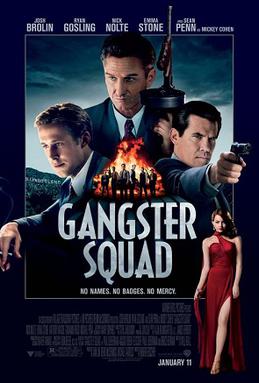
Gangster Squad
I'm a simple guy when it comes to movie. Entertain me, and I'll be pleased. Not every movie needs to be some groundbreaking, never before seen story that rewrites how films are made. Take 2013's Gangster Squad. It has taken a ridiculous amount of heat because.....I have NO IDEA. It is familiar in a way, but it's stylish, entertaining and action-packed with a ridiculous, loaded cast. Screw all the Debbie Downers. I loved this movie.
It's 1949 in Los Angeles and former boxer turned gangster Mickey Cohen (Sean Penn) is taking over the city bit by bit. Gambling, prostitution, drugs, Cohen is buying up cops, judges and politicians left and right as fast as he can. One of seemingly few clean cops, Sgt. John O'Mara (Josh Brolin) is fed up with what he's seeing in a city he wants his family to grow up in. He's approached by the similarly clean police chief, Parker (Nick Nolte), with an offer; assemble a small crew of officers and take the war to Cohen. O'Mara's squad will work as their own separate unit, completely removed from the laws and rules that would typically limit officers. He puts his crew together, including roguish Jerry Wooters (Ryan Gosling), and goes to work, attacking casinos, bars and clubs all over the L.A. area. They immediately find success, but it's only a matter of time before Cohen figures out who's gunning for him. Can O'Mara's Gangster Squad take Cohen's illegal businesses out before he gets to them?
There is little to nothing I didn't like about this movie. Playing like a modern film noir, it's a gem of a flick. It plays like a mix of L.A. Confidential, The Untouchables and The Magnificent Seven. If you put those three movies together and can't get a winner, then you're doing something wrong. Director Ruben Fleischer (Zombieland, 30 Minutes or Less) is at the helm of a damn entertaining movie. It feels like a throwback film to the Hollywood glory days with a huge cast -- much, much more on that later -- to go with a well-written script, exciting, well-choreographed action and a story that never really slows down. More than anything, it is just F-U-N. That's all. There are good guys and bad guys, cops and gangsters, a femme fatale and not a damsel in distress. Is it so wrong for a movie to just be entertaining? I read a surprising amount of reviews that were highly critical of this movie. Maybe I missed something, but I loved it from beginning to end.
Watching the trailer for the first time last year, I have no doubt my eyes were as big as dinner plates. A movie about cops and gangsters in post-WWII L.A. already drew me in, but with this cast?!? It's a ridiculously deep, very talented cast. Because there is so much talent assembled, we're not talking in-depth character studies, but there isn't a weak part in the bunch. For starters, Josh Brolin as the hard-headed, stubborn O'Mara is a hero cop gem. A WWII veteran, he's sick of Cohen and his antics so given a chance to take him down a whole lot of notches, he jumps at the chance. He has a pregnant wife (Mireille Enos) weighing on his mind, but he wants to get the job done, on principle alone. Brolin is aided by Ryan Gosling as Wooters, the cop who sees what L.A. has become and just doesn't care too much, but he's given a reason to care while also getting the love interest, Grace (Emma Stone), Cohen's girl. Uh-oh, more issues!
The names already mentioned would be enough for most movies, but not this one. Penn gets to ham it up as real-life boxer turned gangster Mickey Cohen, sneering and intimidating his way into the part. This is an out-and-out villain, a bad guy you just love to hate and can't wait to see get taken down. Nolte makes the most of his smallish but effective part as Chief Parker, the chief of police who sends O'Mara on his dangerous, illegal mission. Also look for Sullivan Stapleton as Jack Whalen, a bookie and friend of Wooter's working in Cohen's organization (a supporting but excellent part), Holt McCallany as Lockwood, Cohen's bodyguard and enforcer, and Troy Garity as Wrevock, a hired killer working for Cohen.
Not surprisingly, a certain part of the cast caught my eye....O'Mara's Gangster Squad! Uh-oh, it's another men-on-a-mission movie! Assemble a crew of misfits and specialists and let them go to work. How can you lose? Brolin and Gosling are the stars, showing off that hero-sidekick chemistry that every group of specialists needs. But wait, there's more! Rounding out the crew/squad are Harris (Anthony Mackie), a specialist with gun or knife looking to clean up the streets of drugs, Keeler (Giovanni Ribisi), a WWII intelligence officer and expert in radio technology, Kennard (Robert Patrick), the veteran cop and part-Wild West lawman who favors a six-shooter, and Ramirez (Michael Pena), a young Mexican officer who's looked down upon by much of the rest of the force. It's a good group of some really solid actors, all comfortable and willing to take a supporting part to flesh out an impressive cast.
Originally supposed to be released in summer/fall 2012, 'Gangster' was pushed back for re-shoots following the Aurora shooting at a movie theater. What remains is still an action-packed movie that will appease most moviegoer's needs for some shoot 'em up action. The script never goes long without a gunfight or shoot out of some sort. A couple different sequences stand out, including a failed ambush in a busy street in Chinatown and the finale at Park Plaza Hotel especially leaving their mark. It's pistols and machine guns to aid the throwback feel with some pretty cool uses of slow-motion without going overboard. Bloody but not overly graphic, the action sequences are just another selling point.
It's hard to describe this movie without describing the style. The late 1940s (and heading into the 1950s) were an inherently cool time looking back on them. Cops and police officers wore a suit, tie and a hat. The cars were ridiculously cool, the streets even more so, and Fleischer and Co. took that to heart. Part of the appeal here is the look of the movie, like we were transported to 1949 Los Angeles. Just like a scene where O'Mara and crew walk away from the L.A. City Hall, there's a cool factor that's hard to touch or classify. It's stylish and cool....because it is. How about a montage of the Squad doing their work to big band music? It works. There is style on display in every scene whether it be the clothes and sets or the quick, speedily delivered dialogue. I liked everything about this movie and look forward to future and repeat viewings.
Gangster Squad (2013): ****/****
It's 1949 in Los Angeles and former boxer turned gangster Mickey Cohen (Sean Penn) is taking over the city bit by bit. Gambling, prostitution, drugs, Cohen is buying up cops, judges and politicians left and right as fast as he can. One of seemingly few clean cops, Sgt. John O'Mara (Josh Brolin) is fed up with what he's seeing in a city he wants his family to grow up in. He's approached by the similarly clean police chief, Parker (Nick Nolte), with an offer; assemble a small crew of officers and take the war to Cohen. O'Mara's squad will work as their own separate unit, completely removed from the laws and rules that would typically limit officers. He puts his crew together, including roguish Jerry Wooters (Ryan Gosling), and goes to work, attacking casinos, bars and clubs all over the L.A. area. They immediately find success, but it's only a matter of time before Cohen figures out who's gunning for him. Can O'Mara's Gangster Squad take Cohen's illegal businesses out before he gets to them?
There is little to nothing I didn't like about this movie. Playing like a modern film noir, it's a gem of a flick. It plays like a mix of L.A. Confidential, The Untouchables and The Magnificent Seven. If you put those three movies together and can't get a winner, then you're doing something wrong. Director Ruben Fleischer (Zombieland, 30 Minutes or Less) is at the helm of a damn entertaining movie. It feels like a throwback film to the Hollywood glory days with a huge cast -- much, much more on that later -- to go with a well-written script, exciting, well-choreographed action and a story that never really slows down. More than anything, it is just F-U-N. That's all. There are good guys and bad guys, cops and gangsters, a femme fatale and not a damsel in distress. Is it so wrong for a movie to just be entertaining? I read a surprising amount of reviews that were highly critical of this movie. Maybe I missed something, but I loved it from beginning to end.
Watching the trailer for the first time last year, I have no doubt my eyes were as big as dinner plates. A movie about cops and gangsters in post-WWII L.A. already drew me in, but with this cast?!? It's a ridiculously deep, very talented cast. Because there is so much talent assembled, we're not talking in-depth character studies, but there isn't a weak part in the bunch. For starters, Josh Brolin as the hard-headed, stubborn O'Mara is a hero cop gem. A WWII veteran, he's sick of Cohen and his antics so given a chance to take him down a whole lot of notches, he jumps at the chance. He has a pregnant wife (Mireille Enos) weighing on his mind, but he wants to get the job done, on principle alone. Brolin is aided by Ryan Gosling as Wooters, the cop who sees what L.A. has become and just doesn't care too much, but he's given a reason to care while also getting the love interest, Grace (Emma Stone), Cohen's girl. Uh-oh, more issues!
The names already mentioned would be enough for most movies, but not this one. Penn gets to ham it up as real-life boxer turned gangster Mickey Cohen, sneering and intimidating his way into the part. This is an out-and-out villain, a bad guy you just love to hate and can't wait to see get taken down. Nolte makes the most of his smallish but effective part as Chief Parker, the chief of police who sends O'Mara on his dangerous, illegal mission. Also look for Sullivan Stapleton as Jack Whalen, a bookie and friend of Wooter's working in Cohen's organization (a supporting but excellent part), Holt McCallany as Lockwood, Cohen's bodyguard and enforcer, and Troy Garity as Wrevock, a hired killer working for Cohen.
Not surprisingly, a certain part of the cast caught my eye....O'Mara's Gangster Squad! Uh-oh, it's another men-on-a-mission movie! Assemble a crew of misfits and specialists and let them go to work. How can you lose? Brolin and Gosling are the stars, showing off that hero-sidekick chemistry that every group of specialists needs. But wait, there's more! Rounding out the crew/squad are Harris (Anthony Mackie), a specialist with gun or knife looking to clean up the streets of drugs, Keeler (Giovanni Ribisi), a WWII intelligence officer and expert in radio technology, Kennard (Robert Patrick), the veteran cop and part-Wild West lawman who favors a six-shooter, and Ramirez (Michael Pena), a young Mexican officer who's looked down upon by much of the rest of the force. It's a good group of some really solid actors, all comfortable and willing to take a supporting part to flesh out an impressive cast.
Originally supposed to be released in summer/fall 2012, 'Gangster' was pushed back for re-shoots following the Aurora shooting at a movie theater. What remains is still an action-packed movie that will appease most moviegoer's needs for some shoot 'em up action. The script never goes long without a gunfight or shoot out of some sort. A couple different sequences stand out, including a failed ambush in a busy street in Chinatown and the finale at Park Plaza Hotel especially leaving their mark. It's pistols and machine guns to aid the throwback feel with some pretty cool uses of slow-motion without going overboard. Bloody but not overly graphic, the action sequences are just another selling point.
It's hard to describe this movie without describing the style. The late 1940s (and heading into the 1950s) were an inherently cool time looking back on them. Cops and police officers wore a suit, tie and a hat. The cars were ridiculously cool, the streets even more so, and Fleischer and Co. took that to heart. Part of the appeal here is the look of the movie, like we were transported to 1949 Los Angeles. Just like a scene where O'Mara and crew walk away from the L.A. City Hall, there's a cool factor that's hard to touch or classify. It's stylish and cool....because it is. How about a montage of the Squad doing their work to big band music? It works. There is style on display in every scene whether it be the clothes and sets or the quick, speedily delivered dialogue. I liked everything about this movie and look forward to future and repeat viewings.
Gangster Squad (2013): ****/****
Wednesday, August 7, 2013
Stand Up Guys
Oh, how the time flies. Think back to movies of the late 1960s and into the 1970s -- a huge turning point in film history -- and think of all the actors who became huge stars during that stretch. Well, it's been over 30 years since that period, as many as 40 depending on the film/star, and those actors are now in their 60s, 70s and even 80s. Screen icons can't age, can they? If not leading men anymore in huge blockbusters, there's certainly roles out there for actors of such high caliber, like 2013's Stand Up Guys.
Released from prison after serving a 28-year sentence, an aging man named Val (Al Pacino) is met on his parole day by old friend and partner Doc (Christopher Walken). Having spent so much time away from any normal sort of life, Val wants to make up for lost time, drinking, partying, even visiting a brothel, but Doc isn't telling him anything at first. Val of course knows what awaits him...he must answer for the crime that put him away in prison for such a long sentence, even if the crime wasn't his fault. Doc has orders from a small-time aging mobster (Mark Margolis) to kill Val, and he's only got a few hours to do it. Old friends though, Doc is no rush to dispatch his friend, thinking he can at least give him a few hours more. They find another old friend, Hirsch (Alan Arkin), now wasting away in a nursing home, the intention to live up their last few hours together.
If you're a movie fan and can't figure out the appeal here, well....how can't you? In Pacino, Walken and Arkin, you've got three living legends from one of the most interesting periods in Hollywood history. One or two of them working together in a movie would be enough, but all three? Sign me up. From director/actor Fisher Stevens, 'Guys' is a solid comedy-drama with a familiar crook/mob background. It has touches of a film noir -- the story taking place almost entirely at night and all its shadows -- with an unnamed city serving as the backdrop. It's not an action-packed shoot-out, instead a movie content to be a good story that relies heavily on the star power to carry the heaviest load. There's some pretty low-brow humor with some Viagra jokes and multiple trips to a brothel that aren't necessary, but as a whole, the movie is solid.
If you have made it to the fourth paragraph of this review, I'm guessing it's because you're a fan of either one or all of Pacino, Walken and Arkin. This isn't groundbreaking stuff, nothing you haven't seen before if you're a fan of crime or mob movies, but in their capable hands it feels worthwhile throughout. Pacino's Val is the showiest of the parts, a crook who did time rather than give up his accomplices in a previous crime. He knows his time is up, just doesn't know for sure who will do the deed. Walken as Doc is perfect, understated and gentlemanly because he's had years to prep for this unpleasant task. He's tired, world-weary and dreads what awaits. Arkin's is the smallest part as Hirsch, the former getaway driver of the trio.
There is an effortless chemistry and charm to their scenes. An important aspect of the story is in the title. Stand up guys are those who do what the job dictates regardless of the unpleasant consequences. They do it because it's the job. Men do their jobs. As the story develops we see this code of honor among crooks. We learn more about Val, Doc and Hirsch's past, about their younger years when they were a team of low-level but highly effective mob crooks and henchmen. Their scenes among the group talking about the good old days offer some of the movie's high points. It works because these guys are so talented, so good at what they do. As Val's time runs out, Doc must decide what he's going to do. Kill one of his only friends? Don't kill him and risk his own life in the process? It additionally works because it's easy to imagine these three actors making a prequel in the early 1970s, starring as themselves.
Following the trio around, we meet a handful of characters in their misadventures. Julianna Margulies plays Nina, Hirsch's daughter who works as a nurse at a hospital Val and Doc visit. Ooohhh, ER reference! Margolis is his typical intimidating self as Claphands, a ridiculously vengeful mobster with Bill Burr as one of his ineffective henchmen. Lucy Punch is memorable as Wendy, the nerdy-looking owner of the brothel they visit while Addison Timlin is Alex, a waitress at an all-night diner who has befriended Doc over the years. Vanessa Ferlito has a good if odd part as Syliva, a beaten-up and raped woman who the trio rescues and helps exact revenge.
So how then should one end a movie like this? That is where the film struggles to find its footing. It has the right idea with a perfect scene that provides the ideal ending for these characters. It's what they deserve. It's what they should do......and then Stevens has the camera pull away so we don't actually see the ending. There's no resolution, too many things left hanging up in the air. For me, this ending feels a little too smarmy, a little condescending, too self-assured. The idea is right, and the thought is there but this is an ending that needed more closure. I still liked the movie on the whole, but the ending could have been significantly better. Still worth watching. It is difficult to pass up a movie starring the likes of Pacino, Walken and Arkin.
Stand Up Guys (2013): ***/****
Released from prison after serving a 28-year sentence, an aging man named Val (Al Pacino) is met on his parole day by old friend and partner Doc (Christopher Walken). Having spent so much time away from any normal sort of life, Val wants to make up for lost time, drinking, partying, even visiting a brothel, but Doc isn't telling him anything at first. Val of course knows what awaits him...he must answer for the crime that put him away in prison for such a long sentence, even if the crime wasn't his fault. Doc has orders from a small-time aging mobster (Mark Margolis) to kill Val, and he's only got a few hours to do it. Old friends though, Doc is no rush to dispatch his friend, thinking he can at least give him a few hours more. They find another old friend, Hirsch (Alan Arkin), now wasting away in a nursing home, the intention to live up their last few hours together.
If you're a movie fan and can't figure out the appeal here, well....how can't you? In Pacino, Walken and Arkin, you've got three living legends from one of the most interesting periods in Hollywood history. One or two of them working together in a movie would be enough, but all three? Sign me up. From director/actor Fisher Stevens, 'Guys' is a solid comedy-drama with a familiar crook/mob background. It has touches of a film noir -- the story taking place almost entirely at night and all its shadows -- with an unnamed city serving as the backdrop. It's not an action-packed shoot-out, instead a movie content to be a good story that relies heavily on the star power to carry the heaviest load. There's some pretty low-brow humor with some Viagra jokes and multiple trips to a brothel that aren't necessary, but as a whole, the movie is solid.
If you have made it to the fourth paragraph of this review, I'm guessing it's because you're a fan of either one or all of Pacino, Walken and Arkin. This isn't groundbreaking stuff, nothing you haven't seen before if you're a fan of crime or mob movies, but in their capable hands it feels worthwhile throughout. Pacino's Val is the showiest of the parts, a crook who did time rather than give up his accomplices in a previous crime. He knows his time is up, just doesn't know for sure who will do the deed. Walken as Doc is perfect, understated and gentlemanly because he's had years to prep for this unpleasant task. He's tired, world-weary and dreads what awaits. Arkin's is the smallest part as Hirsch, the former getaway driver of the trio.
There is an effortless chemistry and charm to their scenes. An important aspect of the story is in the title. Stand up guys are those who do what the job dictates regardless of the unpleasant consequences. They do it because it's the job. Men do their jobs. As the story develops we see this code of honor among crooks. We learn more about Val, Doc and Hirsch's past, about their younger years when they were a team of low-level but highly effective mob crooks and henchmen. Their scenes among the group talking about the good old days offer some of the movie's high points. It works because these guys are so talented, so good at what they do. As Val's time runs out, Doc must decide what he's going to do. Kill one of his only friends? Don't kill him and risk his own life in the process? It additionally works because it's easy to imagine these three actors making a prequel in the early 1970s, starring as themselves.
Following the trio around, we meet a handful of characters in their misadventures. Julianna Margulies plays Nina, Hirsch's daughter who works as a nurse at a hospital Val and Doc visit. Ooohhh, ER reference! Margolis is his typical intimidating self as Claphands, a ridiculously vengeful mobster with Bill Burr as one of his ineffective henchmen. Lucy Punch is memorable as Wendy, the nerdy-looking owner of the brothel they visit while Addison Timlin is Alex, a waitress at an all-night diner who has befriended Doc over the years. Vanessa Ferlito has a good if odd part as Syliva, a beaten-up and raped woman who the trio rescues and helps exact revenge.
So how then should one end a movie like this? That is where the film struggles to find its footing. It has the right idea with a perfect scene that provides the ideal ending for these characters. It's what they deserve. It's what they should do......and then Stevens has the camera pull away so we don't actually see the ending. There's no resolution, too many things left hanging up in the air. For me, this ending feels a little too smarmy, a little condescending, too self-assured. The idea is right, and the thought is there but this is an ending that needed more closure. I still liked the movie on the whole, but the ending could have been significantly better. Still worth watching. It is difficult to pass up a movie starring the likes of Pacino, Walken and Arkin.
Stand Up Guys (2013): ***/****
Labels:
2010s,
Al Pacino,
Alan Arkin,
Christopher Walken,
Gangsters
Tuesday, August 6, 2013
Murder, Inc.
Having worked for several years in film and television in the late 1950s, Peter Falk was looking for his big break. Typically relegated to supporting parts in both movies and on TV shows, Falk got it in 1960. Chosen from a casting call of off-Broadway actors, Falk was given a key role in the 1960 crime drama Murder, Inc. based on a true story. His career was off and running and Lt. Columbo never looked back.
It's the 1930s, and the United States is reeling from the Great Depression. In New York City, a low-level but rising hired killer, Abe Reles (Falk), is summoned to meet Lepke (David J. Stewart), a well-connected mobster who has an idea for the thuggish Reles and his crew. Mobsters are organizing, working together, and they need a brutal enforcer....Reles. The Brooklyn thug will work with his own men, carrying out hits as ordered from Lepke and his superiors. No one is safe as Reles rises to power, dispatching everyone as ordered. Intimidation, bribes, out and out murder, nothing is too much for him. Caught up in the vicious rise to power is Joey Collins (Stuart Whitman), a down on his luck lounge singer, who Reles enlists in pulling off a hit. It doesn't seem anything can stop this fast-rising criminal organization, but a new district attorney, Burton Turkus (Henry Morgan), is attempting to do just that.
From directors Burt Balaban and Stuart Rosenberg, this 1960 crime drama is based on the true story of an organization of mob killers who started working in the 1930s, dubbed Murder Inc. by the press. Give the Wikipedia link a read. It is a doozy. Burton Turkus' 1951 book provided much of the background for this film that plays more like a fly on the wall documentary than a hard-edged crime drama/thriller. Playing Turkus, Morgan even provides the off-screen narration to explain all the criminal and mob developments. Still years before The Godfather and the wave of Mafia/mob movie that followed, 'Murder' is ahead of its time in that sense. It's hard to believe the responses characters give when they find out that criminal organizations have done just that, organized. Somewhere along the way, it gets a little too pulpy, like it's trying too hard. It's good, but it could have been better.
The style here is of a made-for-TV movie, maybe even an extended TV episode. It was filmed in black and white -- a nice touch for sure -- that helps it play more like a film noir than a quasi-documentary. 'Murder' was filmed on location in and around New York City, adding another layer of realism to the story. There's something missing though, and all I can come up with is that it is on such a small scale. The movie feels very penned in, very set-based, echoing some sort of TV roots. There's also two different musical numbers that feel jammed into the story unnecessarily, slowing down a story that's already a little sluggish.
What helps 'Murder' rise above its problems is the casting of then relative unknown Peter Falk as mob enforcer and hit man Abe 'Kid Twist' Reles. Just 33 years old, Falk was nominated for a Best Supporting Actor for his performance, and it is a scene-stealing part. His intensity, his emotion, it all feels real. His Reles is a brutish thug who does one thing well...killing. He doesn't have much in the way of actual skills, but he's a tried and true killer. The movie is that much better when he's around, but unfortunately, the part doesn't get as much attention as it should with the ensemble cast around him. As the sinister Lepke, Stewart is a good villain in a different vein; more intelligent and thoughtful in his brutality. In the bad guy department, also look for Joseph Bernard as Mendy, Lepke's personal assistant and killer, Warren Finnerty as Bug, Reles' killing partner, and Vincent Gardenia as Lazlo, the criminally smooth mob lawyer, always ready to tangle with authorities.
For a mob, Mafia and hired killer movie, far too much time is spent between Whitman's Joey and his wife Eadie (May Britt), obnoxious with her dead stare and general whiny-ness (and in an Eastern European accent too!). Joey does something stupid Mob-related, unwillingly gets involved and keeps on going, digging deeper and deeper. Yes, there's a payoff coming down the road, but getting there courtesy of Whitman and Britt is painfully slow at times. The movie is far better when it focuses on the mobsters going up against Turkus and Detective Tobin (Simon Oakland), a veteran police officer who's grown wary of "how effective" the D.A. can be. Also look for a pre-Dick Van Dyke show Morey Amsterdam as Walter Sage, a club owner and comedian who becomes a target of Murder Inc. It's an okay movie, but I came away disappointed as it is missing that one special ingredient.
Murder Inc. (1960): ** 1/2 /****
It's the 1930s, and the United States is reeling from the Great Depression. In New York City, a low-level but rising hired killer, Abe Reles (Falk), is summoned to meet Lepke (David J. Stewart), a well-connected mobster who has an idea for the thuggish Reles and his crew. Mobsters are organizing, working together, and they need a brutal enforcer....Reles. The Brooklyn thug will work with his own men, carrying out hits as ordered from Lepke and his superiors. No one is safe as Reles rises to power, dispatching everyone as ordered. Intimidation, bribes, out and out murder, nothing is too much for him. Caught up in the vicious rise to power is Joey Collins (Stuart Whitman), a down on his luck lounge singer, who Reles enlists in pulling off a hit. It doesn't seem anything can stop this fast-rising criminal organization, but a new district attorney, Burton Turkus (Henry Morgan), is attempting to do just that.
From directors Burt Balaban and Stuart Rosenberg, this 1960 crime drama is based on the true story of an organization of mob killers who started working in the 1930s, dubbed Murder Inc. by the press. Give the Wikipedia link a read. It is a doozy. Burton Turkus' 1951 book provided much of the background for this film that plays more like a fly on the wall documentary than a hard-edged crime drama/thriller. Playing Turkus, Morgan even provides the off-screen narration to explain all the criminal and mob developments. Still years before The Godfather and the wave of Mafia/mob movie that followed, 'Murder' is ahead of its time in that sense. It's hard to believe the responses characters give when they find out that criminal organizations have done just that, organized. Somewhere along the way, it gets a little too pulpy, like it's trying too hard. It's good, but it could have been better.
The style here is of a made-for-TV movie, maybe even an extended TV episode. It was filmed in black and white -- a nice touch for sure -- that helps it play more like a film noir than a quasi-documentary. 'Murder' was filmed on location in and around New York City, adding another layer of realism to the story. There's something missing though, and all I can come up with is that it is on such a small scale. The movie feels very penned in, very set-based, echoing some sort of TV roots. There's also two different musical numbers that feel jammed into the story unnecessarily, slowing down a story that's already a little sluggish.
What helps 'Murder' rise above its problems is the casting of then relative unknown Peter Falk as mob enforcer and hit man Abe 'Kid Twist' Reles. Just 33 years old, Falk was nominated for a Best Supporting Actor for his performance, and it is a scene-stealing part. His intensity, his emotion, it all feels real. His Reles is a brutish thug who does one thing well...killing. He doesn't have much in the way of actual skills, but he's a tried and true killer. The movie is that much better when he's around, but unfortunately, the part doesn't get as much attention as it should with the ensemble cast around him. As the sinister Lepke, Stewart is a good villain in a different vein; more intelligent and thoughtful in his brutality. In the bad guy department, also look for Joseph Bernard as Mendy, Lepke's personal assistant and killer, Warren Finnerty as Bug, Reles' killing partner, and Vincent Gardenia as Lazlo, the criminally smooth mob lawyer, always ready to tangle with authorities.
For a mob, Mafia and hired killer movie, far too much time is spent between Whitman's Joey and his wife Eadie (May Britt), obnoxious with her dead stare and general whiny-ness (and in an Eastern European accent too!). Joey does something stupid Mob-related, unwillingly gets involved and keeps on going, digging deeper and deeper. Yes, there's a payoff coming down the road, but getting there courtesy of Whitman and Britt is painfully slow at times. The movie is far better when it focuses on the mobsters going up against Turkus and Detective Tobin (Simon Oakland), a veteran police officer who's grown wary of "how effective" the D.A. can be. Also look for a pre-Dick Van Dyke show Morey Amsterdam as Walter Sage, a club owner and comedian who becomes a target of Murder Inc. It's an okay movie, but I came away disappointed as it is missing that one special ingredient.
Murder Inc. (1960): ** 1/2 /****
Labels:
1960s,
Gangsters,
Peter Falk,
Simon Oakland,
Stuart Whitman
Tuesday, April 16, 2013
Prime Cut
Some movies are just a variety of odd, weird and offbeat. That can be a good thing as long as a movie commits to being quirky. I don't really know what to make of 1972's Prime Cut having just finished it. It is all of those things, but the best part? It embraces the quirkiness and goes with it. Better because it's weird.
Working as an enforcer for the Irish mob in Chicago, Nick Devlin (Lee Marvin) has pretty much seen it all. This time around, he's got a job that even he couldn't quite plan for. With some help from three young Irish enforcers, Nick must head to Kansas City to deal with Mary Ann (Gene Hackman), a mobster himself running a crooked slaughterhouse with some secrets. Several other enforcers have been sent with lousy results. The last one? Mary Ann had him ground up and sent back to Chicago as sausage (quite literally, he's sausage links). Nick isn't one to shy away from a job -- any job -- so he travels to Kansas City and get the $500,000 that Mary Ann owes the Irish mob. The experienced enforcer doesn't quite know everything though, finding upon arrival that even Mary Ann has some tricks up his sleeve.
This is truly a flick that defies just about any description I can come up with. From director Michael Ritchie, I figured it would be a pretty straightforward, enjoyable gangster flick starring the always reliable, always tough Lee Marvin. It's an apt description to a point, but it's also so much more, and for the good. Because it covers so much ground and does it effectively, calling it a crime thriller with pulpy undertones on top of an out of left field love story with an almost existential feel to the fast-paced story that an art house film might be proud of is....very fair. It's all of that, and it does it well. Impressive considering the flick only runs 88 minutes and never really slows down. I was expecting one movie and got another instead, for the better.
Let's start with probably the most normal thing about 'Cut,' and that's Lee Marvin (a favorite here at Just Hit Play). The description of his part sounded a little bit like Point Blank, and at it's most basic, it is. He does the tough guy anti-hero part like nobody's business. A former Marine, he handles the action scenes expertly and capably, but he's not a one-trick pony. Marvin can deliver a snappy one-liner with the best. His Nick Devlin has quite the past (hinted at more than shown), but it's a great lead character. How about Gene Hackman as a villain? Sounds good, right? How about an over the top villain named Mary Ann who oozes sleaze and slime and runs a corrupt slaughterhouse where you can buy top choice meat.....and drugged up young women sold as slaves? Yep, that's a good villain if there ever was. Hackman's part isn't gigantic, but every time he is on-screen, you can't help but love to hate him.
So where to start in general? There's a lot of worthy jumping off points, but the obvious is the opening credits, a montage of the inner workings of Mary Ann's slaughterhouse. Uh-oh, is that a shoe...and then a man being ground up? Watch it HERE. It's an unsettling, realistic opening that certainly sets the tone. Not subtle by any means, things get switched up then in the next scene as Nick, three enforcers and a driver drive to KC in a montage scene reminiscent of a French art house crime thriller. It's quite the change of pace from one scene to the next. Things get ratcheted up then when we meet Mary Ann, Nick walking through his display barn only to see naked young women (heavily drugged) lying in cattle pens for buyers to purchase. The meeting between Nick and Mary Ann (again, why the woman's name?) is perfect, two sides testing the other for all they're worth. Some of these transitions could be kind of jarring if handled incorrectly, but Ritchie manages to make this mess of a story work, and work well.
It's the balance that works. I wouldn't have expected an endearing love story to develop between Marvin's Nick and a young woman he rescues from Mary Ann's sale, Poppy, played in her screen debut by Sissy Spacek. She comes from a sheltered past where she was raised to be sold as a slave, but she's managed to rise above it -- focusing on the simple positives of life -- and finds an ally in Nick, her rescuer. Having rescued her, Nick buys a handful of different dresses and takes her out for an expensive dinner. While everyone else stares at her revealing dress, Nick -- ever the gentleman -- stares them down, teaching her which silverware to use and when. It's almost surreal in its oddness. I make no bones about my dislike of force-feeding a love story into a movie that doesn't need it, but when handled correctly (like here), it's hard to make any complaints.
Then there's the more pulpy crime stuff I expected going in. That's not a negative by any means. It is a tough guy film and that means a whole lot of crazy 1970s action. Probably the most memorable scene is a confrontation at a crowded country fair, Nick running with Poppy from Mary Ann's small army of overall-wearing, shotgun-wielding country boys. The capper is a gem, the duo running in an immense open wheatfield from a thresher. Watch it HERE. The big blowout is saved for last, Nick -- using a submachine gun -- and his remaining enforcers approaching Mary Ann's farm fortress through a field of sunflowers. It's a tense, well-choreographed sequence that sets up the actual finale quite well.
As for the rest of the cast, Gregory Walcott is quite memorable as Weenie, Mary Ann's thuggish, perverted brothers, and Angel Tompkins as Clarabelle, Mary Ann's wife who has a past with Nick. William Morey (in his only role) plays Shay, Nick's driver who's worked many times in the past with him, with Clint Ellison, Howard Platt and Les Lannom as the young enforcers. This is one epically weird movie overall, but I loved just about everything it offers. It most definitely is weird so know what you're getting into, but I highly recommend this one.
Prime Cut (1972): *** 1/2 /****
Working as an enforcer for the Irish mob in Chicago, Nick Devlin (Lee Marvin) has pretty much seen it all. This time around, he's got a job that even he couldn't quite plan for. With some help from three young Irish enforcers, Nick must head to Kansas City to deal with Mary Ann (Gene Hackman), a mobster himself running a crooked slaughterhouse with some secrets. Several other enforcers have been sent with lousy results. The last one? Mary Ann had him ground up and sent back to Chicago as sausage (quite literally, he's sausage links). Nick isn't one to shy away from a job -- any job -- so he travels to Kansas City and get the $500,000 that Mary Ann owes the Irish mob. The experienced enforcer doesn't quite know everything though, finding upon arrival that even Mary Ann has some tricks up his sleeve.
This is truly a flick that defies just about any description I can come up with. From director Michael Ritchie, I figured it would be a pretty straightforward, enjoyable gangster flick starring the always reliable, always tough Lee Marvin. It's an apt description to a point, but it's also so much more, and for the good. Because it covers so much ground and does it effectively, calling it a crime thriller with pulpy undertones on top of an out of left field love story with an almost existential feel to the fast-paced story that an art house film might be proud of is....very fair. It's all of that, and it does it well. Impressive considering the flick only runs 88 minutes and never really slows down. I was expecting one movie and got another instead, for the better.
Let's start with probably the most normal thing about 'Cut,' and that's Lee Marvin (a favorite here at Just Hit Play). The description of his part sounded a little bit like Point Blank, and at it's most basic, it is. He does the tough guy anti-hero part like nobody's business. A former Marine, he handles the action scenes expertly and capably, but he's not a one-trick pony. Marvin can deliver a snappy one-liner with the best. His Nick Devlin has quite the past (hinted at more than shown), but it's a great lead character. How about Gene Hackman as a villain? Sounds good, right? How about an over the top villain named Mary Ann who oozes sleaze and slime and runs a corrupt slaughterhouse where you can buy top choice meat.....and drugged up young women sold as slaves? Yep, that's a good villain if there ever was. Hackman's part isn't gigantic, but every time he is on-screen, you can't help but love to hate him.
So where to start in general? There's a lot of worthy jumping off points, but the obvious is the opening credits, a montage of the inner workings of Mary Ann's slaughterhouse. Uh-oh, is that a shoe...and then a man being ground up? Watch it HERE. It's an unsettling, realistic opening that certainly sets the tone. Not subtle by any means, things get switched up then in the next scene as Nick, three enforcers and a driver drive to KC in a montage scene reminiscent of a French art house crime thriller. It's quite the change of pace from one scene to the next. Things get ratcheted up then when we meet Mary Ann, Nick walking through his display barn only to see naked young women (heavily drugged) lying in cattle pens for buyers to purchase. The meeting between Nick and Mary Ann (again, why the woman's name?) is perfect, two sides testing the other for all they're worth. Some of these transitions could be kind of jarring if handled incorrectly, but Ritchie manages to make this mess of a story work, and work well.
It's the balance that works. I wouldn't have expected an endearing love story to develop between Marvin's Nick and a young woman he rescues from Mary Ann's sale, Poppy, played in her screen debut by Sissy Spacek. She comes from a sheltered past where she was raised to be sold as a slave, but she's managed to rise above it -- focusing on the simple positives of life -- and finds an ally in Nick, her rescuer. Having rescued her, Nick buys a handful of different dresses and takes her out for an expensive dinner. While everyone else stares at her revealing dress, Nick -- ever the gentleman -- stares them down, teaching her which silverware to use and when. It's almost surreal in its oddness. I make no bones about my dislike of force-feeding a love story into a movie that doesn't need it, but when handled correctly (like here), it's hard to make any complaints.
Then there's the more pulpy crime stuff I expected going in. That's not a negative by any means. It is a tough guy film and that means a whole lot of crazy 1970s action. Probably the most memorable scene is a confrontation at a crowded country fair, Nick running with Poppy from Mary Ann's small army of overall-wearing, shotgun-wielding country boys. The capper is a gem, the duo running in an immense open wheatfield from a thresher. Watch it HERE. The big blowout is saved for last, Nick -- using a submachine gun -- and his remaining enforcers approaching Mary Ann's farm fortress through a field of sunflowers. It's a tense, well-choreographed sequence that sets up the actual finale quite well.
As for the rest of the cast, Gregory Walcott is quite memorable as Weenie, Mary Ann's thuggish, perverted brothers, and Angel Tompkins as Clarabelle, Mary Ann's wife who has a past with Nick. William Morey (in his only role) plays Shay, Nick's driver who's worked many times in the past with him, with Clint Ellison, Howard Platt and Les Lannom as the young enforcers. This is one epically weird movie overall, but I loved just about everything it offers. It most definitely is weird so know what you're getting into, but I highly recommend this one.
Prime Cut (1972): *** 1/2 /****
Labels:
1970s,
Gangsters,
Gene Hackman,
Lee Marvin,
Sissy Spacek
Thursday, March 28, 2013
Gangster Story
By 1959, Walter Matthau wasn't exactly a hugely established film star. That would come more in the early 1960s with films like Fail Safe, Charade and Lonely Are the Brave, not to mention his pairings with director Billy Wilder. Just the same, he had starred in more than a few feature films and guest starred on several more TV shows. So why then would he not only star, but direct, 1959's Gangster Story? It's an uuuuuultra-low budget flick that is just bad, if entertainingly bad.
Being transported to the Los Angelese airport, bank robber, thief and cop killer Jack Martin (Matthau) pulls off a dangerous escape, but he kills two police officers in the process. Now trying to escape for good, Martin needs some funding to help him hide. He pulls off a daring bank robbery, netting quite the payday in the process. His job has unfortunately caught the attention of the local mob boss, Dawson (Bruce MacFarlane), who rules any criminal undertakings with an iron fist. Martin does manage to hide out, meeting Carol (Carol Grace, the future Mrs. Matthau), a librarian who unknowingly gives him a job at her mismanaged orange/citrus grove. All the while though, Martin worries what Dawson is pursuing him for, and then he finds out. The mobster wants to hire the infamous killer/robber to work with him.
My first thought was that Walter Matthau had been blackmailed into directing and starring in this movie. Low-budget is not necessarily a bad thing when handled right, but this one is awful. It reeks of an almost amateur quality, like a student filmmaker exploring the ins and outs of camerawork, storytelling and soundtrack. The bad, wooden acting is lousy, but when you've got non-actors acting, that's expected. The camera is never centered, shooting off-center so full faces are rarely in frame. Scene-to-scene transitions are jarring and jumpy. The soundtrack -- no composer listed -- is on par with music you'd hear in an elevator. Sad scene? Slow, sad music. Action scene? L-O-U-D blaring music. Boring scene? Music you'd expect out of a Looney Tunes cartoon. Oh, the theme song, 'The Itch to Scratch,' is pretty awful too. Sorry, no iTunes purchase available I can find.
I can embrace a good low-budget film that embraces that cheap quality, giving it an odd, cheap-looking charm. 'Gangster' on the other hand is just bad. It took three different writers to come up with this script? I think my favorite was Martin's "daring" bank robbery. He calls the police department posing as a movie studio "filming a bank robbery," and they need help with a rehearsal. He then calls the bank manager (David Leonard) and tells him his bank is being robbed. The cops -- thinking it's a rehearsal -- tell him upon arrival to go inside. It seems the cops know how stupid it is as they smirk the entire time. The capper? Martin tells them he's locked the manager in the vault because the script called for it. Oh, he's carrying a bag of money too.
There's plenty of moments like that. My vote for a close second in the stupidity department is when Martin finally teams with Dawson and a small crew of thieves to rob a country club housing a well-to-do bookie. They need a distraction so what do they do? Play a round of golf, putt with an iron, piss off the loner playing behind them, miss 238 shots and then club him over the head when he offers help. The bookie, his security guard and mob gunman run from the room with the freaking safe exposed, leaving Martin -- an internationally known killer so how do they not recognize him? -- in the room. Upon finding the passed out golfer, the bookie (Clegg Hoyt) deadpans 'Probably passed out because he got a hole-in-one.' The movie is full of such gems, but those are the brightest and most memorable. I'd like to think Matthau realized he was directing/starring in a stinker and just went for it, but who knows for sure.
Through all the craziness, goofiness and cheapness, I did like this movie for all those reasons. It is a lousy movie. Martin and sexy librarian Carol fall for each other almost instantly, but we never actually see it. Check that, we see him throw an orange her way which she throws back. Ah, true love! The Martin character is a pretty nasty dude, dispatching cops almost at will, but he's not portrayed as a nut or psychopath, just a crook looking for some money. I think it's better because it is so odd in that sense. Here's the main character. He kills cops. That's all, no explanation provided. It's a bomb of a movie, just 65 minutes long, and it's certainly a lot of fun to watch right up until the inevitable ending. Also look for Garry Walberg as Adolph, Dawson's main henchman. Follow the link below to watch the full movie.
Gangster Story (1959): **/****
Being transported to the Los Angelese airport, bank robber, thief and cop killer Jack Martin (Matthau) pulls off a dangerous escape, but he kills two police officers in the process. Now trying to escape for good, Martin needs some funding to help him hide. He pulls off a daring bank robbery, netting quite the payday in the process. His job has unfortunately caught the attention of the local mob boss, Dawson (Bruce MacFarlane), who rules any criminal undertakings with an iron fist. Martin does manage to hide out, meeting Carol (Carol Grace, the future Mrs. Matthau), a librarian who unknowingly gives him a job at her mismanaged orange/citrus grove. All the while though, Martin worries what Dawson is pursuing him for, and then he finds out. The mobster wants to hire the infamous killer/robber to work with him.
My first thought was that Walter Matthau had been blackmailed into directing and starring in this movie. Low-budget is not necessarily a bad thing when handled right, but this one is awful. It reeks of an almost amateur quality, like a student filmmaker exploring the ins and outs of camerawork, storytelling and soundtrack. The bad, wooden acting is lousy, but when you've got non-actors acting, that's expected. The camera is never centered, shooting off-center so full faces are rarely in frame. Scene-to-scene transitions are jarring and jumpy. The soundtrack -- no composer listed -- is on par with music you'd hear in an elevator. Sad scene? Slow, sad music. Action scene? L-O-U-D blaring music. Boring scene? Music you'd expect out of a Looney Tunes cartoon. Oh, the theme song, 'The Itch to Scratch,' is pretty awful too. Sorry, no iTunes purchase available I can find.
I can embrace a good low-budget film that embraces that cheap quality, giving it an odd, cheap-looking charm. 'Gangster' on the other hand is just bad. It took three different writers to come up with this script? I think my favorite was Martin's "daring" bank robbery. He calls the police department posing as a movie studio "filming a bank robbery," and they need help with a rehearsal. He then calls the bank manager (David Leonard) and tells him his bank is being robbed. The cops -- thinking it's a rehearsal -- tell him upon arrival to go inside. It seems the cops know how stupid it is as they smirk the entire time. The capper? Martin tells them he's locked the manager in the vault because the script called for it. Oh, he's carrying a bag of money too.
There's plenty of moments like that. My vote for a close second in the stupidity department is when Martin finally teams with Dawson and a small crew of thieves to rob a country club housing a well-to-do bookie. They need a distraction so what do they do? Play a round of golf, putt with an iron, piss off the loner playing behind them, miss 238 shots and then club him over the head when he offers help. The bookie, his security guard and mob gunman run from the room with the freaking safe exposed, leaving Martin -- an internationally known killer so how do they not recognize him? -- in the room. Upon finding the passed out golfer, the bookie (Clegg Hoyt) deadpans 'Probably passed out because he got a hole-in-one.' The movie is full of such gems, but those are the brightest and most memorable. I'd like to think Matthau realized he was directing/starring in a stinker and just went for it, but who knows for sure.
Through all the craziness, goofiness and cheapness, I did like this movie for all those reasons. It is a lousy movie. Martin and sexy librarian Carol fall for each other almost instantly, but we never actually see it. Check that, we see him throw an orange her way which she throws back. Ah, true love! The Martin character is a pretty nasty dude, dispatching cops almost at will, but he's not portrayed as a nut or psychopath, just a crook looking for some money. I think it's better because it is so odd in that sense. Here's the main character. He kills cops. That's all, no explanation provided. It's a bomb of a movie, just 65 minutes long, and it's certainly a lot of fun to watch right up until the inevitable ending. Also look for Garry Walberg as Adolph, Dawson's main henchman. Follow the link below to watch the full movie.
Gangster Story (1959): **/****
Tuesday, January 22, 2013
Citizen Gangster
Where America had John Dillinger, Pretty Boy Floyd, the Barker Gang, Machine Gun Kelly on a list of infamous bank robbers, Canada had....um....uh.... yeah....I don't know either. Courtesy of 2011's Citizen Gangster, I'm at least somewhat familiar now with Canada's most infamous bank robber/outlaws. His name? Edwin Alonzo Boyd.
A World War II veteran living in Canada with his wife, Doreen (Kelly Reilly), and his two kids, Eddie Boyd (Scott Speedman) is torn about the direction his life has taken. He struggles to hold down a job, and his family struggles to get by from paycheck to paycheck. A former actor, he wants to be a famous actor but can't manage to find a successful job. What to do? A desperate Eddie dons face makeup and using a German Luger, he robs a bank, escaping with several thousand dollars. One robbery was easy though, and soon Eddie is making headlines all across Canada as the Masked Bandit. As his notoriety rises though, Eddie must decide what's more important; his family or his infamy?
How much of a release did this Canadian-made movie from director Nathan Morlando (and writer) get in the United States? Apparently not a big one. It made $625. No, you didn't misread that, and it's not $625 thousand. It's slightly less than $700 dollars. To be fair, that box office was from just one theater. 'Gangster' sounded interesting. The true story of an infamous bank robber has a ton of potential. It's stylish, the cast does a decent job, especially Speedman, and the relatively unknown nature of Boyd's bank robbing career (to me at least) all should add up to a good movie. In the end, it's a decent movie but nothing more. There are too many negatives or just odd choices for it to be anything else.
A British actor who isn't a hugely recognizable name, Speedman does a solid job as Canadian bank robber Edwin Alonzo Boyd. I like the edge he brings to the character; a husband and father of two now working as a bus driver, quite a departure from his days as a soldier fighting in WWII Europe. He has to balance out his new found infamy. He genuinely likes the fame, attention and notoriety that comes from the newspaper headlines and radio reports following his robberies. On the other hand, he also wants what is best for his family. Reilly too does a good job as Eddie's wife, Doreen. The part leans a little toward the stereotypical -- constantly worried wife trying to get through to her husband -- but she does a good job making Doreen sympathetic. Also look for Brian Cox as Eddie's father and William Mapother as Detective Rhys, a former soldier now leading the manhunt for Eddie.
Beyond the interesting main character though, 'Gangster' struggles to find any sort of balance among Eddie, his family and his increasingly dangerous bank robbing career. The style is pretty cool, especially its washed out visual look. Everything is pale shades of black, gray and white seemingly. I think the decision to balance Max Richter's score with songs from rock group The Black Keys is a very poor misfire. The modern songs playing over the robberies comes across as hammy, out of place and an attempt at being far too stylized. It cries out 'Look at this! We're being cool!' Mostly though, 'Gangster' tries to tackle too much in a movie that runs just 105 minutes. Months (maybe years? The story isn't real clear...ever) pass and big stretches of time pass without warning. What's the biggest issue? Is it about Eddie's family? His career? His hopes to be famous? Pick one and run with it.
As a fan of just about any gangster-bank robber-outlaw movie/story out there, I was a sucker for anything in the story involving Eddie's actual criminal exploits. His robberies are Dillinger-esque as he leaps over bank counters and dramatically makes away with the money. People look to him as a Robin Hood outlaw of sorts. He's caught (several times actually) but manages to escape and picks up a gang in the process including Kevin Durand (very solid), Joseph Cross and Brendan Fletcher. It is in those scenes where 'Gangster' finds its most reliable rhythm. Instead of a focus just on those scenes, it bounces back and forth between Eddie and Doreen fighting about his actions tearing the family apart. It ends on a really effective ending that deserves a bit of a twist. A mixed bag in the end, with just enough positives to outweigh the negatives.
Citizen Gangster (2011): ** 1/2 /****
A World War II veteran living in Canada with his wife, Doreen (Kelly Reilly), and his two kids, Eddie Boyd (Scott Speedman) is torn about the direction his life has taken. He struggles to hold down a job, and his family struggles to get by from paycheck to paycheck. A former actor, he wants to be a famous actor but can't manage to find a successful job. What to do? A desperate Eddie dons face makeup and using a German Luger, he robs a bank, escaping with several thousand dollars. One robbery was easy though, and soon Eddie is making headlines all across Canada as the Masked Bandit. As his notoriety rises though, Eddie must decide what's more important; his family or his infamy?
How much of a release did this Canadian-made movie from director Nathan Morlando (and writer) get in the United States? Apparently not a big one. It made $625. No, you didn't misread that, and it's not $625 thousand. It's slightly less than $700 dollars. To be fair, that box office was from just one theater. 'Gangster' sounded interesting. The true story of an infamous bank robber has a ton of potential. It's stylish, the cast does a decent job, especially Speedman, and the relatively unknown nature of Boyd's bank robbing career (to me at least) all should add up to a good movie. In the end, it's a decent movie but nothing more. There are too many negatives or just odd choices for it to be anything else.
A British actor who isn't a hugely recognizable name, Speedman does a solid job as Canadian bank robber Edwin Alonzo Boyd. I like the edge he brings to the character; a husband and father of two now working as a bus driver, quite a departure from his days as a soldier fighting in WWII Europe. He has to balance out his new found infamy. He genuinely likes the fame, attention and notoriety that comes from the newspaper headlines and radio reports following his robberies. On the other hand, he also wants what is best for his family. Reilly too does a good job as Eddie's wife, Doreen. The part leans a little toward the stereotypical -- constantly worried wife trying to get through to her husband -- but she does a good job making Doreen sympathetic. Also look for Brian Cox as Eddie's father and William Mapother as Detective Rhys, a former soldier now leading the manhunt for Eddie.
Beyond the interesting main character though, 'Gangster' struggles to find any sort of balance among Eddie, his family and his increasingly dangerous bank robbing career. The style is pretty cool, especially its washed out visual look. Everything is pale shades of black, gray and white seemingly. I think the decision to balance Max Richter's score with songs from rock group The Black Keys is a very poor misfire. The modern songs playing over the robberies comes across as hammy, out of place and an attempt at being far too stylized. It cries out 'Look at this! We're being cool!' Mostly though, 'Gangster' tries to tackle too much in a movie that runs just 105 minutes. Months (maybe years? The story isn't real clear...ever) pass and big stretches of time pass without warning. What's the biggest issue? Is it about Eddie's family? His career? His hopes to be famous? Pick one and run with it.
As a fan of just about any gangster-bank robber-outlaw movie/story out there, I was a sucker for anything in the story involving Eddie's actual criminal exploits. His robberies are Dillinger-esque as he leaps over bank counters and dramatically makes away with the money. People look to him as a Robin Hood outlaw of sorts. He's caught (several times actually) but manages to escape and picks up a gang in the process including Kevin Durand (very solid), Joseph Cross and Brendan Fletcher. It is in those scenes where 'Gangster' finds its most reliable rhythm. Instead of a focus just on those scenes, it bounces back and forth between Eddie and Doreen fighting about his actions tearing the family apart. It ends on a really effective ending that deserves a bit of a twist. A mixed bag in the end, with just enough positives to outweigh the negatives.
Citizen Gangster (2011): ** 1/2 /****
Monday, January 21, 2013
The Godfather
Some movies are just better than others, plain and simple. They're the ones that even the most casual movie fans among us are aware of, films like Gone With the Wind, Casablanca, Lawrence of Arabia, and one of my favorite movies, and maybe the greatest movie ever made, 1972's The Godfather.
It's just a few months since the end of WWII, and Vito Corleone (Marlon Brando), the head of the Corleone crime family in New York City and dubbed the Godfather, is at the height of his power. He has an epically successful business, running the unions and all the gambling in the city, and he's able to do it because he has countless politicians and judges in his back pocket. Things are changing though all around him, especially the underworld and the business he helped create. Vito is approached about a deal he could bankroll, but it involves drugs, and he chooses to ignore it. The decision is one that drastically affects the family, one that will incorporate all his family members, especially fiery firstborn Santino (James Caan), adopted Irish son, Tom Hagen (Robert Duvall), and his youngest and smartest son, Michael (Al Pacino). What does the future hold? Who will rise up to help their father?
Based off a novel of the same name by author Mario Puzo, 'Godfather' is one of those rarest films; it's perfect. In that sense, director Francis Ford Coppola improves on Puzo's novel, the rare film that is better than its source novel. None of that is a dig at Puzo -- the novel is one of my favorites, a well-written gem -- but the film takes the idea, premise and characters and runs with it. Clocking in at 175 minutes, it never slows down, never feels dull. The dialogue and script provide countless engrossing talking scenes. The look of the movie with its authentic wardrobe, cars and sets is incredible, Coppola filming in an earthy fashion where things always look dark and burned-out to a point. Oh, and composer Nino Rota's score is halfway decent (that's sarcasm by the way), one of the great, classic scores in Hollywood history. You know it already, but listen to the theme HERE.
What sets Coppola's film apart from countless other films about the Mafia, mobsters and organized crime is the impeccably written story. Puzo's novel introduces countless characters, relationships, history at the reader with all sorts of backstory, and the film assembles it into an expertly told, very coherent (sounds simple, but you'd be surprised) story that develops nicely. It covers over 10 years of time, but at no point does it feel even slightly rushed. Puzo's novel (he also worked with Coppola on the script) introduces characters and within minutes we feel like we've got a good idea of who they are as an individual. Imagine that with over 10 characters that get a fair share of screentime. There is a comfort level with the characters -- the good guys and the bad guys -- that makes the movie more enjoyable the second it begins. Does it all fall into place right away? No, it takes some time, but getting there is half the fun.
As far as true acting movies go, this 1972 classic is hard to beat. There isn't a performance that falls short or feels fake, but two rise above the rest; Brando as Vito Corleone and Pacino as his son, Michael. Playing one of the most iconic characters in film history, Brando's performance has opened the doors for all sorts of impressions, caricatures and stereotypes, but it is a career-best performance (and that's saying something considering Brando's career). It is a layered, nuanced performance, a man in the second half of his life who is highly intelligent, kind and ruthless at the same time, and a man who will stop at nothing to care for his family. Pacino's Michael goes through the film's biggest transition, a young man and WWII hero who wants nothing to do with his family's shady background but finds himself thrust into the family business when outside forces descend on the Corleones. Brando won an Oscar -- fully deserved -- and Pacino was nominated, but whatever the award nominations out there, it's two amazing performances.
Coppola's film earned plenty of acting nominations, three alone for Best Supporting Actor with Pacino, Duvall and Caan all earning a nod. The coolest part? All three deserved it for one reason or another. Caan and Duvall get less screentime, but they make the most of it. Caan is a scene-stealer as the fiery, hot-tempered Santino, known to friends and family as Sonny, the oldest Corleone son. The same for Duvall as Tom Hagen, but in a different way. Where Caan is more aggressive, Duvall underplays his part as Tom, the unofficial Irish Corleone brother, a childhood friend of Sonny's who Vito welcomed into the house. Other members of the Corleone family and operation? Richard Castellano and Abe Vigoda as Clemenza and Tessio, the Corleone caporegimes (think right-hand men, enforcers), John Cazale as Fredo, the Corleone brother and screw-up, Talia Shire as Connie, the lone Corleone sister and her similarly fiery husband, Carlo (Gianni Russo), and Diane Keaton as Kay, young Michael's love who must decide how much she's willing to put up with.
And then there's the opposition, the all-around nice individuals who are trying to take down the Corleones. For starters there's Richard Conte as Barzini, a head of another NYC crime family, Sterling Hayden as Capt. McCluskey, an NYC cop on a rival's payroll, John Marley as a film studio head who incurs the wrath of the Corleones, Al Lettieri as Sollozzo, a drug supplier looking for funding and backing, and Alex Rocco as a casino owner dealing with a buy-out of his casino.
On repeated viewings, I've noticed different features about the film, different layers that can affect how I view it. The biggest is simple; family. Yes, it's a pretty hardcore, violent story about a crime family with its hand in illegal happenings, but it's still family. If you can look past that whole criminal aspect, the biggest focus is the family and the dynamics and relationships among family members. Through the rather vicious, violent ups and downs, love and hate, they're there for each other (for this movie at least). I love how Vito dotes on his kids and grandchildren but can balance that out with a brutal mindset -- it's business, not personal -- at the same time. The relationship between Vito and Michael is the most heartfelt, including one of my all-time favorite scenes as father and son discuss what could have been, maybe what should have been. A worrying Vito wanted more for his son, but a firmly entrenched Michael (very much looking out for the family) calmly states "We'll get there, Pop." It's an endearing, heartfelt moment, one of many.
There are far too many memorable, iconic, and all-time great scenes to discuss one by one. Big picture, that's probably what viewers will remember the most on initial viewing. The infamous horse head scene, the introduction of Vito, his loyal enforcer, Luca Brasi (Lenny Montana), and his "offer he can't refuse," the perfect simplicity and natural quality of the opening wedding, a slight detour to Sicily and its beautiful hills, a meeting among Michael, Sollozzo, and McCluskey in a traditional Italian restaurant, and maybe the most memorable, the baptism scene, almost entirely silent other than Rota's score playing over the developing scenes. Each of the above scenes could be analyzed in a review unto itself, but this review is already getting long-winded. Long story short? It's maybe the greatest movie in Hollywood history without a flaw in sight. Shame on you if you haven't seen it by the way. What are you waiting for?
The Godfather (1972): ****/****
It's just a few months since the end of WWII, and Vito Corleone (Marlon Brando), the head of the Corleone crime family in New York City and dubbed the Godfather, is at the height of his power. He has an epically successful business, running the unions and all the gambling in the city, and he's able to do it because he has countless politicians and judges in his back pocket. Things are changing though all around him, especially the underworld and the business he helped create. Vito is approached about a deal he could bankroll, but it involves drugs, and he chooses to ignore it. The decision is one that drastically affects the family, one that will incorporate all his family members, especially fiery firstborn Santino (James Caan), adopted Irish son, Tom Hagen (Robert Duvall), and his youngest and smartest son, Michael (Al Pacino). What does the future hold? Who will rise up to help their father?
Based off a novel of the same name by author Mario Puzo, 'Godfather' is one of those rarest films; it's perfect. In that sense, director Francis Ford Coppola improves on Puzo's novel, the rare film that is better than its source novel. None of that is a dig at Puzo -- the novel is one of my favorites, a well-written gem -- but the film takes the idea, premise and characters and runs with it. Clocking in at 175 minutes, it never slows down, never feels dull. The dialogue and script provide countless engrossing talking scenes. The look of the movie with its authentic wardrobe, cars and sets is incredible, Coppola filming in an earthy fashion where things always look dark and burned-out to a point. Oh, and composer Nino Rota's score is halfway decent (that's sarcasm by the way), one of the great, classic scores in Hollywood history. You know it already, but listen to the theme HERE.
What sets Coppola's film apart from countless other films about the Mafia, mobsters and organized crime is the impeccably written story. Puzo's novel introduces countless characters, relationships, history at the reader with all sorts of backstory, and the film assembles it into an expertly told, very coherent (sounds simple, but you'd be surprised) story that develops nicely. It covers over 10 years of time, but at no point does it feel even slightly rushed. Puzo's novel (he also worked with Coppola on the script) introduces characters and within minutes we feel like we've got a good idea of who they are as an individual. Imagine that with over 10 characters that get a fair share of screentime. There is a comfort level with the characters -- the good guys and the bad guys -- that makes the movie more enjoyable the second it begins. Does it all fall into place right away? No, it takes some time, but getting there is half the fun.
As far as true acting movies go, this 1972 classic is hard to beat. There isn't a performance that falls short or feels fake, but two rise above the rest; Brando as Vito Corleone and Pacino as his son, Michael. Playing one of the most iconic characters in film history, Brando's performance has opened the doors for all sorts of impressions, caricatures and stereotypes, but it is a career-best performance (and that's saying something considering Brando's career). It is a layered, nuanced performance, a man in the second half of his life who is highly intelligent, kind and ruthless at the same time, and a man who will stop at nothing to care for his family. Pacino's Michael goes through the film's biggest transition, a young man and WWII hero who wants nothing to do with his family's shady background but finds himself thrust into the family business when outside forces descend on the Corleones. Brando won an Oscar -- fully deserved -- and Pacino was nominated, but whatever the award nominations out there, it's two amazing performances.
Coppola's film earned plenty of acting nominations, three alone for Best Supporting Actor with Pacino, Duvall and Caan all earning a nod. The coolest part? All three deserved it for one reason or another. Caan and Duvall get less screentime, but they make the most of it. Caan is a scene-stealer as the fiery, hot-tempered Santino, known to friends and family as Sonny, the oldest Corleone son. The same for Duvall as Tom Hagen, but in a different way. Where Caan is more aggressive, Duvall underplays his part as Tom, the unofficial Irish Corleone brother, a childhood friend of Sonny's who Vito welcomed into the house. Other members of the Corleone family and operation? Richard Castellano and Abe Vigoda as Clemenza and Tessio, the Corleone caporegimes (think right-hand men, enforcers), John Cazale as Fredo, the Corleone brother and screw-up, Talia Shire as Connie, the lone Corleone sister and her similarly fiery husband, Carlo (Gianni Russo), and Diane Keaton as Kay, young Michael's love who must decide how much she's willing to put up with.
And then there's the opposition, the all-around nice individuals who are trying to take down the Corleones. For starters there's Richard Conte as Barzini, a head of another NYC crime family, Sterling Hayden as Capt. McCluskey, an NYC cop on a rival's payroll, John Marley as a film studio head who incurs the wrath of the Corleones, Al Lettieri as Sollozzo, a drug supplier looking for funding and backing, and Alex Rocco as a casino owner dealing with a buy-out of his casino.
On repeated viewings, I've noticed different features about the film, different layers that can affect how I view it. The biggest is simple; family. Yes, it's a pretty hardcore, violent story about a crime family with its hand in illegal happenings, but it's still family. If you can look past that whole criminal aspect, the biggest focus is the family and the dynamics and relationships among family members. Through the rather vicious, violent ups and downs, love and hate, they're there for each other (for this movie at least). I love how Vito dotes on his kids and grandchildren but can balance that out with a brutal mindset -- it's business, not personal -- at the same time. The relationship between Vito and Michael is the most heartfelt, including one of my all-time favorite scenes as father and son discuss what could have been, maybe what should have been. A worrying Vito wanted more for his son, but a firmly entrenched Michael (very much looking out for the family) calmly states "We'll get there, Pop." It's an endearing, heartfelt moment, one of many.
There are far too many memorable, iconic, and all-time great scenes to discuss one by one. Big picture, that's probably what viewers will remember the most on initial viewing. The infamous horse head scene, the introduction of Vito, his loyal enforcer, Luca Brasi (Lenny Montana), and his "offer he can't refuse," the perfect simplicity and natural quality of the opening wedding, a slight detour to Sicily and its beautiful hills, a meeting among Michael, Sollozzo, and McCluskey in a traditional Italian restaurant, and maybe the most memorable, the baptism scene, almost entirely silent other than Rota's score playing over the developing scenes. Each of the above scenes could be analyzed in a review unto itself, but this review is already getting long-winded. Long story short? It's maybe the greatest movie in Hollywood history without a flaw in sight. Shame on you if you haven't seen it by the way. What are you waiting for?
The Godfather (1972): ****/****
Saturday, January 12, 2013
Mean Streets
Even the most talented directors have to start somewhere, typically from the bottom and climb their way up. Yeah, even Martin Scorsese. After making his big screen directorial debut with 1970s Big Bertha, Scorsese followed up the effort with 1973's Mean Streets, a film typically identified as a near-classic, especially considering how influential it was in the years to come.
It's New York City in the 1970s, and it is a less than pleasant place. Among all the craziness is Charlie (Harvey Keitel), a young man in his 20s working for his uncle who has some Mafia ties. Charlie typically works as a collection agent (of sorts), picking up any tributes owed his uncle. He has a good niche, a good life carved out for himself, but Charlie wants more. He wants to start a business of his own -- preferably a restaurant -- and marry his girlfriend (sort of), Teresa (Amy Robinson). A couple things are holding him back though. One, Teresa has epilepsy, and everyone associated with Charlie looks down on the girl. Two, his longtime friend, Johnny Boy (Robert De Niro), is always in trouble, usually related to his lack of success paying off debts. If Charlie ever wants to amount to something, he's going to have to figure out both issues.
From the word 'Go' here, it's obvious that Scorsese is a very talented director behind the camera. All those little touches we're used to now in 2012 with a very established Scorsese are already on display in this 1973 mobster flick. He uses the camera to give his film a style, following the action around with some impressive tracking shots. The camera isn't stationary, always on the go. Maybe Scorsese's most recognizable touch though is his soundtracks, especially using songs from The Rolling Stones. Here, he uses Jumpin' Jack Flash in De Niro's character's entrance. Watch it HERE. It's the epitome of cool. Some 30 years later, it may seem cliched, but Scorsese set the mold here. Just like that ever-moving camera, the soundtrack ends up being a key ingredient to the movie's success. Check out the soundtrack listing HERE.
With style to burn, it's easy to forget the interesting story that 'Streets' presents. Identifying as a story isn't exactly an accurate description as long as we're talking about it. If anything, I would say it's a series of vignettes held together by a handful of characters. The focus in the story is on Charlie, but it's a little trip through his life, his world, and his problems. There are no huge set pieces over even huge scenes. The bouncy, jumping story makes a 112-minute long movie a tad long in portions, but for the most part it works. Working off a script written by Scorsese and Mardik Martin, it has an easiness with its characters and surroundings. It might not always seem like it, but 'Streets' knows where it's going. If I can say anything, it's this. Stick with it.
One of my favorite things about Scorsese's films are his ability to introduce and present characters that are far from likable, but they just the same end up being very likable, even sympathetic. This was Keitel's first major, starring role, and he's a scene-stealer. It's a subtle job he does too. You don't even realize how good he is because everyone else has showier, flashier parts, but this is Keitel's movie. As for De Niro, it's odd to see him in a goofy, almost dumbed-down role as Johnny Boy just because his parts in The Godfather 2 and Taxi Driver are the complete polar opposite. I loved Keitel and De Niro's chemistry, loved their interactions, everything about their friendship. Their group of quasi-friends include Tony (David Proval), a tough guy and restaurant owner, and (Richard Romanus), a bookie who lent Johnny Boy some serious money. Cesare Danova plays Giovanni, Charlie's Mafia-connected uncle who seemingly has a pull on everyone.
If there is any complaint I have about this movie, it is the ending. It's apparent as we get to know Keitel's Charlie -- and more importantly how stupid Johnny Boy is -- that things are not headed in a positive direction unless something drastic changes. So here we are with one of my favorite film elements; that impending sense of doom hanging over characters. 'Streets' builds and builds on that premise and even presents an ending that could (and probably should) have worked. I don't need everything spelled out for me, but a little more closure would have been good here. A little too open-ended for me. But overall, it's a minor complaint in an otherwise very good movie. Scorsese's talent is evident if a little rough at this early point in his career. Seriously though, it's Scorsese, De Niro and Keitel. That's a difficult trio to beat.
Mean Streets (1973): ***/****
It's New York City in the 1970s, and it is a less than pleasant place. Among all the craziness is Charlie (Harvey Keitel), a young man in his 20s working for his uncle who has some Mafia ties. Charlie typically works as a collection agent (of sorts), picking up any tributes owed his uncle. He has a good niche, a good life carved out for himself, but Charlie wants more. He wants to start a business of his own -- preferably a restaurant -- and marry his girlfriend (sort of), Teresa (Amy Robinson). A couple things are holding him back though. One, Teresa has epilepsy, and everyone associated with Charlie looks down on the girl. Two, his longtime friend, Johnny Boy (Robert De Niro), is always in trouble, usually related to his lack of success paying off debts. If Charlie ever wants to amount to something, he's going to have to figure out both issues.
From the word 'Go' here, it's obvious that Scorsese is a very talented director behind the camera. All those little touches we're used to now in 2012 with a very established Scorsese are already on display in this 1973 mobster flick. He uses the camera to give his film a style, following the action around with some impressive tracking shots. The camera isn't stationary, always on the go. Maybe Scorsese's most recognizable touch though is his soundtracks, especially using songs from The Rolling Stones. Here, he uses Jumpin' Jack Flash in De Niro's character's entrance. Watch it HERE. It's the epitome of cool. Some 30 years later, it may seem cliched, but Scorsese set the mold here. Just like that ever-moving camera, the soundtrack ends up being a key ingredient to the movie's success. Check out the soundtrack listing HERE.
With style to burn, it's easy to forget the interesting story that 'Streets' presents. Identifying as a story isn't exactly an accurate description as long as we're talking about it. If anything, I would say it's a series of vignettes held together by a handful of characters. The focus in the story is on Charlie, but it's a little trip through his life, his world, and his problems. There are no huge set pieces over even huge scenes. The bouncy, jumping story makes a 112-minute long movie a tad long in portions, but for the most part it works. Working off a script written by Scorsese and Mardik Martin, it has an easiness with its characters and surroundings. It might not always seem like it, but 'Streets' knows where it's going. If I can say anything, it's this. Stick with it.
One of my favorite things about Scorsese's films are his ability to introduce and present characters that are far from likable, but they just the same end up being very likable, even sympathetic. This was Keitel's first major, starring role, and he's a scene-stealer. It's a subtle job he does too. You don't even realize how good he is because everyone else has showier, flashier parts, but this is Keitel's movie. As for De Niro, it's odd to see him in a goofy, almost dumbed-down role as Johnny Boy just because his parts in The Godfather 2 and Taxi Driver are the complete polar opposite. I loved Keitel and De Niro's chemistry, loved their interactions, everything about their friendship. Their group of quasi-friends include Tony (David Proval), a tough guy and restaurant owner, and (Richard Romanus), a bookie who lent Johnny Boy some serious money. Cesare Danova plays Giovanni, Charlie's Mafia-connected uncle who seemingly has a pull on everyone.
If there is any complaint I have about this movie, it is the ending. It's apparent as we get to know Keitel's Charlie -- and more importantly how stupid Johnny Boy is -- that things are not headed in a positive direction unless something drastic changes. So here we are with one of my favorite film elements; that impending sense of doom hanging over characters. 'Streets' builds and builds on that premise and even presents an ending that could (and probably should) have worked. I don't need everything spelled out for me, but a little more closure would have been good here. A little too open-ended for me. But overall, it's a minor complaint in an otherwise very good movie. Scorsese's talent is evident if a little rough at this early point in his career. Seriously though, it's Scorsese, De Niro and Keitel. That's a difficult trio to beat.
Mean Streets (1973): ***/****
Labels:
1970s,
Gangsters,
Harvey Keitel,
Martin Scorsese,
Robert De Niro
Monday, May 14, 2012
Miller's Crossing
Quirky, darkly funny, extremely violent, all trademarks of the films of the Coen brothers, Joel and Ethan. You basically know what you're getting yourself into when you head into a Coen brothers film. While I've liked all their movies -- some more than others -- I've noticed a recurring trend. The movies? They're entertaining and technically? Pretty much perfect. But they often keep you at arm's length, forcing you to watch a story develop without having a huge interest or personal investment in the characters. Win-lose? That was my first thought on 1990's Miller's Crossing.
It's the Prohibition and in an unnamed city, Irish gangster Leo (Albert Finney) rules with an iron fist, his right-hand man, Tom Reagan (Gabriel Byrne), at his side. Leo's power is hanging in the balance though, Tom seeing that things can change with the snap of a finger. The hard-drinking, gambling Tom is caught in the middle and not helping matters by sleeping with Verna (Marcia Gay Harden), Leo's girl. While Leo tries to hold onto his power, an Italian gangster, Johnny Caspar (Jon Polito), is moving quickly to step into what he hopes will be a power void. Able to think things through easily, Tom concocts a plan to get out cleanly, but with so much on the line, nothing is going to be easy, and it's going to come at a bloody price.
In his 1990 review, Roger Ebert pointed out that 'Crossing' is the best of two worlds; a gangster pic with a film noir setting. At its best, it succeeds because of that. Made on a relatively small budget, it wreaks of authenticity (I mean that in the positive sense by the way) from the 1920s period authentic suits and hats to the classic cars to the weaponry. It feels like we've been dropped into a 1920s city about to be torn apart by a mob war. The look of the movie is incredible, dark colors and backgrounds, shadows everywhere hiding things as needed only to reveal secrets suddenly and shockingly. The heavily Irish-themed score (listen HERE) from Carter Burwell is hit or miss, but when it works, it really works. I get it. 'Crossing' is a great movie to watch and revel in, enjoying it for all the elements that help make a movie a classic.
Yeah, that's right. Here comes the curveball. Why then do I feel so apathetic to the movie? It was a good movie, but it is missing that special something. The cast -- more on that later -- is immensely talented, the script full of witty banter, surprising, startling violence, and a twisting, turning story that only comes together late. But many reviews I read simply said "You should like this movie if not love it." Not many actually say why so in my head? I'm thinking people like this movie simply because they're told to. Yes, I know there's more to it than that. It's a cold movie, one that I enjoyed but didn't jump into head first. I wasn't particularly interested in any of the characters so as the story threw twists and turns at me, I wasn't surprised, shocked or even that interested. I hear reviewers say "It gets better on repeated viewings." To me, that sounds like a huge cop-out.
Now just because the characters aren't likable doesn't mean the performances aren't worth mentioning. A self-identified 'son of a bitch,' Byrne's Tom is the perfect anti-hero. He's a lead character who is nearly impossible to read, much less completely figure him out. I especially liked the brotherly, even father-son relationship, between Byrne and Finney's Leo. It's the longtime partner and the veteran crime boss, both very talented in their unique fields. Polito is a surprising scene-stealer as Caspar, the Italian (eye-talian according to the Irish) gangster caught up in a developing mob war, and Harden is an out of left field but dead-on pick for Verna, the femme fatale. John Turturro is appropriately slimy as Bernie, Verna's conniving brother, J.E. Freeman as Dane, Caspar's enforcer of sorts, Steve Buscemi as the weaselly Mink, and Mike Starr and Al Mancini as Caspar's on-the-street enforcers. Frances McDormand (the Mrs. Joel Coen) also has a small part as the Mayor's secretary.
Many of the usual Coen brothers touches are there. The violence isn't graphic, but it certainly jumps off the screen. A hit attempt gone wrong on Finney's Leo is a gem, the experienced Irish gangster blazing away with a stolen tommy gun, seemingly never reloading despite firing hundreds of rounds. The sound and visual is indescribable in this extended scene. For the most part, the touches are a little off though. Attempts at that very dark, even sinister, humor felt incredibly out of place and even forced at other times. Other scenes are just plain weird, like Caspar slapping his son for telling him what he had for lunch or a schlub boxer screaming like a little girl while someone else gets beaten. The story is pointed and knows where it wants to go so these outlandish attempts at the dark humor fell short for me.
I'll give credit where it's due though. Emotionally investing? Maybe not, but 'Crossing' is definitely an interesting movie. Many parts felt like the script was trying to tell us something, deliver a profound message. Symbolism is everywhere, leading many fans/viewers to make all sorts of crazy conclusions, many of them oddly related to whether all the male characters were gay. Tom's hat comes to take on a deeper meaning, but what exactly? I can't say I even have the vaguest notion. Maybe this is a movie that would drastically improve with repeat viewings, but while I moderately enjoyed it the first time, I don't see myself revisiting it very soon. I feel like I've been writing this a lot lately, but here it is again. Lots of potential, didn't quite live up to it for me.
Miller's Crossing <---trailer (1990): ** 1/2 /****
It's the Prohibition and in an unnamed city, Irish gangster Leo (Albert Finney) rules with an iron fist, his right-hand man, Tom Reagan (Gabriel Byrne), at his side. Leo's power is hanging in the balance though, Tom seeing that things can change with the snap of a finger. The hard-drinking, gambling Tom is caught in the middle and not helping matters by sleeping with Verna (Marcia Gay Harden), Leo's girl. While Leo tries to hold onto his power, an Italian gangster, Johnny Caspar (Jon Polito), is moving quickly to step into what he hopes will be a power void. Able to think things through easily, Tom concocts a plan to get out cleanly, but with so much on the line, nothing is going to be easy, and it's going to come at a bloody price.
In his 1990 review, Roger Ebert pointed out that 'Crossing' is the best of two worlds; a gangster pic with a film noir setting. At its best, it succeeds because of that. Made on a relatively small budget, it wreaks of authenticity (I mean that in the positive sense by the way) from the 1920s period authentic suits and hats to the classic cars to the weaponry. It feels like we've been dropped into a 1920s city about to be torn apart by a mob war. The look of the movie is incredible, dark colors and backgrounds, shadows everywhere hiding things as needed only to reveal secrets suddenly and shockingly. The heavily Irish-themed score (listen HERE) from Carter Burwell is hit or miss, but when it works, it really works. I get it. 'Crossing' is a great movie to watch and revel in, enjoying it for all the elements that help make a movie a classic.
Yeah, that's right. Here comes the curveball. Why then do I feel so apathetic to the movie? It was a good movie, but it is missing that special something. The cast -- more on that later -- is immensely talented, the script full of witty banter, surprising, startling violence, and a twisting, turning story that only comes together late. But many reviews I read simply said "You should like this movie if not love it." Not many actually say why so in my head? I'm thinking people like this movie simply because they're told to. Yes, I know there's more to it than that. It's a cold movie, one that I enjoyed but didn't jump into head first. I wasn't particularly interested in any of the characters so as the story threw twists and turns at me, I wasn't surprised, shocked or even that interested. I hear reviewers say "It gets better on repeated viewings." To me, that sounds like a huge cop-out.
Now just because the characters aren't likable doesn't mean the performances aren't worth mentioning. A self-identified 'son of a bitch,' Byrne's Tom is the perfect anti-hero. He's a lead character who is nearly impossible to read, much less completely figure him out. I especially liked the brotherly, even father-son relationship, between Byrne and Finney's Leo. It's the longtime partner and the veteran crime boss, both very talented in their unique fields. Polito is a surprising scene-stealer as Caspar, the Italian (eye-talian according to the Irish) gangster caught up in a developing mob war, and Harden is an out of left field but dead-on pick for Verna, the femme fatale. John Turturro is appropriately slimy as Bernie, Verna's conniving brother, J.E. Freeman as Dane, Caspar's enforcer of sorts, Steve Buscemi as the weaselly Mink, and Mike Starr and Al Mancini as Caspar's on-the-street enforcers. Frances McDormand (the Mrs. Joel Coen) also has a small part as the Mayor's secretary.
Many of the usual Coen brothers touches are there. The violence isn't graphic, but it certainly jumps off the screen. A hit attempt gone wrong on Finney's Leo is a gem, the experienced Irish gangster blazing away with a stolen tommy gun, seemingly never reloading despite firing hundreds of rounds. The sound and visual is indescribable in this extended scene. For the most part, the touches are a little off though. Attempts at that very dark, even sinister, humor felt incredibly out of place and even forced at other times. Other scenes are just plain weird, like Caspar slapping his son for telling him what he had for lunch or a schlub boxer screaming like a little girl while someone else gets beaten. The story is pointed and knows where it wants to go so these outlandish attempts at the dark humor fell short for me.
I'll give credit where it's due though. Emotionally investing? Maybe not, but 'Crossing' is definitely an interesting movie. Many parts felt like the script was trying to tell us something, deliver a profound message. Symbolism is everywhere, leading many fans/viewers to make all sorts of crazy conclusions, many of them oddly related to whether all the male characters were gay. Tom's hat comes to take on a deeper meaning, but what exactly? I can't say I even have the vaguest notion. Maybe this is a movie that would drastically improve with repeat viewings, but while I moderately enjoyed it the first time, I don't see myself revisiting it very soon. I feel like I've been writing this a lot lately, but here it is again. Lots of potential, didn't quite live up to it for me.
Miller's Crossing <---trailer (1990): ** 1/2 /****
Subscribe to:
Posts (Atom)