What is the sign of an effective anti-war film? What's the mark of a successful entry? ANGER. Frustration. A struggle to believe what you're watching could have actually happened. One of the first American anti-war films is also one of the best, and in general, one of the best movies ever made. If you haven't seen it already, shame on you. Go watch it. Here's 1957's Paths of Glory.
It's 1916 and World War I has been waging for two-plus years. The fighting has bogged down to a standstill, the two sides blasting away from their trenches at each other across no man's land. A French offensive is in the works with one battalion, commanded by Colonel Dax (Kirk Douglas), assigned a key point in the German line. Under extreme machine gun fire, the attack is a failure, Dax's men returning to their own trenches. Someone must answer for the failure though, especially when the division commander (George Macready) demands retribution for the colossal failure. He wants men shot and court-martialed with the high command settling on three men. Three of Dax's men will be charged with cowardice in battle and sit before a court martial tribunal. A well-known criminal lawyer, Dax will defend them...but even the experienced lawyer can't know what awaits.
What a freaking movie. From director Stanley Kubrick (maybe you've heard of him), 'Glory' deserves its place as one of the great war films of all-time but also as one of the best films of all-time in general. Just in terms of story, it is ahead of its time. The cynical, disbelieving tone of its story seems far more in-tune with the late 1960's or the entire decade of the 70's, not the late 1950's. Technically speaking, it is damn perfect from beginning to end. If there's an obvious, glaring weakness, I'm missing it! A phenomenal movie.
The anti-war message is uncomfortable to the point the film is difficult to watch at times. While 'Glory' isn't based on any single incident, stories like this no doubt happened in World War I and countless other wars. Douglas' Dax finds himself defending three innocent soldiers -- Ralph Meeker, Timothy Carey, Joe Turkel -- who will be tried (and potentially worse) for cowardice in battle. He is met at every turn with resistance, countered by men uninterested in a real defense, battling selfish, egotistical maniacs who think solely of themselves, of glory and honor, of promotions and personal gain. If those gains are built on battlefields of men who didn't have to die...well, so be it. Kubrick's film does not pull a single punch. This is war. This is death. This is so much worse than you could have imagined it.
A star before and a star after, Douglas is at his all-time best here with a performance that definitely belongs at the top of his career. His Colonel Dax is a capable officer, a more than capable lawyer, but most of all, he's simply a good man. He's honest, an idealist and genuinely looks out for the well-being of his men. Dax is sick of war but knows the quicker it's over, the quicker he and his men can go him. Douglas does a lot with an understated part -- calm, cool and collected -- as he bides his time. It is in the final act that Douglas gets to stretch his legs with a fiery, pissed-off, beyond frustrated, beyond anger performance that resonates long after the movie's over. Dax's fire and passion shows through best in an outburst as he condemns the actions of one of the selfish, clueless commanding officer who remains oblivious to anything and everything around him. But kudos to Douglas though with a performance that allows him the chance to show off the full scope of his ability.
This is Douglas' film, no doubt, but there's strong performances all over. Adolphe Menjou and Macready are terrifying as the upper-crust commanding officers who look at war with a sort of fog covering their eyes. No one could be this selfishly inept, could they? Their scenes show the depths of their ignorance, of an old-fashioned way of looking at war. Equally despicable are Richard Anderson and Wayne Morris as two officers, both ignorant in their own ways; Anderson with his haughty arrogance, Morris his drunken cowardice. In Meeker, Turkel and Carey, we get the gamut of reactions, seeing how different individuals respond to a situation so hopeless and stupid that it baffles the mind. When nothing at all makes sense, how do you rationalize such a profoundly stupid decision made by countless people seemingly smart enough and powerful enough to know that decision simply shouldn't be made?
Released 11 years later, 2001: A Space Odyssey is usually remembered as Kubrick's best, usually followed by A Clockwork Orange. I think 'Paths' belongs with 1960's Spartacus as the director's best. Just 29 years old at the time, Kubrick already shows what an immense talent he is behind the camera. Clearly influenced by the French New Wave movement, Kubrick's camera becomes an additional character, especially in beautiful unedited, long takes navigating the claustrophobic frontline trenches. We're there with the troops in the bloody, muddy, rat-infested trenches. Going over the top into the death zone known as 'no man's land' is far worse though where men are chewed up and spit out by the hundreds and thousands. Then, we're off to gargantuan French mansions, the picture of decadence and elegance, where the high command makes all their brilliant decisions. The musical score is minimalist to say the least, all the focus on the performances.
Just too many memorable moments to mention. Basically any scene in the trench is memorable, a perfect example of how to film an uninterrupted tracking shot. The attack scenes are harrowing, and the courtroom scenes -- in those French mansions -- make you feel physically ill as you watch the court martial develop. Emile Meyer is memorable as a priest desperately trying to click with the potentially-condemned men, and Turkel is a scene-stealer in a dialogue-heavy scene talking about how soldiers want to die. Through it all, Meeker is at his career-best as the soldier who finds himself on trial for all the wrong reasons. It all leads to one of the more memorable moments I can think of in a war film, anti-war or not. Filmed at an expansive German villa, an extended military procession is an incredible sequence to watch, both aesthetically and emotionally.
An all-timer. One of the greats and a film every movie fan should see at least once.
Paths of Glory (1957): ****/****
The Sons of Katie Elder
"First, we reunite, then find Ma and Pa's killer...then read some reviews."
Showing posts with label Ralph Meeker. Show all posts
Thursday, March 24, 2016
Friday, August 14, 2015
Brannigan
Let's give him points. John Wayne could admit a mistake when he made one. Offered the part of San Francisco detective Harry Callahan -- better known as Dirty Harry -- in the late 1960's, Wayne turned down the part only to see the cop series blow up in a big way for star Clint Eastwood. It took him a couple years to answer, but Wayne turned to the cop genre himself, first with 1974's McQ, and a year later with 1975's Brannigan.
A longtime Chicago cop, Lt. Jim Brannigan (Wayne) has built up quite a reputation for himself over the years, both for good and bad. He's always done his job well but built up quite a list of enemies in the process, especially Ben Larkin (John Vernon), a gangster with a whole lot of knowledge about a whole lot of mob money. With the district attorney's case against Larkin finally coming together, the mobster bails and heads for London on the run. The Chicago police are well aware of the move and with Scotland Yard have Larkin under full surveillance. The catch? They need somebody tough to bring him back. Who better than the man who's been on his case for years, Brannigan himself. The veteran cop heads to England, but what starts as a simple pick-up is quickly thrown out the window when Larkin is kidnapped and ransomed off. Can Brannigan and London police track him down before someone else finishes him off?
As Wikipedia is quick to point out, this 1975 cop drama/thriller follows in the footsteps of Coogan's Bluff (also starring Mr. Eastwood) in terms of the cop as the fish out of water. This isn't fast, brutal Chicago where police work doesn't always play by the rules. This is London, an almost gentlemanly situation where guns are forbidden and rules are made to be followed. Who better than John Wayne to mess that world up? I submit that NO ONE would have been more suited to it. From director Douglas Hickox, 'Brannigan' is a solid if unspectacular cop story, benefiting from Wayne's presence, some solid supporting cast members and very cool on-location shooting in both Chicago (too briefly) and London. Like McQ, it's no classic, but there's enough to recommend.
If you've poked around my reviews these past years, you can tell I kinda like John Wayne. Through good and bad, I'll give his movies a watch. By the 1970's as his health took a turn for the worse (again), he made movies that weren't ground-breaking or world-shattering. Instead, these are movies and roles that are fun. That are entertaining, and in a way, serve as a sort of comfort food. In a way, they were almost a Farewell Tour for one of Hollywood's all-time greats. Much like McQ, Wayne is able to fill the screen with his larger-than-life persona, a gruff, aging cop while still allowing the script to have some fun with his senior citizen status. I've lived in Chicago my whole life, and let me tell you, there's no 68-year old cops running around. From what I've read, Wayne was very much struggling with health concerns during filming, but it doesn't show.
He brings that John Wayne energy in all his scenes, whether he's interrogating a suspect, working with his appointed British partner (Judy Geeson), or going toe-to-toe with his British Scotland Yard counterpart, the very Commander Swann (Richard Attenborough). Health concerns or not (the Duke would only make two more films), Wayne brings that familiar energy to the screen. He has some great chemistry with Geeson in some flirty scenes that aren't pushed too far or too cheesy. The same for his alpha male showdowns with Attenborough's Swann. These are two guys used to doing things their way and getting things done their way. It was very cool to see two pros like Wayne and Attenborough play off each other so effortlessly, one scene ready to murder each other, the next cops doing whatever it takes to get the job done. Some fun parts for surely.
Three years away from his most famous, iconic role in Animal House, Vernon is excellent -- as always -- as the slimy, smooth villain, although he's underused as his characters gets twisted and turned around. Still, it's John Vernon as a bad guy. Hard to pass that up. Mel Ferrer gets to have some fun as Larkin's equally slimy lawyer, forced to work with the cops when the ransom negotiation begins. Also look for Ralph Meeker as Brannigan's commanding officer (a very quick part), Daniel Pilon as a hired killer tasked with offing Brannigan, John Stride as Traven, one of Swann's officers, and James Booth (of Zulu fame) as one of Larkin's sneering kidnappers.
'McQ' had its fair share of flaws, but overall, it was a pretty decent cop flick. I put Brannigan a touch below it. The story and running time feels a little bloated, like 10 or 15 minutes could have been edited here and there. The action is solid -- especially a car chase through London -- and packs quite a punch. It's fun especially seeing Wayne when he does get to unleash all his fury in some interrogation scenes. There are too many times though the story simply drifts. Even the ending disappoints a little, a pretty decent twist livening things up thankfully. It's not a classic and maybe it's not very good at all, but I enjoyed it for what it is.
You only get so many flicks from your favorite actors so enjoy them and focus on the positive. It ain't a classic, but it's entertaining.
Brannigan (1975): ** 1/2 /****
A longtime Chicago cop, Lt. Jim Brannigan (Wayne) has built up quite a reputation for himself over the years, both for good and bad. He's always done his job well but built up quite a list of enemies in the process, especially Ben Larkin (John Vernon), a gangster with a whole lot of knowledge about a whole lot of mob money. With the district attorney's case against Larkin finally coming together, the mobster bails and heads for London on the run. The Chicago police are well aware of the move and with Scotland Yard have Larkin under full surveillance. The catch? They need somebody tough to bring him back. Who better than the man who's been on his case for years, Brannigan himself. The veteran cop heads to England, but what starts as a simple pick-up is quickly thrown out the window when Larkin is kidnapped and ransomed off. Can Brannigan and London police track him down before someone else finishes him off?
As Wikipedia is quick to point out, this 1975 cop drama/thriller follows in the footsteps of Coogan's Bluff (also starring Mr. Eastwood) in terms of the cop as the fish out of water. This isn't fast, brutal Chicago where police work doesn't always play by the rules. This is London, an almost gentlemanly situation where guns are forbidden and rules are made to be followed. Who better than John Wayne to mess that world up? I submit that NO ONE would have been more suited to it. From director Douglas Hickox, 'Brannigan' is a solid if unspectacular cop story, benefiting from Wayne's presence, some solid supporting cast members and very cool on-location shooting in both Chicago (too briefly) and London. Like McQ, it's no classic, but there's enough to recommend.
If you've poked around my reviews these past years, you can tell I kinda like John Wayne. Through good and bad, I'll give his movies a watch. By the 1970's as his health took a turn for the worse (again), he made movies that weren't ground-breaking or world-shattering. Instead, these are movies and roles that are fun. That are entertaining, and in a way, serve as a sort of comfort food. In a way, they were almost a Farewell Tour for one of Hollywood's all-time greats. Much like McQ, Wayne is able to fill the screen with his larger-than-life persona, a gruff, aging cop while still allowing the script to have some fun with his senior citizen status. I've lived in Chicago my whole life, and let me tell you, there's no 68-year old cops running around. From what I've read, Wayne was very much struggling with health concerns during filming, but it doesn't show.
He brings that John Wayne energy in all his scenes, whether he's interrogating a suspect, working with his appointed British partner (Judy Geeson), or going toe-to-toe with his British Scotland Yard counterpart, the very Commander Swann (Richard Attenborough). Health concerns or not (the Duke would only make two more films), Wayne brings that familiar energy to the screen. He has some great chemistry with Geeson in some flirty scenes that aren't pushed too far or too cheesy. The same for his alpha male showdowns with Attenborough's Swann. These are two guys used to doing things their way and getting things done their way. It was very cool to see two pros like Wayne and Attenborough play off each other so effortlessly, one scene ready to murder each other, the next cops doing whatever it takes to get the job done. Some fun parts for surely.
Three years away from his most famous, iconic role in Animal House, Vernon is excellent -- as always -- as the slimy, smooth villain, although he's underused as his characters gets twisted and turned around. Still, it's John Vernon as a bad guy. Hard to pass that up. Mel Ferrer gets to have some fun as Larkin's equally slimy lawyer, forced to work with the cops when the ransom negotiation begins. Also look for Ralph Meeker as Brannigan's commanding officer (a very quick part), Daniel Pilon as a hired killer tasked with offing Brannigan, John Stride as Traven, one of Swann's officers, and James Booth (of Zulu fame) as one of Larkin's sneering kidnappers.
'McQ' had its fair share of flaws, but overall, it was a pretty decent cop flick. I put Brannigan a touch below it. The story and running time feels a little bloated, like 10 or 15 minutes could have been edited here and there. The action is solid -- especially a car chase through London -- and packs quite a punch. It's fun especially seeing Wayne when he does get to unleash all his fury in some interrogation scenes. There are too many times though the story simply drifts. Even the ending disappoints a little, a pretty decent twist livening things up thankfully. It's not a classic and maybe it's not very good at all, but I enjoyed it for what it is.
You only get so many flicks from your favorite actors so enjoy them and focus on the positive. It ain't a classic, but it's entertaining.
Brannigan (1975): ** 1/2 /****
Labels:
1970s,
Cops,
John Vernon,
John Wayne,
Mel Ferrer,
Ralph Meeker,
Richard Attenborough
Thursday, November 6, 2014
The St. Valentine's Day Massacre
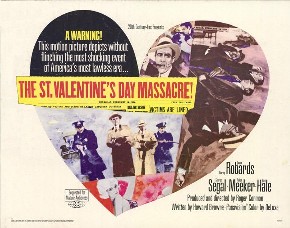
I grew up in Chicago so I love just about everything in the Windy City, all the sports teams, the downtown area, all that great food from Chicago style hot dogs to Chicago style pizza. But that Chicago history? My goodness, there are some dark moments from the Black Sox scandal to the Chicago Fire, the riots at the 1968 Democratic convention and generally all sorts of political corruption and deception. One of the most violent incidents in the city's history? That's told in a 1967 B-movie, The St. Valentine's Day Massacre.
It's early 1929 and the streets of Chicago are filled with warring gangsters from two rival gangs. On one side is Al Capone (Jason Robards), a brutal, possibly maniacal Italian gangster with Mafia ties, who rules Chicago's South Side with an iron fist. Running the city's North side is George 'Bugs' Moran (Ralph Meeker), his Irish gang trying to hold onto their territory. Things across the city are building to an unavoidable confrontation as both sides fight for control of thousands of speakeasies, Prohibition still raging. Capone has grown tired of Moran's gang trying to build up their power and has put into work a plan to execute his rival gang leader. Can one gang win out over the other? Can anyone win with the city's streets riddled with bullets and blood?
Everyone's heard of producer/director extraordinaire Roger Corman? He's one of Hollywood's all-time greats at getting movies made on the cheap so basically the King of B-Movies. That's not a bad thing, and I say it as a compliment. This generally forgotten 1967 gangster flick is one of his best, telling the true story of one of Chicago's darkest moments. It was filmed on studio streets -- cheaper than Chicago's downtown area -- but it works, giving the city a closed in, wintery and claustrophobic effect. This is a flick that works almost like a quasi-documentary, like something you'd see on The History Channel...but darker, much darker. With narrator Paul Frees and his perfectly gravelly voice laying things out, introducing dates, people and times, it all fits together like puzzle pieces.
Where 'Massacre' separates itself from the quasi-documentary feel is that darkness, that gangster world we're thrust into. Low budget though it may be, the movie looks great with countless gangsters wearing impeccably cool suits with fedoras, rocking vicious tommy guns and 1920s boats of cars that look as cool as ever now in 2014 as they would have in 1929. As for the real life gangsters, this isn't The Godfather where you kinda sorta maybe sympathize with the Corleones, however vicious and murdery they are. There ain't a single sympathetic character anywhere in sight. These are nasty, brutal, violent folks interested in making money and killing some rival gangsters in the process. You're not rooting for anybody. You're not hoping these guys come out unscathed. You just wanna see how it all shakes out and who's gonna make it. Let me tell you...not many do.
One of the coolest aspects of 'Massacre' is its ridiculously deep cast. We're not talking a disaster flick type of cast full of aging A-list stars. We're talking a couple very solid movie stars/actors at the top and a cast backing them up absolutely packed to the guts with familiar, recognizable character actors. As for the leads, Robards is terrifyingly hammy as everyone's favorite Chicago gangster, Al Capone. He's got that look in his eye, you just never know what he's going to do next. Meeker is excellent too in a more understated but just as sinister part, Bugs Moran, an Irish gangster and Capone's main rival for power. Also look for a young George Segal in one of his best early roles, playing Peter Gusenberg, one of Moran's enforcers/lieutenants working closely with his brother, another enforcer, Frank (David Canary) while constantly fighting with live-in girlfriend (Jean Hale).
Okay, brace yourself because you're about to get hit with a whole lot of links to actor's IMDB pages. These are all the real-life people involved in the 1920s world of Chicago gang wars, an extremely interesting historical time if you're interested in the subject matter. On the Capone side keep an eye out for Clint Ritchie as the massacre's mastermind, Frank Silvera, Harold J. Stone, Paul Richards, Joe Turkel, Alex Rocco, Leo Gordon, John Agar, and Richard Bakalyan and Jack Nicholson (Yes, that Jack Nicholson) as two hired mafia killers. On the Moran side of things, watch for Bruce Dern, Kurt Kreuger, Tom Reese. Some appearances are quicker than others, but it's cool to see so many people in one movie, even if it is only for a scene or two.
Just an entertaining dark and dirty movie. If you're a fan of history whether it be Chicago or gangsters or anything in between, this gritty, cynical, particularly vicious flick is for you. I loved it.
The St. Valentine's Day Massacre (1967): *** 1/2 /****
It's early 1929 and the streets of Chicago are filled with warring gangsters from two rival gangs. On one side is Al Capone (Jason Robards), a brutal, possibly maniacal Italian gangster with Mafia ties, who rules Chicago's South Side with an iron fist. Running the city's North side is George 'Bugs' Moran (Ralph Meeker), his Irish gang trying to hold onto their territory. Things across the city are building to an unavoidable confrontation as both sides fight for control of thousands of speakeasies, Prohibition still raging. Capone has grown tired of Moran's gang trying to build up their power and has put into work a plan to execute his rival gang leader. Can one gang win out over the other? Can anyone win with the city's streets riddled with bullets and blood?
Everyone's heard of producer/director extraordinaire Roger Corman? He's one of Hollywood's all-time greats at getting movies made on the cheap so basically the King of B-Movies. That's not a bad thing, and I say it as a compliment. This generally forgotten 1967 gangster flick is one of his best, telling the true story of one of Chicago's darkest moments. It was filmed on studio streets -- cheaper than Chicago's downtown area -- but it works, giving the city a closed in, wintery and claustrophobic effect. This is a flick that works almost like a quasi-documentary, like something you'd see on The History Channel...but darker, much darker. With narrator Paul Frees and his perfectly gravelly voice laying things out, introducing dates, people and times, it all fits together like puzzle pieces.
Where 'Massacre' separates itself from the quasi-documentary feel is that darkness, that gangster world we're thrust into. Low budget though it may be, the movie looks great with countless gangsters wearing impeccably cool suits with fedoras, rocking vicious tommy guns and 1920s boats of cars that look as cool as ever now in 2014 as they would have in 1929. As for the real life gangsters, this isn't The Godfather where you kinda sorta maybe sympathize with the Corleones, however vicious and murdery they are. There ain't a single sympathetic character anywhere in sight. These are nasty, brutal, violent folks interested in making money and killing some rival gangsters in the process. You're not rooting for anybody. You're not hoping these guys come out unscathed. You just wanna see how it all shakes out and who's gonna make it. Let me tell you...not many do.
One of the coolest aspects of 'Massacre' is its ridiculously deep cast. We're not talking a disaster flick type of cast full of aging A-list stars. We're talking a couple very solid movie stars/actors at the top and a cast backing them up absolutely packed to the guts with familiar, recognizable character actors. As for the leads, Robards is terrifyingly hammy as everyone's favorite Chicago gangster, Al Capone. He's got that look in his eye, you just never know what he's going to do next. Meeker is excellent too in a more understated but just as sinister part, Bugs Moran, an Irish gangster and Capone's main rival for power. Also look for a young George Segal in one of his best early roles, playing Peter Gusenberg, one of Moran's enforcers/lieutenants working closely with his brother, another enforcer, Frank (David Canary) while constantly fighting with live-in girlfriend (Jean Hale).
Okay, brace yourself because you're about to get hit with a whole lot of links to actor's IMDB pages. These are all the real-life people involved in the 1920s world of Chicago gang wars, an extremely interesting historical time if you're interested in the subject matter. On the Capone side keep an eye out for Clint Ritchie as the massacre's mastermind, Frank Silvera, Harold J. Stone, Paul Richards, Joe Turkel, Alex Rocco, Leo Gordon, John Agar, and Richard Bakalyan and Jack Nicholson (Yes, that Jack Nicholson) as two hired mafia killers. On the Moran side of things, watch for Bruce Dern, Kurt Kreuger, Tom Reese. Some appearances are quicker than others, but it's cool to see so many people in one movie, even if it is only for a scene or two.
Just an entertaining dark and dirty movie. If you're a fan of history whether it be Chicago or gangsters or anything in between, this gritty, cynical, particularly vicious flick is for you. I loved it.
The St. Valentine's Day Massacre (1967): *** 1/2 /****
Thursday, March 20, 2014
Desert Sands
Ah, the French Foreign Legion, where men can be men and no one can judge them for it. Yes, I'm rewriting my western posse lead so deal with it. Originally created in 1831, the Legion is a unit in the French armed forces that allows for foreign nationals to join the Legion, not an exclusively French group of soldiers. This very unique, very interesting military force has provided a long list of films to tell their story. Check out the list HERE. The most famous is Beau Geste, but there are many, many more, including 1955's Desert Sands.
At an isolated outpost in northern Africa, Fort Valeau, the French Foreign Legion garrison is readying for relief, for a break from its year-long posting. The commanding officer (an uncredited Ben Wright) is set to be replaced as well, medical concerns beginning to weigh on him. His replacement? A legend among the Legion, Capt. David Malcolm (Ralph Meeker), an American who has gained quite a reputation over the years as an impressive, more than capable fighting man. Malcolm arrives at the outpost ahead of his relief company (by helicopter too, oooh!), surprised they haven't arrived yet. Malcolm and the garrison soon find out why. A young shiekh, El Zanal (Keith Larsen), has been lying in wait for 15 years, building and planning and preparing for an all-out assault that will wipe out the Legion, starting with Fort Valeau. Malcolm's relief company has been massacred, and the garrison is very much on its own with no help in sight.
There is a certain charm to French Foreign Legion movies that have always appealed to me. The portrayal of these fighting men is usually of misfits and screw-ups looking for a chance to redeem themselves through battle, sometimes through their own death. It's magnified for movies obviously, the Legion a legitimate fighting unit in the French military. But as movies would have it, it seems garrison after garrison of Legionnaires are wiped out by warring tribesmen across Africa and around the world. This short, 87-minute B-movie from director Lesley Selander certainly has its moments. The isolated outpost is a very cool set, and while there isn't a ton of star power, there's some fun characters on-hand. 'Sands' is content to be fun and entertaining, but some script issues really prevent it from being a good movie.
The positives are pretty obvious for me. Isolated outpost, impossible odds, eccentric group of legionnaires forced to fight together, putting aside their differences and rivalries. Fun, right? Meeker is okay as Capt. Malcolm, a little wooden for a guy known for his dark roles. I would have liked a little more background about his legendary status as a Legionnaire as well. His garrison is full of some cool characters that lack star power, but that's a minor concern when you're having fun. They include Sgt. Diepel (J. Carroll Naish), the longtime fighter and tough as nails sarge, Pvt. Tyle (John Smith), the fiery Texan, Havers (Ron Randell), the hard-drinking Brit, Lt. Mackie (Jarl Victor), second-in-command, Gabin (Otto Waldis), the likable vet, Lucia (Peter Mamakos), the amiable Italian, Ducco (Albert Carrier), the cowardly Frenchman, Woloack (Mort Mills), the radioman, Sandy (Philip Tonge), the friendly Scotsman, and Kleiner (Peter Norman), the outpost's doctor. A fun, cool group of disparate characters.
One would think that with an 87-minute movie, there isn't a whole lot of time available to really screw things up. One would be wrong. This movie was good, really entertaining, good action, for the first 45 minutes. Then it wasn't good. Larsen could be the most wooden actor ever, his epic, diabolical plans for revenge coming across as a pretty weak plan....that took 15 years to plan. Meh, what's time anyways? That's one thing though, not a deal-breaker. How about Zanal's sister, Zara (Marla English), also seeking revenge? Well, kind of. Mostly, she instantly falls in love with the not so charismatic Capt. Malcolm. She's like putty in his hand when she finds out his wife and child were killed in a car accident. The ladies do like a tortured bad boy, don't they? A story about a last stand, about honor and loyalty and camaraderie in the Legion? Money in the bank. But no. Let's make it a love story. Sound thinking if you ask me.
Now getting to the 45-minute mark is pretty fun. Good tension, good mystery as we meet the garrison's men, start to question what exactly is going on just out of view over the horizon. Zanal's attack on the fort is a gem, well-choreographed and surprisingly dark for a 1955 flick. For a B-movie in general, it's a pretty solid action sequence. That's ruined in the finale as the Legionnaires fight off a second massacre, defeating the evil invaders with awful strategy. Surrounded on all sides by expert marksmen from positions of height, the Legionnaires stand in the open in square formation, shooting back....and winning!!! It's such a stupidly put together finale, wrapping things up far too quickly. A disappointing end result, mostly because it was pretty decent early on. Also look for John Carradine as Jala, a treacherous, conniving wine merchant. Oh, an evil wine merchant!
Desert Sands (1955): **/****
At an isolated outpost in northern Africa, Fort Valeau, the French Foreign Legion garrison is readying for relief, for a break from its year-long posting. The commanding officer (an uncredited Ben Wright) is set to be replaced as well, medical concerns beginning to weigh on him. His replacement? A legend among the Legion, Capt. David Malcolm (Ralph Meeker), an American who has gained quite a reputation over the years as an impressive, more than capable fighting man. Malcolm arrives at the outpost ahead of his relief company (by helicopter too, oooh!), surprised they haven't arrived yet. Malcolm and the garrison soon find out why. A young shiekh, El Zanal (Keith Larsen), has been lying in wait for 15 years, building and planning and preparing for an all-out assault that will wipe out the Legion, starting with Fort Valeau. Malcolm's relief company has been massacred, and the garrison is very much on its own with no help in sight.
There is a certain charm to French Foreign Legion movies that have always appealed to me. The portrayal of these fighting men is usually of misfits and screw-ups looking for a chance to redeem themselves through battle, sometimes through their own death. It's magnified for movies obviously, the Legion a legitimate fighting unit in the French military. But as movies would have it, it seems garrison after garrison of Legionnaires are wiped out by warring tribesmen across Africa and around the world. This short, 87-minute B-movie from director Lesley Selander certainly has its moments. The isolated outpost is a very cool set, and while there isn't a ton of star power, there's some fun characters on-hand. 'Sands' is content to be fun and entertaining, but some script issues really prevent it from being a good movie.
The positives are pretty obvious for me. Isolated outpost, impossible odds, eccentric group of legionnaires forced to fight together, putting aside their differences and rivalries. Fun, right? Meeker is okay as Capt. Malcolm, a little wooden for a guy known for his dark roles. I would have liked a little more background about his legendary status as a Legionnaire as well. His garrison is full of some cool characters that lack star power, but that's a minor concern when you're having fun. They include Sgt. Diepel (J. Carroll Naish), the longtime fighter and tough as nails sarge, Pvt. Tyle (John Smith), the fiery Texan, Havers (Ron Randell), the hard-drinking Brit, Lt. Mackie (Jarl Victor), second-in-command, Gabin (Otto Waldis), the likable vet, Lucia (Peter Mamakos), the amiable Italian, Ducco (Albert Carrier), the cowardly Frenchman, Woloack (Mort Mills), the radioman, Sandy (Philip Tonge), the friendly Scotsman, and Kleiner (Peter Norman), the outpost's doctor. A fun, cool group of disparate characters.
One would think that with an 87-minute movie, there isn't a whole lot of time available to really screw things up. One would be wrong. This movie was good, really entertaining, good action, for the first 45 minutes. Then it wasn't good. Larsen could be the most wooden actor ever, his epic, diabolical plans for revenge coming across as a pretty weak plan....that took 15 years to plan. Meh, what's time anyways? That's one thing though, not a deal-breaker. How about Zanal's sister, Zara (Marla English), also seeking revenge? Well, kind of. Mostly, she instantly falls in love with the not so charismatic Capt. Malcolm. She's like putty in his hand when she finds out his wife and child were killed in a car accident. The ladies do like a tortured bad boy, don't they? A story about a last stand, about honor and loyalty and camaraderie in the Legion? Money in the bank. But no. Let's make it a love story. Sound thinking if you ask me.
Now getting to the 45-minute mark is pretty fun. Good tension, good mystery as we meet the garrison's men, start to question what exactly is going on just out of view over the horizon. Zanal's attack on the fort is a gem, well-choreographed and surprisingly dark for a 1955 flick. For a B-movie in general, it's a pretty solid action sequence. That's ruined in the finale as the Legionnaires fight off a second massacre, defeating the evil invaders with awful strategy. Surrounded on all sides by expert marksmen from positions of height, the Legionnaires stand in the open in square formation, shooting back....and winning!!! It's such a stupidly put together finale, wrapping things up far too quickly. A disappointing end result, mostly because it was pretty decent early on. Also look for John Carradine as Jala, a treacherous, conniving wine merchant. Oh, an evil wine merchant!
Desert Sands (1955): **/****
Wednesday, December 4, 2013
The Detective
Movie star, actor, singer and entertainer, Frank Sinatra was able to pick and choose his roles as he saw fit by 1968. He picked movies he wanted to do, not just for the sake of doing a movie. With 1968's The Detective, Sinatra was at the helm of a police drama that was ahead of its time and helped kick the door open for where the genre would go at the end of the 1960s and into the 1970s.
A veteran detective with years of experience in New York City, Joe Leland (Sinatra) has seen it all, and it's starting to wear on him more than a little bit. He's been called in to investigate a particularly gruesome murder, the son of a rich businessman killed and disfigured. Rumor has it the dead man was gay, Leland and his fellow detectives forced to explore the gay sub-culture (its the 1960s, just go with it) to see if they can track down the murderer. The case has gained notoriety in the headlines, putting Leland and the precinct in the spotlight to solve it and solve it quickly. It's the kind of case that can make or break a police officer. Solve it and quickly rise through the ranks? Don't? Well, a scapegoat will be needed. It's not the only case on the docket though, crimes -- murders and more -- rolling in on a daily basis. Hopefully, Leland can keep it together long enough to find his man.
The appeal in this police drama from director Gordon Douglas is obvious. Made during one of the most turbulent times in Hollywood history (and American history at that point), 'Detective' embraces the sharp-edged, rougher mindset perpetuating the minds of the audiences. It isn't interested in being politically correct...at all. A gay man being murdered (with his penis cut off) provides quite the jumping off point, constant mention of "fags" and "homos," as well as an almost laughable portrayal of a homosexual meeting point. Beyond that though, it's a brutally realistic story in terms of the storytelling. Sex, violence, one-night stands, drugs, city corruption, 'Detective' is ready, willing and able to dive in head first and get dirty.
For all the positives though, there's the obvious counter of the negatives. In a movie that runs 114 minutes, I thought too much time was spent getting to know Sinatra's Leland via a series of flashbacks. It serves to give some cool background, but there's a limit. We see Leland meet Karen (Lee Remick) who he eventually marries. If cop movies have taught us anything though, it's that a cop's marriage has never gone smoothly in the history of law enforcement. The subject matter may have seemed ahead of its time in 1968, but it makes the story lag. We hear Joe talk about all the women he's been with, we hear Karen discuss her troubled past, her series of one-night stands, her inability to hold a relationship. A little bawdy if you ask me (that's sarcasm by the way). Seeing Remick's Karen say 'Let me make love to you this time' is a little scandalous for the time, but when the murder cases are far more interesting, those wavy-screened flashbacks kill the momentum.
I've always thought Sinatra was an underrated actor. Was he a great actor? No, but he was far better than people remember him. He does a no-nonsense tough guy like nobody's business. As we see with his dating/marrying Karen, Joe is exceptionally smooth, looking like he's almost bored with the process. He's that cool. More than that though, I appreciated the human side of Sinatra's part as longtime detective Joe Leland. The job is beating him down as he sees the lowest of lows, what people can do to each other in day-to-day life. He comes from a family of police officers and does it because it's in his blood, not because he loves it. Joe is good at what he does, but as he sees the violence and corruption, he begins to question how much more he can take. Uninterested in being a PR police man, he wants to do his job. An underrated part, Sinatra is the best part of this one.
Give Sinatra credit when it's due. Other actors wanted to work with the guy. Including Remick, the cast is pretty impressive. The list of Leland's fellow detectives include Robert Duvall, Jack Klugman, Ralph Meeker and Al Freeman Jr, Horace McMahon playing the precinct commander. Jacqueline Bisset plays a widow who approaches Leland with a case involving her dead husband, supposedly by suicide but she believes otherwise. Also look for Tony Musante, Lloyd Bochner and William Windom as possible suspects in the cases Leland is pursuing.
I wanted to like this one more, mostly because there was so much potential for a really good to maybe even near-classic status. The flaws are pretty big though, especially the intense focus on Leland's personal life. I thought the twists in the movie's last act were pretty solid too, catching me by surprise, but even in that aspect, the execution is pretty weak as the film limps to the finish. Really good performance from Sinatra and a solid cast overall, but it never lives up to what it could have been.
The Detective (1968): **/****
A veteran detective with years of experience in New York City, Joe Leland (Sinatra) has seen it all, and it's starting to wear on him more than a little bit. He's been called in to investigate a particularly gruesome murder, the son of a rich businessman killed and disfigured. Rumor has it the dead man was gay, Leland and his fellow detectives forced to explore the gay sub-culture (its the 1960s, just go with it) to see if they can track down the murderer. The case has gained notoriety in the headlines, putting Leland and the precinct in the spotlight to solve it and solve it quickly. It's the kind of case that can make or break a police officer. Solve it and quickly rise through the ranks? Don't? Well, a scapegoat will be needed. It's not the only case on the docket though, crimes -- murders and more -- rolling in on a daily basis. Hopefully, Leland can keep it together long enough to find his man.
The appeal in this police drama from director Gordon Douglas is obvious. Made during one of the most turbulent times in Hollywood history (and American history at that point), 'Detective' embraces the sharp-edged, rougher mindset perpetuating the minds of the audiences. It isn't interested in being politically correct...at all. A gay man being murdered (with his penis cut off) provides quite the jumping off point, constant mention of "fags" and "homos," as well as an almost laughable portrayal of a homosexual meeting point. Beyond that though, it's a brutally realistic story in terms of the storytelling. Sex, violence, one-night stands, drugs, city corruption, 'Detective' is ready, willing and able to dive in head first and get dirty.
For all the positives though, there's the obvious counter of the negatives. In a movie that runs 114 minutes, I thought too much time was spent getting to know Sinatra's Leland via a series of flashbacks. It serves to give some cool background, but there's a limit. We see Leland meet Karen (Lee Remick) who he eventually marries. If cop movies have taught us anything though, it's that a cop's marriage has never gone smoothly in the history of law enforcement. The subject matter may have seemed ahead of its time in 1968, but it makes the story lag. We hear Joe talk about all the women he's been with, we hear Karen discuss her troubled past, her series of one-night stands, her inability to hold a relationship. A little bawdy if you ask me (that's sarcasm by the way). Seeing Remick's Karen say 'Let me make love to you this time' is a little scandalous for the time, but when the murder cases are far more interesting, those wavy-screened flashbacks kill the momentum.
I've always thought Sinatra was an underrated actor. Was he a great actor? No, but he was far better than people remember him. He does a no-nonsense tough guy like nobody's business. As we see with his dating/marrying Karen, Joe is exceptionally smooth, looking like he's almost bored with the process. He's that cool. More than that though, I appreciated the human side of Sinatra's part as longtime detective Joe Leland. The job is beating him down as he sees the lowest of lows, what people can do to each other in day-to-day life. He comes from a family of police officers and does it because it's in his blood, not because he loves it. Joe is good at what he does, but as he sees the violence and corruption, he begins to question how much more he can take. Uninterested in being a PR police man, he wants to do his job. An underrated part, Sinatra is the best part of this one.
Give Sinatra credit when it's due. Other actors wanted to work with the guy. Including Remick, the cast is pretty impressive. The list of Leland's fellow detectives include Robert Duvall, Jack Klugman, Ralph Meeker and Al Freeman Jr, Horace McMahon playing the precinct commander. Jacqueline Bisset plays a widow who approaches Leland with a case involving her dead husband, supposedly by suicide but she believes otherwise. Also look for Tony Musante, Lloyd Bochner and William Windom as possible suspects in the cases Leland is pursuing.
I wanted to like this one more, mostly because there was so much potential for a really good to maybe even near-classic status. The flaws are pretty big though, especially the intense focus on Leland's personal life. I thought the twists in the movie's last act were pretty solid too, catching me by surprise, but even in that aspect, the execution is pretty weak as the film limps to the finish. Really good performance from Sinatra and a solid cast overall, but it never lives up to what it could have been.
The Detective (1968): **/****
Monday, May 28, 2012
The Dirty Dozen
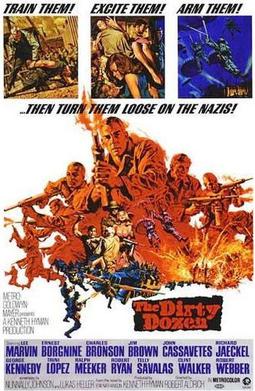
One of the all-time great tough guy casts -- if not the greatest -- in one of my favorite genres. A movie that stands the test of time that is action-packed, darkly funny and amazingly entertaining. It has taken abuse over the years by some because of its shocking ending, but it also has built up a diehard following by those who will defend it to the last (including me). One of my favorite movies ever, and a Memorial Day themed review, 1967's The Dirty Dozen.
An American army officer with a record a mile long, Major John Reisman (Lee Marvin) has been given a mission that even he doesn't believe is real. It's late spring 1944, and as the Allies prepare for the D-Day invasion, the Allied high command (including Ernest Borgnine) delivers his impossible, suicidal mission. Reisman is to take 12 prisoners either sentenced to death or years of imprisonment and hard labor, train them, and then in the days before the D-Day landing, drop them into German-occupied France. Their mission? Attack a German chateau, killing as many high ranking German officers as possible, hopefully wreaking havoc on the high command. Can Reisman get the prisoners to work together before they kill him?
This is a movie that is a perfect storm of timing, casting and story. A story of 12 convicted criminals -- rape, murder, robbery -- turned commandos who resent any sort of authority given a mission to kill enemy officers in cold blood? Could that story even remotely fly in any time other than late 1960s America? It was a time when America was changing, a darker, more cynical time in our history. Director Robert Aldrich taps into something special there. 'Dozen' has a unique look to it, interesting camera angles, a catchy theme for the Dozen -- listen HERE -- and a general feel of giving the middle finger to any sort of power or authority figure. Could there be a more perfect movie for a 1967 audience?
I could write a whole review discussing the characters and the long list of tough guy actors who play them, but I doubt many people would read 10,000 rambling words about how the cast of The Dirty Dozen is the coolest thing ever. Let's start with Lee Marvin, an all-around bad-ass who by the mid 1960s had become a major, bankable star. His Major Reisman, a sarcastic, quick-witted, smart-mouthed and brutally effective officer, is probably his most well known role, and he owns this movie. With the cast behind and around him, that's saying something. Marvin delivers brutally funny one-liners left and right, handles the action scenes flawlessly, and is believable as the cynical leader of this group of crook commandos. With those type of men behind him, you need someone like him to lead. Richard Jaeckel is a scene-stealer as Sgt. Bowren, the MP assigned to work with Reisman in training and execution of the mission. Along with Borgnine, the High Command and other Allied officers include Robert Webber, George Kennedy and Ralph Meeker. Oh, and Robert Ryan as a stiff-collared officer from the 101st. Enough for you? No?
And then there's the Dirty Dozen. The group includes Charles Bronson as Wladislaw, the former officer sentenced to hang for killing one of his own men, a medic carrying medical supplies away from battle. There's former NFL star Jim Brown as Jefferson, an African American soldier who killed in self defense but is sentenced to hang nonetheless. John Cassavetes was nominated for a Best Supporting Actor Oscar as Franko, a Chicago hood who killed a London man for $10 worth of cash. Telly Savalas is Maggot, a psychopathic Southerner convinced God works through him. Clint Walker is Posey, an Apache with rage issues, Donald Sutherland is Pinkley, a dimwitted soldier, and singer Trini Lopez plays Jiminez. Rounding out the Dozen are character actors Tom Busby, Ben Carruthers, Stuart Cooper, Colin Maitland, and Al Mancini as Bravos, the smallest of the bunch but with a mean/funny streak. The focus is Bronson, Brown, Cassavetes, Walker, Savalas and Sutherland, none of them disappointing, all of them living up to the hype, all given a chance to shine.
What has helped 'Dozen' gain its cult-like following over the years is its humor in looking at and poking some fun at war in general. Sutherland's dimwitted Pinkley is forced to inspect a crack platoon of Ryan's Col. Breed in one of the most memorable, truly funny scenes. Watch it HERE. Reisman later arranges for eight London prostitutes to visit the Dozen as their training winds down. The facial expressions exchanged back and forth are priceless. The high point comically -- however dark it is -- comes in the War Games sequence, the Dozen forced to prove their worth by capturing Col. Breed's headquarters. They resort to cheating, con jobs, stealing, and all sorts of trickery. After the extended training sequence -- which has its fair share of funny moments -- the War Games development and the eventual payoff provides some great laughs.
The portion of the movie though that tends to drive people away is the attack on the chateau. SPOILERS AHEAD SPOILERS STOP READING Here's the plan, courtesy of Reisman, which you can watch HERE. It of course, doesn't go as planned, Reisman, Bowren and the Dozen forced to improvise. Their solution is simple; throw grenades and gasoline down air chutes and burn (think napalm) the German officers to death. Heroic? No, I would say not. It's a movie though. These guys aren't portrayed as heroes. These are prototypical 1960s anti-heroes! What does work? The entire finale sequence (around 45 minutes long) is dripping with tension, and once the adrenaline starts pumping, it doesn't stop. The Dozen start to get picked off -- including two legitimate shockers -- as the bullets start flying. I've seen this movie 50 times and still root for two characters especially to make it, knowing all the while they won't. The means are brutal, but as far as an entertaining action sequence goes, it is one of the best.
I'm not sure what this says about me, but I grew up watching this movie a lot. Introduced to it via Memorial Day war movie marathons, it will be always be one of my favorites. I love its cynical, dark look at war. I love the ridiculously strong cast from top to bottom. It is funny, entertaining, action-packed, and a true example of 'They don't make them like that anymore.' A classic.
The Dirty Dozen <---trailer (1967): ****/****
An American army officer with a record a mile long, Major John Reisman (Lee Marvin) has been given a mission that even he doesn't believe is real. It's late spring 1944, and as the Allies prepare for the D-Day invasion, the Allied high command (including Ernest Borgnine) delivers his impossible, suicidal mission. Reisman is to take 12 prisoners either sentenced to death or years of imprisonment and hard labor, train them, and then in the days before the D-Day landing, drop them into German-occupied France. Their mission? Attack a German chateau, killing as many high ranking German officers as possible, hopefully wreaking havoc on the high command. Can Reisman get the prisoners to work together before they kill him?
This is a movie that is a perfect storm of timing, casting and story. A story of 12 convicted criminals -- rape, murder, robbery -- turned commandos who resent any sort of authority given a mission to kill enemy officers in cold blood? Could that story even remotely fly in any time other than late 1960s America? It was a time when America was changing, a darker, more cynical time in our history. Director Robert Aldrich taps into something special there. 'Dozen' has a unique look to it, interesting camera angles, a catchy theme for the Dozen -- listen HERE -- and a general feel of giving the middle finger to any sort of power or authority figure. Could there be a more perfect movie for a 1967 audience?
I could write a whole review discussing the characters and the long list of tough guy actors who play them, but I doubt many people would read 10,000 rambling words about how the cast of The Dirty Dozen is the coolest thing ever. Let's start with Lee Marvin, an all-around bad-ass who by the mid 1960s had become a major, bankable star. His Major Reisman, a sarcastic, quick-witted, smart-mouthed and brutally effective officer, is probably his most well known role, and he owns this movie. With the cast behind and around him, that's saying something. Marvin delivers brutally funny one-liners left and right, handles the action scenes flawlessly, and is believable as the cynical leader of this group of crook commandos. With those type of men behind him, you need someone like him to lead. Richard Jaeckel is a scene-stealer as Sgt. Bowren, the MP assigned to work with Reisman in training and execution of the mission. Along with Borgnine, the High Command and other Allied officers include Robert Webber, George Kennedy and Ralph Meeker. Oh, and Robert Ryan as a stiff-collared officer from the 101st. Enough for you? No?
And then there's the Dirty Dozen. The group includes Charles Bronson as Wladislaw, the former officer sentenced to hang for killing one of his own men, a medic carrying medical supplies away from battle. There's former NFL star Jim Brown as Jefferson, an African American soldier who killed in self defense but is sentenced to hang nonetheless. John Cassavetes was nominated for a Best Supporting Actor Oscar as Franko, a Chicago hood who killed a London man for $10 worth of cash. Telly Savalas is Maggot, a psychopathic Southerner convinced God works through him. Clint Walker is Posey, an Apache with rage issues, Donald Sutherland is Pinkley, a dimwitted soldier, and singer Trini Lopez plays Jiminez. Rounding out the Dozen are character actors Tom Busby, Ben Carruthers, Stuart Cooper, Colin Maitland, and Al Mancini as Bravos, the smallest of the bunch but with a mean/funny streak. The focus is Bronson, Brown, Cassavetes, Walker, Savalas and Sutherland, none of them disappointing, all of them living up to the hype, all given a chance to shine.
What has helped 'Dozen' gain its cult-like following over the years is its humor in looking at and poking some fun at war in general. Sutherland's dimwitted Pinkley is forced to inspect a crack platoon of Ryan's Col. Breed in one of the most memorable, truly funny scenes. Watch it HERE. Reisman later arranges for eight London prostitutes to visit the Dozen as their training winds down. The facial expressions exchanged back and forth are priceless. The high point comically -- however dark it is -- comes in the War Games sequence, the Dozen forced to prove their worth by capturing Col. Breed's headquarters. They resort to cheating, con jobs, stealing, and all sorts of trickery. After the extended training sequence -- which has its fair share of funny moments -- the War Games development and the eventual payoff provides some great laughs.
The portion of the movie though that tends to drive people away is the attack on the chateau. SPOILERS AHEAD SPOILERS STOP READING Here's the plan, courtesy of Reisman, which you can watch HERE. It of course, doesn't go as planned, Reisman, Bowren and the Dozen forced to improvise. Their solution is simple; throw grenades and gasoline down air chutes and burn (think napalm) the German officers to death. Heroic? No, I would say not. It's a movie though. These guys aren't portrayed as heroes. These are prototypical 1960s anti-heroes! What does work? The entire finale sequence (around 45 minutes long) is dripping with tension, and once the adrenaline starts pumping, it doesn't stop. The Dozen start to get picked off -- including two legitimate shockers -- as the bullets start flying. I've seen this movie 50 times and still root for two characters especially to make it, knowing all the while they won't. The means are brutal, but as far as an entertaining action sequence goes, it is one of the best.
I'm not sure what this says about me, but I grew up watching this movie a lot. Introduced to it via Memorial Day war movie marathons, it will be always be one of my favorites. I love its cynical, dark look at war. I love the ridiculously strong cast from top to bottom. It is funny, entertaining, action-packed, and a true example of 'They don't make them like that anymore.' A classic.
The Dirty Dozen <---trailer (1967): ****/****
Sunday, May 22, 2011
Kiss Me Deadly
In the late 1940s and into the 1950s when film noir ruled theaters with its uniquely dark storytelling and innovative filming techniques, no one was more popular writing crime novels than author Mickey Spillane. He started off writing comic books before turning to novels in 1947 with his debut story, I, Jury, eventually writing over 20 novels in all. His stories were incredibly dark and hard-edged, not looking to pull any punches. They seem like the perfect springboard for film noir flicks.
Nowhere was Spillane's writing more appropriate for film noir than his most famous character, private detective/investigator Mike Hammer. For lack of a better or more eloquent description, all I can think of to describe this individual is that he's one gnarly dude. Male leads in film noir -- film or literature -- are never particularly likable characters, but there's almost always some glimmer of goodness in them. Hammer? Not so much. He is brutally violent, hates women basically across the board, and also seems genuinely pissed at the world. All of that is on display in 1955's Kiss Me Deadly.
Driving through the desert outside Los Angeles in the dead of night, Mike Hammer (Ralph Meeker) almost crashes into a young woman, Christina (Cloris Leachman), trying to wave him down. He picks her up, quickly finding out she's escaped from an insane asylum. It's only a few miles later where they're driven off the road. Mike wakes up hours later, beaten severely to find that Christina has been tortured to death. She told him if anything happens, 'Remember her.' Now, Mike wants to know what's going on. What was this woman involved with? With help from his assistant, Velda (Maxine Cooper), he starts to look into it. Already as jaded as possible, even Mike can't prepare for what he finds.
I really don't know what to make of this movie. Released in 1955, it's basically different from any other movie you will have seen from that year or even that decade. Director Robert Aldrich puts his own darker, more cynical take on the film noir genre. It is a black and white world where there really isn't any "white," as in anything good. The characters -- with an exception here and there -- are out for themselves. It's a seedy world where nothing is on the level. Visually, Aldrich uses some cool, ahead of their time camera techniques, and films on location in and around 1950s Los Angeles. The time portal argument again, yes, 1950s LA looks cool.
Starting with Meeker in the lead role as Hammer, there aren't any big names associated with this cast. It helps here because as is so often the case, as an audience we don't have much in the way of preconceived notions or backgrounds on these people. Whether he was playing a good guy or a bad guy (typically bad or at least morally questionable good), Meeker has an intensity on-screen like few other actors in Hollywood. In that way, he's an ideal choice to play Hammer, one of the more despicable lead characters ever. He's just oozing anger, intensity and pure rage as he investigates the weirdness of the girl's death. More importantly, you feel he's capable of just about anything. His "business" as a detective involves blackmailing clients by sleeping with the women or having Velda sleep with the men. White-washed 1950s movie this is not, but Meeker is at his best.
No big names at all after Meeker, but the cast is great nonetheless, mostly because of Spillane's writing. He has all these great characters, all with their own motivations and incentives. Albert Dekker remains in the shadows most of the movie playing the baddie, Dr. Soberin, putting everything in motion. Cooper as Velda is a good match to Meeker, equally cynical but still somehow with feelings for Hammer. She's the scarred female lead that these noirs so often used/needed. Also worth mentioning are Wesley Addy as Pat Murphy, a cop associate if not friend of Hammer's, Paul Stewart as one of Soberin's men (with thugs Jack Lambert and Jack Elam), Gaby Rodgers as Gabrielle, Christina's long-suffering roommate, and Nick Dennis as Nick, one of Meeker's few friends, a mechanic. Even look for a young Strother Martin as someone Hammer interviews.
This movie has gained quite a cult reputation over the years, largely due to the fact that it's basically an anti-1950s movie. You just won't see many movies like this one from that decade. But somewhere in between Spillane's novel and the Aldrich film version, any sort of coherence gets lost in the shuffle. It opens with a bang, the opening sequence is one of the coolest I can think of. But as Hammer starts his investigation, the story weaves this way and that way without any sense of direction. It is a talky movie, and not necessarily a good one. Hammer slaps countless people to get the information he wants, and then moves on. It took me several sittings to get through this 106-minute movie just because I struggled to get involved with anything that was happening.
That builds to the ending, the reason Christina (Leachman in her screen debut) was brutally murdered. The story goes timely, tying things up with a reference to the Manhattan Project in the Nuclear Age. SPOILERS STOP READING SPOILERS How we don't know, but she has in her possession a box that contains some sort of nuclear/radioactive item that when released actually blows up a house. We've got this hard-edged detective story, and then WHAM!, we're going symbolic science fiction about evil and the end of the world. There is an alternate ending (read about it HERE) which actually sounds better considering the studio interference.
Kiss Me Deadly <---trailer (1955): **/****
Nowhere was Spillane's writing more appropriate for film noir than his most famous character, private detective/investigator Mike Hammer. For lack of a better or more eloquent description, all I can think of to describe this individual is that he's one gnarly dude. Male leads in film noir -- film or literature -- are never particularly likable characters, but there's almost always some glimmer of goodness in them. Hammer? Not so much. He is brutally violent, hates women basically across the board, and also seems genuinely pissed at the world. All of that is on display in 1955's Kiss Me Deadly.
Driving through the desert outside Los Angeles in the dead of night, Mike Hammer (Ralph Meeker) almost crashes into a young woman, Christina (Cloris Leachman), trying to wave him down. He picks her up, quickly finding out she's escaped from an insane asylum. It's only a few miles later where they're driven off the road. Mike wakes up hours later, beaten severely to find that Christina has been tortured to death. She told him if anything happens, 'Remember her.' Now, Mike wants to know what's going on. What was this woman involved with? With help from his assistant, Velda (Maxine Cooper), he starts to look into it. Already as jaded as possible, even Mike can't prepare for what he finds.
I really don't know what to make of this movie. Released in 1955, it's basically different from any other movie you will have seen from that year or even that decade. Director Robert Aldrich puts his own darker, more cynical take on the film noir genre. It is a black and white world where there really isn't any "white," as in anything good. The characters -- with an exception here and there -- are out for themselves. It's a seedy world where nothing is on the level. Visually, Aldrich uses some cool, ahead of their time camera techniques, and films on location in and around 1950s Los Angeles. The time portal argument again, yes, 1950s LA looks cool.
Starting with Meeker in the lead role as Hammer, there aren't any big names associated with this cast. It helps here because as is so often the case, as an audience we don't have much in the way of preconceived notions or backgrounds on these people. Whether he was playing a good guy or a bad guy (typically bad or at least morally questionable good), Meeker has an intensity on-screen like few other actors in Hollywood. In that way, he's an ideal choice to play Hammer, one of the more despicable lead characters ever. He's just oozing anger, intensity and pure rage as he investigates the weirdness of the girl's death. More importantly, you feel he's capable of just about anything. His "business" as a detective involves blackmailing clients by sleeping with the women or having Velda sleep with the men. White-washed 1950s movie this is not, but Meeker is at his best.
No big names at all after Meeker, but the cast is great nonetheless, mostly because of Spillane's writing. He has all these great characters, all with their own motivations and incentives. Albert Dekker remains in the shadows most of the movie playing the baddie, Dr. Soberin, putting everything in motion. Cooper as Velda is a good match to Meeker, equally cynical but still somehow with feelings for Hammer. She's the scarred female lead that these noirs so often used/needed. Also worth mentioning are Wesley Addy as Pat Murphy, a cop associate if not friend of Hammer's, Paul Stewart as one of Soberin's men (with thugs Jack Lambert and Jack Elam), Gaby Rodgers as Gabrielle, Christina's long-suffering roommate, and Nick Dennis as Nick, one of Meeker's few friends, a mechanic. Even look for a young Strother Martin as someone Hammer interviews.
This movie has gained quite a cult reputation over the years, largely due to the fact that it's basically an anti-1950s movie. You just won't see many movies like this one from that decade. But somewhere in between Spillane's novel and the Aldrich film version, any sort of coherence gets lost in the shuffle. It opens with a bang, the opening sequence is one of the coolest I can think of. But as Hammer starts his investigation, the story weaves this way and that way without any sense of direction. It is a talky movie, and not necessarily a good one. Hammer slaps countless people to get the information he wants, and then moves on. It took me several sittings to get through this 106-minute movie just because I struggled to get involved with anything that was happening.
That builds to the ending, the reason Christina (Leachman in her screen debut) was brutally murdered. The story goes timely, tying things up with a reference to the Manhattan Project in the Nuclear Age. SPOILERS STOP READING SPOILERS How we don't know, but she has in her possession a box that contains some sort of nuclear/radioactive item that when released actually blows up a house. We've got this hard-edged detective story, and then WHAM!, we're going symbolic science fiction about evil and the end of the world. There is an alternate ending (read about it HERE) which actually sounds better considering the studio interference.
Kiss Me Deadly <---trailer (1955): **/****
Labels:
1950s,
Film Noir,
Jack Elam,
Ralph Meeker,
Robert Aldrich,
Strother Martin
Monday, January 31, 2011
The Anderson Tapes
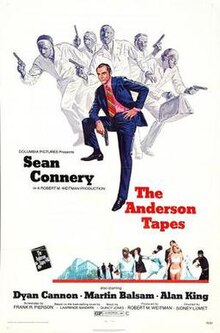
In a little over two years writing reviews here, I've watched my fair share of heist movies (11 if I've got the tags right). It's that perfect blend of action, suspense and drama all wrapped up into one as -- typically -- a group of specialists work together to steal something thought unattainable. Inception had dreams, Goldfinger was Fort knox, and Heat was piles of money. It's almost always one specific thing. That's not the case with 1971's The Anderson Tapes where the target isn't one thing, but one apartment building and everything in it.
To say director Sidney Lumet is slumming here isn't fair, but I'll admit it was the first thing I thought when his name popped up in the opening credits. This is the man who directed 12 Angry Men, Network, Dog Day Afternoon, Serpico, and so many more classic movies, and now he's directing a good old-fashioned heist movie? With a director of his caliber, I don't know if you can call it slumming, but it's a hell of a lot of fun to see someone like Lumet try a more mainstream movie dead set on entertaining more than delivering a message. It is a movie that isn't particularly unique compared to most heist movies, but it is solid all around and very entertaining.
After 10 years in prison for a burglary charge, master thief Duke Anderson (Sean Connery) visits an old girlfriend, Ingrid (Dyan Cannon), who lives in a posh apartment in New York City. Duke is looking for a job to pull off -- any job at all -- and realizes it's staring him dead in the face. Ingrid's building has 12 separate apartments owned by doctors and lawyers and all of society's best (translation = richest). Duke goes about putting together a motley crew of crooks and ex-cons to pull off the job, even going to the mob and kingpin, Angelo (Alan King) for backing. But as he goes about planning the elaborate heist of 12 apartments at one time, Duke realizes security has changed since he went into jail? Security cameras are everywhere, and it seems someone is watching him.
Released in 1971, this is a movie that at the time must have felt like a futuristic look at security with all its high-tech equipment. Now in 2011, it seems very dated that a team of crooks would be even slowed up by a security camera here and there. Composer Quincy Jones' score even plays that up with a robotic, electronic sound which is more distracting than necessary. The subplot with Anderson being constantly videotaped (hence the title of the movie) is disappointing though, not really going anywhere. It is the type of story where all these unknown elements feel like they're building to a huge, twist ending, but it never comes. The final scene is disappointing in that way as so many different elements and unanswered questions don't gel in the end.
That complaint aside, I really enjoyed this movie. This was one of Connery's movies in between James Bond roles, and before he returned to the part in Diamonds are Forever later in 1971. He is one of my all-time favorite actors so seeing him in a well-made heist movie is a cinch for me. His Duke Anderson is tough, intelligent and after 10 years in jail...desperate. He wants and needs to pull of a job. It's as high risk as they come, but the potential for payout at the end is huge so he puts it all on the line. I would have liked a little more resolution late in the movie with his character, but it does make it pretty clear what happens to him. Connery has a good chemistry too with Cannon in their few scenes together (he plays up his sexy, hairy Bond angle). If nothing else, 'Anderson' is worth seeing to get a glimpse of Connery without his toupee, just his thinning hair here.
So in the action equivalent of a men on a mission movie, Connery's Anderson must assemble a team of specialists to help him pull off the job. This is where 'Anderson' is better than most, the supporting cast. Martin Balsam is a scene-stealer and downright hilarious as Haskins, a gay interior decorator along to pick out what's valuable and what isn't worth stealing in the building. Stereotypical and a little politically incorrect? You bet, but it's funny. In one of his first featured roles, a young Christopher Walken plays the Kid, a young ex-con who's an expert in safecracking and dismantling alarms. There's also Val Avery as Parelli, the mob muscle, Dick Anthony Williams as Spencer, the getaway driver, Stan Gottlieb as Pop, an ex-con struggling to adjust to life outside prison, and Paul Benjamin as Spencer's former partner in crime along to help. With smaller parts, Anderson's crew makes the most of it, helping each character leave a lasting impression even with their limited screen-time.
Prior to the heist, there is little in the way of explanation of how Duke and Co. are going to pull this off so not surprisingly, the 40-minute heist sequence to close the movie out is a high point. Lumet films in it a unique way, showing the team get into an apartment, flash to the occupants later being interviewed by the police explaining what happened, and then bouncing back to inside the apartment during the job. It's a cool technique that keeps you guessing because if you pay attention in the background, you see clues of how the job went and if it was successful or not. In the heist, look for Ralph Meeker as a police commander brought in to deal with the crooks, and future SNL star Garrett Morris as a leader of a SWAT team. Nothing new, nothing flashy here, just a solid, exciting heist movie with a good cast.
The Anderson Tapes <---trailer (1971): ***/****
To say director Sidney Lumet is slumming here isn't fair, but I'll admit it was the first thing I thought when his name popped up in the opening credits. This is the man who directed 12 Angry Men, Network, Dog Day Afternoon, Serpico, and so many more classic movies, and now he's directing a good old-fashioned heist movie? With a director of his caliber, I don't know if you can call it slumming, but it's a hell of a lot of fun to see someone like Lumet try a more mainstream movie dead set on entertaining more than delivering a message. It is a movie that isn't particularly unique compared to most heist movies, but it is solid all around and very entertaining.
After 10 years in prison for a burglary charge, master thief Duke Anderson (Sean Connery) visits an old girlfriend, Ingrid (Dyan Cannon), who lives in a posh apartment in New York City. Duke is looking for a job to pull off -- any job at all -- and realizes it's staring him dead in the face. Ingrid's building has 12 separate apartments owned by doctors and lawyers and all of society's best (translation = richest). Duke goes about putting together a motley crew of crooks and ex-cons to pull off the job, even going to the mob and kingpin, Angelo (Alan King) for backing. But as he goes about planning the elaborate heist of 12 apartments at one time, Duke realizes security has changed since he went into jail? Security cameras are everywhere, and it seems someone is watching him.
Released in 1971, this is a movie that at the time must have felt like a futuristic look at security with all its high-tech equipment. Now in 2011, it seems very dated that a team of crooks would be even slowed up by a security camera here and there. Composer Quincy Jones' score even plays that up with a robotic, electronic sound which is more distracting than necessary. The subplot with Anderson being constantly videotaped (hence the title of the movie) is disappointing though, not really going anywhere. It is the type of story where all these unknown elements feel like they're building to a huge, twist ending, but it never comes. The final scene is disappointing in that way as so many different elements and unanswered questions don't gel in the end.
That complaint aside, I really enjoyed this movie. This was one of Connery's movies in between James Bond roles, and before he returned to the part in Diamonds are Forever later in 1971. He is one of my all-time favorite actors so seeing him in a well-made heist movie is a cinch for me. His Duke Anderson is tough, intelligent and after 10 years in jail...desperate. He wants and needs to pull of a job. It's as high risk as they come, but the potential for payout at the end is huge so he puts it all on the line. I would have liked a little more resolution late in the movie with his character, but it does make it pretty clear what happens to him. Connery has a good chemistry too with Cannon in their few scenes together (he plays up his sexy, hairy Bond angle). If nothing else, 'Anderson' is worth seeing to get a glimpse of Connery without his toupee, just his thinning hair here.
So in the action equivalent of a men on a mission movie, Connery's Anderson must assemble a team of specialists to help him pull off the job. This is where 'Anderson' is better than most, the supporting cast. Martin Balsam is a scene-stealer and downright hilarious as Haskins, a gay interior decorator along to pick out what's valuable and what isn't worth stealing in the building. Stereotypical and a little politically incorrect? You bet, but it's funny. In one of his first featured roles, a young Christopher Walken plays the Kid, a young ex-con who's an expert in safecracking and dismantling alarms. There's also Val Avery as Parelli, the mob muscle, Dick Anthony Williams as Spencer, the getaway driver, Stan Gottlieb as Pop, an ex-con struggling to adjust to life outside prison, and Paul Benjamin as Spencer's former partner in crime along to help. With smaller parts, Anderson's crew makes the most of it, helping each character leave a lasting impression even with their limited screen-time.
Prior to the heist, there is little in the way of explanation of how Duke and Co. are going to pull this off so not surprisingly, the 40-minute heist sequence to close the movie out is a high point. Lumet films in it a unique way, showing the team get into an apartment, flash to the occupants later being interviewed by the police explaining what happened, and then bouncing back to inside the apartment during the job. It's a cool technique that keeps you guessing because if you pay attention in the background, you see clues of how the job went and if it was successful or not. In the heist, look for Ralph Meeker as a police commander brought in to deal with the crooks, and future SNL star Garrett Morris as a leader of a SWAT team. Nothing new, nothing flashy here, just a solid, exciting heist movie with a good cast.
The Anderson Tapes <---trailer (1971): ***/****
Sunday, August 1, 2010
I Walk the Line
Is there a genre of movies that could be dubbed "I'm having a mid-life crisis?" It sure seems like there has been enough movies where a middle-aged man, fed up with where his life has ended up, does something to reclaim his youth whether it be an affair with a younger woman, buying an expensive sports car, or the always reliable bail on your life and start over. That's the basic premise for 1970's I Walk the Line.
The movie of course is not based on Andy Taylor -- Andy Griffith's character in The Andy Griffith Show -- but there are a fair share of similarities between the TV sitcom character and the main star here, Gregory Peck. Directed by John Frankenheimer, 'Line' jumps right into the premise of small-town life in the south is like where big-city life seems like a far off thing and the excitement is minimal. But what if something came along -- for one person at least -- that livened things up even for a little bit? Would you embrace it or pass it up? So goes Pecks' dilemma.
As the peace officer in a small Tennessee town, Sheriff Tawes (Peck) just doesn't have much to do. His home life is quiet without much in the way of fireworks (good or bad), and he spends his days patrolling back roads and making sure everything is up to snuff. One day he pulls over a truck driving wildly down the road and meets Alma McClain (Tuesday Weld), a teenage girl who is lively and exciting in a way little else is in his life. They quickly start seeing each other -- secretly of course, this is the South -- only to have Alma's moonshiner father (Ralph Meeker) blackmail Tawes for protection so his moonshining business can keep going. As long as the sheriff gets to see Alma, he doesn't seem to care, but his hushed up affair becomes an issue when an FBI agent (Lonny Chapman) shows up with orders to clean out any moonshiners in the area.
This performance for Peck is quite a departure from his usual roles where he usually played stout men of principles where good was good and bad was bad. Frankenheimer wisely doesn't paint Tawes as a hero or as a bad guy, instead just showing him as a man who's frustrated with the path his life has took. Through Weld's Alma, Tawes sees a chance to be happy, to be young again. Peck pulls this all off perfectly, like a man about to explode. With anything involving an older man and a younger woman (Alma's age is never specified, 19, 20 maybe?), there's a certain element of creepiness, but for the most part it is kept to a minimum. Give Peck credit, he goes right up to that line of crazy, obsession love without going over...just barely.
Making his obsession fully understandable is Tuesday Weld because, well, she looks like she does. The 27-year old actress is playing a part that is slightly younger than her, but this bubbly blond with the huge smile makes it easy to understand why a middle-aged man would feel the way he does about her. What I liked about the character was the question of if she was playing Tawes for his protection or because she was genuinely interested in him, had real feelings for him. Her motives are established late, leading to an ending that surprised me, but it certainly works as a "real" ending. Also worth mentioning in the cast is Meeker in a smaller part as Alma's father Carl (subtle creepy incest hinted at), and Charles Durning as Hunnicutt, Tawes' deputy who always sticks his nose where it doesn't belong.
My biggest issue isn't in what we do see, but what we don't see. Tawes gets involved with Alma very quickly without much in the way of character background. It's obvious he is bored to death by his job, family and life in general, but there's only one scene that even shows it, a dinner scene with his wife (Estelle Parsons), their daughter and Tawes' father. The peaceable sheriff looks like he's about to kill them all in a fit of rage. I'm not looking for 30 minutes of mind-killing boredom where we saw Tawes and his descent, but even a little more background would have been interesting.
One review I read accurately identified 'Line' as a movie that feels like a folk song, a country ballad, and he's dead-on. Singer Johnny Cash handles the soundtrack (including title song "I Walk the Line"), helping the movie move along in the montage sequences as Tawes and Alma sneak off to be together. Frankenheimer filmed in Tennessee, giving the story a sense of being separated from the rest of the world in this tiny backroads town. It feels like you're there with them and not some movie studio set. For an underrated, different movie, give this a try. Watch it at Youtube starting here with Part 1 of 10.
I Walk the Line <---TCM trailer (1970): ** 1/2 /****
The movie of course is not based on Andy Taylor -- Andy Griffith's character in The Andy Griffith Show -- but there are a fair share of similarities between the TV sitcom character and the main star here, Gregory Peck. Directed by John Frankenheimer, 'Line' jumps right into the premise of small-town life in the south is like where big-city life seems like a far off thing and the excitement is minimal. But what if something came along -- for one person at least -- that livened things up even for a little bit? Would you embrace it or pass it up? So goes Pecks' dilemma.
As the peace officer in a small Tennessee town, Sheriff Tawes (Peck) just doesn't have much to do. His home life is quiet without much in the way of fireworks (good or bad), and he spends his days patrolling back roads and making sure everything is up to snuff. One day he pulls over a truck driving wildly down the road and meets Alma McClain (Tuesday Weld), a teenage girl who is lively and exciting in a way little else is in his life. They quickly start seeing each other -- secretly of course, this is the South -- only to have Alma's moonshiner father (Ralph Meeker) blackmail Tawes for protection so his moonshining business can keep going. As long as the sheriff gets to see Alma, he doesn't seem to care, but his hushed up affair becomes an issue when an FBI agent (Lonny Chapman) shows up with orders to clean out any moonshiners in the area.
This performance for Peck is quite a departure from his usual roles where he usually played stout men of principles where good was good and bad was bad. Frankenheimer wisely doesn't paint Tawes as a hero or as a bad guy, instead just showing him as a man who's frustrated with the path his life has took. Through Weld's Alma, Tawes sees a chance to be happy, to be young again. Peck pulls this all off perfectly, like a man about to explode. With anything involving an older man and a younger woman (Alma's age is never specified, 19, 20 maybe?), there's a certain element of creepiness, but for the most part it is kept to a minimum. Give Peck credit, he goes right up to that line of crazy, obsession love without going over...just barely.
Making his obsession fully understandable is Tuesday Weld because, well, she looks like she does. The 27-year old actress is playing a part that is slightly younger than her, but this bubbly blond with the huge smile makes it easy to understand why a middle-aged man would feel the way he does about her. What I liked about the character was the question of if she was playing Tawes for his protection or because she was genuinely interested in him, had real feelings for him. Her motives are established late, leading to an ending that surprised me, but it certainly works as a "real" ending. Also worth mentioning in the cast is Meeker in a smaller part as Alma's father Carl (subtle creepy incest hinted at), and Charles Durning as Hunnicutt, Tawes' deputy who always sticks his nose where it doesn't belong.
My biggest issue isn't in what we do see, but what we don't see. Tawes gets involved with Alma very quickly without much in the way of character background. It's obvious he is bored to death by his job, family and life in general, but there's only one scene that even shows it, a dinner scene with his wife (Estelle Parsons), their daughter and Tawes' father. The peaceable sheriff looks like he's about to kill them all in a fit of rage. I'm not looking for 30 minutes of mind-killing boredom where we saw Tawes and his descent, but even a little more background would have been interesting.
One review I read accurately identified 'Line' as a movie that feels like a folk song, a country ballad, and he's dead-on. Singer Johnny Cash handles the soundtrack (including title song "I Walk the Line"), helping the movie move along in the montage sequences as Tawes and Alma sneak off to be together. Frankenheimer filmed in Tennessee, giving the story a sense of being separated from the rest of the world in this tiny backroads town. It feels like you're there with them and not some movie studio set. For an underrated, different movie, give this a try. Watch it at Youtube starting here with Part 1 of 10.
I Walk the Line <---TCM trailer (1970): ** 1/2 /****
Friday, June 4, 2010
Code Two
Did you ever watch an episode of CHiPs and think 'Man, I wish they made a movie about these guys?' Yeah, me neither. But if you did, 1953's Code Two might be just the movie for you except without Erik Estrada, way too tight biker pants, and police seducing women every chance they get. Almost serving as a public service announcement about how cool it is to be a motorcycle cop, Code Two has its moments in a quick 69-minute running time.
Made with a relatively unknown cast and with a smallish budget, 'Code' benefits from some cool on-location shooting in Los Angeles and the surrounding area which gives a nice window into 1950s California. Add on top of that some even cooler footage of vintage motorcycles whipping around the city, and you've basically got this movie with a ham-fisted storyline thrown in for good measure. Let's face it, what's a motorcycle cop movie without some ridiculous crime to solve?
Heading into the police academy, three officers-to-be dream of one day being motorcycle cops. First, there's Chuck O'Flair (Ralph Meeker), a cocky, fun-loving SOB who wants to prove he's the best. Second, there is Harry Whenlon (Jeff Richards), the boring All-American guy devoid of all personality. Last is Russ Hartley (Robert Horton), a husband looking to provide for his young family. But if these three crazy kids want to be motorcycle cops, first they've got to get through Jumbo Culdane (Keenan Wynn), the tough as nails veteran instructor who will throw everything in the book at them so they're ready for their jobs. Even if they do pass, they've got the extremely dangerous job of patrolling the streets ahead of them.
Nothing from that storyline isn't straight out of the movie script cookie cutter formula maker. Really, the plot is probably the last thing you'd look for in a movie like that. 'Code' at its best is with the trainees going through their equivalent of boot camp to get onto the LAPD and then their bike training to become motorcycle cops. There's some great footage of these training sequences with much of the cast -- especially Meeker and Wynn -- looking like they did much of their own riding whenever possible.
The cast is nothing special with the only characters of interest being Meeker's cocky Chuck and Wynn's tough as nails Jumbo. The All-American boy is about as cardboard as possible, and the family man cop tries to hide his job from his wife who worries about him. Thankfully, not too much time is devoted to either of them. Meeker does what he does best, play an a-hole, and while he's not particularly likable, he's at least interesting. Wynn looks to be enjoying himself the most as Jumbo -- think the police equivalent of a foul-mouthed (for the 50s at least) of a Marine drill sergeant.
The already mentioned ridiculous crime that has to be solved is a doozy. SPOILERS During a routine traffic stop, Harry gets knocked out and run over by a cattle truck (William Campbell is the killer), but little evidence other than a tire track is left behind to provide clues. Meeker's Chuck ends up breaking the case which even now having finished the movie makes me shake my head. In 1952 Los Angeles, some criminal organization is rustling cattle, transporting them in trucks, slaughtering them and butchering the meat, and apparently running some sort of illegal deli. Chuck tracks them down and gets in a shootout with a lot of nameless henchmen just waiting to get knocked off.
A completely forgettable movie but at least its entertaining. Also watch for a young uncredited Chuck Connors in just his fourth movie, making a quick appearance as a sheriff's deputy. Probably worthwhile for motorheads and for a nostalgic look at 1950s Los Angeles.
Code Two <----TCM trailer (1952): ** 1/2 /****
Made with a relatively unknown cast and with a smallish budget, 'Code' benefits from some cool on-location shooting in Los Angeles and the surrounding area which gives a nice window into 1950s California. Add on top of that some even cooler footage of vintage motorcycles whipping around the city, and you've basically got this movie with a ham-fisted storyline thrown in for good measure. Let's face it, what's a motorcycle cop movie without some ridiculous crime to solve?
Heading into the police academy, three officers-to-be dream of one day being motorcycle cops. First, there's Chuck O'Flair (Ralph Meeker), a cocky, fun-loving SOB who wants to prove he's the best. Second, there is Harry Whenlon (Jeff Richards), the boring All-American guy devoid of all personality. Last is Russ Hartley (Robert Horton), a husband looking to provide for his young family. But if these three crazy kids want to be motorcycle cops, first they've got to get through Jumbo Culdane (Keenan Wynn), the tough as nails veteran instructor who will throw everything in the book at them so they're ready for their jobs. Even if they do pass, they've got the extremely dangerous job of patrolling the streets ahead of them.
Nothing from that storyline isn't straight out of the movie script cookie cutter formula maker. Really, the plot is probably the last thing you'd look for in a movie like that. 'Code' at its best is with the trainees going through their equivalent of boot camp to get onto the LAPD and then their bike training to become motorcycle cops. There's some great footage of these training sequences with much of the cast -- especially Meeker and Wynn -- looking like they did much of their own riding whenever possible.
The cast is nothing special with the only characters of interest being Meeker's cocky Chuck and Wynn's tough as nails Jumbo. The All-American boy is about as cardboard as possible, and the family man cop tries to hide his job from his wife who worries about him. Thankfully, not too much time is devoted to either of them. Meeker does what he does best, play an a-hole, and while he's not particularly likable, he's at least interesting. Wynn looks to be enjoying himself the most as Jumbo -- think the police equivalent of a foul-mouthed (for the 50s at least) of a Marine drill sergeant.
The already mentioned ridiculous crime that has to be solved is a doozy. SPOILERS During a routine traffic stop, Harry gets knocked out and run over by a cattle truck (William Campbell is the killer), but little evidence other than a tire track is left behind to provide clues. Meeker's Chuck ends up breaking the case which even now having finished the movie makes me shake my head. In 1952 Los Angeles, some criminal organization is rustling cattle, transporting them in trucks, slaughtering them and butchering the meat, and apparently running some sort of illegal deli. Chuck tracks them down and gets in a shootout with a lot of nameless henchmen just waiting to get knocked off.
A completely forgettable movie but at least its entertaining. Also watch for a young uncredited Chuck Connors in just his fourth movie, making a quick appearance as a sheriff's deputy. Probably worthwhile for motorheads and for a nostalgic look at 1950s Los Angeles.
Code Two <----TCM trailer (1952): ** 1/2 /****
Labels:
1950s,
Chuck Connors,
Cops,
Keenan Wynn,
Ralph Meeker,
William Campbell
Sunday, May 30, 2010
Run of the Arrow
On April 9, 1865, the Civil War officially ended when Confederate general Robert E. Lee surrendered his army to General Ulysses S. Grant at Appomattox Courthouse in Virginia. For many though, there was no end to the war. Many in the South never acknowledged that the war was over and kept on fighting, some more violently than others. 1954's Vera Cruz dealt with some of these individuals who headed south into Mexico for a chance at more fighting and riches and power.
Those men were looking for a chance to keep on fighting. In 1957's Run of the Arrow though, the main character is a patriot to the South and the Confederate army. When the war does end, he refuses to be positive about the country coming together because in his mind, he's a Virginian and a Southerner before an American or a Yankee. What to do? Why head west, young man.
Fed up with a post-war life in Virginia, infantryman and sharpshooter Private O'Meara (Rod Steiger) rides west beyond almost all signs of civilization. He doesn't know what he's looking for, but somewhere down the road hopes to find some where or some place he can be happy. On the trail, he meets an Indian scout for the cavalry and a member of the Dakota Sioux, Walking Coyote (Jay C. Flippen), who introduces him to the way and culture of his tribe. O'Meara is sold on the lifestyle immediately and ends up joining a tribe lead by the warrior Blue Buffalo (Charles Bronson) and taking an Indian wife, Yellow Moccasin (Sara Montiel). But this idyllic little life O'Meara has carved out for himself is endangered by the ever-advancing U.S. army trying to settle the west.
Storyline sound familiar? It should. It's called Dances With Wolves some 30 years later. Of course, there are differences but the basic premise is the same. Directed by the always tough, always reliable Sam Fuller, 'Arrow' is one of many westerns from the 1950s that dealt with more adult themes and messages, much like Anthony Mann's westerns. This isn't good vs. evil. There are all sorts of shades of gray here. Even working through the flaws though, this movie gets points for an attempt at being honest and not whitewashing any of the history.
Fuller was a director extremely capable of filming action, but he leaves the battles and gunplay off to the side for much of the movie -- although the ending is a doozy in terms of on-screen violence. This is more a story about principles, ideals and personal beliefs, what's important to an individual. Steiger's O'Meara is so distraught at the end of the war that he turns his back on his country completely and moves on looking for a new life. He ends up finding out that personal convictions and background are harder left behind than anticipated. Working as a scout late in the movie, O'Meara has a great scene with an army engineer (Brian Keith in a phenomenal scene-stealing part) where they find out men are not so different -- black or white, North or South. For a movie released in 1957, I was surprised at the story's honesty.
The movie's opening scenes jump out as impressive in terms of their effect on the overall storyline. The movie opens on Palm Sunday as Lee surrenders to Grant. A sharpshooter, O'Meara picks off a lone Union soldier but only wounds him. He takes him to a field hospital where the man's life is saved, the bullet missing his heart by centimeters. It's the last shot fired in the war. Years later, who is at the head of a U.S. cavalry company ready to wipe out O'Meara's new Sioux tribe? Lt. Driscoll (Ralph Meeker), the man O'Meara shot and saved years before who is now a bloodthirsty officer who wants to wipe out the Indians. It's a great opening and really sets the tone for the rest of the movie.
As good as this movie can be at times, it's also embarrassingly weird at other times. Jay C. Flippen as a Sioux warrior? Really? There was no one else available who is white? The portrayal of the Sioux also seems more applicable to the Apaches of the Southwest, not the tribes of the plains. It gets to a point where Fuller almost fetishsizes the Indian warriors who were nothing more than some barely there loinclothes and has them glistening in the sun. It's distracting and seems like an odd choice for a director like Fuller who typically went for realism over style.
That said, the movie was surprisingly good. Sure, Steiger's attempt at an Irish accent -- it tunes in and out -- is pretty awful, and a story that covers many years is condensed into 90 minutes seems rushed at times. But on the whole, Fuller and a strong cast turn in a western that is enjoyable, thought-provoking, and in an extremely positive way...different. The movie and story put a different spin on something that is too familiar in many other movies. Definitely check out this quasi Dances With the Wolves inspiration.
Run of the Arrow <---trailer (1957): ***/****
Those men were looking for a chance to keep on fighting. In 1957's Run of the Arrow though, the main character is a patriot to the South and the Confederate army. When the war does end, he refuses to be positive about the country coming together because in his mind, he's a Virginian and a Southerner before an American or a Yankee. What to do? Why head west, young man.
Fed up with a post-war life in Virginia, infantryman and sharpshooter Private O'Meara (Rod Steiger) rides west beyond almost all signs of civilization. He doesn't know what he's looking for, but somewhere down the road hopes to find some where or some place he can be happy. On the trail, he meets an Indian scout for the cavalry and a member of the Dakota Sioux, Walking Coyote (Jay C. Flippen), who introduces him to the way and culture of his tribe. O'Meara is sold on the lifestyle immediately and ends up joining a tribe lead by the warrior Blue Buffalo (Charles Bronson) and taking an Indian wife, Yellow Moccasin (Sara Montiel). But this idyllic little life O'Meara has carved out for himself is endangered by the ever-advancing U.S. army trying to settle the west.
Storyline sound familiar? It should. It's called Dances With Wolves some 30 years later. Of course, there are differences but the basic premise is the same. Directed by the always tough, always reliable Sam Fuller, 'Arrow' is one of many westerns from the 1950s that dealt with more adult themes and messages, much like Anthony Mann's westerns. This isn't good vs. evil. There are all sorts of shades of gray here. Even working through the flaws though, this movie gets points for an attempt at being honest and not whitewashing any of the history.
Fuller was a director extremely capable of filming action, but he leaves the battles and gunplay off to the side for much of the movie -- although the ending is a doozy in terms of on-screen violence. This is more a story about principles, ideals and personal beliefs, what's important to an individual. Steiger's O'Meara is so distraught at the end of the war that he turns his back on his country completely and moves on looking for a new life. He ends up finding out that personal convictions and background are harder left behind than anticipated. Working as a scout late in the movie, O'Meara has a great scene with an army engineer (Brian Keith in a phenomenal scene-stealing part) where they find out men are not so different -- black or white, North or South. For a movie released in 1957, I was surprised at the story's honesty.
The movie's opening scenes jump out as impressive in terms of their effect on the overall storyline. The movie opens on Palm Sunday as Lee surrenders to Grant. A sharpshooter, O'Meara picks off a lone Union soldier but only wounds him. He takes him to a field hospital where the man's life is saved, the bullet missing his heart by centimeters. It's the last shot fired in the war. Years later, who is at the head of a U.S. cavalry company ready to wipe out O'Meara's new Sioux tribe? Lt. Driscoll (Ralph Meeker), the man O'Meara shot and saved years before who is now a bloodthirsty officer who wants to wipe out the Indians. It's a great opening and really sets the tone for the rest of the movie.
As good as this movie can be at times, it's also embarrassingly weird at other times. Jay C. Flippen as a Sioux warrior? Really? There was no one else available who is white? The portrayal of the Sioux also seems more applicable to the Apaches of the Southwest, not the tribes of the plains. It gets to a point where Fuller almost fetishsizes the Indian warriors who were nothing more than some barely there loinclothes and has them glistening in the sun. It's distracting and seems like an odd choice for a director like Fuller who typically went for realism over style.
That said, the movie was surprisingly good. Sure, Steiger's attempt at an Irish accent -- it tunes in and out -- is pretty awful, and a story that covers many years is condensed into 90 minutes seems rushed at times. But on the whole, Fuller and a strong cast turn in a western that is enjoyable, thought-provoking, and in an extremely positive way...different. The movie and story put a different spin on something that is too familiar in many other movies. Definitely check out this quasi Dances With the Wolves inspiration.
Run of the Arrow <---trailer (1957): ***/****
Labels:
1950s,
Brian Keith,
Charles Bronson,
Ralph Meeker,
Rod Steiger,
Sam Fuller,
westerns
Subscribe to:
Posts (Atom)

.jpg)