The Sons of Katie Elder

The Sons of Katie Elder
"First, we reunite, then find Ma and Pa's killer...then read some reviews."
Showing posts with label James Whitmore. Show all posts

Tuesday, March 24, 2015

Chuka

I've been in a bit of a movie funk of late. I've given some newer flicks a try and couldn't/didn't get through them. The same for some older entries, movies that just didn't pull me in quick enough. Well, it is as good a time as any to revisit some reviews and give them an old-fashioned update. Today's review, 1967's Chuka, an underrated western I caught for the first time as I was just starting my reviews here at Just Hit Play.

Out of the snow-capped, frigid mountains of the north, a man named Chuka (Rod Taylor) rides south into the desert. A hired gun and a saddle bum, he has not set destination but is quickly realizing he's riding into the beginnings of an Indian uprising. As he rides across the desert, Chuka stumbles across a waylaid stagecoach carrying two women, one a woman from his past many years ago, the beautiful Senora Veronica Kleitz (Luciana Paluzzi). He agrees to escort them to the nearest outpost, Fort Clendennon but has no idea what he's heading into. The fort is commanded by a former English army officer now serving in the U.S. cavalry, Colonel Valois (John Mills), who is ignoring all the telltale signs of the coming uprising. Can Chuka convince the stubborn colonel to do something or is the entire outpost doomed to be wiped out by the warring Arapaho warriors?

This was a Netflix find for me way back in 2009. I'd never heard of it despite its impressive cast, much less seen a single minute of it. It left quite an impression on me then, and it did again on this recent revisit courtesy of Encore Westerns. The biggest reason? Made on the relative cheap, it is B-L-E-A-K. This is one dark, nasty western from director Gordon Douglas. It has the feel of a TV movie, but my goodness, it doesn't pull any punches. 'Chuka' is a tough guy movie for guys. Plain and simple. There aren't heroic good guys or even despicable villains, just flawed folks in a hellish situation looking for some way -- any way really -- to get out unscathed and keep on living. If there's no way out? Well, hell, let's have a bloody finish.

One of Hollywood's more underrated tough guys and one of my favorites, Rod Taylor passed away this past January at the age of 84 after a long, distinguished career. This is a dark role even for Taylor, ranking up there with Dark of the Sun as one of his more highly charged tough guy roles. I like his Chuka character, a reflection of where the western genre was in 1967. He's not particularly heroic, thinks of himself for the most part and has a reputation as a brutal gunslinger. It's a cool part because it is so brutally efficient. He is the anti-hero, a flawed figure, and as far as westerns go, you don't see a lot of main characters who are just what they seem. Chuka is a saddle tramp, a drifter, a killer and trying not to get shot in the back because of his bloody, body-riddled past. Taylor is always an above average screen presence, and he looks to be having some fun with this darker part.

How about the rest of the cast? It isn't a huge cast -- that whole B-movie feel -- but what's there, it's pretty preemo. John Mills is the flawed outpost commander, his checkered past floating over him at all times. Redemption? You bet, no matter the cost. Ernest Borgnine has some fun too in a role he specialized over the years, the tough as nails right hand man, playing Sgt. Otto Hahnsbach, Valois' loyal NCO who's served next to him for years. The always reliable James Whitmore plays Lou Trent, the fort's drunken scout who forms a fast friendship with Chuka upon his arrival. Paluzzi unfortunately isn't given much to do other than look worried/distressed, but dang, she's gorgeous. Also look for Victoria Vetri as her traveling companion, Louis Hayward as the cowardly Major Benton, and Joseph Sirola as Baldwin, the stagecoach guard who finds himself trapped in the fort with all the others.

So that whole bleak angle....yeah, this is one rough western. There are some slower portions -- Taylor and Paluzzi reuniting just ain't as interesting -- but the focus is this isolated, lonely outpost with a small army of Arapaho warriors waiting to attack. The odds are (to say the least) stacked against them. The fort's garrison? From Mills' Valois and his officers down to the enlisted men, these are the dregs of the army, all of them screw-ups, foul-ups, thieves, killers and deserters. A massacre seems impossible unless something is done and done quickly. A brutal knockdown fight between Taylor and Borgnine is an exhausting affair and a testament to the two actors who didn't appear to use ANY stunt doubles. When the action does come along, it is surprisingly graphic. It isn't bloody, but it is quick and hard-hitting and uncomfortable. It's quite an ending.

A hidden gem of a western. Sure, it has some flaws, but I'm glad I caught up with it (again). The claustrophobic fort set is a gem, really giving a sense of being closed in by the surrounding Indians. You get a sense of the coming doom, all of it building to quite an ending. Solid cast, surprisingly dark, a refreshingly brutal change of pace. Well worth catching up with.

Chuka (1967): ***/****
Rewrite of March 2009 review

Thursday, November 20, 2014

Chato's Land

Here's one of my biggest pet peeves as I watch westerns. Well, any movie that resorts to this hackneyed technique. When you need someone to play a Native American character or a Mexican or an Asian or whatever....you just cast a white guy who can pass as a different ethnicity. It almost always fails in grand fashion...so when it does work? Enjoy it. Go figure, but Charles Bronson of all people makes for a passable Apache in 1972's Chato's Land.

Picking up supplies in a desert town in Arizona, Pardon Chato (Bronson), a half-breed, is told by the sheriff to leave the saloon without getting a drink. The sheriff draws on Chato, forcing the half-Apache, half-Mexican to turn and fire, killing the sheriff. Chato mounts his horse and rides out of town as news spreads across town. A former Confederate officer, Captain Quincey Whitmore (Jack Palance), organizes a posse and sets off into the desert in pursuit of the Apache fugitive, fully intending to hang Chato should he be captured. The posse has trouble tracking him though across the desert and begins to question if the hunt should be continued. But then when they seem to be at the end of their rope, the posse stumbles across Chato's home and more importantly, his wife and child. Now, the hunters have become the hunted.

A frequent collaborator with Charles Bronson, director Michael Winner takes a lot of grief because of his total filmography. They're not necessarily good films, but son of a gun, they're usually pretty entertaining. His forays into westerns though are pretty good, both 'Chato' and 1971's Lawman. Filmed in Almeria, typically a backdrop for spaghetti westerns, 'Chato' is a violent, dark, uncomfortable and yes, revisionist western. It isn't necessarily a movie you love, but one you watch with a sick sense of dread. This isn't the polished, clean western of the 1950s. This is a dark, filthy, world where violence and betrayal reign supreme. Horrific people in a dusty, sweaty world where anything and everything can and will kill you. If that doesn't sound like fun, I don't know what does!

A star in the 1960s, Charles Bronson became an international star in the 1970s with movies like this, Death Wish, The Mechanic and many others. What's impressive about his titular performance as Chato? Well, he's on-screen for maybe 15, maybe 20 minutes total. He says about 48 words the entire movie. This is a movie about his presence alone being the star. Bronson is ideal casting for this steely-eyed, cold, calculating and brutally efficient Apache warrior looking for revenge. The posse spends whole scenes talking about him, Chato waiting in the darkness or over the next ridge to attack, a one-man army. In the second half, Bronson strips down and wears nothing but a loincloth as he goes after the posse. The dude was 51 years old at the time and looks like he could kick anybody's ass. Like anybody. Go ahead, challenge him. It's weird that the title role is almost a cameo, but Bronson kills the part.

So who does he get around to killing on the posse? Another actor who found second life in Europe and internationally in the late 1960s and 1970s, Jack Palance. This is a great part for the grizzled actor with the perfectly, smoky (some would say evil) voice. He waxes eloquently about the Civil War, the desert, the Apaches, anything and everything. Not quite chewing the scenery, but he nibbles a bit. As for the posse, there's some townspeople (Richard Basehart, Paul Young, William Watson, Victor French), some ranchers doing their civic duty (James Whitmore, Roddy McMillan), a Mexican scout (Raul Castro) and three brothers who ranch and are looking for blood (Simon Oakland, Ralph Waite, Mr. Walton himself, and Richard Jordan). We see their unity at first, their eventual turning on each other, and then their desperate bid for survival. There's some cool names, lots of recognizable faces among the posse.

Now if you look back and read some original reviews, they were startlingly negative. I get it. It would be easy to peg this 1972 revenge western as a snuff film of sorts. Much of the second half of the movie is finding interesting ways for Bronson to kill the posse that isn't so pure, isn't so interested in justice or doing what's right. Given a chance to do something horrific, they don't hesitate. They don't flinch. We know virtually nothing about Chato, but we're rooting for him simply because he isn't the posse. And it's there where the snuff aspect comes out. Quite an ending, quite a final shot too. Know what you're getting into but a western definitely worth seeking out. Come on, how many movies can you see a man use a rattlesnake as a throwing weapon? Not too many, huh?

Chato's Land (1972): ***/****

Wednesday, June 4, 2014

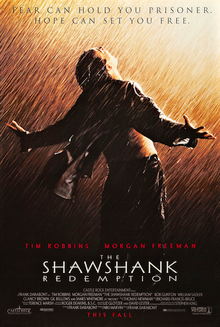
The Shawshank Redemption

Sometimes you just have to shake your head at audiences and moviegoers. Some movies just aren't meant to make some money in theaters no matter how good reviews are, no matter how good the cast and crew is. It just isn't meant to be. Take 1994's The Shawshank Redemption, a movie that barely recovered its budget in theaters but has become a ridiculously popular movie in the 20 years since its release. How good is it? On the IMDB Top 250 (of all-time), it's currently rocking the No. 1 ranking...of All-Time. Not the most scientific voting, but still...

It's 1947 when banker Andy Dufresne (Tim Robbins) is convicted of murdering his wife and the man she was having an affair with. Andy maintains his innocence but the evidence is overwhelmingly against him, and he receives consecutive life sentences as a verdict. He is sent to Shawshank Prison near Portland, Maine and settles into prison life as best he can. More than that, he just wants to survive. Days to weeks, weeks to months, months to years, Andy becomes close friends with a fellow prisoner, Red (Morgan Freeman), who is similarly serving a sentence for murder. Prison life is one step above hell itself, Andy carving out a niche for himself as best he can. Will it ultimately prove to be too much? Will it wear Andy down over the years? Can he somehow prove his innocence when on one else believes him and the evidence against him seems like a sure thing? In prison with life sentences on the line, only time will tell.

What a difficult movie to review in a somewhat concise plot synopsis. I tried to build this movie up to someone recently who had never seen it, and without giving too much away....well, let's just say it proved difficult. It's difficult, but it's for good reason. In the 20 years since 'Redemption' was released, it has gained quite the positive reputation, director Frank Darabont also adapting a screenplay from a short story by acclaimed author Stephen King. For about three years in the early 2000s, AMC and TNT and TBS seemed to show this movie EVERY SINGLE WEEKEND, and I probably watched it every other weekend or so. It had been years since I'd seen the movie straight through in one sitting, and not surprisingly, it holds up one basically all levels. Who knows how it will be remembered in years to come. Will it be a classic? A highly-regarded film? Maybe both, but for me, it's a personal favorite.

As I prepare to write some reviews, I try to identify some flaws, if I haven't already from during the viewing. So those flaws here....yeah, there aren't any. This is one of those perfect movies you can sit back and appreciate on any number of levels. The biggest strength is the story, a dark, unsettling story that is able to blend drama and comedy and even elements of horror effortlessly. The look of the movie reflects the story, colors washed out to pale shades of blue and grey, the Ohio State Reformatory serving as the backdrop for Shawshank. The immense prison walls tower over the prisoners, its hallways holding all kinds of hellish horrors. Another of the movie's strongest features is the soundtrack from Thomas Newman, my personal favorite score from an excellent composer. Listen to the entire soundtrack HERE, music equal parts emotional and moving with unsettling and uncomfortable.

Above all else, this movie rides on the shoulders of its stars, Tim Robbins and Morgan Freeman. Talk about an effortless chemistry. These two pros make it look downright easy. This isn't acting, just two very talented actors doing their thing. Natural doesn't begin to describe the power of their performances, the relationship between Andy and Red developing into a genuine friendship as the years pass. Their conversations crackle, two men talking because, well, because there's plenty of time to talk in prison. They talk about life, about their pasts, their likes and dislikes, but bigger things too. Andy and Red talk about hope -- check that, Hope -- and dreams, about something bigger, about finding your spot and persevering no matter what's thrown in front of you. I can't think of other films where Robbins and Freeman were better than this. Two great actors bringing two flawed, fascinating characters to life.

Who else to look for? How about evil personified as Shawshank's warden (Bob Gunton) and his lead guard and enforcer Byron Hadley (Clancy Brown), two of the most evil, despicable villains ever. James Whitmore, 73 years old at the time and having worked in Hollywood since the late 1940s, is a scene-stealer as Brooks, an aging prisoner who's become institutionalized as his sentence runs into its fifth decade. Other prisoners include William Salder as Haywood, an overbearing at times but generally likable inmate, with Larry Brandenburg, Neil Giuntoli, Brian Libby, Joseph Ragno and David Proval rounding out Red's clique of prisoners. Also look for Gil Bellows as Tommy, a young prisoner who comes to Shawshank in the mid 1960s with knowledge that could change Andy's life.

Maybe the biggest effect this movie has had on audiences is Morgan Freeman Narration Syndrome. Featuring one of the all-time great voiceover narrations, 'Shawshank' propelled Freeman into another stratosphere. It would be fun to listen to Freeman read a phone book. He's that good. The narration is what holds the movie together, almost 20 years of story packed into 142 minutes. There is a simple elegance to the narration, conversations about hope and fate, destiny and love, all of it giving a deeper sense of what's going on. It also features one of my all-time favorite movie lines, Red taking one of Andy's thoughts to heart. 'Get busy living or get busy dying....Damn right.' Just good stuff. Narration can be overdone, condescending, pretentious, but here? It's damn perfect.

There really isn't a weakness in this movie. Not a one. Now that said, the last 40 minutes or so is one of the strongest extended sequences in film history. This is a story that builds and builds, but you're not necessarily sure where. It doesn't drop hints so when a twist comes along, it genuinely shocks and surprises. One twist and surprise on top of each other -- all of them working effortlessly -- that don't feel forced. Thankfully, no 'Gotcha!' moments here. It leads to an ending that is beyond perfect. Moving, emotional and dramatic, including a beautiful final shot set to Newman's music. One of those great movies, a classic that gets better with repeated viewings. Sit back and enjoy it beginning to end.

The Shawshank Redemption (1994): ****/****

Tuesday, May 27, 2014

Tora! Tora! Tora!

One of the most infamous days in American history, December 7, 1941 is one of those instantly recognizable dates. The ones that live on in history itself. The Japanese surprise attack on Pearl Harbor was a world-changer, the United States thrust into World War II in a flash. Released in 1970, Tora! Tora! Tora! takes an almost documentary look at one of the most horrific days in American history.

In 1941, World War II is raging across Europe, Adolf Hitler's army marching and conquering all over the continent. In Japan, a new commander, Admiral Yamamoto (So Yamamura), has been named in the Japanese Navy with huge plans in play. Negotiations have been going on for months with the America and will continue for months to come. The American fleet all over the Pacific waits and braces for an attack that many believe is imminent while American intelligence back in Washington D.C. tries to decipher countless pieces of information, clues and evidence that will point to Japan's intentions. Will the Japanese attack? At the navy base at Pearl Harbor in the Hawaiian islands, Admiral Himmel (Martin Balsam) tries to decide what to do next. As the end of November 1941 nears, a meticulous Japanese plan of attack is put into action; much of the fleet sailing toward Pearl Harbor to unleash a surprise attack that hopes to cripple the American navy.

From director Richard Fleischer, with Kinji Fukasaku and Toshio Masuda directing the Japanese sequences, 'Tora' is the anti-Longest Day. While that 1962 epic told the true story of the D-Day invasion at Normandy with an epic cast of Hollywood legends, 'Tora' goes for the true story angle but without the star power. Fleischer and Co. are interested in the details, the history, the build-up, the intelligence, the government responses, all those little things that history buffs will eat up. It takes a little while to get going -- clocking in at 144 minutes overall -- but it is never dull and once it finds its rhythm, the momentum gets going in a big way. This was a movie that struggled in American theaters but was a huge hit in Japanese theaters. Why is that you ask?

Well, the true story of the attack on Pearl Harbor is hard to believe in itself. There's no way it should have worked on so many levels. That's where 'Tora' is special. The Japanese surprise attack was a brilliant military plan, a reliance on air power leading to the success and that almost complete surprise on the American naval base. From the American side, any number of people and issues impacted the attack. Intelligence reports were handled slowly and sent to the wrong people and places. When the radar spotted the hundreds of Japanese fighters, reports were ignored. It's an amazing series of events, Fleischer's movie interested in all those little things. 'Tora' finds its groove near the hour-mark as the attack becomes imminent. The shots of the Japanese fighters and bombers taking off from carrier decks in the pre-dawn darkness as the sun rises in front of them are eerie, oddly beautiful and intensely uncomfortable as we know what their plan will accomplish.

That's the movie at it's absolute best. Nominated for five Academy Awards, 'Tora' won the award for Best Special Effects. Why? Because of the extended attack on Pearl Harbor, bringing one of the darkest moments in American history to life. The Pearl Harbor sequence is remarkable, starting about the 100-minute mark. The amount of ground it covers is remarkable from the attacks on Battleship Row to Hickam Field and anything and everything in between of military importance. The camera films from ground level to put the American POV in perspective while also filming in the air to give the view the Japanese pilots saw as they attacked. The sequence of the Japanese planes flying across Hawaii to Pearl Harbor especially resonated with me in terms of the reality of what we're watching. Amazing aerial sequences, some incredible stuntwork, and composer Jerry Goldsmith's score boosting it all up a notch, this is a sequence that works on all levels. It brings the horrors of the real-life incident to life to the point it is uncomfortable to watch. A great sequence.

With hopes of leaving the focus on the true story of the attack on Pearl Harbor, the cast was filled out with recognizable, respected actors who didn't exactly have star power. Among the high-ranking American military, look for Balsam, James Whitmore and Jason Robards, and with the Intelligence, E.G. Marshall and Wesley Addy. Among the Japanese there's Yamamura as Admiral Yamamoto with Takahiro Tamura as the flight commander leading the attack on Pearl with and Eijiro Tono as the Admiral leading the attack group across the Pacific toward Hawaii. There's gotta be a 100 or so speaking roles so far too many to mention here, but also look for Joseph Cotten, Richard Anderson and Neville Brand among many others.

An interesting movie basically across the board. Told from both the American and Japanese perspectives on seemingly countless levels, you get an excellent sense of the events leading up to the attack on Pearl Harbor, the actual attack, and the immediate fallout. It ends on a somber note, the world truly thrust into the war at this point on an international level, Yamamoto expressing his thoughts. "I fear all we have done is to awaken a sleeping giant and filled it with a terrible resolve." Profound words and a fitting end to the movie.

Tora! Tora! Tora! (1970): ***/****

Thursday, February 6, 2014

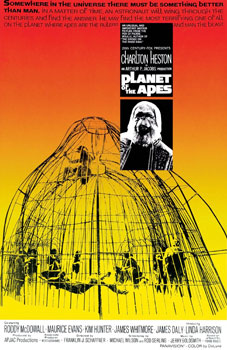
Planet of the Apes (1968)

Ah, science fiction, sometimes I forget how good a genre it can be. For Christmas, my girlfriend got me the Planet of the Apes: Legacy Collection, five films making up one of my favorite film series. It is a series that got progressively worse, continuing because audiences liked them, not because they were particularly classic movies. That said, I like them all a lot and always will, especially the first film, the one genuine classic in the bunch, 1968's Planet of the Apes.

A U.S. spacecraft is traveling in deep space, its four-person crew commanded by cynical astronaut George Taylor (Charlton Heston). Their mission involves exploring the far reaches of space, but a malfunction awakens Taylor and two other survivors as their ship crash lands on a seemingly empty planet. Taylor, along with fellow astronauts Landon (Robert Gunner) and Dodge (Jeff Burton), gather what little supplies they have and head out into this unexplored world, looking for any sign of life. Walking for days inland, they finally do find life, a human-like race that is primitive to say the least, dressed in animal furs and unable to speak. The scientific find is one thing, but the trio of astronauts is in for a far bigger shock. The humans begin to run away from an unseen threat, and then they're there. Taylor and Co. run with them, stunned to see talking apes, dressed in military uniforms on horseback and armed to the teeth. What the hell is going on? What kind of planet have the astronauts found?

It's easy to forget how much impact this 1968 sci-fi classic has had on the science fiction genre as a whole. From director Franklin J. Schaffner, 'Planet' is the first of five movies (in the original series at least) that was followed by a short-lived TV show, an attempt at a reboot (2001's Planet of the Apes), and a far more successful reboot (2011's Rise of the Planet of the Apes). I'm curious to see where the most recent series goes, but this original entry will no doubt be the one all others are compared to. It's smart, original, unsettling and keeps you guessing until the end. There are some moments in the second half that drag a little bit, but the moments that work are science fiction perfection. I plan on watching and reviewing all the Apes movies so keep an eye out, and here we go!

Obviously when you're going into a movie titled Planet of the Apes, you kinda know the twist, right? There's a planet...well, of apes. Still, Schaffner's film (working off a novel from Pierre Boulle) builds the tension to almost unbearable levels in making its revelation. In a mission that isn't completely explained, NASA sends four astronauts (one dies during the voyage) deep into space at the speed of light, working off a theory that it will advance them in time. It does, some sort of malfunction bringing the spaceship into a planet's orbit, the crew crash-landing in a huge lake. We follow them for the next 30 minutes as they venture into a seemingly empty world, Lake Powell in Utah providing a beautiful, creepy, eerie backdrop. Composer Jerry Goldsmith's score is spot-on (listen to an extended sample HERE), using regular musical notes and cues but mixing it in with a variety of odd noises that sound natural and spooky, building up that fear of the unseen and unknown.

It is around the 32-minute mark we are shockingly introduced to the world run by apes. We learn over the course of the movie more about this culture with a hierarchy of government (gorillas = military/power, chimps = educators/science, orangutans = political/authority), a history going back thousands of years, beliefs and faith in a religion and a God-like being, all these little things that make the reveal all that more involving, unsettling and fascinating. As Taylor explores this world as a prisoner -- all humans are slaves -- we meet Dr. Zira (Kim Hunter) and Dr. Cornelius (Roddy McDowall), two intellectuals and scientists, interested in learning and advancing. In Heston's Taylor, they see a chance to learn, but also a threat to everything they know, believe in and hope for. Also look for Maurice Evans as Dr. Zaius, an intellectual who knows what threats history and humans hold, the film's biggest villain, James Whitmore as the President of the Assembly, James Daly as a prosecutor trying to prove Taylor is a mutant. The idea of something so well thought out, so innovative, that simian culture is an obvious but underrated reason for the movie's success. It doesn't hurt either that the makeup for the apes is immaculately impeccable.

Charlton Heston is the man. That is all. He's one of my favorites, and I think he gets a bad wrap at times because at times, he could be a tad wooden, even playing similar roles one after another. Fair to a point, but he's a Hollywood legend for sure. In a long, distinguished career, Heston piled up memorable roles, but this is one of his best. His George Taylor is smart, cynical and willing to question anyone and everything. So when he crash lands on a planet run by intelligent apes? Yeah, he's going to have some issues. His complete shock at what he's found is genuine, Heston committing to the part. At a certain point, his goal is simple, just survive on a planet and in a community that is equal parts curious and scared to death of him. He shows off his acting too, as he's struck mute for an extended portion of the movie. I love the cynical, questioning nature of the character, and the iconic lines from 'Get your paws off me, you damn dirty apes!' (one of the most iconic lines ever) to his final line still resonate 40-plus years later.

Lost at times in the science fiction world and mystery of what we've found are some great moments among the characters. I love the dynamic between Heston's Taylor and Hunter's Dr. Zira. Their dialogue scenes, with McDowall's Cornelius too, have an easy, charming back and forth to them. It just looks easy. This is where some of the ideas and messages of 'Apes' come from. Within a different culture, we see the same questions that humans ask about evolution, survival, faith, beliefs, religion, destiny and finding your niche in life. In an underrated cast that doesn't boast a ton of star power, Hunter and McDowall really step up to the plate in support of one of Heston's best performances. Also look for Linda Harrison as Nova, a woman who bonds with Taylor, even if she is mute, Lou Wagner as Lucius, Zira's nephew who helps Taylor late in the movie, and Buck Kartalian as Julius, a gorilla guard who works with Zira with their human slaves. 

Well, here we are. The ending that rewrote the twist ending, something movies from every genre have tried to duplicate ever since. If you've made it this far into a Planet of the Apes review, I'm guessing that A. You either know the ending or B. Want to know the ending. No spoilers here. If you haven't seen 'Apes,' you deserve to go in fresh without any knowledge of what's coming. It is a great finale, one that deserves its fame and notoriety. A pretty perfect ending to a pretty perfect science fiction flick.

Planet of the Apes (1968): ****/****

Wednesday, September 11, 2013

The Split

A stylish, dark heist flick from the 1960s with one of the all-time great tough guy casts. It's a winning formula for sure, especially for a sucker like me for heist movies. It took me years to track down 1968's The Split -- which I first reviewed in August 2009 -- and I was less than impressed with the film on my first viewing. When it popped up on Turner Classic Movie's schedule recently, I was going to give it another try. I mean....come on.....look at this cast!

A master thief who's gone off the grid seemingly for several years, a man named McClain (Jim Brown) is reunited with a former partner and an expert planner, Gladys (Julie Harris), when it comes to pulling off impossible jobs. They team up again, Gladys putting forth the plan; rob the L.A. Coliseum during an NFL playoff game that will net $500,000. McClain assembles a team of crooks who haven't worked together in the past, but he convinces them to put their differences aside with the thought of a very lucrative payday. The five-man team goes about planning the job with very little time to do so. The dangerous job is one thing though, but the fallout from the job may be even more dangerous, especially when an investigating detective, Lt. Brill (Gene Hackman), catches wind of them and is right behind them.

For years, this 1968 heist film from director Gordon Flemyng wasn't available in any form; DVD, VHS, nothing. Now, it's available on a burn-for-order DVD so if you've never seen it and are dying to catch up, there it is for you. First or second viewing though, I had the same issues. 'Split' has a lot of potential, much of it tied to the casting, but it never quite goes anywhere. It's got the style from its frame-in-frame credits sequence to its Quincy Jones soundtrack, the on-location shooting at the L.A. Coliseum to the dark nature of the team of crooks working together. All these disparate elements never manage to jell, ending up with a heist film that takes a really bizarre turn in the last third of the movie. A very disappointing end result because it did have so much potential.

How about that casting though? In assembling his team for the robbery, Brown's McClain brings together Bert Clinger (Ernest Borgnine), a gym owner and strong man, Harry Kifka (Jack Klugman), a down on his luck limo driver who will serve as the team's getaway driver, Marty Gough (Warren Oates), a temperamental safe cracker, and Dave Negli (Donald Sutherland), a smooth as ice hit man and hired killer. And NFL great turned action star Jim Brown for good measure?!? How can you lose??? Well, as dark and dirty as things get, something is missing from the group. The movie runs only 91 minutes and after McClain's recruiting, things move right along to the actual heist. The group is full of so many bad guys I never found myself rooting for them to pull the job off successfully. Still, it is an impressive grouping of star power, misutilized though they may be.

I think that's the problem for 'Split' in general. With so much going on, the right tone is never picked out. It bounces back and forth and among all these different things. Brown's McClain meets up with his jilted ex-wife, Ellie (Diahann Carroll), still holding a grudge, but darn it, she still likes him a lot as we see in a montage set to a Jones song as they walk along a beach. The actual recruiting of the team just feels a tad bit off, like certain things aren't fitting together well, but it's entertaining enough. The robbery at the Coliseum lacks a certain energy with no real catch of anything unique helping them pull the job off. But the biggest problem? That would be the final half hour.

One of the keys to a good heist film is oddly enough, not the heist. It's the fallout after the job when the cops close in, the team has to wait for things to cool down to get their money, and seemingly inevitably....turn on each other. That's fine and dandy, just about any good heist movie follows that formula. Ready for the derail? It comes in a really odd one-scene cameo from James Whitmore as Ellie's creepy landlord. Then, Gene Hackman doesn't even make his first appearance until 70 minutes into a 90-minute movie. From there on in, the story and twists and turns feel rushed. It's a pretty dark ending, but even that feels mishandled. The movie just sort of ends, leaving all sorts of questions unanswered. A truly disappointing movie, one that handled differently could have been a near-classic among the heist genre. Oh, and the above poster is bad, giving the impression the team is just a bunch of friends out to pull a job. Um.....no.

The Split (1968): **/****
Rewrite of August 2009 review

Thursday, June 13, 2013

Angels in the Outfield (1951)

Growing up, you appreciate some movies more than you probably should because....well, because you're a kid. When you're a kid, everything's cool. One of my favorite movies as a youngster was 1994's Angels in the Outfield. Oh, by the way, I still love that movie. It took years for me to discover that the 1994 Disney movie is actually a remake. Who knew? Here's the original, 1951's Angels in the Outfield.

It's midseason, and the Pittsburgh Pirates and foul-mouthed manager Guffy McGovern (Paul Douglas) is slowly losing his mind. Fans are turning on him, his players hate him and his "managerial tactics," and the press corps is ready to lynch him. One day, a home and garden-esque reporter, Jennifer Paige (Janet Leigh) writes a scathing column of his antics, finally pushing Guffy to the brink. Following one game, Guffy hears an angel address him, telling him to clean up his act and stop berating his team, fans and umpires alike. As long as he does that, angels will help out his team. Guffy obviously thinks it's a big prank....until the hapless Pirates start winning a whole lot of games. Could something heavenly actually be helping the Pirates? The gruff manager keeps his secret just that, secret, until one day a little girl, Bridget (Donna Corcoran), comes out to a game and actually sees the angels on the field. Is Guffy's secret blown for good?

I love sports so I'll watch basically anything even remotely sports-related. But of all the sports, baseball will always be my favorite. The sport translates seamlessly to the big screen, and this entry from director Clarence Brown is an underrated one. So story and characters aside, I think any true baseball fan will get a kick out of this one. It was filmed on location at real-life stadiums, especially Forbes Field in Pittsburgh but also look for Old Comiskey Park in Chicago and a Wrigley Field lookalike in L.A. That throwback, nostalgic feel of a baseball era long since past is evident from the opening credits -- a sample of Take Me Out to the Ball Game -- and never really lets up. There's an appreciation for baseball here that any fan should get a kick out of.

If I didn't know any better, I would have said this was a flick directed by the master of the cornball sap, Frank Capra. I was wrong, but the tone isn't far removed from typical Capra sweetness. There's always that potential with a really happy, sweet story that it goes too far, but that's not the case here. That's the word that comes to mind though; sweet. It's a good story without a mean bone in its body. We never actually see the angels out on the field or in the dugout, only that Corcoran's Bridget sees them clearly on several occasions. Is it a surprise that Douglas' gruff Guffy becomes a sweet, lovable guy? Nah, not at all. At different points I found myself questioning the movie. If angels are helping the Pirates then does that mean they're rooting against other teams? I think it's a valid question, but quickly put it out of my mind. This isn't a film interested in that at all. It's a good, old-fashioned, entertaining story.

Without featuring much in the way of star power, 'Angels' benefits from a lesser known cast. Douglas is an underrated actor, hamming it up a bit here as Guffy but never pushing too far. Leigh is mostly around as a pretty face -- no disrespect intended -- as the non-sports reporter trying to figure sports out. I thought the best part was nine-year old Corcoran as Bridget, a young orphan who spots the angels and bonds quickly with Guffy and Jennifer over the course of the season. It sounds sappy (sorry, I'll stop using that), but I thought it was a cool touch that the angels only appear to a child (an innocent), and not too cynical adults. Also look for Keenan Wynn as the angry radio man with a hatred for Guffy, Spring Byington and Ellen Corby as the nuns at the orphanage, and Bruce Bennett as Saul, a veteran pitcher trying to make it through one last season. Bing Crosby, Yankees legend Joe DiMaggio and baseball great Ty Cobb also make some cool cameos as themselves.

There are things here that I could easily criticize if I was in a foul mood, but I'm not going to. Guffy talks to an angel (voiced by James Whitmore) out on a dark baseball field with the game already in the books. We hear about 'the Heavenly Choir,' the team of angels that are helping the Pirates with some "hunches" in-game. If this sounds like a cop-out, so be it. You can't overthink/overanalyze this movie. Just enjoy it. It's that perfect mix of sappy, cornball charm with some baseball and old-fashioned Americana in it. Appreciate it and sit back.

Angels in the Outfield (1951): *** 1/2 /****

Wednesday, April 25, 2012

Waterhole #3

Throw together elements of It's a Mad, Mad World, Mackenna's Gold, and The Great Race and more or less you get 1967's Waterhole # 3. It comes from my not so favorite sub-genre, the comedic western, but that isn't what bothered me the most. Two major flaws trip up this otherwise pretty decent western.

A U.S. Army gold shipment of four gold bars valued at $100,000 is stolen by a gang and buried near a waterhole by their leader, Doc Quinlen (Roy Jenson). Through a run-in that gets violent quickly, gambler Lewton Cole (James Coburn) discovers a map that will lead him to the buried gold, but he's obviously not the only one looking for it. He steals a horse from Sheriff John Copperud (Carroll O'Connor) and heads off into the desert for the gold. Copperud and his daughter, Billee (Margaret Blye), are not far behind, both with their own motivations. Not far behind them? The double-crossed members of the gang and a cavalry troop looking to get its gold shipment back.

As a fan of westerns, I'll give them all a try; epic or small scale, heavy on action or more artsy, deathly serious or straight comedy. Mostly I was intrigued by this one because of the cast despite all the mixed to negative reviews I was reading. Even Netflix didn't think I'd love it, much less like it too much. For a comedic western, it isn't grating like so many other efforts. It is genuinely funny at times. The cast is too talented for it not to be at least funny by accident, even unintentionally. So where does it go wrong? Pick your poison. There's two guesses, one annoying and one somewhat ethically questionable.

Using the term 'ethically questionable' in any review sounds a little off to me, but it's all I can come up. As Coburn's Lewton heads for the gold in the desert, he's caught in the process of stealing O'Connor's horse, meeting Blye's Billee in the process. He forces himself on her, and even though she kisses back because his kiss must be just so magical....it's a rape scene. Lewton rapes Billee. So how to follow it up? Make it a funny rape scene. In a comedic western, I object to a main character raping a woman. Check that, I object to any character doing that, but you get my point. Is that worth being funny over? I don't care if it's a goofy, stupid movie. I felt funny rooting for Coburn's character after that scene. Oh, and he basically does the same thing toward the end of the movie. It hit a sour note with me, her father more interested in the gold, Billee discovering she loves him after being raped, Lewton playing it off like it was nothing. Ah, rape, one of the lighter topics to deal with.

Now in comparison to a comedic rape, my next objection is going to sound stupid and particularly tame. Making this comedic western more folksy and goofy is country singer Roger Miller's song Waterhole #3 (Code of the West) that basically plays over all the action in the 96-minute movie. Nothing like a folk country western song to rev things up! It talks about killing and raping not being so bad, and does a fantastic job of describing everything going on on-screen, what we've seen and what we're about to see. It's like closed captioning on steroids and set to a tune. Trying to show everyone how awful the song is, I of course cannot find a link to it anywhere on the plains of the Internet. Maybe that's a good thing.

The thing preventing me from completely trashing this movie was the cast. That whole rape thing aside, Coburn brings a certain charm to Lewton, a no-account gambler who's able to manipulate and twist anyone around him. O'Connor too gets to ham it up as the not-so-honest Honest John, Sheriff of Integrity, Arizona. The more obvious physical humor aside, I enjoyed Coburn and O'Connor's back and forth more than anything. In a horrifically written character, Blye is nice eye candy as Billee. Claude Akins plays Sgt. Fugger, the inside man on the robbery, with Jenson and Timothy Carey as the imposing but slow Hilb rounding out the gang. Bruce Dern is funny in his one scene as Tippen, the deputy who disappears on a never-seen posse. James Whitmore appears for two scenes as cavalry captain Shipley, while Joan Blondell is funny as Lavinia, the owner of a whorehouse where everything comes crashing down.

Too bad overall, two bad choices crippling this movie's chances. Take the incredibly unfunny rape/revenge storyline out, replace Miller's mind-numbing score, and you've got a pretty decent comedic western. That pains me a little to say. I'm not typically a fan of comedy being thrown in with a western, but Coburn and O'Connor make this at least partially worth watching. They're very good together, very funny, but it's still a mess of a movie.

Waterhole #3 <---Youtube clip (1967): **/****

Thursday, October 6, 2011

All the Brothers Were Valiant

I got off to a rocky start with 1953's All the Brothers Were Valiant. The story of two brothers on the high seas in the South Pacific in the 1850s seemed like so many other generic high seas adventures that flooded the market in the 1940s and 1950s. It seemed like all the samples from other movies were taken for this one down to the stock characters and idiotic decision-making. Thankfully somewhere along the way, director Richard Thorpe pulls his head out of his butt and decides to make a halfway-decent movie.

After a three year voyage, Joel Thorpe (Robert Taylor) returns to 1848 New Bedford to find out that his brother, Mark, has disappeared from his own voyage somewhere in the South Pacific. Joel is given command of his missing brother's ship -- a whaler -- and prepares for another long voyage, but not before marrying Priscilla Holt (Ann Blyth), the former sweetheart of Mark's who Joel always had a crush on. Priscilla joins Joel as they head for the South Pacific where they manage to find Mark (Stewart Granger), ready with an explanation for his missing status. Mark instantly causes problems, both with Priscilla who he wants back and almost inciting a mutiny on Joel's ship, enticing the crew with promises of pearls.

Okay, every so often I feel the need to say this. I realize it is the rare movie that is perfect and/or flawless. At least 99.99 percent of movies have something wrong with them. It's just hoping that the positives -- however many there are -- outweigh the negatives. That's why I'll be able to give 'Valiant' a positive review, a recommendation for any viewers who are curious. As bad as some parts are, as cliched as the characters and story can be, the end result is positive. I enjoyed the positives more than I hated the negatives, and that's all I'm looking for in a new movie on a first viewing.

Don't get me wrong. That first 30 minutes is particularly brutal. All the high seas cliches are there; the happy crew singing as they go about their work, the long shots of the majestic ship and its towering sails moving across the ocean, the firm but fair captain pushing his crew. It's bad, real bad. Making it worse is that Taylor and Blyth have no chemistry together. I've come around around Taylor who I wasn't always a fan of. This is not a strong part for him, a vanilla "hero" with little charisma or personality. Blythy's Priscilla is around because the story requires some tension. What woman in her right mind would board a ship with her husband with a three-year voyage ahead of them in the 1840s? Somehow, some way, she keeps her hair immaculate and her dresses pristine. Good for her.

The saving grace is Granger's arrival at about the 35-minute mark. He's the necessary bad boy hero, the good guy who has some questionable morals and/or motives. His backstory -- a flashback that runs around 10-15 minutes -- is the high point of the story, probably worthy of an entire movie on its own. Ravaged with fever in the South Pacific, he is cared for by a beautiful native girl (Betta St. John). Once healthy again, Mark joins with a marauding group of adventurers (including James Whitmore and Kurt Kasznar) searching for pearls on an isolated island with a warring tribe as its inhabitants. There is some tension, some excitement, some betrayals and backstabbing and greed in this too-short segment, starting the movie back on its more interesting path.

Thanks to Granger's introduction, the movie does get more interesting as things near the halfway point. There are still some weird coincidences and stupid decisions made, but the possible mutiny livens things up. Mutinies have a way of doing that I suppose. The drama that comes out of this second half illustrates what's wrong with the movie. It boils down to this. Granger is interesting. Taylor isn't. Granger's Mark plays everyone against each other for his own benefit, realizing his mistake in the closing minutes. It is a 1950s movie so his fate is never really in question. Taylor and his monotone voice and delivery keep us on Granger's side unfortunately so we're basically rooting for the "bad guy" of the two brothers.

Sappy love triangle and boring performances from Taylor and Blyth, this was a good movie. Granted, those are big strikes against any movie, but what are you going to do? Blyth bounces back and forth between Joel and Mark every other scene, and the resolution is too perfect to believe. I still liked the movie though in spite of basically everything in my head telling me not to like it. Among the mutinous crew, look for Keenan Wynn in Spanish-mode as Silva, the treacherous leader of the lowly crew, Michael Pate, Leo Gordon, Peter Whitney, and John Lupton. So overall, this movie barely (and it was close) gets a slightly positive recommendation. A classic it is not with some epic flaws, but I did enjoy it.

All the Brothers Were Valiant <---trailer (1953): ** 1/2 /****

Sunday, April 24, 2011

The Command

Time to take a trip in the way back machine to a simpler time, a better time, my childhood. Before TBS turned into a zombie channel that shows Family Guy and The Office exclusively, it was a channel that showed older movies, and pleasantly enough, good, harder to find older movies. Their schedule always blocked out 1 to 3 in the afternoon, often showing some old western or war movies that ran about 90 minutes and with commercials could fill out a two-hour slot. Silly me, I was typically at school until about 2:30, but when I knew a good one would be on, my Mom was always nice enough to record the movie so I could watch it later. I watched a lot of good movies thanks to TBS, but two especially stand out in my head, both of them westerns, 1953's Charge at Feather River and 1954's The Command.

Part of my interest with these two movies is that neither is readily available in any format, although The Command is now available for purchase through the Warner Archive. Are they as good as I remember them? Maybe not, but they're still worth revisiting at least 10 years later. Good news, I have an old beat-up VHS tape of 'Feather River' and TCM recently showed a pristine widescreen presentation of The Command (thank you very much).  Besides the fact that both movies are above average, pretty straightforward B-westerns, the other unifying link is that Guy Madison starred in both flicks. An actor who made a name for himself out of B-westerns like these, Madison had a short window of success in the 1950s before turning to Italian war movies and spaghetti westerns in the 1960s.  Mostly though, he's known for playing Wild Bill Hickok in a western TV show that lasted seven years from 1951-1958.  He wasn't a great actor -- a little stiff at times -- but he was what these B-westerns needed. Honest, strong-willed, and always ready to be a hero.  That's certainly the case in The Command.

Riding along as part of a cavalry patrol, Doctor/Captain Robert MacClaw (Madison) has command thrust upon him when the patrol's commanding officer is mortally wounded and tells him to lead the patrol back to the fort. With no military/cavalry experience, MacClaw has to prove himself to the men of the troop who are immediately wary of this medical officer leading them. His one saving grace may be Sergeant Elliott (James Whitmore), a veteran soldier who is similarly skeptical of the doctor but willing to work with him. The troop reaches safety but is ordered to accompany a wagon train of settlers heading west that is accompanied by two companies of green recruits. To protect the troop from getting an infantry officer as a commander, MacClaw continues to pose as the troop's commander, even as he clashes with the infantry commander, veteran Colonel Janeway (Carl Benton Reid). The troop moves out though riding escort, but a large Indian war party is moving along with them. The Indians are just one problem though as a smallpox epidemic threatens to take out the whole column before they can reach the bigger body of the army's attacking force on the Paradise River.

While many B-westerns are really bad examples of what not to do with a medium-sized budget, decent story, and good if not great casting, The Command is a prime example of how everything can fall into place when handled the correct way. Released through Warner Bros., it is a beautifully shot western and the California locations, filming in a gorgeous widescreen presentation. The story is pretty straightforward, an outnumbered, rag-tag column traveling through Indian territory, hoping to threat the needle to safety. It's never boring though, and there's an actual sense of danger, the war party always closing in, always waiting for a chance to strike.  Composer Dimitri Tiomkin keeps the action flowing with a solid soundtrack that will sound familiar to anyone familiar with his other scores. Maybe I give this movie a notch above what it actually deserves, but you know what? It's a fun story, full of action and some solid performances from the lead. The only problem of any consequence I had with the story was an insistence on adding a love interest for Madison's Capt. MacClaw.

Through all his wooden deliveries, I still find myself liking Guy Madison in the lead. His character is something new in a western, a doctor with no military training forced to learn what does and doesn't work fighting the Indians on the plains. Just by reading the cavalry tactics manual, he seems to pick it up rather quickly, but who's to complain, right? He isn't going to lose, is he?  His mentor/student relationship with Whitmore is solid, and Madison more than handles himself in the action scenes (which are surprisingly grisly for a 1954 western). The character is different so right off the bat the movie is a little more interesting than it would have been with a seasoned officer trying to lead his company to safety. Trying to draw in that female audience though (I guess), Joan Weldon plays Martha, a young single woman traveling with the wagon train who butts heads with Madison's MacClaw only to fall deeply in love with him. I didn't see it coming either. Besides the fact that their developing relationship is boring, the duo doesn't have much in the way of chemistry together. Their scenes tend to drag on at times, killing an otherwise fast-moving story and all the momentum it builds up.

As a sucker for great character actors, I'm going to recommend this one mostly on the shoulders of James Whitmore.  The movie is good enough on its own, but Whitmore definitely moves this western up a notch or two. His Sergeant Elliott character immediately reminded me of his Academy Award nominated performance from 1948's Battleground, and he plays a similar role, the part of the tough but fair sergeant. He's got years of experience and knows the Plains like few men in the troop do.  As Madison's MacClaw adjusts to the position of command, Whitmore's Elliott is a cushion of sorts, answering questions when he can, and basically doing what he can to make the transition smoother both for the Doc and the men he's commanding. In his 40s here, Whitmore looked old no matter how old he actually was, and it all rolls into the character. He's gruff and surly, short on words, letting his actions do more of the talking for him.  His chemistry is good with Madison which is essential, especially because their dialogue scenes dominate the landscape. Whitmore was a class act, always very watchable, and that's certainly the case here.

For a B-movie with a somewhat limited budget that clocks in at just 94 minutes, I was surprised by the epic quality of the finale which on its own takes almost 20 minutes. There is some impressive scope with a small army of extras standing in for the ever-growing Indian war party. The attack on the column's forted-up wagons is a great finale that reminded me a lot of a similar ending to Hondo, made the year before. The action all-around is impressive. The rest of the cast after the first two or three names is more hit or miss in smaller parts.  Benton Reid is a one-note veteran, spouting how he's willing to die on his feet but not in the saddle. Other performers of note include some unnecessary humor from Harvey Lembeck as Pvt. Gottshalk (because there were a lot of snarky Jewish cavalry troopers from NYC in the old west), Ray Teal as the crotchety unit surgeon, and Don Shelton as Major Gibbs, a desk officer with no combat experience assigned to the infantry. An underrated western that gets lost in the sea of bad westerns from the 1950s when studios were cranking them out as quick as audiences could gobble them up.  It's better than most so if you can find a copy, scoop it up.

The Command (1954): ***/****

Thursday, January 27, 2011

The Deep Six

Before he ever became a hero from World War I, Alvin C. York was a conscientious objector, opting on his draft application to put "Yes, don't want to fight" when asked if he wanted to claim an exemption. Of course, he would go on to become an American hero during WWI for his heroic actions when he and a small squad of soldiers captured over 130 German soldiers.  Think about his stance though.  What's so wrong with it? He didn't believe in killing because of his religious beliefs.  This wasn't a man trying to get out of fighting because of any political stance or objection the fighting.  He didn't want to kill his fellow man.

The idea of a conscientious objector is a sticky one because it has to be hard to read a man's true intentions.  Combat and war are a terrifying premise, and most would do anything possible to avoid it.  But regardless of personal or religious beliefs, some men slip through the cracks and make it into combat on a front-line position. That's 1958's The Deep Six, the story of a man raised as a Quaker who outgrew his childhood beliefs as he grew into an adult.  Now when his draft summons arrives in the mail, his beliefs come up again. If it came down to it, could he kill?

A successful advertising artist in Los Angeles, Alec Austen (Alan Ladd), is riding high.  His job pays well, he owns a beautiful seaside home, and he's in love and about to be engaged to his boss, beautiful Susan Cahill (Dianne Foster). When it seems everything is lining up into place, Alec relieves a draft summons for the U.S. Navy because he took an ROTC program in college and is still part of the Naval Reserves.  Raised as a Quaker, he wavers over what to do but ultimately reports for duty where he's assigned to the USS Poe, a destroyer in the Pacific captained by Commander Meredith (James Whitmore). As the Poe sails toward the Japanese and the conflict awaits, Alec begins to question if his childhood beliefs of pacifism are really gone.  When the time comes will he be able to give the order to fire, an order that will almost certainly end in the death of a human being?

Movies about war -- especially in the 1950s -- are a dime a dozen.  Doing the norm and making a flick about combat is fine by me, I love that type of story and own a fair share of those on DVD, but it's always refreshing to see a war story with a fresh spin.  This story is effective because it's hard not to feel for Ladd's Alec character.  It's only natural to be scared about how you'll respond in a situation like he is in regardless of your beliefs or ideologies.  Alec must not only worry about his own concerns, and how he'll respond, but if the choices he makes will end up taking the lives of his crew, the men he bunks and eats with on board the Poe.  Throw in that the crew (including nasty executive officer Keenan Wynn) finds out about his Quakerism and ostracizes him, and you've got a whole bucket of worms.

In a career that was cut short because of his personal demons, Ladd still made his mark on Hollywood.  He always had an easy-going way about him that played on his character's vulnerabilities and made him a likable leading man.  His Alec is quiet and unassuming, a good man pressed into a difficult choice.  He doesn't whine or moan about his predicament, doing his best to deal with it himself.  For the most part, Alec bonds well with his men because he has their best interest at heart.  In helping us to get to know his main character, director Rudolph Mate adds in the subplot with Alec's fiance Susan. Where some movies use this technique and it fails miserably, it works here, and I can't explain why the subplot didn't send me up the wall.  It just works, and it certainly makes Alec more human.  He's worried about marrying Susan because of the very real possibility that he may die at sea, sacrificing his feelings and needs/wants for his concerns on how that event that might not even happen would affect her.

Still, The Deep Six is a war movie, and the heart of the story is Alec and the USS Poe's involvement in the war in the Pacific against the Japanese.  The combat is held to a minimum with an occasional strike by a patrolling Japanese plane and saved for the end when Alec must lead a small patrol onto a Japanese-held island where five downed fliers await rescue.  The finale -- as was the case with much of the movie -- is limited by a smaller budget, but it makes up for any epic battle with the impact the fighting makes.  Filming much of his film at sea, Mate give viewers quite a look at life on a U.S. destroyer, providing some great footage with his cast (not stock footage) on board the ship.  The supporting cast includes JHP favorite Whitmore as the veteran commander, Wynn as the bloodthirsty XO, Efram Zimbalist Jr. as on-ship physician/doctor, Lt. Blanchard, and a scene-stealing William Bendix as Frenchy Shapiro, Alec's close friend and Chief officer.

Reminding me of the somewhat out of place humor in John Ford's Mister Roberts, too much time is spent with the crazy antics of the crew, including a pre-Rat Pack Joey Bishop, Perry Lopez, and voice of Alvin and the Chipmunks Ross Bagdasarian (among other cast members). The humor is unnecessary, and if it is an attempt to lighten the mood, it fails badly.  It's just not funny and takes away from the more interesting aspects of the story.  By no means enough to detract overall from the movie, but worth mentioning.

The Deep Six (1958): ***/****

Friday, July 23, 2010

Who Was That Lady?

In the age of the 24 hours new cycle, TMZ and tabloids everywhere, a lot is made when movie star couples work together in a movie.  Think of the debacle of Jennifer Lopez and Ben Affleck in Gigli as a worst possible scenario.  As long as there's been movies there have been movie couples, it's just that they are in the news more than ever before.  Supply and demand I guess.  One such couple, Tony Curtis and Janet Leigh, worked together twice in two very different movies.

The first I can find is 1958's The Vikings, a historical epic where a Viking tribe attacks England with Kirk Douglas and Ernest Borgnine starring along with Curtis and Leigh.  Fast forward two years and we've got 1960's Who Was That Lady?, a screwball comedy if there ever was one.  With a plotline that most sitcoms would be jealous of, this is a comedy that in all honesty is a truly bad movie.  But thanks to the three stars, the quick pace and the surprisingly funny moments the story produces, it's a truly bad movie that's at least worth checking out.

One day visiting her husband, Dave (Curtis), at work, Ann (Leigh) walks in on a foreign exchange student kissing her husband in his laboratory.  She storms out, demanding he move out of the apartment and getting ready to sign divorce papers.  Claiming the student kissed him -- not the other way around -- Dave tries to come up with a plan, any plan, that will convince his wife he's telling the truth.  He turns to his best friend Mike (Dean Martin), a TV mystery writer, to come up with something. Their solution? Tell Ann that Dave is an FBI agent, and that it was all part of a mission.  Somehow, some way, she buys it, and it looks like Dave is sitting pretty.  That is, until an FBI agent (James Whitmore) and his supervisor (John McIntire) get involved with reports of a rogue agent floating around.   

More than the average comedy, the beauty of the screwball comedy is that nothing, not one thing, has to be based in reality at all.  That is the only reason they're even somewhat enjoyable to watch.  A wife actually buying that explanation that her husband is a FBI agent? Sure, it's a movie.  Actual FBI agents going along with the ploy once they figure out what's going on?  You bet.  It's the type of story (a thin one at that) that keeps getting worse and worse as a simple lie turns into something much, much worse.  Think of a 30-minute episode of I Love Lucy with a crazy story, add about 75 minutes, a bigger budget, a ridiculous story, and a good cast and you've got this movie.

Now as stupid as the proceedings really are, I laughed. I enjoyed the movie. Go figure.  The cast is what sells it for me mostly because of the quick, witty dialogue, the fast pacing, and the chemistry among the group.  Curtis and Martin together are a comedic dream, at times over the top and other times improvising golden lines left and right.  At a certain point, you feel bad for Leigh's character because really, could anyone be that gullible?  But she sells it so well as she gets wrapped up in it all that Ann is as funny as anyone.  Whitmore and McIntire steal every scene they are in as an agent and his supervisor trying to figure out what's going on while also preventing the breakup of a young married couple.  Also look for Simon Oakland and Larry Storch as two Russian agents, bumbling agents of course.

Because the cast plays so well off each other, the lines that would otherwise fall flat end up producing some honestly funny laughs.  From Curtis to McIntire and everyone in between, the cast commits to these ridiculous, darn right stupid parts.  And as dumb as it is? I laughed more than I would have expected.  On the stupidity charts, it just gets dumber and dumber as the story escalates.  My favorite bit was the finale as Curtis and Martin, believing they're in a Russian sub, try to sink the sub not realizing they're in the basement of the Empire State Building.  Singing God Bless America as they await their "deaths" while delivering a crippling blow to Russia, it's all too much and in a good way. There's an extended bit in a Chinese restaurant that keeps going and going, building to one climax after another.  That's the movie.  It keeps building and building until the end. 

That's the whole movie in a nutshell.  Absolutely nuts, over the top, not an ounce of reality, and a movie that's the better for it.  Curtis and Leigh, Martin and Curtis, Whitmore and anyone, they work together like a finely tuned machine to make a really stupid storyline entertaining to watch and interesting from start to finish. Couldn't find a trailer, but TCM does have a clip available through their website.

Who Was That Lady?<-----TCM clip (1960): ***/****

Sunday, June 27, 2010

The Asphalt Jungle

Whether he was behind the camera directing or in front of the camera acting, there were few directors or actors as tough/cool/badass as John Huston.  As an actor, he always played characters with an edge and with his gravelly voice and not so classic looks, he always sold the part.  As a director, he excelled with movies that were as tough as the stories they told.  They were 'guy's guys movies' that rarely disappointed and one of his best was 1950's The Asphalt Jungle.

This 1950 heist movie is worth talking about for two reasons.  One, released at the height of film noir popularity, 'Jungle' finds a way to put its own spin on the story and it ends up being a classic in the genre.  Two, you can judge it by the impact it had on later underworld heist movies.  Watch a heist movie released since 1950, and it's almost impossible not to make some connection or influence Huston's flick had.  At just under two hours, there is not a wasted minute in the build-up, heist, and fall out of a jewelry robbery.

Just out of jail after seven years inside, Doc Reidenschneider (Sam Jaffe) wastes no time setting up a job that could net him and his partners almost a million dollars.  With some help and financial backing from a crooked lawyer, Alonzo Emmerich (Louis Calhern), Doc reveals his plan to knock off a diamond exchange.  He'll need some help though and recruits three men, Dix Handley (Sterling Hayden), the muscle, Gus Minnisi (James Whitmore), the getaway driver, and Louis Ciavelli (Anthony Caruso), the safe-cracker to help him pull off the job.  The Doc has everything figured out down to the second, but all the planning in the world can't account for the unexpected.  And then there's Emmerich, who may have ulterior motives for the heist.

The 'jungle' of the title is the underworld, the crime figures who threaten to take over cities and ruin the lives of good people all across the country, or at least that's how Police Commissioner Hardy (John McIntire) explains it.  Like most noir movies, Huston shoots in black and white in this unnamed midwest city.  The characters live and die in smokey rooms and dark, shadowy alleys as they go about their heist.  Like few other movies, Huston creates a real feeling of the underworld, the seedier parts of town that you don't want to be caught in after a certain hour.  With composer Miklos Rozsa's score, you've got the right start to a winner.

Working with an ensemble cast, Huston gets the best out of this talented crew.  Often stiff and a little wooden in starring roles, Hayden delivers a career-best performance as Dix Handley (other than the pornstar-sounding name).  Handley is a two-bit thug -- dubbed a 'hooligan' -- who dreams (watch HERE) of raising enough money to buy his childhood farm and leaving this dirty city life.  I don't think he was ever better than he was here.  Jaffe too is beyond perfect casting as the small in stature but brilliant planner of crimes and heists, earning an Oscar nomination for his part.  His Doc is incredibly intelligent and a gentleman to boot, seemingly involved in crime because he's good at it.  These two characters end up forming an unlikely friendship based on truth and hard knocks, a surprising friendship to come out of a heist movie.

The rest of the cast isn't anything to sneeze at as well.  Calhern as Emmerich is the prototypical slimy villain.  From the moment the heist is brought up, you know he's looking to double-cross Doc and his crew (with some help from equally slimy Brad Dexter). Where Handley might beat you with his fists, Emmerich would do the same with words and intellect, never ruffling a hair on his head or putting a crease in his suit.  Jean Hagen is solid as Doll, a wandering young woman attracted to Handley in who she sees something good where no one else does.  Whitmore too is great in his quick appearance as Gus, the hunchback getaway driver who will be loyal to the end.  Also look for an actress you might have heard of, Marilyn Monroe in just her 3rd credited role, as Emmerich's mistress.  You look at her and understand what Emmerich was thinking.

The beauty of 'Jungle' is in the execution because it never slows down.  The actual heist -- an exciting if not groundbreaking sequence -- is over less than an hour into the movie.  The fallout from the heist is where the movie revels because even Doc can't plan for everything, in this case unforeseen accidents popping up when least expected.  It's an idea and a premise used in so many types of movies, but it is has never been used so well as it is in the heist movie.  Without giving too much a way, it's safe to say 'Jungle' doesn't exactly have a happy ending -- it is 1950 -- but overall it works better because there wasn't a happy ending.

Because so many heist movies have been made since, The Asphalt Jungle may play like a movie that you've seen many times before...been there, done that.  But watch it thinking that when it was released in 1950, there hadn't been a movie quite like this before.  Director Huston puts together a doozy of a cast with Hayden delivering a career-best part leading the way, and there isn't an aspect of the movie that fails.  A winner in every sense of the word.

The Asphalt Jungle <----trailer (1950): ****/****

Monday, March 22, 2010

Them!

When American forces dropped atomic bombs on Hiroshima and Nagasaki, it was the beginning of a whole new era in terms of world history.  For the next 50 years, the Cold War had the world in a chokehold thanks to the power that atomic and later nuclear weapons possessed.  So who took advantage of this situation?  Why the movie business of course.  What did people really know about these new weapons and the effects they had?  There's still a conspiracy theory that John Wayne died of cancer because he filmed several movies where atomic bombs were tested.

It's just that type of conspiracy that opens the door on 1954's Them!, a movie out of the big bug/animal subgenre that had its heyday in the 1950s and 1960s.  Out in the deserts where these bombs were tested, what really happened?  Directed by Gordon Douglas, this sci-fi classic plays on the emotions and worries of the time because right up there with the 3 C's (Chinese, Cubans, Commies), what was the biggest threat facing the United States?  Big honking bugs and animals bent on destroying civilization as we know it.

Investigating some strange calls, police Sergeant Ben Peterson (James Whitmore) drives out into the New Mexico to find out exactly what's going on.  Along with his partner, Peterson finds crime scenes with no rational explanations, and the only evidence points to an unidentifiable print in the sand.  Zoology experts (Edmund Gwenn and Joan Weldon), along with some help from FBI agent Robert Graham (James Arness), pick up where Peterson left up.  The motley quartet find that the damage is being done by gigantic ants as big as 15 feet long.  Keeping the news under wraps, they manage to destroy one nest of ants only to find out that two queen ants escaped and have headed west.  Can our motley group of heroes save the day before mankind is destroyed?

In a word...yes.  Did you really think the gigantic bugs were going to beat America?  Come on now.  This is a movie that definitely needs to be viewed with an awareness of when it was made.  The perception that Russia or Cuba could attack at any minute was all around in the 1950s, and more than that, no one was quite sure the effects of the a-bombs or how much damage they really did.  So here with the story, the a-bomb testing had a profound impact on nature, making normal desert ants into enormous killing machines.  It sounds ridiculous -- especially writing the plot synopsis -- but because it is handled seriously without even a tiny bit of a sense of humor, the movie works.

This has all the necessary makings of an enjoyable B-movie, starting with the giant ants.  Without the benefit of computerized special effects, the filmmakers had to create these giant killer ants so they'd appear frightening on-screen.  Credit for originality if not a whole lot of scares just by appearance.  Instead, they decided to have these ants make a shrill, high-pitched noise that surprisingly works a lot better than actually seeing them.  The noises provide a strong sense of foreboding, and that something mysterious and unknown is lurking out of sight (like Cubans or Russians) waiting to attack when the opportunity arises.

Because the story is handled so seriously, 'Them!' is more of a genuine enjoyment movie opposed to a campy, so bad it's good movie.  Always reliable character actors Whitmore and Arness (pre-Gunsmoke) lead the cast and make the most of an average script.  Full-fledged, 3-D characters these are not, but with pros like Whitmore and Arness you don't even notice.  They commit to their parts, and in doing so, help us commit to what could have been a ludicrous movie.  Gwenn (Santa in Miracle on 34th Street) doesn't look well but is only expected to spout off lines about the dangerous ants with his daughter Weldon not making much of an impression.  Also starring are Sean McClory as Major Kibbee, a pilot working on the project, Onslow Stevens as General O'Brien, the Army representative, and Fess Parker as Alan Crotty, a farmer who stumbles across these eastbound traveling giant ants.

If this makes any sense, the last 40 minutes plays like a chase scene you will have seen in any number of movies; cop, western, adventure.  Except instead of chasing a crook, we're chasing two queen ants capable of producing thousands of eggs.  The chase leads to the storm drains off the Los Angeles River with Douglas filming on locations used years later by Grease -- among many other movies.  It's a solid finale as Widmore, Arness, and a lot of soldiers search the storm drains for signs of two children trapped somewhere in the ants nest.  Don't expect greatness out of this one, and you'll almost certainly enjoy it.  You can watch it starting here with Part 1 of 10 at Youtube.

Them!...<-----trailer (1954): ***/****