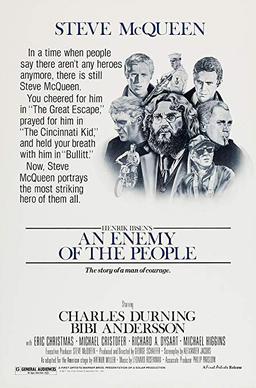
Steve McQueen was the King of Cool. He was Virgil Hilts, Cooler King. He was Detective Frank Bullitt. He was the laconic anti-hero, a superstar on-screen who hated dialogue. So naturally, late in his career he did a complete 180 with a film that has been basically forgotten in the annals of movies. McQueen helped spearhead the film that's based on a Norwegian play from the 1880's. Here it is, 1978's Enemy of the People, the only starring McQueen role I hadn't seen. Verdict? Keep on reading.
Dr. Thomas Stockmann (McQueen) is a middle-aged man, a successful, respected and well-liked physician who is also a family man who desperately loves his wife, Catherine (Bibi Andersson), and their three kids. They live in a small Norwegian village, Stockmann mostly responsible for the town's hot springs, known for their healing powers and a bit of a tourist attraction. The good doctor though is worried and his worries are confirmed when he receives a report that the spring water is filled with bacteria that could easily kill. It seems an easy fix; shut the springs down and repair them, diverting the poisoned water. It seems an easy fix. The town, especially the mayor and Thomas' brother (Charles Durning), questions what the doctor's methods are while also weighing the impact of the potential decision. It all seems so simple, but it is so far from it as Stockmann is met with barriers wherever he turns.
This is an anti-Steve McQueen movie. Made in 1976, it was ready to be released in 1977...but wasn't. It wasn't even given a major release, only seeing the light of day briefly in some college towns in 1978. No one quite knew what to do with it because it was such a departure for its star. So what is the verdict? It's good, not great, a little stilted at times, but even just as a novelty, 'Enemy' is worth seeking out. It is based off a play (of the same name) from Norwegian writer Henrik Ibsen from the 1880s and is heavy on message and dialogue and general disgust with the establishment and system. So...yeah, a fastball down the middle for the King of Cool, right?
Basically from the moment he arrived as an actor, McQueen was a man of few words. He was a huge presence, able to do something physically or with a look that wiped away pages of unnecessary dialogue. He was the anti-hero, the cool as hell badass you couldn't help but root for. This is by far his biggest departure for a career that was cut short by his tragic death in 1980 from cancer. He's unrecognizable, sporting long almost shoulder length hair and a thick beard. He delves into the role, speaking more dialogue here than he probably did in other movies combined. His presence is still there even with the expanded...ya know, talking. He's a ball of righteous energy, knowing that he's right and something must be done immediately to fix this immense problem facing the town, its town council, its mayor, and the people itself, both now and for the future.
Steve McQueen is an all-time favorite of mine. He's up there with John Wayne and Clint Eastwood in my holy triumvirate of movie stars so it was incredibly cool to see him try something so entirely new and different. As an actor, he didn't want to do the same old, same old. He wanted to jump into new and fresh territory so without a doubt, McQueen's performance is the best thing about 'Enemy.' I think his best acting is still The Sand Pebbles and Papillon, but this certainly belongs in the conversation.
Only two other names really jump out from the cast, Andersson as Thomas' wife, eternally faithful to her husband even when his actions threaten to tear the family apart. An excellent performance from Andersson, the wavering in her face evident as she decides if she should continue to back her husband (even if it's not the most logical thing to do). Durning does what he does best, underplayed, bubbling intensity, usually as a slithering villain you just want to slap upside the head. Two excellent performances. Also look for Richard Dysart as the experienced (somewhat cautious) editor of the local paper with Michael Cristofer and Michael Higgins as his two younger, idealistic writers/editors. Eric Christmas plays Catherine's father (a good twist late about him) while Robin Pearson Rose is excellent as Petra, Thomas' daughter, intelligent, thoughtful and starting to figure things out in life as she becomes an adult.
'Enemy' is at times limited by its budget, giving it the look of a made-for-TV movie. It isn't a crippling flaw, but it is noticeable throughout. The cast is small, and the visual appeal certainly reflects the play's roots with long, extended scenes full of dialogue marking the 109-minute film from director George Schaefer. Things limp to the finish line a bit in the final half hour, leading to a finale that tries to go for a touch of hope, but in reality, this is a downbeat ending no matter what we see on-screen.
An interesting movie with an interesting message. It reeks of the 1970's when no one really trusted in the government, politics and those in trouble across any field. I guess that hasn't really changed in 2015 either, huh? The movie is unsettling in those instances as we see a majority rule even though they're wrong, a mob making decisions because who in their right mind would stand up to them? I liked the cynicism of 'Enemy,' the general darkness and bleakness in its outlook on life. Is there hope? Sure, there's always hope, but sometimes you've got to fight for it a little harder. An interesting movie, especially notable because of its scarcity over the last 30-plus years and an excellent performance from the King of Cool himself, Steve McQueen.
An Enemy of the People (1978): ** 1/2 /****
The Sons of Katie Elder
"First, we reunite, then find Ma and Pa's killer...then read some reviews."
Showing posts with label Charles Durning. Show all posts
Tuesday, September 22, 2015
Thursday, December 18, 2014
Tough Guys
Two of the biggest stars of the 1940s, 1950s and 1960s, Burt Lancaster and Kirk Douglas were frequent collaborators during their distinguished careers, doing seven films together. The two best -- for me -- are Gunfight at the O.K. Corral and Seven Days in May, but I've seen a couple others. Well, here's their last venture together, 1986's Tough Guys.
Having served 30 years in prison, Harry Doyle (Lancaster) and Archie Long (Douglas) have finally earned their parole. The veteran bank robbers are reintroduced to a world vastly different than the one they left. Now 72-year old Harry and 67-year old Archie have to figure things out if they hope to make it on the outside, starting with their new living arrangements. Because of his age, Harry is forced to live in a retirement home while Archie moves in at a small apartment and tries to hold down minimum wage jobs. Can they handle their new lives? Can 1980s Los Angeles possibly handle them? The two friends and ex-cons are going to try their hardest, but their checkered pasts may pop up to slow them down and make their readjustment that much harder...if they get through it at all.
As I watched this 1980s action-comedy from director Jeff Kanew, a thought crossed my mind. That can be pretty rare so I've gotta enjoy them when they make their appearances. You know that movie is? A forerunner for a whole sub-genre of flicks that seemed to pop up in the 1990s and still appear here and there. The OLD GUY movie! Since 1986, we've seen the Grumpy Old Men movies, My Fellow Americans, Last Vegas, and probably a bunch more I'm not thinking of. It isn't a good movie, but it is mildly entertaining, most of that because the talent involved is very impressive. It has some laughs but also tries really hard to get those laughs.
It's a premise that would be used in far better fashion some seven years later in The Shawshank Redemption when James Whitmore's Brooks is paroled and discovers a world nothing like the one he left. Here, the goal obviously isn't on the same dramatic level. It's laughs. So what do we get? Two old pros in Lancaster and Douglas wearing some impeccably stylish and impeccably dated hats and fedoras navigating Los Angeles. They're still tough guys, handling street toughs (typically with a swift kick to the crotch), dancing like a crazy person at a night club, and even stumbling into their old watering hole only to find that the bar is now...a gay bar! Oh, the hijinks people will get into, huh?!?
Still, it's Burt Lancaster and Kirk Douglas. Yeah, there are times where you feel like they're far, far better than the source material. Okay, basically the entire movie. These guys are Hollywood legends for a reason, and they don't disappoint. They commit to the script and the parts, breathing some energy into a movie that would have been dead on arrival without that energy. Setting the story in 1980s L.A. does add a fun flavor to the story, and the duo has a great chemistry throughout. Their dynamic reminded me of Paul Newman and Robert Redford as Butch and Sundance if they had made it out of Bolivia. Their dialogue just flows as smoothly as possible. They're got their routines, they've got their plans in a row, and at times, they bitch and moan at each other like an old married couple. About what you'd expect to see from two guys who spent 30 years in jail together. A movie worth watching because of Lancaster and Douglas.
Who else to look out for? Charles Durning as the cop who put Harry and Archie away some 30 years ago and is now suspicious of what they're up to, Alexis Smith as a former flame from Harry's past, a young Dana Carvey as the duo's adoring parole officer, Darlanne Fluegel as a much younger woman who's drawn to Archie's manliness, and Eli Wallach as a bespectacled killer looking to take the train-robbing duo out after years of waiting for a chance.
By the hour-mark, things get a little more predictable than they already were. They struggle to adjust? Ah what?!? Their solution makes perfect sense as they turn back to a life of crime. It gets goofy at times and downright dumb at others, especially the closing scene. But all that said, it's still Burt Lancaster and Kirk Douglas.
Tough Guys (1986): ** 1/2 /****
Having served 30 years in prison, Harry Doyle (Lancaster) and Archie Long (Douglas) have finally earned their parole. The veteran bank robbers are reintroduced to a world vastly different than the one they left. Now 72-year old Harry and 67-year old Archie have to figure things out if they hope to make it on the outside, starting with their new living arrangements. Because of his age, Harry is forced to live in a retirement home while Archie moves in at a small apartment and tries to hold down minimum wage jobs. Can they handle their new lives? Can 1980s Los Angeles possibly handle them? The two friends and ex-cons are going to try their hardest, but their checkered pasts may pop up to slow them down and make their readjustment that much harder...if they get through it at all.
As I watched this 1980s action-comedy from director Jeff Kanew, a thought crossed my mind. That can be pretty rare so I've gotta enjoy them when they make their appearances. You know that movie is? A forerunner for a whole sub-genre of flicks that seemed to pop up in the 1990s and still appear here and there. The OLD GUY movie! Since 1986, we've seen the Grumpy Old Men movies, My Fellow Americans, Last Vegas, and probably a bunch more I'm not thinking of. It isn't a good movie, but it is mildly entertaining, most of that because the talent involved is very impressive. It has some laughs but also tries really hard to get those laughs.
It's a premise that would be used in far better fashion some seven years later in The Shawshank Redemption when James Whitmore's Brooks is paroled and discovers a world nothing like the one he left. Here, the goal obviously isn't on the same dramatic level. It's laughs. So what do we get? Two old pros in Lancaster and Douglas wearing some impeccably stylish and impeccably dated hats and fedoras navigating Los Angeles. They're still tough guys, handling street toughs (typically with a swift kick to the crotch), dancing like a crazy person at a night club, and even stumbling into their old watering hole only to find that the bar is now...a gay bar! Oh, the hijinks people will get into, huh?!?
Still, it's Burt Lancaster and Kirk Douglas. Yeah, there are times where you feel like they're far, far better than the source material. Okay, basically the entire movie. These guys are Hollywood legends for a reason, and they don't disappoint. They commit to the script and the parts, breathing some energy into a movie that would have been dead on arrival without that energy. Setting the story in 1980s L.A. does add a fun flavor to the story, and the duo has a great chemistry throughout. Their dynamic reminded me of Paul Newman and Robert Redford as Butch and Sundance if they had made it out of Bolivia. Their dialogue just flows as smoothly as possible. They're got their routines, they've got their plans in a row, and at times, they bitch and moan at each other like an old married couple. About what you'd expect to see from two guys who spent 30 years in jail together. A movie worth watching because of Lancaster and Douglas.
Who else to look out for? Charles Durning as the cop who put Harry and Archie away some 30 years ago and is now suspicious of what they're up to, Alexis Smith as a former flame from Harry's past, a young Dana Carvey as the duo's adoring parole officer, Darlanne Fluegel as a much younger woman who's drawn to Archie's manliness, and Eli Wallach as a bespectacled killer looking to take the train-robbing duo out after years of waiting for a chance.
By the hour-mark, things get a little more predictable than they already were. They struggle to adjust? Ah what?!? Their solution makes perfect sense as they turn back to a life of crime. It gets goofy at times and downright dumb at others, especially the closing scene. But all that said, it's still Burt Lancaster and Kirk Douglas.
Tough Guys (1986): ** 1/2 /****
Labels:
1980s,
Burt Lancaster,
Charles Durning,
Eli Wallach,
Kirk Douglas
Wednesday, December 3, 2014
The Fury
As I've brought up in several reviews before, I'm not a huge horror fan. Basically, I don't like being scared. Yeah, yeah, laugh at the scaredy cat! I usually need something to pull me into a horror movie, like an especially unique premise or as the case with 1978's The Fury, some cool casting you might not associate with the genre.
A former CIA agent, Peter Sandza (Kirk Douglas) is in the Middle East with his son, Robin (Andrew Stevens), getting ready to move back to the U.S. so Robin can go to college in the states. Well, that's the plan. Robin is kidnapped by a secret government agency with Pete's old friend and colleague, Ben Childress (John Cassavetes), leading the effort. What's behind the kidnapping? Robin seems to have some hidden powers and abilities; telekinetic powers that he doesn't have a full grasp of. Childress and the agency try to kill Peter, but he manages to escape. Now he's hiding out and trying to find out what happened to Robin and where he's been dragged off to. The key may be a high school student in Chicago, Gillian (Amy Irving), who has similar abilities to Robin and is slowly learning how to handle and manipulate them. If only all the pieces can fit together.
This isn't an out-and-out horror movie to be fair. From director Brian De Palma, 'Fury' is more of a supernatural horror flick. De Palma was coming off the mega-success of 1976's Carrie and takes the next natural step. It's not just about telekinetic creepy kids, but the government's involvement with said kids! Yeah! Reading about the story and the cast, I was psyched to give this one a shot, but in the end, I felt like the premise ends up being far better than the finished product. It's a long movie at 118 minutes and struggles with pacing and rhythm. At times, it's over the top to the point I thought it was kinda spoof-like. An uneven final product, lots of characters, some potential, but ultimately one quasi-horror flick that I won't be revisiting anytime soon.
The biggest pull 'Fury' had on me was the casting, a pairing of Kirk Douglas and John Cassavetes. Douglas was in a lull in his career, the late 1970s and 1980s providing some real stinkers for the Hollywood legend. It's a cool part, if an underwritten one, as Douglas' Pete has all sorts of espionage experience that he tries to utilize to get back his son. At 62 years old here, Douglas isn't the prototypical action hero, but he more than holds his own in the chase scenes early in the movie. I grew up watching Cassavetes in The Dirty Dozen and little else so it's always cool seeing him pop up in a cast listing. He's calm, cool and impeccably sinister as Childress, head agent on this mission to acquire all sorts of telekinetic kids. Like so much else, I wish there was more backstory with Childress and this secret agency. What's the end game? What will these kids be used for? How much backing do they actually have or is this a bit of a roguish renegade?
I thought then I was getting one movie from the plot synopsis and ended up getting another. 'Fury' isn't just a movie about old friends turned deadly rivals. It's two stories, the Douglas/Cassavetes story moving along with a separate angle of young Gillian exploring her own powers (however scary and violent they may be). Irving does a really good job as a teenager struggling to come to terms with it all, Carrie Snodgress, Charles Durning, Fiona Lewis, and Carol Eve Rossen playing assorted doctors, physicians and assistants associated with the Paragon Institute, an organization "working" with talented kids. This felt like it could (and should) have been its own movie but no such luck. We get the two different stories that will eventually cross paths in the third act, but the pacing is rough getting there and there were several points I considered completely bailing. Things get a little goofy and a tad bit stupid in the finale with an especially graphic final scene. Some shock value from the director of Carrie? Who would have thought of that?
Now, yes, not a horror fan, but I am a sucker for certain things. High on that list? Any movie filmed in Chicago or even remotely close to the city. 'Fury' films a lot in and around Chicago, including some familiar locations for any fans of 1980's The Blues Brothers. We see everything from Lincoln Park to North Avenue Beach, Water Tower Place to Lower Wacker Drive, even the Old Chicago Shopping Mall and Amusement Park. If the story is a little dull at times, the filming locations in the background certainly help inject some life into things.
A mixed bag, but one I can't really recommend. And that's considering Spartacus, Franco and Chicago play key parts in it!
The Fury (1978): **/****
A former CIA agent, Peter Sandza (Kirk Douglas) is in the Middle East with his son, Robin (Andrew Stevens), getting ready to move back to the U.S. so Robin can go to college in the states. Well, that's the plan. Robin is kidnapped by a secret government agency with Pete's old friend and colleague, Ben Childress (John Cassavetes), leading the effort. What's behind the kidnapping? Robin seems to have some hidden powers and abilities; telekinetic powers that he doesn't have a full grasp of. Childress and the agency try to kill Peter, but he manages to escape. Now he's hiding out and trying to find out what happened to Robin and where he's been dragged off to. The key may be a high school student in Chicago, Gillian (Amy Irving), who has similar abilities to Robin and is slowly learning how to handle and manipulate them. If only all the pieces can fit together.
This isn't an out-and-out horror movie to be fair. From director Brian De Palma, 'Fury' is more of a supernatural horror flick. De Palma was coming off the mega-success of 1976's Carrie and takes the next natural step. It's not just about telekinetic creepy kids, but the government's involvement with said kids! Yeah! Reading about the story and the cast, I was psyched to give this one a shot, but in the end, I felt like the premise ends up being far better than the finished product. It's a long movie at 118 minutes and struggles with pacing and rhythm. At times, it's over the top to the point I thought it was kinda spoof-like. An uneven final product, lots of characters, some potential, but ultimately one quasi-horror flick that I won't be revisiting anytime soon.
The biggest pull 'Fury' had on me was the casting, a pairing of Kirk Douglas and John Cassavetes. Douglas was in a lull in his career, the late 1970s and 1980s providing some real stinkers for the Hollywood legend. It's a cool part, if an underwritten one, as Douglas' Pete has all sorts of espionage experience that he tries to utilize to get back his son. At 62 years old here, Douglas isn't the prototypical action hero, but he more than holds his own in the chase scenes early in the movie. I grew up watching Cassavetes in The Dirty Dozen and little else so it's always cool seeing him pop up in a cast listing. He's calm, cool and impeccably sinister as Childress, head agent on this mission to acquire all sorts of telekinetic kids. Like so much else, I wish there was more backstory with Childress and this secret agency. What's the end game? What will these kids be used for? How much backing do they actually have or is this a bit of a roguish renegade?
I thought then I was getting one movie from the plot synopsis and ended up getting another. 'Fury' isn't just a movie about old friends turned deadly rivals. It's two stories, the Douglas/Cassavetes story moving along with a separate angle of young Gillian exploring her own powers (however scary and violent they may be). Irving does a really good job as a teenager struggling to come to terms with it all, Carrie Snodgress, Charles Durning, Fiona Lewis, and Carol Eve Rossen playing assorted doctors, physicians and assistants associated with the Paragon Institute, an organization "working" with talented kids. This felt like it could (and should) have been its own movie but no such luck. We get the two different stories that will eventually cross paths in the third act, but the pacing is rough getting there and there were several points I considered completely bailing. Things get a little goofy and a tad bit stupid in the finale with an especially graphic final scene. Some shock value from the director of Carrie? Who would have thought of that?
Now, yes, not a horror fan, but I am a sucker for certain things. High on that list? Any movie filmed in Chicago or even remotely close to the city. 'Fury' films a lot in and around Chicago, including some familiar locations for any fans of 1980's The Blues Brothers. We see everything from Lincoln Park to North Avenue Beach, Water Tower Place to Lower Wacker Drive, even the Old Chicago Shopping Mall and Amusement Park. If the story is a little dull at times, the filming locations in the background certainly help inject some life into things.
A mixed bag, but one I can't really recommend. And that's considering Spartacus, Franco and Chicago play key parts in it!
The Fury (1978): **/****
Labels:
1970s,
Brian De Palma,
Charles Durning,
Horror,
John Cassavetes,
Kirk Douglas
Monday, June 23, 2014
North Dallas Forty
Football at all levels, everything from the NFL to NCAA to high school and Pop Warner, is at an all-time high in terms of popularity. Over the last few years, football has been in the news for an ever-increasing amount of negative news, much of it related to the dangers of the sport. This isn't anything new, but the purely impressive numbers are mounting at dangerous levels. Years ahead of its time and based on a bestselling novel, here's 1979's North Dallas Forty.
A wide receiver for the North Dallas Bulls, Phil Elliott (Nick Nolte) is past but his prime but still a very reliable player who the team counts on in go-to situations seemingly week in and week out. He's coming off an especially strong performance, hauling in the game-winning catch, but football is a week to week sport. With his friend and the team's quarterback, Seth Maxwell (Mac Davis), Phil has come to rely on painkillers to survive from game to game, not to mention the recreational drugs, increasing drinking and meaningless sexual encounters. It's becoming a lot to handle for Elliott, the receiver questioning his career choice, the business behind it, and the possibility of that career coming to an end quicker than he would have liked. The next game is fast approaching, and the Bulls need a win more than ever. Can Phil pull it together again?
Yowza, what a good movie, a sports movie that isn't often mentioned as one of the genre's best. It certainly deserves to be mentioned in the conversation. Based off the bestselling novel from Peter Gent (a former wide receiver), 'North' is a not-so thinly veiled dig at the Dallas Cowboys of the late 1960s when Gent was with the team. It is a hell of a story, a damning, indicting look at something fans take for granted at times. What goes on in this 1979 could be shocking for audiences currently, much less 30-plus years ago. This is honest, uncomfortable, funny, depressing and one of those brutally underrated movies -- kudos director Ted Kotcheff -- that has an air of authenticity that could only come from someone who's been in the locker rooms, the practice fields, the training room and the postgame parties. You feel like you're getting a window into something dark and disturbing. It's not just something we watch as fans on the weekend, but a cutthroat business with money as the bottom line.
With Nolte leading a strong ensemble cast, 'North' offers more than a few memorable moments. The opener sets the tone immediately, Nolte's Elliott waking up and going through his morning routine. He can barely make it to the tub to soak in the water. Yeah, the game-winning catch is glamorous, but at what cost? I loved the excesses of the postgame party, the Bulls celebrating with a raucous, out of control blowout. As big and crazy as the party is, the pregame moments in the locker room are just as effective. We run the gamut of preparations, some quietly readying themselves, others psyching themselves up for the game. None of these moments feel overdone or forced, and it would have been easy for the story to take that extra step forward to over-the-top. In ways that just watching the games never do, you get a sense as a viewer what it means to survive as a professional football player through the ups and the downs.
Who better to play the gravely-voiced veteran wide receiver who's hanging on to what he loves -- playing football -- better than Nick Nolte? I submit that no one is better. Nolte delivers a great performance as Phil Elliott, a skilled receiver who doesn't have the most ability but works at it religiously, relying on some of the best hands in football. It's great seeing his development (the story takes place over a little week) as he weighs the pros and cons of what he does for a living. His friendship and working relationship with Davis' Seth provides some great human moments as well as some that just make you cringe. We see the difference too between the star quarterback (Davis, a singer, holding his own as a character if not a football player) who the team so desperately depends on, and the far-more replaceable wide receiver. This is a business, a lesson we learn all too harshly.
Who else to look for? A very strong ensemble as we see the players, coaching staff of the Bulls, the owner and management, anyone and everyone. Playing a variation on legendary Cowboys coach Tom Landry, G.D. Spradlin plays Bulls head coach B.A. Strothers, an authoritarian leader, with Charles Durning as his rah-rah, get in your face coordinator. Steve Forrest is slimy and smooth as Conrad Hunter, the Bulls' owner who wants a championship for Dallas, Dabney Coleman as his brother and general manager. Dayle Haddon plays Charlotte, a woman removed from the sport Phil falls for while Savannah Smith Boucher is a far-more casual sexual acquaintance. Bo Svenson and John Matuszak are terrifying as two of the Bulls offensive linemen, embodying the concept of football players as modern-day gladiators.
As the movie develops though, it's the business of the sport and football that takes the spotlight. We see snippets of a game, just a few plays on one drive in a key game between Dallas and Chicago, the plays shot almost in complete darkness so we can't see the stands (and fans, probably cheaper this way). It's quick and effective without overstaying its welcome. I was genuinely surprised by where the story went in the final 15 minutes, an appropriately dark finale that works on basically all levels to show how ridiculous the sport and the business can be. A classic sports movie that deserves far more of a reputation. Now if Nolte's Phil would just stop wearing that stupid cap....
North Dallas Forty (1979): ***/****
A wide receiver for the North Dallas Bulls, Phil Elliott (Nick Nolte) is past but his prime but still a very reliable player who the team counts on in go-to situations seemingly week in and week out. He's coming off an especially strong performance, hauling in the game-winning catch, but football is a week to week sport. With his friend and the team's quarterback, Seth Maxwell (Mac Davis), Phil has come to rely on painkillers to survive from game to game, not to mention the recreational drugs, increasing drinking and meaningless sexual encounters. It's becoming a lot to handle for Elliott, the receiver questioning his career choice, the business behind it, and the possibility of that career coming to an end quicker than he would have liked. The next game is fast approaching, and the Bulls need a win more than ever. Can Phil pull it together again?
Yowza, what a good movie, a sports movie that isn't often mentioned as one of the genre's best. It certainly deserves to be mentioned in the conversation. Based off the bestselling novel from Peter Gent (a former wide receiver), 'North' is a not-so thinly veiled dig at the Dallas Cowboys of the late 1960s when Gent was with the team. It is a hell of a story, a damning, indicting look at something fans take for granted at times. What goes on in this 1979 could be shocking for audiences currently, much less 30-plus years ago. This is honest, uncomfortable, funny, depressing and one of those brutally underrated movies -- kudos director Ted Kotcheff -- that has an air of authenticity that could only come from someone who's been in the locker rooms, the practice fields, the training room and the postgame parties. You feel like you're getting a window into something dark and disturbing. It's not just something we watch as fans on the weekend, but a cutthroat business with money as the bottom line.
With Nolte leading a strong ensemble cast, 'North' offers more than a few memorable moments. The opener sets the tone immediately, Nolte's Elliott waking up and going through his morning routine. He can barely make it to the tub to soak in the water. Yeah, the game-winning catch is glamorous, but at what cost? I loved the excesses of the postgame party, the Bulls celebrating with a raucous, out of control blowout. As big and crazy as the party is, the pregame moments in the locker room are just as effective. We run the gamut of preparations, some quietly readying themselves, others psyching themselves up for the game. None of these moments feel overdone or forced, and it would have been easy for the story to take that extra step forward to over-the-top. In ways that just watching the games never do, you get a sense as a viewer what it means to survive as a professional football player through the ups and the downs.
Who better to play the gravely-voiced veteran wide receiver who's hanging on to what he loves -- playing football -- better than Nick Nolte? I submit that no one is better. Nolte delivers a great performance as Phil Elliott, a skilled receiver who doesn't have the most ability but works at it religiously, relying on some of the best hands in football. It's great seeing his development (the story takes place over a little week) as he weighs the pros and cons of what he does for a living. His friendship and working relationship with Davis' Seth provides some great human moments as well as some that just make you cringe. We see the difference too between the star quarterback (Davis, a singer, holding his own as a character if not a football player) who the team so desperately depends on, and the far-more replaceable wide receiver. This is a business, a lesson we learn all too harshly.
Who else to look for? A very strong ensemble as we see the players, coaching staff of the Bulls, the owner and management, anyone and everyone. Playing a variation on legendary Cowboys coach Tom Landry, G.D. Spradlin plays Bulls head coach B.A. Strothers, an authoritarian leader, with Charles Durning as his rah-rah, get in your face coordinator. Steve Forrest is slimy and smooth as Conrad Hunter, the Bulls' owner who wants a championship for Dallas, Dabney Coleman as his brother and general manager. Dayle Haddon plays Charlotte, a woman removed from the sport Phil falls for while Savannah Smith Boucher is a far-more casual sexual acquaintance. Bo Svenson and John Matuszak are terrifying as two of the Bulls offensive linemen, embodying the concept of football players as modern-day gladiators.
As the movie develops though, it's the business of the sport and football that takes the spotlight. We see snippets of a game, just a few plays on one drive in a key game between Dallas and Chicago, the plays shot almost in complete darkness so we can't see the stands (and fans, probably cheaper this way). It's quick and effective without overstaying its welcome. I was genuinely surprised by where the story went in the final 15 minutes, an appropriately dark finale that works on basically all levels to show how ridiculous the sport and the business can be. A classic sports movie that deserves far more of a reputation. Now if Nolte's Phil would just stop wearing that stupid cap....
North Dallas Forty (1979): ***/****
Labels:
1970s,
Bo Svenson,
Charles Durning,
Dabney Coleman,
G.D. Spradlin,
Nick Nolte,
Sports
Monday, May 5, 2014
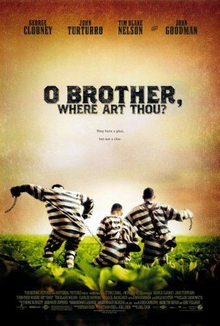
O Brother, Where Art Thou?
Joel and Ethan Coen are the movie director equivalents of chameleons. They do a little bit of everything from a horrifically violent, dark crime thriller like No Country for Old Men to genuinely funny (and still horrifically dark) comedies like Burn After Reading with all sorts of classics and near-classics among their filmography from Fargo to Big Lebowski, Blood Simple to Raising Arizona. But how about a story based (even loosely) off of one of literature's greatest works? A daunting task for sure. That's 2000's O Brother, Where Art Thou?
It's 1937 in the deep South and three convicts, Ulysses Everett McGill (George Clooney), Pete Hogwallop (John Turturro) and Delmar O'Donnell (Tim Blake Nelson), have managed a daring escape from their chain gang. Their reasoning? Everett told his fellow prisoners that he hid away a huge treasure from the robbery that ultimately landed him on the chain gang. He's only got a few days before the treasure's location is washed away, a valley being turned into a lake as part of a hydroelectric project. Chained together at their ankles, the fugitive trio is working against the clock, the road ahead of them full of obstacles both external and internal amidst a gubernatorial race as well. All sorts of people stand in their way, both those hoping to help them and those trying to stop them and in some cases, stop them. Time is running out, and Everett has a secret up his sleeve.
There just aren't too many directors out there with more visual and storytelling style than the Coen brothers. How many directors could pull off a transition from a poem from classic Greek mythology to a similar story in pre-WWII deep south with a heavy reliance on folk music, quirky characters and an episodic story that could be called downright random? Not too many as I sit here writing this review. The Coen Brothers on the other hand make it look pretty effortless. It is a fun movie from beginning to end, the generally random shifts in tone, humor and laughs moving things along at a brisk pace in a 107-minute movie. In other hands, things might have gotten bogged down but that certainly isn't the case here. A very solid, entertaining movie.
Through all the zaniness in the deep south, we follow our intrepid trio on their journey. The chemistry is pretty perfect, Clooney, Turturro and Nelson showing off that effortless chemistry that simply works. The Coen brothers also wrote the script, their quirky humor showing through in the three convicts. Clooney as the vain, motor-mouthed, ultra-confident Everett, the unofficial leader of the group. His preference for Dapper Dan hair pomade consistently gets him and his traveling companions in trouble, his insistence on looking his best (he wears a hair net to sleep to not muss his hair) providing some great moments. He uses $20 words when a $1 word would cut it. His long rambling monologues are pretty great, a man trying to show others how smart he is. Turturro as Pete is a bit of a wild card, prone to frustrating outbursts as their plan unravels. The best characterization goes to Blake Nelson as Delmar, the sweet, thoughtful and generally naive convict who simply has a nice, positive outlook on life.
These three out-there escaped convicts are searching for Everett's buried treasure from an armored car robbery. But naturally, what do they end up doing? They become renowned folk singers, Everett thinking quick on his feet to name themselves The Soggy Bottom Boys (based on The Foggy Mountain Boys, their hit song a cover of Man of Constant Sorrow. Whether it's the Soggy boys singing or T-Bone Burnett's folk-heavy soundtrack, the music is a hugely successful, essential ingredient to the movie's success. The music is always there, always catchy, driving the story forward, the score transitioning scene-to-scene. It's the music and style that works, the Coens using digital color correction to give 'Brother' an almost washed out, sepia look to the story. All those little things that add up to a really enjoyable movie.
We've got three crazy characters to follow across the south, but following Homer's footsteps in The Odyssey, our trio meets some odd characters on the road. Part of the fun is figuring out who's who in relation to the poem. We've got a loving-life bible salesman (John Goodman), a gubernatorial candidate (Charles Durning) seeking reelection, his hot-chasing opponent (Wayne Duvall), Everett's frustrated wife (Holly Hunter) and her new beau (Ray McKinnon), infamous gangster Baby Face Nelson (Michael Badalucco), down on his luck musician Tommy (musician Chris Thomas King), a blind radio programmer (Stephen Root), the sheriff (Daniel von Bargen) in hot pursuit, the blind seer (Lee Weaver) who warns the convicts of what awaits them and lastly, Pete's cousin (Frank Collison) who's curious why Pete just showed up...in chains.
When the Coens decide to do something, they commit to doing it right. From the set design and style to the script and the characters, their movies create these little worlds that are folksy and real and authentic. A very enjoyable movie with some great parts and a lot of laughs. An easy one to recommend.
O Brother, Where Art Thou? (2000): ***/****
It's 1937 in the deep South and three convicts, Ulysses Everett McGill (George Clooney), Pete Hogwallop (John Turturro) and Delmar O'Donnell (Tim Blake Nelson), have managed a daring escape from their chain gang. Their reasoning? Everett told his fellow prisoners that he hid away a huge treasure from the robbery that ultimately landed him on the chain gang. He's only got a few days before the treasure's location is washed away, a valley being turned into a lake as part of a hydroelectric project. Chained together at their ankles, the fugitive trio is working against the clock, the road ahead of them full of obstacles both external and internal amidst a gubernatorial race as well. All sorts of people stand in their way, both those hoping to help them and those trying to stop them and in some cases, stop them. Time is running out, and Everett has a secret up his sleeve.
There just aren't too many directors out there with more visual and storytelling style than the Coen brothers. How many directors could pull off a transition from a poem from classic Greek mythology to a similar story in pre-WWII deep south with a heavy reliance on folk music, quirky characters and an episodic story that could be called downright random? Not too many as I sit here writing this review. The Coen Brothers on the other hand make it look pretty effortless. It is a fun movie from beginning to end, the generally random shifts in tone, humor and laughs moving things along at a brisk pace in a 107-minute movie. In other hands, things might have gotten bogged down but that certainly isn't the case here. A very solid, entertaining movie.
Through all the zaniness in the deep south, we follow our intrepid trio on their journey. The chemistry is pretty perfect, Clooney, Turturro and Nelson showing off that effortless chemistry that simply works. The Coen brothers also wrote the script, their quirky humor showing through in the three convicts. Clooney as the vain, motor-mouthed, ultra-confident Everett, the unofficial leader of the group. His preference for Dapper Dan hair pomade consistently gets him and his traveling companions in trouble, his insistence on looking his best (he wears a hair net to sleep to not muss his hair) providing some great moments. He uses $20 words when a $1 word would cut it. His long rambling monologues are pretty great, a man trying to show others how smart he is. Turturro as Pete is a bit of a wild card, prone to frustrating outbursts as their plan unravels. The best characterization goes to Blake Nelson as Delmar, the sweet, thoughtful and generally naive convict who simply has a nice, positive outlook on life.
These three out-there escaped convicts are searching for Everett's buried treasure from an armored car robbery. But naturally, what do they end up doing? They become renowned folk singers, Everett thinking quick on his feet to name themselves The Soggy Bottom Boys (based on The Foggy Mountain Boys, their hit song a cover of Man of Constant Sorrow. Whether it's the Soggy boys singing or T-Bone Burnett's folk-heavy soundtrack, the music is a hugely successful, essential ingredient to the movie's success. The music is always there, always catchy, driving the story forward, the score transitioning scene-to-scene. It's the music and style that works, the Coens using digital color correction to give 'Brother' an almost washed out, sepia look to the story. All those little things that add up to a really enjoyable movie.
We've got three crazy characters to follow across the south, but following Homer's footsteps in The Odyssey, our trio meets some odd characters on the road. Part of the fun is figuring out who's who in relation to the poem. We've got a loving-life bible salesman (John Goodman), a gubernatorial candidate (Charles Durning) seeking reelection, his hot-chasing opponent (Wayne Duvall), Everett's frustrated wife (Holly Hunter) and her new beau (Ray McKinnon), infamous gangster Baby Face Nelson (Michael Badalucco), down on his luck musician Tommy (musician Chris Thomas King), a blind radio programmer (Stephen Root), the sheriff (Daniel von Bargen) in hot pursuit, the blind seer (Lee Weaver) who warns the convicts of what awaits them and lastly, Pete's cousin (Frank Collison) who's curious why Pete just showed up...in chains.
When the Coens decide to do something, they commit to doing it right. From the set design and style to the script and the characters, their movies create these little worlds that are folksy and real and authentic. A very enjoyable movie with some great parts and a lot of laughs. An easy one to recommend.
O Brother, Where Art Thou? (2000): ***/****
Monday, October 22, 2012
Harry and Walter Go to New York
Some films are doomed from the start. They just are. Production problems, casting decisions, pacing/tone issues, any and all can derail a movie. There's a whole wing of Hollywood movies that are known as Epic Failures. Some overcame it, others didn't. Massively over-budget, 1976's Harry and Walter Go To New York is one that didn't despite an impressive cast.
It's 1908 and a pair of vaudeville actors, Harry (James Caan) and Walter (Elliott Gould), are struggling to make any money at all at their shows, eventually resorting to pickpocketing where they are not surprisingly caught quickly. At the same time, infamous millionaire safecracker Adam Worth (Michael Caine) is caught during a robbery and sent to prison. Working as Worth's slave-servants, Harry and Walter manage to escape and with the blueprints for the infamous bank robber's next job. Unfortunately the well-to-do Worth isn't far behind, and now it's a race against the clock to see who can pull off the job first; the bumbling performers turned con men or the experienced, expert robber?
For whatever reason, this is a movie that received generally poor reviews. On the other hand, I liked it a lot. As Roger Ebert mentions in his review, 'Harry and Walter' is clearly made in the vein of The Sting. There isn't much ink about the movie or its troubled production, but I'm guessing the massive budget problems had to do with the lavish period sets and costumes. It's turn of the century Massachusetts and New York, and everything from the ultra-detailed sets to the immaculate time-appropriate suits to the light-hearted, goofy score from David Shire works well together, especially Laszlo Kovacs' Earth-toned, dulled down color cinematography. It is a period piece, and this 1976 flick gets the period details done the right way.
I'm thinking the biggest reason for the generally negative reviews is the type of humor. Where The Sting was well-written and funny in its ability to underplay the situation, 'Harry and Walter' is not so subtle. High comedy this is not, director Mark Rydell's period-heist movie relying far more on physical humor, and bumbling humor at that. I typically don't go for that type of humor, but it worked for me here. Much of that credit goes to Caan and Gould as the buddy relationship that produces much of the laughs. I've always been a Caan fan, but this is a showier part for him, not the usual tough guy role. Case in point: he sings and dances. Caan's Harry is the confident know-it-all, Gould's Walter the quiet, nervous knows it won't work partner. They play off each other effortlessly.
If James Caan and Elliott Gould weren't enough though (and shame on you if that's the case), the supporting cast shouldn't disappoint. How often do you see Michael Caine get third billing in a movie? His Adam Worth is a scene-stealer, not quite a villain but certainly approaching that territory. Diane Keaton plays Lissa Chestnut, a crusading newspaper woman who joins the bank robbing effort and has everyone fall for her. Charles Durning is the worried bank owner trying to save his $. Also look for Lesley Ann Warren, Michael Conrad, Burt Young, Val Avery, Carol Kane, Jack Gilford, Dennis Dugan and Ted Cassidy rounding out a very deep cast.
A period piece merged with a heist flick certainly had my curiosity on high alert. The actual heist isn't anything special as Harry and Walter's "expert team" attempt to get into Durning's perfect safe. In order to create a diversion, Harry and Walter end up hijacking a stage show with their own hijinx and shenanigans. The act finally wears thin a little, but it's not enough to detract from a movie I enjoyed a lot. The cast is too talented so even if you don't go along with the physical comedy/humor, you should still get some enjoyment out of it. If nothing else, look for the prison from The Shawshank Redemption as a familiar location. Well worth checking out.
Harry and Walter Go To New York <---trailer (1976): ***/****
It's 1908 and a pair of vaudeville actors, Harry (James Caan) and Walter (Elliott Gould), are struggling to make any money at all at their shows, eventually resorting to pickpocketing where they are not surprisingly caught quickly. At the same time, infamous millionaire safecracker Adam Worth (Michael Caine) is caught during a robbery and sent to prison. Working as Worth's slave-servants, Harry and Walter manage to escape and with the blueprints for the infamous bank robber's next job. Unfortunately the well-to-do Worth isn't far behind, and now it's a race against the clock to see who can pull off the job first; the bumbling performers turned con men or the experienced, expert robber?
For whatever reason, this is a movie that received generally poor reviews. On the other hand, I liked it a lot. As Roger Ebert mentions in his review, 'Harry and Walter' is clearly made in the vein of The Sting. There isn't much ink about the movie or its troubled production, but I'm guessing the massive budget problems had to do with the lavish period sets and costumes. It's turn of the century Massachusetts and New York, and everything from the ultra-detailed sets to the immaculate time-appropriate suits to the light-hearted, goofy score from David Shire works well together, especially Laszlo Kovacs' Earth-toned, dulled down color cinematography. It is a period piece, and this 1976 flick gets the period details done the right way.
I'm thinking the biggest reason for the generally negative reviews is the type of humor. Where The Sting was well-written and funny in its ability to underplay the situation, 'Harry and Walter' is not so subtle. High comedy this is not, director Mark Rydell's period-heist movie relying far more on physical humor, and bumbling humor at that. I typically don't go for that type of humor, but it worked for me here. Much of that credit goes to Caan and Gould as the buddy relationship that produces much of the laughs. I've always been a Caan fan, but this is a showier part for him, not the usual tough guy role. Case in point: he sings and dances. Caan's Harry is the confident know-it-all, Gould's Walter the quiet, nervous knows it won't work partner. They play off each other effortlessly.
If James Caan and Elliott Gould weren't enough though (and shame on you if that's the case), the supporting cast shouldn't disappoint. How often do you see Michael Caine get third billing in a movie? His Adam Worth is a scene-stealer, not quite a villain but certainly approaching that territory. Diane Keaton plays Lissa Chestnut, a crusading newspaper woman who joins the bank robbing effort and has everyone fall for her. Charles Durning is the worried bank owner trying to save his $. Also look for Lesley Ann Warren, Michael Conrad, Burt Young, Val Avery, Carol Kane, Jack Gilford, Dennis Dugan and Ted Cassidy rounding out a very deep cast.
A period piece merged with a heist flick certainly had my curiosity on high alert. The actual heist isn't anything special as Harry and Walter's "expert team" attempt to get into Durning's perfect safe. In order to create a diversion, Harry and Walter end up hijacking a stage show with their own hijinx and shenanigans. The act finally wears thin a little, but it's not enough to detract from a movie I enjoyed a lot. The cast is too talented so even if you don't go along with the physical comedy/humor, you should still get some enjoyment out of it. If nothing else, look for the prison from The Shawshank Redemption as a familiar location. Well worth checking out.
Harry and Walter Go To New York <---trailer (1976): ***/****
Friday, September 7, 2012
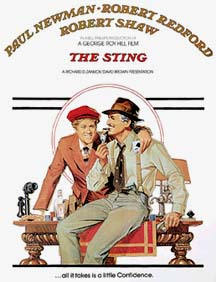
The Sting
Pairing Paul Newman and Robert Redford, the duo ended up being a match made in heaven for 1969's Butch Cassidy and the Sundance Kid. Could the pairing work again? Oh, you bet. Teaming up again for 1973's The Sting, Newman and Redford again show off an impeccable chemistry, a great back and forth, and a whole lot of talent in one of the 1970s best movies and one of my all-time favorites.
Working in 1936 Joliet just outside of Chicago, con man Johnny Hooker (Redford) pushes too far on one con when he and his partner, Luther (Robert Earl Jones), steal some $11,000 from a money runner working for big-time New York mobster Doyle Lonnegan (Robert Shaw). The mobster hears about it and in the aftermath, Luther is killed. On the run and always looking over his shoulder, Hooker seeks out Henry Gondorff (Newman), an infamous con man himself who's now on the run from the F.B.I. after a con of his went south. Hooker teams up with Gondorff, hoping to run a long con on Lonnegan to exact some revenge. With countless thieves, con men and grifters working their magic, a long list of things need to happen to pull the job off, but Gondorff and Hooker go to work knowing if the con fails, they may pay for it with their lives.
The Newman-Redford pairing -- along with Butch and Sundance director George Roy Hill -- is clearly one that works and is a key reason for the movie's success. I don't say this often because I don't want to overdo and/or overuse it, but The Sting is one of those rare perfect movies. All the scenes work without any extra fat on the bone. Even at 129 minutes, it flows effortlessly. The script (which won an Oscar) is one of the all-time greats. On first viewing, it might be a little difficult to keep up with everything, but in the end it fits together like puzzle pieces clicking into place. Smart, funny and well-written, the script helps bring this criminal underworld to life....in a nice way. It's the 1930s "criminal" underworld that the movies presented.
A period piece like this depends on a couple different thing. The first and usually most important? Does it look and feel authentic to the period it is set in? That's a safe answer here. The look of the movie ends up being an additional character. You genuinely feel like you're watching 1930s Chicago from the sets to the bad-ass suits to the cars zipping around the downtown streets. Much of the film was shot in California backlots, but several scenes were filmed on-location in Chicago, including LaSalle Street Station, Union Station and the Penn Central Freight Yards. What most people will remember from 'Sting' though is the music, starting with Scott Joplin's whistle-worthy theme, The Entertainer. It gives the story a light-hearted touch -- almost a goofy feel -- but it ends up working perfectly with the tone. The locations, sets, costumes, and music all contribute to a great retro style -- along with title cards introducing the scenes -- that is hard to replicate.
So Newman and Redford, pretty cool, huh? They just don't make stars like this anymore. Watching talented actors of this caliber on-screen, it's just fun. Their chemistry never feels forced. It's just two guys playing off each other like they have been doing it their entire lives. While both actors play prominent roles, more focus is given to Redford's Johnny Hooker, a talented if younger grifter looking for some revenge. He learns the ropes from Newman's more experienced, somewhat grizzled con man. Redford was even nominated for an Oscar for his performance, but both have their moments. Newman especially gets some laughs in his scene where he meet Shaw's Lonnegan, posing as a drunken but rather lucky poker player who throws the hook out there so the crew can reel in their target. Putting on a big, boisterous entrance, Newman (entering with "Sorry I was late, I was taking a crap") hits all the right notes in a part that allows Redford most of the spotlight.
In one of his most memorable roles before his death at the age of 51, Shaw is a great villain to counter Newman and Redford's very likable crooks. His Lonnegan will kill anyone who gets in his way and isn't picky or squeamish about doing so. As for the rest of the cast, Charles Durning is appropriately double-handed as Lt. Snyder, a Joliet cop with a grudge against Hooker. Putting together a team of thieves, Gondorff assembles Kid Twist (Harold Gould), the smooth-talking organizer, J.J. Singleton (Ray Walston), the veteran con man with a knack for investigating, Eddie Niles (John Heffernan), the numbers specialist, Billie (Eileen Brennan), his madam of sorts, and Erie Kid (Jack Kehoe), Hooker's former partner who's down on his luck. Dana Elcar has a small part too as F.B.I. agent Polk, hot on Gondorff's trail.
What I love most about The Sting though is how it all comes together in the end. We're given all these clues, characters and situations early on, but we're never quite sure how it fits together. The title cards sort of help -- The Hook, The Set-Up, The Sting -- but it's great to see the con come together so smoothly. Gondorff has hinted that it's not always the job that's the toughest. It's the aftermath and getting away alive. With that in mind, the last 30 minutes throws a handful of twists our way, all of them working, some working epically well. It's a great finale full of twists, surprises and some laughs. A great movie from start to finish.
The Sting <---trailer (1973): ****/****
Working in 1936 Joliet just outside of Chicago, con man Johnny Hooker (Redford) pushes too far on one con when he and his partner, Luther (Robert Earl Jones), steal some $11,000 from a money runner working for big-time New York mobster Doyle Lonnegan (Robert Shaw). The mobster hears about it and in the aftermath, Luther is killed. On the run and always looking over his shoulder, Hooker seeks out Henry Gondorff (Newman), an infamous con man himself who's now on the run from the F.B.I. after a con of his went south. Hooker teams up with Gondorff, hoping to run a long con on Lonnegan to exact some revenge. With countless thieves, con men and grifters working their magic, a long list of things need to happen to pull the job off, but Gondorff and Hooker go to work knowing if the con fails, they may pay for it with their lives.
The Newman-Redford pairing -- along with Butch and Sundance director George Roy Hill -- is clearly one that works and is a key reason for the movie's success. I don't say this often because I don't want to overdo and/or overuse it, but The Sting is one of those rare perfect movies. All the scenes work without any extra fat on the bone. Even at 129 minutes, it flows effortlessly. The script (which won an Oscar) is one of the all-time greats. On first viewing, it might be a little difficult to keep up with everything, but in the end it fits together like puzzle pieces clicking into place. Smart, funny and well-written, the script helps bring this criminal underworld to life....in a nice way. It's the 1930s "criminal" underworld that the movies presented.
A period piece like this depends on a couple different thing. The first and usually most important? Does it look and feel authentic to the period it is set in? That's a safe answer here. The look of the movie ends up being an additional character. You genuinely feel like you're watching 1930s Chicago from the sets to the bad-ass suits to the cars zipping around the downtown streets. Much of the film was shot in California backlots, but several scenes were filmed on-location in Chicago, including LaSalle Street Station, Union Station and the Penn Central Freight Yards. What most people will remember from 'Sting' though is the music, starting with Scott Joplin's whistle-worthy theme, The Entertainer. It gives the story a light-hearted touch -- almost a goofy feel -- but it ends up working perfectly with the tone. The locations, sets, costumes, and music all contribute to a great retro style -- along with title cards introducing the scenes -- that is hard to replicate.
So Newman and Redford, pretty cool, huh? They just don't make stars like this anymore. Watching talented actors of this caliber on-screen, it's just fun. Their chemistry never feels forced. It's just two guys playing off each other like they have been doing it their entire lives. While both actors play prominent roles, more focus is given to Redford's Johnny Hooker, a talented if younger grifter looking for some revenge. He learns the ropes from Newman's more experienced, somewhat grizzled con man. Redford was even nominated for an Oscar for his performance, but both have their moments. Newman especially gets some laughs in his scene where he meet Shaw's Lonnegan, posing as a drunken but rather lucky poker player who throws the hook out there so the crew can reel in their target. Putting on a big, boisterous entrance, Newman (entering with "Sorry I was late, I was taking a crap") hits all the right notes in a part that allows Redford most of the spotlight.
In one of his most memorable roles before his death at the age of 51, Shaw is a great villain to counter Newman and Redford's very likable crooks. His Lonnegan will kill anyone who gets in his way and isn't picky or squeamish about doing so. As for the rest of the cast, Charles Durning is appropriately double-handed as Lt. Snyder, a Joliet cop with a grudge against Hooker. Putting together a team of thieves, Gondorff assembles Kid Twist (Harold Gould), the smooth-talking organizer, J.J. Singleton (Ray Walston), the veteran con man with a knack for investigating, Eddie Niles (John Heffernan), the numbers specialist, Billie (Eileen Brennan), his madam of sorts, and Erie Kid (Jack Kehoe), Hooker's former partner who's down on his luck. Dana Elcar has a small part too as F.B.I. agent Polk, hot on Gondorff's trail.
What I love most about The Sting though is how it all comes together in the end. We're given all these clues, characters and situations early on, but we're never quite sure how it fits together. The title cards sort of help -- The Hook, The Set-Up, The Sting -- but it's great to see the con come together so smoothly. Gondorff has hinted that it's not always the job that's the toughest. It's the aftermath and getting away alive. With that in mind, the last 30 minutes throws a handful of twists our way, all of them working, some working epically well. It's a great finale full of twists, surprises and some laughs. A great movie from start to finish.
The Sting <---trailer (1973): ****/****
Labels:
1970s,
Charles Durning,
Comedy,
George Roy Hill,
Paul Newman,
Robert Redford,
Robert Shaw
Sunday, August 1, 2010
I Walk the Line
Is there a genre of movies that could be dubbed "I'm having a mid-life crisis?" It sure seems like there has been enough movies where a middle-aged man, fed up with where his life has ended up, does something to reclaim his youth whether it be an affair with a younger woman, buying an expensive sports car, or the always reliable bail on your life and start over. That's the basic premise for 1970's I Walk the Line.
The movie of course is not based on Andy Taylor -- Andy Griffith's character in The Andy Griffith Show -- but there are a fair share of similarities between the TV sitcom character and the main star here, Gregory Peck. Directed by John Frankenheimer, 'Line' jumps right into the premise of small-town life in the south is like where big-city life seems like a far off thing and the excitement is minimal. But what if something came along -- for one person at least -- that livened things up even for a little bit? Would you embrace it or pass it up? So goes Pecks' dilemma.
As the peace officer in a small Tennessee town, Sheriff Tawes (Peck) just doesn't have much to do. His home life is quiet without much in the way of fireworks (good or bad), and he spends his days patrolling back roads and making sure everything is up to snuff. One day he pulls over a truck driving wildly down the road and meets Alma McClain (Tuesday Weld), a teenage girl who is lively and exciting in a way little else is in his life. They quickly start seeing each other -- secretly of course, this is the South -- only to have Alma's moonshiner father (Ralph Meeker) blackmail Tawes for protection so his moonshining business can keep going. As long as the sheriff gets to see Alma, he doesn't seem to care, but his hushed up affair becomes an issue when an FBI agent (Lonny Chapman) shows up with orders to clean out any moonshiners in the area.
This performance for Peck is quite a departure from his usual roles where he usually played stout men of principles where good was good and bad was bad. Frankenheimer wisely doesn't paint Tawes as a hero or as a bad guy, instead just showing him as a man who's frustrated with the path his life has took. Through Weld's Alma, Tawes sees a chance to be happy, to be young again. Peck pulls this all off perfectly, like a man about to explode. With anything involving an older man and a younger woman (Alma's age is never specified, 19, 20 maybe?), there's a certain element of creepiness, but for the most part it is kept to a minimum. Give Peck credit, he goes right up to that line of crazy, obsession love without going over...just barely.
Making his obsession fully understandable is Tuesday Weld because, well, she looks like she does. The 27-year old actress is playing a part that is slightly younger than her, but this bubbly blond with the huge smile makes it easy to understand why a middle-aged man would feel the way he does about her. What I liked about the character was the question of if she was playing Tawes for his protection or because she was genuinely interested in him, had real feelings for him. Her motives are established late, leading to an ending that surprised me, but it certainly works as a "real" ending. Also worth mentioning in the cast is Meeker in a smaller part as Alma's father Carl (subtle creepy incest hinted at), and Charles Durning as Hunnicutt, Tawes' deputy who always sticks his nose where it doesn't belong.
My biggest issue isn't in what we do see, but what we don't see. Tawes gets involved with Alma very quickly without much in the way of character background. It's obvious he is bored to death by his job, family and life in general, but there's only one scene that even shows it, a dinner scene with his wife (Estelle Parsons), their daughter and Tawes' father. The peaceable sheriff looks like he's about to kill them all in a fit of rage. I'm not looking for 30 minutes of mind-killing boredom where we saw Tawes and his descent, but even a little more background would have been interesting.
One review I read accurately identified 'Line' as a movie that feels like a folk song, a country ballad, and he's dead-on. Singer Johnny Cash handles the soundtrack (including title song "I Walk the Line"), helping the movie move along in the montage sequences as Tawes and Alma sneak off to be together. Frankenheimer filmed in Tennessee, giving the story a sense of being separated from the rest of the world in this tiny backroads town. It feels like you're there with them and not some movie studio set. For an underrated, different movie, give this a try. Watch it at Youtube starting here with Part 1 of 10.
I Walk the Line <---TCM trailer (1970): ** 1/2 /****
The movie of course is not based on Andy Taylor -- Andy Griffith's character in The Andy Griffith Show -- but there are a fair share of similarities between the TV sitcom character and the main star here, Gregory Peck. Directed by John Frankenheimer, 'Line' jumps right into the premise of small-town life in the south is like where big-city life seems like a far off thing and the excitement is minimal. But what if something came along -- for one person at least -- that livened things up even for a little bit? Would you embrace it or pass it up? So goes Pecks' dilemma.
As the peace officer in a small Tennessee town, Sheriff Tawes (Peck) just doesn't have much to do. His home life is quiet without much in the way of fireworks (good or bad), and he spends his days patrolling back roads and making sure everything is up to snuff. One day he pulls over a truck driving wildly down the road and meets Alma McClain (Tuesday Weld), a teenage girl who is lively and exciting in a way little else is in his life. They quickly start seeing each other -- secretly of course, this is the South -- only to have Alma's moonshiner father (Ralph Meeker) blackmail Tawes for protection so his moonshining business can keep going. As long as the sheriff gets to see Alma, he doesn't seem to care, but his hushed up affair becomes an issue when an FBI agent (Lonny Chapman) shows up with orders to clean out any moonshiners in the area.
This performance for Peck is quite a departure from his usual roles where he usually played stout men of principles where good was good and bad was bad. Frankenheimer wisely doesn't paint Tawes as a hero or as a bad guy, instead just showing him as a man who's frustrated with the path his life has took. Through Weld's Alma, Tawes sees a chance to be happy, to be young again. Peck pulls this all off perfectly, like a man about to explode. With anything involving an older man and a younger woman (Alma's age is never specified, 19, 20 maybe?), there's a certain element of creepiness, but for the most part it is kept to a minimum. Give Peck credit, he goes right up to that line of crazy, obsession love without going over...just barely.
Making his obsession fully understandable is Tuesday Weld because, well, she looks like she does. The 27-year old actress is playing a part that is slightly younger than her, but this bubbly blond with the huge smile makes it easy to understand why a middle-aged man would feel the way he does about her. What I liked about the character was the question of if she was playing Tawes for his protection or because she was genuinely interested in him, had real feelings for him. Her motives are established late, leading to an ending that surprised me, but it certainly works as a "real" ending. Also worth mentioning in the cast is Meeker in a smaller part as Alma's father Carl (subtle creepy incest hinted at), and Charles Durning as Hunnicutt, Tawes' deputy who always sticks his nose where it doesn't belong.
My biggest issue isn't in what we do see, but what we don't see. Tawes gets involved with Alma very quickly without much in the way of character background. It's obvious he is bored to death by his job, family and life in general, but there's only one scene that even shows it, a dinner scene with his wife (Estelle Parsons), their daughter and Tawes' father. The peaceable sheriff looks like he's about to kill them all in a fit of rage. I'm not looking for 30 minutes of mind-killing boredom where we saw Tawes and his descent, but even a little more background would have been interesting.
One review I read accurately identified 'Line' as a movie that feels like a folk song, a country ballad, and he's dead-on. Singer Johnny Cash handles the soundtrack (including title song "I Walk the Line"), helping the movie move along in the montage sequences as Tawes and Alma sneak off to be together. Frankenheimer filmed in Tennessee, giving the story a sense of being separated from the rest of the world in this tiny backroads town. It feels like you're there with them and not some movie studio set. For an underrated, different movie, give this a try. Watch it at Youtube starting here with Part 1 of 10.
I Walk the Line <---TCM trailer (1970): ** 1/2 /****
Saturday, April 3, 2010
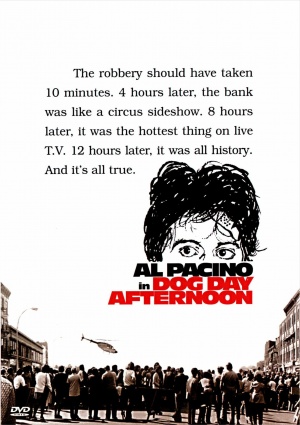
Dog Day Afternoon
Over the last year or so I've tried to catch up on all the classic movies I've missed. You know, those ones where people responded "WWWWWWWWWhat?" when you tell them you haven't seen them. I never intentionally dodged these movies, I just never actively sought them out. My problem in some cases is that I know these movies are held in high regard, and therefore expect more out of them. Raging Bull more than lived up to expectations, Goodfellas was highly enjoyable, and Judgment at Nuremberg was a powerfully effective movie. The latest one I've watched was 1975's Dog Day Afternoon.
I'll point this out first that I really enjoyed the movie, but I didn't love it. Certain parts worked perfectly, like director Sidney Lumet filming this true story like a documentary in the New York locations the story took place and Al Pacino's incredible performance. Lumet's pseudo-documentary style is appropriate for the story, giving the viewer a feeling of being a fly on the wall as the story develops. My only real complaint is that in its effort to be truthful with the facts, the movie is a little long. The first hour moves along at a quick pace, but somewhere in the second hour, the pacing hits a wall. All the momentum built up is lost, and while the ending is worth the wait, it can't save or solve the pacing issues.
On a scorching hot summer day in August 1972, two men, Sonny Wortzik (Pacino) and Sal Naturile (John Cazale) walk into a Brooklyn bank with a rifle and a machine gun to rob the place. Right away, nothing goes smoothly, starting with the bank having just over $1,000 after a deposit was picked up. Minutes go by longer than they had planned, and the phone rings. Detective Eugene Moretti (Charles Durning) is on the other end, and he wants to talk. The bank is surrounded by police, and there's no way out. Sonny refuses and with eight hostages -- the bank manager, 6 tellers, and a bank guard -- starts to negotiate a way out of the mess he's gotten himself into. Huge crowds form outside along with media and hundreds of cops, but a strange thing happens. Sonny becomes a hero to the crowd, but no matter what he does, there's no easy way out of the situation.
The circus-like atmosphere that develops following the botched bank robbery is an indictment of the times, with Sonny blatantly playing to the crowds, like THIS well-known scene. He screams at the police officers surrounding him to back off and holster their weapons. At one point, he throws money -- fake $5 bills -- to the gathering crowds and becomes a fan favorite to them. This is Pacino at his best in the role, a blend of calm intellect and brash outbursts all rolled into one. I won't go as far as saying I was rooting for Pacino's Sonny, but the fact that he's even a little bit sympathetic is a testament to Pacino's acting. This also earned him his 4th straight Best Acting Oscar nomination -- of which he won NONE -- and is a total departure from most of his other roles.
For such a big story, the cast is rather small which works surprisingly well. It's a big story, but the key moments are these interactions between a handful of characters. Cazale was only in six movies before dying at 43 of bone cancer, and he doesn't disappoint in any of them. His Sal has a tortured past of which we find out very little, but it's shown he's not a very smart person and is much more of a follower than a leader. Durning gets a flashier part as Det. Moretti, the police officer with the unpleasant task of negotiating the situation to save the lives of Sonny's hostages. Unfortunately, Durning's Moretti basically disappears once the FBI shows up and is gone in the last 45 minutes. Sully Boyar as Mulvaney, the bank manager, and Penelope Allen as Sylvia, the head bank teller, are the only hostages to make much of an impression. Chris Sarandon received an Oscar nomination for his part as Leon, but I'll go into that next.
SPOILERS for this paragraph SPOILERS I don't know if it's a twist because the Netflix movie sleeve says it in the first sentence of the description -- thanks for that, Netflix -- but Sarandon is Leon, Sonny's lover/husband, and the reason Sonny planned the robbery. He wanted to get money so Leon could have a sex-change operation because he thinks he's a woman trapped in a man's body. This revelation comes about halfway through the movie and certainly comes as a bit of a shock (and that's knowing it is coming). It isn't meant as a judgment that Sonny is gay or bisexual, instead Lumet just lays this all out for us to explain his motivations. Sonny is married with kids, and when we see his background and personal life, it is clear why he's done what he has. His wife is shrill, his mother overbearing, and the man he loves isn't all there in the head. He has been pushed too far and knows nowhere else to turn other than this desperate ploy.
The real-life incident 'Dog Day' is based on took about 14 hours, and in the movie the pacing starts to drag once the sun goes down as the story tries to show everything that happened. The real-life Sonny claimed only about 30% of the movie is true/factual. Certain scenes go on too long -- especially conversations Sonny has with his wife, mother and Leon -- and had me looking for the fast forward button. But still, the positives definitely outweigh the negatives, especially Pacino's performance and Lumet's direction. I won't say it is a classic because there are some serious flaws, but it is still a great movie.
Dog Day Afternoon <----trailer (1975): ***/****
I'll point this out first that I really enjoyed the movie, but I didn't love it. Certain parts worked perfectly, like director Sidney Lumet filming this true story like a documentary in the New York locations the story took place and Al Pacino's incredible performance. Lumet's pseudo-documentary style is appropriate for the story, giving the viewer a feeling of being a fly on the wall as the story develops. My only real complaint is that in its effort to be truthful with the facts, the movie is a little long. The first hour moves along at a quick pace, but somewhere in the second hour, the pacing hits a wall. All the momentum built up is lost, and while the ending is worth the wait, it can't save or solve the pacing issues.
On a scorching hot summer day in August 1972, two men, Sonny Wortzik (Pacino) and Sal Naturile (John Cazale) walk into a Brooklyn bank with a rifle and a machine gun to rob the place. Right away, nothing goes smoothly, starting with the bank having just over $1,000 after a deposit was picked up. Minutes go by longer than they had planned, and the phone rings. Detective Eugene Moretti (Charles Durning) is on the other end, and he wants to talk. The bank is surrounded by police, and there's no way out. Sonny refuses and with eight hostages -- the bank manager, 6 tellers, and a bank guard -- starts to negotiate a way out of the mess he's gotten himself into. Huge crowds form outside along with media and hundreds of cops, but a strange thing happens. Sonny becomes a hero to the crowd, but no matter what he does, there's no easy way out of the situation.
The circus-like atmosphere that develops following the botched bank robbery is an indictment of the times, with Sonny blatantly playing to the crowds, like THIS well-known scene. He screams at the police officers surrounding him to back off and holster their weapons. At one point, he throws money -- fake $5 bills -- to the gathering crowds and becomes a fan favorite to them. This is Pacino at his best in the role, a blend of calm intellect and brash outbursts all rolled into one. I won't go as far as saying I was rooting for Pacino's Sonny, but the fact that he's even a little bit sympathetic is a testament to Pacino's acting. This also earned him his 4th straight Best Acting Oscar nomination -- of which he won NONE -- and is a total departure from most of his other roles.
For such a big story, the cast is rather small which works surprisingly well. It's a big story, but the key moments are these interactions between a handful of characters. Cazale was only in six movies before dying at 43 of bone cancer, and he doesn't disappoint in any of them. His Sal has a tortured past of which we find out very little, but it's shown he's not a very smart person and is much more of a follower than a leader. Durning gets a flashier part as Det. Moretti, the police officer with the unpleasant task of negotiating the situation to save the lives of Sonny's hostages. Unfortunately, Durning's Moretti basically disappears once the FBI shows up and is gone in the last 45 minutes. Sully Boyar as Mulvaney, the bank manager, and Penelope Allen as Sylvia, the head bank teller, are the only hostages to make much of an impression. Chris Sarandon received an Oscar nomination for his part as Leon, but I'll go into that next.
SPOILERS for this paragraph SPOILERS I don't know if it's a twist because the Netflix movie sleeve says it in the first sentence of the description -- thanks for that, Netflix -- but Sarandon is Leon, Sonny's lover/husband, and the reason Sonny planned the robbery. He wanted to get money so Leon could have a sex-change operation because he thinks he's a woman trapped in a man's body. This revelation comes about halfway through the movie and certainly comes as a bit of a shock (and that's knowing it is coming). It isn't meant as a judgment that Sonny is gay or bisexual, instead Lumet just lays this all out for us to explain his motivations. Sonny is married with kids, and when we see his background and personal life, it is clear why he's done what he has. His wife is shrill, his mother overbearing, and the man he loves isn't all there in the head. He has been pushed too far and knows nowhere else to turn other than this desperate ploy.
The real-life incident 'Dog Day' is based on took about 14 hours, and in the movie the pacing starts to drag once the sun goes down as the story tries to show everything that happened. The real-life Sonny claimed only about 30% of the movie is true/factual. Certain scenes go on too long -- especially conversations Sonny has with his wife, mother and Leon -- and had me looking for the fast forward button. But still, the positives definitely outweigh the negatives, especially Pacino's performance and Lumet's direction. I won't say it is a classic because there are some serious flaws, but it is still a great movie.
Dog Day Afternoon <----trailer (1975): ***/****
Sunday, November 8, 2009
The Final Countdown
It's 1979 and defense contractor Warren Lasky (Martin Sheen) has been chosen to take an advisory trip on the U.S.S. Nimitz, a US Navy nuclear carrier stationed in the Pacific. On board, Capt. Yelland (Kirk Douglas) welcomes Lasky and offers to help in any way he can. Others, like Wing Commander Owens (James Farentino), aren't so convinced Lasky's there to help. All personal grudges are thrown to the curb when the Nimitz sails into a horrific storm unlike anyone onboard has ever been through. On the other side of the storm, everything seems to be okay. The carrier can move as quickly as ever, all weapons and communications systems still work, and the crew is all right.
But something's not quite right. The radio is broadcasting Jack Benny shows, the radio frequencies and codes are years past their usefulness, and oddly enough, Japanese fighter planes are seen in the vicinity. Lasky, Yelland and crew figure it out; the Nimitz has somehow traveled back in time. It's December 6, 1941, just hours before the Japanese sneak attack on Pearl Harbor. The debate starts immediately as to what they should do, intervene and prevent the attack and change history or do nothing and let America's involvement in WWII come to fruition?
Time travel is about as complicated as anything presented in science fiction. Shows like Lost and Flash Forward and countless movies have dealt with the subject with all it's little wrinkles and differences. Sheen's Lasky wonders aloud 'if we stop the attack and therefore stop America in WWII, do we cease to exist because the line of time that caused us to be there is now altered?' It's the type of conversation that hurts your head just thinking about it and all the possibilities. But that's the fun of the premise; what if?
The build-up and the mounting clues as Yelland tries to figure out what is going on are the high points of the movie. The problem is in the final 30 minutes as Yelland makes his decision on what to do with his attack force of almost 100 modern jet fighters. The problem? It's a cop out ending. There is no ending. Recently, Quentin Tarantino rewrote history with his Inglourious Basterds, and I found myself wishing 'Countdown' did that too. But it doesn't, settling for an ending that makes sense but doesn't do anything risky. It's a safe decision, and unfortunately one that brings the movie down a notch. There is a worthwhile twist in the final scene, but not one to steer the movie back on course.
A positive to take away is the casting with veteran star Kirk Douglas taking the lead as Capt. Yelland, the commander of the USS Nimitz. Yelland must decide what to do in a situation no Navy officer ever figured on having to do, change history or follow orders. Sheen gets the more showy part as Lasky, the defense contractor always looking for alternatives. It's his character that believes with one fell swoop the whole timeline of history could be altered for the better. Farentino is also good as Owens, the amateur historian and expert fighter pilot. Charles Durning and Katharine Ross play Senator Samuel Chapman and his aide Laurel who living in 1941 become the unwilling participants aboard a time-traveling carrier. Ron O'Neal is also good as Cmdr. Thurman, Yelland's right hand man.
This is a science fiction story ripe with potential that never really delivers in the end. Too bad because even with a disappointing ending, 'Countdown' is still a movie I'd recommend because the premise is so interesting and out of the box of normal movie storytelling. Good cast, especially Douglas and Sheen, and some great footage aboard an immense US carrier. Dated special effects be damned, this one is still worth seeing.
The Final Countdown <----trailer (1980): ** 1/2 /****
Labels:
1980s,
Charles Durning,
Katharine Ross,
Kirk Douglas,
Martin Sheen,
Sci-Fi,
WWII
Subscribe to:
Posts (Atom)