The Sons of Katie Elder

The Sons of Katie Elder
"First, we reunite, then find Ma and Pa's killer...then read some reviews."
Showing posts with label Don Murray. Show all posts

Monday, February 24, 2014

One Foot in Hell

Alan Ladd is Shane. That's it. End of story. In the classic 1953 western, Ladd played one of the genre's most famous gunfighters/cowboys, a man named Shane working with homesteaders against ruthless cattle barons. It's an iconic character, one that is easily remembered as one of Ladd's best. So what to make of Alan Ladd -- Shane himself -- playing....a bad guy?!? I know. It caught me by surprise too, but here we are with 1960's One Foot in Hell.

The end of the Civil War is a recent memory as former Confederate soldier Mitch Barrett (Ladd) moves west with his wife, Ellie (Rachel Stephens), hoping to start a new life. Ellie is pregnant though and goes into labor as they ride into the town of Blue Springs, Arizona. Mitch tries to get a hotel room, get a doctor, get medicine, but before he can get back to Ellie, she passes away. He holds certain townspeople to blame for his wife's death, but looking to move on, he takes a job as a deputy in town and settles into a new life. Months go by, Mitch becoming a trusted member of the community, forming friendships and relationships with the townspeople. One day, he approaches a drunken prisoner, Dan Keats (Don Murray), with an offer to cripple the town, but he needs help. As Dan quickly figures out, Mitch hasn't let his feelings of revenge go at all, and he's going to do everything he can to cripple this town.


This western from director James B. Clark actually has its root in television. It's based off a screenplay from Aaron Spelling (later of Beverly Hills 90210, Charlie's Angels, 7th Heaven fame and many others). Spelling had written it originally for Playhouse 90, a TV show that aired in the late 1950s, then adapting it for the big screen in this B-western that clearly didn't have a big budget but also doesn't let that be a huge detriment. It has been almost completely forgotten within the western genre, lost in waves of B-westerns that bombarded audiences in the 1950s and 1960s. Why shouldn't it be forgotten? Well, for starters, it is dark. Very dark. Most 1960 westerns, I still have this picture of white hat good guys vs. black hat bad guys. That trend was starting to change by 1960, especially here in this generally forgotten genre entry.

Where to start? With Ladd as revenge-seeking Mitch. In all my reviews of Ladd films, I feel like I've brought up his general stiffness on-screen, only certain parts rising above that wooden delivery. This actually isn't that part, but the wooden acting actually pays off here. Until Ladd's Mitch approaches Murray's Keats in his jail cell, I wasn't sure where the movie was heading, thinking maybe I was watching a pretty straightforward western hero gets second chance story. Nope, not at all. This is a man who wants revenge, and he's willing to wait for it to make it more painful for all those involved. By 1960, alcoholism was ravaging Ladd, and it shows. He doesn't look good at all. But that wooden delivery? It plays well with a man driven to obsession about gaining that revenge. It's hard to read his intentions at almost all times. How far is he willing to go? What is he willing to sacrifice? If it sounds like a backhanded compliment, so be it. Ladd's performance works, and it's definitely cool to see him play such a dark, villainous role.

Ladd is the biggest name here, but the supporting cast is pretty good, adding to that darkness started off by Ladd's Mitch. Hamming it up a bit at times, Murray is good as Keats, the former Confederate soldier who's turned to the bottle rather than deal with his tragic losses from the war. He's also a talented artist and an artillery specialist, giving Mitch a versatile assistant in his revenge plan. Mitch also assembles a small crew to work with including Sir Harry Ivers (Dan O'Herlihy), an English gentleman and a master thief, Julie (Dolores Michaels), a prostitute posing as Mitch's new wife, and Stu Christian (Barry Coe), a fast draw and gunman with no scruples about killing innocents. It's an interesting group to watch, one that threatens to tear itself apart before it can even unleash its plan. Star power? Nope, but some cool characters. It would have been nice to get some more background, more development, but cool just the same. Also, look for Larry Gates as the town doctor who convinces Mitch to stick around.

But again, that darkness, it's hard to shake it. The opening scene is uncomfortable to watch, Mitch meeting a slow-moving hotel desk clerk (Henry Norell) with lots of questions, a store owner (John Alexander) who holds Mitch up over $1.87 he owes for medicine his wife desperately needs, not allowing it on credit, and the sheriff (Karl Swenson) who arrests Mitch when he's forced to pull a gun to get the medicine. It just caught me by surprise, but for the good. The ending taps the brakes some unfortunately, an out of left field storyline that feels forced and far more typical of a 1960 American western. Also -- and I could have been watching an edited version of the film -- one key character's death isn't shown. Hhhmmm, interesting, but not for the better.

Still, getting to the finale is very interesting. It's a cool change of pace for any number of reasons, especially Alan Ladd in a bad guy role. If you can track down a copy, definitely give it a shot.

One Foot in Hell (1960): ***/****

Wednesday, February 19, 2014

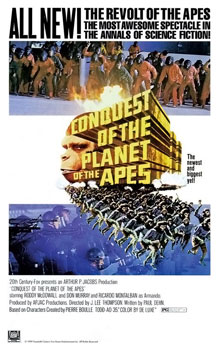
Conquest of the Planet of the Apes

Well, we might as well continue what we've started. While I'd seen the first three Planet of the Apes movies growing up on multiple occasions, I can't say the same for the last two movies in the series, 1972's Conquest of the Planet of the Apes and 1973's Battle for the Planet of the Apes. I've seen bits and pieces of both but never all the way through in one sitting. And away we go!

It's 1991 in North America, some 20 years since the talking apes, Zira and Cornelius, were murdered along with their baby...but it wasn't their baby. Things have changed around the world, a mysterious virus killing every single cat and dog on Earth, humans turning to apes/monkeys to be their pets. That changed quickly though, their mental capacities showing they're not so worthwhile as pets, but as slaves. It's been eight years, apes and chimpanzees used as janitors, delivery men, waiters and so many other tasks and jobs. That baby though that was supposed to have died? He didn't, and now he's 20 years old, still with loving-life Armando (Ricardo Montalban), who is now bringing the 20-year old intelligent, talking Caesar (Roddy McDowall) to the big city for the first time. Caesar is stunned and disgusted at what he finds, and when he becomes separated from Armando he's forced to adjust or reveal his secret.

Watching the Apes series in fairly quick succession, I've came away impressed. This fourth entry, this one from director J. Lee Thompson who had been in talks to direct the first movie, certainly qualifies. Is it a classic film? No, but fans of the series and science fiction in general will no doubt enjoy it. This series has impressed me because the original 1968 Planet of the Apes is a classic stand-alone science fiction film. It doesn't need any sequels. There are some questions we'd like more answers about, more background, but we know the truth, what really happened. Following the first sequel, 'Beneath,' the series found a way to survive and evolve -- whether intentionally or just lucking into it -- by bringing all five movies full circle. It's a nice touch, and each movie is different from its predecessor. Similar themes, tones, even some actors make it from movie to movie, but in an age of repetitive sequels, it's cool to see original, different sequels like this.

For this third sequel, there's a time jump.....into the future of 1991!!! 'Conquest' was filmed on location in Los Angeles at Century City, an appropriate, sparse and ultra-modern look for the visual of what Earth would have looked like in 1991....from a 1972 audience. Basically the entire story takes place in this one complex, the human rulers trying to limit and control the problems among the ape slaves. The apes are getting smarter, showing more initiative, being more disobedient. Add the very intelligent and very disgusted/motivated Caesar to the mix, and we've officially got an issue. There are points where things feel rushed in an 88-minute movie, another 10 minutes maybe fleshing it out some, but continuing what the series has laid out, this is a particularly dark, brutal story. What we see is even a tamed version of the original ending. It's not graphic (these movies were still considered "family movies") but the violence can be disturbing at times.

As has been the case for the first three movies, the key is the characters, whether they be heroes, villains or somewhere in between. That's what I found interesting here. Do we want to root for the evil, despicable humans who abuse slaves? Or do we root for the revolting apes to....wipe out mankind? Hhhhmmm, well, that's a toughie. It can be an uncomfortable movie to watch at times because of that dynamic. McDowall returns to the series, playing Cornelius' son (so technically his own) Caesar. It's a very good part for McDowall, fiery and angry, the match that sets off the explosion that's been waiting to happen. Hidden away from what society has become by Montalban's Armando, Caesar hasn't seen the darkness the world has to offer, until now. The rage inside him begins to grow and when he gets the proper motivation for revenge, he begins to planning the revolution, assembling and building, waiting for his time. A very good part for McDowall, especially his monologue in the final scene.

Again stealing the show is Montalban as the likable, charming and idealistic Armando, more Caesar's surrogate father than owner. It's not a huge part, but it is definitely a memorable one, Montalban again stealing all his scenes. Don Murray is nicely cast as Breck, the sadistic governor of the city, convinced that a talking ape is out there and hellbent on finding and killing him. Hari Rhodes plays his assistant, McDonald, an intelligent, thoughtful man, who has a bond of sorts with Caesar after they meet, and Severn Darden plays Breck's enforcer on his other shoulder, Kolp. Natalie Trundy continues her participation in the series, playing Lisa, a female ape, after already playing a mutant and a doctor in previous movies. John Randolph appears briefly in an update of a monologue he had in 'Escape' as well.

The portrayal of the future can be uncomfortable to watch at times. Breck and his fellow officials wear black and dark clothing, his soldiers wearing completely black uniforms that make them look like Nazi stormtroopers. The apes on the other hand wear green and orange jumpsuits, the color jumping off the screen. As I mentioned, I was surprised by how this story developed. The actual conquest in the final act of the movie is intense to say the least. The ending is startling, even if it was edited to be a little more tame. Still, I liked this sequel a lot and can't wait to see where the series goes in its finale. As well, it's hard not to notice how much this sequel inspired the Apes reboot, 2011's Rise of the Planet of the Apes. Just saying.

Conquest of the Planet of the Apes (1972): ***/****

Thursday, August 16, 2012

The Viking Queen

In the 1960s, the unofficial age of the epics, not all studios were able to produce immensely scaled historical dramas with A-list stars and a cast of thousands. Some, like Hammer Films, did their best to counter on significantly smaller budgets. More violence, more nudity, less message and spectacle, like 1967's oddly named The Viking Queen.

With her father the Briton king on his deathbed, young Briton woman Salina (Finnish actress/model Carita) is given power of the empire and is told to rule with a fair and just hand. Her selection divides the people, but she does her best to make a decision that is best for her people. Part of her father's deal was a controversial deal of co-rule with the Roman rulers, led by governor general Justinian (Don Murray). Very few among the Britons, Druids and Romans seem willing to go along with the plan, but when they fall deeply in love, both Salina and Justinian do everything they can to make the new system of rule work. With so much power at stake, all sides begin to conspire.

From Hammer Film Productions, this is a somewhat interesting if not necessarily good movie. Obviously made on a significantly smaller budget than the Hollywood epics of the time, 'Queen' has a certain low-budget charm. Much of the budget seems to have been spent on costuming and set design, leaving all those other things left by the wayside. So instead of a big sweeping story, we get lots of curvy, scantily clad women and....yeah, that's about it. Basically every scene a woman is on-screen, she's topless but strategically covered by hair, wearing a low-cut top that reveals -- as Peter Griffin would say -- 'side boob,' or just forced to wear a top and push-up bra that looks like she's being choked. Who needs spectacle when you've got that?

The Romeo and Juliet angle is played out about as you would expect it. Definitely the feeling of been there and seen and done that. It certainly doesn't help that Murray is rather wooden as Roman general Justinian although he does sport a Roman-looking haircut that's pretty ridiculous. Finnish model Carita (in one of 2 career film roles) just isn't an actress although her performance is far from the worst thing here. She's acceptable if somewhat stiff. Mostly her part is what I mentioned earlier; eye candy and lots of it. In that department, she's perfect casting, like THIS scene where's she "topless" and whipped. But putting the two actors together, Murray and Carita just don't have much in the way of chemistry. With a story that focuses on that Romeo and Juliet angle, even a little chemistry would have gone a long way.

Thankfully the rest of the cast with lots of familiar faces is having some fun with the cliched story. Donald Houston hams it up like nobody's business as Maelgan, a Druid high priest who rants and raves at anyone who will listen about the coming war that will have the land running with blood. Andrew Keir is a bright spot as Octavian, Justinian's second in command who resents the fact that he's been passed over for promotion, Percy Herbert playing his also treacherous Roman right hand man. Patrick Troughton too is a positive as Tristram, Salina's trusted adviser, who must also look out for his wavering son, Fergus (Sean Caffrey). Adrienne Corri and Nicola Pagett round out the eye candy contingent as Salina's sisters.

Now if you're in the Ass-Kicking Female Characters Dept., stick around for the end, a battle royale between Salina's Britons and Justinian's Roman legion. Salina and her two sisters -- going for the sexy look rather than battle appropriate -- ride their chariots into the Roman ranks. Like I've mentioned, no huge scale, but a solid, well put together battle sequence. A quick downer ending too which came as a bit of a surprise. And also, what the hell is with the title? Salina isn't a Viking, and there's no freaking Vikings anywhere in the story! Pretty mindless "historical epic" mostly worthwhile for the babe quotient. That's all I got. Eye candy here.

The Viking Queen <---Youtube clip (1967): * 1/2 /****

Saturday, March 12, 2011

Bus Stop

An icon of beauty and style, Marilyn Monroe isn't always thought of as a true, dramatic actress.  In comedy, she was perfectly suited, often playing the sexy if ditsy blonde. Depending on the movie, it can take more acting ability to nail the comedy than the drama, but I've always thought Monroe was a solid actress across the board. It was only later in her shortened career that she turned to more dramatic roles consistently, including 1956's Bus Stop.

Before I jump into the review, I'm going to say this about the movie.  I hated it. Truly hated it. I sat through it for Monroe alone, and little else.  The story and plotting was beyond ridiculous, forced and hackneyed for the sake of the story and little else.  The leading man was such an exaggerated, annoying character that I found myself rooting for something horrible to happen to him. And at 96 minutes, this movie could not have ended quickly enough. The one saving grace? Monroe, showing off her tremendous beauty and an ability to act in a dramatic role.

The owner of a successful ranch in Montana, 21-year old Beauregard 'Bo' Decker (Don Murray) is traveling to Phoenix with veteran ranch hand Virgil (Arthur O'Connell) to take part in a high-stakes rodeo competition. Decker is looking for the big payoff at the end, and hopefully finding a wife to come live with him. After a long bus trip, they arrive in Phoenix where Bo sees Cherie (Monroe), a saloon performer making her way west slowly but surely to Hollywood. It's love at first sight for the young cowboy, and he decides that she will be his wife. The only problem? No one told Cherie anything about the arrangement, and she can't manage to shake off the persistent efforts of Bo.

The premise sounded interesting enough even if the description at TCM's website emphasizes Bo's kidnapping of Cherie late in the movie as a huge plot point. It sounds like a screwball comedy but is played like a straight drama. See any problems there? There's no comedy, but the drama is so off-the-wall it never clicks or gels in the least. The movie is just there, never choosing a side or what it's about. If there was some slapstick comedy, maybe it works. If there was a sense of danger as to what Bo might actually do, we're talking about a decent thriller.  Instead, we get this, a 96-minute movie that doesn't go anywhere and doesn't say anything.

I've written before about the likability of main characters and movies sinking or swimming on that decision. Do you like the main character at all? Are we supposed to? Unfortunately for Bus Stop, I hated Murray's Bo, but I'm pretty sure we're supposed to like him, root for him in some way. If I'm wrong, and he's meant to be a big joke, then what was the point of the whole movie? This was Murray's first feature film, and all the talent he would show in later roles just isn't there.  I can't decide if its his character or the acting...or both. Beauregard is a 12-year old in a 21-year old's body. He is overbearing, obnoxious, a stalker, bull-headed, stubborn, and downright annoying.  If you're going for a lovable cut-up who never grew up, so be it, but not like this.  It's too much.

What's worse is that the story and all the characters around him allow all this. Is it the awful script that requires things to move along so no one stops Bo? Did anyone care? If this movie was released in 2011, it would be about a young man stalking a young girl, desperately trying to convince her to love him. At different points, he breaks into her apartment and lies down next to her, gets engaged without telling her, and plans on getting married the next day. When that doesn't work, he actually lassoes her as she tries to escape, and NO ONE stops him. The cries of help didn't alert anyone that she's distressed? He's convinced that he can make her fall in love with him. The Bo character gets a chance at redemption late (after he gets the crap kicked out of him by Robert Bray's bus driver character), but it's too late to save the movie, and too quick of a transformation for this man-child.

So unfortunately while Murray's character needed to be taken out and shot about 10 minutes into the movie, the rest of the cast is above average. Looking pale as a ghost and sporting an Ozarks hillbilly accent, Monroe shows off her acting chops, carrying the movie through its rougher patches. She looks great too which never hurts, and even gets to sing a song soon after her introduction. O'Connell is all right, Bray is a bonus because he beats down Murray, Betty Field having some fun as sassy diner owner Grace, and Eileen Heckart as funny sidekick Vera to Monroe's Cherie. But all things considered, Monroe is the only reason to invest 96 minutes here. Murray is awful and single-handedly ruins the movie.

Bus Stop <---trailer (1956): */****

Tuesday, October 5, 2010

Baby, the Rain Must Fall

Throughout his cancer-shortened career, Steve McQueen readily admitted he didn't think much of the acting profession he had chosen. It was a job to him, plain and simple, one that he obviously had a talent for but also one he never really embraced as being a legitimate job or occupation.  Well, whether he admitted it or not, McQueen was an incredible presence on screen.  Critics said he often played the same character -- what successful movie star can't that tag be applied to? -- but as a defender of McQueen, I've yet to come across a part of his that didn't have something to recommend.

To be fair, McQueen did perfect the part of the quiet, loner anti-hero who just doesn't fit in with society and its norms.  This formula worked in big blockbusters like The Great Escape and The Magnificent Seven and more character-driven stories like The Sand Pebbles (nonetheless an epic) and Papillon.  Early in the 1960s after his star-making part as Cooler King Virgil Hilts in The Great Escape, McQueen made a point of doing different parts and not being typecast as one specific kind of action actor/star.  So over two years, he made three movies -- none of which have been remembered well -- including 1965's Baby the Rain Must Fall

Making the long bus trip across Texas with her young daughter, Georgette Thomas (Lee Remick) is on her way to find her husband who she hasn't seen in years. Henry Thomas (McQueen) is a recent parolee from the state penitentiary looking for a clean slate in life and fully embraces his wife and daughter's return.  He dives right into making their lives better, renting a house to live in and looking to take night classes and get a degree.  At the same time though, Henry has this dream of selling his country/western songs and hitting it big, becoming the next Elvis Presley.  Georgette is on his side supporting him all the way, but Henry's past demons from a difficult childhood start to emerge, making an already difficult task nearly impossible.

Director Robert Mulligan crafts an intriguing story here that has drawn comparisons to the stories and plays of Tennessee Williams. Intriguing doesn't always translate to interesting though.  Filming in black and white, Mulligan makes what looks like a 1960s version of The Grapes of Wrath.  With his Texas locations, there is a sparseness, an emptiness to the story.  Big wide open stretches of land with the wind blowing by with nothing to stop it.  The story is focused on Henry and Georgette and a handful of supporting characters, and it is always grounded in a very human, very realistic way.  All said though, it's too bleak, too dark with no real hope of a peaceful resolution.  You know before it starts that this is going to have a tragic ending, you just don't HOW exactly it's going to go down.

As a fan of McQueen, I'll admit that I'd watch the man read a phone book, sure that he would put some unique spin on his reading.  His Henry Thomas character is one of his more underrated parts and is generally unknown thanks to the film's epic tanking in theaters.  A good jumping off point is that from the start, McQueen makes Henry a very likable character.  You're rooting for him to hit it big, become a star.  In preparing for his part, he uses a lot of his own personal experiences from his own checkered past and troubled childhood to really get to know the character.  As Henry devolves into a shell of himself, it's startling to watch the transformation.  It is uncomfortable watching it at times as McQueen brings a ton of intensity to the performance.  This isn't as iconic as Hilts gunning his motorcycle across the countryside or Det. Bullitt racing through the streets of San Francisco, but it proves without a doubt that McQueen was a great actor...if there was ever any question.

In a part that could have been overshadowed by McQueen's powerful performance, Lee Remick more than stands her own as Henry's wife, Georgette.  Remick's looks definitely play into the character, but for the better.  She is this extremely thin blonde young woman who looks like a stiff wind could knock her over.  Add in her girl next door looks and a Texas drawl, and you figure you've got this character pegged.  You'd be wrong.  Her Georgette has lived for years as a single mother (a great mother at that) and is as tough as they come.  She's not going to let anyone or anything slow her down.  Add in her obvious chemistry with McQueen, and you've got quite a pair in the lead roles.  Also starring are Paul Fix as the town judge, Don Murray as the local deputy who grew up with Henry and knows his past, and young Kimberly Block in her only acting performance as Margaret Rose, the Thomas' daughter.

One other complaint, but it's a pretty bad one.  McQueen plays a country singer with one major problem; McQueen couldn't sing a lick.  Anytime Henry sings, we see McQueen lip-synching to the lyrics, but it's clearly someone else singing.  The voices just don't match up.  Check one example out HERE. It completely takes you out of the flow of the movie, and these scenes can be painful to watch.  Still, McQueen and Remick are great leads, and that's the main reason to check out this forgotten flick from the 1960s.

Baby the Rain Must Fall <---trailer (1965): ** 1/2 /****

Tuesday, September 7, 2010

Advise and Consent

Recently in the news, former Illinois governor Rod Blagojevich was found guilty on one count of 24 levied against him.  A mistrial is in the works, but the news was nothing new.  Controversies and scandals in politics are as old as well, politics itself.  Are we surprised anymore when a politician, whether it be the President or down through the ranks to Senators, Representatives, Governors, and on and on, does something stupid in the news?  Sex, past indiscretions, corruption, all over the above, nothing seems to faze the American public anymore.

Let's go back almost half a century in more innocent times, I guess, the 1960s weren't exactly innocent.  But the times were certainly different without that 24-hour news cycle that keeps viewers up to date on everything going on.  Politicians could have secrets and that's just what they were, secrets.  The master of adult-themed movies, Otto Preminger explored this concept with 1962's Advise and Consent. When you accept a position in the public eye, you lose your privacy to a certain point.  You open yourself up for criticism on many fronts, but if this Preminger movie teaches us anything, we all have secrets. It's only a matter of time before they're found out.

The President of the United States (Franchot Tone) has chosen a nominee for the vacant position of the Secretary of State. The man is Robert Leffingwell (Henry Fonda) and from the get-go, the nomination divides the Senate who will have to approve or disapprove him. The Senate majority leader (Walter Pidgeon) is all for the choice and knows he can get the necessary number of votes for Leffingwell. Opposing him is a long-time senator from South Carolina (Charles Laughton), who was burned by Leffingwell in the past and still holds a grudge. But before a vote can be counted, the nomination must go through a Senate sub-committee headed by an idealistic young senator (Don Murray) who will decide if Leffingwell is capable of doing the job. But as the committee starts, the dirt comes out and the fight begins.

As he did so often with his movies, Preminger puts together a very impressive ensemble cast to work with.  It's so good from top to bottom that Fonda -- yes, Henry Fonda -- is almost an afterthought as a supporting character.  He doesn't even make an appearance in the last 30 minutes.  Preminger was a perfectionist as a filmmaker, but actors must have liked working with him.  Along with the names mentioned above, there is also Gene Tierney, Peter Lawford, Will Geer, Burgess Meredith, Lew Ayres, and Paul Ford among others. Like any large ensemble, some in the cast get more of a chance to shine than others, but none disappoint however long they're on screen.  Murray, Pidgeon and Laughton are the ones that shine brightest though, including Ayres as a vanilla vice president.

This isn't a movie about camera techniques or in your face effects.  Preminger lets takes and scenes go on uninterrupted without the slightest editing.  Characters hold conversations like they would in real life.  He lets his cast show off their ability, letting the dialogue do all the talking the story needs.  At times, the pace can be infuriatingly slow (it is 140 minutes long) because of that, especially toward the end when the pace should be picking up, but it's all part of the story the movie revels in.  Preminger filmed in countless locations in Washington DC -- shooting in black and white -- giving a real feel for all the backroom deals and shady motives that really go on in the capital.  It doesn't intentionally call attention to itself, but the movie is a treat to watch on a purely visual level.

What was somewhat disappointing as the story develops is that by 2010, nothing really surprised me in terms of government scandals and controversies.  In the last 10 or 20 years, there has been murder, extramarital affairs, corruption, prostitution, kidnappings, and any number of other things I'm probably forgetting.  So when the scandals do pop up, including Fonda's Leffingwell and his past involvement in a different government and Murray's Senator's past coming back to haunt him, they don't have a huge affect on the viewer.  Shocking in 1962, maybe, but not in 2010.  Through no fault of Preminger's then (you can't blame him for making a move when he did), the emotional impact is lessened then just by time and how the world has changed in the almost 50 years since.

As everything does unravel in the end and the twists and secrets come out, the story thankfully picks up some steam.  One twist at the very end was a little too coincidental for me personally, the timing just too perfect, but that's movies for you. It is a movie that is as professionally done as just about any other movie you'll come across, and the cast is hard to top.  If there was a way to watch this in 1962, maybe the impact would have been greater, but in 2010, it's still pretty good.

Advise and Consent <---IMDB trailer (1962): ***/****

Saturday, June 26, 2010

Shake Hands With the Devil

Growing up watching older movies, I came to embrace just about any tough guy movie star from John Wayne to Clint Eastwood and everyone in between.  But having seen nothing more than a clip here and there and reading about his other movies, I was never able to embrace James Cagney, one of Hollywood's first stars and possibly the most famous in the 1930s and 1940s. It wasn't that I actively disliked Cagney or his movies, but the over the top, fast-talking little tough guy never appealed to me.  So having seen only two Cagney movies, I'm giving him a try and seeing what he's all about.

The most recent one I've watched is one of his later pictures, 1959's Shake Hands With the Devil.  Cagney was nearing 60 years old when he made this British production, but he shows no signs of slowing down.  His character goes through quite an arc from beginning to end, starting off as a heroic freedom fighter and ending up as an obsessed quasi-villain.  But through it all, the focus and attention is on him, especially with a second-billed star who just can't keep up with him.

It's 1921 in Ireland and American veteran of WWI Kerry O'Shea (Don Murray) is studying at a surgeon school to become a doctor. With the IRA battling the Black and Tans in hopes of making their country a free republic, Ireland is up for grabs with violence in the streets on every corner. O'Shea is walking home late one night with a friend when he's forced to take action against the Black and Tans, making him a marked man.  He's supposed to be smuggled out of Ireland, but ends up joining an IRA squad, led by Sean Linehan (Cagney), his professor at the medical school.  O'Shea joins the effort with the squad's sights set on one man, a brutal local commander, but the effort begins to take a toll on the men, especially Linehan at the top.

A story that focuses on a bloody, often incredibly brutal fight for independence has to tread a fine line in how it tells the story.  Both the IRA and the Black and Tans committed atrocities during the fighting for Irish independence from British rule.  Director Michael Anderson does not paint either side as completely heroic or completely villainous to his credit.  Both sides have flaws and are willing to murder, maim and sabotage, whatever it takes to get their side to win.  Obviously focusing on the Irish Republican Army more than their opponents the viewer will get more depth and background from one side, but even then it's not always positive, most of that coming from Cagney's Linehan.

It's obvious early on that Cagney is not just making a cameo appearance as an Irishman teaching at a medical school so it does not come as much of a surprise when he's revealed to be an IRA commandant with years of experience and know-how.  Once O'Shea joins the group, Linehan is a strong, sturdy leader who is committed to his men and to the fight, more than ready to give his life if the cause demands it.  But as the fighting continues, Linehan begins to crack a bit and his personal issues begin to emerge, especially with a young barmaid (Glynis Johns) who hangs around with his men, and the ever-present threat from traitors and informers.  Even when it seems the fighting is nearing its end, Linehan refuses to give up, wanting to continue the fight.

As his counter though, Murray's Terry O'Shea starts off as an interesting character, but he fades into the background midway through the movie.  He's a WWI vet sick of killing and violence and just wants to move on to a new life as a doctor when he's thrust into this fight for independence.  His father a former freedom fighter, O'Shea has to live up to certain expectations, but by the end he's fallen in love with a young English girl (Dana Wynter) who he met about 10 minutes ago.  Thankfully the rest of the cast steps up, including Michael Redgrave as the General, an IRA leader, Cyril Cusack as Chris Noonan, poet turned IRA gunman, and even Richard Harris in just his second movie playing Terrence O'Brien, a self-assured but capable member of Lenihan's squad.        

Filming in Ireland, Anderson made the choice to film in black and white as opposed to color.  It is a decision that makes sense because of the tone and mood of the story.  If he had chosen a color format, 'Shake Hands' would look like The Quiet Man.  But lush green fields and soft rolling hills would seem out of place with a story focusing on such a dark subject.  Full of shadows, Anderson made the right choice going with black and white instead of color.  It's an interesting movie with a controversial topic and worth watching if you can track it down.

Shake Hands With the Devil (1959): ** 1/2 /****