The Sons of Katie Elder

The Sons of Katie Elder
"First, we reunite, then find Ma and Pa's killer...then read some reviews."
Showing posts with label Gordon Jackson. Show all posts

Wednesday, May 22, 2013

Hell Drivers

Driving a gravel truck doesn't seem like a real exciting basis for a tense dramatic action film, does it? Nah, I didn't think so. With an impressive cast of future stars, 1957's Hell Drivers manages to prove me wrong in a big way. Driving a gravel truck for high stakes! Let's do this!

An ex-con looking for work, Tom Yately (Stanley Baker) manages to find a job with Hawlett's Trucking Company. The job sounds simple enough; transporting truckloads of gravel from one location to another 12 miles away. There's a catch though. The small fleet of truck drivers compete on a daily basis to see who can make the most runs with a minimum number of runs required. The end result is a drive at breakneck speeds around a twisting, winding course where safety is a secondary thought. Tom just wants to do a job and make some money, but he immediately clashes with Red (Patrick McGoohan), the fleet foreman and resident champ that no one can touch. Tom tries to avoid the macho head games, avoid the confrontation and do his job, but Red isn't going to allow it.

The Music Box Theatre recently had a screening of this realistic, dark drama from director Cy Endfield which I, of course, was not able to go to. Thanks you On Demand for having it hidden away, allowing me to catch up with it! 'Drivers' has a low-budget, ultra-realistic feel that plays like a documentary more than a feature film. Filmed in a grainy black and white, that dreary English sky never looked so....dreary? I know, I'm a master wordsmith. It's a nasty, unpleasant, me-first world presented here. If a little predictable at times, it's still a movie I enjoyed a lot.

What originally caught my attention here was the casting, an impressive list of actors who would go on to bigger and better things in the coming years. An underrated actor who never quite got his due, Baker is an ideal star. It's not your typical hero role for a 1957 flick. He's quiet, a man of few words but resolute in his word and genuinely trying to put his checkered criminal past (talked about, no actual details) behind him. However, he's also not one to take any crap from a rival. The weaker parts of the story have Baker's Tom interacting with Lucy (Peggy Cummins), Hawlett's secretary, who's involved with another driver but likes Tom just the same. Again, it's not your typical lovey-dovey relationship -- far from it and thankfully so -- but these scenes take away from the real focus of the story, the epically dangerous truck driving.

Baker is a good start, but 'Drivers' is far from done. McGoohan is a crazy presence as Red, the almost primal main rival for Baker's Tom. With his crazy eyes, wild, bushy eyebrows and ripped up leather vest, he looks like he'd like to eat his rivals, not just beat them. Herbert Lom is a scene-stealer as Gino, a former Italian P.O.W. who decided to stay in England after WWII. A gentleman with some brains, he bonds quickly with Tom, forming a fast friendship. Oh, there's more. The Hawlett drivers include Sean Connery, Sid James, Gordon Jackson, Alfie Bass, Wensley Pithey and George Murcell. Also look for Wilfrid Lawson as Ed, Hawlett's mechanic who also tests potential drivers' ability (watch Baker's test HERE). There's even small parts for David McCallum as Jimmy, Tommy's younger brother, and Jill Ireland as a waitress at the restaurant all the drivers eat at. 

A movie called 'Hell Drivers' about truck drivers transporting gravel certainly didn't sound like the most exciting background for a story, but Enfield's script (along with documentarian John Kruse) keeps things moving. The footage of the trucks driving along the roads has obviously been sped up, but it's still pretty cool. These big lorries roaring down the country roads, zipping in and around traffic, shortcuts through fields and quarries, it all ends up being solid action. A straightforward, enjoyable dramatic story with a more than worthwhile cast. Definitely seek this one out.

Hell Drivers (1957): ***/****

Wednesday, April 10, 2013

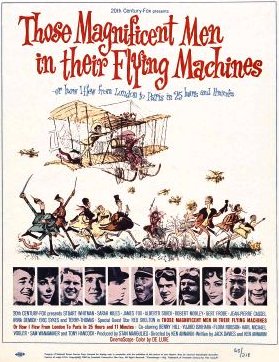
Those Magnificent Men in Their Flying Machines

The roadshow epic is unfortunately a thing of the past, a symbol of a Hollywood era that ruled through the 1950s and early 1960s. Even the lousy ones have something worthwhile. For me, I love the huge scale, the intro music, the intermission, the casts of thousands. By the mid 1960s though, things, they were 'a changing, and the epics were becoming a thing of the past. One of the last films hitting theaters before the era completely died out was a good one, 1965's Those Magnificent Men in Their Flying Machines.

It's 1910, and British army officer Richard Mays (James Fox) is among a small group of pilots worldwide who are helping advance aviation just seven years since the Wright Brothers flew at Kitty Hawk in 1903. He's sorta-engaged to Patricia Rawnsley (Sarah Miles), the daughter of Lord Rawnsley (Robert Morley), a newspaper owner disgusted at the thought of other countries' pilots advancing quicker in aviation than England. Using all his pull, Lord Rawnsley organizes an international air race from England to Paris that will show once and for all who is the best pilot around. Pilots from around the world travel to England with their flying machines with the hopes of winning the race and its lucrative prize. Among them, Orvil Newton (Stuart Whitman), an American cowboy, with his eyes set on the race, the prize, and maybe Patricia too. Uh-oh, America vs. Britain!

Working with Jack Davies to write the script and direct the film as well, Ken Annakin was a huge fan of aviation, and it shows with this 1965 epic. Setting the story in 1910 is a great touch as aviation and flying were still in its infancy. There weren't airlines or commercial jets. Individuals -- not businesses -- were trying to figure out what worked and didn't work in flying. Flying machines (yes, planes) flew much closer to the ground, couldn't stay in the air that long, and had a variety of mechanical and structural issues. Sounds fun, huh? And a little dangerous? Yeah, just a little. Check out the Wikipedia link HERE for an idea of the variety of planes featured here. There's some doozies in the group, definitely making you appreciate the modern jet airliner.

In the vein of The Great Race and It's a Mad, Mad World, 'Flying' is big and flashy but never gets too big or unwieldy. An opening montage with Red Skelton starring as individuals through history learning how hard flying can be (Neanderthal, Ancient Greek, Middle Ages, Victorian), leading right into the cartoon credits played under the Flying Machines theme song (listen HERE). I liked Ron Goodwin's score a lot too, similar to his score four years later in The Battle of Britain. Much of the story was filmed at the Brookley Motor Racing Track, helping give a real sense of 1910s aviation with its lush green fields serving as landing strips, immense wooden hangars housing the new wave of planes, and an outfitted windmill serving as a lookout point for Fire Chief Perkins (Benny Hill). The aerial sequences are impressive, even on the pre-takeoff as we see hundreds and thousands of extras lining the airfields.

The one thing lacking here from most other roadshow epics is huge star power. There are some really solid actors/actresses here, but there's no gigantic star(s). Whitman and Fox get the leads as the American and British pilots, fighting to win the race but also to win the lady. Thankfully, this storyline isn't too painful to watch, bouncing among a handful of different pilots. Some of the other international pilots include Count Emilio (Alberto Sordi), the Italian family man with a penchant for crashing, Pierre Dubois (Jean-Pierre Cassel), the loving life Frenchman, Sir Percy (Terry-Thomas), the sabotaging Englishman with his maligned assistant, Courtney (Eric Sykes), Yamamoto (Yujiro Ishihara), the experienced Japanese pilot and the race favorite, Capt. Rumplestoss (Karl Michael Vogler), the inexperienced but proud German army officer, and MacDougal (Gordon Jackson), the fun-loving Scotsman. Not much star power, but we get a lot of memorable characters with some truly funny recurring bits.

While the scale on a large scale is always impressive, it's the recurring bits that help bring the movie up a notch. It's fun seeing Orvil and Richard go toe-to-toe, the American always looking good in heroic fashion. There's also Dubois swearing he's seeing the same girl over and over again, Irina Dernick playing all of the women. In a pre-World War I time, there's also national rivalries, the English believing they're better than anyone, the Germans doing the same, and the Italians and Frenchmen having fun at their expense. Dubois and his French crew constantly mess with the Germans, especially their commander, Colonel Manfred (scene-stealing Gert Frobe) and Rumplestoss. There's also James Robertson Justice making a quick appearance as the narrator, deadpanning his way through the Skelton bit, Flora Robson as Mother Superior, a nun with an incentive to help the race, Sam Wanamaker as Orvil's partner and friend, and an uncredited Ronnie Stevens as the race's public address announcer.   

'Flying Machines' isn't as long as many epics, wrapping up in just 138 minutes as opposed to so many other three-hour monstrosities. Much of the first 90 minutes is spent on the ground getting to know our pilots, including a whole lot of hijinks and shenanigans as our international lineup tries to outdo each other. The last 50 minutes focus on the race with some impressive aerial sequences, our antiquated looking planes flying across England, the English Channel, and finally Paris. I loved this movie, and more so as it went along. No star power? No problem. It's a gem, and one of the last true roadshow epics. Enjoy it.

Those Magnificent Men in Their Flying Machines (1965): ****/****

Friday, March 22, 2013

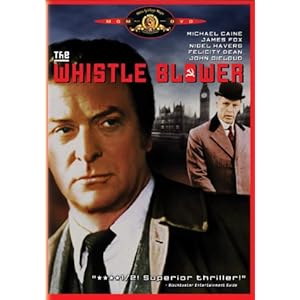
The Whistle Blower

Espionage flicks typically go one of two ways. One, the James Bond route; lots of action, explosions, beautiful women, gunfights, that sort of thing. Two, the more realistic way, films like Tinker, Tailor, Soldier, Spy and Argo. They both have their positives to take away, and sometimes it just depends what you're in the mood for. Where does 1987's The Whistle Blower fall? Oh so serious.

A veteran of the British Navy who served as a pilot during the Korean War, Frank Jones (Michael Caine) has moved on with his life and now has a mildly successful sales company. More and more, Frank finds himself talking his idealistic young son, Bob (Nigel Havers), down off the ledge about the nature of his job. Bob is a Russian linguist working for British intelligence, but he's become disillusioned about how the nature of the espionage is handled. Frank tries to convince him that with a struggling economy, any job is a good job, especially for a language specialist in Russian. Frank is stunned then when he receives the news that his son died in an accident, falling off the roof of his apartment building. Everyone from the police to the coroner believes it was an accident, but having talked to his son, Frank knows his son was investigating some deep, dark things. Was it an accident or part of a cover-up of something far more sinister?

Thank you, Netflix, for this one. I found it while looking through Caine's filmography/listing, and after months of procrastinating and avoiding it, I gave it a shot this week. There's no question what type of espionage flick this one is. It is the most serious of serious. No deadpan humor, no sexy secret agents, no guns a' blazing with explosions and fireballs. This is a gentlemanly espionage....well, mostly. From director Simon Langton, 'Whistle' manages to be both highly unsettling and low key in its delivery. You don't hear that often, do you? It can be a tad on the slow side, a little dull at times, but for the most part, I liked this one.

No surprises here, but Michael Caine will be my first, second and third reasons for watching this movie. Even when a movie is lousy, Caine is eternally watchable. When a movie is halfway decent, like 'Whistle' is, his performance can help bring it up a notch or two. Reflecting the solemn and serious tone of the story, it is a mostly understated, underplayed part for the screen veteran. He loves his son while also being frustrated by him. When Bob dies under suspicious circumstances, Frank is the only one who believes there could be more to the story. The portions of the story that follow are the movie at its best; an angry, confused and curious father searching for answers about his offspring. He even gets a few chances at some rabid outbursts, and let me tell you, I wouldn't want to be on the receiving end of a Caine outburst.

On top of Caine's performance, I liked the subtle nature of the story. At 104 minutes, it is never in a rush to get anywhere. Early on, it's not even in a rush to lay everything out. It's like as an audience we're dropped into a story that already had a prologue. Names, situations, backgrounds, reputations, they're all thrown at us, and we're forced to figure it out on the fly as it comes at us. Much of it surrounds British intelligence's effort to monitor Russian messages electronically. One agent Dodgson (Bill Wallis) has been pitting the Brits/Americans vs. the Russians, and those crafty Brits intend on figuring out what's going on. Their investigation leads to a traitor (John Gielgud) who's lived in England for over 20 years. As he continues to look for answers concerning his son, Frank finds out what his son was involved with, but also how far those intelligence agencies will go to produce effective results.

Like 2011's Tinker, Tailor, Soldier, Spy, 'Whistle' delves into the inner workings of the intelligence agencies. It isn't just them looking out for the country's well-being, but seeing how far they can push it to test the limits of their power.  It's a pretty frightening thought. Is one life expendable if it could lead to a huge payoff intelligence-wise? James Fox has an unsettling part as Lord, a British higher-up who calmly lays out a brutally sadistic plan, Barry Foster plays Charlie Greig, an old Army buddy of Frank's now working in Intelligence, and Gordon Jackson plays Bruce, the agent in the field putting plans into effect. Also watch for Felicity Dean as Cynthia, Bob's new girlfriend, a soon-to-be divorced woman with a kid, and Kenneth Colley as Pickett, a leftist crusading journalist desperately searching for a deeply hidden story.

I wish I had liked this movie more. For all the positives, it is slow, and it lacks a certain energy. Understated is one thing, but the story is so underplayed that I never really felt any sense of worry. The ending is disappointing although the final scene is moving, featuring some very cool on-location shooting at the Cenotaph in Whitehall, London.

The Whistle Blower (1987): ** 1/2 /****

Sunday, October 23, 2011

Danger Route

I stumbled across a channel in the last few weeks I didn't realize was on the dial -- This TV -- and taking any chance I can to see some hard-to-find movies, I've been reviewing their website fairly regularly. They're not showing classics, focusing more on some lesser known, more mainstream movies, including some I've never heard of, including 1967's Danger Route.

Part James Bond knock-off with a darker outlook on the life of a secret agent/spy, it struggles at times to decide what's really going on. The cast was what drew me in, and for the most part no one disappoints. Certain moments ring so true you feel they just have to be accurate, dead-on in their portrayal of the espionage underworld. The other moments though? Well, they fall short. The first 45 minutes were mind-numbingly slow, the middle portions a major improvement, and the end too tidy although perfectly cynical.

A secret agent with a license to kill, Jonas Wylde (Richard Johnson) has had enough of the business and wants out.  He decides to take on one more job, a contract hit on an order he receives from his superiors. A Czechoslovakian scientist has defected to the Americans with all his secrets, and he's ready to spill them all.  Wylde must now figure a way to get to the heavily guarded defector, briefly staying in Britain as he travels to America. As his plan comes together though, the very capable and highly professional Jonas begins to suspect something else is up. His mission is one thing, but is there something more? Is he part of a mole hunt? Who exactly is gunning for him?

I'm going to get this one rant out of the way and then won't come back to it again. As I say/type it, I know I sound like an ignorant American, but here goes anyways. This movie is very British. Usually in my mind, that's a positive. Here? Mostly because there was no closed captioning on the broadcast, it's a bad thing. Johnson talks in what can only be described as a quiet mumble. I'm pretty decent deciphering accents, but this movie threw me for a loop.  Therefore, I felt more than a few times like I was behind or had missed something, jumps in logic and story going over my head.  Apparently not though, 'Danger' just relying on a twisting and turning story that doesn't always make sense.

Taking into consideration his choice to talk in a growling whisper for most of his lines, Johnson is still an interesting choice to play this well-worn, experienced secret agent.  Usually playing a key secondary role -- he specialized in the right hand man part -- he gets a chance at a starring role.  I like the edge he brings to his character, an ability to handle himself in every situation, a distrust in basically everyone around him, and a knack for figuring things out quicker than humanly possible. In the cool but odd department, he also dispatches quite a few people via a nicely placed judo chop that Austin Powers would be proud of. Johnson's Wylde snaps necks like nobody's business.

About 45 minutes into the movie after the painfully slow opening, I was very much drawn in. Wylde finds out his mission is more than he was told, and things get interesting.  Director/actor Sam Wanamaker has a scene-stealing part that in two or three brutally effective scenes almost save the movie on their own. Playing CIA agent 'Lucinda,' Wanamaker shows the potential here after capturing Wylde, telling him exactly how he caught him.  It's well-written, well thought out and executed as perfectly as possible.  Simple and straightforward, and the best scene in the movie going away.

The supporting parts on the whole -- including Wanamaker -- are key without being time-consuming in actual screentime.  Harry Andrews plays Canning, Wylde's long-time supervisor trying to look out for one of his most-trusted agents. Gordon Jackson is Brian, Wylde's partner who helps him in and out of different missions, leaving the authorities in the dust.  Call me chauvinistic, but I had trouble keeping track of the female characters in this movie, four of them if I counted right, all attractive, blonde women. There's Carol Lynley as Jocelyn, Wylde's mistress, Barbara Bouchet as Marita, a possible double agent playing both sides, Sylvia Sims as Barbara, Canning's wife, and Diana Dors as a somewhat clueless maid Wylde plays.     

I wanted to like this one, and really tried to get into it, but it never amounts to much. Decent cast wasted in a disappointing espionage story.

Danger Route <---trailer (1967): * 1/2 /****

Wednesday, June 1, 2011

The Great Escape

I have two favorite movies, neither of which I'm able to pick one over the other.  I love them both, and all other movies come after it, first is 1960's The Alamo which I've reviewed before and then there's 1963's The Great Escape. Introduced to it at a young age when I showed an interest in history, I've probably seen it 25 or 30 times straight through, and another 75 or 100 catching bits and pieces. For me, it is that rare perfect movie. Great story, impressive cast, exciting action, and one of the best soundtracks ever. You can't ask for much more.

In World War II, both the Allies and Axis forces had to deal with how to handle prisoners of wars. In Germany, the Luftwaffe, the German Air Force, was placed in charge of these Allied prisoners, placing them in P.O.W. camps all over their occupied territory. These prisoners -- as was their sworn duty -- tried countless escapes over the length of the war in typically small groups, sometimes getting as many as a dozen out. But one true story set the bar for heroism and courage among the prisoners, the true story of 76 prisoners escaping Stalag Luft III in March 1944. Literally hundreds of prisoners were involved in the effort as the escape even had an impact on D-Day some three months later.

It's 1943, and a new prison camp has been built. The German Luftwaffe has taken the worst prisoners from all their camps and thrown them in this new camp that features all the security aspects they've learned from previous camps.  In this "perfect" camp, the Germans (Hannes Messemer is the commandant) intend to watch these men very carefully. Leading the prisoners is Roger Bartlett (Richard Attenborough), dubbed 'Big X' for his leadership at the top of the 'X Organization,' a team of prisoners working together to bust out as many captured soldiers as they can. Bartlett has bigger plans though this time around. Instead of just getting two or three prisoners out, he intends to get 250 out of the camp with a large-scale plan that includes three extremely long tunnels under the barbed-wire fence. The plan seems impossible, but the prisoners go to work, slowly working their way toward escape.

Do you know the line 'They don't make them like they used to?' This movie applies. Director John Sturges (one of my favorites and an underrated filmmaker overall) turns in his all-time best film, one that stands at or near the top in the lexicon of World War II movies. It is based in fact, sticking to the details and truths in the story, without getting bogged down.  There is action, humor (never overplayed, just natural humor arising from the situation), and characters you love and are generally rooting for. Composer Elmer Bernstein turns in a score that is one of the greats, especially the main theme, listen HERE. Bernstein's score both drives the story as needed and keeps it grounded in the quieter, emotional scenes (including one where a tunnel is discovered and its tragic consequences).  Sturges filmed in Germany -- as his assistant said, 'Germany looks like Germany.' An entire camp was built, an exact duplicate of the actual camp, bringing this 1963 epic up another notch in terms of realism and authenticity.

Sturges' movies were famous for their male-dominated ensemble casts, but this may be his most impressive. Start with Steve McQueen as Hilts, the motorcycle-riding 'Cooler King,' the role that shot him to international stardom. Then there's James Garner as Hendley, the scrounger, and Attenborough as Bartlett, the prisoner's top man, a brilliant mind who comes up with this improbable plan. Not bad, huh? Oh yeah, there's also James Donald as Ramsey, the senior British officer, Charles Bronson and John Leyton as Danny and Willie, the tunnel kings, James Coburn as Sedgwick, the manufacturer, Donald Pleasence as Blythe, the forger, David McCallum as Ashley-Pitt, "dispersal," and Gordon Jackson as MacDonald, the intelligence officer. Other prisoners include Nigel Stock, Jud Taylor and Angus Lennie in a small but essential part as Ives, Hilt's progressively wire-happy partner. A more impressive cast could be impossible to assemble.

What is amazing is that even with all those stars -- some on the rise, some already established -- is that they all register, they all make a lasting impression in a positive way. More on McQueen later, but Attenborough delivers a career-best as Big X, the driven even obsessed leader who wants to take the war back to the Germans, not sitting out the war comfortably as his captors intend. Garner's Hendley bonds with Pleasence's Blythe in some of the movie's most touching scenes, two very different people forming a friendship. Bronson and Leyton as the tunnel kings certainly make an impression, carving three tunnels out of the Earth 30 feet below the surface. Bronson is at his best, a Polish flyer with claustrophobia who hides his fear of small, enclosed spaces and digs. Coburn doesn't get a ton to do compared to the others, but is his usual, laconic self. There is not a weakness in the cast from top to bottom.

When movie fans think of The Great Escape, they usually go right to Steve McQueen, a rising star who got his crack at the big time here and didn't disappoint.  His Capt. Virgil Hilts is one of his most iconic roles, the loner, trouble-making American prisoner who attempts escape attempt after attempt.  What's funny is that his character basically disappears for vast stretches of the movie, only to reappear after a stint in the cooler and steal every scene he is in. This is McQueen at his laid back, scene-stealing best. With all the notable actor's actors around him, he is the unquestioned star thanks in great part to the finale, a motorcycle chase across Germany with his captors in hot pursuit. It is one of the greatest chases sequences ever, caped with one of the most impressive stunts ever, a 7-foot jump by stunt man Bud Ekins over a high-strung barbed-wire fence. McQueen is my favorite, but this is always his best to me.

With a final run-time of 2 hours and 53 minutes, Sturges' true story doesn't have to rush along at a lightning pace...but does anyway. The first 105 minutes or so focus exclusively on the escape attempt, putting all the little details together that need to happen. The first and biggest of course is the digging of the tunnels, 30 feet down and over 300 feet straight out. A track is built to transport prisoners/diggers, and wooden boards are needed to shore up the entire length of the tunnel. Up above, forgers create documents, tailors make clothes, Intelligence gathers information, all part of an elaborate system of security and watchmen to make sure nothing is discovered by their ever-vigilant German guards. It would have been easy for this movie to get bogged down in these details, but The Great Escape revels in them, making the mundane and possibly boring, exciting at a breakneck pace.

It is a movie called 'The Great Escape' though, and it is at its most exciting once the prisoners do escape, 76 of them in the dead of night spread out all over the German countryside. The escape attempt covers the last hour of the movie, an incredible extended sequence that is hard to top. It is almost entirely dialogue free, Bernstein's score playing over the action the whole way. Finally free of their camp, the prisoners make their efforts to hopefully reach freedom, some by train, some by bikes, others by planes, and in Hilts' case, a stolen German motorcycle.  Sturges was an action master, and this may be his tour de force sequence.

I could go on and on with this movie, and I've already sort of done so. My head is full of little tidbits of information that I've picked up over the course of repeated viewings.  Above all else through the drama, the facts, and the action is that Sturges gets the tone right from Paul Brickhill's source novel, and most importantly, the true story it is based on. These men did the impossible in an impossible situation. Knowing their chances of escape back to freedom were slim, they plodded on when they could have just as easily quit. If you didn't know and just read the details -- check out the Wikipedia entry HERE for more details -- you would say there's no way this happened, but somehow, some way, it did. The ending hits you square in the stomach as it should, but the movie ends on a positive note; McQueen's Hilts once again in the cooler, bouncing his baseball off the wall.  You may capture him again, but you'll never stop him from trying.

A perfect movie, one of the best around, and one of my two favorite movies.

The Great Escape <---trailer (1963): ****/****

Saturday, August 14, 2010

Yesterday's Enemy

War movies can be categorized into a wide variety of sub-genres, but two really stick with me the more I think about.  I'm struggling to come up with one that doesn't fit into one or the other in some way, anti-war and then a more heroic look at war.  Anti-war will typically get better critical reviews, think Platoon, Paths of Glory, Born on the 4th of July, Full Metal Jacket, and many, many more.  One that has been almost completely forgotten because of its controversial story is 1959's Yesterday's Enemy, a movie years ahead of its time that still packs a punch over 50 years later.

Anti-war movies typically have to tread that fine line between powerful and moving emotionally and just being preachy.  'Enemy' is just too honest, too forthright with the realities of war to be preachy.  It drags you into this story and quickly dispatches any notions you have about war movies you've seen in the past.  Sure, there's some genre characters, but they don't act like characters you've seen before.  These are soldiers fighting a hopeless mission where chances of survival range from slim to none, but they continue on because it's what they do, they fight.  Later after the plot review, I'm going to give major plot points away so be forewarned as you continue reading.

After a surprise Japanese attack, the ragtag remnants of a British battalion trudge through the Burmese jungle hoping to hook up with the main line of defense or at least find other wandering units.  Commanded by the highest ranking surviving officer, Capt. Langford (Stanley Baker), the survivors -- totaling between 40 and 50 men -- stumble across an isolated village where they find information about an upcoming Japanese offensive.  It's news that could save the lives of hundreds and maybe thousands of men if it reaches headquarters.  The radio is out though, forcing Langford to send a small squad forward with the news led by his right hand man, Sgt. McKenzie (Gordon Jackson), hoping the news reaches HQ.  With the Japanese not far behind, Langford stays behind in the village with the rest of the men, trying to buy as much time as possible while maybe, just maybe, surviving the coming firefight against impossible odds.

With WWII, there is and was a perception that the Allies were all heroic soldiers while the Axis were all demonized murderers intent on mass slaughter.  War crimes were committed on both sides of the war in Europe and the Pacific no matter what people believe.  That's part of what sets this movie apart from others.  In 1959 just 14 years since the end of WWII, 'Enemy' shows British and Japanese troops committing acts that would have been prime grounds for a war crime trial.  But in the context of the movie, it's necessary.  Baker's Langford is going to do whatever it takes to protect his men. A war correspondent (Leo McKern) asks though at what point does it become an atrocity? Two innocent people killed? 10? 100? Thousands? Topping this off though, director Val Guest doesn't answer that question. It's up to the individual to decide. If one person dies, is it worth the 10 that were saved?

It's rare you see a war movie, especially a pre-Vietnam war movie, that is so brutally honest.  Baker orders the execution of two Burmese villagers to get a Japanese informant to spill his guts.  Later, a Japanese officer (Philip Ahn) puts Langford in a similar situation, demanding he tell him everything he knows or his men will be killed.  Neither man does this because they relish killing in cold blood.  They do it because if they want to do their job and win the war people have to die, often in horrific, blood curdling situations. The whole movie delivers a powerful message, but it really hits home in the end.  Not knowing that McKenzie's squad has been ambushed and killed, Langford and a handful of survivors stand fast till the bitter end.  It is an unknown futile effort, but maybe it is more courageous because of that.  They don't know their stubbornness is wasted, their bravery unnecessary.  It is their duty and they intend to live up to it.

Known most for his performances in Zulu and The Guns of Navarone, Baker delivers a career-best performance as Capt. Langford.  He's not a raging, homicidal maniac, he's an officer who thinks things out in detail.  Forced to make extremely difficult decisions that will knowingly cause death in his own ranks, Langford commands this battalion remnant with a bigger picture in mind.  This isn't a hero or a villain, it's one man in an uncompromising situation who has to make decisions that could have horrific consequences and then has to live with it.  The conscience of the movie comes in three characters, a priest (Guy Rolfe), McKern's correspondent, and a medical officer (David Oxley), all questioning the humanity of what they're doing, Rolfe and McKern especially delivering strong performances.  Along with Jackson's Sgt. character, rounding out the unit among many others is Percy Herbert, David Lodge, and Richard Pasco as Lt. Hastings, the young officer dealing with the inner demons that tell him survival is a better option than blind courage. 

Filmed mostly on an indoor set, 'Enemy' still manages to give the feeling of being in the humid, sweaty Burmese jungle with a claustrophobic surrounding that gives the perception of being closed in with nowhere to go.  Guest films in black and white -- adding to the stark feeling -- and makes his soldiers look like soldiers who've been jungle fighting for months.  They're sweaty, wear unkempt beards, and their uniforms are in tatters.  Like everything else in this forgotten war movie, it all rings true.  Forgotten because of it's controversial subject matter and portrayal of Allied soldiers, Yesterday's Enemy is one of the best war movies I've ever seen. Honest, brutal, incredibly realistic, and a must see movie.

Yesterday's Enemy <---TCM trailer (1959): ****/****

Saturday, February 6, 2010

Tunes of Glory

Sometimes I can't help but think that British movies -- compared to Hollywood movies -- just get it. No over the top action, no fancy CGI or special effects, just that old reliable...acting. All it can take to pull a viewer in is a tour-de-force performance from an actor or actress, and you're hooked. Production values can be slim to none, but as long as the acting is on target chances are the movie will be a winner.

There I go again with vague, sweeping generalities, but British movies seem to rely more on acting above all else, with actors like Peter O'Toole, Richard Burton, Richard Attenborough, and of course, Alec Guinness. The English actor was a chameleon when it came to his roles, and I can't help but wonder if he'd be more well-known for his overall ability if he hadn't been in Star Wars. So many people associate him with Obi-Wan Kenobi that the rest of his movies have been somewhat forgotten. But in 1960's Tunes of Glory, Guinness once again shows how strong an actor he really was.

In command of a Highlands battalion in the years following WWII, Major Jock Sinclair (Guinness) is loved by his men. He led them through WWII in Europe and is really just one of the men...albeit with a higher rank. Sinclair is not the strictest of commanders and lets smaller things go in lieu of the bigger picture, and for that reason he's loved by his men. The battalion receives a new commander, Colonel Barrow (John Mills), an officer who spent much of the war in a German POW camp with years of desk duty prior to that. Barrow is a stickler for details, doing everything by the book. His command style clashes with Sinclair and what the battalion is used to. A division forms and the conflict comes to a rise when Sinclair strikes a corporal (John Fraser) who has been seeing his daughter (Susannah York).

Should Barrow bring his second-in-command up on charges? He's had prior issues with Sinclair so a court martial might seem like personal revenge. As well, a trial would bring disgrace to the battalion. But if he doesn't, Barrow is going up against everything he believes in. Whatever the Colonel decides to do could very well tear apart the unit from the inside out. This is a story definitely characteristic of a slow-burn, a plot that keeps on building and piling on. As a viewer, you know there will be some sort of confrontation but in what sense? I for one was completely caught off guard by the ending, a downer in every sense of the idea, but one that works and the most appropriate one too. A happy ending would seem out of place here.

This is a movie dominated by two men, Guinness and Mills, and dominated in a good way. Guinness' Sinclair is built up as the man to side with; he's loved by every one from family to fellow officers to his soldiers. There's a vibe off the character though, a little full of himself and quick-tempered. Mills is the toy soldier, the desk jockey who's never seen combat but is tortured still by his time spent in a German POW camp. He doesn't interact well with the men and gives off a sense of superiority to soldier and officer alike. What's interesting in the execution is how the story develops and how our perceptions change -- or at least mine did -- as we learn more about these two men.

With basically the whole story set in this extravagant barracks the battalion lives in and only a few venture outside the wall, the conflict drives things along thanks to the supporting cast. Some of the other battalion's officers include Dennis Price, Allan Cuthbertson, Duncan Macrae, and Paul Whitsun-Jones, some siding with Sinclair and others Barrow. Gordon Jackson especially rises above the rest as Capt. Jimmy Cairns, the battalion adjutant and a man loyal to his commander to a fault. It's one of those supporting roles that doesn't have much in the way of lines but ends up being memorable nonetheless.

No frills moviemaking at its finest. There is nothing flashy about the proceedings, but the story makes this movie special and really worth checking out. Two very different men, but both are strong-willed and even pigheaded when it comes to getting what they want. A Youtube user was kind enough to post the movie into segments, starting here with Part 1 of 10. Well worth your time if you don't mind sitting down at the computer for 105 minutes. Guinness, Mills, and a fine supporting cast don't disappoint.

Tunes of Glory <----trailer (1960): ***/****