Okay, I'll admit. I am a diehard Planet of the Apes fan. I know....it's a complete shocker for anyone who follows the site. The original series -- 5 movies -- is fun to watch from beginning to end, even if by the fifth film, things were running on empty. Then there's that Tim Burton remake/reboot version that....I don't know, was just awful. And then there was 2011's Rise of the Planet of the Apes, one of the most pleasant surprises in years for me in big-budget theatrical releases. Which naturally leads up to 2014's Dawn of the Planet of the Apes, currently raking in piles of money and critical acclaim.
It has been 10 years since a virus has torn the world apart, wiping out a majority of mankind across the planet. Little pockets of humanity have managed to survive, working together to do so. But north of San Francisco, the intelligent, genetically-evolved ape, Caesar (Andy Serkis), is leading a community of apes that has moved on with no interference from humanity. It's been so long since the apes have even seen a human they begin to wonder if any have even survived. That wonder is answered when a small group of humans, led by Malcolm (Jason Clarke), walks into the woods in hopes of reaching a nearby dam, a dam that if restarted up could power the life of their colony of survivors waiting in fortified San Francisco. Caesar must now decide what to do. Allow the humans to repair the broken-down dam and refuel their colony? Don't allow them to pass and risk a violent response from the humans who have become increasingly desperate? The ape community hangs in the balance.
Revisiting 'Rise' before jumping into 'Dawn' this weekend, I came away impressed again with where the series/franchise has gone. I can't say enough how surprised I was, how genuinely good 'Rise' was. Naturally, I was psyched for the sequel, to see what was done with the follow-up (Yes, I support sequels as it suits me). Director Matt Reeves takes the helm and does it well. It isn't necessarily what you'd expect from a summer blockbuster. It isn't mindless, stupid action on a grand scale. Yeah, it has action, but the focus and grand scale is more interested in the story and the characters, developing it all so the action actually means something. It's not just random explosions. The action and the story work together seamlessly. This isn't a mindless blockbuster. This is a good movie, and it is most definitely the better for it. 'Dawn' takes the baton and keeps on running, a worthy sequel, one that lays things out nicely for another sequel should they so choose.
What helps set this sequel apart from most inferior sequels is that rehashed idea from the original series that started way back in 1968 with The Planet of the Apes. 'Dawn' creates a story in a new world, a world that has gone most of 10 years without much in the way of human involvement. The roads have been claimed back by nature. The towns -- we see San Francisco as the main human backdrop -- are falling apart, nature, plants, weeds and greenery growing as far as the eye can see. Amongst this world without too much human interference, the Earth is getting back to the basics. In this world, little communities have popped up, including Caesar's ape village up in the Muir Woods National Monument, and the Colony in San Francisco, human survivors banding together. It seems simple to commend a movie for creating a world -- that's what they're supposed to do -- but 'Dawn' works. We're thrust into a dark, gloomy, dreary world where survival comes above all else. Simple as that.
Picking up right where he left off, Andy Serkis again steals the show as Caesar, the highly intelligent ape leader who has even learned to speak (the other apes coming along nicely in that department). At no point watching the apes do you ever really consider you're watching computer-generated images. It just looks real. It looks natural. The visual is key because if it didn't work, you're taken completely out of the movie and that can be impossible to recover from. Beyond the visual though, the best part of the movie is the development of the Caesar character. The revolution of the 1st movie is gone so the apes settle into a new life, Caesar as their leader. We see him struggling with decisions, struggling with leadership, struggling with what to do. He's now got a family to consider too, his wife, Cornelia (Judy Greer), and his son, Blue Eyes (Nick Thurston). The performance is the heart of the movie, Serkis carrying the movie from beginning to end.
So go figure, but there is far more interest here in the apes story than the humans. That's not to say the humans aren't interesting, just not as interesting as the apes. Along with Caesar and his family, we also see Koba (Toby Kebbell), Caesar's fiery friend, a rescue from a science lab, Maurice (Karin Konoval), an already intelligent former circus ape and Caesar's closest friend, and Rocket (Terry Notary), another friend from the ape habitat. As for the humans and along with Clarke, look for Dreyfus (Gary Oldman), the leader of the San Francisco colony, Ellie (Keri Russell), Malcolm's girlfriend, a doctor, Alexander (Kodi Smit-McPhee), Malcolm's son, with Kirk Acevedo, Jon Eyez, and Enrique Murciano as assorted other humans we meet.
The coolest dynamic that develops in 'Dawn' is between Caesar and Malcolm. They're both working to accomplish something, both working against incredibly tough odds to get that done. Their scenes together are pretty perfect, both men/fathers realizing how tough their situations are. They don't complain or pout, instead continuing to chip away and work at getting where they need to be. The ape-human dynamic there gives a different dimension to the already interesting story. And yes, the finale packs in the action, a violent night battle in the abandoned streets of San Francisco. It's got a lot going for it, drama, action, some surprising laughs, a little bit of everything. There's also some nice touches for series fans, including the soundtrack using quick samples of composer Jerry Goldsmith's score from the original 'Planet.'
A more than worthy sequel, one that hopefully propels the series forward into another entry!
Dawn of the Planet of the Apes (2014): ***/****
The Sons of Katie Elder
"First, we reunite, then find Ma and Pa's killer...then read some reviews."
Showing posts with label Planet of the Apes. Show all posts
Tuesday, July 15, 2014
Monday, March 3, 2014
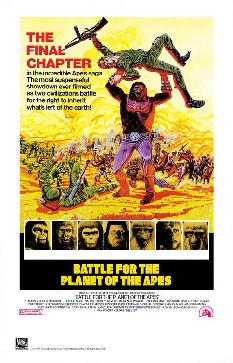
Battle for the Planet of the Apes
Here we sit. It's been a long ride full of ups and downs, but we made it through, and I'd like to thank all of those who supported me along the way. Yes, it is officially time to wrap up the Planet of the Apes series. It is time for 1973's Battle for the Planet of the Apes. Pretty dramatic, huh?!? I should totally do voiceover work.
It has been 12 years since the highly intelligent, thoughtful talking chimp, Caesar (Roddy McDowall) led the bloody revolt that gained apes -- the chimps, orangutans, and gorillas -- their freedom from their cruel human masters. It was a revolt that set off a chain reaction, countries and cities turning on each other, nuclear weapons wiping whole cities off the face of the Earth. Caesar and a small community of apes and humans manage to escape the destruction, building a city in the wilderness and starting their own civilization of sorts. It is a tenuous situation though, Caesar dealing with the apes' control over the humans, an ape general, Aldo (Claude Akins), eager to gain power, and the possibility of another group of human survivors -- mutated beings -- invading his territory. Can he hold it all together?
I've long been a fan of the Planet of the Apes series so it's been fun catching up with the series, especially watching all five movies straight through for the first time ever. It's cool to see the continuity among the five flicks, see recurring characters, recurring stories and plotlines. This fifth entry, from director J. Lee Thompson (who also directed Conquest), was released as part of the collection as an 'Extended Version,' running 93 minutes with about 10 minutes of additional footage reinserted. Not going to lie here, I was kinda disappointed with this final entry. There are positives -- more in that department later -- but there are also far too many negatives. The story seems like a jumbled collection of the previous storylines -- especially Beneath and Conquest -- and doesn't create enough of its own identity. Fans of the series will definitely enjoy it, but as far as series finales go, this one could have been better.
What are the biggest issues? Well, the script for starters. Reading about the Extended Cut (with spoilers), it's cool to see what footage was added back into the movie. Some scenes work better than others, some lack any rhythm or pacing. The exploration of the bombed-out city should be adrenaline-pumping, but the build-up is slow that it loses any momentum. It also seems thrown together for the sake of a sequel, an unnecessary one at that. It's only 12 years since the end of 'Conquest,' but the apes speak clearly and perfectly understandable. A whole species learns to speak in a little over a decade? Why did the humans go with the apes? Was it for survival? A whole sub-culture comes together so quickly, rushed backstory like the entire movie. There are portions that work as it tries to connect and wrap up with the rest of the series, especially the connection to Beneath, the villain, Governor Kolp (Severn Dearden), having an assistant, Mendez (Paul Stevens), the same name as the leader of the mutants in Beneath, the Alpha bomb there too. Little touches like that are pretty cool, especially for nerds like me
The biggest positive is the face of the franchise right there with Charlton Heston, Roddy McDowall, who starred in four of the five movies playing two different roles. His Caesar is the intelligent, thoughtful leader of the ape civilization, juggling countless roles. He's a leader, a father, a friend, and he's got to keep all the plates spinning at once. McDowall is the heart of it all, and not surprisingly, he kills the part. He is the link through it all, the best aspect of the character being his interest, his curiosity about his past. What were his parents like? How did they end up on a human-ruled Earth? What led to their tragic deaths? As a family man, we meet his wife, Lisa (Natalie Trundy, who also starred in four Ape movies), and his teenage son, Cornelius (Bobby Porter), who just wants to be a kid, Caesar doing his best to make his son's life smooth and easy. Any issues the movie may have, McDowall is above it. A fitting lead performance to wrap things up.
The rest of the cast is okay, some solid names, some recognizable faces, but nothing really eye-popping. Akins hams it up like a crazy person, his General Aldo really just a child in a position of power. He's the polar opposite of Caesar, fiery and emotional, but an action he takes certainly takes drives the story forward. For some of the other key ape performances, Lew Ayres is a scene-stealer as Mandemus, the senior citizen ape placed in charge of the armory, his logical thinking tripping everyone up, and Paul Williams as Virgil, the intellectual, the thinker who plays Devil's Advocate to just about everything Caesar does, but in a helpful fashion. Austin Stoker plays MacDonald, the face of the human group living with the apes. He has a good chemistry with McDowall's Caesar in their scenes together in an underused part.
I don't know. I came away disappointed. Maybe it tries to do too much, maybe it's just not very good. If you're a fan of the series, you've got to see it to wrap things up. There, plain and simple. It lacks that special something to hold it all together. A framing device with John Huston making a quick appearance as the Lawgiver tries to show that the Apes timeline can and should be adjusted, but everything else in the series seems to suggest otherwise. If it didn't, everything would collapse in on itself in the space time continuum. Yeah, time travel analysis. Didn't see that coming, did you?!? Watch it for the series, for the sci-fi aspect, just enough positives in a movie that lacked some energy. Still, it's been a hugely entertaining series, a fun ride over five movies. Thanks to the girlfriend for the Christmas present. Now, I've just gotta get her to watch them...
Battle for the Planet of the Apes (1973): ** 1/2 /****
It has been 12 years since the highly intelligent, thoughtful talking chimp, Caesar (Roddy McDowall) led the bloody revolt that gained apes -- the chimps, orangutans, and gorillas -- their freedom from their cruel human masters. It was a revolt that set off a chain reaction, countries and cities turning on each other, nuclear weapons wiping whole cities off the face of the Earth. Caesar and a small community of apes and humans manage to escape the destruction, building a city in the wilderness and starting their own civilization of sorts. It is a tenuous situation though, Caesar dealing with the apes' control over the humans, an ape general, Aldo (Claude Akins), eager to gain power, and the possibility of another group of human survivors -- mutated beings -- invading his territory. Can he hold it all together?
I've long been a fan of the Planet of the Apes series so it's been fun catching up with the series, especially watching all five movies straight through for the first time ever. It's cool to see the continuity among the five flicks, see recurring characters, recurring stories and plotlines. This fifth entry, from director J. Lee Thompson (who also directed Conquest), was released as part of the collection as an 'Extended Version,' running 93 minutes with about 10 minutes of additional footage reinserted. Not going to lie here, I was kinda disappointed with this final entry. There are positives -- more in that department later -- but there are also far too many negatives. The story seems like a jumbled collection of the previous storylines -- especially Beneath and Conquest -- and doesn't create enough of its own identity. Fans of the series will definitely enjoy it, but as far as series finales go, this one could have been better.
What are the biggest issues? Well, the script for starters. Reading about the Extended Cut (with spoilers), it's cool to see what footage was added back into the movie. Some scenes work better than others, some lack any rhythm or pacing. The exploration of the bombed-out city should be adrenaline-pumping, but the build-up is slow that it loses any momentum. It also seems thrown together for the sake of a sequel, an unnecessary one at that. It's only 12 years since the end of 'Conquest,' but the apes speak clearly and perfectly understandable. A whole species learns to speak in a little over a decade? Why did the humans go with the apes? Was it for survival? A whole sub-culture comes together so quickly, rushed backstory like the entire movie. There are portions that work as it tries to connect and wrap up with the rest of the series, especially the connection to Beneath, the villain, Governor Kolp (Severn Dearden), having an assistant, Mendez (Paul Stevens), the same name as the leader of the mutants in Beneath, the Alpha bomb there too. Little touches like that are pretty cool, especially for nerds like me
The biggest positive is the face of the franchise right there with Charlton Heston, Roddy McDowall, who starred in four of the five movies playing two different roles. His Caesar is the intelligent, thoughtful leader of the ape civilization, juggling countless roles. He's a leader, a father, a friend, and he's got to keep all the plates spinning at once. McDowall is the heart of it all, and not surprisingly, he kills the part. He is the link through it all, the best aspect of the character being his interest, his curiosity about his past. What were his parents like? How did they end up on a human-ruled Earth? What led to their tragic deaths? As a family man, we meet his wife, Lisa (Natalie Trundy, who also starred in four Ape movies), and his teenage son, Cornelius (Bobby Porter), who just wants to be a kid, Caesar doing his best to make his son's life smooth and easy. Any issues the movie may have, McDowall is above it. A fitting lead performance to wrap things up.
The rest of the cast is okay, some solid names, some recognizable faces, but nothing really eye-popping. Akins hams it up like a crazy person, his General Aldo really just a child in a position of power. He's the polar opposite of Caesar, fiery and emotional, but an action he takes certainly takes drives the story forward. For some of the other key ape performances, Lew Ayres is a scene-stealer as Mandemus, the senior citizen ape placed in charge of the armory, his logical thinking tripping everyone up, and Paul Williams as Virgil, the intellectual, the thinker who plays Devil's Advocate to just about everything Caesar does, but in a helpful fashion. Austin Stoker plays MacDonald, the face of the human group living with the apes. He has a good chemistry with McDowall's Caesar in their scenes together in an underused part.
I don't know. I came away disappointed. Maybe it tries to do too much, maybe it's just not very good. If you're a fan of the series, you've got to see it to wrap things up. There, plain and simple. It lacks that special something to hold it all together. A framing device with John Huston making a quick appearance as the Lawgiver tries to show that the Apes timeline can and should be adjusted, but everything else in the series seems to suggest otherwise. If it didn't, everything would collapse in on itself in the space time continuum. Yeah, time travel analysis. Didn't see that coming, did you?!? Watch it for the series, for the sci-fi aspect, just enough positives in a movie that lacked some energy. Still, it's been a hugely entertaining series, a fun ride over five movies. Thanks to the girlfriend for the Christmas present. Now, I've just gotta get her to watch them...
Battle for the Planet of the Apes (1973): ** 1/2 /****
Wednesday, February 19, 2014
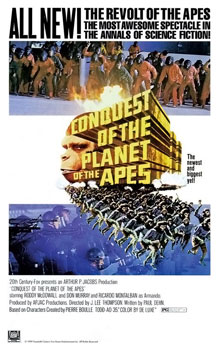
Conquest of the Planet of the Apes
Well, we might as well continue what we've started. While I'd seen the first three Planet of the Apes movies growing up on multiple occasions, I can't say the same for the last two movies in the series, 1972's Conquest of the Planet of the Apes and 1973's Battle for the Planet of the Apes. I've seen bits and pieces of both but never all the way through in one sitting. And away we go!
It's 1991 in North America, some 20 years since the talking apes, Zira and Cornelius, were murdered along with their baby...but it wasn't their baby. Things have changed around the world, a mysterious virus killing every single cat and dog on Earth, humans turning to apes/monkeys to be their pets. That changed quickly though, their mental capacities showing they're not so worthwhile as pets, but as slaves. It's been eight years, apes and chimpanzees used as janitors, delivery men, waiters and so many other tasks and jobs. That baby though that was supposed to have died? He didn't, and now he's 20 years old, still with loving-life Armando (Ricardo Montalban), who is now bringing the 20-year old intelligent, talking Caesar (Roddy McDowall) to the big city for the first time. Caesar is stunned and disgusted at what he finds, and when he becomes separated from Armando he's forced to adjust or reveal his secret.
Watching the Apes series in fairly quick succession, I've came away impressed. This fourth entry, this one from director J. Lee Thompson who had been in talks to direct the first movie, certainly qualifies. Is it a classic film? No, but fans of the series and science fiction in general will no doubt enjoy it. This series has impressed me because the original 1968 Planet of the Apes is a classic stand-alone science fiction film. It doesn't need any sequels. There are some questions we'd like more answers about, more background, but we know the truth, what really happened. Following the first sequel, 'Beneath,' the series found a way to survive and evolve -- whether intentionally or just lucking into it -- by bringing all five movies full circle. It's a nice touch, and each movie is different from its predecessor. Similar themes, tones, even some actors make it from movie to movie, but in an age of repetitive sequels, it's cool to see original, different sequels like this.
For this third sequel, there's a time jump.....into the future of 1991!!! 'Conquest' was filmed on location in Los Angeles at Century City, an appropriate, sparse and ultra-modern look for the visual of what Earth would have looked like in 1991....from a 1972 audience. Basically the entire story takes place in this one complex, the human rulers trying to limit and control the problems among the ape slaves. The apes are getting smarter, showing more initiative, being more disobedient. Add the very intelligent and very disgusted/motivated Caesar to the mix, and we've officially got an issue. There are points where things feel rushed in an 88-minute movie, another 10 minutes maybe fleshing it out some, but continuing what the series has laid out, this is a particularly dark, brutal story. What we see is even a tamed version of the original ending. It's not graphic (these movies were still considered "family movies") but the violence can be disturbing at times.
As has been the case for the first three movies, the key is the characters, whether they be heroes, villains or somewhere in between. That's what I found interesting here. Do we want to root for the evil, despicable humans who abuse slaves? Or do we root for the revolting apes to....wipe out mankind? Hhhhmmm, well, that's a toughie. It can be an uncomfortable movie to watch at times because of that dynamic. McDowall returns to the series, playing Cornelius' son (so technically his own) Caesar. It's a very good part for McDowall, fiery and angry, the match that sets off the explosion that's been waiting to happen. Hidden away from what society has become by Montalban's Armando, Caesar hasn't seen the darkness the world has to offer, until now. The rage inside him begins to grow and when he gets the proper motivation for revenge, he begins to planning the revolution, assembling and building, waiting for his time. A very good part for McDowall, especially his monologue in the final scene.
Again stealing the show is Montalban as the likable, charming and idealistic Armando, more Caesar's surrogate father than owner. It's not a huge part, but it is definitely a memorable one, Montalban again stealing all his scenes. Don Murray is nicely cast as Breck, the sadistic governor of the city, convinced that a talking ape is out there and hellbent on finding and killing him. Hari Rhodes plays his assistant, McDonald, an intelligent, thoughtful man, who has a bond of sorts with Caesar after they meet, and Severn Darden plays Breck's enforcer on his other shoulder, Kolp. Natalie Trundy continues her participation in the series, playing Lisa, a female ape, after already playing a mutant and a doctor in previous movies. John Randolph appears briefly in an update of a monologue he had in 'Escape' as well.
The portrayal of the future can be uncomfortable to watch at times. Breck and his fellow officials wear black and dark clothing, his soldiers wearing completely black uniforms that make them look like Nazi stormtroopers. The apes on the other hand wear green and orange jumpsuits, the color jumping off the screen. As I mentioned, I was surprised by how this story developed. The actual conquest in the final act of the movie is intense to say the least. The ending is startling, even if it was edited to be a little more tame. Still, I liked this sequel a lot and can't wait to see where the series goes in its finale. As well, it's hard not to notice how much this sequel inspired the Apes reboot, 2011's Rise of the Planet of the Apes. Just saying.
Conquest of the Planet of the Apes (1972): ***/****
It's 1991 in North America, some 20 years since the talking apes, Zira and Cornelius, were murdered along with their baby...but it wasn't their baby. Things have changed around the world, a mysterious virus killing every single cat and dog on Earth, humans turning to apes/monkeys to be their pets. That changed quickly though, their mental capacities showing they're not so worthwhile as pets, but as slaves. It's been eight years, apes and chimpanzees used as janitors, delivery men, waiters and so many other tasks and jobs. That baby though that was supposed to have died? He didn't, and now he's 20 years old, still with loving-life Armando (Ricardo Montalban), who is now bringing the 20-year old intelligent, talking Caesar (Roddy McDowall) to the big city for the first time. Caesar is stunned and disgusted at what he finds, and when he becomes separated from Armando he's forced to adjust or reveal his secret.
Watching the Apes series in fairly quick succession, I've came away impressed. This fourth entry, this one from director J. Lee Thompson who had been in talks to direct the first movie, certainly qualifies. Is it a classic film? No, but fans of the series and science fiction in general will no doubt enjoy it. This series has impressed me because the original 1968 Planet of the Apes is a classic stand-alone science fiction film. It doesn't need any sequels. There are some questions we'd like more answers about, more background, but we know the truth, what really happened. Following the first sequel, 'Beneath,' the series found a way to survive and evolve -- whether intentionally or just lucking into it -- by bringing all five movies full circle. It's a nice touch, and each movie is different from its predecessor. Similar themes, tones, even some actors make it from movie to movie, but in an age of repetitive sequels, it's cool to see original, different sequels like this.
For this third sequel, there's a time jump.....into the future of 1991!!! 'Conquest' was filmed on location in Los Angeles at Century City, an appropriate, sparse and ultra-modern look for the visual of what Earth would have looked like in 1991....from a 1972 audience. Basically the entire story takes place in this one complex, the human rulers trying to limit and control the problems among the ape slaves. The apes are getting smarter, showing more initiative, being more disobedient. Add the very intelligent and very disgusted/motivated Caesar to the mix, and we've officially got an issue. There are points where things feel rushed in an 88-minute movie, another 10 minutes maybe fleshing it out some, but continuing what the series has laid out, this is a particularly dark, brutal story. What we see is even a tamed version of the original ending. It's not graphic (these movies were still considered "family movies") but the violence can be disturbing at times.
As has been the case for the first three movies, the key is the characters, whether they be heroes, villains or somewhere in between. That's what I found interesting here. Do we want to root for the evil, despicable humans who abuse slaves? Or do we root for the revolting apes to....wipe out mankind? Hhhhmmm, well, that's a toughie. It can be an uncomfortable movie to watch at times because of that dynamic. McDowall returns to the series, playing Cornelius' son (so technically his own) Caesar. It's a very good part for McDowall, fiery and angry, the match that sets off the explosion that's been waiting to happen. Hidden away from what society has become by Montalban's Armando, Caesar hasn't seen the darkness the world has to offer, until now. The rage inside him begins to grow and when he gets the proper motivation for revenge, he begins to planning the revolution, assembling and building, waiting for his time. A very good part for McDowall, especially his monologue in the final scene.
Again stealing the show is Montalban as the likable, charming and idealistic Armando, more Caesar's surrogate father than owner. It's not a huge part, but it is definitely a memorable one, Montalban again stealing all his scenes. Don Murray is nicely cast as Breck, the sadistic governor of the city, convinced that a talking ape is out there and hellbent on finding and killing him. Hari Rhodes plays his assistant, McDonald, an intelligent, thoughtful man, who has a bond of sorts with Caesar after they meet, and Severn Darden plays Breck's enforcer on his other shoulder, Kolp. Natalie Trundy continues her participation in the series, playing Lisa, a female ape, after already playing a mutant and a doctor in previous movies. John Randolph appears briefly in an update of a monologue he had in 'Escape' as well.
The portrayal of the future can be uncomfortable to watch at times. Breck and his fellow officials wear black and dark clothing, his soldiers wearing completely black uniforms that make them look like Nazi stormtroopers. The apes on the other hand wear green and orange jumpsuits, the color jumping off the screen. As I mentioned, I was surprised by how this story developed. The actual conquest in the final act of the movie is intense to say the least. The ending is startling, even if it was edited to be a little more tame. Still, I liked this sequel a lot and can't wait to see where the series goes in its finale. As well, it's hard not to notice how much this sequel inspired the Apes reboot, 2011's Rise of the Planet of the Apes. Just saying.
Conquest of the Planet of the Apes (1972): ***/****
Thursday, February 13, 2014
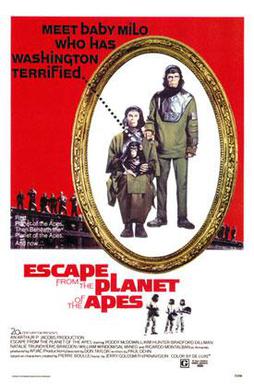
Escape from the Planet of the Apes
Sometimes a series is too successful to just let it end naturally. Following the success of Planet of the Apes and Beneath the Planet of the Apes, Fox Studios wanted another sequel, but there was a problem. Without giving too much away, the ending for 'Beneath' well....didn't really leave any opening for a follow-up. That's what screenwriters are for and ta-da! The series continued! A third movie in the series, 1971's Escape from the Planet of the Apes.
On a warm sunny day off the coast in southern California, a spaceship is discovered floating in the Pacific. The ship is brought ashore, the Army waiting to welcome the astronauts on-board but no one is sure where the spaceship came from or who is in fact on-board. Those waiting are stunned when the three astronauts remove their helmets, revealing themselves as apes. The three astronauts? Dr. Cornelius (Roddy McDowall), his wife, Dr. Zira (Kim Hunter) and Dr. Milo (Sal Mineo). The arrival of talking, intelligent apes stuns the world, forcing the government to decide what to do with the ape trio. Some are welcoming, Cornelius and Zira especially becoming instantly famous in pop culture. Others though aren't so welcoming, questioning where these apes came from and what is their intention in coming to Earth? Both sides need to find a happy medium, but some are sure the presence alone of these futuristic astronauts is a threat to the future of mankind.
So as we talked about, Beneath the Planet of the Apes didn't leave much of an opening for the series to continue, Charlton Heston insisting that be it for the series. Money is a powerful motivator though, isn't it? The series continues, but back on Earth in modern times. Director Don Taylor begins the second half of the series, catapulting the franchise in a different route for its final three films, composer Jerry Goldsmith returning as well with a great score. The premise linking 'Beneath' and 'Escape' is a tad contrived, a tad forced when you think about how 'Beneath' ended but for the sake of where the series is going, it's not so bad. Why does it stand out from the rest?
Two reasons. McDowall and Hunter. Playing Cornelius, McDowall returns to the series after being unable to to star in 'Beneath' because of a scheduling conflict. Less than pleased with her characterization in 'Beneath' (or maybe lack of), Hunter returned because she liked the script. The story is a departure from the first two movies, but this returning duo is perfect. Where we saw Heston's Taylor and James Franciscus' Brent struggling to adjust in a simian world, we now see Cornelius and Zira going through the same struggles in a human world. Where everything else has changed around them, having a spouse is a constant. Their chemistry is perfect, two intelligent individuals deciding what should be their next step, how best to survive in this human world. They have these perfect little moments, Cornelius trying on suits, Zira trying on stylish dresses, Cornelius standing up for his wife, Zira fighting for respect that carries the story surprisingly well on an emotional level.
It's cool to see Cornelius and Zira -- key supporting parts in the first two movies, still supporting parts -- step into the lead roles. That added dimension carries the movie. Who else to look for? Bradford Dillman and Natalie Trundy as Lewis Dixon and Stephanie Branton, two doctors and animal psychiatrists who become almost public relations representatives for Cornelius and Zira, but more importantly, they become trusted friends. Eric Braeden is Dr. Otto Hasslein, the scientific adviser to the President (William Windom), who questions that if these apes come from Earth's future...why did they leave? It's Eric Braeden so yes, he's a villain. Mineo makes the most of his smallish part as Dr. Milo, the third ape to travel through time with Cornelius and Zira, while Ricardo Montalban is a scene-stealer as Armando, the charming, friendly owner of a circus who works with Lewis and Stephanie. Also look for Jason Evers and Albert Salmi as Braeden's two henchmen, while John Randolph is the head of the commission investigating what to do with the visiting simians.
There are portions of this movie that are really sweet, great emotional moments that work because of the chemistry between McDowall and Hunter. Following the trend of the first two movies though, things take a turn for the dark though near the halfway point of the 98-minute movie. The time travel aspect comes up, if someone from the future knows what's going to happen, can we change it by wiping them out? We discuss issues of nuclear war, experimentation on animals, prejudices against races and cultures, but it is all handled in subtle enough fashion that it works. The ending is pretty heartbreaking in itself, but as the series has set us up for, there's a great twist in the final scene. Definitely stick with it to the final credits.
Another worthy Planet of the Apes movie, throwing us for a loop but all for the interesting. Coming up next, the final two films in the series, Conquest of Planet of the Apes and Battle for the Planet of the Apes, neither of which I've seen in one sitting. Stay tuned!
Escape from the Planet of the Apes (1971): ***/****
On a warm sunny day off the coast in southern California, a spaceship is discovered floating in the Pacific. The ship is brought ashore, the Army waiting to welcome the astronauts on-board but no one is sure where the spaceship came from or who is in fact on-board. Those waiting are stunned when the three astronauts remove their helmets, revealing themselves as apes. The three astronauts? Dr. Cornelius (Roddy McDowall), his wife, Dr. Zira (Kim Hunter) and Dr. Milo (Sal Mineo). The arrival of talking, intelligent apes stuns the world, forcing the government to decide what to do with the ape trio. Some are welcoming, Cornelius and Zira especially becoming instantly famous in pop culture. Others though aren't so welcoming, questioning where these apes came from and what is their intention in coming to Earth? Both sides need to find a happy medium, but some are sure the presence alone of these futuristic astronauts is a threat to the future of mankind.
So as we talked about, Beneath the Planet of the Apes didn't leave much of an opening for the series to continue, Charlton Heston insisting that be it for the series. Money is a powerful motivator though, isn't it? The series continues, but back on Earth in modern times. Director Don Taylor begins the second half of the series, catapulting the franchise in a different route for its final three films, composer Jerry Goldsmith returning as well with a great score. The premise linking 'Beneath' and 'Escape' is a tad contrived, a tad forced when you think about how 'Beneath' ended but for the sake of where the series is going, it's not so bad. Why does it stand out from the rest?
Two reasons. McDowall and Hunter. Playing Cornelius, McDowall returns to the series after being unable to to star in 'Beneath' because of a scheduling conflict. Less than pleased with her characterization in 'Beneath' (or maybe lack of), Hunter returned because she liked the script. The story is a departure from the first two movies, but this returning duo is perfect. Where we saw Heston's Taylor and James Franciscus' Brent struggling to adjust in a simian world, we now see Cornelius and Zira going through the same struggles in a human world. Where everything else has changed around them, having a spouse is a constant. Their chemistry is perfect, two intelligent individuals deciding what should be their next step, how best to survive in this human world. They have these perfect little moments, Cornelius trying on suits, Zira trying on stylish dresses, Cornelius standing up for his wife, Zira fighting for respect that carries the story surprisingly well on an emotional level.
It's cool to see Cornelius and Zira -- key supporting parts in the first two movies, still supporting parts -- step into the lead roles. That added dimension carries the movie. Who else to look for? Bradford Dillman and Natalie Trundy as Lewis Dixon and Stephanie Branton, two doctors and animal psychiatrists who become almost public relations representatives for Cornelius and Zira, but more importantly, they become trusted friends. Eric Braeden is Dr. Otto Hasslein, the scientific adviser to the President (William Windom), who questions that if these apes come from Earth's future...why did they leave? It's Eric Braeden so yes, he's a villain. Mineo makes the most of his smallish part as Dr. Milo, the third ape to travel through time with Cornelius and Zira, while Ricardo Montalban is a scene-stealer as Armando, the charming, friendly owner of a circus who works with Lewis and Stephanie. Also look for Jason Evers and Albert Salmi as Braeden's two henchmen, while John Randolph is the head of the commission investigating what to do with the visiting simians.
There are portions of this movie that are really sweet, great emotional moments that work because of the chemistry between McDowall and Hunter. Following the trend of the first two movies though, things take a turn for the dark though near the halfway point of the 98-minute movie. The time travel aspect comes up, if someone from the future knows what's going to happen, can we change it by wiping them out? We discuss issues of nuclear war, experimentation on animals, prejudices against races and cultures, but it is all handled in subtle enough fashion that it works. The ending is pretty heartbreaking in itself, but as the series has set us up for, there's a great twist in the final scene. Definitely stick with it to the final credits.
Another worthy Planet of the Apes movie, throwing us for a loop but all for the interesting. Coming up next, the final two films in the series, Conquest of Planet of the Apes and Battle for the Planet of the Apes, neither of which I've seen in one sitting. Stay tuned!
Escape from the Planet of the Apes (1971): ***/****
Friday, February 7, 2014
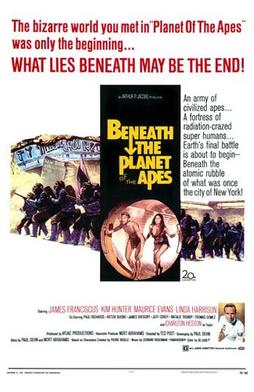
Beneath the Planet of the Apes
Well, let's not mess with a good thing. I love the original Planet of the Apes, and it's been years since I caught up with its four sequels. While none of the sequels live up to the original's success, these are good movies (even if there was no need for any sequel). My personal favorite has always been the first sequel, 1970's Beneath the Planet of the Apes.
Following where the previous NASA mission explored in deep space, a spaceship crashes on the same far-off planet, astronaut Brent (James Franciscus), trying desperately to survive. When the ship's commander (Tod Andrews) dies from his wounds, Brent is all alone among the wreckage. Thinking he's alone on this planet, Brent is shocked when a woman rides over the hill on a horse packed with supplies. The woman is Nova (Linda Harrison), and she's clutching the dog tags of Taylor (Charlton Heston) in her hand. Unable to speak, Nova can't communicate what happened to Taylor, Brent only knowing that he's landed on the right planet. Nova takes him to Ape City though, leaving the stranded astronaut stunned at what he's found. Now on the run, Brent and Nova must stay one step ahead of the gorilla army, an invasion planned for the mysterious Forbidden Zone.
Picking up exactly where the original 'Apes' left off, 'Beneath' is an interesting follow-up. Following the immense success of the first movie, Fox Studios went ahead with a sequel that star Charlton Heston wanted nothing to do with. That contract thing though, it gets in the way of what you want to do. Heston agreed to play a small part (he's only on-screen for about 10 minutes) with the demand that one sequel was all there would be. Well, he got his first part of the deal, but there were three more sequels to come. What's the result here? A solid sequel that stays true to the formula laid out by the first one, adding some new layers in the second half of a 95-minute movie. Early on, it feels almost like a scene-for-scene remake -- Brent going through what Taylor did -- but it's the second half that brings the movie up a notch or two.
Replacing Heston in the lead role is Franciscus, a good actor who never became a huge star in film or television. He was a familiar face though who does a solid if unspectacular job as Brent. The biggest issue with the character is what I mentioned earlier, Brent is just too similar to Taylor to really leave his own mark. Still, I liked Franciscus, and Brent does get his chance to step into the spotlight in the final act as we find out what's in the Forbidden Zone. Also returning from the first movie is Kim Hunter as the friendly, helpful intelligent Dr. Zira, Maurice Evans as the cynical, truth-hiding Dr. Zaius, David Watson replacing Roddy McDowall (other obligations) as Cornelius', Zira's husband and fellow scientist. Also joining the cast is James Gregory as General Ursus, the commander of the army who's obsessed with leading an invasion into the Forbidden Zone.
So what exactly is out there, hiding away in the Forbidden Zone? SPOILERS in this paragraph SPOILERS Chased by a squad of gorilla cavalry, Brent and Nova ride into the Forbidden Zone, hiding away in a subterranean cavern that ends up being the subway tunnels underneath New York City. They find a community of mutants who survived the original atomic blasts and now worship a Doomsday bomb that was built strong enough to destroy the world. What to do, what to do? The mutants have no way of protecting themselves while the invading gorilla army intends to wipe out anything they find in the Forbidden Zone. Brent, Nova and Taylor are caught in the middle to look for a solution, however dangerous. Look for Paul Richards as Mendez, leader of the mutants, with Victor Buono, Jeff Corey, Natalie Trundy, Don Pedro Colley and Gregory Sierra his Mutant Cabinent of sorts.
Where 'Beneath' sets itself above the other sequels is in the road the story goes down in the final act. A familiar story up to that point, it takes a big turn....for the better. I don't want to give spoilers away because like the original, the ending resonates more if you're surprised at where it goes. You know me by now, I'm a sucker for a dark, brutally cynical ending. This one sets the bar pretty high, unceremonious in how it knocks off certain characters, the final twist coming and going in a flash. That's it. That's all. Movie over. An underrated sequel for sure, well worth checking out for science fiction fans, especially for fans of the Apes series. Next up, Escape from the Planet of the Apes!
Beneath the Planet of the Apes (1970): ***/****
Following where the previous NASA mission explored in deep space, a spaceship crashes on the same far-off planet, astronaut Brent (James Franciscus), trying desperately to survive. When the ship's commander (Tod Andrews) dies from his wounds, Brent is all alone among the wreckage. Thinking he's alone on this planet, Brent is shocked when a woman rides over the hill on a horse packed with supplies. The woman is Nova (Linda Harrison), and she's clutching the dog tags of Taylor (Charlton Heston) in her hand. Unable to speak, Nova can't communicate what happened to Taylor, Brent only knowing that he's landed on the right planet. Nova takes him to Ape City though, leaving the stranded astronaut stunned at what he's found. Now on the run, Brent and Nova must stay one step ahead of the gorilla army, an invasion planned for the mysterious Forbidden Zone.
Picking up exactly where the original 'Apes' left off, 'Beneath' is an interesting follow-up. Following the immense success of the first movie, Fox Studios went ahead with a sequel that star Charlton Heston wanted nothing to do with. That contract thing though, it gets in the way of what you want to do. Heston agreed to play a small part (he's only on-screen for about 10 minutes) with the demand that one sequel was all there would be. Well, he got his first part of the deal, but there were three more sequels to come. What's the result here? A solid sequel that stays true to the formula laid out by the first one, adding some new layers in the second half of a 95-minute movie. Early on, it feels almost like a scene-for-scene remake -- Brent going through what Taylor did -- but it's the second half that brings the movie up a notch or two.
Replacing Heston in the lead role is Franciscus, a good actor who never became a huge star in film or television. He was a familiar face though who does a solid if unspectacular job as Brent. The biggest issue with the character is what I mentioned earlier, Brent is just too similar to Taylor to really leave his own mark. Still, I liked Franciscus, and Brent does get his chance to step into the spotlight in the final act as we find out what's in the Forbidden Zone. Also returning from the first movie is Kim Hunter as the friendly, helpful intelligent Dr. Zira, Maurice Evans as the cynical, truth-hiding Dr. Zaius, David Watson replacing Roddy McDowall (other obligations) as Cornelius', Zira's husband and fellow scientist. Also joining the cast is James Gregory as General Ursus, the commander of the army who's obsessed with leading an invasion into the Forbidden Zone.
So what exactly is out there, hiding away in the Forbidden Zone? SPOILERS in this paragraph SPOILERS Chased by a squad of gorilla cavalry, Brent and Nova ride into the Forbidden Zone, hiding away in a subterranean cavern that ends up being the subway tunnels underneath New York City. They find a community of mutants who survived the original atomic blasts and now worship a Doomsday bomb that was built strong enough to destroy the world. What to do, what to do? The mutants have no way of protecting themselves while the invading gorilla army intends to wipe out anything they find in the Forbidden Zone. Brent, Nova and Taylor are caught in the middle to look for a solution, however dangerous. Look for Paul Richards as Mendez, leader of the mutants, with Victor Buono, Jeff Corey, Natalie Trundy, Don Pedro Colley and Gregory Sierra his Mutant Cabinent of sorts.
Where 'Beneath' sets itself above the other sequels is in the road the story goes down in the final act. A familiar story up to that point, it takes a big turn....for the better. I don't want to give spoilers away because like the original, the ending resonates more if you're surprised at where it goes. You know me by now, I'm a sucker for a dark, brutally cynical ending. This one sets the bar pretty high, unceremonious in how it knocks off certain characters, the final twist coming and going in a flash. That's it. That's all. Movie over. An underrated sequel for sure, well worth checking out for science fiction fans, especially for fans of the Apes series. Next up, Escape from the Planet of the Apes!
Beneath the Planet of the Apes (1970): ***/****
Thursday, February 6, 2014
Planet of the Apes (1968)
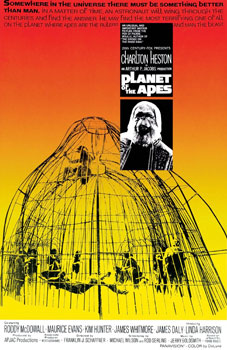
Ah, science fiction, sometimes I forget how good a genre it can be. For Christmas, my girlfriend got me the Planet of the Apes: Legacy Collection, five films making up one of my favorite film series. It is a series that got progressively worse, continuing because audiences liked them, not because they were particularly classic movies. That said, I like them all a lot and always will, especially the first film, the one genuine classic in the bunch, 1968's Planet of the Apes.
A U.S. spacecraft is traveling in deep space, its four-person crew commanded by cynical astronaut George Taylor (Charlton Heston). Their mission involves exploring the far reaches of space, but a malfunction awakens Taylor and two other survivors as their ship crash lands on a seemingly empty planet. Taylor, along with fellow astronauts Landon (Robert Gunner) and Dodge (Jeff Burton), gather what little supplies they have and head out into this unexplored world, looking for any sign of life. Walking for days inland, they finally do find life, a human-like race that is primitive to say the least, dressed in animal furs and unable to speak. The scientific find is one thing, but the trio of astronauts is in for a far bigger shock. The humans begin to run away from an unseen threat, and then they're there. Taylor and Co. run with them, stunned to see talking apes, dressed in military uniforms on horseback and armed to the teeth. What the hell is going on? What kind of planet have the astronauts found?
It's easy to forget how much impact this 1968 sci-fi classic has had on the science fiction genre as a whole. From director Franklin J. Schaffner, 'Planet' is the first of five movies (in the original series at least) that was followed by a short-lived TV show, an attempt at a reboot (2001's Planet of the Apes), and a far more successful reboot (2011's Rise of the Planet of the Apes). I'm curious to see where the most recent series goes, but this original entry will no doubt be the one all others are compared to. It's smart, original, unsettling and keeps you guessing until the end. There are some moments in the second half that drag a little bit, but the moments that work are science fiction perfection. I plan on watching and reviewing all the Apes movies so keep an eye out, and here we go!
Obviously when you're going into a movie titled Planet of the Apes, you kinda know the twist, right? There's a planet...well, of apes. Still, Schaffner's film (working off a novel from Pierre Boulle) builds the tension to almost unbearable levels in making its revelation. In a mission that isn't completely explained, NASA sends four astronauts (one dies during the voyage) deep into space at the speed of light, working off a theory that it will advance them in time. It does, some sort of malfunction bringing the spaceship into a planet's orbit, the crew crash-landing in a huge lake. We follow them for the next 30 minutes as they venture into a seemingly empty world, Lake Powell in Utah providing a beautiful, creepy, eerie backdrop. Composer Jerry Goldsmith's score is spot-on (listen to an extended sample HERE), using regular musical notes and cues but mixing it in with a variety of odd noises that sound natural and spooky, building up that fear of the unseen and unknown.
It is around the 32-minute mark we are shockingly introduced to the world run by apes. We learn over the course of the movie more about this culture with a hierarchy of government (gorillas = military/power, chimps = educators/science, orangutans = political/authority), a history going back thousands of years, beliefs and faith in a religion and a God-like being, all these little things that make the reveal all that more involving, unsettling and fascinating. As Taylor explores this world as a prisoner -- all humans are slaves -- we meet Dr. Zira (Kim Hunter) and Dr. Cornelius (Roddy McDowall), two intellectuals and scientists, interested in learning and advancing. In Heston's Taylor, they see a chance to learn, but also a threat to everything they know, believe in and hope for. Also look for Maurice Evans as Dr. Zaius, an intellectual who knows what threats history and humans hold, the film's biggest villain, James Whitmore as the President of the Assembly, James Daly as a prosecutor trying to prove Taylor is a mutant. The idea of something so well thought out, so innovative, that simian culture is an obvious but underrated reason for the movie's success. It doesn't hurt either that the makeup for the apes is immaculately impeccable.
Charlton Heston is the man. That is all. He's one of my favorites, and I think he gets a bad wrap at times because at times, he could be a tad wooden, even playing similar roles one after another. Fair to a point, but he's a Hollywood legend for sure. In a long, distinguished career, Heston piled up memorable roles, but this is one of his best. His George Taylor is smart, cynical and willing to question anyone and everything. So when he crash lands on a planet run by intelligent apes? Yeah, he's going to have some issues. His complete shock at what he's found is genuine, Heston committing to the part. At a certain point, his goal is simple, just survive on a planet and in a community that is equal parts curious and scared to death of him. He shows off his acting too, as he's struck mute for an extended portion of the movie. I love the cynical, questioning nature of the character, and the iconic lines from 'Get your paws off me, you damn dirty apes!' (one of the most iconic lines ever) to his final line still resonate 40-plus years later.
Lost at times in the science fiction world and mystery of what we've found are some great moments among the characters. I love the dynamic between Heston's Taylor and Hunter's Dr. Zira. Their dialogue scenes, with McDowall's Cornelius too, have an easy, charming back and forth to them. It just looks easy. This is where some of the ideas and messages of 'Apes' come from. Within a different culture, we see the same questions that humans ask about evolution, survival, faith, beliefs, religion, destiny and finding your niche in life. In an underrated cast that doesn't boast a ton of star power, Hunter and McDowall really step up to the plate in support of one of Heston's best performances. Also look for Linda Harrison as Nova, a woman who bonds with Taylor, even if she is mute, Lou Wagner as Lucius, Zira's nephew who helps Taylor late in the movie, and Buck Kartalian as Julius, a gorilla guard who works with Zira with their human slaves.
Well, here we are. The ending that rewrote the twist ending, something movies from every genre have tried to duplicate ever since. If you've made it this far into a Planet of the Apes review, I'm guessing that A. You either know the ending or B. Want to know the ending. No spoilers here. If you haven't seen 'Apes,' you deserve to go in fresh without any knowledge of what's coming. It is a great finale, one that deserves its fame and notoriety. A pretty perfect ending to a pretty perfect science fiction flick.
Planet of the Apes (1968): ****/****
A U.S. spacecraft is traveling in deep space, its four-person crew commanded by cynical astronaut George Taylor (Charlton Heston). Their mission involves exploring the far reaches of space, but a malfunction awakens Taylor and two other survivors as their ship crash lands on a seemingly empty planet. Taylor, along with fellow astronauts Landon (Robert Gunner) and Dodge (Jeff Burton), gather what little supplies they have and head out into this unexplored world, looking for any sign of life. Walking for days inland, they finally do find life, a human-like race that is primitive to say the least, dressed in animal furs and unable to speak. The scientific find is one thing, but the trio of astronauts is in for a far bigger shock. The humans begin to run away from an unseen threat, and then they're there. Taylor and Co. run with them, stunned to see talking apes, dressed in military uniforms on horseback and armed to the teeth. What the hell is going on? What kind of planet have the astronauts found?
It's easy to forget how much impact this 1968 sci-fi classic has had on the science fiction genre as a whole. From director Franklin J. Schaffner, 'Planet' is the first of five movies (in the original series at least) that was followed by a short-lived TV show, an attempt at a reboot (2001's Planet of the Apes), and a far more successful reboot (2011's Rise of the Planet of the Apes). I'm curious to see where the most recent series goes, but this original entry will no doubt be the one all others are compared to. It's smart, original, unsettling and keeps you guessing until the end. There are some moments in the second half that drag a little bit, but the moments that work are science fiction perfection. I plan on watching and reviewing all the Apes movies so keep an eye out, and here we go!
Obviously when you're going into a movie titled Planet of the Apes, you kinda know the twist, right? There's a planet...well, of apes. Still, Schaffner's film (working off a novel from Pierre Boulle) builds the tension to almost unbearable levels in making its revelation. In a mission that isn't completely explained, NASA sends four astronauts (one dies during the voyage) deep into space at the speed of light, working off a theory that it will advance them in time. It does, some sort of malfunction bringing the spaceship into a planet's orbit, the crew crash-landing in a huge lake. We follow them for the next 30 minutes as they venture into a seemingly empty world, Lake Powell in Utah providing a beautiful, creepy, eerie backdrop. Composer Jerry Goldsmith's score is spot-on (listen to an extended sample HERE), using regular musical notes and cues but mixing it in with a variety of odd noises that sound natural and spooky, building up that fear of the unseen and unknown.
It is around the 32-minute mark we are shockingly introduced to the world run by apes. We learn over the course of the movie more about this culture with a hierarchy of government (gorillas = military/power, chimps = educators/science, orangutans = political/authority), a history going back thousands of years, beliefs and faith in a religion and a God-like being, all these little things that make the reveal all that more involving, unsettling and fascinating. As Taylor explores this world as a prisoner -- all humans are slaves -- we meet Dr. Zira (Kim Hunter) and Dr. Cornelius (Roddy McDowall), two intellectuals and scientists, interested in learning and advancing. In Heston's Taylor, they see a chance to learn, but also a threat to everything they know, believe in and hope for. Also look for Maurice Evans as Dr. Zaius, an intellectual who knows what threats history and humans hold, the film's biggest villain, James Whitmore as the President of the Assembly, James Daly as a prosecutor trying to prove Taylor is a mutant. The idea of something so well thought out, so innovative, that simian culture is an obvious but underrated reason for the movie's success. It doesn't hurt either that the makeup for the apes is immaculately impeccable.
Charlton Heston is the man. That is all. He's one of my favorites, and I think he gets a bad wrap at times because at times, he could be a tad wooden, even playing similar roles one after another. Fair to a point, but he's a Hollywood legend for sure. In a long, distinguished career, Heston piled up memorable roles, but this is one of his best. His George Taylor is smart, cynical and willing to question anyone and everything. So when he crash lands on a planet run by intelligent apes? Yeah, he's going to have some issues. His complete shock at what he's found is genuine, Heston committing to the part. At a certain point, his goal is simple, just survive on a planet and in a community that is equal parts curious and scared to death of him. He shows off his acting too, as he's struck mute for an extended portion of the movie. I love the cynical, questioning nature of the character, and the iconic lines from 'Get your paws off me, you damn dirty apes!' (one of the most iconic lines ever) to his final line still resonate 40-plus years later.
Lost at times in the science fiction world and mystery of what we've found are some great moments among the characters. I love the dynamic between Heston's Taylor and Hunter's Dr. Zira. Their dialogue scenes, with McDowall's Cornelius too, have an easy, charming back and forth to them. It just looks easy. This is where some of the ideas and messages of 'Apes' come from. Within a different culture, we see the same questions that humans ask about evolution, survival, faith, beliefs, religion, destiny and finding your niche in life. In an underrated cast that doesn't boast a ton of star power, Hunter and McDowall really step up to the plate in support of one of Heston's best performances. Also look for Linda Harrison as Nova, a woman who bonds with Taylor, even if she is mute, Lou Wagner as Lucius, Zira's nephew who helps Taylor late in the movie, and Buck Kartalian as Julius, a gorilla guard who works with Zira with their human slaves.
Well, here we are. The ending that rewrote the twist ending, something movies from every genre have tried to duplicate ever since. If you've made it this far into a Planet of the Apes review, I'm guessing that A. You either know the ending or B. Want to know the ending. No spoilers here. If you haven't seen 'Apes,' you deserve to go in fresh without any knowledge of what's coming. It is a great finale, one that deserves its fame and notoriety. A pretty perfect ending to a pretty perfect science fiction flick.
Planet of the Apes (1968): ****/****
Tuesday, September 27, 2011
Planet of the Apes (2001)
My curiosity got the best of me on this one. The original five 'Apes' movies are some of my favorites, and the newest entry was highly enjoyable. I've avoided director Tim Burton's addition to the series for years for a couple reasons. The biggest reason? I thought it looked like a pile of awfulness. More than that though, it looked like a dumbed-down, mindless remake that didn't need to be remade. I was in the right frame of mind though to watch it, hoping my enjoyment from 'Rise' might boost the 2001 version. Long story short? It didn't. The 2001 version is everything I was afraid it would be and more...or less I guess depending on how you look at it.
An astronaut/scientist on a U.S. space station in 2029, Leo Davidson (Mark Wahlberg) is working with a large staff, exploring all space has to offer, including studies with chimps. As the station moves through space, an electromagnetic storm is discovered in front of them, Leo following one of his test chimps into the storm which turns out to be a wormhole. His pod crash lands on a strange planet full of jungle and deserts. Just minutes after crash landing though, he makes a bizarre discovery. The planet is ruled by a war-like tribe of apes, and the humans are slaves. Leo is caught almost immediately so what can he do? An ape general, Thade (Tim Roth), is suspicious of this more intelligent human, leaving Leo to come up with a plan. Can he get free and then get off this planet?
This next part is going to sound stupid, but I can't come up with a smart, semi-intelligent way to say it. You're watching a movie called 'Planet of the Apes,' right? It's clear at some point a human main character will discover he's on a planet ruled by intelligent apes, right? With the 1968 original, there's a sense of mystery, and when the apes are revealed in the human-hunting scene, there is a genuine shock and surprise...even knowing it's coming. That is a fundamental problem of Burton's 2001 remake. Wahlberg's Leo crash lands, runs, sees intelligent apes and never seems to question what's going on. He just goes along with it. To a point, Burton and the script seem to take that element for granted, assuming the audience just isn't going to be shocked/surprised and throwing that chance aside.
As I brought up in the 'Rise' review, there was a cheese-ball charm to the original, humans dressed up as apes. 'Rise' went the other route with computer-generated apes (<---that sounds cool). 2001's 'Planet' is somewhere in between, but the effort falls short. The apes, gorillas and chimps are both too human and too simian-based. At times, they are like skittish cats, and other times are far too much like humans. Also, monkeys apparently can leap hundreds of feet into the air from a stand-still. Who knew? Roth's Thade is too over the top as a villain, finding a way to be both unintentionally funny and not intimidating at the same time. Helena Bonham Carter is Ari, a sympathetic monkey, Michael Clarke Duncan is the angry army ape, Paul Giamatti is a finnicky slave-trading monkey, David Warner is a monkey senator, and even Charlton Heston himself -- star of the original Apes movie -- makes a quick appearance.
Now as much as I like Mark Wahlberg, I think he is not the right choice here to play the lead, U.S. astronaut Leo Davidson. Some of it is his fault as he doesn't bring a whole lot of charisma to the part, brooding and growling through his situation. He also never seems to question anything. If it's me, and I crash land on a planet ruled by apes....I don't know...maybe I ask some questions. In the matter of hours, Leo becomes this heroic human who all the slaves are drawn to, and I'm thinking....really? That's all it took? Punch an ape and lead a poorly planned escape? The script gives him absolutely nothing to do though so it's not entirely on Wahlberg. Also wasted in human parts is Kris Kristofferson as Karubi, a chief of a fleeing tribe, and supermodel Estella Warren as Daena, a young, babely human girl. I imagine at some point the script called for a random hot girl who had to do nothing except look good. She nails the part in that sense.
There is something missing in this movie that I can't put my finger on. The look of the movie isn't quite right, appearing like it was shot on a poorly-built studio set. The ape village/town certainly looks pretty clean as does the whole movie. Jungle, village, expansive desert, it feels faked. The whole movie is boring though on top of that. There is a certain B-movie campiness to it, but basically nothing happens, Leo becomes a hero, leads a revolution, and then there is a brief ape vs. human fight. The original explored in some depth the idea of what was happening, animal mistreatment, fate and destiny, bigger issues. Not so much here. Dumbed-down was pretty spot on, the final product a mindless two hours that doesn't even touch its predecessors.
And how about that ending? The 1968 original was a gem, one that still is remembered for its shock value. How about this one? Shock value, yes, but it makes absolutely no FREAKING sense. Burton has said in interviews he left it up to the audience to make up their mind, and that a possible sequel would have explained things clearly. That's a weak excuse on the part of a director. It certainly goes for a surprise, and it is that...surprising. But nothing is explained, and no logical, reasonable explanation comes to mind. You've got to watch it yourself though, and revel in the badness.
Planet of the Apes <---trailer (2001): */****
Wednesday, September 7, 2011
Rise of the Planet of the Apes
If you're going to try and re-energize a franchise though, this summer's surprise hit, Rise of the Planet of the Apes, is a cookie cutter example of how to pull it off successfully. For fans of the original movies, this newest venture is a mix between Escape, Conquest and Battle with some tweaks here and there to keep us interested. Thankfully director Rupert Wyatt doesn't go for the status quo. It is new. It is interesting from the get-go, and he makes a wise choice. Midway through the movie, the attention is turned from the man and chimp relationship to almost exclusively a story that focuses on the apes. What was surprising is how well the technique works in a movie that genuinely caught me off guard in terms of quality and entertainment value.
Working for a pharmaceutical company in San Francisco, doctor Will Rodman (James Franco) has worked for years on a cure for alzheimer's disease through case studies on chimps. Over five years he has little luck until he starts to work with Caesar, the orphaned infant baby of the one chimp who showed signs of progress. Will is amazed at what he sees over the coming months and years, Caesar growing physically obviously but also taking leaps and bounds forward in terms of intelligence, comprehension and understanding. No matter what happens though or how much he grows and learns though, Caesar is still a monkey and no one quite knows what to do with him. One day, the ever-intelligent chimp defends Will's father (John Lithgow) from a berating neighbor, sending both him and Will down a path where nothing good can come from it.
I watched the movie, and a lot of things rolled around in my head. First, I came away very impressed. It is an impressive, well-told story in terms of scale, but there is a genuine emotion in the proceedings, Will and Caesar and their father/son or brotherly relationship developing. That's probably the best place to start, British actor Andy Serkis who stands in via computer-generated images as Caesar, bringing this highly intelligent chimpanzee to life, making him a full-fledged, red-blooded, 3-D character that you end up rooting for. The serum he takes boosts him to almost a man-like state. Serkis has done work like this before, like Peter Jackson's King Kong and Gollum in Lord of the Rings, but this movie sinks or swims on his performance. All the chimps, apes, and gorillas we meet are CGI so either you buy it or you don't.
The original Apes movies had a certain cheese-ball charm because it was humans dressed as apes. Not the case here. Credit to Serkis and all the techs and engineers for making us believe in and root for these mistreated animals pushed far beyond any normal limits. The Caesar character -- and his relationship with Franco's Will -- is the heart of the movie, especially as we see the chimp develop, taking a power position among the other imprisoned apes at a "sanctuary" run by Brian Cox and Tom Felton. There's the potential for this to go badly and to go badly quickly, but Serkis and Co. commit to the material. I believed what I was watching and was rooting for them. The Caesar character is a perfect lead, better than I could have ever hoped.
That is important when you consider most of the human roles go one of two ways. There are the good humans -- Franco, girlfriend and veterinarian in a pointless role Freida Pinto, scene-stealing Lithgow, monkey handler Tyler Labine -- and the epically bad, like Cox, Felton (Draco Malfoy from the Harry Potter movies), David Oyelowo's evil pharmaceutical CEO interested in the $, and berating neighbor David Hewlett. Franco is good in a thankless role that has him overshadowed by his CGI-monkey counterpart, and it's always good to see John Lithgow, even in a supporting role. The bad guys? Well, they're the type of bad guys you just know are going to die horrifically basically from the minute they're introduced. The parts for the human roles are necessary but not essential to the story. They're there to help move things along, and that's all. Don't be bad is all the script requires of them.
So this is Rise of the Planet of the Apes, right? At some point the apes have to take over, right? You won't be disappointed. Caesar develops in front of our eyes from a intelligent, thoughtful young chimp into an ultra-intelligent, clear-thinking grown chimp able to plan and think ahead. Beaten and abused at the sanctuary, he leads an escape as a small herd (right word? Eh, beyond the point) of monkeys, also given the serum that makes them smarter. They go on a rampage through San Francisco, trying to get across the Golden Gate Bridge to the Redwood Forest outside the city. The escape and rampage sequence is like a release for the audience. For one, it's an adrenaline-pumping action scene, highly intelligent apes on the attack, especially the showdown at the Golden Gate. This all sounds ridiculous as I re-read this, but somehow and some way it works. It just does in a way I never thought it would.
Who thought that would happen? I really liked this movie. Did my skepticism and lowered expectations have something to do with it? I honestly don't think so. The story is engaging, the characters -- especially Caesar -- are very interesting, and it's even cool to see the interactions among the chimps, apes and gorillas as they organize. San Francisco is an ideal setting, and composer Patrick Doyle has a score that is solid without being overpowering, working with what's happening on the screen as opposed to against it. There was the potential with a movie about smart apes for an over the top, cartoonish story that could have been truly awful, just a bad movie. 'Rise' avoids all those pitfalls. I hopefully look forward to any sequels coming down the road in the future because this was a great reboot of a franchise.
Rise of the Planet of the Apes <---trailer (2011): *** 1/2 /****
Labels:
2010s,
Andy Serkis,
Brian Cox,
James Franco,
John Lithgow,
Planet of the Apes,
Sci-Fi
Subscribe to:
Posts (Atom)