The Sons of Katie Elder

The Sons of Katie Elder
"First, we reunite, then find Ma and Pa's killer...then read some reviews."
Showing posts with label Mickey Rooney. Show all posts

Thursday, May 29, 2014

24 Hours to Kill

When it comes to movies, sometimes you should just listen to your gut. I recorded 1965's 24 Hours to Kill off of Turner Classic Movies back in early February, and there it sat on the DVR for two-plus months. I watched five or 10 minutes and was intrigued, but something seemed a little odd. Maybe my gut was ahead of my brain in this case. It's got a couple redeeming features, but mostly....yeah, just bad.

Flying his commercial flight with a full crew and packed airliner, pilot Jamie Faulkner (Lex Barker) is forced to land in Beirut when the plane has engine troubles. He thinks it'll be a quick fix, but mechanics say otherwise. The plane is going to be grounded for 24 hours while the engines are worked on. One of the members of his crew, Norman 'Jonesy' Jones (Mickey Rooney), seems especially distressed at the news, hanging close to the crew as they head into Beirut. What's wrong? What isn't he telling them? He tells Faulkner over drinks that a friend of his robbed a crime syndicate in Beirut of a gold shipment, the syndicate blaming Jonesy for the theft. Is there more to his story? Maybe, but now Faulkner is forced to be on guard for one of the members of his crew while also seeing if he can find out the truth. The clock is ticking.

I typically like 1960s crime thrillers made in Europe and the Middle East. There's a certain low budget hidden away charm that comes from movies like this, movies that aren't readily available or even readily known in the U.S. When 'Kill' popped up on TCM's schedule, I was intrigued. From director Peter Bezencenet, 'Kill' has some potential but it goes nowhere. International intrigue with smuggling and a crime syndicate and all sorts of ulterior motives, nothing wrong there, but the execution just isn't there. The best thing going is the on-location shooting in Beirut, a bit of a time capsule to a city that would be torn apart by war in 1970s with the Lebanese Civil War. The Beirut backdrop provides some gorgeous, very cool locations to a story that unfortunately does not hold its own.

A Hollywood legend who started his career all the way back in the 1920s, Mickey Rooney passed away this April at the age of 93. There isn't much he didn't do over a career that spanned 10 decades. In the second half of his career, Rooney did his best to reinvent himself, taking darker, more sinister roles than the ones audiences had come to expect from him. This performance certainly qualifies, an airplane engineer who clearly isn't letting on to everything he knows. A bad guy is one thing, but a lousy character is another. Rooney does his best, but this is not a well-written character. It's basically a series of bluffs as Jonesey sees what he can get away with in dealing with both his friends among the crew and the syndicate trying to track him down. All he does is whine and moan, getting into one stupid situation after another. I'm a big Rooney fan, but this isn't his best moment.

So as mentioned, a lot of that has to do with the script. The on-location shooting in Beirut is a definite positive, but I'm also beginning to suspect maybe Lebanon had some financial backing to advertise their city. A script that should have been a more modern film noir simply falls short. It becomes light comedy as we hang out with Jamie's crew, including babely Louise (Helga Sommerfeld), who Jamie has some sort of relationship with (I'm thinking work mistress). There's also Tommy (Michael Medwin), a ladies man with a little black book who's ignoring the advances of similarly babely Franzi (France Anglade), another stewardess. Oh, and there's co-pilot Kurt (Wolfgang Lukschy) who's struggling with a gambling addiction of sorts. Who cares?!? Focus on the crime syndicate and all the underhanded, dastardly doings from the criminal underworld, not a travel guide for Beirut!

It's a 94-minute movie without much in the way of energy, just a series of scenes joined by tourist detours around the city. The ending doesn't pull any punches, but by then it's too late. I had checked out long before. If there's a minor positive, it's Walter Slezak in Bond-villain mode as Malouf, the mysterious bad guy in the syndicate who wears a Fez, has an imbecile enforcer who's a doctor, and a hot blonde limo driver. Other than that? Steer clear.

24 Hours to Kill (1965): */****

Wednesday, July 4, 2012

The Muppets

I grew up watching anything Jim Henson got his hands on....okay, maybe not The Dark Crystal or Labyrinth. But Sesame Street? Fraggle Rock? The Muppets? Oh, yes, most definitely. Fraggle Rock's basic weirdness excluded, I loved everything Sesame Street and The Muppets could throw my way from TV shows to feature length movies. So last summer when I saw a new Muppets movie was being made, I was psyched. Enter 2011's The Muppets.

Growing up, young Walter (voice of Peter Linz) has always been a little different, but he's always gotten along best with his brother, Gary (Jason Segel), who's planning a trip to Los Angeles with his girlfriend, Mary (Amy Adams). Gary goes along with hopes of seeing the Muppet Studios, but instead he accidentally hears some startling news. A greedy businessman, Tex Richman (Chris Cooper), has bought the decrepit studio and plans to knock the place down. The only way out? Use a part of Richman's contract against him, but to do so, Walter has to reunite the long since departed Muppets. Can he find them? Naturally he starts at the top, looking for one Kermit the Frog.

It is clear from the script that he co-penned, but Segel was and is a huge fan of the Muppets dating back to The Muppet Show, The Muppet Movie, and yeah, basically anything with Muppets in it. Henson's creations have been out of the limelight for far too long if you ask me so there's a sense of nostalgia just watching this movie. The script actually plays that angle up as the old gang gets back together. Are the Muppets even famous anymore? Will anyone recognize them, much less welcome them back? Segel's script pays tribute to previous Muppet entries -- inside jokes, somewhat edgy humor for puppets, recurring gags -- but never goes overboard. Basically, if you have enjoyed watching the Muppets at any point in your life, something in this story will appeal to you.

While I feel ridiculous criticizing this movie in any sense, the positives outweigh the negatives for the most part. Why's that? Because it's the Muppets, and we get to see the old crew back together! Kermit, Miss Piggy, Fozzie Bear, the Great Gonzo, Rolf the Dog, Animal, Swedish Chef, Sam the Eagle, Dr. Bunson Hunnydue and Beeker, and any number of other guys I'm forgetting. It's not a long movie so some characters get thrown by the wayside, but what's there for each is prime. Kermit as usual plays straight man to the antics, Miss Piggy loses her mind, and Fozzie is hilarious (as always). There's just a comfort level with seeing these characters again.

Now anyone new to the Muppet franchise should beware of wave after wave of cameo appearances. Cooper is hysterical as maniacally evil Tex Richman, insisting his henchmen laugh maniacally because he can't. Rashida Jones plays a maligned TV executive who puts the Muppets back on TV. Also look for Jack Black in a scene-stealing part as himself, Alan Arkin, Sarah Silverman, Mickey Rooney, Zach Galifianakis, Neil Patrick Harris, John Krasinski, singer Selena Gomez, Whoopi Goldberg, The Big Bang Theory's Jim Parsons, Emily Blunt, Dave Grohl as a replacement Animal, and Ken Jeong. And because Netflix/rental DVDs refuse to include special features on discs, apparently the deleted scenes feature many, many more cameos.

Brace yourself for the sacrilege. I have to criticize a Muppet movie. God bless Jason Segel and his Muppet fandom, but the hamfisted, forced story of his Gary and Adams' Mary is painful to watch. It's got to be hard being upstaged by Muppets, but basically anytime the story left focus from them to the humans....dullsville. It didn't help either that the song and dance numbers are awful. Maybe I'm spoiled with the original The Muppet Movie, but those original songs are classics. The Rainbow Connection does make an appearance here thankfully. As a topper, the new character, Walter, doesn't bring much new to the group. Still, this is a Muppet movie, and with fart shoes! Check it out HERE. The parts that do work -- Fozzie's Muppet cover band, Animal in Anger Management to control his drumming problem, the 'Muppet Man' dupe -- are spot-on. Too bad there couldn't have been more of those moments.

The Muppets <---trailer (2011): ** 1/2 /****

Thursday, June 30, 2011

Operation Mad Ball

One of Jack Lemmon's most famous roles came in 1955 as the quiet, mousey, anti-confrontational Ensign Pulver in Mister Roberts starring alongside Henry Fonda and James Cagney. By the end of the movie, his character has transformed into his polar opposite; confident, sure of himself, and not worried about rustling some feathers.  This was explored some in the all-around bad and unnecessary sequel Ensign Pulver unfortunately.  So while in no way related to either 'Roberts' or 'Pulver,' 1957's Operation Mad Ball made me think of the character Pulver as he plays off a variation of that previous character.

As I'm discovering more and more with the comedies I see, I'm never quite sure how to review them. They're meant to be funny of course, but humor is one of the most subjective things about movies.  What's funny to me can fall flat with everyone else in the audience.  With an action movie, you can talk about the fight sequences or the car chase. With heavy dramatic movies, it's the performances and the actors.  What about comedies? Should I just list all the scenes and bits that made me laugh or chuckle?  Now that would be an invigorating read, wouldn't it?  Basically this is an apology to any readers. I like comedies. I like watching them. Reviewing them? Not so much.

It's September 1945 in France at an Allied hospital near Normandy. World War II has been over for several months now in the European theater, and boredom and tedium have set in for the soldiers. At this hospital is Private Hogan (Lemmon), a highly intelligent wheeler dealer who doesn't actually like work but can get just about anything done if he puts his mind to it. One of his fellow soldiers (Roger Smith) would like nothing more than to meet his girlfriend in a private setting, but only Hogan can arrange it. What starts off as a small romantic evening turns into an extravaganza, a gigantic party with seemingly everyone in camp involved. Can Hogan pull it off though? The company adjutant, gung-ho Captain Lock (Ernie Kovacs), already has Hogan on his radar, and he threatens to bring everything crashing down around the scrounging, wheeling and dealing private.

This war flick was aired recently on Turner Classic Movies as part of a one-night tribute to Ernie Kovacs, the ahead of his time comedian from the 1950s who was tragically killed in a car accident in 1962 at the age of 42.  I've seen him in a role here and there but didn't always come away impressed.  To be fair, I think this is the first movie of his I've seen where he plays a dominant role.  As a character you're not supposed to like, he hits this one out of the park.  His Capt. Lock is that guy you're supposed to hate.  He's not as bumbling as he could have been, but you know in the end Hogan will get the best of him. Kovacs shows a knack for subtle humor and more obvious humor in the form of physical comedy. Some of his facial expressions are priceless.  The best though is his final scene, a look of ultimate despair on his face as to what's happening.

As the story moves along, I was reminded of a MASH episode where Hawkeye needs a new pair of boots and starts to trade things so he can get a pair. One trade turns into another until there's a long line of trades waiting to happen, all of them contingent on the other. That's this movie. A scrounger, a wheeler-dealer, a crafty negotiator, Hogan plays his cards right and almost always gets what he wants. The story isn't the most pointed one around because it needs some detours to show the ridiculous amount of detail the enterprising private goes through to pull off the party. Lots going on overall, including a love interest, Nurse Lt. Bixby (Kathryn Grant), a clueless commanding officer (Arthur O'Connell), a worthy foe for Hogan in a quick-witted French widow, Madame LaFour (Jeanne Manet), and a great bit with a German P.O.W. (Kort Falkenberg) posing as a corpse that Lock thinks is still alive.

One of the all-time greats when it comes to acting -- drama, comedy, it doesn't matter -- Jack Lemmon is the show here.  His Private Hogan is the type of soldier who would be a great officer...if he wanted to or even applied himself. Instead, he's pleased with his low responsibility duties that allow him time for his "extracurricular activities."  Lemmon is a scene-stealer in the sense that even when he's low-key, you're drawn to him.  His crew of fellow low-ranking soldiers include Mickey Rooney, a pre-Bewitched Dick York, James Darren, Smith, an uncredited Paul Picerni, and L.Q. Jones among others.  Rooney is memorable especially as a high-strung Southerner, often rhyming all his speech with a 'Fiddle-dee-doo, fiddle-dee-daa' sing-song style of talking, and York too shines as Lock's secretary/assistant who works as a spy and inside source for Hogan's antics and plans.  Good performances at the top and strong supporting parts to back it all up.

What else to say, what else to say? I liked this easygoing post-World War II comedy. It is filmed in black and white -- always a bonus in my mind -- and never tries to be anything other than fun and entertaining.  It succeeds. At 105 minutes, it's that perfect length for a comedy of its ilk.  Good movie, great cast, and a fun movie overall.

Operation Mad Ball <---trailer (1957): ***/****

Sunday, January 16, 2011

The Last Mile

I've always believed one of the best things about movies is that they let you get away from everything, just sit back and enjoy something entertaining for a few hours if you so choose.  They let you step into the shoes of someone else, something else, anything.  You can be an astronaut, a cop, a businessman, a gunfighter, name a profession and there's most likely a movie out there about it.  But what about the movies that aren't specifically made to entertain, but instead deliver a message, an objective of some kind?  That's mostly what I thought about while watching 1959's The Last Mile.

Have you ever wondered it would be like to be a Death Row inmate awaiting your coming death, those last few days, hours and minutes both flying by and dragging at the same time?  I can't say I have, but it's an interesting premise.  People die from any number of things, some by surprise and quickly in car accidents or as innocent bystanders.  Others pass on from medical issues, diseases that ravage your body.  But what about an individual who did something so horrifically wrong that they too are sentenced to die for their actions?  All they can do is wait and wonder...what if?  That's this movie, an unsettling look at life in the death house, the prisoners awaiting their final judgment in the electric chair.

Sentenced to death for a murder he committed, Richard Walters (Clifford David) is assigned to Death Row, the aptly titled 'Death House' where all prisoners awaiting corporal punishment are held. Walters is just two weeks away from his date with the electric chair and has nothing to do but sit back and wait, pondering all the thoughts that race through his head in his final days.  It is during these days that he meets and bonds with his fellow cellmates even though he can't see them, only hear them.  He especially forms a bond with his next-door neighbor, Johnny Mears (Mickey Rooney).  As the date of his execution nears, Walters begins to fear that the stay of execution will not come in time, but in the next cell over, Mears has a plan that could save them all, or get them all killed in the process.

Director Howard Koch makes a wise decision in telling this story that's a remake of a 1932 film and loosely based on a real-life incident in a Southwestern prison. With eight cells in 'the death house,' it would have been incredibly easy to vilify these main characters.  It's safe to assume if you're awaiting your execution, you've done something horrific to get to that point.  But with a movie meant to condemn the unnecessary brutality of the prison system, you just can't delve into the crimes these men have committed if as a director you want the viewer to have any sort of sympathy for these men.  We find out Walters killed a man -- he claims he didn't mean to -- but never the circumstances or situation that prompted the act.  It's a wise choice in story-telling because when the sh*t does hit the fan, you're oddly drawn to these Death Row inmates.

Filmed in black and white with minimal sets -- the eight cells of the death house dominate the movie -- Koch's movie has the distinct feel of a stage play.  The camera rarely ventures into the cells, choosing to stay on the other side of the imposing bars of the cell.  The black and white camerawork keeps everything in the shadows, the prisoners hiding in the darkness of their cells, the guards lurking around just out of sight.  It's an incredibly uncomfortable movie to watch, seeing men waiting for their death, hopeless waiting for some sort of reprieve.  An early segment shows a prisoner (John Vari) in his final hours, finally being pulled from his chair and sent to the electric chair.  We don't see the results first hand, instead only witnessing the overhead lights flickering as the switch is pulled. It's a startling opening and does a great job of setting the mood for what's to come, especially when Walters' death sentence nears.

The opening credits of the movie list only Mickey Rooney as the star, and for good reason.  This is his movie from the beginning.  He plays Johnny Mears, a condemned killer who is typically quiet, subdued and a calming influence on the other prisoners.  Rooney's stature can throw you off.  He's not tall, and you wouldn't normally think of him as an intimidating, imposing person.  But this Mears character, when he blows, he blows in a big way.  Pushed too far, he takes matters into his own hands leading a violent, take no prisoners approach to the standoff.  It's the type of performance that you just can't take your eyes off of.  Rooney steals the movie, including one of the great final lines and shots of a movie I can remember.  The other prisoners include David, Vari, Michael Constantine, George Marcy, John McCurry, Ford Rainey, Johnny Seven, and Sully Michaels.  They're all relative unknowns, and are good enough in their parts without distracting from Rooney.  Also look for Frank Overton as Father O'Connors, the prison priest, and Clifton James, Red Barry, Leon Janney and Clifton James as the most sadistic guards.

So the story builds and builds, and all the while I'm thinking this could be the most depressing movie I've ever seen.  90 minutes of sitting around listening to a group of men talk about their fear of death?  Rooney's Mears leads a prison revolt that gets bloody very quickly with hostages taken.  It's an interesting balance because Mears and his fellow prisoners stand to lose nothing.  What are the guards and warden going to do? Kill them twice? From the warden's perspective, he can't give in to their demands without causing a domino effect in prisons across the country.  The ending keeps things on line with the whole movie's tone and demeanor, staying cynical to the end.  Stick around until the end credits though because that ending is a whopper of a good one.

The Last Mile (1959): *** 1/2 /**** 

Saturday, January 15, 2011

Drive a Crooked Road

Thanks to a heavy day of programming in late December with movies I'm interested in, I've been on Mickey Rooney overload over the last week or so. That's not a bad thing because as I've pointed out in recent reviews, he's one of my favorite character actors once he grew up into an adult actor.  The latest Rooney flick I reviewed, My Outlaw Brother, wasn't a great showcase for his abilities, but an unknown noir that's slipped through the cracks over the years, 1954's Drive a Crooked Road, certainly does. 

There's nothing about Rooney that upon looking at him screams 'I'm a movie star!' He stood only 5'3 and wasn't a classically handsome guy.  For me though, that's part of his appeal.  He was the anti-star who overcame an early career as a child star to become an adult star.  In this age of failed celebrities, how rare does that actually happen?  He was capable of humor (Mad, Mad World), drama, action, and combinations of the three like his parts in Ambush Bay or The Secret Invasion where he got to ham it up with scenery-chewing parts.  Of all the Rooney roles I've seen though, 'Crooked Road' may be the best.

Working as a mechanic in a Los Angeles garage, Eddie Shannon (Rooney) leads a quiet life.  He rents a small apartment and lives alone, sometimes entering road races on the weekend for some extra cash.  Eddie has a scar across his forehead from an incident in his past, one that clearly troubles him as he goes through his lonely life.  One day, he meets the very beautiful Barbara (Dianne Foster) when she brings her car into the garage Eddie works at.  He can't explain it, but for some reason Barbara is interested in him, and they start seeing each other.  It all seems too good to be true, and it is.  After several weeks, Barbara introduces him to two friends of hers, Steve (Kevin McCarthy) and Harold (Jack Kelly) who have a business proposition for him. Steve has planned the perfect robbery, and all he needs is a skilled driver for the getaway. Torn about what to do, Eddie balances out his feelings for Barbara with the knowledge he's going down a road he can't return on.

If you're not familiar with Rooney or any of his roles, or you are familiar with him and didn't think much of him as an actor, check this movie out.  As Foster's Barbara describes Rooney's Eddie, he is a 'lonely, little animal' who is just looking for some sort of happiness.  His facial scar is left unexplained for the most part other than a throwaway line explaining it was 'part of a car accident.' Maybe that line is truthful, but there is something more to it that we never find out about it.  Was someone else in the car with him, someone he cared or loved about very much?  His Eddie Shannon character doesn't have a mean bone in his body, going about his business quietly even as co-workers (including Jerry Paris, Paul Picerni, Harry Landers and Dick Crockett) poke fun at him.   

What takes this character to another level is his relationship with the very pretty Barbara, someone he clicks with right away.  You can tell through his interactions that he's somewhat skeptical about the developments.  He's burn hurt in the past somehow and isn't quite ready to open up to someone new, even if he does have strong feelings for her.  The tragic character description comes through when Barbara introduces him to Steve and Harold, and you start to question what her motives were all along.  Was it as a favor to old friend Steve, or at any point were there genuine feelings involved?  Pushed too far and already head over heels, Eddie continues because he genuinely cares for her and thinks this is what she wants him to do. Rooney does a fabulous job bringing this character to life, a vulnerable but kind-hearted man just looking for some sort of normalcy, some sort of happiness. He sees his shot -- however slim -- in getting to that point in a relationship doomed from the start.

Something appealed to me about this movie that I can't quite put my finger on, even now a day after finishing it.  Director Richard Quine doesn't do anything too spectacular here, nothing out of left field, but everything from casting to locations to story is handled professionally and capably.  The movie is shot in black and white giving the Los Angeles locations an old nostalgic feel of a time long since passed.  Foster is the femme fatale, the female character you're just not sure of.  She seems perfect early on, basically the ideal woman even though later we find out everything isn't as it seems.  McCarthy plays the impossibly smooth friend/crook who gets Eddie involved in the heist while Kelly plays his partner and heavy doomed to meet a nasty fate.  The heist itself is nothing special and is more of a vehicle to the end than anything else although Eddie's getaway across a desert road is a highlight.

So what worked so well?  All the little pieces add up nicely, but the selling point here is Mickey Rooney.  With a B-movie, a noir like this, I think it would have been hard for Rooney to get anything in the way of recognition from the Academy Awards, but I feel safe saying he certainly deserved a nomination here.  It's an understated performance that doesn't get caught up in theatrics, and credit to Rooney for that.  Like many heist/robbery movies, the heist is actually the easy part, it's the fallout that causes the problems.  It's there where the movie goes into tragic territory. A great part, a moving, heart-breaking ending, and a movie that has been wrongfully forgotten in the years since.

Drive a Crooked Road <---TCM trailer (1954): ****/**** 

Wednesday, January 12, 2011

My Outlaw Brother

From a young age, Mickey Rooney was almost always on stage in front of people. As a child actor, he starred in 78 comedies between 1927 and 1936 as Mickey McGuire before becoming more universally known as Judy Garland's on-screen partner in countless movies.  The early parts of his career are probably what he's most remembered for, but by the time he was 30 in 1950, Rooney started doing more dramatic roles, some obviously better than others.  Rarely the star, mostly a key supporting character, that's how I think of Rooney, an underrated character actor who always kept his parts interesting regardless of the quality of the movie.

One movie that wasn't particularly bad but wasn't particularly good either was 1951's My Outlaw Brother, a low budget western that has since lapsed into public domain.  It's typical of so many westerns made in the 1930s, 1940s and 1950s that studios churned out as quick as they could make them.  They usually offer a chance to see some well-known stars before they were stars in quirky but still entertaining stories that clearly didn't have very large budgets.  This isn't Rooney's best part as he was trying to establish himself as a more serious actor, but it's an interesting watch for western fans.

Assigned a dangerous mission, Texas Ranger Joe Walter (Robert Preston) must ride across the Rio Grande into Mexico to the small mountain town of San Clemente. There an American, Patrick O'Moore (Robert Stack), is working with an Indian bandit, El Tigre, terrorizing the country.  Walter must bring him out alive and back across the border so he can face justice. It looks and sounds like suicide, but with his trusty horse Sunny under him, Walter accepts and rides south.  Along the trail, he meets another ride heading to San Clemente and is more than a little surprised to find out the man is Patrick's younger brother from New York City, Denny (Rooney), who's going to visit his brother after many years apart.  Could this chance meeting help his odds?

The problem with most of these public domain movies is that the prints available on TV or the ones you can buy on DVD are pretty low quality after decades of mishandling and poor care.  That's the case here with a poor print that is at different times fuzzy or scratchy with the audio volumes dipping in and out.  With a decent print, the black and white filming would be halfway decent with some authentic looking locations. The movie was filmed at Estudios Tepeyac and when the story does venture outside, we get some cool locations, especially an abandoned mission where Patrick's hideout is.  The music is not memorable, and the story nothing new in the least either, but I was rarely bored.

You can attribute most if not all of that sentiment to the cast.  I don't know if he was a great actor (I've only seen him in four or five movies), but Preston is one of the most watchable movie stars I can think of.  Playing the Texas Ranger, he's an ideal for that laconic, capable, and tough character, guiding Rooney's inexperienced cowboy Denny along the trail.  Rooney got top billing, but Preston was really the star.  Stack doesn't fare as well as the possibly villainous Patrick.  He looks ridiculous duded up as a Mexican vaquero and ends up delivering a stiff performance that doesn't make you care one way or the other what happens to him.  There's a twist late about Patrick, but it comes out of left field and feels like a rushed ending wrapped up nicely with a bow.  Also look for Wanda Hendrix as Carmela Alvarado, a possible love interest, and Jose Torvay as a hot-tempered, vengeful blacksmith.

Some of Rooney's better parts would come in the years following My Outlaw Brother, but this feels like one where he's still trying to figure things out.  Is it a drama or a comedy? Is his character a brawler or a klutz?  And how in the hell does he manage to seduce Hendrix's Alvarado?  Rooney goes for a broader playing of Denny O'Moore, a city boy traveling into the wilderness for the first time and always getting into scrapes where he needs to be rescued.  A solid drinking game while watching this movie would be to take a shot for every time Rooney says 'Ow!'  You'd be wasted pretty quickly.  Still, he's got a good chemistry with Preston, and that helps carry the movie through its rougher patches.

Watch the full movie HERE starting with Part 1 of 9.

My Outlaw Brother (1951): **/****       

Tuesday, January 11, 2011

Breakfast at Tiffany's

I can't remember the last movie that threw me off as much as the 1961 classic Breakfast at Tiffany's. I'd never seen it before today and knew nothing about it other than the setting of 1960s New York City, the style, and of course, Audrey Hepburn.  My sister swears by this movie so really, that was my only exposure to it. So over the years, did I convince myself that the movie was something else, something vastly different?  I didn't know what to expect heading into the movie and was quickly surprised by the route this story took.  I don't even know where to start so bear with me.

My biggest preconceived notion of this movie heading into it was that it was the epitome of timeless style, the very beautiful Audrey Hepburn representing this ideal woman that all other women aspire to be. There are posters, books, puzzles, coffee cups, t-shirts, anything at all you care to name with Hepburn on it.  So why does this movie get held in such high regard?  Is it the style alone?  Because honestly, this is an incredibly depressing movie.  It's based on a novella from Truman Capote -- master of weirdness and eccentricity -- and is definitely a casualty of the decade/era it was released.  So here goes, I'll try and be fair.

Washed-up writer Paul Varjak (George Peppard) is moving into his newly furnished New York City apartment when he meets one of the other tenants in the building, Holly Golightly (Hepburn). To say the least, Paul doesn't know what to make of this young woman, a carefree individual who seems to float along wherever life will take her.  She is the oddest of oddballs and lives on a series of whims and gut feelings, not wanting to get pegged down wherever she is or whatever she is doing.  Paul is instantly intrigued (and probably a little attracted) by Holly, but he just can't figure her out.  They seem like such different people, but really, they're almost the same person and as Paul figures out, they belong together.  Can he convince Holly of that though?

Okay, for openers director Blake Edwards is handicapped by 1960s censors and limitations around his storytelling. He is limited by what he can actually do or have characters talk about so instead of actual revelations or explanations we get subtle roundabouts and hints at what is going on.  I was more than a little taken aback to find out that Hepburn's Holly is a call girl and Peppard's Paul is a gigolo.  Really?!? None of this is ever directly addressed, but it's fairly obvious to put 2 and 2 together to make four.  Weirder though, Holly is a call girl/escort who takes the money of the guy she's with and then bails on him, later calling him a 'rat' or 'super-rat.' Paul seems to have one customer -- Patricia Neal's 2-E, a middle-aged married woman -- after giving up a potentially lucrative writing career.

So the stylish duo is a call girl and a gigolo, not a movie breaker in the least, right?  Okay, it did take awhile to get used to that idea, especially in a movie released in theaters in 1961 and held in such high regard some 50 years later.  But that's the least of the problems if you ask me. At a certain point you just accept what the characters are.  It's that the movie doesn't know what it wants to say or where to go.  Are we supposed to support Holly or even like her? In reality, her character is not likable but as a wise IMDB poster explains...'She's pretty so we like her.' Is it a drama or a romantic comedy? Is it neither? Are we supposed to drift along and let the movie wash over us? I was surprised by where the movie went in the last half hour, but it was one in a long line of surprises.

Now where I can understand moviegoers falling in love with 'Tiffany's' is in the casting of Hepburn and Peppard.  Throw aside the fact that both characters are willing to sleep with you for cash.  There hasn't been a more classically beautiful actress in Hollywood before or since Audrey Hepburn.  She's that perfect blend of cuteness and being amazingly sexy. She's headstrong and funny, adorable and cute, vulnerable and exciting, all rolled into one.  The chemistry Hepburn has with Peppard is top-notch and is believable in a way that never makes you question if they're acting.  They're just good together, plain and simple.  Hepburn is the vision of beauty as Holly, a stylish icon that will not be soon forgotten in movie lore.  Yes, her character isn't always likable -- Peppard either to a lesser degree -- but credit to both actors for making Holly and Paul not despicable to the point where you hate them and the movie they're in.

Maybe this is a movie that will hit me differently after I digest it fully in a couple of days, but I doubt it.  As a whole, finished product, it is an odd movie and there's no other way to describe it.  Also in the cast is Buddy Ebsen as Doc, a man from Holly's past, Martin Balsam as O.J., her quasi-agent, and Mickey Rooney in one of the most grossly stereotypical performances I've ever seen, playing an Asian man living in Holly's building.  If it was intended as humor, it falls horrifically short. Too bad because Rooney is typically one of the most reliable character actors around.  All in all, I can't give this a positive rating, but if I was it'd be because I looked at it through romantic comedy-colored glasses.  Hepburn is perfect, Peppard is cool and NYC never looked so stylish.

Breakfast at Tiffany's <---trailer (1961): ** 1/2 /****

Sunday, January 9, 2011

The Extraordinary Seaman

When director John Frankenheimer got it right with his movies, he hit it out of the park.  We're talking movies like The Train, Seven Days in May, Grand Prix, The Manchurian Candidate, and Birdman of Alcatraz. These are movies that are classics or at least near-classics and should be must-watch for any movie fan.  Just about any director though has to have a couple duds on his/her resume, and until now I hadn't seen Frankenheimer's dud.  For all I know, he may only have the one, but 1969's The Extraordinary Seaman is one of the worst movies I've ever seen.

Reading through Turner Classic Movies' schedule each week, I typically look for actors/actresses I'm a fan of, or if nothing else a title that sounds interesting.  When I stumbled across the cast of this one, my first thought was how had I completely missed the boat on this one?  David Niven in the lead? Faye Dunaway and Alan Alda in supporting roles? Mickey Rooney too?  And it's a World War II story? I don't know at what point I realized this was an awful movie, but it didn't take long.  We're not talking a 'so bad it's good' type movie either.  No guilty pleasure, no real redeeming quality anywhere in sight.  Just plain awful and no amount of talent in the cast was going to save this clunker.

After their ship is sunk somewhere in the Pacific, four sailors (including Alda, Rooney and two relative unknowns) navigate their life boat to land where they seek help while trying to avoid any Japanese forces.  In their wanderings, the foursome stumbles upon an abandoned old gunship with no crew commanded by Commander Finchhaven (Niven) of the Royal Navy.  With his 'new crew,' the commander goes about readying his ship for sea and hopefully Australia.  The sailors, especially Alda's Lt. Krim, are suspicious of the British officer.  He drinks and drinks whiskey without ever getting drunk, never sleeps or eats, and never leaves the bridge of the ship.  What's going on with this possibly nutty officer on this crazy ship?

I feel stupid when I've watched a movie, hated it intensely, and then gone over to the IMDB and find it has a ridiculously high rating. Did I miss the boat on something or are movie viewers like monkeys who like what they're told to like?  So when I do watch a movie, hate it, and see that a majority of voters agree on how horrifically awful something is, it makes me feel better.  'Extraordinary' has earned itself a respectable 2.4 rating from 283 votes as of this review so clearly I wasn't missing anything major here.  It's just a bad movie, and that definitely made me feel slightly better about wasting 80 minutes of my life watching it.  I kept waiting for it to get better, but here's a secret for you...it doesn't.  Don't even bother.

My first thought when I saw the movie was only 82 minutes long was that it packed a lot into a very small window.  Yeah, I couldn't have been more wrong there.  Unsuccessfully trying to either make an existential dig at the lunacy of war or a slapstick comedy that is short on the laughs, Frankenheimer refuses to pick a direction to go in.  If there's a message, I missed it.  The same goes for any supposed laughs.  He uses an odd technique though, splicing in news reel footage of WWII and then editing in his cast.  The off-screen narration usually has some oddball link to what's happening to the characters, but it's incredibly random and doesn't add much to the story.  It's also overused to the point where I started fast-forwarding through huge stretches of the movie.  Actual run time is 82 minutes, but I'd say about 45-60 minutes is actual filmed scenes with a cast that deserves so much better.

So, yes, it's awful almost right from the start, but a cast like that has to save it a little bit, doesn't it?  That's what I figured.  It's not necessarily the cast's fault that what they're working with is one of the more bizarre scripts I've ever seen, but you've got to hold someone accountable.  Alan Alda is playing a younger version of Hawkeye Pierce, his M.A.S.H. character, with almost all of his eccentric mannerisms and oddities present.  Niven is sleep-walking through this part and doesn't bring any of his typical charm to the story.  I'm not sure why Faye Dunaway signed on for this because her character is completely unnecessary and has little involvement with the story.  She does look good so that might be the lone positive I take away from this movie.  Rooney is the lone one at least trying, his Oglethorpe character a paranoid cook convinced everyone is a Japanese spy.

What pulled me through this movie was some sort of explanation with David Niven's character.  SPOILERS When it is revealed, it's not surprisingly pretty underwhelming.  His family has a long tradition of dying in battle, and he did too...in 1914.  Apparently, his grandfather admiral can grant wishes from beyond the grave and forces Niven's Finchhaven to remain on Earth until he can redeem himself by sinking an enemy cruiser.  The only problem? The ending is so poorly handled that nothing is resolved at all.  No resolution for any of the characters is always a solid capper in my book.  What a bad, downright horrible movie. Talking about downright bad taste, read the caption on the poster above.  It's not often you hear Adolf Hitler thanked for something that claimed the lives of millions of people. 

The Extraordinary Seaman <---TCM clips (1969): */****   

Saturday, June 12, 2010

The Secret Invasion

Released in 1967, Robert Aldrich's The Dirty Dozen came along at just the right terms for movie audiences with its cynical tone and generally pessimistic look at society and any sort of hierarchy and power.  The story of 12 convicts chosen to take part in a suicide mission just before D-Day was unlike anything audiences had seen.  To Aldrich's credit, he made the premise unique and damn entertaining.  Really though, the idea of convicts turned commandos had been used countless times before.

Take 1964's The Secret Invasion from the master of schlock, low-budget B-movies, director Roger Corman. The cult director made a career of doing a lot with very little in terms of money in the budget as well as producing some 300-plus movies.  But when given the chance, Corman showed what he was able to do with even a mid-sized budget like in 1964's The Secret Invasion, a WWII story that uses the same basic premise as Dirty Dozen.  Don't be confused though, 'Invasion' is still a B-movie without any notion of being anything else.  On the highly positive side, it's a prime example of how good a B-movie can be when everything goes right.

Stationed in Cairo in 1943, British Major Richard Mace (Stewart Granger) has assembled a dubious crew to help him on a dangerous mission in the Balkans.  From prisons and penitentiaries all around the world, Mace has assembled a crew of criminals -- all experts in one way or another -- to join him.  Just days away from the Allied invasion of Italy, Mace and his team will sneak into the Balkans and help an Italian general (Enzo Fiermonte) escape from a heavily guarded German prison.  With the general's help, Mace hopes to turn the Italian forces against the Germans, making the Allied invasion even a little bit smoother.  First though, the major has to worry about keeping his team of crooks in line, many of them willing to shoot him and escape the first chance they get.

Now with a B-movie -- even a really good one like this -- you can't expect a bunch of A-listers starring.  Instead, you get something better.  Actors you know and have seen countless times but usually in supporting roles.  Some were past their prime and others still on the rise.  Corman hits a home run with the casting of his dirty half-dozen including Raf Vallone as Rocca, a mafioso and expert planner of strategy, Mickey Rooney as Scanlon, an IRA explosives expert, Edd Byrnes as Fell, the master forger, Henry Silva as Durell, the hired assassin, and William Campbell as Saval, a master of disguise and deception.  These were all solid character actors given a shot at starring roles, and the ensemble doesn't disappoint.

With any 'men on a mission' movie, there's a certain dark element that makes them intriguing.  By the end, you know most if not all won't make it so early on make your choices.  'Invasion' certainly has some fun with this notion as to who survives and how.  The cast is clearly having some fun with these cardboard cutouts for roles.  Vallone as the reliable second in command speaks in that heavily accented English and certainly makes a positive impression, as does Silva as the dead-eyed killer.  But by far, the most surprising and enjoyable part is for Rooney as the half-mad Irishman and explosives expert.  Playing completely against type -- as he would do again two years later in B-movie Ambush Bay -- Rooney absolutely steals the movie.

As much as I like a good, old-fashioned long movie (even The Dirty Dozen was 150 minutes long), a quick-paced B-movie can be just as enjoyable.  With his 95-minute movie here, Corman keeps the story going at all times with some snappy dialogue or a quick action set-piece.  The story flies by and never really slows down.  It's never long before the half-dozen find themselves in some sticky new situation they have to get out of.  Along the way, they dodge either, work with some partisans, and then finally must fight their way out of the German fortress.  Sounds easy, don't it?

Taking advantage of a bigger budget, Corman filmed in Yugoslavia and Croatia, giving the whole movie a unique, realistic feel to the proceedings.  The on-location shooting is great, but Corman saves the best for last.  Chased by hundreds of German soldiers, Mace's crew must escape up a seaside hill with the Germans close on their heels.  He clearly spent some money on this battle sequence with an epic feel.  Lots of extras working as German soldiers, explosions and shootouts galore, and some surprises as to who survives and who doesn't.  It's a great action sequence, and Corman almost lulls you to sleep early with so little action.  He certainly makes up for it in his finale.

I stumbled across this war flick at IMDB a few years back and am I ever glad I did.  It's exciting right from the start -- opening scenes included below -- and never really slows down.  Cool choices in casting, gorgeous locations, and a wham bang action finish.  Maybe it doesn't have the high hopes a movie like The Dirty Dozen did, but from master director/producer Corman, this is about as good as a B-movie can be!

The Secret Invasion <---opening (1964): *** 1/2 /****

Monday, April 27, 2009

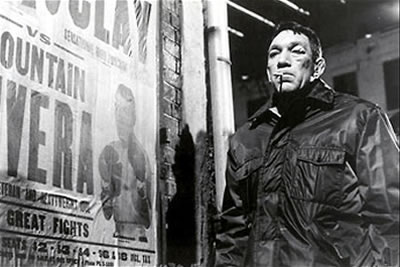
Requiem for a Heavyweight

Sports movies have covered a wide variety of topics over the years. The genre's got so many stories that anything from comedy to serious drama to thriller can be handled within a sports story. A forerunner of sorts for Martin Scorcese's Raging Bull, 1962's Requiem for a Heavyweight is a sports movie that may seem like something you've seen before, but that's because it was an original, a movie that set the stage for other similar movies to come along.

In a fight with Cassius Clay, veteran boxer Luis 'Mountain' Rivera (Anthony Quinn) takes quite a beating before being knocked out late in the 7th round. It's after the fight a doctor tells Mountain that he's done. A couple more punches to the head and he may lose his eyesight completely. So what to do now? Boxing is all Rivera's known, and after 17 years in the ring he's now forced to look for something new, a completely different career. He might have found an answer in Grace Miller (a great supporting part for Julie Harris), a social worker who sees the potential Mountain has.

Released in 1962, director Ralph Nelson's movie could have been straight out of the late 40s when film noir was at the top of its game. If I hadn't seen the release date, I would have said it was film noir, maybe running in a double feature with 1949's The Set-Up with Robert Ryan. Filmed in black and white, almost every scene is full of shadows and characters sitting in the darkness.

Not a 'name' director, Nelson had a string of moderate successes in the 1960s and 1970s but never became a huge star. Too bad because of the movies I've seen, he was a talented man behind the camera. He had an eye for the visual and wasn't just content to point the camera at the actors and shoot. Nelson thinks outside the box with Requiem, making shots that could have been ordinary something memorable. The movie opens through the eyes of Mountain as he's pummeled by Clay. The scene goes on for several minutes as he wakes up and groggily walks from the ring with his manager and cut-man. The technique is repeated in the finale and is used equally as effective.

But what most movies come down to isn't how the director shoots scenes or even the storyline, it can be all about the actors. The three main leads make this movie, especially Quinn as Mountain Rivera. How he wasn't nominated for his performance here by the Academy escapes me. In a career of making countless characters come to life, this is one of his best. Rivera is a kid in a man's body that's taken years of abuse in the ring. He's still got an innocence to him, and he trusts those around him, even when everything points to doing just the opposite. Truly one of Quinn's finest performances.

Right behind him are Jackie Gleason and Mickey Rooney as Maish Remmick, Mountain's manager, and Army, his cut-man who's taken his own share of abuse in the ring. Maish at one time probably had Mountain's best interest at heart but now with his fighter's ability declining, he makes a decision that could tear them apart. Gleason makes the character both sympathetic and despicable depending on which scene you look at. After coming into the public eye as Judy Garland's boyfriend, Rooney shows how good an actor he was. Like a big brother, Army looks out for Mountain's well-being when no one else does. This trio has a history together that goes back many years, and it's a credit to the three actors for making it believable.

At under 90 minutes, this isn't a long movie, but in a short time the audience feels like you've gotten to know the characters and their history and relationships. It all builds to a heartbreaking ending for Mountain, one that shows the true colors of the character. He's a boxer who's best days have passed him by, but that doesn't mean he still can't help those around him. One of the best and underappreciated movies to come out of the sports genre with a great performance from Quinn. With a screenplay from The Twilight Zone's Rod Serling, it's about as can't miss as a movie can be.

Requiem for a Heavyweight <---trailer (1962): *** 1/2 /****