The Sons of Katie Elder

The Sons of Katie Elder
"First, we reunite, then find Ma and Pa's killer...then read some reviews."
Showing posts with label Patricia Neal. Show all posts

Friday, June 20, 2014

The Day the Earth Stood Still (1951)

So the Cold War was pretty freaking scary, huh? I'm going on word of mouth here. I was born in 1985 and am trusting history to tell me the truth. I kid of course, the fear of the Cold War was very, very real. Especially in the 1950s and 1960s, the constant threat of mutually assured destruction was a very real threat, both the United States and the U.S.S.R. having the ability to wipe the other off the face of the Earth with the push of a button. The science fiction genre of the time had several movies that tried to subtly warn us of our impending doom, like 1957's The Day the Earth Stood Still.

All over the world, reports are bouncing from country to country of a U.F.O. flying at an alarming rate in the atmosphere. No one knows what it is or who or what is piloting it, and then to the world's astonishment, the unidentified spacecraft lands in the National Mall in Washington D.C.. A few hours pass and nothing happens as a crowd gathers to see what happens next. To the crowd's astonishment, the ship opens and a man steps out, identifying himself as Klaatu (Michael Rennie), a humanoid who says he comes in peace. With him, he identifies Gort, an immense robot with a special power he won't reveal. As he approaches the crowd, the military opens fire, wounding Klaatu who is sent to Walter Reed Hospital. The humanoid requests to speak to all the world's leaders but it is a request that is quickly shot down. With no alternative, Klaatu puts his own plan into action. First step? Escaping from the hospital.

As I've mentioned in some recent reviews, I've hit a rut at times finding new movies I haven't seen that are....well, good. I found myself deleting movies off the DVR, fast-forwarding through Netflix rentals, all that fun stuff. I tried to get back to the basics, looking for so-called "classic films" that I hadn't seen for any number of reasons. High up on that list are a whole lot of Academy Award winning and nominated movies and countless other well-received flicks and fan favorites. This sci-fi flick from director Robert Wise is all of those things and here we sit. I liked it, didn't love it though unfortunately. 

More than anything else, I liked the idea here, the message. 'Day' works as a smart, kinda subtle (but not so really) warning and message to not only the U.S., but the entire world and a 1951 audience. Semi-SPOILERS ahead semi-SPOILERS What is Klaatu's objective? It is both a threat, a request and a warning. Klaatu comes from a planet somewhere in the universe that serves almost as a watchguard to make sure things go on as they should. And Earth? They're causing some problems with the Cold War threat proposing not only a problem for our planet but for the universe as well. Klaatu's message is simple. Get in line...or get destroyed. His "assistant" of sorts, Gort, has the ability to disintegrate weapons with a death-like ray that comes from his eye visor. That's just the start though, more doom coming in the future should Earthlings not get in line. Pretty cool, premise, huh? I thought so.

Simply put, the message is appropriate, but the movie itself is....well, dull. After Klaatu escapes from the hospital, he poses as any old Joe America, staying at a boarding house under the name 'Mr. Carpenter.' He watches, he observes and he listens, taking it all in. There are some cool, interesting scenes as Klaatu/Carpenter walks around Washington with Bobby (Billy Gray), the son of the owner of the boarding house. He asks questions, trying to get a better read on mankind. Who better to ask for an honest answer than a young boy, an innocent of sorts. We also meet Bobby's mom, Helen (Patricia Neal), a single mom who's now dating an overbearing boyfriend (Hugh Marlowe) who's suspicious of Mr. Carpenter (as he should be). Also look for Sam Jaffe as a quirky intellectual Klaatu contacts on how to proceed about delivering his message, a cool supporting part.

I watched this science fiction flick about a week ago, and I took my time writing the review. While the reviews are uniformly positive, I came away with a cold feeling. An interesting, thought-provoking message is one thing, but delivering that message in an interesting fashion is another thing. Rennie is excellent in the lead role, but beyond that, nothing really jumped off the screen for me. A disappointing negative review.

The Day the Earth Stood Still (1951): **/****

Sunday, March 4, 2012

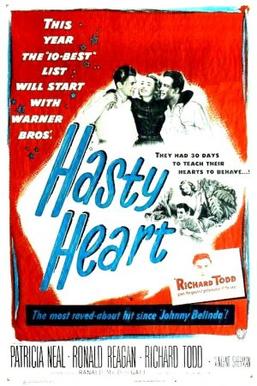
The Hasty Heart

A war is ending, and after months and possibly years of fighting, the light can be seen at the end of the tunnel. I can only imagine soldiers being so close to getting back home, only trying to make it through to the end safe and unscathed. What about those soldiers wounded and even killed in the closing days of a war? That would be the jumping off point for 1949's The Hasty Heart.

Serving in Burma in WWII with his Scottish regiment, Corporal Lachlan MacLachlan (Richard Todd) is wounded while on patrol and sent to a military hospital in the jungle. Shrapnel has torn up his kidney forcing doctors to remove it, but now his second kidney is showing signs of failure. Doctors only give him a few weeks to live but decide not to tell him. Instead, he's moved to another ward, this one run by Nurse Margaret Parker (Patricia Neal) with five international patients, soldiers from around the world, including Yank (Ronald Reagan).  The ward is asked to be kind and friendly to Lachlan, hopefully making the most of his last few weeks alive. Not knowing why his orders home are being held up, Lachlan isn't going to make it easy.

Based off a play from writer John Patrick, 'Hasty' is a great example of a play making the successful jump to film effortlessly. With a few quick departures outdoors, the entire movie -- at 102 minutes -- is set in the one ward occupied by Nurse Parker, Yank and four other recovering soldiers. It's easy to see this being a stage-based play. The story is a good one no matter whether it is a play or a film. Director Vincent Sherman personalizes the story as much as possible, bringing to life all the different characters and seeing their predicament. A little sappy, a little too sentimental at times maybe, but this isn't a cynical, world-weary look at the closing days and subsequent months following WWII. It is instead a story of the people involved, and the effect the war has had on them.

Earning a Best Actor nomination for the 1949 Oscars was an achievement in itself for actor Richard Todd, the only nomination he would get in an underrated career. Other performances from that year? Broderick Crawford in All the King's Men, Kirk Douglas in Champion, John Wayne in Sands of Iwo Jima, and Gregory Peck in Twelve O'Clock High. Not bad, huh? In just his third credited role as an actor, Todd leaves his mark. His Lachie comes from a tough background where he's always dealt with ridicule and scorn, fighting for everything he's earned. When these other patients warm up to him -- despite everything he throws at them -- he's thrown for a loop. It is a beautiful performance, especially when he does open up to his fellow prisoners. Todd makes this character human where it wasn't human just minutes before. He didn't win the Oscar, losing to Crawford's much showier part, but it is a well deserved nomination.

What struck me as odd with the nomination is that Todd received third billing behind both Reagan and Neal in the cast. It is a leading performance, but one of three 'Hasty' offers. Any one of the three offers a performance that could carry a movie on its own. The future 40th President of the United States, Reagan takes his chance to act here and runs with it. He was in a lot of B-movies that didn't always offer him a chance to act. He was just himself, but his part as Yank, an American soldier recovering from a bout with malaria, the unofficial leader of the ward is a solid one and layered. Like the other patients, he's genuinely trying to befriend Lachie only to meet roadblock after roadblock. Neal is Neal, easily one of the most underrated actresses of her generation. Her Nurse Parker is the epitome of what a nurse should be. She's thoughtful, caring and willing to work at helping her patients even when they want nothing to do with her.

The other patients are an international group that reflect the wide-ranging melting pot that were the soldiers fighting in Burma in 1944 and 1945. The group includes Tommy (Howard Marion-Crawford), an overweight Brit who jokes about his weight, Kiwi (Ralph Michael), a New Zealander who wants to get home and see his newborn baby, Digger (John Sherman), the quiet Aussie, and Blossom (Orlando Martins), the African soldier who can't understand a word of English. I liked the dynamic among the group. It reflects a group that's been with each other for awhile now, friendships quickly forming in a trying situation. Anthony Nicholls plays Lt. Colonel Dunn, the commander of the hospital who makes the decision to not tell MacLachlan the news.

I wasn't sure how they were going to wrap up 'Hasty' with several options available. Do you show Lachie's death? Do you hold back and leave it up to us as an audience to imagine it? Or the worst option, do you swoop in at the end and save him, offering a kidney transplant? On that subject, the movie says it can't be done, but I thought you could transplant a kidney. Eh, what do I know, I'm writing movie reviews. The important point is that Sherman chooses the right option...whatever that might be. Sorry, no spoilers. It's a fitting, very moving ending, especially a simple gesture Reagan's Yank makes to the Scotsman. A great movie on the whole.

The Hasty Heart <---TCM clips (1949): ****/****

Tuesday, January 11, 2011

Breakfast at Tiffany's

I can't remember the last movie that threw me off as much as the 1961 classic Breakfast at Tiffany's. I'd never seen it before today and knew nothing about it other than the setting of 1960s New York City, the style, and of course, Audrey Hepburn.  My sister swears by this movie so really, that was my only exposure to it. So over the years, did I convince myself that the movie was something else, something vastly different?  I didn't know what to expect heading into the movie and was quickly surprised by the route this story took.  I don't even know where to start so bear with me.

My biggest preconceived notion of this movie heading into it was that it was the epitome of timeless style, the very beautiful Audrey Hepburn representing this ideal woman that all other women aspire to be. There are posters, books, puzzles, coffee cups, t-shirts, anything at all you care to name with Hepburn on it.  So why does this movie get held in such high regard?  Is it the style alone?  Because honestly, this is an incredibly depressing movie.  It's based on a novella from Truman Capote -- master of weirdness and eccentricity -- and is definitely a casualty of the decade/era it was released.  So here goes, I'll try and be fair.

Washed-up writer Paul Varjak (George Peppard) is moving into his newly furnished New York City apartment when he meets one of the other tenants in the building, Holly Golightly (Hepburn). To say the least, Paul doesn't know what to make of this young woman, a carefree individual who seems to float along wherever life will take her.  She is the oddest of oddballs and lives on a series of whims and gut feelings, not wanting to get pegged down wherever she is or whatever she is doing.  Paul is instantly intrigued (and probably a little attracted) by Holly, but he just can't figure her out.  They seem like such different people, but really, they're almost the same person and as Paul figures out, they belong together.  Can he convince Holly of that though?

Okay, for openers director Blake Edwards is handicapped by 1960s censors and limitations around his storytelling. He is limited by what he can actually do or have characters talk about so instead of actual revelations or explanations we get subtle roundabouts and hints at what is going on.  I was more than a little taken aback to find out that Hepburn's Holly is a call girl and Peppard's Paul is a gigolo.  Really?!? None of this is ever directly addressed, but it's fairly obvious to put 2 and 2 together to make four.  Weirder though, Holly is a call girl/escort who takes the money of the guy she's with and then bails on him, later calling him a 'rat' or 'super-rat.' Paul seems to have one customer -- Patricia Neal's 2-E, a middle-aged married woman -- after giving up a potentially lucrative writing career.

So the stylish duo is a call girl and a gigolo, not a movie breaker in the least, right?  Okay, it did take awhile to get used to that idea, especially in a movie released in theaters in 1961 and held in such high regard some 50 years later.  But that's the least of the problems if you ask me. At a certain point you just accept what the characters are.  It's that the movie doesn't know what it wants to say or where to go.  Are we supposed to support Holly or even like her? In reality, her character is not likable but as a wise IMDB poster explains...'She's pretty so we like her.' Is it a drama or a romantic comedy? Is it neither? Are we supposed to drift along and let the movie wash over us? I was surprised by where the movie went in the last half hour, but it was one in a long line of surprises.

Now where I can understand moviegoers falling in love with 'Tiffany's' is in the casting of Hepburn and Peppard.  Throw aside the fact that both characters are willing to sleep with you for cash.  There hasn't been a more classically beautiful actress in Hollywood before or since Audrey Hepburn.  She's that perfect blend of cuteness and being amazingly sexy. She's headstrong and funny, adorable and cute, vulnerable and exciting, all rolled into one.  The chemistry Hepburn has with Peppard is top-notch and is believable in a way that never makes you question if they're acting.  They're just good together, plain and simple.  Hepburn is the vision of beauty as Holly, a stylish icon that will not be soon forgotten in movie lore.  Yes, her character isn't always likable -- Peppard either to a lesser degree -- but credit to both actors for making Holly and Paul not despicable to the point where you hate them and the movie they're in.

Maybe this is a movie that will hit me differently after I digest it fully in a couple of days, but I doubt it.  As a whole, finished product, it is an odd movie and there's no other way to describe it.  Also in the cast is Buddy Ebsen as Doc, a man from Holly's past, Martin Balsam as O.J., her quasi-agent, and Mickey Rooney in one of the most grossly stereotypical performances I've ever seen, playing an Asian man living in Holly's building.  If it was intended as humor, it falls horrifically short. Too bad because Rooney is typically one of the most reliable character actors around.  All in all, I can't give this a positive rating, but if I was it'd be because I looked at it through romantic comedy-colored glasses.  Hepburn is perfect, Peppard is cool and NYC never looked so stylish.

Breakfast at Tiffany's <---trailer (1961): ** 1/2 /****