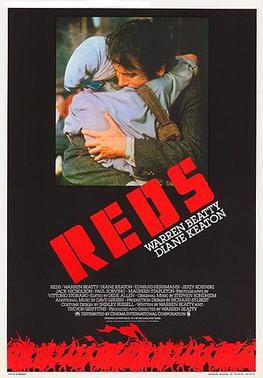
The amount of information, facts and tidbits I don't know about Russian history could full volumes. I love history -- ALL of it -- but something about the immensity of Russia and its history has proved rather intimidating to me. Where to even start? Well, movies seem to agree with me. I liked but didn't love 1965's Doctor Zhivago, but there's another Russian epic that's long been recommend to me. Let's get going with 1981's Reds.
Living in Portland, Oregon in 1915, Louise Bryant (Diane Keaton) has a relatively safe if dull life. She's married, does art and is a hopeful writer. Then, she meets John Reed (Warren Beatty), a highly respected if somewhat controversial writer with an impressive following. She is immediately drawn to him and ends up following him to New York City to be with him while also hopefully pursuing a career as a writer and a journalist. There's a relative catch though. John is a staunch supporter of the socialist movement, a movement that threatens to tear World War I apart as workers around the world, especially in Russia, begin to push for more rights, more privileges. In the midst of World War I (and with the Russian Revolution looming), Louise has entered into one of history's most tumultuous times. She loves John and he loves her, but the world seems on the brink of blowing itself up. What will happen next?
For years, my Mom has recommended this movie to me. It's one of her all-time favorites, and she knows far more about the time and backstory than I do. For some background reading, read about the Russian Revolution HERE at Wikipedia. It's not even fair to say this is a Russian Revolution movie. This is a story about two people's lives amidst that turbulent time in world history with a heavy socialist focus. For more reading, read about John Reed and Louise Bryant, two incredibly interesting individuals. It is a big, epic movie, clocking in at equally intimidating 194 minutes, and took Beatty (who starred, directed, produced and wrote) and his cast and crew a full year to film. That's before you consider a lengthy editing process. Beatty is no dummy, taking on films that mean something to him, and this is the definition of that. This is a message movie, an intellectual, thought-out, impressive film. Is it good though?
I will say it is more interesting than it is good, if that makes sense. 'Reds' picked up 12 Oscar nominations, ultimately winning three, including Beatty as Best Director. For a movie that clocks in at almost three and a half hours, it did well at the box office and resonated with critics and has developed quite a following among fans. It was filmed in New York City, Finland, England, Sweden and Spain. So....yeah, what else? 'Reds' is an epic. The scale and immensity is impressive. This is an epic about an idea though, the idea of socialism. This is 194 minutes of almost entirely talking. This is talking about a principle, about government, about corruption, about history, about the system. 'Reds' isn't Lawrence of Arabia or The Godfather or Gone With the Wind. It is its own epic, and with Beatty backing it all the way, it is quite okay with being its own film. I struggled at times because it is such a smart, well-written movie. Is that enough to hamstring a film? I don't know, but definitely know what you're getting into here.
Picking up two of the film's four Oscar acting nominations, Beatty and Keaton carry the film. Either one or the other is in almost every scene, and apparently the filming was so strenuous on their off-screen relationship they ultimately broke up. I didn't necessarily buy their doomed love, their unexplained chemistry. What did I buy? Their performances themselves are excellent. These are two extremely intelligent individuals, drawn to each other but who's personalities butt heads because they're both so strong-willed. Based on historical figures, both characters are 3-D, blood and guts people, not cardboard cutouts. Kudos to both actors who again make their characters interesting/fascinating if not necessarily likable.
Up until 2012's Silver Linings Playbook, 'Reds' was the last film to receive Oscar nominations for all four acting categories. The culprits? Jack Nicholson as playwright/writer Eugene O'Neill and Maureen Stapleton as famed anarchist Emma Goldman. These aren't huge supporting parts, but what's there is choice, two actors making the most of their relatively small screentime. Also look for Edward Herrmann, Jerzy Kosinski, M. Emmet Walsh, Paul Sorvino, William Daniels, Gene Hackman, and R.G. Armstrong in supporting parts. Some of them are pretty quick, none of them truly developed, and a couple are nothing more than a single scene. Of the smaller parts, Kosinski is memorable as a socialist leader working with Reed and Hackman as a booze-loving, honest newspaper editor.
One of the best choices Beatty makes as a director was a wise style choice. Along with the actual story, interviews with those who knew Reed and Bryant during the 1910s and 1920s are interspersed throughout the movie. These people -- now in their 70s and 80s -- reminiscing about John and Louise, about the times, about how things have changed, these are the moments that proved most memorable for me. Check out the list of witnesses HERE. So as I mentioned before, this is an excellent movie. One you appreciate and admire and respect. I felt like I learned some things as the story develops, but did I love the movie like I hoped I would? Nope. Still very much worth checking out, but not quite the movie I was expecting.
Reds (1981): ** 1/2 /****
The Sons of Katie Elder
"First, we reunite, then find Ma and Pa's killer...then read some reviews."
Showing posts with label R.G. Armstrong. Show all posts
Monday, October 6, 2014
Tuesday, March 4, 2014
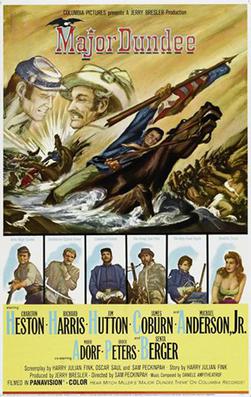
Major Dundee
It's late in 1864, the Civil War raging back east, but in the New Mexico territory, an Apache war party led by Sierra Charriba (Michael Pate), massacres a troop of U.S. cavalry, kidnapping three boys from a local ranch at the same time. The commander of a nearby Confederate prison camp, Major Amos Dundee (Charlton Heston) decides to go after the Apaches, rescuing the kids and bringing Charriba to justice. Without abandoning the camp though, he must assemble a ragtag group of Confederate prisoners, black infantry, inexperienced officers, cowboys, drunks, bandits and thieves to capture the Apaches. At his right hand is a Confederate officer and friend from the past but now a sworn enemy, Capt. Benjamin Tyreen (Richard Harris). Dundee's company of irregular cavalry hits the trail, following the Apache war party into Mexico, tangling with occupying French forces as well. The Apaches and the French are just two enemies though, the Union and Confederate loyalties among the company threatening to tear Dundee's command apart from the inside.
The production history of this Peckinpah western has quite the checkered past. The production in Mexico went way over budget and way over schedule. Depending on what you read, Peckinpah's original cut for 'Dundee' was anywhere between three and four hours long. When the studio took it away from him, it was cut down to just over two hours. A DVD released in 2005 had a new, never before seen version with almost 15 additional minutes added to the running time. Some additional footage was found that was unable to be reinserted back into the film, but as is, we'll probably never know/see Peckinpah's intended version. So what's the end result with the 136-minute version? A far better western than the 123-minute version that features some good performances, a ridiculously deep cast, some ahead of its time vicious action, and a story that drifts needlessly at times.
What was Peckinpah's goal? He wanted to make an epic western, a new western in the vein of the John Ford cavalry movies. It was supposed to be big and violent full of scope and vision. 'Dundee' doesn't quite live up to that, but in terms of pure entertainment, it's hard to beat. It starts with Charlton Heston in the titular role. Like Peckinpah's best movies, Dundee is the flawed anti-hero like nobody's business. The story almost becomes Moby Dick in the Civil War west. Dundee has been posted to this isolated prison camp because of a command decision he made at Gettysburg (hinted at, never spelled out), and he intends to right that wrong. His plan? Get the kids back, take out Sierra Charriba, become a hero again. The problem? Dundee may not be cut out for command. He's equal parts brilliant strategist with overreaching egoist. His pride and ego get in the way of things, the mission into Mexico becoming an obsession. Quite the performance, one that doesn't always get the notoriety it deserves in Heston's already impressive filmography.
One of Peckinpah's favorite storytelling devices was the anti-hero and his right hand man, sometimes a former friend turned unwilling ally, a device used to its best ability four years later in The Wild Bunch. Here, that relationship is between Heston's Dundee and Richard Harris' Capt. Ben Tyreen. Again, their checkered history (friendship turned bitter rivalry, even hatred) all leads up to this, two men forced to work together. Harris is one of my favorite actors, and this is my favorite performance of many, one of my all-time favorite characters in any film. Harris' Tyreen is everything Dundee wants to be; intelligent, charming, a good leader, and well liked and respected by his men. Tyreen has one great line after another, Harris bringing this character to life, a Irish immigrant turned cashiered American officer to Confederate renegade. The dynamic between Dundee and Tyreen provides some of the movie's best dialogue scenes, the confrontations crackling with energy. Kudos to both actors for developing that chemistry to its fullest.
Brace yourself though. This movie has one sick cast of tough guy actors, many from the Peckinpah stock character Hall of Fame. Jim Hutton provides some laughs as Lt. Graham, a bumbling artillery officer assigned to the cavalry. James Coburn is a scene-stealer as Samuel Potts, Dundee's one-armed, bearded, quick-witted scout, as is Mario Adorf as the feisty, loyal Sgt. Gomez, Dundee's most capable Union soldier. Michael Anderson Jr. does a fine job too as Trooper Ryan, Dundee's young bugler, providing the narration from his in-mission journal. There's also Brock Peters as Aesop, the leader of the small contingent of black infantry, Slim Pickens as Wiley, the drunken mule-packer, R.G. Armstrong as Reverend Dahlstrom, the shotgun-wielding preacher, and Dub Taylor as Priam, the disheveled horse thief. As for Tyreen's Confederates, there's Ben Johnson as the tough Sgt. Chillum, L.Q. Jones and Warren Oates as Arthur and O.W. Hadley, and John Davis Chandler as Jimmy Lee, the troublemaker. Also look for Karl Swenson as Dundee's second-in-command at the prison camp. Just a ridiculously deep cast full of great characters.
Where the movie struggles some -- but is also damn entertaining in those struggles -- is the final 40 minutes. The story does drift too much from the Apaches to the French to Dundee's lost weekend in Durango and a brief love affair with Senta Berger's Teresa. Trooper Ryan's narration gets choppy, weeks slipping by in a flash. The saving grace is back-to-back action sequences, one a showdown with the Apaches in a box canyon, the other a bloody, violent battle with French lancers in the Rio Grande. This is Peckinpah at his action best, clearly an indicator of where his movies would go, especially with The Wild Bunch. Watch the scene with the French and see how brutal it is, how graphic it could have been if censors allowed it. Characters are unceremoniously killed off (blink and you'll miss it), including one surprising death, but it's just a great action scene leading to a quick ending.
Most Peckinpah fans don't list this as their favorite, maybe not even one of their favorites. I just really like this movie, always have, and the longer version with the additional 15 minutes or so really does help make it better. The musical score from composer Daniele Amfitheatrof takes some heat, especially the Major Dundee theme (listen HERE), but I like it, almost as a guilty pleasure. Filming on location in Mexico, including stops in Durango, a gorgeous waterfall location at El Saltito, and many more, all add to that authentic flavor. You really feel like you're on an odyssey across Mexico, seeing a variety of spots, locations and cities. One of my favorite westerns, a heavily flawed but just a damn entertaining movie in the end. Hard to beat, even if we'll never see that epic 4-hour version Peckinpah intended.
Major Dundee (1965): ****/****
Rewrite of August 2009 review
Thursday, May 30, 2013
My Name is Nobody
The truth of the wild west was that it was a particularly nasty place. Of all the sheriffs, marshals, cowboys, bandits, gunfighters and hired guns that gained infamy -- good or bad -- in the years following the Civil War, I feel safe saying very few got to choose their ending. Many died bloody in horrifically violent fashion. It's a simple theme of countless westerns; choosing how you go out, how you die when your time is up. Among other things, it's a theme that makes up the best parts of 1973's My Name is Nobody.
A famous gunfighter who's gained notoriety wherever he goes, Jack Beauregard (Henry Fonda) has decided to leave his infamous reputation behind him. It's 1899, and the west that he knew is becoming a thing of the past. His plan is simple; buy a ticket on a ship in New Orleans and sail away to Europe where no one knows him or his own past. That's his plan at least. On the trail, he keeps meeting a younger gunfighter known simply as Nobody (Terence Hill) who has his own plans for Beauregard. He's followed Beauregard's busy and checkered past and finding out that he intends to retire, wants him to do otherwise in glorious, bloody fashion. Nobody wants Jack to face off against the infamous Wild Bunch, a gang of 150 killers and gunmen, stamping his name in the history books.
From director Tonino Valerii, 'Nobody' is one weird revisionist-comedy-spaghetti western. It is based on a story idea from spaghetti western directing legend Sergio Leone, and there are rumors/reports that he even directed some scenes here. It is both equal parts goofy, slapstick comedy and some really poignant scenes about the closing days of the wild west. Often times, it plays almost like a tribute to the western genre, both American and spaghetti westerns. On the other hand, it creates its own identity while still paying tribute. Composer Ennio Morricone's score borrows liberally from his previous scores -- most notably Fonda's Frank Theme in Once Upon a Time in the West -- and even uses samples of Wagner's Valkyrie score (listen HERE) for the Wild Bunch theme. Give the main theme a try HERE, a little lighter in theme and tone. The locations, the music, the obvious love of the genre, it's all there.
Using a familiar western pairing of the experienced, veteran gunfighter and the young up-start looking to make a name for himself, 'Nobody' again takes something familiar and makes it different while still working. Fonda is the veteran gunfighter, his Jack Beauregard having simply outlived the era that made him a known name. He just wants to retire, leave the name behind, and more importantly the target painted squarely on his back. Hill's mysterious Nobody isn't going to allow it, wanting his hero to go out in a blaze of glory. He may not want to allow it, but he never forces Jack to do anything, just keeps on talking and talking, trying to convince him to follow the path he should take. They have a great dynamic; Fonda amused at first by Nobody, Hill with an ever-present smile on his face. Nothing is ever spelled out, but there's almost a protecting angel aura hanging over him. However it's interpreted, it's two good parts.
Either Fonda or Hill is in almost every scene, but 'Nobody' has an interesting, even surprising supporting cast. Jean Martin plays Sullivan, a mine owner in business with the Wild Bunch to distribute his stolen gold (an odd, unnecessary storyline). Familiar American faces R.G. Armstrong, Geoffrey Lewis, Steve Kanaly and Leo Gordon make quick appearances as various gunfighters gunning with and gunning for Jack. Among several familiar spaghetti western faces look for Mario Brega and Benito Stefanelli among others.
The biggest thing preventing this tribute western is a self-indulgent streak right up its back. I like Hill a lot as an actor, but I've never been a huge fan of his overly comedic parts. His Trinity westerns are infamous for a slapstick comedy that typically divides fans into the love/hate department. The first 80 minutes here give Hill plenty of chances -- far too many -- to show off that physical ability. One scene has Nobody in a bar seeing if he can chug booze/beer, throw the glass over his shoulder and shoot it before it hits the ground. Watch it HERE. While interesting in itself, it just goes on too long. Then there's the sped-up fight scenes, Hill slapping opponents over and over again before they can draw a gun on him. These are all things that could be funny/worthwhile in small doses, but it just goes on too long here.
The saving grace here is the final 30 minutes, a pretty perfect finale that helps the movie end on quite the high note. Nobody finally gets Jack to believe in his Wild Bunch shootout, an artsy, well-done sequence that pits Jack against the small army of gunmen on an open prairie. The follow-up is even better and offers a solid twist as Jack and Nobody end up in New Orleans. No spoilers here, but it works well. The highlight though is Jack's letter to Nobody about the changing times, what to look out for, and how the world and wild west has changed. It's a simple, eloquent ending that manages to wrap up on quite the freeze frame. The movie in its entirety is a mixed bag, but I loved it when it works.
My Name is Nobody (1973): ***/****
A famous gunfighter who's gained notoriety wherever he goes, Jack Beauregard (Henry Fonda) has decided to leave his infamous reputation behind him. It's 1899, and the west that he knew is becoming a thing of the past. His plan is simple; buy a ticket on a ship in New Orleans and sail away to Europe where no one knows him or his own past. That's his plan at least. On the trail, he keeps meeting a younger gunfighter known simply as Nobody (Terence Hill) who has his own plans for Beauregard. He's followed Beauregard's busy and checkered past and finding out that he intends to retire, wants him to do otherwise in glorious, bloody fashion. Nobody wants Jack to face off against the infamous Wild Bunch, a gang of 150 killers and gunmen, stamping his name in the history books.
From director Tonino Valerii, 'Nobody' is one weird revisionist-comedy-spaghetti western. It is based on a story idea from spaghetti western directing legend Sergio Leone, and there are rumors/reports that he even directed some scenes here. It is both equal parts goofy, slapstick comedy and some really poignant scenes about the closing days of the wild west. Often times, it plays almost like a tribute to the western genre, both American and spaghetti westerns. On the other hand, it creates its own identity while still paying tribute. Composer Ennio Morricone's score borrows liberally from his previous scores -- most notably Fonda's Frank Theme in Once Upon a Time in the West -- and even uses samples of Wagner's Valkyrie score (listen HERE) for the Wild Bunch theme. Give the main theme a try HERE, a little lighter in theme and tone. The locations, the music, the obvious love of the genre, it's all there.
Using a familiar western pairing of the experienced, veteran gunfighter and the young up-start looking to make a name for himself, 'Nobody' again takes something familiar and makes it different while still working. Fonda is the veteran gunfighter, his Jack Beauregard having simply outlived the era that made him a known name. He just wants to retire, leave the name behind, and more importantly the target painted squarely on his back. Hill's mysterious Nobody isn't going to allow it, wanting his hero to go out in a blaze of glory. He may not want to allow it, but he never forces Jack to do anything, just keeps on talking and talking, trying to convince him to follow the path he should take. They have a great dynamic; Fonda amused at first by Nobody, Hill with an ever-present smile on his face. Nothing is ever spelled out, but there's almost a protecting angel aura hanging over him. However it's interpreted, it's two good parts.
Either Fonda or Hill is in almost every scene, but 'Nobody' has an interesting, even surprising supporting cast. Jean Martin plays Sullivan, a mine owner in business with the Wild Bunch to distribute his stolen gold (an odd, unnecessary storyline). Familiar American faces R.G. Armstrong, Geoffrey Lewis, Steve Kanaly and Leo Gordon make quick appearances as various gunfighters gunning with and gunning for Jack. Among several familiar spaghetti western faces look for Mario Brega and Benito Stefanelli among others.
The biggest thing preventing this tribute western is a self-indulgent streak right up its back. I like Hill a lot as an actor, but I've never been a huge fan of his overly comedic parts. His Trinity westerns are infamous for a slapstick comedy that typically divides fans into the love/hate department. The first 80 minutes here give Hill plenty of chances -- far too many -- to show off that physical ability. One scene has Nobody in a bar seeing if he can chug booze/beer, throw the glass over his shoulder and shoot it before it hits the ground. Watch it HERE. While interesting in itself, it just goes on too long. Then there's the sped-up fight scenes, Hill slapping opponents over and over again before they can draw a gun on him. These are all things that could be funny/worthwhile in small doses, but it just goes on too long here.
The saving grace here is the final 30 minutes, a pretty perfect finale that helps the movie end on quite the high note. Nobody finally gets Jack to believe in his Wild Bunch shootout, an artsy, well-done sequence that pits Jack against the small army of gunmen on an open prairie. The follow-up is even better and offers a solid twist as Jack and Nobody end up in New Orleans. No spoilers here, but it works well. The highlight though is Jack's letter to Nobody about the changing times, what to look out for, and how the world and wild west has changed. It's a simple, eloquent ending that manages to wrap up on quite the freeze frame. The movie in its entirety is a mixed bag, but I loved it when it works.
My Name is Nobody (1973): ***/****
Friday, April 9, 2010
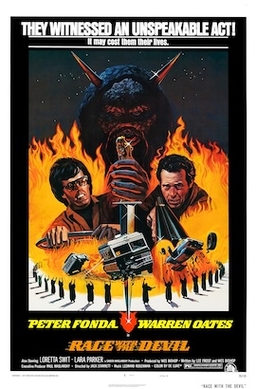
Race With the Devil
Ah, the open road where anything can happen. Of course, if everyday life was anything like the open road in movies, no one would ever leave their home. Has anything ever gone well on an epic road trip? There's always murdering hitchhikers, roving motorcycle gangs, or suicidal semi-truck drivers just waiting to kill you. In 1975's Race with the Devil, it's none of those. Instead, it's a satanic cult terrorizing our all-American couples on the open road.
After saving for years for vacation, two couples, Roger and Kelly (Peter Fonda and Lara Parker) and Frank and Alice (Warren Oates and Loretta Swit) head west in their new RV for Aspen, Colorado for some skiing. The first night out, they camp a mile or so off the road to enjoy the beauty of the country. Staying up late drinking, Roger and Frank see something weird on a nearby hilltop; a group of people chanting and dancing around a roaring fire. At first, they think nothing of it until one of the dancers is stripped and stabbed. They're spotted, and by the skin of their teeth escape. The sheriff (R.G. Armstrong) in the closest town investigates and sends them on their way when he decides there's nothing more they can do. But these cultists aren't done with these two couples yet.
When it comes to horror and thriller movies, I typically stay pretty clear of them. But with this one, the cast and the very B-movieish plot caught my eye. 'Devil' was released four years after Steven Spielberg's Duel premiered on TV, and it would be hard not to compare the two. Where Duel had one man vs. one rogue semi driver, 'Devil' has four people running for their lives from a lot of people -- a number is never really established. SPOILERS It seems everyone they run into following the murder is in the cult. You could call it a twist, but it was pretty obvious to me what was going on the second Armstrong enters as the all too helpful country sheriff. END OF SPOILERS
I enjoyed the movie as a whole, but two scenes will stick with me most of all. One, the getaway after they've been spotted. It's the dead of night, and these cultists are hauling ass after them. I'll go into this more later, but a gigantic, new model RV also isn't the best getaway vehicle. Of course, the RV gets stuck in a shallow riverbed as the cultists close in. Check out the murder and getaway HERE at Youtube. Another is midway through the movie as paranoia starts to set in that they're being tracked. The cult has hidden rattlesnakes throughout the RV, and coming from someone who isn't a huge fan of snakes in general, this is an incredibly uncomfortable scene to watch. Add to it that the scene goes on and on as Roger and Frank try to throw these snakes outside, and you've got quite a shocker sequence.
The last 45 minutes are more like Duel because the story is almost completely contained in this RV as the cultists try to knock them off the road. These chase sequences are something else, especially considering the type of vehicles. The RV seems to swallow up the road with its size, and chasing them are tow trucks, school buses, and midsize trucks. The chases feature some impressive stunt driving and keep that lightning fast pace going right up until the end. The two couples just want to get to Amarillo and a bigger police force to report what's happened, but nothing is going to come easy for them on the open road and all its dangers.
Fonda and Oates had worked together four years earlier in 1971's The Hired Hand, and the chemistry they had there rolls over to this B-movie. These aren't roles that require a whole lot of acting -- look worried/pissed/terrified and repeat -- but both stars look to be having fun. Oates always is worth watching even in the worst movies, and Fonda holds his own alongside the wily character actor. This was also the first time I'd seen Swit -- MASH's Margaret 'Hot Lips' Houlihan -- in a movie and not TV. The same as the gents, she's required to look worried and be scared. Parker doesn't make much of an impression as the wife who's losing her mind a whole lot quicker than the rest of the RV passengers. They do meet a handful of people on the road -- all of them connected with the cult -- but they're nothing more than creepy faces.
And then there was the ending. I won't spoil it here for you, but it is the type of ending that could only be in a movie from the 1970s, and more than that, a 70s horror/thriller flick. It's quick with little build-up and certainly caught me off guard. Don't blink or you might miss it before the credits start to roll. Apparently, it's a pretty unpopular ending, but I really liked it in terms of story and shock value. The whole story's been building up to this so why throw in a happy ending? Check this out at Youtube, starting with Part 1. A cheesy movie for sure, but it packs some good scares and a good cast. Worth a watch.
Race With the Devil <-----trailer (1975): ***/****
After saving for years for vacation, two couples, Roger and Kelly (Peter Fonda and Lara Parker) and Frank and Alice (Warren Oates and Loretta Swit) head west in their new RV for Aspen, Colorado for some skiing. The first night out, they camp a mile or so off the road to enjoy the beauty of the country. Staying up late drinking, Roger and Frank see something weird on a nearby hilltop; a group of people chanting and dancing around a roaring fire. At first, they think nothing of it until one of the dancers is stripped and stabbed. They're spotted, and by the skin of their teeth escape. The sheriff (R.G. Armstrong) in the closest town investigates and sends them on their way when he decides there's nothing more they can do. But these cultists aren't done with these two couples yet.
When it comes to horror and thriller movies, I typically stay pretty clear of them. But with this one, the cast and the very B-movieish plot caught my eye. 'Devil' was released four years after Steven Spielberg's Duel premiered on TV, and it would be hard not to compare the two. Where Duel had one man vs. one rogue semi driver, 'Devil' has four people running for their lives from a lot of people -- a number is never really established. SPOILERS It seems everyone they run into following the murder is in the cult. You could call it a twist, but it was pretty obvious to me what was going on the second Armstrong enters as the all too helpful country sheriff. END OF SPOILERS
I enjoyed the movie as a whole, but two scenes will stick with me most of all. One, the getaway after they've been spotted. It's the dead of night, and these cultists are hauling ass after them. I'll go into this more later, but a gigantic, new model RV also isn't the best getaway vehicle. Of course, the RV gets stuck in a shallow riverbed as the cultists close in. Check out the murder and getaway HERE at Youtube. Another is midway through the movie as paranoia starts to set in that they're being tracked. The cult has hidden rattlesnakes throughout the RV, and coming from someone who isn't a huge fan of snakes in general, this is an incredibly uncomfortable scene to watch. Add to it that the scene goes on and on as Roger and Frank try to throw these snakes outside, and you've got quite a shocker sequence.
The last 45 minutes are more like Duel because the story is almost completely contained in this RV as the cultists try to knock them off the road. These chase sequences are something else, especially considering the type of vehicles. The RV seems to swallow up the road with its size, and chasing them are tow trucks, school buses, and midsize trucks. The chases feature some impressive stunt driving and keep that lightning fast pace going right up until the end. The two couples just want to get to Amarillo and a bigger police force to report what's happened, but nothing is going to come easy for them on the open road and all its dangers.
Fonda and Oates had worked together four years earlier in 1971's The Hired Hand, and the chemistry they had there rolls over to this B-movie. These aren't roles that require a whole lot of acting -- look worried/pissed/terrified and repeat -- but both stars look to be having fun. Oates always is worth watching even in the worst movies, and Fonda holds his own alongside the wily character actor. This was also the first time I'd seen Swit -- MASH's Margaret 'Hot Lips' Houlihan -- in a movie and not TV. The same as the gents, she's required to look worried and be scared. Parker doesn't make much of an impression as the wife who's losing her mind a whole lot quicker than the rest of the RV passengers. They do meet a handful of people on the road -- all of them connected with the cult -- but they're nothing more than creepy faces.
And then there was the ending. I won't spoil it here for you, but it is the type of ending that could only be in a movie from the 1970s, and more than that, a 70s horror/thriller flick. It's quick with little build-up and certainly caught me off guard. Don't blink or you might miss it before the credits start to roll. Apparently, it's a pretty unpopular ending, but I really liked it in terms of story and shock value. The whole story's been building up to this so why throw in a happy ending? Check this out at Youtube, starting with Part 1. A cheesy movie for sure, but it packs some good scares and a good cast. Worth a watch.
Race With the Devil <-----trailer (1975): ***/****
Labels:
1970s,
Horror,
Peter Fonda,
R.G. Armstrong,
Warren Oates
Friday, January 22, 2010
White Lightning
Reviewing Quentin Tarantino's Inglourious Basterds last fall, I did my fair share of slobbering over the movie but didn't go into much detail when it came to the soundtrack. An avid movie buff, Tarantino sampled a long list of scores from previous movies -- including a heavy dose of Ennio Morricone and spaghetti westerns -- that ranged from critically acclaimed French movies to lesser thought of average flicks. What was so surprising was that almost all these scores that were made for other movies worked so well in Tarantino's WWII story.Not intentionally seeking these movies out, I've caught up with many of them and more than a few times have thought 'why does this music sound familiar?' while watching. Give the man credit, he knows how to put a sountrack together. The latest track I can cross off the list is from 1973's White Lightning with a soundtrack from composer Charles Bernstein. Listen HERE to the main theme that Tarantino used in 'Inglorious Basterds.'
Bernstein's main theme sets the tone just seconds into White Lightning in a great scene that plays along with the credits. Two men are rowing a boat out in the swamp with a second boat tied behind them. In that second boat, two teenagers are gagged and cuffed to an anchor lying on the floor. One of the men in the lead boat pulls a shotgun up and blasts a hole in the second boat, sending the two boys to their painful deaths. At a work camp/prison upstate, one prisoner, Gator McCluskey (Burt Reynolds) receives news that his brother is dead and no one knows how it happened.
A longtime whiskey runner, Gator is no fool and can figure out what happened -- of course he doesn't know that his younger brother was one of the two in the boat. He cuts a deal with the government to work as an informant and try to bring the Bogan County sheriff, J.C. Connors (Ned Beatty), down for years of corruption and overstepping his bounds of the office. Gator signs on with another moonshine runner, Roy Boone (Bo Hopkins), and starts to work for the big supplier in the county, Big Bear (R.G. Armstrong). It's not long before Connors figures out Washington has a snoop in town, but can Gator get enough information on him to take him down before he gets whacked?
Moonshine in the deep South has been handled all sorts of ways in popular culture, as comedy in TV shows like The Andy Griffith Show and seriously like in Thunder Road with Robert Mitchum. White Lightning falls somewhere in between with comedic and dramatic moments. Gator takes the job as an informant only as a means to exact some revenge, but he doesn't seem to be in any rush to take that revenge. He does some moonshining, some driving, romances Boone's girl Lou (Jennifer Billingsley) and generally enjoys himself now that he's out of prison.
A few exciting car chases make the movie worthwhile including some crazy stunts, one that almost ended disastrously when a car tried to jump a pier onto a barge floating down the river. These chases are basically the Dukes of Hazard before that show was around, so imagine fast cars gunning it across country backroads with cops hot on their tail. Not a paved road in sight as sand, dirt and dust gets kicked up all over the South. Reynolds, Hopkins and Beatty all look to have done a fair share of their own stunt driving which is always nice to see instead of an obviously inserted stuntman.
This 'rednecks and cars' movie was released a year after the huge success of Deliverance so Reynolds was becoming a huge star at the time. I'd never say he was a great actor, but he's a great movie star. His parts always had a lot of presence, and Reynolds was a more than capable comedic action star. A part that required him to be a smart-ass who's always ready with a punch or a one-liner was ideal for him, and this fits in that category. The rest of the cast is one of those typically 70s casts that just makes me happy. Hopkins and Armstrong are joined by Matt Clark as Dude Watson, Gator's source and mechanic. All great supporting actors that were never huge stars but nonetheless make a movie better just by being there. And Beatty as the villain, who would have thought a little, balding, pudgy guy could be so intimidating, but he pulls it off.
A harmless enough movie that's a good way to spend a couple hours. Fast cars, sometimes faster women, boozing and corrupt cops. That sounds like an entertaining movie to me. I liked it enough to watch the sequel that came out three years later, named appropriately enough 'Gator.' If interested in checking this one out, Hulu has it available to watch, click HERE.
White Lightning <----trailer (1973) ** 1/2 /****
Labels:
1970s,
Bo Hopkins,
Burt Reynolds,
Ned Beatty,
R.G. Armstrong
Wednesday, October 28, 2009
The Ballad of Cable Hogue
Abandoned in the desert by his partners Taggart (L.Q. Jones) and Bowen (Strother Martin), desert drifter Cable Hogue (Jason Robards) endures five days without water as he attempts to walk to the next far-off town. As he lies down ready to give up and die, he sees a drop of water on his boot and discovers a hidden water hole deep in the sand. A stagecoach passes by (Slim Pickens riding shotgun) and tells him there's no water for 40 miles between towns for the stagecoach route. Seeing a chance for some serious cash, Cable files a claim and sets up shop out in the desert, charging 10 cents for a person to drink and 25 cents for animals.
As the money starts to roll in, so do the people. First, there's Reverend Joshua Sloane (David Warner), a minister who travels across the west preaching and generally getting in trouble with married women. Second, there's Hildy (Stella Stevens), a prostitute in a nearby town who falls for Cable but must decide whether to stay with him or continue on to San Francisco where she'll marry a rich man. Holding everything up is Cable who is content to wait at his water hole, Cable Springs, until Taggart and Bowen eventually show up and give him a chance at revenge.
With maybe two guns fired the whole movie, the attention is clearly on the story. It's the early 20th Century so like The Wild Bunch or Ride the High Country, Peckinpah's movie deals with the changing times in the wild west. While a key twist revolves around the times and the advancing technology, the story otherwise could be set anywhere in any time period. Cable's little operation out in the desert is a quaint little American dream, coming full circle when Pickens brings him an American flag to fly. It's a story that is in no rush to get its message across, letting things out here and there.
The high point of 'Cable' is star Jason Robards. Two years removed from one of his best parts -- Cheyenne in Once Upon a Time in the West -- Robards gives Cable a hard edge. Warner's Joshua deems Cable not a good man or a bad man, just a man. He's a likable character, a fella who doesn't care much for people or their cities in towns. He's content to live his life out in the desert (Arizona and New Mexico were the filming locations) and let his money pile up. In her on-screen nudity phase, Stevens plays the hooker with a heart of gold who falls in love with Cable. There's a natural chemistry between the actors although it's hard not to notice that Stevens is naked, half-naked, or undressing just about every time she's in view.
As strong as the leads are, the movie in general suffers from what I like to call the makings of a folksy western. Westerns in the 70s went away from gunfights and action, focusing more on lyrical storytelling, lots of folk songs, and some truly unnecessary comedy, and 'Cable' is no exception. A song over the credits, Tomorrow is the Song I Sing, and Butterfly Mornin's (sung by Stevens) grind the already slow-moving pace to a complete halt. With some low-brow humor, Peckinpah also speeds up the film like a bad Benny Hill episode which looks out of place and amateurish when comparing it to the director's other movies. Adding to the comedy, Warner's horny reverend feels out of place and generally comes across as painfully unfunny.
The revenge storyline is left by the wayside for much of the movie, and that's fine. Robards is appealing on-screen, and it's as enjoyable to see his watering hole station grow and his interactions with Warner, Pickens, and R.G. Armstrong as a stagecoach supervisor, and Peter Whitney as a bank officer who bankrolls Cable. But when the revenge aspect steps back to the forefront, it does not ring true. The whole ending seems a little forced. The premise is an ideal one, similar to The Wild Bunch without the epic gunbattle, but in execution it doesn't work. SPOILER Cable gets run over by a car and basically is fine, laughs at his own death, has Warner eulogize him, and then dies off-screen. He's such a strong character it is a shame he is dispatched like he is. END OF SPOILER
'Cable' is an uneven effort from Peckinpah that ranges from great -- the first hour and Robards' performance -- to below average (folk songs, comedy, forced ending). If you are a fan of Bloody Sam, I'd definitely say 'watch this one.' The volatile director only made 16 movies, and it'd be hard to recommend completely passing over one of them.
The Ballad of Cable Hogue <---trailer (1970): ** 1/2 /****
Tuesday, May 19, 2009
J.W. Coop
Usually when a movie star is the key force behind a movie being made, it's a good thing. They feel so strongly about the subject that the feeling is transferred to the movie. One example, John Wayne's The Alamo in which Wayne starred, directed, produced and helped fund. People say its too long, but I love it. Made early in the 1970s, J.W. Coop comes from a similar background.
Underrated Cliff Robertson wrote, produced, directed, and starred and had his company back the movie about an aging rodeo star. While Robertson is good in the title role, the movie never quite lives up to expectations. It's like so many other 1970s road movies that you've seen before and most likely will see again.
Robertson plays J.W. Coop, a rodeo star fresh out of prison after a 10-year stint for passing a bad check, a little severe if you ask me. Coop returns home to see his mother (Geraldine Page, actually a year younger than Robertson), only to find she's lost her mind. With nothing holding him down at home, JW hits the road with hopes of making up for lost time on the rodeo circuit. It's when he finds out how another cowboy is making a living, flying to countless different rodeos, that Coop decides he wants to be the champ.
Nothing too far-fetched here, but the movie bounces around so much with little explanation. First, Coop just wants to return to the rodeo. But then he meets an attractive hippie (model Cristina Ferrare) and changes his mind for no reason that's ever really explained. That's my problem with much of the movie. It tries too hard to be creative or innovative, whether it be in the storytelling or just how things are shot. Quick cutting isn't necessary in most cases, it just calls attention to itself.
As the title character, Robertson gives a quiet performance where he takes in all the action around him. Not much dialogue for Coop, but the actor/director is content to show where JW's at through long shots that remain on the aging rodeo star. He's a tired man who isn't always quite sure how much things have changed in the years he was in prison. Ferrare is the only real co-star here as Bean, the young hippie who starts a relationship with JW. Page appears in just one scene and is frighteningly effective, but that's the first 15 minutes of the movie. R.G. Armstrong makes an appearance as a fellow cowboy, but it's nothing memorable other than to say 'Hey, that's R.G. Armstrong!'
I'm just not quite sure about this movie. The middle section, about 30 minutes to 90 minutes is good, but the bookends just don't work. The opening takes much too long to build up any speed, and the ending has so much going on in the last 20 minutes that everything feels rushed. The ending works even if it's apparent about halfway through the movie how it's going to end. Still, I'm not sure how we're supposed to interpret the ending. It goes two ways, either J.W. lives or he dies, and I think it's Option No. 2, but that could just be me.
Released the same year as J.W. Coop, Sam Peckinpah's Junior Bonner is a similar movie, an aging rodeo star, Steve McQueen instead of Robertson, returns home to find that so much he knew growing up has changed. Comparing the two movies though, Junior Bonner knows what it's trying to say and doesn't waver from beginning until end. J.W. Coop has a similar message, but has it's fair share of trouble getting that message across. Worthwhile for Robertson in a strong part and some cool rodeo footage, but otherwise an average movie. Here's a cool montage done of stills from the movie, SPOILERS though, so be forewarned.
J.W. Coop (1972): **/****
Underrated Cliff Robertson wrote, produced, directed, and starred and had his company back the movie about an aging rodeo star. While Robertson is good in the title role, the movie never quite lives up to expectations. It's like so many other 1970s road movies that you've seen before and most likely will see again.
Robertson plays J.W. Coop, a rodeo star fresh out of prison after a 10-year stint for passing a bad check, a little severe if you ask me. Coop returns home to see his mother (Geraldine Page, actually a year younger than Robertson), only to find she's lost her mind. With nothing holding him down at home, JW hits the road with hopes of making up for lost time on the rodeo circuit. It's when he finds out how another cowboy is making a living, flying to countless different rodeos, that Coop decides he wants to be the champ.
Nothing too far-fetched here, but the movie bounces around so much with little explanation. First, Coop just wants to return to the rodeo. But then he meets an attractive hippie (model Cristina Ferrare) and changes his mind for no reason that's ever really explained. That's my problem with much of the movie. It tries too hard to be creative or innovative, whether it be in the storytelling or just how things are shot. Quick cutting isn't necessary in most cases, it just calls attention to itself.
As the title character, Robertson gives a quiet performance where he takes in all the action around him. Not much dialogue for Coop, but the actor/director is content to show where JW's at through long shots that remain on the aging rodeo star. He's a tired man who isn't always quite sure how much things have changed in the years he was in prison. Ferrare is the only real co-star here as Bean, the young hippie who starts a relationship with JW. Page appears in just one scene and is frighteningly effective, but that's the first 15 minutes of the movie. R.G. Armstrong makes an appearance as a fellow cowboy, but it's nothing memorable other than to say 'Hey, that's R.G. Armstrong!'
I'm just not quite sure about this movie. The middle section, about 30 minutes to 90 minutes is good, but the bookends just don't work. The opening takes much too long to build up any speed, and the ending has so much going on in the last 20 minutes that everything feels rushed. The ending works even if it's apparent about halfway through the movie how it's going to end. Still, I'm not sure how we're supposed to interpret the ending. It goes two ways, either J.W. lives or he dies, and I think it's Option No. 2, but that could just be me.
Released the same year as J.W. Coop, Sam Peckinpah's Junior Bonner is a similar movie, an aging rodeo star, Steve McQueen instead of Robertson, returns home to find that so much he knew growing up has changed. Comparing the two movies though, Junior Bonner knows what it's trying to say and doesn't waver from beginning until end. J.W. Coop has a similar message, but has it's fair share of trouble getting that message across. Worthwhile for Robertson in a strong part and some cool rodeo footage, but otherwise an average movie. Here's a cool montage done of stills from the movie, SPOILERS though, so be forewarned.
J.W. Coop (1972): **/****
Subscribe to:
Posts (Atom)