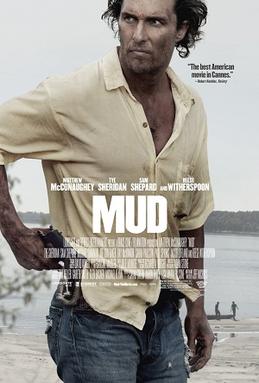
Somewhere in the mid 2000s, Matthew McConaughey became a punchline for jokes. It seemed like after a strong start to his acting career -- A Time to Kill, Lone Star, Amistad -- he began to play caricatures of himself. Well, something clicked because over the last two or three years, McConaughey has gotten back down to business with roles that allow him to show off that genuine acting ability, including 2012's Mud.
Living on the Mississippi River in De Witt, Arkansas with his parents, young Ellis (Tye Sheridan) spends his days hanging out with his best friend, Neckbone (Jacob Lofland), exploring the river on his boat. Their latest search involves a boat out on an island in the river that was supposedly thrown into a tree during a recent flood. Ellis and Neckbone go searching for it, finding it fairly easily, but that's not all they find. There's some pretty obvious evidence that someone is living in the boat, footprints in the sand that are clearly very recent. It doesn't take long to find who it is, a man with questions hanging over him who nonetheless bonds with the two boys. He goes simply by Mud (McConaughey), and he's hiding on the river island. More than that though, he needs their help in getting off the island meeting up with someone...urgently. What exactly is he up to though? Is he in trouble, and will he bring the boys down with him in the process?
As I read reviews for this film from director Jeff Nichols, the description "modern fairy tale" kept coming up. Is it a fair, apt description? I suppose so, emphasis on the modern part. It's a couple days later since I watched this movie, and I'm still processing it. I think I liked it, but I'm not sure why. Other than the coming of age story, I'm not sure what the message was. I don't know what it's trying to say in general. It was universally liked, reviewed in positive fashion by anyone who can put two words together, and I went in with high hopes. So will I be the one person in the entire world who didn't like this movie? Sit tight and find out.
No, it won't be me. I liked this movie, even if its hard to peg exactly why I liked this one. McConaughey's performance is obviously key (more on that later), but it's more than that. It is a fair description to call this a modern fairy tale with more of a reliance on a coming of age story. Nichols wrote and directed the film, choosing the Mississippi River as the backdrop to his story. 'Mud' reminded me in that sense of Mark Twain's Tom Sawyer and Huck Finn stories, not to mention Stand By Me. Filming on location in Arkansas, Nichols made a wise decision. The American South with its rural, backroads (not intended in a negative way) is like we're watching a different world. It's a small town, not much to do, one that's struggling with the economy, a poor town trying to survive and adapt with changing times. It does have a lyrical feel to it -- credit to composer David Wingo and his score for adding to that -- and feels removed from our world in a sense, and it all works.
Getting some Oscar buzz for his performance here, McConaughey deserves all of that buzz. He seems to be back on the right track in picking his roles from here to Dallas Buyer's Club to The Wolf of Wall Street, not to mention his parts in Magic Mike, The Paperboy and Killer Joe. I liked how he brought Mud to life from the second we meet him. The odd name is never explained, but everyone who knows him never questions it. The character is a bit of a mystery, his backstory slowly parceled out as we find out why he's hiding on this heavily-wooded island in the Mississippi. We learn maybe everything isn't so ideal, so perfect, but McConaughey makes him charming, his Southern drawl putting us at ease, his homespun stories making it hard not to like him. Mud is a trusting, fiercely loyal, honor-bound and completely genuine. He believes in what he's doing, only questioning involving the boys in his plan late in the movie. McConaughey makes Mud a great lead character, hinted at a little of his special abilities/powers, but mostly he's just a good, if flawed, guy.
The coming of age story in Arkansas river country works so well in addition to McConaughey's performance because of Sheridan as Ellis and Lofland as Neckbone (another great name never explained). This doesn't feel like two young actors working, just two teenagers and best friends going about their day-to-day lives. When they stumble on Mud on the island, it's an adventure, if a possibly dangerous one. I loved what both of them brought to the story, a believable, human development that never feels forced. They're in that messy teenage period, trying to figure out life, their families, what they want to be, Ellis becoming the main character, Mud his unlikely teacher of life of sorts. Ellis has a crush on May Pearl (Bonnie Sturdivant), an older girl in town, is dealing with his parents (Ray McKinnon and Sarah Paulson) possibly divorcing, all on top of what Mud needs their help for.
The rest of the cast kinda got lost in the shuffle of McConaughey's excellent lead performance, Reese Witherspoon playing Juniper, Mud's seemingly doomed girlfriend, Sam Shepard as Tom, Ellis' neighbor across the river who knows Mud from years past, Michael Shannon as Galen, Neckbone's Uncle who he lives with since his parents passed away, Paul Sparks as Carver, a man pursuing Mud, Joe Don Baker appearing briefly and in intimidating fashion as Carver's menacing father.
I really wasn't sure where this one was going. I really wasn't sure what the message was, basically every woman we meet a really poor representation of anything good, all of them nagging, cheating, manipulative individuals. I've done my best not to give too much away, but don't be confused. It's worth watching and even better going in with a clean slate. I will say I don't think it's the modern classic that some have made it out to be, but I did enjoy Mud a lot. McConaughey especially is pretty perfect, heading an enjoyable movie that gets points just because it tries to do something different from the norm and succeeds on just about every level. An easy movie to recommend.
Mud (2012): ***/****
The Sons of Katie Elder
"First, we reunite, then find Ma and Pa's killer...then read some reviews."
Showing posts with label Joe Don Baker. Show all posts
Monday, January 6, 2014
Thursday, July 26, 2012
Strange Wilderness
I love a good stupid movie just like everybody else. But like anything, there's dumb, dumbest, stupid, stupidest, and mind-bogglingly stupid, the kind of stupid that makes your head hurt to watch it. The jury is still out for 2008's Strange Wilderness and where that one ends up.
When his father dies, Peter (Steve Zahn) steps in and takes over his long-running, very successful nature show, 'Strange Wilderness'....and promptly drives it into the ground. The quality drops, the educational aspect plummets, and the show is on the brink of being canceled. Peter, soundman Fred (Allen Covert), and Wilderness's ragtag crew have only two weeks to turn the show around, but how can they manage that? A story falls right into their lap, but first they've got to find it. Bigfoot has been sighted in Central America! Let the road trip begin.
Should I be surprised that this 2008 stoner comedy came from the brilliant minds of Happy Madison Productions, Adam Sandler's film company? I suppose not, but it sure does help make sense of this mess of a movie. Excluding the closing credits, it doesn't even hit the 80-minute mark. The "story" is a sham of a script held together by bathroom humor, awful physical comedy, and a reliance on anything crotch-related or even close, one running gag after another. At one point, Zahn's character actually has a turkey attack him, the animal attempting to swallow his penis. Yes, the scene of Zahn running around hysterically is funny, but I can't think of a stupider, low-brow type of humor. Repeat that for 79 minutes and you've got your movie. One scene has the crew giggling away because a man's name is 'Dick.' That's all. No last name. Watch it HERE. For every funny moment, there's an excruciating one close behind.
The odd thing? The parts that do work are very funny. The disgusted TV producer (Jeff Garlin) goes through a quick succession of clips from previous shows, and the complete random quality of the clips produces some quality laughs. They include lions having sex with a sexually-themed voiceover, giraffes head-butting each other, an alligator eating a man ("We wanted to honor him"), a man at a peace rally on running around on fire, and so on. Any actual Strange Wilderness footage is hysterical from a shark episode (watch HERE) to a bear episode (watch HERE) with portions devoted to beavers, piranhas, and monkeys among other. Zahn's calming, almost monotone voice nails the voiceovers. These parts are so mind-bogglingly stupid it makes me think someone with talent wrote them. They're that stupid, but go figure, they're funny too. Their discovery of Bigfoot, their encounter with him, and the rationalization of how they handled that encounter is priceless too.
Going for the stupid and not smart laughs, the cast is hit-or-miss. Zahn is a decent lead, hamming it up like a crazy person as needed, longtime Sandler co-star Covert a worthy straight man with his long hair and floppy mustache. Rounding out the 'Wilderness' crew are Jonah Hill as Cooker, the freaky conspiracy theorist, Kevin Heffernan as Whitaker, the alcoholic mechanic turned animal handler, Justin Long as Junior, the stoner cameraman, Ashley Scott as Cheryl, the necessary babe, and Peter Dante as Danny, the idiot. That's all. He's an idiot. Hill is funny when he's subtle, not like here where he's so over-exaggerated he becomes obnoxious. Heffernan is very funny, Long leaves little impression, Scott looks good, and Dante is the worst offender of the bunch, playing the same part he does in all the Happy Madison movies. His best bit? A dark but truly funny bit where he dresses up like a sea lion and is promptly attacked by a shark.
In some bizarre casting, watch for Ernest Borgnine, Joe Don Baker and Robert Patrick in small parts. You read that right, all three names. How they took these parts I'll never know. None of them are given anything to do -- short of a disgusting sight gag Patrick gets -- but all three are professionals and do their job. It's especially cool to see Borgnine (91 years old at the time) in the movie, introducing himself to a new generation of moviegoers.
You don't go into a movie like this thinking you will be watching a masterpiece. I realize that, but this is one screwy movie. The funny part? As they made the movie, they know it was screwy. It ends with Zahn, Covert and Garlin laughing out loud at the ridiculous nature of the story....and that's the ending. No gag reel. That's the ending. Epically stupid, good for some laughs, but too stupid for its own good at other times.
Strange Wilderness <---trailer (2008): **/****
When his father dies, Peter (Steve Zahn) steps in and takes over his long-running, very successful nature show, 'Strange Wilderness'....and promptly drives it into the ground. The quality drops, the educational aspect plummets, and the show is on the brink of being canceled. Peter, soundman Fred (Allen Covert), and Wilderness's ragtag crew have only two weeks to turn the show around, but how can they manage that? A story falls right into their lap, but first they've got to find it. Bigfoot has been sighted in Central America! Let the road trip begin.
Should I be surprised that this 2008 stoner comedy came from the brilliant minds of Happy Madison Productions, Adam Sandler's film company? I suppose not, but it sure does help make sense of this mess of a movie. Excluding the closing credits, it doesn't even hit the 80-minute mark. The "story" is a sham of a script held together by bathroom humor, awful physical comedy, and a reliance on anything crotch-related or even close, one running gag after another. At one point, Zahn's character actually has a turkey attack him, the animal attempting to swallow his penis. Yes, the scene of Zahn running around hysterically is funny, but I can't think of a stupider, low-brow type of humor. Repeat that for 79 minutes and you've got your movie. One scene has the crew giggling away because a man's name is 'Dick.' That's all. No last name. Watch it HERE. For every funny moment, there's an excruciating one close behind.
The odd thing? The parts that do work are very funny. The disgusted TV producer (Jeff Garlin) goes through a quick succession of clips from previous shows, and the complete random quality of the clips produces some quality laughs. They include lions having sex with a sexually-themed voiceover, giraffes head-butting each other, an alligator eating a man ("We wanted to honor him"), a man at a peace rally on running around on fire, and so on. Any actual Strange Wilderness footage is hysterical from a shark episode (watch HERE) to a bear episode (watch HERE) with portions devoted to beavers, piranhas, and monkeys among other. Zahn's calming, almost monotone voice nails the voiceovers. These parts are so mind-bogglingly stupid it makes me think someone with talent wrote them. They're that stupid, but go figure, they're funny too. Their discovery of Bigfoot, their encounter with him, and the rationalization of how they handled that encounter is priceless too.
Going for the stupid and not smart laughs, the cast is hit-or-miss. Zahn is a decent lead, hamming it up like a crazy person as needed, longtime Sandler co-star Covert a worthy straight man with his long hair and floppy mustache. Rounding out the 'Wilderness' crew are Jonah Hill as Cooker, the freaky conspiracy theorist, Kevin Heffernan as Whitaker, the alcoholic mechanic turned animal handler, Justin Long as Junior, the stoner cameraman, Ashley Scott as Cheryl, the necessary babe, and Peter Dante as Danny, the idiot. That's all. He's an idiot. Hill is funny when he's subtle, not like here where he's so over-exaggerated he becomes obnoxious. Heffernan is very funny, Long leaves little impression, Scott looks good, and Dante is the worst offender of the bunch, playing the same part he does in all the Happy Madison movies. His best bit? A dark but truly funny bit where he dresses up like a sea lion and is promptly attacked by a shark.
In some bizarre casting, watch for Ernest Borgnine, Joe Don Baker and Robert Patrick in small parts. You read that right, all three names. How they took these parts I'll never know. None of them are given anything to do -- short of a disgusting sight gag Patrick gets -- but all three are professionals and do their job. It's especially cool to see Borgnine (91 years old at the time) in the movie, introducing himself to a new generation of moviegoers.
You don't go into a movie like this thinking you will be watching a masterpiece. I realize that, but this is one screwy movie. The funny part? As they made the movie, they know it was screwy. It ends with Zahn, Covert and Garlin laughing out loud at the ridiculous nature of the story....and that's the ending. No gag reel. That's the ending. Epically stupid, good for some laughs, but too stupid for its own good at other times.
Strange Wilderness <---trailer (2008): **/****
Labels:
2000s,
Comedy,
Ernest Borgnine,
Joe Don Baker,
Jonah Hill,
Justin Long,
Robert Patrick,
Steve Zahn
Thursday, June 21, 2012
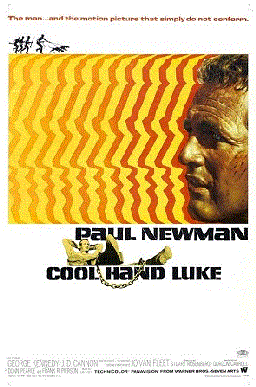
Cool Hand Luke
Heroes are supposed to be noble, loyal, honor-bound and always do what's right. But in the 1960s and its increased cynicism from the audience, was that concept of a hero really going to fly? The idea of an anti-hero started popping up in the 1950s thanks to James Dean and Marlon Brando among others, but for me, the one that kicked the door open in the 1960s was Paul Newman in 1967's Cool Hand Luke.
Having taken the heads off of a long row of parking meters, a drunken Lucas Jackson (Newman) is arrested and sentenced to a two-year sentence on a chain gang in Florida. He meets the Captain (Strother Martin) and his bevy of guards who keep their prison camp roster of 50 prisoners busy on the roads six days a week, but this camp has had nothing like Luke. Easy going enough early on in his sentence, he begins to bristle at being imprisoned, at being told what he's supposed to do. He becomes a hero to his other prisoners, forming a friendship with head honcho, Dragline (George Kennedy), but Luke can only take being held down for so long, and he wants out now.
Paul Newman is one of my all-time favorites, and this is HIS iconic part. Butch Cassidy, The Hustler, The Sting, and many others, all memorable roles, but nothing quite like this one. Want a face for a 1960s audience looking for something different? In steps Lucas Jackson, a man who has little regard for what society says he should do with his life, even less regard for any sort of authority hovering over him. Newman makes Luke -- dubbed 'Cool Hand' for a bluff in poker -- a charming, likable individual, his easy-going, natural smile disarming you in a second. We learn a lot about this character with little background (a veteran, countless jobs, a drifter), finding out that no one and no thing will slow him down. He will do things on his terms, and anyone else can be damned. Newman at his best.
With Newman's Oscar-nominated part at the head, 'Cool' has become one of the seminal movies of the late 1960s, ranking up there with The Wild Bunch, The Graduate, Bonnie and Clyde and several others I'm missing. This is a movie made for a late 1960s audience that isn't content with the status quo. No respect for authority or the so-called 'system'? Check. An anti-hero that wants to do things and live his life his way? Double check. The system are Martin's quiet but intense Captain, Boss Godfrey (Morgan Woodward), the silent guard who wears his ever-present aviator glasses, along with steely-eyed Luke Askew, Richard Donner and John McLiam. The system is the villain here, imprisoning and breaking the individual down to conform. It's easy to see the appeal in 1967, and just as easy to see now 45 years later in 2012. The thinker, the free spirit, the intelligent rebel, it's an appealing character and premise to root for.
Because Newman's performance is so strong at the top, another part of the film gets lost in the shuffle, and that's the ensemble cast all around him from Martin and Kennedy to the guards to the prisoners. Martin is perfect in his few scenes, including muttering the iconic 'What we have here is failure to communicate.' Kennedy won an Oscar for his part as Dragline, an illiterate but intelligent and fast-talking prisoner who all the other prisoners look up to. Newman and Kennedy play off each other impeccably, the subtle, underplayed Luke with the showier, aggressive and funny Dragline. Other prisoners include J.D. Cannon, Lou Antonio, Robert Drivas, Harry Dean Stanton, Dennis Hopper, Wayne Rogers, Ralph Waite, Joe Don Baker, Dick Davalos and Buck Kartalian among others. Clifton James and Anthony Zerbe are good as prisoners turned associates who help the guards.
Like any movie that lives on so many years after its release, there's got to be something to make it memorable, and director Stuart Rosenberg doesn't disappoint. The most obvious is Luke stating he can eat 50 eggs in an hour, a classic sequence in its humor, but there's so much more. Luke singing Plastic Jesus -- watch HERE -- after receiving some distressing news is an all-time great. There's Luke earning everyone's respect in a brutal, knock-down boxing match (watch HERE), refusing to go down even when he's beat. There's a teenager washing a car, driving the on-looking prisoners wild (HERE), and up there with Plastic Jesus for the most moving scene, Luke talking with his dying mother, Arletta (Jo Van Fleet). Almost scene-to-scene is aided by composer Lalo Schifrin's amazingly spot-on music, especially the main theme which you can listen to HERE.
What struck me most in my latest viewing was the darkness of the story. The first hour is generally light-hearted, introducing characters, backgrounds and interactions, setting us up by liking Newman's Luke so much in spite of his bullheaded stubbornness. I'd forgotten then how intensely dark and at times uncomfortable the second half of the movie is. From the start, we know Luke is heading down a bad road, but that unbearable tension and impending sense of doom keeps building. The movie still has its lighter touches -- Luke's escapes provide some unlikely humor -- but there will not be a truly happy ending here. In the end though, one of the final shots shows that free spirits might not always win, but that also doesn't mean the system, authority and power positions will win either. The symbolism can be a little obvious, a little heavy-handed, but the message still strikes a chord.
A classic from beginning to end. End of story.
Cool Hand Luke <---trailer (1967): ****/****
Having taken the heads off of a long row of parking meters, a drunken Lucas Jackson (Newman) is arrested and sentenced to a two-year sentence on a chain gang in Florida. He meets the Captain (Strother Martin) and his bevy of guards who keep their prison camp roster of 50 prisoners busy on the roads six days a week, but this camp has had nothing like Luke. Easy going enough early on in his sentence, he begins to bristle at being imprisoned, at being told what he's supposed to do. He becomes a hero to his other prisoners, forming a friendship with head honcho, Dragline (George Kennedy), but Luke can only take being held down for so long, and he wants out now.
Paul Newman is one of my all-time favorites, and this is HIS iconic part. Butch Cassidy, The Hustler, The Sting, and many others, all memorable roles, but nothing quite like this one. Want a face for a 1960s audience looking for something different? In steps Lucas Jackson, a man who has little regard for what society says he should do with his life, even less regard for any sort of authority hovering over him. Newman makes Luke -- dubbed 'Cool Hand' for a bluff in poker -- a charming, likable individual, his easy-going, natural smile disarming you in a second. We learn a lot about this character with little background (a veteran, countless jobs, a drifter), finding out that no one and no thing will slow him down. He will do things on his terms, and anyone else can be damned. Newman at his best.
With Newman's Oscar-nominated part at the head, 'Cool' has become one of the seminal movies of the late 1960s, ranking up there with The Wild Bunch, The Graduate, Bonnie and Clyde and several others I'm missing. This is a movie made for a late 1960s audience that isn't content with the status quo. No respect for authority or the so-called 'system'? Check. An anti-hero that wants to do things and live his life his way? Double check. The system are Martin's quiet but intense Captain, Boss Godfrey (Morgan Woodward), the silent guard who wears his ever-present aviator glasses, along with steely-eyed Luke Askew, Richard Donner and John McLiam. The system is the villain here, imprisoning and breaking the individual down to conform. It's easy to see the appeal in 1967, and just as easy to see now 45 years later in 2012. The thinker, the free spirit, the intelligent rebel, it's an appealing character and premise to root for.
Because Newman's performance is so strong at the top, another part of the film gets lost in the shuffle, and that's the ensemble cast all around him from Martin and Kennedy to the guards to the prisoners. Martin is perfect in his few scenes, including muttering the iconic 'What we have here is failure to communicate.' Kennedy won an Oscar for his part as Dragline, an illiterate but intelligent and fast-talking prisoner who all the other prisoners look up to. Newman and Kennedy play off each other impeccably, the subtle, underplayed Luke with the showier, aggressive and funny Dragline. Other prisoners include J.D. Cannon, Lou Antonio, Robert Drivas, Harry Dean Stanton, Dennis Hopper, Wayne Rogers, Ralph Waite, Joe Don Baker, Dick Davalos and Buck Kartalian among others. Clifton James and Anthony Zerbe are good as prisoners turned associates who help the guards.
Like any movie that lives on so many years after its release, there's got to be something to make it memorable, and director Stuart Rosenberg doesn't disappoint. The most obvious is Luke stating he can eat 50 eggs in an hour, a classic sequence in its humor, but there's so much more. Luke singing Plastic Jesus -- watch HERE -- after receiving some distressing news is an all-time great. There's Luke earning everyone's respect in a brutal, knock-down boxing match (watch HERE), refusing to go down even when he's beat. There's a teenager washing a car, driving the on-looking prisoners wild (HERE), and up there with Plastic Jesus for the most moving scene, Luke talking with his dying mother, Arletta (Jo Van Fleet). Almost scene-to-scene is aided by composer Lalo Schifrin's amazingly spot-on music, especially the main theme which you can listen to HERE.
What struck me most in my latest viewing was the darkness of the story. The first hour is generally light-hearted, introducing characters, backgrounds and interactions, setting us up by liking Newman's Luke so much in spite of his bullheaded stubbornness. I'd forgotten then how intensely dark and at times uncomfortable the second half of the movie is. From the start, we know Luke is heading down a bad road, but that unbearable tension and impending sense of doom keeps building. The movie still has its lighter touches -- Luke's escapes provide some unlikely humor -- but there will not be a truly happy ending here. In the end though, one of the final shots shows that free spirits might not always win, but that also doesn't mean the system, authority and power positions will win either. The symbolism can be a little obvious, a little heavy-handed, but the message still strikes a chord.
A classic from beginning to end. End of story.
Cool Hand Luke <---trailer (1967): ****/****
Monday, September 26, 2011
Wild Rovers
With Sam Peckinpah's 1969 western The Wild Bunch, the conversation pretty much begins and ends about the best changing of the times westerns, the closing of an era. Star William Holden gives a career-best performance in this blood-splattered western, the leader of a gang of aging outlaws looking for one last score in Mexico. Holden had a long list of great performances, but one that has flown under the radar all these years is a similar changing times story in the wild west, 1971's Wild Rovers.
By the late 1800s and into the first 10 or 20 years of the 1900s, the idea of the wild west was one fading away into the background. Movie westerns have explored this era in countless ways, most revolving around the idea of a man (or men) refusing to change with the times, handcuffed to the way they know how to do things. The Wild Bunch handles it in a brutal, forthright fashion, a cynical view of outlaws going out in a blaze of glory rather than change. Butch Cassidy and the Sundance Kid has its darker moments, but for the most part is more comedic with more humor thanks to its buddy pairing of Newman and Redford. Then there's Wild Rovers, falling somewhere in between, moments of startling violence balanced out with endearing emotional flashes. It finds a good balance in between in an underrated western.
It's almost round-up time for the R-Bar cattle ranch in Wyoming with owner Walt Buckman (Karl Malden) readying his crew of cowboys for the coming rush of work. Among them is Ross Bodine (Holden), a veteran cowboy approaching the age of 50 who's spent 30-plus years in the saddle, and Frank Post (Ryan O'Neal), a young cowboy full of piss and vinegar looking to have a good time. Frustrated with their lot in life -- working long hours with little reward -- the two cowboys come up with an idea; rob a bank and with their take head to Mexico where they can start their own ranch. The bank robbery in the dead of night goes smoothly, but Buckman sends his sons, Paul (Joe Don Baker), his father's favorite and an easy-going sort in general, and John (Tom Skerritt), the youngster desperately seeking his father's approval. Ross and Post were good cowboys, but can they be good outlaws too?
As a western fan, there is something simple and profound in westerns similar to this. A changing time, and a lifestyle gone, men refusing to change who are set in their ways. To direct a western like this, I wouldn't have thought Blake Edwards to be the right choice, but I was wrong. Known for his comedies, especially the Pink Panther movies, Edwards takes his time with this 139-minute long movie. The story drifts along in an episodic nature, introducing the characters and the situation at its leisure. Even post-robbery, the story isn't in any rush. It is a harsher west than many westerns portray, building up tension in certain scenes that can be unbearable to watch. It just works. My only real fault is that the movie has an overture, intermission and entr'acte, and finale music. It seems out of place, like something a different-toned Edwards comedy would have used. Just a minor point, nothing worth worrying about. I just fast forwarded through these segments.
Playing Pike Bishop in Peckinpah's The Wild Bunch, Holden delivered a career best performance, and in my mind, there isn't a close second. This might be that second-best role, a character that is obviously more light-hearted than Bishop, but not too dissimilar. His Ross Bodine is a cowboy about to turn 50 years old who has spent much of his life working himself to the bone herding cows without much to show for it. Robbing a bank seems like an easy out so he takes the chance when presented. Just 53 years old, Holden looks much older. He is a sympathetic, tragic main character if there ever was one, and Holden brings that to life.
Two monologues -- one at the beginning, another at the end -- let him show his range, one about fate and dying, the other about an unlikely friendship that's developed with O'Neal's Post. I thought the best scene though was a quiet moment, Bodine lying in bed next to a prostitute, staring off into the distance. His eyes say a lot, a man who realizes he's made the wrong choice and now has to deal with the consequences. From that moment, you know where this character is headed if you weren't already sure.
Now as perfectly cast as Holden is as the world-weary Bodine, I think there's a bit of miscasting with O'Neal as his young counterpart, Frank Post. Regardless of the role, I've never thought too highly of O'Neal as an actor. The character is interesting here, but I don't think it is due to his acting. He's naive at times but with a devilish streak at others. He's saved by the fact that he's working with a pro like Holden. In the older mentor, younger student dynamic, the relationship works. They play off each other well, their dialogue crackling back and forth as a genuine friendship grows out of this dash for safety in Mexico. It's not a bad performance for O'Neal, but it could have been better.
The other parts while important aren't as key. Malden is the archetypal western cattle baron, ruling with a strong hand and iron will. Baker and Skerritt are nicely cast alongside each other, polar opposites in terms of personality. Baker's John is frustrated with the hunt that drags on into weeks and months while Skerritt's Paul intends to follow his father's request no matter what it takes.
Dealing with a story that is about a closing chapter in American history, you've got to assume the ending will not be a happy one. The last 45 minutes is where this movie becomes special as Bodine and Post stop at a desert town and rest up before pushing on to Mexico. The ending packs a wallop, leaving that feeling of being punched in the stomach. It's moving for all the people involved, a tragic end to almost all the characters. I don't want to say more without taking away from the emotional impact, but it makes some of the slower parts worth sitting through. This is an underrated western that deserves far more respect than it gets. Beautifully shot all over the west in Monument Valley, Utah and Arizona and aided by a Jerry Goldsmith score that's best in its quieter moments, Wild Rovers is a hidden gem well worth catching up with.
Wild Rovers <---TCM trailer/clips (1971): ***/****
By the late 1800s and into the first 10 or 20 years of the 1900s, the idea of the wild west was one fading away into the background. Movie westerns have explored this era in countless ways, most revolving around the idea of a man (or men) refusing to change with the times, handcuffed to the way they know how to do things. The Wild Bunch handles it in a brutal, forthright fashion, a cynical view of outlaws going out in a blaze of glory rather than change. Butch Cassidy and the Sundance Kid has its darker moments, but for the most part is more comedic with more humor thanks to its buddy pairing of Newman and Redford. Then there's Wild Rovers, falling somewhere in between, moments of startling violence balanced out with endearing emotional flashes. It finds a good balance in between in an underrated western.
It's almost round-up time for the R-Bar cattle ranch in Wyoming with owner Walt Buckman (Karl Malden) readying his crew of cowboys for the coming rush of work. Among them is Ross Bodine (Holden), a veteran cowboy approaching the age of 50 who's spent 30-plus years in the saddle, and Frank Post (Ryan O'Neal), a young cowboy full of piss and vinegar looking to have a good time. Frustrated with their lot in life -- working long hours with little reward -- the two cowboys come up with an idea; rob a bank and with their take head to Mexico where they can start their own ranch. The bank robbery in the dead of night goes smoothly, but Buckman sends his sons, Paul (Joe Don Baker), his father's favorite and an easy-going sort in general, and John (Tom Skerritt), the youngster desperately seeking his father's approval. Ross and Post were good cowboys, but can they be good outlaws too?
As a western fan, there is something simple and profound in westerns similar to this. A changing time, and a lifestyle gone, men refusing to change who are set in their ways. To direct a western like this, I wouldn't have thought Blake Edwards to be the right choice, but I was wrong. Known for his comedies, especially the Pink Panther movies, Edwards takes his time with this 139-minute long movie. The story drifts along in an episodic nature, introducing the characters and the situation at its leisure. Even post-robbery, the story isn't in any rush. It is a harsher west than many westerns portray, building up tension in certain scenes that can be unbearable to watch. It just works. My only real fault is that the movie has an overture, intermission and entr'acte, and finale music. It seems out of place, like something a different-toned Edwards comedy would have used. Just a minor point, nothing worth worrying about. I just fast forwarded through these segments.
Playing Pike Bishop in Peckinpah's The Wild Bunch, Holden delivered a career best performance, and in my mind, there isn't a close second. This might be that second-best role, a character that is obviously more light-hearted than Bishop, but not too dissimilar. His Ross Bodine is a cowboy about to turn 50 years old who has spent much of his life working himself to the bone herding cows without much to show for it. Robbing a bank seems like an easy out so he takes the chance when presented. Just 53 years old, Holden looks much older. He is a sympathetic, tragic main character if there ever was one, and Holden brings that to life.
Two monologues -- one at the beginning, another at the end -- let him show his range, one about fate and dying, the other about an unlikely friendship that's developed with O'Neal's Post. I thought the best scene though was a quiet moment, Bodine lying in bed next to a prostitute, staring off into the distance. His eyes say a lot, a man who realizes he's made the wrong choice and now has to deal with the consequences. From that moment, you know where this character is headed if you weren't already sure.
Now as perfectly cast as Holden is as the world-weary Bodine, I think there's a bit of miscasting with O'Neal as his young counterpart, Frank Post. Regardless of the role, I've never thought too highly of O'Neal as an actor. The character is interesting here, but I don't think it is due to his acting. He's naive at times but with a devilish streak at others. He's saved by the fact that he's working with a pro like Holden. In the older mentor, younger student dynamic, the relationship works. They play off each other well, their dialogue crackling back and forth as a genuine friendship grows out of this dash for safety in Mexico. It's not a bad performance for O'Neal, but it could have been better.
The other parts while important aren't as key. Malden is the archetypal western cattle baron, ruling with a strong hand and iron will. Baker and Skerritt are nicely cast alongside each other, polar opposites in terms of personality. Baker's John is frustrated with the hunt that drags on into weeks and months while Skerritt's Paul intends to follow his father's request no matter what it takes.
Dealing with a story that is about a closing chapter in American history, you've got to assume the ending will not be a happy one. The last 45 minutes is where this movie becomes special as Bodine and Post stop at a desert town and rest up before pushing on to Mexico. The ending packs a wallop, leaving that feeling of being punched in the stomach. It's moving for all the people involved, a tragic end to almost all the characters. I don't want to say more without taking away from the emotional impact, but it makes some of the slower parts worth sitting through. This is an underrated western that deserves far more respect than it gets. Beautifully shot all over the west in Monument Valley, Utah and Arizona and aided by a Jerry Goldsmith score that's best in its quieter moments, Wild Rovers is a hidden gem well worth catching up with.
Wild Rovers <---TCM trailer/clips (1971): ***/****
Labels:
1970s,
Joe Don Baker,
Karl Malden,
Ryan O'Neal,
Tom Skerritt,
westerns,
William Holden
Wednesday, July 13, 2011
Goldeneye
Making his debut as the infamous MI6 agent with a license to kill, Brosnan helped reinvigorate the franchise with 1995's Goldeneye. He only made four movies, ending with one of the worst Bond movies ever in 2002's Die Another Day, and his second and third entries are not the best entries either. It has to do at least a little with no more Ian Fleming novels to base stories off of, but there were other problems, few of them having to do with Brosnan's actual performance. But for starters, Goldeneye is one of the best that has actually gotten more popular over the years thanks to a Nintendo 64 game and more recently, a Nintendo Wii version with Daniel Craig digitally inserted where Brosnan would have been. So, Pierce, welcome to the franchise.
Working a mission with fellow 00 agent, Alec '006' Trevelyan (Sean Bean) at a secret weapons facility deep in Russia, MI6 agent James Bond (Brosnan) barely survives when Russian troops discover his presence in the facility. He struggles knowing Alec was killed in the process, but moves on, and nine years later continues his work. A new mission pops up when a new prototype for a high-powered offensive helicopter is stolen. Bond begins to think it's related to a mysterious Russian arms dealer named Janus who no one ever has actually met. When a Russian radar station is knocked out by a satellite firing an EMP pulse, Bond investigates, trying to find one of the two survivors, a computer technician named Natalya (Izabella Scorupco). But as clues start to mount, Bond begins to wonder. Is his supposedly dead partner Alec somehow involved in this scheme?
Besides the obvious transition from Dalton to Brosnan, Goldeneye is also noteworthy because it's the first Bond movie to be released since the Soviet Union collapsed. The evil Commie Russians were always a prime enemy for Bond to battle. So in a lot of ways, this is a transitional 007 flick. Director Martin Campbell (who would return for Craig's first movie, Casino Royale) brings the right energy to the franchise. There's action, but not too much. It's over the top, but never cartoonish or comic book stylized. There is humor and one-liners, but they're never over-done. Goldeneye is not only a good James Bond movie, but just a good movie overall. Brosnan's later entries struggled to stay in that middle ground, instead bouncing around too much into humor and ridiculous, even stupid, action.
Sean Connery is and always will be the best James Bond. Daniel Craig certainly has the potential to be second best, and of course depending on who you ask, any Bond fan is going to have a personal favorite. Brosnan is an interesting mix because he's a solid mix of all of those previous Bond actors while still putting his own spin on the character. He's smooth and stylish but can be equally cold. He's calmly efficient in his workings, but he is also troubled by his past failures. Much the way Connery did, Brosnan delivers his lines impeccably. James Bond one-liners have a tendency to sound forced and awkward if not handled just the right way, but Brosnan has a way of throwing them off the cuff that feels natural. As the series went forward, Brosnan as Bond was the least of the franchise's troubles. He was never in question, just the movies he starred in.
Just about any good James Bond movie has any number of reasons why it is successful. For me, one of Goldeneye's biggest selling points is the cast in support of Brosnan. Sean Bean is one of the best and most underrated actors around at playing that villain you can't help but like a little bit. He's charming but with that hint of evil waiting to reveal itself. Scorupco isn't the best Bond girl, but she does have a good chemistry with Brosnan if nothing else. Famke Jannsen is one of the all-time best Bond girls as Xenia, Trevelyan's hench-woman, a killer who literally squeezes her victims to death with her thighs, getting some sort of sexual release in the process. Judi Dench is a great addition as M, head of MI6, Joe Don Baker plays Jack Wade, Bond's CIA counter, Robbie Coltrane is Valentin, a former KGB agent, Gottfried John is the treacherous Russian general, Orumov, Alan Cumming is conniving computer hacker Boris, Tcheky Karyo is Mishkin, Russia's defense minister, and of course, Desmond Llewelyn is Q, Bond's supplier of any and all needed gadgets.
Looking at the storyline this is an interesting addition to the Bond movies. The pre-credit sequence actually has something to do with the rest of the movie, and of all those sequences it is one of the best. But after Tina Turner's Bond song (listen HERE), the action goes by the wayside for most of an hour. Campbell doesn't rush the proceedings, giving Brosnan some room to breathe as Bond, laying out all the characters and situation. He does not disappoint then when the action does come around. A chase through a Russian facility followed by a tank chase through St. Petersburg is nicely executed as is a small-scale showdown with Trevelyan and Xenia on a Russian missile train. The finale at the necessary secret base as Trevelyan tries to rob the Bank of London through Boris' hacking is a great set piece, something you have come to expect from a Bond movie.
Partially because I love the N64 game so much, I probably give the actual movie a higher rating than I might if I was just judging purely on the movie alone. But it is still one of the best James Bond movies, and a fitting intro to Pierce Brosnan as 007. Not quite a reboot like Casino Royale was, Goldeneye is by far the best Brosnan entry, and one any Bond fan should enjoy.
Goldeneye <---trailer (1995): *** 1/2 /****
Labels:
1990s,
James Bond,
Joe Don Baker,
Pierce Brosnan,
Sean Bean
Tuesday, February 22, 2011
Charley Varrick
This is a prime example of how good a crime thriller from the 1970s can be. There is something unexplainable about the style and appeal of a movie from the 1970s that's hard to put your finger on. This Don Siegel-directed thriller has a lot of those elements that range from something as simple as the dusty western settings to the cynical nature to composer Lalo Schifrin's score and everything in between. More than that, there is nothing ground-breaking or innovative about it. This is just professionals doing what they do. It's even easy to see how directors like the Coen Brothers were influenced by the movie, especially No Country for Old Men. With Matthau in the lead and Siegel handling the directing duties, Charley Varrick is a high-quality, well-made, professionally handled movie. Nothing flashy about this one, just a solid movie.
As part of a botched but still successful bank robbery, small-time crooks Charley Varrick (Matthau) and Harman Sullivan (Andy Robinson) head into the back roads of the New Mexico desert looking to escape the police roadblocks and searches. When they check their take though, both men are stunned at what they see. They find over $750,000 in cash, all from a little bank in the middle of nowhere. Charley quickly pieces it together, it was a mob bank holding money until it could be shipped out of the country. What should they do? It doesn't take long for mob fence, Maynard Boyle (John Vernon), to start a search for his lost money, hiring a hit-man named Molly (Joe Don Baker) to follow what little clues they have. Charley is getting backed into a corner, and it seems he's only got one way out.
With awful movies that know they're awful and movies with high expectations that try to be something they are not, it can be refreshing to see a good, old-fashioned, entertaining story like this one. There are no major twists, no huge revelations, just a getaway story with crooks, mobsters and cops on all sides. Based on a novel by John Reese, 'Charley' knows where it is going and how to get there. It can be somewhat predictable, but the fun is going along for the ride. Because of the talent both in front and behind the camera, there's never any rush to move things along needlessly fast. Even considering the seriousness of the story and subject matter, there is a matter of fact, easygoing way about this Siegel production.
Known for his versatility across movie genres, Matthau slipped effortlessly among his movie roles, bouncing back and forth around comedies, action and drama. He doesn't have the classic good looks of so many leading men, but for me that's always been a positive. He looks more like the audience member watching the movie than a suave Hollywood star. His Charley is smart, a quick thinker, and seemingly always a step ahead of his pursuers. Matthau makes this character (who could have been easy to dislike) a strong lead, and something to root for in a sea of not so likable and downright despicable characters. Joe Don Baker is a great villain, the hit-man with a condescending edge and scruples to boot about what he does. Vernon is Vernon, the perfectly smarmy bad guy who unfortunately is underused, but he makes the most of his not so big appearance.
One of my favorite things about movies released in the 1970s are the supporting casts. For all the actors like Eastwood, Bronson, Hoffman, Hackman and so many others that starred in these movies, there were countless character actors who filled out the typically unnecessary supporting roles that were still fun to watch. These characters were great at fleshing movies out, and Charley Varrick is packed full of them. The list includes Felicia Farr as Vernon's secretary, 70s sexpot Sheree North as a photographer with a criminal edge, Norman Fell as a district attorney's investigator, Benson Fong as Honest John, a source of Baker's, Woodrow Parfrey as a cowardly bank manager, William Schallert as a focused country sheriff, and a handful of other faces you'll recognize, all in parts that add that little touch to the movie overall.
Now if you're paying attention at all, you can predict the ending long before it arrives. No, maybe not the specifics, but you know what Charley is up to as the noose looks to be tightening around his neck. Now, none of that is to say that the finale isn't worthwhile. Anything but, it's a great ending. Varrick ends up meeting Vernon and Baker at an abandoned airfield with some great aerial stunts included as a chase ensues over the airfield and into a rotted out junk yard. Like the whole movie, there's nothing surprising about the ending, but it is a satisfying one. A hidden gem from a great decade of movies, Charley Varrick is a winner all around.
Charley Varrick <---trailer (1973): ***/****
Labels:
1970s,
Don Siegel,
Joe Don Baker,
John Vernon,
Norman Fell,
Sheree North,
Walter Matthau
Friday, September 3, 2010
The Outfit
The premise of a lone gunman going after the mob is nothing new and has been done several times since 1973, including Mel Gibson in Payback and Tom Hanks in Road to Perdition among others. Payback is almost an exact reworking of the story here, but the original is still the best. If you needed to explain to someone what a 1970s crime thriller was about, The Outfit could be a blueprint for everything that is good about that type of movies. Perfect casting, exciting action, a cynical, very dark tone, a little black humor thrown in, and a gritty style that just can't be replicated.
Fresh out of prison, Earl Macklin (Robert Duvall) finds out his brother has been killed by two hit men, supposedly for a job the brothers pulled off years before on a mob bank. With a former girlfriend (Karen Black) along for the ride, Macklin survives a hit attempt on his own life and decides to go on the offensive. He enlists the help of a former partner, Cody (Joe Don Baker), and the duo goes to work. Macklin wants $250,000 for the trouble 'the outfit' has caused him, but when they don't pay up they start hitting backroom casinos and mob fronts, taking all the money in sight. But as they go up the ladder, Macklin and Cody realize they'll have to go right to the top, the big-time mobster in charge, Mailer (Robert Ryan). The mobster's waiting for them though and nobody might get out alive.
This is everything that's good about a 1970s B-movie crime thriller. No big budget, no huge scale, just two pissed off guys with nothing to lose going after the mob. Director John Flynn shoots his movie in seedy motels, back room offices and dark alleys where a story like this would actually take place. It was filmed in and around Los Angeles, the locations being one of the strong suits of the movie. You feel like you're there with Macklin and Cody. This isn't high class, high end mafiosos were talking about, just low-level thugs. Everything from the 1970s boats of cars, the bad suits, the awful style, it all works to perfection here.
I've written before about my love of character actors, and Flynn goes all out here to round out his cast. What was so great about 70s movies was that an actor would take a supporting role that might not require more than a scene or two. They'd make a quick appearance and be gone, but that's just one scene. There would be another and another until you've got all these great names filling out the story. More on the leads later, but the support is as good as it gets. Timothy Carey plays a mob go-between, Richard Jaeckel and Bill McKinney play mechanic brothers supplying cars for crooks with Sheree North along as McKinney's slutty wife, Felice Orlandi and Tom Reese as two hit men, film noir femme fatale Jane Greer as Macklin's sister-in-law, among many other recognizable faces you'll be watching out for.
Now there's the buddy cop movie, but here there is the buddy crook movie (mostly holding back on the humor). Duvall and Baker make this movie as Macklin and Cody. Duvall is basically the anti-hero of all-time. He didn't have classic good looks, he was a little pudgy, he was balding, but it all adds up nicely. He's an all-around hardass who knows what he wants and doesn't care who gets hurt in the process as long as he gets it. Baker's Cody is a little more laid back but equally capable of handling himself. Like any buddy movie, there's a bond, a link between these two men who know their chances of survival are slim but go ahead anyways. At one point, Macklin says Cody can walk out, no hard feelings. Cody answers in typical tough guy fashion "I want to see how it turns out." It doesn't get much cooler than that in true anti-hero form.
Making what amounts to an extended cameo, Robert Ryan's Mailer of course gets progressively pissed off at these two low-level hoods. That leads to the equivalent of a suicide mission as Macklin and Cody go gunning for him at his heavily guarded estate. The ending is full of tension and some great action, but there's a bit of a cop out in the last scene. No spoilers here, and honestly, it doesn't ruin the movie but I could have thought of a better ending. No DVD available, but if you stumble across this one, plant yourself in a seat, sit back and enjoy.
The Outfit <---TCM clip (1973): *** 1/2 /****
Saturday, September 19, 2009
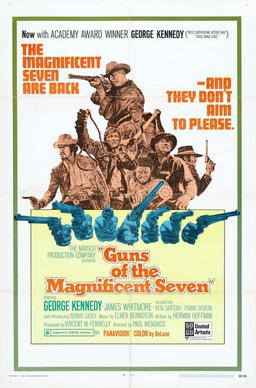
Guns of the Magnificent Seven
Now this may just be me, but George Kennedy doesn't resemble Yul Brynner too much. After two Magnificent Seven movies with Brynner as the star, the third movie starred a new 'Chris' leading a new 7, Kennedy. Of course the posters over at IMDB have to nail this down. So is he the same character? A different man named Chris? Did he undergo extensive plastic surgery? Okay, maybe not that last one, but you get the idea.
Three years removed from Return of the Magnificent Seven comes director Paul Wendkos' take on the popular series, 1969's Guns of the Magnificent Seven. It's a departure from the first two movies with Kennedy, a year removed from his Oscar from Cool Hand Luke, stepping into the saddle. But where 'Return' was basically a rehash of the original classic, 'Guns' gets points for originality both in story and casting. Also, having Elmer Bernstein's score doesn't hurt, especially with some new notes in the music.
Deep in Mexico, a revolutionary leader, Quintero (Fernando Rey) is captured by a sadistic Mexican colonel, Diego (Michael Ansara), who runs a prison that resembles a fortress more than anything else. One of Quintero's most loyal followers, Maximilliano (Reni Santoni) heads north to look for help in getting Quintero out of prison before it's too late. In a border town, Max finds a man named Chris (Kennedy) who's in the process of saving another man, Keno (Monte Markham), from a lynch mob. Chris agrees to help out and assembles a group of specialists to help him in the prison break. They seek help from a local bandit Lobero (Frank Silvera) and his gang -- quite a change of pace since the 1st one, huh? -- but the odds still seem impossible.
The Seven: Kennedy is more than capable of handling the lead role, and while he doesn't look like Brynner at all, he brings the same characteristics to the part; loyal, honest, and always willing to stand up for the downtrodden. As for the other six, this is by far the most unique group when comparing the three sequels. Markham as Keno, the Steve McQueen right hand man role, isn't given a ton to do after his introduction, but as a right hand man, he does what he's supposed to; look cool while helping the leader. Santoni's Max is a youngster with little fighting experience but who wants nothing more than to join the fight.
In adding a black character, Bernie Casey's Cassie, a dynamite expert, the dimension of race is added and even more so with another member of the seven, Slater (Joe Don Baker), a one-armed Confederate gunslinger. Cassie and Slater would seem to have nothing in common, but a friendship develops when they realize how similar they really are. James Whitmore, as solid as ever, plays Levi, an aging knife fighter who's settled down with a family but takes the job for the $. Adding some depth to the character, Levi bonds with Emil (Tony Davis), a young Mexican boy looking for his father. Unfortunately, the 7th member, P.J. (Scott Thomas) receives little development which is a shame because a expert gunfighter/rope thrower dying of tuberculosis has some potential.
The Villain: A definite step up here after Emilio Fernandez's part in 'Return.' Michael Ansara plays Diego to a T. He's a sadistic commandant trying to snuff out the revolution in his district no matter what the cost, especially when it comes to torturing his prisoners. One torture scene midway through the movie shows a creative way to take care of prisoners, bury them in sand up to their throats and then trample and suffocate them with horses walking all around them. Ansara's Diego isn't as developed as much as Calvera or Lorca, but he's just a straight bad guy and sometimes that's all you need.
Some critics said this movie is too slow-going and to be fair, there isn't a ton of action. But really, none of these movies are action-packed. Characters are introduced, we get to know them, and then throw in the action so that when some of the 7 do eventually die, their deaths mean something emotionally. The finale in 'Guns' is on par with the shootout at the end of the original. Finally ready for their assault, Chris leads the 7 and a small group of farmers in an attack on Diego's prison, dubbed the 'Cave of the Rats,' and his 200-man garrison.
It's loud, chaotic and violent, and completely different from the rest of the series. For one, the 7 go on the attack instead of waiting to be attacked against larger numbers. Second, two characters are killed almost at the outset of the battle, and for awhile it looks like the plan might actually fail. Semi-SPOILER I'm convinced Max was supposed to die, he gets absolutely riddled by at least 3 Mexican soldiers, but he's there at the end, apparently just wounded. This would have been the first Mag7 movie to kill 5 of the 7 END OF SPOILER. The attack is a great action sequence from start to finish, and the prison set looks pretty cool too, and even with some other surprises as to who survives and who doesn't to keep you guessing.
A worthy sequel to the original for sure. It does justice in every way while still putting its own spin on a familiar story. Good casting and a strong script that really fleshes out the new members of the Magnificent Seven with a great, action-packed finale. Next up...the finale, The Magnificent Seven Ride!
Guns of the Magnificent Seven <----trailer (1969): ***/**** (Best tagline ever: 7 Against 700; They Just Couldn't Lose!) MASSIVE SPOILERS: Cool fan-made video breaking movie down
Three years removed from Return of the Magnificent Seven comes director Paul Wendkos' take on the popular series, 1969's Guns of the Magnificent Seven. It's a departure from the first two movies with Kennedy, a year removed from his Oscar from Cool Hand Luke, stepping into the saddle. But where 'Return' was basically a rehash of the original classic, 'Guns' gets points for originality both in story and casting. Also, having Elmer Bernstein's score doesn't hurt, especially with some new notes in the music.
Deep in Mexico, a revolutionary leader, Quintero (Fernando Rey) is captured by a sadistic Mexican colonel, Diego (Michael Ansara), who runs a prison that resembles a fortress more than anything else. One of Quintero's most loyal followers, Maximilliano (Reni Santoni) heads north to look for help in getting Quintero out of prison before it's too late. In a border town, Max finds a man named Chris (Kennedy) who's in the process of saving another man, Keno (Monte Markham), from a lynch mob. Chris agrees to help out and assembles a group of specialists to help him in the prison break. They seek help from a local bandit Lobero (Frank Silvera) and his gang -- quite a change of pace since the 1st one, huh? -- but the odds still seem impossible.
The Seven: Kennedy is more than capable of handling the lead role, and while he doesn't look like Brynner at all, he brings the same characteristics to the part; loyal, honest, and always willing to stand up for the downtrodden. As for the other six, this is by far the most unique group when comparing the three sequels. Markham as Keno, the Steve McQueen right hand man role, isn't given a ton to do after his introduction, but as a right hand man, he does what he's supposed to; look cool while helping the leader. Santoni's Max is a youngster with little fighting experience but who wants nothing more than to join the fight.
In adding a black character, Bernie Casey's Cassie, a dynamite expert, the dimension of race is added and even more so with another member of the seven, Slater (Joe Don Baker), a one-armed Confederate gunslinger. Cassie and Slater would seem to have nothing in common, but a friendship develops when they realize how similar they really are. James Whitmore, as solid as ever, plays Levi, an aging knife fighter who's settled down with a family but takes the job for the $. Adding some depth to the character, Levi bonds with Emil (Tony Davis), a young Mexican boy looking for his father. Unfortunately, the 7th member, P.J. (Scott Thomas) receives little development which is a shame because a expert gunfighter/rope thrower dying of tuberculosis has some potential.
The Villain: A definite step up here after Emilio Fernandez's part in 'Return.' Michael Ansara plays Diego to a T. He's a sadistic commandant trying to snuff out the revolution in his district no matter what the cost, especially when it comes to torturing his prisoners. One torture scene midway through the movie shows a creative way to take care of prisoners, bury them in sand up to their throats and then trample and suffocate them with horses walking all around them. Ansara's Diego isn't as developed as much as Calvera or Lorca, but he's just a straight bad guy and sometimes that's all you need.
Some critics said this movie is too slow-going and to be fair, there isn't a ton of action. But really, none of these movies are action-packed. Characters are introduced, we get to know them, and then throw in the action so that when some of the 7 do eventually die, their deaths mean something emotionally. The finale in 'Guns' is on par with the shootout at the end of the original. Finally ready for their assault, Chris leads the 7 and a small group of farmers in an attack on Diego's prison, dubbed the 'Cave of the Rats,' and his 200-man garrison.
It's loud, chaotic and violent, and completely different from the rest of the series. For one, the 7 go on the attack instead of waiting to be attacked against larger numbers. Second, two characters are killed almost at the outset of the battle, and for awhile it looks like the plan might actually fail. Semi-SPOILER I'm convinced Max was supposed to die, he gets absolutely riddled by at least 3 Mexican soldiers, but he's there at the end, apparently just wounded. This would have been the first Mag7 movie to kill 5 of the 7 END OF SPOILER. The attack is a great action sequence from start to finish, and the prison set looks pretty cool too, and even with some other surprises as to who survives and who doesn't to keep you guessing.
A worthy sequel to the original for sure. It does justice in every way while still putting its own spin on a familiar story. Good casting and a strong script that really fleshes out the new members of the Magnificent Seven with a great, action-packed finale. Next up...the finale, The Magnificent Seven Ride!
Guns of the Magnificent Seven <----trailer (1969): ***/**** (Best tagline ever: 7 Against 700; They Just Couldn't Lose!) MASSIVE SPOILERS: Cool fan-made video breaking movie down
Monday, June 1, 2009
The Living Daylights
Fans of James Bond seem to be pretty mixed when it comes to feelings about the Roger Moore era. I was surprised as anyone, but I ended up liking most of the Moore Bonds. They're not classics other than The Spy Who Loved Me, but they're very entertaining if at times too campy. I moved on this week to the brief two-film Timothy Dalton stint as everyone's favorite 00 agent with 1987's The Living Daylights.
Just like the movies, I'm working my way through Ian Fleming's Bond books and short stories. And with just one movie, I can say Dalton is closest of all the Bond actors to what Fleming originally intended with the character. Lost amidst all the cool gadgets, gorgeous women and beautiful locations is that James Bond is a cold character, an agent who will stop at nothing to get the job done no matter who or what gets in his way. All the actors, Connery, Lazenby, Moore, Brosnan and most recently Craig, put their own spin on 007. But Dalton in his first movie gets Bond back to his roots, an efficient, effective spy who can be ruthless in his methods at times.
The Living Daylights across the board tries to get back to the basics. There's no arch-villain trying to take over the world here with some harebrained scheme to ransom off the Earth with nuclear bombs. Instead, Bond is helping a Russian general, Koskov (Jeroen Krabbe) defect or so it seems at first. The KGB kidnaps the General only after he reveals a Russian plan to start knocking off MI6's agents. But it all seems too easy and the only trail leads to a Russian cello player, Kara Milovy (Maryam d'Abo). Bond begins to unravel a plan that includes diamonds, opium smuggling, a multimillion arms deal, and even the Mujahideen, the Afghan freedom fighters.
After some initial confusion with backstabs and double-crosses, TLD finds it's groove really quickly. With a new actor in the lead role, the opening pre-credit sequence is always interesting to see. This is one of the best as three MI6 agents go through a training exercise in Gibraltar. We don't know which one is Bond until a fourth agent appears and starts killing the others. Check it out here courtesy of what else? Youtube. Without the general overdone jokey feel of some of the Moore movies, TLD gets to focus on what most Bond fans want to see, the action and story. The last 40 minutes is basically one long extended sequence with a raging battle on an airstrip as the Mujahideen, Russian soldiers, and Bond duke it out for a plane filled with bags of raw opium and a bomb.
Here's the finale of the plane fight as Bond fights with henchmen Necros (Andreas Wisniewski) at the back end of a cargo plane. It's got some of the best stuntwork I've yet to see in the Bond series. I can't say enough about the action in general. Directing his fourth movie from the series, John Glen clearly knows what he's doing by now with this the best by far of the quartet.
Behind Dalton, the supporting cast might lack some of the name recognition of the other movies, but it's a more than solid group. d'Abo is cute as the Bond girl here, but it's not a particularly memorable Bond girl. Joining Krabbe and Wisniewski in the villain department, Joe Don Baker gets to ham it up as Brad Whittaker, an ex-West Point cadet booted for cheating now making money as a worldwide arms dealer. Fans of the Brosnan movies should recognize him several years before he played CIA agent Jack Wade. John Rhys-Davies has a brief part as Pushkin, a Russian general being played by all sides. It's not much, but Rhys-Davies is the type of actor who gives a movie credibility just by being there. Then there's Art Malik as Kamran Shah, a Mujahideen fighter teaming up with Bond. In the years since 9/11, it's still odd to see the Afghan resistance portrayed the way they are, especially knowing how history developed and changed as the Afghans went from allies to enemies.
Going in I wasn't sure what to expect from the Dalton opener because I usually heard negative reviews, but I got wrapped up in The Living Daylights right away. I love how Dalton leaves his own mark on Bond, not settling for a rehashed version of Connery or Moore, and it's a Bond movie at least remotely based in reality. Here's the trailer and the title song by A-Ha, not one of the best themes but not bad either. Composer John Barry doesn't disappoint either, turning in another memorable score with all the recognizable music with some new twists.
Just like the movies, I'm working my way through Ian Fleming's Bond books and short stories. And with just one movie, I can say Dalton is closest of all the Bond actors to what Fleming originally intended with the character. Lost amidst all the cool gadgets, gorgeous women and beautiful locations is that James Bond is a cold character, an agent who will stop at nothing to get the job done no matter who or what gets in his way. All the actors, Connery, Lazenby, Moore, Brosnan and most recently Craig, put their own spin on 007. But Dalton in his first movie gets Bond back to his roots, an efficient, effective spy who can be ruthless in his methods at times.
The Living Daylights across the board tries to get back to the basics. There's no arch-villain trying to take over the world here with some harebrained scheme to ransom off the Earth with nuclear bombs. Instead, Bond is helping a Russian general, Koskov (Jeroen Krabbe) defect or so it seems at first. The KGB kidnaps the General only after he reveals a Russian plan to start knocking off MI6's agents. But it all seems too easy and the only trail leads to a Russian cello player, Kara Milovy (Maryam d'Abo). Bond begins to unravel a plan that includes diamonds, opium smuggling, a multimillion arms deal, and even the Mujahideen, the Afghan freedom fighters.
After some initial confusion with backstabs and double-crosses, TLD finds it's groove really quickly. With a new actor in the lead role, the opening pre-credit sequence is always interesting to see. This is one of the best as three MI6 agents go through a training exercise in Gibraltar. We don't know which one is Bond until a fourth agent appears and starts killing the others. Check it out here courtesy of what else? Youtube. Without the general overdone jokey feel of some of the Moore movies, TLD gets to focus on what most Bond fans want to see, the action and story. The last 40 minutes is basically one long extended sequence with a raging battle on an airstrip as the Mujahideen, Russian soldiers, and Bond duke it out for a plane filled with bags of raw opium and a bomb.
Here's the finale of the plane fight as Bond fights with henchmen Necros (Andreas Wisniewski) at the back end of a cargo plane. It's got some of the best stuntwork I've yet to see in the Bond series. I can't say enough about the action in general. Directing his fourth movie from the series, John Glen clearly knows what he's doing by now with this the best by far of the quartet.
Behind Dalton, the supporting cast might lack some of the name recognition of the other movies, but it's a more than solid group. d'Abo is cute as the Bond girl here, but it's not a particularly memorable Bond girl. Joining Krabbe and Wisniewski in the villain department, Joe Don Baker gets to ham it up as Brad Whittaker, an ex-West Point cadet booted for cheating now making money as a worldwide arms dealer. Fans of the Brosnan movies should recognize him several years before he played CIA agent Jack Wade. John Rhys-Davies has a brief part as Pushkin, a Russian general being played by all sides. It's not much, but Rhys-Davies is the type of actor who gives a movie credibility just by being there. Then there's Art Malik as Kamran Shah, a Mujahideen fighter teaming up with Bond. In the years since 9/11, it's still odd to see the Afghan resistance portrayed the way they are, especially knowing how history developed and changed as the Afghans went from allies to enemies.
Going in I wasn't sure what to expect from the Dalton opener because I usually heard negative reviews, but I got wrapped up in The Living Daylights right away. I love how Dalton leaves his own mark on Bond, not settling for a rehashed version of Connery or Moore, and it's a Bond movie at least remotely based in reality. Here's the trailer and the title song by A-Ha, not one of the best themes but not bad either. Composer John Barry doesn't disappoint either, turning in another memorable score with all the recognizable music with some new twists.
Subscribe to:
Posts (Atom)