With Sam Peckinpah's 1969 western The Wild Bunch, the conversation pretty much begins and ends about the best changing of the times westerns, the closing of an era. Star William Holden gives a career-best performance in this blood-splattered western, the leader of a gang of aging outlaws looking for one last score in Mexico. Holden had a long list of great performances, but one that has flown under the radar all these years is a similar changing times story in the wild west, 1971's Wild Rovers.
By the late 1800s and into the first 10 or 20 years of the 1900s, the idea of the wild west was one fading away into the background. Movie westerns have explored this era in countless ways, most revolving around the idea of a man (or men) refusing to change with the times, handcuffed to the way they know how to do things. The Wild Bunch handles it in a brutal, forthright fashion, a cynical view of outlaws going out in a blaze of glory rather than change. Butch Cassidy and the Sundance Kid has its darker moments, but for the most part is more comedic with more humor thanks to its buddy pairing of Newman and Redford. Then there's Wild Rovers, falling somewhere in between, moments of startling violence balanced out with endearing emotional flashes. It finds a good balance in between in an underrated western.
It's almost round-up time for the R-Bar cattle ranch in Wyoming with owner Walt Buckman (Karl Malden) readying his crew of cowboys for the coming rush of work. Among them is Ross Bodine (Holden), a veteran cowboy approaching the age of 50 who's spent 30-plus years in the saddle, and Frank Post (Ryan O'Neal), a young cowboy full of piss and vinegar looking to have a good time. Frustrated with their lot in life -- working long hours with little reward -- the two cowboys come up with an idea; rob a bank and with their take head to Mexico where they can start their own ranch. The bank robbery in the dead of night goes smoothly, but Buckman sends his sons, Paul (Joe Don Baker), his father's favorite and an easy-going sort in general, and John (Tom Skerritt), the youngster desperately seeking his father's approval. Ross and Post were good cowboys, but can they be good outlaws too?
As a western fan, there is something simple and profound in westerns similar to this. A changing time, and a lifestyle gone, men refusing to change who are set in their ways. To direct a western like this, I wouldn't have thought Blake Edwards to be the right choice, but I was wrong. Known for his comedies, especially the Pink Panther movies, Edwards takes his time with this 139-minute long movie. The story drifts along in an episodic nature, introducing the characters and the situation at its leisure. Even post-robbery, the story isn't in any rush. It is a harsher west than many westerns portray, building up tension in certain scenes that can be unbearable to watch. It just works. My only real fault is that the movie has an overture, intermission and entr'acte, and finale music. It seems out of place, like something a different-toned Edwards comedy would have used. Just a minor point, nothing worth worrying about. I just fast forwarded through these segments.
Playing Pike Bishop in Peckinpah's The Wild Bunch, Holden delivered a career best performance, and in my mind, there isn't a close second. This might be that second-best role, a character that is obviously more light-hearted than Bishop, but not too dissimilar. His Ross Bodine is a cowboy about to turn 50 years old who has spent much of his life working himself to the bone herding cows without much to show for it. Robbing a bank seems like an easy out so he takes the chance when presented. Just 53 years old, Holden looks much older. He is a sympathetic, tragic main character if there ever was one, and Holden brings that to life.
Two monologues -- one at the beginning, another at the end -- let him show his range, one about fate and dying, the other about an unlikely friendship that's developed with O'Neal's Post. I thought the best scene though was a quiet moment, Bodine lying in bed next to a prostitute, staring off into the distance. His eyes say a lot, a man who realizes he's made the wrong choice and now has to deal with the consequences. From that moment, you know where this character is headed if you weren't already sure.
Now as perfectly cast as Holden is as the world-weary Bodine, I think there's a bit of miscasting with O'Neal as his young counterpart, Frank Post. Regardless of the role, I've never thought too highly of O'Neal as an actor. The character is interesting here, but I don't think it is due to his acting. He's naive at times but with a devilish streak at others. He's saved by the fact that he's working with a pro like Holden. In the older mentor, younger student dynamic, the relationship works. They play off each other well, their dialogue crackling back and forth as a genuine friendship grows out of this dash for safety in Mexico. It's not a bad performance for O'Neal, but it could have been better.
The other parts while important aren't as key. Malden is the archetypal western cattle baron, ruling with a strong hand and iron will. Baker and Skerritt are nicely cast alongside each other, polar opposites in terms of personality. Baker's John is frustrated with the hunt that drags on into weeks and months while Skerritt's Paul intends to follow his father's request no matter what it takes.
Dealing with a story that is about a closing chapter in American history, you've got to assume the ending will not be a happy one. The last 45 minutes is where this movie becomes special as Bodine and Post stop at a desert town and rest up before pushing on to Mexico. The ending packs a wallop, leaving that feeling of being punched in the stomach. It's moving for all the people involved, a tragic end to almost all the characters. I don't want to say more without taking away from the emotional impact, but it makes some of the slower parts worth sitting through. This is an underrated western that deserves far more respect than it gets. Beautifully shot all over the west in Monument Valley, Utah and Arizona and aided by a Jerry Goldsmith score that's best in its quieter moments, Wild Rovers is a hidden gem well worth catching up with.
Wild Rovers <---TCM trailer/clips (1971): ***/****
The Sons of Katie Elder
"First, we reunite, then find Ma and Pa's killer...then read some reviews."
Showing posts with label Ryan O'Neal. Show all posts
Monday, September 26, 2011
Thursday, November 19, 2009
The Driver
As far back as the silent Keystone Cops series, movies have had car chases. In the late 60s, Bullitt and The French Connection opened the door for a slew of car-chase related movies that continues to this day. Name a halfway decent action movie from the last 30-40 years, and there's a good chance there is a car chase. Who knows what attracts audiences to them? Ridiculously cool cars gunning it across country and through crowded cities just sounds fun.
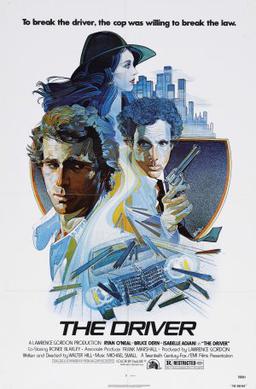
But with car chases, and I'm not talking racing movies, there are few movies directed to the most important thing in the chase -- the guy behind the wheel. Released in 1978, The Driver just does that, focusing almost completely on the man driving the badass car(s). Director Walter Hill handles a movie that could have been a color film noir movie with the typically cool anti-hero, the femme fatale, and the dedicated, driven cop trying to catch the rebellious main character. It's the type of movie that almost borders on the pretentious with characters addressed as their occupation -- the Driver, the Detective, the Connection -- but pulls back just enough not to be obnoxious.
When a crook/robber/underworld thug is trying to pull off a job, there's one person that can significantly help his chances get away. Everyone knows him simply as the Driver (Ryan O'Neal), the best getaway driver and wheelman around. The police are fully aware of who and what he is, especially the Detective (Bruce Dern), but they're never able to pin any of the crimes on him, and he always gets away to pull off another getaway. But the Detective has been pushed too far so he goes about setting up a trap that even the Driver can't escape from.
The plot is straightforward with little diversions to take away from the heated and on-going battle between the getaway driver and the police officer trying to bring him in. There's a rivalry between the men that O'Neal and Dern pull off perfectly. O'Neal's Driver is quickly aware that he's being set up and still take the job if for nothing else than to prove he can do it, and more importantly he's smarter than a cop. O'Neal isn't a great actor, but playing the strong, silent type works nicely for him. Dern is a scene-stealer (as he usually was) as the slightly crazy detective who will risk anything to catch his rival.
Director Hill clearly knows what he's doing with an often minimalist story that focuses so closely on style over substance, especially with the chase scenes that bookend the movie. The opening as the Driver attempts to escape from the police (watch it HERE) is a great intro as to what type of movie you're about to watch. It also features one of the best endings to a car chase I can remember. The finale -- check it out here with SPOILERS of course -- is even better, combining some great stunt driving with a sometimes unbearable tension as O'Neal drives a souped-up pickup truck chasing down a Firebird.
Watching the chase scenes is easier to appreciate because O'Neal did just enough driving to make it seem believable. Sure, a stunt driver probably did most of it, but the viewer actually sees O'Neal behind the wheel. It sounds simple, but it helps a lot. And one of the reasons I'll always love older movies, no fake-looking CGI could ever replace good old fashioned stunts. In these chase scenes, Hill doesn't mess around with a loud blaring soundtrack that tells you how to feel. Just like Bullitt, The Driver's chase scenes are almost silent other than the sounds of the engines chugging along trying to outdo each other. Definitely some of the best car chases around because they don't mess with the formula. Simple, straightforward and exciting.
With the rest of the cast, a few names jump out but it's O'Neal and Dern's movie to win or lose. Isabelle Adjani is the Player, a young woman in desperate need of money who provides an alibi for the Driver after the opening getaway. If there was a love interest, Adjani would be it, but the story doesn't have time to waste with a love story. Ronee Blakley is the Connection, the woman who sets the Driver up with jobs and seems to have some sort of past with him but that could be me overanalyzing. Felice Orlandi and Matt Clark are two of Dern's fellow detectives working the case and Joseph Walsh and Rudy Ramos are Glasses and Teeth, two crooks who need the Driver's services.
A quasi-existential chase movie that's a lot of fun to watch, especially for any fans of car chases in the vein of Bullitt, The French Connection, and Two-Lane Blacktop. Stars Ryan O'Neal and Bruce Dern look to be having a good time making it, and director Walter Hill turns in a taut, exciting story dominated by car chases at either end of the movie. Car junkies shouldn't miss this one.
The Driver <----trailer (1978): ***/****
But with car chases, and I'm not talking racing movies, there are few movies directed to the most important thing in the chase -- the guy behind the wheel. Released in 1978, The Driver just does that, focusing almost completely on the man driving the badass car(s). Director Walter Hill handles a movie that could have been a color film noir movie with the typically cool anti-hero, the femme fatale, and the dedicated, driven cop trying to catch the rebellious main character. It's the type of movie that almost borders on the pretentious with characters addressed as their occupation -- the Driver, the Detective, the Connection -- but pulls back just enough not to be obnoxious.
When a crook/robber/underworld thug is trying to pull off a job, there's one person that can significantly help his chances get away. Everyone knows him simply as the Driver (Ryan O'Neal), the best getaway driver and wheelman around. The police are fully aware of who and what he is, especially the Detective (Bruce Dern), but they're never able to pin any of the crimes on him, and he always gets away to pull off another getaway. But the Detective has been pushed too far so he goes about setting up a trap that even the Driver can't escape from.
The plot is straightforward with little diversions to take away from the heated and on-going battle between the getaway driver and the police officer trying to bring him in. There's a rivalry between the men that O'Neal and Dern pull off perfectly. O'Neal's Driver is quickly aware that he's being set up and still take the job if for nothing else than to prove he can do it, and more importantly he's smarter than a cop. O'Neal isn't a great actor, but playing the strong, silent type works nicely for him. Dern is a scene-stealer (as he usually was) as the slightly crazy detective who will risk anything to catch his rival.
Director Hill clearly knows what he's doing with an often minimalist story that focuses so closely on style over substance, especially with the chase scenes that bookend the movie. The opening as the Driver attempts to escape from the police (watch it HERE) is a great intro as to what type of movie you're about to watch. It also features one of the best endings to a car chase I can remember. The finale -- check it out here with SPOILERS of course -- is even better, combining some great stunt driving with a sometimes unbearable tension as O'Neal drives a souped-up pickup truck chasing down a Firebird.
Watching the chase scenes is easier to appreciate because O'Neal did just enough driving to make it seem believable. Sure, a stunt driver probably did most of it, but the viewer actually sees O'Neal behind the wheel. It sounds simple, but it helps a lot. And one of the reasons I'll always love older movies, no fake-looking CGI could ever replace good old fashioned stunts. In these chase scenes, Hill doesn't mess around with a loud blaring soundtrack that tells you how to feel. Just like Bullitt, The Driver's chase scenes are almost silent other than the sounds of the engines chugging along trying to outdo each other. Definitely some of the best car chases around because they don't mess with the formula. Simple, straightforward and exciting.
With the rest of the cast, a few names jump out but it's O'Neal and Dern's movie to win or lose. Isabelle Adjani is the Player, a young woman in desperate need of money who provides an alibi for the Driver after the opening getaway. If there was a love interest, Adjani would be it, but the story doesn't have time to waste with a love story. Ronee Blakley is the Connection, the woman who sets the Driver up with jobs and seems to have some sort of past with him but that could be me overanalyzing. Felice Orlandi and Matt Clark are two of Dern's fellow detectives working the case and Joseph Walsh and Rudy Ramos are Glasses and Teeth, two crooks who need the Driver's services.
A quasi-existential chase movie that's a lot of fun to watch, especially for any fans of car chases in the vein of Bullitt, The French Connection, and Two-Lane Blacktop. Stars Ryan O'Neal and Bruce Dern look to be having a good time making it, and director Walter Hill turns in a taut, exciting story dominated by car chases at either end of the movie. Car junkies shouldn't miss this one.
The Driver <----trailer (1978): ***/****
Labels:
1970s,
Bruce Dern,
Car Movies,
Matt Clark,
Ryan O'Neal,
Walter Hill
Subscribe to:
Posts (Atom)