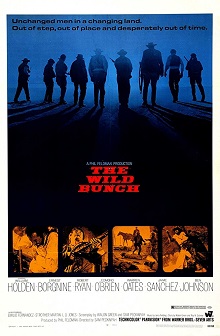
By 1969, director Sam Peckinpah had worked on several TV series and several film productions, including The Deadly Companions, Ride the High Country and Major Dundee. He was an incredibly talented director but one whose fiery personality and personal demons could potentially derail any film he worked on. But in 1969, it all came together, Peckinpah making his classic, his all-time great film, one of the best westerns ever and best films ever in general, 1969's The Wild Bunch.
It's 1913 in a small border town near the Rio Grande, and a gang of outlaws, led by the infamous Pike Bishop (William Holden), disguised as soldiers ride in to rob the bank of a rumored silver shipment. The robbery is an epic disaster as a posse of bounty hunters, led by Deke Thornton (Robert Ryan), a paroled outlaw who used to ride with Pike, is waiting in ambush. Many of Pike's gang is killed in the robbery that nets them NO money. The remaining members of the gang, including Dutch Engstrom (Ernest Borgnine), retreat into Mexico. They need a new job, a new robbery, a new chance to earn some money. Pike especially knows that time is running out, that times are changing, and their chances at surviving as outlaws is becoming ever more unlikely. It doesn't help that Deke and his bounty hunters have followed them into Mexico, looking to collect the bounties on these infamous outlaws. With time running out, what do they do?
What a movie. Every so often, each and EVERY thing involved in the making of a film comes together and forms that perfect symmetry. 'Bunch' is an all-timer, not just a movie I love but a great movie in terms of storytelling and in technical terms. Appropriate for the time it was released (the late 1960's), it is cynical, horrifically violent, brutally honest and generally downbeat. This is a western and film ahead of its time, helping set the tone where films would go in the coming years. This is Peckinpah at the top of his game. He would have other good to great to classic films, but this is his Great film. Just a gem.
There is little to nothing to criticize here. While the filming process sounds incredibly interesting (a film in itself), the choice to film in Mexico pays off huge dividends. Cinematographer Lucien Ballard shoots a beautiful movie with the Mexican countryside and desert as a backdrop. The locations are phenomenal. You feel like you're watching the actual settings of the Mexican Revolution to our story. Composer Jerry Fielding turns in quite the memorable score as well, appropriately epic at times and equally quiet and emotional as necessary in other scenes. Listen to a sample HERE. As for the story itself, Peckinpah and writer Walon Green turn in a screenplay that's just a gem. It isn't a movie in a rush, letting things breathe and allow the viewer to get to know the characters -- for good or bad -- over its 145-minute running time. Sit back and take it in. You shan't be disappointed!
Many westerns have dealt with the death of the old west, the end of an era, but none better than The Wild Bunch. It's 1913 and there's no place for these outlaws, killers and gunfighters anymore. The world is changing, and civilization (of sorts) is moving in to replace them. We follow a gang of those outlaws, robbers, killers/murderers as they try to pull off their one last job and step away, and it's a testament to the acting on display and screenplay that we feel any sympathy at all to these men. Like few movies I've ever seen, there is a doomed quality to these men who are working with limited time on their hands. They know the door is closing on them, more than likely a bloody death awaiting them if they don't figure out something soon.
Where Peckinpah's screenplay is so strong is in its characterization and its depth. There's a whole lot of acting talent on display in 'Bunch,' and for much of the cast, this is their all-time best performance or certainly one of their best. Holden's Pike Bishop is one of the most fascinating characters ever in my book, an aging outlaw who's outlived his time but doesn't know what else to do. Borgnine too is excellent as Dutch, his right-hand man who can also see the writing on the wall. Their scene together after the early botched robbery is essential, two men who potentially know what awaits them but go into things willingly because maybe that ending is what's supposed to happen. On the counter, Ryan's Deke Thornton is equally tragic. He's riding after his old partner, Bishop, and would much rather be riding with them than chasing them. But as the script relies on, your word is your word, and these men live by that coda.
One of the many things Peckinpah loved to touch on in his films was that bond of men under fire who come through while others don't. Holden's Pike is the mouthpiece for that concept, of giving your word and sticking by it even when it'd be far easier to tuck your tail and run. We see that again and again with the bunch, including Pike, Dutch, old, grizzled Sykes (Edmond O'Brien), the crass, unsavory Gorch brothers, Lyle (Warren Oates) and Tector (Ben Johnson), and Angel (Jaime Sanchez), the youngest of the group, a fiery Mexican. What's interesting is that though Pike and the bunch claim to live by this coda, they continue to fall short of actually living up to it. It's when they realize their faults in that department that the story takes a far more tragic turn toward the inevitable ending that you just knew was coming.
Because the already-mentioned star power wasn't enough, here's some more! Along with Ryan, look for scene-chewing Strother Martin and L.Q. Jones as two scummy bounty hunters with Albert Dekker as the railroad magnate "employing" them. Emilio Fernandez is perfectly slimy as Mapache, the Mexican general claiming to be some sort of freedom fighter but it seems it is all for show, for more power, with Jorge Russek and Alfonso Arau (El Guapo in Three Amigos) as his subordinate officers. Also look for Bo Hopkins, Dub Taylor and Chano Urueta in key (if small) supporting parts.
What 'Bunch' has become synonymous with over the years is its groundbreaking, sometimes horrifying portrayal of on-screen violence. It's not that Peckinpah lingers on the violence for the sake of shock value. Far from it, but instead he makes it into an art form. The idea of a 'dance of death' comes to mind in any portrayal of violence with three main set pieces (1. The opening robbery turned into a bloody shootout 2. A prolonged train robbery and 3. The final, bullet-riddled and blood-splattered gun battle). The editing is ridiculously fast and cut in with perfect uses of slow motion. Simply put, there is an art to Peckinpah's use of violence, both in the editing, in the overwhelming use of slow-motion blood squibs, and the impact of that violence we're seeing. If Bonnie and Clyde opened the door some for its own use of on-screen violence, Peckinpah's The Wild Bunch kicked that door wide open. Almost 50 years later, it still resonates, and it's clear the impact it had on hundreds and thousands of movies released since.
It all builds to maybe the most memorable action sequence of all-time. If it's not No. 1, it certainly belongs in the conversation. In a sequence that's been dubbed "The Battle of Bloody Porch," it all comes together in an extended sequence that has lost none of its edge since its release in 1969. This is a transfixing scene that is equal parts horrifying and startling but you just can't look away. There are too many great moments just in this scene alone to mention, including an improvised walk the Bunch takes on their way to a final showdown (maybe the movie's second-strongest sequence). It is followed by a quick, shocking death, and then an eerie moment of silence that hangs in the air. With one gunshot, it is on, bullets flying thick in the air. Obvious SPOILERS but you can watch it HERE. If you haven't seen the movie, I don't recommend watching the sequence out of context. Watch the movie and soak it all in as part of the whole product. Just a remarkable extended sequence with virtually no music. The focus is the characters, violence and death. Nothing more. Nothing less.
A classic in every sense of the word. I pick something new up with every viewing, and it never loses any of its impact. A film without a weakness.
The Wild Bunch (1969): ****/****
The Sons of Katie Elder
"First, we reunite, then find Ma and Pa's killer...then read some reviews."
Showing posts with label William Holden. Show all posts
Monday, December 28, 2015
Monday, August 10, 2015
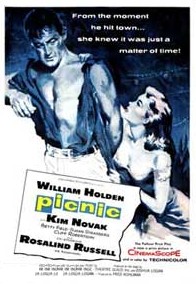
Picnic
I tend to think of the 1950's as a pleasant mix of Leave it to Beaver and Happy Days. Naturally, that's not what the entire decade in the U.S. was like, but isn't it fun to think of it that way? They were more innocent times before the hair on fire 1960's rolled around, huh? Some of those 1950's movies though, you could see an indication of what was to come. One sexually charged or sexually repressed movie after another hit theaters, many of them based off scandalous novels or stage plays. One I've always been curious to watch and was finally able to track down? That's 1955's Picnic.
A freight train rolls into a quiet Kansas town on a hot summer day, and a man named Hal Carter (William Holden) jumps off. A drifter without a home or too much money in his pocket, Hal hopes to reunite with a friend from college and maybe get a job out of it...if possible. It doesn't take too long for Hal to find the friend, Alan Benson (Cliff Robertson), the well-to-do son of one of the richest men in town. Even after years apart and with both men having gone down such different paths, the two fraternity buddies pick things up like they were never apart. It's Labor Day, and Hal's timing is pretty good as the whole town is heading off to an immense picnic, a farewell of sorts to the summer. Hal is a little wary of the gathering as the outsider in town but ends up going. Problem? You bet, especially when Hal sets his sights on Madge (Kim Novak), Alan's beautiful girlfriend who comes from a poor(ish) family. Let the drama begin.
In the button-down, gentlemanly, poodle-skirt era of the 1950's, people simply did not have sex. It was simply...FORBIDDEN. Or so the movies would have you think. This was a huge time of change in Hollywood as studios got away from all sorts of production codes that limited what could and couldn't be shown. So as a result, audiences got a lot of sexually charged, forbidden love movies, often set in little towns where sexual frustrations apparently ran rampant. We got movies like this, Peyton Place, God's Little Acre, A Streetcar Named Desire, Baby Doll and plenty more I'm probably forgetting. All that repression and frustration always explodes in dramatic fashion! Ah, emotions and feelings! Yeah, at times, things can go a little overboard. That's Picnic. Some good moments, some good performances, with some really heavy, overdone moments.
'Picnic' is based off a Pulitzer Prize winning play that took Broadway by storm in 1953. Director Joshua Logan helmed both the play and the feature film, picking up an Oscar nomination in the process. In its filming techniques, 'Picnic' never feels like a stage-based play turned feature film. You can't say that for a lot of like-minded films. Logan filmed on-location in Hutchinson, Kansas and explores the town. You get a feel for the town, its people and its energy. The movie itself clocks in at 115 minutes and can clearly be divided in two parts. That first hour sets the stage, introducing all this hidden drama, rivalries, personal problems and lets the tension build into the high-drama of the second half as all those issues come to center stage. As for me? I loved the first hour and tolerated the second. More on that to come.
The cast doesn't feature a ton of big names, but that's not a bad thing. Holden took some heat because at 37 he was probably a little too old for the Hal part, but probably doesn't mean much. He brings the right energy to the part, hiding some personal demons while presenting an outgoing, fun-loving, likable persona. Really? He's a man in his mid-20s trying to find his lot in life, and so far, he's come up empty wherever he's turned. This isn't always a likable character, but Holden's Hal is a sympathetic one. His chemistry with Novak's Madge is perceptible in the air, just two people drawn to each other and they can't explain it. Novak would develop into a solid actress over the years, but here, her performance is a little rough. As a presence, she's unquestioned, stunningly beautiful, her Madge sick of everyone judging her by looks and looks alone.
Who else to look for? 'Picnic' was actually Cliff Robertson's first credited feature film, his Alan being an interesting mix, a spoiled kid who doesn't want to be the spoiled kid. We do get to see a mean streak in him though so stay tuned. Betty Field plays Flo, Madge's single mother, badgering and worrying and overbearing, while Susan Strasberg is Millie, Madge's tomboy little sister, smart, a reader and sick of Madge. Rosalind Russell hams it up as Rosemary, a 40-something schoolteacher in town, with a suitor/boyfriend of sorts in shop owner, Howard (Arthur O'Connell in an Oscar-nominated turn). Also look for Verna Felton as Helen Potts, the adorable next door neighbor, a bit of a conscience for the film/town, and Nick Adams as a horny teenager.
When Picnic is good, it's really good. But when it goes? Man, it goes. Everything comes to crazy fruition at the tail end of the picnic, and all hell breaks loose. The key, momentum-changing shift is started when a shirt gets torn, and literally everyone FREAKS THE EF OUT. A movie based on a stage play becomes very stagey and overdone and hammy. EMOTIONS and FEELINGS are everywhere. It's not that the drama isn't effective. It's that it lacks all subtlety at all. It becomes painful to watch at times. The ending itself is built up as a happy ending (of sorts), but man, when you think about it, this is NO happy ending at all. Still...it's a very cool final shot, so that counts for something right?
An interesting mix in the end. I really liked parts of it, especially Holden's performance, but the whole thing gets to be a little much in the end. The positives serve as a time capsule of sports. The entire story takes place in a 24-hour time period, and my goodness, it was quite the sunny, beautiful Labor Day. This is a beautiful movie to sit back and watch and appreciate it. We get a picture of 1950's life, especially in the extended picnic sequence as the whole town comes together to celebrate. Before all hell breaks loose in the emotions department in the second half, you get a sense of a more innocent time, and then Holden's shirt gets ripped and all bets are off. Still, there's enough to recommend but be forewarned that things turn into a sappy, tawdry soap opera in the second half.
Picnic (1955): ** 1/2 /****
A freight train rolls into a quiet Kansas town on a hot summer day, and a man named Hal Carter (William Holden) jumps off. A drifter without a home or too much money in his pocket, Hal hopes to reunite with a friend from college and maybe get a job out of it...if possible. It doesn't take too long for Hal to find the friend, Alan Benson (Cliff Robertson), the well-to-do son of one of the richest men in town. Even after years apart and with both men having gone down such different paths, the two fraternity buddies pick things up like they were never apart. It's Labor Day, and Hal's timing is pretty good as the whole town is heading off to an immense picnic, a farewell of sorts to the summer. Hal is a little wary of the gathering as the outsider in town but ends up going. Problem? You bet, especially when Hal sets his sights on Madge (Kim Novak), Alan's beautiful girlfriend who comes from a poor(ish) family. Let the drama begin.
In the button-down, gentlemanly, poodle-skirt era of the 1950's, people simply did not have sex. It was simply...FORBIDDEN. Or so the movies would have you think. This was a huge time of change in Hollywood as studios got away from all sorts of production codes that limited what could and couldn't be shown. So as a result, audiences got a lot of sexually charged, forbidden love movies, often set in little towns where sexual frustrations apparently ran rampant. We got movies like this, Peyton Place, God's Little Acre, A Streetcar Named Desire, Baby Doll and plenty more I'm probably forgetting. All that repression and frustration always explodes in dramatic fashion! Ah, emotions and feelings! Yeah, at times, things can go a little overboard. That's Picnic. Some good moments, some good performances, with some really heavy, overdone moments.
'Picnic' is based off a Pulitzer Prize winning play that took Broadway by storm in 1953. Director Joshua Logan helmed both the play and the feature film, picking up an Oscar nomination in the process. In its filming techniques, 'Picnic' never feels like a stage-based play turned feature film. You can't say that for a lot of like-minded films. Logan filmed on-location in Hutchinson, Kansas and explores the town. You get a feel for the town, its people and its energy. The movie itself clocks in at 115 minutes and can clearly be divided in two parts. That first hour sets the stage, introducing all this hidden drama, rivalries, personal problems and lets the tension build into the high-drama of the second half as all those issues come to center stage. As for me? I loved the first hour and tolerated the second. More on that to come.
The cast doesn't feature a ton of big names, but that's not a bad thing. Holden took some heat because at 37 he was probably a little too old for the Hal part, but probably doesn't mean much. He brings the right energy to the part, hiding some personal demons while presenting an outgoing, fun-loving, likable persona. Really? He's a man in his mid-20s trying to find his lot in life, and so far, he's come up empty wherever he's turned. This isn't always a likable character, but Holden's Hal is a sympathetic one. His chemistry with Novak's Madge is perceptible in the air, just two people drawn to each other and they can't explain it. Novak would develop into a solid actress over the years, but here, her performance is a little rough. As a presence, she's unquestioned, stunningly beautiful, her Madge sick of everyone judging her by looks and looks alone.
Who else to look for? 'Picnic' was actually Cliff Robertson's first credited feature film, his Alan being an interesting mix, a spoiled kid who doesn't want to be the spoiled kid. We do get to see a mean streak in him though so stay tuned. Betty Field plays Flo, Madge's single mother, badgering and worrying and overbearing, while Susan Strasberg is Millie, Madge's tomboy little sister, smart, a reader and sick of Madge. Rosalind Russell hams it up as Rosemary, a 40-something schoolteacher in town, with a suitor/boyfriend of sorts in shop owner, Howard (Arthur O'Connell in an Oscar-nominated turn). Also look for Verna Felton as Helen Potts, the adorable next door neighbor, a bit of a conscience for the film/town, and Nick Adams as a horny teenager.
When Picnic is good, it's really good. But when it goes? Man, it goes. Everything comes to crazy fruition at the tail end of the picnic, and all hell breaks loose. The key, momentum-changing shift is started when a shirt gets torn, and literally everyone FREAKS THE EF OUT. A movie based on a stage play becomes very stagey and overdone and hammy. EMOTIONS and FEELINGS are everywhere. It's not that the drama isn't effective. It's that it lacks all subtlety at all. It becomes painful to watch at times. The ending itself is built up as a happy ending (of sorts), but man, when you think about it, this is NO happy ending at all. Still...it's a very cool final shot, so that counts for something right?
An interesting mix in the end. I really liked parts of it, especially Holden's performance, but the whole thing gets to be a little much in the end. The positives serve as a time capsule of sports. The entire story takes place in a 24-hour time period, and my goodness, it was quite the sunny, beautiful Labor Day. This is a beautiful movie to sit back and watch and appreciate it. We get a picture of 1950's life, especially in the extended picnic sequence as the whole town comes together to celebrate. Before all hell breaks loose in the emotions department in the second half, you get a sense of a more innocent time, and then Holden's shirt gets ripped and all bets are off. Still, there's enough to recommend but be forewarned that things turn into a sappy, tawdry soap opera in the second half.
Picnic (1955): ** 1/2 /****
Labels:
1950s,
Arthur O'Connell,
Cliff Robertson,
Kim Novak,
Nick Adams,
William Holden
Friday, February 20, 2015
The Revengers
As I've mentioned before, I've got a list in my head of hard-to-find movies that I've long sought. An interesting cast, a intriguing story, anything and everything, it can be anything that catches my eye. Today's entry? A 1972 western, The Revengers, that I found recently at the local Barnes and Noble. It was a tad pricey for a movie I've never seen, but this is one that's been on the list for too long to risk passing up. Did it pass the test?
A Civil War veteran with a distinguished war record, John Benedict (William Holden) has put the war behind him and is now running a successful ranch in Colorado. His life is thrown into chaos though when he returns from a hunt to find his wife and four children brutally murdered. A posse catches some of those responsible, Comancheros working with raiding Comanche Indians, who identify the leader of the attack, a one-eyed renegade named Tarp. Wanting nothing more than to exact revenge on the renegade, Benedict rides into Texas and then Mexico, ultimately leaving a posse behind. He tracks Tarp down to an isolated trading post but the odds are stacked against him. Needing help to kill Tarp, Benedict takes desperate measures, recruiting six convicts from a prison mine in the hills in Mexico. Will they turn on him the first chance they get? Can Benedict hold them together long enough to get the job done?
Yikes, what a weird movie. The 1970s were a weird time for the western genre in general, but this one was really weird. It's from director Daniel Mann and was a bomb in theaters upon its release. 'Revengers' has the distinct feel of an American western but with touches of a made-for-TV flick with some touches of ultra-violent spaghetti western mixed in. So unfortunately it is all of those and none of those because it never quite picks a tone. The positives though? Filmed in New Mexico, this is quite the good-looking western with some unique locations that I've never seen in a western before. The western-themed score features some rock overtones too, kinda odd but it works in a bizarre fashion. Go figure. There's something entertaining and oddly appealing just the same even if I can't honestly say that it's "just good."
The basic premise for 'Revengers' is a tweak on the 1967 WWII movie, The Dirty Dozen (one of my favorites). One halfway decent guy, a team of convicts turned mercenaries of sorts, unleash them on some impossible, mostly suicidal mission. I loved the DD and really enjoyed knockoffs and quasi-knockoffs using a similar premise. I thought I'd enjoy (maybe love) this one. I didn't. Holden is solid but nothing flashy as John Benedict, the revenge-seeking rancher who wants to kill the man who helped lead the attack on his family and ranch.
His Revengers? There's some recognizable faces and some cool parts, starting with Ernest Borgnine hamming it up as Hoop, a former Comanchero himself who'd turn on his own mother for a profit. There's also Job (Woody Strode), a runaway slave who killed his pursuers and ended up in prison, Quiberon (Roger Hanin), a woman-loving deserter from Maximillian's army and a bandito, Zweig (Reinhard Kolldehoff), the mad German, Chamaco (Jorge Luke), the young Mexican assassin, and Cholo (Jorge Martinez de Hoyos), the philosophizing revolutionary. The international, dynamic feel to the quasi-vigilante group is very cool. Like the movie and story itself, there is a ton of potential that never quite jells. Benedict treats his convict partners as equals, addressing them as 'Mr. ...' and they come to respect the man who handed them their freedom.
That's where things get to be a little disjointed. By a little, I mean a lot. The build-up is entertaining but familiar, seemingly shooting for something action-heavy and dumb and fun. It's a movie that is 108 minutes long and takes a big, surprising departure a little past the halfway point. I didn't see it coming AT ALL. However, it isn't just that the departure happens. It's that the twist throws the rest of the movie for a loop that it never really recovers from. We're shown that most of a year passes, the Revengers develop into friends, becoming almost a bounty hunting gang -- randomly shooting down attackers at one point -- and Benedict has become something else, something he never wanted to be. That device is used several times, jumps in stories moving things forward without warning in a flash.
And in the end, that becomes it's ultimate undoing. 'Revengers' has absolutely no idea what it wants to say or do, much less how to do it. I would have loved to see a story that focused far more on the dynamic between Benedict and the men who become his unlikely allies. That premise could have been at the helm of a really good to maybe great western. Instead, it never clicks as intended. Even the ending disappoints, kinda a limp finish for a story that could have built to something ultra-violent and dark and surprising. In other parts, look for Susan Hayward and Arthur Hunnicutt. Ultimately a disappointment but one that did entertain me overall. Probably more of a two-star review, but with that cast, I'll give it a slight bump. The print on the DVD is a beauty for those wavering over what to do concerning a purchase.
The Revengers (1972): ** 1/2 /****
A Civil War veteran with a distinguished war record, John Benedict (William Holden) has put the war behind him and is now running a successful ranch in Colorado. His life is thrown into chaos though when he returns from a hunt to find his wife and four children brutally murdered. A posse catches some of those responsible, Comancheros working with raiding Comanche Indians, who identify the leader of the attack, a one-eyed renegade named Tarp. Wanting nothing more than to exact revenge on the renegade, Benedict rides into Texas and then Mexico, ultimately leaving a posse behind. He tracks Tarp down to an isolated trading post but the odds are stacked against him. Needing help to kill Tarp, Benedict takes desperate measures, recruiting six convicts from a prison mine in the hills in Mexico. Will they turn on him the first chance they get? Can Benedict hold them together long enough to get the job done?
Yikes, what a weird movie. The 1970s were a weird time for the western genre in general, but this one was really weird. It's from director Daniel Mann and was a bomb in theaters upon its release. 'Revengers' has the distinct feel of an American western but with touches of a made-for-TV flick with some touches of ultra-violent spaghetti western mixed in. So unfortunately it is all of those and none of those because it never quite picks a tone. The positives though? Filmed in New Mexico, this is quite the good-looking western with some unique locations that I've never seen in a western before. The western-themed score features some rock overtones too, kinda odd but it works in a bizarre fashion. Go figure. There's something entertaining and oddly appealing just the same even if I can't honestly say that it's "just good."
The basic premise for 'Revengers' is a tweak on the 1967 WWII movie, The Dirty Dozen (one of my favorites). One halfway decent guy, a team of convicts turned mercenaries of sorts, unleash them on some impossible, mostly suicidal mission. I loved the DD and really enjoyed knockoffs and quasi-knockoffs using a similar premise. I thought I'd enjoy (maybe love) this one. I didn't. Holden is solid but nothing flashy as John Benedict, the revenge-seeking rancher who wants to kill the man who helped lead the attack on his family and ranch.
His Revengers? There's some recognizable faces and some cool parts, starting with Ernest Borgnine hamming it up as Hoop, a former Comanchero himself who'd turn on his own mother for a profit. There's also Job (Woody Strode), a runaway slave who killed his pursuers and ended up in prison, Quiberon (Roger Hanin), a woman-loving deserter from Maximillian's army and a bandito, Zweig (Reinhard Kolldehoff), the mad German, Chamaco (Jorge Luke), the young Mexican assassin, and Cholo (Jorge Martinez de Hoyos), the philosophizing revolutionary. The international, dynamic feel to the quasi-vigilante group is very cool. Like the movie and story itself, there is a ton of potential that never quite jells. Benedict treats his convict partners as equals, addressing them as 'Mr. ...' and they come to respect the man who handed them their freedom.
That's where things get to be a little disjointed. By a little, I mean a lot. The build-up is entertaining but familiar, seemingly shooting for something action-heavy and dumb and fun. It's a movie that is 108 minutes long and takes a big, surprising departure a little past the halfway point. I didn't see it coming AT ALL. However, it isn't just that the departure happens. It's that the twist throws the rest of the movie for a loop that it never really recovers from. We're shown that most of a year passes, the Revengers develop into friends, becoming almost a bounty hunting gang -- randomly shooting down attackers at one point -- and Benedict has become something else, something he never wanted to be. That device is used several times, jumps in stories moving things forward without warning in a flash.
And in the end, that becomes it's ultimate undoing. 'Revengers' has absolutely no idea what it wants to say or do, much less how to do it. I would have loved to see a story that focused far more on the dynamic between Benedict and the men who become his unlikely allies. That premise could have been at the helm of a really good to maybe great western. Instead, it never clicks as intended. Even the ending disappoints, kinda a limp finish for a story that could have built to something ultra-violent and dark and surprising. In other parts, look for Susan Hayward and Arthur Hunnicutt. Ultimately a disappointment but one that did entertain me overall. Probably more of a two-star review, but with that cast, I'll give it a slight bump. The print on the DVD is a beauty for those wavering over what to do concerning a purchase.
The Revengers (1972): ** 1/2 /****
Wednesday, November 26, 2014
The Bridge on the River Kwai
When you're talking about great prisoner of war movies, that conversation is inevitably going to come down to two movies. For me, it's an easy distinction, an easy pick for which one is the best. That's one of my two favorite movies ever, 1963's The Great Escape. What's the other classic P.O.W. film? One of Hollywood's all-time greats, 1957's The Bridge on the River Kwai.
It's 1943 in western Burma and a battalion of British prisoners has arrived at Camp 16 along the Burma Railway. Allied prisoners are being used all along the railway to help build the tracks and bridges it needs to move supplies up and down the country. The commandant of the camp, Colonel Saito (Sessue Hayakawa), has been given a quick deadline in order to build a bridge over the river Kwai, but he quickly hits a roadblock in the form of the ranking officer among the Brits, Colonel Nicholson (Alec Guinness). Both men are career officers, both of them stubborn and strong-willed that they know what is right and how to do it. What follows is a battle of wills as the two commanders see who will crack first with the deadline fast approaching. Unbeknownst to both of them, Allied intelligence has caught wind of the bridge across the river. A former prisoner, Shears (William Holden), of the camp is working with an experienced commando, Warden (Jack Hawkins), to lead a team back into Burma and take out the bridge.
That David Lean, he was a halfway decent director, winning two Best Picture Oscars in his storied career. One win was for Lawrence of Arabia. One was for River Kwai. My favorite? You're reading that movie's review right now. It is a film remembered as one of the all-time greats, and it deserves that status. The portrayal of war, its message about war, the instantly recognizable Colonel Bogey March (listen HERE), the phenomenal casting, the on-location shooting in Ceylon (Sri Lanka), the gorgeous filmography, and a great musical score overall from Malcolm Arnold. The scale is gigantic, but the story remains personal. It is a giant movie with an ability to never lose its focus or get too far away from where it wants to go. On my most recent viewing, I thought (more than I remember) there were some slow/sluggish portions in the 161-minute movie but not nearly enough to fault an otherwise pretty perfect movie.
The name evades me, but I remember seeing another British actor say in an interview "I didn't understand the Nicholson part until I saw Guinness' performance." That's how good Alec Guinness is in his Oscar-winning performance. This is an incredible acting job, a layered character that is baffling at times to understand. Colonel Nicholson is a fascinating character because his word, his beliefs and his stubborn make-up are everything to him. If he believes he is right, he IS right. This is a career soldier willing to put his life on the line to stand by his beliefs. A career officer, he knows nothing else other than the army. His dynamic with Hayakawa's Col. Saito is the guts of the movie, two officers believing they're right and seeing who will blink first. Who needs the other more to accomplish their goal? A late scene where Guinness' Nicholson discussing his career illuminates what drives the man. He wants to leave something that will be remembered. He does, but what if it helps the Japanese war effort?
What a cast! Guinness rightfully deserves first mention, but that's only the start. William Holden's character, Shears, is underwritten some, but it is a necessary, still very interesting character to move the action along. Holden is one of my favorites, and I liked his Shears, especially when a big twist is revealed near the halfway point. Jack Hawkins is just solid as Warden, the unlikely commando officer, an interesting similarity to Nicholson in the very, very British officer category. Hayakawa at times gets lost in the conversation, but he too is highly memorable as Saito, rough facade, terrified/worried inside at a possible failure. James Donald (also starring in The Great Escape) is the viewer, playing Major Clipton, the medical officer, trying to figure things out, to understand what's going on. Also worth mentioning is Geoffrey Horne as Joyce, the young, inexperienced commando trying to prove he can handle the job.
Also look for Andre Morell as Colonel Green, a key officer in Force 316, and Percy Herbert and Harold Goodwin as two British soldiers in the camp, Grogan and Baker.
Without resorting to hitting us over the head with a message, Lean does an understated job of delivering an anti-war message. What is it? Well....war is crazy. This isn't a horrifically violent movie, and the portrayals of a Japanese P.O.W. camp are pretty tame, but 'Kwai' effortlessly lays out all these different responses to war. Shears = Survival. Warden = A job. Clipton = Chaos and confusion. And Nicholson? A career. There are some moments of humor, usually pretty dark, mostly cynical, but Lean's movie (working off a novel by Pierre Boulle) presents the lunacy of war and simply lets it breathe. Decide for yourself who is right, if anyone.
So let's talk about that ending. No real SPOILERS here, but still, I'm talking (hopefully vaguely) about the finale. Great movie overall, one of the best ever. The ending to 'Kwai' is maybe top 5 finales to a movie ever as Force 316 (Warden, Shears, Joyce, a Siamese guerrilla and several Siamese girls) attempts to destroy the bridge at its grand opening. With nothing given away, there's a twist that is too perfect to describe. The last 35-40 minutes are phenomenal, and it only gets stronger in the final 15 minutes when the twist is revealed. Talk about tension built to an almost unbearable level. You can't believe what you're seeing, especially when Nicholson makes an amazing decision. It is a finale that leaves you drained and hammers home Lean's anti-war message. In the end, what is accomplished and at what cost? Boulle's finale is a doozy, a true whopper, if you read the novel.
Sometimes movies just work, a synergy of everything assembled clicking together. It is a beautiful movie, and Arnold's score works in unison with that visual, especially when Warden, Shears, Joyce and Co. finally arrive deep in the jungle at the bridge site. It is the first time we're seeing the completed bridge, and there's something simple and beautiful about the structure. Arnold's score soars, and all the pieces fit together. I think that's the beauty of it. This is my favorite David Lean movie overall, and it deserves its status as an all-time classic.
The Bridge on the River Kwai (1957): ****/****
It's 1943 in western Burma and a battalion of British prisoners has arrived at Camp 16 along the Burma Railway. Allied prisoners are being used all along the railway to help build the tracks and bridges it needs to move supplies up and down the country. The commandant of the camp, Colonel Saito (Sessue Hayakawa), has been given a quick deadline in order to build a bridge over the river Kwai, but he quickly hits a roadblock in the form of the ranking officer among the Brits, Colonel Nicholson (Alec Guinness). Both men are career officers, both of them stubborn and strong-willed that they know what is right and how to do it. What follows is a battle of wills as the two commanders see who will crack first with the deadline fast approaching. Unbeknownst to both of them, Allied intelligence has caught wind of the bridge across the river. A former prisoner, Shears (William Holden), of the camp is working with an experienced commando, Warden (Jack Hawkins), to lead a team back into Burma and take out the bridge.
That David Lean, he was a halfway decent director, winning two Best Picture Oscars in his storied career. One win was for Lawrence of Arabia. One was for River Kwai. My favorite? You're reading that movie's review right now. It is a film remembered as one of the all-time greats, and it deserves that status. The portrayal of war, its message about war, the instantly recognizable Colonel Bogey March (listen HERE), the phenomenal casting, the on-location shooting in Ceylon (Sri Lanka), the gorgeous filmography, and a great musical score overall from Malcolm Arnold. The scale is gigantic, but the story remains personal. It is a giant movie with an ability to never lose its focus or get too far away from where it wants to go. On my most recent viewing, I thought (more than I remember) there were some slow/sluggish portions in the 161-minute movie but not nearly enough to fault an otherwise pretty perfect movie.
The name evades me, but I remember seeing another British actor say in an interview "I didn't understand the Nicholson part until I saw Guinness' performance." That's how good Alec Guinness is in his Oscar-winning performance. This is an incredible acting job, a layered character that is baffling at times to understand. Colonel Nicholson is a fascinating character because his word, his beliefs and his stubborn make-up are everything to him. If he believes he is right, he IS right. This is a career soldier willing to put his life on the line to stand by his beliefs. A career officer, he knows nothing else other than the army. His dynamic with Hayakawa's Col. Saito is the guts of the movie, two officers believing they're right and seeing who will blink first. Who needs the other more to accomplish their goal? A late scene where Guinness' Nicholson discussing his career illuminates what drives the man. He wants to leave something that will be remembered. He does, but what if it helps the Japanese war effort?
What a cast! Guinness rightfully deserves first mention, but that's only the start. William Holden's character, Shears, is underwritten some, but it is a necessary, still very interesting character to move the action along. Holden is one of my favorites, and I liked his Shears, especially when a big twist is revealed near the halfway point. Jack Hawkins is just solid as Warden, the unlikely commando officer, an interesting similarity to Nicholson in the very, very British officer category. Hayakawa at times gets lost in the conversation, but he too is highly memorable as Saito, rough facade, terrified/worried inside at a possible failure. James Donald (also starring in The Great Escape) is the viewer, playing Major Clipton, the medical officer, trying to figure things out, to understand what's going on. Also worth mentioning is Geoffrey Horne as Joyce, the young, inexperienced commando trying to prove he can handle the job.
Also look for Andre Morell as Colonel Green, a key officer in Force 316, and Percy Herbert and Harold Goodwin as two British soldiers in the camp, Grogan and Baker.
Without resorting to hitting us over the head with a message, Lean does an understated job of delivering an anti-war message. What is it? Well....war is crazy. This isn't a horrifically violent movie, and the portrayals of a Japanese P.O.W. camp are pretty tame, but 'Kwai' effortlessly lays out all these different responses to war. Shears = Survival. Warden = A job. Clipton = Chaos and confusion. And Nicholson? A career. There are some moments of humor, usually pretty dark, mostly cynical, but Lean's movie (working off a novel by Pierre Boulle) presents the lunacy of war and simply lets it breathe. Decide for yourself who is right, if anyone.
So let's talk about that ending. No real SPOILERS here, but still, I'm talking (hopefully vaguely) about the finale. Great movie overall, one of the best ever. The ending to 'Kwai' is maybe top 5 finales to a movie ever as Force 316 (Warden, Shears, Joyce, a Siamese guerrilla and several Siamese girls) attempts to destroy the bridge at its grand opening. With nothing given away, there's a twist that is too perfect to describe. The last 35-40 minutes are phenomenal, and it only gets stronger in the final 15 minutes when the twist is revealed. Talk about tension built to an almost unbearable level. You can't believe what you're seeing, especially when Nicholson makes an amazing decision. It is a finale that leaves you drained and hammers home Lean's anti-war message. In the end, what is accomplished and at what cost? Boulle's finale is a doozy, a true whopper, if you read the novel.
Sometimes movies just work, a synergy of everything assembled clicking together. It is a beautiful movie, and Arnold's score works in unison with that visual, especially when Warden, Shears, Joyce and Co. finally arrive deep in the jungle at the bridge site. It is the first time we're seeing the completed bridge, and there's something simple and beautiful about the structure. Arnold's score soars, and all the pieces fit together. I think that's the beauty of it. This is my favorite David Lean movie overall, and it deserves its status as an all-time classic.
The Bridge on the River Kwai (1957): ****/****
Wednesday, October 29, 2014
Damien: Omen II
So I love the original The Omen. Everybody cool with that? Yeah, I'm not a horror fan, but there's a sick, disturbing appeal -- for me at least -- for movies dealing with Satan, pure evil, and in this case, the Antichrist. A big success in 1976, The Omen spawned two sequels, a TV movie, and a remake that I just reviewed recently. I've seen the sequels, but it's been years so thanks to an AMC mini-marathon, here we are with 1978's Damien: Omen II.
It's been seven years since young Damien Thorn barely survived an attack from his father who was trying to murder the five-year old boy. Now, Damien (Jonathan Scott-Taylor) is 12 years old and living in the Chicago suburbs with his uncle, Richard (William Holden), and aunt, Ann (Lee Grant). Richard is the C.E.O. of Thorn Industries, a company on the verge of some major, lucrative developments. Damien is heading to military school with his cousin, Mark (Lucas Donat), as he heads into his teenage years. His past is his past though, and he's moved on, but now he's starting to have odd feelings, weird sensations (and it ain't puberty!). What is going on? What's behind it all? Certain people keep telling Damien that big changes are coming and that he should fully embrace it. Others are willing to risk their lives to stop him from embracing his future.
Yeah, yeah, yeah, I can be wishy-washy when it comes to sequels. I typically think sequels are pretty dumb...until I like them. That's the beauty of it all here. If you look at the original The Omen, it's a perfect self-contained movie. The ending is slightly open-ended, but there is a creepy resolution including that great creepy final shot. But what happens to Damien? Where does he go from there? And that's where the sequels enter, letting Damien grow up. Director Don Taylor does a solid job developing the story of Damien and letting it breathe. The jump in time forward seven years was a cool choice -- the Antichrist as a teenager, gasp!?! -- and it keeps that incredibly creepy, underplayed vibe. Even composer Jerry Goldsmith tweaks his musical score, not the same score as the original but still perfectly sinister.
This isn't necessarily a smart horror movie, but it is a really good one. Creepy kids are a fixture in the genre, and Damien (here and in the original) is near or at the top of that list. But what about a creepy kid coming of age story? As cheesy and after-school special as that sounds, that's what this movie is. What Damien did in the original flick was never purely evil. Here....yeah, he's starting to realize who he is, what he's capable of, and what he can aspire to. When that aspiration is potentially ruling the world through evil? Sorta terrifying. Scott-Taylor does an excellent job playing Damien, a charming, smart young man. He's got that icy, steely look in his eyes and it is a terrifying premise as we see what is capable in this young man, especially when certain people around him are doing their best to protect him. A solid performance, a solid and interesting character.
As for the rest of the cast, there isn't a ton of star power. William Holden is obviously the biggest name here, and he does a solid, workmanlike job as Richard Thorn, a businessman who knows at least part of his family's past but maybe not the whole thing. His chemistry with Grant is believable, and just by being here, he legitimizes the whole proceedings. Also look for Lew Ayres (in his last role), Robert Foxworth and Nicholas Pryor as Thorn co-workers, all around for different reasons. Lance Henriksen is nicely cast as Sergeant Neff, Damien's platoon leader at military school while Sylvia Sidney and Elizabeth Shepherd play two women who may know the truth about Damien's background and possible future. In a cool connection to the original Omen, Leo McKern returns in a startling open scene as Bugenhagen, an exorcist and archeologist who knows the truth, with Ian Hendry as a friend and possible believer.
I read a topic at the IMDB message board for 'Damien' that cracked me up. It complained about a lack of plot with a reliance of "Hey, Damien is evil!....Ah, I'm dead" scenes. It's actually pretty spot-on. This isn't a plot-driven movie with more of a focus on the character. Now that said, the deaths are pretty gruesome -- if not graphic -- as some sort of evil power seemingly protects Damien wherever and whenever needed. There's some memorable deaths, the scenes full of impending doom and danger with Goldsmith's score doing its thing. Also worth mentioning, 'Damien' was partially filmed on-location in Chicago with some shots on LaSalle Street and some key scenes at the Field Museum including a great surprise ending.
A very solid sequel, one I was glad I could catch up with, especially during the Halloween season. Worth checking out for sure, especially for original Omen fans and horror fans in general.
Damien: Omen II (1978): ***/****
It's been seven years since young Damien Thorn barely survived an attack from his father who was trying to murder the five-year old boy. Now, Damien (Jonathan Scott-Taylor) is 12 years old and living in the Chicago suburbs with his uncle, Richard (William Holden), and aunt, Ann (Lee Grant). Richard is the C.E.O. of Thorn Industries, a company on the verge of some major, lucrative developments. Damien is heading to military school with his cousin, Mark (Lucas Donat), as he heads into his teenage years. His past is his past though, and he's moved on, but now he's starting to have odd feelings, weird sensations (and it ain't puberty!). What is going on? What's behind it all? Certain people keep telling Damien that big changes are coming and that he should fully embrace it. Others are willing to risk their lives to stop him from embracing his future.
Yeah, yeah, yeah, I can be wishy-washy when it comes to sequels. I typically think sequels are pretty dumb...until I like them. That's the beauty of it all here. If you look at the original The Omen, it's a perfect self-contained movie. The ending is slightly open-ended, but there is a creepy resolution including that great creepy final shot. But what happens to Damien? Where does he go from there? And that's where the sequels enter, letting Damien grow up. Director Don Taylor does a solid job developing the story of Damien and letting it breathe. The jump in time forward seven years was a cool choice -- the Antichrist as a teenager, gasp!?! -- and it keeps that incredibly creepy, underplayed vibe. Even composer Jerry Goldsmith tweaks his musical score, not the same score as the original but still perfectly sinister.
This isn't necessarily a smart horror movie, but it is a really good one. Creepy kids are a fixture in the genre, and Damien (here and in the original) is near or at the top of that list. But what about a creepy kid coming of age story? As cheesy and after-school special as that sounds, that's what this movie is. What Damien did in the original flick was never purely evil. Here....yeah, he's starting to realize who he is, what he's capable of, and what he can aspire to. When that aspiration is potentially ruling the world through evil? Sorta terrifying. Scott-Taylor does an excellent job playing Damien, a charming, smart young man. He's got that icy, steely look in his eyes and it is a terrifying premise as we see what is capable in this young man, especially when certain people around him are doing their best to protect him. A solid performance, a solid and interesting character.
As for the rest of the cast, there isn't a ton of star power. William Holden is obviously the biggest name here, and he does a solid, workmanlike job as Richard Thorn, a businessman who knows at least part of his family's past but maybe not the whole thing. His chemistry with Grant is believable, and just by being here, he legitimizes the whole proceedings. Also look for Lew Ayres (in his last role), Robert Foxworth and Nicholas Pryor as Thorn co-workers, all around for different reasons. Lance Henriksen is nicely cast as Sergeant Neff, Damien's platoon leader at military school while Sylvia Sidney and Elizabeth Shepherd play two women who may know the truth about Damien's background and possible future. In a cool connection to the original Omen, Leo McKern returns in a startling open scene as Bugenhagen, an exorcist and archeologist who knows the truth, with Ian Hendry as a friend and possible believer.
I read a topic at the IMDB message board for 'Damien' that cracked me up. It complained about a lack of plot with a reliance of "Hey, Damien is evil!....Ah, I'm dead" scenes. It's actually pretty spot-on. This isn't a plot-driven movie with more of a focus on the character. Now that said, the deaths are pretty gruesome -- if not graphic -- as some sort of evil power seemingly protects Damien wherever and whenever needed. There's some memorable deaths, the scenes full of impending doom and danger with Goldsmith's score doing its thing. Also worth mentioning, 'Damien' was partially filmed on-location in Chicago with some shots on LaSalle Street and some key scenes at the Field Museum including a great surprise ending.
A very solid sequel, one I was glad I could catch up with, especially during the Halloween season. Worth checking out for sure, especially for original Omen fans and horror fans in general.
Damien: Omen II (1978): ***/****
Labels:
1970s,
Don Taylor,
Horror,
Ian Hendry,
Lance Henriksen,
Lew Ayres,
Sequels,
William Holden
Sunday, September 14, 2014
Force of Arms
Yuck, here we are again. War movies that aren't content to just be war movies. What else gets added to the formula? A love story, two tortured souls brought together because, God bless it, the universe just wants it to happen! Those crazy kids, they just belong together even if the war will do its best to keep them apart. Today's entry is 1951's Force of Arms.
It's 1943 and the fighting in Italy is intensifying all along the front. After weeks and months on the line, an infantry platoon commanded by Sgt. Joe Peterson (William Holden) is tasked with one more objective. Though it costs heavy casualties, the platoon retakes an important position from the Germans. The entire unit is awarded five days of leave far removed from the muddy, cold front lines, Peterson meets a WAC, Lt. Eleanor MacKay (Nancy Olson), who he starts off on a rocky path almost immediately. Still, as they argue and test each other back and forth, both Joe and Eleanor can't deny their attraction to each other. The clock is ticking though as the soldier and the WAC must decide where to go next before Joe returns to the front line fighting. Can they come to terms with how they feel about each other in time?
Gag me, I hate when I have to write plot descriptions like this. Don't get me wrong. If there's a good romance war story out there, I'll give it a fair shot. Also, I don't really count Casablanca. I'm talking war stories, men on the front lines when the story takes a detour for some loving away from the front. Director Michael Curtiz's flick has a ton of potential because the portions focusing on the fighting, on Peterson taking a leadership role, of the platoon both in action and resting, that is 'Force' at its strongest. Too much time is spent on the budding relationship between Holden and Olson in the process. 'Force' is filmed in black and white with some cool location shooting, California filling in surprisingly well for Italy. It has a gritty, worn look, but dang, enough with the love story.
Holden is one of my favorites, and Olson has more than held her own in Sunset Blvd., Battle Cry and several other flicks. They have some decent chemistry together, but this script does them absolutely no favors. They meet in a military cemetery in the dead of the night and at no point does Holden's Peterson ever think "Hmm, I wonder what she's doing here? Maybe someone she knew...died?" From there, we get to know two folks working through some stuff -- Peterson the war wearing him down day to day, Eleanor trying to overcome a lost love -- with death hanging in the air. They wonder aloud what love really is, question if they truly can love, take dreamy walks on the Italian countryside, and share tons of scandalous hugs where they rub faces. A love story is one thing. One that moves this sluggishly with not enough of a payoff? Yeah, not good.
At times, 'Force' reminded me of 1959's Never so Few, a WWII story that is at its strongest when it focuses on the war, on the soldiers, on the combat. That's 'Force' in a nutshell. The story starts at its strongest as Peterson's platoon is tasked with retaking a German-held position on a rocky hill. This isn't large scale warfare but a small unit of soldiers going toe to toe against another small unit of soldiers. The violence isn't graphic, but it's startling and quick just the same. That's most of the action/combat scenes, including the platoon moving into position under heavy German guns and later navigating an Italian town with winding streets and German shells and mortars raining down on them. As quick as these segments are over, the script jumps right back to the love story. Oh, joy.
Beyond Holden in the soldier department, look for Frank Lovejoy as Major Bradford, the unit's commanding officer and an old friend of Peterson's from back home. Commanding officer and one of his trusted officers but also friends with a past. In Peterson's platoon, look for Gene Evans as McFee, worried what his wife is up to back home, Dick Wesson as Kleiner, a capable soldier and a capable smartass, Paul Picerni as Sheridan, the smooth Italian (similar to the part he played in To Hell and Back), Ross Ford as Hooker, the southern farmer, Ron Hagerthy as Minto, Peterson's runner, and a young Don Gordon in one of his first speaking parts as Sgt. Webber. I like the group dynamic, their friendships, their arguments. It feels natural, and I just wish there was more of it.
A mixed bag unfortunately. When it's good, it's pretty good. When it's bad, love is pretty rough to watch.
Force of Arms (1951): **/****
It's 1943 and the fighting in Italy is intensifying all along the front. After weeks and months on the line, an infantry platoon commanded by Sgt. Joe Peterson (William Holden) is tasked with one more objective. Though it costs heavy casualties, the platoon retakes an important position from the Germans. The entire unit is awarded five days of leave far removed from the muddy, cold front lines, Peterson meets a WAC, Lt. Eleanor MacKay (Nancy Olson), who he starts off on a rocky path almost immediately. Still, as they argue and test each other back and forth, both Joe and Eleanor can't deny their attraction to each other. The clock is ticking though as the soldier and the WAC must decide where to go next before Joe returns to the front line fighting. Can they come to terms with how they feel about each other in time?
Gag me, I hate when I have to write plot descriptions like this. Don't get me wrong. If there's a good romance war story out there, I'll give it a fair shot. Also, I don't really count Casablanca. I'm talking war stories, men on the front lines when the story takes a detour for some loving away from the front. Director Michael Curtiz's flick has a ton of potential because the portions focusing on the fighting, on Peterson taking a leadership role, of the platoon both in action and resting, that is 'Force' at its strongest. Too much time is spent on the budding relationship between Holden and Olson in the process. 'Force' is filmed in black and white with some cool location shooting, California filling in surprisingly well for Italy. It has a gritty, worn look, but dang, enough with the love story.
Holden is one of my favorites, and Olson has more than held her own in Sunset Blvd., Battle Cry and several other flicks. They have some decent chemistry together, but this script does them absolutely no favors. They meet in a military cemetery in the dead of the night and at no point does Holden's Peterson ever think "Hmm, I wonder what she's doing here? Maybe someone she knew...died?" From there, we get to know two folks working through some stuff -- Peterson the war wearing him down day to day, Eleanor trying to overcome a lost love -- with death hanging in the air. They wonder aloud what love really is, question if they truly can love, take dreamy walks on the Italian countryside, and share tons of scandalous hugs where they rub faces. A love story is one thing. One that moves this sluggishly with not enough of a payoff? Yeah, not good.
At times, 'Force' reminded me of 1959's Never so Few, a WWII story that is at its strongest when it focuses on the war, on the soldiers, on the combat. That's 'Force' in a nutshell. The story starts at its strongest as Peterson's platoon is tasked with retaking a German-held position on a rocky hill. This isn't large scale warfare but a small unit of soldiers going toe to toe against another small unit of soldiers. The violence isn't graphic, but it's startling and quick just the same. That's most of the action/combat scenes, including the platoon moving into position under heavy German guns and later navigating an Italian town with winding streets and German shells and mortars raining down on them. As quick as these segments are over, the script jumps right back to the love story. Oh, joy.
Beyond Holden in the soldier department, look for Frank Lovejoy as Major Bradford, the unit's commanding officer and an old friend of Peterson's from back home. Commanding officer and one of his trusted officers but also friends with a past. In Peterson's platoon, look for Gene Evans as McFee, worried what his wife is up to back home, Dick Wesson as Kleiner, a capable soldier and a capable smartass, Paul Picerni as Sheridan, the smooth Italian (similar to the part he played in To Hell and Back), Ross Ford as Hooker, the southern farmer, Ron Hagerthy as Minto, Peterson's runner, and a young Don Gordon in one of his first speaking parts as Sgt. Webber. I like the group dynamic, their friendships, their arguments. It feels natural, and I just wish there was more of it.
A mixed bag unfortunately. When it's good, it's pretty good. When it's bad, love is pretty rough to watch.
Force of Arms (1951): **/****
Labels:
1950s,
Don Gordon,
Frank Lovejoy,
Gene Evans,
Michael Curtiz,
Paul Picerni,
William Holden,
WWII
Thursday, January 2, 2014
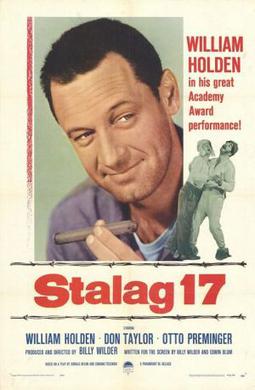
Stalag 17
Well, there are just certain movies I should have reviewed by now. I've mentioned on multiple occasions how much I like prisoner of war movies like The Great Escape and Bridge on the River Kwai, but the first one to really put the WWII sub-genre came along in 1953, Stalag 17, a classic that doesn't always get its due.
It's nearing Christmas in 1944, and a breakout is planned in Stalag 17, a German prisoner of war camp deep in Germany for Allied fliers. The night of the escape, the two prisoners making the attempt are machine gunned outside the barbed wire fence, leaving the prisoners they left behind in Barracks 4 to question what's going on. How did the Germans know details of the escape? The prisoners look to J.J. Sefton (William Holden) as the culprit, a possible stoolie who trades and bargains with the German captors for all sorts of luxuries from eggs to cigarettes to booze. Maybe Sefton has been giving away all their secrets for his own benefit, but Sefton knows otherwise. He may be a chiseler, but he's not a traitor. The problem is simple though, he can't prove it. Who among the other prisoners in Barracks 4 is the real culprit? He's going to need an answer and need it quick before his bunkmates decide they've had enough of him for good.
From director Billy Wilder, 'Stalag' is a gem of a film, one of my favorites going back to when I was a kid. It was based on a Broadway play that had 472 showings over its run. The stage-based play roots are obvious, but in a good way. Filmed in a very appropriate, very effective black and white, 'Stalag' is set almost entirely in Barracks 4 as the story develops, Christmas approaching ever quicker. The only departures we have from the barracks are outside into the camp compound. We never leave the camp, the entire story based in Stalag 17. The crowded, claustrophobic barracks becomes another character with the bunks almost bumping into each other, the windows with the frost and ice sticking to the panes, the clothes hanging from lines hung from wall to wall. Franz Waxman's uncredited score is solid as well if underplayed, Johnny Coming Marching Home a key component of the story as well.
One of three nominations the movie received went to William Holden as Barracks 4 chiseler and general trouble-maker J.J. Sefton. Nominated for his part in Sunset Boulevard but not winning, Holden got a much-deserved win here, taking home the Oscar. More impressive? He was going up against Burt Lancaster and Montgomery Clift in From Here to Eternity. Holden brings this character to life, a less than sympathetic but still appealing individual who's decided to make the most of his prisoner of war status. He's going to live in comfort, and if that means dealing/trading with his German captors, then so be it. It's not an issue until his bunkmates decide he's the traitor giving the Germans all their secrets. This is where Holden's acting steps up a notch, a desperate man now fighting for his survival instead of his personal comfort. Not often remembered as one of his best, but it's a goodie.
Holden's performance comes as part of a very solid ensemble cast that doesn't feature a ton of A-list stars, instead turning to a group of familiar character actors. Start with Robert Strauss as Animal and Harvey Lembeck as Harry Shapiro, the barracks cut-ups, Richard Erdman as Hoffy, the barracks chief, Peter Graves as Price, barracks security, Neville Brand as Duke, the hothead, and Gil Stratton as Cookie, Sefton's mousey assistant, and Robinson Stone, Robert Shawley, and William Pierson rounding out the bunch. Don Taylor co-stars as Lt. Dunbar, a prisoner in transit who comes under SS questioning, Jay Lawrence his impersonating, smart-mouthed traveling companion, Sgt. Bagradian. The comedy between Animal and Harry gets to be a little much at times, Bagradian's impersonations a little forced, but as a collective whole it's a good, strong, deep group of interesting characters.
It is hard to watch this without seeing the obvious influences some 10-plus years later with TV's Hogan's Heroes. Director Otto Preminger stars as Von Scherbach, the Stalag commander, an old-school German aristocrat and gentleman while Sig Ruman plays barracks guard Sgt. Schulz, a VERY obvious influence on John Banner's famous Sgt. Schultz character in the TV show.
An episodic story that clocks in at exactly 120 minutes, there really isn't a slow moment in Wilder's Stalag 17. In directing his film, Wilder decided to shoot chronologically so that way the cast and crew wouldn't know the twist -- the identity of the barracks traitor -- until the end of filming. The first hour or so of the movie blends the drama and comedy nicely setting up the second half of the movie. As the barracks traitor story comes to the forefront, that's when '17' is at its best. The last 30 minutes are pretty perfect, Holden's Sefton starting to piece the clues together in a great couple scenes, Wilder's talent fully on display in shooting style, while the actual reveal and the finale are spot-on. This is a movie that doesn't always get the recognition it deserves, but it sure deserves it. One of my favorites.
Stalag 17 (1953): ****/****
It's nearing Christmas in 1944, and a breakout is planned in Stalag 17, a German prisoner of war camp deep in Germany for Allied fliers. The night of the escape, the two prisoners making the attempt are machine gunned outside the barbed wire fence, leaving the prisoners they left behind in Barracks 4 to question what's going on. How did the Germans know details of the escape? The prisoners look to J.J. Sefton (William Holden) as the culprit, a possible stoolie who trades and bargains with the German captors for all sorts of luxuries from eggs to cigarettes to booze. Maybe Sefton has been giving away all their secrets for his own benefit, but Sefton knows otherwise. He may be a chiseler, but he's not a traitor. The problem is simple though, he can't prove it. Who among the other prisoners in Barracks 4 is the real culprit? He's going to need an answer and need it quick before his bunkmates decide they've had enough of him for good.
From director Billy Wilder, 'Stalag' is a gem of a film, one of my favorites going back to when I was a kid. It was based on a Broadway play that had 472 showings over its run. The stage-based play roots are obvious, but in a good way. Filmed in a very appropriate, very effective black and white, 'Stalag' is set almost entirely in Barracks 4 as the story develops, Christmas approaching ever quicker. The only departures we have from the barracks are outside into the camp compound. We never leave the camp, the entire story based in Stalag 17. The crowded, claustrophobic barracks becomes another character with the bunks almost bumping into each other, the windows with the frost and ice sticking to the panes, the clothes hanging from lines hung from wall to wall. Franz Waxman's uncredited score is solid as well if underplayed, Johnny Coming Marching Home a key component of the story as well.
One of three nominations the movie received went to William Holden as Barracks 4 chiseler and general trouble-maker J.J. Sefton. Nominated for his part in Sunset Boulevard but not winning, Holden got a much-deserved win here, taking home the Oscar. More impressive? He was going up against Burt Lancaster and Montgomery Clift in From Here to Eternity. Holden brings this character to life, a less than sympathetic but still appealing individual who's decided to make the most of his prisoner of war status. He's going to live in comfort, and if that means dealing/trading with his German captors, then so be it. It's not an issue until his bunkmates decide he's the traitor giving the Germans all their secrets. This is where Holden's acting steps up a notch, a desperate man now fighting for his survival instead of his personal comfort. Not often remembered as one of his best, but it's a goodie.
Holden's performance comes as part of a very solid ensemble cast that doesn't feature a ton of A-list stars, instead turning to a group of familiar character actors. Start with Robert Strauss as Animal and Harvey Lembeck as Harry Shapiro, the barracks cut-ups, Richard Erdman as Hoffy, the barracks chief, Peter Graves as Price, barracks security, Neville Brand as Duke, the hothead, and Gil Stratton as Cookie, Sefton's mousey assistant, and Robinson Stone, Robert Shawley, and William Pierson rounding out the bunch. Don Taylor co-stars as Lt. Dunbar, a prisoner in transit who comes under SS questioning, Jay Lawrence his impersonating, smart-mouthed traveling companion, Sgt. Bagradian. The comedy between Animal and Harry gets to be a little much at times, Bagradian's impersonations a little forced, but as a collective whole it's a good, strong, deep group of interesting characters.
It is hard to watch this without seeing the obvious influences some 10-plus years later with TV's Hogan's Heroes. Director Otto Preminger stars as Von Scherbach, the Stalag commander, an old-school German aristocrat and gentleman while Sig Ruman plays barracks guard Sgt. Schulz, a VERY obvious influence on John Banner's famous Sgt. Schultz character in the TV show.
An episodic story that clocks in at exactly 120 minutes, there really isn't a slow moment in Wilder's Stalag 17. In directing his film, Wilder decided to shoot chronologically so that way the cast and crew wouldn't know the twist -- the identity of the barracks traitor -- until the end of filming. The first hour or so of the movie blends the drama and comedy nicely setting up the second half of the movie. As the barracks traitor story comes to the forefront, that's when '17' is at its best. The last 30 minutes are pretty perfect, Holden's Sefton starting to piece the clues together in a great couple scenes, Wilder's talent fully on display in shooting style, while the actual reveal and the finale are spot-on. This is a movie that doesn't always get the recognition it deserves, but it sure deserves it. One of my favorites.
Stalag 17 (1953): ****/****
Tuesday, November 19, 2013
21 Hours at Munich
It was an event in history that captivated the world in its truth. The Munich massacre in 1972 at the Summer Olympic Games was unbelievable in the sense that it really happened. It is an event that shows how far motivated people will go to accomplish what they want, the depths they'll go to. As far as film versions go, the story spawned Steven Spielberg's Munich, a story about the fallout after the massacre, but there is a version of the facts, a TV movie from 1976, 21 Hours at Munich.
It's early on September 5, 1972 and the summer Olympic games are in full swing in Munich, West Germany. In the predawn darkness, eight members of the terrorist group Black September headed by a man named Issa (Franco Nero) sneak into the Olympic Village where athletes from around the world bunk and take 11 Israeli athletes captive. German officials from both the police and the government descend on Olympic Village, including Dr. Manfred Schneider (William Holden), the Chief of Police, to negotiate with the terrorists and find out what they want in exchange for the Israeli hostages. The clock is ticking though, the demands more ludicrous than they could have ever imagined. With the lives of the hostages at stake, the German government and the Olympic committee work to resolve the situation knowing that Issa and his compatriots will kill their hostages if they feel their demands won't be met. What can be done either way?
Besides a lousy print on Netflix, I'd never been able to track this one down until I found it recently on MGM-HD on TV. Finally a good print for a pretty good movie. From director William A. Graham, 'Hours' was originally a TV movie that received a theatrical release in some countries overseas. While the scope isn't huge like a theatrical epic, it doesn't have that distinct feel of a TV movie. Shown on TV just four years after the real-life events that inspired it, it certainly seems like the wounds would have been too fresh for audiences. That's probably going to go a long way in determining if you will like or dislike this movie. It isn't supposed to be entertaining. Interesting? Yes, very much so, but if you're remotely aware of the incident, you know how it ends. It becomes more and more uncomfortable to watch, a painfully tense movie that builds to its inevitably dark, frustrating conclusion.
Sticking as close to the facts as possible, 'Hours' is particularly memorable because of the facts. The truth of the story leads to some incredible set pieces to watch. If you've seen Steven Spielberg's Munich, you've got an idea of what to expect. Sneaking into the Olympic Village and taking the Israeli hostages, the opening sequence is beyond tense. Done with almost no dialogue, it's like we're there with them as the athletes run, hide, fight back as they realize what's going on. The Israeli wrestling coach, Moshe Weinberg, fights back in an incredibly heroic way, as does Yossef Gutfreund (Paul L. Smith), an Israeli wrestling judge), who first discovers the Black September attackers and desperately tries to hold them back at the door. Knowing the truth, reading about it, it all adds up to that incredibly discomforting level that makes it incredibly tough to watch. But at the same time, seeing the harrowing truth of it all makes it real in a visceral, blood-curdling, shiver up your spine way.
The same qualifies for the finale as the hostages and their Arab captors have been transported to an airport/airfield outside Berlin. A plan has been devised to take out the Black September members, but it's come together quickly, not to mention it's pitch dark and far from an ideal situation of how to rescue the Israeli athletes. We see how the plan crumbles in execution, all the little things becoming big problems. Without giving anything away (for those that don't know the truth), it's an incredible ending, a moving, equally uncomfortable finale to a story that defies logic, in the sense that something this horrific could happen at all.
Taking a backseat to the story is a very capable cast. Nero ends up delivering the best performance as Issa, leader of the Black September terrorists. It's a great part because it is a villainous part -- a pretty obvious one -- but Nero makes Issa a human being, not some ridiculously cliched international villain. Sympathetic? Nope, not supposed to be. Fascinating? You bet. His cat and mouse negotiating game with the always solid William Holden becomes the most interesting part of the fast-developing story. Also look for Shirley Knight as an Olympic committee member tasked with being a go-between with Issa and those trying to stop him, Anthony Quayle as a veteran officer of the Israeli special forces/secret service, Richard Basehart as a member of the German government spearheading the rescue effort, and Noel Willman as another German official closely working with Holden's Schneider.
With the feel of a documentary, 'Hours' presents the facts and lets them be. It was filmed on the actual locations where the Munich incident took place in Olympic Village. The actual on-location sites provide an eerie, dream-like feel to the fast-developing story, knowing what actually happened there just a few years before. If you can track a copy down or stumble onto at MGM-HD, I highly recommend it. Well worth it.
21 Hours at Munich (1976): *** 1/2 /****
Labels:
1970s,
Anthony Quayle,
Franco Nero,
Richard Basehart,
William Holden
Thursday, July 11, 2013
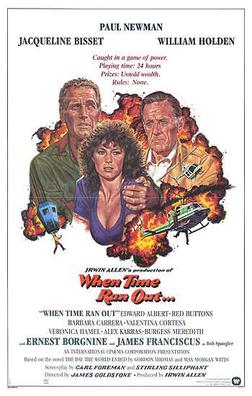
When Time Ran Out
With The Poseidon Adventure and The Towering Inferno to his name, producer Irwin Allen had quite the track record when it came to disaster flicks. In this case, he went back to the well once too often, and the end result is a less than quality final product, 1980's When Time Ran Out.
On a remote island in the Pacific, extremely successful businessman Shelby Gilmore (William Holden) is putting the final touches on his newly constructed hotel resort with his partner, Bob Spangler (James Franciscus), a longtime native of the island. Miles away from the oceanside resort is a volcano that's been dormant for over 60 years, but it is starting to show signs of another eruption but on a far greater scale than it's ever shown. Drilling an oil well on the island with his crew, Hank Anderson (Paul Newman) sees all the telltale signs of what's to come, but he can't convince Spangler to prep for what promises to be an epic disaster (money is a powerful motivator, isn't it?). As he makes a last ditch effort to convince others, the volcano explodes in grand fashion. Can all the island inhabitants and guests find a way to survive?
Like any successful genre, 'Time' follows the formula laid out by countless other disaster flicks. Assemble an all-star cast of actors and actresses, put them in some ridiculously perilous situation, and see who survives. The only problem? Well, other than the script that is. By 1980, the genre had outlasted its welcome a bit. Audiences had seen just about every calamity a disaster film could throw at them. How many times can you see the same movie over and over again, just replacing the man-made disasters, natural disasters or various diseases? 'Time' bombed in theaters and received some very poor reviews. Star power aside, it's got nothing going for it. Other than that? It's a real winner.
What sucked me in was the casting. To be fair, these are all cardboard cutouts of real characters, but the star power is legitimate. Newman is sleepwalking as Hank, the quiet oil driller who steps up as a hero because all disaster movies need a hero. He's also in trouble when he meets his ex, Kay (Jacqueline Bisset, around to wear a low-cut, tight T-shirt), who's now dating Holden's Shelby. Uh-oh, relationship drama! Sit back though, we're just getting started. Franciscus is the big villain -- $ $ for eyes -- who's cheating on his wife, Nikki (Veronica Hamel), with a hotel employee, Iolani (Barbara Carrera), who's engaged to islander Brian (Edward Albert). And just because, there's also Ernest Borgnine's NYC cop tracking a possible crook (Red Buttons) while Burgess Meredith and Valentina Cortese play an old married couple. There's also Alex Karras as Newman's right hand man, Pat Morita as a saloon owner and Sheila Allen as Mona, his wife.
Now more than just the all star cast is how the all star cast is treated. You could do a drinking game with these movies, or you could keep a scorecard. Every time a celebrity dies, take a shot. Throw $20 in and whoever guesses which celebrities survive and which ones don't gets all the money. The volcano explodes about halfway through director James Goldstone's flick, giving plenty of time for all the celebrity carnage. There's some surprises here, but nothing gigantic. Still, you've got to stick with it. Who makes it?!? Who doesn't?!?
Mostly though, the issue here is that it's just too dumb for it's own good. The volcano explodes so Newman's Hank leads a small group of individuals away from the fast-moving lava. Seems like sound thinking, right? Oh, no, they're all celebrities! Something bad might happen to them! It's beyond cliched here. The group must actually walk along a mountain ledge that's about to fall apart. Then, they've got to navigate a rickety wooden bridge that stands over a deep, flowing river of lava! That extended sequence goes on for about 20 minutes and actually ends with Meredith saving two kids by walking a tight rope (read = thin wooden rail) with a balancing act. The scene goes on and on, lacking any real tension.
For a movie budgeted at $20 million, it's hard to see where all that cash went. The special effects are laughable, especially the projectiles thrown from the volcano, usually landing directly on the hotel and/or people. The two sequences above were clearly shot on a poorly lit indoor stage, adding a nice touch of realism to the proceedings. That's a joke by the way. Then, at different points, the volcano is either right on top of the hotel or miles away as needed. Whatever is most appropriate for that given shot. This one's a dud. Even the all star cast couldn't save this one.
When Time Ran Out (1980): */****
On a remote island in the Pacific, extremely successful businessman Shelby Gilmore (William Holden) is putting the final touches on his newly constructed hotel resort with his partner, Bob Spangler (James Franciscus), a longtime native of the island. Miles away from the oceanside resort is a volcano that's been dormant for over 60 years, but it is starting to show signs of another eruption but on a far greater scale than it's ever shown. Drilling an oil well on the island with his crew, Hank Anderson (Paul Newman) sees all the telltale signs of what's to come, but he can't convince Spangler to prep for what promises to be an epic disaster (money is a powerful motivator, isn't it?). As he makes a last ditch effort to convince others, the volcano explodes in grand fashion. Can all the island inhabitants and guests find a way to survive?
Like any successful genre, 'Time' follows the formula laid out by countless other disaster flicks. Assemble an all-star cast of actors and actresses, put them in some ridiculously perilous situation, and see who survives. The only problem? Well, other than the script that is. By 1980, the genre had outlasted its welcome a bit. Audiences had seen just about every calamity a disaster film could throw at them. How many times can you see the same movie over and over again, just replacing the man-made disasters, natural disasters or various diseases? 'Time' bombed in theaters and received some very poor reviews. Star power aside, it's got nothing going for it. Other than that? It's a real winner.
What sucked me in was the casting. To be fair, these are all cardboard cutouts of real characters, but the star power is legitimate. Newman is sleepwalking as Hank, the quiet oil driller who steps up as a hero because all disaster movies need a hero. He's also in trouble when he meets his ex, Kay (Jacqueline Bisset, around to wear a low-cut, tight T-shirt), who's now dating Holden's Shelby. Uh-oh, relationship drama! Sit back though, we're just getting started. Franciscus is the big villain -- $ $ for eyes -- who's cheating on his wife, Nikki (Veronica Hamel), with a hotel employee, Iolani (Barbara Carrera), who's engaged to islander Brian (Edward Albert). And just because, there's also Ernest Borgnine's NYC cop tracking a possible crook (Red Buttons) while Burgess Meredith and Valentina Cortese play an old married couple. There's also Alex Karras as Newman's right hand man, Pat Morita as a saloon owner and Sheila Allen as Mona, his wife.
Now more than just the all star cast is how the all star cast is treated. You could do a drinking game with these movies, or you could keep a scorecard. Every time a celebrity dies, take a shot. Throw $20 in and whoever guesses which celebrities survive and which ones don't gets all the money. The volcano explodes about halfway through director James Goldstone's flick, giving plenty of time for all the celebrity carnage. There's some surprises here, but nothing gigantic. Still, you've got to stick with it. Who makes it?!? Who doesn't?!?
Mostly though, the issue here is that it's just too dumb for it's own good. The volcano explodes so Newman's Hank leads a small group of individuals away from the fast-moving lava. Seems like sound thinking, right? Oh, no, they're all celebrities! Something bad might happen to them! It's beyond cliched here. The group must actually walk along a mountain ledge that's about to fall apart. Then, they've got to navigate a rickety wooden bridge that stands over a deep, flowing river of lava! That extended sequence goes on for about 20 minutes and actually ends with Meredith saving two kids by walking a tight rope (read = thin wooden rail) with a balancing act. The scene goes on and on, lacking any real tension.
For a movie budgeted at $20 million, it's hard to see where all that cash went. The special effects are laughable, especially the projectiles thrown from the volcano, usually landing directly on the hotel and/or people. The two sequences above were clearly shot on a poorly lit indoor stage, adding a nice touch of realism to the proceedings. That's a joke by the way. Then, at different points, the volcano is either right on top of the hotel or miles away as needed. Whatever is most appropriate for that given shot. This one's a dud. Even the all star cast couldn't save this one.
When Time Ran Out (1980): */****
Monday, May 27, 2013
The Devil's Brigade
It's 1942 and with World War II very much yet to be decided, Lt. Colonel Robert Frederick (William Holden) has been summoned to a staff meeting in England. Even though he has no combat experience, Frederick is being given command of a new unit, the First Special Service Force. Their ultimate mission is still to be decided but the Colonel prepares for the training that awaits his brigade that consists of a crack unit of well-trained Canadian troops commanded by Dunkirk veteran Maj. Alan Crown (Cliff Robertson) and an unruly, misfit group of American troops headed by the similarly unruly Maj. Cliff Bricker (Vince Edwards). The two sides bristle immediately, but training continues. If Frederick can manage to keep his men together, their services are very much needed, including a dangerous mission on the Italian front.
From veteran director Andrew McLaglen, 'Brigade' is based on a real-life military unit, the First Special Service Force. Released just a year after The Dirty Dozen, it bears some striking similarities, but it more than capably carves out its own niche in war movie department. It is one of the great men-on-a-mission movies, and that's saying something considering the late 1960s were rampant with them. McLaglen filmed on location in Italy for much of the second half of the movie, giving an authentic look and feel to the proceedings as the Brigade goes into battle. Composer Alex North turns in a gem of a soundtrack, his theme for the Brigade (listen HERE) one that you'll be whistling for days. The main theme is a highlight, but North specializes in the quieter, darker and more sinister moments leading up to the battle in the finale.
More of a workmanlike director than an auteur, McLaglen specialized in movies like this with impressive casts of male stars. This 1968 WWII flick is loaded with star power. As Colonel Frederick, Holden doesn't get a flashy part, but he leads the way just the same. His officer wants to prove himself while also proving how capable his men are too. The best part in the film goes to Robertson as Maj. Crown, an intelligent, well-spoken and brutally capable officer who survived the Dunkirk disaster. It is a smart, underplayed role, and he steals every scene he's in. As his American counterpart, Edwards too is very solid. His Maj. Bricker is blunt and without a filter, a scrounger and hustler with the best of them. Also look for Dana Andrews, Michael Rennie and Carroll O'Connor as American generals, all making cameo appearances.
Ah, yes, and then there's the rest of the cast. If the star power above wasn't enough, McLaglen assembles a deep, talented cast of tough guys to fill out the ranks of the brigade. Leading the American contingent, look for Claude Akins, Andrew Prine, Richard Jaeckel, Luke Askew, Tom Troupe, Bill Fletcher and Tom Stern. For the Canadian half of the Brigade, watch out for Jack Watson, Harry Carey Jr., Jeremy Slate, Richard Dawson and Jean-Paul Vignon. It's cool just seeing all these recognizable faces here together, some leaving more of an impression than others. Jaeckel as Omar Greco, an acrobat trying to escape but finding a home instead, especially stands out as does Akins as Rocky, the American bully, Prine as Ransom, a smart misfit, Watson as Peacock, the tough but gentlemanly Canadian and Slate as O'Neill, the hand-to-hand combat instructor.
I think it's the cast that separates the movie from so many other solid WWII movies. It's a familiar formula here; introduce everyone, train them, have them put their differences aside following some male bonding and then unleash them on the enemy. The male bonding comes courtesy of a barroom brawl (watch HERE) with some rowdy lumberjacks, a great scene. The script is ideal in its ability to let these tough guys be tough guys. It's fun, natural with chemistry and features some great one-liners. Other highlights include Slate's introduction in a showdown with Akins (watch HERE), a 30-mile hike where the rivalry develops further, and many others. Moral of the story is this, we need these parts to be effective for the second half of the movie to truly work. And you bet it does.
The last hour follows the Brigade as it enters combat. Required to prove themselves and their ability, Frederick leads a patrol behind the lines to a heavily guarded Italian town crawling with Germans. It's a lighter action scene, but memorable just the same. The best part though is in the finale, the Brigade ordered to attack the apparently impenetrable Mount la Difensa (where the Service Force really made a name for themselves), a mountain garrisoned by German infantry and heavy armor. First, they must scale a sheer cliff-face to mount a surprise attack on the garrison. It is a great action sequence, McLaglen filming in the trenches and dugouts as the Brigade begins their assault. We always know where the battle is, where it's going, and the sheer scale of it. When the casualties do come (and they do, quickly and with some surprises), it makes this extended battle sequence that much more effective emotionally.
This has always been one of my favorites, and I seem to pick something new up with each passing viewing (I'm guessing I'm somewhere between 20 and 30). This time? The darkness late, Frederick greeting his men as they prepare for battle. North's score goes dark, Dawson explaining "Haven't you ever heard a man say goodbye?" It's an eerie, uncomfortable moment. Spot-on too, considering the Brigade sustained 77% casualties in the coming battle. 'Brigade' doesn't have the reputation of so many other WWII movies of the time, but it deserves some attention. A hidden gem.
The Devil's Brigade (1968): ****/****
* Rewrite of June 2010 review
Thursday, May 10, 2012
The Key
As a movie lover, Turner Classic Movies has been invaluable to me over the years. I've been introduced to movie stars, unknown classics, American, English, French, Japanese and many more types of movies. But every so often, their website cracks me up. Take 1958's The Key for example. The plot description aptly and appropriately stated 'The key to a woman's apartment may hold bad luck for her lovers.' All true, but what did it leave out? That whole WWII backdrop thing....if that means anything.
More than just a World War II setting, this Carol Reed-directed story is a unique, different WWII setting. Little background heading into that ever-important plot description. It isn't on the battlefield or even the home front, but somewhere in between. It is early in the war (1940 and 1941) and the North Atlantic is full of ships, the German U-boats wreaking havoc on Allied shipping. Because of these attacks, many ships are unable to sail to port, often severely damaged and desperately needing assistance. Enter the basically defenseless tug boats who's job it is to bring them in, the U-boats waiting to strike again. And on with that plot thing....
An American who volunteered with the Canadian Army, Capt. David Ross (William Holden) has been reassigned and given a command in the British Navy. He will co-command a tugboat that rescues handicapped Allied ships, a dangerous task considering his boat has one ancient gun and no armor. Ross immediately meets Capt. Chris Ford (Trevor Howard), an old friend and commander of another tugboat in the outfit. They hit it off right away, the old friends reuniting. In passing though, Chris hands Ross a key to his flat, telling him that if anything happens to him, he can move into the apartment. The only issue? A young woman named Stella (Sophia Loren) lives there too. The situation strikes Ross as particularly odd. What isn't Chris telling him, if anything?
From the few Reed movies I've seen -- from his classic The Third Man to lesser known films like The Running Man -- it's easy to see the British director is so highly respected. As a filmmaker, he's a step above most other directors. Anyone can point a camera at the action and call it a day. He goes for more than that, and 'Key' is certainly an example of that. As I mentioned before, the WWII backdrop is an essential part of the story, but the TCM description is spot-on too without even mentioning the war. So in the end, this is a WWII story with a quasi-love triangle (and more) where death hovers above the characters waiting for a chance to strike. It refuses to be pigeon holed at any point, seemingly reveling in its different qualities. Hard to compare to anything else, but it's a movie I very much enjoyed.
SPOILERS STOP READING SPOILERS The "twist" of sorts is that Loren's Stella is apparently some sort of angel of death. Her husband was a tugboat captain but was killed at sea. Her apartment was up for grabs then -- exact details and background are fuzzy -- but another sailor/tugboat captain moved in. He was killed....as was the next one, and then Howard's Ford moves in. Can you see where this is going? Reed plays up this angle for all it's worth. Yes, it is a love story set in WWII England, but it is also much more than that. As I watched, I couldn't help but think this was an extended, feature length episode of The Twilight Zone. That was a compliment by the way. I love that show.
Reed builds up those creepier elements, all the little things coming together to work together perfectly. Much of composer Malcolm Arnold's score sounds exactly like his score from The Bridge on the River Kwai, but then he uses a soft, eerie score that will send shivers up your back in certain scenes. Loren plays Stella almost like an apparition, a ghost. She can sense when her lovers' time is up, asking if she can go to the dock to say goodbye to them. Because of the job of the captains and its inherent risk, death is prevalent, but she knows when it's coming. Reed uses his camera here as a mood-setting, tilting it off to one way or another, aggressively zooming in and out at the action and dialogue. They are just little things that don't drastically affect anything about the story, but at the same time, it is subtle in its effectiveness.
From his spot behind the camera, Reed almost always had impressive casts to work with, and 'Key' is no different. This was Holden at the top of his game, and he doesn't disappoint. It isn't smooth, charming William Holden. This is an underrated acting performance for him. He's scared, angry and upset at the futility of what they do, finding a friend in Chris and possibly more in Stella. Howard plays against type to a point, getting a chance to ham it up a bit. It is a dark part (his "None of us will make it out alive" line speaking volumes), but it is a character that intends to take advantage of whatever time he has left. This is also the first Loren part I've seen that didn't glam her up. She's a beautiful woman, but that's not the focus of the part. She is traumatized, depressed and confused with what the world has thrown at her. Loren does a great job with the part, showing off her dramatic ability when given a chance to be only an actress with eye candy possibility.
Also look for Kieron Moore as Kane, Chris' weary second-in-command, Oskar Homolka as Capt. Van Dam, Ross' fellow commander of the tugboat they share, switching off missions back and forth, Bernard Lee as Commander Wadlow, the officer in charge of his unlikely fleet of tugboats, and Bryan Forbes as Weaver, Ross' second-in-command trying to help out in whatever way he can.
I don't want to give the impression that I liked this movie solely because it was different although that certainly helped. It is a genuinely good story and film, aided by Reed's direction and the acting performances from a very talented cast. Different? Yes, but for all the right reasons.
The Key <---TCM trailer/clips (1958): ***/****
More than just a World War II setting, this Carol Reed-directed story is a unique, different WWII setting. Little background heading into that ever-important plot description. It isn't on the battlefield or even the home front, but somewhere in between. It is early in the war (1940 and 1941) and the North Atlantic is full of ships, the German U-boats wreaking havoc on Allied shipping. Because of these attacks, many ships are unable to sail to port, often severely damaged and desperately needing assistance. Enter the basically defenseless tug boats who's job it is to bring them in, the U-boats waiting to strike again. And on with that plot thing....
An American who volunteered with the Canadian Army, Capt. David Ross (William Holden) has been reassigned and given a command in the British Navy. He will co-command a tugboat that rescues handicapped Allied ships, a dangerous task considering his boat has one ancient gun and no armor. Ross immediately meets Capt. Chris Ford (Trevor Howard), an old friend and commander of another tugboat in the outfit. They hit it off right away, the old friends reuniting. In passing though, Chris hands Ross a key to his flat, telling him that if anything happens to him, he can move into the apartment. The only issue? A young woman named Stella (Sophia Loren) lives there too. The situation strikes Ross as particularly odd. What isn't Chris telling him, if anything?
From the few Reed movies I've seen -- from his classic The Third Man to lesser known films like The Running Man -- it's easy to see the British director is so highly respected. As a filmmaker, he's a step above most other directors. Anyone can point a camera at the action and call it a day. He goes for more than that, and 'Key' is certainly an example of that. As I mentioned before, the WWII backdrop is an essential part of the story, but the TCM description is spot-on too without even mentioning the war. So in the end, this is a WWII story with a quasi-love triangle (and more) where death hovers above the characters waiting for a chance to strike. It refuses to be pigeon holed at any point, seemingly reveling in its different qualities. Hard to compare to anything else, but it's a movie I very much enjoyed.
SPOILERS STOP READING SPOILERS The "twist" of sorts is that Loren's Stella is apparently some sort of angel of death. Her husband was a tugboat captain but was killed at sea. Her apartment was up for grabs then -- exact details and background are fuzzy -- but another sailor/tugboat captain moved in. He was killed....as was the next one, and then Howard's Ford moves in. Can you see where this is going? Reed plays up this angle for all it's worth. Yes, it is a love story set in WWII England, but it is also much more than that. As I watched, I couldn't help but think this was an extended, feature length episode of The Twilight Zone. That was a compliment by the way. I love that show.
Reed builds up those creepier elements, all the little things coming together to work together perfectly. Much of composer Malcolm Arnold's score sounds exactly like his score from The Bridge on the River Kwai, but then he uses a soft, eerie score that will send shivers up your back in certain scenes. Loren plays Stella almost like an apparition, a ghost. She can sense when her lovers' time is up, asking if she can go to the dock to say goodbye to them. Because of the job of the captains and its inherent risk, death is prevalent, but she knows when it's coming. Reed uses his camera here as a mood-setting, tilting it off to one way or another, aggressively zooming in and out at the action and dialogue. They are just little things that don't drastically affect anything about the story, but at the same time, it is subtle in its effectiveness.
From his spot behind the camera, Reed almost always had impressive casts to work with, and 'Key' is no different. This was Holden at the top of his game, and he doesn't disappoint. It isn't smooth, charming William Holden. This is an underrated acting performance for him. He's scared, angry and upset at the futility of what they do, finding a friend in Chris and possibly more in Stella. Howard plays against type to a point, getting a chance to ham it up a bit. It is a dark part (his "None of us will make it out alive" line speaking volumes), but it is a character that intends to take advantage of whatever time he has left. This is also the first Loren part I've seen that didn't glam her up. She's a beautiful woman, but that's not the focus of the part. She is traumatized, depressed and confused with what the world has thrown at her. Loren does a great job with the part, showing off her dramatic ability when given a chance to be only an actress with eye candy possibility.
Also look for Kieron Moore as Kane, Chris' weary second-in-command, Oskar Homolka as Capt. Van Dam, Ross' fellow commander of the tugboat they share, switching off missions back and forth, Bernard Lee as Commander Wadlow, the officer in charge of his unlikely fleet of tugboats, and Bryan Forbes as Weaver, Ross' second-in-command trying to help out in whatever way he can.
I don't want to give the impression that I liked this movie solely because it was different although that certainly helped. It is a genuinely good story and film, aided by Reed's direction and the acting performances from a very talented cast. Different? Yes, but for all the right reasons.
The Key <---TCM trailer/clips (1958): ***/****
Labels:
1950s,
Bernard Lee,
Bryan Forbes,
Carol Reed,
Kieron Moore,
Sophia Loren,
Trevor Howard,
William Holden,
WWII
Monday, September 26, 2011
Wild Rovers
With Sam Peckinpah's 1969 western The Wild Bunch, the conversation pretty much begins and ends about the best changing of the times westerns, the closing of an era. Star William Holden gives a career-best performance in this blood-splattered western, the leader of a gang of aging outlaws looking for one last score in Mexico. Holden had a long list of great performances, but one that has flown under the radar all these years is a similar changing times story in the wild west, 1971's Wild Rovers.
By the late 1800s and into the first 10 or 20 years of the 1900s, the idea of the wild west was one fading away into the background. Movie westerns have explored this era in countless ways, most revolving around the idea of a man (or men) refusing to change with the times, handcuffed to the way they know how to do things. The Wild Bunch handles it in a brutal, forthright fashion, a cynical view of outlaws going out in a blaze of glory rather than change. Butch Cassidy and the Sundance Kid has its darker moments, but for the most part is more comedic with more humor thanks to its buddy pairing of Newman and Redford. Then there's Wild Rovers, falling somewhere in between, moments of startling violence balanced out with endearing emotional flashes. It finds a good balance in between in an underrated western.
It's almost round-up time for the R-Bar cattle ranch in Wyoming with owner Walt Buckman (Karl Malden) readying his crew of cowboys for the coming rush of work. Among them is Ross Bodine (Holden), a veteran cowboy approaching the age of 50 who's spent 30-plus years in the saddle, and Frank Post (Ryan O'Neal), a young cowboy full of piss and vinegar looking to have a good time. Frustrated with their lot in life -- working long hours with little reward -- the two cowboys come up with an idea; rob a bank and with their take head to Mexico where they can start their own ranch. The bank robbery in the dead of night goes smoothly, but Buckman sends his sons, Paul (Joe Don Baker), his father's favorite and an easy-going sort in general, and John (Tom Skerritt), the youngster desperately seeking his father's approval. Ross and Post were good cowboys, but can they be good outlaws too?
As a western fan, there is something simple and profound in westerns similar to this. A changing time, and a lifestyle gone, men refusing to change who are set in their ways. To direct a western like this, I wouldn't have thought Blake Edwards to be the right choice, but I was wrong. Known for his comedies, especially the Pink Panther movies, Edwards takes his time with this 139-minute long movie. The story drifts along in an episodic nature, introducing the characters and the situation at its leisure. Even post-robbery, the story isn't in any rush. It is a harsher west than many westerns portray, building up tension in certain scenes that can be unbearable to watch. It just works. My only real fault is that the movie has an overture, intermission and entr'acte, and finale music. It seems out of place, like something a different-toned Edwards comedy would have used. Just a minor point, nothing worth worrying about. I just fast forwarded through these segments.
Playing Pike Bishop in Peckinpah's The Wild Bunch, Holden delivered a career best performance, and in my mind, there isn't a close second. This might be that second-best role, a character that is obviously more light-hearted than Bishop, but not too dissimilar. His Ross Bodine is a cowboy about to turn 50 years old who has spent much of his life working himself to the bone herding cows without much to show for it. Robbing a bank seems like an easy out so he takes the chance when presented. Just 53 years old, Holden looks much older. He is a sympathetic, tragic main character if there ever was one, and Holden brings that to life.
Two monologues -- one at the beginning, another at the end -- let him show his range, one about fate and dying, the other about an unlikely friendship that's developed with O'Neal's Post. I thought the best scene though was a quiet moment, Bodine lying in bed next to a prostitute, staring off into the distance. His eyes say a lot, a man who realizes he's made the wrong choice and now has to deal with the consequences. From that moment, you know where this character is headed if you weren't already sure.
Now as perfectly cast as Holden is as the world-weary Bodine, I think there's a bit of miscasting with O'Neal as his young counterpart, Frank Post. Regardless of the role, I've never thought too highly of O'Neal as an actor. The character is interesting here, but I don't think it is due to his acting. He's naive at times but with a devilish streak at others. He's saved by the fact that he's working with a pro like Holden. In the older mentor, younger student dynamic, the relationship works. They play off each other well, their dialogue crackling back and forth as a genuine friendship grows out of this dash for safety in Mexico. It's not a bad performance for O'Neal, but it could have been better.
The other parts while important aren't as key. Malden is the archetypal western cattle baron, ruling with a strong hand and iron will. Baker and Skerritt are nicely cast alongside each other, polar opposites in terms of personality. Baker's John is frustrated with the hunt that drags on into weeks and months while Skerritt's Paul intends to follow his father's request no matter what it takes.
Dealing with a story that is about a closing chapter in American history, you've got to assume the ending will not be a happy one. The last 45 minutes is where this movie becomes special as Bodine and Post stop at a desert town and rest up before pushing on to Mexico. The ending packs a wallop, leaving that feeling of being punched in the stomach. It's moving for all the people involved, a tragic end to almost all the characters. I don't want to say more without taking away from the emotional impact, but it makes some of the slower parts worth sitting through. This is an underrated western that deserves far more respect than it gets. Beautifully shot all over the west in Monument Valley, Utah and Arizona and aided by a Jerry Goldsmith score that's best in its quieter moments, Wild Rovers is a hidden gem well worth catching up with.
Wild Rovers <---TCM trailer/clips (1971): ***/****
By the late 1800s and into the first 10 or 20 years of the 1900s, the idea of the wild west was one fading away into the background. Movie westerns have explored this era in countless ways, most revolving around the idea of a man (or men) refusing to change with the times, handcuffed to the way they know how to do things. The Wild Bunch handles it in a brutal, forthright fashion, a cynical view of outlaws going out in a blaze of glory rather than change. Butch Cassidy and the Sundance Kid has its darker moments, but for the most part is more comedic with more humor thanks to its buddy pairing of Newman and Redford. Then there's Wild Rovers, falling somewhere in between, moments of startling violence balanced out with endearing emotional flashes. It finds a good balance in between in an underrated western.
It's almost round-up time for the R-Bar cattle ranch in Wyoming with owner Walt Buckman (Karl Malden) readying his crew of cowboys for the coming rush of work. Among them is Ross Bodine (Holden), a veteran cowboy approaching the age of 50 who's spent 30-plus years in the saddle, and Frank Post (Ryan O'Neal), a young cowboy full of piss and vinegar looking to have a good time. Frustrated with their lot in life -- working long hours with little reward -- the two cowboys come up with an idea; rob a bank and with their take head to Mexico where they can start their own ranch. The bank robbery in the dead of night goes smoothly, but Buckman sends his sons, Paul (Joe Don Baker), his father's favorite and an easy-going sort in general, and John (Tom Skerritt), the youngster desperately seeking his father's approval. Ross and Post were good cowboys, but can they be good outlaws too?
As a western fan, there is something simple and profound in westerns similar to this. A changing time, and a lifestyle gone, men refusing to change who are set in their ways. To direct a western like this, I wouldn't have thought Blake Edwards to be the right choice, but I was wrong. Known for his comedies, especially the Pink Panther movies, Edwards takes his time with this 139-minute long movie. The story drifts along in an episodic nature, introducing the characters and the situation at its leisure. Even post-robbery, the story isn't in any rush. It is a harsher west than many westerns portray, building up tension in certain scenes that can be unbearable to watch. It just works. My only real fault is that the movie has an overture, intermission and entr'acte, and finale music. It seems out of place, like something a different-toned Edwards comedy would have used. Just a minor point, nothing worth worrying about. I just fast forwarded through these segments.
Playing Pike Bishop in Peckinpah's The Wild Bunch, Holden delivered a career best performance, and in my mind, there isn't a close second. This might be that second-best role, a character that is obviously more light-hearted than Bishop, but not too dissimilar. His Ross Bodine is a cowboy about to turn 50 years old who has spent much of his life working himself to the bone herding cows without much to show for it. Robbing a bank seems like an easy out so he takes the chance when presented. Just 53 years old, Holden looks much older. He is a sympathetic, tragic main character if there ever was one, and Holden brings that to life.
Two monologues -- one at the beginning, another at the end -- let him show his range, one about fate and dying, the other about an unlikely friendship that's developed with O'Neal's Post. I thought the best scene though was a quiet moment, Bodine lying in bed next to a prostitute, staring off into the distance. His eyes say a lot, a man who realizes he's made the wrong choice and now has to deal with the consequences. From that moment, you know where this character is headed if you weren't already sure.
Now as perfectly cast as Holden is as the world-weary Bodine, I think there's a bit of miscasting with O'Neal as his young counterpart, Frank Post. Regardless of the role, I've never thought too highly of O'Neal as an actor. The character is interesting here, but I don't think it is due to his acting. He's naive at times but with a devilish streak at others. He's saved by the fact that he's working with a pro like Holden. In the older mentor, younger student dynamic, the relationship works. They play off each other well, their dialogue crackling back and forth as a genuine friendship grows out of this dash for safety in Mexico. It's not a bad performance for O'Neal, but it could have been better.
The other parts while important aren't as key. Malden is the archetypal western cattle baron, ruling with a strong hand and iron will. Baker and Skerritt are nicely cast alongside each other, polar opposites in terms of personality. Baker's John is frustrated with the hunt that drags on into weeks and months while Skerritt's Paul intends to follow his father's request no matter what it takes.
Dealing with a story that is about a closing chapter in American history, you've got to assume the ending will not be a happy one. The last 45 minutes is where this movie becomes special as Bodine and Post stop at a desert town and rest up before pushing on to Mexico. The ending packs a wallop, leaving that feeling of being punched in the stomach. It's moving for all the people involved, a tragic end to almost all the characters. I don't want to say more without taking away from the emotional impact, but it makes some of the slower parts worth sitting through. This is an underrated western that deserves far more respect than it gets. Beautifully shot all over the west in Monument Valley, Utah and Arizona and aided by a Jerry Goldsmith score that's best in its quieter moments, Wild Rovers is a hidden gem well worth catching up with.
Wild Rovers <---TCM trailer/clips (1971): ***/****
Labels:
1970s,
Joe Don Baker,
Karl Malden,
Ryan O'Neal,
Tom Skerritt,
westerns,
William Holden
Tuesday, March 15, 2011
Texas (1941)
Through the late 1940s and into the 1950s and 1960s, two of the most reliable, bankable stars in Hollywood were William Holden and Glenn Ford. But everyone has got to start somewhere, right? I've seen movies with both actors, but a majority of them were from the 1950s and 1960s when they were already established stars. As very young-looking youngsters in 1941, they worked together on an odd but entertaining western simply titled Texas.
It can be fun with movies like this seeing stars before they were stars. For one here with Texas, both Holden and Ford look like they're fresh out of high school. Holden was just 23 years old, and Ford not too much older at 25 when the movie was made. Through all the exaggerated comedy, rambling story and over-reliance on stock footage, that is what makes Texas bearable. Long before either man was a household name, the young acting duo shows off the talent that audiences would come to love and expect in future roles.
The Civil War has ended and two cavalry troopers from Jeb Stuart's forces, Dan Thomas (Holden) and Tod Ramsey (Ford), are drifting west. They find themselves in Abilene on their way further south to Texas and all its riches when they see a stagecoach being robbed. They turn the tables and rob the robbers, but through a miscommunication end up being chased by a posse. With little hope of getting away, they separate and make a getaway on their own. Time passes as Dan latches on with a group of rustlers harassing every herd that heads north while Tod signs on as a foreman at a well-to-do cattle ranch. Their paths seem destined to cross again, especially when both men have an interest in a beautiful rancher's daughter, Mike (Claire Trevor). Is their friendship going to last or will it be torn apart?
Director George Marshall turns in an odd, all over the place finished product with this 1941 western. At just 93 minutes, a ton of story is packed into a relatively quick running time. That description above doesn't quite do it justice because there is much, much more going on. It is an odd mix of a brotherly relationship in the west, slapstick comedy that is painful to watch at times, the always excruciating love triangle, way too much stock footage, and a story that is far too choppy at times, ending up playing like an hour-long serial instead of a feature length movie. I don't know if a longer movie would have helped to flesh things out, but it couldn't have hurt.
I've never been much for comedic westerns with the exceptions of spoofs like Blazing Saddles that pull out all the stops. If you're going to make it funny, go all the way. Don't make a comedic drama (if that makes any sense). An early scene introduces us to Dan and Tod which is fine. A departure from the set-up or a jumping off point for what's to come is fine if it helps us get to know the characters. An old school boxing match has Dan getting whaled on for 50 or 60 rounds that feels like it actually goes on that long. With a short 93-minute movie like this, it's too much. Also in the comedy department, Edgar Buchanan (usually one of my favorite character actors) hams it up as a conniving dentist who happens to be the villain too, making evil, despicable decisions one after another. He is funny with that quiet, raspy stream of conscious talking, but next thing you know he's planning to shoot everyone around him. Separately it could have worked, but together it never fits.
While it may not seem like it, I did enjoy Texas. Holden and Ford are always watchable even in their weakest efforts, and this isn't one of them. The brother relationship in movies is as old as westerns themselves. They're close and have bonded through the hellacious situations they've survived together. Eventually, something is going to tear them apart, forcing them to either fight it out or knuckle under and run. Holden especially has some fun with the Dan Thomas part, the cowboy who will turn wherever there's money available. It's the part that Holden would make his bread and butter, the lovable rogue. Ford's part is more vanilla, the generic good guy who always makes the right decision no matter the consequences. Still, the movie is at its best when they duo is on-screen together.
Filmed in black and white, Marshall relies too much on stock footage, especially late with an epic cattle drive heading to Abilene. As for the love triangle, it doesn't make a ton of sense how it develops, but with Trevor working with Holden and Ford, it isn't as bad as so many other love triangles are. For a story that rambles as much as it does from one place to another with no real end in sight, the finale comes together quite quickly. I would have liked this story much more with a few slight changes. Add maybe 15 minutes, take out the comedy, and thin out the stock footage. The talent in the acting department and the story has potential to be something better. Even then, I still liked the movie, but I didn't love it.
Texas (1941): ** 1/2 /****
It can be fun with movies like this seeing stars before they were stars. For one here with Texas, both Holden and Ford look like they're fresh out of high school. Holden was just 23 years old, and Ford not too much older at 25 when the movie was made. Through all the exaggerated comedy, rambling story and over-reliance on stock footage, that is what makes Texas bearable. Long before either man was a household name, the young acting duo shows off the talent that audiences would come to love and expect in future roles.
The Civil War has ended and two cavalry troopers from Jeb Stuart's forces, Dan Thomas (Holden) and Tod Ramsey (Ford), are drifting west. They find themselves in Abilene on their way further south to Texas and all its riches when they see a stagecoach being robbed. They turn the tables and rob the robbers, but through a miscommunication end up being chased by a posse. With little hope of getting away, they separate and make a getaway on their own. Time passes as Dan latches on with a group of rustlers harassing every herd that heads north while Tod signs on as a foreman at a well-to-do cattle ranch. Their paths seem destined to cross again, especially when both men have an interest in a beautiful rancher's daughter, Mike (Claire Trevor). Is their friendship going to last or will it be torn apart?
Director George Marshall turns in an odd, all over the place finished product with this 1941 western. At just 93 minutes, a ton of story is packed into a relatively quick running time. That description above doesn't quite do it justice because there is much, much more going on. It is an odd mix of a brotherly relationship in the west, slapstick comedy that is painful to watch at times, the always excruciating love triangle, way too much stock footage, and a story that is far too choppy at times, ending up playing like an hour-long serial instead of a feature length movie. I don't know if a longer movie would have helped to flesh things out, but it couldn't have hurt.
I've never been much for comedic westerns with the exceptions of spoofs like Blazing Saddles that pull out all the stops. If you're going to make it funny, go all the way. Don't make a comedic drama (if that makes any sense). An early scene introduces us to Dan and Tod which is fine. A departure from the set-up or a jumping off point for what's to come is fine if it helps us get to know the characters. An old school boxing match has Dan getting whaled on for 50 or 60 rounds that feels like it actually goes on that long. With a short 93-minute movie like this, it's too much. Also in the comedy department, Edgar Buchanan (usually one of my favorite character actors) hams it up as a conniving dentist who happens to be the villain too, making evil, despicable decisions one after another. He is funny with that quiet, raspy stream of conscious talking, but next thing you know he's planning to shoot everyone around him. Separately it could have worked, but together it never fits.
While it may not seem like it, I did enjoy Texas. Holden and Ford are always watchable even in their weakest efforts, and this isn't one of them. The brother relationship in movies is as old as westerns themselves. They're close and have bonded through the hellacious situations they've survived together. Eventually, something is going to tear them apart, forcing them to either fight it out or knuckle under and run. Holden especially has some fun with the Dan Thomas part, the cowboy who will turn wherever there's money available. It's the part that Holden would make his bread and butter, the lovable rogue. Ford's part is more vanilla, the generic good guy who always makes the right decision no matter the consequences. Still, the movie is at its best when they duo is on-screen together.
Filmed in black and white, Marshall relies too much on stock footage, especially late with an epic cattle drive heading to Abilene. As for the love triangle, it doesn't make a ton of sense how it develops, but with Trevor working with Holden and Ford, it isn't as bad as so many other love triangles are. For a story that rambles as much as it does from one place to another with no real end in sight, the finale comes together quite quickly. I would have liked this story much more with a few slight changes. Add maybe 15 minutes, take out the comedy, and thin out the stock footage. The talent in the acting department and the story has potential to be something better. Even then, I still liked the movie, but I didn't love it.
Texas (1941): ** 1/2 /****
Labels:
1940s,
Claire Trevor,
George Marshall,
Glenn Ford,
westerns,
William Holden
Friday, February 4, 2011
Casino Royale (1966)
After a four-year gap since Pierce Brosnan's final James Bond movie, MI6 agent 007 returned in a big way in 2006 with Daniel Craig taking over the part of the secret agent. It was a huge success and served as an excellent reboot for the franchise, quickly climbing into my top 5 all-time Bond flicks. Why did it work? Like most of the best movies from the franchise, it stuck close to the Ian Fleming source novel that had not been made previously...in a serious fashion at least. That's where 1966's awful Casino Royale jumps in.
By 1966, star Sean Connery had already completed four 007 movies and had turned James Bond into one of the world's biggest stars. It was so popular that spoofs started popping up like James Coburn as Derek Flint and Dean Martin as Matt Helm among others. I get it, strike when the iron is hot, but in a saturated market of spy and espionage movies -- serious and spoof -- don't you want to at least turn out a quality product? With six different directors shooting different portions of the movie, this was like How the West Was Won: 007 Style. Besides an occasional laugh here and there, the only redeeming quality is an out-of-this world (if wasted) cast, but more on that later.
All over the world, American, British, Russian, and French agents are turning up dead and their agencies don't have the slightest clue or evidence as to who's pulling off the jobs. The agency heads turn to retired MI6 agent, Sir James Bond (David Niven), to root out the problem. Bond is a legend in the espionage business, but his best days are behind him, and he questions what has happened to the field he worked so well in, carving out a name and reputation for himself. He concocts a crazy plan to smoke out whoever is behind the murders; using his name, agents all over the world (Peter Sellers, Ursula Andress, Daliah Lavi, Joanna Pettet, Woody Allen, Terence Cooper) will see if working as bait draws the mastermind out of his lair. The plan might be too good though because SMERSH and mastermind Le Chiffre (Orson Welles) send agents to kill the original and still best James Bond around.
Now anyone familiar with Casino Royale -- Fleming's novel or the Craig movie -- knows that the plot described there is nothing like the book or the movie. Bond's effort to detain Le Chiffre at the baccarat table is handled in a scene that takes about 10 minutes, not an entire movie. Using other spy spoofs as an example, there is clearly potential here. A character as ripe for the picking as James Bond is hard to mess up in the humor department, but this movie is a mess. For all the subtle, perfectly delivered lines that pepper the script, there's huge scenes of excess of physical and slapstick humor that even Mel Brooks must have shaken his head at. The finale is the worst of all with one of the 14 directors obviously not knowing where to cut things off.
Let's start with the crazy amount of talent involved here behind the camera, including John Huston (also playing M in one scene) and Robert Parrish among four other less notable names. The writing too includes Sellers, Billy Wilder, and Joseph Heller. How did this much talent put together such an awful movie? On top of the cast listed above, there's also parts for Deborah Kerr, William Holden, Jean-Paul Belmondo, Peter O'Toole (on-screen for about 6 seconds), Charles Boyer, George Raft, Jacqueline Bisset, and Barbara Bouchet. What's worse is that the cast appears to be having a blast making the picture. It's just that much worse that what they're working with is beneath all of their talent. Bit parts and extended cameos for almost all of these names limit actual on-screen time, but just in terms of name power, this movie is impressive.
The only star that I thought was legitimately good was David Niven as retired 007, Sir James Bond, enjoying his retirement in an isolated English country villa only to be thrust back into the world of espionage. Because it is an older Bond, Niven has some fun with the part, poking fun at Connery's portrayal especially. He gets some good laughs from his constant curiosity of how all secret agents have become sex fiends, leaving lonely, beautiful women in every city all over the Earth. He shakes his head at all the changes he sees in the life of a spy only to embrace them once he's back into it. A professional plain and simple, Niven makes the most of the material, rising above it to deliver a worthwhile performance.
So this movie was bad, downright awful at times, okay? I am scraping the bottom of the barrel here looking for something to write about. Most of the movie was just so stupid and dumb I can't even complain. It's so bad it is surreal at times. So what can I recommend? If nothing else with this overabundance of characters, the script calls for a long list of beautiful actresses who are required to wear slinky outfits and do little else. Kerr, Lavi, Pettet, Andress, and Bouchet are all half-naked for about 90% of the movie, and that's all I've got. So stupidly bad, this movie has to be seen to be believed.
Casino Royale <---trailer (1966): */****
By 1966, star Sean Connery had already completed four 007 movies and had turned James Bond into one of the world's biggest stars. It was so popular that spoofs started popping up like James Coburn as Derek Flint and Dean Martin as Matt Helm among others. I get it, strike when the iron is hot, but in a saturated market of spy and espionage movies -- serious and spoof -- don't you want to at least turn out a quality product? With six different directors shooting different portions of the movie, this was like How the West Was Won: 007 Style. Besides an occasional laugh here and there, the only redeeming quality is an out-of-this world (if wasted) cast, but more on that later.
All over the world, American, British, Russian, and French agents are turning up dead and their agencies don't have the slightest clue or evidence as to who's pulling off the jobs. The agency heads turn to retired MI6 agent, Sir James Bond (David Niven), to root out the problem. Bond is a legend in the espionage business, but his best days are behind him, and he questions what has happened to the field he worked so well in, carving out a name and reputation for himself. He concocts a crazy plan to smoke out whoever is behind the murders; using his name, agents all over the world (Peter Sellers, Ursula Andress, Daliah Lavi, Joanna Pettet, Woody Allen, Terence Cooper) will see if working as bait draws the mastermind out of his lair. The plan might be too good though because SMERSH and mastermind Le Chiffre (Orson Welles) send agents to kill the original and still best James Bond around.
Now anyone familiar with Casino Royale -- Fleming's novel or the Craig movie -- knows that the plot described there is nothing like the book or the movie. Bond's effort to detain Le Chiffre at the baccarat table is handled in a scene that takes about 10 minutes, not an entire movie. Using other spy spoofs as an example, there is clearly potential here. A character as ripe for the picking as James Bond is hard to mess up in the humor department, but this movie is a mess. For all the subtle, perfectly delivered lines that pepper the script, there's huge scenes of excess of physical and slapstick humor that even Mel Brooks must have shaken his head at. The finale is the worst of all with one of the 14 directors obviously not knowing where to cut things off.
Let's start with the crazy amount of talent involved here behind the camera, including John Huston (also playing M in one scene) and Robert Parrish among four other less notable names. The writing too includes Sellers, Billy Wilder, and Joseph Heller. How did this much talent put together such an awful movie? On top of the cast listed above, there's also parts for Deborah Kerr, William Holden, Jean-Paul Belmondo, Peter O'Toole (on-screen for about 6 seconds), Charles Boyer, George Raft, Jacqueline Bisset, and Barbara Bouchet. What's worse is that the cast appears to be having a blast making the picture. It's just that much worse that what they're working with is beneath all of their talent. Bit parts and extended cameos for almost all of these names limit actual on-screen time, but just in terms of name power, this movie is impressive.
The only star that I thought was legitimately good was David Niven as retired 007, Sir James Bond, enjoying his retirement in an isolated English country villa only to be thrust back into the world of espionage. Because it is an older Bond, Niven has some fun with the part, poking fun at Connery's portrayal especially. He gets some good laughs from his constant curiosity of how all secret agents have become sex fiends, leaving lonely, beautiful women in every city all over the Earth. He shakes his head at all the changes he sees in the life of a spy only to embrace them once he's back into it. A professional plain and simple, Niven makes the most of the material, rising above it to deliver a worthwhile performance.
So this movie was bad, downright awful at times, okay? I am scraping the bottom of the barrel here looking for something to write about. Most of the movie was just so stupid and dumb I can't even complain. It's so bad it is surreal at times. So what can I recommend? If nothing else with this overabundance of characters, the script calls for a long list of beautiful actresses who are required to wear slinky outfits and do little else. Kerr, Lavi, Pettet, Andress, and Bouchet are all half-naked for about 90% of the movie, and that's all I've got. So stupidly bad, this movie has to be seen to be believed.
Casino Royale <---trailer (1966): */****
Subscribe to:
Posts (Atom)