The Sons of Katie Elder

The Sons of Katie Elder
"First, we reunite, then find Ma and Pa's killer...then read some reviews."
Showing posts with label Peter O'Toole. Show all posts

Thursday, May 31, 2012

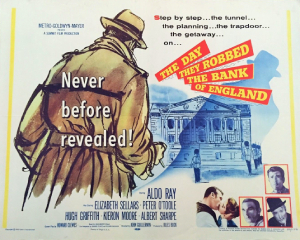
The Day They Robbed the Bank of England

Never a huge star, instead one finding a niche as a character actor and tough guy on-screen, Aldo Ray is one of many gems to come out of the 1950s and 1960s. Most of his roles were supporting parts -- often as part of impressive ensemble casts -- but he did get the occasional leading role, like 1960's The Day They Robbed the Bank of England. Can you figure out what it's about? Yes, puppies.

It's the turn of the century in 1900s London, and the IRA needs money, needs a lot of it and needs it quick to support the movement. In London, O'Shea (Hugh Griffith) and Mrs. Muldoon (Elizabeth Sellars), a widow of a dead IRA gunman, have assembled a small group of thieves and IRA fighters to pull off an impossible job, one that's never been done before. They have hired an American with Irish blood, Norgate (Ray), to lead the job, but where to even start in taking down the seemingly impregnable, heavily guarded bank? Norgate starts by trying to get in from the inside, befriending Capt. Fitch (Peter O'Toole), a young officer working as part of the bank guard. Can Norgate and his team find a way in?

Yes, another heist movie. Sue me, I love these movies. As far as this popular sub-genre goes though, 'Day' is an interesting one that certainly tries to distance itself from the genre conventions. From director John Guillermin, this heist movie starts off on a positive note with a story set in 1910s London, not the present. It sounds simple, but it's deceptively simple in tweaking the story. There are no huge, high-tech security features, just a securely built, heavily guarded vault with no easy way in or out. This is not Ocean's 11. It keeps you guessing though, and Guillermin has some fun with some crazy, exaggerated zooms with the camera, composer Edwin Astley likewise keeping things moving with his score. It is filmed in black and white, keeping things focused on the story and characters, and never tries to be a groundbreaking classic, just a good, old-fashioned impossible robbery.

This is a solid example of a strong part for Aldo Ray in the lead. He doesn't have to do any heavy lifting, instead focusing on being that tough guy -- even a little anti-hero -- who wants to get the job done no matter what obstacles get thrown at him. Norgate's backstory is unfortunately kept under wraps, but some past demons and struggles with the law are hinted at. It's not a flashy part, but Ray is a meat and potatoes kind of guy, and he gets the job done here. This was also just O'Toole's second film role, and even with a poorly written character, the talent is evident. Norgate's team includes Griffin's O'Shea as the bankroll and IRA big-wig, Kieron Moore as fiery Walsh, Joseph Tomelty, Wolf Frees and Albert Sharpe as scene-stealing Tosher, an old drunk who knows a secret that could make the robbery a huge success, affectionately calling Norgate 'Your worship.'

Preventing 'Day' from becoming a classic are a couple flaws that shoot the story in the foot. The early portions of the movie drag a bit as we find that Norgate has a past with Sellars' Mrs. Muldoon who now has a suitor of sorts in Moore's Walsh too. No, it's not a painfully drawn out love triangle -- thankfully -- but the scenes with Norgate trying to win her back are tedious to say the least. Again, there's no real background explained so what should we care? Oh, they used to be together?!? Eh, pass. The other is the utter stupidity in the Fitch character, a disgruntled, bored officer who is so mind-blowingly stupid he doesn't see that Norgate is pilfering him for detailed information about the bank layout. It's a necessary part of the story (how else do they find the dimensions of the vault?), but there wasn't anything better that could have been used?

It is a heist movie, and reflecting the workmanlike nature of its star, the actual robbery is a meat and potatoes kind of job. No big twists or tricks, just a devious plan that has Norgate and his team tunneling into the vault via a shut-down sewer. Meanwhile, O'Toole's Fitch begins to smell a rat in the whole situation. Can he figure it out in time, putting all the pieces together? The last 45 minutes as the heist develops and unravels are not surprisingly the best part, including a memorable ending, Ray doing a ton in his final two scenes without speaking a word. Solid, entertaining heist movie. Definitely worth checking out.

The Day They Robbed the Bank of England <---TCM clips (1960): ***/****

Tuesday, May 1, 2012

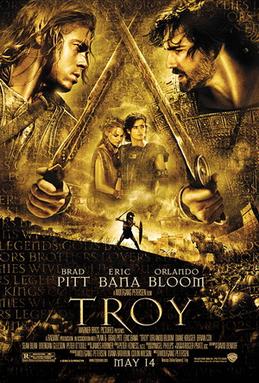
Troy

Made by a respected director with a strong ensemble cast and using the original epic story as its source, 2004's Troy certainly has a lot going for it. So what happened in theaters? I guess it's a shame to call a movie that made over $130 million a failure, but when that movie cost $175 to make....yeah, that's a failure. Too bad because the end result -- no matter the money -- is a huge, well-made and entertaining epic, a throwback to the 1950s and 1960s in terms of scale.

Sometime around 1,000 B.C., Trojan princes Hector (Eric Bana) and Paris (Orlando Bloom) are visiting Sparta and its king, Menelaus (Brendan Gleeson). Paris falls madly in love with the king's wife, Helen (Diane Kruger), secretly taking her with them as they return to Troy. Finding his wife gone, Menelaus goes to his brother, Agamemnon (Brian Cox), seeking help in getting her back. The Greek king has amassed quite an empire and sees an opportunity for it to grow bigger. He assembles an army of thousands of ships and over 50,000 men, sailing across the Aegean Sea to attack Troy. The fortified and high-walled city awaits what the Greeks can throw at them, including the most powerful warrior of his time, the legendary if moody Achilles (Brad Pitt). The coming battle will be unlike anything the world has ever seen.

Based on the original literature epic, Homer's Iliad, Troy is a movie made on a massive scale. Director Wolfgang Petersen assembles quite the cast, built lavish sets with even more lavish costuming, and for lack of a better description, makes everything BIG. That's good and bad. It is an impressive movie to watch at times, but in its scale, it loses some of its heart. Troy keeps you at arm's length. At times, far too much is going on. Even at 162 minutes, some subplots feel disjointed and rushed, others completely pushed to the side. Composer James Horner's score is all right, but it pales in comparison to some of his best works. Josh Groban's song 'Remember' is played over the credits too, listen HERE. Positive and/or negative, Troy is missing that special something. It is a good movie, but that missing ingredient isn't there to make it a classic.

It would be hard to have a better jumping off point than Homer's Iliad in turning any form of literature into a feature film. For starters, there's a reason it's called Greek tragedy. No matter if you're good or bad, in the end it likely won't end well for you. No time is wasted on petty arguments. Greek tragedies and epics are interested in the big picture. We're talking power and glory, love and betrayal, murder and backstabbing. Petersen faces a monumental task in bringing the story to theaters though. The Iliad takes place over a decade. The movie? Seems like the siege of Troy takes place over a long weekend. With so many characters and so many stories bouncing around, some can't help but be left behind. This is a story that would be suited to a four or five part miniseries...at the least. On the positive side, Troy is about the people, not the people and the Greek gods. Wise choice there, Mr. Petersen, wise choice.

The best dynamic in the movie is between Brad Pitt and Eric Bana, warriors on opposite sides of the war who are on a collision course to face each other. Buffed up with about 30-40 pounds of extra muscle, Pitt went through quite a transformation to look like half-man, half-god Achilles. In the acting department though, this is far from his best work. It's a despicable character, but Pitt doesn't bring a ton of energy to the screen until about the halfway point. Bana is the main reason to see Troy as Hector, the honor-bound prince of Troy who sticks by his family when it would be incredibly easy to leave. Both men live by a personal code and principle, holding some similarities while also being vastly different. Those differences make for an interesting rivalry to watch unfold.

And then there's the rest of the cast, apparently everyone in Hollywood getting a part here and there. Playing Greek king Agamemnon, Cox is the most villainous of all the characters, a power-obsessed ruler willing to sacrifice anything as needed to achieve his goal. In this case, that's pouncing on his brother's request for help. Gleeson as the spurned and scorned Menelaus is surprisingly sympathetic in an underused part. Bloom and Kruger are pretty together, basically a means to get the story moving before being dumped in the trash. Bloom does a fine job turning Paris into a whiny weakling capable of doing anything right. Yes, that's sarcasm. Also look for screen legend Peter O'Toole as Priam, the aging Trojan king, Sean Bean as Odysseus, another Greek king and close friend of Achilles, Garrett Hedlund as Patroclus, Achilles' young nephew and warrior-to-be, Julie Christie in a one-scene cameo as Thetis, Achilles' mother, Saffron Burrows as Andromache, Hector's loving wife, Rose Byrne as Briseis, the Trojan girl who catches Achilles' eye, and Vincent Regan as Eudorus, Achilles' right-hand man in his unit of Myrmidons.

Part of the fun of these ancient/biblical epics was the spectacle in watching them, a cast of thousands filling the screen. That fun element is robbed some with an overabundance of CGI throughout, thousands of CGI creations filling out the Greek and Trojan armies. Battle scenes are still a sight to behold, immense scale as the two warring sides throw charge after charge at one another. Like the movie on the whole, it's just missing something. What is it? I can't quite figure it out yet, but I'll get there. In the meantime, I'll like the movie, but not love it.

Troy <----trailer (2004): ***/****

Thursday, March 3, 2011

The Stunt Man

By all accounts, 1980's The Stunt Man is a solid, well-made movie.  Not always a great standard for a movie's quality, the IMDB rating hovers just around 7.3 out of 10 as I write this review. At Rotten Tomatoes, it earned a 91% positive review from 22 different reviewers, and a 76% of the audience enjoyed it.  The Academy Awards apparently thought a lot of it too with star Peter O'Toole earning a Best Actor nomination and director Richard Rush getting a Best Director nomination (neither man would win). So with all that said, why did I despise this movie so much?

There is plenty of talent involved, and a story about a legendary mess of a movie being made sounded appealing.  O'Toole is watchable in every movie I've ever seen him in, and this Oscar-nominated part is no different.  But actually sitting down and watching this movie, it took me at least six sittings to make it through a mind-bogglingly slow 131-minute movie. By the last 45 minutes (how I made it that far into the movie I don't know), I was fast-forwarding through scenes as quick as I could.  It's that rare movie I truly hate, but this one was pretty awful.  It's not because it's a bad movie in itself.  Anything but.  It tries to be something else, a movie with a message, and fails miserably.

Spotted by two police officers at a highway diner, fugitive Cameron (Steve Railsback) flees through the woods and stumbles onto a movie set where a car crashes off a bridge into a river below, the stunt driver drowning inside accidentally. He continues running and ends up in a different scene being filmed, meeting possibly insane director of the film, Eli Cross (O'Toole). Incurring the wrath of the local sheriff (Alex Rocco) for the possible murder of the stunt man, Eli convinces him that Cameron is said stunt man and nothing's wrong. On the run, Cameron agrees and sticks around, learning how to be a stunt man. He has a love-hate relationship with the eccentric Eli and even falls for leading lady, Nina Franklin (Barbara Hershey). But when everything seems ideal, Cameron finds out Eli has a past with Nina, and now he has to attempt the dangerous driving stunt that killed his predecessor.

Where to start, where to start? I wasn't incredibly familiar with this movie going in and was only aware that O'Toole was the star. He's one of those few actors I will watch in anything, but more on that later. About 30 minutes into this movie, I wasn't quite sure what I was watching. Was it a dark comedy lampooning the movie-making industry? Was it a drama with some existential message about the bizarre nature of acting and making films?  I didn't know, and I couldn't decide. That's never a good sign that far into the movie. What's worse is that it never resolves itself.  The IMDB description says 'Action/Comedy/Drama.' I'm not quite sure what to call it even now.

The movie inside the movie is that O'Toole is directing a historical epic about a WWI hero on the run somewhere in Europe, running from German soldiers and fighters doing their damnedest to pick him off. As near as I can figure, it's supposed to be a trainwreck of a movie, one with the highest aspirations that you just know will fail. So is it an intentional dig that the movie we're watching seems as equally bad? The opening feels like a bizarre dream sequence, but the story never rights itself after that. Huge jumps in the story make it nearly impossible to follow or even keep up, and nothing is ever rightfully explained. Is Eli actually trying to kill Cameron? Why does the director embrace this admitted escaped convict so readily?

With 75 acting credits to his name, O'Toole worked with the gamut of directors, maybe the most famous being David Lean in Lawrence of Arabia. He had to see the good and bad, the calm and the agitated, the friendly and the enemies. He channels them all for this performance, rolling everything into one crazy, always entertaining, always mysterious director leading this mess of a movie. I was never sure of Eli's true intentions because he shows right away he is more interested in the safety of his movie than the actual people working on the movie. One outburst (watch HERE) is perfectly insane, one Christian Bale must have watched before his own blow-up. The movie is difficult to get through, but O'Toole's performance makes it somewhat bearable.

When O'Toole isn't on-screen though, the movie drops off in a big way. I don't know if Railsback is just a bad actor, or the character is poorly written, but there is nothing appealing about the Cameron character at all. His past and his breaking the law is left in the background for the most part, the revelation coming later in the proceedings thankfully. We're never rooting for him though, and his paranoia gets tedious quickly. Hershey is the same way, a cardboard cutout of a character who never becomes interesting. Allen Garfield's screenwriter and Charles Bail's veteran stunt man are underused in supporting parts that show this movie did have some potential. That's the whole problem. There's potential all over the place that never amounts to anything.

The Stunt Man <---trailer (1980): */****

Friday, February 4, 2011

Casino Royale (1966)

After a four-year gap since Pierce Brosnan's final James Bond movie, MI6 agent 007 returned in a big way in 2006 with Daniel Craig taking over the part of the secret agent.  It was a huge success and served as an excellent reboot for the franchise, quickly climbing into my top 5 all-time Bond flicks.  Why did it work? Like most of the best movies from the franchise, it stuck close to the Ian Fleming source novel that had not been made previously...in a serious fashion at least.  That's where 1966's awful Casino Royale jumps in.

By 1966, star Sean Connery had already completed four 007 movies and had turned James Bond into one of the world's biggest stars.  It was so popular that spoofs started popping up like James Coburn as Derek Flint and Dean Martin as Matt Helm among others.  I get it, strike when the iron is hot, but in a saturated market of spy and espionage movies -- serious and spoof -- don't you want to at least turn out a quality product?  With six different directors shooting different portions of the movie, this was like How the West Was Won: 007 Style.  Besides an occasional laugh here and there, the only redeeming quality is an out-of-this world (if wasted) cast, but more on that later.

All over the world, American, British, Russian, and French agents are turning up dead and their agencies don't have the slightest clue or evidence as to who's pulling off the jobs.  The agency heads turn to retired MI6 agent, Sir James Bond (David Niven), to root out the problem. Bond is a legend in the espionage business, but his best days are behind him, and he questions what has happened to the field he worked so well in, carving out a name and reputation for himself.  He concocts a crazy plan to smoke out whoever is behind the murders; using his name, agents all over the world (Peter Sellers, Ursula Andress, Daliah Lavi, Joanna Pettet, Woody Allen, Terence Cooper) will see if working as bait draws the mastermind out of his lair. The plan might be too good though because SMERSH and mastermind Le Chiffre (Orson Welles) send agents to kill the original and still best James Bond around.

Now anyone familiar with Casino Royale -- Fleming's novel or the Craig movie -- knows that the plot described there is nothing like the book or the movie.  Bond's effort to detain Le Chiffre at the baccarat table is handled in a scene that takes about 10 minutes, not an entire movie.  Using other spy spoofs as an example, there is clearly potential here.  A character as ripe for the picking as James Bond is hard to mess up in the humor department, but this movie is a mess.  For all the subtle, perfectly delivered lines that pepper the script, there's huge scenes of excess of physical and slapstick humor that even Mel Brooks must have shaken his head at.  The finale is the worst of all with one of the 14 directors obviously not knowing where to cut things off.

Let's start with the crazy amount of talent involved here behind the camera, including John Huston (also playing M in one scene) and Robert Parrish among four other less notable names.  The writing too includes Sellers, Billy Wilder, and Joseph Heller.  How did this much talent put together such an awful movie? On top of the cast listed above, there's also parts for Deborah Kerr, William Holden, Jean-Paul Belmondo, Peter O'Toole (on-screen for about 6 seconds), Charles Boyer, George Raft, Jacqueline Bisset, and Barbara Bouchet. What's worse is that the cast appears to be having a blast making the picture.  It's just that much worse that what they're working with is beneath all of their talent.  Bit parts and extended cameos for almost all of these names limit actual on-screen time, but just in terms of name power, this movie is impressive.

The only star that I thought was legitimately good was David Niven as retired 007, Sir James Bond, enjoying his retirement in an isolated English country villa only to be thrust back into the world of espionage.  Because it is an older Bond, Niven has some fun with the part, poking fun at Connery's portrayal especially.  He gets some good laughs from his constant curiosity of how all secret agents have become sex fiends, leaving lonely, beautiful women in every city all over the Earth.  He shakes his head at all the changes he sees in the life of a spy only to embrace them once he's back into it.  A professional plain and simple, Niven makes the most of the material, rising above it to deliver a worthwhile performance.

So this movie was bad, downright awful at times, okay? I am scraping the bottom of the barrel here looking for something to write about.  Most of the movie was just so stupid and dumb I can't even complain.  It's so bad it is surreal at times.  So what can I recommend? If nothing else with this overabundance of characters, the script calls for a long list of beautiful actresses who are required to wear slinky outfits and do little else.  Kerr, Lavi, Pettet, Andress, and Bouchet are all half-naked for about 90% of the movie, and that's all I've got.  So stupidly bad, this movie has to be seen to be believed.

Casino Royale <---trailer (1966): */****

Tuesday, August 24, 2010

Zulu Dawn

Military victories when handled the right way -- good cast, big enough budget, halfway decent script -- can translate well to a feature length movie.  Think of D-Day, Gettysburg, Battle of Britain for examples of a battle filmed on an epic scale with the final result the better for it.  So flip the coin then and look at the opposite, military disasters.  It can be fascinating to see a skirmish, battle, or even a war turn for the worse and what made it do that.  Telling the story of one of the worst military disasters in history, 1979's Zulu Dawn does everything it should in giving an honest look at that disaster.

In theaters 15 years before 'Dawn,' 1964's Zulu told the true story of the battle of Rorke's Drift, a last stand situation where about 100 British soldiers in 1879 held off the attacks of thousands of Zulu warriors for over a day.  Before that battle, an army of thousands of Zulu warriors had almost completely destroyed a whole British battalion a few miles away.  So while there is no link other than the same setting and story, Zulu Dawn is an unofficial prequel to a movie made 15 years earlier.  1964's Zulu mentioned the previous battle in a prologue, but director Douglas Hickox delves right in to tell the story of one of history's biggest military disasters.

In the South African province of Natal in 1879, British general Lord Chelmsford (Peter O'Toole) awaits orders on what to do with the possibility of a war breaking out between the British and the Zulu nation. A representative of the British government (John Mills) has sent an ultimatum to the Zulus, disassemble your army of warriors and dissolve the nation as a whole and there will be no issue. The offer is of course refused so Chelmsford leads a small army of around 2,000 men (including 2nd in command Burt Lancaster, a real scene-stealer here) into the Zulu territory against an army estimated at 30,000 men.  But the proud, even arrogant British march into Zululand assuring themselves of an easy victory, not knowing what awaits them.

If you haven't figured by now, that easy victory never comes to fruition after Chelmsford foolishly splits up his forces and basically invites piecemeal destruction as overwhelming numbers just destroy his men. It seems through history the British have had their fair share of military disasters and never really learn from those defeats.  Marching into Zulu territory, one officer (Christopher Cazenove) remarks how noble their effort is, how heroic their actions like the campaign will be a walk in the park.  Like any story where the end result is never in doubt, Hickox creates palpable tension, a sense of doom of what is to come.

Of course with a historical movie like that, you want to see the disaster, you want to see the Titanic sink so getting there can be a little tedious at times.  Where 'Dawn' is at its absolute best is in the depiction of the battle of Isandlwana where thousands of Zulu warriors take heavy casualties as they wipe out almost all the British defenders at their camp in a ragtag defense. As near as I can figure, the battle scene was filmed on the actual location of the massacre, giving the whole sequence an eerie feeling.  On a huge scale, the battle is amazing to watch, but never overwhelming.  You're always aware of what's going on, where the lines are, if the British are holding or falling back.  Elmer Bernstein's score aids the cause, helping the battle both on an epic scale but also the smaller scale of the man-to-man fighting element of what a last stand must be like.  The movie's good, but the Isandlwana sequence at almost 40 minutes long is great.

With a large cast with a long list of characters, some get lost in the shuffle more than others.  O'Toole is the stereotypical arrogant, gentlemanly British officer while Lancaster is more an officer of the men, looking out for their best interest whenever possible.  Lancaster's Colonel Durnford is definitely the star of the movie, even in an underused part.  Simon Ward impresses as Lt. Verecker, a cavalry officer who lived in South Africa before volunteering with the Brits. Also joining the British army is Denholm Elliott as a commanding officer, Cazenove and James Faulkner as lower ranking officers who make a gallant charge in the closing moments in the massacre, Bob Hoskins as a veteran sergeant desperately trying to keep his men in order and alive, Nigel Davenport as O'Toole's aide, and many more, some making better and longer impressions than others, but those are the best of the bunch.

Filming on location in South Africa, you truly get a sense of the wide open expanses of the African frontier.  This definitely aids the battle scenes with an enormous scale of armies and strategy as the battle develops from a firefight into a bloody, fleeing massacre.  There are some great visual moments but also emotional, surprising moments, like Verecker's patrol riding over the crest of a hill and stumbling upon an immense army of Zulu warriors facing them.  In the massacre, all the soldiers we've met go out in their own blaze of glory.  This is available to watch through Youtube, start with Part 1 of 12. Overall, not as good as Zulu but a worthy prequel, and it would certainly make an entertaining double-bill.

Zulu Dawn <---Video Detective trailer (1979): ***/****