The Sons of Katie Elder

The Sons of Katie Elder
"First, we reunite, then find Ma and Pa's killer...then read some reviews."
Showing posts with label Barbara Hershey. Show all posts

Sunday, January 13, 2013

Return to Lonesome Dove

Based off a novel by author Larry McMurtry (one of my all-time favorite books) in 1985 and turned into a wildly successful TV miniseries in 1989, Lonesome Dove is one of the all-time greats. Great characters, story, scope and scale, it has few rivals in the canon of miniseries. Some four years later in 1993 an unofficial sequel, Return to Lonesome Dove, was released, one McMurtry supposedly hated to the point he altered his official sequel like he was thumbing his nose. Oh, this should be good.

Having completed his mission for his friend, Gus, back in Texas, former Texas Ranger Woodrow Call (Jon Voight) undertakes another daring, almost impossible task. With his cattle ranch back in Montana focusing on the cattle herd, Call intends to drive a herd of mustangs north, breeding the horses with the best animal stock he can find. With help from another former Texas Ranger, Gideon Walker (William Petersen), and a veteran cowboy, Isom Pickett (Louis Gossett Jr.), Call readies a herd. Back in Montana at the Hat Creek ranch, Newt Dobbs (Rick Schroder) is doing his best to keep the ranch going. When he receives a telegram from Call, he heads south to meet with Clara Allen (Barbara Hershey) at her ranch. What awaits them all will not come easy as rustlers, outlaws, range wars and even good old-fashioned greed rear their ugly head.

First off, this 1993 sequel isn't Lonesome Dove. No miniseries could replicate the original's success on basically every single level. To be fair, the original didn't need a sequel of any sort, but here we sit. McMurtry wrote an official sequel to Lonesome Dove the same year as this TV follow-up, Streets of Laredo, that was apparently the author's less than pleased response to this miniseries. He hated it and ended up writing a book that seemed needlessly hateful, even spiteful, in wiping out characters, making some characters make ridiculous jumps that were based in no reality whatsoever. I read the book (and watched that miniseries) because I loved the characters. It was a disappointing, unnecessary follow-up. Did McMurtry think this 1993 series was just a chance for some easy money for a studio and TV? Maybe, but you know what else? It works in a big way.

Let me say it again. This isn't Lonesome Dove. What is it then? Fans of the 1989 miniseries shouldn't be disappointed. I came away very impressed and ended up loving it. It is a well-written, well-acted story that picks up logically where the story left off. My biggest concern was 'What's the point?' The characters didn't necessarily need more resolution. My worries were unfounded. Director Mike Robe and script writer John Wilder -- for lack of a better description -- do the characters right. They do the story right. It has it all; action, romance, sweep and scale to boot. While it's a personal story that succeeds because we like the characters, it's also a big, sweeping story about the taming of the west. It wasn't easy, and people died in the process (good and bad people alike). A couple different things aid the success here. 'Return' was filmed in Montana and Texas, and it is a beautiful miniseries to watch from beginning to end. The biggest thing though is composer Ken Thorne "tweaking" of the score from the original by Basil Poledouris. That music is like another character being transitioned from one miniseries to the next. Listen to a sample of the music HERE.

The actor with the biggest shoes to fill here is without question Jon Voight, replacing Tommy Lee Jones in a career-best performance as Woodrow Call. This is a tremendously layered character, one who can be infuriating to watch one second, and the next you can't help but feel for him. Strong, resolute, and living by a personal code of honor, Call expects others to do the same....and is typically disappointed by them. I was suspicious of the Voight casting, and early on, I wasn't a huge fan. But as the movie goes along, I grew to like the performance more and more. I came away vastly impressed with what Voight was able to do, making the character his own. Replacing Angelica Houston, Hershey too does an admirable job as Clara Allen, the tough as nails horse trader living near Ogallala, Nebraska who has to deal with all sorts of history with Woodrow. Two pairs of big shoes to fill, but both actors fill them admirably.

I thought the best thing going for this miniseries though was the return of Rick Schroeder to play young cowboy Newt Dobbs. A boy growing into manhood in 'LD,' he is a man now, but trying to learn and figure out what kind of man he really is. With the taming of the west, it's a great character to see these changes in as everything around him changes. We're seeing him grow up in front of us. His main subplot involves a rival cattle rancher in Montana, Gregor Dunnigan (Oliver Reed), who becomes a father figure of sorts to him. There's a Shakespearean/mythological edge to the relationship with Gregor's young wife, Ferris (Reese Witherspoon), seeing something she likes in young Newt. Also returning from the original are Chris Cooper as July Johnson, former sheriff now working at Clara's ranch, and Tim Scott as Pea Eye Parker, a former ranger who's long worked with Call and the Hat Creek outfit. Scott is given far more screentime and is a scene-stealer every minute he's in front of the camera. Other returnees include Barry Tubb, William Sanderson and David Carpenter as Jasper, Lippy and Needle, three more Hat Creek cowboys.

If there is an issue with this miniseries, it's that there are a lot of different storylines covered in four episodes. Yes, they criss-cross here and there, but there are a lot of characters and stories to be dealt with. You're going to love some more than others. I certainly did, although I liked them all. My favorite beyond Newt's story was the focus on the mustang herd being driven north from Texas. Playing a character similar to Robert Duvall's Gus, Petersen is a breath of fresh air as Gideon Walker, my favorite new character to the story. Gossett Jr. is underused but still very good as Isom with CCH Pounder as his wife, Sarah, along for the drive with their two children. The cowboys include mostly Mexican vaqueros led by Agostina Vega (Nia Peeples), a young Mexican woman looking for something from Call. Also look for Dennis Haysbert as one nasty villain, Cherokee Jackson, a half-breed outlaw who keeps crossing the herd's trail. Reginald T. Dorsey also a cool if small part as Isaac, Isom's brother leading the mustangs north.

Because the story does have so much going on, the 5 hour and 45-minute running time never really lags. That doesn't mean that some parts aren't better than others. Not surprisingly, the best is saved for the finale. It is an incredibly moving finale, including one absolutely gut-wrenching scene between Voight's Call and Schroder's Newt. It's the scene you wanted to see at the end of Lonesome Dove only to have it never come to fruition. As is though, this is a nearly perfect ending. It's a great capper to a great miniseries, a worthy addition to a great series in general.

Return to Lonesome Dove (1993): *** 1/2 /****

Thursday, March 3, 2011

The Stunt Man

By all accounts, 1980's The Stunt Man is a solid, well-made movie.  Not always a great standard for a movie's quality, the IMDB rating hovers just around 7.3 out of 10 as I write this review. At Rotten Tomatoes, it earned a 91% positive review from 22 different reviewers, and a 76% of the audience enjoyed it.  The Academy Awards apparently thought a lot of it too with star Peter O'Toole earning a Best Actor nomination and director Richard Rush getting a Best Director nomination (neither man would win). So with all that said, why did I despise this movie so much?

There is plenty of talent involved, and a story about a legendary mess of a movie being made sounded appealing.  O'Toole is watchable in every movie I've ever seen him in, and this Oscar-nominated part is no different.  But actually sitting down and watching this movie, it took me at least six sittings to make it through a mind-bogglingly slow 131-minute movie. By the last 45 minutes (how I made it that far into the movie I don't know), I was fast-forwarding through scenes as quick as I could.  It's that rare movie I truly hate, but this one was pretty awful.  It's not because it's a bad movie in itself.  Anything but.  It tries to be something else, a movie with a message, and fails miserably.

Spotted by two police officers at a highway diner, fugitive Cameron (Steve Railsback) flees through the woods and stumbles onto a movie set where a car crashes off a bridge into a river below, the stunt driver drowning inside accidentally. He continues running and ends up in a different scene being filmed, meeting possibly insane director of the film, Eli Cross (O'Toole). Incurring the wrath of the local sheriff (Alex Rocco) for the possible murder of the stunt man, Eli convinces him that Cameron is said stunt man and nothing's wrong. On the run, Cameron agrees and sticks around, learning how to be a stunt man. He has a love-hate relationship with the eccentric Eli and even falls for leading lady, Nina Franklin (Barbara Hershey). But when everything seems ideal, Cameron finds out Eli has a past with Nina, and now he has to attempt the dangerous driving stunt that killed his predecessor.

Where to start, where to start? I wasn't incredibly familiar with this movie going in and was only aware that O'Toole was the star. He's one of those few actors I will watch in anything, but more on that later. About 30 minutes into this movie, I wasn't quite sure what I was watching. Was it a dark comedy lampooning the movie-making industry? Was it a drama with some existential message about the bizarre nature of acting and making films?  I didn't know, and I couldn't decide. That's never a good sign that far into the movie. What's worse is that it never resolves itself.  The IMDB description says 'Action/Comedy/Drama.' I'm not quite sure what to call it even now.

The movie inside the movie is that O'Toole is directing a historical epic about a WWI hero on the run somewhere in Europe, running from German soldiers and fighters doing their damnedest to pick him off. As near as I can figure, it's supposed to be a trainwreck of a movie, one with the highest aspirations that you just know will fail. So is it an intentional dig that the movie we're watching seems as equally bad? The opening feels like a bizarre dream sequence, but the story never rights itself after that. Huge jumps in the story make it nearly impossible to follow or even keep up, and nothing is ever rightfully explained. Is Eli actually trying to kill Cameron? Why does the director embrace this admitted escaped convict so readily?

With 75 acting credits to his name, O'Toole worked with the gamut of directors, maybe the most famous being David Lean in Lawrence of Arabia. He had to see the good and bad, the calm and the agitated, the friendly and the enemies. He channels them all for this performance, rolling everything into one crazy, always entertaining, always mysterious director leading this mess of a movie. I was never sure of Eli's true intentions because he shows right away he is more interested in the safety of his movie than the actual people working on the movie. One outburst (watch HERE) is perfectly insane, one Christian Bale must have watched before his own blow-up. The movie is difficult to get through, but O'Toole's performance makes it somewhat bearable.

When O'Toole isn't on-screen though, the movie drops off in a big way. I don't know if Railsback is just a bad actor, or the character is poorly written, but there is nothing appealing about the Cameron character at all. His past and his breaking the law is left in the background for the most part, the revelation coming later in the proceedings thankfully. We're never rooting for him though, and his paranoia gets tedious quickly. Hershey is the same way, a cardboard cutout of a character who never becomes interesting. Allen Garfield's screenwriter and Charles Bail's veteran stunt man are underused in supporting parts that show this movie did have some potential. That's the whole problem. There's potential all over the place that never amounts to anything.

The Stunt Man <---trailer (1980): */****

Monday, June 28, 2010

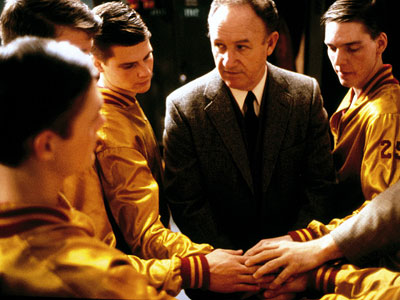
Hoosiers

Attending Indiana University for four years, it's safe to say I know how serious Indiana -- the state and the university -- takes its basketball.  Pro, college, and high school, it doesn't matter.  The state loves basketball.  Maybe the best way to see this love of the sport is in 1986's Hoosiers, the best basketball movie ever made and easily one of the top five sports movies ever made.  Where it might take a couple hours to explain how much Indiana love their basketball heroes, it's easier to say this.  Just check out the movie.

Based very loosely on the 1954 Milan state championship team, Hoosiers paints a picture of what life in small-town Indiana was like in the 1950s.  In the same way that Friday Night Lights showed what high school football means to Texas, so goes high school basketball to Indiana.  In a town where there's little to do and not much in the way of excitement, the basketball team was a top priority in entertainment.  On Friday nights, the town packed the gym to root on their boys.  When they traveled, the town did too.  Naturally there's a huge amount of pressure that goes with that on the coaches and players.  In telling this story, director David Anspaugh creates one of the more emotional, powerful, and enjoyable underdog stories, a perfect example of what can be right about sports.

After 10 years away from coaching, Norman Dale (Gene Hackman) accepts a coaching position in Hickory, Indiana, a small high school with just under 70 students.  He quickly meets resistance on just about every front possible including the acting principal, Miss Fleener (Barbara Hershey), the townsfolk who expect their team to be perfect, and worst of all, the team's best player, Jimmy Chitwood (Maris Valainis) has decided not to play in honor of the last coach's passing.  Undeterred, Dale goes about his business of trying to coach his 7-man squad to be the best team they can be.  A weird thing starts to happen even as everyone objects to Dale's strategy, Hickory starts winning, and it looks like nothing is going to stop them.

There's so many positives going on with this movie I really don't know where to start.  A hugely under-appreciated actor, I don't know if Hackman was ever better than he was here.  His Norman Dale has been given a second chance to do something good after an incident from his past hung over his head all these years.  He clearly knows what he's doing coaching on the sidelines, but he has to convince everyone else he knows what he's doing.  As for the necessary 'coach' moment, listen to this speech and tell me that wouldn't get a team fired up.  I love so many of Hackman's parts -- good guys and bad guys alike -- but this may be my favorite.

As for the basketball, it's handled well in scenes that always allow you to keep up with the action.  Local high school and college athletes filled out the Hickory squad, and with the exception of Valainas as Chitwood, none of the players ever acted again.  You never get a sense of someone putting on a show or overacting.  These were kids in their late teens playing themselves.  And even down to a set-shot jumper or style of play, they look like they could have played in the 1950s.  The basketball scenes are instrumental in getting that 1950s feel to the story.  We're not talking massive gymnasiums for playing, we're talking tiny, claustrophobic places where the crowd is right on top of the action.

I'm going to say SPOILERS here, but if you don't know how Hoosiers ends where have you been these last 24 years?  Chitwood rejoins the team and saves Dale's job, sparking the team all the way to the state title game at Hinkle Fieldhouse in Indianapolis against a powerhouse team from South Bend. An absolutely inspired scene has Dale measuring the basket and the free throw line at Hinkle to show that the venue may be much bigger, but the court is just the same. The ending of course is obvious, Hickory has to win, but that doesn't take away from the power of the moment. Valainis says maybe 20 words the whole movie, but none speak larger than 'I'll make it.'  Done, and game over.  Gives me chills just thinking of it.

Beyond the underdog story, sports movies are so often about second chances and rising to the occasion.  In many ways, they're about people coming to together in a situation out of their comfort zone.  Dale butts heads with Hershey's Myra Fleener for his tactics but ends up wearing her down.  Dale takes on the town drunk and one of the player's fathers, Shooter (Dennis Hopper, Oscar-nominated for his role), because he knows basketball like few others do despite his drinking problems.  Chitwood wants nothing to do with basketball at first, only to realize how much it means to him and more importantly, his town.  The sports aspect is key, but the interpersonal relationships that develop are as big a part of the sports flick above all else.

Comparing sports movies though, a key element is that one moment, that special scene that does send chills down your back.  Hoosiers has too many to even count, most of them aided by Jerry Goldsmith's Oscar-nominated score.  Give it a listen HERE and HERE.  There's the entrance at the fieldhouse, Ollie hitting two underhanded free throws to win the regional title game, Hackman sending four players out and stating 'My team is on the floor,' or Hopper's Shooter forced to coach and lead his team to victory.  It is the moments like that which make sports movies special.

I don't intend this as a cop-out, but you watch Hoosiers and just know it's a good movie.  It lives on in Indiana -- people still talk about Milan, and are angry that with the class system there'll never be another Milan -- as if this story was the true one.  Every so often in movies, every little thing fits perfectly together in a way that is hard to express or explain.  It's just good, and that's what counts.

Hoosiers <----trailer (1986): ****/**** 

Friday, August 14, 2009

A Glenn Ford double feature

Glenn Ford doesn't get a lot of credit as a major western star like a John Wayne, Clint Eastwood, or Randolph Scott. Maybe it's because he was only in one western that is considered a classic, the original 3:10 To Yuma, but Ford turned out a strong list of quality westerns especially later in his career in the 1950s and 1960s. TCM did a Glenn Ford Day as part of their Summer Under the Stars recently, and I was able to catch two westerns I'd missed in the past both from the second half of his career.

1967's A Time for Killing is a good example of how American westerns tried to respond to the cynical, darker spaghetti westerns from Italy. It's the closing days of the Civil War when a group of Confederate prisoners led by Captain Dorrit Bentley (George Hamilton) escape from a Union stockade near the U.S./Mexico border. Heading south, they ambush a supply train and take a prisoner, Emily Biddle (Inger Stevens), the fiance of the Union major, Wolcott (Ford), tracking them.

Bentley's Confederate escapees are a pretty slimy bunch, not too say that Wolcott's Union patrol is any better. It's the end of a long, bloody war, and these men on both sides are exhausted and just want to go home. I was caught off guard by how far the movie went to show those depths. Even when Bentley finds out the war is over, he keeps the news from the men, and Walcott disobeys orders and follows the fugitives into Mexico. The movie was filmed in Old Tucson and Utah and looks great, appropriately gritty and dusty.

While Ford is good as Major Tom Wolcott, the officer trying to rescue his fiance, it's Hamilton who leaves the deepest impression. His Bentley is an ultra-patriot who refuses to believe the war is over and will continue to take that war to the Yankees. Before her tragic death that was ruled a suicide, Stevens made a string of quality westerns late in the 60s, and she's very good here, holding her own with both Ford and Hamilton. The background players include Kenneth Tobey, Max Baer in a role slightly different from Jethro on Beverly Hillbillies, Timothy Carey, Harry Dean Stanton, Todd Armstrong, and for all you trivia buffs out there, Harrison Ford in just his third movie.

Made two years later, Heaven With a Gun is a more traditional western, but it does make efforts to change with the times when dealing with sex and violence. How many westerns have started with a stranger riding into a town and no one knows who he is or what his motives are? It'd probably take quite a few posts just to list all those movies, but that's how 'Heaven' begins with Jim Killian (Ford) riding into Vinegaroon, a town divided between cattle ranchers and sheepherders. Looking to make up for his violent past, Killian sets up a church in town with hopes of uniting both sides.

His main opposition is Asa Beck (John Anderson), a cattle rancher who with his son, Coke (David Carradine) will have nothing to do with sheepherders and refuses to even listen to Killian's ideas. On the other hand, Killian gets help from everyone else in town including Madge (Carolyn Jones), the saloon/brothel owner, Leloopa (Barbara Hershey), a young Indian girl Jim cares for after her father is killed, and Bart Patterson (William Bryant), a local ranch owner. Also worth mentioning are two supporting parts for J.D. Cannon as a hired gun, Mace, and Noah Beery Jr as Garvey, one of Beck's most trusted hands.

The script calls for some random nudity that feels just thrown into the script for the sake of some topless saloon girls, and the violence is pretty vicious even if it's not shown. Much of it is off-screen, but it's pretty grim whether you see the results or not. The sex and violence then makes the ending seem a little off for me. Killian is trying to stop Beck and his gunhands from massacring the sheepherders and cattle ranchers who are now working together. It doesn't work overall and comes across as too forced, like the money just wasn't there to set up a shootout.

The constant through both movies is Ford's steadying influence on the story. He was usually cast as the good guy, but later in his career they added a wrinkle to that old standby, the good guy who used to be a bad guy and is looking to repent. It's hard to judge Ford as an actor because in roles like this he didn't have to show a lot of range. But like John Wayne did in his later years, Ford nails these parts. He's likable on-screen with a very natural presence. I liked both movies, Time for Killing a lot and Heaven With A Gun despite the ending.

A Time for Killing <---fan-made trailer (1967): ***/****
Heaven With a Gun (1969): ** 1/2 /****