So big money, huh? Yeah, it scares the hell out of me mostly because the only time we ever hear about Wall Street and huge international corporations is when they're getting taken down for all sorts of tax frauds, insider trading and stock manipulation. How can the rich get richer basically. Like politics, right?!? Yeah, the world's a scary place. Nowhere is that more evident than in director Martin Scorsese's latest, 2013's The Wolf of Wall Street.
Arriving on Wall Street in 1987, Jordan Belfort (Leonardo DiCaprio) is a young, ambitious and even naive stock broker looking to make a career for himself. He also has horrific timing. Within months of becoming a full-time broker, Jordan is out of work as quick as he had it, a result of Black Monday. Looking for work, Jordan ends up working in a New Jersey boiler room selling penny stocks. The money is there, his aggressive selling style winning over customer after customer. It's not enough though. Jordan wants more. He needs more. He gets it his own way, starting his own start-up scam selling stocks with the very official sounding name, Stratton Oakmont, and a new right-hand man, Donnie Azoff (Jonah Hill), goes to work. He gets an office, gets some salesmen, teaches them the selling techniques, and it works....a lot. Money starts flowing in, ridiculous amounts of money, and Jordan's empire grows. Millions of dollars, a luxurious, self-indulgent life of sex, drugs, and everything in between, everything is attainable. Has Jordan's company gotten too big though?
You know what's the most terrifying thing to take away from this movie? It happened. This all happened. Read about the real-life Jordan Belfort HERE and know that as ridiculously over the top, as self-indulgent, as ludicrous as the movie is, IT HAPPENED. Belfort's story also served as the inspiration for 2000's Boiler Room. 'Wolf' doesn't delve in too much to the gory financial details, trying to introduce what's going on and moving on to the life and empire Belfort has created for himself. Not surprisingly, it has picked up some Oscar buzz, garnering nominations for Best Picture, Best Director and Best Actor, picking up five overall. It's a loaded Academy Awards so it will definitely be interesting to see what comes of it all.
What's the end result here? A terrifying, truly funny, unsettling, amazingly entertaining story. Scorsese's style is there at all times. DiCaprio's narration -- mostly heard over the action, at times seen as Jordan addresses the camera -- is almost non-stop, keeping things going, explaining all the new developments that the ever-crooked Stratton Oakmont is up to. 'Wolf' clocks in at a robust 179 minutes (that's almost 3 full hours for you non-math fans like me), the script from Terence Winter covering a ton of ground and a lot of years, but it never feels rushed. If you didn't know this was real, you'd think it was a drugged-up fantasy, a dream-like trip into a bizarre nightmare. There isn't one linear story, no one plot, just an ever-building doomsday scenario we all know is coming. The first hour is the rise to power, the second the stay at the top, and the third the inevitable and crushing downfall. Replacing mobsters with Wall Street brokers, 'Wolf' did remind me of Scorsese's Goodfellas at times in terms of that rise to power story arc.
As the appointed Wolf of Wall Street (earning the nickname 'Wolfie'), DiCaprio picked up another Best Actor nomination, his third Best actor and fourth overall (he remains winless), for his part here. It's a part that is hard to look away from. It is a trainwreck, and we're just waiting for the train to wreck. DiCaprio's performance is a gem as we watch Jordan's rise to power and inevitable fall from grace. He learns the ins-and-outs of the stock market from a veteran broker, John Hanna (Matthew McConaughey, a truly scene-stealing part, and he's on-screen about 10 minutes, maybe), and from there, Jordan is on his way. It's ego. It's pride. It's vanity. It is having everything the world can offer. His life becomes a cliche of the rich and famous as he visits prostitutes on a regular basis, does ridiculous amounts of drugs, becomes addicted to quaaludes, and commits himself to a life he loves and embraces, a life that will lead to his doom. From the narration to the decadence, DiCaprio brings this scumbag to life. It's not a likable character. Jordan is a deplorable individual, but he's epically, grandly good at his profession. Will DiCaprio win the Oscar? I don't know considering the opponents -- Dern, McConaughey, Bale, Ejiofor -- but he more than deserves that nomination.
DiCaprio isn't alone though, 'Wolf' featuring an impressive list of performances. Some are like McConaughey, quick, effective and lasting in terms of influence, while others figure more prominently, like Jonah Hill's Best Supporting Actor nominated part as Donnie. It's hard to put this character into words, a motor-mouth, a troublemaker, a loyal right-hand man, and just as greedy as Jordan, especially when the money starts to pile up (quite literally). Another really strong part goes to relative unknown (but not for too much longer) Margot Robbie as Naomi, Jordan's second wife, a former model and the definition of a trophy wife....who becomes much more. Adding to the scene-stealing list (how many such parts can a movie have?) is Rob Reiner as Jordan's Dad, helping his son with the business but quite aware where his son is heading. The link for these three parts -- and really the entire cast -- is the chemistry. As ridiculously goofy and off the wall as the story can be at times, it's at least somewhat grounded because of the chemistry, the believable qualities.
Also look for Kyle Chandler as Denham, the FBI agent leading the case against Jordan, Jon Favreau as Riskin, the security officer trying to help Jordan around the S.E.C. sanctions, Jean Dujardin as Saurel, the helpful Swiss banker, and Jon Bernthal, P.J. Byrne, Kenneth Choi, Brian Sacca, and Henry Zebrowski as Jordan's crew of "vice presidents" who become his inner circle. Even look for actor/director Spike Jonze in a small, effective part.
I have a concept of Best Picture nominations as being almost exclusively dramatic. This year's nominations certainly back up that assumption, from 12 Years a Slave to Captain Phillips, Nebraska to Dallas Buyers Club (American Hustle obviously had some laughs too). So what to take away from 'Wolf'? It is funny, ridiculously funny. This isn't physical humor laughs. These are scenes so far out of the ordinary that their unique qualities are funny just because. These are scenes played straight that produce countless laughs. My personal favorite? Jordan and Donnie overdo it on some old quaaludes (Lemmon 714) thinking they've lost their potency. Well...they didn't. The extended scene as both try to overcome some heavy duty effects are hilarious. I was crying. 'Wolf' has plenty of these moments, from analyzing a contract of a little person who agrees to be used as a throwing dart to McConaughey's Hannah's monologue about how to truly become a successful stock broker. It's incredibly dark humor, often uncomfortable, but these were genuine laughs.
Is there a complaint here? Yeah, the length of the movie. It never drags but the almost three-hour movie.....yeah, it felt as I was walking out that I'd been there three or four days. I don't know what you cut, but just be known it's a long movie. Mostly though, it's really good. It's the general negative outlook on, well, everything. Lost in the shuffle of the drama and debauchery is such a negative tone and outlook on life. Everyone is out for themselves, and no one really cares who gets caught in the wake. A trip of a movie full of drug use, nudity (some scenes far more graphic than others), truly interesting characters, lots of illegal stock and Wall Street activity, style to burn, and just a treat to watch. Scorsese does it again. I can't wait to see what, if any, awards it takes home at next month's Oscars.
The Wolf of Wall Street (2013): *** 1/2 /****
The Sons of Katie Elder
"First, we reunite, then find Ma and Pa's killer...then read some reviews."
Showing posts with label Leonardo DiCaprio. Show all posts
Friday, February 28, 2014
Monday, November 11, 2013
The Great Gatsby (2013)
One of the few books/novels I had to read for AP/Honors English in high school and college and actually enjoyed was F. Scott Fitzgerald's The Great Gatsby, a condemnation of the Jazz Age, rich folks, all sorts of waste, and all that good stuff. It's had several reincarnations since, including one film starring Robert Redford, and more than a few other film and stage productions. In the age of the remake/reboot, here we sit with 2013's big-budget The Great Gatsby, as lavish and over the top as the story condemns.
It's 1922 and Nick Carraway (Tobey Maguire) has moved east to pursue a job in business on the stock market, leaving his Midwestern roots and his dream of being a writer behind him. He rents a small cottage on Long Island and can't help but notice the lavish, ridiculously over the top parties on almost a nightly basis at his next door neighbor's mansion. His neighbor? The mysteriously rich Jay Gatsby (Leonardo DiCaprio), a man in his early 30s who no one knows much about. Specifically invited to one of Gatsby's parties, Nick shows up and is amazed at what he finds and sees, a party unlike any he's ever seen. He meets Gatsby, taking an instant like to this amiable, quirky man with all sorts of unanswered questions hanging over his head. Who is he really? How did he come to this spot? Nick will most certainly be surprised when he finds out, but will he care or will he just be worried about his new friend?
When I hear the name Baz Luhrmann, I think of one thing; one, big old extravagant director. With movies like Romeo and Juliet, Moulin Rouge and Australia to his name, Luhrmann has a track record for hugely visual, highly stylized films that reek (in a good way) of extravagant sets, goofy style, color, movement and more color. He continues the tradition/trend here with one crazy visual movie. It's style, style and style. We're transported to 1920s NYC courtesy of some pretty obvious but pretty cool CGI. The modern soundtrack is a little much -- songs from Jay Z, Beyonce, Andre 3000, Jack White among others -- and calls too much attention to itself at times. It's not just that the movie is stylish. Luhrmann and his crew commit to bringing it to life. Even if the story sucked or wasn't interesting, you could just sit back and revel in the visual. Thankfully, it's not just style and no substance.
Early on though, I'll admit to being rather worried about what I'd gotten into. As the movie finds its tone and pace, the first 20-25 minutes were rough for me. Things are righted the minute DiCaprio as Jay Gatsby appears on-screen for the first time. Talk about ideal casting, DiCaprio is perfectly cast as the mysterious, charismatic, engaging Gatsby. Let's face it. DiCaprio is a good-looking guy and that certainly helps here. He brings a certain charming energy to the part. Reading the book in high school, I really liked the Gatsby character. He's rich beyond anyone's dreams, but he isn't some smarmy, condescending millionaire. His past is slowly filtered out as we learn about his love for Daisy Buchanan (Carey Mulligan), Nick's cousin who also happens to be married to an equally rich man, Tom Buchanan (Joel Edgerton). We learn that Gatsby is like most people. He looks for happiness, for love, for someone to share his riches with. It's an excellent part for DiCaprio, again showing what a good actor he is.
The rest of the cast is uniformly solid behind him. I'm not a fan of Maguire going back to his Spiderman days, but he's pretty decent here. His Nick is our window into the story, Nick seeing and exploring as we do into this very rich world. His narration gets to be too much at times -- simply trying too hard -- but it's cool to see his friendship develop with Gatsby. Mulligan and Edgerton provide some interesting characters as Daisy and her husband, Tom, Daisy and Gatsby's love providing the spark for the second half of the story. We also get to meet Jordan Baker (Elizabeth Debicki), a young, up and coming golfer who Nick meets soon after moving to NYC. Isla Fisher plays Myrtle, Tom's mistress, with Jason Clarke playing her husband, the owner of a gas station.
Having read the book (even if it was years ago), I had a certain worry heading into this flick. How close would the script stay to the novel? I worry about it with most books I've read that are turned into films. Thankfully, this adaptation sticks pretty close. While I liked the style and the visual appeal is obvious, I got more enjoyment out of the second half when Jay and Daisy's love steps to the forefront. The style is still there, but it's here we see more substance and get to know the characters far better. The sense of doom arises because we know everything can't end well for all those involved. Where will it head? Will it keep driving toward Fitzgerald's inevitable end? It's in the second half of the movie where 'Gatsby' finds that groove, that right mix of style, story, substance and characters. A pleasant surprise for sure.
The Great Gatsby (2013): ***/****
It's 1922 and Nick Carraway (Tobey Maguire) has moved east to pursue a job in business on the stock market, leaving his Midwestern roots and his dream of being a writer behind him. He rents a small cottage on Long Island and can't help but notice the lavish, ridiculously over the top parties on almost a nightly basis at his next door neighbor's mansion. His neighbor? The mysteriously rich Jay Gatsby (Leonardo DiCaprio), a man in his early 30s who no one knows much about. Specifically invited to one of Gatsby's parties, Nick shows up and is amazed at what he finds and sees, a party unlike any he's ever seen. He meets Gatsby, taking an instant like to this amiable, quirky man with all sorts of unanswered questions hanging over his head. Who is he really? How did he come to this spot? Nick will most certainly be surprised when he finds out, but will he care or will he just be worried about his new friend?
When I hear the name Baz Luhrmann, I think of one thing; one, big old extravagant director. With movies like Romeo and Juliet, Moulin Rouge and Australia to his name, Luhrmann has a track record for hugely visual, highly stylized films that reek (in a good way) of extravagant sets, goofy style, color, movement and more color. He continues the tradition/trend here with one crazy visual movie. It's style, style and style. We're transported to 1920s NYC courtesy of some pretty obvious but pretty cool CGI. The modern soundtrack is a little much -- songs from Jay Z, Beyonce, Andre 3000, Jack White among others -- and calls too much attention to itself at times. It's not just that the movie is stylish. Luhrmann and his crew commit to bringing it to life. Even if the story sucked or wasn't interesting, you could just sit back and revel in the visual. Thankfully, it's not just style and no substance.
Early on though, I'll admit to being rather worried about what I'd gotten into. As the movie finds its tone and pace, the first 20-25 minutes were rough for me. Things are righted the minute DiCaprio as Jay Gatsby appears on-screen for the first time. Talk about ideal casting, DiCaprio is perfectly cast as the mysterious, charismatic, engaging Gatsby. Let's face it. DiCaprio is a good-looking guy and that certainly helps here. He brings a certain charming energy to the part. Reading the book in high school, I really liked the Gatsby character. He's rich beyond anyone's dreams, but he isn't some smarmy, condescending millionaire. His past is slowly filtered out as we learn about his love for Daisy Buchanan (Carey Mulligan), Nick's cousin who also happens to be married to an equally rich man, Tom Buchanan (Joel Edgerton). We learn that Gatsby is like most people. He looks for happiness, for love, for someone to share his riches with. It's an excellent part for DiCaprio, again showing what a good actor he is.
The rest of the cast is uniformly solid behind him. I'm not a fan of Maguire going back to his Spiderman days, but he's pretty decent here. His Nick is our window into the story, Nick seeing and exploring as we do into this very rich world. His narration gets to be too much at times -- simply trying too hard -- but it's cool to see his friendship develop with Gatsby. Mulligan and Edgerton provide some interesting characters as Daisy and her husband, Tom, Daisy and Gatsby's love providing the spark for the second half of the story. We also get to meet Jordan Baker (Elizabeth Debicki), a young, up and coming golfer who Nick meets soon after moving to NYC. Isla Fisher plays Myrtle, Tom's mistress, with Jason Clarke playing her husband, the owner of a gas station.
Having read the book (even if it was years ago), I had a certain worry heading into this flick. How close would the script stay to the novel? I worry about it with most books I've read that are turned into films. Thankfully, this adaptation sticks pretty close. While I liked the style and the visual appeal is obvious, I got more enjoyment out of the second half when Jay and Daisy's love steps to the forefront. The style is still there, but it's here we see more substance and get to know the characters far better. The sense of doom arises because we know everything can't end well for all those involved. Where will it head? Will it keep driving toward Fitzgerald's inevitable end? It's in the second half of the movie where 'Gatsby' finds that groove, that right mix of style, story, substance and characters. A pleasant surprise for sure.
The Great Gatsby (2013): ***/****
Monday, January 7, 2013
Django Unchained
Not everyone is a fan of director Quentin Tarantino. I understand that. He tends to rub people the wrong way at times in his verbosity and lack of filter. Within each of his movies, there are even moments I want to slap him, tell him to tone things down. But the best part? When he gets something right, he does it so ridiculously well it makes you appreciate how good a feature film can be. Enter 2012's Django Unchained.
Being transported following a slave auction in 1858 Texas, slave Django (Jamie Foxx) is rescued by a dentist turned bounty hunter, Dr. King Schultz (Christoph Waltz). The good doctor has a proposal; Django knows what the Brittle brothers, three notorious outlaws, look like while Schultz cannot identify them. If Django travels with him and identifies him, Schultz will give him his freedom. Django agrees but with a caveat, he wants Schultz's help getting his wife, Broomhilda (Kerry Washington), also sold at an auction, back. The duo forms an unlikely partnership, the bounty hunter teaching the slave the ways of the business. The Brittle brothers await somewhere at a southern plantation, but Django and Schultz also find out that Broomhilda was purchased by Monsieur Calvin Candie (Leonardo DiCaprio), owner of one of the biggest plantations in the South. What awaits the bounty hunter dentist and his slave apprentice?
Above all else, Quentin Tarantino (directing and writing the script here) loves movies. He truly loves them. His movies always reflect that. He grew up watching all sorts of movies -- spaghetti westerns, blaxploitation flicks, countless others -- and his movies typically work as a quasi-tribute to those movies he loves. When things are going well, it is going really well. As a viewer, I watch certain scenes and just inherently know 'This is what movies should be.' His movies are done on an epic scope, blending an incredible visual with drama and humor, performances that can shock and surprise whether they be workmanlike or highly memorable, a style in story and camerawork that sets it apart from the rest. Because Tarantino can get far too indulgent at times, it's easy to look past his freakish talent, but it's there just the same. If only there was a way to calm him down....just a little.
For a director with less than 10 feature films to his name, Tarantino has created an impressive, eclectic variety of movies. Not surprisingly, 'Django' defies any specific description. Is it a western? Yeah, sort of, but that's limiting. It takes place almost entirely in the deep South in 1858, long before our concept of the wild west ever began. This is a movie that in its rather verbose 165 minutes covers a whole lot of ground. It is at times incredibly difficult to watch, especially considering its rather blunt portrayal of slavery and violence. Whippings, dog attacks, the ever-present and constant use of the 'N-word,' it's all there, including a brutal fighting style called Mandingo, slaves fighting to the death with their bare hands for the enjoyment and entertainment of their masters. But ultimately, a movie that defies description is not a bad thing, not by a long shot. While it refers and pays tribute to countless other movies, it is most definitely its own movie.
The best thing going for 'Django' is the casting of Foxx and Waltz and the relationship that develops between the two men. The casting of the Django character was tricky, attracting names from Will Smith to Tyrese Gibson to Terrence Howard, but Foxx is a great choice. His character is likable and sympathetic while also giving a hard edge that shows how driven he is. Playing a part not dissimilar to his part in Tarantino's Inglourious Basterds, Waltz is again a scene-stealer. Foxx is the anti-hero, Waltz the showier part as Dr. King Schultz. Tarantino's script does a fine job developing both men, especially Dr. Schultz as the movie delves deeper and deeper into their mission. It is the unlikeliest of pairings, but it is beyond perfect. Schultz takes him along purely for financial reasons (the badder the man, the bigger the bounty) but ends up looking to Django as an equal he insists on sticking with. I loved the two performances and hope both actors are rewarded with some award nominations in the coming weeks.
Actors and actresses want to work with Tarantino, and the biggest surprise in casting was Leonard DiCaprio as Southern plantation owner Calvin Candie. It is a gem of a performance. Like Waltz, it is big and showy and aggressive, but it never feels forced. DiCaprio takes the chance to work with a Tarantino script and runs with it. Seeing him in such an obvious but racially-charged role as a bad guy isn't a bad thing either. The real villain though? In my estimation, Samuel L. Jackson in a scene-stealing part as Stephen, Candie's head slave who looks out for himself, screw black, white and any other skin color. Washington too does a fine job in a not so great part as Broomhilda, the damsel in distress waiting for her true love to rescue her.
That should be enough for any movie, but it is a Tarantino movie so....yeah, it isn't enough. In varying roles look for Walt Goggins, Dennis Christopher, Don Johnson, Jonah Hill, James Remar, James Russo, Bruce Dern, Russ Tamblyn, Amber Tamblyn, Don Stroud, Michael Parks, Tom Savini, and M.C. Gainey. The coolest appearance goes to the original Django himself, Franco Nero, appearing in a quick scene with Foxx that any fan of the 1966 spaghetti western should appreciate. They have a quick exchange and share a knowing look in a very cool scene.
Another fixture in a Tarantino movie is the musical score, and he doesn't disappoint here. The actual Django theme from 1966 (Listen HERE) plays over the opening credits with composer Luis Bacalov's scores from several other movies used throughout the story. Other samples include Ennio Morricone's scores from Two Mules for Sister Sara, Violent City, Hornets' Nest, Hellbenders and others mixed in with Bacalov scores, and several rap songs (out of place to me). For the most part, the soundtrack fits well without being as aggressively blaring as certain Tarantino soundtracks.
How about another Tarantino fixture? Yep, it took me awhile, but here we are talking about on-screen violence, a staple in Tarantino films. For the most part, the director uses violence to shock and surprise, disgust and enthrall at the same time. It's quick and shocking and graphic. That's fine, the violence even played for some incredibly dark humor at times. For me though, even Tarantino goes too far in a late shootout that pushes the bounds I have for violence. Graphic and gratuitous is one thing, but it's such a ridiculously over the top sequence -- slow motion galore, blood squibs and clouds of bloody mist on steroids -- that it becomes disgusting. The violence is at its best in quick bursts, but when it lingers, it starts to become too much.
For a movie I liked a lot (maybe even loved, give me a couple days to think about it), it may sound like I'm too negative. 'Django' certainly has some negatives. It has some pacing problems just past the halfway point of the movie that it struggles to overcome. The first 110 minutes or so are nearly perfect while the second half of the story is still impressive but just not on the same level. The ending -- not surprisingly -- does not disappoint. It is a funny, impressive, moving, incredibly dark, smart, vicious, honest and highly entertaining movie. I could do whole reviews about single scenes, performances and countless other little things from this movie. It has flaws (don't be confused there), but when it works, I loved this movie, even enough to give it a four-star rating. Say what you want about Quentin Tarantino, but the man knows how to make a film that can bring together and/or divide an audience like nobody's business. Definitely check this one out.
Django Unchained (2012): ****/****
Being transported following a slave auction in 1858 Texas, slave Django (Jamie Foxx) is rescued by a dentist turned bounty hunter, Dr. King Schultz (Christoph Waltz). The good doctor has a proposal; Django knows what the Brittle brothers, three notorious outlaws, look like while Schultz cannot identify them. If Django travels with him and identifies him, Schultz will give him his freedom. Django agrees but with a caveat, he wants Schultz's help getting his wife, Broomhilda (Kerry Washington), also sold at an auction, back. The duo forms an unlikely partnership, the bounty hunter teaching the slave the ways of the business. The Brittle brothers await somewhere at a southern plantation, but Django and Schultz also find out that Broomhilda was purchased by Monsieur Calvin Candie (Leonardo DiCaprio), owner of one of the biggest plantations in the South. What awaits the bounty hunter dentist and his slave apprentice?
Above all else, Quentin Tarantino (directing and writing the script here) loves movies. He truly loves them. His movies always reflect that. He grew up watching all sorts of movies -- spaghetti westerns, blaxploitation flicks, countless others -- and his movies typically work as a quasi-tribute to those movies he loves. When things are going well, it is going really well. As a viewer, I watch certain scenes and just inherently know 'This is what movies should be.' His movies are done on an epic scope, blending an incredible visual with drama and humor, performances that can shock and surprise whether they be workmanlike or highly memorable, a style in story and camerawork that sets it apart from the rest. Because Tarantino can get far too indulgent at times, it's easy to look past his freakish talent, but it's there just the same. If only there was a way to calm him down....just a little.
For a director with less than 10 feature films to his name, Tarantino has created an impressive, eclectic variety of movies. Not surprisingly, 'Django' defies any specific description. Is it a western? Yeah, sort of, but that's limiting. It takes place almost entirely in the deep South in 1858, long before our concept of the wild west ever began. This is a movie that in its rather verbose 165 minutes covers a whole lot of ground. It is at times incredibly difficult to watch, especially considering its rather blunt portrayal of slavery and violence. Whippings, dog attacks, the ever-present and constant use of the 'N-word,' it's all there, including a brutal fighting style called Mandingo, slaves fighting to the death with their bare hands for the enjoyment and entertainment of their masters. But ultimately, a movie that defies description is not a bad thing, not by a long shot. While it refers and pays tribute to countless other movies, it is most definitely its own movie.
The best thing going for 'Django' is the casting of Foxx and Waltz and the relationship that develops between the two men. The casting of the Django character was tricky, attracting names from Will Smith to Tyrese Gibson to Terrence Howard, but Foxx is a great choice. His character is likable and sympathetic while also giving a hard edge that shows how driven he is. Playing a part not dissimilar to his part in Tarantino's Inglourious Basterds, Waltz is again a scene-stealer. Foxx is the anti-hero, Waltz the showier part as Dr. King Schultz. Tarantino's script does a fine job developing both men, especially Dr. Schultz as the movie delves deeper and deeper into their mission. It is the unlikeliest of pairings, but it is beyond perfect. Schultz takes him along purely for financial reasons (the badder the man, the bigger the bounty) but ends up looking to Django as an equal he insists on sticking with. I loved the two performances and hope both actors are rewarded with some award nominations in the coming weeks.
Actors and actresses want to work with Tarantino, and the biggest surprise in casting was Leonard DiCaprio as Southern plantation owner Calvin Candie. It is a gem of a performance. Like Waltz, it is big and showy and aggressive, but it never feels forced. DiCaprio takes the chance to work with a Tarantino script and runs with it. Seeing him in such an obvious but racially-charged role as a bad guy isn't a bad thing either. The real villain though? In my estimation, Samuel L. Jackson in a scene-stealing part as Stephen, Candie's head slave who looks out for himself, screw black, white and any other skin color. Washington too does a fine job in a not so great part as Broomhilda, the damsel in distress waiting for her true love to rescue her.
That should be enough for any movie, but it is a Tarantino movie so....yeah, it isn't enough. In varying roles look for Walt Goggins, Dennis Christopher, Don Johnson, Jonah Hill, James Remar, James Russo, Bruce Dern, Russ Tamblyn, Amber Tamblyn, Don Stroud, Michael Parks, Tom Savini, and M.C. Gainey. The coolest appearance goes to the original Django himself, Franco Nero, appearing in a quick scene with Foxx that any fan of the 1966 spaghetti western should appreciate. They have a quick exchange and share a knowing look in a very cool scene.
Another fixture in a Tarantino movie is the musical score, and he doesn't disappoint here. The actual Django theme from 1966 (Listen HERE) plays over the opening credits with composer Luis Bacalov's scores from several other movies used throughout the story. Other samples include Ennio Morricone's scores from Two Mules for Sister Sara, Violent City, Hornets' Nest, Hellbenders and others mixed in with Bacalov scores, and several rap songs (out of place to me). For the most part, the soundtrack fits well without being as aggressively blaring as certain Tarantino soundtracks.
How about another Tarantino fixture? Yep, it took me awhile, but here we are talking about on-screen violence, a staple in Tarantino films. For the most part, the director uses violence to shock and surprise, disgust and enthrall at the same time. It's quick and shocking and graphic. That's fine, the violence even played for some incredibly dark humor at times. For me though, even Tarantino goes too far in a late shootout that pushes the bounds I have for violence. Graphic and gratuitous is one thing, but it's such a ridiculously over the top sequence -- slow motion galore, blood squibs and clouds of bloody mist on steroids -- that it becomes disgusting. The violence is at its best in quick bursts, but when it lingers, it starts to become too much.
For a movie I liked a lot (maybe even loved, give me a couple days to think about it), it may sound like I'm too negative. 'Django' certainly has some negatives. It has some pacing problems just past the halfway point of the movie that it struggles to overcome. The first 110 minutes or so are nearly perfect while the second half of the story is still impressive but just not on the same level. The ending -- not surprisingly -- does not disappoint. It is a funny, impressive, moving, incredibly dark, smart, vicious, honest and highly entertaining movie. I could do whole reviews about single scenes, performances and countless other little things from this movie. It has flaws (don't be confused there), but when it works, I loved this movie, even enough to give it a four-star rating. Say what you want about Quentin Tarantino, but the man knows how to make a film that can bring together and/or divide an audience like nobody's business. Definitely check this one out.
Django Unchained (2012): ****/****
Sunday, July 25, 2010
Inception
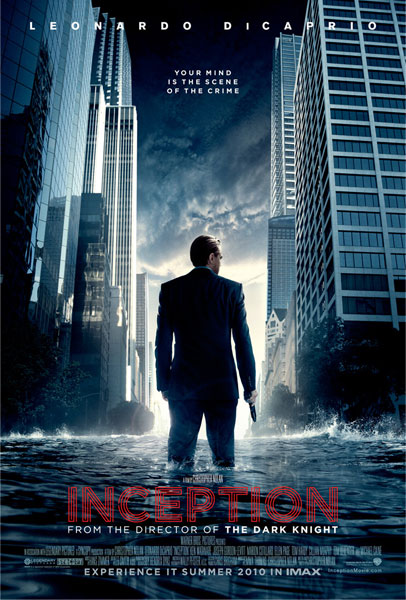
I really have no idea at all about where to even start reviewing Inception, released last weekend in theaters and the most recent movie from director Christopher Nolan. If you choose to stop reading my review now, just know that it is everything that is good about movies, one that keeps you interested from start to finish, has a polish to it and a style all it's own, and in general is better than 99.9 % of most movies that ever make the theaters. So if you're going to stop reading my most likely ranting review, know that I'm giving it a 4-star rating and enjoy the movie.
Working on a script for ten-plus years, Nolan does what very few writer/directors can do; he creates a unique world that is unlike anything you've ever seen. It is intelligent in a way few movies are and it requires, it demands that you pay attention. People walked into the theaters 4 or 5 minutes late, and all I could think was "Well, they're screwed." Coming up with the best way to recommend this movie, I'll say this. Watching it, you get that feeling that you're watching what a movie should be; an experience. The visuals, the acting, the writing, Hans Zimmer's pulsing score, it all comes together in a way few movies do. Here comes the hard part, trying to explain the plot.
Dom Cobb (Leonardo DiCaprio) is the best of the best at what he does. He's a dream thief, able to steal your deepest, darkest secrets through your subconscious while you are asleep. With a specialized team and his partner Arthur (Joseph Gordon-Levitt), he is able to insert himself into someone's dreams and find out everything and anything about them. But this time, he's messed up and he is being blackmailed by an employer, an extremely powerful business man named Saito (Ken Watanabe). Instead of stealing an idea, Saito wants to implant an idea in someone's head, a rival businessman, Fischer (Cillian Murphy), so that he'll dissolve his huge empire. Cobb isn't interested until he finds out the stakes, then he goes about assembling a team to perform this 'inception,' a more dangerous technique and harder to accomplish where all the risks are raised.
To say that is the whole plot is underselling the movie. I could do reviews and reviews that really delve into what the movie is about and probably still miss something. In creating this world of dreams and subconscious, Nolan has made his own sets of rules as to what can and can't happen. Because of that, as a viewer we have no background with any of this and are forced to pay that much more attention to keep up. Honestly though, I paid attention -- no talking, no texting, no bathroom breaks -- and feel I have a pretty good grasp of what's going on. If you're worried about being confused, just go in with an open mind and do your best to keep up. At a certain point, just go along for the ride and enjoy yourself.
As was the case with Nolan's previous big-budget movies (the two Batman movies and The Prestige), he's able to put an impressive cast together. If you had told me 10 years ago watching Titanic that I'd like DiCaprio as an actor, I'd have said you were crazy. But starring as Cobb, he continues a string of movies where he's not just tolerable, he's a strong actor who can stand on his own. Joining him on his team are Ariadne (Ellen Page), the architect of the dream worlds they go into, Eames (Tom Hardy), the forger, Yusuf (Dileep Rao), the chemist, and Gordon-Levitt as Arthur. Hardy especially stands out, but all of the team more than hold their own. Watanabe and Murphy are more chess pieces to be played with, but their presence alone helps the story. French beauty Marion Cotillard is perfectly scary in a supporting role, and then add in Tom Berenger, Pete Postlethwaite and Michael Caine with small parts, and you've got a can't miss cast.
One reason I enjoyed the TV show 'Lost' so much was that it played with your perception of time and space. Where better to continue that trend than in your dreams where anything and everything from your own subconscious can make an impact? That was an element that caught me by surprise here. You can be in someone else's dream, but your own thoughts, fears, worries can fight their way into the dream-world. DiCaprio's Cobb is a prime example of this, a tortured individual with a checkered past. The best part of the movie though is the execution of the inception, a three-leveled dream as Cobb's team goes deeper into Fischer's "mind." Time is shorter in certain levels than others, what may only be seconds in one level is years in another. There of course has to be limbo then, where there is no time and dreams float about with the minds they belong to. Trippy ideas all of them, but certainly incredibly creative.
The Chicago Tribune's Michael Phillips made an excellent point about Inception, stating that this is at its heart, a heist movie, that one last job. That's the movie's strength. All these crazy visual tricks play into it as cities fold in on each other, gravity goes out the window, and time doesn't mean as much. It's basically the craziest, most involved heist ever with Cobb looking to pull off that one last job that will reunite him with his family. At its heart, Inception has that small angle, a family man trying to right a wrong, and on a bigger angle, a huge, incredibly unique storyline that pulled me in from the get-go. It's a movie that is nearly impossible to review without giving away far too much. If you've made it this long, I'll say it again. Just go see Inception and decide for yourself.
Inception <----trailer (2010): ****/****
Working on a script for ten-plus years, Nolan does what very few writer/directors can do; he creates a unique world that is unlike anything you've ever seen. It is intelligent in a way few movies are and it requires, it demands that you pay attention. People walked into the theaters 4 or 5 minutes late, and all I could think was "Well, they're screwed." Coming up with the best way to recommend this movie, I'll say this. Watching it, you get that feeling that you're watching what a movie should be; an experience. The visuals, the acting, the writing, Hans Zimmer's pulsing score, it all comes together in a way few movies do. Here comes the hard part, trying to explain the plot.
Dom Cobb (Leonardo DiCaprio) is the best of the best at what he does. He's a dream thief, able to steal your deepest, darkest secrets through your subconscious while you are asleep. With a specialized team and his partner Arthur (Joseph Gordon-Levitt), he is able to insert himself into someone's dreams and find out everything and anything about them. But this time, he's messed up and he is being blackmailed by an employer, an extremely powerful business man named Saito (Ken Watanabe). Instead of stealing an idea, Saito wants to implant an idea in someone's head, a rival businessman, Fischer (Cillian Murphy), so that he'll dissolve his huge empire. Cobb isn't interested until he finds out the stakes, then he goes about assembling a team to perform this 'inception,' a more dangerous technique and harder to accomplish where all the risks are raised.
To say that is the whole plot is underselling the movie. I could do reviews and reviews that really delve into what the movie is about and probably still miss something. In creating this world of dreams and subconscious, Nolan has made his own sets of rules as to what can and can't happen. Because of that, as a viewer we have no background with any of this and are forced to pay that much more attention to keep up. Honestly though, I paid attention -- no talking, no texting, no bathroom breaks -- and feel I have a pretty good grasp of what's going on. If you're worried about being confused, just go in with an open mind and do your best to keep up. At a certain point, just go along for the ride and enjoy yourself.
As was the case with Nolan's previous big-budget movies (the two Batman movies and The Prestige), he's able to put an impressive cast together. If you had told me 10 years ago watching Titanic that I'd like DiCaprio as an actor, I'd have said you were crazy. But starring as Cobb, he continues a string of movies where he's not just tolerable, he's a strong actor who can stand on his own. Joining him on his team are Ariadne (Ellen Page), the architect of the dream worlds they go into, Eames (Tom Hardy), the forger, Yusuf (Dileep Rao), the chemist, and Gordon-Levitt as Arthur. Hardy especially stands out, but all of the team more than hold their own. Watanabe and Murphy are more chess pieces to be played with, but their presence alone helps the story. French beauty Marion Cotillard is perfectly scary in a supporting role, and then add in Tom Berenger, Pete Postlethwaite and Michael Caine with small parts, and you've got a can't miss cast.
One reason I enjoyed the TV show 'Lost' so much was that it played with your perception of time and space. Where better to continue that trend than in your dreams where anything and everything from your own subconscious can make an impact? That was an element that caught me by surprise here. You can be in someone else's dream, but your own thoughts, fears, worries can fight their way into the dream-world. DiCaprio's Cobb is a prime example of this, a tortured individual with a checkered past. The best part of the movie though is the execution of the inception, a three-leveled dream as Cobb's team goes deeper into Fischer's "mind." Time is shorter in certain levels than others, what may only be seconds in one level is years in another. There of course has to be limbo then, where there is no time and dreams float about with the minds they belong to. Trippy ideas all of them, but certainly incredibly creative.
The Chicago Tribune's Michael Phillips made an excellent point about Inception, stating that this is at its heart, a heist movie, that one last job. That's the movie's strength. All these crazy visual tricks play into it as cities fold in on each other, gravity goes out the window, and time doesn't mean as much. It's basically the craziest, most involved heist ever with Cobb looking to pull off that one last job that will reunite him with his family. At its heart, Inception has that small angle, a family man trying to right a wrong, and on a bigger angle, a huge, incredibly unique storyline that pulled me in from the get-go. It's a movie that is nearly impossible to review without giving away far too much. If you've made it this long, I'll say it again. Just go see Inception and decide for yourself.
Inception <----trailer (2010): ****/****
Monday, April 26, 2010
Blood Diamond
Out of conflict comes the good and the bad. There are those who try and do something with the idea of accomplishing something good, and then there are others who try to profit from the suffering all around them. Then somewhere in between are the unwilling and unlucky caught in the middle just fighting to survive. Based in Sierra Leone in 1999, 2006's Blood Diamond has a character pertaining to each description.
This is an action movie with a message -- an undervalued and under appreciated sub genre in action movies. Basing a story in war torn Sierra Leone is not the basis for a feel-good, up story, and director Edward Zwick tries to show his story without any unnecessary upbeat feelings. A repeated line is 'TIA...this is Africa.' Here's the situation, deal with it. As government troops battle rebel forces, both sides seek to control the diamond fields where prisoners search for blood diamonds that will be used to fund the fight by buying arms and ammunitions. Amidst the chaos is the story of three people, a man looking for riches, another searching for his family, and a journalist trying to do something right.
With previous movies like Glory, The Last Samurai, and Defiance, Zwick has proven adept at handling big, sweeping pictures. Add Blood Diamond to the list because this is a big movie, especially in terms of scale. The movie was shot in Africa -- benefiting greatly from it -- and gives you a real sense of what surviving amidst a civil war must have been like. It is a chaotic trip through war-ravaged Sierra Leone with death around every corner. But for all the brutality and violence, there is a beauty to the movie as Archer and Vandy trek across the expanses of the countryside with the beauty of the nature shining through. Credit there goes to cinematographer Eduardo Serra and composer James Newton Howard for blending the visual and audio so seamlessly.
It's late in the Sierra Leone Civil War in 1999 and poor fisherman and father Solomon Vandy (Djimon Hounsou) has been torn away from his family by rebel forces and forced to work in the diamond mines. Vandy finds an enormous diamond which he manages to hide as government troops overwhelm the mine, but he's thrown in jail. There a Rhodesian smuggler and arms dealer, Danny Archer (Leonardo DiCaprio), hears of his find and arranges Vandy's release. Danny himself was thrown into jail for smuggling diamonds and now owes his boss (Arnold Vosloo) a hefty sum. Vandy suspiciously agrees to lead Archer to the diamond if he will help him find his family. With help from a do-good journalist (Jennifer Connelly), Archer agrees and they set off into the chaotic, brutal countryside, the smuggler dreaming of the riches that await him, the fisherman yearning to see his family again.
Since his star-making part in Titanic, DiCaprio has shown an ability to take on some pretty meaty roles and not just playing the romantic lead. He was nominated for best lead actor here and it's a nomination he really deserved. His Archer is a bit of a wild card in that it is almost impossible to read him. Sure, he says he's trying to help Solomon, but he has also shown that he looks out for himself and his own well-being above all else. This is a 3-D, flesh and blood character that DiCaprio brings to life. He is a deeply flawed individual with a past that still haunts him. And on a much lighter note, he gets to do another interesting accent, pulling off a South African accent nicely. This isn't an easy character to read or root for, but Danny Archer is certainly interesting to watch.
Like DiCaprio, Hounsou was also nominated -- for best supporting actor -- for his part as Solomon Vandy. I was first introduced to Hounsou with his supporting part in Gladiator and have liked him ever since. He is able to combine a quiet dignity with emotions that might explode at any minute. This man is going to do anything he can to ensure the safety of his family. The scene where he discovers his son has been taken by rebel forces is difficult to watch because we're seeing a man come apart at the seams as the anger and pure hatred coarse through his veins. It is a great performance and one that matches DiCaprio's powerhouse role. Connelly's character is nothing new -- a journalist exhausted at the ways of the world who gets a sick thrill from what she's doing -- but she pulls it off well. Her Maddy could have felt like an add-on to the story, but she ends up playing an important role in the cross country trek.
Like any movie, certain scenes stick with you longer than others. Looking to examples like Glory (the assault on Fort Wagner) and Last Samurai (the final battle), it's a safe statement to say that Zwick puts together epic action scenes as well as any director around. They're interesting to watch, but they also resonate emotionally because there's an attachment to the characters and their situation. Two sequences come to mind here. One, Archer and Solomon race through city streets as rebel forces invade, and two, an air strike is called in on a rebel camp as Archer and Solomon look for his son and the blood diamond. Both action set pieces have an enormous scale that is a pleasure to watch, all building to a final chase as they head for an airfield and a plane that will take them to safety.
My complaint here is that Blood Diamond is a long movie at 143 minutes. It's never dull, and looking back I can't think of scenes I would cut to shorten it. But it feels really long, like I was watching for much longer than 2.5 hours. It's hard to put a figure on it because the pacing is all right, and the characters certainly take you for a ride. Maybe it's just that the story takes a long time to get where it wants to be. None of this is enough to deter me from recommending it, but it is something that bothered me just the same. A very good movie all around with great performances and a sweeping story.
Blood Diamond <----trailer (2006): ***/****
This is an action movie with a message -- an undervalued and under appreciated sub genre in action movies. Basing a story in war torn Sierra Leone is not the basis for a feel-good, up story, and director Edward Zwick tries to show his story without any unnecessary upbeat feelings. A repeated line is 'TIA...this is Africa.' Here's the situation, deal with it. As government troops battle rebel forces, both sides seek to control the diamond fields where prisoners search for blood diamonds that will be used to fund the fight by buying arms and ammunitions. Amidst the chaos is the story of three people, a man looking for riches, another searching for his family, and a journalist trying to do something right.
With previous movies like Glory, The Last Samurai, and Defiance, Zwick has proven adept at handling big, sweeping pictures. Add Blood Diamond to the list because this is a big movie, especially in terms of scale. The movie was shot in Africa -- benefiting greatly from it -- and gives you a real sense of what surviving amidst a civil war must have been like. It is a chaotic trip through war-ravaged Sierra Leone with death around every corner. But for all the brutality and violence, there is a beauty to the movie as Archer and Vandy trek across the expanses of the countryside with the beauty of the nature shining through. Credit there goes to cinematographer Eduardo Serra and composer James Newton Howard for blending the visual and audio so seamlessly.
It's late in the Sierra Leone Civil War in 1999 and poor fisherman and father Solomon Vandy (Djimon Hounsou) has been torn away from his family by rebel forces and forced to work in the diamond mines. Vandy finds an enormous diamond which he manages to hide as government troops overwhelm the mine, but he's thrown in jail. There a Rhodesian smuggler and arms dealer, Danny Archer (Leonardo DiCaprio), hears of his find and arranges Vandy's release. Danny himself was thrown into jail for smuggling diamonds and now owes his boss (Arnold Vosloo) a hefty sum. Vandy suspiciously agrees to lead Archer to the diamond if he will help him find his family. With help from a do-good journalist (Jennifer Connelly), Archer agrees and they set off into the chaotic, brutal countryside, the smuggler dreaming of the riches that await him, the fisherman yearning to see his family again.
Since his star-making part in Titanic, DiCaprio has shown an ability to take on some pretty meaty roles and not just playing the romantic lead. He was nominated for best lead actor here and it's a nomination he really deserved. His Archer is a bit of a wild card in that it is almost impossible to read him. Sure, he says he's trying to help Solomon, but he has also shown that he looks out for himself and his own well-being above all else. This is a 3-D, flesh and blood character that DiCaprio brings to life. He is a deeply flawed individual with a past that still haunts him. And on a much lighter note, he gets to do another interesting accent, pulling off a South African accent nicely. This isn't an easy character to read or root for, but Danny Archer is certainly interesting to watch.
Like DiCaprio, Hounsou was also nominated -- for best supporting actor -- for his part as Solomon Vandy. I was first introduced to Hounsou with his supporting part in Gladiator and have liked him ever since. He is able to combine a quiet dignity with emotions that might explode at any minute. This man is going to do anything he can to ensure the safety of his family. The scene where he discovers his son has been taken by rebel forces is difficult to watch because we're seeing a man come apart at the seams as the anger and pure hatred coarse through his veins. It is a great performance and one that matches DiCaprio's powerhouse role. Connelly's character is nothing new -- a journalist exhausted at the ways of the world who gets a sick thrill from what she's doing -- but she pulls it off well. Her Maddy could have felt like an add-on to the story, but she ends up playing an important role in the cross country trek.
Like any movie, certain scenes stick with you longer than others. Looking to examples like Glory (the assault on Fort Wagner) and Last Samurai (the final battle), it's a safe statement to say that Zwick puts together epic action scenes as well as any director around. They're interesting to watch, but they also resonate emotionally because there's an attachment to the characters and their situation. Two sequences come to mind here. One, Archer and Solomon race through city streets as rebel forces invade, and two, an air strike is called in on a rebel camp as Archer and Solomon look for his son and the blood diamond. Both action set pieces have an enormous scale that is a pleasure to watch, all building to a final chase as they head for an airfield and a plane that will take them to safety.
My complaint here is that Blood Diamond is a long movie at 143 minutes. It's never dull, and looking back I can't think of scenes I would cut to shorten it. But it feels really long, like I was watching for much longer than 2.5 hours. It's hard to put a figure on it because the pacing is all right, and the characters certainly take you for a ride. Maybe it's just that the story takes a long time to get where it wants to be. None of this is enough to deter me from recommending it, but it is something that bothered me just the same. A very good movie all around with great performances and a sweeping story.
Blood Diamond <----trailer (2006): ***/****
Sunday, April 4, 2010
Shutter Island
When a big budget movie comes out and I find out it's based on a book, I typically try to read the book first before seeing the movie. It isn't a hard and fast rule, but it always helps when I've heard of the author or know the book is held in high regard. For that reason, it took me a month and a half to see Shutter Island in theaters. When I saw previews for a thriller from director Martin Scorsese, I was hooked, but I paused when I heard it is based on a novel by Dennis Lehane and features quite a twist. My thinking has always been with books/movies, if I'm going to be surprised, I'd rather be surprised by a book.
After reading the book, I can say the twist worked very effectively and I never saw it coming. In a way, seeing the movie after finishing Lehane's novel almost made the theater viewing feel like a second time around. Scorsese sticks extremely closely to the storyline with a few small exceptions and one MAJOR exception, but on the whole, the highly respected director more than treats the subject matter with respect. As for the twist, knowing it going into the movie certainly influences the viewing. No two ways about it, this is a good twist. Hints are dropped left and right, but they are incidental moments that mean nothing without the knowledge. It's not a twist for the sake of having a twist, instead providing a moving and surprising ending.
It's 1954 and U.S. Marshal Teddy Daniels (Scorsese favorite Leonardo DiCaprio) has been teamed up with a new partner, Chuck Aule (Mark Ruffalo), on a strange investigation. In Boston Harbor on a small island called Shutter Island, a violent criminal escapes from her cell at Ashecliffe Mental Hospital. Daniels and Aule are called in to investigate the escape which as the evidence is revealed seems more and more like a disappearance. Nothing adds up concerning the escape, and the head physician, Dr. Cawley (Ben Kingsley) seems to be hiding something. Nothing on the island is what it's supposed to be, and Daniels and Aule begin to wonder what they've gotten themselves into.
Several reviews I've read said Scorsese's newest movie has some Hitchcockian cues, and I'd be hard pressed to argue that, especially making some comparisons to Vertigo. I think the closest thing you can compare Shutter Island to is Scorsese's remake of Cape Fear, but even then, it's a loose comparison. The director has created a visually stunning movie here, full of doom and gloom on this island out in Boston Harbor. The cinematography is beautiful in a dark, terrifying sort of way, a foreboding that everything is not quite right. Lots of play with dark and light, shadows and smoke make the story uncomfortable to watch at times like a good thriller should.
However, after watching the trailer, reading the book, and now having seen the movie, I think it was marketed wrong. It's advertised as a scary movie, but it really isn't. Sure, there's some 'Gotcha!' moments, but as a whole, it's a moody, dialogue-driven movie. The creepiest parts of the movie by far are the flashbacks and dream sequences as Teddy deals with some demons from his past as he investigates this peculiar case. The island setting contributes to this because as the marshals begin to uncover things there's no place to go, they're trapped and at the mercy of the hospital's staff. That feeling of claustrophobia just adds and builds on this sense of doom that starts from the opening shot and never really lets up. Kudos to the soundtrack (can't find a composer) that at times is loud and ominous at times, and quiet and soothing at others.
Early in his career, Scorsese's favorite actor was Robert De Niro, but now DiCaprio has stepped into the spotlight as the favorite. I loved him in The Departed, and here he even continues on with that Boston accent. Other than that, it's a great performance. His Teddy Daniels is a man who's good at what he does, but sometimes at a cost. His mental stability is questioned because of his past when his wife died in a fire started by an arsonist. The character is basically the viewer, trying to piece things together as they're presented. DiCaprio hasn't made a ton of movies for being such a huge star, but this quickly climbs to the top of the list in my opinion.
With a Scorsese movie though, one star wouldn't be enough, and here his supporting cast is pitch perfect. Ruffalo gets the workmanlike role as the new partner trying to keep up with Teddy's investigation. It's a thankless part, but he's rewarded in the end. Kingsley matches DiCaprio step for step as Dr. Cawley, the head physician at Ashecliffe in a role that keeps you guessing. What's he really up to? He is steering the marshals away from something or steering them where he wants them to be? A consummate pro like Kingsley handles it with ease in a part that I hope gets him some Oscar buzz for best supporting actor. Michelle Williams plays Dolores, Teddy's dead wife who he still sees in his dreams in a very moving part. If that trio wasn't enough, add Max von Sydow, Patricia Clarkson, Jackie Earle Haley, Elias Koteas, Ted Levine, Emily Mortimer and John Carroll Lynch. Other than von Sydow, none of those mentioned are in more than a scene or two, but they all bring their A-game with their brief appearances. Audiences may have issue with the movie, but it's not because of the cast.
I go back and forth with movies with a twist, but when handled well I have no issue with them. This is clearly one handled well. It's the type of story that leaves you confused and questioning everything you saw and will almost certainly make a second viewing almost mandatory to see all the clues and hints. Even knowing it's coming in the movie, it still surprised me because it is handled so well. The reveal is by far the best scene in the movie and the most powerful/emotional too. Scorsese did make one addition -- the movie's final line -- which I thought was unnecessary, but other than that, I have no issue with a twist that seems to divide audiences right down the middle.
A little different for Martin Scorsese, sure, but with one of the best directors ever, it's fun just to see him work. This is a movie that works in term of story and also on its own as a strong movie with casting, cinematography, and atmosphere. It doesn't really matter the order, but read the book and see the movie!
Shutter Island <----trailer (2010): ****/****
After reading the book, I can say the twist worked very effectively and I never saw it coming. In a way, seeing the movie after finishing Lehane's novel almost made the theater viewing feel like a second time around. Scorsese sticks extremely closely to the storyline with a few small exceptions and one MAJOR exception, but on the whole, the highly respected director more than treats the subject matter with respect. As for the twist, knowing it going into the movie certainly influences the viewing. No two ways about it, this is a good twist. Hints are dropped left and right, but they are incidental moments that mean nothing without the knowledge. It's not a twist for the sake of having a twist, instead providing a moving and surprising ending.
It's 1954 and U.S. Marshal Teddy Daniels (Scorsese favorite Leonardo DiCaprio) has been teamed up with a new partner, Chuck Aule (Mark Ruffalo), on a strange investigation. In Boston Harbor on a small island called Shutter Island, a violent criminal escapes from her cell at Ashecliffe Mental Hospital. Daniels and Aule are called in to investigate the escape which as the evidence is revealed seems more and more like a disappearance. Nothing adds up concerning the escape, and the head physician, Dr. Cawley (Ben Kingsley) seems to be hiding something. Nothing on the island is what it's supposed to be, and Daniels and Aule begin to wonder what they've gotten themselves into.
Several reviews I've read said Scorsese's newest movie has some Hitchcockian cues, and I'd be hard pressed to argue that, especially making some comparisons to Vertigo. I think the closest thing you can compare Shutter Island to is Scorsese's remake of Cape Fear, but even then, it's a loose comparison. The director has created a visually stunning movie here, full of doom and gloom on this island out in Boston Harbor. The cinematography is beautiful in a dark, terrifying sort of way, a foreboding that everything is not quite right. Lots of play with dark and light, shadows and smoke make the story uncomfortable to watch at times like a good thriller should.
However, after watching the trailer, reading the book, and now having seen the movie, I think it was marketed wrong. It's advertised as a scary movie, but it really isn't. Sure, there's some 'Gotcha!' moments, but as a whole, it's a moody, dialogue-driven movie. The creepiest parts of the movie by far are the flashbacks and dream sequences as Teddy deals with some demons from his past as he investigates this peculiar case. The island setting contributes to this because as the marshals begin to uncover things there's no place to go, they're trapped and at the mercy of the hospital's staff. That feeling of claustrophobia just adds and builds on this sense of doom that starts from the opening shot and never really lets up. Kudos to the soundtrack (can't find a composer) that at times is loud and ominous at times, and quiet and soothing at others.
Early in his career, Scorsese's favorite actor was Robert De Niro, but now DiCaprio has stepped into the spotlight as the favorite. I loved him in The Departed, and here he even continues on with that Boston accent. Other than that, it's a great performance. His Teddy Daniels is a man who's good at what he does, but sometimes at a cost. His mental stability is questioned because of his past when his wife died in a fire started by an arsonist. The character is basically the viewer, trying to piece things together as they're presented. DiCaprio hasn't made a ton of movies for being such a huge star, but this quickly climbs to the top of the list in my opinion.
With a Scorsese movie though, one star wouldn't be enough, and here his supporting cast is pitch perfect. Ruffalo gets the workmanlike role as the new partner trying to keep up with Teddy's investigation. It's a thankless part, but he's rewarded in the end. Kingsley matches DiCaprio step for step as Dr. Cawley, the head physician at Ashecliffe in a role that keeps you guessing. What's he really up to? He is steering the marshals away from something or steering them where he wants them to be? A consummate pro like Kingsley handles it with ease in a part that I hope gets him some Oscar buzz for best supporting actor. Michelle Williams plays Dolores, Teddy's dead wife who he still sees in his dreams in a very moving part. If that trio wasn't enough, add Max von Sydow, Patricia Clarkson, Jackie Earle Haley, Elias Koteas, Ted Levine, Emily Mortimer and John Carroll Lynch. Other than von Sydow, none of those mentioned are in more than a scene or two, but they all bring their A-game with their brief appearances. Audiences may have issue with the movie, but it's not because of the cast.
I go back and forth with movies with a twist, but when handled well I have no issue with them. This is clearly one handled well. It's the type of story that leaves you confused and questioning everything you saw and will almost certainly make a second viewing almost mandatory to see all the clues and hints. Even knowing it's coming in the movie, it still surprised me because it is handled so well. The reveal is by far the best scene in the movie and the most powerful/emotional too. Scorsese did make one addition -- the movie's final line -- which I thought was unnecessary, but other than that, I have no issue with a twist that seems to divide audiences right down the middle.
A little different for Martin Scorsese, sure, but with one of the best directors ever, it's fun just to see him work. This is a movie that works in term of story and also on its own as a strong movie with casting, cinematography, and atmosphere. It doesn't really matter the order, but read the book and see the movie!
Shutter Island <----trailer (2010): ****/****
Friday, February 20, 2009
Body of Lies
Looking at the movies that take place in/around Iraq, Afghanistan and other countries, it's a shame that several strong movies have slipped through the cracks. Ridley Scott's "Body of Lies" grossed under $40 million at the box office, but if it had been released in the late 90s, we'd be talking about a huge blockbuster. It's a timely movie detailing the CIA's efforts to smoke out and ultimately take down a terror cell planning and executing attacks all over Europe and the U.S.
Showing how technology affects what CIA agents do out in the field, the story is told through the perspective of field agent Roger Ferris, an up and coming operative assigned to find Al-Saleem, the leader of a terrorist cell that's promised to take the fight to the attackers. Ferris becomes more and more disillusioned with his job as he sees the results, sometimes extremely costly results. As Ferris, Leonardo DiCaprio again proves why he's one of the best actors of his generation. Ferris knows what's he doing, but even as a young agent, there's a weariness to him that DiCaprio brings out.
Ferris' supervisor is Ed Hoffman, a middle-aged man who keeps in constant contact with his agents by cell phone. He often talks to Ferris as he does everyday things, taking the kids to school, a soccer game, that type of stuff. At the same time, Hoffman has access to unlimited technology that allows him to track Ferris and make sure he's all right. Russell Crowe seems to be really enjoying himself in a somewhat smaller role than usual, but one that gives him chances for snappy one-liners as he verbally goes toe-to-toe with Ferris. Hoffman even says at some point "10 years ago I could have kicked your ass." He's no longer a field agent, but he's got more than enough experience to lead his division.
There weren't as many twists and turns as I thought there would be in Body. The story's pretty straightforward; the CIA trying to find and eliminate a new, deadly terrorist cell. What's interesting is how they go about accomplishing this. I won't reveal it here just because I don't want to give it away. Some good action here too in short bursts, including an early attack on a safe house by Ferris and his local source.
Director Scott doesn't disappoint here in his first movie since American Gangster. With "Departed" screenwriter William Monahan, it'd be hard to miss here. Strong performances from the two leads, a timely spy thriller that slipped through the cracks in theaters last fall, Body of Lies deserves better.
Labels:
2000s,
Leonardo DiCaprio,
Ridley Scott,
Russell Crowe
Subscribe to:
Posts (Atom)