The Sons of Katie Elder

The Sons of Katie Elder
"First, we reunite, then find Ma and Pa's killer...then read some reviews."
Showing posts with label Bruce Cabot. Show all posts

Thursday, March 3, 2016

The Quiet American

For the United States, the Vietnam War officially began in 1965 as American forces officially became involved in the fighting in Vietnam. Of course, American advisors had been on the ground in Vietnam for a decade-plus trying to help swing things toward the American way and away from the Communist way. A particularly nasty period leading to a far nastier period, it's shady and dark and very hush-hush, very Cold War. Not too many films address the pre-Vietnam War time. An exception? From 1958, The Quiet American.

It's 1952 in Saigon and the political situation in Vietnam is on the verge of exploding as Vietnamese insurgents have begun to fight back against their French colonist rulers. Everything is seemingly in the balance just waiting for someone to strike the match that sets it all off. Living in the city is Thomas Fowler (Michael Redgrave), a middle-aged British journalist working as a war correspondent on the almost-daily updates of the fighting. He lives with a young Vietnamese woman, Phuong (Giorgia Moll), and is quite comfortable in his living situation in spite of the fighting and death around him. His peaceful arrangement changes though when a young American (Audie Murphy) shows up in Saigon. Working with a friends of Asia organization, the American takes an immediate liking to Phuong, putting the young woman in quite a spot. Now, Fowler -- with a wife back home -- must decide what is most important to him.

This 1958 historical drama from director Joseph Mankiewicz is based on a novel by author Graham Greene. As for the finished product, Greene was less than pleased with some rather major changes made from his source novel. Mankiewicz too was displeased with what the studio had done to the version he had written and then directed. I haven't read the novel, but I have seen the 2002 version of the film (starring Michael Caine and Brendan Fraser) that's supposedly a lot more in line with Greene's original. Moral of the story? Issues those involved may have had, 'Quiet' is worth a watch for any number of reasons, flaws considered and flaws aside.

My feeble mind can only grasp so much Politic. That's right...the upper-cased Politic. That was my worry about this 1958 drama. Though it is a personal story among three people in Saigon, the political situation in the city (and the world on a bigger level) is the basis. I wasn't always sure what they're talking about, but it's fascinating to watch it develop. Basically, everyone has their motives, the French, Communists, Americans and those that would benefit from a third force taking an active role in Vietnam, in this case those dastardly Americans. Mankiewicz filmed in Vietnam in 1958 -- so not the most peaceful filming location -- which gives 'Quiet' an authentic air of actually being a part of what we're seeing on-screen. Filming was less than smooth sounds like as demonstrations and violence rocked the city. How about that for adding that layer of reality?

The basis of the story is one of my least favorite storytelling devices....well, ever. It's the love triangle among Redgrave's middle-aged journalist, Murphy's noble, naive, idealistic American, and Moll's innocent Phuong who simply wants to be happy. The historical backdrop certainly helps alleviate the pain, but mostly, it's the acting talent involved. Mankiewicz's script lets these potential cardboard cutouts be red-blooded individuals (mostly). Redgrave is excellent as Fowler, the journalist going through a mid-life crisis of sorts at the worst possible moment. It's a challenging character because he isn't sympathetic, is a bit too whiny but all under the umbrella of being a stodgy British gentleman. He's passive aggressive and with a touch of condescending for good measure. By far, that's the best performance.

Murphy wasn't the first choice to play the titular, unnamed character, just part of a checkered production that saw some huge names drop in and out of filming. Murphy takes a rap sometimes for his wooden acting, but I thought he was excellent here. The biggest change made from Greene's novel is in the character, Murphy's American presented as a heroic, naive, honest, genuinely good individual while his backstory and motive for being in Vietnam are never truly explained. The 2002 version did not have that problem. Redgrave and Murphy play well off each other, Moll keeping up throughout with a thankless part. Also look for Claude Dauphin as a scene-stealing police investigator, Bruce Cabot, Fred Sadoff, Kerima and Richard Loo in key supporting parts.

There are issues with the story's pacing and as I mentioned, I get lost at times in the politically-heavy scenes. But as a movie? It's very good. I liked the movie-watching experience a lot. Filmed in black and white, 'Quiet' looks great, humid and sweaty and sun-drenched, a perfect backdrop for that politically and love-charged Saigon. The storytelling techniques work well -- giving away the ending in the opening scene, the rest told in flashback -- and the acting is solid all-around. A lot to recommend for an oft-forgotten drama.

The Quiet American (1958): ***/****

Sunday, November 29, 2015

The War Wagon

I love westerns. I love heist movies. They're two of my favorite genres. So what happens when you combine the two? And throw in two of my all-time favorite actors? Oh, no.....it's a movie nerd alert!!! With just an air of fun hanging over the whole story and production, it's hard not to get on-board and truly enjoy the 1967 western The War Wagon.

Fresh out of jail after serving a three-year sentence for a crime he didn't commit, former rancher Taw Jackson (John Wayne) heads home with revenge on his mind. Framed by a local businessman and landowner, Pierce (Bruce Cabot), Jackson wants to exact revenge where it hurts most...Pierce's gold mine. The attempt would seem suicidal though, Pierce paying for an armor-plated wagon outfitted with a Gatling gun and guarded by 33 outriders that transports the gold from the mine to the train station that would prove to be a major deterrent to any would-be robbers. Jackson isn't about to give up though, but he does need some help, including an unlikely partnership with a hired gun named Lomax (Kirk Douglas) with whom he's had a deadly rivalry in the past and has the bullet wounds to prove it. With a small team of fellow crooks, Taw puts his plan into action to rob the armor-plated wagon, the War Wagon. But just how in hell is he going to pull this off successfully without getting shot full of holes?

This is a movie that's just hard not to like. It was a staple on AMC and TNT growing up so I saw it many times, and it's one I always look forward to revisiting every so often. This last time, well, it had been quite awhile. From tough guy director (and a Wayne favorite) Burt Kennedy, 'War' is one of those perfectly straightforward westerns with no pretensions about the changing times or a revisionist view. It's F-U-N, plain and simple, mixing so effortlessly that western setting with a heist story. Put a crew together, give them a crazy, no way in hell this works mission, and let things fall where they may. Not the best, but one of the most purely entertaining westerns to come out of the decade.

So John Wayne and...Kirk Douglas. Please and THANK YOU. The duo had worked previously together in 1965's In Harm's Way and 1966's Cast a Giant Shadow, but this is the best pairing because it just lets these two pros go to work. Yeah, the heist is fun throughout, but you watch this movie for any and all scenes between Wayne and Douglas. The dialogue crackles between them, a rivalry that treads that fine line between joking and deadly serious. There's some genuine menace in the chemistry, but you just sit back and watch things develop. The best part? They're clearly having a blast. An underrated comedic actor to begin with, Wayne gets to show off his funny chops with some great line deliveries, and Douglas is the perfect foil as Lomax, a hired gun who's a bit of a dandy but takes his job supremely seriously, especially with so much potential money on the line. You couldn't ask for a better star duo to lead the adventure film.

Any good heist needs a good heist team so who to look out for? Certainly a motley crew of crooks, including the very white Howard Keel as Levi Walking Bear, Keenan Wynn as Wes, an employee of Pierce's, and Robert Walker Jr. as Billy, an explosives expert with a drinking problem. A Wayne friend and favorite, Cabot looks to be having a ball as Pierce, the sneering, menacing crook with a whole bunch of power. Also cool to see background player Don Collier get a more visible part as Pierce's right-hand man. Also look for Joanna BarnesValora NolandBruce DernChuck Roberson (Wayne's stunt double), Emilio Fernandez, and Gene Evans rounding out the cast.

'Wagon' has a lot of little things going for it that combined make for a significantly better flick. Durango, Mexico was one of Wayne's favorite filming locations including Sons of Katie Elder, The Train Robbers, Chisum and here with 'Wagon.' The Mexican mountains and wilderness provide an intimidating, authentic backdrop to the story. Dimitri Tiomkin's score is a gem, big and booming, perfect for an adventure story and one that instantly screams 'Oh, yeah, that's Tiomkin music.' Lastly, an oh so perfectly bad theme song that you can listen to HERE. It's awful, but my goodness, is it ever catchy. I defy you to watch the movie and not to be humming along to the theme days later.

But, ah yes, the heist. There's hints along the way of what Taw, Lomax and Co. are up to, but nothing too specific. So like the best heist movies, as the caper develops, we're in the dark to the exact details, all of that adding a sense of mystery to the proceedings. Nothing too crazy here other than a matter of split-second timing, some dumb luck, and one rather prominent plot hole if you ask me. But there's no point in ripping it to pieces too hard. This is a movie that's meant to be a hell of a lot of fun, and it succeeds throughout on that premise. Wayne and Douglas are pitch perfect together and look to be having a ball.

Sit back, enjoy and let that fun take over from there.

The War Wagon (1967): ***/****
Rewrite of February 2009 review

Wednesday, May 6, 2015

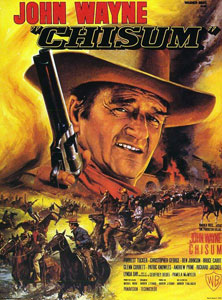
Chisum

By the late 1960s and into the 1970s, John Wayne's movies became more familiar, more safe. You know what though? There's a comfort in familiarity, and there's some genuinely good movies in the bunch. Today's review is one of those efforts, telling one of the more famous stories of the wild west that ranks up there with the gunfight at the O.K. Corral or the Battle of the Little Big Horn. That story? The Lincoln County War. That movie? 1970's Chisum.

It's 1878 in the New Mexico territory, and aging rancher John Chisum (Wayne) has carved an immense cattle ranch out of the wilderness, made it all into something to behold. He's preparing for his niece, Sallie (Pamela McMyler), to come and visit the ranch, but there's some serious issues to be dealt with. An equally powerful man with some serious financial backing, Lawrence Murphy (Forrest Tucker), has moved into Lincoln County and is looking to take over. Take over EVERYTHING. First up on his list? Buying the sheriff, the bank, and scooping up all the land he can and drive Chisum out as quick as he can. Chisum is well-rooted though, and nothing is going to come easy for the despicably vicious, greedy Murphy. There's a wild card in the entire situation though, a young, fiery gunfighter with a fast-growing reputation and a fast draw with his pistol, William Bonney (Geoffrey Deuel), better known as Billy the Kid.

I've loved John Wayne and his movies since I was a little kid. Hopefully, I always will! I hadn't seen this 1970 western from director Andrew McLaglen in years until a recent showing on Turner Classic Movies gave me the opportunity to revisit it. Am I glad I did! It is different, telling the mostly true story of the Lincoln County War with some artistic license thrown in here and there. A lot of familiar faces, filming locations in Durango, Mexico where other Wayne ventures (The War Wagon, Sons of Katie Elder, The Undefeated, The Train Robbers) were filmed, a memorable score from Dominic Frontiere, and cinematographer William Clothier bringing the Mexican locations to life, yeah, it IS familiar. That's not a bad thing. I loved catching up with the movie and liked it much more than I remember. There's just enough different here to keep things interesting. And let's face it, the story and recognizable historical characters are a great backdrop for that mostly true story.

Okay, one of the most famous stories of the wild west. What do we need? How about a movie star capable of leading the way? In 1970, Wayne was still at the top of his game. He had the tough guy hero part down to an art with decades of practice. That is most definitely a compliment. Wayne was always at home in the western, and that's the case here. His Chisum -- based on the real-life John Chisum -- becomes a figurehead of the west. Years before, Chisum moved west into New Mexico and carved out a cattle ranch out of the land. Now, he's learning to slowly, begrudgingly changing with the times to survive. A testament to Wayne here is that he's not on-screen a ton. Yes, he's the star, but the Hollywood legend is content to let other members of a solid ensemble step into the limelight. When he is in the limelight? It's Duke at his tough as nails best, playing straight man to a bunch of antics while also stealing the camera, especially in a late confrontation with Tucker's Murphy. Nothing flashy, just a western professional.

Part of the fun here is the familiar names and characters popping up. The Billy the Kid story has been told in the Young Guns movies, The Left-Handed Gun, Pat Garrett and Billy the Kid, The Outlaw and many more I'm probably forgetting. I liked the spin Deuel puts on young William Bonney, a brash kid trying to put a checkered past behind him. He may be too good with a gun to let it happen though. Deuel's scenes with Glenn Corbett's Pat Garrett are a highlight, especially knowing where these two men end up. Also look for peaceful, second-chance rancher John Tunstall (Patric Knowles), Alex McSween (Andrew Prine, with his wife Lynda Day George), corrupt Sheriff Brady (Bruce Cabot), and more than a few familiar faces in the background.

The cast is one of Chisum's best features. Tucker is a slimy, nasty, slithery villain, with both Christopher George and Richard Jaeckel as his brutal enforcers. Another Just Hit Play favorite, Ben Johnson is Pepper, Wayne's right-hand man, a mumbling cowboy who'd rather solve a problem with his gun than his words, a part similar to the one he played in both The Undefeated and The Train Robbers. You ready though for some other names? Take a deep breath with me. Also look for John Agar, Robert Donner, Ray Teal, Hank Worden, Pedro Armendariz Jr., Edward Faulkner, Christopher Mitchum and plenty of faces from the John Wayne stock company. Quite the cast. QUITE a group of tough guys, a McLaglen specialty. 

About as good as a traditional western can get. There's good guys, dastardly bad guys, shootouts to be had, and set against the backdrop against one of the wild west's most famous/infamous incidents ever. Something really hit me with this most recent watch, and I came away more impressed than I'd been with previous viewings. Hopefully, you'll like it just as much!

Chisum (1970): *** 1/2 /****

Wednesday, January 14, 2015

The Sheriff of Fractured Jaw

Here's an odd formula for you. A very British actor, a busty bombshell, a British western (British?!?) and filming locations that would go onto bigger and better things within five years. What does all that add up to? A mostly entertaining, often fascinating 1960 western, The Sheriff of Fractured Jaw.

The son of the owner of a firearms company based in England, Jonathan Tibbs (Kenneth More) is looking for something to do. He doesn't feel quite at home in his father's company and is more comfortable building all sorts of crazy gadgets and contraptions. It doesn't take Tibbs too long to figure out a solution. Reading the newspaper one day, he reads a story about the violent wilds of the American west...where guns are quite prevalent. His rationalization? Where there's violence...there's guns so Tibbs packs up and heads to the American west in hopes of expanding his father's business. After plenty of travel, he ends up in the lawless town of Fractured Jaw where sheriffs can't seem to stick around too long. Well, they've got a new one. Through a series of misunderstandings and miscommunications, Tibbs becomes the new sheriff and the key to getting through it? A tough saloon owner, Kate (Jayne Mansfield), who takes a liking to the semi-clueless Brit. 

Go figure. This oddball, schizophrenic formula....it kinda works. In one of his last films, director Raoul Walsh helms this goofy, off the wall western. He was past his heyday back in Hollywood's Golden Age, working often with swashbuckling star Errol Flynn, but it's just one more choice you'd think wouldn't work but ends up working quite well. I'll watch anything western but a British western? It wouldn't/shouldn't seem to fit. Look, this isn't a classic. Far from it, things falling apart nicely in the last 30 minutes. When it does work, it's a pleasant change of pace, an entertaining mess. Oh, and those filming locations? 'Fractured' films on-location in Almeria, Spain where in about four years hundreds of spaghetti westerns were filmed. Makes sense, don't it?

Okay, let's cast a male and female lead, two actors who you'd never think would star in a British comedy western together. Hmm, and they're going to have to show off some lovey-dovey chemistry? How about Kenneth More and Jayne Mansfield? DONE! But once again, 'Fractured' gets the last laugh. More is by far the best thing the movie has to offer. A character development that depends on misunderstandings sounds tenuous at best, but More just commits. He plays it all straight and never seems to be going really hard at getting the laughs. He just gets them. The fish out of water routine -- the gentlemanly Brit in the rough and tumble west -- works over and over again. More's Tibbs is a gentleman, polite and trying to make friends and in the process never seems to realize he's doing everything in about the exact wrong way you're supposed to do it. An example? Indians attack the stagecoach he's on so naturally he tries to approach them peaceably to tell them to stop. Oh, by the way. His plan works.

Because More is so good, the chemistry with Mansfield works. One of the biggest sex symbols of the 1950s and into the 1960s, Mansfield isn't a great actress but she makes a go of it. She's here to look sexy, wear very tight dresses and let her natural endowments do the rest. She also sings three different songs, but she's dubbed so that's not her real singing voice. Instead, we're left to consider how anyone could actually be built like that. She's a real-life Barbie doll!

Who else to look for? Some familiar western faces to help ease viewers into...GASP...a British western!!! Henry Hull gets the most screentime as Masters, the Mayor of Fractured Jaw who likes Tibbs immediately, even if he has no idea that his new sheriff can barely handle a gun, much less live up to a reputation of a hardened fast draw. Also look for Bruce Cabot as a rancher who wants to test Tibbs, William Campbell as the real deal, a real fast draw and gunfighter, and Robert Morley as Tibbs' uncle.

So 'Fractured' runs about 103 minutes and for 60 minutes or so, it's really good. Then it takes a detour it never really recovers from. More's Tibbs gets caught up in a sticky situation with two warring ranches and their armies of gunslingers as well as an Indian tribe looking to stir up some trouble. The fish out of water bit wears a little thin as things are stretched out to fill that running time. Still, the first hour is really fun, and I enjoyed it a lot. So in the end, it's an enjoyable mess with some surprisingly good performances. Yep, a British comedy western actually works. I would have bet big money against that thought!

The Sheriff of Fractured Jaw (1960): ** 1/2 /****

Saturday, April 26, 2014

The Undefeated

Considering the extreme and far-reaching effects the Civil War had on American history, it's odd there haven't been more movies about the most costly war in the United States' relatively young history. The western genre has done its fair share of quasi-Civil War movies, the war becoming a jumping off point for a shoot 'em up story. What to do once the war is over? Like Major Dundee and Vera Cruz, many went south into Mexico. We can add 1969's The Undefeated to that short list.

After four years of bloody fighting, the Civil War has come to a close, leaving both the North and South to figure out where to go forward. With some of his remaining soldiers, a former Union cavalry officer, Colonel John Henry Thomas (John Wayne), rounds up a herd of 3,000 wild horses with the intention of driving them south into Mexico where they'll sell them to Emperor Maximilian's forces. A former Confederate officer, Colonel James Langdon (Rock Hudson), who had outfitted his own regiment, is leaving his plantation behind, moving south to Mexico with his surviving men, along with their wives, children and family in hoping to start a new life. In turbulent times for both the U.S. and Mexico, these two groups' paths may cross, and with wounds from the war still fresh on both sides.

This portion of history has always fascinated me, especially in movies like this, Major Dundee and Vera Cruz. I grew up watching this John Wayne western, and in spite of its flaws, I've always been a fan. From frequent Wayne collaborator and director Andrew V. McLaglen, 'Undefeated' is a fun western with a very good, deep cast, authentic locations in and around Durango, Mexico (Dundee fans will appreciate some familiar spots), a memorable score from composer Hugo Montenegro (listen HERE, disregard the odd video choice), and in general an entertaining quality that lifts it up past the flaws. It plays like a lot of Wayne's later movies; easy to sit back and watch, some action and shootouts, some drama, some romance, and some laughs here and there. When westerns were changing so dramatically in the late 1960s and heading into the 1970s, it can be fun just to watch an old-fashioned western with good guys and bad guys. No more, no less.

In a pretty cool casting choice, Wayne goes toe to toe here with Rock Hudson. It's not the most obvious pairing, but it works, simple as that. Wayne is playing a variation on his archetypal cowboy part, the leader of a small, surviving group of volunteers that rode with him throughout the Civil War. Now, he's looking for some cash to start over with, hence the immense horse drive. Hudson's Langdon too is looking for a clean start, the horrors and severe losses of the war still fresh on his mind. They're two different men, but they also have many similarities. They're fighting men who stand by what's right, loyal to those who ride with them, and ultimately try to do what they should do, not what's easiest. Their scenes together are the high points of the story, an easygoing charm with just a little Union vs. Confederacy animosity lingering. Two parts I liked a lot.

Working with a big story and a whole lot of characters, there's a lot going on in 'Undefeated,' clocking in at 119 minutes. Both halves -- Union and Confederacy -- are interesting, but I liked Wayne's half more. His trail-worn, loyal riders include Ben Johnson as Short Grub, his right hand man, Harry Carey Jr., John Agar (his part was heavily cut, including his early death scene), Don Collier (a familiar face, often a stunt man in Wayne movies), Jerry Gatlin and Dub Taylor as McCartney, the cantankerous cook who's always looking to fight, a mangy cat, High Bred, at his side. NFL quarterback Roman Gabriel joins the cast too as Blue Boy, Thomas' adopted Cherokee son. With so many western regulars, there's an ease to these scenes that are just fun to watch. Also look briefly for small parts for Paul Fix, Royal Dano and Pedro Armendariz Jr.

With the kinda-sorta episodic story that amiably drifts along, half of the focus is on those Confederates. It's never boring, but it's also not as interesting as their Union counterparts. We meet Langdon's wife (Lee Meriwether), his buxom teenage daughter, Charlotte (Melissa Newman), and his widowed sister-in-law (Marian McCargo). His men include Bruce Cabot, NFL star Merlin Olsen, Jan-Michael Vincent, Robert Donner, Edward Faulkner and whiny Big John Hamilton. We get to see young, pretty Charlotte hold off Jan-Michael Vincent's Bubba Wilkes' advances (she like Blue Boy). We get to see worrying wife Lee Meriwether....well, look worried. Olsen's Little George hangs out with the kids, then fights the Union cavalry. There's plenty of familiar faces, some good parts, but it's simply not as interesting to watch. Not bad, just not as good as it could have been.

Certain portions of the episodic story drag, but some certainly stand out. The pre-credits sequence wraps up the Civil War in a quick Union attack on a Confederate position. Later, Wayne and Hudson must team up to hold off a bandit attack on the Confederate wagon train, a good, exciting sequence. My favorite though is a late battle between the Union riders and French cavalry, the horse herd used as a weapon and negotiating ploy with a Mexican officer (Tony Aguilar). I'm wavering here. It's not a great western -- maybe not even a good one -- but I'm always entertained watching it. John Wayne fans, western fans alike should like this one.

The Undefeated (1969): ***/****

Sunday, August 18, 2013

The Comancheros

Following Texas' war for independence with Mexico in 1836, the expansive republic was on its own for government, economy and protection without help from outsiders. Who came to the forefront to help protect the fledgling republic? The Texas Rangers, and no, not the Major League Baseball team, instead a small group of law officers who patrolled Texas trying to protect its citizens. Recurring characters in the western genre, one of the best portrayals of the Rangers is 1961's The Comancheros.

It's 1843 when a Louisiana gambler, Paul Regret (Stuart Whitman), finds himself on the run following an accidental death in a duel. Regret heads for Texas but as he readies to disembark from the riverboat, he is instead arrested for murder by a Texas Ranger, Captain Jake Cutter (John Wayne). The duel was fair by all accounts, but the dead man was the son of a powerful judge who wants vengeance. Intending to bring Regret back to Louisiana, Cutter instead finds himself working with the man. All through the territory, Comanche raiding parties are attacking one ranch and homestead after another. Cutter has long thought the Comanches are being led by a gang of white men who pull the strings, but he has no proof. Posing as a gunrunner and with Regret as his somewhat unwilling partner, Cutter heads into Comanche territory and finds just what he thought he would, a gang of drifters, bandits and killers -- Comancheros -- working with the Comanches. Can they get out alive?

The 1960s were a big time for John Wayne. He wasn't just a box office star, but by now after 30-plus years in the business, he was a screen legend. This was the decade where -- for better or worse -- he started playing himself more than meaty roles like The Searchers, She Wore a Yellow Ribbon, and The Man Who Shot Liberty Valance. His mindset changed some as he started to make movies that typically had one objective....please the audience. These were movies meant to entertain, movies the whole family could go see. They would revolve around action-packed stories, good casts of familiar faces, great locations and whistle-worthy scores, movies like this one, The Undefeated, Sons of Katie Elder, McLintock!, Donovan's Reef and Hatari. This is a prime example of that type of movie. It's fun, exciting and with a whole lot of action. A groundbreaking, innovative western? Nope, but as far as popcorn movies go, it's hard to beat.

This obviously isn't a comedy western, but it isn't as dark and downbeat as the plot description might imply. For me, the best thing going for 'Comancheros' has always been the pairing of Wayne and Whitman, an Odd Couple pairing that works extremely well. It almost plays like a buddy western movie, the resolute Ranger and the roguish gambler. Wayne especially gets to show off a comedic side that most of his movies just didn't allow. His backwoods Ranger mispronounces Monsieur as Mon-sewer, providing some good laughs throughout. Whitman too looks right at home alongside the Duke, the duo exchanging some great dialogue scenes together on the trail. It looks easy watching them. Regret is far from a veteran trailsman, but he picks it up quick. Cutter bristles at times with his prisoner's unique ways, but thrust into a do-or-die situation, they end up becoming unlikely friends. Two good lead performances for sure.

While the A-list names might not be there, 'Comancheros' offers a very solid cast, one all western fans should appreciate. Lee Marvin makes what amounts to a cameo as Tully Crow, a brutal, vicious Comanchero, stealing the show and providing some great moments with Wayne in their scenes together. The one weak point is Ina Balin as Pilar, a beautiful young woman who falls for Regret and vice versa. Her scenes are pretty painful, especially as she "analyzes" love. Nehemiah Persoff is similarly a scene-stealer as Graile, the handicapped, brutal leader of the Comancheros with Michael Ansara as his sadistic henchman, Amelung, and also look for Jack Elam as one of the Comancheros. As for the other Rangers, look for Bruce Cabot as Major Henry and Patrick Wayne as Tobe, a young ranger along on the mission into Comanchero territory. Also look for the beautiful Joan O'Brien as Melinda, a widow who cares deeply for Cutter (and maybe more...uh-oh!) with Wayne's daughter Aissa playing Melinda's daughter.  

Looking at the credits, Michael Curtiz is listed as the director, but Curtiz became sick during filming and was unable to complete the movie, dying soon after its release. Wayne stepped in and directed in uncredited fashion, finishing the movie. The story itself is pretty episodic, the first 45 minutes spent with the hunt and escape and hunt and escape between Regret and Cutter. It covers a lot of ground before the Comancheros are even introduced, but it's never dull and never really slows down. There actually isn't a ton of action, but what's there is enjoyable. What is noteworthy is a talented cast clearly having some fun with a story that's hard not to go along with. Also worth mentioning, Elmer Bernstein's memorable score, especially the theme. Listen to it HERE. Get your popcorn ready, sit back and enjoy this one.

The Comancheros (1961): ***/****

Sunday, December 16, 2012

Big Jake

From his starring screen debut in 1930's The Big Trail to his final film in 1976's The Shootist, John Wayne became one of Hollywood's most beloved stars. For me, he will always be one of my favorites. Some look to The Searchers, She Wore a Yellow Ribbon and The Shootist as his best roles (and they are), but one of my favorites from the Duke is a change of pace western from 1971, Big Jake

It's 1909 along the Texas/Mexico border when an outlaw, John Fain (Richard Boone), leads his gang of murderers and cutthroats in a vicious attack on the expansive McCandles Ranch. Ten people are killed, and ranch owner Martha (Maureen O'Hara) sees her grandson kidnapped. Fain demands a ransom of $1 million, leaving a note that says simply "Follow the map." Knowing her grandson could be killed no matter what she decides, Martha seeks out her estranged husband, Jacob (Wayne), to take the ransom money into Mexico and get his grandson (who he didn't know) back. With help from his two sons, James (Patrick Wayne) and Michael (Christopher Mitchum), and an old friend, Apache Sam Sharpnose (Bruce Cabot), Jacob agrees, setting off to bring his grandson back alive or his captors dead.

Without a doubt, this is the most graphically violent movie of Wayne's career. Others like The Alamo are violent, but nothing quite like this. For western fans alone, that feature makes this George Sherman-directed western worth watching. Sidenote: With Sherman sick and unable to be on-location during shooting, Wayne directed much of the movie. In a career that spanned five decades, this is certainly a departure for the Duke. It is trying to be more modern, using some heavy-duty blood squibs. Even when the violence isn't on-screen, it is beyond startling and even disturbing in some scenes. Somewhat oddly, there is still an oddly comic tune at times that feels out of place alongside the sometimes extreme violence.

Wouldn't you know it though? I grew up watching this film -- still have an old VHS recording off TBS along with the bare-bones DVD -- and will always remember it fondly. Beyond the on-screen violence, there is something different about this western that's hard to put my finger on. I think I like it because of its general eccentric nature; the violence mixed with the odd humor. 'Jake' was shot on location in Mexico in Durango and Zacatecas, giving it a real sense of authenticity. Many Wayne westerns -- The War Wagon, Sons of Katie Elder, The Undefeated -- were shot in Mexico, and wouldn't you know it? Mexico looks like Mexico, giving a great backdrop to the story. The always reliable Elmer Bernstein turns in an eclectic score that covers a lot of ground, but in a good way. Listen to the main theme HERE, but that's just a taste of what Bernstein's score has to offer. Another case of the little things aiding the bigger cause.

What else though? I love the interaction between Wayne and his two sons he hasn't seen in years. Estranged from his family (for unknown reasons), he only comes back at his wife's request. Wayne's introduction is priceless, O'Hara's Martha saying she needs a man as unpleasant as the mission he'll undertake. Cut to Wayne squinting down the barrel of a rifle in an extreme close-up with Bernstein's score playing. Jake is believed to have been killed years before, forcing him to hear many people say "I thought you were dead." Nope, still kicking, traveling through Texas and Mexico with his fiercely loyal dog. Seeing his sons again provides some of the movie's genuinely funny moments and also some surprisingly effective dramatic moments. Neither Patrick Wayne or Mitchum are out of this world actors, but they hold their own, as does a scene-stealing Cabot as an aging Apache.

The cast is far from done there, especially an underused Richard Boone as the calculating, brutal John Fain. Most villains cower in Wayne's shadow, but not Boone. Their scenes together are beyond perfect, few though they may be. Watch THIS scene for proof (apologies for the low quality). Fain's gang includes O'Brien (Glenn Corbett), a half-breed gunslinger, Pop Dawson (an unrecognizable Harry Carey Jr.), Kid Duffy (stuntman Dean Smith), a deadshot with a rifle, John Goodfellow (Gregg Palmer), a machete-wielding psycho, Trooper (Jim Burk), an Army deserter, and Will Fain (Robert Warner), John's brother who favors a shotgun. Singer Bobby Vinton makes a brief appearance as Jake's third son. Also look for recognizable western faces John Doucette, John Agar, Jim Davis, Hank Worden, Chuck Roberson (Wayne's stunt double), and Roy Jenson. Wayne's real-life son, Ethan Wayne, plays the kidnapped Little Jake.

Following the startling opening attack at the McCandles Ranch, things more or less settle down until the finale in the action department. After dealing with some pistoleros who want to get their hands on the $1 million ransom, Jacob and Co. head to the ruins of an old Spanish mission for the exchange. On a stormy night, the sequence that follows is a gem. It's brutal and vicious -- with at least two surprises -- but it always stays on a small-scale level where you know what's going on. The mission and plaza was supposedly used in the 1910s by revolutionary Pancho Villa for executions, adding a dark edge to the scenes. The gunplay isn't remembered as one of the all-time bests, but the finale is one of my favorites, partially due to the action, some to the script with its great one-liners.

Whatever the reasoning, I love this movie. I know it's not a great movie, but I love it just the same. John Wayne fans should appreciate this one, and western fans on the whole as well.

Big Jake <----trailer (1971): ****/****
Rewrite of review from July 2009

Sunday, August 7, 2011

John Paul Jones

Is it possible that over the last 200 years the American Revolution has gotten lost in the shuffle of all of the United States' history? The story of the 13 colonies working together and fighting for their freedom is as incredible now as it was in the last quarter of the 18th Century. Thousands of individuals put everything on the line -- their lives, their families, their rights -- in their fight for freedom. As I've mentioned in other American Revolution reviews, Hollywood hasn't fully embraced the time period, resulting in a lack of movies...much less too many good ones.

A war that lasted eight years and took countless thousands of lives is going to produce its fair share of heroes. Names like George Washington, Thomas Jefferson, Benjamin Franklin, and many more are synonymous with the war, but most of the well-known names are remembered for their work in helping bring America its freedom from the government side. One of the biggest American military heroes was John Paul Jones, an American naval officer who helped make our country's navy what it is today. His story is told in the factually correctly if somewhat dull to watch epic, 1959's John Paul Jones -- appropriately titled, huh?

A young man growing up on the high seas, Scotsman John Paul (Robert Stack) gains years of experience doing everything he can on different ships. He rises through the ranks, eventually gaining command of a ship, only to see a suppressed mutiny derail his career path. He is forced to take refuge in 1770s Virginia, taking the name 'Jones' to throw off any pursuers. John Paul Jones arrives in Virginia at the right time as the colonists continue to push their British rulers.  Looking for experienced naval officers, the Continental forces turn to Jones, offering him a command position in the fledgling Navy.  Playing a key role in the Revolution as the colonists earn their freedom, Jones gains notoriety around the world, setting up a post-war life that could even earn him more fame.

Released in 1958 at the height of the historical epic's popularity among audiences, 'Paul Jones' certainly has a lot of potential to be a memorable movie.  In the translation from historical facts and details to on-screen adaptation though, something gets lost. At 126 minutes, one would think there was plenty of time to develop a well-told story, but one would think a lot of things.  Money and budget were clearly spent on the look and feel of the movie with its lavish costumes and extravagant sets which even a pan-n-scan cut of the movie couldn't ruin. Max Steiner's score is appropriately epic and booming, but not that good. Most of the issues can be traced back to an issue many epics have. Director John Farrow is more interested in the spectacle than the story or characters, and the final product keeps you at arm's length, never really letting you in.

Is it Farrow's fault, or a less than impressive script? I was surprised not that the movie isn't very good, but for another reason. It is very historically accurate to Jones' real life exploits -- kudos to a movie for accuracy -- but it is beyond dull, blasting into boring territory with ease. For starters, too much time is spent on pre-Revolution JP Jones, including a crush on Virginia belle Dorothea (Erin O'Brien). His involvement with the Revolution (the thing people know him best for) feels rushed as we never get a sense of how the war is going until America has won its freedom. Then, after England gives the colonies to America, the story doesn't know how to end, rushing through the final years of his life in hopes of providing some closure. It is a movie that tries too accomplish too much, and in the process, accomplishes nothing. Just a badly paced, dull attempt at an epic.

The more I see of Stack, the less I'm drawn to him as an actor.  My biggest question is whether he's got the star quality to play such a heroic character, and to be fair, it isn't entirely Stack's fault.  This should be an interesting character, but Jones as presented is pretty one-note.  Stack doesn't have a ton of range as an actor, producing little differences in anger, in love, and in combat.  Like the story he was in, I was bored watching him develop his reputation (for the good) and in the process become a hero.  Some other members of the cast include Charles Coburn as Benjamin Franklin, Marisa Pavan as Aimee, a love interest, Bette Davis in an out of place cameo as Catherine the Great, Macdonald Carey as Patrick Henry, and Jean-Pierre Aumont as King Louis XVI. With a story that covers 20-plus years, a ton of characters/individuals are introduced, but very few leave much of an impression, positive or negative.

The saving grace of the movie are the segments in the Revolution, including Jones' daring, heroic raid on England in 1778.  Some of his crew include Tom Brannum, Bruce Cabot, and Archie Duncan among some others.  These scenes show Jones for what he was -- a heroic leader who inspired his crew and a country through his actions.  Unfortunately there is too little of that and too much of a soap opera-esque background.  I struggled to get through this snail-paced movie, continuing to wait for it to get better.  It didn't though, the few bright spots overshadowed by the low points.

John Paul Jones (1958): * 1/2 /****

Monday, April 19, 2010

Hellfighters

After years of chain smoking, John Wayne underwent surgery to remove his cancerous left lung in 1964.  A huge star since he burst onto the scene in the 1930s, the Duke came back with a vengeance and over the next 15 years made 20 movies.  With an exception here and there, these movies were typically family affairs for Wayne.  He worked with directors, crews, and actors that were familiar with him.  And in this period more than any other, John Wayne didn't even have to act because most of the time he was playing himself. 

Going through such a drastic procedure clearly didn't slow him down, but it certainly made the star appreciate what he had.  Why mess with productions that would only threaten his health again?  Instead, he stuck with what he knew.  And of those 20 movies, I can name several which are in my top 10 Duke movies.  One that isn't?  That's easy, 1968's Hellfighters.  I don't remember how old I was when I saw my first John Wayne movie, but I know I was young, and in the years since, I've seen just about every single one.  Hellfighters was one of the few I hadn't, and to be honest, I don't know why.  I never intentionally avoided it, but I never sought it out either.  I'm glad I saw it to check it off the list, but it's not one of Wayne's better efforts.

John Wayne plays Chance Buckman, the owner of a company that puts out oil well fires.  Buckman's exploits are based loosely on real life firefighter Red Adair, but reading up about Adair, it looks like the only thing the movie and his life have in common is that they were both actually oil well firefighters.  It's about there the similarities diverge in a big way.  In terms of pure visual entertainment and spectacle, I'm hard-pressed to think of too many things more exciting to watch than an epic, blazing oil well fire.  These scenes are the high points of the movie.  But somehow and for some reason, the story is dumbed down and filtered to the point where it could be any dangerous profession.  So instead of 2 hours of fighting oil well fires, we get unnecessary family drama.

Chance Buckman (Wayne) loves what he does and he's damn good at it.  With his company based out of Houston, Buckman travels the world with his team putting out, extinguishing and saving oil wells that burst into flames during drilling.  It's incredibly dangerous work, but with years of practice and know-how, Chance has got it down to an art.  But after one accident that hospitalizes him, his estranged daughter, Tish (Katharine Ross), comes to see him and ends up marrying Chance's right-hand man, Greg Parker (Jim Hutton). As if his job wasn't worrisome enough, Chance is now worrying about his daughter and son-in-law, not to mention his divorced wife, Madelyn (Vera Miles), who returns after years away. 

It almost pains me to right that specific of a plot description for a movie about oil well firefighters.  And that's the unfortunate part.  With a profession like this, you would think it nearly impossible to make a dull movie about it, but director Andrew V. McLaglen succeeds in a big way.  The minute the story heads away from the fire scenes, Hellfighters is downright dull.  I'll admit some of the family background is needed to show the effects the job has on the firefighter and their families, but a little goes a long way here.  Ross especially seems to get a kick out of showing up at these dangerous sites, seemingly oblivious to that danger.  Wayne and Hutton spend much of the movie yelling at her to get down or get back.  Her character is annoying and not in a cutesy way.

These romantic scenes are at times painful to watch.  Wayne worked with Vera Miles in several pictures, but never with a romantic dynamic between them.  As divorcees, they have little chemistry together, and it seems an odd choice to make 60-year old Wayne a heartthrob with this part.  As annoying as the Hutton/Ross love plotline can be, at least it's somewhat believable.  Not so with an older Wayne and a 39-year old Miles.  Still, Wayne is the Duke, and he does make the most of his part, instilling some humor and 'Never say die!' spirit into it.  Hutton is wasted as Chance's right hand man which is disappointing because as was the case with The Green Berets, he's got good chemistry with Wayne.

I'm not able to find clips available of the oil well scenes, but they're a sight to behold with a feeling of 'I know I shouldn't look, but I must!' throughout.  Now whether McLaglen filmed actual oil well fires or created his own for the sake of the movie, I don't know, but these are some remarkable sequences.  Making them that much cooler, Wayne and Hutton look to do at least some of their own stunts nearby the flaming wells.  Wayne's team includes Bruce Cabot and Edward Faulkner as on-site help, with old friend and partner Jay C. Flippen left behind back at the office.  It's too bad more couldn't have been done with the team because I found them much more interesting.  Two solid hours of fighting oil fires probably isn't feasible, but cut the movie by 30 minutes, and maybe we're onto something.

All I can say is I wish this was a better movie.  There's only so many John Wayne movies out there so when I see one that doesn't live up to its potential, I feel like I'm missing out.  Hellfighters has a lot of potential but never lives up to it.  Lots of great sequences are there with a solid cast, but it never clicks together.  The story drifts along filling in the blanks between fires before the necessary, not at all surprising ending.  Worthwhile for the oil well fire sequences, but other than that, steer clear.

Hellfighters <----fan-made trailer (1968): **/****

Wednesday, March 24, 2010

Dodge City

I've covered this before, but when I watch enough older movies (pre-1950s or so) it keeps coming up.  If possible, watch these movies with the mindset you're watching them in the year they were released.  New innovations come along every few years with movies starting with the jump from silent to sound and building onward with color, widescreen, 3-D, CGI, and more recently with Avatar, whole new ways of filming human acting.  It's hard sometimes though because well, it isn't 1939.  What was appealing in 1939 doesn't necessarily translate well to 2010.  That was my feeling with 1939's Dodge City.

Look at the all years in Hollywood history and 1939 is often labeled the greatest year in movie history, and for good reason.  Here's a list of the more impressive flicks.  And even though Dodge City is on that list, I'm not judging or comparing it to Gone With the Wind or The Wizard of Oz.  But like both those movies, it is about the spectacle of what's happening on-screen.  It's filmed in Technicolor with lots of bright, vivid colors that look almost fake, huge sets filled with seemingly hundreds of extras, and a story as big as the taming of the west.

After helping the railroad reach Dodge City, Wade Hatton (Errol Flynn) returns after years away from the wild, rumbling boom town with friends Rusty (Alan Hale) and Tex (Guinn Williams).  The town they've helped build has gone to hell and any attempts at civilizing the town are stopped by a cattle man, Jeff Surrett (Bruce Cabot).  Townspeople he has business deals with or owes money end up shot in the back with no witnesses.  The town calls for Hatton to become sheriff and clear Surrett out, and at first he's completely unwilling.  But something changes when an action of Surrett's pushes him too far.  He takes the badge and starts to clean the town up, but Surrett is standing in his way and shows no sign of giving up.

The story is nothing new for a western, but that's not a complaint, just an observation.  The problem is that all the other little things add up to be a problem.  In the casting, Ann Sheridan gets third billing for a part that requires her to sing two or three times as a dance hall girl.  These scenes have a line of dance hall girls dancing on-stage for a saloon full of raucous cowboys and grind the already slim story to a halt.  They're cool enough to look at visually but too distracting overall.  The same goes for the exterior shots of Dodge City (with studios in California filling in for Kansas) which are content to show crowded streets with all their extras.  And even if the spectacle of the movie was more appealing, it pales in a big way compared to Gone With the Wind's spectacle.

The least of the problems is Errol Flynn as tough gunfighter with a golden heart, Wade Hatton.  He's a good example of what western heroes were before Sergio Leone got his hands on the genre in the 1960s.  Hatton is a good man, looking out for women and children first, and when pushed too far, watch out bad guys because he's coming after you.  Frequent Flynn co-star Olivia de Haviland is the love interest who hates Flynn until it's important for her to turn a page and like him.  The duo worked many times together and for good reason.  They had some great chemistry that comes naturally and never looks like they had to force things along.

As his rival, Cabot is a solid villain.  Thanks to his pairings later in his career with John Wayne, it would be easy to think Cabot usually played a variation on the trusty sidekick.  But early in his career, he played his fair share of bad guys, especially in the 30s.  His voice sounds like a deep growl, and he was a physically intimidating actor so he is a good counter to Flynn's heroic good guy.  Victor Jory is also solid as one of Surrett's gunslingers who wouldn't bat an eye at shooting a guy in the back.  Hale and Williams are the annoying, not so funny amusing sidekicks who are there to get a laugh or two.  I like both actors but their parts just aren't funny.

The movie does pick up speed once Hatton becomes sheriff in Dodge City, and the finale starts off promising as Hatton and Co. shoot it out with Surrett on a burning train.  But the ending limps to the finish, almost like director Michael Curtiz just ran out of money.  SPOILER Surrett and his cronies escape and are making their getaway only to have Hatton and Rusty pick them off as they run.  No big showdown, no worthy end for a quality bad guy.  Just a quick shot of a dead Surrett after he's been thrown from his horse.  Surprise, surprise, but Hatton also gets the girl.  I know, it surprised me too.  END OF SPOILER

This is not a bad movie in any way, and it feels wrong giving it a negative review for a movie that's main goal is to be entertaining.  But all the spectacle moments take away from a story that could have been good, if not great.  Errol Flynn is always worth a watch, Olivia de Haviland is a great actress, and Bruce Cabot's a good villain, but that's about it.  Average western worth checking out if you're looking for a decent enough way to kill two hours.  An Errol Flynn fan has posted many of his movies at Youtube, including Dodge City, starting with Part 1 of 10.

Dodge City <----trailer (1939): **/****

Tuesday, January 20, 2009

Cat Ballou

Westerns have always been my favorite movies ever since I started watching John Wayne movies and Fess Parker as Davy Crockett. While I've tried to see as many as I can, one type of westerns has never appealed to me; comedy westerns. Sure, there are exceptions, Butch Cassidy and the Sundance Kid and Blazing Saddles come to mind, but mostly I enjoy serious/dark westerns with some humor laced throughout the movie.

Thanks to Turner Classic Movies though, I can add another likable comedy western to my list, 1965's Cat Ballou starring a pre-"Hanoi Jane" Jane Fonda and Lee Marvin. The genre was a-struggling mightily by the mid 60s and this was before Leone's Dollars trilogy so Cat Ballou wasn't your typical shoot 'em up western. Fonda is Catherine "Cat Ballou, a young schoolteacher who turns to crime to get revenge for her father's death.


Reading that, you'd think it was a pretty dark western, but it's pretty much just the opposite thanks to two great parts by the same actor, Lee Marvin. Pretty much relegated to supporting parts and TV guest spots, Marvin got his big chance here in dual roles as Kid Sheleen, a drunken gunfighter past his prime, and Tim Strawn, a vicious killer who murdered Cat's father.


Here's Kid Shelleen's introduction


It was a part that earned Marvin his one and only Oscar nomination and win. His performance alone is worth the price of admission. Of course, it doesn't hurt that Jane Fonda was pretty easy on the eyes, and her role as Cat Ballou is one of her best. Cat Ballou caught me off-guard, but I can highly recommend it.


Lee Marvin ****/****

Cat Ballou ***/****