The Sons of Katie Elder

The Sons of Katie Elder
"First, we reunite, then find Ma and Pa's killer...then read some reviews."
Showing posts with label Jane Fonda. Show all posts

Thursday, March 13, 2014

Lee Daniels' The Butler

The names of the U.S. Presidents are instantly recognizable, names synonymous with the history of the United States, especially that building where the president leaves, whatever it's called. The White House I think? What about all the people who work at the White House, who keep the place running? And no, it's not just the nameless/faceless individuals who get killed during terrorist attacks in movies like White House Down and Olympus Has Fallen. I kid of course as we jump into 2013's Lee Daniels' The Butler, the true story of one of the White House's longtime butlers.

Growing up as a young boy with his sharecropping family in 1926 Georgia, Cecil Gaines has his outlook on life forever impacted when his father is shot down by a white man, the land owner where the family work, after raping his mother. Cecil is taught to be a house worker, a butler, and grows up finding jobs here and there working as a butler for the rich and well-to-do, eventually ending up at a Washington D.C. hotel. It isn't long before a grown-up Cecil (Forest Whitaker) has created quite a reputation for himself, earning an interview and eventually a full-time job at the White House, working with the sizable staff to make sure the President's home is a crisp, clean operation on a day-to-day basis. It's the late 1950s though, America heading into a turbulent time in its young history. Cecil has an inside look at America's involvement at home and internationally, all the while trying to raise a family with his wife, Gloria (Oprah Winfrey).  

This wasn't a movie I was dying to see, but I was nonetheless curious, even intrigued to see it. Loosely based on the true story of Eugene Allen, 'Butler' is director Lee Daniels' second film since his 2009 movie, Precious, that really put him on the map. It received pretty solid reviews and was a surprise success in theaters, earning over $167 million. I'm not really sure what to take away from it overall. I can appreciate what the message is going for, what it's trying to stand for and say about American history, yet that said, I didn't especially like it. What it's trying to do is admirable. What it accomplishes? Still mulling that over. Some of that can be chalked up to the script which tries to accomplish a ton in a 132-minute movie.

What I didn't question was Forest Whitaker in the lead role. Playing Cecil Gaines, Whitaker is our window as an audience into a whole lot of American history. We see his mindset, his frustrations, his motivations, his friendships, his rivalries, all of it. It isn't a flashy part, far from it, just a very straightforward, effective part. Whitaker's Cecil is a family man who wants to provide for that family, especially his wife, Gloria, struggling with alcoholism as she misses Cecil, his oldest son, Lewis (David Oyelowo, a good performance with some odd moments as a 37-year old playing a 15-year old), who dives headfirst into the civil rights movement, and his youngest son, Charlie (Elijah Kelley). His narration as a lead characters gets to be a little heavy-handed at times, but that's the script and not on Whitaker's shoulders. A very solid performance for Whitaker, a man trying to get by and live in some extremely turbulent times.

Beyond the family though, the supporting cast is mostly a long list of historical characters and bit parts that aren't around long enough to resonate. We meet a handful of Presidents including Dwight Eisenhower (Robin Williams), John F. Kennedy (James Marsden), Lyndon B. Johnson (Liev Schreiber), Richard Nixon (John Cusack) and Ronald Reagan (Alan Rickman), even meeting Nancy Reagan (Jane Fonda). These little episodes are pretty cool, but they're also gone as quick as they started. Because of that pacing issue, these scenes, appearances and story developments aren't as effective as they could and should have been. In storytelling technique, 'Butler' reminded me of the classic Forrest Gump, bouncing around to a lot of stories, a lot of key moments in American history, the story giving us a window into those moments. Where Forrest Gump blended the humor and drama though, 'Butler' stays on the dramatic path, and it wore on me. This can be a heavy, dark movie to get through at times.

Give the movie credit. It tries to do a lot. Ultimately though, I felt like it tries to do too much. A story focusing on Cecil's 30-plus year career at the White House would have been fascinating in itself. The same for a man trying to care for his family through the turbulence of the Civil Rights movement, into Vietnam and beyond. Doing both ends up making things too bouncy to the point neither story gets the attention it deserves. Much time is spent with Oyelowo's efforts in the Civil Rights movement, Cecil and Gloria worried and angry back home. Moments that feel like they should resonate well and carry the movie feel rushed, not letting those moments breathe. Much like the recent The Monuments Men, this feels like a story that would have been better suited to a miniseries. The effort is admirable, the execution tolerable. Moments like Cecil interacting with his fellow butlers (Cuba Gooding Jr. and Lenny Kravitz) ended up resonating more with me than most of the far-more dramatic scenes. Also look for Terrence Howard , Mariah Carey, Alex Pettyfer, Vanessa Redgrave in odd, out of place parts.

That's the biggest issue. It doesn't pick a route and stick with it. Moments that work among portions of story that drift too much, kinda a necessity with a story that covers six decades in a man's life. I also resented something from the final scene, a written, on-screen message thanking all the men and women that have helped gain "our freedom." As a white individual, this message hit me the wrong way, and I admit I may be over-analyzing. Is this a movie meant solely for an African-American audience? Should I not be watching this movie? It's a mixed bag in the end, a generally interesting movie that ultimately doesn't live up to its potential.

Lee Daniels' The Butler (2013): ** 1/2 /****

Monday, October 10, 2011

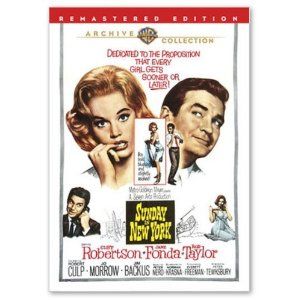
Sunday in New York

A member of one of Hollywood's royal families, Jane Fonda can be remembered for a lot of things. Her controversial visit to North Vietnam, earning her the nickname Hanoi Jane, is certainly at the top of that list. In the 1980s, she "reinvented" herself in a way, releasing a series of exercise tapes. None of this even mentions her film roles, including campy space sex romp Barbarella or her five Academy Award nominations or two Oscar wins. Before all that though? A handful of light 1960s romantic comedies, including 1963's Sunday in New York.

Now as I write this in an age of inept, annoying and downright awful romantic comedies, it's safe to say that the concept of romantic comedies has taken a bit of a hit, a public relations debacle. At some point, romantic comedies stopped being romantic, smart and enjoyable, resorting to moronically stupid stories that put stereotypes to shame and characters doing things no sane or rational person would ever do. Just because it was released in the 1960s doesn't mean these are perfect movies. But there is a charm, a style, and a sense of enjoyment that has been lost in so many movies since.

After a bad breakup with her fiance, 22-year old Eileen (Fonda) visits her older brother, Adam (Cliff Robertson), in New York City, planning to spend a week or so with him and just get away from her problems. She corners him, asking if men are only interested in sex in relationships. A globe-trotting airline pilot and all-around ladies man, Adam does the only thing he can do for his sister's benefit...he lies. Eileen isn't so sure, meeting Mike (Rod Taylor) later that day and hitting it off immediately with him. She intends to put Mike to the test to see if he'll be interested if she throws herself at him.  Her plan doesn't go quite as planned though, putting her in an awkward situation when her ex-fiance, Russ (Robert Culp), bursts into the apartment with Eileen and Mike only wearing bath robes. Uh-oh, Eileen's got some explaining to do.

More than the well-written, semi-intelligent script or the interesting and still believable characters, there is that style and charm in 'Sunday' that you just can't duplicate.  Director Peter Tewksbury shot the movie on location in NYC, and let's face it, it is hard to mess up that city in a movie, especially downtown Manhattan.  It could serve as a companion piece to Breakfast at Tiffany's, (released two years earlier), serving as a time portal into a very cool city some 50 years back. All the guys wear suits (at all times too), the ladies get dolled up to go out. Adam's apartment -- where much of the shenanigans take place -- is immense and ends up being an additional character. Imagine the Friends' apartment in 1963, and you've got your set. The whole story takes place in under 24 hours -- that one rainy Sunday afternoon -- but never feels rushed. Charm and style, 'Sunday' has it to spare.

As for the semi-intelligent part involving the script, this movie was probably a little shocking to audiences in 1963. Now, it seems tame although there are some instances that caught me off guard watching it for the first time. Fonda's Eileen is a virgin, wondering if she's the last one on the planet. Culp's Russ dumped her because their relationship wasn't developing physically quick enough for his liking. Fonda even makes a reference to Russ having to play "handball" several times a week (that line and Fonda's delivery really cracked me up).  The point is though, it's never dirty or filthy, just adults talking about sex and relationships.  It will seem tame to modern audiences, but you enjoy the story and its developments and the characters. Smart? Maybe not, but it feels real.

A well-written script is one thing, but having the actors/actresses to pull it off is another thing. 'Sunday' goes 4-for-4 in that department. Fonda is the all-American girl here, so perfectly cute that you can't help but like her.  Her chemistry with Taylor is as natural as they come, their friendship/relationship serving as an easy blue print for what romantic comedies should aspire for. As for Taylor and Robertson, neither would seem like an obvious choice for their parts, both men more at home in a "guy's movie." They're too talented not to leave a positive impression though, both getting a chance to show off their lighter, comedic sides. Culp is the unknowing dupe, the somewhat sympathetic but mostly clueless boyfriend. Also look for Jim Backus as Drysdale, Robertson's flight controller boss, and Jo Morrow as Mona, Adam's girlfriend who just can't seem to buy a break.

For all my writing about an intelligent romantic comedy, the last third of the movie does resort to a needlessly ridiculous plot twist about a case of mistaken identity. Culp thinks Taylor is Fonda's brother, not a stranger she just met, and Robertson is Taylor's pilot friend. Yep, I Love Lucy syndrome, a "dilemma" that could be solved with one simple explanation. It never panders or tries too hard to be funny though, just going along with the developments. A high point is Robertson and Taylor dancing together, showing Fonda how to explain the situation. Physical comedy that isn't overdone. It's just right. Now if only some more recent romantic comedies could be even halfway as good as this one....then we'd have something.

Sunday in New York <---TCM trailer (1963): ***/****

Wednesday, February 4, 2009

The China Syndrome

Within the disaster movie genre, I've noticed a enjoyable sub-genre where there's not only a disaster but it is being caused by the powers that be. I watched "The China Syndrome" the last couple of days and can include that movie in the list. It could also be included in any list of paranoid thrillers from the 1970s.


Released around the time of the Three Mile Island accident in Harrisburg, The China Syndrome begins with a news crew filming a feature at the Ventana Nuclear Power Plant in California. Of course, something goes wrong and the nuclear core is almost uncovered. The cameraman, played by a bearded Michael Douglas, turns his camera on without anyone realizing it, filming the whole accident from the control room's perspective. The problem is solved though without too much damage and soon enough the plant is back on-line.

Typically starring in comedies, Jack Lemmon steps up in a big way in this thriller as a shift supervisor in the control room. He thinks there's something more going on with the pump, and that if too much pressure is placed on the pump everything goes kaboom and nuclear clouds are released all over the state. Lemmon was nominated for his performance, and rightfully so, as a man who has worked for many years at this plant and doesn't want to see something horrific happen because the powers that be are worried about losing money and are willing to sacrifice possibly hundreds of thousands people.


Also earning a nomination is Jane Fonda as Kimberly Miller, a field reporter for a TV station who is given fluff assignments which brings in lots of viewers. Miller aspires to be an investigative reporter but is being held back because she's so successful with her light, happy stories. So when a problem arises with Lemmon's Jack Godell and the power plant, she has two reasons to seek out the story, career-wise and the obvious one of, well, you know, survival.


Labeling The China Syndrome as a disaster movie isn't really fair I guess. It's more so what could happen, the threat of what would happen if a nuclear power plant went through a meltdown. But the tension is there because I wasn't quite sure how far the movie was going to take the storyline. The ending is surprising, but it leaves the big picture to your interpretation. Highly enjoyed this 70s thriller!
Here's the first scene from the movie, sets the stage for what's to come.

Tuesday, January 20, 2009

Cat Ballou

Westerns have always been my favorite movies ever since I started watching John Wayne movies and Fess Parker as Davy Crockett. While I've tried to see as many as I can, one type of westerns has never appealed to me; comedy westerns. Sure, there are exceptions, Butch Cassidy and the Sundance Kid and Blazing Saddles come to mind, but mostly I enjoy serious/dark westerns with some humor laced throughout the movie.

Thanks to Turner Classic Movies though, I can add another likable comedy western to my list, 1965's Cat Ballou starring a pre-"Hanoi Jane" Jane Fonda and Lee Marvin. The genre was a-struggling mightily by the mid 60s and this was before Leone's Dollars trilogy so Cat Ballou wasn't your typical shoot 'em up western. Fonda is Catherine "Cat Ballou, a young schoolteacher who turns to crime to get revenge for her father's death.


Reading that, you'd think it was a pretty dark western, but it's pretty much just the opposite thanks to two great parts by the same actor, Lee Marvin. Pretty much relegated to supporting parts and TV guest spots, Marvin got his big chance here in dual roles as Kid Sheleen, a drunken gunfighter past his prime, and Tim Strawn, a vicious killer who murdered Cat's father.


Here's Kid Shelleen's introduction


It was a part that earned Marvin his one and only Oscar nomination and win. His performance alone is worth the price of admission. Of course, it doesn't hurt that Jane Fonda was pretty easy on the eyes, and her role as Cat Ballou is one of her best. Cat Ballou caught me off-guard, but I can highly recommend it.


Lee Marvin ****/****

Cat Ballou ***/****