In a career shortened by his tragic death at the age of 50, Steve McQueen turned in one memorable performance after another. Films like The Sand Pebbles and The Great Escape and Bullitt come to mind as frequent mentions as the King of Cool's most iconic roles (and rightfully so. They're gems). But how about an underrated performance that doesn't get its due? I've always thought 1962's Hell is For Heroes belonged in McQueen's best performance list. What do you think?
It's 1944 in France along the Siegfried Line and rumors are spreading that troops will be heading home soon. As the infantry waits, Private John Reese (McQueen) arrives as a replacement for an already undermanned squad commanded by Sgt. Larkin (Harry Guardino) with the platoon led by Sgt. Pike (Fess Parker). The troops aren't going home though. They're being sent back on the line. Larkin's squad is in for a surprise though. The entire company was moved in during the night, but many of the men were pulled back during the night and relocated up the line to serve as a reserve for an expected German counterattack. What's that mean for Larkin's squad? The sergeant and his five men, including Reese, must hold an extended portion of the line until reinforcements can arrive. Can they? What if the Germans catch on to who they're actually facing off against?
I think this is one of the best, most underrated war films ever made. It is rarely mentioned in conversations of great war films, but it certainly belongs in the conversation. Director Don Siegel -- one of the all-timers at tough guy flicks -- helms a low-budget (but never in a bad way) war story that genuinely tries to show the horrors of war on a more personal level. This isn't armies clashing over territory. This is a half-dozen tired American soldiers simply trying to survive against overwhelming odds and in spite of idiotic orders. There's no picture of the war or fighting on a grand scale. We're in the trenches and foxholes with the soldiers who are interested in getting some sleep, eating some good food and not being shot at for a change.
What's always appealed to me about Siegel's film is the stark, bleak look. 'Heroes' is filmed in black and white, an excellent decision that helps focus the story more on the soldiers and their bleak situation with little in the way of distraction. Much of the story is focused then on a stretch of line marked with trenches, dugouts, bombed-out pillboxes, dragon's teeth, foxholes and all the remnants of previous fighting littering the ground. Across the line a few hundred yards, the German infantry -- mostly unseen -- waits like a presence just waiting to strike. An obvious impact on TV's Combat!, 'Heroes' has a memorable look, Siegel not undone by his relatively small budget. Throw in a wartime score from Leonard Rosenman -- not used often, highly effective when used -- that's moody and dark and scene-setting and you've got all the ingredients! Watch the opening/closing credits HERE for a sample.
The thing holding it all together though is McQueen's performance as Private John Reese, a brutally efficient soldier and fighter who's most effective in combat. Once removed from the fighting, he starts to get in trouble. This is a performance built on such an intimidating presence that McQueen was supposedly incredibly difficult to work with on-set, rarely getting out of character. His physical appearance is gaunt with several day-old stubble on his face. For lack of a better description, Reese is a psychopath, albeit an incredibly capable soldier. One of the earliest method actors, McQueen radiates intensity and rage here like few performances I've ever seen. He barely speaks and when he does, he's short, quick and to the point. But my goodness, it is a highly memorable performance, one tortured individual who is most at home when the bullets are flying through the air and death is ever-present. One of my first thoughts when watching The Hurt Locker was that Jeremy Renner's character could have been Reese's son! What a performance from McQueen.
The entire ensemble is a strong one with McQueen leading the way. Fess Parker is solid as Pike, the tough sergeant trying to hold his men together even considering the hellish fighting they've been through. Larkin too is a capable soldier, Guardino doing a fine job of showing his unease at what he likely should do and what he's been ordered to do. His squad includes James Coburn as Henshaw, a mechanical genius, Bobby Darin as Corby, a scrounger always ready with a joke/quip, Mike Kellin as Kolinsky, the worrier, and Bill Mullikin as Cumberly, the cheery soldier with a positive outlook. The squad gets unlikely reinforcements in the form of Bob Newhart's Pvt. Driscoll, a typist who finds himself at the front line, and Nick Adams as Homer, a young Polish man who tags along with the squad. Also look for Joseph Hoover as Capt. Loomis, the company commander, and L.Q. Jones appearing very briefly as a supply sergeant.
This is one of the earliest examples of a real look at war I can think of. Sure, Darin has some jokes and Newhart briefly gets to do a telephone bit, but the message of the story is the absolute horror of war. There's nothing glamorous or glorifying about it. It's men killing men in horrific fashion. 'Heroes' is interested in small unit pictures, squad vs. squad, as we see some of the ruses Larkin's men use to trick the Germans into thinking there's far more of them than there really is. When the violence and gunfire erupts, it's quick, unsettling and vicious. Characters die in truly uncomfortable ways that isn't just "Bang...You're Dead." One characters screams "My guts! My guts! Don't tell my wife it was like this!" as he bleeds out before a medic arrives. Generally forgotten, 'Heroes' was one of the first to show war as it really was, laying the groundwork for many future war films.
Take this next part with a grain of salt (I'm not sure how true it is), but I've read Siegel simply ran out of money late in filming and the studio didn't give him anymore. What's next? An improvised ending that is actually one of the most memorable, startling endings I've ever seen. It stays in tune with the movie's general downbeat tone with no happy endings in sight. What I've always wondered then is this...what was the original ending if there was more of a budget? I'm still searching for that answer! In the meantime, it's an excellent movie, one that deserves far more of a reputation among war movie fans. It's a gem.
Hell is For Heroes (1962): ****/****
Rewrite of December 2010 review
The Sons of Katie Elder
"First, we reunite, then find Ma and Pa's killer...then read some reviews."
Showing posts with label Don Siegel. Show all posts
Sunday, January 3, 2016
Monday, August 24, 2015
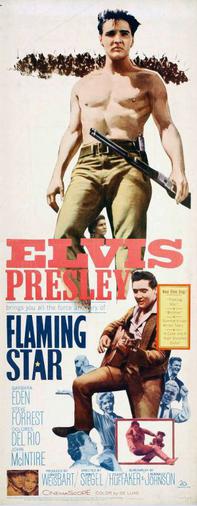
Flaming Star
Elvis Presley was a singer, a performer, an entertainer. And yes, he was a movie star, starring in 31 movies over 13 years. Most were movies meant to capitalize on his singing (and scandalous dancing), the King singing plenty of his songs to keep audiences dancing in their seats. I like Elvis' music a lot, but musicals are not really my thing so I've actually never seen any of those movies. What have I seen? Presley's ventures into the western genre, 1969's Charro! and today's review, 1960's Flaming Star.
In the late 1870's in west Texas, aging, small-time rancher Sam Burton (John McIntire) has worked hard to create a life for himself with his family. On their small but solid ranch, they run cattle and horses, working every day to keep things up. Sam's family includes his wife (his second wife), a full-blooded Kiowa woman, Neddy (Dolores Del Rio), and two sons, Pacer (Presley), and Clint (Steve Forrest), with his first wife. Pacer is a half-breed but has lived his whole life with the whites, not the Kiowas. It's never been much of an issue as the Burton's friends think of them as just that; friends and even family. But when a new, young chief riles up his Kiowa warriors, no one in the territory is safe...except the Burtons who seem to go untouched while everyone around them is attacked. The townspeople and local families begin to suspect something. Now who's the bigger enemies? The supposedly friendly white families and settlers or the rampaging Kiowas?
I caught parts of this 1960 western years (YEARS) ago on AMC at some point but never sat down and watched the entire thing. Well, this channel called Encore Westerns shows westerns...all...day...long, and I was able to track it down. Westerns I haven't seen are getting harder and harder to find! Why this one doesn't have more of a reputation for the positive, I just don't know. It's not a classic, but with an excellent performance from young Mr. Presley and a hard-hitting story, 'Star' deserves much more standing within the western genre.
A big ingredient for success? Director Don Siegel behind the camera. One of the all-time great tough guy directors, Siegel is known for his pairings with Clint Eastwood in the 1960's and 1970's, but he had actually been directing feature films since the late 1940's. He was a no-nonsense kind of director, and 'Star' fits the mold. Even by 1960, westerns often painted the white Americans as the good guys and the Indians (whatever tribe, pick one) as the blood-thirsty savages obsessed with killing. That trend would begin to change in the coming years, but this is one of the first westerns I can think that tries to not only humanize Native Americans but shows that white settlers were far from perfect. It is a rare socially conscious western that simply paints things as they were. Prejudices and biases are ugly in any form, whether it's 2015 or 1878. This is a western story ahead of its time, and it's the better for it.
By the time this film was released, Presley was a S-T-A-R. He'd already made five movies, but this was the first to allow him to show off his dramatic acting chops. Much like he would years later in Charro, Presley gives an above average turn as the stoic, quiet, loyal and very capable anti-hero (of sorts). If there's any red flags, it's that Presley is playing a half-white, half-Indian character, but the part, script or Presley never makes it cliched, forced or overdone. Other than some really tan skin (really tan), the casting of a white actor as a Native American character isn't an issue, never presenting itself. Presley is known for being a singer, a dancer, an entertainer, but when given the chance, he showed that he was a more than respectable dramatic presence too. This is a good one.
The dynamic among the Burton family as a whole is key and the main (and best) focus of the story. For these four people, their "situation" isn't a situation at all. They are family. White blood or Indian blood doesn't matter in the least. McIntire and Del Rio are excellent as a couple that's been married for half a lifetime by now. The same goes for Presley and Forrest, half-brothers who never question the 'half' part. They complain and insult each other but are always there for the other because that's what brothers do. Hatred and violence can be quite the divider though, testing even the strongest of brotherly relationships. Four very strong performances from Presley, McIntire, Del Rio and Forrest as the heart of the movie.
Filling out the rest of the cast, look for a pre-I Dream of Jeannie Barbara Eden, Rodolfo Acosta, Richard Jaeckel, Karl Swenson, L.Q. Jones, Ford Rainey, and Perry Lopez.
There are some slightly overdone dramatic moments in the second half as everything comes front and center. AH, DRAMA! The ending too feels a little rushed, almost like a key scene was shot but eventually cut for timing or something. Overall though, this is an easy movie to recommend for any number of reasons from Elvis fans to western fans. And yes, Presley sings one song early almost to appease his fans before the story takes a turn for the dark. A hard-hitting story western that's definitely worth checking out.
Flaming Star (1960): ***/****
In the late 1870's in west Texas, aging, small-time rancher Sam Burton (John McIntire) has worked hard to create a life for himself with his family. On their small but solid ranch, they run cattle and horses, working every day to keep things up. Sam's family includes his wife (his second wife), a full-blooded Kiowa woman, Neddy (Dolores Del Rio), and two sons, Pacer (Presley), and Clint (Steve Forrest), with his first wife. Pacer is a half-breed but has lived his whole life with the whites, not the Kiowas. It's never been much of an issue as the Burton's friends think of them as just that; friends and even family. But when a new, young chief riles up his Kiowa warriors, no one in the territory is safe...except the Burtons who seem to go untouched while everyone around them is attacked. The townspeople and local families begin to suspect something. Now who's the bigger enemies? The supposedly friendly white families and settlers or the rampaging Kiowas?
I caught parts of this 1960 western years (YEARS) ago on AMC at some point but never sat down and watched the entire thing. Well, this channel called Encore Westerns shows westerns...all...day...long, and I was able to track it down. Westerns I haven't seen are getting harder and harder to find! Why this one doesn't have more of a reputation for the positive, I just don't know. It's not a classic, but with an excellent performance from young Mr. Presley and a hard-hitting story, 'Star' deserves much more standing within the western genre.
A big ingredient for success? Director Don Siegel behind the camera. One of the all-time great tough guy directors, Siegel is known for his pairings with Clint Eastwood in the 1960's and 1970's, but he had actually been directing feature films since the late 1940's. He was a no-nonsense kind of director, and 'Star' fits the mold. Even by 1960, westerns often painted the white Americans as the good guys and the Indians (whatever tribe, pick one) as the blood-thirsty savages obsessed with killing. That trend would begin to change in the coming years, but this is one of the first westerns I can think that tries to not only humanize Native Americans but shows that white settlers were far from perfect. It is a rare socially conscious western that simply paints things as they were. Prejudices and biases are ugly in any form, whether it's 2015 or 1878. This is a western story ahead of its time, and it's the better for it.
By the time this film was released, Presley was a S-T-A-R. He'd already made five movies, but this was the first to allow him to show off his dramatic acting chops. Much like he would years later in Charro, Presley gives an above average turn as the stoic, quiet, loyal and very capable anti-hero (of sorts). If there's any red flags, it's that Presley is playing a half-white, half-Indian character, but the part, script or Presley never makes it cliched, forced or overdone. Other than some really tan skin (really tan), the casting of a white actor as a Native American character isn't an issue, never presenting itself. Presley is known for being a singer, a dancer, an entertainer, but when given the chance, he showed that he was a more than respectable dramatic presence too. This is a good one.
The dynamic among the Burton family as a whole is key and the main (and best) focus of the story. For these four people, their "situation" isn't a situation at all. They are family. White blood or Indian blood doesn't matter in the least. McIntire and Del Rio are excellent as a couple that's been married for half a lifetime by now. The same goes for Presley and Forrest, half-brothers who never question the 'half' part. They complain and insult each other but are always there for the other because that's what brothers do. Hatred and violence can be quite the divider though, testing even the strongest of brotherly relationships. Four very strong performances from Presley, McIntire, Del Rio and Forrest as the heart of the movie.
Filling out the rest of the cast, look for a pre-I Dream of Jeannie Barbara Eden, Rodolfo Acosta, Richard Jaeckel, Karl Swenson, L.Q. Jones, Ford Rainey, and Perry Lopez.
There are some slightly overdone dramatic moments in the second half as everything comes front and center. AH, DRAMA! The ending too feels a little rushed, almost like a key scene was shot but eventually cut for timing or something. Overall though, this is an easy movie to recommend for any number of reasons from Elvis fans to western fans. And yes, Presley sings one song early almost to appease his fans before the story takes a turn for the dark. A hard-hitting story western that's definitely worth checking out.
Flaming Star (1960): ***/****
Saturday, July 20, 2013
Invasion of the Body Snatchers (1956)
As different eras and time periods pass, highly successful genres in Hollywood find ways to stay fresh, changing with the new times. Almost always though, there's a common tie, some link to what originally made the genre successful with audiences. Take science fiction. It is a genre that has been aided by the invention of all sorts of new technology, especially CGI. But what's the best time period for the genre? I'll watch a sci-fi flick from any decade, any time period, but for me, the genre was at its absolute strongest in the 1950s. I caught up with one classic I'd never seen before, 1956's Invasion of the Body Snatchers.
Returning to his home in Santa Mira, California, after attending a two-week convention, Dr. Miles Bennell (Kevin McCarthy) is alarmed by the amount of requests he receives from patients upon his return. Several people are complaining that their loved ones seem a little off, that the people they've known all their lives simply aren't themselves. Bennell looks into it a bit but doesn't think much of it....at first. A friend and neighbor (King Donovan) has found what he believes to be a dead body that somewhat resembles him but without any distinctive features or fingerprints to identify him. With a longtime crush and recent divorcee Becky (Dana Wynter) at his side, Bennell starts to investigate and is stunned by what he finds. Some sort of extraterrestrial race is in fact replacing human beings with almost duplicate versions of themselves, but eliminating emotion in the process. Can Bennell figure out how to stop the rapidly reproducing duplicates in time?
The 1950s were packed to the gills with everything from Forbidden Planet to The Day the Earth Stood Still, It Came From Outer Space to The Thing. As far as comparisons go, 'Invasion' is interesting because of some similarities with 1951's The Thing, but also how it impacted John Carpenter's The Thing remake. From Don Siegel, this 1956 sci-fi creeper is a gem. Based on a serial that ran in Collier's Magazine, it is smart, well-written and scary without having to resort to obvious GOTCHA! scares and thrills. Filmed in black and white, it is subtle and unsettling, Siegel using his camera in a variety of different angles, POV, and tracking shots. The shadowy black and white works well, almost like a sci-fi film noir, building that sensation of impending doom expertly. We know something isn't quite right, but what is it exactly?
An obvious influence on Siegel's film is rather timely for a 1950s audience, but now in 2013, it's easier to keep it in perspective. With McCarthyism and a Red Scare permeating the United States, Americans were worried about an ever-constant threat of Commies and Reds affecting an American way of life. What better way to translate that than in a story of a mysterious alien race that secretly and covertly tries to change who you are? The end result? An eerily similar version of what you used to be, but not quite spot-on. Now, we can look back on that secondary layer to the story and see it for what it is. I wonder if 1950s audiences picked up on it. Regardless, Siegel and the script don't overdo that angle. It is underplayed, just another subtle layer to the scares.
A really solid character actor who never quite became a huge star, McCarthy is a great lead here as Dr. Miles Bennell, a likable, smart and smooth doctor who questions things as much as anyone. But something that's hard to explain like this? How could people literally be replaced without anyone else noticing? McCarthy does a good job showing that slow burn as he figures out exactly what's going on, from a doctor who thinks things out to a man who appears unhinged when he learns the truth. Avoiding just being the pretty face along for the ride, Wynter more than holds her own as the female lead. The rest of the cast is lesser known actors, the ensemble as a whole doing a pretty cool job. Larry Gates plays a similarly questioning psychiatrist who Miles seeks out for help, Donovan and future Morticia Adams Carolyn Jones as Jack and Teddy, a couple who finds a suspicious body, Jean Willes as Miles' nurse Sally, and even future director Sam Peckinpah as Charlie, one of the townspeople affected by the quasi-alien invasion.
There really isn't a weak moment in the film, but with an 80-minute running time, things really pick up about the 35 or 40-minute mark. We start to learn what's really going on, and unlike most sci-fi movies that feature a twist, this one works. Sometimes films try so hard to really throw you for a loop that the twist comes across as laughable. Not the case here thankfully. Besides, even if you don't buy the twist/explanation, the final 30 minutes are so fast-paced you won't even notice. Siegel's camera work (including some cool tracking shots from a distance) and a race for survival provide some ridiculously tense moments. The ending is a little weak, Siegel being forced to film a prologue and epilogue (featuring uncredited Whit Bissell and Richard Deacon) that starts off well enough but ends up weakening the possible darkness of his original ending. Still a classic, still well worth tracking down.
Invasion of the Body Snatchers (1956): ****/****
Returning to his home in Santa Mira, California, after attending a two-week convention, Dr. Miles Bennell (Kevin McCarthy) is alarmed by the amount of requests he receives from patients upon his return. Several people are complaining that their loved ones seem a little off, that the people they've known all their lives simply aren't themselves. Bennell looks into it a bit but doesn't think much of it....at first. A friend and neighbor (King Donovan) has found what he believes to be a dead body that somewhat resembles him but without any distinctive features or fingerprints to identify him. With a longtime crush and recent divorcee Becky (Dana Wynter) at his side, Bennell starts to investigate and is stunned by what he finds. Some sort of extraterrestrial race is in fact replacing human beings with almost duplicate versions of themselves, but eliminating emotion in the process. Can Bennell figure out how to stop the rapidly reproducing duplicates in time?
The 1950s were packed to the gills with everything from Forbidden Planet to The Day the Earth Stood Still, It Came From Outer Space to The Thing. As far as comparisons go, 'Invasion' is interesting because of some similarities with 1951's The Thing, but also how it impacted John Carpenter's The Thing remake. From Don Siegel, this 1956 sci-fi creeper is a gem. Based on a serial that ran in Collier's Magazine, it is smart, well-written and scary without having to resort to obvious GOTCHA! scares and thrills. Filmed in black and white, it is subtle and unsettling, Siegel using his camera in a variety of different angles, POV, and tracking shots. The shadowy black and white works well, almost like a sci-fi film noir, building that sensation of impending doom expertly. We know something isn't quite right, but what is it exactly?
An obvious influence on Siegel's film is rather timely for a 1950s audience, but now in 2013, it's easier to keep it in perspective. With McCarthyism and a Red Scare permeating the United States, Americans were worried about an ever-constant threat of Commies and Reds affecting an American way of life. What better way to translate that than in a story of a mysterious alien race that secretly and covertly tries to change who you are? The end result? An eerily similar version of what you used to be, but not quite spot-on. Now, we can look back on that secondary layer to the story and see it for what it is. I wonder if 1950s audiences picked up on it. Regardless, Siegel and the script don't overdo that angle. It is underplayed, just another subtle layer to the scares.
A really solid character actor who never quite became a huge star, McCarthy is a great lead here as Dr. Miles Bennell, a likable, smart and smooth doctor who questions things as much as anyone. But something that's hard to explain like this? How could people literally be replaced without anyone else noticing? McCarthy does a good job showing that slow burn as he figures out exactly what's going on, from a doctor who thinks things out to a man who appears unhinged when he learns the truth. Avoiding just being the pretty face along for the ride, Wynter more than holds her own as the female lead. The rest of the cast is lesser known actors, the ensemble as a whole doing a pretty cool job. Larry Gates plays a similarly questioning psychiatrist who Miles seeks out for help, Donovan and future Morticia Adams Carolyn Jones as Jack and Teddy, a couple who finds a suspicious body, Jean Willes as Miles' nurse Sally, and even future director Sam Peckinpah as Charlie, one of the townspeople affected by the quasi-alien invasion.
There really isn't a weak moment in the film, but with an 80-minute running time, things really pick up about the 35 or 40-minute mark. We start to learn what's really going on, and unlike most sci-fi movies that feature a twist, this one works. Sometimes films try so hard to really throw you for a loop that the twist comes across as laughable. Not the case here thankfully. Besides, even if you don't buy the twist/explanation, the final 30 minutes are so fast-paced you won't even notice. Siegel's camera work (including some cool tracking shots from a distance) and a race for survival provide some ridiculously tense moments. The ending is a little weak, Siegel being forced to film a prologue and epilogue (featuring uncredited Whit Bissell and Richard Deacon) that starts off well enough but ends up weakening the possible darkness of his original ending. Still a classic, still well worth tracking down.
Invasion of the Body Snatchers (1956): ****/****
Labels:
1950s,
Don Siegel,
Horror,
Kevin McCarthy,
Sam Peckinpah,
Sci-Fi,
Whit Bissell
Saturday, November 3, 2012
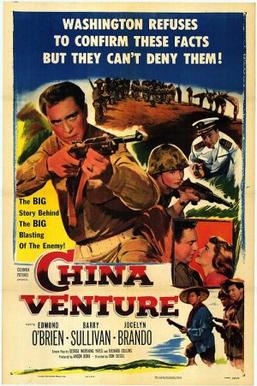
China Venture
Blah. That's all I'm coming up with for 1953's China Venture, a WWII story from director Don Siegel. Blah. Pretty weak, isn't it? It's not even good enough to mildly praise nor horrible enough to rip to pieces. It's just there, wasting away in its 83-minute running time. And away we go!
Leading a small patrol of Marines into China late in 1944, Capt. Matt Reardon (Edmond O'Brien) receives a message from Chinese guerrillas high up in the mountains. A high-ranking Japanese general (Philip Ahn) has crashed in the jungle, and for a price -- $10,000 -- the guerrillas will sell him to the Americans. Radioing for help, Reardon's patrol is "reinforced" by a Navy intelligence officer, Thompson (Barry Sullivan), a doctor (Dayton Lummis) and a nurse (Joceln Brando) to interrogate and care for the general. Heading into the thick jungle, Reardon's patrol is in a race against the clock as Japanese forces close in on the downed general too.
From director Don Siegel, 'Venture' is not meant to be some groundbreaking, innovative WWII story. Made in 1953 and not even breaking the 90-minue mark, it is a no-frills story that blends the men on a mission story with a handful of other familiar genre conventions. None of it really amounts to much, the different conventions working against each other in such a short time. The angle of the fighting in China is always interesting -- Americans, Japanese and Chinese warlords all fighting -- but the story never gets to push the limits. Even 1959's Never So Few (in all its amazing badness) went a little further. The "love story" between O'Brien and Brando is a flop too, slowing things down needlessly.
Where some positives come out is Siegel's tough guy talent behind the camera. At different points, 'Venture' reminded me some of Siegel's underrated WWII gem, 1962's Hell is For Heroes. Shot in black and white, it has the gritty, dirty look of an episode of Combat. The jungle is a gnarly, nasty place, and jungle fighting is full of ambushes, booby traps and all sorts of unpleasantness. While there isn't enough action, what's there is appropriately unpleasant. I just wish there was more of it, but instead we get long, uncut tracking shots of Reardon's patrol walking through the jungle, walking up and down hills. Not exactly adrenaline-pumping action.
Leading the cast, O'Brien has some good and some bad going for him. As the smart-mouth but capable Reardon, he's believable; a tough officer looking out for his men. The romance angle with Brando's Lt. Wilkins is painful to watch at times. Sullivan is solid as Cmdr. Thompson, the Navy Intelligence officer with no jungle-fighting experience. Reardon's squad includes Leo Gordon as the tough Sgt. Janowicz (O'Brien's scenes with him are highlights), Dabbs Greer, Alvy Moore, Wong Atarne and several other completely unlisted actors in the cast listing. The whole 'men on a mission' angle is wasted. Instead the focus is on the bickering between Reardon and Thompson, and the lovey-dovey stuff with Brando's caring nurse.
In the last third of the movie, the chance for some betrayals and actual excitement is there, but even that is mishandled. Leon Askin (later General Burkhalter on Hogan's Heroes) is badly cast as Wu King, the Chinese warlord auctioning off the Japanese general. Stereotypical doesn't begin to describe the part. As the rescuing Japanese forces close in, Reardon and Thompson are forced to make an extremely difficult decision, and the result proves to be the movie's strongest scene. But in the moments after, the finale is rushed. The movie isn't bad or good in the end. There are worse ways to spend 83 minutes, but I can think of a lot of better ways.
China Venture (1953): **/****
Leading a small patrol of Marines into China late in 1944, Capt. Matt Reardon (Edmond O'Brien) receives a message from Chinese guerrillas high up in the mountains. A high-ranking Japanese general (Philip Ahn) has crashed in the jungle, and for a price -- $10,000 -- the guerrillas will sell him to the Americans. Radioing for help, Reardon's patrol is "reinforced" by a Navy intelligence officer, Thompson (Barry Sullivan), a doctor (Dayton Lummis) and a nurse (Joceln Brando) to interrogate and care for the general. Heading into the thick jungle, Reardon's patrol is in a race against the clock as Japanese forces close in on the downed general too.
From director Don Siegel, 'Venture' is not meant to be some groundbreaking, innovative WWII story. Made in 1953 and not even breaking the 90-minue mark, it is a no-frills story that blends the men on a mission story with a handful of other familiar genre conventions. None of it really amounts to much, the different conventions working against each other in such a short time. The angle of the fighting in China is always interesting -- Americans, Japanese and Chinese warlords all fighting -- but the story never gets to push the limits. Even 1959's Never So Few (in all its amazing badness) went a little further. The "love story" between O'Brien and Brando is a flop too, slowing things down needlessly.
Where some positives come out is Siegel's tough guy talent behind the camera. At different points, 'Venture' reminded me some of Siegel's underrated WWII gem, 1962's Hell is For Heroes. Shot in black and white, it has the gritty, dirty look of an episode of Combat. The jungle is a gnarly, nasty place, and jungle fighting is full of ambushes, booby traps and all sorts of unpleasantness. While there isn't enough action, what's there is appropriately unpleasant. I just wish there was more of it, but instead we get long, uncut tracking shots of Reardon's patrol walking through the jungle, walking up and down hills. Not exactly adrenaline-pumping action.
Leading the cast, O'Brien has some good and some bad going for him. As the smart-mouth but capable Reardon, he's believable; a tough officer looking out for his men. The romance angle with Brando's Lt. Wilkins is painful to watch at times. Sullivan is solid as Cmdr. Thompson, the Navy Intelligence officer with no jungle-fighting experience. Reardon's squad includes Leo Gordon as the tough Sgt. Janowicz (O'Brien's scenes with him are highlights), Dabbs Greer, Alvy Moore, Wong Atarne and several other completely unlisted actors in the cast listing. The whole 'men on a mission' angle is wasted. Instead the focus is on the bickering between Reardon and Thompson, and the lovey-dovey stuff with Brando's caring nurse.
In the last third of the movie, the chance for some betrayals and actual excitement is there, but even that is mishandled. Leon Askin (later General Burkhalter on Hogan's Heroes) is badly cast as Wu King, the Chinese warlord auctioning off the Japanese general. Stereotypical doesn't begin to describe the part. As the rescuing Japanese forces close in, Reardon and Thompson are forced to make an extremely difficult decision, and the result proves to be the movie's strongest scene. But in the moments after, the finale is rushed. The movie isn't bad or good in the end. There are worse ways to spend 83 minutes, but I can think of a lot of better ways.
China Venture (1953): **/****
Labels:
1950s,
Barry Sullivan,
Don Siegel,
Edmond O'Brien,
Leo Gordon,
WWII
Tuesday, February 22, 2011
Charley Varrick
This is a prime example of how good a crime thriller from the 1970s can be. There is something unexplainable about the style and appeal of a movie from the 1970s that's hard to put your finger on. This Don Siegel-directed thriller has a lot of those elements that range from something as simple as the dusty western settings to the cynical nature to composer Lalo Schifrin's score and everything in between. More than that, there is nothing ground-breaking or innovative about it. This is just professionals doing what they do. It's even easy to see how directors like the Coen Brothers were influenced by the movie, especially No Country for Old Men. With Matthau in the lead and Siegel handling the directing duties, Charley Varrick is a high-quality, well-made, professionally handled movie. Nothing flashy about this one, just a solid movie.
As part of a botched but still successful bank robbery, small-time crooks Charley Varrick (Matthau) and Harman Sullivan (Andy Robinson) head into the back roads of the New Mexico desert looking to escape the police roadblocks and searches. When they check their take though, both men are stunned at what they see. They find over $750,000 in cash, all from a little bank in the middle of nowhere. Charley quickly pieces it together, it was a mob bank holding money until it could be shipped out of the country. What should they do? It doesn't take long for mob fence, Maynard Boyle (John Vernon), to start a search for his lost money, hiring a hit-man named Molly (Joe Don Baker) to follow what little clues they have. Charley is getting backed into a corner, and it seems he's only got one way out.
With awful movies that know they're awful and movies with high expectations that try to be something they are not, it can be refreshing to see a good, old-fashioned, entertaining story like this one. There are no major twists, no huge revelations, just a getaway story with crooks, mobsters and cops on all sides. Based on a novel by John Reese, 'Charley' knows where it is going and how to get there. It can be somewhat predictable, but the fun is going along for the ride. Because of the talent both in front and behind the camera, there's never any rush to move things along needlessly fast. Even considering the seriousness of the story and subject matter, there is a matter of fact, easygoing way about this Siegel production.
Known for his versatility across movie genres, Matthau slipped effortlessly among his movie roles, bouncing back and forth around comedies, action and drama. He doesn't have the classic good looks of so many leading men, but for me that's always been a positive. He looks more like the audience member watching the movie than a suave Hollywood star. His Charley is smart, a quick thinker, and seemingly always a step ahead of his pursuers. Matthau makes this character (who could have been easy to dislike) a strong lead, and something to root for in a sea of not so likable and downright despicable characters. Joe Don Baker is a great villain, the hit-man with a condescending edge and scruples to boot about what he does. Vernon is Vernon, the perfectly smarmy bad guy who unfortunately is underused, but he makes the most of his not so big appearance.
One of my favorite things about movies released in the 1970s are the supporting casts. For all the actors like Eastwood, Bronson, Hoffman, Hackman and so many others that starred in these movies, there were countless character actors who filled out the typically unnecessary supporting roles that were still fun to watch. These characters were great at fleshing movies out, and Charley Varrick is packed full of them. The list includes Felicia Farr as Vernon's secretary, 70s sexpot Sheree North as a photographer with a criminal edge, Norman Fell as a district attorney's investigator, Benson Fong as Honest John, a source of Baker's, Woodrow Parfrey as a cowardly bank manager, William Schallert as a focused country sheriff, and a handful of other faces you'll recognize, all in parts that add that little touch to the movie overall.
Now if you're paying attention at all, you can predict the ending long before it arrives. No, maybe not the specifics, but you know what Charley is up to as the noose looks to be tightening around his neck. Now, none of that is to say that the finale isn't worthwhile. Anything but, it's a great ending. Varrick ends up meeting Vernon and Baker at an abandoned airfield with some great aerial stunts included as a chase ensues over the airfield and into a rotted out junk yard. Like the whole movie, there's nothing surprising about the ending, but it is a satisfying one. A hidden gem from a great decade of movies, Charley Varrick is a winner all around.
Charley Varrick <---trailer (1973): ***/****
Labels:
1970s,
Don Siegel,
Joe Don Baker,
John Vernon,
Norman Fell,
Sheree North,
Walter Matthau
Wednesday, July 14, 2010
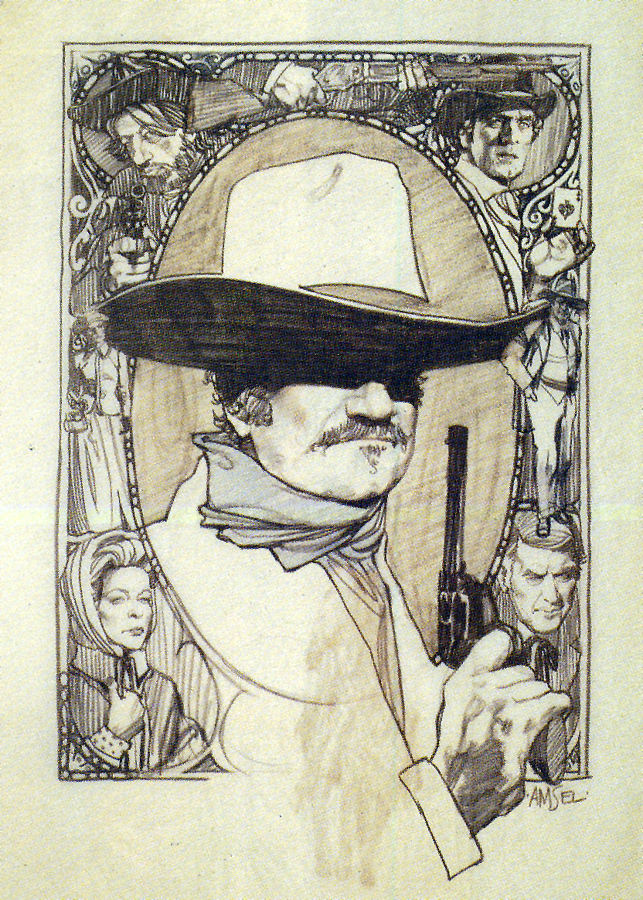
The Shootist
As a movie star, you don't always pick how you get to ride into the sunset on the horizon. For many, their days as a star are long past. Others just never get that right role that allows you to end on a high note. Well, there is an exception to every role, and that's John Wayne, one of the most iconic stars to come out of Hollywood's first 50 years with sound films. A star whose popularity went up and down some over a long career, Wayne was always in the public eye with his movies, his last part being one of his best all-time parts, 1976's The Shootist.
During the mid 1970s when Wayne was in the process of making his last few movies, The Duke was struggling with stomach cancer that would ultimately end up killing him in 1979. More than any other time in his career, Wayne resorted to playing a version, a caricature of himself in the late 1960s and into the 1970s. There was a comfort factor involved for both the actor and the audiences who still loved seeing him on-screen. With an exception here and there, none of these later movies are classics, but they're all entertaining. The Shootist is one of those few exceptions, a classic thanks almost exclusively to Wayne's performance in the title role.
It's 1901 and infamous gunfighter J.B. Books (Wayne) rides into Carson City to see an old friend of his, Doc Hostetler (James Stewart). Books has been feeling poorly, and the Doc confirms the bad news; he has cancer and only has a few months to live. The gunfighter takes a room at a boarding house run by a recent widow, Mrs. Rogers (Lauren Bacall) and her troublemaker son, Gillom (Ron Howard). Books goes about wrapping certain things up with his life as he prepares to die, putting things in place and tying up some loose ends. But the Doc warned him, letting the cancer kill him will be a long, drawn out and incredibly painful process. If there was a way to quicken that death, he recommends Books do it. So knowing what awaits him, the older, worn-out gunfighter puts together one last moment of glory.
Seven years earlier, Wayne won his first and only Academy Award for his performance as Rooster Cogburn in True Grit. In a sense, it was a lifetime achievement award for all he had accomplished in his career. But just on performance alone, his John Bernard Books ranks up there as one of his all-time top five. It is a part that Wayne was born to play, plain and simple. His Books is a dignified man with a reputation as a killer, a man who lives by certain principles and expects others to do the same. He doesn't apologize for his past and to a certain point, is frustrated with the life he has led where every young punk with a gun wants to kill him to prove how good they are. Easily one of the Duke's best parts, and a fitting end to a great career.
Directed by Don Siegel, 'Shootist' brings together an excellent cast, almost like a going away party for the Duke. Having worked together 20 years before in 'Blood Alley,' Bacall and Wayne are perfect together with some of the best on-screen chemistry Wayne ever had with a female co-star. Their scenes flow so easily, and it's just fun watching two pros show what they can do with good material. The same for young Ron Howard who plays a different character than the viewer is used to considering his Andy Griffith and Happy Days roots. Books becomes a bit of a father figure to Howard's Gillom and tries to teach him the lessons of how to be a man. Along with Stewart as the doctor, there's Harry Morgan as the town sheriff, John Carradine as the undertaker, Sheree North as a lost love of Books, and Scatman Crothers as the livery stable owner.
The story builds to a certain point, and you dread where it is going -- even knowing it is where it has to go. Books takes the Doc's advice and arranges a way so three men who would love nothing more than to put a bullet in him meet him at the same place. If all goes well, he'll go out in one last blaze of glory, avoiding whatever the cancer can throw at him. The trio include Richard Boone, Hugh O'Brian and Bill McKinney, all three waiting for him in a saloon. The ending is foreshadowed in a line delivered midway through the movie, but it still comes as a bit of a shock. Of his 170 or so movies, John Wayne actually died in just eight movies, and few are as moving as this one. You can watch it HERE, obvious SPOILERS.
Beyond the sets, background and lack of gunplay, this is a movie entirely devoted to character, specifically John Bernard Books and the last few days of his life. It is a western focusing on the changing times as the old west becomes a thing of the past, the U.S. advancing forward into a new time. In that way, it's appropriate that the Wayne character wants no part of it. As some characters point out, he is a relic from the previous times. His exit then is only appropriate, going out as he came in. One of Wayne's best and an underrated western overall.
The Shootist <----trailer (1976): ****/****
During the mid 1970s when Wayne was in the process of making his last few movies, The Duke was struggling with stomach cancer that would ultimately end up killing him in 1979. More than any other time in his career, Wayne resorted to playing a version, a caricature of himself in the late 1960s and into the 1970s. There was a comfort factor involved for both the actor and the audiences who still loved seeing him on-screen. With an exception here and there, none of these later movies are classics, but they're all entertaining. The Shootist is one of those few exceptions, a classic thanks almost exclusively to Wayne's performance in the title role.
It's 1901 and infamous gunfighter J.B. Books (Wayne) rides into Carson City to see an old friend of his, Doc Hostetler (James Stewart). Books has been feeling poorly, and the Doc confirms the bad news; he has cancer and only has a few months to live. The gunfighter takes a room at a boarding house run by a recent widow, Mrs. Rogers (Lauren Bacall) and her troublemaker son, Gillom (Ron Howard). Books goes about wrapping certain things up with his life as he prepares to die, putting things in place and tying up some loose ends. But the Doc warned him, letting the cancer kill him will be a long, drawn out and incredibly painful process. If there was a way to quicken that death, he recommends Books do it. So knowing what awaits him, the older, worn-out gunfighter puts together one last moment of glory.
Seven years earlier, Wayne won his first and only Academy Award for his performance as Rooster Cogburn in True Grit. In a sense, it was a lifetime achievement award for all he had accomplished in his career. But just on performance alone, his John Bernard Books ranks up there as one of his all-time top five. It is a part that Wayne was born to play, plain and simple. His Books is a dignified man with a reputation as a killer, a man who lives by certain principles and expects others to do the same. He doesn't apologize for his past and to a certain point, is frustrated with the life he has led where every young punk with a gun wants to kill him to prove how good they are. Easily one of the Duke's best parts, and a fitting end to a great career.
Directed by Don Siegel, 'Shootist' brings together an excellent cast, almost like a going away party for the Duke. Having worked together 20 years before in 'Blood Alley,' Bacall and Wayne are perfect together with some of the best on-screen chemistry Wayne ever had with a female co-star. Their scenes flow so easily, and it's just fun watching two pros show what they can do with good material. The same for young Ron Howard who plays a different character than the viewer is used to considering his Andy Griffith and Happy Days roots. Books becomes a bit of a father figure to Howard's Gillom and tries to teach him the lessons of how to be a man. Along with Stewart as the doctor, there's Harry Morgan as the town sheriff, John Carradine as the undertaker, Sheree North as a lost love of Books, and Scatman Crothers as the livery stable owner.
The story builds to a certain point, and you dread where it is going -- even knowing it is where it has to go. Books takes the Doc's advice and arranges a way so three men who would love nothing more than to put a bullet in him meet him at the same place. If all goes well, he'll go out in one last blaze of glory, avoiding whatever the cancer can throw at him. The trio include Richard Boone, Hugh O'Brian and Bill McKinney, all three waiting for him in a saloon. The ending is foreshadowed in a line delivered midway through the movie, but it still comes as a bit of a shock. Of his 170 or so movies, John Wayne actually died in just eight movies, and few are as moving as this one. You can watch it HERE, obvious SPOILERS.
Beyond the sets, background and lack of gunplay, this is a movie entirely devoted to character, specifically John Bernard Books and the last few days of his life. It is a western focusing on the changing times as the old west becomes a thing of the past, the U.S. advancing forward into a new time. In that way, it's appropriate that the Wayne character wants no part of it. As some characters point out, he is a relic from the previous times. His exit then is only appropriate, going out as he came in. One of Wayne's best and an underrated western overall.
The Shootist <----trailer (1976): ****/****
Sunday, May 2, 2010
The Gun Runners
One of my biggest complaints about movies over the last 10 or so years is the overwhelming use of remakes. Older movies are being updated, TV shows are being turned into movies, basically anything that's been proven successful in the past is being used repeatedly. And really why not? Why think of new creative, unique ideas when you can just reuse something from the past? It seems more prevalent now, but remakes are as old as movies themselves.
Take 1958's The Gun Runners which is based on an Ernest Hemingway novel from 1937, To Have and Have Not. Using Hemingway is nothing new to say the least, and this B-movie came just 14 years removed from the Humphrey Bogart/Lauren Bacall vehicle and only eight years removed from another remake made in 1950 starring John Garfield. They all deal with the same story, but it's fair to say this is a remake of a remake...and not a particularly good one at that.
With his midsize fishing boat off the coast of Florida, captain Sam Martin (Audie Murphy) who with his drunken first mate Harvey (Everett Sloane) takes tourists out for fishing trips, but he isn't too successful at it. He's months behind on payments for his boat with no real sign of money starting to flow in. One day, an American tourist enlists Sam's services to take him and a lady friend out onto the Gulf where he brings up a proposition. He'd like to go to Cuba -- in the midst of a revolution -- for a night where no one would bother him, and he'll pay well to get what he wants. The man's name is Hannigan (Eddie Albert), and he's not telling Sam everything. He's an arms dealer and has an arrangement for a large inbound shipment for the rebel fighters. Sam catches wind of the plan though and isn't going to go along willingly, but Hannigan has an ace up his sleeve.
Setting the story in southern Florida with detours over to Cuba is almost always a good idea in hopes of bringing up some controversy, even now 40 years later where the wet-foot, dry foot policy still remains with Cubans trying to escape to the U.S. But even with veteran tough guy director Don Siegel at the helm, this B-movie lacks a certain energy. There are long scenes of dialogue that don't really go anywhere, and the dynamics between characters is downright dull at times.
In the lead, Murphy takes off the gunbelt and cowboy hat and replaces it with a silly-looking captain's hat which he keeps on for almost the whole movie. I'm trying to think of an actor Murphy could be compared to, but I'm drawing a blank. I'll say this; he's a poor man's somebody. The real-life WWII hero made a movie career that saw him typically in B-westerns so it is refreshing to see a change of pace here. But like so much of the movie, his character is boring. He loves his wife (Patricia Owens) but their relationship lacks any fireworks. He looks out for drunken Harvey but why is he so protective? It's a nice enough character who you know in the end will make the right decision, but that's part of the problem. Sam Martin is about as interesting to watch as a drunken Harvey sleeping one off.
It's odd looking back on some actors' careers for how they're remembered. Albert is generally remembered as the star of the very stupid but very popular TV sitcom Green Acres, but I always think of him as playing a bad guy, and a good one at that. He was perfectly evil in The Longest Yard and Attack!, and he's one of few bright spots here. As Hannigan, Albert is charming and slimy at the same time, the kind of villain you love to root against. He'll deal with whoever has the most money, principals or morals be damned. The rest of the cast features Richard Jaeckel and Jack Elam in small parts where they're required to look menacing and do little else.
Throughout the movie where there should be a physical confrontation or at least a good shouting match, it feels like Siegel and his crew figured a way to keep the process cheap. I'm betting not a scene -- two at most -- go by before somebody's drinking, and I'm not talking apple juice. Got a problem? Go to the bar. Need to meet someone to talk things out? Go to a bar. Maybe this movie would be better if I had watched it drunk or at least buzzed. It's a snoozer with little to recommend other than Eddie Albert's turn as a villain.
The Gun Runners <---clips (1958): * 1/2 /****
Labels:
1950s,
Audie Murphy,
Don Siegel,
Eddie Albert,
Jack Elam,
Remakes,
Richard Jaeckel
Wednesday, November 18, 2009
The Beguiled
A major disappointment in theaters because of some not so truthful marketing, The Beguiled was the third teaming between Eastwood and director Don Siegel and it wouldn't be their last as they worked together in the Dirty Harry series too. Siegel was known for his tough, hard-hitting movies that included westerns, war movies and police stories. So working together on a Gothic, off-beat Civil War suspense thriller was really a departure for both actor and director. Surprisingly enough, the combination works in an odd way.
While walking through the woods looking for mushrooms, 12-year old Amy (Pamelyn Ferdin) stumbles across a wounded Union soldier. She's able to drag him to the School for Young Ladies she lives in in southern Louisiana. The owner of the school, Martha Farnsworth (Geraldine Page), decides to treat the soldier's wounds before turning him over to Confederate forces so he can be sent to a prison camp. Soon enough, the Union soldier comes around and introduces himself as Corporal John McBurney (Eastwood). Seeing an opportunity, McBurney takes it and starts going to work on the men-starved women living at the school as he recovers and builds up his strength.
This is about as off-beat a movie as Eastwood has made and for that reason one of the best. It's completely different from any other movie he stars in. Shot on location in Louisiana, 'Beguiled' has the feel of a Gothic horror movie. Using an actual Southern home for outdoor shooting, there's a feeling of authenticity that would have been lost with a Hollywood set. The house is surrounded by brush, shrubbery and plant life, giving an intense feeling of claustrophobia right from the get-go. There's a sense that anything could be hiding in the brush -- Union or Confederate soldiers -- and who knows when it will reveal itself.
Credit goes to composer Lalo Schifrin and cinematographer Bruce Surtees for creating such a beautiful but unsettling movie. Schifrin's score varies from whimsical to downright scary depending on the scene. Surtees' camera work relies on shadows and darkness in the vast hallways of the Southern plantation home. Combine these two and the with the ever-changing tone of the movie, you've got a surprisingly moody Civil War story. It has elements of horror and suspense that work so well together leading up until the final scenes which provide quite a twist. Several scenes make me wince just thinking of them, but I won't spoil them here.
Probably speaking here more than in some of his earlier movies combined, Eastwood plays against type as Cp. John McBurney, or McB to his friends. He's a hustler and a con man in many ways, seducing any of the young women who come close to him, especially school teacher Edwina (Elizabeth Hartman in a great part). McBurney's going to do whatever it takes to avoid being sent to a Confederate prison camp, no matter how many people he has to trick. As his counter, Broadway actress Page is a worthy foe, a woman in charge of an isolated school for young women. Her Martha knows she probably shouldn't keep McB on, but also feels a need to have a man around the grounds. The other girls include Ferdin in a scene-stealing role, Jo Ann Harris as Carol, the sexually curious 17-year old, Darleen Carr as Doris, the fiercely patriotic Southerner convinced they should turn McB in, and Mae Mercer as Hallie, Martha's slave.
Completely surprised by how much I enjoyed this movie. Different from what you might normally expect from a Clint Eastwood and Don Siegel movie, but keep an open mind and this one could catch you off guard too.
The Beguiled (1971): ***/****
Monday, June 22, 2009
Netflix review #23: Madigan
In the 60s and 70s when everyone from John Wayne and Steve McQueen were making cop movies, it seemed every well-known guy's guy actor was taking a crack at the genre. And why not really? With American audiences becoming more cynical and wanting the more hard-hitting stories, movies could delve into tougher subjects and even previously taboo topics, like sex, drugs, racism, all that good stuff. Released in 1968, Madigan starts to incorporate those things, but it's almost just testing the waters. A villain who likes kinky sex? Mention it and move on. A cop who 'forgets' suspects' rights? Hint at it and change the topic!
New York detectives Daniel Madigan (Richard Widmark) and Rocco Bonaro (Harry Guardino) are looking to bring a witness in for questioning in a murder case. But what starts as routine investigating takes a nasty turn when the witness, Barney Benesch (Steve Ihnat), takes advantage of a brief lapse of concentration from the two veteran detectives. He pulls a gun on them, takes their guns and escapes into the city. Both detectives have come under fire in the past for their rough methods, but they're given 72 hours to bring Benesch in.
Looking down on all that happens from City Hall, police commisioner Anthony X. Russell (Henry Fonda) is trying to juggle any number of prickly cases, including the Madigan debacle, but also a possible corruption scandal with his close friend and Chief Inspector Charles Kane (James Whitmore). Russell has a past with Madigan and neither man thinks the other is completely on the up and up.
My first reaction after finishing the movie was that Siegel, typically as good as they get with telling a no-frills story that gets right to the point, bit off more than he could chew here. There's too much going on in the way of story here. It's not a long movie at just 101 minutes so both stories, Madigan and Bonaro hunting down the fugitive and Russell trying to keep rein on the city, suffer from lack of development. Both stories are interesting, but each could have had their own movie. Instead, we get a sometimes rushed, not all the way developed procedural cop movie.
Siegel's films almost always did a fine job casting, and for all its faults, Madigan has a strong cast top to bottom. Widmark was an anti-hero in the 1950s before anyone even knew what that meant so as Madigan he's an ideal choice. Det. Madigan is not a likable character with little in the way of redeeming qualities. He's completely driven by his job and cheats on his wife, Julia (a good part for Inger Stevens), mostly because he can. As his superior though, Fonda sleepwalks through his part as the police commisioner. It's not a great part to begin with, but even Fonda doesn't do much with it.
With Widmark, the best parts go to Guardino and Whitmore, two great, often underappreciated character actors. Guardino had already worked with Siegel in 1962's Hell is For Heroes, a WWII movie everyone should see, and would work with him again in Dirty Harry. The New York actor is an ideal sidekick to Widmark because he doesn't have to do much to be noticed. He's a good presence and works well with Widmark. Whitmore does the same as a veteran cop who's risen through the ranks but now sees his career possibly tumbling down around him for a decision he was forced to make. The rest of the cast includes Susan Clark, Michael Dunn, Don Stroud, Sheree North, Raymond St. Jacques, and Frank Marth.
Being a Siegel cop movie, certain touches are there that would be hard to miss. This isn't a good guys vs. bad guys cop movie from the 1950s. Right off the bat, there's nudity in the first scene. The villain is known for his kinky sex preferences and somewhat easier to track because of it. There's police brutality, hinted at more than shown, and quite a bit of shoot first, ask questions later mentality. None of these things are pushed too far or overdone, but even a year or two previously, these subjects might have shocked audiences.
So I can't say I loved the movie or even really enjoyed it, but because of the strong casting, especially Widmark in the lead, and Siegel's typically consistent style, I can mildly recommend Madigan. Here's the trailer with surprisingly enough, female nudity. I can't think of a trailer that's gotten away with that other than red-band trailers, even now in 2009.
Madigan (1968): **/****
Labels:
1960s,
Cops,
Don Siegel,
Harry Guardino,
Henry Fonda,
James Whitmore,
NYC,
Richard Widmark,
Sheree North
Thursday, March 26, 2009
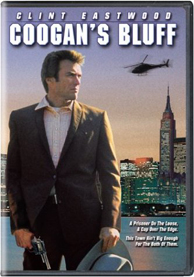
Coogan's Bluff
Piute county Deputy Sheriff Walt Coogan out of Arizona is good at what he does, but in doing his job he tends to piss people off, including the sheriff. So after one such incident, he's sent on a mission to New York City to extradite a prisoner. But arriving in NY, Coogan gets fed up with all the procedures and rules he'll have to follow to get custody of the prisoner, a hop-head named Jim Ringerman. Coogan bluffs his way into the hospital Ringerman is at after he took some LSD. But on the way to the airport, he escapes with some help from his girlfriend. Now Coogan's on his own in a city he can't stand, and nothing's going to stop him from bringing his man back.
Director Siegel had a specialty for tough, gritty movies where guys were guys and that's how it was. Coogan's Bluff definitely falls into that category. The movie has a rough feel to it and seems to have been shot on a lower budget. At times, it tries too hard including one long sequence at a rave. The scene almost calls out 'hey, look, this is how the late 60s were!' Toward the end of the movie, it's almost like Siegel and Co. realized they didn't know how to finish the movie and the story/plot becomes disjointed. A cool action sequence at the end makes up for it though.
Two action scenes stand out here, helped in great part by Eastwood doing many of his own stunts. One has Coogan taking on a group of six or seven thugs in a pool hall. It's a pretty vicious fight as pool cues and balls are flying, as are some of the thugs. The finale action is an exciting motorcycle chase near the Cloisters Museum in Manhattan, another case where you can clearly see Eastwood on the bike.
Joining the cast is Lee J. Cobb, a great character actor who made a career out of playing crotchety old guys who complain about everything. Cobb plays Lt. McElroy, the NY police officer who must work with Coogan even if he does disagree with his methods. Susan Clark plays Julie Roth, a probation officer who Coogan meets and takes a keen interest in in more ways than one. Don Stroud, who would play a rival of Eastwood's again in Joe Kidd, is good in a smaller part as Ringerman, the drug-addicted prisoner trying to avoid extradition back to Arizona where he committed an unidentified crime. Tisha Sterling has a memorable part as Linny Raven, Ringerman's girl who you're never quite sure what her motives are.
The DVD is a good deal but a bit of a disappointment. The widescreen presentation is there and looks good, but no special features at all. Still, it's worth it for the movie alone, even just to see a dry-run of Dirty Harry.
Coogan's Bluff (1968): ***/*****
Labels:
1960s,
Clint Eastwood,
Cops,
Don Siegel,
Lee J. Cobb,
NYC
Subscribe to:
Posts (Atom)