One of those great Hollywood tough guys, Jack Palance was without a doubt, one of the best heavies around in film. He was great in those tough, can't keep down parts that ranged from heroes to dastardly villains, especially in 1953's Shane where he played one of the western genre's all-time great villains. So in the 1950s as he played a lot of anti-heroes, a lot of out-and-out bad guys, it's cool to see him in a well-told, somber western from 1957, The Lonely Man.
In a quiet, dusty western town, a man with quite the reputation, Jacob Wade (Palance), rides up the street looking to find someone. His reputation leans heavily toward the wrong side of the law, Wade gaining notoriety as a gunfighter, a killer, a bandit, and wherever he goes, that name precedes him. He finds the man he's looking for, Riley (Anthony Perkins), a young man, a bit of a loafer around town who goes about his own business quietly. Who is he? He's Wade's son, the son he hasn't seen in over 15 years since leaving him and the boy's mother, hitting the outlaw trail of sorts. After all those years apart though, Wade wants to do right by his son, setting him up with a ranch, some cattle. It will be small at first, but with some hard work, it can flourish....if Riley wants anything to do with his long-lost father's help. It's more than that though. Men from Wade's past are on his trail, men looking to exact revenge on the infamous gunslinger.
Well, here we sit. It is movies like this that make me such a huge fan of the western. There's nothing particularly out of this world unique, nothing you probably haven't seen in other, more well-known westerns over the years. And you know what? There's nothing wrong with that. From director Henry Levin, 'Lonely' is a well-told, old-fashioned story that I liked from the beginning. It gets to the core of what can be so right about westerns. Ultimately, it's about doing what's right, even if it'd be easier to turn and ride out. It's about living up to your word, standing by a friend when he's in trouble, and doing your damnedest to live up to what you should be whether it's loyal, honest or hard-working. As Davy Crockett said, 'Know you're right and go ahead.' In story terms, it doesn't get more straightforward than that.
We get that perspective that would be dealt with years later in movies like Ride the High Country, The Magnificent Seven and The Wild Bunch through the eyes of Palance's Jacob Wade (apparently not related to THIS Jake Wade). His outlaw is trying to put that outlaw past behind him, but that past may not allow it. He regrets the things he's done, the men he's killed, those he's put at risk. It may be too late to save himself, but in his son, there remains some sort of hope for a better future. Palance could be a gem at chewing the scenery, but he was at his best here when he underplays everything. He keeps it inside, the emotions brewing and waiting for an outburst. It is a part that brims with intensity, but it never comes over the top. The chemistry between Palance and Perkins is excellent, a father who wants to help the son he abandoned (supposedly), a son who wants nothing to do with the offer of help. The father-son dynamic works across most genres, and that's no different in the western.
Now that supporting cast. Yikes, just yikes. Some of those familiar faces would go onto bigger and better in the coming years, but that's our benefit. There's a very deep cast that western fans will definitely appreciate from top to bottom. Neville Brand gets the lead villain part as King Fisher, a former saloon owner who has a bullet he carries with Wade's name on it, some of the lead still in his leg. His gang includes Lee Van Cleef, Elisha Cook Jr., and Adam Williams. Robert Middleton has a strong, key supporting part as Ben Ryerson, a former member of Wade's gang, now riding with him trying to put the boy on the right track. There's also a quick part for Claude Akins, a former gang member looking for some "help" with John Doucette riding by his side. Even look for Denver Pyle in an early appearance as a sheriff who knows Wade's reputation.
There's some issues here, but nothing huge. The story is a tad slow, even at 88 minutes dragging in bits and pieces. The subplot with Elaine Aiken's Ada, a saloon girl who rode with Wade and wanted to settle down with him, doesn't develop as much as it could have. When Perkins' Riley shows some interest, I'd had about enough with that part of the story. For the most part though, things work and they work well. A somber, soft score permeates the emotionally-charged family story, and the locations in the Alabama Hills in California are a gorgeous backdrop to the developments across the board. It isn't a perfect western, but it is a really good one that genre fans will definitely enjoy. You pretty much know where it's building early on, but getting to the finale was part of the fun. An easy western to recommend.
The Lonely Man (1957): ***/****
The Sons of Katie Elder
"First, we reunite, then find Ma and Pa's killer...then read some reviews."
Showing posts with label Anthony Perkins. Show all posts
Sunday, July 13, 2014
Tuesday, April 19, 2011
Five Miles to Midnight
This intro isn't exactly dead-on as it pertains to the movie, but it was one of the first things I thought of while watching 1962's Five Miles to Midnight. When I watched Airport for the first time a few years ago, I was genuinely surprised to learn that passengers could buy insurance in airports before their flights. For one like in Airport, it seemed an easy way for some suicidal nut to make some quick cash. On the other hand, it hit me wrong, and I'm pretty cynical when it comes to things like that. In 'Five Miles,' life insurance at the airport ends up being the motivating force for one character.
After having a fight with her husband, Robert (Anthony Perkins), that turns physical, Lisa Macklin (Sophia Loren) decides she's had enough and tells him that she wants a divorce. He fights it at first, but finally agrees, telling her they'll figure it all out once he returns to Paris after a quick business trip. Lisa is stunned the next day when the newspaper says that Robert's plane crashed somewhere in France with no survivors. She's even more surprised then when he turns up on her doorstep, claiming he survived when he was thrown from the wreckage in the crash. Lisa wants nothing to do with him, but he makes a deal with her. He took out an insurance policy before takeoff, and he'll leave her behind for good if she receives the $120,000 claim and gives it to him. Can she go through with it though just to rid herself of him?
Two days after watching this movie, I'm not really sure what to write about. Like any movie, there's positives and negatives to take away, but what were they? It's that rare movie I can't come up with something to write about. So here goes, probably a review that rambles more than it should. 'Five Miles' has some odd casting choices and not necessarily for the better, knows where it wants to get but not how to get there, has some excellent on-location work in Paris (hard to mess that up), and has an ending that while not particularly surprising still provides a bit of a shock factor. Okay, that's a good start I guess.
Four years earlier in Desire Under the Elms, Loren and Perkins worked together so while I haven't seen that movie, I feel safe saying they must have had better chemistry than they did here. Sophia Loren is maybe the most beautiful actress to ever grace the screen, and while I don't intend this as a dig against Perkins, they just don't look good together. Is it fair to judge a movie on whether its cast members look good together? For me, I needed some reason to believe that at some point Loren's Lisa met Perkins' Robert and fell for him. Instead, we get nothing. It also seems a stretch that Loren would be scared of a skinny guy like Anthony Perkins. A great comment at the IMDB said that one punch/slap from the Italian actress, and he'd be down for the duration.
If it makes sense, the two actors don't have a great chemistry together, but their performances on their own are interesting. Two years removed from the success of Psycho, it's easy to see Perkins already being typecast in Norman Bates-mode. He makes Robert this neurotic ball of energy, at one second charming and personable while the next second he's overbearing, jealous and abusive. As is the case with Lisa, his smile has a disarming effect on people, able to diffuse the situations he so often gets himself into. Loren too delivers a solid performance as a young wife simply pushed too far past her limits. She's had enough with her husband but has no way to get out of the situation any quicker than it's going. Her descent into some sort of madness is creepy to watch, making the ending that much better.
The problem with that ending is that director Anatole Litvak takes his sweet time getting there. After the plane crash, Robert does his best Lazarus impression and is back in the story by about the 20-minute mark. Then, as Lisa goes through the process of getting the insurance check, we get another 90 minutes building to the ending, and it is slow going. Not much happens in between, and that's where the movie struggles. Perkins interacts with a boy (Tommy Norden) curious why he never leaves the apartment. Lisa moves on, starting to see newspaper writer Gig Young who's naturally curious about what's going on. Building tension is one thing, but it's clear Lisa is nearing her limit, and the story just keeps piling on and on.
What saves 'Five Miles' from being a really bad, pointless even boring movie is the last 20 minutes. You see the twist coming two-fold if you're paying attention at all, but that doesn't mean it can't be enjoyable to watch it unfold. Better than the twist is the finale then, the final nails in the coffin for one character. I was definitely surprised with that aspect of the story, especially the movie ending on such a sour note. The other positive is the look of the movie whether it be the vast Macklin apartment that still manages to be claustrophobic or the Parisian locations. It's got to be impossible to make that city look bad, and 'Five Miles' doesn't go for lots of known locations either. Still, the movie is a mixed bag, and one I struggled to get through.
Five Miles to Midnight <---trailer (1962): **/****
Tuesday, December 14, 2010
The Life and Times of Judge Roy Bean
When people get more cynical, so do their movies. In the 1930s, westerns portrayed good guys wearing white hats and bad guys in black duds. By the time Clint Eastwood came along in the spaghetti westerns gunning down anything that would net him a buck, things were up for grabs. Then in the late 1960s and 1970s, somebody decided to put a new spin on the old west, stories that were more cynical in nature that attempted to show what the west was really like. Goodbye romantic, hello cynicism. Say howdy to the revisionist western.
If you look at the list of westerns included in the Wikipedia entry, there are some good entries, but for the most part I don't necessarily like revisionist westerns. They try much too hard to show you that what you've been watching all these years is garbage. Take 1972's The Life and Times of Judge Roy Bean, directed by one of my favorites, John Huston. In telling the story of real-life Roy Bean, this western blends some really awkward comedic moments, overlong sub-plots that go nowhere, some hypocritical views on just about everything (can't decide if that was intended), and in general a waste of a very strong cast.
Sometime around the turn of the century, "outlaw" Roy Bean (Paul Newman) rides into west Texas past the Pecos River, an area notorious for hiding bandits and criminals. At one saloon, they turn on him and leave him for dead only to have the wounded man come back and gun them all down. Disgusted by what he's seen, Bean sets up shop as a judge, administering his unique brand of justice to anyone and everyone looking for trouble. Word spreads and soon he even has deputies who help him out, all in the name of Texas and Lilly Langtry (Ava Gardner), a stage actress from the east, a woman Bean has always been in love with. But Bean's style of justice may catch up with him as civilization follows him around every corner, and his time may be running out.
I don't know where to start with this one because to be fair, Huston doesn't know where to start either. Roy Bean was a real-life judge in west Texas who ended up becoming a legendary figure after he died. So with this revisionist western instead of telling a story that showed what the actual man was like, Huston goes for the ridiculous legend. At a run-time of 120 minutes (a very long 120 minutes), 'Life' is all over the place with no sense of where it's going. The tone ranges from slapstick comedy that produces its fair share of groans -- it did from me at least -- to an oddly serious finale. It tries to be funny while also delivering a hacked up message about the changing times and the last few years of the wild west. Pick one or the other and go with it, but don't waver between the two.
A bright spot not surprisingly is Newman in the titular role, rising above materiel that at times is just beneath him. Newman's parts in the 1970s typically covered a wide variety of movies, and this surely doesn't disappoint. What works is that he commits so fully to this part. His beliefs are ridiculously hypocritical, and he'll string anyone up at the drop of a hat if he disagrees with what's been said or done. If you're loyal to him, he'll be loyal to you, but for heaven's sake don't turn on him. This isn't a part on par with his best performances like Butch Cassidy or Lucas Jackson, but it's a quality one. Even when the movie is dull to watch, it's worthwhile to check out Newman.
So with a story that is light on story and heavy on non-related vignettes, we get a chance to see a long list of actors play small parts (some being on-screen no more than a few seconds). Gardner makes an appearance in the movie's final scene in a moving scene that comes along a little too late. Anthony Perkins is a scene-stealer as a traveling preacher who realizes Newman's Bean may be a little off his rocker but doesn't want to get shot bringing the topic up. Ned Beatty, Matt Clark, Jim Burk, Bill McKinney, and Steve Kanaly are underused but all solid as Bean's loyal deputies. Also watch for Victoria Principal, Tab Hunter, Huston as a grizzled old mountain man, Stacy Keach as an albino gunman, Roddy McDowall, Anthony Zerbe, and Jacqueline Bisset in parts that range from bad to good, your decision on where they fall.
I will give Huston credit for trying new things. Early on, we get narration from Perkins and Hunter, but instead of just hearing it, the camera is placed right in front of them as they ride into town. They're looking right at the audience, addressing us in a cool change of pace, a unique little technique. But then the narration resorts to been there, done that voiceovers. It's just an odd movie overall, one with plenty of flaws but enough positives to give it a mild recommendation.
The Life and Times of Judge Roy Bean <---trailer (1972): **/****
Tuesday, August 10, 2010
On the Beach
Not having lived through the Cold War, it's hard to fathom a life that always had a death cloud hanging over the world. If the U.S. and the Soviet Union did decide to go to war, it would have been over in minutes with no real winner thanks to weapons that guaranteed both sides would be wiped out. There was always that threat, that looming danger of what could be. Movies like Fail Safe, Dr. Strangelove, and The Bedford Incident are just some of the movies that have dealt with this subject, but it's the rarer film that deals with after that big what-if, like 1959's On the Beach.
An American submarine commanded by Capt. Dwight Towers (Gregory Peck) surfaces off the coast of Australia and docks. A nuclear holocaust has wiped out most of the world's population, but Australia was untouched by the apocalyptic fighting. Towers and the U.S.S. Sawfish arrive to find a country and a continent not quite sure what to do with themselves. Scientists and intellectuals predict that Australia has five or six months before radiation from the fallout reaches them, and then it will be a quick process of a week or two before all survivors are killed too. With possibly months to live, what do you do? Towers and his sub head north to see if there's any hope of survival, that the radiation may miss Australia.
First off, this has to qualify as one of the most depressing movies I've ever seen. Director Stanley Kramer creates quite a vision of what a post-apocalyptic world would be like. The whole purpose of the movie is to ask what would your reaction be if you knew you only had months to live? The vehicle of a nuclear fallout is how you to that question, but it works just as well dealing with mortality, we're all going to die. It's just a matter of when and how. The story is honest and doesn't try to whitewash anything here, these people are doomed and respond in different ways.
We see these reactions through a wide range of characters. Peck's Towers lost his wife and two kids back home but sees similarities in an Australian woman, Moira Davidson (Ava Gardner), who has nothing and no one to live for. A young navy officer (Anthony Perkins) deals with his wife (Donna Anderson) who refuses to admit that anything is wrong, and that down the road to avoid unspeakable pain she may have to take her life and that of her baby. An older scientist/doctor (Fred Astaire) copes by drinking and working on a Ferrari sports car he's purchased. No one reacts the same way, all responding individually to this horror that is presented.
Some moments provide these powerful instances of how the individual would respond. While patrolling outside San Francisco, Towers' sub has a member of the crew (John Meillon) who is a native of the city escape from the sub and swim ashore, knowing he will die in a matter of days instead of months waiting back in Australia. He tells Towers he wants to die at home, not in some strange place. The scene where the sailor talks with Peck (via loudspeaker) is an incredibly moving one. Just as moving, a scene where Astaire explains how this probably all started; one man probably looking at a computer screen swearing he saw a blip, an attack, and pushing the button or turning the key to assure the mutual destruction. Kramer's film has a lot of these powerful moments, both those two stand out from the rest.
For a movie that deals with the end of the world as we know it, in other words an epic scale, it also a very personal movie. It depends on your reaction to the end of the world, your feelings about knowing that death is coming and there's nothing you can do about it. My worry about halfway through the movie was that Kramer was waiting to pull the rug out from under the viewer, provide some sort of ridiculous solution that will allow these people to survive. My worries were unfounded, Kramer is too talented of a director to do that, force some happy ending on the viewer for a story that needs to have an unhappy one. The last 10 minutes are a perfect ending -- watch HERE -- including a final, very timely warning to 1959 viewers.
My one complaint, a minor one at that in relation to the whole movie, is that no one in Australia really tries to do anything to ensure survival. With five or six months, much could be accomplished whether it's bomb shelters or finding some protection from the radiation. Maybe it's naive to think that, probably only saving a few extra weeks or months, but all of Australia is content to go on with their lives as normal, drink a lot, go to the beach. Everyone just seems freakishly calm, no riots, no looting. They're all very mannerly about the end of the world. A minor flaw in an otherwise really effective movie, but one I felt I had to point out. Don't let it stop you from checking this one out.
On the Beach <----TCM trailer (1959): *** 1/2 /****
Labels:
1950s,
Anthony Perkins,
Apocalyptic,
Ava Gardner,
Fred Astaire,
Gregory Peck,
Stanley Kramer
Thursday, February 18, 2010
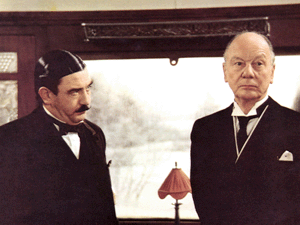
Murder on the Orient Express
Different directors have different personalities, different ways audiences look at them. Michael Bay? Loud, explosive movies. James Cameron? Huge blockbusters. Still chugging along at 86 years old, director Sidney Lumet has had a knack for working with some of Hollywood’s biggest stars in movies with a long list of those biggest stars. Working off an Agatha Christie source novel, 1974’s Murder on the Orient Express assembles one of the most impressive casts ever assembled.
Playing Belgian detective Hercule Poirot, Albert Finney leads this cast in an enjoyable, ridiculous murder mystery set in the 1935. Finney is in just about every scene and dominates the movie. I’ve never read a Christie novel or anything at all related with Poirot, but this character reminded me of Peter Falk’s TV detective Columbo. A quirky, eccentric detective solves convoluted crimes that no person in their right mind should be able to comprehend.
Boarding the Orient Express after receiving orders to return to London, famed detective Hercule Poirot (Finney) is given a berth on the crowded train thanks to a railroad official (Martin Balsam) and long-time friend. But on the second night out, a mysterious American passenger, Ratchett (Richard Widmark), is murdered, stabbed through the midsection 12 times. The railroad official turns to Poirot to solve the murder before the train reaches the next station. A snow-covered pass blocks the train’s way, giving Poirot free range to go about solving the mystery. The detective quickly figures out that Ratchett was involved in a well-known kidnapping case. So was it a hired killer, or was one of the many passengers onboard the murderer?
The murder mystery itself is an interesting one that unfolds quickly in the first 30 minutes or so. The whole next hour is devoted to a series of interrogations/interviews as Finney’s Poirot and Balsam’s Bianchi assemble the evidence concerning Ratchett’s murder. With a dialogue-heavy movie, the story sinks or swims on these scenes. In that sense, it swims long and hard. Finney earned an Oscar nomination for his performance, and it’s a treat to watch him interact with his supporting cast.
The cast is a who’s who of Hollywood stars from the Golden Age and then a newer wave of younger stars making a name for themselves and then a few in between. Describing all these characters would require a whole other review in itself so I’ll try and keep it shorter. Along with Finney, Balsam, and Widmark, there’s a list of names that include Anthony Perkins, Ingrid Bergman (Oscar-nominated supporting part), Lauren Bacall, Sean Connery, Michael York, Jacqueline Bisset, Vanessa Redgrave, Jean-Pierre Cassel, and John Gielgud. Most of them are given a brief intro and then their interrogations with Poirot. Basically that amounts to a cameo-like role for all of them, but it’s great just to see all those big-names working together.
SPOILERS Don’t read anymore if you want to know who the murderer is SPOILERS. Poirot does his detective work and then confronts all the train’s passengers. His conclusion? They all murdered Ratchett, each stabbing him once with the same knife. Each passenger has a connection to an infamous kidnapping case that Widmark’s Ratchett masterminded, resulting in the death of five people. So working together, the murdering dozen or so have planned this murder to a fault…they just didn’t plan on Poirot being onboard. This twist is stupid, ridiculous, over the top, and somehow…it works. The ending itself is a bit of a letdown, but that’s a minor complaint.
The reveal itself is well-handled in an almost 30-minute scene where all the clues and evidence comes together. Lumet handles it perfectly with quick flashbacks to Poirot’s questioning as Finney seemingly lose his mind only to figure everything out. And that’s why this is a movie worth watching, the performances from Finney to the long list of A-list actors making the most of their supporting roles. More than a little beyond the limits of believability, but still fun from beginning to end.
Murder on the Orient Express <----trailer (1974): ***/****
Wednesday, October 28, 2009
Pretty Poison
In an epically unlucky case of typecasting, Anthony Perkins made a huge impression on audiences in Alfred Hitchcock's 1960 thriller Psycho playing unhinged Norman Bates. In fact, Perkins made too big of an impression because from then on during his career, he was always looked to for the slightly crazy roles that probably prevented him from getting the more glamorous leading man roles. Perkins went through a slow period after Psycho, but in 1968 made a movie with another mentally disturbed character, Pretty Poison.TCM Underground aired this movie last Friday and having heard absolutely nothing about it I thought I'd give it a try. Perkins does play a toned-down version of Norman Bates, another disturbed individual with his fair share of personal problems. Not being an actor, I can only guess what being typecast feels like, but Perkins is so good in these roles it's easy to understand what casting directors saw in him. He plays these parts so effortlessly, making you empathize with his characters when you know you probably shouldn't.
Released from prison after serving a sentence for arson and accidental homicide, Dennis Pitt meets his parole officer, Morton Azenauer (John Randolph), who has set him up with a job in a quiet, little Massachusetts town. Dennis goes along with the plan, but takes a different job in a different town where he takes a job working in a chemical plant. Azenauer warned him not to live out his elaborate fantasies that run through his head, but Dennis can't help himself. He meets Sue Ann Stepanek (Tuesday Weld), a high school band majorette, and tells her that he is actually a secret agent for the CIA assigned to destroy the chemical plant because of the deadly toxins it dumps into the water.
At first a little skeptical, Sue Ann starts to believe Dennis' crazy statements. So with a willing sidekick, Dennis begins to plan his mission, destroy the chemical plant before it can do anymore damage. Not surprisingly, things escalate to the point where Dennis no longer has control on the situation, especially when Azenauer shows up wondering what's happened to him. As well, Sue Ann's mother (Beverly Garland) is suspicious of this older man's interest in her 17-year old daughter.
Pretty Poison's story can be described as a slow burn. Upon meeting Sue Ann, there is a feeling that everything is not quite right with this high school girl. She's just too willing to go along with this plan that Dennis concocts about being a secret agent. In this small northeastern town, Sue Ann's bored with her life and is looking for any excitement. For about the first 45 or 50 minutes, that is what the story feels like, a somewhat offbeat but almost sweet relationship between these two people. When Dennis actually puts his plan into action, that's when the sh*t really hits the fan, sending the story down a vastly different road right up until the end.
Perkins delivers a strong performance as Dennis Pitt with one question reasonating in my head as to the make-up of his character. Does Dennis really believe he is a secret agent for the CIA or is it really an elaborate fantasy in his head? It's hard to tell at times, but for most of the movie's 89 minute running time, I've got the feeling Dennis believes he is in fact a secret agent. It's only late in the movie when his fantasy has gone horribly awry that reality dawns on him. As Sue Ann, 25-year old Weld pulls off a frightening performance, really as the villain of the story. She has the innocent look of a high school senior, but below the surface there's some scary stuff going on.
Pretty Poison has been released on DVD so if interested, check out Amazon, or check out TCM's online schedule every so often to see if it pops up again sometime soon. It's a creepy story that just keeps building and building until the final scene which reminded me of the ending The Omen would use years later. Great performances from a tyepcast Perkins as a mentally disturbed man and Weld too as the not so innocent teenage girl. The trailer below has some SPOILERS, and don't be confused, this is not a romantic comedy as much as it might try to make you think otherwise.
Pretty Poison <----trailer (1968): ***/****
Subscribe to:
Posts (Atom)