Well, it's that time of the year again. Time for Alamo and Texas independence-themed reviews! Today's entry is a 1994 TV movie that aired over two nights. I remember watching it, just in that fun stage as I was really getting into history for the first time. Loved it then, liked it years later when I re-visited it, and here we sit, watching it some 21 years since I first watched it. Now I'm 29 and have everything figured out. Right? Right?!? Here's 1994's Texas.
It's 1821 and Stephen F. Austin (Patrick Duffy) is leading several hundred American settlers into the Mexican province of Texas. The settlers will help tame this wild territory that is as wild as they come, all the while doing so as Mexican citizens. The years pass though and tensions begin to rise between the Mexican government down in Mexico City and the ever-increasing number of Americans flowing into the territory. Among the settlers are a widowed mother, Mattie (Chelsea Field), trying to create a new life, a Scottish farmer, MacNab (Daragh O'Malley), who's son, Otto (Rick Schroder), will play a huge role in Texas' future, and a Mexican landowner and vaquero, Benito Garza (Benjamin Bratt), who sees the trouble coming on the horizon. As the 1820s turn into the 1830s, the tensions heat up to the point where war looks more and more likely. The war for Texas Independence is fast approaching.
From the time I saw Disney's Davy Crockett and then John Wayne's The Alamo, I was immediately intrigued by the story of the Alamo. I still am. I'll read, watch, look into anything about the subject so growing up, this ABC miniseries was right up my alley. In the years, I expanded my horizons some to include the entire Texas Revolution. So where do we start? Nine-year old me wasn't quite so harsh on what he watched. 29-year old me? Eek. I still like it because of the subject matter, but my goodness, this miniseries just isn't very good. Sure, condensing 15 years of story into a 3-hour miniseries is a daunting task....but still. The miniseries is based off an immense, humongous, if you hit someone with it you'd knock them out book from author James Michener. Well worth checking out for a good read and a good workout.
The Texas Revolution packed a ton of action into about seven months, something History's Texas Rising will hopefully bring to life come Memorial Day. What do we get here? A love triangle between politically-minded Austin, independent Mattie and fiery Benito. For real? A love triangle? Gag me. That's the crux of the first half of the running time with a surprising payoff in the second half. Come on though, Texas history and we get two guys fighting over the same woman? The budget is somewhat limited, borrowing footage liberally from previous Alamo/Texas movies like 1955's The Last Command and another TV movie, Gone for Texas. I guess it shouldn't come as a surprise that a movie made 39 years before doesn't exactly fit in with a 1994 TV movie. The attempt and effort is impressive overall, but ultimately it falls short.
Going for that big miniseries feel, we get some familiar faces in the cast but no HUGE stars. Schroder, Bratt and Duffy are the most memorable characters, bringing them to life where others remain mostly cliches or cardboard cutouts of real individuals. The relationship between Schroeder's young Otto and Bratt's Benito is a high-point, a brotherly relationship developing between the American teenager and the Mexican cowboy. That relationship takes some surprising twists as the war approaches, the two men deciding what's most important to them. Duffy too is strong as Austin, the father of Texas who's left out of the history books far too often. Field's character is interesting but is handed no favors by the screenplay that has love tearing at her from both sides. Oh, the horror!
As far as instantly recognizable Texas personalities go, we also get to meet Stacy Keach as Sam Houston, sneering and growling throughout, and our Alamo trio of Jim Bowie (an excellent if somewhat over the top David Keith), William Travis (Grant Show), and Davy Crockett (John Schneider in a small part). I also liked country singer Randy Travis as Captain Sam Garner, a Texas Ranger commander, and Frederick Coffin as Zeve Campbell, a fellow settler and friend of MacNab's. Anthony Michael Hall feels out of place and forced as the cowardly, big-talking Yancey Quimper. There's also a small part for Maria Conchita Alonso. Oh, and someone named Charlton Heston -- whoever that is -- provides the narration.
While I was still entertained overall, that entertainment came as more of a guilty pleasure this time around. The music is okay, but overdone at times, and the acting ranges from good to acceptable to hysterically overdone. Without a doubt the second half is the stronger half as Texas is plunged into the revolution, but even that's limited. The entire Alamo battle sequence is lifted from Last Command, and the Battle of San Jacinto is about 15 minutes straight of slow motion, blood-squibbed garbage. Probably best suited for history, Texas and Alamo buffs.
Texas (1994): ** 1/2 /****
The Sons of Katie Elder

"First, we reunite, then find Ma and Pa's killer...then read some reviews."
Showing posts with label Charlton Heston. Show all posts
Showing posts with label Charlton Heston. Show all posts
Tuesday, March 3, 2015

Monday, November 3, 2014
The Avenging Angel

Having traveled west as a young boy with Brigham Young (Charlton Heston) and his Mormon followers, Miles Utley grows up a devout follower of the leader of the Latter Day Saints. It is a movement though riles many, building enemies wherever it goes. As he grows up, Miles becomes a member of the Danites, a secret group of bodyguards who's sole job is to protect Young from threats both inside and out. Now a grown man, Miles (Tom Berenger) is the most skilled of these hidden assassins but now even he will be tested. He kills a would-be assassin during one of Young's speeches but something isn't quite right. It doesn't all add up. Instead, Miles finds that he's the target of something bigger and far more sinister than he thought. Who's the fall guy? Unless he can prove otherwise, it's Miles who may hang.
It's been the year of the TNT made-for-TV western here at Just Hit Play with Rough Riders, Crossfire Trail, The Buffalo Soldiers and now, The Avenging Angel. I had absolutely no recollection of this somewhat earlier entry until I stumbled across it late at night on Encore Westerns a few weeks ago. Like the other TV movies, it's made on a smaller scale but is never really limited by it. Good story, interesting cast, lots of potential. I liked the filming locations, giving the story a mountainous backdrop, and the story is pretty cool as it bends the truth quite a bit for the sake of some entertainment. 'Angel' is missing that special something, and I can't quite put my finger on it. It's okay but not much more.
If there's a positive, it is Tom Berenger, a very solid actor who never quite became a movie star. Recently I reviewed Rough Riders, Berenger stealing the movie in a showy part as future U.S. president Teddy Roosevelt. This is the polar opposite of that part. It's a quiet, intense, even sinister part. Without question, Berenger's Miles obeys orders, knowing he's doing what is required, no matter how difficult. And then it isn't so cut and dry. Has he been used for more sinister motives? I've always liked Berenger, and this is a solid, not so flashy tough guy part. That's not enough though so Miles is given two different love interests, Liza Rigby (Leslie Hope), the wife of an important Mormon leader, and Miranda Young (Fay Masterson), the daughter of Brigham Young. Three cheers for the unnecessary love story!
The rest of the cast is....well, interesting. Heston makes more of an extended cameo as the respected Mormon leader, Brigham Young. This is Hollywood legend Charlton Heston, glaring and growling through his part. Still, it is a Hollywood legend, providing some legitimacy just by being there. The same for James Coburn in a fun part as an aging Mormon trailsman, Porter Rockwell, who hasn't met his match, even training Miles for everything his job as a Danite will throw at him. Also look for Kevin Tighe, Jeffrey Jones, Tom Bower and Daniel Quinn as assorted Mormon leaders, some more important than others. It was also cool to see Andrew Prine in a cool one-scene appearance as a newspaper publisher who isn't afraid to ruffle some feathers through his stories.
I guess the worst thing you can say about this flick is its predictability. Once we've met everyone involved -- in other words, the suspects -- I thought it was pretty easy to piece it all together. When the twists come revealing who's behind this big, bad, evil plot, it doesn't really come along as a twist. That's the movie in a nutshell. Not surprising and could have been better. I'll give Berenger credit though. As another reviewer pointed out, he's got a knack for finding little known stories of American history, like here and in 1999's generally forgotten One Man's Hero. That one's good and Rough Riders was really good. This one's not that memorable.
The Avenging Angel (1995): **/****
Monday, August 18, 2014
The Buccaneer

War has broken out between the young United States of America and Great Britain, the power up for grabs after British forces capture Washington D.C., the American government barely escaping. Down in Louisiana, New Orleans is bracing for an attack, a small American army commanded by General Andy Jackson (Charlton Heston) ready to hold off a far superior British army. New Orleans will be the key as whoever holds the river will control the Mississippi River. The key to it all? A powerful, rich pirate named Jean Lafitte (Yul Brynner) who helps control the mouth of the Mississippi with his fortified pirate colony. Whichever side he sides with will have all the power and both the British and Americans are desperately trying to convince him. They're both very convincing, but what will Lafitte decide in the end?
Of all the wars America has fought in since the American Revolution in the 1770s and 1780s, the War of 1812 has to be one of those most easily forgotten. I can't even think of another film about the war. 'Buccaneer' is also noteworthy for its director, an actor making his only appearance behind the camera. Who you ask? That would be Anthony Quinn, Zorba himself taking a shot at directing. It is rumored that famed director Cecil B. DeMille did direct some of the movie while also appearing on-screen early for the prologue that sets up the history of what we're about to see in the film. What it tries to accomplish is admirable, bringing a part of American history to light that hasn't gotten the amount of attention that other wars, conflicts and incidents have. What it accomplishes in the end? That's more up in the air.
The biggest positive is Yul Brynner as infamous French pirate Jean Lafitte. As portrayed here, he's probably a little idealistic (but that's more the tone of the movie) as to the historical figure, but Brynner does a solid job. This is a man caught in the middle and trying to figure out what's his best play, whether it be with the British or the Americans. He thinks selfishly, knowing whichever way he chooses will affect his vast fleet of pirates but also thousands of other people. Dressed up as a bit of a dandy -- in one of the few roles I can think of where Brynner sports hair, even if it is a wig -- Brynner commits to the part. He has some fun with it, the best thing going in a story that tries to accomplish a lot in terms of scale and characters and history. His struggles are interesting throughout, a bit of a doomed character, and his scenes in the second half of the movie with Heston's Jackson provide the movie's strongest points.
The rest of 'Buccaneer' is more of a mixed bag. One of my biggest questions involves the sets. The entire movie is filmed on indoor sets, giving the story an odd, even cheap look. In some scenes, like the battle of New Orleans, it adds a cool claustrophobic effect to the proceedings, but for the most part it limits the potential. It's going for an epic scale, full of a long list of characters and big history, but never quite gets there. In other words, the DeMille touch...sorta. Everything is polished and colorful and too clean for an 1810s world. A pirate world at that! It's more than that though, a story that bounces around too much and simply takes too long to get where it needs to be. The last 45 minutes are 'Buccaneer' at its strongest, but the first hour and the last 15 minutes drag a bit too much. Elmer Bernstein's score is okay but not up there with his best.
So DeMille loved his epics, right? Nowhere else is that more evident in the casting. Check out the full cast and crew listing HERE. There's 200-plus names, a whole lot credited, a whole lot more uncredited. Just too much going on all over the place. There's Claire Bloom as the fiery daughter of a rival pirate captain, Charles Boyer as Lafitte's very French second-in-command, Inger Stevens as the beautiful daughter of the Louisiana governor (E.G. Marshall), Heston as Andrew Jackson, Henry Hull as his backwoods, buckskin wearing assistant, Lorne Greene as a rich resident of New Orleans, and George Matthews as Lafitte's loyal henchman of sorts. That's only part of the cast. There's too many familiar faces and recognizable names to mention. Among Lafitte's pirates we see Woody Strode to John Dierkes and many more. If you ask me, it speaks to a movie that was edited some heavily in post-production.
If you stick around, the second half is significantly better than the first half. The battle of New Orleans isn't a long, drawn-out battle but what's there is enjoyable. Parts of the movie are really good but as a whole it wastes much of its potential. Too bad.
The Buccaneer (1958): **/****
Wednesday, June 11, 2014
The Mountain Men

In the late 1830s along the Rocky Mountains, a veteran, very experienced mountain man named Bill Tyler (Charlton Heston) is coming down from the mountains with a pack mule full of beaver pelts. For the most part, Tyler likes to keep to himself, minding his own business, but when he meets a friend and fellow mountain man, Henry Frapp (Brian Keith), he decides to head to the yearly rendezvous. They want to sell their pelts, drink some whiskey and live it up a little. As the mountain man duo heads to the rendezvous, they run into trouble, a Blackfoot war party crossing their paths. Tyler rescues an Indian woman, Running Moon (Victoria Racimo), who just happens to be the squaw of the warrior leading the party, Heavy Eagle (Stephen Macht). Now instead of just looking to make some money for their winter work, Tyler and Frapp are now fighting it out with a Blackfoot war party.
The appeal of the mountain man is pretty obvious for me. Yeah, there's all those negatives -- impending doom around every corner, horrific weather, Indians trying to kill you, countless animals ready to rip you to pieces -- but is that such a big deal? Okay, sure, I guess. Maybe I'm thinking more of the romantic portrayal of the mountain men. These were the first white men to travel west into the American west, some of the first people to see some of our country's most beautiful features. They lived on their own, provided for themselves and lived among nature. Movies like this one and Jeremiah Johnson try to show that middle ground, the positive and the negative. From director Richard Lang, 'Mountain' is a beautiful movie that shows the epically big expanses of the west, filming on-location in several national parks and forests, Yellowstone, Grand Teton, Shoshone, Bridger-Teton included. You really get a sense of 1830s America, what these men saw.
If you're going to cast two hard-edged, rough-looking mountain men, you'd better get it right. I didn't love this movie, but it's hard not to appreciate the casting here. Charlton Heston and Brian Keith are pretty perfect together, both for their similarities and differences. While they're not trapping partners, they have worked together in the past and consider each other friends. Heston's Bill Tyler is more quirky, more inward, more odd in his tendencies. Keith's Frapp is his polar opposite, a motor mouth who's always talking about one thing or another, always looking for his next drink of whiskey. That odd couple dynamic works from beginning to end, especially late when Frapp decides to go with Tyler on a dangerous ride into the mountains. There is an easygoing, friendly chemistry that helps tie the episodic story together throughout.
The best supporting part goes to Racimo as Indian squaw Running Moon, desperately looking to escape from her life. It's a good part if a little forced for the sake of the story. Her chemistry with Heston is solid, but their relationship seems to develop rather quickly. Macht gets to play the stereotypically angry Indian warrior, his Heavy Eagle a menacing villain but not really given any development. Longtime Hollywood veteran Victor Jory makes his last on-screen appearance as Iron Belly, an ancient Indian chief, only on-screen for one scene. Seymour Cassel and William Lucking play two less likable mountain men, a bit of a rivalry developing when the discussion of a lost valley of untrapped waters comes up. There's at least six or seven other parts I could mention, but none are on-screen for more than a minute or two. We meet an Easterner heading west, but he disappears quickly. We meet a vengeful warrior, but same thing. He Gone.
And that in general is why this movie struggles at times. It covers a ton of ground in its relatively short 102-minute running time. Too much ground if you ask me, as if 'Mountain' had a set list of things it wants to accomplish. Running time be damned, the story was going to hit these bullet points. Too many characters, too many episodic stops along the way for the story. I liked some stops along the way -- especially the finale -- but it takes a meandering road to get there. Decent, even good, but could have been much better.
The Mountain Men (1980): ** 1/2 /****
Tuesday, March 25, 2014
Khartoum
.jpg)
In 1883, an English general marches into the Sudan with 10,000 Egyptian troops looking to capture or put down a rebellion of Muslim zealots being led by the Mahdi (Laurence Olivier), believing himself to be the one appointed by Muhammad as a savior. The army is massacred to a man, leaving the British government in a spot. The Prime Minister, William Gladstone (Ralph Richardson), doesn't want to commit a British army to the Sudan to resolve the situation, but what other measure can be taken? A solution is found in the form of a British military hero, General Charles "Chinese" Gordon (Charlton Heston), the man who helped rid the Sudan of slavery. The plan seems doomed to failure -- the British admitting to him they will only offer military assistance as a last ditch effort -- but Gordon takes the job just the same. What is his reasoning? Can he accomplish a mission with little hope of success? What does the Mahdi have in store? It's all going to be played out on an international stage.
I love a good epic from The Alamo to Spartacus, Ben-Hur to Lawrence of Arabia. This 1966 epic from director Basil Dearden doesn't quite have the huge scale of those other movies, but it is most definitely a gem. It clocks in at a modest 134 minutes (not quite the 3-hour behemoths) but accomplishes a lot in its running time. 'Khartoum' is based on a true story about Britain's quasi-involvement in the Sudan during the 1880s, filming on location in Egypt to give it some authenticity. Most importantly, it has the feel of an epic from the look to the far-reaching story to the music (composer Frank Cordell's score is solid) to the action. It doesn't have quite the reputation or following of so many other historical epics from the 1950s and 1960s, but it is well worth seeking out.
Who better to lead the way in this epic than Mr. Epic himself, Charlton Heston? Here's a case of some excellent casting. This is an underrated performance in a career that featured plenty of memorable roles, his Gordon interesting because there's so much mystery. A military hero, he's religious, loyal, intelligent, stubborn, and so much more. Does he take on this mission because he believes he can accomplish the impossible? Or is it ego, his vanity? Is it more than that? Is it something else? Whatever the answer, this is a layered, deep character who possibly only has one for sure intention...to do good. Gordon himself -- read about him HERE -- was a fascinating person, and Heston more than does him justice. We see all the sides of Gordon, a capable leader, a strong military strategist, and a man brimming with personality. It's easy to see why people believed in him, why people followed him and turned to Gordon when times were tough. An excellent performance from Heston.
The depth of the cast isn't the cast of thousands we've come to expect from an epic, but what's there is excellent. Olivier's part isn't huge -- kinda an extended cameo -- but once you get past the point that the very British actor is playing a very Muslim Arab, it's a good part. His scenes with Heston's Gordon are a high point, two Hollywood legends going toe-to-toe in quiet, underplayed scenes dripping with tension. Richard Johnson is excellent too as Colonel J.D.H. Stewart, the one officer granted to Gordon, working as his aide who sees the writing on the wall with their desperate mission. Richardson leads the government contingent as the wishy-washy prime minister, Michael Hordern, Hugh Williams and Ralph Michael as his government tools. In the military department, Nigel Green plays General Wolseley, the army commander tasked with "rescuing" Gordon, while Peter Arne plays Major Kitchener, the signal corps officer sent somewhat close to Khartoum to aid the defense. Also look for Johnny Sekka as Khaleel, Gordon's house servant, and Alexander Knox as a British official working with Gordon in Khartoum.
Enough with all this acting stuff, let's talk about some epic scale! I liked the story and the characters, feeling like I really learned something from this historic story. What resonated most though in 'Khartoum' was the impressive scale from three extended battle sequences. The opening massacre really sets the tone, the Mahdi's army swarming down hillsides at an exhausted army. Seemingly thousands of extras fill the screen in an amazingly tone-setting sequence. The middle action sequence has Gordon's forces holding off a nighttime ambush of the Mahdi's forces while the final assault on Khartoum packs the screen with Gordon's small forces in the city and the Mahdi's army charging the city in endless waves. Cinematographer Edward Scaife and second unit director Yakima Canutt (a former stunt man, a hugely underrated name in Hollywood stunt/action history) film right there in the dirt and sand with the action. They put the cameras on trucks and speed right into the battle like cavalry charging into its own battle. Great, adrenaline-pumping sequences that belong in the conversation of memorable battle scenes.
I liked a lot about this 1966 epic. It's able to cover a lot of ground, the siege of Khartoum lasting almost a full year. Things never feel rushed as we get to know Gordon, his motivations (sort of), the international situation, the British "solution" to the plan, and the slow-burn Gladstone and Parliament use to hopefully resolve it all. While it's an up and close and personal story, the script from Robert Ardrey does a good job keeping it in an international perspective. All the while, the doom builds right up until the conclusion. I liked it a lot, the expansive look from the opening prologue narrated by Leo Genn to the desert scenes and everything in between. Highly recommended.
Khartoum (1966): ***/****
Saturday, March 15, 2014
The Three Musketeers (1973)

It's the 1620s in France, and a young, poor and idealistic Frenchman, D'Artagnan (Michael York) is on his way to Paris to become a Musketeer. Without the experience necessary, D'Artagnan is quickly turned down and turned away. In the span of a few hours, he manages to insult three different Musketeers, agreeing to duel with each of them at three different times back-to-back. When he meets them later, D'Artagnan ends up fighting at their sides, including Athos (Oliver Reed), Aramis (Richard Chamberlain) and Porthos (Frank Finlay), against the Cardinal's guards. While he's not officially a Musketeer, young D'Artagnan is welcomed by the friendly trio, especially when they are thrust into some intrigue between the French queen and an English lord while Cardinal Richelieu (Charlton Heston) seeks to gain more and more power over the inept French king.
Ready to get your mind blown? This movie was originally intended for.....The Beatles!!! Director Richard Lester had worked with the famous British rockers in Help! and A Hard Day's Night, but the Musketeers a la The Beatles never came to fruition. Instead, we get this entry, a solid action-packed story with a great cast and some funny physical humor that works surprisingly well. With a ton of attention to period detail, 'Musketeers' shot on location in Spain (a nice stand-in for France, kudos to cinematographer David Watkin) and features a fun, big, fast-paced score from composer Michel Legrand. It isn't the cleaned-up, glossy vision like the 1948 version or even the 1993 reboot. I can't speak for the the newest take on Dumas' iconic characters from 2011. Lester's version though? It seems to be the favorite of all the versions, so good that most of four hours of footage was shot, Lester deciding to make one film into two. Yeah, the cast was less than pleased. Paid for one film, turned into two. That's good business.
Go figure, the high point of this 1973 take is the Three Musketeers. I haven't seen much with Michael York in it other than the Austin Powers trilogy so it was cool to see him in a part like this. Playing D'Artagnan, he just goes for it, committing to bringing the almost hyper-active, goofy, idealistic young man to life. He also falls for the lovely Constance Bonacieux, played by Raquel Welch, and that's never a bad thing. York fits in well with Reed, Chamberlain and Finlay as the three established Musketeers who all come to respect young D'Artagnan, originally thinking of him as one of their own. If anything, the group is underused through much of the 105-minute movie. I wanted to see more of them. Of the three, I was most impressed with Oliver Reed as the fiery Athos, the unofficial leader of the trio. Reed defined on-screen intensity in the 1970s, and his Athos is just a cool character, waiting for an enemy to make his mistake and unleash an attack. Also look for Roy Kinnear as Panchet, D'Artagnan's hired servant who becomes an unofficial fifth member of the group.
If there's a weakness, it's that Dumas' novel just has so much going on. A ton of characters, a fast-moving story, it's a lot to handle in a movie that's 15 minutes short of 2-hours, and that's including a credit sequence. There's a ton of talent here, but it gets lost in the shuffle at times. Heston is underused as Cardinal Richelieu, the treacherous papal official looking to take over France, Faye Dunaway playing his gorgeous spy, Milady de Winter, and Christopher Lee as Rochefort as the head of the Cardinal's guards. As for the French royalty, look for Geraldine Chaplin and Jean Pierre Cassel. Rounding out the cast is Simon Ward as the Duke of Buckingham and Spike Milligan as Bonacieux, Constance's dimwitted husband.
But what are the Musketeers all about? Sword fighting. Lots of sword fighting. Master swordsman William Hobbs choreographed some great fight scenes that are big and all over the place with four and five swordsman on either side. The highlight is a great extended fight at a quiet countryside convent, a group of laundry women working away when the Musketeers arrive to fight a group of the Cardinal's guards. The action features some great physical gags, rope swings that don't quite reach where they're needed, trips and falls at will. Kinnear provides some good laughs too, always ready to hit some baddies over the head with a blunt instrument while the Musketeers duel away with their swords. Fun throughout.
Because it was decided post-production to turn one movie into two, the ending is just sorta there. A tad disjointed to say the least with not much resolved. I hope to check in with the follow-up soon. In the meantime, this one was pretty good. How can you pass up a movie where Roy Kinnear walks around dressed up as a polar bear who can juggle and then causes massive amounts of havoc? Or a catfight between Raquel Welch and Faye Dunaway. I submit that you CANNOT.
The Three Musketeers (1973): ***/****
Tuesday, March 4, 2014
Major Dundee
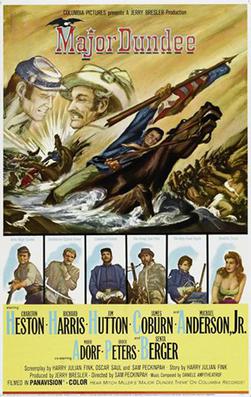
It's late in 1864, the Civil War raging back east, but in the New Mexico territory, an Apache war party led by Sierra Charriba (Michael Pate), massacres a troop of U.S. cavalry, kidnapping three boys from a local ranch at the same time. The commander of a nearby Confederate prison camp, Major Amos Dundee (Charlton Heston) decides to go after the Apaches, rescuing the kids and bringing Charriba to justice. Without abandoning the camp though, he must assemble a ragtag group of Confederate prisoners, black infantry, inexperienced officers, cowboys, drunks, bandits and thieves to capture the Apaches. At his right hand is a Confederate officer and friend from the past but now a sworn enemy, Capt. Benjamin Tyreen (Richard Harris). Dundee's company of irregular cavalry hits the trail, following the Apache war party into Mexico, tangling with occupying French forces as well. The Apaches and the French are just two enemies though, the Union and Confederate loyalties among the company threatening to tear Dundee's command apart from the inside.
The production history of this Peckinpah western has quite the checkered past. The production in Mexico went way over budget and way over schedule. Depending on what you read, Peckinpah's original cut for 'Dundee' was anywhere between three and four hours long. When the studio took it away from him, it was cut down to just over two hours. A DVD released in 2005 had a new, never before seen version with almost 15 additional minutes added to the running time. Some additional footage was found that was unable to be reinserted back into the film, but as is, we'll probably never know/see Peckinpah's intended version. So what's the end result with the 136-minute version? A far better western than the 123-minute version that features some good performances, a ridiculously deep cast, some ahead of its time vicious action, and a story that drifts needlessly at times.
What was Peckinpah's goal? He wanted to make an epic western, a new western in the vein of the John Ford cavalry movies. It was supposed to be big and violent full of scope and vision. 'Dundee' doesn't quite live up to that, but in terms of pure entertainment, it's hard to beat. It starts with Charlton Heston in the titular role. Like Peckinpah's best movies, Dundee is the flawed anti-hero like nobody's business. The story almost becomes Moby Dick in the Civil War west. Dundee has been posted to this isolated prison camp because of a command decision he made at Gettysburg (hinted at, never spelled out), and he intends to right that wrong. His plan? Get the kids back, take out Sierra Charriba, become a hero again. The problem? Dundee may not be cut out for command. He's equal parts brilliant strategist with overreaching egoist. His pride and ego get in the way of things, the mission into Mexico becoming an obsession. Quite the performance, one that doesn't always get the notoriety it deserves in Heston's already impressive filmography.
One of Peckinpah's favorite storytelling devices was the anti-hero and his right hand man, sometimes a former friend turned unwilling ally, a device used to its best ability four years later in The Wild Bunch. Here, that relationship is between Heston's Dundee and Richard Harris' Capt. Ben Tyreen. Again, their checkered history (friendship turned bitter rivalry, even hatred) all leads up to this, two men forced to work together. Harris is one of my favorite actors, and this is my favorite performance of many, one of my all-time favorite characters in any film. Harris' Tyreen is everything Dundee wants to be; intelligent, charming, a good leader, and well liked and respected by his men. Tyreen has one great line after another, Harris bringing this character to life, a Irish immigrant turned cashiered American officer to Confederate renegade. The dynamic between Dundee and Tyreen provides some of the movie's best dialogue scenes, the confrontations crackling with energy. Kudos to both actors for developing that chemistry to its fullest.
Brace yourself though. This movie has one sick cast of tough guy actors, many from the Peckinpah stock character Hall of Fame. Jim Hutton provides some laughs as Lt. Graham, a bumbling artillery officer assigned to the cavalry. James Coburn is a scene-stealer as Samuel Potts, Dundee's one-armed, bearded, quick-witted scout, as is Mario Adorf as the feisty, loyal Sgt. Gomez, Dundee's most capable Union soldier. Michael Anderson Jr. does a fine job too as Trooper Ryan, Dundee's young bugler, providing the narration from his in-mission journal. There's also Brock Peters as Aesop, the leader of the small contingent of black infantry, Slim Pickens as Wiley, the drunken mule-packer, R.G. Armstrong as Reverend Dahlstrom, the shotgun-wielding preacher, and Dub Taylor as Priam, the disheveled horse thief. As for Tyreen's Confederates, there's Ben Johnson as the tough Sgt. Chillum, L.Q. Jones and Warren Oates as Arthur and O.W. Hadley, and John Davis Chandler as Jimmy Lee, the troublemaker. Also look for Karl Swenson as Dundee's second-in-command at the prison camp. Just a ridiculously deep cast full of great characters.
Where the movie struggles some -- but is also damn entertaining in those struggles -- is the final 40 minutes. The story does drift too much from the Apaches to the French to Dundee's lost weekend in Durango and a brief love affair with Senta Berger's Teresa. Trooper Ryan's narration gets choppy, weeks slipping by in a flash. The saving grace is back-to-back action sequences, one a showdown with the Apaches in a box canyon, the other a bloody, violent battle with French lancers in the Rio Grande. This is Peckinpah at his action best, clearly an indicator of where his movies would go, especially with The Wild Bunch. Watch the scene with the French and see how brutal it is, how graphic it could have been if censors allowed it. Characters are unceremoniously killed off (blink and you'll miss it), including one surprising death, but it's just a great action scene leading to a quick ending.
Most Peckinpah fans don't list this as their favorite, maybe not even one of their favorites. I just really like this movie, always have, and the longer version with the additional 15 minutes or so really does help make it better. The musical score from composer Daniele Amfitheatrof takes some heat, especially the Major Dundee theme (listen HERE), but I like it, almost as a guilty pleasure. Filming on location in Mexico, including stops in Durango, a gorgeous waterfall location at El Saltito, and many more, all add to that authentic flavor. You really feel like you're on an odyssey across Mexico, seeing a variety of spots, locations and cities. One of my favorite westerns, a heavily flawed but just a damn entertaining movie in the end. Hard to beat, even if we'll never see that epic 4-hour version Peckinpah intended.
Major Dundee (1965): ****/****
Rewrite of August 2009 review
Friday, February 7, 2014
Beneath the Planet of the Apes
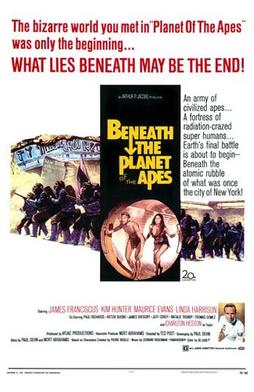
Following where the previous NASA mission explored in deep space, a spaceship crashes on the same far-off planet, astronaut Brent (James Franciscus), trying desperately to survive. When the ship's commander (Tod Andrews) dies from his wounds, Brent is all alone among the wreckage. Thinking he's alone on this planet, Brent is shocked when a woman rides over the hill on a horse packed with supplies. The woman is Nova (Linda Harrison), and she's clutching the dog tags of Taylor (Charlton Heston) in her hand. Unable to speak, Nova can't communicate what happened to Taylor, Brent only knowing that he's landed on the right planet. Nova takes him to Ape City though, leaving the stranded astronaut stunned at what he's found. Now on the run, Brent and Nova must stay one step ahead of the gorilla army, an invasion planned for the mysterious Forbidden Zone.
Picking up exactly where the original 'Apes' left off, 'Beneath' is an interesting follow-up. Following the immense success of the first movie, Fox Studios went ahead with a sequel that star Charlton Heston wanted nothing to do with. That contract thing though, it gets in the way of what you want to do. Heston agreed to play a small part (he's only on-screen for about 10 minutes) with the demand that one sequel was all there would be. Well, he got his first part of the deal, but there were three more sequels to come. What's the result here? A solid sequel that stays true to the formula laid out by the first one, adding some new layers in the second half of a 95-minute movie. Early on, it feels almost like a scene-for-scene remake -- Brent going through what Taylor did -- but it's the second half that brings the movie up a notch or two.
Replacing Heston in the lead role is Franciscus, a good actor who never became a huge star in film or television. He was a familiar face though who does a solid if unspectacular job as Brent. The biggest issue with the character is what I mentioned earlier, Brent is just too similar to Taylor to really leave his own mark. Still, I liked Franciscus, and Brent does get his chance to step into the spotlight in the final act as we find out what's in the Forbidden Zone. Also returning from the first movie is Kim Hunter as the friendly, helpful intelligent Dr. Zira, Maurice Evans as the cynical, truth-hiding Dr. Zaius, David Watson replacing Roddy McDowall (other obligations) as Cornelius', Zira's husband and fellow scientist. Also joining the cast is James Gregory as General Ursus, the commander of the army who's obsessed with leading an invasion into the Forbidden Zone.
So what exactly is out there, hiding away in the Forbidden Zone? SPOILERS in this paragraph SPOILERS Chased by a squad of gorilla cavalry, Brent and Nova ride into the Forbidden Zone, hiding away in a subterranean cavern that ends up being the subway tunnels underneath New York City. They find a community of mutants who survived the original atomic blasts and now worship a Doomsday bomb that was built strong enough to destroy the world. What to do, what to do? The mutants have no way of protecting themselves while the invading gorilla army intends to wipe out anything they find in the Forbidden Zone. Brent, Nova and Taylor are caught in the middle to look for a solution, however dangerous. Look for Paul Richards as Mendez, leader of the mutants, with Victor Buono, Jeff Corey, Natalie Trundy, Don Pedro Colley and Gregory Sierra his Mutant Cabinent of sorts.
Where 'Beneath' sets itself above the other sequels is in the road the story goes down in the final act. A familiar story up to that point, it takes a big turn....for the better. I don't want to give spoilers away because like the original, the ending resonates more if you're surprised at where it goes. You know me by now, I'm a sucker for a dark, brutally cynical ending. This one sets the bar pretty high, unceremonious in how it knocks off certain characters, the final twist coming and going in a flash. That's it. That's all. Movie over. An underrated sequel for sure, well worth checking out for science fiction fans, especially for fans of the Apes series. Next up, Escape from the Planet of the Apes!
Beneath the Planet of the Apes (1970): ***/****
Thursday, February 6, 2014
Planet of the Apes (1968)
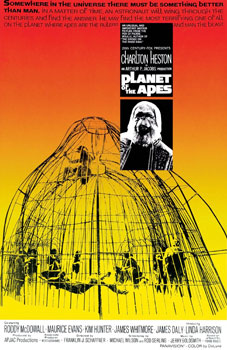
A U.S. spacecraft is traveling in deep space, its four-person crew commanded by cynical astronaut George Taylor (Charlton Heston). Their mission involves exploring the far reaches of space, but a malfunction awakens Taylor and two other survivors as their ship crash lands on a seemingly empty planet. Taylor, along with fellow astronauts Landon (Robert Gunner) and Dodge (Jeff Burton), gather what little supplies they have and head out into this unexplored world, looking for any sign of life. Walking for days inland, they finally do find life, a human-like race that is primitive to say the least, dressed in animal furs and unable to speak. The scientific find is one thing, but the trio of astronauts is in for a far bigger shock. The humans begin to run away from an unseen threat, and then they're there. Taylor and Co. run with them, stunned to see talking apes, dressed in military uniforms on horseback and armed to the teeth. What the hell is going on? What kind of planet have the astronauts found?
It's easy to forget how much impact this 1968 sci-fi classic has had on the science fiction genre as a whole. From director Franklin J. Schaffner, 'Planet' is the first of five movies (in the original series at least) that was followed by a short-lived TV show, an attempt at a reboot (2001's Planet of the Apes), and a far more successful reboot (2011's Rise of the Planet of the Apes). I'm curious to see where the most recent series goes, but this original entry will no doubt be the one all others are compared to. It's smart, original, unsettling and keeps you guessing until the end. There are some moments in the second half that drag a little bit, but the moments that work are science fiction perfection. I plan on watching and reviewing all the Apes movies so keep an eye out, and here we go!
Obviously when you're going into a movie titled Planet of the Apes, you kinda know the twist, right? There's a planet...well, of apes. Still, Schaffner's film (working off a novel from Pierre Boulle) builds the tension to almost unbearable levels in making its revelation. In a mission that isn't completely explained, NASA sends four astronauts (one dies during the voyage) deep into space at the speed of light, working off a theory that it will advance them in time. It does, some sort of malfunction bringing the spaceship into a planet's orbit, the crew crash-landing in a huge lake. We follow them for the next 30 minutes as they venture into a seemingly empty world, Lake Powell in Utah providing a beautiful, creepy, eerie backdrop. Composer Jerry Goldsmith's score is spot-on (listen to an extended sample HERE), using regular musical notes and cues but mixing it in with a variety of odd noises that sound natural and spooky, building up that fear of the unseen and unknown.
It is around the 32-minute mark we are shockingly introduced to the world run by apes. We learn over the course of the movie more about this culture with a hierarchy of government (gorillas = military/power, chimps = educators/science, orangutans = political/authority), a history going back thousands of years, beliefs and faith in a religion and a God-like being, all these little things that make the reveal all that more involving, unsettling and fascinating. As Taylor explores this world as a prisoner -- all humans are slaves -- we meet Dr. Zira (Kim Hunter) and Dr. Cornelius (Roddy McDowall), two intellectuals and scientists, interested in learning and advancing. In Heston's Taylor, they see a chance to learn, but also a threat to everything they know, believe in and hope for. Also look for Maurice Evans as Dr. Zaius, an intellectual who knows what threats history and humans hold, the film's biggest villain, James Whitmore as the President of the Assembly, James Daly as a prosecutor trying to prove Taylor is a mutant. The idea of something so well thought out, so innovative, that simian culture is an obvious but underrated reason for the movie's success. It doesn't hurt either that the makeup for the apes is immaculately impeccable.
Charlton Heston is the man. That is all. He's one of my favorites, and I think he gets a bad wrap at times because at times, he could be a tad wooden, even playing similar roles one after another. Fair to a point, but he's a Hollywood legend for sure. In a long, distinguished career, Heston piled up memorable roles, but this is one of his best. His George Taylor is smart, cynical and willing to question anyone and everything. So when he crash lands on a planet run by intelligent apes? Yeah, he's going to have some issues. His complete shock at what he's found is genuine, Heston committing to the part. At a certain point, his goal is simple, just survive on a planet and in a community that is equal parts curious and scared to death of him. He shows off his acting too, as he's struck mute for an extended portion of the movie. I love the cynical, questioning nature of the character, and the iconic lines from 'Get your paws off me, you damn dirty apes!' (one of the most iconic lines ever) to his final line still resonate 40-plus years later.
Lost at times in the science fiction world and mystery of what we've found are some great moments among the characters. I love the dynamic between Heston's Taylor and Hunter's Dr. Zira. Their dialogue scenes, with McDowall's Cornelius too, have an easy, charming back and forth to them. It just looks easy. This is where some of the ideas and messages of 'Apes' come from. Within a different culture, we see the same questions that humans ask about evolution, survival, faith, beliefs, religion, destiny and finding your niche in life. In an underrated cast that doesn't boast a ton of star power, Hunter and McDowall really step up to the plate in support of one of Heston's best performances. Also look for Linda Harrison as Nova, a woman who bonds with Taylor, even if she is mute, Lou Wagner as Lucius, Zira's nephew who helps Taylor late in the movie, and Buck Kartalian as Julius, a gorilla guard who works with Zira with their human slaves.
Well, here we are. The ending that rewrote the twist ending, something movies from every genre have tried to duplicate ever since. If you've made it this far into a Planet of the Apes review, I'm guessing that A. You either know the ending or B. Want to know the ending. No spoilers here. If you haven't seen 'Apes,' you deserve to go in fresh without any knowledge of what's coming. It is a great finale, one that deserves its fame and notoriety. A pretty perfect ending to a pretty perfect science fiction flick.
Planet of the Apes (1968): ****/****
Monday, October 28, 2013
Skyjacked

A veteran airline pilot with a military background, Capt. Hank O'Hara (Charlton Heston) boards his flight to Minneapolis on a Boeing 707 like any other flight. Once the plane is airborne though, a passenger discovers a message in the bathroom. Written on the mirror in lipstick is a message telling O'Hara to divert the plane to Anchorage or a bomb will be exploded. Is it serious? Is it a prank? While they're trying to decide for sure, a second threat/message is found, demanding the flight be diverted immediately. O'Hara goes along with it, knowing nothing can be achieved by calling the bomber's bluff. The plane heads to Anchorage but the weather is horrific for hundreds of miles in every direction. Can O'Hara get the plane to its new destination? Can they find out who the bomber is in time?
Rampant during the 1970s before dying out a bit in the early 1980s, the disaster flick genre produced some classics, some duds and a whole lot of flicks right in between. From director John Guillermin, 'Skyjacked' is right in the middle there. It's not really good, and it's not really bad. In the end, it's an entertaining, sometimes very tense disaster flick that has it's moments. For the most part it avoids a lot of the overdramatic pratfalls that can doom any movie. A nutso bomber has a bomb on an airliner packed with passengers. Do we need much else in the drama department? We waste little time before getting on board and letting the fun begin. The story does take a surprising twist near the halfway point, but I thought it worked pretty well. Yeah, it comes out of left field, but considering who the bomber is, I liked it.
It is a disaster flick so who should star? If you answered anyone else other than Charlton Heston, shame on you. In the 1970s, his name seemed synonymous with the genre. Are they all great performances? Nah, not really, but him just being there definitely legitimizes the movie. He commits to the part, and it's always fun to see him do his thing. I liked his Capt. O'Hara, a tough as nails pilot who will do anything he can to ensure that his passengers, crew and plane makes it through okay. His crew includes Mike Henry as his co-pilot and Ken Swofford as his navigator with Yvette Mimieux as Angela, the head stewardess who had a previous "thing" with O'Hara. Wouldn't you know it? Those feelings might be creeping back up again! I know, right, I didn't see that coming either!
Following the disaster movie formula, we get a whole lot of characters rounding out the cast. Will everyone make it? Who goes nuts? No spoilers here as to the identity of the bomber mostly because I had it ruined for me via a Netflix plot description. Let's start with Walter Pidgeon as a U.S. Senator on the way to Washington D.C., his son (Nicholas Hammond) who has an interest in free-spirited Susan Dey. James Brolin plays a U.S. soldier trying to get to his sister's wedding with Roosevelt Grier sharing his row of seats with him as a musician traveling with his rather large instrument. Mariette Hartley is a very pregnant woman traveling by herself while Jeanne Crain and Ross Elliott play a married couple moving to a new job after some past job troubles. Mostly a cameo, Claude Akins plays a radar specialist who helps O'Hara bring the plane down safely. Not exactly the cast of Towering Inferno in terms of star power, but it's a fun cast with some cool supporting parts.
How about the weirder portions of the movie? My favorite has Heston's O'Hara smoking a pipe...in the cockpit. In general, there seems to be a lot of smoking on-board. I know its the 1970s, but talk about a funny time capsule. A close second in the ridiculous department is pregnant Mariette Hartley turning down a water for a....Bloody Mary. Maybe her going into labor is a drink-induced karma, who knows. There's also a couple of dreamy, cloud-like flashbacks that are pretty bad, but those pale in comparison to the bomber's hallucinations. The story isn't great, keeping things on a superficial level with basically all the characters, but I did enjoy it in a stupid, entertaining popcorn flick kind of way. Decent disaster flick.
Skyjacked (1972): ** 1/2 /****
Tuesday, August 20, 2013
Gray Lady Down

Awarded a promotion, Commander Paul Blanchard (Charlton Heston) is on his last patrol, bringing in the U.S.S. Neptune -- a nuclear submarine -- into port. In foggy conditions though in the Atlantic, the surfaced submarine is struck by a Norwegian freighter and sinks, falling over 1,400 feet below the surface. The Neptune manages to land on a ledge above the ocean floor, perched precariously and one slip-up away from sinking all the way to the bottom of the ocean. They manage to send out an S.O.S. though, and the U.S. Navy is quickly sending rescue ships and crews to the site, headed by specialist Captain Bennett (Stacy Keach). Time is running out though, and the surviving members of Neptune's crew have a limited amount of air. The mission is obviously extremely delicate, the Navy turning to an eccentric officer, Capt. Gates (David Carradine), with a specialized two-man sub to save the day. Can they do so in time?
My first thought when I stumbled across this movie was that it was based on a similar story, even sounding similar to a British war movie about a similar accident, Morning Departure. Nope, I was wrong. From director David Greene, 'Gray' is a disaster flick that doesn't play like a disaster flick. For me, that was a good thing. This isn't some natural calamity, no huge building on fire, no airplane trying to stay in the air. Instead, it feels like a war story that could be true. A horrific accident at sea? A group of survivors desperately holding out? An all-out effort by the Navy to rescue them? Yeah, I could totally buy that as being a true story. It plays well without pandering or being too obvious. There aren't a lot of stand-out examples of "Oh, drama! People are in danger!"
The danger is established and recognized throughout, but for me, it never felt really obvious. That's saying something considering the end-game here. The Neptune sinks several hundred feet below its crush depth, meaning that at any second the submarine could simply be ripped to pieces by the extreme pressure of the water. I can't think of too many worst ways to die than drowning near the bottom of the ocean. Making it worse, the Neptune was torn up nicely in the collision, forcing the survivors to band together in the parts of the sub that are still operational. Just inches and feet away though, the water pressure is beating away at the air-tight doors. Credit to composer Jerry Fielding for turning in a score that doesn't need to be in the forefront either. It is a solid, underplayed score that reveals itself in some key moments.
The one way 'Gray' does stick to its disaster flick roots is in the casting. It's not a huge A-list cast like Towering Inferno or Poseidon Adventure, but it's solid just the same. Mr. Disaster himself, Charlton Heston is a rock-solid lead. It's a quieter, less obvious part that Heston handles well, the sub commander trying to keep his men going while hiding his own worry, concern and guilt over the accident. Keach does a solid part in a more workmanlike role that simply doesn't give him much to do. It's Stacy Keach though, and that ain't a bad thing. As for Blanchard's crew, Ronny Cox is Cmdr. Samuelson, the Neptune's second-in-command who starts to question how things came about. Also look for Stephen McHattie as Murphy, the officer on watch who blames himself for the accident, a pre-Caddyshack Michael O'Keefe as the radioman, Hilly Hicks as Page, the medic, and more than a few other familiar faces. Rosemary Forsyth makes a quick cameo-like appearance as Blanchard's wife.
The best part though goes to David Carradine as the eccentric Navy officer who doesn't have much use for authority in any form. His Capt. Gates has developed a two-man submersible with a hydraulic arm that can be used underwater. When the Neptune's escape hatch is blocked, Gates and his assistant, Mickey (Ned Beatty), are called in to remove the underwater debris. Gates isn't interested in protocol, orders and what should be done. He's more interested in getting the job done and rescuing the trapped men in the Neptune. It is a part and character we're supposed to like, but Carradine's roguish Navy officer handles it perfectly. Solid casting from top to bottom, Carradine rising to the top.
Sure, things get to be a little much by the end. How many different things can be thrown at this seemingly doomed submarine? It's one thing after another and all against a ticking clock getting close to its deadline. The tension gets ratcheted up throughout, especially when the Navy is finally able to use its Deep Submergence Rescue Vehile (DSRV) in conjunction with Gates' submersible. The final 45 minutes feature a couple pretty big surprises, including one shocker in the final scene that caught me by surprise. Critics and reviews ripped this one to pieces for any number of reasons, but I liked it. It's a solid, entertaining and pretty dramatic story that kept me interested throughout. Also, look for a pre-Superman Christopher Reeve making his screen debut.
Gray Lady Down (1978): ***/****
Tuesday, June 4, 2013
Three Violent People

It's been a few months since the end of the Civil War, and decorated Confederate cavalry officer Capt. Colt Saunders (Charlton Heston) is trying to return home to his cattle ranch in Texas. Making one last stop, he's knocked out in a fight as he tries to rescue a beautiful woman from some drunken carpetbaggers. The woman's name is Lorna (Anne Baxter), and she's a former dance hall girl but doesn't tell Colt that. They marry within hours of meeting and head to the ranch, but problems galore await. The provisional government, including Commissioner Harrison (Bruce Bennett), is scooping up land, cattle and horses with little in return for the owners. Looking to keep his ranch going, Colt has no intention of just handing over everything he owns. As Lorna holds out on her secret, Colt readies for a fight to protect what's his own.
Telling the story of the Reconstruction era via a Texas ranch is a pretty cool idea for director Rudolph Mate's western. The opening scene does a solid job of setting the stage. Carpetbaggers have descended on towns all across the war-torn south, scooping up businesses and failed ranches for rock bottom prices. A Confederate vet and a native Texan, Colt obviously doesn't abide by this new development. It's cool to see a western deal with this subject, especially the corruption that riddled the government. In hopes of rebuilding the country, some rather nasty decisions had to be made.
Unfortunately though, that's probably the best thing going for Mate's film; the story. Basically everything else falls short, starting with the leads. Heston was always at home in historical flicks whether they be westerns, biblical stories, or period pieces. It's odd then saying that he's miscast here as Capt. Colt Saunders a fiery, short-tempered rancher who does what he needs/wants and everything else can be damn. Heston could be all of those things depending on the role, but he looks to be sleepwalking here. It obviously doesn't help then when Heston and Baxter have little to no chemistry together. The whole relationship seems forced and goofy, the duo exchanging lots of passionate embraces and even....GASP!....a few kisses. And fade to black!
The rest of the cast is slightly better if still misused or underused. Gilbert Roland is not surprisingly a scene-stealer as Innocencio, Colt's top hand and longtime worker at the ranch. We've seen the part before as Roland uses a mix of Spanglish and 'Ay Chihuahua!' moments. Still, he's good at it so be it. Even look for some familiar faces among his five sons, the very Mexican-looking Robert Blake and a pre-MASH Jamie Farr. Tom Tryon has a cool character as Cinch, Colt's one-armed younger brother who holds a ton of resentment for his brother, but Tryon's not the most personable actor. Bennett is slimy as Harrison with Forrest Tucker wasted as his main henchman, Cable.
With a slow-moving, sappy story, I really disliked the first hour-plus of this 99-minute flick. The final half hour or so saves it from being a complete waste of time thankfully. All these different characters and rivalries finally step up to the plate and embrace some of their Greek mythology roots. Brother hates brother? Wife with secret hates husband? Betrayals, greed and redemption? Yes, it must be Greek mythology! The ending is a little too tidy, but it is significantly more enjoyable than the first hour. Still not a great movie, but not awful. If that's not a ringing endorsement, I don't know what is.
Three Violent People (1956): **/****
Tuesday, December 25, 2012
The War Lord
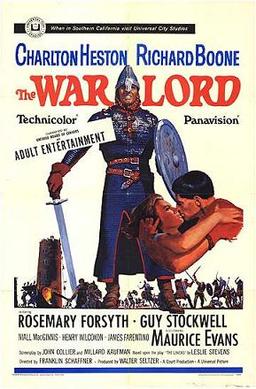
It's the 11th Century in the Middle Ages in France, knight Chrysagon de la Cruex (Heston) has been given a mission. An isolated Druid village along the coast comes under constant attack so Chrysagon is tasked with taking a small troop of knights and soldiers, including his brother, Draco (Guy Stockwell), and right hand man, Bors (Richard Boone). Upon arriving, he finds a poor village where a failed defensive castle was only partially built and villagers who have strayed from acceptable ways. Chrysagon's group works well though, but the knight falls for a beautiful young woman from the village, Bronwyn (Rosemary Forsyth). The only problem? She is engaged to a villager, and the only way Chrysagon can have her is to simply take her, angering the rest of the villagers. All the while, the threat of an attack looms.
In the age of the epics -- the 1960s -- this modestly scaled epic from director Franklin J. Schaffner has been lost in the shuffle over the last 40-plus years. I say 'modestly scaled,' and I don't intend that at all in a negative way. There are no on-location shooting, just California filling in for Middle Ages France. Much of the story is contained in one stretch of marshy coast, Chrysagon's single-towered castle sitting just off the land in a shallow waterway. There is something simple and elegant about the setting; the knights in their water-surrounded castle, the villagers hidden away in the woods. So while the scale isn't on a hugely epic level -- no countries warring, no government in-fighting -- it focuses on the personal at its most simple. In this case, it's just a man and woman who fall madly in love with each other and all the repercussions and fall-out.
I've made no secret about my general disdain for romance sub-plots in stories that simply don't call for it. In this epic though, it's not only necessary but handled well. I don't think of Heston as a natural choice for a historical epic's romantic lead, but he does a solid job here in an understated way. His Chrysagon has been fighting for a Duke for 20-something years, traveling, fighting and warring wherever he goes. When he meets Forsyth's Bronwyn, he can't help himself. He needs her, wants her. Similarly, Bronwyn is drawn to him in a way she can't explain. Without being ridiculously lovey-dovey or over the top, this relationship seems real. Everything hits the fan when Chrysagon realizes a local custom allows the powerful lords to take a virgin bride on her wedding night for himself. Not surprisingly, Bronwyn's husband-to-be (James Farentino) is less than pleased to give away his wife for a night. The results are not surprisingly pretty downbeat, but getting there is worthwhile, and the finale is a highly effective emotional punch.
Balancing out the effective love story is the solid casting backing up Heston. Adding another dimension is Stockwell's Draco as Chrysagon's brother. Brothers in the Middle Ages who differ in opinions on how to do things? Well, it doesn't take a nuclear scientist to figure out that might not end well. Stockwell does a fine job as Draco, the less-experienced knight in battle who nonetheless wants to prove himself. As the gruff voiced Bors, Boone delivers the best supporting performance. As we learn more about how these characters came to ride together, Boone's acting gets better and better, including a great job in the last few scenes without saying more than a few words. Also look for Maurice Evans as the local priest caught in the middle of the knights and villagers, Niall MacGinnis as Odins, the village elder trying to hold his people together, Henry Wilcoxon as the rival Frisian chief, and Allen Jaffe and Michael Conrad as two of Chrysagon's men.
So overall, I liked this movie a lot. I liked it a lot, and that's considering that there is little in the way of action until the last third of the 120-minute long movie. When it does arrive on the scene, the action does not disappoint. The Frisian raiders arrive to reclaim the chief's son -- accidentally left behind in a raid and feared dead -- forcing Chrysagon and his troop to retreat to their castle tower for defense. The violence is brutal without being graphic, and the action is kept from the view of the foot soldiers. We see the Frisians attacking -- catch an example HERE -- in various ways, any way to breach the heavily guarded door or at least get over the walls. The attack runs about 25 minutes, and it's a gem. The post-battle fallout is equally good too. Also worth mentioning, the score from Jerome Moross and Hans J. Salter is perfect for both the action and the love scenes. Check out the entire movie at Youtube starting HERE.
The War Lord (1965): ***/****
Tuesday, September 27, 2011
Planet of the Apes (2001)
_poster.jpg)
My curiosity got the best of me on this one. The original five 'Apes' movies are some of my favorites, and the newest entry was highly enjoyable. I've avoided director Tim Burton's addition to the series for years for a couple reasons. The biggest reason? I thought it looked like a pile of awfulness. More than that though, it looked like a dumbed-down, mindless remake that didn't need to be remade. I was in the right frame of mind though to watch it, hoping my enjoyment from 'Rise' might boost the 2001 version. Long story short? It didn't. The 2001 version is everything I was afraid it would be and more...or less I guess depending on how you look at it.
An astronaut/scientist on a U.S. space station in 2029, Leo Davidson (Mark Wahlberg) is working with a large staff, exploring all space has to offer, including studies with chimps. As the station moves through space, an electromagnetic storm is discovered in front of them, Leo following one of his test chimps into the storm which turns out to be a wormhole. His pod crash lands on a strange planet full of jungle and deserts. Just minutes after crash landing though, he makes a bizarre discovery. The planet is ruled by a war-like tribe of apes, and the humans are slaves. Leo is caught almost immediately so what can he do? An ape general, Thade (Tim Roth), is suspicious of this more intelligent human, leaving Leo to come up with a plan. Can he get free and then get off this planet?
This next part is going to sound stupid, but I can't come up with a smart, semi-intelligent way to say it. You're watching a movie called 'Planet of the Apes,' right? It's clear at some point a human main character will discover he's on a planet ruled by intelligent apes, right? With the 1968 original, there's a sense of mystery, and when the apes are revealed in the human-hunting scene, there is a genuine shock and surprise...even knowing it's coming. That is a fundamental problem of Burton's 2001 remake. Wahlberg's Leo crash lands, runs, sees intelligent apes and never seems to question what's going on. He just goes along with it. To a point, Burton and the script seem to take that element for granted, assuming the audience just isn't going to be shocked/surprised and throwing that chance aside.
As I brought up in the 'Rise' review, there was a cheese-ball charm to the original, humans dressed up as apes. 'Rise' went the other route with computer-generated apes (<---that sounds cool). 2001's 'Planet' is somewhere in between, but the effort falls short. The apes, gorillas and chimps are both too human and too simian-based. At times, they are like skittish cats, and other times are far too much like humans. Also, monkeys apparently can leap hundreds of feet into the air from a stand-still. Who knew? Roth's Thade is too over the top as a villain, finding a way to be both unintentionally funny and not intimidating at the same time. Helena Bonham Carter is Ari, a sympathetic monkey, Michael Clarke Duncan is the angry army ape, Paul Giamatti is a finnicky slave-trading monkey, David Warner is a monkey senator, and even Charlton Heston himself -- star of the original Apes movie -- makes a quick appearance.
Now as much as I like Mark Wahlberg, I think he is not the right choice here to play the lead, U.S. astronaut Leo Davidson. Some of it is his fault as he doesn't bring a whole lot of charisma to the part, brooding and growling through his situation. He also never seems to question anything. If it's me, and I crash land on a planet ruled by apes....I don't know...maybe I ask some questions. In the matter of hours, Leo becomes this heroic human who all the slaves are drawn to, and I'm thinking....really? That's all it took? Punch an ape and lead a poorly planned escape? The script gives him absolutely nothing to do though so it's not entirely on Wahlberg. Also wasted in human parts is Kris Kristofferson as Karubi, a chief of a fleeing tribe, and supermodel Estella Warren as Daena, a young, babely human girl. I imagine at some point the script called for a random hot girl who had to do nothing except look good. She nails the part in that sense.
There is something missing in this movie that I can't put my finger on. The look of the movie isn't quite right, appearing like it was shot on a poorly-built studio set. The ape village/town certainly looks pretty clean as does the whole movie. Jungle, village, expansive desert, it feels faked. The whole movie is boring though on top of that. There is a certain B-movie campiness to it, but basically nothing happens, Leo becomes a hero, leads a revolution, and then there is a brief ape vs. human fight. The original explored in some depth the idea of what was happening, animal mistreatment, fate and destiny, bigger issues. Not so much here. Dumbed-down was pretty spot on, the final product a mindless two hours that doesn't even touch its predecessors.
And how about that ending? The 1968 original was a gem, one that still is remembered for its shock value. How about this one? Shock value, yes, but it makes absolutely no FREAKING sense. Burton has said in interviews he left it up to the audience to make up their mind, and that a possible sequel would have explained things clearly. That's a weak excuse on the part of a director. It certainly goes for a surprise, and it is that...surprising. But nothing is explained, and no logical, reasonable explanation comes to mind. You've got to watch it yourself though, and revel in the badness.
Planet of the Apes <---trailer (2001): */****
Subscribe to:
Posts (Atom)