So I'm kinda slow sometimes. I'm not the most tech-oriented of people so I just kinda assumed iTunes just offered music downloads and rentals of new movies. Yeah...nope. There's hundreds and thousands of movies available to rent and/or buy!!! You'd think I would have realized this years ago, but anyhoo, here we sit. I found a flick I've long sought out, 1961's The Long and the Short and the Tall.
During the Japanese invasion of Burma in 1942, a small, seven-man patrol commanded by Sgt. Mitchem (Richard Todd) is deep in the jungle miles away from their base camp. Their mission? Record sounds of troop movements and vehicles moving through the jungle that will be used to trick Japanese troops into thinking they're facing more opposition than they really are. With his right-hand man, Corporal Johnstone (Richard Harris), at his side, Mitchem is trying to keep things in line with inexperienced soldiers making up the patrol. As they prepare to wrap up the mission, the patrol begins to have radio issues, and the men begin to question if something is up. Several are convinced they've been cut off by Japanese troops, and they're now on their own deep in the jungle. Can they make it back to the camp? Their situation is muddled even more when a lone Japanese soldier walks into their camp. Now they're alone and isolated and also have to decide what to do with their prisoner.
Talk about a dark, anti-war flick. This is your movie if you're looking for one. Director Leslie Norman helms this British film that's based off a play and doesn't have much of a reputation built up over the years. It's surprising in that sense because 'Long' is quite the quality movie. Sure, it has flaws but it tries things that movies weren't even thinking of trying, much less attempting yet. Filmed in a stark black and white, the story was filmed on indoor sets in England. Rather than film in real jungles, the decision works. The plants and vegetation permeate the screen to give things quite the claustrophobic feel that hangs in the air. The Japanese troops could be anywhere, but we just can't see them. Music is kept to a minimum with very little taking away from the ever-developing story.
For both good and bad, one of the most interesting things in 'Long' is the dialogue. Based off a play, this is movie dependent on an abundance of dialogue. Why does it work? It feels authentic...when I could understand it. The patrol is made up of soldiers from all over Great Britain, Scotland and Ireland so we get all sorts of thick brogues and cockney accents. This is a movie dependent on getting to know the soldiers through these conversations. We learn little about them in terms of background, but we start to see their personalities, their dynamics, their rivalries, their hatreds. At times, it gets to be a little much because it just wears on your ears, 90-plus minutes of soldiers bitching and moaning at each other.
So in terms of reality, 'Long' gets big points. These aren't heroic, gung-ho soldiers seeking glory. They just want to stay alive. Todd and Harris are good together as the only two veterans among the group. There's also Laurence Harvey as Bamforth, an annoying motormouth from London, Ronald Fraser as MacLeish, the wishy-washy Scotsman, David McCallum as Whitaker, the mousy radioman, John Meillon as Smith, the most intelligent among the group but simply looking to follow orders, and John Rees as Evans, Bamforth's friend and a bit of a follower. There isn't a likable man in the bunch, just less despicable individuals. This isn't an anti-war movie made about Vietnam. This was made in the early 1960s and is already beginning to reflect how the world felt about war and violence and so-called bravery and heroism. Quite a cast, all of them playing humans, not robotic killing machines. Harvey especially hams it up, pushing buttons left and right to the point he's unbearable as a character. Quite the performance if you think of it that way.
It's in the last half that things really take a turn for the dark when the patrol takes a prisoner (Kenji Takaki) and must decide what to do about him. Take him along? Leave him behind to possibly talk? Or the most uncomfortable option...kill him in cold-blood? The story blends morality, ethics, survival, the rules of war, right and wrong, all of it as the situation gets harrier and harrier. The finale takes some interesting turns, some of them more predictable than others, but they work. Overall, it's a really good movie that's missing that special something. I really recommend it, but it's more of a quality movie than an entertaining movie. Still worth chasing it down but know what you're getting into here.
The Long and the Short and the Tall (1961): ** 1/2 /****
The Sons of Katie Elder
"First, we reunite, then find Ma and Pa's killer...then read some reviews."
Showing posts with label Richard Harris. Show all posts
Monday, February 2, 2015
Tuesday, August 12, 2014
The Wild Geese
A little bit of a spin on the wild west gunslinger, today's
discussion centers around the mercenary, the hired gun who will take
just about any job as long as the money is good. And if movies have
taught us anything, mercenaries had lots of work throughout Africa in
the 1960s and since with movies like Dark of the Sun, The Dogs of War
and most recently Tears of the Sun. What about the best of the bunch?
It's a movie many American viewers may not have heard of because it
didn't get much of a release in the states. That movie? One of my
favorites, 1978's The Wild Geese.
A brutally efficient mercenary with years of experience under his belt, Allan Faulkner (Richard Burton) has agreed to take on a dangerous mission in Africa courtesy of the equally brutal, efficient and greedy merchant banker, Sir Edward Matherson (Stewart Granger). With lucrative copper mining rights on the line, Matherson needs Faulker to rescue a deposed African leader, Julius Limbani (Winston Ntshona), a leader of the people and a good man, to retake the government and settle things down. Taking a hefty payday, Faulker assembles an experienced, effective unit of 50 mercenaries, including fellow officers Lt. Shawn Fynn (Roger Moore), Capt. Rafer Janders (Richard Harris) and Lt. Pieter Coetzee (Hardy Kruger), and goes about putting together an effective plan, a smash and grab job. Faulker has the men assembled to pull off the job with a minimum of danger, but no matter how well thought out the mission is, even these mercenaries can't know what awaits them when they drop into Africa.
This review comes just a day after my Von Ryan's Express review, one of the great entertaining war movies ever made. More than that, just a great action movie. Well, surprise surprise, but I put this 1979 mercenary-centric action/drama on the same level. Is it a great movie in the vein of The Godfather or Lawrence of Arabia? Heck no, but it doesn't need to be! I watched a version that was 128 minutes long, and it is one extended thrill ride from beginning to end. Director Andrew McLaglen is far from a great director, but this is one of his best (if not THE best) movies. It is gritty, graphic, rough and tumble and the definition of a great tough guy flick. This is a movie that earns it's "Guy's Guy" type of movie, even if that theme song (listen HERE) seems a little out of place. But that's for the opening and closing credits. Enough with that. Let's get to the action!
Okay, not quite yet there with the casting. In the men-on-a-mission vein of The Guns of Navarone or Where Eagles Dare, here's one of the all-time great tough guy casts. The script calls for some older mercenaries, giving stars who weren't exactly A-list stars a chance at the spotlight again, and let me tell you, they don't disappoint. In a part of his career where the films weren't exactly great (an understatement), Richard Burton absolutely nails the part as Faulkner, a weathered, experienced mercenary who doesn't care for much other than the money he makes and the booze he can drink. Not exactly a stretch, but let's not nitpick. His officers include Harris as Janders, the master tactician and planner, Moore as Fynn, the born soldier who can fly or drive anything with a motor, and Kruger as Coetzee, the South African experienced bush fighter who has quite a few racist tendencies. They each get their moments to shine, the tough guy quartet killing it throughout with an easygoing, likable chemistry.
But wait....there's more!!! Along with Granger's quick appearance, there's Barry Foster and Patrick Allen as other shadowy characters involved in putting the mission together. Filling out the mercenary lineup are scene-stealing Jack Watson as foul-mouthed drill instructor Sandy Young, John Kani as Sgt. Jesse, the youngest of the bunch but an incredibly capable fighter, Kenneth Griffith as Witty, the flamboyantly gay medic, with Ronald Fraser, Ian Yule (an actual former mercenary), Percy Herbert, and Glyn Baker rounding out the crew. Also look for Jeff Corey and Frank Findlay in small parts. Just a cool, underrated supporting cast with plenty of memorable, recognizable faces.
Based off a novel by Daniel Carney and a Reginald Rose screenplay, one of 'Wild's' most underrated aspects is its script. Yes, it is familiar. Yes, it is politically incorrect one moment and somewhat preachy the next. But in the end, you throw it all together and all those separate ingredients work well together. It follows the men-on-a-mission formula nicely, going from assembling the team, to training the team, to unleashing the mercenaries on their dangerous mission deep in Africa, a regiment of brutal Simbas waiting to wipe them out if given the chance. There's too many good moments to mention from the Wild Geese free-falling out of a plane at 25,000 feet to Watson's hysterical rants during the training sequences to the almost non-stop smartass attitudes that produce a ton of memorable one-liners, some funny and some highly effective in the old drama department. Just a lot of positives on display here across the board.
But the biggest positive? The action of course! It's so good that the DVD actually offers a stand-alone menu where you can watch solely the explosions, shootouts and all sorts of hell that breaks loose. Without giving away any spoilers, the mission doesn't go off quite as planned, Faulkner and his men forced to improvise deep in enemy territory. Most of the last hour of the film is one extended action scene with some occasional dialogue to break things up. The highlight is the last 30 minutes, the mercenaries shooting it out with a large force of Simbas hell bent on stopping them from escaping. It's bloody, graphic and uncomfortable and features some surprising twists too as the body count rises ever higher. The action turns into a chaotic chase across the African savannah, lines and flanks shifting minute to minute. What an action movie.
This can be a difficult movie to track down. Years ago, I was lucky enough to track down a Tango DVD of this 1978 mercenary flick. It's currently available at Amazon for a very reasonable $12.99 if you're curious. As I mentioned, is it a perfect film? Nope, and again, it isn't meant to be. Instead, it is pure escapism, pure entertainment, and for me that's all I'm looking for. Familiar but highly entertaining story, action to burn and one of my all-time favorite casts. Can't recommend this one enough.
The Wild Geese (1978): ****/****
Rewrite of June 2009 review
A brutally efficient mercenary with years of experience under his belt, Allan Faulkner (Richard Burton) has agreed to take on a dangerous mission in Africa courtesy of the equally brutal, efficient and greedy merchant banker, Sir Edward Matherson (Stewart Granger). With lucrative copper mining rights on the line, Matherson needs Faulker to rescue a deposed African leader, Julius Limbani (Winston Ntshona), a leader of the people and a good man, to retake the government and settle things down. Taking a hefty payday, Faulker assembles an experienced, effective unit of 50 mercenaries, including fellow officers Lt. Shawn Fynn (Roger Moore), Capt. Rafer Janders (Richard Harris) and Lt. Pieter Coetzee (Hardy Kruger), and goes about putting together an effective plan, a smash and grab job. Faulker has the men assembled to pull off the job with a minimum of danger, but no matter how well thought out the mission is, even these mercenaries can't know what awaits them when they drop into Africa.
This review comes just a day after my Von Ryan's Express review, one of the great entertaining war movies ever made. More than that, just a great action movie. Well, surprise surprise, but I put this 1979 mercenary-centric action/drama on the same level. Is it a great movie in the vein of The Godfather or Lawrence of Arabia? Heck no, but it doesn't need to be! I watched a version that was 128 minutes long, and it is one extended thrill ride from beginning to end. Director Andrew McLaglen is far from a great director, but this is one of his best (if not THE best) movies. It is gritty, graphic, rough and tumble and the definition of a great tough guy flick. This is a movie that earns it's "Guy's Guy" type of movie, even if that theme song (listen HERE) seems a little out of place. But that's for the opening and closing credits. Enough with that. Let's get to the action!
Okay, not quite yet there with the casting. In the men-on-a-mission vein of The Guns of Navarone or Where Eagles Dare, here's one of the all-time great tough guy casts. The script calls for some older mercenaries, giving stars who weren't exactly A-list stars a chance at the spotlight again, and let me tell you, they don't disappoint. In a part of his career where the films weren't exactly great (an understatement), Richard Burton absolutely nails the part as Faulkner, a weathered, experienced mercenary who doesn't care for much other than the money he makes and the booze he can drink. Not exactly a stretch, but let's not nitpick. His officers include Harris as Janders, the master tactician and planner, Moore as Fynn, the born soldier who can fly or drive anything with a motor, and Kruger as Coetzee, the South African experienced bush fighter who has quite a few racist tendencies. They each get their moments to shine, the tough guy quartet killing it throughout with an easygoing, likable chemistry.
But wait....there's more!!! Along with Granger's quick appearance, there's Barry Foster and Patrick Allen as other shadowy characters involved in putting the mission together. Filling out the mercenary lineup are scene-stealing Jack Watson as foul-mouthed drill instructor Sandy Young, John Kani as Sgt. Jesse, the youngest of the bunch but an incredibly capable fighter, Kenneth Griffith as Witty, the flamboyantly gay medic, with Ronald Fraser, Ian Yule (an actual former mercenary), Percy Herbert, and Glyn Baker rounding out the crew. Also look for Jeff Corey and Frank Findlay in small parts. Just a cool, underrated supporting cast with plenty of memorable, recognizable faces.
Based off a novel by Daniel Carney and a Reginald Rose screenplay, one of 'Wild's' most underrated aspects is its script. Yes, it is familiar. Yes, it is politically incorrect one moment and somewhat preachy the next. But in the end, you throw it all together and all those separate ingredients work well together. It follows the men-on-a-mission formula nicely, going from assembling the team, to training the team, to unleashing the mercenaries on their dangerous mission deep in Africa, a regiment of brutal Simbas waiting to wipe them out if given the chance. There's too many good moments to mention from the Wild Geese free-falling out of a plane at 25,000 feet to Watson's hysterical rants during the training sequences to the almost non-stop smartass attitudes that produce a ton of memorable one-liners, some funny and some highly effective in the old drama department. Just a lot of positives on display here across the board.
But the biggest positive? The action of course! It's so good that the DVD actually offers a stand-alone menu where you can watch solely the explosions, shootouts and all sorts of hell that breaks loose. Without giving away any spoilers, the mission doesn't go off quite as planned, Faulkner and his men forced to improvise deep in enemy territory. Most of the last hour of the film is one extended action scene with some occasional dialogue to break things up. The highlight is the last 30 minutes, the mercenaries shooting it out with a large force of Simbas hell bent on stopping them from escaping. It's bloody, graphic and uncomfortable and features some surprising twists too as the body count rises ever higher. The action turns into a chaotic chase across the African savannah, lines and flanks shifting minute to minute. What an action movie.
This can be a difficult movie to track down. Years ago, I was lucky enough to track down a Tango DVD of this 1978 mercenary flick. It's currently available at Amazon for a very reasonable $12.99 if you're curious. As I mentioned, is it a perfect film? Nope, and again, it isn't meant to be. Instead, it is pure escapism, pure entertainment, and for me that's all I'm looking for. Familiar but highly entertaining story, action to burn and one of my all-time favorite casts. Can't recommend this one enough.
The Wild Geese (1978): ****/****
Rewrite of June 2009 review
Tuesday, March 4, 2014
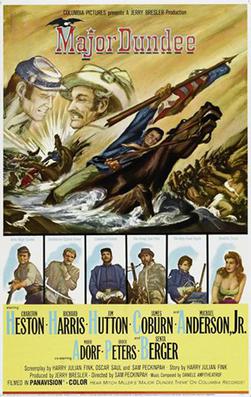
Major Dundee
It's late in 1864, the Civil War raging back east, but in the New Mexico territory, an Apache war party led by Sierra Charriba (Michael Pate), massacres a troop of U.S. cavalry, kidnapping three boys from a local ranch at the same time. The commander of a nearby Confederate prison camp, Major Amos Dundee (Charlton Heston) decides to go after the Apaches, rescuing the kids and bringing Charriba to justice. Without abandoning the camp though, he must assemble a ragtag group of Confederate prisoners, black infantry, inexperienced officers, cowboys, drunks, bandits and thieves to capture the Apaches. At his right hand is a Confederate officer and friend from the past but now a sworn enemy, Capt. Benjamin Tyreen (Richard Harris). Dundee's company of irregular cavalry hits the trail, following the Apache war party into Mexico, tangling with occupying French forces as well. The Apaches and the French are just two enemies though, the Union and Confederate loyalties among the company threatening to tear Dundee's command apart from the inside.
The production history of this Peckinpah western has quite the checkered past. The production in Mexico went way over budget and way over schedule. Depending on what you read, Peckinpah's original cut for 'Dundee' was anywhere between three and four hours long. When the studio took it away from him, it was cut down to just over two hours. A DVD released in 2005 had a new, never before seen version with almost 15 additional minutes added to the running time. Some additional footage was found that was unable to be reinserted back into the film, but as is, we'll probably never know/see Peckinpah's intended version. So what's the end result with the 136-minute version? A far better western than the 123-minute version that features some good performances, a ridiculously deep cast, some ahead of its time vicious action, and a story that drifts needlessly at times.
What was Peckinpah's goal? He wanted to make an epic western, a new western in the vein of the John Ford cavalry movies. It was supposed to be big and violent full of scope and vision. 'Dundee' doesn't quite live up to that, but in terms of pure entertainment, it's hard to beat. It starts with Charlton Heston in the titular role. Like Peckinpah's best movies, Dundee is the flawed anti-hero like nobody's business. The story almost becomes Moby Dick in the Civil War west. Dundee has been posted to this isolated prison camp because of a command decision he made at Gettysburg (hinted at, never spelled out), and he intends to right that wrong. His plan? Get the kids back, take out Sierra Charriba, become a hero again. The problem? Dundee may not be cut out for command. He's equal parts brilliant strategist with overreaching egoist. His pride and ego get in the way of things, the mission into Mexico becoming an obsession. Quite the performance, one that doesn't always get the notoriety it deserves in Heston's already impressive filmography.
One of Peckinpah's favorite storytelling devices was the anti-hero and his right hand man, sometimes a former friend turned unwilling ally, a device used to its best ability four years later in The Wild Bunch. Here, that relationship is between Heston's Dundee and Richard Harris' Capt. Ben Tyreen. Again, their checkered history (friendship turned bitter rivalry, even hatred) all leads up to this, two men forced to work together. Harris is one of my favorite actors, and this is my favorite performance of many, one of my all-time favorite characters in any film. Harris' Tyreen is everything Dundee wants to be; intelligent, charming, a good leader, and well liked and respected by his men. Tyreen has one great line after another, Harris bringing this character to life, a Irish immigrant turned cashiered American officer to Confederate renegade. The dynamic between Dundee and Tyreen provides some of the movie's best dialogue scenes, the confrontations crackling with energy. Kudos to both actors for developing that chemistry to its fullest.
Brace yourself though. This movie has one sick cast of tough guy actors, many from the Peckinpah stock character Hall of Fame. Jim Hutton provides some laughs as Lt. Graham, a bumbling artillery officer assigned to the cavalry. James Coburn is a scene-stealer as Samuel Potts, Dundee's one-armed, bearded, quick-witted scout, as is Mario Adorf as the feisty, loyal Sgt. Gomez, Dundee's most capable Union soldier. Michael Anderson Jr. does a fine job too as Trooper Ryan, Dundee's young bugler, providing the narration from his in-mission journal. There's also Brock Peters as Aesop, the leader of the small contingent of black infantry, Slim Pickens as Wiley, the drunken mule-packer, R.G. Armstrong as Reverend Dahlstrom, the shotgun-wielding preacher, and Dub Taylor as Priam, the disheveled horse thief. As for Tyreen's Confederates, there's Ben Johnson as the tough Sgt. Chillum, L.Q. Jones and Warren Oates as Arthur and O.W. Hadley, and John Davis Chandler as Jimmy Lee, the troublemaker. Also look for Karl Swenson as Dundee's second-in-command at the prison camp. Just a ridiculously deep cast full of great characters.
Where the movie struggles some -- but is also damn entertaining in those struggles -- is the final 40 minutes. The story does drift too much from the Apaches to the French to Dundee's lost weekend in Durango and a brief love affair with Senta Berger's Teresa. Trooper Ryan's narration gets choppy, weeks slipping by in a flash. The saving grace is back-to-back action sequences, one a showdown with the Apaches in a box canyon, the other a bloody, violent battle with French lancers in the Rio Grande. This is Peckinpah at his action best, clearly an indicator of where his movies would go, especially with The Wild Bunch. Watch the scene with the French and see how brutal it is, how graphic it could have been if censors allowed it. Characters are unceremoniously killed off (blink and you'll miss it), including one surprising death, but it's just a great action scene leading to a quick ending.
Most Peckinpah fans don't list this as their favorite, maybe not even one of their favorites. I just really like this movie, always have, and the longer version with the additional 15 minutes or so really does help make it better. The musical score from composer Daniele Amfitheatrof takes some heat, especially the Major Dundee theme (listen HERE), but I like it, almost as a guilty pleasure. Filming on location in Mexico, including stops in Durango, a gorgeous waterfall location at El Saltito, and many more, all add to that authentic flavor. You really feel like you're on an odyssey across Mexico, seeing a variety of spots, locations and cities. One of my favorite westerns, a heavily flawed but just a damn entertaining movie in the end. Hard to beat, even if we'll never see that epic 4-hour version Peckinpah intended.
Major Dundee (1965): ****/****
Rewrite of August 2009 review
Sunday, August 5, 2012
Gladiator (2000)
The age of the historical epic has long since past, the 1950s and 1960s full of three-hour movies with a cast of thousands, scale to spare and a window into a historical time long since past. It's hard to beat these movies in terms of pure entertainment quality, a time when Hollywood -- a pre CGI Hollywood -- was willing to drop a lot of money for that quality. Over 40 years later though, there was and still is a demand for movies like that, and when done right, they rank up there with the best of the past, especially 2000's Gladiator.
Having won a brutal victory for Roman emperor Marcus Aurelius (Richard Harris) in Germania, Roman general Maximus (Russell Crowe) is betrayed and left for dead for when Marcus' son, Commodus (Joaquin Phoenix), forcibly takes the throne away from his aging father. Maximus races home to find his wife and son tortured, raped and murdered, but in the aftermath he is scooped up by a traveling caravan and as a slave is sold to Proximo (Oliver Reed), the owner of a gladiator school in Zucchabar. At first wanting nothing to do with this life, Maximus realizes that with each win in the gladiator ring, he takes one step closer to meeting Commodus again, and for the general-turned-slave-turned gladiator, all he wants is one more shots at meeting the Roman emperor who took his life away from him.
If the story has a little bit of a scatter-brained quality, I apologize. That's more on me trying to condense a 155-minute movie into a paragraph synopsis. Fans of 1960s epics will no doubt recognize some of the story; it borrows somewhat liberally from 1964's The Fall of the Roman Empire and does use some real-life historical basis for its story. Some historical inaccuracies aside, director Ridley Scott has an epic gem here. It has the feel and look of an epic, and sometimes that alone can be enough. Is the portrayal of ancient Rome spot-on in terms of accuracy? No, not especially, the screenplay taking some liberties there. But traveling from the gloomy battlefields of Germania to the far-off desert communities of the Roman provinces to the glory and majesty of Rome, Scott gets it right in spite of any historical inaccuracies.
A respected and at least somewhat well known actor who'd been working in Hollywood for years, Russell Crowe became a household name courtesy of this movie and his starring role. Crowe won the Best Actor Oscar for his part as Maximus, the betrayed Roman general who must avenge his family's murder at all costs. It's appropriate that Crowe was chosen for the part because he has the star-power quality of a Charlton Heston or John Wayne. As an actor, he belongs in big, expansive epics where that star power can shine through. A story of an obsessed man looking for revenge can be tricky, but Crowe makes Maximus likable which sounds easy but is essential to the movie's success. He is an ultra-capable commander, a brutally effective and skilled warrior, and a stout and ready leader of men. Great lead performance.
Without the huge A-list supporting cast, Gladiator is probably a little better for it. The cast -- big names or not -- does not disappoint, the depth of the cast making up for any lack of star power. Phoenix is uncomfortably evil as Commodus, the power-hungry but ultimately insane Roman emperor. He sneers and glares as he scoops up power, wanting nothing more than an incestuous love from sister Lucilla (Connie Nielsen in a very strong supporting part). My favorite character is Reed's Proximo, a former gladiator granted his freedom and now an owner of a gladiator school. A cynic looking for the biggest payday, Proximo sees that potential in Maximus -- dubbed the Spaniard in the gladiatorial ring -- but also starts to see more than that, sees there's good and bad, right and wrong, more than just money. Reed unfortunately died before production wrapped, but it is a scene-stealing performance. The same goes for Harris as Marcus, an aging, dying emperor looking to right wrongs he's done and save Rome from itself.
Beyond those key supporting roles are several more, a little more in the background but just as important. This was my first introduction to Djimon Hounsou who plays Juba, an African slave turned gladiator. He bonds with Maximus, both men having been violently separated from their families. Ralf Moeller is also very good as Haken, a bear of a man and a Germanic gladiator who sides with Maximus and Juba. Derek Jacobi plays Gracchus, a strong-willed member of the Senate who hates what Commodus has done to Rome, with David Schofield and John Shrapnel as other Senators of varying loyalty. Tomas Arana plays Quintus, Maximus' former second in command, with Tommy Flanagan playing Cicero, Maximus' aide in camp. David Hemmings also has a brief but memorable part as Cassius, the Colosseum's announcer.
With the epic story moving all over the Roman Empire, one thing rises above all others as I rewatched Gladiator recently, and that's the scale and blood-splattered quality of the action sequences. Oh, and there's plenty of them. In creating these sequences, Scott uses computer-generated images, but he never overdoes it. The opening battle in muddy Germania is a bloody, chaotic mess, the action then moving onto the equally bloody but beautifully photographed gladiatorial fights. The fights in the provinces are efficient and bloody, the scale more impressive once Maximus, Proximo and Co. reach Rome and the Colosseum. All of the action is aided by composer Hans Zimmer's score, everything you hope and want an epic musical score to be. Listen to a sample of a battle sequence music HERE. Action galore and on a gigantic scale, you should not be disappointed in that department.
The only thing I did come away somewhat disappointed on my recent viewing was the talky quality of the movie as Commodus takes power in Rome. Yes, they're necessary scenes to establish characters and motivation, but dialogue scenes of Rome, republic, the mob, and the Senate become a little tedious. Scott seems to know it too, never waiting too long to unleash another action sequence in our direction. That said, the last 45 minutes are nearly perfect, the pieces all falling into place for one final showdown. Epically dark and cynical as betrayals, backstabbing and murder rule the day, the last half-hour plus does not disappoint, helping make up for some of the slower portions building up to it. An epic and a great one at that. They're getting rarer these days so enjoy them as much as you can.
Gladiator <---trailer (2000): ****/****
Having won a brutal victory for Roman emperor Marcus Aurelius (Richard Harris) in Germania, Roman general Maximus (Russell Crowe) is betrayed and left for dead for when Marcus' son, Commodus (Joaquin Phoenix), forcibly takes the throne away from his aging father. Maximus races home to find his wife and son tortured, raped and murdered, but in the aftermath he is scooped up by a traveling caravan and as a slave is sold to Proximo (Oliver Reed), the owner of a gladiator school in Zucchabar. At first wanting nothing to do with this life, Maximus realizes that with each win in the gladiator ring, he takes one step closer to meeting Commodus again, and for the general-turned-slave-turned gladiator, all he wants is one more shots at meeting the Roman emperor who took his life away from him.
If the story has a little bit of a scatter-brained quality, I apologize. That's more on me trying to condense a 155-minute movie into a paragraph synopsis. Fans of 1960s epics will no doubt recognize some of the story; it borrows somewhat liberally from 1964's The Fall of the Roman Empire and does use some real-life historical basis for its story. Some historical inaccuracies aside, director Ridley Scott has an epic gem here. It has the feel and look of an epic, and sometimes that alone can be enough. Is the portrayal of ancient Rome spot-on in terms of accuracy? No, not especially, the screenplay taking some liberties there. But traveling from the gloomy battlefields of Germania to the far-off desert communities of the Roman provinces to the glory and majesty of Rome, Scott gets it right in spite of any historical inaccuracies.
A respected and at least somewhat well known actor who'd been working in Hollywood for years, Russell Crowe became a household name courtesy of this movie and his starring role. Crowe won the Best Actor Oscar for his part as Maximus, the betrayed Roman general who must avenge his family's murder at all costs. It's appropriate that Crowe was chosen for the part because he has the star-power quality of a Charlton Heston or John Wayne. As an actor, he belongs in big, expansive epics where that star power can shine through. A story of an obsessed man looking for revenge can be tricky, but Crowe makes Maximus likable which sounds easy but is essential to the movie's success. He is an ultra-capable commander, a brutally effective and skilled warrior, and a stout and ready leader of men. Great lead performance.
Without the huge A-list supporting cast, Gladiator is probably a little better for it. The cast -- big names or not -- does not disappoint, the depth of the cast making up for any lack of star power. Phoenix is uncomfortably evil as Commodus, the power-hungry but ultimately insane Roman emperor. He sneers and glares as he scoops up power, wanting nothing more than an incestuous love from sister Lucilla (Connie Nielsen in a very strong supporting part). My favorite character is Reed's Proximo, a former gladiator granted his freedom and now an owner of a gladiator school. A cynic looking for the biggest payday, Proximo sees that potential in Maximus -- dubbed the Spaniard in the gladiatorial ring -- but also starts to see more than that, sees there's good and bad, right and wrong, more than just money. Reed unfortunately died before production wrapped, but it is a scene-stealing performance. The same goes for Harris as Marcus, an aging, dying emperor looking to right wrongs he's done and save Rome from itself.
Beyond those key supporting roles are several more, a little more in the background but just as important. This was my first introduction to Djimon Hounsou who plays Juba, an African slave turned gladiator. He bonds with Maximus, both men having been violently separated from their families. Ralf Moeller is also very good as Haken, a bear of a man and a Germanic gladiator who sides with Maximus and Juba. Derek Jacobi plays Gracchus, a strong-willed member of the Senate who hates what Commodus has done to Rome, with David Schofield and John Shrapnel as other Senators of varying loyalty. Tomas Arana plays Quintus, Maximus' former second in command, with Tommy Flanagan playing Cicero, Maximus' aide in camp. David Hemmings also has a brief but memorable part as Cassius, the Colosseum's announcer.
With the epic story moving all over the Roman Empire, one thing rises above all others as I rewatched Gladiator recently, and that's the scale and blood-splattered quality of the action sequences. Oh, and there's plenty of them. In creating these sequences, Scott uses computer-generated images, but he never overdoes it. The opening battle in muddy Germania is a bloody, chaotic mess, the action then moving onto the equally bloody but beautifully photographed gladiatorial fights. The fights in the provinces are efficient and bloody, the scale more impressive once Maximus, Proximo and Co. reach Rome and the Colosseum. All of the action is aided by composer Hans Zimmer's score, everything you hope and want an epic musical score to be. Listen to a sample of a battle sequence music HERE. Action galore and on a gigantic scale, you should not be disappointed in that department.
The only thing I did come away somewhat disappointed on my recent viewing was the talky quality of the movie as Commodus takes power in Rome. Yes, they're necessary scenes to establish characters and motivation, but dialogue scenes of Rome, republic, the mob, and the Senate become a little tedious. Scott seems to know it too, never waiting too long to unleash another action sequence in our direction. That said, the last 45 minutes are nearly perfect, the pieces all falling into place for one final showdown. Epically dark and cynical as betrayals, backstabbing and murder rule the day, the last half-hour plus does not disappoint, helping make up for some of the slower portions building up to it. An epic and a great one at that. They're getting rarer these days so enjoy them as much as you can.
Gladiator <---trailer (2000): ****/****
Saturday, February 18, 2012
Juggernaut
On board the ocean liner Brittanica, Captain Alex Brunel (Omar Sharif) is in charge of 1,200 passengers traveling from England to New York City. The ship is only a day or so removed from port when a message comes in. A terrorist identified only as Juggernaut has placed seven bombs on-board the ship. He's demanding a ransom of half a million pounds to be delivered by dawn the next morning. If he doesn't receive the money, the bombs will explode. Working against a clock, a bomb disposal team led by Lt. Commander Anthony Fallon (Richard Harris) and right hand man, Charlie Braddock (David Hemmings), are flown in to defuse the bombs. Can they disarm them in time?
My usual picture of disaster movies is chaotic throngs of nameless individuals running around like their hair is on fire, old people and children trampled underfoot. Then Gene Hackman or Paul Newman steps to the forefront and saves the day, calming the masses with one soothing speech. In a lot of ways then, director Richard Lester has created the anti-disaster movie. A somber falls over the ship when the news of the bomb is released, the passengers realizing they can do nothing but sit back and wait, and hope. There is an almost documentary-like feel to Juggernaut, and a general low-key feeling of high-tension situation. It isn't the chaos or violence that erupts, but that sense of doom and dread knowing death waits with the sunrise. A disaster movie doesn't have to be aggressive and in your face to be effective. It just has to hit you emotionally in some way, and it does here. How would you respond in this dire situation?
Maybe Juggernaut doesn't have the huge names other disaster movies do, but it's still a memorable cast listing. More on Harris and Hemmings later, but let's start with Mr. Sharif, calmly cool as the Britannic's captain. He's given little to do other than try and stay calm, but because it is Omar Sharif it is at least watchable in its ho-hum ways. Anthony Hopkins plays Superintendent McCleod, a police officer leading the investigation to find the bomber back in England, also working with some extra motivation, his wife (Caroline Mortimer) and kids are on board. Ian Holm is Porter, the Britannic's company owner trying to fix the situation as best as possible. Shirley Knight plays a single woman who hooks up with Sharif's captain, trying to figure the man out. Roy Kinnear and Jack Watson play two members of the crew while Clifton James has a good part as an American politician with a unique outlook on the situation.
With a story that focuses on the horrific situation more than the personal aspect of the characters, something has got to keep you interested at that individual, person-to-person level. For me, that part came through with Harris and Hemmings as the leaders of the bomb squad. An early introduction shows them disarming a bomb in a London museum only to be called away to another rescue mission. We learn little about them other than Harris' Fallon has yet to meet a bomb he can't defuse, but because of the horrifying aspects of their job, it becomes personal. They live on a day-to-day basis, surviving one day at a time because honestly, they have no idea when their end will come. Harris is a scene stealer and the best thing going for Juggernaut, confident, cocky and ready with a joke because that's the only way he knows how to cope. His brotherly relationship with Hemmings is spot-on, a friendship that could only be a product of years of working together in this death-defying situation.
As mentioned before, what sets Juggernaut apart from so many other still entertaining movies is the bomb aspect. Much of the second half of the movie is spent with Harris, Hemmings and their team sitting in front of these seven bombs placed in oil drums that will explode if moved even a little. Harris' Fallon goes first, experimenting to see what will work, his team following suit. If something goes wrong (i.e. the bomb explodes), the team picks up where he left off. Tension doesn't begin to describe these scenes. The camera is right there on the ground with them in the dark passageways of this immense ocean liner. That documentary feel gives you the sensation of being there with them. The clock keeps ticking down, and what do you think happens? It's a cliche, but a good one. A blue wire and a red wire. Which one do you cut?
Is it possible for a disaster movie to be low-key and still be effective? Juggernaut proves that it can. Not remembered with some of the classic disaster flicks, but it is a good one nonetheless. Good cast, unique twist on a familiar formula, and tension and adrenaline to spare. Well worth checking out.
Juggernaut <---trailer (1974): ***/****
Thursday, September 15, 2011
The Heroes of Telemark
While troops from both the Allied and Axis powers all over Europe and the South Pacific in WWII, another battle raged in laboratories with scientists and doctors working toward another goal; the creation of the first atomic bomb. Whichever country made the first bomb would almost assuredly win the war as just the threat of using such a weapon would force other countries to surrender. In 1942 some three years into the war, Germany seemed to be in the lead as Adolf Hitler sought the perfect weapons.
Based on a true story, 1965's The Heroes of Telemark tells the story of the Norwegian resistance's effort to stop the atomic development. By the mid 1960s, WWII espionage and commando stories were at the absolute height of their success as a wave of movies flooded theaters (sorry for the bad pun). 'Telemark' is one that isn't a classic, and despite some interesting casting in the two leads has been generally forgotten. It hasn't been available to watch on DVD in the U.S. until recently so that might have something to do with it, but even though I enjoy the movie I can appreciate those who don't. More on that later.
Working at a university in Oslo in Nazi-occupied Norway in 1942, Professor Rolf Pedersen (Kirk Douglas) is trying to stay as far away from the war effort -- on either side -- as possible. One day he is approached by Knut Straud (Richard Harris), a resistance fighter from the town of Rjukan, who has information about the Germans' development and increased production of heavy water in a factory in his hometown. Rolf sees the potential for disaster and agrees to go with Knut to England -- sneaking into the country -- to consult with British Intelligence on what they want done. The thought of Hitler having atomic weapons at his disposal is all the motivation he needs. The objective then is simple; send a commando team (including Knut and Rolf) to the Rjukan factory to sabotage the effort and slow down the developments. The means to do it? A little harder as the Germans have an intimidating security force all around the factory.
While the names have been changed and some of the events dramatized a bit, the basic story is based off a true story of the Norwegian resistance and their efforts to slow down the Germans' advances in atomic weaponry. That plot description is a general one too, only taking the story up to the hour mark or so in a 131-minute movie. Director Anthony Mann certainly adds a wrinkle to the commando story with the potential of this new city-destroying weapon. Most commando/espionage movies have an objective like taking out a key bridge or an important gun emplacement. Using the history and very timely matter of atomic weapons is an interesting and fact-based twist.
My biggest surprise when I first saw this was the casting of Kirk Douglas and Richard Harris as the two leads. I was in a Richard Harris phase -- still am I guess, he's a badass -- and thought 'Why the hell was I not aware of this movie?!?' Seeing two big stars like these two is part of the fun of stumbling across movies like this. Douglas was the more established one here, Harris the rising star, and apparently they didn't get along too well on-set. That is very much a good thing because their on-screen rivalry is very much real. They don't like each other at all. They work together because they need each others help and are forced to do so, not because they enjoy being commandos together. Douglas gets the shinier part -- including a rekindling relationship with ex-wife Anna, played by Ulla Jacobsson -- while Harris gets pushed to the side too much. Still, it's Kirk Douglas and Richard Harris. They're cool so deal with it.
Two key sequences always stand out for me, both of them coming straight out of the history books. The first is the raid on the Rjukan factory as Rolf and Knut lead eight Norwegian resistance fighters into the factory, avoiding security at every turn. The real-life raid went just as smoothly as this one, but Mann shoots it so well that the scene's are packed with tension and adrenaline. All it takes is one goof, and these guys are going to be outnumbered in a big way. The same goes for the finale as the Dynamic Duo attempts to sink a ferry carrying thousands of gallons of heavy water going across the Norwegian fjords. In both sequences, there is little to no gunfire, the natural tension of the situation doing the heavy lifting.
So what's the problem with this movie? I can't put my finger on it, and I like the movie. It is just missing something. At 131 minutes it is a tad on the slow side. Mann shot the movie on location in Norway, and it is stunning to watch. Composer Malcolm Arnold's score is highly memorable, even if it borrows liberally from his Bridge on the River Kwai soundtrack. Michael Redgrave is underused as Anna's uncle also working with the resistance. I guess the best description I can give is that it isn't the most personal movie. It never sucks you in the way The Guns of Navarone or Where Eagles Dare do. Still a good WWII commando movie, but not the best.
The Heroes of Telemark <---TCM trailer (1965): ***/****
Based on a true story, 1965's The Heroes of Telemark tells the story of the Norwegian resistance's effort to stop the atomic development. By the mid 1960s, WWII espionage and commando stories were at the absolute height of their success as a wave of movies flooded theaters (sorry for the bad pun). 'Telemark' is one that isn't a classic, and despite some interesting casting in the two leads has been generally forgotten. It hasn't been available to watch on DVD in the U.S. until recently so that might have something to do with it, but even though I enjoy the movie I can appreciate those who don't. More on that later.
Working at a university in Oslo in Nazi-occupied Norway in 1942, Professor Rolf Pedersen (Kirk Douglas) is trying to stay as far away from the war effort -- on either side -- as possible. One day he is approached by Knut Straud (Richard Harris), a resistance fighter from the town of Rjukan, who has information about the Germans' development and increased production of heavy water in a factory in his hometown. Rolf sees the potential for disaster and agrees to go with Knut to England -- sneaking into the country -- to consult with British Intelligence on what they want done. The thought of Hitler having atomic weapons at his disposal is all the motivation he needs. The objective then is simple; send a commando team (including Knut and Rolf) to the Rjukan factory to sabotage the effort and slow down the developments. The means to do it? A little harder as the Germans have an intimidating security force all around the factory.
While the names have been changed and some of the events dramatized a bit, the basic story is based off a true story of the Norwegian resistance and their efforts to slow down the Germans' advances in atomic weaponry. That plot description is a general one too, only taking the story up to the hour mark or so in a 131-minute movie. Director Anthony Mann certainly adds a wrinkle to the commando story with the potential of this new city-destroying weapon. Most commando/espionage movies have an objective like taking out a key bridge or an important gun emplacement. Using the history and very timely matter of atomic weapons is an interesting and fact-based twist.
My biggest surprise when I first saw this was the casting of Kirk Douglas and Richard Harris as the two leads. I was in a Richard Harris phase -- still am I guess, he's a badass -- and thought 'Why the hell was I not aware of this movie?!?' Seeing two big stars like these two is part of the fun of stumbling across movies like this. Douglas was the more established one here, Harris the rising star, and apparently they didn't get along too well on-set. That is very much a good thing because their on-screen rivalry is very much real. They don't like each other at all. They work together because they need each others help and are forced to do so, not because they enjoy being commandos together. Douglas gets the shinier part -- including a rekindling relationship with ex-wife Anna, played by Ulla Jacobsson -- while Harris gets pushed to the side too much. Still, it's Kirk Douglas and Richard Harris. They're cool so deal with it.
Two key sequences always stand out for me, both of them coming straight out of the history books. The first is the raid on the Rjukan factory as Rolf and Knut lead eight Norwegian resistance fighters into the factory, avoiding security at every turn. The real-life raid went just as smoothly as this one, but Mann shoots it so well that the scene's are packed with tension and adrenaline. All it takes is one goof, and these guys are going to be outnumbered in a big way. The same goes for the finale as the Dynamic Duo attempts to sink a ferry carrying thousands of gallons of heavy water going across the Norwegian fjords. In both sequences, there is little to no gunfire, the natural tension of the situation doing the heavy lifting.
So what's the problem with this movie? I can't put my finger on it, and I like the movie. It is just missing something. At 131 minutes it is a tad on the slow side. Mann shot the movie on location in Norway, and it is stunning to watch. Composer Malcolm Arnold's score is highly memorable, even if it borrows liberally from his Bridge on the River Kwai soundtrack. Michael Redgrave is underused as Anna's uncle also working with the resistance. I guess the best description I can give is that it isn't the most personal movie. It never sucks you in the way The Guns of Navarone or Where Eagles Dare do. Still a good WWII commando movie, but not the best.
The Heroes of Telemark <---TCM trailer (1965): ***/****
Labels:
1960s,
Anthony Mann,
Kirk Douglas,
Michael Redgrave,
Richard Harris,
WWII
Wednesday, August 3, 2011
Harry Potter and the Sorcerer's Stone
First released in 1997 from author J.K. Rowling, the Harry Potter franchise in both literature and film has taken the world by storm. The seven Potter books have sold 450 million copies -- actually think about how many books that is -- and the films to date (I'm writing this before the final film is released) have grossed six billion dollars worldwide. Now partially because I don't like being told to read/watch something, my only experience with the Potter books comes from reading the first story during a college English class.
While there was nothing about the series that turned me off, I just wasn't pulled in like so many of the devoted fans that love everything about the character(s), the series and this whole new world. I enjoyed the first book -- Harry Potter and the Sorcerer's Stone -- but got through it more because I needed to for the class as opposed to wanting to read it. So now 14 years later as the final movie is about to hit theaters tomorrow, I finally looked into the first movie, watching 2001's Harry Potter and the Sorcerer's Stone. Better late than never, right?
Growing up with his aunt, uncle and cousin after his parents died when he was a baby, 11-year old Harry Potter (Daniel Radcliffe) has always been a little different, but he has no idea why. As weird things start happening around him, he gets a strange visitor, an immense man with a gigantic beard, Hagrid (Robbie Coltrane), who tells him he should get ready to travel to Hogwarts, a school for young wizards. Not sure what to make of everything, Harry goes along, thrust into a world of oddities, magic, and spells where everyone seems to know him, but he has no idea why. He meets Ron Weasley (Rupert Grint) and Hermione Granger (Emma Watson), fellow first year wizardry students, and starts to learn the ways of being a wizard. As he learns all he can though, Harry begins to see that there's more to his past than he knows, and he may be destined for bigger and better things.
A whole new crazy wizard world aside, I think a big selling point of these movies/books is actually the simplicity of the Harry character. He's a young kid trying to find out who he is and what he should do to grow up. Granted, he's going to a wizard school and not just grammar school, but what person in the audience can't appreciate that feeling of butterflies as you step into something new? Over the last 10 years and all the movies that followed, Radcliffe has grown up in front of our eyes, and as a 12-year old here in the opener, he shows what a great actor he can be. Child actors are incredibly hit or miss, but he shows off his impressive talents. The same goes for Grint as Ron, Harry's best friend and partner in crime, and Watson as Hermione, the know-it-all who wants to be the best wizard ever. It's this friendship among the three youngsters that keeps the movie grounded in the coming movies because through all the craziness, they're still just three good friends.
On to bigger and better things though, a whole world devoted to being a wizard. Director Chris Columbus has the unenviable task of turning a hugely popular book into a movie that fans will approve of, and more than that, live up to expectations. Visually, the movie is a stunner, a beautiful story to watch all the way through. Hogwarts looks like an English castle from the Middle Ages as the wizard students are separated by house. It's a clean slate though to create this world because Rowling creates everything from the ground up. We're introduced to the game of Quidditch, a cross-breed of hockey and soccer on brooms, school houses with names like Griffindor and Slyterhin, a school that literally moves around in its architectural form as needed, teachers and professors with all sorts of specialties, creatures and objects that are unique and interesting in their weirdness. It's fun to watch and easy to keep up with, the movie almost serving as a guide for what is to come in the series.
Credit goes to the child (and now adult) actors in Radcliffe, Grint and Watson for making the series what it is over the last 10 years. But one of the things that helped legitimize the series in its film form was the ridiculous talents involved in filling out all these great supporting roles. Ready to get some serious acting chops dropped on you? Start with Richard Harris as Professor Albus Dumbledore, the head master of Hogwarts and wisest of all the professors. Some of the other professors include Maggie Smith as Minerva McGonagall, Ian Hart as the squirrelly Prof. Quirrell, John Cleese as Nearly Headless Nick, and Alan Rickman as Severus Snape, head of the Slytherin House. Coltrane is a scene-stealer as the gigantic, somewhat dim Hagrid who is almost Harry's guardian angel, and John Hurt even makes a one-scene appearance as Olllivander, a wand maker. What works though is that these don't feel like unnecessary cameos, instead being little parts brought to life by immensely talented actors and actresses. They're characters, not movie stars.
Having not seen the rest of the movies -- yet -- I've still kept up with the series over the years. It was hard not to keep up even by accident with the wave of media attention devoted to Harry Potter. The series has changed quite a bit in the years since its debut, and mostly for the better. I read a surprising amount of critiques that ripped this movie pretty good because it was aimed so much at kids while the later movies went to a darker, more cynical place. This is the movie that had to be made to introduce the series though, a fun, exciting adventure that introduces all the players and puts everything where it needs to be. I've tried to keep the review tight and know I missed a fair amount of stuff that I could have mentioned.
What's worth knowing? It's a good movie, and a great introduction to an extremely popular series that has gotten bigger and better since. A very good start.
Harry Potter and the Sorcerer's Stone <---trailer (2001): ***/****
While there was nothing about the series that turned me off, I just wasn't pulled in like so many of the devoted fans that love everything about the character(s), the series and this whole new world. I enjoyed the first book -- Harry Potter and the Sorcerer's Stone -- but got through it more because I needed to for the class as opposed to wanting to read it. So now 14 years later as the final movie is about to hit theaters tomorrow, I finally looked into the first movie, watching 2001's Harry Potter and the Sorcerer's Stone. Better late than never, right?
Growing up with his aunt, uncle and cousin after his parents died when he was a baby, 11-year old Harry Potter (Daniel Radcliffe) has always been a little different, but he has no idea why. As weird things start happening around him, he gets a strange visitor, an immense man with a gigantic beard, Hagrid (Robbie Coltrane), who tells him he should get ready to travel to Hogwarts, a school for young wizards. Not sure what to make of everything, Harry goes along, thrust into a world of oddities, magic, and spells where everyone seems to know him, but he has no idea why. He meets Ron Weasley (Rupert Grint) and Hermione Granger (Emma Watson), fellow first year wizardry students, and starts to learn the ways of being a wizard. As he learns all he can though, Harry begins to see that there's more to his past than he knows, and he may be destined for bigger and better things.
A whole new crazy wizard world aside, I think a big selling point of these movies/books is actually the simplicity of the Harry character. He's a young kid trying to find out who he is and what he should do to grow up. Granted, he's going to a wizard school and not just grammar school, but what person in the audience can't appreciate that feeling of butterflies as you step into something new? Over the last 10 years and all the movies that followed, Radcliffe has grown up in front of our eyes, and as a 12-year old here in the opener, he shows what a great actor he can be. Child actors are incredibly hit or miss, but he shows off his impressive talents. The same goes for Grint as Ron, Harry's best friend and partner in crime, and Watson as Hermione, the know-it-all who wants to be the best wizard ever. It's this friendship among the three youngsters that keeps the movie grounded in the coming movies because through all the craziness, they're still just three good friends.
On to bigger and better things though, a whole world devoted to being a wizard. Director Chris Columbus has the unenviable task of turning a hugely popular book into a movie that fans will approve of, and more than that, live up to expectations. Visually, the movie is a stunner, a beautiful story to watch all the way through. Hogwarts looks like an English castle from the Middle Ages as the wizard students are separated by house. It's a clean slate though to create this world because Rowling creates everything from the ground up. We're introduced to the game of Quidditch, a cross-breed of hockey and soccer on brooms, school houses with names like Griffindor and Slyterhin, a school that literally moves around in its architectural form as needed, teachers and professors with all sorts of specialties, creatures and objects that are unique and interesting in their weirdness. It's fun to watch and easy to keep up with, the movie almost serving as a guide for what is to come in the series.
Credit goes to the child (and now adult) actors in Radcliffe, Grint and Watson for making the series what it is over the last 10 years. But one of the things that helped legitimize the series in its film form was the ridiculous talents involved in filling out all these great supporting roles. Ready to get some serious acting chops dropped on you? Start with Richard Harris as Professor Albus Dumbledore, the head master of Hogwarts and wisest of all the professors. Some of the other professors include Maggie Smith as Minerva McGonagall, Ian Hart as the squirrelly Prof. Quirrell, John Cleese as Nearly Headless Nick, and Alan Rickman as Severus Snape, head of the Slytherin House. Coltrane is a scene-stealer as the gigantic, somewhat dim Hagrid who is almost Harry's guardian angel, and John Hurt even makes a one-scene appearance as Olllivander, a wand maker. What works though is that these don't feel like unnecessary cameos, instead being little parts brought to life by immensely talented actors and actresses. They're characters, not movie stars.
Having not seen the rest of the movies -- yet -- I've still kept up with the series over the years. It was hard not to keep up even by accident with the wave of media attention devoted to Harry Potter. The series has changed quite a bit in the years since its debut, and mostly for the better. I read a surprising amount of critiques that ripped this movie pretty good because it was aimed so much at kids while the later movies went to a darker, more cynical place. This is the movie that had to be made to introduce the series though, a fun, exciting adventure that introduces all the players and puts everything where it needs to be. I've tried to keep the review tight and know I missed a fair amount of stuff that I could have mentioned.
What's worth knowing? It's a good movie, and a great introduction to an extremely popular series that has gotten bigger and better since. A very good start.
Harry Potter and the Sorcerer's Stone <---trailer (2001): ***/****
Labels:
2000s,
Alan Rickman,
Fantasy,
John Hurt,
Maggie Smith,
Richard Harris
Saturday, July 3, 2010
The Wreck of the Mary Deare
Looking for a sign as to whether a movie is worth checking out? Do some research and find out the pre-production in the movie. Was it a smooth production, on-time and under budget? Did stars and directors drop out? Reading about 1959's The Wreck of the Mary Deare, I found that Alfred Hitchcock was originally attached to the movie only to drop out because he couldn't figure out what to do with the source novel. Hitchcock bailed and worked on a different movie that ended up being halfway decent, North by Northwest. As for the movie he left behind, that one wasn't so lucky.
Director Michael Anderson stepped in to helm the movie that has a lot working for it, and a lot of things that just don't add up. The cast features two highly regarded actors -- one on the rise, one in his last movie -- and a story that should have been more interesting. It attempts to keep you guessing by keeping you in the dark, but in the process just ends up being frustratingly boring. By the time everything gets figured out there are some good reveals in a story that does come together, but even then it's so low-key that it barely registers.
Salvaging wrecks and abandoned ships in the Atlantic Ocean, Captain Mike (Ben Wright) and partner John Sands (Charlton Heston) stumble upon a large vessel in the English Channel apparently on fire with no one at the controls. Sands gets on board hoping to claim the abandoned vessel and salvage it for a pretty penny only to find a man, Gideon Patch (Gary Cooper), claiming to be the captain. He enlists Sands help in docking the ship, the Mary Deare, in the Minquiers where they'll abandon it and find land where Patch can tell his side of the story at a court of inquiry. Sands is instantly suspicious of Patch's motives, but the drive and greed for the salvage rights keeps him involved. Waiting at the court of inquiry though is a prosecutor (Michael Redgrave) who isn't going to pull any punches in finding out what really happened.
The high seas is as good a place to start a story because honestly, anything can happen there because you're relying on principles and morals of individuals to come out on top. There's no one to police crimes. You're on the water alone and are forced to fend for yourself. The opening sequences as Heston's Sands explores the empty Mary Deare are well-handled, full of tension because we wonder what really happened? Where's the crew? But once Cooper shows up, there's at least a wordless half hour of these two trying to keep the ship afloat and beach it in the Minquiers, a rock-ridden area off the coast of France. The pacing is really off and coming so early it makes it difficult to get into the movie.
More than that, the guessing game as to what really happened aboard the Mary Deare becomes tiresome. Here's a scene that is repeated at least five times. Sands: What happened? Patch: I can't tell you yet, just trust me. Curiosity only takes you so far unless you're given some sort of reason to be pulled along. There are some clues, big business intrigue, large monetary payouts, betrayals and murder all involved as Patch tries to prove his innocence so he can one day captain another ship. The intrigue gives Richard Harris (in just his 3rd movie) a crack at playing a bad guy as well, playing Higgins, a treacherous second officer. Harris is one of my favorites, but I prefer him as a roguish hero more than a straight bad guy. Truth be told, he's an intimidating villain.
Reading about the movie, the tipping point was Cooper and Heston starring together in a movie. This would be Cooper's second-to-last movie before his death in 1961 while Heston was in the midst of a string of roles that made him one of Hollywood's most bankable stars. There's a decent chemistry between the two actors, and they do dominate much of the screentime, but something is missing. Beyond the acting and on-screen persona, Cooper seems tired and looks to be going through the motions. Even when trying to swing opinion to his side, he's just not that convincing. Heston's part could have been filled by just about anyone, requiring him to follow along at Cooper's coattails, asking a question now and then and generally being frustrated. For two names as big as theirs, I expected more from the two lead roles.
That rings true for the whole movie, I expected more of...well, everything. The acting is nothing to write home about, the story is dead in the water almost from the beginning and attempts to liven it up fall short. As a whole, the movie feels very flat without a sense of energy or urgency to get things going and make it better. A disappointing end result.
The Wreck of the Mary Deare <----trailer (1959): **/****
Director Michael Anderson stepped in to helm the movie that has a lot working for it, and a lot of things that just don't add up. The cast features two highly regarded actors -- one on the rise, one in his last movie -- and a story that should have been more interesting. It attempts to keep you guessing by keeping you in the dark, but in the process just ends up being frustratingly boring. By the time everything gets figured out there are some good reveals in a story that does come together, but even then it's so low-key that it barely registers.
Salvaging wrecks and abandoned ships in the Atlantic Ocean, Captain Mike (Ben Wright) and partner John Sands (Charlton Heston) stumble upon a large vessel in the English Channel apparently on fire with no one at the controls. Sands gets on board hoping to claim the abandoned vessel and salvage it for a pretty penny only to find a man, Gideon Patch (Gary Cooper), claiming to be the captain. He enlists Sands help in docking the ship, the Mary Deare, in the Minquiers where they'll abandon it and find land where Patch can tell his side of the story at a court of inquiry. Sands is instantly suspicious of Patch's motives, but the drive and greed for the salvage rights keeps him involved. Waiting at the court of inquiry though is a prosecutor (Michael Redgrave) who isn't going to pull any punches in finding out what really happened.
The high seas is as good a place to start a story because honestly, anything can happen there because you're relying on principles and morals of individuals to come out on top. There's no one to police crimes. You're on the water alone and are forced to fend for yourself. The opening sequences as Heston's Sands explores the empty Mary Deare are well-handled, full of tension because we wonder what really happened? Where's the crew? But once Cooper shows up, there's at least a wordless half hour of these two trying to keep the ship afloat and beach it in the Minquiers, a rock-ridden area off the coast of France. The pacing is really off and coming so early it makes it difficult to get into the movie.
More than that, the guessing game as to what really happened aboard the Mary Deare becomes tiresome. Here's a scene that is repeated at least five times. Sands: What happened? Patch: I can't tell you yet, just trust me. Curiosity only takes you so far unless you're given some sort of reason to be pulled along. There are some clues, big business intrigue, large monetary payouts, betrayals and murder all involved as Patch tries to prove his innocence so he can one day captain another ship. The intrigue gives Richard Harris (in just his 3rd movie) a crack at playing a bad guy as well, playing Higgins, a treacherous second officer. Harris is one of my favorites, but I prefer him as a roguish hero more than a straight bad guy. Truth be told, he's an intimidating villain.
Reading about the movie, the tipping point was Cooper and Heston starring together in a movie. This would be Cooper's second-to-last movie before his death in 1961 while Heston was in the midst of a string of roles that made him one of Hollywood's most bankable stars. There's a decent chemistry between the two actors, and they do dominate much of the screentime, but something is missing. Beyond the acting and on-screen persona, Cooper seems tired and looks to be going through the motions. Even when trying to swing opinion to his side, he's just not that convincing. Heston's part could have been filled by just about anyone, requiring him to follow along at Cooper's coattails, asking a question now and then and generally being frustrated. For two names as big as theirs, I expected more from the two lead roles.
That rings true for the whole movie, I expected more of...well, everything. The acting is nothing to write home about, the story is dead in the water almost from the beginning and attempts to liven it up fall short. As a whole, the movie feels very flat without a sense of energy or urgency to get things going and make it better. A disappointing end result.
The Wreck of the Mary Deare <----trailer (1959): **/****
Saturday, June 26, 2010
Shake Hands With the Devil
Growing up watching older movies, I came to embrace just about any tough guy movie star from John Wayne to Clint Eastwood and everyone in between. But having seen nothing more than a clip here and there and reading about his other movies, I was never able to embrace James Cagney, one of Hollywood's first stars and possibly the most famous in the 1930s and 1940s. It wasn't that I actively disliked Cagney or his movies, but the over the top, fast-talking little tough guy never appealed to me. So having seen only two Cagney movies, I'm giving him a try and seeing what he's all about.
The most recent one I've watched is one of his later pictures, 1959's Shake Hands With the Devil. Cagney was nearing 60 years old when he made this British production, but he shows no signs of slowing down. His character goes through quite an arc from beginning to end, starting off as a heroic freedom fighter and ending up as an obsessed quasi-villain. But through it all, the focus and attention is on him, especially with a second-billed star who just can't keep up with him.
It's 1921 in Ireland and American veteran of WWI Kerry O'Shea (Don Murray) is studying at a surgeon school to become a doctor. With the IRA battling the Black and Tans in hopes of making their country a free republic, Ireland is up for grabs with violence in the streets on every corner. O'Shea is walking home late one night with a friend when he's forced to take action against the Black and Tans, making him a marked man. He's supposed to be smuggled out of Ireland, but ends up joining an IRA squad, led by Sean Linehan (Cagney), his professor at the medical school. O'Shea joins the effort with the squad's sights set on one man, a brutal local commander, but the effort begins to take a toll on the men, especially Linehan at the top.
A story that focuses on a bloody, often incredibly brutal fight for independence has to tread a fine line in how it tells the story. Both the IRA and the Black and Tans committed atrocities during the fighting for Irish independence from British rule. Director Michael Anderson does not paint either side as completely heroic or completely villainous to his credit. Both sides have flaws and are willing to murder, maim and sabotage, whatever it takes to get their side to win. Obviously focusing on the Irish Republican Army more than their opponents the viewer will get more depth and background from one side, but even then it's not always positive, most of that coming from Cagney's Linehan.
It's obvious early on that Cagney is not just making a cameo appearance as an Irishman teaching at a medical school so it does not come as much of a surprise when he's revealed to be an IRA commandant with years of experience and know-how. Once O'Shea joins the group, Linehan is a strong, sturdy leader who is committed to his men and to the fight, more than ready to give his life if the cause demands it. But as the fighting continues, Linehan begins to crack a bit and his personal issues begin to emerge, especially with a young barmaid (Glynis Johns) who hangs around with his men, and the ever-present threat from traitors and informers. Even when it seems the fighting is nearing its end, Linehan refuses to give up, wanting to continue the fight.
As his counter though, Murray's Terry O'Shea starts off as an interesting character, but he fades into the background midway through the movie. He's a WWI vet sick of killing and violence and just wants to move on to a new life as a doctor when he's thrust into this fight for independence. His father a former freedom fighter, O'Shea has to live up to certain expectations, but by the end he's fallen in love with a young English girl (Dana Wynter) who he met about 10 minutes ago. Thankfully the rest of the cast steps up, including Michael Redgrave as the General, an IRA leader, Cyril Cusack as Chris Noonan, poet turned IRA gunman, and even Richard Harris in just his second movie playing Terrence O'Brien, a self-assured but capable member of Lenihan's squad.
Filming in Ireland, Anderson made the choice to film in black and white as opposed to color. It is a decision that makes sense because of the tone and mood of the story. If he had chosen a color format, 'Shake Hands' would look like The Quiet Man. But lush green fields and soft rolling hills would seem out of place with a story focusing on such a dark subject. Full of shadows, Anderson made the right choice going with black and white instead of color. It's an interesting movie with a controversial topic and worth watching if you can track it down.
Shake Hands With the Devil (1959): ** 1/2 /****
The most recent one I've watched is one of his later pictures, 1959's Shake Hands With the Devil. Cagney was nearing 60 years old when he made this British production, but he shows no signs of slowing down. His character goes through quite an arc from beginning to end, starting off as a heroic freedom fighter and ending up as an obsessed quasi-villain. But through it all, the focus and attention is on him, especially with a second-billed star who just can't keep up with him.
It's 1921 in Ireland and American veteran of WWI Kerry O'Shea (Don Murray) is studying at a surgeon school to become a doctor. With the IRA battling the Black and Tans in hopes of making their country a free republic, Ireland is up for grabs with violence in the streets on every corner. O'Shea is walking home late one night with a friend when he's forced to take action against the Black and Tans, making him a marked man. He's supposed to be smuggled out of Ireland, but ends up joining an IRA squad, led by Sean Linehan (Cagney), his professor at the medical school. O'Shea joins the effort with the squad's sights set on one man, a brutal local commander, but the effort begins to take a toll on the men, especially Linehan at the top.
A story that focuses on a bloody, often incredibly brutal fight for independence has to tread a fine line in how it tells the story. Both the IRA and the Black and Tans committed atrocities during the fighting for Irish independence from British rule. Director Michael Anderson does not paint either side as completely heroic or completely villainous to his credit. Both sides have flaws and are willing to murder, maim and sabotage, whatever it takes to get their side to win. Obviously focusing on the Irish Republican Army more than their opponents the viewer will get more depth and background from one side, but even then it's not always positive, most of that coming from Cagney's Linehan.
It's obvious early on that Cagney is not just making a cameo appearance as an Irishman teaching at a medical school so it does not come as much of a surprise when he's revealed to be an IRA commandant with years of experience and know-how. Once O'Shea joins the group, Linehan is a strong, sturdy leader who is committed to his men and to the fight, more than ready to give his life if the cause demands it. But as the fighting continues, Linehan begins to crack a bit and his personal issues begin to emerge, especially with a young barmaid (Glynis Johns) who hangs around with his men, and the ever-present threat from traitors and informers. Even when it seems the fighting is nearing its end, Linehan refuses to give up, wanting to continue the fight.
As his counter though, Murray's Terry O'Shea starts off as an interesting character, but he fades into the background midway through the movie. He's a WWI vet sick of killing and violence and just wants to move on to a new life as a doctor when he's thrust into this fight for independence. His father a former freedom fighter, O'Shea has to live up to certain expectations, but by the end he's fallen in love with a young English girl (Dana Wynter) who he met about 10 minutes ago. Thankfully the rest of the cast steps up, including Michael Redgrave as the General, an IRA leader, Cyril Cusack as Chris Noonan, poet turned IRA gunman, and even Richard Harris in just his second movie playing Terrence O'Brien, a self-assured but capable member of Lenihan's squad.
Filming in Ireland, Anderson made the choice to film in black and white as opposed to color. It is a decision that makes sense because of the tone and mood of the story. If he had chosen a color format, 'Shake Hands' would look like The Quiet Man. But lush green fields and soft rolling hills would seem out of place with a story focusing on such a dark subject. Full of shadows, Anderson made the right choice going with black and white instead of color. It's an interesting movie with a controversial topic and worth watching if you can track it down.
Shake Hands With the Devil (1959): ** 1/2 /****
Monday, April 12, 2010
Patriot Games
As for Ford in Patriot Games, he's the one that has become synonymous with the part of Jack Ryan. Yes, I'm remembering Ben Affleck took over the part in Sum of All Fears. Where Ryan was a key character in 'Red October,' he wasn't the most important part, but with Patriot Games we get more of a look at the character as opposed to the action. The making of special feature has interviews with several members of the movie, all who bristle to one extent or another when asked if 'PG' is an action movie. It does have its fair share of action, but a character study with some action thrown in is more applicable. I love Red October and Present Danger is a near-classic so Patriot Games had its work cut out and lived up to the expectations.
While vacationing in London, former CIA analyst Jack Ryan (Ford) stumbles into an assassination attempt on a member of the Royal family. In the blink of an eye, he reacts, killing two assassins and capturing a third, Sean Miller (Sean Bean). The royal family is saved, and Ryan even testifies in court about the attempt and his involvement in stopping the murder. Ryan and his wife Cathy (Anne Archer) and daughter Sally (Thora Birch) return home thinking everything is behind them. Not so fast, because Miller escapes during transit and rejoins the fanatical members of this IRA splinter group. Headed by Kevin O'Connell (Patrick Bergin), the group still has their sites set on the Royal family, and for Miller especially, he wants revenge on Ryan because one of the men he killed was Sean's younger brother. But after an attempt is made on his family's lives, Ryan goes on the offensive.
With two of the most successful franchises under his belt -- Star Wars and Indiana Jones -- Ford was about as bankable a star as existed in 1992. Sometimes I think he's judged more as a star than an actor, but the man can act plain and simple. Playing a character like Jack Ryan, he gets a chance to show off those chops in a story that doesn't rely on fantasy settings and 1930s-esque cliffhangers. Ford's Ryan is a family man always looking out for his wife and daugther who teaches classes at the Naval Academy in Annapolis who's left his CIA past (as a desk jockey) behind him. His confrontation with IRA rep Richard Harris is so sublimely perfect (watch it HERE) in showing though that he is not a man to be trifled with. Ford handles the action nicely -- doing most of his own stunts -- but balances it out with some very emotional scenes with his family. Archer and Birch round out the family, and the trio have a definite chemistry together that would continue into Clear and Present Danger.
British actor Sean Bean is at his best when he's playing a villain, and this is him at his absolute best. He's beyond creepy in his devotion to the cause and seeking revenge for his brother's death (which he had a hand in causing but blames others, go figure). His Miller drifts in and out of the story, and whether intentional or not, it works well because he's a presence lurking and waiting to attack. Bergin and Polly Walker are the more even-keeled but still deadly members of the splinter group. The rest of the cast isn't given a ton to do, but the names alone make this appealing. Harris makes the most of a small part as does Samuel L. Jackson, James Earl Jones, and James Fox. Would it have been nice to see more of these great actors? Sure, but the focus of the story is Ryan vs. Miller and other backstories would have been unnecessary in this really tight, wel-told story.
Patriot Games does have some great action, including a tension-filled chase through Annapolis and on a nearby freeway, that is highlighted by the end as the IRA splinter group descends on a darkened Ryan household after the power's been pulled. This isn't enough though with the action really ramping up after they leave the house. Great ending with a fitting end for several characters. The coolest part though puts a new spin on the action scene. Ryan and some fellow CIA associates watch an SAS attack on a terrorist camp in North Africa via satellite imagery. So instead of hearing the gunshots and seeing explosions, we see these eerie colors and shapes being thrown around, one analyst matter of factly stating 'That's a kill.' It's an incredible sequence and surprisingly moving as Ryan sees the affect his investigation has had. He was always looking to protect his family, but seeing it via satellite thousands of miles away, it's a haunting experience.
Coming from a Tom Clancy novel, you know you're getting a high quality, very professional movie. Director Phillip Noyce films on location in London with some dreary looking English locations adding some mood, and then films in Annapolis itself which always translates well to the screen. It's a beautiful campus, and it would be hard to mess up those locations. Composer James Horner's score is not his strongest, but the soundtrack is at its best in its Irish themes. I didn't love the movie, but I did really enjoy it. Not quite as good as Red October but right on par with Clear and Present Danger, and that's not a bad thing.
Patriot Games <----trailer (1992): ***/****
Friday, September 11, 2009
The Guns of Navarone
Author Alistair MacLean was a master of thrillers, suspense and adventure in his long career. Of all his books though, two have become classics unto themselves thanks to the movies that resulted from their stories, 1969's Where Eagles Dare and 1961's The Guns of Navarone. Both movies share similarities, but when comparing them 'Navarone' is the better movie and has helped serve as a blueprint for adventure movies ever since.
In both MacLean novels, the setting is WWII with an almost suicidal men on a mission story. Everything points against an expert team getting the job done, but somehow they pull through in the end. No real spoilers there. In Navarone, it's 1943 and the war is still up for grabs. In the Mediterranean on the Greek island of Kheros, 2,000 British soldiers are trapped with no way of escaping. Allied Intelligence learns the Germans are planning an assault on the island with only a week to prepare. The Allies plan to rescue the men on Kheros, but there's a problem. The only way to get ships through is a channel near the island of Navarone where two huge radar-controlled guns will sink anything in range.
With time running out, Commodore Jensen (James Robertson Justice in a great cameo appearance) assembles a crack team of operators to get to the German-held island of Navarone and destroy the guns. First up, Captain Keith Mallory (Gregory Peck), a guerilla fighter in Crete who's survived 18 months behind enemy lines and who has a special talent that will come into play. Joining Mallory is his partner in Crete, Andrea Stavros (Anthony Quinn), a Greek officer extremely capable with his hands, a knife or a sniper rifle who also has an ax to grind with Mallory. The duo will lead the team of British commandos that include Maj. Roy Franklin (Anthony Quayle), Cpl. Miller (David Niven), the explosives expert, Pvt. Butcher Brown (Stanley Baker), a specialist with machines and knives, and Pvt. Spyro Pappadimos (James Darren), a young soldier adept at killing.
The commando team must sail to Navarone and get onto the island by scaling a 400-ft cliff. They will receive help from 2 Greek resistance fighters, Maria (Irene Papas) and Anna (Gia Scala), but even with that help, they must deal with horrific weather conditions, German patrols getting ever closer, and the mounting evidence that a traitor is among the group.
In the trailer (link later), Peck somewhat arrogantly states that this may be the most exciting adventure movie you will ever see. I'd normally have an issue with someone telling me that, but I find it hard to disagree with the statement. At a somewhat leisurely 156 minutes, the movie flies by with director J. Lee Thompson letting the tension and momentum build as the team tries to overcome the odds to blow up the guns and save the men on Kheros. The movie puts together a series of great set pieces, including the team arriving at Navarone in a heavy storm and then having to scale a supposedly unguarded 400-ft cliff. Thompson doesn't rush these scenes and lets them develop.
For an adventure movie, there isn't a ton of action. It's more of a build-up with anticipation of what could happen if something goes wrong. You're constantly on edge that at any moment the Germans could close in and capture the team. So with an average amount of action, it's the actors who benefit the most. Peck is an ideal choice for the unlikely leader who must step into a command position, and Niven would seemingly be out of place in a WWII adventure movie, but he's perfect. Early on, Niven's Miller is a mood-lightener with his almost constant one-liners. It's as the movie progresses, that Niven becomes the conscience, debating about the futility of what they're doing. Great parts for both actors.
And while Peck and Niven are very good lead, Anthony Quinn makes this movie special. His Andrea Stavros is a man of few words who lets his actions speak for themselves. He lost his wife and children early in the war and seeks revenge on the Germans and also Peck's Mallory who he holds responsible. One of the coolest scenes has Stavros holding off a German patrol with only a sniper rifle on a mountainside. He later meets the team, arriving at the predestined location before them, greeting Mallory and Miller with a calm 'Good evening, gentlemen' while he smokes a pipe. In a long line of great characters, this is one of Quinn's best.
Watching this movie every year or so, it never gets old. Aided by one of Dimitri Tiomkin's best scores and a great script from producer Carl Foreman, it truly is one of the best action/adventure movies ever. Also look for a young Richard Harris early as an exhausted 'bloody' pilot. Exciting from beginning to end with a chaotic final act, The Guns of Navarone is one of the best men-on-a-mission movies you'll ever watch. If you haven't seen it, the DVD is a cheap one and worth a blind buy. If you don't want to buy it, check out Youtube where you can see it part-by-part.
The Guns of Navarone <-----trailer (1961): ****/****
In both MacLean novels, the setting is WWII with an almost suicidal men on a mission story. Everything points against an expert team getting the job done, but somehow they pull through in the end. No real spoilers there. In Navarone, it's 1943 and the war is still up for grabs. In the Mediterranean on the Greek island of Kheros, 2,000 British soldiers are trapped with no way of escaping. Allied Intelligence learns the Germans are planning an assault on the island with only a week to prepare. The Allies plan to rescue the men on Kheros, but there's a problem. The only way to get ships through is a channel near the island of Navarone where two huge radar-controlled guns will sink anything in range.
With time running out, Commodore Jensen (James Robertson Justice in a great cameo appearance) assembles a crack team of operators to get to the German-held island of Navarone and destroy the guns. First up, Captain Keith Mallory (Gregory Peck), a guerilla fighter in Crete who's survived 18 months behind enemy lines and who has a special talent that will come into play. Joining Mallory is his partner in Crete, Andrea Stavros (Anthony Quinn), a Greek officer extremely capable with his hands, a knife or a sniper rifle who also has an ax to grind with Mallory. The duo will lead the team of British commandos that include Maj. Roy Franklin (Anthony Quayle), Cpl. Miller (David Niven), the explosives expert, Pvt. Butcher Brown (Stanley Baker), a specialist with machines and knives, and Pvt. Spyro Pappadimos (James Darren), a young soldier adept at killing.
The commando team must sail to Navarone and get onto the island by scaling a 400-ft cliff. They will receive help from 2 Greek resistance fighters, Maria (Irene Papas) and Anna (Gia Scala), but even with that help, they must deal with horrific weather conditions, German patrols getting ever closer, and the mounting evidence that a traitor is among the group.
In the trailer (link later), Peck somewhat arrogantly states that this may be the most exciting adventure movie you will ever see. I'd normally have an issue with someone telling me that, but I find it hard to disagree with the statement. At a somewhat leisurely 156 minutes, the movie flies by with director J. Lee Thompson letting the tension and momentum build as the team tries to overcome the odds to blow up the guns and save the men on Kheros. The movie puts together a series of great set pieces, including the team arriving at Navarone in a heavy storm and then having to scale a supposedly unguarded 400-ft cliff. Thompson doesn't rush these scenes and lets them develop.
For an adventure movie, there isn't a ton of action. It's more of a build-up with anticipation of what could happen if something goes wrong. You're constantly on edge that at any moment the Germans could close in and capture the team. So with an average amount of action, it's the actors who benefit the most. Peck is an ideal choice for the unlikely leader who must step into a command position, and Niven would seemingly be out of place in a WWII adventure movie, but he's perfect. Early on, Niven's Miller is a mood-lightener with his almost constant one-liners. It's as the movie progresses, that Niven becomes the conscience, debating about the futility of what they're doing. Great parts for both actors.
And while Peck and Niven are very good lead, Anthony Quinn makes this movie special. His Andrea Stavros is a man of few words who lets his actions speak for themselves. He lost his wife and children early in the war and seeks revenge on the Germans and also Peck's Mallory who he holds responsible. One of the coolest scenes has Stavros holding off a German patrol with only a sniper rifle on a mountainside. He later meets the team, arriving at the predestined location before them, greeting Mallory and Miller with a calm 'Good evening, gentlemen' while he smokes a pipe. In a long line of great characters, this is one of Quinn's best.
Watching this movie every year or so, it never gets old. Aided by one of Dimitri Tiomkin's best scores and a great script from producer Carl Foreman, it truly is one of the best action/adventure movies ever. Also look for a young Richard Harris early as an exhausted 'bloody' pilot. Exciting from beginning to end with a chaotic final act, The Guns of Navarone is one of the best men-on-a-mission movies you'll ever watch. If you haven't seen it, the DVD is a cheap one and worth a blind buy. If you don't want to buy it, check out Youtube where you can see it part-by-part.
The Guns of Navarone <-----trailer (1961): ****/****
Subscribe to:
Posts (Atom)
_poster.jpg)