The Sons of Katie Elder

The Sons of Katie Elder
"First, we reunite, then find Ma and Pa's killer...then read some reviews."
Showing posts with label Slim Pickens. Show all posts

Saturday, July 25, 2015

The Great Locomotive Chase

Walt Disney was a man with ideas far ahead of his time. As television was becoming a force to be reckoned with in the 1950s, Disney's Disneyland TV series was ground-breaking and gave viewers something they'd never seen before. These were smart shows too, shows about culture, the world, nature, and maybe most memorably, history. Kids loved history (kinda still do I guess). In one of his lesser known efforts that doesn't have the reputation of his other ventures, a historical feature film, 1956's The Great Locomotive Chase.

It's 1862 and the Civil War is still in its early stages both in the east in Virginia and in the south too in Tennessee and Georgia. Among all the fighting, one man, James Andrews (Fess Parker), is making a reputation as a blockade runner, supplying the Confederate forces with much-needed supplies. In reality though, Andrews is a spy working for the Union. Now, he's been tasked with a dangerous mission. In hopes of helping a surprise Union advance, Andrews and a small detachment of men must travel deep into Georgia and try to destroy as much of a key railroad as they can so Confederate reinforcements can't reach the fighting in time. What's Andrews' plan though? Well, the odds are against him. Not too far north of Atlanta, he and his men will steal a locomotive and race up the line, destroying track, burning bridges, and ripping down telegraph wires, all the while hoping to stay ahead of pursuers. Can they do it? It's going to take some luck and some impeccable planning and timing.

This 1956 Disney historical drama is actually based on a true story from the Civil. With an obvious SPOILER warning, read about it HERE. This is a story that may seem familiar to movie fans with Buster Keaton telling the same story way back in 1926 with the classic silent film, The General (a gem if you haven't seen it). For whatever reason, it hasn't resonated with audiences since its release like so many other Disney movies of the 1950's and 1960's. The goal? At least partially replicate the success of the Davy Crockett episodes (starring Parker) that swept the country. I've seen this movie twice and like it a lot. If it isn't a classic, so be it. If it exciting stuff, especially when the locomotive chase comes along, and features a pretty cool cast of recognizable faces, if not huge star power.

Aired recently on Turner Classic Movies as part of a Disney-themed night, host Leonard Maltin made an interesting point, something I try and bring up occasionally in reviews. Way back in 1956, there was no such thing as computer-generated images. If you wanted something in your movie, you had to find some way through special and visual effects, matte paintings, tricks of the eyes to get the job done. So what's the coolest thing going here? That chase. THAT CHASE. Filmed in Georgia, 'Locomotive' used real locomotives and had them tearing up and down railroad tracks through the Georgia countryside. Shot in technicolor, director Francis D. Lyon turns in one beautiful-looking movie. The chase is incredibly exciting, edge of your seat stuff as Andrews and his Raiders run for their lives with....

Dogged pursuit unfortunately (for them). The mission actually starts off pretty successfully. What Andrews hadn't counted on was the freakishly stubborn train official, William Fuller (Jeffrey Hunter, just 30 years old), who chases them up the track with everything he has. At just 85 minutes, 'Locomotive' is a pretty quick movie, but it is at its absolute strongest in the 45-minute or so extended chase scene from beginning to end. It becomes a lightning-paced cat and mouse game as Andrews throws everything he can at Fuller while Fuller puts his head down and barrels through the obstacles. I try and avoid saying a movie is a thrill ride, but as far as chase scenes go, this is one of the best. There's too many anxious moments to count, the success or failure of the mission contingent on a second or two here, a minute or two there. The chase, the twists, the Georgia countryside, the matte paintings in the background, it's all can't miss stuff.

If you're a fan of tough guy movies from westerns to war movies to film noirs and with a good dose of Disney thrown in, you'll get a kick out of the cast here. For starters, Davy Crockett himself as Andrews is a welcome lead. A tad wooden at times, Parker is nonetheless a very likable hero, stout, resolute, loyal and willing to risk it all to accomplish his mission. Hunter isn't given much to do other than stubbornly chase after a train, but his presence is always welcome. Their few scenes together -- Parker and Hunter -- are excellent, especially one when Hunter's Fuller approaches Andrews because he believes something is up minutes before the locomotive heist. As for the rest of the cast, look for Kenneth Tobey, John Lupton, Jeff York, Harry Carey Jr., Don Megowan, Slim Pickens, Claude Jarman Jr., and Eddie Firestone. Remember, it's just 85 minutes long so little character development but a lot of familiar, welcome faces.

Not much to fault here. The post-chase fallout drags a bit only because it seems Disney and Co. didn't quite know how to wrap things up. Stick with the history (a rather dark history at that) or fudge the truth a little bit? Disney sticks with the real-life history for an ending that's pretty dark for a Disney movie. Thankfully, it goes down the Davy Crockett route and only hits at what's to happen, never showing it in what would have been graphic detail. And come on, Parker (Crockett), Tobey (Bowie) and Megowan (Travis) are back together again! With York (Mike Fink) too! How can you lose?!? An underrated winner.

The Great Locomotive Chase (1956): ***/****

Tuesday, June 2, 2015

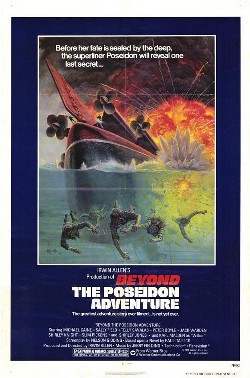
Beyond the Poseidon Adventure

I've never hid my feelings about sequels and remakes. Sure, they can be lazy and big, old cash-cows, but if there's a need to make more movies or an interesting plotline or character(s), then I'm all for it. Same for remakes. If the original sucked or had untapped potential, then fire away. But the other efforts? The purely for the big payday efforts...yeah, here we are today. I watched 1979's Beyond the Poseidon Adventure because I could, because I'm an idiot and...yeah, here's the review.

It's New Year's Eve and Captain Mike Turner (Michael Caine) is on the Mediterranean Sea on his tugboat, the Jenny, with his first mate, partner and friend, crusty seaman, Wilbur (Karl Malden), and a spunky young woman, Celeste (Sally Field), they picked up at their last port. Turner is in some serious financial trouble and will likely see his boat repossessed very soon. But out at sea, they stumble across the floating wreckage of the S.S. Poseidon as a helicopter flies away overhead. Turner's eyes light up. He claims the salvage rights for the ship and taking a huge risk tries to get onto the capsized cruise ship. Turner isn't alone though. Another ship boards, a Dr. Stefan Svevo (Telly Savalas) explaining his ship heard a distress signal and he intends to help any potential survivors. The ship could sink or explode at any moment, but Turner and Co. head into the wreckage, hoping to find some sort of treasure, money, diamonds...if they can survive.

What the hell? I mean, come on. Really? It took Master of Disaster Irwin Allen (directing and producing here) seven years to get this sequel made after the mega-success of 1972's The Poseidon Adventure. I liked the original Poseidon even if I didn't love it. It's hard not to appreciate it for all that it accomplished, influencing whole genres and hundreds of movies since. You know what it didn't call for? A sequel. As in AT ALL. This is an opportunity to make money, pure, plain and simple. Worst than that, it isn't even guilty pleasure good. The cast is interesting as they usually are with disaster movies, but mostly, it is just B-A-D.

It is literally the same movie with one minor change. We've got idiots heading into the sinking ship that is continually rocked with explosions. Sure, the reasons are greed-based (just about everyone can get on-board with that) but really? REALLY?!? And let's think about this for a minute. Does anyone actually believe that Telly Savalas is telling the truth? It's Telly Freaking Savalas. There's simply no way that he is what he says he is. The problem becomes that when the twist is revealed, it is absolutely ridiculous, ending in a gunfight in a cargo hold. So yeah, that happens but the twisting and turning story stretches the limits even for an unnecessary sequel. If it helps your peace of mind (and it should), things don't get better as the running time approaches two hours. It gets worse.

So at this point, the saving grace has to be the star power of the cast. The cast is pretty solid in name recognition, and the formula is the same as most disaster movies. Introduce all our Hollywood stars and see who makes it out relatively unscathed. This was an interesting part of Michael Caine's career, one he's admitted he was in it for the money. There's gems like The Swarm and more into the 1980s, Jaws IV: The Revenge. He was rough in 'Swarm,' but he's actually pretty decent here. He commits to the part/script -- however bad -- and goes for it. Along with Field, Malden and Savalas, there's also Peter Boyle, Jack Warden, Shirley Jones, Shirley Knight, Paul Picerni, Slim Pickens, Mark Harmon, Veronica Hamel, and Angela Cartwright rounding out our assorted ensemble of survivors. Give them some sort of personal background, throw them together and let things fall apart from there. It does so in pretty spectacular fashion.

Things get pretty out of control, truly boring and bad in the second half. The twists are ridiculous, and scene-to-scene, it just feels like everyone is trying too hard. Sally Field is at her disgustingly adorable cutest, always ready with a nervous one-liner in the face of impending doom. Slim Pickens hams it up like his paycheck depended on it and other stuff happens with other actors. Meh, just really bad pretty much from the get-go. Not even guilty pleasure good. Just lousy.

Beyond the Poseidon Adventure (1979): */****

Wednesday, March 11, 2015

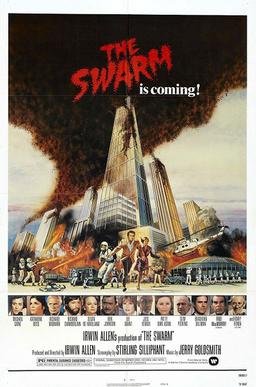
The Swarm

I'm not always the quickest learner so I'll take the blame for this one. I guess I should have learned quicker. While there are exceptions, there just weren't many good disaster movies in the 1970s and then into the 1980s. So for every Airport, Towering Inferno and Poseidon Adventure, there are movies like 1978's The Swarm. Yep, another nail in the coffin of a genre struggling to hold on for dear life.

At an isolated army installation in the American Southwest, a heavily armed patrol slowly navigates the eerily empty facility. What the hell happened here? Deep underground at the installation, the investigating patrol finds several dead bodies and a few lucky survivors, including a mysterious doctor, Brad Crane (Michael Caine), who says he's an expert on the world of insects. A much larger army force, commanded by crotchety General Slater (Richard Widmark), arrives soon after, and they're too stunned at what they find and what Crane claims is behind the mysterious attack. The responsibility goes to....an immense swarm of African killer bees. Bees!!!! Making the situation worse, there's no cure for the bees' surprisingly venomous sting and seemingly no one is immune. It looks like nothing can stop the not-so-fast moving bees, and they're heading for Houston.

Sometimes you DO just know. When this 1978 disaster flick from director Irwin Allen -- Master of Disaster flicks -- popped up on Turner Classic Movies' schedule, I had to set it to record. I HAD to. Movies with casts like this don't pop up too often so I had to at least give it a try. Worst case, it's just entertaining in a bad, guilty pleasure fashion, right? Well, that's what you would think. This wasn't even good in a 'So bad it's good' way. It just isn't entertaining. Apparently, I'm not the only one who thinks so. 'Swarm' is on all sorts of worst movies ever made lists and bombed in epic fashion in theaters back in 1978. If that's not a recipe for success, I don't know what is!

Maybe the most frightening thing to take away from this bee-disaster flick is that there's a director's cut available out there clocking in at 156 minutes. The TCM version I saw was an already painfully long 116 minutes. God knows what else could be expanded on in an additional 40 minutes because I was losing interest in the shortened version at the 60-minute mark. For goodness sake, 'Swarm' utilizes a love triangle featuring Olivia de Havilland, Ben Johnson and Fred MacMurray (in his last role) as a subplot! Yes, because that's what we need, three Hollywood legends in a senior citizen love triangle in a disaster flick where a swarm of killer bees are the villains. Seems reasonable, don't it? I can't say I'd be too interested in seeking out that longer version of a dud like this.

Star Michael Caine has said this is the worst movie he ever made, and it's hard to disagree. As the insect/bug specialist, Caine looks to be immensely bored throughout. If there's a slightly redeeming quality in 'Swarm,' it's that the cast is epically impressive. Now are any of them given much of anything to do? That would be a big N-O, but still, look at all those Hollywood stars! Along with Caine and perpetually angry Widmark, look for Katharine Ross, Henry Fonda and Richard Chamberlain as some of the scientists tasked with halting the advance of the bees.  Also look for Lee Grant, Jose Ferrer, Patty Duke, Bradford Dillman, Slim Pickens, and Cameron Mitchell in other supporting parts, some more painfully forced than others.

Things unfortunately develop in more spoof-fashion than straight disaster flick. How many slow motion bee attack scenes can we witness before it just becomes laughable? Because the movie is about bees, we get one hilarious scene after another about our very talented cast discussing what the bees' intentions are, if they're seeking revenge, if there is a major bee plan to take over the world. It's all done so straight that it becomes spoof-like, and that's never a good thing. The problem is there just isn't that one reason to sit back and watch this one, and that's considering the star power on hand. The cast is given little to nothing to do, the killer bees are a laughable "villain," and the entertainment value just isn't there. Give this one a wide berth.

The Swarm (1978): */****

Tuesday, March 4, 2014

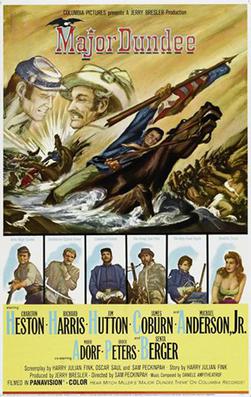
Major Dundee

With his 1962 western Ride the High Country, director Sam Peckinpah put himself on the map, springboarding his directing and writing success on TV into feature films. It took him three years to do a follow-up, a western that had countless production issues and was eventually taken away from Peckinpah in the editing phase. It's everything that was good and bad about Peckinpah as a director. It's not a western often remembered as one of his bests, but 1965's Major Dundee is one of my favorites.

It's late in 1864, the Civil War raging back east, but in the New Mexico territory, an Apache war party led by Sierra Charriba (Michael Pate), massacres a troop of U.S. cavalry, kidnapping three boys from a local ranch at the same time. The commander of a nearby Confederate prison camp, Major Amos Dundee (Charlton Heston) decides to go after the Apaches, rescuing the kids and bringing Charriba to justice. Without abandoning the camp though, he must assemble a ragtag group of Confederate prisoners, black infantry, inexperienced officers, cowboys, drunks, bandits and thieves to capture the Apaches. At his right hand is a Confederate officer and friend from the past but now a sworn enemy, Capt. Benjamin Tyreen (Richard Harris). Dundee's company of irregular cavalry hits the trail, following the Apache war party into Mexico, tangling with occupying French forces as well. The Apaches and the French are just two enemies though, the Union and Confederate loyalties among the company threatening to tear Dundee's command apart from the inside.

The production history of this Peckinpah western has quite the checkered past. The production in Mexico went way over budget and way over schedule. Depending on what you read, Peckinpah's original cut for 'Dundee' was anywhere between three and four hours long. When the studio took it away from him, it was cut down to just over two hours. A DVD released in 2005 had a new, never before seen version with almost 15 additional minutes added to the running time. Some additional footage was found that was unable to be reinserted back into the film, but as is, we'll probably never know/see Peckinpah's intended version. So what's the end result with the 136-minute version? A far better western than the 123-minute version that features some good performances, a ridiculously deep cast, some ahead of its time vicious action, and a story that drifts needlessly at times.

What was Peckinpah's goal? He wanted to make an epic western, a new western in the vein of the John Ford cavalry movies. It was supposed to be big and violent full of scope and vision. 'Dundee' doesn't quite live up to that, but in terms of pure entertainment, it's hard to beat. It starts with Charlton Heston in the titular role. Like Peckinpah's best movies, Dundee is the flawed anti-hero like nobody's business. The story almost becomes Moby Dick in the Civil War west. Dundee has been posted to this isolated prison camp because of a command decision he made at Gettysburg (hinted at, never spelled out), and he intends to right that wrong. His plan? Get the kids back, take out Sierra Charriba, become a hero again. The problem? Dundee may not be cut out for command. He's equal parts brilliant strategist with overreaching egoist. His pride and ego get in the way of things, the mission into Mexico becoming an obsession. Quite the performance, one that doesn't always get the notoriety it deserves in Heston's already impressive filmography.

One of Peckinpah's favorite storytelling devices was the anti-hero and his right hand man, sometimes a former friend turned unwilling ally, a device used to its best ability four years later in The Wild Bunch. Here, that relationship is between Heston's Dundee and Richard Harris' Capt. Ben Tyreen. Again, their checkered history (friendship turned bitter rivalry, even hatred) all leads up to this, two men forced to work together. Harris is one of my favorite actors, and this is my favorite performance of many, one of my all-time favorite characters in any film. Harris' Tyreen is everything Dundee wants to be; intelligent, charming, a good leader, and well liked and respected by his men. Tyreen has one great line after another, Harris bringing this character to life, a Irish immigrant turned cashiered American officer to Confederate renegade. The dynamic between Dundee and Tyreen provides some of the movie's best dialogue scenes, the confrontations crackling with energy. Kudos to both actors for developing that chemistry to its fullest.

Brace yourself though. This movie has one sick cast of tough guy actors, many from the Peckinpah stock character Hall of Fame. Jim Hutton provides some laughs as Lt. Graham, a bumbling artillery officer assigned to the cavalry. James Coburn is a scene-stealer as Samuel Potts, Dundee's one-armed, bearded, quick-witted scout, as is Mario Adorf as the feisty, loyal Sgt. Gomez, Dundee's most capable Union soldier. Michael Anderson Jr. does a fine job too as Trooper Ryan, Dundee's young bugler, providing the narration from his in-mission journal. There's also Brock Peters as Aesop, the leader of the small contingent of black infantry, Slim Pickens as Wiley, the drunken mule-packer, R.G. Armstrong as Reverend Dahlstrom, the shotgun-wielding preacher, and Dub Taylor as Priam, the disheveled horse thief. As for Tyreen's Confederates, there's Ben Johnson as the tough Sgt. Chillum, L.Q. Jones and Warren Oates as Arthur and O.W. Hadley, and John Davis Chandler as Jimmy Lee, the troublemaker. Also look for Karl Swenson as Dundee's second-in-command at the prison camp. Just a ridiculously deep cast full of great characters.

Where the movie struggles some -- but is also damn entertaining in those struggles -- is the final 40 minutes. The story does drift too much from the Apaches to the French to Dundee's lost weekend in Durango and a brief love affair with Senta Berger's Teresa. Trooper Ryan's narration gets choppy, weeks slipping by in a flash. The saving grace is back-to-back action sequences, one a showdown with the Apaches in a box canyon, the other a bloody, violent battle with French lancers in the Rio Grande. This is Peckinpah at his action best, clearly an indicator of where his movies would go, especially with The Wild Bunch. Watch the scene with the French and see how brutal it is, how graphic it could have been if censors allowed it. Characters are unceremoniously killed off (blink and you'll miss it), including one surprising death, but it's just a great action scene leading to a quick ending.

Most Peckinpah fans don't list this as their favorite, maybe not even one of their favorites. I just really like this movie, always have, and the longer version with the additional 15 minutes or so really does help make it better. The musical score from composer Daniele Amfitheatrof takes some heat, especially the Major Dundee theme (listen HERE), but I like it, almost as a guilty pleasure. Filming on location in Mexico, including stops in Durango, a gorgeous waterfall location at El Saltito, and many more, all add to that authentic flavor. You really feel like you're on an odyssey across Mexico, seeing a variety of spots, locations and cities. One of my favorite westerns, a heavily flawed but just a damn entertaining movie in the end. Hard to beat, even if we'll never see that epic 4-hour version Peckinpah intended.

Major Dundee (1965): ****/****
Rewrite of August 2009 review

Monday, May 6, 2013

Escort West

Think 'wild west,' and a lot of people will think of the 30-plus years after the Civil War right on through the end of the 19th Century. But there is a crossover as the two historical eras overlapped. Yes, the Civil War western like Major Dundee, Escape from Fort Bravo, Two Flags West, and now, a new entry, 1958's Escort West.

It's been just a few months since the end of the Civil War, and ex-Confederate soldier Ben Lassiter (Victor Mature) is riding west with his 10-year old daughter, Abby (Reba Walters). They're heading to Oregon -- via Nevada? -- but now they've caught up with a Union patrol guarding a payroll shipment. Ben and Abby head their separate ways, but down the trail they ride across the massacred remains of the patrol with two female survivors, sisters Beth (Elaine Stewart) and Martha (Faith Domergue) Drury. A Modoc war party is on the warpath killing everything in its path. The Drury sisters tell Ben they were supposed to meet up with another Union patrol somewhere ahead of them, but they're not sure exactly where. While trying to avoid the Modoc warriors, can Ben and Co. manage to find the patrol and safety?

This western from director Francis D. Lyon is interesting for its writing staff; actor/writer Leo Gordon and Fred Hartsook (cool name). Gordon made a career out of playing tough guy roles in films like Tobruk (also wrote), Hondo and many others, including this one. He also wrote more than a few films and TV episodes and did it well. Gordon had a knack for writing meat and potato stories that audiences ate up. They're pretty straight forward, but they feature plenty of action and tough guys beating the hell out of each other. This one is pretty straightforward too, even a little short at 75 minutes, but western fans should enjoy it.

The Civil War western angle plays well here. A few months since the end of the war, Mature's Ben is looking for a fresh start. He's put the war behind him and wants to move on with his daughter. Meeting up with Union cavalry troopers though that aren't so forgiving, the hatred and rivalry from the war still very much alive. It's made worse when Ben meets the Drury sisters. Beth likes the Confederate and his daughter, but Martha isn't so forgiving, holding a hard-edged hatred for the Confederacy having lost her husband in the war (but there's more going on there too). The Union vs. Confederacy angle works well, giving a familiar western a fresh perspective. Then, the two former enemies must band together to survive Indian attacks. Good stuff all around.

The casting is good from top to bottom here, starting with Mature. He's a very capable soldier, but we also see a softer side of him as he looks out for his daughter. Stewart is solid and Domergue is appropriately shrill and hateful as the Drury sisters. Rex Ingram is a scene-stealer as Nelson, a black Union quartermaster wounded in the attack who bonds with Ben. The Union troopers include William Ching and Noah Beery Jr. as the officers in charge with Slim Pickens, Harry Carey Jr., Ken Curtis and Gordon. With a movie that's just 75 minutes, none of these familiar western faces are given much to do, but it's cool to see so many in one film. Would the movie be better with some more development in story and characters? Sure, what movie wouldn't? What's here is solid though.

Filmed in black and white, 'Escort' has the California hills/mountains posing as the Nevada mountains. It's got an interesting visual look to the story, the black and white adding a nice touch. The cavalry vs. Modoc story develops nicely with a claustrophobic touch as the canyons full of rocks and plants seem to be closing in on the troopers. Indians are hiding all around, just waiting to attack. An actor named X Brands play Tago, the Modoc leader. The biggest flaw may be that at 75 minutes, it feels rushed. The ending comes together too quickly, wrapping up in a flash because....well, because it does. It's a solid, entertaining B-western that could have been significantly better, but it's not bad for what it is.

Escort West (1958): ** 1/2 /**** 

Wednesday, March 6, 2013

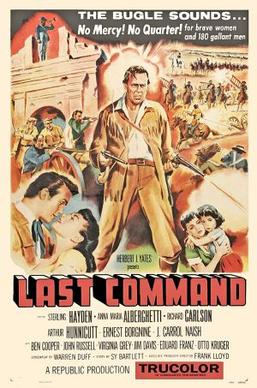
The Last Command (1955)

Of the three most well-known heroes of the battle of the Alamo, David Crockett, James Bowie and William Travis, there's no doubt who is the most well-known of the three. Oh, that'd be Crockett for those unfamiliar with history. In second place, the infamous knife fighter Jim Bowie who's had several films based on his exploits including 1952's The Iron Mistress (meh) and for today's review, 1955's The Last Command.

It's 1834, and knife fighter, adventurer and land owner Jim Bowie (Sterling Hayden) is riding south through Texas to Mexico to see his home and his family. As he rides through the territory though, he finds that many Texan colonists have had enough with Mexican president, Santa Anna (J. Carrol Naish), who's become more of a dictator with each passing day. Old friends with the president, Bowie isn't sure who to side with at first, but when his wife and children die, he's forced to come up with answers about what he believes and what he should ultimately do with the coming revolution. He joins the fighting, leading a group of volunteers. Santa Anna has started to march an army north from Mexico City to deal with the revolutionaries, and all roads lead to the town of San Antonio and a ruined old mission, the Alamo.

Anyone familiar with John Wayne's The Alamo from 1960 will no doubt notice some similarities between that film and this 1955 flick from Republic Studios. The reason? This was originally made with Wayne -- still working at Republic -- attached as an actor. He wanted to make an Alamo film, but disagreements with the studio drove the two sides apart. The end result was simple; Wayne left Republic, Republic made the film without Wayne, apparently out of spite. There are some similarities, from Davy Crockett's death to the Alamo defenders raiding the surrounding Mexican army for artillery and many others. The biggest difference though is obvious, a focus on Jim Bowie.

It's funny that in the casting of the infamous knife fighter, one of America's truly unique historical personalities, two of Hollywood's most wooden, vanilla actors were chosen. In 'Iron,' Alan Ladd starred, and here, Hayden takes the reins as Bowie. I'll say this. I don't think Hayden has a "showy" side, but he at least commits here and shows some energy in the lead. Just like Wayne's film would do, there is an unnecessary -- even painful -- love story as Bowie falls for Consuelo (Anna Maria Alberghetti), a young Mexican woman from a rich family (Eduard Franz plays her well-to-do uncle). Above all else, it's cool to see Bowie get a movie devoted to him and his involvement in the months leading up to and in the Texas Revolution. He was a fiery, passionate fighter who fought for what he believed in. His friendship with Santa Anna is a little much (the Mexican dictator affectionately calls him 'Jimmy'), but seeing a familiar story from an unfamiliar angle is refreshing.

Overall, the story focuses on a two-year period starting in 1834 and running through March 1836 and the battle and fall of the Alamo. The movie runs just 110-minutes and is a little slow-moving at times -- rather talky -- so non-history fans may lose some interest. Alamo buffs will get a kick out of the story though that focuses on Texas history that most Alamo movies simply ignore. We do meet some familiar faces, including Colonel Travis (Richard Carlson), Davy Crockett (Arthur Hunnicutt) and Lt. Dickinson (John Russell). Carlson is solid as the similarly fiery Travis, and Hunnicutt is a scene-stealer as the backwoods, storytelling Crockett that's based more in myth than the real-life Crockett. The story doesn't just jump right to the Alamo, but lays some ground work and background leading up to the famous battle. Also look for Ernest Borgnine as Mike Radin a rival-turned-friend of Bowie's and Ben Cooper as Jeb Lacey, a young Texan who looks up to Bowie. Other Alamo defenders include Slim Pickens, Jim Davis, Roy Roberts and Russell Simpson as the Parson.

The actual battle for the Alamo takes up about the last 40 minutes of 'Command.' The set is somewhat limited -- we basically see one corner of the mission along with the wooden palisade -- but there's something oddly cool about the set built near Bracketville, Texas (where Wayne's film was made). For a movie released in 1955, the final assault on the Alamo is surprisingly vicious and violent. Nothing graphic, but still pretty hardcore stuff for a 1950s audience. Each character gets their moment, their on-screen death with Bowie saved for last.

There's nothing hugely memorable about this 1955 Republic picture, but I like it just the same. Composer Max Steiner's score is a highlight -- give it a sample HERE -- and the Jim Bowie theme song (listen HERE) is pretty awful, but in an amazingly bad and memorable way. Lots of good actors, familiar faces and an enjoyable if unspectacular story in director Frank Lloyd's historical bio-pic. One IMDB reviewer points it out accurately. It's neither a big budget A-movie or a low-budget B-movie, but it's somewhere in between. TCM has three clips available so give them a watch at the link below.

The Last Command (1955): ***/****

Wednesday, January 23, 2013

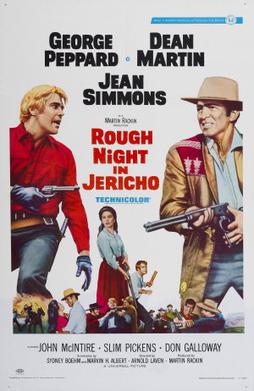
Rough Night in Jericho

Dean Martin is one of my favorite movie stars and/or entertainers. As far as his movies go, I typically think of the Rat Packer as a heroic good guy, ranging from drama in movies like Some Came Running or The Sons of Katie Elder to goofy comedies like the Matt Helm spoofs. But in a few departures from that heroic good guy, Martin switched it up, playing some bad guys, like 1967's Rough Night in Jericho.

Working with his longtime friend and former peace officer, Ben Hickman (John McIntire), former deputy and gunslinger Dolan (George Peppard) ride into the town of Jericho looking to set up a business. They've been hired by a widow, Molly (Jean Simmons), to help revive a stagecoach company that's recently gone under. What they find is something far different from what they expected. The town is run by sheriff turned town boss Alex Flood (Martin) who has his hand in every business and establishment in and around Jericho. Not surprisingly, Flood wants the new stagecoach company gone, even wounding Hickman as they arrive. Molly begs Dolan to help get rid of Flood, but ever the gambler, he doesn't like his odds. But in trying to push them out of Jericho, Flood pushes too far, and Dolan is going to push right back.

This is just another in a long list of reasons why I like westerns. Released in 1967 when westerns were very much trying to change with the times (cough more violence cough), I had never even remotely heard of 'Jericho.' From director Arnold Laven, it stars two of my favorite stars in Martin and Peppard, but it had never even crossed my radar. Always keep looking for those hidden gems because you never know when you will find one. It's somewhat limited by a smallish budget -- lots of indoor sets standing in for "outdoor" scenes -- and the score from Don Costa isn't anything out of this world. But in the end, things fall into place for an enjoyable, sometimes surprisingly violent western.

Your enjoyment will no doubt come from how big a fan you are of 1. westerns and 2. Dean Martin and George Peppard. I'm guilty on both counts so read on with a grain of salt. For starters, it's always fun to see an actor play against type like Martin is doing here. His Alex Flood is a charming, capable, intimidating bad guy; a former sheriff who cleaned up the town and basically took over in the process. Peppard does what he does best; cocky disinterest, looking like he's bored at times but being eternally cool in the process. Their scenes together are the high point of this western. Two tough guys talking over a bottle of whiskey, over a card game, both trying to intimidate the other one into leaving town. I loved the dynamic, both men knowing what the other is capable, but neither willing to blink or give up.

Playing the love interest of the not so painful love triangle, Jean Simmons wouldn't seem to be an obvious choice for a western. Go figure, but she's a worthy opponent and target for Martin and Peppard. Slight and soft with her voice, she's nonetheless one tough lady, even when Martin's Flood starts whaling on her. McIntire is in bed (wounded) much of the movie, but once he heals up, his crotchety veteran of the west fits right in with the toughness of the story. Filling out the ranks as Flood's evil henchmen who will no doubt meet nasty fates are Slim Pickens, Steve Sandor and and Brad Weston. Don Galloway has a good supporting part as Jase, the former sheriff of Jericho run out of town because he stands up to Flood over a hanging.

Two years before the groundbreaking The Wild Bunch was released, here comes 'Jericho.' Obviously not on par with that classic, this movie is nonetheless surprisingly violent. It's not as graphic, but it's certainly getting there. It is effective though because it is a surprise. At one point, we see a man get blasted in the face by a shotgun, blood flowing down his hands and arms. Realistic? No, but the point is made. Plenty of blood squibs (cheesy maybe, better than people clutching at wounds? Yes) as countless good and bad guys bite the dust. A highlight in the nastiness department comes in a fight between Slim Pickens and Peppard, Pickens' evil Yarbrough favoring a horse whip. Brutal, knockdown fight that feels real, not forced at all. Lots of positives, only a few minor negatives. Generally forgotten, well worth tracking down.

Rough Night in Jericho (1967): ***/****

Saturday, January 19, 2013

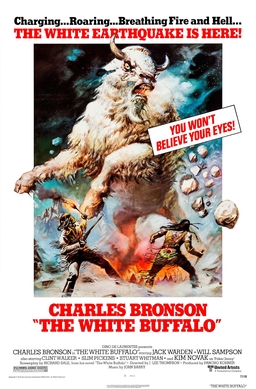
The White Buffalo

Gunfighter and army scout Wild Bill Hickok and Lakota warrior Crazy Horse are two of the most famous (even infamous), recognizable names in the history of the taming of the American west. At any point in their shortened lives -- they died a year apart in 1876 and 1877 -- did they meet? It's an interesting what-if and so goes 1977's The White Buffalo.

Having visited the East, Wild Bill Hickok (Charles Bronson) -- going under the alias 'James Otis' -- returns to the wild west. He has been tortured of late by a nightmare that plagues him night in and night out. It's the same nightmare each night; a vision of an immense white buffalo bearing down on him and ready to kill him in a second. Hickok doesn't know what to make of the dream, but when he hears rumors that a white buffalo has been spotted in the Black Hills, he goes on the hunt, bringing a trapper, Charlie Zane (Jack Warden), along for help. The famed gunfighter won't be alone though as they cross the path of Lakota chief Crazy Horse (Will Sampson) who similarly wants to hunt down and kill the alleged white buffalo. Which hunter will get him first?  

This was an odd western to watch. It's from director J. Lee Thompson of Cape Fear and The Guns of Navarone fame. The IMDB summary lists it as a quasi-Jaws ripoff, and it's not completely off base while also not being completely on-point either. Even three days since I've watched it, I'm still not sure exactly what I watched. It comes across as an odd, sometimes enjoyable episodic story that never quite finds a rhythm. Is it about Wild Bill making his return? Is it saying something more profound about the changing times of the west, and even the closing years of the "wild" west? Is it just a cool what-if about pairing two of the most interesting figures in American history? It's probably a little of all of them, but it is definitely hurt by not picking a route and sticking with it.

At its strongest, the focus is on the changing times of the west. Two men -- Hickok and Crazy Horse -- are very similar in personality, character and history. Their only difference? Hickok hates Indians, Crazy Horse hates the never-ending flow of white men into Indian land. As they both search for the white buffalo, they cross each others' paths, each saving the other man's life in a do-or-die situation. They put aside their hatred and differences aside in a quest to accomplish their mutual goals. I liked Bronson's performance a lot, even if it is pretty typical western anti-hero stuff. Sampson rises above a pretty stereotypically written part too as Crazy Horse. He avoids the stilted "Me Indian...you white man....How" conversation and plays well off of Bronson. The high point is Hickok and Crazy Horse talking across a campfire, both men wondering what the future holds.

Of the rest of the cast, Warden is the only one actually given anything more than a cameo. He has some good scenes with Bronson's Hickok, but it's a pretty standard meat and potatoes kind of role. Beyond those three parts, 'Buffalo' consists of a handful of really random cameos. We're not talking 10-15 minutes on-screen. We're talking individual scenes, some no more than a minute or two. Kim Novak gets the meatiest cameo as Poker Jenny, a woman from Hickok's past. Clint Walker also has some fun as Whistling Jack Kileen, a bear of a man gunning for Hickok. Also keep an eye out for Slim Pickens, Stuart Whitman, John Carradine, and Ed Lauter.

One of the oddest things though for 'Buffalo' is just that.....the buffalo. It doesn't look cheap, but it certainly tries for the Jaws-effect. We never really get a pristine, clear at the buffalo. Instead, we get extreme close-ups of the raging buffalo's eyes or his horns, we get far-off shots of the buffalo charging. It doesn't look ridiculous, but it sure approaches it. The final showdown among the buffalo, Hickok and Crazy Horse is pretty cool though. Sure, there are flaws. Any night scene was clearly shot on an indoor set with fake snow, trees and rocks. It looks pretty cheesy. There's also the cool scenes, an almost iconic shot of Hickok wearing his low-brimmed hat, his darkened glasses, his buckskin coat and brace of pistols. So in the end, it's a mixed bag, both good and bad.

The White Buffalo (1977): ** 1/2 /****

Wednesday, August 8, 2012

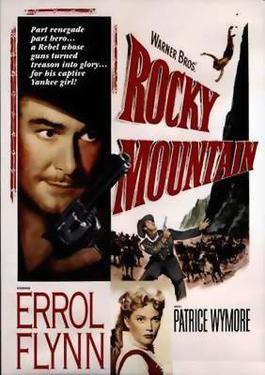
Rocky Mountain

As far as the American Civil War, there just haven't been much in the way of movies about the topic. Sure, there's been epics -- Gettysburg, Glory, Cold Mountain -- but overall as a sub-genre, there's been less compared to almost any other war America was involved in. I don't know that for sure, I'm just assuming. Westerns set during the time though have their own little niche, especially when Union and Confederate forces must band together and fight, like 1950's Rocky Mountain.

Leading a small seven-man squad west for a secret mission that could save the Confederacy, Capt. Lafe Barstow (Errol Flynn) has his mind set on the mission and that alone. Their plan? Start an uprising in California, hoping to take attention -- and troops -- away from fighting in the east. His plan takes a hit though when Barstow's squad fights off a Shoshone attack and rescues a beautiful young woman, Johanna (Patrice Wymore) from a wrecked stagecoach. On their way to meet the hopeful leader of the uprising, Cole Smith (Howard Petrie), Barstow must not make a decision. Johanna's fiance is a Union officer and will no doubt come looking for her. His squad is stuck in the middle, forced to continue the mission or save Johanna, worrying about Shoshone war parties and Union patrols all around them.

Forgetting to record this when it recently aired on TCM, I was pleasantly surprised to find it available for viewing at Netflix. I was even more pleasantly surprised after watching it. The late 1940s and early 1950s were an important transition for westerns. It wasn't so much the white-hatted good guys vs. the black-hatted bad guys. Most characters had flaws, even inner demons they had to deal with. From director William Keighley, 'Rocky' isn't quite there....but it's getting there. The Union and Confederacy teaming up was used several times after (Escape from Fort Bravo, Major Dundee), but this is one of the first I can come up with. It's the little things here. The men have beards, stubble, and look like they've been sweating in the desert heat. At least some effort was made to make it seem authentic. I give points just for the attempt. When that attempt works? Win-win for the viewer.

A couple more 'little things' here that help make 'Rocky' a little more memorable. Keighley filmed his western in black and white, pretty typical for the time in a western. Would it have been an interesting movie to watch in color? Yeah, you bet, 1948's She Wore a Yellow Ribbon coming to mind. But the rocky, barren desert is aided by the black and white filming, giving a starkness to the setting that color might have canceled out. He films on location in New Mexico, using some familiar locations including some that fans of John Ford's Fort Apache will notice (more on that later). Also, 'Rocky' borrows an instantly recognizable musical score from composer Max Steiner, using his They Died With Their Boots On theme. Give it a listen HERE starting at a :49.

His star fading a bit by 1950, Errol Flynn nonetheless makes the most of his last western. He just looks comfortable in the part. His Capt. Barstow is a strong leader, liked and respected by his men, but he also has a moral compass that won't let him turn his back on what's right and wrong. The only slow moments here are his not-so-surprising romance with Wymore's Johanna. She's engaged to Union cavalry officer, Lt. Rickey (Scott Forbes), but can't help be drawn to the very attractive Capt. Barstow. Playing the sneaky, sniveling Cole Smith, Petrie is a background player, but his character plays a key role late. Also look for western vet and character actor Chubby Johnson as Craigie, the stagecoach driver with no allegiances to North or South, just himself, bringing some homespun charm to this small but funny part.

What drew me to the movie -- right up there with Errol Flynn -- was the story that sounded like such an obvious forerunner to movies like Escape from Fort Bravo and Major Dundee. Nowhere was that more evident than Flynn's small squad of Confederate misfits. Not any huge names here, but western fans will no doubt get a kick out of watching the group. It includes Guinn Williams as Pap, the old man of the group, Dickie Jones as Jimmy, the soft-spoken youngster who fights like mad while also looking out for his mutt of a dog, Slim Pickens (in his first credited role) as Plank, a plainsman who served time in prison, Robert Henry as Kip, a young man and heir to a plantation back home, Sheb Wooley as Rawlins, the steamboat man with a mean streak, Peter Coe as Pierre, the Frenchman from Louisiana, and Rush Williams as Jonas, the plainsman and dead shot with a rifle. Not a weak link in the bunch, but Jones especially stands out, including one scene he has with Wymore discussing his brief encounter with Robert E. Lee before Gettysburg. Just seven solid supporting parts for Flynn.

It's the rare western I can't find something positive to talk about. And about an hour into 'Rocky' I was liking it a lot if not loving it. And then there's the last 25 minutes. I have this picture of 1940s and 1950s movies typically ending rather happily; guy gets the girl, everyone makes it. That certainly ain't the case here. Somewhat short on action to this point -- not an issue in the least -- the finale has Flynn's Barstow and his squad making a dangerous decision separate from the mission. I won't give spoilers away, but I was shocked by this ending in its brutal honesty. It was also filmed in the same canyon as the massacre in Fort Apache. Flynn addressing his men says after a chase "They've seen our backs....let's show them our fronts." It's a line that could sound cheesy, but in a western in this situation with Flynn delivering it, it works in a big way. I loved the honesty of the ending. LOVED it. It takes a pretty good western and makes it a near classic instead.

Rocky Mountain <---trailer (1950): *** 1/2 /****

Friday, January 6, 2012

The Deserter

When a poster at a message board brought the movie up, I didn't believe him, thinking the movie he talked about was made up. As a western fan, how had this one slipped past me? Somehow it did, probably thanks to no U.S. DVD release and an old VHS (thank you Amazon vendors). The movie? A spaghetti western of sorts, think The Dirty Dozen in the West. It's 1970's The Deserter.

Returning from a patrol, Captain Viktor Caleb (Bekim Fehmiu) finds his wife on the brink of death, raped and tortured by an Apache war party. He mercifully ends her suffering, shooting her, and abandons his post but not before shooting the commander, Maj. Brown (Richard Crenna), who he blames. Two years pass and the cavalry Border Command has a new commander, General Miles (John Huston). Caleb has spent two years waging his own war on the Apaches, but Miles needs his help. An Apache chief, Mangus Durango, is organizing a huge war party that threatens to wipe out everyone in the territory. Their only hope? Caleb selects a small group of men and train them to fight like Apaches, striking the Apache camp in Mexico before the slaughter begins.

From American director Burt Kennedy, 'Deserter' isn't your prototypical spaghetti western. It was filmed in Almeria, Spain -- with some familiar locations for spaghetti fans -- and features a quirky but memorable score from Piero Piccioni. Listen to the main theme HERE. As opposed to bandits and gunslingers, the story obviously focuses on the cavalry and the Apaches so it's a cool change of pace. Mostly though, it is an above average men on a mission story, one of my favorite sub-genres in movies. A small group of men, all experts and specialists in their own way assigned an almost impossible, nearly suicidal mission. The movie follows the cookie-cutter formula, but in a good way. First, lay things out and assemble the team. Second, train them. And third, unleash them for their mission.

My rating far down below may be high in the eyes of some readers, but there's a reason. This isn't a great, classic movie that will live on in movie history. On the other hand, it is a great, fun and entertaining movie that quickly climbed into my list of favorites upon first viewing. Kennedy was a workmanlike director more than an auteur, but he knows how to manage this movie. The screenplay by western regular Clair Huffaker is a gem, nothing original but full of great one-liners, the perfect dialogue for a team of tough as nails "volunteers." This always sounds like a cop-out to me, but it's just a fun movie. Sit back and enjoy 100 minutes of running and gunning action in the desert.

Read some reviews about this generally forgotten western, and you'll find plenty of criticism of the casting of star Fehmiu in the lead. A Yugoslavian actor, this is one of his few English-speaking roles. I had absolutely no problem with him as Caleb and even think his steely-eyed, ice water running through his veins acting style is a high point of the film. Caleb doesn't care about living or dying, just avenging his wife's brutal death. That can be an appealing trait in a lead character. While I came to like Fehmiu as Caleb, what drew me into this movie was the supporting cast.

Big names? No, not especially, but reading the cast listing should put a smile on any western fan's face. Crenna is solid as needed as Caleb's opposition, and Huston is a scene-stealer as General Miles, chewing the scenery like only he can. Then there's Caleb's squad, a who's who of western characters. Start with Slim Pickens and Ricardo Montalban as Tattinger, a crotchety veteran scout, and Natchai, an Apache scout, both of them Caleb's closest friends. Not enough? There's also Chuck Connors as Reynolds, a dynamite-wielding chaplain, Ian Bannen as Crawford, an English soldier touring the Southwest, Brandon De Wilde as Ferguson, the young, unproven officer, Woody Strode as Jackson, the strong man and troublemaker, Albert Salmi as Schmidt, the soldier with a grudge against Caleb, Patrick Wayne as Robinson, the Gatling gun operator with his brother, Doc Greaves as Scott, the doctor, and recognizable spaghetti face Fausto Tozzi as Orozco, the knife fighter.

Good cast much?  If you can't go along with that group, westerns probably aren't your thing. It is a men on a mission movie, and that means....wait for it...action! Most of it is saved for the last 40 minutes, but the training sequences leading up to it are equally as fun, a quick montage highlighting all the mayhem. The mission is the high point though, and even though some night scenes are limited by obviously indoor sets, it isn't a deal breaker. Men on a mission movie means casualties though, and the results here were surprising as to who makes it and who doesn't. Violent, bloody and chaotic, a worthwhile end to an underrated western.

Now this link won't be to a pristine, widescreen print, but it you're curious about seeing the movie you can see it at Youtube HERE. It's a Public Domain print and looks to be missing about 6 minutes from the VHS I have, but when a movie is as hard to find as this one, take what you can. Hope you enjoy it as much as I do!

The Deserter <---trailer (1971): ****/****   

Saturday, October 29, 2011

The Getaway

In a too short career, director Sam Peckinpah is both rightly and wrongly remembered for one thing; on-screen violence. It's true of course, The Wild Bunch opening the door for more graphic, brutal portrayals of violence. On the other hand, Peckinpah is so much more, an extremely talented director who used violence as a way of telling his stories. 'Wild' and Straw Dogs were shockers, Bring Me the Head of Alfredo Garcia a drug-induced trip, Ride the High Country a western classic. His most mainstream movie though, just a straight action thriller with no real message, is 1972's The Getaway.

Serving a 10-year sentence for armed robbery, Carter 'Doc McCoy (Steve McQueen) is paroled when his wife, Carol (Ali MacGraw), cuts a deal with a crooked/corrupt businessman, Jack Beynon (Ben Johnson). The parole comes at a price though, Doc having to take part in a bank robbery with two other crooks, Butler (Al Lettieri) and Jackson (Bo Hopkins). The robbery nets $500,000, but in the aftermath Jackson is killed, Butler tries to turn on Doc, and Beynon is looking to double cross them all.  Now with Carol in tow, Doc is on the run, searching for a way out. With hired killers all around smelling the money, Doc and Carol -- dealing with some additional marriage issues -- must run the gauntlet to freedom, but where do they go?

Say what you want about Peckinpah as a director -- and he has his fair share of detractors -- but the man had style.  By 1972, he was an established director and ended up with one of his career's biggest successes with 'Getaway.' His movies had style, but it was a gritty, realistic, no frills style.  His trademark slow-motion violence is there (if somewhat subdued compared to other movies), and the characters are as tough as they come, everyone doing whatever it takes to survive on their own. It's a nasty little world Peckinpah presents as Doc makes his getaway across southern Texas along the Rio Grande. From his typically unique opening credit sequence through the final shootout, Peckinpah always keeps it interesting.

I love seeing teams of superstar directors and actors, especially when they're two of my favorites like here with Peckinpah and McQueen. The duo worked twice together in 1972, also making rodeo flick Junior Bonner. Their personal and individual styles just work together. McQueen's icy, business-like Doc McCoy is one of his darker characters. He's an incredible anti-hero, an ex-con who doesn't trust anybody, even his wife when he finds out what she's been up to. Where some actors made impressions with long stretches of dialogue, McQueen does a lot here -- as he often did -- with very little, using his face, a simple look, his physicality to get a message across. A man of few words to say the least. And because I mention it with every McQueen review....he's very cool. Black suit, shades and a 12-gauge shotgun blasting away at a police car? How isn't that cool?

Because of McQueen as the leading man and Peckinpah in the director's chair, I've always been able to look past some of the movie's more glaring problems. For one? There are surreal moments that just don't fit. Lettieri can and usually was an intimidating villain, but his Rudy Butler is bizarre, almost child-like. He ends up kidnapping a veterinarian, Harold (Jack Dodson), and his wife, Fran (Sally Struthers), to patch up his wounds. The scenes are so off-the-wall they're painful to watch, Rudy having sex with Fran in front of Harold. There's also a food fight, and Fran's utter dependence on Rudy with Struthers at her shrill best. I'm not for domestic abuse, but when McQueen punches a screaming, frantic, whining Struthers near the end it was like a release. Lettieri wasted, and Struthers at her annoying best.

Putting together a finished product, McQueen used his clout to get a new score for the movie, replacing Peckinpah collaborator Jerry Fielding with Quincy Jones. All in all, a bad choice. The score is awful and completely out of place. Not that kind of awful you can ignore either. Harmonica solos? Really, that's the best you've got? And God bless her, but MacGraw just was not a good actress. The future Mrs. Steve McQueen brings little personality to the part with McQueen salvaging what he can of their on-screen time together. Whatever chemistry they had in real-life rolled over to the movie at least a little bit, but that can't save 'Getaway' from her lack of acting ability.

Thankfully there's a ton of other small but well-done supporting parts. Johnson is underused, but his scene with McQueen on the Riverwalk in San Antonio is a great exchange. Hopkins too -- a Peckinpah favorite -- isn't around long, but it's always good seeing his brewing yet cool and laid back persona. Also look for Richard Bright as a conman, Dub Taylor as Laughlin, a hotel owner with connections everywhere, and Roy Jenson and John Bryson as two of Beynon's henchmen. The best part though is for Slim Pickens as an aging Cowboy who Doc and Carol meet in their getaway attempt. It's a small part -- maybe 5 minutes -- that I think should have earned Pickens a Best Supporting Actor nomination, it's that good. His dialogue is honest and refreshing, and his extended scene with McQueen and MacGraw is one of the most natural exchanges I've ever seen. Great part for one of the all-time great character actors.

For a Peckinpah movie, the action is pretty slim. If anything, 'Getaway' focuses more on the chase and the tension that gets built up. McQueen going to town on pursuing police with a shotgun is like a release for him as much as it is the viewer. The same goes for the showdown in Laughlin's hotel, an orgy of shotguns and machine guns. Peckinpah doesn't go overboard, tapping the brakes as necessary. He knows what works and what doesn't, what audiences want to see. It's a flawed movie in the end, but a good one. Since it has inspired a remake while also being sampled by countless other movies, especially impacting No Country for Old Men. Check this one out for Peckinpah behind the camera, and McQueen in front of it.

The Getaway <---trailer (1972): ***/****

Thursday, August 25, 2011

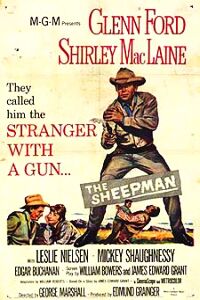
The Sheepman

Watching and reading enough about the taming of the west in the second half of the 19th Century, you notice certain rivalries popping up...if rivalries is the right word.  There was cowboys vs. Indians (not aliens), outlaws and bandits against marshals, sheriffs and law enforcement, American vs. Mexican (among any number of other nationalities who didn't care for each other), and because it wasn't just beef being shipped around the country, cattle vs. sheep.

Cattle grazed on the land while sheep basically picked the land clean, ripping the grass out by the roots so it didn't grow back.  Didn't think you were going to get that sort of introduction to a western now, did you?  That's the basic problem in many cattle vs. sheep westerns, including the 1958 oater The Sheepman. I'd seen this movie a few years ago but watched it recently on Turner Classic Movies when I thought I had not seen it. I watch a fair share of westerns so they start running together at a certain point...my bad.  A good, entertaining and relatively harmless western, typical of so many 1950s westerns.

In the western town of Powder Valley where the cattle dominates the land, a stranger, Jason Sweet (Glenn Ford), arrives one day on the train. He quickly makes his presence felt, buying a saddle, buying drinks, picking a fight with the town tough guy. What's he up to? Jason is making sure everyone knows he's not a man to be tangled with because the next day his herd of sheep are inbound on the train.  The cattle owners want nothing to do with Jason's herd, and they don't intend to go along quietly.  The big man in the area who controls everything, Colonel Bedford (Leslie Nielsen) -- who Jason knows from his opposite side of the law past -- leads the charge to stop him, but the situation gets murky when Jason meets Dell Payton (Shirley MacLaine), Bedford's fiance. Now it is more than just a cattle and sheep situation, and the solution doesn't seem like an easy one.

This is a western that is pretty typical of a 1950s genre entry.  Director George Marshall handles his straightforward, no frills story with his typical professionalism.  The movie is only 87 minutes long so there is not much in the way of wasted time here.  The story knows where it wants to get, especially that first half hour as Jason "introduces" himself around Powder Valley. That's the aspect of the comedic western that works best, an easy going, fun introduction.  From there on in, things settle in with the good guys taking on the bad guys. Until late in the movie, the bad guys -- Nielsen included -- aren't even that bad.  Finally Ford's Jason is pushed too far though, and he has to respond.

Realizing I've probably written this with all my Glenn Ford movie reviews, I think Ford is one of the most under-appreciated western stars that came out of the 1950s and 1960s.  He doesn't have the name recognition that a John Wayne would, mostly because his westerns aren't considered classics.  Ford probably belongs with Randolph Scott for his star caliber, solid, quality westerns that don't often wow you, but are always entertaining.  As sheep herder Jason Sweet, he brings his typical western persona to the part.  Ford was always very natural on-screen, showing off an ease that could give the impression he wasn't acting at all.  He is likable though from the start, and you're rooting for him.  Pointless bit of movie trivia, Ford wore the same hat in all his westerns.  Not the same hat style, the actual hat. It still looks relatively clean here.

Playing the part of the female love interest, Shirley MacLaine makes the most of her appearance.  So often this character -- the center of a pointless, needless, and unnecessary love triangle -- is forced into the story for the sake of having the character around. Not much is done to actually develop MacLaine's Dell character, but if nothing else she's trying, and that's all you're looking for at times. Anyone with an IQ over 10 or so knows from the second she is introduced she'll end up with Ford's Jason, but they've got to keep us guessing a little, right?  MacLaine isn't the damsel in distress thankfully, just a frontier woman caught in a bad situation. Her chemistry with Ford in their scenes together is easily seen, and their dialogue/conversations have an easy flow to them throughout.

Because there isn't a ton else to analyze about this one, we get more cast analysis and criticism! Yeah for people!  Before he became most well-known for The Naked Gun movies, Nielsen was a dramatic actor capable of drama, comedy, and action.  He's not the baddest of bad guys until late in the movie, but he has some good back and forths with Ford.  The rest of the cast includes some very recognizable western faces including Mickey Shaughnessy as one of Nielsen's henchmen, Edgar Buchanan as the wily, shifty stable owner who knows everything and everyone, Willis Bouchey as Dell's father, Pernell Roberts as Choctaw Neil, a gunslinger and adversary of Jason's, Slim Pickens as the town marshal who goes fishing when trouble arises, and Pedro Gonzalez Gonzalez as Angelo, one of Jason's sheepherders.

Not a great western, but certainly not a bad western. Just sort of in between, a western you can watch every couple years without getting bored or worn down.

The Sheepman <---trailer (1958): ** 1/2 /****   

Saturday, October 30, 2010

The Glory Guys

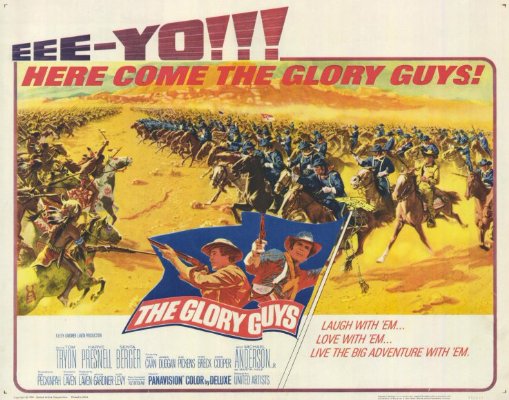
For over two years, I've been a Netflix member and have caught up with a lot of movies that were either impossible to find or I just wasn't willing to buy to actually see them.  Over the two years, Netflix has added many features but maybe none better than the ability to watch a long list of movies instantly through your computer or even by downloading through your TV.  There are some hidden gems among these many movies, but you've just got to find them.  I stumbled across a western today I've long wanted to see, 1965's The Glory Guys.

I don't know how many years back, but I caught the last 10 or 15 minutes of this on TCM when I got home from school.  Because it looked good and I was interested in seeing it again, it obviously hasn't been on TCM and of course is not available in any format.  Thank you, Netflix, for making it available.  With a screenplay by infamous director Sam Peckinpah, this western is a thinly veiled version of the massacre at the Little Big Horn when George Armstrong Custer and the 7th Cavalry were wiped out by a huge grouping of plains Indians. TV director Arnold Laven is listed as the movie's director, but rumors persist that Peckinpah handled some of the directing duties.  For a western that is long forgotten, it has too many positives to be left behind as it is.

After fighting the Apaches in the southwest, Captain Demas Harrod (Tom Tryon) is transferred to Fort Doniphan by the orders of famed Indian fighter General Frederick McCabe (Andrew Duggan).  He is assigned a company in the renowned 3rd Cavalry, but the men are a motley group of misfits with little experience with horses or firearms.  With the help of his company sergeant, Gregory (Slim Pickens), Harrod goes about whipping the men into shape for the coming campaign. Harrod also finds himself in a fight for the hand of widowed gunslinger Lisa Woodard (the always lovely Senta Berger) against Army scout Sol Rogers (Harve Presnell). All their problems aside though, the 3rd Cavalry is part of a huge campaign meant to control the plains Indians for good, and Gen. McCabe is looking for glory in the process, no matter the cost in men.

Part of the reason this western has been forgotten over the last 45 years is the casting of the leads, Tryon and Presnell.  Neither actor was a big star coming into 'Glory Guys' and neither would be afterward.  They're the type of roles you can see much bigger names taking over, but for me I thought the two did solid jobs.  Tryon can be a tad wooden at times, and Presnell's character is underwritten and underused, but they have a good chemistry together as they fight for Berger (and who'd blame them?). The unnecessary love triangle isn't as awful as it could have been thankfully, and besides a few scenes that kill momentum in the middle is left by the wayside.

More than a few things here reminded me of Peckinpah's other 1965 western, Major Dundee.  The big ones are obvious, a cavalry story fighting Indians serving as the basis for both movies' story.  But then there's the location filming in Durango, Mexico for both, and the casting of Berger, Pickens, and Michael Anderson Jr. in an eerily similar role to the one he played in Major Dundee. Whoever ended up directing more of 'Glory Guys,' there is the distinct feel of a Peckinpah movie whether it's seeing the same locations or just the dynamic among male characters.  Peckinpah had a knack for tough, hard-edged male characters who fight and fight only to side with each other when the chips are down.  There is a code among men like these, and they tend to live by it no matter the end result.  So yes, it may be an average western, but it's elements like this that help lift it up a notch or two.

What works best when the story isn't focusing on the love triangle is the training and development of Harrod's D Company as they arrive at the fort only to turn into highly competent cavalry soldiers.  Pickens is perfectly cast as tough Sgt. Gregory with Anderson Jr., a very young James Caan as brawling Irishman Anthony Duggan (the accent is must-hear), Adam Williams, and Erik Holland rounding out the recognizable faces in the company.  Peckinpah's screenplay is at its best when dealing with the training and the camaraderie that develops among these men.  The characters lean to outlines more than red-blooded characters, but Cann especially stands out, as does Anderson Jr.  Tryon's Harrod pushes his men because he's seen Gen. McCabe's dangerous battlefield tactics and knows the better prepared his men are, the more likely they'll make it through alive.  I wish more time could have been spent with D Company, but what's here is quality.

Now onto one of my self-named elements of movies I love, the sense of doom.  With a story about an eventual massacre, you know where everything's going to end up.  The last 45 minutes are dripping with tension as the 3rd Cavalry unknowingly rides to their doom.  The actual battle is a spectacle to behold, hundreds of cavalry and Indians on horseback going toe to toe.  Clearly some serious money was spent on the finale, an epic, well choreographed and constructed battle that would preview similar scenes in Major Dundee and The Wild Bunch.  If you're a Netflix member, I recommend checking this one out, and if not, keep an eye out for it.  How hard is it to find? I couldn't even find a trailer or a video clip.

The Glory Guys (1965): ***/****

Monday, July 26, 2010

The Cowboys

At a certain point in his career, John Wayne started taking flak for playing himself in all of his movies instead of playing a different character each time around.  This criticism typically applies to Wayne's movies from the late 1960s and early 1970s, and in a lot of cases the criticisms were valid.  But lost in the shuffle sometimes is that the huge star turned in three of his all-time best performances during this span, including his Oscar-winning turn in True Grit, his last performance in The Shootist, and in 1972's The Cowboys.

It is a western that has taken its fair share of abuse over the years, especially for the message given late in the movie.  But where so many American westerns had become so blah in the 1960s, 'Cowboys' tries for something different instead of the same old worn down story.  By now Wayne had been a star in movies for over 30 years and many moviegoers had grown up watching him on-screen.  So playing the starring roles in this Mark Rydell-directed western, why not take that notion on a bigger level?  The Duke steps into a starring role that has him as a surrogate father for a dozen cowboys, make that 'half-cowboys,' for now that is.

Looking to drive his 1,200 cattle to market, rancher Wil Andersen (Wayne) is in trouble.  A recent gold strike has brought every man in the territory and left the rancher with no cowboys to drive the cattle.  Andersen turns to the only people available, 11 boys ranging from 9 to 15 from the local schoolhouse, who get a crash course in being a cowboy.  With only one other man, black cook Jebediah Nightlinger (Roscoe Lee Browne), along for help, Andersen sets off with his herd.  The cowboys learn driving a herd of cattle isn't as glamorous as it sounds with long hours in the saddle and little chance for rest.  But slowly but surely, the cattle moves along as Andersen's crew begin to figure the job out.  When it seems nothing can stop them though, Andersen realizes a gang led by a rustler (Bruce Dern) is tracking them with eyes set on stealing the herd.

SPOILERS STOP READING SPOILERS In a career that spanned five decades, John Wayne is legendary for any number of things, but one thing more than most makes for that sort of trivia movie buffs (myself included) love.  The question is how many movies did he die in on-screen?  The answer is 8 -- if you can name more than two, kudos to you -- and The Cowboys is one of them.  Making it more shocking is not the fact that he does die, but how he dies.  Wayne's Wil Anderson beats the bejesus out of Dern's character and walks away from him like he couldn't be bothered with this excuse for a man.  Dern proceeds to shoot him in the back/arm/legs/stomach four times.  This all leads to an ending many have an objection to.  END OF SPOILERS

Along the trail, Andersen teaches these young cowboys how to do their job, for their benefit and for his.  That's the part that sets this role apart from the average Wayne movie.  He teaches these boys how to act like men, how to grow up, and how to handle yourself in situations where it would be easier to turn tail and run than stand your ground.  As the special features on the DVD discuss, Wayne both on-screen and off took a fatherly role to these kids.  It's a great performance as he acts with several young actors with experience and others with none who had a rodeo background.  They range from Robert Carradine (in his film debut) and A. Martinez as the oldest cowboys at the ripe old age of 15 all the way down to the youngest like 11-year old Clay O'Brien. All of the cowboys have a natural, easy way about them when acting, and it's a shame many of them didn't continue in the acting department because there's some talent there.

To film the movie, Rydell teams with cinematographer Robert Surtees, filming all over California, New Mexico and Colorado, the end result being a gorgeous-looking western with a wide variety of locations that help give the impression of the cattle drive actually moving south.  Also worth mentioning is John Williams' score that you will be whistling along, humming in your head for days afterward. Listen HERE if curious. There's two main tracks, the cowboys theme and Dern's theme, sounding like a rattlesnake about to strike.

Two supporting parts help anchor the movie, those being Lee Browne as Nightlinger and Dern as Asa Watts, dubbed 'Long Hair' in the credits.  Both were classically trained actors, but they fit in as smoothly as possible here (also look for Slim Pickens in a small part).  Wayne famously told Dern before they shot his death scene "Oh, people are going to hate you" and he was right.  Who shoots John Wayne in the back?  His villain is perfect because in other movies Wayne dies in, it's a nameless soldier doing it, but here we get a pure evil bad guy.  It all produces an ending many objected to; the cowboys getting revenge on Watts and his rustlers -- watch it HERE -- and in a sense becoming men.  I think it's a ridiculous notion because the ending makes sense.  They're not killing Watts because they have a bloodlust, they're doing it because there's right and wrong. But still, some audiences objected, but I'll leave it up to you to decide. The movie's a good one, and that's all that matters to me.

The Cowboys <----trailer (1972): *** 1/2 /****

Tuesday, June 1, 2010

The Sacketts


In a career that spanned a handful of decades, author Louis L'Amour published over 100 works that included novels, short stories, and even some non-fiction, many of which were turned into TV shows and feature length film adaptations.   Most of these works were westerns, and I started reading them at a young age, starting with The First Fast Draw.   I've enjoyed some more than others, but the ones I've gone back to come from a series of books about the Sackett family.

In the time when miniseries were extremely popular -- better known as the 1970s and 1980s -- two of L'Amour's Sackett novels were turned into a two-part miniseries in 1979 appropriately titled The Sacketts. My first concern was that the two source novels are two separate works about three brothers -- two in one book, and the third in a separate book -- with a very quick crossover.  So how is a miniseries with two vastly different stories expected to work?  Like any adaptation, things were dropped and left by the wayside, but big picture, this miniseries works because of the talent involved.

Based on the novels The Daybreakers and Sackett, the miniseries focuses on three brothers from a Tennessee family heading west in the years following the Civil War.  Tell (Sam Elliott) is the oldest and despite growing up in the South, joined up with a Union infantry regiment during the war.  Once Lee surrenders, Tell heads west, ending up as a drifter/saddle tramp looking for work wherever he can get it.  Too young to join the fight, Orrin (Tom Selleck) is engaged to be married to a local girl, but a long-standing feud interrupts with young brother Tyrel (Jeff Osterhage) killing a man in his brother's defense.   With the local law looking for answers, Orrin and Ty head west to set up a new life.

Riding into Texas, Orrin and Ty sign on with a cattle drive heading north to Abilene.  Along the way, they become more than capable cowpunchers and in the process meet  ramrod and trail driver Tom Sunday (Glenn Ford) and veteran cowboy Cap Rountree (Ben Johnson). Delivering the cattle to a buyer, the quartet sticks together and heads west to Santa Fe only to find a range war brewing between the Mexicans (led by Gilbert Roland) and the Americans (the always evil John Vernon in charge). Further north in the mountains, Tell stumbles upon a gold vein, but that's just the start.  The Bigelow brothers are on his trail looking for vengeance.  And wouldn't you bet, at some point the brothers' trails cross?

Cramming two full books into a 4-hour miniseries had to have been a daunting task for writer Jim Byrnes, and he does a solid job adapting the novels. Both books delved into romantic subplots with the brothers meeting women along the way, but in putting together a story about three brothers -- and not the ladies -- these subplots are just that, subplots in the background.  Byrnes also had to invent basically a new storyline (the brothers meeting up on the trail) and an ending because Daybreakers and Sackett just didn't cross paths.  All in all, props to Byrnes for pulling it off.

Starting with the casting of the Sackett brothers, the actors involved from top to bottom are downright impressive, more so for fans of westerns.  Elliott, Selleck, and Osterhage were not stars when they were chosen to play these brothers.  It's funny that the best character, Tyrel, was played by the actor who for some reason, never became a bigger star.  As L'Amour writes them, Ty was my favorite.  Like Tell, he's quiet and unassuming, but when pushed he pushes back.  Elliott is basically a rougher, older Ty and growls his way through the part, and Selleck gets to be Selleck, a charming, likable personality.  Among the three, there's a definite chemistry which pays off in a big way.

L'Amour's main characters were the prototypical western hero; tough, honorable, and able to shoot their way out of any sticky situation.  These were men of few words who did what was right because they didn't know any other way.  These three actors were all so good there's even an unofficial sequel -- 1982's The Shadow Riders -- where they play a trio of brothers, the Travens this time.  Through all its other flaws in the miniseries, the casting is about as perfect as casting can be.

By 1979, the western had played out its line in terms of moviegoing popularity thanks to the spaghetti westerns and ultra-violent spins the genre took.  So in a way, this is a last hurrah for the western, and the casting represents that.  Tom Sunday is younger in the book, but Ford playing him is just right.  He's a former lawyer, a cowboy, and a gunfighter and serves as a replacement father for the boys.  Johnson as the saddle-sore cowboy who seen it all? Born to play the part.  Roland makes a quick appearance, and Vernon is typically evil.  Ruth Roman is good as Emma, a saloon owner in an outlaw town who knows Cap. The Bigelow brothers include Jack Elam, Slim Pickens, and Gene Evans.  For the cherry on top, throw L.Q. Jones and Paul Koslo in for good measure. It'd be hard to ask for a better cast.

This review is getting a little long so I'll start to wrap this up.   It's hard to complain about a TV miniseries looking like a TV miniseries, but The Sacketts isn't exactly made on a huge scale.  It feels like we see the same town over and over with the same backgrounds once the story requires the brothers to hit the trail.  My biggest complaint though was the music.  A soundtrack doesn't have to be great, it just can't be noticeably bad.  Well, the score here is bad, and in an obvious overdone way.  Overall though, just complaints for a highly entertaining, well-made miniseries that does justice to Louis L'Amour's novels.

The Sacketts (1979): ***/****