When I hear the name Red Buttons, I think of movies. Yes, he was also a Broadway performer and stand-up comedian, but I'm most aware of him for his film roles, like in The Longest Day, Hatari!, and The Poseidon Adventure. Not given many leading roles, Buttons was a great second banana, typically playing a partner or sidekick, like 1958's Imitation General, an underrated WWII comedy.
It's 1944 in France following the successful D-Day invasion, but the fighting rages on. After a bloody battle between German and American forces, an American officer, Brigadier General Charles Lane (Kent Smith) is traveling across the battlefield in a jeep with his two longtime aides, Master Sgt. Murphy Savage (Glenn Ford) and Corporal Chan Derby (Buttons). Remnants of American forces are still in the area, but they're cut off and surrounded by German forces. Lane wants to organize the men, hoping that the sight of a general on the front lines energizes them and brings them together. It is a solid plan, Murphy and Derby going along with it, but Lane is killed saving Murphy from a German machine gun. What to do? The Germans are on all sides and prepping for a counterattack. Murphy does the only thing he can think of....and poses as General Lane, hoping to do exactly what the general had hoped, organizing the men to avoid a horrific, bloody route.
Here we go down this route again. Reading up on this generally forgotten WWII comedy when it appeared on TCM's schedule, I was skeptical of the movie. The Leonard Maltin review called it "a tepid, occasionally tasteless" comedy that "defeats its game cast." Ringing endorsement, huh? I'd never heard of it though prior to it popping up on TCM, and I wanted to give it a fair shot. Well, Mr. Maltin was wrong on this one if you ask me. From director George Marshall, 'Imitation' not surprisingly doesn't rewrite the genre. It's a WWII comedy after all. Any war movie that's a comedy -- and not a dark comedy like MASH or Catch-22 -- has to tread that fine line. War isn't naturally funny so playing it for goofy, physical laughs can be iffy. The premise here did sound pretty goofy, but I stuck with it and was rewarded in the end. It's good stuff, and I'm glad I gave it a fair shot.
A few days since I reviewed 1956's Ransom!, here comes a complete 180 from star Glenn Ford. An underrated actor in general, Ford was home in just about any role he ever did, action, drama or comedy. For me though, I watch him and like him best when he gets to show off some of his comedic chops, like he does here. It's not the laughs a comic would get, but laughs from a really underplayed line delivery. He has an ease about him in parts like this that makes him very likable. His Master Sgt. Murphy has genuinely good intentions here when he dons the general's stars and puts on the dead officer's helmet. It isn't glory he's after, just trying to prevent a battlefield route of an already beaten down army. There's just enough drama to pull it off, Ford's Murphy questioning if he's made the right decision. Oh, and he gets to woo a pretty French woman, Simone (Taina Elg), so that's nice. Those scenes are the movie's weakest points.
Playing almost like a buddy flick, 'Imitation' is at its deadpan funniest when Ford and Buttons are on-screen together. Their Murphy and Derby have been friends and fellow soldiers across North Africa into Sicily and finally into France. In other words, they know each other well, trust each other and have a genuine friendship. They show that friendship through a non-stop running dialogue that revolves around insults and in-jokes, the duo's lightning-quick delivery back and forth playing well. I liked both Ford and Buttons a lot here. In a too short appearance, Smith is very good too as General Lane. As for some of the other men bottled up in the Allied pocket of resistance are Cpl. Sellers (Dean Jones), a shell-shocked bookworm of a soldier, Pvt. Orville Hutchmeyer (Tige Andrews), an adversary of Murphy's and the only man around who can identify him as a fraud, and Lt. Clayton (John Wilder), a young NCO always putting his foot in his mouth around Murphy.
When the story focuses on Murphy and Simone at her bombed-out farmhouse, the story in an 88-minute long movie begins to drag a little bit. It's at its best when 'Imitation' heads out into the field. With the hills around Hollywood standing in for France, the big Cinemascope look plays well, especially filming in black and white. The action scenes are on a small scale, but that smallish scale doesn't hurt a thing. It's actually the better for it. As well, the scenes with Murphy frantically trying to hide from Hutchmeyer provide some genuine laughs too amidst all the chaos. The whole movie succeeds on that smaller scale. No cast and crew of thousands, no bigger picture of what's going on. Instead, we get an enjoyable WWII comedy that isn't obnoxiously stupid or at the other end of the spectrum, ridiculously dark and cynical. It's just a good old-fashioned comedy that I liked a lot.
Imitation General (1958): ***/****
The Sons of Katie Elder
"First, we reunite, then find Ma and Pa's killer...then read some reviews."
Showing posts with label George Marshall. Show all posts
Thursday, August 29, 2013
Thursday, March 21, 2013
The Happy Thieves
If you've made it this far, maybe you can go a little further. Oh, Shawshank Redemption quotes! Anyways, I've been reviewing a fair share of heist/caper movies recently thanks to Turner Classic Movie's heist marathons. Only a couple more, I swear. Here we go with the relatively unknown 1961 heist flick, The Happy Thieves.
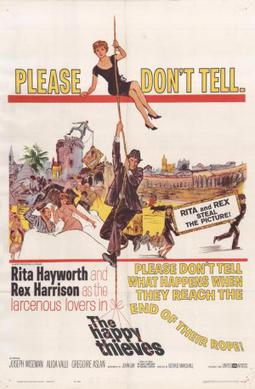
Jimmy Bourne (Rex Harrison) is an art thief, and a really good one at that. Pulling a long recon to steal a painting at a Spanish villa, Jimmy pulls off the job successfully. He gets away unnoticed, handing the rolled-up painting to his partner (and future wife), Eve (Rita Hayworth). Getting it through customs though, Eve loses the tube, forcing Jimmy and his forging art painting partner Jean (Joseph Wiseman), to improvise. It doesn't take long before the truth comes out. A visitor at the Spanish villa, Dr. Munoz (Gregoire Aslan), has pictures that can blackmail Jimmy, Jean and Eve....unless they pull off another art heist for him. Munoz wants the crew to take a Goya painting from the Prado Museum in Madrid. The problem? The painting is large, really large, and won't make for an easy job. The alternative is simple; jail.
Watch enough movies from any genre, and you will become familiar with it and all its conventions, cliches and stereotypes. If you like that genre enough to keep coming back to the well, that's a good thing. Not every heist movie is an extremely dark, cynical story, but the best and more memorable usually are. The job is usually the easiest part with the fallout following the job usually producing more fireworks. From director George Marshall, 'Happy' falls in between unfortunately. Everything from the music to the characters reflects a light, positive, even goofy tone. At the opposite end of the spectrum are some very dark, very surprising twists. If the story had picked one or the other, it could have been significantly better. Don't waver back and forth. Pick a route.
Through the light and the dark, I was most drawn to the casting. Harrison, Hayworth and Wiseman as a small team of crooks pulling an art heist? Count me in. These are three very respectable actors. I don't mean that heist movies don't attract good actors, but seeing actors of this caliber is pretty cool. Harrison as Jimmy is the quiet, gentlemanly thief, always composed, always ready with a contingency plan. Hayworth is okay as Eve, but the character gets on the shrill, worrisome side almost immediately. I didn't buy the chemistry between Harrison and Hayworth either. My favorite part was Wiseman as Jean, an accomplished painter who paints duplicates for Jimmy, usually fighting off his own nerves (some untimely throwing up too) in the process at the job gets closer, or unfortunately...during the job.
Also joining the cast is Aslan, doing what he does best as a menacing, intimidating villain, favoring a walking cane with a rifle in it. Alida Valli plays Duchess Blanca, a well-off, mysterious European woman with her hand in everything. Virgilio Teixeira has a fun and small but key supporting part as Cayetano, a Spanish bullfighter who may be an unknowing participant in Jimmy's job. Also look for George Rigaud, Britt Ekland, Peter Illing and Gerard Tichy in smaller parts.
I did like a lot about this movie. Marshall films in black and white, shooting on-location in Madrid and in Paris. That B&W look gives 'Happy' a throwback, retro visual look. It's a beautiful end product. I also liked the musical score from composer Mario Nascimbene, a mixture of light-hearted music and soft whistling. It leans more toward the light, positive side of the story. When the story turns to the dark, the score doesn't necessarily keep up in the tone department, but I liked the score just the same.
So back and forth between light and dark, the highlight of this heist flick is the actual heist at the Prado Museum. We know how Jimmy and Jean will pull the job, using Jean's forged duplicate to get their hands on Goya's The Second of May 1808. It's a straightforward, pretty simple job that takes advantage of a diversion outside the museum to distract the guards, but like the parts of the movie that do work, it has a certain charm to the developing caper. The bad part? The diversion Jimmy utilizes ends up involving murder, but he doesn't seem bothered by that in the least. When the character background reflects that he's an up-and-up English gentleman only to show no worry about a friend being murdered struck me as odd and out of place. I liked parts of 'Happy' enough, but not enough to really recommend this one fully. Give it a try at Youtube at the link below.
The Happy Thieves (1961): ** 1/2 /****
Jimmy Bourne (Rex Harrison) is an art thief, and a really good one at that. Pulling a long recon to steal a painting at a Spanish villa, Jimmy pulls off the job successfully. He gets away unnoticed, handing the rolled-up painting to his partner (and future wife), Eve (Rita Hayworth). Getting it through customs though, Eve loses the tube, forcing Jimmy and his forging art painting partner Jean (Joseph Wiseman), to improvise. It doesn't take long before the truth comes out. A visitor at the Spanish villa, Dr. Munoz (Gregoire Aslan), has pictures that can blackmail Jimmy, Jean and Eve....unless they pull off another art heist for him. Munoz wants the crew to take a Goya painting from the Prado Museum in Madrid. The problem? The painting is large, really large, and won't make for an easy job. The alternative is simple; jail.
Watch enough movies from any genre, and you will become familiar with it and all its conventions, cliches and stereotypes. If you like that genre enough to keep coming back to the well, that's a good thing. Not every heist movie is an extremely dark, cynical story, but the best and more memorable usually are. The job is usually the easiest part with the fallout following the job usually producing more fireworks. From director George Marshall, 'Happy' falls in between unfortunately. Everything from the music to the characters reflects a light, positive, even goofy tone. At the opposite end of the spectrum are some very dark, very surprising twists. If the story had picked one or the other, it could have been significantly better. Don't waver back and forth. Pick a route.
Through the light and the dark, I was most drawn to the casting. Harrison, Hayworth and Wiseman as a small team of crooks pulling an art heist? Count me in. These are three very respectable actors. I don't mean that heist movies don't attract good actors, but seeing actors of this caliber is pretty cool. Harrison as Jimmy is the quiet, gentlemanly thief, always composed, always ready with a contingency plan. Hayworth is okay as Eve, but the character gets on the shrill, worrisome side almost immediately. I didn't buy the chemistry between Harrison and Hayworth either. My favorite part was Wiseman as Jean, an accomplished painter who paints duplicates for Jimmy, usually fighting off his own nerves (some untimely throwing up too) in the process at the job gets closer, or unfortunately...during the job.
Also joining the cast is Aslan, doing what he does best as a menacing, intimidating villain, favoring a walking cane with a rifle in it. Alida Valli plays Duchess Blanca, a well-off, mysterious European woman with her hand in everything. Virgilio Teixeira has a fun and small but key supporting part as Cayetano, a Spanish bullfighter who may be an unknowing participant in Jimmy's job. Also look for George Rigaud, Britt Ekland, Peter Illing and Gerard Tichy in smaller parts.
I did like a lot about this movie. Marshall films in black and white, shooting on-location in Madrid and in Paris. That B&W look gives 'Happy' a throwback, retro visual look. It's a beautiful end product. I also liked the musical score from composer Mario Nascimbene, a mixture of light-hearted music and soft whistling. It leans more toward the light, positive side of the story. When the story turns to the dark, the score doesn't necessarily keep up in the tone department, but I liked the score just the same.
So back and forth between light and dark, the highlight of this heist flick is the actual heist at the Prado Museum. We know how Jimmy and Jean will pull the job, using Jean's forged duplicate to get their hands on Goya's The Second of May 1808. It's a straightforward, pretty simple job that takes advantage of a diversion outside the museum to distract the guards, but like the parts of the movie that do work, it has a certain charm to the developing caper. The bad part? The diversion Jimmy utilizes ends up involving murder, but he doesn't seem bothered by that in the least. When the character background reflects that he's an up-and-up English gentleman only to show no worry about a friend being murdered struck me as odd and out of place. I liked parts of 'Happy' enough, but not enough to really recommend this one fully. Give it a try at Youtube at the link below.
The Happy Thieves (1961): ** 1/2 /****
Thursday, August 25, 2011
The Sheepman
Watching and reading enough about the taming of the west in the second half of the 19th Century, you notice certain rivalries popping up...if rivalries is the right word. There was cowboys vs. Indians (not aliens), outlaws and bandits against marshals, sheriffs and law enforcement, American vs. Mexican (among any number of other nationalities who didn't care for each other), and because it wasn't just beef being shipped around the country, cattle vs. sheep.
Cattle grazed on the land while sheep basically picked the land clean, ripping the grass out by the roots so it didn't grow back. Didn't think you were going to get that sort of introduction to a western now, did you? That's the basic problem in many cattle vs. sheep westerns, including the 1958 oater The Sheepman. I'd seen this movie a few years ago but watched it recently on Turner Classic Movies when I thought I had not seen it. I watch a fair share of westerns so they start running together at a certain point...my bad. A good, entertaining and relatively harmless western, typical of so many 1950s westerns.
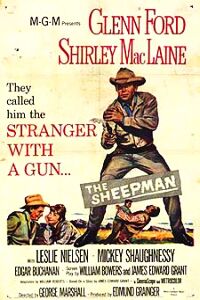
In the western town of Powder Valley where the cattle dominates the land, a stranger, Jason Sweet (Glenn Ford), arrives one day on the train. He quickly makes his presence felt, buying a saddle, buying drinks, picking a fight with the town tough guy. What's he up to? Jason is making sure everyone knows he's not a man to be tangled with because the next day his herd of sheep are inbound on the train. The cattle owners want nothing to do with Jason's herd, and they don't intend to go along quietly. The big man in the area who controls everything, Colonel Bedford (Leslie Nielsen) -- who Jason knows from his opposite side of the law past -- leads the charge to stop him, but the situation gets murky when Jason meets Dell Payton (Shirley MacLaine), Bedford's fiance. Now it is more than just a cattle and sheep situation, and the solution doesn't seem like an easy one.
This is a western that is pretty typical of a 1950s genre entry. Director George Marshall handles his straightforward, no frills story with his typical professionalism. The movie is only 87 minutes long so there is not much in the way of wasted time here. The story knows where it wants to get, especially that first half hour as Jason "introduces" himself around Powder Valley. That's the aspect of the comedic western that works best, an easy going, fun introduction. From there on in, things settle in with the good guys taking on the bad guys. Until late in the movie, the bad guys -- Nielsen included -- aren't even that bad. Finally Ford's Jason is pushed too far though, and he has to respond.
Realizing I've probably written this with all my Glenn Ford movie reviews, I think Ford is one of the most under-appreciated western stars that came out of the 1950s and 1960s. He doesn't have the name recognition that a John Wayne would, mostly because his westerns aren't considered classics. Ford probably belongs with Randolph Scott for his star caliber, solid, quality westerns that don't often wow you, but are always entertaining. As sheep herder Jason Sweet, he brings his typical western persona to the part. Ford was always very natural on-screen, showing off an ease that could give the impression he wasn't acting at all. He is likable though from the start, and you're rooting for him. Pointless bit of movie trivia, Ford wore the same hat in all his westerns. Not the same hat style, the actual hat. It still looks relatively clean here.
Playing the part of the female love interest, Shirley MacLaine makes the most of her appearance. So often this character -- the center of a pointless, needless, and unnecessary love triangle -- is forced into the story for the sake of having the character around. Not much is done to actually develop MacLaine's Dell character, but if nothing else she's trying, and that's all you're looking for at times. Anyone with an IQ over 10 or so knows from the second she is introduced she'll end up with Ford's Jason, but they've got to keep us guessing a little, right? MacLaine isn't the damsel in distress thankfully, just a frontier woman caught in a bad situation. Her chemistry with Ford in their scenes together is easily seen, and their dialogue/conversations have an easy flow to them throughout.
Because there isn't a ton else to analyze about this one, we get more cast analysis and criticism! Yeah for people! Before he became most well-known for The Naked Gun movies, Nielsen was a dramatic actor capable of drama, comedy, and action. He's not the baddest of bad guys until late in the movie, but he has some good back and forths with Ford. The rest of the cast includes some very recognizable western faces including Mickey Shaughnessy as one of Nielsen's henchmen, Edgar Buchanan as the wily, shifty stable owner who knows everything and everyone, Willis Bouchey as Dell's father, Pernell Roberts as Choctaw Neil, a gunslinger and adversary of Jason's, Slim Pickens as the town marshal who goes fishing when trouble arises, and Pedro Gonzalez Gonzalez as Angelo, one of Jason's sheepherders.
Not a great western, but certainly not a bad western. Just sort of in between, a western you can watch every couple years without getting bored or worn down.
The Sheepman <---trailer (1958): ** 1/2 /****
Cattle grazed on the land while sheep basically picked the land clean, ripping the grass out by the roots so it didn't grow back. Didn't think you were going to get that sort of introduction to a western now, did you? That's the basic problem in many cattle vs. sheep westerns, including the 1958 oater The Sheepman. I'd seen this movie a few years ago but watched it recently on Turner Classic Movies when I thought I had not seen it. I watch a fair share of westerns so they start running together at a certain point...my bad. A good, entertaining and relatively harmless western, typical of so many 1950s westerns.
In the western town of Powder Valley where the cattle dominates the land, a stranger, Jason Sweet (Glenn Ford), arrives one day on the train. He quickly makes his presence felt, buying a saddle, buying drinks, picking a fight with the town tough guy. What's he up to? Jason is making sure everyone knows he's not a man to be tangled with because the next day his herd of sheep are inbound on the train. The cattle owners want nothing to do with Jason's herd, and they don't intend to go along quietly. The big man in the area who controls everything, Colonel Bedford (Leslie Nielsen) -- who Jason knows from his opposite side of the law past -- leads the charge to stop him, but the situation gets murky when Jason meets Dell Payton (Shirley MacLaine), Bedford's fiance. Now it is more than just a cattle and sheep situation, and the solution doesn't seem like an easy one.
This is a western that is pretty typical of a 1950s genre entry. Director George Marshall handles his straightforward, no frills story with his typical professionalism. The movie is only 87 minutes long so there is not much in the way of wasted time here. The story knows where it wants to get, especially that first half hour as Jason "introduces" himself around Powder Valley. That's the aspect of the comedic western that works best, an easy going, fun introduction. From there on in, things settle in with the good guys taking on the bad guys. Until late in the movie, the bad guys -- Nielsen included -- aren't even that bad. Finally Ford's Jason is pushed too far though, and he has to respond.
Realizing I've probably written this with all my Glenn Ford movie reviews, I think Ford is one of the most under-appreciated western stars that came out of the 1950s and 1960s. He doesn't have the name recognition that a John Wayne would, mostly because his westerns aren't considered classics. Ford probably belongs with Randolph Scott for his star caliber, solid, quality westerns that don't often wow you, but are always entertaining. As sheep herder Jason Sweet, he brings his typical western persona to the part. Ford was always very natural on-screen, showing off an ease that could give the impression he wasn't acting at all. He is likable though from the start, and you're rooting for him. Pointless bit of movie trivia, Ford wore the same hat in all his westerns. Not the same hat style, the actual hat. It still looks relatively clean here.
Playing the part of the female love interest, Shirley MacLaine makes the most of her appearance. So often this character -- the center of a pointless, needless, and unnecessary love triangle -- is forced into the story for the sake of having the character around. Not much is done to actually develop MacLaine's Dell character, but if nothing else she's trying, and that's all you're looking for at times. Anyone with an IQ over 10 or so knows from the second she is introduced she'll end up with Ford's Jason, but they've got to keep us guessing a little, right? MacLaine isn't the damsel in distress thankfully, just a frontier woman caught in a bad situation. Her chemistry with Ford in their scenes together is easily seen, and their dialogue/conversations have an easy flow to them throughout.
Because there isn't a ton else to analyze about this one, we get more cast analysis and criticism! Yeah for people! Before he became most well-known for The Naked Gun movies, Nielsen was a dramatic actor capable of drama, comedy, and action. He's not the baddest of bad guys until late in the movie, but he has some good back and forths with Ford. The rest of the cast includes some very recognizable western faces including Mickey Shaughnessy as one of Nielsen's henchmen, Edgar Buchanan as the wily, shifty stable owner who knows everything and everyone, Willis Bouchey as Dell's father, Pernell Roberts as Choctaw Neil, a gunslinger and adversary of Jason's, Slim Pickens as the town marshal who goes fishing when trouble arises, and Pedro Gonzalez Gonzalez as Angelo, one of Jason's sheepherders.
Not a great western, but certainly not a bad western. Just sort of in between, a western you can watch every couple years without getting bored or worn down.
The Sheepman <---trailer (1958): ** 1/2 /****
Monday, July 11, 2011
The Guns of Fort Petticoat
It can be easy at times to forget that in the taming of the wild west, it wasn’t just the men leading the charge. Now granted, the movies, TV shows and western novels tend to focus on the male characters, but the women played a major role in the settling of the west. I’ve made no bones about my issue with female characters in so many westerns, but my issue has nothing to do with what the women did, just how they’re portrayed; the whiny, helpless damsels in distress who couldn’t find their way out of a paper bag. To live in the west in the second half of the 1800s, you had to be tough whether you were man or woman.
Too few westerns take advantage of that situation. There are countless stories of what women accomplished in the west. One of the best examples – which I reviewed a couple years back – was Westward the Women, a story of a wagon train full of women heading west to meet their husbands. They struggle on and keep going, taking everything thrown at them and continuing to fight. As part of the Audie Murphy night recently on Turner Classic Movies, 1957’s The Guns of Fort Petticoat reminded me a lot of ‘Westward’ for all the right reasons, taking the formula and tweaking it a bit as a valley-full of women must fend for themselves during an Indian uprising.
With the Union and Confederate forces back east in the Civil War, cavalry officer Lt. Frank Hewitt (Murphy) sees a superior officer order an unnecessary and brutal attack on a peaceful Indian village and knows there will be repercussions at their western post. He deserts his post and rides south, knowing there will be attacks and raids for thousands of miles in every direction. Hewitt is heading home to his home in Texas, a little valley that lies unprotected with all the men off fighting the war. Organizing all the women left behind, he prepares a defense at an abandoned Spanish mission, knowing an attack will come. He trains the women, readying them for the coming fight, but can he get them ready enough in time?
This is a movie that had a lot of potential to be a campy western full of obvious humor that would have been remembered for all the wrong reasons. Instead, director George Marshall turns in an above average western that is entertaining, well-made and different from your typical run of the mill cowboys/cavalry and Indians movies. 'Guns' was filmed in Old Tucson, one of the most instantly recognizable locations for western shooting to anyone even remotely familiar with westerns. For starters, it looks great. Not given a credit in the credit sequence, composer Mischa Bakaleinoff turns in an appropriate, exciting western score that keeps the action flowing. At just 82 minutes, this is fast paced and exciting, and a quality example of a modest B-movie rising above its genre conventions.
Before his tragic death in 1971 in a plane crash, Murphy made 44 movies of which 33 were westerns. He just seems at home as the lead -- cowboy, rancher, officer, scout, gunman -- in all these westerns. I don't intend this as a criticism, but Murphy wasn't the greatest actor around as he worked within a comfort zone that played to his range. Nothing wrong with that. That resolute, staunch hero is especially needed here because he's the only good guy (quite literally GUY) around. There are attacking Indians, conniving cowards, and a gang of opportunistic bandits around with Murphy leading the way for his little company of female fighters. Murphy -- range limitations aside -- is always very believable, very natural in his acting, and his performance is a key to this movie's success.
Instead of working with one tough, strong female co-star, Murphy gets plenty of them here. His company includes Kathryn Grant as Anne, a pretty tomboy who catches Lt. Hewitt's eyes, Hope Emerson as Hannah Lacey, an older, tough as nails woman who claims to be as tough as any three men and becomes Hewitt's "sergeant," (a similar role to the one she played in a similar movie, Westward the Women), Peggy Maley as Lucy, a saloon girl with a heart of gold (of course), Isobel Elsom as a prim and proper Southern woman with her slave/assistant, Hetty (Ernestine Wade) along, Jeanette Nolan as Cora, the bible-thumping religious freak and Patricia Tiernan as Stella, a past love interest of Hewitt's who hasn't quite moved on. As an ensemble filling in the pieces around Murphy, the almost all female supporting cast does not disappoint in their performances.
So often 1950s westerns can be extremely tame looks at a particularly brutal time in American history. That's not an issue here with this western. When a small group of people fort up and basically prepare for a siege, there are going to be some casualties. My worry was that somehow all these characters would make it through the movie unscathed, throwing away any semblance of reality. The siege and continuing attacks on the mission where Hewitt and Co. hole up are a bright spot for the movie. They're realistic, violent, and shot in a way where the battle is always coherent and easy to follow (harder than you'd think comparing it to other movies). And there are casualties which is probably a little more shocking because you just don't see many female characters killed in westerns. The action though on top of a solid story make this western better than most.
Now there are moments where this movie leans toward the camp humor (intentionally or not). Jeff Donnell plays Mary Wheeler, a single woman who is pregnant with the baby of a no-good gunslinger, Emmett Kettle (Sean McClory). It's the type of performance that grates like so many other helpless female characters and feels out of place compared to the rest of the women. There's also the obnoxious but somehow necessary little kid (Kim Charney), full of piss and vinegar and "tough talk" who ends up causing an attack when the Indians are about to pass the group by. Nolan's Cora is also a little much as the religious zealot, especially her rant in the end. Other small parts go to Ray Teal, Nestor Paiva and James Griffith as three low-down bandits. Underused parts, but effective for what's needed. Named Salt Pork, Tortilla and Kipper respectively, they also have three of the coolest names ever.
Reviews are somewhat mixed on Guns, and most of the criticisms I read were very fair. But in the end, I liked this western a lot. It isn't a classic western, but it does just about everything it can to be an above average oater.
The Guns of Fort Petticoat <---TCM clips (1957): *** 1/2 /****
Labels:
1950s,
Audie Murphy,
George Marshall,
Sean McClory,
westerns
Monday, April 25, 2011
Advance to the Rear
Comedies seem to go through their ups and down patches like any genre movie does. In the last 10 years or so, R-rated comedies have seen a resurgence in popularity while in the 1990s it was romantic comedies and in the 1980s raucous, mind-numbingly stupid sex comedies. The 1970s and even the tail end of the 1960s? I guess it depends on the movie. Prior to that though in the age of big screen spectacles and epics, there was an innocence to comedies that was lost over the years. Epic comedies (how weird does that sound?) like The Great Race, It's a Mad, Mad, Mad World, The Russians are Coming and many more dominated movies.
Take 1964's Advance to the Rear, a comedic spoof of one of the funniest times in American history...the Civil War. There's no way that should work, right? America's bloodiest conflict doesn't seem like its ripe for the picking for a big-screen spoof. Somehow it does though, even if it isn't on the level of the previously mentioned comedies. It's no classic, but it accomplishes what it sets out to do. It is funny in a ridiculously stupid way, full of slapstick humor, some romance, and a cast full of recognizable names, all of them playing bumbling idiots. That's a formula for success if there ever was one.
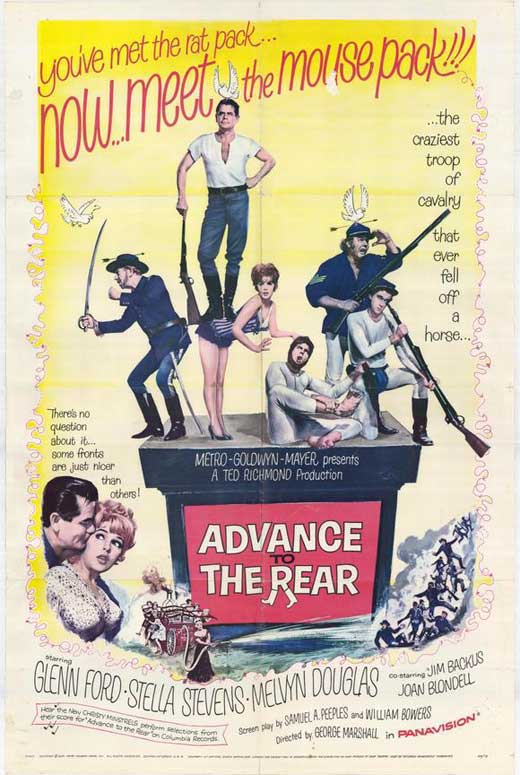
It's 1862, and lawyer turned infantry soldier Captain Jared Heath (Glenn Ford) is the aide to a veteran of West Point and all-around clueless officer, Colonel Claude Brackenbury (Melvyn Douglas). Supposed to lead an attack on a Confederate position, Brackenbury's regiment instead turns and runs from the field of battle thanks to a simple miscommunication. The unit is made an example of for their cowardice and receives order to go west to a remote outpost, also taking along misfits and screw-ups from other units in the Union army. Dubbed Company Q, they head west by riverboat. Confederate intelligence catches wind of the new unit and assumes they're some sort of specialized unit meant to perform a dangerous mission. A beautiful Confederate spy, Martha Lou Williams (Stella Stevens), is sent west to investigate, and see exactly what these "special soldiers" are up to.
Slapstick comedy is completely hit-or-miss with me. I grew up watching The Three Stooges and Laurel and Hardy shorts so I do like some of it. But if it isn't handled correctly, it's going to go poorly, and do it fast. The problem is that you have to fully commit to doing the slapstick so you open things up to look completely stupid if it isn't funny. The physical humor here isn't bad, but it certainly isn't good either. Director George Marshall uses all sorts of wacky techniques, almost telling us when to laugh. Sound effects seem like they were used from a Batman TV episode and are painfully out of place. A soldier skis down a hill on tree branch skis? Add the sound of a plane taking off. Someone goes flying through the air? Cue the sound barrier being broken. Sound effects and sped-up action screams out desperation to me, and there's a good amount of it here.
When I think of Glenn Ford, I typically think of an underrated dramatic actor, someone able to move across genres and be believable and successful in all types of movies. Comedy? Not really the first thing that comes to mind. I was pleasantly surprised then when Ford as Capt. Jared Heath, a ladies man and the rare competent soldier in the bunch, ends up carrying the movie. By far, he's the biggest bright spot going for this 1960s comedy. He delivers his lines in such a deadpan fashion while also handling the more physical scenes that it seems effortless. Ford has a great chemistry with the always beautiful Stella Stevens (who poses as a showgirl briefly) in the romantic scenes and also with Douglas' clueless Colonel Brackenbury, the experienced officer who can't stand his aide and his way of going about things. Their exchanges of cracks back and forth help make up for some of the worst examples of slapstick, as do the scenes with Ford and Stevens. Ford's Heath quickly figures out she's a Confederate spy, but because he wants to marry her lets it go by the wayside. I don't blame him.
There was some wasted potential with the supporting cast to develop them into some better, even funnier characters. Jim Backus and Whit Bissell are the equally idiotic Union generals who send Company Q out west only to realize they've sent them to lead an actual dangerous mission that could turn the tide of the war. Joan Blondell plays Easy Jenny, the leader of the showgirls who take a shining to Heath and his men. Michael Pate has a small part as Charlie Thin Elk, an Indian chief who went to West Point in the 1830s. James Griffith plays Hugo Zattig, the leader of a group of Confederate renegades. As for Company Q, there's Alan Hale Jr. as Sgt. Davis, Andrew Prine as Pvt. Selous, always hiccuping, and Jesse Pearson as Cpl. Geary, a soldier who always has horses following him around because of his unique smell. There were some other interesting soldiers -- a klepto, a firebug, a boxer, a brawler -- who are introduced but never get much to do. If the movie was longer (it's only 100 minutes) like other 60s comedies, it's safe to say there would be some more development among Company Q.
It feels funny watching a Civil War comedy no matter how much of the humor does or doesn't work. Marshall films it in a great-looking widescreen fashion -- in black and white at that -- making it feel like an epic action/adventure flick, not a spoof. It is funny at times, but not as funny as it could have been. I wanted to like the movie more than I did. It's decent enough but nothing more. Also worth watching to see John Wayne's stunt man Chuck Roberson get a speaking role as a Confederate guerrilla. It is available to watch at Youtube starting HERE.
Advance to the Rear <--- TCM trailer (1964): ** 1/2 /****
Take 1964's Advance to the Rear, a comedic spoof of one of the funniest times in American history...the Civil War. There's no way that should work, right? America's bloodiest conflict doesn't seem like its ripe for the picking for a big-screen spoof. Somehow it does though, even if it isn't on the level of the previously mentioned comedies. It's no classic, but it accomplishes what it sets out to do. It is funny in a ridiculously stupid way, full of slapstick humor, some romance, and a cast full of recognizable names, all of them playing bumbling idiots. That's a formula for success if there ever was one.
It's 1862, and lawyer turned infantry soldier Captain Jared Heath (Glenn Ford) is the aide to a veteran of West Point and all-around clueless officer, Colonel Claude Brackenbury (Melvyn Douglas). Supposed to lead an attack on a Confederate position, Brackenbury's regiment instead turns and runs from the field of battle thanks to a simple miscommunication. The unit is made an example of for their cowardice and receives order to go west to a remote outpost, also taking along misfits and screw-ups from other units in the Union army. Dubbed Company Q, they head west by riverboat. Confederate intelligence catches wind of the new unit and assumes they're some sort of specialized unit meant to perform a dangerous mission. A beautiful Confederate spy, Martha Lou Williams (Stella Stevens), is sent west to investigate, and see exactly what these "special soldiers" are up to.
Slapstick comedy is completely hit-or-miss with me. I grew up watching The Three Stooges and Laurel and Hardy shorts so I do like some of it. But if it isn't handled correctly, it's going to go poorly, and do it fast. The problem is that you have to fully commit to doing the slapstick so you open things up to look completely stupid if it isn't funny. The physical humor here isn't bad, but it certainly isn't good either. Director George Marshall uses all sorts of wacky techniques, almost telling us when to laugh. Sound effects seem like they were used from a Batman TV episode and are painfully out of place. A soldier skis down a hill on tree branch skis? Add the sound of a plane taking off. Someone goes flying through the air? Cue the sound barrier being broken. Sound effects and sped-up action screams out desperation to me, and there's a good amount of it here.
When I think of Glenn Ford, I typically think of an underrated dramatic actor, someone able to move across genres and be believable and successful in all types of movies. Comedy? Not really the first thing that comes to mind. I was pleasantly surprised then when Ford as Capt. Jared Heath, a ladies man and the rare competent soldier in the bunch, ends up carrying the movie. By far, he's the biggest bright spot going for this 1960s comedy. He delivers his lines in such a deadpan fashion while also handling the more physical scenes that it seems effortless. Ford has a great chemistry with the always beautiful Stella Stevens (who poses as a showgirl briefly) in the romantic scenes and also with Douglas' clueless Colonel Brackenbury, the experienced officer who can't stand his aide and his way of going about things. Their exchanges of cracks back and forth help make up for some of the worst examples of slapstick, as do the scenes with Ford and Stevens. Ford's Heath quickly figures out she's a Confederate spy, but because he wants to marry her lets it go by the wayside. I don't blame him.
There was some wasted potential with the supporting cast to develop them into some better, even funnier characters. Jim Backus and Whit Bissell are the equally idiotic Union generals who send Company Q out west only to realize they've sent them to lead an actual dangerous mission that could turn the tide of the war. Joan Blondell plays Easy Jenny, the leader of the showgirls who take a shining to Heath and his men. Michael Pate has a small part as Charlie Thin Elk, an Indian chief who went to West Point in the 1830s. James Griffith plays Hugo Zattig, the leader of a group of Confederate renegades. As for Company Q, there's Alan Hale Jr. as Sgt. Davis, Andrew Prine as Pvt. Selous, always hiccuping, and Jesse Pearson as Cpl. Geary, a soldier who always has horses following him around because of his unique smell. There were some other interesting soldiers -- a klepto, a firebug, a boxer, a brawler -- who are introduced but never get much to do. If the movie was longer (it's only 100 minutes) like other 60s comedies, it's safe to say there would be some more development among Company Q.
It feels funny watching a Civil War comedy no matter how much of the humor does or doesn't work. Marshall films it in a great-looking widescreen fashion -- in black and white at that -- making it feel like an epic action/adventure flick, not a spoof. It is funny at times, but not as funny as it could have been. I wanted to like the movie more than I did. It's decent enough but nothing more. Also worth watching to see John Wayne's stunt man Chuck Roberson get a speaking role as a Confederate guerrilla. It is available to watch at Youtube starting HERE.
Advance to the Rear <--- TCM trailer (1964): ** 1/2 /****
Tuesday, March 15, 2011
Texas (1941)
Through the late 1940s and into the 1950s and 1960s, two of the most reliable, bankable stars in Hollywood were William Holden and Glenn Ford. But everyone has got to start somewhere, right? I've seen movies with both actors, but a majority of them were from the 1950s and 1960s when they were already established stars. As very young-looking youngsters in 1941, they worked together on an odd but entertaining western simply titled Texas.
It can be fun with movies like this seeing stars before they were stars. For one here with Texas, both Holden and Ford look like they're fresh out of high school. Holden was just 23 years old, and Ford not too much older at 25 when the movie was made. Through all the exaggerated comedy, rambling story and over-reliance on stock footage, that is what makes Texas bearable. Long before either man was a household name, the young acting duo shows off the talent that audiences would come to love and expect in future roles.
The Civil War has ended and two cavalry troopers from Jeb Stuart's forces, Dan Thomas (Holden) and Tod Ramsey (Ford), are drifting west. They find themselves in Abilene on their way further south to Texas and all its riches when they see a stagecoach being robbed. They turn the tables and rob the robbers, but through a miscommunication end up being chased by a posse. With little hope of getting away, they separate and make a getaway on their own. Time passes as Dan latches on with a group of rustlers harassing every herd that heads north while Tod signs on as a foreman at a well-to-do cattle ranch. Their paths seem destined to cross again, especially when both men have an interest in a beautiful rancher's daughter, Mike (Claire Trevor). Is their friendship going to last or will it be torn apart?
Director George Marshall turns in an odd, all over the place finished product with this 1941 western. At just 93 minutes, a ton of story is packed into a relatively quick running time. That description above doesn't quite do it justice because there is much, much more going on. It is an odd mix of a brotherly relationship in the west, slapstick comedy that is painful to watch at times, the always excruciating love triangle, way too much stock footage, and a story that is far too choppy at times, ending up playing like an hour-long serial instead of a feature length movie. I don't know if a longer movie would have helped to flesh things out, but it couldn't have hurt.
I've never been much for comedic westerns with the exceptions of spoofs like Blazing Saddles that pull out all the stops. If you're going to make it funny, go all the way. Don't make a comedic drama (if that makes any sense). An early scene introduces us to Dan and Tod which is fine. A departure from the set-up or a jumping off point for what's to come is fine if it helps us get to know the characters. An old school boxing match has Dan getting whaled on for 50 or 60 rounds that feels like it actually goes on that long. With a short 93-minute movie like this, it's too much. Also in the comedy department, Edgar Buchanan (usually one of my favorite character actors) hams it up as a conniving dentist who happens to be the villain too, making evil, despicable decisions one after another. He is funny with that quiet, raspy stream of conscious talking, but next thing you know he's planning to shoot everyone around him. Separately it could have worked, but together it never fits.
While it may not seem like it, I did enjoy Texas. Holden and Ford are always watchable even in their weakest efforts, and this isn't one of them. The brother relationship in movies is as old as westerns themselves. They're close and have bonded through the hellacious situations they've survived together. Eventually, something is going to tear them apart, forcing them to either fight it out or knuckle under and run. Holden especially has some fun with the Dan Thomas part, the cowboy who will turn wherever there's money available. It's the part that Holden would make his bread and butter, the lovable rogue. Ford's part is more vanilla, the generic good guy who always makes the right decision no matter the consequences. Still, the movie is at its best when they duo is on-screen together.
Filmed in black and white, Marshall relies too much on stock footage, especially late with an epic cattle drive heading to Abilene. As for the love triangle, it doesn't make a ton of sense how it develops, but with Trevor working with Holden and Ford, it isn't as bad as so many other love triangles are. For a story that rambles as much as it does from one place to another with no real end in sight, the finale comes together quite quickly. I would have liked this story much more with a few slight changes. Add maybe 15 minutes, take out the comedy, and thin out the stock footage. The talent in the acting department and the story has potential to be something better. Even then, I still liked the movie, but I didn't love it.
Texas (1941): ** 1/2 /****
It can be fun with movies like this seeing stars before they were stars. For one here with Texas, both Holden and Ford look like they're fresh out of high school. Holden was just 23 years old, and Ford not too much older at 25 when the movie was made. Through all the exaggerated comedy, rambling story and over-reliance on stock footage, that is what makes Texas bearable. Long before either man was a household name, the young acting duo shows off the talent that audiences would come to love and expect in future roles.
The Civil War has ended and two cavalry troopers from Jeb Stuart's forces, Dan Thomas (Holden) and Tod Ramsey (Ford), are drifting west. They find themselves in Abilene on their way further south to Texas and all its riches when they see a stagecoach being robbed. They turn the tables and rob the robbers, but through a miscommunication end up being chased by a posse. With little hope of getting away, they separate and make a getaway on their own. Time passes as Dan latches on with a group of rustlers harassing every herd that heads north while Tod signs on as a foreman at a well-to-do cattle ranch. Their paths seem destined to cross again, especially when both men have an interest in a beautiful rancher's daughter, Mike (Claire Trevor). Is their friendship going to last or will it be torn apart?
Director George Marshall turns in an odd, all over the place finished product with this 1941 western. At just 93 minutes, a ton of story is packed into a relatively quick running time. That description above doesn't quite do it justice because there is much, much more going on. It is an odd mix of a brotherly relationship in the west, slapstick comedy that is painful to watch at times, the always excruciating love triangle, way too much stock footage, and a story that is far too choppy at times, ending up playing like an hour-long serial instead of a feature length movie. I don't know if a longer movie would have helped to flesh things out, but it couldn't have hurt.
I've never been much for comedic westerns with the exceptions of spoofs like Blazing Saddles that pull out all the stops. If you're going to make it funny, go all the way. Don't make a comedic drama (if that makes any sense). An early scene introduces us to Dan and Tod which is fine. A departure from the set-up or a jumping off point for what's to come is fine if it helps us get to know the characters. An old school boxing match has Dan getting whaled on for 50 or 60 rounds that feels like it actually goes on that long. With a short 93-minute movie like this, it's too much. Also in the comedy department, Edgar Buchanan (usually one of my favorite character actors) hams it up as a conniving dentist who happens to be the villain too, making evil, despicable decisions one after another. He is funny with that quiet, raspy stream of conscious talking, but next thing you know he's planning to shoot everyone around him. Separately it could have worked, but together it never fits.
While it may not seem like it, I did enjoy Texas. Holden and Ford are always watchable even in their weakest efforts, and this isn't one of them. The brother relationship in movies is as old as westerns themselves. They're close and have bonded through the hellacious situations they've survived together. Eventually, something is going to tear them apart, forcing them to either fight it out or knuckle under and run. Holden especially has some fun with the Dan Thomas part, the cowboy who will turn wherever there's money available. It's the part that Holden would make his bread and butter, the lovable rogue. Ford's part is more vanilla, the generic good guy who always makes the right decision no matter the consequences. Still, the movie is at its best when they duo is on-screen together.
Filmed in black and white, Marshall relies too much on stock footage, especially late with an epic cattle drive heading to Abilene. As for the love triangle, it doesn't make a ton of sense how it develops, but with Trevor working with Holden and Ford, it isn't as bad as so many other love triangles are. For a story that rambles as much as it does from one place to another with no real end in sight, the finale comes together quite quickly. I would have liked this story much more with a few slight changes. Add maybe 15 minutes, take out the comedy, and thin out the stock footage. The talent in the acting department and the story has potential to be something better. Even then, I still liked the movie, but I didn't love it.
Texas (1941): ** 1/2 /****
Labels:
1940s,
Claire Trevor,
George Marshall,
Glenn Ford,
westerns,
William Holden
Tuesday, December 21, 2010
The Blue Dahlia
Many movies made about the Vietnam War don’t focus in on the actual conflict that went on in Vietnam in the 1960s and 1970s, but instead key in on what happens to the soldiers when they return home, how the war has affected them in ways not previously thought of. War has an impact on the soldiers involved no matter the conflict or what century it took place, but Vietnam was the first where the public was aware of these issues. A WWII movie, The Best Years of Our Lives, dealt with this pertaining to World War II veterans returning home. A film noir released in 1946, The Blue Dahlia, has three main characters returning to the United States, all dealing with the return in their own way.
When I first read about this movie at Turner Classic Movie’s website, I assumed it was related to ‘The Black Dahlia,’ the Hollywood flop from five or six years ago that was forgotten almost as soon as it was released in theaters to critical panning. Well, other than the use of ‘Dahlia’ in the title, there is no common link. Blue Dahlia is a solid, well-made film noir about a murder mystery in the Los Angeles club scene where everyone is shady and willing to backstab anyone else for their own gain. It isn’t held in as high regard as many other noir classics, but it is a very solid entry into a very deep genre of movies in film noir.
Returning to the States after receiving a medical discharge, former Navy pilot John Morrison (Alan Ladd) can’t wait to get home and see his wife, Helen (Doris Dowling). He finds something else though waiting for him as his wife has adopted a new partying lifestyle, including starting a relationship with slippery club owner, Eddie Harwood (Howard Da Silva). Morrison’s wife has a dark secret she reveals to John, sending him into a fit of rage that even has him thinking about killing her. Instead, he walks out on her, leaving his past life behind. The next morning though John hears radio reports that his wife has been murdered, and he’s wanted for questioning. With help from his former Navy buddies (William Bendix and Hugh Beaumont), Morrison goes about proving his innocence and finding his wife’s actual murderer.
The post subplot (soldier condition) is centered around William Bendix’s Buzz character, a tail gunner on Morrison’s bomber in the Pacific. Along with John and Beaumont’s George, Buzz received a medical discharge after sustaining a serious wound that tore away part of his skull. He now has a metal plate on the back of his head and is struggling with his readjustment to a more normal life. He freaks out at loud noises and any sort of music playing and has a temper that’s ready to snap at the drop of a hat. For a movie released in the years since the end of World War II, it’s refreshing to see such honesty in dealing with an issue that would have been affecting thousands of similar-minded soldiers all over the U.S.
As for the main plot with the murder mystery, director George Marshall knows what he’s doing. First off, if you think Alan Ladd’s character is the guilty party, shame on you. It’s Shane for goodness sake! He isn’t going to kill his wife! Several possible suspects are presented ranging from the obvious to the dark horse that most viewers will think did it to the actual murderer. I thought I had this one figured out, but the joke was on me. ‘Dahlia’ certainly does its best to keep you guessing, a nice touch amidst the typical noir conventions that viewers have come to expect.
Of the few movies I’ve seen Ladd in other than Shane, I’ve always been a fan of this underrated actor. He apparently did all sorts of things to take away attention from his lack of height (he was only 5’6), but his on-screen presence makes up for it. Ladd has this quiet intensity in his characters that give a feel of not knowing quite what the man is capable of. Here, he is pushed too far by his wife, and even though she is at fault for something horrific in her past, Ladd’s Morrison knows she deserved better than the fate she met. A worthy leading part for Ladd as he carries the movie.
The supporting cast is not made up entirely of home runs, but for the most part the casting works. Bendix especially shines as Buzz while Beaumont (later Mr. Cleaver in Leave it to Beaver) isn’t given as much to do. Da Silva is a great villain, a man with his hand in all sorts of shady dealings. Veronica Lake plays a less essential character early on who ends up playing a key role in the murder investigation as it develops. Ladd and Lake end up in a somewhat forced romantic relationship that ends up wrapping all the separate subplots together nicely in the end.
The Blue Dahlia <---trailer (1946): ** ½ /****
Labels:
1940s,
Alan Ladd,
Film Noir,
George Marshall,
William Bendix
Subscribe to:
Posts (Atom)