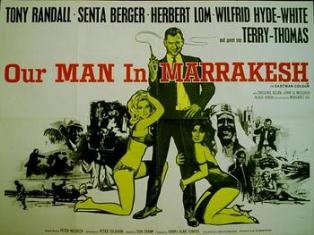
B-movies can be really good when handled right. Now the counter, they can be really, really bad when handled wrong. Whole studios between the 1940s and 1960s were devoted to B-movies, like American International Pictures with its horror, thriller and westerns. How about a spy spoof that has some fun with the James Bond formula, the mistaken identity genre like North by Northwest and a generally fun attitude? That would be 1966's Bang! Bang! You're Dead, released in Europe as Our Man in Marrakesh.
On vacation from his job with an oil company, Andrew Jessel (Tony Randall) is spending his time away from work in northern Africa in Morocco. He boards a bus headed to Marrakesh with five other passengers, not knowing that one of them is carrying two million dollars intended for Mr. Casimir (Herbert Lom), a powerful man with his hand in everything underworld. Where's that money heading? Paid here and there to help fix an upcoming vote at the United Nations. Casimir is trying to find out who, Jessep finding himself mixed up in it all when he finds a dead body in his hotel room closet. One of the other passengers, Kyra Stanovy (Senta Berger), stumbles into the room and sees the dead body, stunned even more when she recognizes who it is. Now, Andrew is very much involved, trapped in a foreign country and trying to hide a corpse. Mr. Casimir is right with him, watching his every step.
I don't hide my feelings about spoofs. I'm usually not a fan. It's the rare spoof I like -- Blazing Saddles, Young Frankenstein, Spinal Tap -- with most of them trying too hard to...well, be a spoof. From director Don Sharp, 'Bang' isn't a literal spoof as I think of a spoof, instead having some fun with a typically pretty serious topic, international intrigue. In the end, I liked it but didn't love it. It's pretty light, fun at times, obnoxious at others, and a decent enough waste of time for 90 minutes or so. The on-location shooting in Marrakesh, Morocco is a definite plus, even if some scenes are undone by some really obvious green-screen shots. Still, Marrakesh in the 1960s sure looked cool, the time capsule effect a big positive.
Leading the way in the Mistaken Identity department is Tony Randall, Mr. Felix Unger himself. Doesn't Randall scream tough guy hero in a spy flick with international intrigue? Yeah, I guess not. He has some fun with the Everyman part, the normal guy thrust into a crazy situation full of conniving crooks, beautiful, mysterious women, wishy-washy motives, lots of enforcers, hit men and car chases, and life and death opportunities around every corner. Randall shows off his impeccable comedic timing throughout, questioning all the craziness that's going on but mostly going along with it. Would you question too much if you got to hang out with Senta Berger? Okay, maybe once a dead body showed up, but I'd still debate it. One of the more unlikely action heroes, Randall throws himself into the mix in the chase and action scenes, his goofiness and lighter tone playing well with the kooky story.
Across the board, the cast is the biggest selling point for this spy spoof. As the sexy sidekick, Berger is just that, pretty sexy. Skimpy and/or tight outfits, sexy Euro accent, how can you lose? Playing the slimy, slick villain, there weren't many better than Herbert Lom, an oiliness to his impeccably smooth and suave Mr. Casimir. Klaus Kinski makes the most of a small(ish) but intimidating part as Jonquil, Casimir's brutally effective enforcer while Margaret Lee sex kittens it up as Casimir's young lady friend/lover who's always asking him to "come lay down with him." Oh, scandalous! As for the other suspects on the bus to Marrakesh, look for Wilfrid Hyde-White as Fairbrother, a Brit working with a septic company (maybeeeeeee) and John Le Mesurier as Lillywhite, another Brith looking to expand his own business. Who is the courier with all that cash? What's everyone up to? There's also some fun parts for Terry-Thomas as El Caid, the son of a former crook trying to go straight...well, sorta, and Gregoire Aslan as Achmed, a truck driver who sides with Andrew and Kyra as things escalate.
My typical issue with movies with a twist, stories with some mystery, is that they try to be too cute in keeping that mystery under wraps. Without going back and rewatching 'Bang,' I'd wager Berger's Kyra tell Randall's Andrew "I'll tell you everything that's going on tomorrow!" Or.....or, just sit down and tell us now. Whatever works. Don't be too cute. Don't leave audiences on the hook for the sake of that cuteness. Thankfully, the last 30-40 minutes pick up the pace once we figure everything out. The finale is pretty fun as everything comes together, one extended chase and action sequence. It's a fun movie, easily digested and onto the next movie!
Bang! Bang! You're Dead! (1966): ** 1/2 /****
The Sons of Katie Elder
"First, we reunite, then find Ma and Pa's killer...then read some reviews."
Showing posts with label Gregoire Aslan. Show all posts
Monday, March 31, 2014
Thursday, March 21, 2013
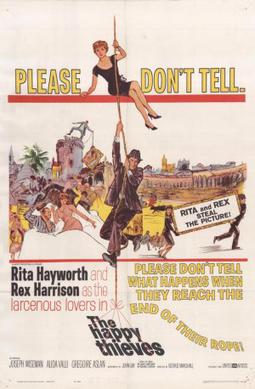
The Happy Thieves
If you've made it this far, maybe you can go a little further. Oh, Shawshank Redemption quotes! Anyways, I've been reviewing a fair share of heist/caper movies recently thanks to Turner Classic Movie's heist marathons. Only a couple more, I swear. Here we go with the relatively unknown 1961 heist flick, The Happy Thieves.
Jimmy Bourne (Rex Harrison) is an art thief, and a really good one at that. Pulling a long recon to steal a painting at a Spanish villa, Jimmy pulls off the job successfully. He gets away unnoticed, handing the rolled-up painting to his partner (and future wife), Eve (Rita Hayworth). Getting it through customs though, Eve loses the tube, forcing Jimmy and his forging art painting partner Jean (Joseph Wiseman), to improvise. It doesn't take long before the truth comes out. A visitor at the Spanish villa, Dr. Munoz (Gregoire Aslan), has pictures that can blackmail Jimmy, Jean and Eve....unless they pull off another art heist for him. Munoz wants the crew to take a Goya painting from the Prado Museum in Madrid. The problem? The painting is large, really large, and won't make for an easy job. The alternative is simple; jail.
Watch enough movies from any genre, and you will become familiar with it and all its conventions, cliches and stereotypes. If you like that genre enough to keep coming back to the well, that's a good thing. Not every heist movie is an extremely dark, cynical story, but the best and more memorable usually are. The job is usually the easiest part with the fallout following the job usually producing more fireworks. From director George Marshall, 'Happy' falls in between unfortunately. Everything from the music to the characters reflects a light, positive, even goofy tone. At the opposite end of the spectrum are some very dark, very surprising twists. If the story had picked one or the other, it could have been significantly better. Don't waver back and forth. Pick a route.
Through the light and the dark, I was most drawn to the casting. Harrison, Hayworth and Wiseman as a small team of crooks pulling an art heist? Count me in. These are three very respectable actors. I don't mean that heist movies don't attract good actors, but seeing actors of this caliber is pretty cool. Harrison as Jimmy is the quiet, gentlemanly thief, always composed, always ready with a contingency plan. Hayworth is okay as Eve, but the character gets on the shrill, worrisome side almost immediately. I didn't buy the chemistry between Harrison and Hayworth either. My favorite part was Wiseman as Jean, an accomplished painter who paints duplicates for Jimmy, usually fighting off his own nerves (some untimely throwing up too) in the process at the job gets closer, or unfortunately...during the job.
Also joining the cast is Aslan, doing what he does best as a menacing, intimidating villain, favoring a walking cane with a rifle in it. Alida Valli plays Duchess Blanca, a well-off, mysterious European woman with her hand in everything. Virgilio Teixeira has a fun and small but key supporting part as Cayetano, a Spanish bullfighter who may be an unknowing participant in Jimmy's job. Also look for George Rigaud, Britt Ekland, Peter Illing and Gerard Tichy in smaller parts.
I did like a lot about this movie. Marshall films in black and white, shooting on-location in Madrid and in Paris. That B&W look gives 'Happy' a throwback, retro visual look. It's a beautiful end product. I also liked the musical score from composer Mario Nascimbene, a mixture of light-hearted music and soft whistling. It leans more toward the light, positive side of the story. When the story turns to the dark, the score doesn't necessarily keep up in the tone department, but I liked the score just the same.
So back and forth between light and dark, the highlight of this heist flick is the actual heist at the Prado Museum. We know how Jimmy and Jean will pull the job, using Jean's forged duplicate to get their hands on Goya's The Second of May 1808. It's a straightforward, pretty simple job that takes advantage of a diversion outside the museum to distract the guards, but like the parts of the movie that do work, it has a certain charm to the developing caper. The bad part? The diversion Jimmy utilizes ends up involving murder, but he doesn't seem bothered by that in the least. When the character background reflects that he's an up-and-up English gentleman only to show no worry about a friend being murdered struck me as odd and out of place. I liked parts of 'Happy' enough, but not enough to really recommend this one fully. Give it a try at Youtube at the link below.
The Happy Thieves (1961): ** 1/2 /****
Friday, May 6, 2011
Sea Fury
Most well-known for his performances in a handful of John Ford movies, Victor McLaglen was one of the great character actors to come out of Hollywood's Golden Age. In the Ford movies, his theatrics were often a little too much, a little too jokey for my liking, but it doesn't take away from a great career. It was one that saw him star in over 100 movies (silent and sound), even winning a Best Actor Oscar for his performance in The Informer. He died in 1959 from a heart attack, just a year after completing his final film, 1958's Sea Fury.
It can be sad watching actors and actresses in their last films, and for McLaglen, that's true on several levels. In his 70s by the time this movie was made, he looks every inch of 70 if not more. He's playing a character he often played, a rough, brawling and boozing man who's led a tough life but plans on going out kicking, not lying back in bed. McLaglen just doesn't look himself though right from the start. What makes it worse is that through all his trademark blustering is that's nearly indecipherable, mumbling his way through lines to the point it's hard to comprehend a thing he says. The performance is far from bad, but it's not up to his standards that he established over a 30-plus year career.
Captaining the Fury II, a tugboat salvage vessel, Captain Bellew (McLaglen) leads his ship into port in the Bay of Biscay hoping to get help for his long-time first officer, severely wounded in an accident. It's in port that he meets Salgado (Roger Delgado), a poor man who tries to set up Bellew with his very beautiful young daughter, Josita (Luciana Paluzzi). The weathered old captain tries to buy young Josita's affections with many gifts and presents, but she wants nothing to do with him, much less marry him as her father intends. Instead, she falls for Abel Houston (Stanley Baker), a new crew member aboard the Fury, who returns her affections. Going behind the captain's back, Abel starts to see Josita, knowing that eventually everything with come crashing down. As the confrontation comes to a head, the Fury receives a radio report of a wrecked ship carrying a valuable cargo. It's a race to the wreck with a rival ship, the tension momentarily thrown by the wayside.
A film generally forgotten over the years, 'Sea Fury' is an interesting piece for several reasons. If nothing else, it is McLaglen's last film, the last chance viewers have to see him before his death a year later in 1959. More than just that though, it's dark look at action on the high seas through the eyes of a salvage vessel (a shady occupation if there ever was one). Director Cy Endfield's film has not aged well over the years, but that could just be the print I saw on TCM. Shot in black and white, 'Fury' still is a pleasure to watch. The little, tucked away coastal village in Cataluna is idyllic, like a picture of a time long since past. The musical score is Spanish-themed, a Spanish guitar playing lightly in the background, giving a soothing feeling to the story that will not end well. More on that later.
I've made no cover-up about my dislike for the love triangle plot-line in movies, TV, books, and generally...pop culture. It's a lazy way to create conflict among a group of characters, and is about as hackneyed a topic as one you'll come across. If you are going to go down that route, at least do it the right way, and 'Fury' definitely tries. It is clear from the start that Paluzzi's Josita is only going along with her father's wishes to make him happy. She has no intention of ending up with McLaglen's much older, unattractive brawler. There's the tension because Baker's Abel clearly knows it too. This isn't a lovey-dovey triangle where the cute girl has to decide who she'll end up with. You fear for Baker's life, knowing if McLaglen's Captain finds out, he's going to take him out. The tension and fear is genuine, even if the execution in the end disappoints.
The three main leads -- McLaglen, Baker, and Paluzzi -- are an interesting bunch. McLaglen was the most established, Baker a rising star, and Paluzzi was fast-becoming a sex kitten on-screen. The dynamic among the three of them drives the movie, always keeping the story flowing along. I talked about McLaglen's performance already, disappointing for a last hurrah. Baker is the more prototypical lead, young, handsome, and strong. Paluzzi -- at 21 years old -- is drop dead gorgeous, plain and simple. As an actress, she's still raw, but the potential is there. Also look for Gregoire Aslan as Fernando, a fellow member of the crew, a young Robert Shaw as a conniving officer on board, and British character actor Percy Herbert as an insubordinate member of the Fury's crew, among others, none of whom I recognized.
The tension is there, the potential for a great ending just waiting to be tapped, and then? Nothing. Happy ending. Everyone walks off into the sunset, happy with how things turned out. As Mr. Cynical, I Love Downer Endings, it seemed obvious to me to kill Baker's character during a dangerous salvage mission near the end (there's some great footage here of an open sea rescue, very exciting and expertly handled). Even Endfield shoots the action like Baker's Abel will be killed, but he ends up making it. Happy with his big score, Bellew gives Josita to Abel, and credits roll. It was a wasted effort in my mind only because the build-up keeps working toward a downer ending, and then pulls the rug out from under you. Still a decent enough movie, but not nearly what it could have been.
Sea Fury (1958): ** 1/2 /****
Thursday, December 16, 2010
The Criminal
Watching this British crime thriller, I was quickly reminded of many other similar movies released in the 1960s to theaters and not just British movies, but American, Italian and French. That's not to say this isn't an original idea, and it is handled well, but it's hard not to notice. The tough, quiet, hard-bitten crook is at the top of his game only to find himself at the bottom of the heap and looking to work his way up. Yes, it is all familiar, but for a movie released in 1960, it is incredibly dark and cynical. Everyone is a bad guy -- just depends on the shades of gray -- and in the end, you know it's just not going to be a happy ending for anyone involved.
After serving a long stint in prison, John Bannion (Baker) is released with a pardon, but not before administering one last round of extreme prison justice to a newly arrived prisoner. Working on a tip from a fellow prisoner, Bannion goes to work on a new job that will net his whole crew a bundle of cash. It all seems to good to be true, and it is. The job goes off without a hitch, but someone involved with the heist is an informant, turning Bannion in. Before he is arrested though, the recently released crook hides all off the cash they robbed and doesn't tell anyone. As he prepares to go back to prison though, Bannion knows he has a huge target on his back because everyone wants to know the location of the hidden cash, including the informant who turned him in.
I'll get the negatives out of the way early. I've written about this before, and it will most likely come up again. As an American viewer, a British accent can be a hard one to understand. That's a huge problem here. The dialogue from Alun Owen's screenplay is fast-paced and delivered quickly back and forth between characters who are already mumbling to each other. Long story short, I wasn't always aware of exactly what was going on. You've got a sense of the big picture, but I'm quite sure I missed a fair share of things along the way. Also, when you can't understand the words being spoken -- much less hear them -- characters' names and important places get lost in the shuffle. Looking through the full cast listings at IMDB, I can only identify about half the people listed, and when you're not familiar with many of the faces, that can be a major problem.
I've always thought of movies changing to a more cynical, honest look at the world as coming along in the late 1960s when violence, sex and harsher language all became more acceptable in the eyes of the audience. Well, this Joseph Losey crime thriller didn't get the memo. The violence isn't necessarily graphic, but it certainly makes an impact. Characters are picked off left and right as needed, and the consequences on those nearby are clearly seen. This isn't bang, character dies, let's move on. There's also some surprising uses of on-screen nudity, some as "tame" as the paintings of naked women in Baker's apartment, others as in your face as German beauty and Baker's love interest Margit Saad stepping out of a tub and the camera doesn't pan away. No complaints (she looks marvelous to quote Billy Crystal), just an observation.
So it's dark, it's cynical, and no real redeeming qualities anywhere in sight. Quite a combination of three for a movie. As the star, Baker plays John Bannion straight down the middle. He's a criminal without a good bone in his body, always looking out for himself. He uses everyone around him for personal gain, except Saad's Suzanne, who he may genuinely like or maybe he just enjoys sleeping with her. It is all relative though because the characters around him are that much worse. There are mobsters gunning for him, sadistic guards who coordinate the beatings, wardens who prefer to remain clueless, fellow prisoners who'd like nothing more than to split him open, and past girlfriends with a grudge. This guy has his work cut out for him if he wants to make it out alive.
Reflecting the general nature of the cast, the movie is filmed in the darkness and shadows. The prison set is cramped and claustrophobic, and things don't get better even when Bannion is released. His apartment is poorly lit and packed with possessions, but it's cold. That's the whole movie. It is cold and hard to get involved with, but somehow it still does. In the supporting cast, look for Sam Wanamaker and Nigel Green as part of Bannion's crew, Patrick Magee as head guard Barrows, and Gregoire Aslan as a prisoner with mob connections who can pull some strings.
The Criminal <---trailer (1960): ** 1/2 /****
Labels:
1960s,
British crime,
Gregoire Aslan,
Nigel Green,
Stanley Baker
Sunday, February 1, 2009
Netflix review #3: Lost Command
Last year I was able to catch "Battle of Algiers" on TCM after hearing so many rave reviews about the almost-documentary film detailing a part of the Algerian War in the late 1950s and early 1960s. It was one of the best movies I saw last year so when I saw there was a more Hollywood take on the war, I had to at least give it a try.
Lost Command tells the story of the Algerian fight for independence mostly from the French perspective, including Lt. Colonel Pierre Raspeguy's 10th Parachute Regiment as they tangle with a rebel group in the hills and then dealing with terrorists in Algiers. Anthony Quinn plays Raspeguy, a veteran soldier worn down by all the fighting but who still feels the need to accomplish his mission. The movie begins at the disastrous battle at Dien Bien Phu as the Vietminh capture the last of Raspeguy and his men.
After spending several months in a prison camp, Raspeguy and his men are released, but the colonel finds out his regiment has been disbanded. It isn't long before the French command offers him a new regiment, albeit with men that were rejects from other units. Raspeguy agrees, and with some men from his previous unit, including Alain Delon's Capt. Esclavier, begins to train his men.
The story is good, and by the end the characters are more than just cardboard cutouts. Delon is a good counter to Quinn, his Esclavier is an idealist who needs a reason to fight, not just for the thrill of it all. In an odd choice for casting, George Segal plays Mahidi, an Arab leading a group of rebels and an ex-paratrooper who served with Raspeguy. Michele Morgan and Claudia Cardinale are the love interests, with Cardinale getting a chance to play a more villainous role. Raspeguy's men include Maurice Ronet as Boisfeuras, Maurice Sarfati as Merle, Jean-Claude Bercq as Orsini, Syl Lamont as Verte, and Gordon Heath as Dia. Spaghetti western fans should look for small parts for Al Muloch and Aldo Sambrell. Also look for Gregoire Aslan.
The high points of the movie, besides the strong cast, are the action scenes. Three major set pieces are featured, the opening attack at Dien Bien Phu including a parachute drop gone horribly wrong, an ambush of the 10th Regiment by Algerian rebels, and a firefight on a mountain side as Raspeguy and his men attempt to stop Mahidi from acquiring an arms shipment. All three battles have an epic feel to them, especially the finale.
The DVD has a widescreen presentation of the movie that's never looked better and is a significant improvement from the pan-n-scan VHS tape. The Spanish locations benefit the most with the widescreen. Special features are two trailers, one for Lost Command and one for The Guns of Navarone. An action picture more than anything, I highly recommend this one.
Lost Command (1966): ***/****
Labels:
1960s,
Alain Delon,
Anthony Quinn,
Claudia Cardinale,
George Segal,
Gregoire Aslan
Thursday, January 22, 2009
The Devil at 4 O'Clock
Years before the disaster genre became popular in the 1970s with movies like Earthquake and The Towering Inferno, a movie called The Devil at 4 O'Clock was released with all the makings of a disaster movie, good special effects, ensemble cast, and in this case, a less than happy Hollywood ending. I was kind of surprised reading the reviews for 'Devil' which were generally lukewarm, sometimes negative and rarely positive. It caught me off guard mostly because I really enjoyed it, especially after a somewhat slow first half hour.
So after characters are introduced, everything hits the fan. The volcanic island comes to life, spewing lava and molten rock high into the air. Doonan insists on trying to get to the hospital before lava flows reach the children, but he can't find any help to get up there until the three convicts step up to the plate with hopes of having their sentences commuted. Frank Sinatra leads the three convicts as Harry, a self-proclaimed bum who falls for Camille (22-year old Barbara Luna), a blind woman working at the hospital. His partners are Marcel (Gregoire Aslan), a Frenchman who loves life and everything about it, and Charlie (Bernie Hamilton), a skeptic who's always had to look out for No. 1. As the lava makes its way down the mountain, can the unlikely group of four make it in time?
In one of his later roles in his great career, Spencer Tracy plays Father Matthew Doonan, a priest on a remote Tahitian island who's lost his congregation. Years before, he helped build a children's hospital for lepers causing the citizens to basically shun him, even though the leprosy isn't contagious. But anyways, the damage is done, and after almost 20 years living and working on the island, a replacement, Father Joseph Perreau (Kerwin Matthews), is being sent to the island. Onboard Perrau's plane are three convicts on their way to a prison on Tahiti to serve 8-year sentences.
Most well known for his singing abilities, and rightfully so, Sinatra's acting career has always been underappreciated. With the right role, the Chairman of the Board got to show off his range, in dramatic parts like From Here to Eternity and straight action/adventure movies like Von Ryan's Express or thrillers like The Manchurian Candidate. This is one of those parts as Harry transforms from a down-and-out bum on his way to prison to a man looking to save those in serious danger.
Sure, parts of the movie drag on a little long, but the characters are believable and likable, even the convicts, and the Hawaiian locations don't hurt at all. The story deals with issues of faith, beliefs and principles without being preachy about it as well. It is a movie that has flown under the radar all these years, surprising when you consider the two leads in Tracy and Sinatra. It's not a perfect movie, but it's definitely worth checking out.
Labels:
1960s,
Frank Sinatra,
Gregoire Aslan,
Kerwin Matthews,
Spencer Tracy
Subscribe to:
Posts (Atom)