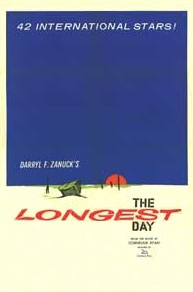
When you look back through history, certain dates hold a higher place in the history books. It can be someone's birth, someone's death, or just have an amazing historical significance in terms of impact on the world. High up on that list is June 6, 1944, the day Allied forces invaded Normandy, better known as D-Day. In the age of gigantic, sprawling epics, one of the best movies of the 1960s tackles the immense subject, 1962's The Longest Day.
A plot description wouldn't do this flick justice. It's just infeasible. The history will serve as a big enough jumping off point. After four-plus years of war, Allied forces had massed for months, all prepping for the invasion of Europe, hopefully taking back the continent from Adolf Hitler and his Nazi Third Reich. The invasion was months and years in planning, millions of men, millions of tons of equipment, thousands and thousands of ships, trucks, jeeps and tanks waiting to be unleashed at Normandy and in the French countryside. What was the mystery? The Allies tried desperately to keep the location of the invasion -- Normandy -- secret to help save lives and make the invasion smoother. The Germans similarly tried desperately to discover where the attack was coming. The war hung in the balance along with millions of lives, not just those taking part in the attack but all over the world. Not bad for historical significance, huh?
So tackling that premise in movie form seems a rather daunting task if you ask me. In the age of the epic, this one doesn't disappoint. At 178 minutes, 'Longest' covers a ridiculous amount of ground in a story that takes place over about a 36-hour time span. We see the Allies deciding the time is finally right after days of wavering while the Germans decide if this is the actual invasion or just a feint, a distraction to throw them off. Based on the book by Cornelius Ryan, it is told in docu-drama style as we meet all the participants from the high command to the soldiers, paratroopers to resistance fighters, townspeople to priests and everything and everyone in between. This isn't a movie about characters, but instead about the spectacle and immensity of what happened. If the Allied invasion on D-Day didn't work, who knows how the world would have changed?
Just a huge movie but one that never feels rushed or forced. The three-hour running time absolutely flies by. It was filmed in black and white, giving it an appropriately dated look. Maybe color takes away from what's on-screen, but the decision to film in black and white simply put, works. Ken Annakin, Andrew Marton and Bernhard Wicki combine to direct this behemoth epic and to handle it well. Technically speaking, it is a virtually flawless film. Some stock footage is sprinkled here and there, but many of the locations where the actual events took place were used as filming locations. Talk about authenticity, it can be downright eerie watching some of the scenes knowing the locations' history. The score from Maurice Jarre is used in appropriate doses with the main theme (listen HERE) a memorable piece of music that's always stuck with me.
As an epic though, one thing was required more than just about anything else. That requirement? A cast of seemingly thousands. Literally everyone in Hollywood and stars internationally were required to star in this movie. Okay, a slight exaggeration, but you get my point. Most of these parts were nothing more than cameos, but just as a taste of the ridiculous star power on display, we get John Wayne, Robert Mitchum, Robert Ryan, Henry Fonda, Richard Burton, Edmond O'Brien, Rod Steiger, even a pre-James Bond Sean Connery. Many of those parts only required an on-screen appearance of a minute or two -- some for much more -- but their presence alone...just wowza. The scary part? That's only a somewhat small taste of the depth of the cast that truly brings an international flavor to the D-Day proceedings with German, French, British, American and many more brought together.
The Longest Day is an epic, plain and simple, but for every scene where the scope and scale impresses, I loved the quieter, personal and often times, terrifyingly real scenes just as effective and memorable. I loved Richard Todd as a paratrooper commander tasked with landing in France via glider and taking a key bridge and holding until reinforcements arrive...if they can. The scene where American paratroopers, including strung-up Red Buttons, overshoot their landing zone and land in a German town is tragic and moving. One paratrooper (Sal Mineo) making a tragic decision is surprising and intensely real. I especially liked the simplicity of a late scene between Burton's RAF pilot and Richard Beymer's American paratrooper discussing the necessary evil of the day but also the lunacy of it. I think the best, most iconic moment has Hans Christian Blech's German officer finally spotting the invasion force in the English Channel when the fog clears. His face drops and he mumbles 'Die invasion,' all set to Beethoven's Fifth Symphony. Just a ton of great moments like this.
The other counter to those scenes are the BIG moments, and that's where the technical comes into play. One tremendous scene has a German fighter strafing the beaches, all of which we see from the perspective of the plane. Hundreds and thousands of extras scramble for cover underneath in a remarkable visual scene. The same later in 'Longest' when French commandos fight their way up a street in a French town, a helicopter (I think) filming all the action. As well, the scene of the paratroopers coming down on the German-held Sainte-Mere-Eglise is a horrifying scene that utilizes some very cool camerawork. Also look for a cool scene where American Rangers -- including Robert Wagner, George Segal, Paul Anka, Fabian, Tommy Sands -- scale the cliffs of Pointe de Huc, all trying to knock out a key German emplacement. Some especially memorable moments, not all of them action scenes.
Because I don't want to forget anyone but don't want to overdo it describing EVERY character, also look for Eddie Albert, Irina Demick, Mel Ferrer, Steve Forest, Gert Frobe, Leo Genn, Jeffrey Hunter, Curd Jurgens, Peter Lawford, Christian Marquand, Roddy McDowall, Kenneth More, Wolfgang Preiss, Ron Randell, Jean Servais, Norman Rossington, Tom Tryon, Peter van Eyck and Stuart Whitman. Okay, I'll take a breath now.
The Longest Day isn't the best war movie around, but it's one of my favorites. It tries to accomplish a ton and succeeds on just about every level. The history, the scale, the spectacle, the gigantic cast, the moments that resonate amongst all the epic qualities. It also serves as an excellent companion piece to the more recent Saving Private Ryan. Nowhere near as violent, but a more far-reaching story. A gem from the age of epics.
The Longest Day (1962): ****/****
The Sons of Katie Elder
"First, we reunite, then find Ma and Pa's killer...then read some reviews."
Showing posts with label Stuart Whitman. Show all posts
Tuesday, February 3, 2015
Friday, May 30, 2014
Sands of the Kalahari
Ah, the survival film, the type of movie that makes you think how you would react in a life and death, do or die situation. Me? I'd probably wet myself and die of fright in most situations. Adrift at sea, stranded anywhere from a snow-covered mountain to a barren, savage desert wasteland, it all sounds pretty hellish to me. A straightforward story of survival with a hugely dark message, enter 1965's Sands of the Kalahari.
Traveling across Africa, Grace Munkton (Susannah York) is at the airport waiting for her flight when over the loudspeaker she hears her flight has been indefinitely postponed. She heads to a nearby hotel and is woken up hours later by a knock at the door. Several passengers have agreed to pay a pilot, Sturdevan (Nigel Davenport) with his own plane to fly them to their destination. With five passengers, Sturdevan takes off but hours out from the airfield they fly directly into an immense swarm of locusts. The engines give out, the plane crash-landing in the middle of the African desert. Now with limited supplies, Grace, Sturdevan and four other individuals must survive. They're trapped in the middle of the desert with no indication of where they are, where they should head. Making it worse? Sturdevan was unable to report his position before crashing. Can the group survive? Can they survive each other?
'Kalahari' comes from director Cy Endfield (who also wrote the screenplay) and star Stanley Baker who had worked together a year earlier on the very successful Zulu. It keeps the African location, but from there the similarities end. This flick was filmed on-location in South-West Africa and Spain, an expansive, sun-drenched look to the desert survival story. The music is kept to a minimum, the focus almost entirely on the survival aspect. It is based off a novel by author William Mulvihill and gets points for some wise choices. It's unglamorous, gritty, cynical and dark. It explores the possibilities when a situation is quite literally life and death. How would you respond? Would you freak out? Would you do your best to remain calm, hold out for hope and rescue? It's hard not to at least think of this story on a personal level in that sense.
The survivors certainly cover the gamut in terms of variety. We get a female character, an old man, strapping young man, the educated, the physical, the bullying. A little society pops up among the survivors who find a relative life when they stumble across a cave carved into an immense black rock mountain, a water hole nearby with a limited food supply. Baker plays Bain, an alcoholic engineer who's injured in the crash. Davenport has a character that's odd across the board in terms of personal choices, the pilot Sturdevan an interesting, flawed character. York adds the interesting element as the woman, drawn to Stuart Whitman's O'Brien, a big-game hunter who's traveling with two high-powered rifles in tow. Whitman is the star here, his O'Brien realizing how tenuous their grasp on survival is, and he's willing to make some harsh decisions. There's also Harry Andrews as Grimmelman, an aging German man with desert experience, and Theodore Bikel as Dr. Bondrachai, a professor with tons of knowledge but not necessarily life experience.
I liked this movie enough to seek out the novel from Mulvihill. I read it over a couple days, an entertaining, interesting read that I enjoyed. Endfield's adaptation is odd in a sense, trying to add some more profound outlooks on life. He doesn't just show the desperation for survival. He has to tell us about it. Everything is spelled out for us. Campfire scenes try to explain what's happening, about their situation, about how they're changing. I think they're trying to be profound in their analysis of humans, survival and that desperation that sets in with death on the line. Just show it though. These long, expository scenes of dialogue become tedious and worse than that, condescending.
If there's a weakness, it's that the story isn't as interested in spelling things out. 'Kalahari' leaves a couple loose ends in the finale about what happens to certain characters. The ending itself is perfect in its execution. There's some good twists along the way, some good performances, but it's also a tad slow-moving and drifts along at parts. I wanted to really like this one, but I came away with mixed feelings. I'll recommend it, but this is a decent movie that could have been significantly better.
Sands of the Kalahari (1965): ** 1/2 /****
Traveling across Africa, Grace Munkton (Susannah York) is at the airport waiting for her flight when over the loudspeaker she hears her flight has been indefinitely postponed. She heads to a nearby hotel and is woken up hours later by a knock at the door. Several passengers have agreed to pay a pilot, Sturdevan (Nigel Davenport) with his own plane to fly them to their destination. With five passengers, Sturdevan takes off but hours out from the airfield they fly directly into an immense swarm of locusts. The engines give out, the plane crash-landing in the middle of the African desert. Now with limited supplies, Grace, Sturdevan and four other individuals must survive. They're trapped in the middle of the desert with no indication of where they are, where they should head. Making it worse? Sturdevan was unable to report his position before crashing. Can the group survive? Can they survive each other?
'Kalahari' comes from director Cy Endfield (who also wrote the screenplay) and star Stanley Baker who had worked together a year earlier on the very successful Zulu. It keeps the African location, but from there the similarities end. This flick was filmed on-location in South-West Africa and Spain, an expansive, sun-drenched look to the desert survival story. The music is kept to a minimum, the focus almost entirely on the survival aspect. It is based off a novel by author William Mulvihill and gets points for some wise choices. It's unglamorous, gritty, cynical and dark. It explores the possibilities when a situation is quite literally life and death. How would you respond? Would you freak out? Would you do your best to remain calm, hold out for hope and rescue? It's hard not to at least think of this story on a personal level in that sense.
The survivors certainly cover the gamut in terms of variety. We get a female character, an old man, strapping young man, the educated, the physical, the bullying. A little society pops up among the survivors who find a relative life when they stumble across a cave carved into an immense black rock mountain, a water hole nearby with a limited food supply. Baker plays Bain, an alcoholic engineer who's injured in the crash. Davenport has a character that's odd across the board in terms of personal choices, the pilot Sturdevan an interesting, flawed character. York adds the interesting element as the woman, drawn to Stuart Whitman's O'Brien, a big-game hunter who's traveling with two high-powered rifles in tow. Whitman is the star here, his O'Brien realizing how tenuous their grasp on survival is, and he's willing to make some harsh decisions. There's also Harry Andrews as Grimmelman, an aging German man with desert experience, and Theodore Bikel as Dr. Bondrachai, a professor with tons of knowledge but not necessarily life experience.
I liked this movie enough to seek out the novel from Mulvihill. I read it over a couple days, an entertaining, interesting read that I enjoyed. Endfield's adaptation is odd in a sense, trying to add some more profound outlooks on life. He doesn't just show the desperation for survival. He has to tell us about it. Everything is spelled out for us. Campfire scenes try to explain what's happening, about their situation, about how they're changing. I think they're trying to be profound in their analysis of humans, survival and that desperation that sets in with death on the line. Just show it though. These long, expository scenes of dialogue become tedious and worse than that, condescending.
If there's a weakness, it's that the story isn't as interested in spelling things out. 'Kalahari' leaves a couple loose ends in the finale about what happens to certain characters. The ending itself is perfect in its execution. There's some good twists along the way, some good performances, but it's also a tad slow-moving and drifts along at parts. I wanted to really like this one, but I came away with mixed feelings. I'll recommend it, but this is a decent movie that could have been significantly better.
Sands of the Kalahari (1965): ** 1/2 /****
Sunday, August 18, 2013
The Comancheros
Following Texas' war for independence with Mexico in 1836, the expansive republic was on its own for government, economy and protection without help from outsiders. Who came to the forefront to help protect the fledgling republic? The Texas Rangers, and no, not the Major League Baseball team, instead a small group of law officers who patrolled Texas trying to protect its citizens. Recurring characters in the western genre, one of the best portrayals of the Rangers is 1961's The Comancheros.
It's 1843 when a Louisiana gambler, Paul Regret (Stuart Whitman), finds himself on the run following an accidental death in a duel. Regret heads for Texas but as he readies to disembark from the riverboat, he is instead arrested for murder by a Texas Ranger, Captain Jake Cutter (John Wayne). The duel was fair by all accounts, but the dead man was the son of a powerful judge who wants vengeance. Intending to bring Regret back to Louisiana, Cutter instead finds himself working with the man. All through the territory, Comanche raiding parties are attacking one ranch and homestead after another. Cutter has long thought the Comanches are being led by a gang of white men who pull the strings, but he has no proof. Posing as a gunrunner and with Regret as his somewhat unwilling partner, Cutter heads into Comanche territory and finds just what he thought he would, a gang of drifters, bandits and killers -- Comancheros -- working with the Comanches. Can they get out alive?
The 1960s were a big time for John Wayne. He wasn't just a box office star, but by now after 30-plus years in the business, he was a screen legend. This was the decade where -- for better or worse -- he started playing himself more than meaty roles like The Searchers, She Wore a Yellow Ribbon, and The Man Who Shot Liberty Valance. His mindset changed some as he started to make movies that typically had one objective....please the audience. These were movies meant to entertain, movies the whole family could go see. They would revolve around action-packed stories, good casts of familiar faces, great locations and whistle-worthy scores, movies like this one, The Undefeated, Sons of Katie Elder, McLintock!, Donovan's Reef and Hatari. This is a prime example of that type of movie. It's fun, exciting and with a whole lot of action. A groundbreaking, innovative western? Nope, but as far as popcorn movies go, it's hard to beat.
This obviously isn't a comedy western, but it isn't as dark and downbeat as the plot description might imply. For me, the best thing going for 'Comancheros' has always been the pairing of Wayne and Whitman, an Odd Couple pairing that works extremely well. It almost plays like a buddy western movie, the resolute Ranger and the roguish gambler. Wayne especially gets to show off a comedic side that most of his movies just didn't allow. His backwoods Ranger mispronounces Monsieur as Mon-sewer, providing some good laughs throughout. Whitman too looks right at home alongside the Duke, the duo exchanging some great dialogue scenes together on the trail. It looks easy watching them. Regret is far from a veteran trailsman, but he picks it up quick. Cutter bristles at times with his prisoner's unique ways, but thrust into a do-or-die situation, they end up becoming unlikely friends. Two good lead performances for sure.
While the A-list names might not be there, 'Comancheros' offers a very solid cast, one all western fans should appreciate. Lee Marvin makes what amounts to a cameo as Tully Crow, a brutal, vicious Comanchero, stealing the show and providing some great moments with Wayne in their scenes together. The one weak point is Ina Balin as Pilar, a beautiful young woman who falls for Regret and vice versa. Her scenes are pretty painful, especially as she "analyzes" love. Nehemiah Persoff is similarly a scene-stealer as Graile, the handicapped, brutal leader of the Comancheros with Michael Ansara as his sadistic henchman, Amelung, and also look for Jack Elam as one of the Comancheros. As for the other Rangers, look for Bruce Cabot as Major Henry and Patrick Wayne as Tobe, a young ranger along on the mission into Comanchero territory. Also look for the beautiful Joan O'Brien as Melinda, a widow who cares deeply for Cutter (and maybe more...uh-oh!) with Wayne's daughter Aissa playing Melinda's daughter.
Looking at the credits, Michael Curtiz is listed as the director, but Curtiz became sick during filming and was unable to complete the movie, dying soon after its release. Wayne stepped in and directed in uncredited fashion, finishing the movie. The story itself is pretty episodic, the first 45 minutes spent with the hunt and escape and hunt and escape between Regret and Cutter. It covers a lot of ground before the Comancheros are even introduced, but it's never dull and never really slows down. There actually isn't a ton of action, but what's there is enjoyable. What is noteworthy is a talented cast clearly having some fun with a story that's hard not to go along with. Also worth mentioning, Elmer Bernstein's memorable score, especially the theme. Listen to it HERE. Get your popcorn ready, sit back and enjoy this one.
The Comancheros (1961): ***/****
It's 1843 when a Louisiana gambler, Paul Regret (Stuart Whitman), finds himself on the run following an accidental death in a duel. Regret heads for Texas but as he readies to disembark from the riverboat, he is instead arrested for murder by a Texas Ranger, Captain Jake Cutter (John Wayne). The duel was fair by all accounts, but the dead man was the son of a powerful judge who wants vengeance. Intending to bring Regret back to Louisiana, Cutter instead finds himself working with the man. All through the territory, Comanche raiding parties are attacking one ranch and homestead after another. Cutter has long thought the Comanches are being led by a gang of white men who pull the strings, but he has no proof. Posing as a gunrunner and with Regret as his somewhat unwilling partner, Cutter heads into Comanche territory and finds just what he thought he would, a gang of drifters, bandits and killers -- Comancheros -- working with the Comanches. Can they get out alive?
The 1960s were a big time for John Wayne. He wasn't just a box office star, but by now after 30-plus years in the business, he was a screen legend. This was the decade where -- for better or worse -- he started playing himself more than meaty roles like The Searchers, She Wore a Yellow Ribbon, and The Man Who Shot Liberty Valance. His mindset changed some as he started to make movies that typically had one objective....please the audience. These were movies meant to entertain, movies the whole family could go see. They would revolve around action-packed stories, good casts of familiar faces, great locations and whistle-worthy scores, movies like this one, The Undefeated, Sons of Katie Elder, McLintock!, Donovan's Reef and Hatari. This is a prime example of that type of movie. It's fun, exciting and with a whole lot of action. A groundbreaking, innovative western? Nope, but as far as popcorn movies go, it's hard to beat.
This obviously isn't a comedy western, but it isn't as dark and downbeat as the plot description might imply. For me, the best thing going for 'Comancheros' has always been the pairing of Wayne and Whitman, an Odd Couple pairing that works extremely well. It almost plays like a buddy western movie, the resolute Ranger and the roguish gambler. Wayne especially gets to show off a comedic side that most of his movies just didn't allow. His backwoods Ranger mispronounces Monsieur as Mon-sewer, providing some good laughs throughout. Whitman too looks right at home alongside the Duke, the duo exchanging some great dialogue scenes together on the trail. It looks easy watching them. Regret is far from a veteran trailsman, but he picks it up quick. Cutter bristles at times with his prisoner's unique ways, but thrust into a do-or-die situation, they end up becoming unlikely friends. Two good lead performances for sure.
While the A-list names might not be there, 'Comancheros' offers a very solid cast, one all western fans should appreciate. Lee Marvin makes what amounts to a cameo as Tully Crow, a brutal, vicious Comanchero, stealing the show and providing some great moments with Wayne in their scenes together. The one weak point is Ina Balin as Pilar, a beautiful young woman who falls for Regret and vice versa. Her scenes are pretty painful, especially as she "analyzes" love. Nehemiah Persoff is similarly a scene-stealer as Graile, the handicapped, brutal leader of the Comancheros with Michael Ansara as his sadistic henchman, Amelung, and also look for Jack Elam as one of the Comancheros. As for the other Rangers, look for Bruce Cabot as Major Henry and Patrick Wayne as Tobe, a young ranger along on the mission into Comanchero territory. Also look for the beautiful Joan O'Brien as Melinda, a widow who cares deeply for Cutter (and maybe more...uh-oh!) with Wayne's daughter Aissa playing Melinda's daughter.
Looking at the credits, Michael Curtiz is listed as the director, but Curtiz became sick during filming and was unable to complete the movie, dying soon after its release. Wayne stepped in and directed in uncredited fashion, finishing the movie. The story itself is pretty episodic, the first 45 minutes spent with the hunt and escape and hunt and escape between Regret and Cutter. It covers a lot of ground before the Comancheros are even introduced, but it's never dull and never really slows down. There actually isn't a ton of action, but what's there is enjoyable. What is noteworthy is a talented cast clearly having some fun with a story that's hard not to go along with. Also worth mentioning, Elmer Bernstein's memorable score, especially the theme. Listen to it HERE. Get your popcorn ready, sit back and enjoy this one.
The Comancheros (1961): ***/****
Tuesday, August 6, 2013
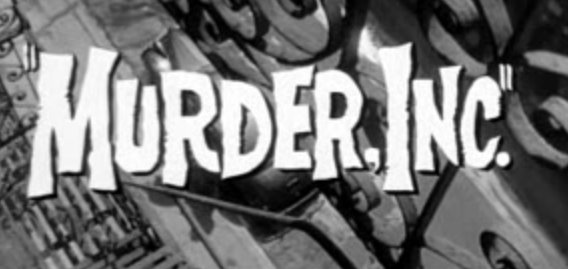
Murder, Inc.
Having worked for several years in film and television in the late 1950s, Peter Falk was looking for his big break. Typically relegated to supporting parts in both movies and on TV shows, Falk got it in 1960. Chosen from a casting call of off-Broadway actors, Falk was given a key role in the 1960 crime drama Murder, Inc. based on a true story. His career was off and running and Lt. Columbo never looked back.
It's the 1930s, and the United States is reeling from the Great Depression. In New York City, a low-level but rising hired killer, Abe Reles (Falk), is summoned to meet Lepke (David J. Stewart), a well-connected mobster who has an idea for the thuggish Reles and his crew. Mobsters are organizing, working together, and they need a brutal enforcer....Reles. The Brooklyn thug will work with his own men, carrying out hits as ordered from Lepke and his superiors. No one is safe as Reles rises to power, dispatching everyone as ordered. Intimidation, bribes, out and out murder, nothing is too much for him. Caught up in the vicious rise to power is Joey Collins (Stuart Whitman), a down on his luck lounge singer, who Reles enlists in pulling off a hit. It doesn't seem anything can stop this fast-rising criminal organization, but a new district attorney, Burton Turkus (Henry Morgan), is attempting to do just that.
From directors Burt Balaban and Stuart Rosenberg, this 1960 crime drama is based on the true story of an organization of mob killers who started working in the 1930s, dubbed Murder Inc. by the press. Give the Wikipedia link a read. It is a doozy. Burton Turkus' 1951 book provided much of the background for this film that plays more like a fly on the wall documentary than a hard-edged crime drama/thriller. Playing Turkus, Morgan even provides the off-screen narration to explain all the criminal and mob developments. Still years before The Godfather and the wave of Mafia/mob movie that followed, 'Murder' is ahead of its time in that sense. It's hard to believe the responses characters give when they find out that criminal organizations have done just that, organized. Somewhere along the way, it gets a little too pulpy, like it's trying too hard. It's good, but it could have been better.
The style here is of a made-for-TV movie, maybe even an extended TV episode. It was filmed in black and white -- a nice touch for sure -- that helps it play more like a film noir than a quasi-documentary. 'Murder' was filmed on location in and around New York City, adding another layer of realism to the story. There's something missing though, and all I can come up with is that it is on such a small scale. The movie feels very penned in, very set-based, echoing some sort of TV roots. There's also two different musical numbers that feel jammed into the story unnecessarily, slowing down a story that's already a little sluggish.
What helps 'Murder' rise above its problems is the casting of then relative unknown Peter Falk as mob enforcer and hit man Abe 'Kid Twist' Reles. Just 33 years old, Falk was nominated for a Best Supporting Actor for his performance, and it is a scene-stealing part. His intensity, his emotion, it all feels real. His Reles is a brutish thug who does one thing well...killing. He doesn't have much in the way of actual skills, but he's a tried and true killer. The movie is that much better when he's around, but unfortunately, the part doesn't get as much attention as it should with the ensemble cast around him. As the sinister Lepke, Stewart is a good villain in a different vein; more intelligent and thoughtful in his brutality. In the bad guy department, also look for Joseph Bernard as Mendy, Lepke's personal assistant and killer, Warren Finnerty as Bug, Reles' killing partner, and Vincent Gardenia as Lazlo, the criminally smooth mob lawyer, always ready to tangle with authorities.
For a mob, Mafia and hired killer movie, far too much time is spent between Whitman's Joey and his wife Eadie (May Britt), obnoxious with her dead stare and general whiny-ness (and in an Eastern European accent too!). Joey does something stupid Mob-related, unwillingly gets involved and keeps on going, digging deeper and deeper. Yes, there's a payoff coming down the road, but getting there courtesy of Whitman and Britt is painfully slow at times. The movie is far better when it focuses on the mobsters going up against Turkus and Detective Tobin (Simon Oakland), a veteran police officer who's grown wary of "how effective" the D.A. can be. Also look for a pre-Dick Van Dyke show Morey Amsterdam as Walter Sage, a club owner and comedian who becomes a target of Murder Inc. It's an okay movie, but I came away disappointed as it is missing that one special ingredient.
Murder Inc. (1960): ** 1/2 /****
It's the 1930s, and the United States is reeling from the Great Depression. In New York City, a low-level but rising hired killer, Abe Reles (Falk), is summoned to meet Lepke (David J. Stewart), a well-connected mobster who has an idea for the thuggish Reles and his crew. Mobsters are organizing, working together, and they need a brutal enforcer....Reles. The Brooklyn thug will work with his own men, carrying out hits as ordered from Lepke and his superiors. No one is safe as Reles rises to power, dispatching everyone as ordered. Intimidation, bribes, out and out murder, nothing is too much for him. Caught up in the vicious rise to power is Joey Collins (Stuart Whitman), a down on his luck lounge singer, who Reles enlists in pulling off a hit. It doesn't seem anything can stop this fast-rising criminal organization, but a new district attorney, Burton Turkus (Henry Morgan), is attempting to do just that.
From directors Burt Balaban and Stuart Rosenberg, this 1960 crime drama is based on the true story of an organization of mob killers who started working in the 1930s, dubbed Murder Inc. by the press. Give the Wikipedia link a read. It is a doozy. Burton Turkus' 1951 book provided much of the background for this film that plays more like a fly on the wall documentary than a hard-edged crime drama/thriller. Playing Turkus, Morgan even provides the off-screen narration to explain all the criminal and mob developments. Still years before The Godfather and the wave of Mafia/mob movie that followed, 'Murder' is ahead of its time in that sense. It's hard to believe the responses characters give when they find out that criminal organizations have done just that, organized. Somewhere along the way, it gets a little too pulpy, like it's trying too hard. It's good, but it could have been better.
The style here is of a made-for-TV movie, maybe even an extended TV episode. It was filmed in black and white -- a nice touch for sure -- that helps it play more like a film noir than a quasi-documentary. 'Murder' was filmed on location in and around New York City, adding another layer of realism to the story. There's something missing though, and all I can come up with is that it is on such a small scale. The movie feels very penned in, very set-based, echoing some sort of TV roots. There's also two different musical numbers that feel jammed into the story unnecessarily, slowing down a story that's already a little sluggish.
What helps 'Murder' rise above its problems is the casting of then relative unknown Peter Falk as mob enforcer and hit man Abe 'Kid Twist' Reles. Just 33 years old, Falk was nominated for a Best Supporting Actor for his performance, and it is a scene-stealing part. His intensity, his emotion, it all feels real. His Reles is a brutish thug who does one thing well...killing. He doesn't have much in the way of actual skills, but he's a tried and true killer. The movie is that much better when he's around, but unfortunately, the part doesn't get as much attention as it should with the ensemble cast around him. As the sinister Lepke, Stewart is a good villain in a different vein; more intelligent and thoughtful in his brutality. In the bad guy department, also look for Joseph Bernard as Mendy, Lepke's personal assistant and killer, Warren Finnerty as Bug, Reles' killing partner, and Vincent Gardenia as Lazlo, the criminally smooth mob lawyer, always ready to tangle with authorities.
For a mob, Mafia and hired killer movie, far too much time is spent between Whitman's Joey and his wife Eadie (May Britt), obnoxious with her dead stare and general whiny-ness (and in an Eastern European accent too!). Joey does something stupid Mob-related, unwillingly gets involved and keeps on going, digging deeper and deeper. Yes, there's a payoff coming down the road, but getting there courtesy of Whitman and Britt is painfully slow at times. The movie is far better when it focuses on the mobsters going up against Turkus and Detective Tobin (Simon Oakland), a veteran police officer who's grown wary of "how effective" the D.A. can be. Also look for a pre-Dick Van Dyke show Morey Amsterdam as Walter Sage, a club owner and comedian who becomes a target of Murder Inc. It's an okay movie, but I came away disappointed as it is missing that one special ingredient.
Murder Inc. (1960): ** 1/2 /****
Labels:
1960s,
Gangsters,
Peter Falk,
Simon Oakland,
Stuart Whitman
Monday, April 15, 2013
The Man from the Alamo
Under siege by the Mexican army by General Santa Anna, the Alamo mission and garrison is in trouble. A messenger returns to the mission with the worst news possible; no reinforcements will come, leaving the defenders to fight it out themselves. He also tells of reports of raiding Mexican soldiers attacking, burning, destroying and killing Texan settlements where many defenders -- and their families -- lived. The small group decides that someone must go help protect the families, and John Stroud (Glenn Ford) draws the short stick. Leaving the garrison behind, Stroud slips out and returns home to find his family killed and house burned down. A young Mexican boy, Carlos (Marc Cavell), witnessed the attack and tells him Americans dressed as Mexicans led the attack. As he starts to track the men down though, Stroud finds out the Alamo has fallen, and a messenger from the Alamo, Lt. Lamar (Hugh O'Brian), identifies him as the coward who abandoned the mission, not knowing why he left. Can Stroud avenge his family while also clearing his name?
I like everything about the Alamo. I'll read anything, watch anything, talk about anything so for me, this 1953 B-western from director Budd Boetticher is a hidden gem. It's pretty standard stuff in terms of its western status, but instead of just telling the story of a coward who abandons his friends, it's a story of a coward from the Alamo. Using the basic premise of the famous 'Line in the Sand' speech, 'Man' runs with it. The Alamo portion of the story covers less than 20 minutes in a 79-minute movie, but it's a great bookend. The rest of the story is still interesting, playing fast and loose with the historical facts while always maintaining a high entertainment level. Stroud takes off on a journey through war-torn Texas in the Runaway Scrape, attempting to prove his innocence while taking an involvement in a wagon train trying to evade the chasing Mexican army. It's good stuff throughout, and for a sucker like me for anything even remotely Alamo-related, it's really good stuff.
Playing the titular character, Ford does a good job leading a pretty solid ensemble cast. He was always at home in the western, and he doesn't disappoint here. We don't learn a lot about him by seeing it, we simply here about it. As he leaves the Alamo, we hear from those left behind that his John "has always had bad luck." True, he won't be killed at the Alamo, but the tag of being the man that left the doomed mission will hang over him regardless of his intentions. We don't meet his family, only seeing him arrive at the charred remains of his home, Carlos having buried his own father along with John's wife and son. I liked the character a lot. He doesn't really care what others think of him because he knows the truth. Instead, he becomes obsessed with getting revenge on the men who killed his family. Not flashy for Ford, but very good, including handling many of his own stunts, including some impressive ones on horseback.
Because the story requires someone to believe Stroud is innocent -- at some point after the appropriate doubts -- Julie Adams stars as Beth, a young woman traveling with the wagon train away from the Mexican army. Oh, she's the love interest too. I know, I was stunned too. Chill Wills (who would star 7 years later in John Wayne's The Alamo) co-stars as Beth's father, a one-armed newspaper publisher, while Myra Marsh plays Beth's mother. O'Brian is a good quasi-bad guy, a Texan officer who's convinced Stroud is a coward, not knowing the entire story. Victor Jory is Jess Wade, the Texan/American working with a gang of cutthroats and killers on the Mexican's side to cause chaos, Neville Brand playing one of his thugs. Also look quickly in the opening scene for Stuart Whitman as a guard overlooking a Texan counsel.
Now for some Alamo analysis! Sure, the Alamo segment runs only about 20 minutes, but it's a worthy intro. The Alamo fortress seems to be only the fortified chapel -- nothing like the actual layout of the mission -- but it works in an odd way, giving a claustrophobic feel to the battle. Mexican cannon shells rain down on the condensed fortress, a living hell if there ever was. We meet Crockett, Bowie and Travis however briefly (even seeing Dennis Weaver as coonskin cap-wearing defender), but the focus is on the impending doom and Stroud's similarly doomed mission. I really enjoyed the intro, but I liked the whole movie a lot too. Well worth it.
Man from the Alamo (1953): ***/****
Wednesday, April 10, 2013
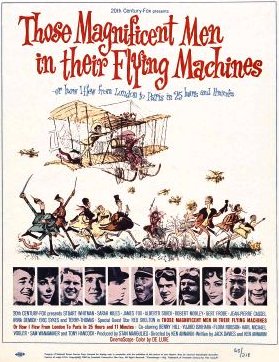
Those Magnificent Men in Their Flying Machines
The roadshow epic is unfortunately a thing of the past, a symbol of a Hollywood era that ruled through the 1950s and early 1960s. Even the lousy ones have something worthwhile. For me, I love the huge scale, the intro music, the intermission, the casts of thousands. By the mid 1960s though, things, they were 'a changing, and the epics were becoming a thing of the past. One of the last films hitting theaters before the era completely died out was a good one, 1965's Those Magnificent Men in Their Flying Machines.
It's 1910, and British army officer Richard Mays (James Fox) is among a small group of pilots worldwide who are helping advance aviation just seven years since the Wright Brothers flew at Kitty Hawk in 1903. He's sorta-engaged to Patricia Rawnsley (Sarah Miles), the daughter of Lord Rawnsley (Robert Morley), a newspaper owner disgusted at the thought of other countries' pilots advancing quicker in aviation than England. Using all his pull, Lord Rawnsley organizes an international air race from England to Paris that will show once and for all who is the best pilot around. Pilots from around the world travel to England with their flying machines with the hopes of winning the race and its lucrative prize. Among them, Orvil Newton (Stuart Whitman), an American cowboy, with his eyes set on the race, the prize, and maybe Patricia too. Uh-oh, America vs. Britain!
Working with Jack Davies to write the script and direct the film as well, Ken Annakin was a huge fan of aviation, and it shows with this 1965 epic. Setting the story in 1910 is a great touch as aviation and flying were still in its infancy. There weren't airlines or commercial jets. Individuals -- not businesses -- were trying to figure out what worked and didn't work in flying. Flying machines (yes, planes) flew much closer to the ground, couldn't stay in the air that long, and had a variety of mechanical and structural issues. Sounds fun, huh? And a little dangerous? Yeah, just a little. Check out the Wikipedia link HERE for an idea of the variety of planes featured here. There's some doozies in the group, definitely making you appreciate the modern jet airliner.
In the vein of The Great Race and It's a Mad, Mad World, 'Flying' is big and flashy but never gets too big or unwieldy. An opening montage with Red Skelton starring as individuals through history learning how hard flying can be (Neanderthal, Ancient Greek, Middle Ages, Victorian), leading right into the cartoon credits played under the Flying Machines theme song (listen HERE). I liked Ron Goodwin's score a lot too, similar to his score four years later in The Battle of Britain. Much of the story was filmed at the Brookley Motor Racing Track, helping give a real sense of 1910s aviation with its lush green fields serving as landing strips, immense wooden hangars housing the new wave of planes, and an outfitted windmill serving as a lookout point for Fire Chief Perkins (Benny Hill). The aerial sequences are impressive, even on the pre-takeoff as we see hundreds and thousands of extras lining the airfields.
The one thing lacking here from most other roadshow epics is huge star power. There are some really solid actors/actresses here, but there's no gigantic star(s). Whitman and Fox get the leads as the American and British pilots, fighting to win the race but also to win the lady. Thankfully, this storyline isn't too painful to watch, bouncing among a handful of different pilots. Some of the other international pilots include Count Emilio (Alberto Sordi), the Italian family man with a penchant for crashing, Pierre Dubois (Jean-Pierre Cassel), the loving life Frenchman, Sir Percy (Terry-Thomas), the sabotaging Englishman with his maligned assistant, Courtney (Eric Sykes), Yamamoto (Yujiro Ishihara), the experienced Japanese pilot and the race favorite, Capt. Rumplestoss (Karl Michael Vogler), the inexperienced but proud German army officer, and MacDougal (Gordon Jackson), the fun-loving Scotsman. Not much star power, but we get a lot of memorable characters with some truly funny recurring bits.
While the scale on a large scale is always impressive, it's the recurring bits that help bring the movie up a notch. It's fun seeing Orvil and Richard go toe-to-toe, the American always looking good in heroic fashion. There's also Dubois swearing he's seeing the same girl over and over again, Irina Dernick playing all of the women. In a pre-World War I time, there's also national rivalries, the English believing they're better than anyone, the Germans doing the same, and the Italians and Frenchmen having fun at their expense. Dubois and his French crew constantly mess with the Germans, especially their commander, Colonel Manfred (scene-stealing Gert Frobe) and Rumplestoss. There's also James Robertson Justice making a quick appearance as the narrator, deadpanning his way through the Skelton bit, Flora Robson as Mother Superior, a nun with an incentive to help the race, Sam Wanamaker as Orvil's partner and friend, and an uncredited Ronnie Stevens as the race's public address announcer.
'Flying Machines' isn't as long as many epics, wrapping up in just 138 minutes as opposed to so many other three-hour monstrosities. Much of the first 90 minutes is spent on the ground getting to know our pilots, including a whole lot of hijinks and shenanigans as our international lineup tries to outdo each other. The last 50 minutes focus on the race with some impressive aerial sequences, our antiquated looking planes flying across England, the English Channel, and finally Paris. I loved this movie, and more so as it went along. No star power? No problem. It's a gem, and one of the last true roadshow epics. Enjoy it.
Those Magnificent Men in Their Flying Machines (1965): ****/****
It's 1910, and British army officer Richard Mays (James Fox) is among a small group of pilots worldwide who are helping advance aviation just seven years since the Wright Brothers flew at Kitty Hawk in 1903. He's sorta-engaged to Patricia Rawnsley (Sarah Miles), the daughter of Lord Rawnsley (Robert Morley), a newspaper owner disgusted at the thought of other countries' pilots advancing quicker in aviation than England. Using all his pull, Lord Rawnsley organizes an international air race from England to Paris that will show once and for all who is the best pilot around. Pilots from around the world travel to England with their flying machines with the hopes of winning the race and its lucrative prize. Among them, Orvil Newton (Stuart Whitman), an American cowboy, with his eyes set on the race, the prize, and maybe Patricia too. Uh-oh, America vs. Britain!
Working with Jack Davies to write the script and direct the film as well, Ken Annakin was a huge fan of aviation, and it shows with this 1965 epic. Setting the story in 1910 is a great touch as aviation and flying were still in its infancy. There weren't airlines or commercial jets. Individuals -- not businesses -- were trying to figure out what worked and didn't work in flying. Flying machines (yes, planes) flew much closer to the ground, couldn't stay in the air that long, and had a variety of mechanical and structural issues. Sounds fun, huh? And a little dangerous? Yeah, just a little. Check out the Wikipedia link HERE for an idea of the variety of planes featured here. There's some doozies in the group, definitely making you appreciate the modern jet airliner.
In the vein of The Great Race and It's a Mad, Mad World, 'Flying' is big and flashy but never gets too big or unwieldy. An opening montage with Red Skelton starring as individuals through history learning how hard flying can be (Neanderthal, Ancient Greek, Middle Ages, Victorian), leading right into the cartoon credits played under the Flying Machines theme song (listen HERE). I liked Ron Goodwin's score a lot too, similar to his score four years later in The Battle of Britain. Much of the story was filmed at the Brookley Motor Racing Track, helping give a real sense of 1910s aviation with its lush green fields serving as landing strips, immense wooden hangars housing the new wave of planes, and an outfitted windmill serving as a lookout point for Fire Chief Perkins (Benny Hill). The aerial sequences are impressive, even on the pre-takeoff as we see hundreds and thousands of extras lining the airfields.
The one thing lacking here from most other roadshow epics is huge star power. There are some really solid actors/actresses here, but there's no gigantic star(s). Whitman and Fox get the leads as the American and British pilots, fighting to win the race but also to win the lady. Thankfully, this storyline isn't too painful to watch, bouncing among a handful of different pilots. Some of the other international pilots include Count Emilio (Alberto Sordi), the Italian family man with a penchant for crashing, Pierre Dubois (Jean-Pierre Cassel), the loving life Frenchman, Sir Percy (Terry-Thomas), the sabotaging Englishman with his maligned assistant, Courtney (Eric Sykes), Yamamoto (Yujiro Ishihara), the experienced Japanese pilot and the race favorite, Capt. Rumplestoss (Karl Michael Vogler), the inexperienced but proud German army officer, and MacDougal (Gordon Jackson), the fun-loving Scotsman. Not much star power, but we get a lot of memorable characters with some truly funny recurring bits.
While the scale on a large scale is always impressive, it's the recurring bits that help bring the movie up a notch. It's fun seeing Orvil and Richard go toe-to-toe, the American always looking good in heroic fashion. There's also Dubois swearing he's seeing the same girl over and over again, Irina Dernick playing all of the women. In a pre-World War I time, there's also national rivalries, the English believing they're better than anyone, the Germans doing the same, and the Italians and Frenchmen having fun at their expense. Dubois and his French crew constantly mess with the Germans, especially their commander, Colonel Manfred (scene-stealing Gert Frobe) and Rumplestoss. There's also James Robertson Justice making a quick appearance as the narrator, deadpanning his way through the Skelton bit, Flora Robson as Mother Superior, a nun with an incentive to help the race, Sam Wanamaker as Orvil's partner and friend, and an uncredited Ronnie Stevens as the race's public address announcer.
'Flying Machines' isn't as long as many epics, wrapping up in just 138 minutes as opposed to so many other three-hour monstrosities. Much of the first 90 minutes is spent on the ground getting to know our pilots, including a whole lot of hijinks and shenanigans as our international lineup tries to outdo each other. The last 50 minutes focus on the race with some impressive aerial sequences, our antiquated looking planes flying across England, the English Channel, and finally Paris. I loved this movie, and more so as it went along. No star power? No problem. It's a gem, and one of the last true roadshow epics. Enjoy it.
Those Magnificent Men in Their Flying Machines (1965): ****/****
Saturday, January 19, 2013
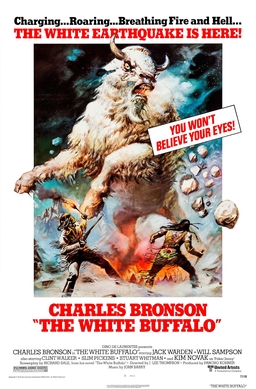
The White Buffalo
Gunfighter and army scout Wild Bill Hickok and Lakota warrior Crazy Horse are two of the most famous (even infamous), recognizable names in the history of the taming of the American west. At any point in their shortened lives -- they died a year apart in 1876 and 1877 -- did they meet? It's an interesting what-if and so goes 1977's The White Buffalo.
Having visited the East, Wild Bill Hickok (Charles Bronson) -- going under the alias 'James Otis' -- returns to the wild west. He has been tortured of late by a nightmare that plagues him night in and night out. It's the same nightmare each night; a vision of an immense white buffalo bearing down on him and ready to kill him in a second. Hickok doesn't know what to make of the dream, but when he hears rumors that a white buffalo has been spotted in the Black Hills, he goes on the hunt, bringing a trapper, Charlie Zane (Jack Warden), along for help. The famed gunfighter won't be alone though as they cross the path of Lakota chief Crazy Horse (Will Sampson) who similarly wants to hunt down and kill the alleged white buffalo. Which hunter will get him first?
This was an odd western to watch. It's from director J. Lee Thompson of Cape Fear and The Guns of Navarone fame. The IMDB summary lists it as a quasi-Jaws ripoff, and it's not completely off base while also not being completely on-point either. Even three days since I've watched it, I'm still not sure exactly what I watched. It comes across as an odd, sometimes enjoyable episodic story that never quite finds a rhythm. Is it about Wild Bill making his return? Is it saying something more profound about the changing times of the west, and even the closing years of the "wild" west? Is it just a cool what-if about pairing two of the most interesting figures in American history? It's probably a little of all of them, but it is definitely hurt by not picking a route and sticking with it.
At its strongest, the focus is on the changing times of the west. Two men -- Hickok and Crazy Horse -- are very similar in personality, character and history. Their only difference? Hickok hates Indians, Crazy Horse hates the never-ending flow of white men into Indian land. As they both search for the white buffalo, they cross each others' paths, each saving the other man's life in a do-or-die situation. They put aside their hatred and differences aside in a quest to accomplish their mutual goals. I liked Bronson's performance a lot, even if it is pretty typical western anti-hero stuff. Sampson rises above a pretty stereotypically written part too as Crazy Horse. He avoids the stilted "Me Indian...you white man....How" conversation and plays well off of Bronson. The high point is Hickok and Crazy Horse talking across a campfire, both men wondering what the future holds.
Of the rest of the cast, Warden is the only one actually given anything more than a cameo. He has some good scenes with Bronson's Hickok, but it's a pretty standard meat and potatoes kind of role. Beyond those three parts, 'Buffalo' consists of a handful of really random cameos. We're not talking 10-15 minutes on-screen. We're talking individual scenes, some no more than a minute or two. Kim Novak gets the meatiest cameo as Poker Jenny, a woman from Hickok's past. Clint Walker also has some fun as Whistling Jack Kileen, a bear of a man gunning for Hickok. Also keep an eye out for Slim Pickens, Stuart Whitman, John Carradine, and Ed Lauter.
One of the oddest things though for 'Buffalo' is just that.....the buffalo. It doesn't look cheap, but it certainly tries for the Jaws-effect. We never really get a pristine, clear at the buffalo. Instead, we get extreme close-ups of the raging buffalo's eyes or his horns, we get far-off shots of the buffalo charging. It doesn't look ridiculous, but it sure approaches it. The final showdown among the buffalo, Hickok and Crazy Horse is pretty cool though. Sure, there are flaws. Any night scene was clearly shot on an indoor set with fake snow, trees and rocks. It looks pretty cheesy. There's also the cool scenes, an almost iconic shot of Hickok wearing his low-brimmed hat, his darkened glasses, his buckskin coat and brace of pistols. So in the end, it's a mixed bag, both good and bad.
The White Buffalo (1977): ** 1/2 /****
Having visited the East, Wild Bill Hickok (Charles Bronson) -- going under the alias 'James Otis' -- returns to the wild west. He has been tortured of late by a nightmare that plagues him night in and night out. It's the same nightmare each night; a vision of an immense white buffalo bearing down on him and ready to kill him in a second. Hickok doesn't know what to make of the dream, but when he hears rumors that a white buffalo has been spotted in the Black Hills, he goes on the hunt, bringing a trapper, Charlie Zane (Jack Warden), along for help. The famed gunfighter won't be alone though as they cross the path of Lakota chief Crazy Horse (Will Sampson) who similarly wants to hunt down and kill the alleged white buffalo. Which hunter will get him first?
This was an odd western to watch. It's from director J. Lee Thompson of Cape Fear and The Guns of Navarone fame. The IMDB summary lists it as a quasi-Jaws ripoff, and it's not completely off base while also not being completely on-point either. Even three days since I've watched it, I'm still not sure exactly what I watched. It comes across as an odd, sometimes enjoyable episodic story that never quite finds a rhythm. Is it about Wild Bill making his return? Is it saying something more profound about the changing times of the west, and even the closing years of the "wild" west? Is it just a cool what-if about pairing two of the most interesting figures in American history? It's probably a little of all of them, but it is definitely hurt by not picking a route and sticking with it.
At its strongest, the focus is on the changing times of the west. Two men -- Hickok and Crazy Horse -- are very similar in personality, character and history. Their only difference? Hickok hates Indians, Crazy Horse hates the never-ending flow of white men into Indian land. As they both search for the white buffalo, they cross each others' paths, each saving the other man's life in a do-or-die situation. They put aside their hatred and differences aside in a quest to accomplish their mutual goals. I liked Bronson's performance a lot, even if it is pretty typical western anti-hero stuff. Sampson rises above a pretty stereotypically written part too as Crazy Horse. He avoids the stilted "Me Indian...you white man....How" conversation and plays well off of Bronson. The high point is Hickok and Crazy Horse talking across a campfire, both men wondering what the future holds.
Of the rest of the cast, Warden is the only one actually given anything more than a cameo. He has some good scenes with Bronson's Hickok, but it's a pretty standard meat and potatoes kind of role. Beyond those three parts, 'Buffalo' consists of a handful of really random cameos. We're not talking 10-15 minutes on-screen. We're talking individual scenes, some no more than a minute or two. Kim Novak gets the meatiest cameo as Poker Jenny, a woman from Hickok's past. Clint Walker also has some fun as Whistling Jack Kileen, a bear of a man gunning for Hickok. Also keep an eye out for Slim Pickens, Stuart Whitman, John Carradine, and Ed Lauter.
One of the oddest things though for 'Buffalo' is just that.....the buffalo. It doesn't look cheap, but it certainly tries for the Jaws-effect. We never really get a pristine, clear at the buffalo. Instead, we get extreme close-ups of the raging buffalo's eyes or his horns, we get far-off shots of the buffalo charging. It doesn't look ridiculous, but it sure approaches it. The final showdown among the buffalo, Hickok and Crazy Horse is pretty cool though. Sure, there are flaws. Any night scene was clearly shot on an indoor set with fake snow, trees and rocks. It looks pretty cheesy. There's also the cool scenes, an almost iconic shot of Hickok wearing his low-brimmed hat, his darkened glasses, his buckskin coat and brace of pistols. So in the end, it's a mixed bag, both good and bad.
The White Buffalo (1977): ** 1/2 /****
Thursday, November 22, 2012
Rio Conchos
No matter what movies will tell you, there was nothing
particularly pleasant about the wild, wild west. Let’s even limit that from the
years immediately following the Civil War right up into the 1890s. Depending on
the western, you’re going to get a different picture of that brutal, plain
nasty survival based time. One of the deepest and darkest? That’s 1964’s RioConchos, an ahead of its time western that still resonates today.
It’s 1867 along the Texas/Mexico border, and a shipment of
2,000 new repeating rifles meant for the undermanned U.S. cavalry has been
stolen without a trace. Jim Lassiter (RichardBoone), a former Confederate officer, is arrested with one of those rifles
soon after brutally shooting down a handful of Apache warriors. Lassiter is
approached to undertake a dangerous mission; find the rifles before they fall
into the wrong hands. He doesn’t want to but agrees to it, an incident from his
past haunting him. Under the command of Capt. Haven (Stuart Whitman) and a cavalry sergeant, Franklin (Jim Brown), and with a shifty bandit,
Rodriguez (Tony Franciosa), along to
“even things out,” Lassiter heads into Mexico. What awaits? A Confederate
officer, Pardee (Edmond O’Brien),
trying to start a second war with an army of Apache warriors.
From the first time I saw this Gordon Douglas-western on a beat-up old VHS, I loved this western.
It’s harder to find although it has received a DVD release the last few years.
It has all the little things going for it. Jerry Goldsmith’s score is a gem (listen HERE), setting the stage for a similar score four
years later with Bandolero! There’s also the location shooting in Arches National Park and Dead Horse State Park in Utah and
that adds that sense of realism that the best desert westerns have. Those
little things, they can make a bad movie mildly acceptable and a decent movie
into a good to great final product. The story as well doesn’t spell everything
out for you. It’s not always clear what some characters’ intentions are, adding
a sense of mystery to the mission.
What appealed to me most about ‘Conchos’ though was the casting.
It’s a men on a mission movie, and a goodie. These aren’t four specially
trained commandos working together. This is a group of four very different men
at that. With his gravelly voice, heavily lined face and generally nasty
demeanor, Boone looks extremely comfortable in the western setting. Lassister’s
background adds some much-needed sympathy to the Lassiter character. Franciosa
especially is a scene-stealer as the shiftless Rodriguez, always ready with a
smile but mostly waiting for a chance to double-cross you. Whitman delivers a
workmanlike performance, lost in the shuffle against Boone and Franciosa. In
his first movie, Brown is a nearly-silent presence, but an imposing one at
that.
The focus is on the back-stabbing quartet, but the supporting
cast also features Wende Wagner as an Apache woman the group picks up along the
way on the trail, Warner Anderson as Colonel Wagner, the Union commander setting up the mission, Rodolfo Acosta as Bloodshirt, a warring Apache
chief, Vito Scotti as a Mexican bandit, and an uncredited Timothy Carey as a
suspicious bartender with few answers. O’Brien as Pardee is nothing more than a
cameo. The character is more important as a name and idea, Pardee finally
showing up in the last 30 minutes. Hearing Boone say ‘Parrrrrr-deeeeeee’ is
worth the price of admission alone.
As for the whole nastiness factor, ‘Conchos’ has plenty of
it and more to spare. We’re introduced to Lassiter callously gunning down five
Apache warriors burying one of their own. Lassiter and Haven hate each other
almost as much as the Apaches. The former Confederate wants revenge for the
death of his wife and daughter at the hands of Apaches, and he sees Indians as
one being; man, woman, child. It doesn’t matter. In a rage, he tries to bash
Wagner’s Sally’s head in. The border setting helps too. It’s a country with
little law or rule. Whoever is fastest with a gun rules.
Now up to this point, you wouldn’t be wrong to think this is
an action-packed western. Ready to be surprised? It isn’t. The action is kept
to quick-hitting scenes that don’t linger. That ends up being a good thing. It
doesn’t overstay its welcome. An encounter with bandits is chaotic and bloody
as is a showdown later with an Apache war party. The nastiness in the action
department comes late when Lassiter and Co. encounter Pardee’s army of ex-Confederate
soldiers, Mexican bandits, and Apaches, enduring some brutal torture at their
hands. The ending still surprises me in its darkness, but it’s an ending that
won’t be easily forgotten. An underrated western, one definitely worth catching
up with.
Rio Conchos <---trailer (1964): *** 1/2 /****
Thursday, September 8, 2011
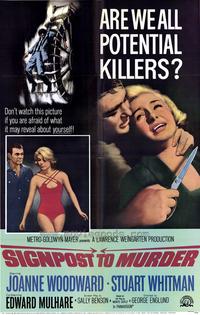
Signpost to Murder
Because it has been awhile and I can't think of a better lead for today's review, we're going with the character actor intro. And today's special guest is Stuart Whitman, come on down! An actor with a prolific filmography, Whitman appeared in over 200 television shows and feature films starting in the late 1950s and right on through into 2000. He started off like many other actors from the time in television, including a starring role in Cimarron Strip. Whitman was never a huge star, but he was one of those faces you recognize in a movie and are glad to see him.
He's probably most well known for his part alongside John Wayne in 1961's The Comancheros, more than holding his own against the Duke at the height of Wayne's popularity. Whitman was a good tough guy lead, able to take that lead role but just as easily taking a supporting role. Most fans will recognize him from action and adventure movies, including ones like Rio Conchos where he works well with a strong ensemble cast. There were the exceptions, the films where he was given a prominent starring role, like 1964's Signpost to Murder, a well-made mystery thriller based off a Monte Doyle play. It's a pretty decent movie, one I enjoyed as I tried to figure out the twist only to see the movie fall apart in the end. They can't all be winners.
Having served a five-year sentence after being found guilty by insanity of murdering his wife, Alex Forrester (Whitman) is denied a parole from the British mental institution he's been living in. His psychiatrist, Dr. Fleming (Edward Mulhare), vouches for Alex, claiming he's turned a new leaf and has come back to some normal sense of sanity. Desperate and frustrated, Alex escapes and plans to hide out for 14 days, citing an archaic Victorian law that allows an escaped prisoner a new trial if he remains free for two weeks. He hides out in a nearby town, basically kidnapping a pretty middle-aged woman, Molly Thomas (Joanne Woodward), and keeping her in her house while the heat dies down. Molly's husband is due home anytime, but Alex has nowhere to go. The search is closing in, giving him few options as to what to do, and where does Molly stand with her knowledge of his escape?
Like so many plays turned into a feature film, it's pretty easy to spot. Besides an early introduction at the mental institution, the whole story -- the run-time is only 74 minutes -- is set in the Thomas house, a large, expansive country home that ends up being a character right alongside Whitman and Woodward. Director George Englund takes advantage of this very cool set, filming it in wide angles so you can see the whole house seemingly while still giving it a claustrophobic feel as Whitman's Forrester hides out as best he can. Englund also shoots in black and white, giving even more of a creepy, atmospheric feel to the developing story. Playing over the mystery is a great score from composer Lyn Murray. His score is soft and soothing at times, almost lulling you to sleep and then building slowly to surprises and revelations. As for as plays turned movies go, this is a good example of the transition being a smooth one.
Another positive -- before I proceed to rip the movie apart -- is the casting. In Whitman, Woodward and Mulhare, 'Signpost' has three really solid actors who were never huge stars but were nonetheless very strong, reliable actors. Much of the movie takes place in just one night as Alex and Molly go from kidnapper and victim to two struggling souls bonding through their weirdness. Somehow and some way, that chemistry works. Whitman pulls off the mystery well because we're left twisting in the wind for much of the movie whether he is actually insane. Woodward plays well off of him, and for the first time in a movie I've seen her, I thought she was just drop dead sexy. I don't intend that as a weird sexist comment because it's a key part of the character, and she is highly convincing. Mulhare is equally good as Dr. Fleming, the psychiatrist looking out as best he can for his patient who he genuinely wants to get better and rejoin society as a normal, rational individual.
And then there's the ending. This is the type of movie where you just know there will be a huge, surprising twist. If you're like me, you end up trying to figure it out yourself before the movie tells you what it is. My natural assumption was that it would be relevant to Whitman's Alex and his possible sanity or insanity and his guilt in murdering his wife, slitting her throat and letting her bleed out in the bathtub. The twist is relevant to that, but not in the way you'd think. I'm all for a good, well thought out twist where everything comes together nicely in a way you did not normally expect. If a movie pulls the wool over my eyes and I'm blindsided, but the twist still works, well, kudos to you for making a hell of a twist. But about halfway through the movie, the twist leans in a different direction, making Woodward's Molly a possibly involved player in all the mystery, murder and mayhem.
Then, Englund's movie pulls the rugs out from under you. Even at just 74 minutes, the pacing is somewhat leisurely with dialogue dominating the screen-time. With about five minutes to go, the story throws everything at the fan with twists coming left and right. If you've spent this much time developing the twist and the story, why not take a little more time and let it breathe, let it figure itself out? Instead the finale as is ends up being incredibly rushed. It's so interested in revealing the twist that countless other things don't end up getting explained at all. Talk about open-ended, we don't even know if Alex is guilty of murdering his wife! Some explanation -- however weak -- would have been appreciated, but it never comes. It basically ruins an otherwise solid thriller, leaving quite a bad taste in your mouth. It is probably still worthwhile to watch for the performances from the three leads and a cool setting, but beware of the disappointing ending.
Signpost to Murder <---TCM trailer (1964): **/****
He's probably most well known for his part alongside John Wayne in 1961's The Comancheros, more than holding his own against the Duke at the height of Wayne's popularity. Whitman was a good tough guy lead, able to take that lead role but just as easily taking a supporting role. Most fans will recognize him from action and adventure movies, including ones like Rio Conchos where he works well with a strong ensemble cast. There were the exceptions, the films where he was given a prominent starring role, like 1964's Signpost to Murder, a well-made mystery thriller based off a Monte Doyle play. It's a pretty decent movie, one I enjoyed as I tried to figure out the twist only to see the movie fall apart in the end. They can't all be winners.
Having served a five-year sentence after being found guilty by insanity of murdering his wife, Alex Forrester (Whitman) is denied a parole from the British mental institution he's been living in. His psychiatrist, Dr. Fleming (Edward Mulhare), vouches for Alex, claiming he's turned a new leaf and has come back to some normal sense of sanity. Desperate and frustrated, Alex escapes and plans to hide out for 14 days, citing an archaic Victorian law that allows an escaped prisoner a new trial if he remains free for two weeks. He hides out in a nearby town, basically kidnapping a pretty middle-aged woman, Molly Thomas (Joanne Woodward), and keeping her in her house while the heat dies down. Molly's husband is due home anytime, but Alex has nowhere to go. The search is closing in, giving him few options as to what to do, and where does Molly stand with her knowledge of his escape?
Like so many plays turned into a feature film, it's pretty easy to spot. Besides an early introduction at the mental institution, the whole story -- the run-time is only 74 minutes -- is set in the Thomas house, a large, expansive country home that ends up being a character right alongside Whitman and Woodward. Director George Englund takes advantage of this very cool set, filming it in wide angles so you can see the whole house seemingly while still giving it a claustrophobic feel as Whitman's Forrester hides out as best he can. Englund also shoots in black and white, giving even more of a creepy, atmospheric feel to the developing story. Playing over the mystery is a great score from composer Lyn Murray. His score is soft and soothing at times, almost lulling you to sleep and then building slowly to surprises and revelations. As for as plays turned movies go, this is a good example of the transition being a smooth one.
Another positive -- before I proceed to rip the movie apart -- is the casting. In Whitman, Woodward and Mulhare, 'Signpost' has three really solid actors who were never huge stars but were nonetheless very strong, reliable actors. Much of the movie takes place in just one night as Alex and Molly go from kidnapper and victim to two struggling souls bonding through their weirdness. Somehow and some way, that chemistry works. Whitman pulls off the mystery well because we're left twisting in the wind for much of the movie whether he is actually insane. Woodward plays well off of him, and for the first time in a movie I've seen her, I thought she was just drop dead sexy. I don't intend that as a weird sexist comment because it's a key part of the character, and she is highly convincing. Mulhare is equally good as Dr. Fleming, the psychiatrist looking out as best he can for his patient who he genuinely wants to get better and rejoin society as a normal, rational individual.
And then there's the ending. This is the type of movie where you just know there will be a huge, surprising twist. If you're like me, you end up trying to figure it out yourself before the movie tells you what it is. My natural assumption was that it would be relevant to Whitman's Alex and his possible sanity or insanity and his guilt in murdering his wife, slitting her throat and letting her bleed out in the bathtub. The twist is relevant to that, but not in the way you'd think. I'm all for a good, well thought out twist where everything comes together nicely in a way you did not normally expect. If a movie pulls the wool over my eyes and I'm blindsided, but the twist still works, well, kudos to you for making a hell of a twist. But about halfway through the movie, the twist leans in a different direction, making Woodward's Molly a possibly involved player in all the mystery, murder and mayhem.
Then, Englund's movie pulls the rugs out from under you. Even at just 74 minutes, the pacing is somewhat leisurely with dialogue dominating the screen-time. With about five minutes to go, the story throws everything at the fan with twists coming left and right. If you've spent this much time developing the twist and the story, why not take a little more time and let it breathe, let it figure itself out? Instead the finale as is ends up being incredibly rushed. It's so interested in revealing the twist that countless other things don't end up getting explained at all. Talk about open-ended, we don't even know if Alex is guilty of murdering his wife! Some explanation -- however weak -- would have been appreciated, but it never comes. It basically ruins an otherwise solid thriller, leaving quite a bad taste in your mouth. It is probably still worthwhile to watch for the performances from the three leads and a cool setting, but beware of the disappointing ending.
Signpost to Murder <---TCM trailer (1964): **/****
Labels:
1960s,
Edward Mulhare,
Joanne Woodward,
Stuart Whitman
Monday, August 29, 2011
War Drums
So movie portrayals are one thing because stereotypes are an easy way to get a message across. But what about westerns -- and movies in general -- that try to be an end-all, be-all depiction of the Native Americans? That was what I took away from 1957's War Drums. By the 1950s, westerns were leaning toward a more favorable (at least a little more balanced) portrayal of Indians, movies like Broken Arrow starring Jimmy Stewart. 'Drums' certainly tries to go down that route, presenting the Apaches in a positive light, but that portrayal is so ripe with stereotypes and misconceptions -- not to mention some really bad casting -- that the effort is lost.
Living as a slave following a raid on her family ranch, a young Mexican woman, Riva (Joan Taylor), is rescued in a way by an Apache war party, led by chief Mangas (Lex Barker). The chief's first thought is to sell her to a white settler and make some money off her or at least make a worthwhile trade. A friend of Mangas', Luke Fargo (Ben Johnson), is a trader and horse wrangler and sees Riva's plight, instantly falling head over heels for her. Mangas has started to feel the same way and decides to take her as a wife. She is not your typical Apache wife though, learning to hunt and fight at her husband's side. Fargo worries about her and where she will end up, but can't go against his friend's wants and wishes. The problem comes to fruition though as more and more white settlers move into the area, including many who couldn't care less they're on Apache land.
I give any western (and on a bigger level, any movie) that tries to be unique, to tell a story from a different perspective than most viewers are used to. At its most basic -- stripping away reliance on stereotypes and a generally odd portrayal of Apaches -- War Drums tries to do that. Early on, it portrays the Apaches as...wait for it....human beings just trying to survive and live their lives. The story is set in the late 1850s and early 1860s as the United States steers toward the Civil War, providing an interesting counter to that situation in the Southwest. Another positive, an honesty about the life and the times. Apaches warred with Mexicans, whites fought with Apaches. No one was exempt, and no one group was all bad. There's always a couple rotten apples.
Who should I rip first? Well, because the movie focuses more on the Apache tribe, let's start with them. In an effort to humanize this warring, brutal tribe, director Reginald Le Borg (<---cool name, huh?) makes an odd choice. He makes a legitimate attempt to show the Apaches weren't stereotypically evil by using...stereotypes? All of the Apaches -- warrior, wives, medicine man -- speak in a stilted, halting fashion, talking in lines full of odd animal imagery and existential thoughts. Lex Barker -- formerly Tarzan and later Old Shatterhand -- is a very white Apache chief, supposedly playing the real-life Mangas Colorado. His Mexican wife, Riva, is badly miscast, Taylor apparently around for eye candy. She goes for a stereotypically over the top and fiery Mexican woman who becomes a feared warrior after shooting a few arrows into a tree. Mostly, she wears short dresses or tight buckskin pants.
That's not all though, just a good start. Apparently the Apache warrior as an individual had a weird war cry that the Ewoks from Return of the Jedi or 10th Century Viking warriors would have been proud of. At every possible moment, they yell 'Ayee!' We're talking happy, sad, defeating an enemy, getting married, having a good breakfast. They yell that nonsensical war cry. Enough with the Indian ripping, let's get to the white men, either angelically faultless like Johnson's Luke Fargo or mind-blowingly evil like the bloodthirsty miners who almost start a war. In an effort to demonize them even more, the story calls for outright pandering. When Mangas is caught and whipped, one miner yells 'Carve your name into his back!' to the "whipee." The man with the whip replies "I would if I knew how to write!" Oh, that's just too much. Is he evil because he's stupid, or stupid because he's evil?
For all the groan-inducing, roll your eyes at the badness moments, the movie isn't as bad as I've made it out to be. To be fair, it's not that great either, but I enjoyed it for what it is. It is a 75-minute B-western with a different story and some exciting action. A classic it is not, but even if the execution didn't work out in trying to tell a balanced story about whites and Indians, the attempt (however heavy handed) was made. In the supporting cast, look for an unrecognizable John Colicos as Chino, an Apache medicine man, and an uncredited Stuart Whitman playing a worrying husband.
War Drums <---TCM trailer (1957): ** 1/2 /****
Labels:
1950s,
Ben Johnson,
Lex Barker,
Stuart Whitman,
westerns
Saturday, February 12, 2011
Night of the Lepus
One of my all-time favorite quotes from Michael Caine in an interview he did about the many movies he's made during his career. When asked what he remembered about the classic Jaws IV, he said "Not much, but I remember the house I bought because I made that movie." That says it all. An actor/actress doesn't need to make a classic every time they make a movie, and who blames them? It's the rare Laurence Olivier or Peter O'Toole that makes an above average, high quality finished product with each movie. And as a movie watcher, you're going to see your share of duds with some still deep, impressive casts. You know going in that the movie is going to be awful, but you watch anyways.
I couldn't help myself and watched 1972's Night of the Lepus, one of the worst movies ever made without a doubt, no question about it. The cast isn't full of A-list, big name stars, but there were a bunch of names I recognized -- and have enjoyed seeing in other movies -- but by the time I finished the movie all I could think was that each and every one of these stars must have been in massive amounts of debt. To be fair, this is supposed to be a bad movie, a B-movie of epic proportions. Cheesy special effects, a ridiculous story, and overacting around every corner. This is a flick that might have been better if it wasn't played so seriously (add a little camp value), but it is what it is. It's an awful movie that did give me a couple chuckles here and there. Now was it intended that way? Who knows for sure.
Working his ranch in the Arizona desert, grizzled rancher Cole Hillman (Rory Calhoun) is seeing a takeover of rabbits on his range to the point where his cattle can't graze because the land has been stripped down. He seeks help from a friend working at a local university in the medical/science department, Elgin Clark (DeForest Kelly), who recommends contacting a researcher couple working in the area, Roy (Stuart Whitman) and Gerry (Janet Leigh) Bennett. They decide to start testing on the rabbits in hopes of stopping them from reproducing, using a new hormone on a small test group. But in the testing process, their daughter lets one of the rabbits go where he rejoins the thousands of rabbits already on the range. The local sheriff (Paul Fix) quickly starts getting calls about bizarre attacks by an unknown animal. Roy and Gerry's worst fears come true, the hormone had the wrong affect on the animals. Rabid, murdering rabbits the size of mountain lions are reproducing in huge numbers, and they're on the rampage. NO ONE is safe!
That was a fun plot description to write, not going to lie. Rabid, murdering rabbits on the rampage? How could that not be amazing? As long as there have been creature movies, there have been bigger than they're supposed to be creature movies. Honestly, how do you make furry, little bunny rabbits terrifying? Well, first, you can't really. Look at them. But if you're going to try...make them gigantic with a taste for human flesh. Another similarly awful movie, The Killer Shrews, dealt with the same "issue." Tiny, little shrews tested on and turn into creatures the size of dogs. Equally ridiculous, and equally not scary. It's all mindlessly stupid almost from the start, and it just gets stupider as the "story" moves along.
The technique for making gigantic rabbits is laughable and hilarious at the same time. I only noticed two instances of green screen filming where the cast is edited into a shot of the big bunnies (from a distance of course). I suppose it was a good thing that this technique wasn't used too much because the end result is pretty bad in the effects department. The solution on the other hand isn't much better. Very small sets were built to match the sets that the actual human cast used, and then rabbits were released onto these sets with cameras filming. Even better, the cameras are almost underneath the animals to give the impression of their IMMENSITY! Nothing like slow-motion, running rabbits to send a shiver up your spine. My favorite technique though (okay, there were two) was the close-up of a pissed off rabbit with his tooth (yes, singular) dripping with blood with growling heard in the background. Rabbits gotta eat, huh? Capping all this off is the "soundtrack" for the rabbits attacking. Imagine a low, consistent roar like the sound of a cattle drive added in with the sound of slobbering animals. Scary it is not, but funny, very much so.
For the cast, I have seen and enjoyed watching movies with all five of the names mentioned. I go back and forth wondering what the process was like getting involved with a movie like this. At some point, they actually decided "Yes, I'm going to do this movie. I think it has potential." Okay, maybe not, but they must have been pretty hard-up for any sort of work, any sort of cash at all. What makes this movie better/worse depending on how you look at it is that the cast -- which was a talented one -- plays it all so ridiculously straight that you can't help but give them credit for it. Stick to your guns! Whitman, Calhoun, Kelly and Fix were all known commodities for me. Solid supporting actors who were never stars but were always fun seeing them in any number of movies. And then there's Janet Leigh. Did someone have some scandalous information on her and forced her to do this movie? Kudos to her for sticking with it though. She plays the part of the tough but loving wife as well as humanly possible.
One of my favorites with movies like this is how do you wrap it up? How do you kill hundreds and maybe thousands of giant, murdering rabbits? Whitman's plan is unique but I'm still not sure it actually makes sense. The massing of rabbits is herded toward a stretch of electrified train tracks and then slaughtered with nowhere to go but on those tracks. It's hysterical (I feel bad for saying that electrocuting bunnies is hysterical by the way) and ridiculous just like the rest of the movie. If you're looking for a good laugh, this creature feature is a winner. It's available to watch at Youtube starting HERE with Part 1 of 9.
The Night of the Lepus <---trailer (1972): */****
I couldn't help myself and watched 1972's Night of the Lepus, one of the worst movies ever made without a doubt, no question about it. The cast isn't full of A-list, big name stars, but there were a bunch of names I recognized -- and have enjoyed seeing in other movies -- but by the time I finished the movie all I could think was that each and every one of these stars must have been in massive amounts of debt. To be fair, this is supposed to be a bad movie, a B-movie of epic proportions. Cheesy special effects, a ridiculous story, and overacting around every corner. This is a flick that might have been better if it wasn't played so seriously (add a little camp value), but it is what it is. It's an awful movie that did give me a couple chuckles here and there. Now was it intended that way? Who knows for sure.
Working his ranch in the Arizona desert, grizzled rancher Cole Hillman (Rory Calhoun) is seeing a takeover of rabbits on his range to the point where his cattle can't graze because the land has been stripped down. He seeks help from a friend working at a local university in the medical/science department, Elgin Clark (DeForest Kelly), who recommends contacting a researcher couple working in the area, Roy (Stuart Whitman) and Gerry (Janet Leigh) Bennett. They decide to start testing on the rabbits in hopes of stopping them from reproducing, using a new hormone on a small test group. But in the testing process, their daughter lets one of the rabbits go where he rejoins the thousands of rabbits already on the range. The local sheriff (Paul Fix) quickly starts getting calls about bizarre attacks by an unknown animal. Roy and Gerry's worst fears come true, the hormone had the wrong affect on the animals. Rabid, murdering rabbits the size of mountain lions are reproducing in huge numbers, and they're on the rampage. NO ONE is safe!
That was a fun plot description to write, not going to lie. Rabid, murdering rabbits on the rampage? How could that not be amazing? As long as there have been creature movies, there have been bigger than they're supposed to be creature movies. Honestly, how do you make furry, little bunny rabbits terrifying? Well, first, you can't really. Look at them. But if you're going to try...make them gigantic with a taste for human flesh. Another similarly awful movie, The Killer Shrews, dealt with the same "issue." Tiny, little shrews tested on and turn into creatures the size of dogs. Equally ridiculous, and equally not scary. It's all mindlessly stupid almost from the start, and it just gets stupider as the "story" moves along.
The technique for making gigantic rabbits is laughable and hilarious at the same time. I only noticed two instances of green screen filming where the cast is edited into a shot of the big bunnies (from a distance of course). I suppose it was a good thing that this technique wasn't used too much because the end result is pretty bad in the effects department. The solution on the other hand isn't much better. Very small sets were built to match the sets that the actual human cast used, and then rabbits were released onto these sets with cameras filming. Even better, the cameras are almost underneath the animals to give the impression of their IMMENSITY! Nothing like slow-motion, running rabbits to send a shiver up your spine. My favorite technique though (okay, there were two) was the close-up of a pissed off rabbit with his tooth (yes, singular) dripping with blood with growling heard in the background. Rabbits gotta eat, huh? Capping all this off is the "soundtrack" for the rabbits attacking. Imagine a low, consistent roar like the sound of a cattle drive added in with the sound of slobbering animals. Scary it is not, but funny, very much so.
For the cast, I have seen and enjoyed watching movies with all five of the names mentioned. I go back and forth wondering what the process was like getting involved with a movie like this. At some point, they actually decided "Yes, I'm going to do this movie. I think it has potential." Okay, maybe not, but they must have been pretty hard-up for any sort of work, any sort of cash at all. What makes this movie better/worse depending on how you look at it is that the cast -- which was a talented one -- plays it all so ridiculously straight that you can't help but give them credit for it. Stick to your guns! Whitman, Calhoun, Kelly and Fix were all known commodities for me. Solid supporting actors who were never stars but were always fun seeing them in any number of movies. And then there's Janet Leigh. Did someone have some scandalous information on her and forced her to do this movie? Kudos to her for sticking with it though. She plays the part of the tough but loving wife as well as humanly possible.
One of my favorites with movies like this is how do you wrap it up? How do you kill hundreds and maybe thousands of giant, murdering rabbits? Whitman's plan is unique but I'm still not sure it actually makes sense. The massing of rabbits is herded toward a stretch of electrified train tracks and then slaughtered with nowhere to go but on those tracks. It's hysterical (I feel bad for saying that electrocuting bunnies is hysterical by the way) and ridiculous just like the rest of the movie. If you're looking for a good laugh, this creature feature is a winner. It's available to watch at Youtube starting HERE with Part 1 of 9.
The Night of the Lepus <---trailer (1972): */****
Labels:
1970s,
Horror,
Janet Leigh,
Paul Fix,
Rory Calhoun,
Stuart Whitman
Saturday, November 13, 2010
The Last Escape
While spaghetti westerns took over in the late 1960s thanks to the success of the Sergio Leone trilogy among other flicks, a smaller genre of European action movies started to hit screens to similar success. They were Euro war movies, action packed stories light on story that always managed to be entertaining, sometime in how bad they were. Imagine spaghetti westerns, but replace a six-shooter with a machine gun and you've got the idea. 'Escape' has a lot going against it, and at times it can be pretty awful. Cheap/small budget isn't necessarily a bad thing, but when it smacks you in the face and screams out how cheap it is, we've got a problem.
The leader of an American commando team, Captain Mitchell (Stuart Whitman), is the only survivor of a German ambush when his team is betrayed. He manages to escape the ambush and hooks up with the British commandos he was supposed to work with. When the highest ranking British officer is killed, a young, inexperienced officer, Lt. Wilcox (Martin Jarvis), steps into command. Together, Mitchell and the British commandos must kidnap a German rocket scientist (Pinkas Braun) who holds information that could turn the tide of the war. The scientist is more than willing for a way out of Germany as long as the commandos take all the scientists' families with them. So chased by an obsessed SS officer (Gunther Neutze) and a Russian tank patrol also looking to bring in the scientist, Mitchell and Co. make a mad dash across Germany trying to get to Allied lines.
During a scene about midway through the movie, everything clicked for me. I swore I'd seen this movie before. Well, sort of. Some 33 years later in Tears of the Sun, Bruce Willis is basically working with an identical story albeit in a later, different time and place. That's the problem with the whole movie. You feel like you've seen it before. Heavy on footage from other movies (633 Squadron, Operation Crossbow, Battle of Britain), the cheapness reeks in this B-movie. The inserted footage doesn't even match up with what's going on as bombers attack a German base. The match up of the footage consists of the same explosions shown over and over again from different viewpoints. Cheap is one thing, but there's a limit.
The only even somewhat recognizable face here is Stuart Whitman as steely-eyed American commando Captain Lee Mitchell. Never a big star to being with, Whitman worked best as the sidekick in the roles I'm familiar with, especially working with John Wayne in The Comancheros or Richard Boone in Rio Conchos. This just isn't a strong part for him, and it's not entirely his fault. To say his character is a cardboard cutout of what a leading character should be would be an unnecessary dig at a piece of cardboard. So to start with Whitman's not working with much, and then he growls his way through his lines. It gets to the point you start to wonder if he realized what a lousy movie he was part of and decided to take it out on his co-stars. Awkward, unnecessary love story with possible German traitor (Margit Saad) added for a female audience...I guess.
So it was the action that suckered me in after watching the trailer, and it's the action that will allow me to even mildly recommend this movie (which I'm going to do almost in spite of myself). It is a movie with a smaller budget, but there's never any dead time before Mitchell and his British commandos are caught up in another running firefight with their German pursuers. The action is never on a large scale, but it's always entertaining with plenty of gunfire and explosions. The finale is by far the best thing the movie's got going for it as American, British, German and Russian forces all shoot it out so they can get their hands on this all-important German scientist.
I realize I'm probably overhyping the action, but there's not much more to write up. The rest of the cast leaves little to no impression, and director Walter Grauman (typically sticking with TV shows) doesn't really know what to do to fill out a 90-minute running time. I will say the locations add something to the non-stop chase scene that is the last 60 minutes of the movie. IMDB says it was filmed in Munich, Bavaria and Germany, and it certainly looks it. Heavily wooded areas that look untouched by history add a sense of being alone and on your own for Mitchell and his team. So overall, yes, I'm giving this a slightly positive recommendation. I don't know why, and I have the right to take this back later. I enjoyed it though. Check it out on Netflix's Instant watch if curious.
The Last Escape <---trailer (1970): ** 1/2 /****
Subscribe to:
Posts (Atom)