The Sons of Katie Elder

The Sons of Katie Elder
"First, we reunite, then find Ma and Pa's killer...then read some reviews."
Showing posts with label James Fox. Show all posts

Wednesday, July 9, 2014

Farewell to the King

John Milius is tough. There, I said it. A director and writer who became fairly well known in the late 1970s and the 1980s, Milius doesn't have a long, sprawling filmography. He's directed a little more than a handful of movies with almost 30 writing credits to his names as well. I've enjoyed the Milius entries -- directing and/or writing -- I've seen and can now check another one off the list, one of his lesser known efforts (and maybe for a reason), 1989's Farewell to the King.

It's early in World War II, and an American deserter, Learoyd (Nick Nolte), manages to escape Bataan and Corregidor with several other deserters. They land on Borneo, Learoyd again managing to survive while the other deserters are caught and executed by the Japanese. Learoyd retreats into the jungle, trying to survive. Some three years later, WWII's tide has turned and the Japanese are holding onto their last footholds across the Pacific. A special forces officer, Captain Fairbourne (Nigel Havers), is being dropped into Borneo to unite the native tribes on the island in an effort to lead a guerrilla movement against the retreating Japanese forces. Who does he find in charge of the natives, including a headhunting tribe, but Learoyd himself, looked at as a god by the natives. Can Fairbourne manage to convince the eccentric American deserter turned king to fight with the Allies with the war seemingly in grasp?

Well, this was certainly an interesting movie, if not necessarily a good one. A bomb at the box office in 1989, 'Farewell' was only called to my attention by a fellow blogger and all-around good guy Chris at Nothing Is Written. You can read his review HERE. I liked it more than him, but the flaws are evident all over the place in this Milius film. It is safe to say I liked the idea, premise and potential of the movie here more than the actual execution which ends up being all over the place in a movie that runs about 115 minutes. Milius has said in interviews that 'Farewell' was taken away from in post-production and hacked to pieces by the studio. It certainly seems like it could be true. The story is rushed at times, whole explanatory scenes seemingly hacked away, and in general, my thought was that the idea of a good movie is there. In the end, simply too much is on the plate, Milius trying to accomplish too much.

Let's start with the King himself, Nick Nolte. I can't make up my mind about this titular performance for good or bad. The biggest thing is that Nolte may not have been the right choice for the part. It is a character that demands a lot, but at no point did I really get a sense of why these tribes in Borneo are drawn to Learoyd. Yes, we're told his blue eyes, blonde hair and dragon tattoo on his chest are all reasons, but there's got to be something more than that, right? Nolte's Learoyd spouts a lot of mumbo-jumbo about nature and its power, of living life the right way. The goal seems to be to say something profound and deep, but it comes across as heavy-handed and aggressively dumb. He tries to be too Father Earthy, and it falls short. Much of the time, Nolte's gruff, gravelly-voiced demeanor works in tough guy parts but here I felt like something more was needed that simply isn't.

The parts that do work feature Learoyd and Captain Fairbourne, the special forces officer sent to assemble a native insurrection. The acting isn't great, but the idea of the Fairbourne character is certainly interesting, a variation on the naive, innocent Joyce character from Bridge on the River Kwai. He's been through all the training, knows how to kill most effectively...but he's never had to do it and now he's thrust into a bloody, gruesome guerrilla warfare. Also look for Frank McCrae as Tenga, Fairbourne's Australian radioman, with Marius Weyers, William Wise, Wayne Pygram and Richard Morgan rounding out the specialist team sent to train the natives, a wasted opportunity for some cool supporting characters. Gerry Lopez plays Gwai, Learoyd's right-hand man, Marilyn Tokuda playing Learoyd's wife.

'Farewell' does have plenty to offer. Composer Basil Poledouris turns in a memorable, sweeping score that becomes a key ingredient in the story. Milius and cinematographer Dean Semler helm a visually stunning movie, the locations in Borneo looking almost like a classic painting. The scene-to-scene transitions are as good if not better than the actual story. Some visuals especially stand out, including the build-up to an ambush of a Japanese column and the fallout as weather rolls in. There is about 45 minutes near the second half of the movie where 'Farewell' really hits its stride but it has bookends that aren't on the same level. As Learoyd, Fairbourne, the specialists and the natives join the war, that is the movie at its strongest.

Chris' review accurately pointed out how much 'Farewell' seems to borrow from other movies, and again, he's dead-on. The message and idea is there, but actually getting it across is a different thing. Milius never truly gets that message across. The finale feels downright rushed, the corrupt British (including very British James Fox) turning on the natives. If there is a director's cut out there, I'd be curious to see it. There is the potential for a good, even really good movie, among the pieces but as is, it is an interesting if heavily flawed final product.

Farewell to the King (1989): **/****

Wednesday, April 10, 2013

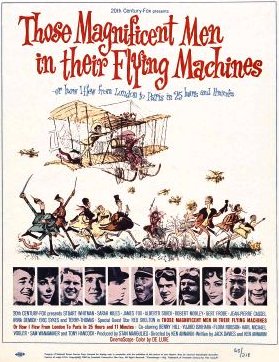
Those Magnificent Men in Their Flying Machines

The roadshow epic is unfortunately a thing of the past, a symbol of a Hollywood era that ruled through the 1950s and early 1960s. Even the lousy ones have something worthwhile. For me, I love the huge scale, the intro music, the intermission, the casts of thousands. By the mid 1960s though, things, they were 'a changing, and the epics were becoming a thing of the past. One of the last films hitting theaters before the era completely died out was a good one, 1965's Those Magnificent Men in Their Flying Machines.

It's 1910, and British army officer Richard Mays (James Fox) is among a small group of pilots worldwide who are helping advance aviation just seven years since the Wright Brothers flew at Kitty Hawk in 1903. He's sorta-engaged to Patricia Rawnsley (Sarah Miles), the daughter of Lord Rawnsley (Robert Morley), a newspaper owner disgusted at the thought of other countries' pilots advancing quicker in aviation than England. Using all his pull, Lord Rawnsley organizes an international air race from England to Paris that will show once and for all who is the best pilot around. Pilots from around the world travel to England with their flying machines with the hopes of winning the race and its lucrative prize. Among them, Orvil Newton (Stuart Whitman), an American cowboy, with his eyes set on the race, the prize, and maybe Patricia too. Uh-oh, America vs. Britain!

Working with Jack Davies to write the script and direct the film as well, Ken Annakin was a huge fan of aviation, and it shows with this 1965 epic. Setting the story in 1910 is a great touch as aviation and flying were still in its infancy. There weren't airlines or commercial jets. Individuals -- not businesses -- were trying to figure out what worked and didn't work in flying. Flying machines (yes, planes) flew much closer to the ground, couldn't stay in the air that long, and had a variety of mechanical and structural issues. Sounds fun, huh? And a little dangerous? Yeah, just a little. Check out the Wikipedia link HERE for an idea of the variety of planes featured here. There's some doozies in the group, definitely making you appreciate the modern jet airliner.

In the vein of The Great Race and It's a Mad, Mad World, 'Flying' is big and flashy but never gets too big or unwieldy. An opening montage with Red Skelton starring as individuals through history learning how hard flying can be (Neanderthal, Ancient Greek, Middle Ages, Victorian), leading right into the cartoon credits played under the Flying Machines theme song (listen HERE). I liked Ron Goodwin's score a lot too, similar to his score four years later in The Battle of Britain. Much of the story was filmed at the Brookley Motor Racing Track, helping give a real sense of 1910s aviation with its lush green fields serving as landing strips, immense wooden hangars housing the new wave of planes, and an outfitted windmill serving as a lookout point for Fire Chief Perkins (Benny Hill). The aerial sequences are impressive, even on the pre-takeoff as we see hundreds and thousands of extras lining the airfields.

The one thing lacking here from most other roadshow epics is huge star power. There are some really solid actors/actresses here, but there's no gigantic star(s). Whitman and Fox get the leads as the American and British pilots, fighting to win the race but also to win the lady. Thankfully, this storyline isn't too painful to watch, bouncing among a handful of different pilots. Some of the other international pilots include Count Emilio (Alberto Sordi), the Italian family man with a penchant for crashing, Pierre Dubois (Jean-Pierre Cassel), the loving life Frenchman, Sir Percy (Terry-Thomas), the sabotaging Englishman with his maligned assistant, Courtney (Eric Sykes), Yamamoto (Yujiro Ishihara), the experienced Japanese pilot and the race favorite, Capt. Rumplestoss (Karl Michael Vogler), the inexperienced but proud German army officer, and MacDougal (Gordon Jackson), the fun-loving Scotsman. Not much star power, but we get a lot of memorable characters with some truly funny recurring bits.

While the scale on a large scale is always impressive, it's the recurring bits that help bring the movie up a notch. It's fun seeing Orvil and Richard go toe-to-toe, the American always looking good in heroic fashion. There's also Dubois swearing he's seeing the same girl over and over again, Irina Dernick playing all of the women. In a pre-World War I time, there's also national rivalries, the English believing they're better than anyone, the Germans doing the same, and the Italians and Frenchmen having fun at their expense. Dubois and his French crew constantly mess with the Germans, especially their commander, Colonel Manfred (scene-stealing Gert Frobe) and Rumplestoss. There's also James Robertson Justice making a quick appearance as the narrator, deadpanning his way through the Skelton bit, Flora Robson as Mother Superior, a nun with an incentive to help the race, Sam Wanamaker as Orvil's partner and friend, and an uncredited Ronnie Stevens as the race's public address announcer.   

'Flying Machines' isn't as long as many epics, wrapping up in just 138 minutes as opposed to so many other three-hour monstrosities. Much of the first 90 minutes is spent on the ground getting to know our pilots, including a whole lot of hijinks and shenanigans as our international lineup tries to outdo each other. The last 50 minutes focus on the race with some impressive aerial sequences, our antiquated looking planes flying across England, the English Channel, and finally Paris. I loved this movie, and more so as it went along. No star power? No problem. It's a gem, and one of the last true roadshow epics. Enjoy it.

Those Magnificent Men in Their Flying Machines (1965): ****/****

Friday, March 22, 2013

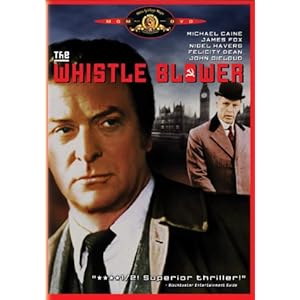
The Whistle Blower

Espionage flicks typically go one of two ways. One, the James Bond route; lots of action, explosions, beautiful women, gunfights, that sort of thing. Two, the more realistic way, films like Tinker, Tailor, Soldier, Spy and Argo. They both have their positives to take away, and sometimes it just depends what you're in the mood for. Where does 1987's The Whistle Blower fall? Oh so serious.

A veteran of the British Navy who served as a pilot during the Korean War, Frank Jones (Michael Caine) has moved on with his life and now has a mildly successful sales company. More and more, Frank finds himself talking his idealistic young son, Bob (Nigel Havers), down off the ledge about the nature of his job. Bob is a Russian linguist working for British intelligence, but he's become disillusioned about how the nature of the espionage is handled. Frank tries to convince him that with a struggling economy, any job is a good job, especially for a language specialist in Russian. Frank is stunned then when he receives the news that his son died in an accident, falling off the roof of his apartment building. Everyone from the police to the coroner believes it was an accident, but having talked to his son, Frank knows his son was investigating some deep, dark things. Was it an accident or part of a cover-up of something far more sinister?

Thank you, Netflix, for this one. I found it while looking through Caine's filmography/listing, and after months of procrastinating and avoiding it, I gave it a shot this week. There's no question what type of espionage flick this one is. It is the most serious of serious. No deadpan humor, no sexy secret agents, no guns a' blazing with explosions and fireballs. This is a gentlemanly espionage....well, mostly. From director Simon Langton, 'Whistle' manages to be both highly unsettling and low key in its delivery. You don't hear that often, do you? It can be a tad on the slow side, a little dull at times, but for the most part, I liked this one.

No surprises here, but Michael Caine will be my first, second and third reasons for watching this movie. Even when a movie is lousy, Caine is eternally watchable. When a movie is halfway decent, like 'Whistle' is, his performance can help bring it up a notch or two. Reflecting the solemn and serious tone of the story, it is a mostly understated, underplayed part for the screen veteran. He loves his son while also being frustrated by him. When Bob dies under suspicious circumstances, Frank is the only one who believes there could be more to the story. The portions of the story that follow are the movie at its best; an angry, confused and curious father searching for answers about his offspring. He even gets a few chances at some rabid outbursts, and let me tell you, I wouldn't want to be on the receiving end of a Caine outburst.

On top of Caine's performance, I liked the subtle nature of the story. At 104 minutes, it is never in a rush to get anywhere. Early on, it's not even in a rush to lay everything out. It's like as an audience we're dropped into a story that already had a prologue. Names, situations, backgrounds, reputations, they're all thrown at us, and we're forced to figure it out on the fly as it comes at us. Much of it surrounds British intelligence's effort to monitor Russian messages electronically. One agent Dodgson (Bill Wallis) has been pitting the Brits/Americans vs. the Russians, and those crafty Brits intend on figuring out what's going on. Their investigation leads to a traitor (John Gielgud) who's lived in England for over 20 years. As he continues to look for answers concerning his son, Frank finds out what his son was involved with, but also how far those intelligence agencies will go to produce effective results.

Like 2011's Tinker, Tailor, Soldier, Spy, 'Whistle' delves into the inner workings of the intelligence agencies. It isn't just them looking out for the country's well-being, but seeing how far they can push it to test the limits of their power.  It's a pretty frightening thought. Is one life expendable if it could lead to a huge payoff intelligence-wise? James Fox has an unsettling part as Lord, a British higher-up who calmly lays out a brutally sadistic plan, Barry Foster plays Charlie Greig, an old Army buddy of Frank's now working in Intelligence, and Gordon Jackson plays Bruce, the agent in the field putting plans into effect. Also watch for Felicity Dean as Cynthia, Bob's new girlfriend, a soon-to-be divorced woman with a kid, and Kenneth Colley as Pickett, a leftist crusading journalist desperately searching for a deeply hidden story.

I wish I had liked this movie more. For all the positives, it is slow, and it lacks a certain energy. Understated is one thing, but the story is so underplayed that I never really felt any sense of worry. The ending is disappointing although the final scene is moving, featuring some very cool on-location shooting at the Cenotaph in Whitehall, London.

The Whistle Blower (1987): ** 1/2 /****