The Sons of Katie Elder

The Sons of Katie Elder
"First, we reunite, then find Ma and Pa's killer...then read some reviews."
Showing posts with label Alain Delon. Show all posts

Thursday, July 3, 2014

Purple Noon

I remember watching 1999's The Talented Mr. Ripley with the family, a rental from Blockbuster (YES, a video store) on a Saturday night. Before I could really appreciate what was going on, maybe even accurately describe it, I know I liked the creepy, stylish thriller. It is an uncomfortable, beautifully shot film with a handful of interesting performances. Wouldn't you know it though? It isn't the first film based off Patricia Highsmith's novel of the same name. That would be 1960's Purple Noon.

Hired by a rich businessman in San Francisco, young Tom Ripley (Alain Delon) has been sent to Italy with a job, a potentially very lucrative job. Tom has been hired to find Philippe Greenleaf (Maurice Ronet), the businessman's son, somewhere in Italy and bring him home, receiving $5,000 for his troubles if he can pull it off. Upon meeting Philippe though, Tom forms an unlikely friendship with the vain, egotistical and spoiled young man. It is a friendship of extreme highs and lows, Philippe constantly pushing and testing Tom. Finally with a deadline fast approaching, Tom decides he's has just about enough, especially when Philippe flat-out tells him he won't leave Italy to return to San Francisco. Deciding he wants more than just the delivery fee for his services, Tom puts a drastic plan into action, a plan that will need all sorts of luck to pull off. Can he do it? Can he get away with it?

Just another reason to always be on the lookout for those hidden gems that are out there. As a fan of the 1999 Mr. Ripley, I was curious to see how this 1960 French version differed, if at all. I haven't read Highsmith's source novel, but I intend to now. There are differences, but the basic gist is there throughout as the two films follow a similar formula. Director Rene Clement has a movie here dripping with style, a style that's pretty effortless. His camera lingers for long, uninterrupted shots that keep the focus on his stars and cast. The music by Nino Rota is underplayed, adding a sinister touch to the developing thriller, and yes, filming on location in Italy turned out to be a good thing. Who knew?!? The main backdrops are both Rome and Naples, both Italian cities adding a depth and visual look to the story. It is a sun-drenched beautiful movie, beginning to end.

Over recent years, I guess I can say I "discovered" Alain Delon. The French actor didn't star in a ton of American movies, but I stumbled across him as I watched director Jean-Pierre Melville's French heist/crime thrillers, Delon a favorite star to work with. Way back in 1960 though, he was a relative unknown having only acted in a handful of smaller scale movies. Given his first starring role in a major release, Delon doesn't disappoint. This is one creepy, underplayed and sinister performance, Delon doing it with ease and adding a sense of charm to the ever-creepier proceedings. Delon's Tom Ripley is a mystery, a man from a lower class background who sees the potential (however dark and morbid) to better himself. He adds some great touches to that morbidity, reveling in the moment when he should be horrified at what he's just done. A frightening performance, one that pulls you in to see if somehow, some way, Tom can pull it all off.

This was Delon's movie, and what a performance. That said, there isn't a weakness in the entire cast that features a handful of other key parts. Ronet is exceptionally unlikable as Philippe, the worst kind of person who's charming and good-looking and knows it, pushing the limits with everyone and anyone to see what he can get away with, especially Tom. Considering how Philippe treats him, you don't give a pass to Tom, but you at least understand what drove him to do what he does. Marie Laforet plays Marge, Philippe's fiance who is another frequent target of his outbursts, finding a friend of sorts in sympathetic Tom. Also look for Erno Crisa as a police inspector, Frank Latimore as a partying friend of Philippe's, and Billy Kearns as a more polished, suspicious friend of Philippe's.

I love movies like this with a story that's hanging on the edge. Will our protagonist be caught? Will he somehow pull it off? As I mentioned before, it's not that we're rooting for him, but that doesn't take away from the suspense. There are more scenes than I can mention, Tom's delicate plan hanging in the balance, maybe one mistake from everything blowing up in his face. The ending delivers an excellent twist too, one different from the 1999 version, and I'm curious to see what the novel's version is. A beautiful stylish movie with a scene-stealing, sinister Delon. A very easy movie to recommend.

Purple Noon (1960): ***/****

Thursday, February 27, 2014

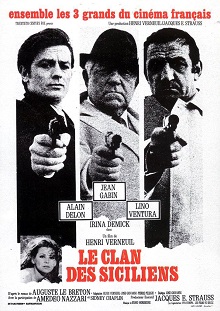
The Sicilian Clan

Well, here we are again, and it's been too long. Mostly because they're not readily available in the U.S., I have to search out Euro-crime thrillers from the 1960s and 1970s on Netflix, on Youtube, and occasionally random channels on TV. So when I do find one, I better savor it, right? Not an issue with 1969's The Sicilian Clan, a very stylish, very easy movie to like.

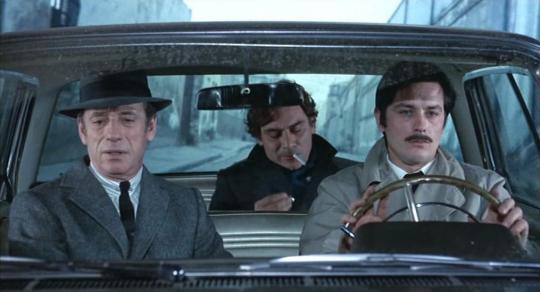
About to be sent to trial over the murder of two police officers, accused killer and thief Roger Sartet (Alain Delon) instead manages a daring escape aided by a former partner in crime, Aldo (Yves Lefebvre). In exchange for helping him pull off the escape, Sartet agrees to work with Aldo's family, the Manalese clan, a small-scale but successful Sicilian crime family, headed by patriarch Vittorio (Jean Gabin). Their plan? Take down a heavily guarded diamond exhibit displayed in Rome, state of the art technology intended to trip them up at any given moment. It seems an impossible, even suicidal objective with virtually no shot of succeeding. With some help from an American mafioso counterpart, Sartet and the Manalese clan put a plan into action though. It's as daring as they come, but some rivalries and personal motivations threaten to tear it apart before the heist is ever put into action. Their time is limited too, the police commissioner, Le Goff (Lino Ventura), obsessively searching for Sartet.

These movies never get old. Okay, well that's not completely true. There are some duds, but even the duds usually have something worth recommending. This one from director Henri Verneuil is a gem so no worries in that department. When it works, it just does, plain and simple. There is a style that helps carry the sub-genre from one movie to another. The on-location shooting never hurts, especially here in Paris, but the music goes a long way too. Here it's one of the best composers ever, Ennio Morricone providing a score that's equal parts playful and catchy with darker samples as needed. Listen to a sample HERE. For me though, the most appealing part of the Euro-crime genre is simple. These movies are cynical, brutal and dark. A majority of the stories play like tweaked American film noirs. Crime doesn't pay, the crooks are pretty nasty, the cops sometimes more so, and we're rarely talking about a happy Hollywood ending.

Released in 1969, this French crime thriller's appeal is more than obvious. One movie that stars Alain Delon, Lino Ventura and Jean Gabin?!? These were three iconic actors in France, internationally, in the genre, in all sorts of ways, so to see them working together in a single movie is just a lot of fun. There are lots of characters, but the ensemble cast leaves the focus on this trio. Delon is one of my favorites, his cool, calm, even icy demeanor just reflecting well as the anti-hero you can't help but like. Gabin is the smooth one here though, his Vittorio almost monotone in his delivery. His facial expressions almost never change, nothing rattling him. Even when things go awry, he calmly deals with, internalizing the rage. As for Ventura, it's cool to see him in a non-villain role, his Le Goff an experienced police officer who becomes almost obsessed with catching the murdering Sartet. All characters/actors that are capable of carrying a movie on their own, working together in a very worthwhile ensemble.

Who else to look out for? Those are the most recognizable names, but there's some cool supporting parts. Vittorio's sons include Lefebvre and Marc Porel, his son-in-law played by Philippe Baronnet, all three taking active parts in their crime family. Aldo's wife, Jeanne, is played by Irina Dernick, a Frenchwoman who takes a liking to Delon's Sartet as a fellow Frenchman as she's not used to living with all these Sicilians. Amedeo Nazzari is excellent as Tony, an American mobster who's worked with Vittorio in the past, working together again to pull off this diamond heist. Tony sends one of his men, Sydney Chaplin playing the alcoholic crook, Jack. Danielle Volle has a small but necessary (and good) part as Sartet's sister, worried about her brother's well-being.

And now for that heist. This is a genre that's done just about everything it can do to throw something new and original and fresh at the audience. Well, kudos to you The Sicilian Clan. This is definitely something new. When the diamond exhibit is introduced, I thought I was watching Rififi or Le Cercle Rouge (actually released a year later in 1970), but I was in for a surprise. 'Sicilian' doesn't go for the status quo....at all. This French crime thriller definitely comes up with something new and different, Sartet, Vittorio and the Manalese clan working with Tony and his New York mobsters to pull off the job. No spoilers here, the heist coming together nicely. If you think about it, there is a flaw in their plan that involves kidnapping -- it's rather unnecessary if you ask me -- but you get so caught up in what they're doing it isn't a huge issue. It becomes far more about 'Can they pull it off?'

But as Euro-crime thrillers have taught me, that ending.....well, the heist is usually the easy part. It's the fallout that provides the most drama. Again, I'm not going to spoil how it develops because even though it is hinted at in the build-up, it gets lost in the shuffle. When it does reveal itself, yeah, it works after some initial issues I had with it. The twist comes from a special place in the Mafia family lexicon. Don't....go....against....the....Family. That's it. Don't mess it up, and you'll probably be okay. It is quite an ending, very appropriate to the general darkness of the genre. An excellent movie, one very much worth catching up to.

The Sicilian Clan (1969): *** 1/2 /****

Saturday, February 2, 2013

Texas Across the River

Comedy westerns are completely hit or miss with me. With rare exceptions like Blazing Saddles, I do my best to avoid them. Every so often though, I've got to give them a try, like 1966's Texas Across the River, a pleasant surprise thanks mostly to its casting.

Readying to marry Southern belle Phoebe Ann Naylor (Rosemary Forsyth), Spanish duke Don Andrea Baldassare (Alain Delon) is confronted by another suitor for Phoebe. The suitor ends up dead -- due to an accident -- in the ensuing fight, and Andrea is forced to run. He heads across the border into Texas, still an unsettled territory. He's rescued from a sticky predicament with the pursuing cavalry by Sam Hollis (Dean Martin) and his Indian sidekick, Kronk (Joey Bishop). Owing them his life, Don Andrea -- a crack shot and fine horseman -- accompanies them as they travel into Texas toward the little settlement of Moccasin Falls. What are they up to? Sam and Kronk are gunrunners, but that's just the start. Warring Comanches, revenge-seeking cavalry and a love....square are just some of the hijinks around the corner.

Let's get this over with. This comedy western from director Michael Gordon is pretty stupid. There's something about westerns that doesn't translate well to comedies (if you ask me, and you are asking, right?). So that considered, if you're going to make a comedy set in the wild west, you can't be subtle. Be dumb, be stupid and go for the politically incorrect angle. Thankfully, 'Across' commits. It is dumb, but it isn't completely stupid either. The script has some good running bits, some solid sight gags, and is politically incorrect without being offensive. It's harmless enough, running 101 minutes, and doesn't overstay it's welcome.

What is worth it then about this flick? What caught my eye was the casting. An established star in Europe, Delon was creating quite a name for himself in America as well. He gets to play the fish out of water here, the European aristocrat who ain't quite familiar with the rough and tumble ways of the wild west, especially Texas. His counterpart in Martin's Sam is just the opposite. Dean Martin does what he does best, funny, effortless line deliveries, and he's cool all the way. The 31-year old Delon (handling much of his own stunts) and 49-year old Martin have an easygoing chemistry that goes wells with the slightly schizophrenic nature of the story and other characters. As peaceful Indian Kronk, Bishop (an obvious choice to play an Indian, don't you think?) is surprisingly funny. He gets to play the straight man to all the craziness as a deadpan Indian always ready with a clever one-liner.

There are plenty of other names to look out for, starting with Forsyth as Phoebe Ann, the Southern belle who never has a lack of suitors pursuing her. Her purpose here is to bat her eyes and look good which she accomplishes with ease, especially a not so subtle scene where she walks out of a pond with nothing but a clingy poncho on. Martin's reaction is priceless. Watch it HERE. Providing another love interest is Tina Aumont as Lonetta, a Comanche woman Don Andrea rescues from certain death. Peter Graves and Andrew Prine play Rodney and Sibley, brothers in the cavalry trying to get revenge for their dead brother. Michael Ansara has some fun as Iron Shirt, a Comanche chief trying to prove his son, Yellow Knife (Linden Chiles), isn't a complete screw-up.

Goofy though they may be, 'Across' does have its fair share of laughs. Much of it is of the physical variety, especially the opening fight scene at the wedding gone wrong. What bits work? When Ansara and his Comanches speak "Indian" the English subtitles appear. When they speak English, pictures appear, translating things back into Comanche. Delon keeps getting into trouble, Martin rescues him, Bishop wisecracks. The running bit about Graves' Rodney's indecipherable cavalry commands is funny as well. Smart humor this is not, but I enjoyed it just the same. Not a classic, but still worth a watch for western fans, especially for the fun the cast looks to be having.

Texas Across the River (1966): ***/****

Thursday, September 22, 2011

Scorpio

There are two types of spy movies in this world, my friend. Sorry for the random The Good, the Bad, and the Ugly reference. Anyways....there is the James Bond formula; super agent who always cheats death, always gets the girl, and always wins in the end, thwarting some evil genius from taking over the world. Then there's the more realistic look at the life of a spy (okay, "realistic" in a movie sense). Betrayals, back-stabbings, back alley deals, and most likely a bullet in your head at the end of the movie. Both formulas are good, and in general it's hard to mess up a spy movie.

One that definitely leans more to the realistic side is 1973's Scorpio. Seeing this movie at the video store (yeah, I know, VHS tapes, crazy) for years growing up, I remember always confusing it with Serpico starring Al Pacino.  Who knew I had some form of dyslexia, reading what I wanted to?  Aired recently as part of Burt Lancaster Day on Turner Classic Movie's Summer Under the Stars tribute, I finally got a chance to watch this movie, separating it from the Al Pacino-NYC cop movie.  It is based in some sense of spy reality where everything doesn't always turn out perfectly. The cast is good, and the story interesting for the most part, but even then I never found myself drawn into the movie as a whole.

After pulling off a successful assassination in the Middle East, CIA operative Cross (Burt Lancaster) returns to the U.S. with the hired killer, Jean Laurier (Alain Delon), who helped him pull off the job. Years of service under his belt and top secret knowledge to boot, Cross intends to leave the CIA, but he won't get out so easy. A CIA supervisor, McLeod (John Colicos), has ordered Cross shot on sight to shut him up. Cross goes on the run, heading for Europe as he's forced to leave his wife, Sarah (Joanne Linville), behind.  He finds a surprising person trailing him. Wanting nothing more than to become a CIA agent, Laurier is blackmailed by McLeod into hunting down his mentor.  He knows him best, how he does things and is promised his position if he can take him out. In a cat and mouse game, who will come out on top?

When I saw this movie on TCM's schedule, I was psyched to finally get to see this spy flick. The cast sounded pitch perfect, the story a familiar if still interesting take on the spy genre.  Then I watched it, and something was just missing that I can't put my finger on.  The locations are good without being distracting. As he runs, Lancaster's Cross ends up in Washington, NYC, Vienna and all over Europe for quick pit stops. The story keeps you guessing, especially the biggie; why is Cross on a hit list? There is an incredibly well-made chase sequence that allows Lancaster -- still a great physical presence here at 60 years old -- and Delon to do much of their own stuntwork as they race through a high-rise construction site in Vienna.  I don't know what went wrong though. While I liked the movie, I wanted to love it. Lack of energy, too sure of itself, something. A piece is missing, and I don't know how to explain it.

The experienced veteran and the rising star newbie, a tried and true plot device that has worked countless times before and will most likely work many more times.  Director Michael Winner even used this device a year earlier in the original and underrated The Mechanic. The worry is that because the formula/device is familiar it won't be interesting, but having actors like Lancaster and Delon play the parts has a way of making anything worth watching. Lancaster is one of the coolest actors to ever grace the screen, an effortless cool that you just can't teach. The same for Delon, an actor who underplayed most of his roles. It's great to see him lash out some here. The duo is perfect in their few scenes together, men with genuine appreciation and respect for the other, both knowing one of them will almost certainly die before all is said and done.

Beyond just being cool though, the acting from the whole cast is impressive.  Lancaster makes Cross a more than capable CIA operative, one with the ability to handle himself in every situation. More than that though, he's worn down by years in the espionage business, and he wants out. Delon is the youngster who wants it all and is willing to do anything to get it. Not enough for you? A co-star from the classic The Train, Paul Scofield is quite the scene-stealer as Zharkov, a Russian agent who is both a friend and enemy to Cross. His scenes with Lancaster crackle with energy, something I found would have made it into the rest of the movie. Colicos is good as McLeod, a mystery man because we just don't know his motives. Also worth mentioning were J.D. Cannon as Filchock, a CIA agent trying to piece it all together, Gayle Hunnicutt as Susan, Laurier's serious girlfriend, Mel Stewart as Pick, a connected man working with Cross, and Shmuel Rodensky as Lang, a man Cross saved from certain death in WWII. 

In a business associated with betrayals, backstabbing and all sorts of crazy shenanigans, it stands to reason we're going to get some twists and turns in a spy movie, right? You would be right. That is where Scorpio works at its highest level. Beyond the strong performances throughout the cast, the last 20 minutes are great as one solid, rational twist is revealed one after another. We get the answers we've been waiting for, and the final shot of the movie is a shocker too.  It's been hinted at, but seeing it is quite a capper to a whirlwind finale.  The movie is good -- don't think I'm not recommending it -- but it could have been better. Stick around until the end though. You won't regret it.

Scorpio <---TCM trailer (1973): ** 1/2 /****

Thursday, August 5, 2010

Le Cercle Rouge

Before I started this blog a little over a year and a half ago, I had watched a handful of movies that I didn't feel like reviewing.  Sure, it was only a week or two since I'd seen them, but as much as possible I wanted to review a flick with the flick fresh in my mind.  One movie I really wanted to review was a Netflix rental that has quickly climbed to a non-existent list of my favorite movies (okay, I have a definitive Top 5), 1970's Le Cercle Rouge or for us non-French speaking moviegoers, The Red Circle. With some leftover b-day money, I bought the pricey Criterion Collection DVD, and 18 months later after initial viewing, here's the review.

Over a three-year span, French director Jean-PierreMelville had one of the best strings of movies ever for a director starting with Le Samourai in 1967, continuing with Army of Shadows in 1969 and wrapping up with 1970's Cercle Rouge. I've yet to see a Melville film I didn't enjoy, but 'LCR' was my favorite.  It's a slower-paced heist movie that features the director's typically cool gangsters in a world where everyone looks out for themselves and anyone would turn you in if it would benefit them even a little bit.  But more than that, it is a surprisingly deep look at the criminal underworld, and the way complete strangers bond and work together in strenuous situations...in this case a jewelry heist.

In Paris, three men are about to work together for the first time on a perfectly planned jewelry heist that will net them almost $20 million francs.  There's Corey (Alain Delon), a recently released prisoner who has nothing left for him back home and vows to never return to prison. Supremely cool, calm and collected, nothing seemingly can get to him.  Second is Vogel (Gian Maria Volonte), an escaped fugitive who accidentally meets Corey, the two forming a quick friendship when they realize how similar they are.  Last there's Jansen (Yves Montand), a former cop and expert marksman struggling with a drinking problem, a man just looking for redemption and a second chance. But while these three conspire together to pull the jewelry heist, a police inspector (Andres Bourvil) investigates anything and everything he can about Vogel, wanting to catch the man who slipped through his grasp.

For fans of Melville, this is a prime example of when a director figures everything out in the moviemaking process, knowing exactly what he wants in a finished product.  He puts it together here.  His characters are loners, men of principle who even in the underworld hold honor and respect to a high degree.  The gangsters wear suits, trench coats and hats, smoke cigarettes and drink hard liquor.  There is always a cool, light jazz soundtrack playing over their actions.  They populate late night clubs and lonely, dusty apartments.  And no matter what, these guys are cool to the utmost.  It is a highly stylized, very suave and most likely idealized view of the criminal underworld, but you know what? It doesn't matter.  Melville drops you into this gangster's world, and you just go along for the ride.

We go into this world with the three men who've never worked together, and know very little about each other.  But with little to no background on Corey (what was he in prison for?) or Vogel (why was he arrested?), Melville makes these characters who would be very easy to dislike the ones you side with.  This is a performance that ranks with Le Samourai as Delon's best.  His Corey is so quietly understated you wonder if Delon is even acting or just playing himself.  In terms of pure cool, it doesn't get better than this character.  The same for Volonte as Vogel, an intense part as this mysterious crook we know nothing about.  Montand gets the most background for his character and doesn't disappoint.  Separately, all three parts are perfect, but together, they're as good as it gets in movies.  The scenes among the three are pitch perfect, each character knowing what is expected of them.  These men are professionals and they know how to get the job done.

The tour-de-force scene is an almost 30-minute extended sequence with not a word spoken as Corey, Vogel and Jansen pull off the heist.  With an obvious comparison to Jules Dassin's Rififi, Melville creates a tension that is hard to explain.  You're so geared up during the scene because any sound, any sound at all, will spell doom for this criminal trio.  The security system they're going up against features sensors, hidden locks, and a wide array of technology to deter them.  In terms of pure moviemaking skill, I don't know if Melville was ever better than he was here.  The whole heist is about as ideally laid out as a movie could do.  The whole movie is good, but that extended scene sets it apart from most.

MILD SPOILERS If you've watched any Melville movies, you'll know he's from the old school way of thinking; if your character has done something bad, he's going to have to pay for it.  Le Cercle Rouge applies in every way.  I'm not going to spoil it here, but it's certainly not a happy ending.  The police closing in as the three desperately look to get some cash out of the deal, they make a gutsy play.  It's an ending that caught me by surprise the second time around as much as the first one.  It is a surprisingly moving if downbeat ending that shows the honor and loyalty these crooks have working together.  They're partners, and that's how it is, end result be damned.

It all comes together with a fictional quote that explains the title, the red circle.  Men of a certain ilk like these criminals are destined to end up in the same place as unpleasant as it assuredly will be.  There's nothing they can to do avoid it, this is the path they've chosen.  In the end, they're going to end up together in this 'red circle.' And in the end for Melville, that's where they'll be no matter if it's far from happy. A great ending to one of my favorite movies.

Le Cercle Rouge <----French trailer (1970): ****/**** 

Saturday, May 22, 2010

Rocco and His Brothers


A long movie does not necessarily have to be a bad movie.  Some of my favorite movies -- The Great Escape, The Alamo, The Godfather, The Good, the Bad and the Ugly -- all clock in around three hours if not longer.  But these long movies tend to work better in a historical context, the big epic movie.  It's not a hard and fast rule, but it certainly helps.  The Godfather is a 3-hour movie about a mafia family, but for lack of a more educated description; stuff happens.

One of Italy's neorealist films, 1960's Rocco and His Brothers, is a movie that clocks in at just under three hours, and in a similar fashion tells the relationships and inner workings of a large family.  Sure, those relationships develop over time and problems arise, but in telling a story as realistically and personally as possible, the sometimes slow pacing kills any energy that builds up.  Add to the mix characters making decisions that no human being would ever make, and I came away disappointed in a movie that's earned a reputation of a classic.

After the family patriarch dies, the Parondi clan moves north to Milan, leaving their simpler life in the Italian countryside behind them.  The mother, Rosaria (Katina Paxinou), hopes to receive some help settling in from her oldest son, Vincenzo (Spiro Focas), who's moved to the city and is engaged to Ginetta (Claudia Cardinale). Rosaria disapproves of the engagement so now the family and her five sons must figure a way to survive on their own with no means of support.  Vincenzo ends up moving out and living with Ginetta so the other four brothers have to scramble for work.

The second oldest brother, Simone (Renato Salvatori), drifts along until he's spotted working in a gym and starts boxing, quickly rising through the ranks.  Then there's Rocco (Alain Delon), a good-natured, very kind young man who always looks out for his mother and brothers, often at his own expense.  Ciro (Max Cartier) goes to trade school so he can get a job at the Alfa Romeo factory, and the youngest, teenager Luca (Rocco Vidolazzi) makes deliveries for a pharmacy.   Everything seems like they're on the right track, but conflicts and rivalries pop up among the brothers, tearing them apart with little hope of bringing them back together.

In terms of style, 'Rocco' is can't miss with that Italian neorealism filmmaking easily seen throughout the movie.  Filmed in black and white on location in Rome and Milan, director Luchino Visconti delivers a movie that is gorgeous to look at.  The camerawork isn't aggressive but you're always aware the lens is right there in the streets or the crowded apartments with the characters.  Long shots/takes pop up throughout the movie almost as if the camera is there with the characters watching the plot develop.  In a cool little bit of personal style, each segment is introduced with a brother's name as their personal story comes to the forefront.

But as talented as Visconti is and as beautiful a movie as he creates, the visual and the realism only last for so long.  This is a llllllllllllong movie where just about every one of its 175-minute running time is noticeable.  Overall, not much happens other than long scenes of dialogue here and there, then longer segments where nothing is said at all. 

Even with five brothers, the Parondi mother, and a long list of supporting characters, the story centers on Rocco, the saintly brother, and Simone, the supremely flawed brother on a bad road.  Delon is one of my favorites, and his character is beyond likable without a dent in the armor with at least a couple allusions to him being a Christ-like figure.  Salvatori as Simone is everything Rocco isn't.  He drinks, gambles, runs around with women but truly loves one, a prostitute, Nadia (Annie Girardot) and lets his brief success and power go to his head.

The conflict between these two brothers is the key driving force in the 2nd half of the movie as Simone hits wall after wall, causing one problem after another, and driving his family away even though they're trying to help him.  Leading that charge is Rocco who is able to look past all these horrific flaws and decisions because at the core of the problem, Simone is his brother and he can look past it all.  I won't spoil how the relationship develops and climaxes, but let's say Nadia is involved and she ends up with the brother she wants nothing to do with.  Rocco makes decision after decision trying to help his brother when in real life, it feels like NO ONE would ever allow themselves to be stepped on and marched over as much as he does.

I understand making Rocco's character as likable as he is.  After his father dies, Rocco steps into the role of looking out for his family because no one else can.  But there's a limit to that.  I've always had a pet peeve about characters -- not just in movies but also books, TV -- that make a decision(s) because the story requires it.  Add to that element the issue that Simone is impossible to root for, impossible to get behind, and it just becomes more infuriating.  The ending itself is ambiguous and forces you to decide how everything is resolved.  Ideally, Rocco comes to his senses, but that's just too easy.

Knowing this movie was held in high regard by critics and fans alike, I wanted to like this movie, even more so considering the talent involved in front of and behind the camera.  But all things considered, the flaws were just too much.  The movie is far too long, incredibly slow-moving, and the characters make decisions that no sane person would ever make for the sake of the story.  I'll give it 2 stars because it's trying to be something more, and even if it fails, it was a worthy attempt.

Rocco and His Brothers <----trailer (1960): **/****

Sunday, February 1, 2009

Netflix review #3: Lost Command

Last year I was able to catch "Battle of Algiers" on TCM after hearing so many rave reviews about the almost-documentary film detailing a part of the Algerian War in the late 1950s and early 1960s. It was one of the best movies I saw last year so when I saw there was a more Hollywood take on the war, I had to at least give it a try.

Lost Command tells the story of the Algerian fight for independence mostly from the French perspective, including Lt. Colonel Pierre Raspeguy's 10th Parachute Regiment as they tangle with a rebel group in the hills and then dealing with terrorists in Algiers. Anthony Quinn plays Raspeguy, a veteran soldier worn down by all the fighting but who still feels the need to accomplish his mission. The movie begins at the disastrous battle at Dien Bien Phu as the Vietminh capture the last of Raspeguy and his men.

After spending several months in a prison camp, Raspeguy and his men are released, but the colonel finds out his regiment has been disbanded. It isn't long before the French command offers him a new regiment, albeit with men that were rejects from other units. Raspeguy agrees, and with some men from his previous unit, including Alain Delon's Capt. Esclavier, begins to train his men.

The story is good, and by the end the characters are more than just cardboard cutouts. Delon is a good counter to Quinn, his Esclavier is an idealist who needs a reason to fight, not just for the thrill of it all. In an odd choice for casting, George Segal plays Mahidi, an Arab leading a group of rebels and an ex-paratrooper who served with Raspeguy. Michele Morgan and Claudia Cardinale are the love interests, with Cardinale getting a chance to play a more villainous role. Raspeguy's men include Maurice Ronet as Boisfeuras, Maurice Sarfati as Merle, Jean-Claude Bercq as Orsini, Syl Lamont as Verte, and Gordon Heath as Dia. Spaghetti western fans should look for small parts for Al Muloch and Aldo Sambrell. Also look for Gregoire Aslan.

The high points of the movie, besides the strong cast, are the action scenes. Three major set pieces are featured, the opening attack at Dien Bien Phu including a parachute drop gone horribly wrong, an ambush of the 10th Regiment by Algerian rebels, and a firefight on a mountain side as Raspeguy and his men attempt to stop Mahidi from acquiring an arms shipment. All three battles have an epic feel to them, especially the finale.

The DVD has a widescreen presentation of the movie that's never looked better and is a significant improvement from the pan-n-scan VHS tape. The Spanish locations benefit the most with the widescreen. Special features are two trailers, one for Lost Command and one for The Guns of Navarone. An action picture more than anything, I highly recommend this one.
Lost Command (1966): ***/****