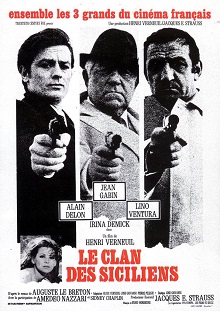
Well, here we are again, and it's been too long. Mostly because they're not readily available in the U.S., I have to search out Euro-crime thrillers from the 1960s and 1970s on Netflix, on Youtube, and occasionally random channels on TV. So when I do find one, I better savor it, right? Not an issue with 1969's The Sicilian Clan, a very stylish, very easy movie to like.
About to be sent to trial over the murder of two police officers, accused killer and thief Roger Sartet (Alain Delon) instead manages a daring escape aided by a former partner in crime, Aldo (Yves Lefebvre). In exchange for helping him pull off the escape, Sartet agrees to work with Aldo's family, the Manalese clan, a small-scale but successful Sicilian crime family, headed by patriarch Vittorio (Jean Gabin). Their plan? Take down a heavily guarded diamond exhibit displayed in Rome, state of the art technology intended to trip them up at any given moment. It seems an impossible, even suicidal objective with virtually no shot of succeeding. With some help from an American mafioso counterpart, Sartet and the Manalese clan put a plan into action though. It's as daring as they come, but some rivalries and personal motivations threaten to tear it apart before the heist is ever put into action. Their time is limited too, the police commissioner, Le Goff (Lino Ventura), obsessively searching for Sartet.
These movies never get old. Okay, well that's not completely true. There are some duds, but even the duds usually have something worth recommending. This one from director Henri Verneuil is a gem so no worries in that department. When it works, it just does, plain and simple. There is a style that helps carry the sub-genre from one movie to another. The on-location shooting never hurts, especially here in Paris, but the music goes a long way too. Here it's one of the best composers ever, Ennio Morricone providing a score that's equal parts playful and catchy with darker samples as needed. Listen to a sample HERE. For me though, the most appealing part of the Euro-crime genre is simple. These movies are cynical, brutal and dark. A majority of the stories play like tweaked American film noirs. Crime doesn't pay, the crooks are pretty nasty, the cops sometimes more so, and we're rarely talking about a happy Hollywood ending.
Released in 1969, this French crime thriller's appeal is more than obvious. One movie that stars Alain Delon, Lino Ventura and Jean Gabin?!? These were three iconic actors in France, internationally, in the genre, in all sorts of ways, so to see them working together in a single movie is just a lot of fun. There are lots of characters, but the ensemble cast leaves the focus on this trio. Delon is one of my favorites, his cool, calm, even icy demeanor just reflecting well as the anti-hero you can't help but like. Gabin is the smooth one here though, his Vittorio almost monotone in his delivery. His facial expressions almost never change, nothing rattling him. Even when things go awry, he calmly deals with, internalizing the rage. As for Ventura, it's cool to see him in a non-villain role, his Le Goff an experienced police officer who becomes almost obsessed with catching the murdering Sartet. All characters/actors that are capable of carrying a movie on their own, working together in a very worthwhile ensemble.
Who else to look out for? Those are the most recognizable names, but there's some cool supporting parts. Vittorio's sons include Lefebvre and Marc Porel, his son-in-law played by Philippe Baronnet, all three taking active parts in their crime family. Aldo's wife, Jeanne, is played by Irina Dernick, a Frenchwoman who takes a liking to Delon's Sartet as a fellow Frenchman as she's not used to living with all these Sicilians. Amedeo Nazzari is excellent as Tony, an American mobster who's worked with Vittorio in the past, working together again to pull off this diamond heist. Tony sends one of his men, Sydney Chaplin playing the alcoholic crook, Jack. Danielle Volle has a small but necessary (and good) part as Sartet's sister, worried about her brother's well-being.
And now for that heist. This is a genre that's done just about everything it can do to throw something new and original and fresh at the audience. Well, kudos to you The Sicilian Clan. This is definitely something new. When the diamond exhibit is introduced, I thought I was watching Rififi or Le Cercle Rouge (actually released a year later in 1970), but I was in for a surprise. 'Sicilian' doesn't go for the status quo....at all. This French crime thriller definitely comes up with something new and different, Sartet, Vittorio and the Manalese clan working with Tony and his New York mobsters to pull off the job. No spoilers here, the heist coming together nicely. If you think about it, there is a flaw in their plan that involves kidnapping -- it's rather unnecessary if you ask me -- but you get so caught up in what they're doing it isn't a huge issue. It becomes far more about 'Can they pull it off?'
But as Euro-crime thrillers have taught me, that ending.....well, the heist is usually the easy part. It's the fallout that provides the most drama. Again, I'm not going to spoil how it develops because even though it is hinted at in the build-up, it gets lost in the shuffle. When it does reveal itself, yeah, it works after some initial issues I had with it. The twist comes from a special place in the Mafia family lexicon. Don't....go....against....the....Family. That's it. Don't mess it up, and you'll probably be okay. It is quite an ending, very appropriate to the general darkness of the genre. An excellent movie, one very much worth catching up to.
The Sicilian Clan (1969): *** 1/2 /****
The Sons of Katie Elder
"First, we reunite, then find Ma and Pa's killer...then read some reviews."
Showing posts with label Lino Ventura. Show all posts
Thursday, February 27, 2014
Monday, March 1, 2010
Classe Tous Risques
Having seen a handful of movies starring Lino Ventura, I feel safe saying that the guy just can't play anything else than a villain. That's not a dig or a criticism, just an observation. He's really good at playing the bad guys. Even in a movie like Melville's Army of Shadows where he's a French resistance leader fighting the Germans, Ventura puts off this aura of intimidation and fear that makes you think he's a villain even as you're rooting for him.
In 1960's Classe tous risques, Ventura's part certainly treads that line between good and bad. He's a gangster, but he's also a dad looking out for his two young sons, ages 8 and 5. But in looking out for his kids, Ventura's Abel character breaks the law left and right, pulling off robberies, knocking off a couple guys, whatever it takes. There are moments where his character is incredibly sympathetic, but it's not long before he reminds you he's a killer and a gangster.
After four years on the run, infamous gangster Abel Davos (Ventura) is sneaking back into Paris with his family. Sneaking into the country proves to be more difficult than planned and his wife and partner are killed in a shootout with customs officials. Stranded in the middle of Italy with little money, no resources and his two kids, Abel turns to members of his old gang now living in Paris for help. They recruit a young thief, Eric Stark (Jean-Paul Belmondo), to drive an ambulance to pick him and the kids up and bring them back to Paris. It's during this rather tense journey that Abel forms a quick friendship with Eric, but he's got other things on his mind. Abel starts to question why didn't his friends come help him personally instead of sending this youngster?
Directed by Claude Sautet, 'Classe' (translated as Consider All Risks) has all the elements of a high-quality noirish gangster movie. It's filmed in black and white and the French and Italian locations look phenomenal, both the scenes in the cities and countryside. There's something to be said for filming on location, and that's a big appeal of the French new wave. They feel incredibly realistic with a gritty on the street look. So whether the movie is good or bad, there's always something enjoyable to notice.
All that said, I didn't love this one. There is little action involved with an extended chase occupying much of the first 30 minutes or so, on foot, in cars, and in boats so all the biggies. But the remainder of the story is more of a slow burn with the threat of being captured providing some tense moments. That's the issue though, the detective (Jacques Dacqmine) is hot on Abel's trail but never too hot. An unnecessary subplot with Belmondo's Stark and a young actress (Sandra Milo) is added that seems ridiculous in this story. Driving through Italy, Stark picks her up on the side of the road and offers a ride. Surprisingly enough, they fall for each other, and much of the last 30 minutes is spent on their budding relationship. So when the story should be focusing on the noose tightening around Abel, we get a date between Stark and Liliane.
As pointed out before, I'm all for the downer endings, especially in stories with gangsters and gunfighters. How often does it end well for killers and thieves in real life? But in movies they always seem to make it. 'Classe' has its equivalent of a downer ending, but not in a good way. All this great tension is built up, and then there's no pay-off. It just ends, like that. Cue the credits, or in this case 'Fin.' It does work for the story, but it's dispatched with too quickly. Some quick narration explains what happens in two or three sentences, and that's it. I felt kind of cheated out of a better ending.
The relationship between an older vet of the biz and a relative newcomer is nothing unique to movies. Name a genre, and you can probably pick an example of that storytelling technique. It works especially well here because Ventura and Belmondo are such strong, reliable actors. Their ages differ by many years, but they're similar in many ways and seem to live by the same code and principles. Improving the movie would have been easy for me, add more about Ventura's Abel and Belmondo's Eric. The rest of the cast is solid, especially two of Abel's old cronies (Michel Ardan and Claude Cerval) and a fence (Marcel Dalio) who's worked with Abel before, sometimes more willingly than others.
'Classe' falls in the middle when comparing some other French gangster movies. The cast -- especially pros like Ventura and Belmondo -- is worth recommending, and the cinematography does not disappoint. Composer Georges Delerue provides a nice score that's both appropriately loud when needed and soothing in the quieter scenes. While it's not a classic, it's still good. And an average movie that strives to be great tends to be better than an average movie that just settles for the status quo.
Classe tous risques <----trailer (1960): ** 1/2 /****
In 1960's Classe tous risques, Ventura's part certainly treads that line between good and bad. He's a gangster, but he's also a dad looking out for his two young sons, ages 8 and 5. But in looking out for his kids, Ventura's Abel character breaks the law left and right, pulling off robberies, knocking off a couple guys, whatever it takes. There are moments where his character is incredibly sympathetic, but it's not long before he reminds you he's a killer and a gangster.
After four years on the run, infamous gangster Abel Davos (Ventura) is sneaking back into Paris with his family. Sneaking into the country proves to be more difficult than planned and his wife and partner are killed in a shootout with customs officials. Stranded in the middle of Italy with little money, no resources and his two kids, Abel turns to members of his old gang now living in Paris for help. They recruit a young thief, Eric Stark (Jean-Paul Belmondo), to drive an ambulance to pick him and the kids up and bring them back to Paris. It's during this rather tense journey that Abel forms a quick friendship with Eric, but he's got other things on his mind. Abel starts to question why didn't his friends come help him personally instead of sending this youngster?
Directed by Claude Sautet, 'Classe' (translated as Consider All Risks) has all the elements of a high-quality noirish gangster movie. It's filmed in black and white and the French and Italian locations look phenomenal, both the scenes in the cities and countryside. There's something to be said for filming on location, and that's a big appeal of the French new wave. They feel incredibly realistic with a gritty on the street look. So whether the movie is good or bad, there's always something enjoyable to notice.
All that said, I didn't love this one. There is little action involved with an extended chase occupying much of the first 30 minutes or so, on foot, in cars, and in boats so all the biggies. But the remainder of the story is more of a slow burn with the threat of being captured providing some tense moments. That's the issue though, the detective (Jacques Dacqmine) is hot on Abel's trail but never too hot. An unnecessary subplot with Belmondo's Stark and a young actress (Sandra Milo) is added that seems ridiculous in this story. Driving through Italy, Stark picks her up on the side of the road and offers a ride. Surprisingly enough, they fall for each other, and much of the last 30 minutes is spent on their budding relationship. So when the story should be focusing on the noose tightening around Abel, we get a date between Stark and Liliane.
As pointed out before, I'm all for the downer endings, especially in stories with gangsters and gunfighters. How often does it end well for killers and thieves in real life? But in movies they always seem to make it. 'Classe' has its equivalent of a downer ending, but not in a good way. All this great tension is built up, and then there's no pay-off. It just ends, like that. Cue the credits, or in this case 'Fin.' It does work for the story, but it's dispatched with too quickly. Some quick narration explains what happens in two or three sentences, and that's it. I felt kind of cheated out of a better ending.
The relationship between an older vet of the biz and a relative newcomer is nothing unique to movies. Name a genre, and you can probably pick an example of that storytelling technique. It works especially well here because Ventura and Belmondo are such strong, reliable actors. Their ages differ by many years, but they're similar in many ways and seem to live by the same code and principles. Improving the movie would have been easy for me, add more about Ventura's Abel and Belmondo's Eric. The rest of the cast is solid, especially two of Abel's old cronies (Michel Ardan and Claude Cerval) and a fence (Marcel Dalio) who's worked with Abel before, sometimes more willingly than others.
'Classe' falls in the middle when comparing some other French gangster movies. The cast -- especially pros like Ventura and Belmondo -- is worth recommending, and the cinematography does not disappoint. Composer Georges Delerue provides a nice score that's both appropriately loud when needed and soothing in the quieter scenes. While it's not a classic, it's still good. And an average movie that strives to be great tends to be better than an average movie that just settles for the status quo.
Classe tous risques <----trailer (1960): ** 1/2 /****
Labels:
1960s,
French Cinema,
Gangsters,
Jean-Paul Belmondo,
Lino Ventura
Tuesday, February 23, 2010
Touchez Pas Au Grisbi
During the Great Depression when families had very little money, going to the movies provided a cheap alternative to more expensive field trips. And above all else, some genres appealed to audiences more, especially gangster flicks with stars like James Cagney and Edward G. Robinson among fan favorites. Their popularity waned, but the damage – in a good way – was done. A generation of young directors were influenced heavily by these films, and then grew up to make their own personal gangster films.
This influence was especially noticeable in French films, more specifically French New Wave, starting in the late 1940s and continuing on into the 50s and 60s. These were usually darker stories heavy on style that tended to live in the underworld of crooks, criminals, and gangsters. Of course, these weren’t low level thugs who looked one step above a homeless person. These gangsters were well to do, wearing a suit and a fedora, dropping huge amounts of cash wherever they went with a woman always on their arms, and a cool jazz soundtrack playing as a soundtrack.
What is so surprising with so many of these movies is that the gangsters – typically villains in most American movies – end up being the sympathetic figure amidst all the violence and chaos. They’re on the wrong side of law, but somehow it’s easy to look past their profession. In Jacques Becker’s 1954 gangster flick Touchez Pas au Grisbi, Jean Gabin is Max, a slightly past his prime gangster looking to get out of the business. That’s a storyline that is as old as movies itself, but Becker’s movie is an underrated and forgotten classic.
A respected and well-liked gangster, Max is hoping to get out of the business as he sees all the young men taking over. With his long-time partner in crime, Riton (Rene Dary), Max has pulled off one last heist that netted the duo $50 million in gold bars. But in trying to impress his younger girlfriend, Josy (Jeanne Moreau), Riton spills their secret, and it’s not long before Josy tells her new boyfriend, a ruthless mobster, Angelo (Lino Ventura), who quickly forms a plan to get his hands on the gold. Now instead of looking to put his criminal past behind him, Max is forced to fend off Angelo’s deadly attacks if he wants to hang on to his gold.
These French gangster movies are heavy on style but never at the expense of the story. That’s not to say the stories are overly complicated (‘Touchez’ is based on a French novel), but there also aren’t twists and turns in the plot around every corner. Becker films in black and white, giving the Parisian night both eerie and intimidating while also creating an incredibly visual experience. There’s something appealing about the simplicity of the story. Of course, it is a product of the times, and these French New Wave gangster movies aren’t exactly known for their happy endings. This isn’t as downbeat as say Le Samourai or Breathless, but its close.
Stepping into that anti-hero role that is so familiar to the crime genre – and many others for that matter, like westerns – Gabin delivers an amazingly understated but still powerfully effective performance as Max. He’s a veteran of the underworld, and there’s little he hasn’t seen. Max is loyal to his friend and partner Riton, even when it would be more logical to cut him loose and work on his own. Everyone seems to like Max who is devoutly loyal to his friends, even rival Angelo who goes after his gold only because it’s a business, not because he’s got anything against him. I haven’t seen Gabin in other movies, but this was quite an introduction. It’s also an obvious influence on Jean-Pierre Melville’s Le Samourai with Alain Delon playing a similar character in tone and demeanor.
Max is a pretty even-keeled guy unless you push him too far. Watching Angelo’s deception provides some tense moments as Max figures things out, and when Riton is kidnapped, Max decides things have gone too far. Working with a local high-ranking gangster (Paul Frankeur) and an up and coming youngster (Michel Jourdan), Max arranges a pick-up, a trade straight up with the gold and Riton. It’s a great sequence, and the one scene with some heavy-duty action. The scene unfolds in the dead of night on a country road with a startling finish that has its fair share of irony with the idea that crime don’t pay. It’s a good kicker to the story that is heavy on style with some strong acting. Don’t be scared by the subtitles, the Frenchies know how to make a gangster movie like nobody’s business.
Touchez Pas au Grisbi <----trailer (1954): *** 1/2 /****
This influence was especially noticeable in French films, more specifically French New Wave, starting in the late 1940s and continuing on into the 50s and 60s. These were usually darker stories heavy on style that tended to live in the underworld of crooks, criminals, and gangsters. Of course, these weren’t low level thugs who looked one step above a homeless person. These gangsters were well to do, wearing a suit and a fedora, dropping huge amounts of cash wherever they went with a woman always on their arms, and a cool jazz soundtrack playing as a soundtrack.
What is so surprising with so many of these movies is that the gangsters – typically villains in most American movies – end up being the sympathetic figure amidst all the violence and chaos. They’re on the wrong side of law, but somehow it’s easy to look past their profession. In Jacques Becker’s 1954 gangster flick Touchez Pas au Grisbi, Jean Gabin is Max, a slightly past his prime gangster looking to get out of the business. That’s a storyline that is as old as movies itself, but Becker’s movie is an underrated and forgotten classic.
A respected and well-liked gangster, Max is hoping to get out of the business as he sees all the young men taking over. With his long-time partner in crime, Riton (Rene Dary), Max has pulled off one last heist that netted the duo $50 million in gold bars. But in trying to impress his younger girlfriend, Josy (Jeanne Moreau), Riton spills their secret, and it’s not long before Josy tells her new boyfriend, a ruthless mobster, Angelo (Lino Ventura), who quickly forms a plan to get his hands on the gold. Now instead of looking to put his criminal past behind him, Max is forced to fend off Angelo’s deadly attacks if he wants to hang on to his gold.
These French gangster movies are heavy on style but never at the expense of the story. That’s not to say the stories are overly complicated (‘Touchez’ is based on a French novel), but there also aren’t twists and turns in the plot around every corner. Becker films in black and white, giving the Parisian night both eerie and intimidating while also creating an incredibly visual experience. There’s something appealing about the simplicity of the story. Of course, it is a product of the times, and these French New Wave gangster movies aren’t exactly known for their happy endings. This isn’t as downbeat as say Le Samourai or Breathless, but its close.
Stepping into that anti-hero role that is so familiar to the crime genre – and many others for that matter, like westerns – Gabin delivers an amazingly understated but still powerfully effective performance as Max. He’s a veteran of the underworld, and there’s little he hasn’t seen. Max is loyal to his friend and partner Riton, even when it would be more logical to cut him loose and work on his own. Everyone seems to like Max who is devoutly loyal to his friends, even rival Angelo who goes after his gold only because it’s a business, not because he’s got anything against him. I haven’t seen Gabin in other movies, but this was quite an introduction. It’s also an obvious influence on Jean-Pierre Melville’s Le Samourai with Alain Delon playing a similar character in tone and demeanor.
Max is a pretty even-keeled guy unless you push him too far. Watching Angelo’s deception provides some tense moments as Max figures things out, and when Riton is kidnapped, Max decides things have gone too far. Working with a local high-ranking gangster (Paul Frankeur) and an up and coming youngster (Michel Jourdan), Max arranges a pick-up, a trade straight up with the gold and Riton. It’s a great sequence, and the one scene with some heavy-duty action. The scene unfolds in the dead of night on a country road with a startling finish that has its fair share of irony with the idea that crime don’t pay. It’s a good kicker to the story that is heavy on style with some strong acting. Don’t be scared by the subtitles, the Frenchies know how to make a gangster movie like nobody’s business.
Touchez Pas au Grisbi <----trailer (1954): *** 1/2 /****
Labels:
1950s,
French Cinema,
Gangsters,
Jacques Becker,
Jeanne Moreau,
Lino Ventura
Wednesday, March 4, 2009
Army of Shadows
The movie has very little action and in style terms is very similar to the other Melville films I saw. Dialogue seems to be used as a last resort with whole scenes with only a few words spoken, instead looks are exchanged and long tracking shots of characters moving keep the story going. One painfully tense scene involves two prisoners under guard speaking in French so the German won't understand them. Hearing them, we know their desperate plan to escape, but a camera pan around the little room while waiting for the move has the scene dripping with tension. Another scene in one long shot is the Germans entering Paris in 1940. It goes on for minutes as a column and band comes into frame far off in the distance and then approaches the camera. It's only as the lead soldier is about to step on the camera the shot freezes and the opening credits roll. The shot is so simple but it looks so cool. Melville is a master at turning the simple into the supremely cool. Here's the first ten minutes.
And that's what I liked about the movie, it doesn't go for the easy story with lots of ambushes and Frenchmen gunning down hundreds of Germans. Shadows is more about the behind-the-scenes, the everyday life of the men and women of the resistance. It's a long movie at 2 hours and 25 minutes, but it moves along quickly all the way until the final, somewhat surprising cut before the credits. I guess I should have figured by now, but Melville isn't one for neat, tidy endings.
Lino Ventura is the lead here as Phillippe Gerbier, a civil engineer who escapes from the Germans after a short stay in an internment camp, not quite a concentration camp but the same idea. It's not long before he's a key member of the resistance, leading his close-knit squad of fighters. Ventura's performance is an understated but memorable one, a man who wants to get the job done whatever it may be. Paul Meurisse co-stars as Luc Jardie, the chief, the head of the resistance, an intellectual now fighting with a "carful of killers" as Gerbier says.
The rest of the team includes Jean-Francois (Jean-Pierre Cassel), a young man looking for a way to get back at the Germans, Mathilde (Simone Signoret), the lone woman in the group who is as brave as any of the men she works with, quickly building respect/admiration, Le Masque (Claude Mann), a man who at first doesn't think he'd be able to do what is required of him but becomes as integral a part as anyone, Felix (Paul Crauchet), Gerbier's right hand man, and Le Bison (Christian Barbier), the scrounger and getaway driver. Knowing very little about these characters, I still found myself sympathizing with them, a testament to Melville's ability.
The Criterion Collection DVD, only saw Disc 1, has a menu that says Army of Shadows was not released in the U.S. until 2006. Don't miss out on your chance now to see this classic. Here's the American re-release trailer.
Subscribe to:
Posts (Atom)
