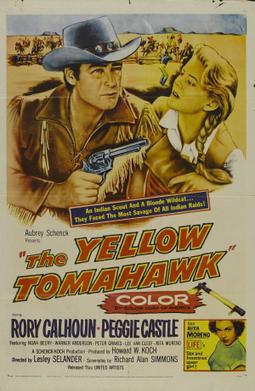
Every so often, I just need a good, old-fashioned B-western. It doesn't have to be great or even particularly good, but I need that dose of WESTERN. So while 1954's The Yellow Tomahawk is pretty run-of-the-mill, I liked it. Entertaining, surprisingly violent and with a cool cast, it's a solid western that's worth a watch.
Riding out of the wilderness, frontiersman Adam Reed (Rory Calhoun) finds himself being chased by Cheyenne warriors. He's cornered and looks to be in trouble until his blood brother, Cheyenne warrior Fire Knife (Lee Van Cleef), steps in, all of it a show to arrange a meeting. Fire Knife has a warning and a message he would like delivered. The U.S. cavalry is building a new fort nearby with a commander, Major Ives (Warner Anderson), who lead a bloody massacre months prior against a peaceful Indian camp. His reputation has preceded him with Fire Knife passing his message along to Reed. What is it? Tell Ives to stop building the fort and risk an attack that will wipe out the partially-assembled fort. Reed rides down to the fort and passes it along but Ives isn't having it, doubting the truth of the threat. What awaits for the small garrison and the soldiers' families who have traveled west? Reed sees the writing on the wall but no one else seems to believe what's coming.
Nothing flashy here, nothing too crazy. From director Lesley Selander, 'Tomahawk' is nonetheless an entertaining, pretty solid western that isn't limited by its budget or limitations. A longtime director in film and television, Selander is a pro at spinning a movie like this. So often, westerns are town-bound. limited by a fake-looking set that never allows the story to breathe. This particular entry does not have that problem with virtually no sets! The cavalry building a fort allows for no sets other than a couple half-assembled walls. It was shot on-location at the Kanab Movie Ranch and Fort, giving the story a cool, intimidating, scary sense of the openness of the desert and wilderness. You're all alone out there, and with the threat of an imminent Indian attack, there's no place to hide.
A star of B-westerns who often played supporting roles in bigger budget pictures, Calhoun is a favorite of mine. He plays a memorable, roguish good guy, a solid anti-hero with an edge who is quite comfortable in the western and in the saddle. His Adam Reed character, a frontiersman and scout of sorts, is interesting because of his hinted-at backstory. It's never told in detail, but it appears he lived with the Cheyenne at some point, his brotherhood and family connection with a young Lee Van Cleef as warrior Fire Knife. If there was a little more time to breathe ('Tomahawk' is a very pleasant 82 minutes), maybe we could have learned some more about out hero. Still, what's there is pretty cool.
No A-listers on-hand here, but that doesn't detract from an overall good cast. Peggie Castle (Lily Merrill on TV's Lawman) is the necessary love interest, a beautiful woman visiting her fiance, a cavalry officer, at the budding fort. She's no damsel in distress either, a welcome addition to the genre. Noah Beery Jr. has some stereotypical fun as Tonio, an ay-ay-ay Mexican horse wrangler with a beautiful Indian girl, Honey Bear (Rita Moreno), who follows him around. As the stupidly blind officer, Major Ives, Warner Anderson is frighteningly uncomfortable, portraying an officer that was probably all too familiar in the wild west. Also look for Peter Graves (gold prospector) and Adam Williams and James Best (cavalry troopers) in key supporting parts.
One good western after another followed a simple formula. Introduce a disparate group of survivors and individuals, throw them into a survival situation with an ever-present Indian war party, and see who makes it out. After an intense, tension-building first 30 minutes or so, that's what 'Tomahawk' uses as a base. We follow a small group of survivors of an Indian attack trying to get across the desert to safety. The action itself is pretty intense in itself, especially the Cheyenne attack on the hastily-built and poorly-defended fort. It's not hugely graphic -- it is still 1954 after all -- but the violence is incredibly rough and if it had been shown on-screen, whoo, we're talking one nasty picture. The ending too is pretty honest for a mid-1950's western, something that surprised me, caught me off-guard a little bit.
A solid western overall. Worth checking out.
The Yellow Tomahawk (1954): ** 1/2 /****
The Sons of Katie Elder
"First, we reunite, then find Ma and Pa's killer...then read some reviews."
Showing posts with label Noah Beery Jr. Show all posts
Tuesday, January 12, 2016
Monday, February 17, 2014
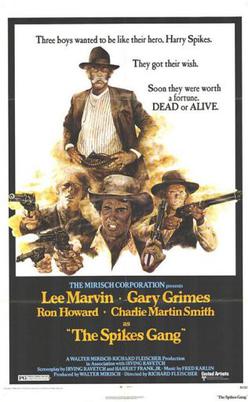
The Spikes Gang
Growing up is tough, and yes, here we are with another coming of age movie. No, it's not a teenager in the 1980s, a little boy growing up in Germany during the Holocaust, but a sub-genre from one of my favorite genres, growing up in the wild west. Movies from The Culpepper Cattle Co. to True Grit and others, it's an always interesting sub-genre. We can definitely add 1974's The Spikes Gang to the list.
Living with his parents on an isolated farm in Texas, teenager Wilson Young (Gary Grimes) has had about enough of his father's strict, one might say cruel, treatment. Walking around out in the isolated brush country with his two friends, Les (Ron Howard) and Tod (Charles Martin Smith), Will finds the body of a seemingly dead man. He isn't though, the three teenagers nursing the severely wounded man back to health. They find out the man is Harry Spikes (Lee Marvin), a notorious bank robber who thanks the boys for their help and rides out. Not soon after, Will, Les and Tod all leave home, vowing to live life and explore the world and all it has to offer. Life on the road isn't everything it's made out to be though, the trio ending up in a Mexican prison with no hope...until now. Spikes lucks upon them, bribing the guard to let them out. His solution? He likes the boys and teaches them how to become bank robbers, forming the oddest gang of bank robbers around.
I was worried as I watched the credits for this Richard Fleischer-directed western. The soundtrack was a soft, folksy-sounding guitar playing, and I'm thinking I stumbled into a lyrical, whimsical 1970s western where everyone's nice and cute and the world is just dreamy. Well, I'm glad I stuck with it. There certainly are moments like that, the three boys hitting the road and ready to experience the world. That sentiment is quickly thrown out the window, and the movie gets better immediately. With no money and starving, Will decides to rob a bank out of nowhere. They get away with some money but Tod accidentally shoots a passerby trying to stop them. From there, the story's previously happy, go-lucky story degenerates, getting darker with each passing scene. Is that a good thing? Um, yes, my name is Tim. Have you read any of my reviews?
This is a gem of a western, one that deserves a much bigger reputation. Fans of westerns typically love or hate 1970s westerns, movies that ripped away the idea that the wild west was glamorous, romantic or anything like most John Wayne westerns. As an interesting touch, 'Spikes' was filmed in Almeria and Andalucia in Spain, the familiar locations for countless spaghetti westerns. So we've got an unsentimental American western interested in exposing the myths of the old west in locations made famous by spaghetti westerns, a genre similarly interested in blowing open the American west. How can you lose? The 96-minute western covers a lot of ground but never feels rushed, an episodic story a positive here. We see some quick appearances from Arthur Hunnicutt as a past-his-prime gunslinger/saddle tramp, Noah Berry Jr. as an unlikely ally, and it all works in perfect fashion.
Beyond the story, the movie works because of the cast. It starts with Lee Marvin as infamous bank robber Harry Spikes. This is a part equal parts charming/disarming and frightening in its reality. He genuinely likes the three boys, looking after them, feeding them, buying them clothes and guns, teaching them how to become outlaws, but he's also brutally honest about it. If they get hurt, he'll leave them. This is a dangerous profession he's chosen and the boys have chosen. It can end at any time, and all it takes is one bullet. Marvin's performance is a gem, one that deserves to be considered one of his best. It's funny, charming, disturbing at times, and he steals every scene he is in. This isn't a part that requires him to be in every scene, drifting in and out at times as needed. When he's on-screen though, it's impossible to look away.
With a lead performance like Marvin as Harry Spikes, it'd be easy for his teenage counterparts to get lost in the shuffle. These are three talented young actors though, and any such worry is unfounded. The best part is for Gary Grimes as Will, the unofficial leader of the trio. He's sick of his father's constant nagging (and occasional beatings with a belt), opting to hit the road. The transformation he goes through is the most profound, the darkest of the three. He was a specialist in the youngster role in 70s westerns, also starring in Culpepper Cattle Co. and Cahill, U.S. Marshal, ultimately retiring from acting in the late 1970s. It's a very human part with some startling developments late. The same year Happy Days premiered, Howard is also very good as Will's closest friend, a logical thinker who's almost the group's conscious. Martin Smith too is excellent as Tod, the most religious and worrisome of the trio.
I wasn't sure exactly where this 1974 western was heading although there were some hints at the finale. The ending is perfectly executed, a major twist revealing itself in the last 15 minutes. It isn't glossy, polished or romantic. This is the west as it was. Dark, nasty, bloody and all about survival. In other words, it's realistic and far from a happy ending. I loved this western, can't recommend it enough.
The Spikes Gang (1974): *** 1/2 /****
Living with his parents on an isolated farm in Texas, teenager Wilson Young (Gary Grimes) has had about enough of his father's strict, one might say cruel, treatment. Walking around out in the isolated brush country with his two friends, Les (Ron Howard) and Tod (Charles Martin Smith), Will finds the body of a seemingly dead man. He isn't though, the three teenagers nursing the severely wounded man back to health. They find out the man is Harry Spikes (Lee Marvin), a notorious bank robber who thanks the boys for their help and rides out. Not soon after, Will, Les and Tod all leave home, vowing to live life and explore the world and all it has to offer. Life on the road isn't everything it's made out to be though, the trio ending up in a Mexican prison with no hope...until now. Spikes lucks upon them, bribing the guard to let them out. His solution? He likes the boys and teaches them how to become bank robbers, forming the oddest gang of bank robbers around.
I was worried as I watched the credits for this Richard Fleischer-directed western. The soundtrack was a soft, folksy-sounding guitar playing, and I'm thinking I stumbled into a lyrical, whimsical 1970s western where everyone's nice and cute and the world is just dreamy. Well, I'm glad I stuck with it. There certainly are moments like that, the three boys hitting the road and ready to experience the world. That sentiment is quickly thrown out the window, and the movie gets better immediately. With no money and starving, Will decides to rob a bank out of nowhere. They get away with some money but Tod accidentally shoots a passerby trying to stop them. From there, the story's previously happy, go-lucky story degenerates, getting darker with each passing scene. Is that a good thing? Um, yes, my name is Tim. Have you read any of my reviews?
This is a gem of a western, one that deserves a much bigger reputation. Fans of westerns typically love or hate 1970s westerns, movies that ripped away the idea that the wild west was glamorous, romantic or anything like most John Wayne westerns. As an interesting touch, 'Spikes' was filmed in Almeria and Andalucia in Spain, the familiar locations for countless spaghetti westerns. So we've got an unsentimental American western interested in exposing the myths of the old west in locations made famous by spaghetti westerns, a genre similarly interested in blowing open the American west. How can you lose? The 96-minute western covers a lot of ground but never feels rushed, an episodic story a positive here. We see some quick appearances from Arthur Hunnicutt as a past-his-prime gunslinger/saddle tramp, Noah Berry Jr. as an unlikely ally, and it all works in perfect fashion.
Beyond the story, the movie works because of the cast. It starts with Lee Marvin as infamous bank robber Harry Spikes. This is a part equal parts charming/disarming and frightening in its reality. He genuinely likes the three boys, looking after them, feeding them, buying them clothes and guns, teaching them how to become outlaws, but he's also brutally honest about it. If they get hurt, he'll leave them. This is a dangerous profession he's chosen and the boys have chosen. It can end at any time, and all it takes is one bullet. Marvin's performance is a gem, one that deserves to be considered one of his best. It's funny, charming, disturbing at times, and he steals every scene he is in. This isn't a part that requires him to be in every scene, drifting in and out at times as needed. When he's on-screen though, it's impossible to look away.
With a lead performance like Marvin as Harry Spikes, it'd be easy for his teenage counterparts to get lost in the shuffle. These are three talented young actors though, and any such worry is unfounded. The best part is for Gary Grimes as Will, the unofficial leader of the trio. He's sick of his father's constant nagging (and occasional beatings with a belt), opting to hit the road. The transformation he goes through is the most profound, the darkest of the three. He was a specialist in the youngster role in 70s westerns, also starring in Culpepper Cattle Co. and Cahill, U.S. Marshal, ultimately retiring from acting in the late 1970s. It's a very human part with some startling developments late. The same year Happy Days premiered, Howard is also very good as Will's closest friend, a logical thinker who's almost the group's conscious. Martin Smith too is excellent as Tod, the most religious and worrisome of the trio.
I wasn't sure exactly where this 1974 western was heading although there were some hints at the finale. The ending is perfectly executed, a major twist revealing itself in the last 15 minutes. It isn't glossy, polished or romantic. This is the west as it was. Dark, nasty, bloody and all about survival. In other words, it's realistic and far from a happy ending. I loved this western, can't recommend it enough.
The Spikes Gang (1974): *** 1/2 /****
Friday, October 25, 2013
Guns of the Timberland
I guess I only have myself to blame. I should have learned with 1952's The Big Trees that logging and cutting down trees just isn't exciting as it sounds. Just the same, when 1960's Guns of the Timberland popped up on Turner Classic Movie's schedule, I wanted to give it a shot. It comes from a novel by an author I like a lot, and the cast sounded pretty capable. Yeah, I was wrong. It's now 0-for-2 when it comes to logging movies.
Traveling by train, Jim Hadley (Alan Ladd) and Monty Walker (Gilbert Roland) are heading into the mountains to finish out a contract they've signed. It's 1895 somewhere in the Pacific Northwest, and Jim, Monty and their crew of lumberjacks have been contracted to provide limber for a new railroad line. They've invested much of their own money to help get the job and desperately need it to come through for them. They think the job will be easy...until they get there. The area they're supposed to clear is dominated by ranches that need the trees to provide a watershed for the land. No trees, no ability to hold water in the land. One ranchowner, Laura Rileyy (Jeanne Crain), is at the forefront of the effort to stop them, and the whole town is behind her. Both sides stand to lose everything should the other side succeed. Who will cave and buckle first?
When I see based on a story/novel from western writer Louis L'Amour, I'm always psyched. I grew up reading his stories and still read them today. I haven't read this source story, but it sounds like the movie script switched up the focus of the novel. In the movie, we follow Jim and Monty in their efforts to clear the land. In the book, it sure sounds like it's the other way around as we see from the rancher's perspective. Ultimately, I felt like that went a long way toward dooming the picture. It's hard to support and/or hate either side here. Both sides are doing what they need to do to survive. Yes, it's at the expense of the other side. So really....are there good guys and bad guys? It's hard to judge either side too harshly. Too bad because with that said, all the natural conflict goes out the window. We don't really want either side to win if that makes sense.
I did like the cast even if they are given little to do. I like Ladd depending on the role, and he's decent here because he's paired with the fiery, always fun Roland. Thankfully, Roland avoids the stereotypical 'Ay, chihuahua!' moments he so often resorted to. Ladd seems a little off, some of his lines stepping on other actor's lines, maybe off a second or two as to when he should have said something. I don't know what was going on, but Ladd even looks a little uncomfortable in most of his scenes. Also joining the crew of boisterous, roughneck, fun-loving lumberjacks is Noah Beery Jr., Henry Kulky, and Johnny Seven, some there for comic relief, others for intimidation factors.
On the other side of the line is a really dull crew of quasi-bad guys who aren't so bad. Crain is okay as tough female rancher Riley, but even she falls for Ladd's Jim at the drop of a hat. The most villainous is Lyle Bettger as Clay Bell, Riley's foreman who isn't below some rather nasty methods to get the lumberjacks out of town. Frankie Avalon plays Bert, a young man working on the Riley ranch who finds himself caught between the ranch and the appealing freedom of the lumberjacks. It's actually a pretty good part for Avalon, even if the script finds two opportunities to let him sing. The rest of the townspeople don't make much of an impression, just a sea of passive-aggressive, cackling maroons who revel in all the stunts pulled against the lumberjacks. Mostly, you just want to see them get punched in the face a couple times.
If there is a positive to take away here, it's the on-location shooting. Director Robert D. Webb filmed his movie in Blairsden and Graeagle, California up in the mountains. It may be one big old dull story, but it's nice to look at while you're being bored. That's the biggest issue. The tension is there, but it's just never that interesting. You don't care how things end up, and the finale is a big old cop-out. I didn't have high expectations to begin with, but even those weren't worth it.
Guns of the Timberland (1960): * 1/2 /****
Traveling by train, Jim Hadley (Alan Ladd) and Monty Walker (Gilbert Roland) are heading into the mountains to finish out a contract they've signed. It's 1895 somewhere in the Pacific Northwest, and Jim, Monty and their crew of lumberjacks have been contracted to provide limber for a new railroad line. They've invested much of their own money to help get the job and desperately need it to come through for them. They think the job will be easy...until they get there. The area they're supposed to clear is dominated by ranches that need the trees to provide a watershed for the land. No trees, no ability to hold water in the land. One ranchowner, Laura Rileyy (Jeanne Crain), is at the forefront of the effort to stop them, and the whole town is behind her. Both sides stand to lose everything should the other side succeed. Who will cave and buckle first?
When I see based on a story/novel from western writer Louis L'Amour, I'm always psyched. I grew up reading his stories and still read them today. I haven't read this source story, but it sounds like the movie script switched up the focus of the novel. In the movie, we follow Jim and Monty in their efforts to clear the land. In the book, it sure sounds like it's the other way around as we see from the rancher's perspective. Ultimately, I felt like that went a long way toward dooming the picture. It's hard to support and/or hate either side here. Both sides are doing what they need to do to survive. Yes, it's at the expense of the other side. So really....are there good guys and bad guys? It's hard to judge either side too harshly. Too bad because with that said, all the natural conflict goes out the window. We don't really want either side to win if that makes sense.
I did like the cast even if they are given little to do. I like Ladd depending on the role, and he's decent here because he's paired with the fiery, always fun Roland. Thankfully, Roland avoids the stereotypical 'Ay, chihuahua!' moments he so often resorted to. Ladd seems a little off, some of his lines stepping on other actor's lines, maybe off a second or two as to when he should have said something. I don't know what was going on, but Ladd even looks a little uncomfortable in most of his scenes. Also joining the crew of boisterous, roughneck, fun-loving lumberjacks is Noah Beery Jr., Henry Kulky, and Johnny Seven, some there for comic relief, others for intimidation factors.
On the other side of the line is a really dull crew of quasi-bad guys who aren't so bad. Crain is okay as tough female rancher Riley, but even she falls for Ladd's Jim at the drop of a hat. The most villainous is Lyle Bettger as Clay Bell, Riley's foreman who isn't below some rather nasty methods to get the lumberjacks out of town. Frankie Avalon plays Bert, a young man working on the Riley ranch who finds himself caught between the ranch and the appealing freedom of the lumberjacks. It's actually a pretty good part for Avalon, even if the script finds two opportunities to let him sing. The rest of the townspeople don't make much of an impression, just a sea of passive-aggressive, cackling maroons who revel in all the stunts pulled against the lumberjacks. Mostly, you just want to see them get punched in the face a couple times.
If there is a positive to take away here, it's the on-location shooting. Director Robert D. Webb filmed his movie in Blairsden and Graeagle, California up in the mountains. It may be one big old dull story, but it's nice to look at while you're being bored. That's the biggest issue. The tension is there, but it's just never that interesting. You don't care how things end up, and the finale is a big old cop-out. I didn't have high expectations to begin with, but even those weren't worth it.
Guns of the Timberland (1960): * 1/2 /****
Labels:
1960s,
Alan Ladd,
Gilbert Roland,
Louis L'Amour,
Lyle Bettger,
Noah Beery Jr,
westerns
Wednesday, October 2, 2013
Incident at Phantom Hill
I've been watching westerns since I was little, and I'll be watching them for years to come hopefully. By now at the ripe old age of 28, I've seen just about all of the must-see westerns out there, but with a genre that's been around since the first films, I've got a whole lot more to catch up with, like 1966's Incident at Phantom Hill, a solid if not hugely known American western.
It's the final few weeks of the Civil War and a heavily guarded Union convoy is transporting over a $1 million in gold bars across the Texas desert. A capable, shifty bandit turned Confederate soldier, Joe Barlow (Dan Duryea), leads an attack on the convoy, massacring the guards and making off with the gold. Some weeks later a Union captain, Matt Martin (Robert Fuller), is tasked with a mission. Barlow has been captured and says he can lead him to where the gold is hidden in the desert. There's a catch though...the hiding spot is in land designated for the Comanches where no white man is allowed. If Martin is to accept the mission, it will be without any permission or backing from the U.S. Army. With some personal reasons of his own, Martin accepts and with Barlow and a small detachment of volunteer soldiers heads out into the desert. With so much gold on the line though, it's questionable if anyone with him can be trusted.
While this 1966 western has been on the Encore Westerns schedule on and off for several months now, I was never able to catch up with it. Until now! Thanks Encore On Demand! From director Earl Bellamy, 'Incident' is a solid western that isn't trying to be a classic in any vein. It's more than content to assemble a cool cast, throw them into a pretty dark post-Civil War western and let the chips fall where they may. 'Incident' was filmed in the California desert -- with some similar locations to TV's Hondo -- so if it doesn't look like Texas, so be it, it's a fitting backdrop to the story. Overall, it is a pretty simple formula but it works. A whole lot of gold, a vengeance-seeking Union officer, a murdering bandit and Confederate soldier, a motley collection of volunteers, lowlifes and drifters seeking the gold and Comanches on all sides. How can you go wrong?
The most interesting dynamic here was between Fuller's Capt. Martin and Duryea's Joe Barlow, completely unwilling partners. I haven't seen Fuller in much, but I liked him in The Magnificent Seven sequel 'Return of the 7.' Here, it's an okay part, but mostly his Capt. Martin seems irritated and yells every one of his lines and glares at everyone around him in between. I suppose that frustration comes from his ever-constant vigilance in watching Barlow, played to perfection by Duryea. Nothing about Duryea screams great villain, but he's perfect once again. He's slight in stature, his voice is really high, but it works. His Barlow is a murdering bandit, looking for a pardon for a pre-war murder of a U.S. marshal. He's like a rattlesnake lying in wait, just waiting for his chance to make his move on his captors and escape. I enjoyed the movie overall, but Duryea is the best thing going here.
Overall, I was surprised by the general nastiness of this western. At 87 minutes, it packs a whole lot of darkness into a short running time. That's fair I guess when you figure there's a million bucks in gold bars out there in the desert. More on the casting of the crew later, but Martin's detachment of volunteers range from psychopaths to drunks, pacifists to one soldier plagued with guilt. Along the way, the convoy runs into a knife-wielding hunter (Denver Pyle) and his gang who quickly catch on that Martin's men are onto something big. At a trading post, the owner (William Phipps) leers in not so subtle fashion at a woman (hinted at she's a prostitute) along for the ride. Martin intercedes, knowing what awaits if she's left behind. How did she get there in the first place? A sheriff (Don Collier) had "dated her" but kicked her out of town when a different, classier, more reputable girl came along. It all adds up to a surprisingly dark tone that works really well.
Onto the rest of the cast. Jocelyn Lane plays Memphis, the possible prostitute basically shanghaied onto the convoy. Lane is rather wooden, always immaculately decked out in wardrobe and makeup regardless of the desert setting. Martin's motley crew of men include Lt. Adam Long (Tom Simcox), the guilt-ridden survivor of the original massacre, Dr. Armstrong (Linden Chiles), a pacifist doctor struggling with all the patients he lost during the Civil War, Otto Krausman (Claude Akins), a murdering soldier hell bent on killing as many Comanches as he can to avenge his family, and O'Rourke (Noah Beery Jr.), a boozing Irishman. No big stars, but some solid, interesting characters. Also look for Paul Fix as the general who assigns Martin his mission.
Nothing flashy here as a western, just an entertaining one. Also listen in the opening massacre with part of 1965's Shenandoah's soundtrack used. Odd because it isn't credited, and nothing else is used. Yeah, movie nerd trivia! Western fans will definitely like this one, worth a watch for sure.
Incident at Phantom Hill (1966): ***/****
It's the final few weeks of the Civil War and a heavily guarded Union convoy is transporting over a $1 million in gold bars across the Texas desert. A capable, shifty bandit turned Confederate soldier, Joe Barlow (Dan Duryea), leads an attack on the convoy, massacring the guards and making off with the gold. Some weeks later a Union captain, Matt Martin (Robert Fuller), is tasked with a mission. Barlow has been captured and says he can lead him to where the gold is hidden in the desert. There's a catch though...the hiding spot is in land designated for the Comanches where no white man is allowed. If Martin is to accept the mission, it will be without any permission or backing from the U.S. Army. With some personal reasons of his own, Martin accepts and with Barlow and a small detachment of volunteer soldiers heads out into the desert. With so much gold on the line though, it's questionable if anyone with him can be trusted.
While this 1966 western has been on the Encore Westerns schedule on and off for several months now, I was never able to catch up with it. Until now! Thanks Encore On Demand! From director Earl Bellamy, 'Incident' is a solid western that isn't trying to be a classic in any vein. It's more than content to assemble a cool cast, throw them into a pretty dark post-Civil War western and let the chips fall where they may. 'Incident' was filmed in the California desert -- with some similar locations to TV's Hondo -- so if it doesn't look like Texas, so be it, it's a fitting backdrop to the story. Overall, it is a pretty simple formula but it works. A whole lot of gold, a vengeance-seeking Union officer, a murdering bandit and Confederate soldier, a motley collection of volunteers, lowlifes and drifters seeking the gold and Comanches on all sides. How can you go wrong?
The most interesting dynamic here was between Fuller's Capt. Martin and Duryea's Joe Barlow, completely unwilling partners. I haven't seen Fuller in much, but I liked him in The Magnificent Seven sequel 'Return of the 7.' Here, it's an okay part, but mostly his Capt. Martin seems irritated and yells every one of his lines and glares at everyone around him in between. I suppose that frustration comes from his ever-constant vigilance in watching Barlow, played to perfection by Duryea. Nothing about Duryea screams great villain, but he's perfect once again. He's slight in stature, his voice is really high, but it works. His Barlow is a murdering bandit, looking for a pardon for a pre-war murder of a U.S. marshal. He's like a rattlesnake lying in wait, just waiting for his chance to make his move on his captors and escape. I enjoyed the movie overall, but Duryea is the best thing going here.
Overall, I was surprised by the general nastiness of this western. At 87 minutes, it packs a whole lot of darkness into a short running time. That's fair I guess when you figure there's a million bucks in gold bars out there in the desert. More on the casting of the crew later, but Martin's detachment of volunteers range from psychopaths to drunks, pacifists to one soldier plagued with guilt. Along the way, the convoy runs into a knife-wielding hunter (Denver Pyle) and his gang who quickly catch on that Martin's men are onto something big. At a trading post, the owner (William Phipps) leers in not so subtle fashion at a woman (hinted at she's a prostitute) along for the ride. Martin intercedes, knowing what awaits if she's left behind. How did she get there in the first place? A sheriff (Don Collier) had "dated her" but kicked her out of town when a different, classier, more reputable girl came along. It all adds up to a surprisingly dark tone that works really well.
Onto the rest of the cast. Jocelyn Lane plays Memphis, the possible prostitute basically shanghaied onto the convoy. Lane is rather wooden, always immaculately decked out in wardrobe and makeup regardless of the desert setting. Martin's motley crew of men include Lt. Adam Long (Tom Simcox), the guilt-ridden survivor of the original massacre, Dr. Armstrong (Linden Chiles), a pacifist doctor struggling with all the patients he lost during the Civil War, Otto Krausman (Claude Akins), a murdering soldier hell bent on killing as many Comanches as he can to avenge his family, and O'Rourke (Noah Beery Jr.), a boozing Irishman. No big stars, but some solid, interesting characters. Also look for Paul Fix as the general who assigns Martin his mission.
Nothing flashy here as a western, just an entertaining one. Also listen in the opening massacre with part of 1965's Shenandoah's soundtrack used. Odd because it isn't credited, and nothing else is used. Yeah, movie nerd trivia! Western fans will definitely like this one, worth a watch for sure.
Incident at Phantom Hill (1966): ***/****
Labels:
1960s,
Claude Akins,
Dan Duryea,
Denver Pyle,
Noah Beery Jr,
Paul Fix,
Robert Fuller,
The Civil War,
westerns
Monday, May 6, 2013
Escort West
Think 'wild west,' and a lot of people will think of the 30-plus years after the Civil War right on through the end of the 19th Century. But there is a crossover as the two historical eras overlapped. Yes, the Civil War western like Major Dundee, Escape from Fort Bravo, Two Flags West, and now, a new entry, 1958's Escort West.
It's been just a few months since the end of the Civil War, and ex-Confederate soldier Ben Lassiter (Victor Mature) is riding west with his 10-year old daughter, Abby (Reba Walters). They're heading to Oregon -- via Nevada? -- but now they've caught up with a Union patrol guarding a payroll shipment. Ben and Abby head their separate ways, but down the trail they ride across the massacred remains of the patrol with two female survivors, sisters Beth (Elaine Stewart) and Martha (Faith Domergue) Drury. A Modoc war party is on the warpath killing everything in its path. The Drury sisters tell Ben they were supposed to meet up with another Union patrol somewhere ahead of them, but they're not sure exactly where. While trying to avoid the Modoc warriors, can Ben and Co. manage to find the patrol and safety?
This western from director Francis D. Lyon is interesting for its writing staff; actor/writer Leo Gordon and Fred Hartsook (cool name). Gordon made a career out of playing tough guy roles in films like Tobruk (also wrote), Hondo and many others, including this one. He also wrote more than a few films and TV episodes and did it well. Gordon had a knack for writing meat and potato stories that audiences ate up. They're pretty straight forward, but they feature plenty of action and tough guys beating the hell out of each other. This one is pretty straightforward too, even a little short at 75 minutes, but western fans should enjoy it.
The Civil War western angle plays well here. A few months since the end of the war, Mature's Ben is looking for a fresh start. He's put the war behind him and wants to move on with his daughter. Meeting up with Union cavalry troopers though that aren't so forgiving, the hatred and rivalry from the war still very much alive. It's made worse when Ben meets the Drury sisters. Beth likes the Confederate and his daughter, but Martha isn't so forgiving, holding a hard-edged hatred for the Confederacy having lost her husband in the war (but there's more going on there too). The Union vs. Confederacy angle works well, giving a familiar western a fresh perspective. Then, the two former enemies must band together to survive Indian attacks. Good stuff all around.
The casting is good from top to bottom here, starting with Mature. He's a very capable soldier, but we also see a softer side of him as he looks out for his daughter. Stewart is solid and Domergue is appropriately shrill and hateful as the Drury sisters. Rex Ingram is a scene-stealer as Nelson, a black Union quartermaster wounded in the attack who bonds with Ben. The Union troopers include William Ching and Noah Beery Jr. as the officers in charge with Slim Pickens, Harry Carey Jr., Ken Curtis and Gordon. With a movie that's just 75 minutes, none of these familiar western faces are given much to do, but it's cool to see so many in one film. Would the movie be better with some more development in story and characters? Sure, what movie wouldn't? What's here is solid though.
Filmed in black and white, 'Escort' has the California hills/mountains posing as the Nevada mountains. It's got an interesting visual look to the story, the black and white adding a nice touch. The cavalry vs. Modoc story develops nicely with a claustrophobic touch as the canyons full of rocks and plants seem to be closing in on the troopers. Indians are hiding all around, just waiting to attack. An actor named X Brands play Tago, the Modoc leader. The biggest flaw may be that at 75 minutes, it feels rushed. The ending comes together too quickly, wrapping up in a flash because....well, because it does. It's a solid, entertaining B-western that could have been significantly better, but it's not bad for what it is.
Escort West (1958): ** 1/2 /****
It's been just a few months since the end of the Civil War, and ex-Confederate soldier Ben Lassiter (Victor Mature) is riding west with his 10-year old daughter, Abby (Reba Walters). They're heading to Oregon -- via Nevada? -- but now they've caught up with a Union patrol guarding a payroll shipment. Ben and Abby head their separate ways, but down the trail they ride across the massacred remains of the patrol with two female survivors, sisters Beth (Elaine Stewart) and Martha (Faith Domergue) Drury. A Modoc war party is on the warpath killing everything in its path. The Drury sisters tell Ben they were supposed to meet up with another Union patrol somewhere ahead of them, but they're not sure exactly where. While trying to avoid the Modoc warriors, can Ben and Co. manage to find the patrol and safety?
This western from director Francis D. Lyon is interesting for its writing staff; actor/writer Leo Gordon and Fred Hartsook (cool name). Gordon made a career out of playing tough guy roles in films like Tobruk (also wrote), Hondo and many others, including this one. He also wrote more than a few films and TV episodes and did it well. Gordon had a knack for writing meat and potato stories that audiences ate up. They're pretty straight forward, but they feature plenty of action and tough guys beating the hell out of each other. This one is pretty straightforward too, even a little short at 75 minutes, but western fans should enjoy it.
The Civil War western angle plays well here. A few months since the end of the war, Mature's Ben is looking for a fresh start. He's put the war behind him and wants to move on with his daughter. Meeting up with Union cavalry troopers though that aren't so forgiving, the hatred and rivalry from the war still very much alive. It's made worse when Ben meets the Drury sisters. Beth likes the Confederate and his daughter, but Martha isn't so forgiving, holding a hard-edged hatred for the Confederacy having lost her husband in the war (but there's more going on there too). The Union vs. Confederacy angle works well, giving a familiar western a fresh perspective. Then, the two former enemies must band together to survive Indian attacks. Good stuff all around.
The casting is good from top to bottom here, starting with Mature. He's a very capable soldier, but we also see a softer side of him as he looks out for his daughter. Stewart is solid and Domergue is appropriately shrill and hateful as the Drury sisters. Rex Ingram is a scene-stealer as Nelson, a black Union quartermaster wounded in the attack who bonds with Ben. The Union troopers include William Ching and Noah Beery Jr. as the officers in charge with Slim Pickens, Harry Carey Jr., Ken Curtis and Gordon. With a movie that's just 75 minutes, none of these familiar western faces are given much to do, but it's cool to see so many in one film. Would the movie be better with some more development in story and characters? Sure, what movie wouldn't? What's here is solid though.
Filmed in black and white, 'Escort' has the California hills/mountains posing as the Nevada mountains. It's got an interesting visual look to the story, the black and white adding a nice touch. The cavalry vs. Modoc story develops nicely with a claustrophobic touch as the canyons full of rocks and plants seem to be closing in on the troopers. Indians are hiding all around, just waiting to attack. An actor named X Brands play Tago, the Modoc leader. The biggest flaw may be that at 75 minutes, it feels rushed. The ending comes together too quickly, wrapping up in a flash because....well, because it does. It's a solid, entertaining B-western that could have been significantly better, but it's not bad for what it is.
Escort West (1958): ** 1/2 /****
Labels:
1950s,
Harry Carey Jr,
Ken Curtis,
Leo Gordon,
Noah Beery Jr,
Slim Pickens,
Victor Mature,
westerns
Monday, September 12, 2011
Two Flags West
For four years between 1861 and 1865, the Civil War raged on as North fought South, mostly in the eastern half of the country. Out west though, life went on, and the U.S. army and cavalry still had to protect settlers from raiding Indians from any number of tribes. It's a little known but always interesting part of American history, this time in the west that is overshadowed what was happening back in the east. It's a topic that's been explored a couple times through film, most notably Sam Peckinpah's Major Dundee and John Sturges' Escape from Fort Bravo, and now I can add another to the list, 1950's Two Flags West, an obvious influence on both films.
So if a majority of your soldiers are off fighting elsewhere, what does an army do to fill out its ranks? In 1863, President Lincoln passed a proclamation stating that any Confederate prisoners of war in Union prison camps could sign up to fight with the Union in the west, battling Indians rather than wasting away in a prison camp. As if fighting Indians wasn't enough, any movie dealing with this situation now gets the natural rivalry and hatred of North vs. South now forced to work alongside each other. If that's not a recipe for success, I don't know what is. 'Flags' plays on that sentiment, ending up with an underrated and exciting Civil War/western combo.
On his way to Fort Thorn, a remote outpost in New Mexico, wounded Union officer Capt. Bradford (Cornel Wilde) stops at a Union prison camp in Illinois, offering Confederate cavalry there commanded by Colonel Clay Tucker (Joseph Cotten) a proposition. If they enlist in the Union army, they can ride out of the camp and join him in traveling west to fight the warring and dangerous Apache tribe in the southwest. Tucker and his fellow surviving prisoners -- some 40-plus men -- agree and head west with Bradford to Fort Thorn. There they find the situation a little more prickly than they imagined. In addition to the Apaches, they must deal with Major Kenniston (Jeff Chandler), an officer with a deep-seeded hatred for any Confederates who he blames for his brother's death. His brother's widow, Elena (Linda Darnell), is also at the post, providing even more of a rivalry among the new arrivals.
With the talented cast involved and the above-average finished product, I'm semi-stunned to see this movie has no reputation at all, either positive or negative. I was lucky enough to catch it on TCM's recent tribute to Linda Darnell, but other than that it's not available anywhere on DVD or even VHS (that I could find). It makes sense of course. It's a good movie, lost in a sea of good movies over the years. Director Robert Wise turns out a solid western that knows what it is doing and how to entertain. 'Flags' is a pretty dark western overall, especially for one released in 1950, and has its fair share of violence, some of which is surprisingly graphic and gruesome. It doesn't overstay its welcome at just 92 minutes, but coupled with an interesting story, great cast, gorgeous New Mexico locations and a solid score from composer Hugo Friedhofer, ends up being an above average western that deserves some sort of reputation.
Maybe some of the issue is the casting. Cotten, Darnell, Chandler and Wilde are not HUGE names when it comes to movie stars. I count that as a big positive here. They're all good actors, not just stars. They work well together in an ensemble that does have a lot going on, but Wise keeps all those plates spinning for the most part. Cotten is the gentleman Southern officer, a more than capable soldier who looks out for his men above all else. Chandler gets to be a villain of sorts playing a character that reminded me of Henry Fonda's performance in Fort Apache. He always played flawed good guys so doing a 180 is a nice twist. Wilde is the odd man out with the smaller part but he makes the most of it. And instead of a love triangle, we've got a love square with Darnell having to decide among those three actors. My only other movie I've seen Darnell in is My Darling Clementine -- not a great performance for her but not really her fault -- so this is a drastic improvement.
Filmed in black and white, Wise's cavalry western with North meeting South isn't your typical western. Sure, there are those iconic shots a la John Ford of a cavalry troop riding across the horizon, but in general there is a darkness here that you don't see often. Chandler's Major Kenniston hates the Confederates -- he was wounded in the opening moments of the fighting at First Bull Run and later escaped from Libby Prison -- and through his hatred almost gets his whole command wiped out. Cotten's Colonel Tucker is a proud Southern officer but only to a point, an issue which Kenniston pokes and prods. Everyone is out for themselves in this western, leading to a surprising ending.
Thinly garrisoned by aging and wounded Union soldiers sent west and a lone company of Confederate cavalry, Kenniston provokes an attack as the Apache tribes come together to attack Fort Thorn. For a modestly budgeted western, the assault on the fort is impressive in its scale. Chaotic and violent, it looks like at one point the whole garrison -- women and children included -- will be massacred. The ending does provide a twist, Chandler's ego-maniacal officer given a chance to redeem himself. Thin on action up to this point, the finale makes up for it.
In other supporting parts, look for Noah Beery Jr, Arthur Hunnicutt and Dale Robertson as the three most visible members of Colonel Tucker's Confederate troop. Jay C. Flippen has a small part as Sgt. Duffy, Kenniston's aide and a veteran soldier with plenty of experience. Flippen and Hunnicutt have a couple good back-and-forths with their Union vs. Confederacy rivalry. Skeptical as to why this movie had no notoriety, I wasn't sure what to expect from Two Flags West, but I was more than pleasantly surprised. If you can track down a copy or stumble across it on TCM again, I highly recommend it.
Two Flags West <---TCM trailer (1950): ***/****
So if a majority of your soldiers are off fighting elsewhere, what does an army do to fill out its ranks? In 1863, President Lincoln passed a proclamation stating that any Confederate prisoners of war in Union prison camps could sign up to fight with the Union in the west, battling Indians rather than wasting away in a prison camp. As if fighting Indians wasn't enough, any movie dealing with this situation now gets the natural rivalry and hatred of North vs. South now forced to work alongside each other. If that's not a recipe for success, I don't know what is. 'Flags' plays on that sentiment, ending up with an underrated and exciting Civil War/western combo.
On his way to Fort Thorn, a remote outpost in New Mexico, wounded Union officer Capt. Bradford (Cornel Wilde) stops at a Union prison camp in Illinois, offering Confederate cavalry there commanded by Colonel Clay Tucker (Joseph Cotten) a proposition. If they enlist in the Union army, they can ride out of the camp and join him in traveling west to fight the warring and dangerous Apache tribe in the southwest. Tucker and his fellow surviving prisoners -- some 40-plus men -- agree and head west with Bradford to Fort Thorn. There they find the situation a little more prickly than they imagined. In addition to the Apaches, they must deal with Major Kenniston (Jeff Chandler), an officer with a deep-seeded hatred for any Confederates who he blames for his brother's death. His brother's widow, Elena (Linda Darnell), is also at the post, providing even more of a rivalry among the new arrivals.
With the talented cast involved and the above-average finished product, I'm semi-stunned to see this movie has no reputation at all, either positive or negative. I was lucky enough to catch it on TCM's recent tribute to Linda Darnell, but other than that it's not available anywhere on DVD or even VHS (that I could find). It makes sense of course. It's a good movie, lost in a sea of good movies over the years. Director Robert Wise turns out a solid western that knows what it is doing and how to entertain. 'Flags' is a pretty dark western overall, especially for one released in 1950, and has its fair share of violence, some of which is surprisingly graphic and gruesome. It doesn't overstay its welcome at just 92 minutes, but coupled with an interesting story, great cast, gorgeous New Mexico locations and a solid score from composer Hugo Friedhofer, ends up being an above average western that deserves some sort of reputation.
Maybe some of the issue is the casting. Cotten, Darnell, Chandler and Wilde are not HUGE names when it comes to movie stars. I count that as a big positive here. They're all good actors, not just stars. They work well together in an ensemble that does have a lot going on, but Wise keeps all those plates spinning for the most part. Cotten is the gentleman Southern officer, a more than capable soldier who looks out for his men above all else. Chandler gets to be a villain of sorts playing a character that reminded me of Henry Fonda's performance in Fort Apache. He always played flawed good guys so doing a 180 is a nice twist. Wilde is the odd man out with the smaller part but he makes the most of it. And instead of a love triangle, we've got a love square with Darnell having to decide among those three actors. My only other movie I've seen Darnell in is My Darling Clementine -- not a great performance for her but not really her fault -- so this is a drastic improvement.
Filmed in black and white, Wise's cavalry western with North meeting South isn't your typical western. Sure, there are those iconic shots a la John Ford of a cavalry troop riding across the horizon, but in general there is a darkness here that you don't see often. Chandler's Major Kenniston hates the Confederates -- he was wounded in the opening moments of the fighting at First Bull Run and later escaped from Libby Prison -- and through his hatred almost gets his whole command wiped out. Cotten's Colonel Tucker is a proud Southern officer but only to a point, an issue which Kenniston pokes and prods. Everyone is out for themselves in this western, leading to a surprising ending.
Thinly garrisoned by aging and wounded Union soldiers sent west and a lone company of Confederate cavalry, Kenniston provokes an attack as the Apache tribes come together to attack Fort Thorn. For a modestly budgeted western, the assault on the fort is impressive in its scale. Chaotic and violent, it looks like at one point the whole garrison -- women and children included -- will be massacred. The ending does provide a twist, Chandler's ego-maniacal officer given a chance to redeem himself. Thin on action up to this point, the finale makes up for it.
In other supporting parts, look for Noah Beery Jr, Arthur Hunnicutt and Dale Robertson as the three most visible members of Colonel Tucker's Confederate troop. Jay C. Flippen has a small part as Sgt. Duffy, Kenniston's aide and a veteran soldier with plenty of experience. Flippen and Hunnicutt have a couple good back-and-forths with their Union vs. Confederacy rivalry. Skeptical as to why this movie had no notoriety, I wasn't sure what to expect from Two Flags West, but I was more than pleasantly surprised. If you can track down a copy or stumble across it on TCM again, I highly recommend it.
Two Flags West <---TCM trailer (1950): ***/****
Wednesday, June 8, 2011
Bad Lands
So the timing isn't really good here as I throw remake and reboot one after another out there, but timing isn't everything, is it? After reviewing 1955's I Died a Thousand Times which was a remake of 1941's High Sierra, I stumbled across another movie that's a virtual scene-for-scene remake of a John Ford classic. Where the previous review at least had a decade in between releases, this one was quite a bit closer. The Ford version is a 1934 flick called The Lost Patrol, and the remake came out just five years later with 1939's Bad Lands.
The Lost Patrol is an interesting film for a lot of reasons, mostly because for a movie released in 1934, it was far ahead of its time. It was quick, hard-hitting and violent, not playing up to conventions of the war genre. Above all else, it is different. A small patrol of Foreign Legion soldiers is trapped at a desert oasis and under siege by Bedouin riflemen (almost always unseen). 'Lands' isn't quite an exact remake mostly because the setting is transplanted from the African desert to the American southwest in the 1870s. Other than the setting though, it's the same movie. Not as good overall, it is still interesting, but mostly as a comparison piece to the better The Lost Patrol.
Leading a posse for a murdering bandit, Apache Jack, Sheriff Bill Cummings (Robert Barrat) is riding at the head of nine men. They have ridden into the desert after Apache Jack escaped from jail and murdered a Mexican woman. Tracking him, they hole up at a water hole high up the rocky hills. The posse finds a vein of silver though in the rocks, and they begin to think about who can get a claim in first. That night though, an Apache war party steals their horses, stranding them in the middle of desert with nowhere to go. Cummings and his posse have ample water, but the Apaches are gunning for them. Should they send for help, or sit tight and hope they can hold out long enough for some sort of help to arrive?
The rehash of the story isn't as sketchy as it seems mostly because both films came from RKO Studios. Neither movie could have cost much to make with the small cast and little need for any sort of background players, army of extras, or any sets at all other than the desert. None of this rehash comes as a judgment because in the years since the premise has been used repeatedly, including a very violent Euro-western, Chato's Land. It is simple, straightforward, and effective. Until the end, we never see more than one Apache, leaving the enemy as more of a presence than an actual scare. The warriors are everywhere and nowhere at the same time, just waiting for their chance to strike.
Maybe because the cast isn't that well known, but filling out the sheriff's posse isn't as fun this time around as The Lost Patrol. The characters are still more genre archetypes (I think that's the word I'm looking for) than red-blooded characters, but come on, they're basically fodder for the Apache war party. Along with Barrat's Sheriff Cummings, there's Mulford (Douglas Walton), the inexperienced rider from NYC, Eaton (Robert Coote), an amiable Englishman, Chick (Noah Beery Jr.), an unlikable rabble-rouser, Billy Sweet (Guinn Williams), a happy go lucky cowboy, Henry (Andy Clyde) and Garth (Francis Ford, John's brother), two old-timer prospectors with some gay undertones, Rayburn (Addison Richards), a gunslinger gunning for the sheriff, Curly (Paul Hurst), a crotchety cowboy, and Lopez (Francis McDonald), a Mexican looking for revenge for the murder of his wife.
With a movie that barely breaks the 60-minute mark with a 70-minute running time, you would think there would be no time to waste. Well, you would be wrong. Before the ambush and siege at the water hole, there's about 10-15 minutes of the posse riding around. Then at the water hole, there are long scenes of dialogue as the posse discusses their lives, their fears, and generally their frustration at the predicament they're in. Throw in the possibility of vast riches with the silver vein, and you've got a lot going on that is not always interesting. The Apaches are a presence for a majority of the movie, finally revealing themselves at the end in one last shootout. The fear of an attack is genuine, but the censors and lack of any violence limit the potential. Most of the posse is killed off-screen, and besides, there are only a few characters that are actually likable.
Just like The Lost Patrol, I liked this movie. It's a good movie that could have been great with a few tweaks here and there. The premise is simple, and that's the beauty of it. The story is straightforward with no wasted subplots, the hope for survival driving and moving everything along. Shot in black and white with an impressive dark streak for a movie from 1939, there's a lot to offer. It just isn't great, and it could have been better. Still, a western The Lost Patrol isn't a bad thing.
Bad Lands (1939): ** 1/2 /****
The Lost Patrol is an interesting film for a lot of reasons, mostly because for a movie released in 1934, it was far ahead of its time. It was quick, hard-hitting and violent, not playing up to conventions of the war genre. Above all else, it is different. A small patrol of Foreign Legion soldiers is trapped at a desert oasis and under siege by Bedouin riflemen (almost always unseen). 'Lands' isn't quite an exact remake mostly because the setting is transplanted from the African desert to the American southwest in the 1870s. Other than the setting though, it's the same movie. Not as good overall, it is still interesting, but mostly as a comparison piece to the better The Lost Patrol.
Leading a posse for a murdering bandit, Apache Jack, Sheriff Bill Cummings (Robert Barrat) is riding at the head of nine men. They have ridden into the desert after Apache Jack escaped from jail and murdered a Mexican woman. Tracking him, they hole up at a water hole high up the rocky hills. The posse finds a vein of silver though in the rocks, and they begin to think about who can get a claim in first. That night though, an Apache war party steals their horses, stranding them in the middle of desert with nowhere to go. Cummings and his posse have ample water, but the Apaches are gunning for them. Should they send for help, or sit tight and hope they can hold out long enough for some sort of help to arrive?
The rehash of the story isn't as sketchy as it seems mostly because both films came from RKO Studios. Neither movie could have cost much to make with the small cast and little need for any sort of background players, army of extras, or any sets at all other than the desert. None of this rehash comes as a judgment because in the years since the premise has been used repeatedly, including a very violent Euro-western, Chato's Land. It is simple, straightforward, and effective. Until the end, we never see more than one Apache, leaving the enemy as more of a presence than an actual scare. The warriors are everywhere and nowhere at the same time, just waiting for their chance to strike.
Maybe because the cast isn't that well known, but filling out the sheriff's posse isn't as fun this time around as The Lost Patrol. The characters are still more genre archetypes (I think that's the word I'm looking for) than red-blooded characters, but come on, they're basically fodder for the Apache war party. Along with Barrat's Sheriff Cummings, there's Mulford (Douglas Walton), the inexperienced rider from NYC, Eaton (Robert Coote), an amiable Englishman, Chick (Noah Beery Jr.), an unlikable rabble-rouser, Billy Sweet (Guinn Williams), a happy go lucky cowboy, Henry (Andy Clyde) and Garth (Francis Ford, John's brother), two old-timer prospectors with some gay undertones, Rayburn (Addison Richards), a gunslinger gunning for the sheriff, Curly (Paul Hurst), a crotchety cowboy, and Lopez (Francis McDonald), a Mexican looking for revenge for the murder of his wife.
With a movie that barely breaks the 60-minute mark with a 70-minute running time, you would think there would be no time to waste. Well, you would be wrong. Before the ambush and siege at the water hole, there's about 10-15 minutes of the posse riding around. Then at the water hole, there are long scenes of dialogue as the posse discusses their lives, their fears, and generally their frustration at the predicament they're in. Throw in the possibility of vast riches with the silver vein, and you've got a lot going on that is not always interesting. The Apaches are a presence for a majority of the movie, finally revealing themselves at the end in one last shootout. The fear of an attack is genuine, but the censors and lack of any violence limit the potential. Most of the posse is killed off-screen, and besides, there are only a few characters that are actually likable.
Just like The Lost Patrol, I liked this movie. It's a good movie that could have been great with a few tweaks here and there. The premise is simple, and that's the beauty of it. The story is straightforward with no wasted subplots, the hope for survival driving and moving everything along. Shot in black and white with an impressive dark streak for a movie from 1939, there's a lot to offer. It just isn't great, and it could have been better. Still, a western The Lost Patrol isn't a bad thing.
Bad Lands (1939): ** 1/2 /****
Saturday, April 30, 2011
Journey to Shiloh
Coming of age stories are universal. Every one at some point grows up so you can appreciate what someone else went through. Well, in a perfect world I guess. The late 1960s were a time of coming of age for the whole country as the United States went through an incredible transformation, and the movies reflected that. Cynicism and loss of faith in the government certainly didn't help, and nowhere was that problem more evident than in the US's involvement in Vietnam. Movies took some not so subtle jabs at that involvement, thinly veiled stories that were obviously criticisms of Vietnam but based in a different time or place in history.
That was basically the last thing on my mind as I started watching 1968's Journey to Shiloh, a Civil War western that plays like a TV movie but features a very interesting cast (more on that later). At the outbreak of the war in 1861, hundreds of thousands of troops went off to fight a war they all figured would be over after one good battle, beliefs of a glorious, noble fight in front of them. They quickly found out that there's nothing glorious or noble about war, and this low-budget western/war picture reflects that. Young men go off to war, wanting to do what they believe and know is right only to be dealt a startling wake-up call. For some though, it comes to late.
It's 1862 as young Buck Burnett (James Caan) and Miller Nalls (Michael Sarrazin) lead a small company of teenagers toward the fighting in the East, hoping to join up with General Hood's Texas forces fighting with Robert E. Lee's army in Virginia. These seven riders -- they call themselves the Concho County Comanches -- from west Texas want to join the fight, not to fight for slaves or state rights but because they think it's the right thing to do. But as they leave Texas and head into Louisiana, they quickly find that nothing is quite as it was made out to be. Anyone and everyone is looking to get a dollar or two out of the fighting, and they're eventually shanghaied into joining a Confederate infantry unit. The group of friends is separated and put into different units as the Confederate army prepares for the upcoming fight at Shiloh (read about the Battle of Shiloh).
Through a cornball opening via folk song, we get to know the "Comanches" as they call themselves, and I was immediately encouraged, thinking I'd stumbled across a quasi-Magnificent Seven remake. Caan is the star of the movie regardless of how big the cast is, and other than a ridiculous-looking wig Buck is required to wear, does an admirable job as the quiet, loyal, confident and capable leader. Sarrazin is underused (as is most of the cast) as Miller, Buck's best friend and right hand man. Rounding out the group is Todo McClean (Don Stroud), the strong, silent type, J.C. Sutton (Paul Petersen, earlier of The Donna Reed Show), the fast draw and best gunman, Eubie Bell (Michael Burns), the jokester, Little Bit Lucket (Jan-Michael Vincent), the youngster, and Willie Bill (Harrison Ford). In one of his first movies, Ford has about 8 lines of dialogue unfortunately and is mostly a background filler. Regardless of the quality of the movie, it's cool to see up and coming stars like Caan, Sarrazin, Vincent and Ford in some earlier roles.
Even among all the poorly delivered lines and stilted action, the movie has its appeal. There just aren't many Civil War movies out there, and fewer that show the war behind the lines, away from the fighting. 'Shiloh' if nothing else gives a picture of the towns and villages and travel along the roads as the war rages between North and South. The story is a tad episodic at times -- making me think it was a TV movie, even though it isn't -- as the seven riders head east, meeting people along the way and seeing that the war isn't something as simple as North vs. South. They see the war for what it really is, and start to question why there were so geared up for fighting complete strangers from the North with whom they have no prior argument. It's not a heavy-handed attempt to show this, but more and more I kept thinking about America's involvement in Vietnam and the sentiment at the time (as the war was turning to the negative) as it got worse and worse. Corny at times, the movie does aspire to say something so even though it might not get completely there, it's a solid attempt.
Unfortunately though, the movie is ultimately handicapped by anything resembling a respectable budget. California is a poor stand-in for Texas, Louisiana and Tennessee no matter how you cut it. The episodic story feels rushed, and I'm betting some scenes were out of order in the storyline. The portrayal of the battle of Shiloh is so laughably cheap I wished they would have almost ignored the whole thing. Stock footage from previous Civil War movies -- especially 1965's Shenandoah -- stands in for actual battles, but whole shots are repeated two and three times in the matter of seconds. Then we get the cut-ins of Caan and Sarrazin with a few extras, but the attempt is awful to try and sync it together. On the positive, the soundtrack (other than the theme song at beginning and end) from composer David Gates is good, keeping the action flowing along. And even with the negatives, the message is there. Stop reading if you don't want to know the ending.
SPOILERS STOP READING SPOILERS As the movie neared its conclusion (handled rather clumsily), I was hoping director William Hale stuck to his guns and went through an appropriately downer of an ending. Caan is the only one of the group to survive, but if Hale wanted to deliver a great cynical, timely conclusion, he has Caan get killed too, and there was the chance for it. The ending still works, just not as good as it could have been. As for the general rushed feeling of things, two characters are killed off-screen, one gets sick and dies in the span of a day or so, and another dies conveniently when Caan arrives. The emotional impact could have been much greater if these deaths were handled a little better. END OF SPOILERS
Mentioning the rest of the cast, Noah Beery Jr is his usual hammy self as Sgt. Mercer Barnes, the Confederate soldier who takes the youngsters under his wing, John Doucette as Confederate general Braxton Bragg, and Brenda Scott as Gabrielle, a dance hall girl Buck falls for in Vicksburg. The movie is hard to find, odd considering what the cast would go on to do, but it's a good movie, if a flawed one. It's on Starz Play currently and is available to watch on Netflix's Instant Watch if you're curious.
Journey to Shiloh <---opening song/intro (1968): ** 1/2 /****
That was basically the last thing on my mind as I started watching 1968's Journey to Shiloh, a Civil War western that plays like a TV movie but features a very interesting cast (more on that later). At the outbreak of the war in 1861, hundreds of thousands of troops went off to fight a war they all figured would be over after one good battle, beliefs of a glorious, noble fight in front of them. They quickly found out that there's nothing glorious or noble about war, and this low-budget western/war picture reflects that. Young men go off to war, wanting to do what they believe and know is right only to be dealt a startling wake-up call. For some though, it comes to late.
It's 1862 as young Buck Burnett (James Caan) and Miller Nalls (Michael Sarrazin) lead a small company of teenagers toward the fighting in the East, hoping to join up with General Hood's Texas forces fighting with Robert E. Lee's army in Virginia. These seven riders -- they call themselves the Concho County Comanches -- from west Texas want to join the fight, not to fight for slaves or state rights but because they think it's the right thing to do. But as they leave Texas and head into Louisiana, they quickly find that nothing is quite as it was made out to be. Anyone and everyone is looking to get a dollar or two out of the fighting, and they're eventually shanghaied into joining a Confederate infantry unit. The group of friends is separated and put into different units as the Confederate army prepares for the upcoming fight at Shiloh (read about the Battle of Shiloh).
Through a cornball opening via folk song, we get to know the "Comanches" as they call themselves, and I was immediately encouraged, thinking I'd stumbled across a quasi-Magnificent Seven remake. Caan is the star of the movie regardless of how big the cast is, and other than a ridiculous-looking wig Buck is required to wear, does an admirable job as the quiet, loyal, confident and capable leader. Sarrazin is underused (as is most of the cast) as Miller, Buck's best friend and right hand man. Rounding out the group is Todo McClean (Don Stroud), the strong, silent type, J.C. Sutton (Paul Petersen, earlier of The Donna Reed Show), the fast draw and best gunman, Eubie Bell (Michael Burns), the jokester, Little Bit Lucket (Jan-Michael Vincent), the youngster, and Willie Bill (Harrison Ford). In one of his first movies, Ford has about 8 lines of dialogue unfortunately and is mostly a background filler. Regardless of the quality of the movie, it's cool to see up and coming stars like Caan, Sarrazin, Vincent and Ford in some earlier roles.
Even among all the poorly delivered lines and stilted action, the movie has its appeal. There just aren't many Civil War movies out there, and fewer that show the war behind the lines, away from the fighting. 'Shiloh' if nothing else gives a picture of the towns and villages and travel along the roads as the war rages between North and South. The story is a tad episodic at times -- making me think it was a TV movie, even though it isn't -- as the seven riders head east, meeting people along the way and seeing that the war isn't something as simple as North vs. South. They see the war for what it really is, and start to question why there were so geared up for fighting complete strangers from the North with whom they have no prior argument. It's not a heavy-handed attempt to show this, but more and more I kept thinking about America's involvement in Vietnam and the sentiment at the time (as the war was turning to the negative) as it got worse and worse. Corny at times, the movie does aspire to say something so even though it might not get completely there, it's a solid attempt.
Unfortunately though, the movie is ultimately handicapped by anything resembling a respectable budget. California is a poor stand-in for Texas, Louisiana and Tennessee no matter how you cut it. The episodic story feels rushed, and I'm betting some scenes were out of order in the storyline. The portrayal of the battle of Shiloh is so laughably cheap I wished they would have almost ignored the whole thing. Stock footage from previous Civil War movies -- especially 1965's Shenandoah -- stands in for actual battles, but whole shots are repeated two and three times in the matter of seconds. Then we get the cut-ins of Caan and Sarrazin with a few extras, but the attempt is awful to try and sync it together. On the positive, the soundtrack (other than the theme song at beginning and end) from composer David Gates is good, keeping the action flowing along. And even with the negatives, the message is there. Stop reading if you don't want to know the ending.
SPOILERS STOP READING SPOILERS As the movie neared its conclusion (handled rather clumsily), I was hoping director William Hale stuck to his guns and went through an appropriately downer of an ending. Caan is the only one of the group to survive, but if Hale wanted to deliver a great cynical, timely conclusion, he has Caan get killed too, and there was the chance for it. The ending still works, just not as good as it could have been. As for the general rushed feeling of things, two characters are killed off-screen, one gets sick and dies in the span of a day or so, and another dies conveniently when Caan arrives. The emotional impact could have been much greater if these deaths were handled a little better. END OF SPOILERS
Mentioning the rest of the cast, Noah Beery Jr is his usual hammy self as Sgt. Mercer Barnes, the Confederate soldier who takes the youngsters under his wing, John Doucette as Confederate general Braxton Bragg, and Brenda Scott as Gabrielle, a dance hall girl Buck falls for in Vicksburg. The movie is hard to find, odd considering what the cast would go on to do, but it's a good movie, if a flawed one. It's on Starz Play currently and is available to watch on Netflix's Instant Watch if you're curious.
Journey to Shiloh <---opening song/intro (1968): ** 1/2 /****
Tuesday, February 1, 2011
Only Angels Have Wings
Movies are right at home, the old bread and butter, when dealing with characters running away from something, looking for another shot after some horrific mistake was made in the past. If movies have taught us anything, for an American in this situation, there's two options...both equally deadly. One, enlist in the French Foreign Legion where you will most likely get killed in a nasty massacre in the desert. Two, go to South America and waste away in some dingy, damp village. That's not the whole premise of 1939's Only Angels Have Wings, but it's close.
Reading the description of this 1939 flick from Columbia Pictures, my first reaction was how similar it sounded to the French classic The Wages of Fear and its American remake Sorcerer. 'Angels' obviously came first, but it deals with a similar topic. Deep in an unnamed South American country, a group of Americans -- displaced by their choice or someone else forcing their hand -- working for a struggling company. For one reason or another, they're all running from something in their past, now forced into doing a job that will just as likely kill them as make them rich.
Waiting for her ship to depart, American singer Bonnie Lee (Jean Arthur) stumbles upon a little haven of back home in a South American port city. A complex owned by a European immigrant, Dutch (Sig Ruman) and run by an American pilot, Geoff Carter (Cary Grant), has a restaurant that serves good, old-fashioned American food with a runway outside the building. Bonnie is quickly drawn to the smooth, suave, most definitely aloof Geoff, only to find out how perilous the situation is. Dutch and Geoff have signed a contract to deliver the mail twice a week by plane to cities inland for six months and then receive a big payday. If they fail to deliver, the contract is void. With their stable of American pilots and World War I era planes, they've managed to make it five months and two weeks. They're close to their goal, but the flights become ever more dangerous, and the only way through to the next city is a flight through the fog-covered, looming mountains inland.
I watched this movie over a couple of sittings -- stupid work, getting in the way of my movie watching -- and certainly enjoyed it enough, although I didn't love it. My complaint here is one I usually have with movies released in the 1930s. Hollywood was still figuring out what worked and didn't work with movies, what audiences wanted and what they didn't want. For the most part, the acting isn't over the top as the cast thankfully turns down the theatrical stage touches. It is filmed completely on an indoor set which limits the scope of the story, but in an effort to balance that out, there is some great footage of these rickety looking planes flying through the mountains, taking off and landing, canceling out some of the cheaper effects to illustrate the planes "flying" through rough weather conditions. So what was wrong with this flick? I'm not sure, but something was missing.
Director Howard Hawks carved quite a nice little niche for himself in a career that includes over 40 movies, many of them held in high regard among fans and critics. His stories often focused on a group of men brought together through unlikely, strenuous circumstances having to band together to accomplish a similar goal, bonding in the process and putting their differences aside. 'Angels' is right at home with that premise. Grant is the tough but fair owner and chief pilot of this motley "airline," if you can call it that. His pilots include the always reliable and entertaining Thomas Mitchell as Kid Dabb, a veteran pilot struggling with vision loss, Allyn Joslyn, Noah Beery Jr., Victor Kilian, John Carroll, and Don Barry filling out the ranks of this misfit outfit.
Through all the slower portions of the movie with the pretty awful love triangle, Geoff's crew and their story carries the movie. Grant is at his suave, roguish best, Mitchell is as reliable as ever as the smart-mouthed sidekick, and Rugan and Co. fill in the holes wherever necessary. A key subplot has a new pilot, Bat MacPherson (Richard Barthelmess) arriving to fly, only to find out he's got a past with Mitchell's Kid. The men hold his past decisions against him, but MacPherson rises to the occasion as he desperately attempts to prove it was all a mistake. That's what works so well here. All these men are running from something so whether they realize it or not, they're all in the same boat. If this business have any hopes of succeeding, they will have to work together and put their differences aside. For Hawks, it's a tried and true formula, and as usual, it works.
Now Hawks used that formula a few more times during his career, but he also threw in those awkward, unnecessary love triangles too. Arthur's Bonnie falls for Cary Grant almost right away so then we get two hours of her trying to figure out if she belongs with him. Then MacPherson's new bride (21-year old Rita Hayworth) ends up being a woman from Grant's past to complicate things. Oh, no! Two women in love with the same man?!? If you have an iota of intelligence, you know who he is going to end up with, but my goodness, it takes awhile getting there. Thankfully, there's enough positive going on to outweigh the dull, slow-moving negatives. You can watch it at Youtube, starting HERE with Part 1 of 12.
Only Angels Have Wings <---trailer (1939): ***/****
Reading the description of this 1939 flick from Columbia Pictures, my first reaction was how similar it sounded to the French classic The Wages of Fear and its American remake Sorcerer. 'Angels' obviously came first, but it deals with a similar topic. Deep in an unnamed South American country, a group of Americans -- displaced by their choice or someone else forcing their hand -- working for a struggling company. For one reason or another, they're all running from something in their past, now forced into doing a job that will just as likely kill them as make them rich.
Waiting for her ship to depart, American singer Bonnie Lee (Jean Arthur) stumbles upon a little haven of back home in a South American port city. A complex owned by a European immigrant, Dutch (Sig Ruman) and run by an American pilot, Geoff Carter (Cary Grant), has a restaurant that serves good, old-fashioned American food with a runway outside the building. Bonnie is quickly drawn to the smooth, suave, most definitely aloof Geoff, only to find out how perilous the situation is. Dutch and Geoff have signed a contract to deliver the mail twice a week by plane to cities inland for six months and then receive a big payday. If they fail to deliver, the contract is void. With their stable of American pilots and World War I era planes, they've managed to make it five months and two weeks. They're close to their goal, but the flights become ever more dangerous, and the only way through to the next city is a flight through the fog-covered, looming mountains inland.
I watched this movie over a couple of sittings -- stupid work, getting in the way of my movie watching -- and certainly enjoyed it enough, although I didn't love it. My complaint here is one I usually have with movies released in the 1930s. Hollywood was still figuring out what worked and didn't work with movies, what audiences wanted and what they didn't want. For the most part, the acting isn't over the top as the cast thankfully turns down the theatrical stage touches. It is filmed completely on an indoor set which limits the scope of the story, but in an effort to balance that out, there is some great footage of these rickety looking planes flying through the mountains, taking off and landing, canceling out some of the cheaper effects to illustrate the planes "flying" through rough weather conditions. So what was wrong with this flick? I'm not sure, but something was missing.
Director Howard Hawks carved quite a nice little niche for himself in a career that includes over 40 movies, many of them held in high regard among fans and critics. His stories often focused on a group of men brought together through unlikely, strenuous circumstances having to band together to accomplish a similar goal, bonding in the process and putting their differences aside. 'Angels' is right at home with that premise. Grant is the tough but fair owner and chief pilot of this motley "airline," if you can call it that. His pilots include the always reliable and entertaining Thomas Mitchell as Kid Dabb, a veteran pilot struggling with vision loss, Allyn Joslyn, Noah Beery Jr., Victor Kilian, John Carroll, and Don Barry filling out the ranks of this misfit outfit.
Through all the slower portions of the movie with the pretty awful love triangle, Geoff's crew and their story carries the movie. Grant is at his suave, roguish best, Mitchell is as reliable as ever as the smart-mouthed sidekick, and Rugan and Co. fill in the holes wherever necessary. A key subplot has a new pilot, Bat MacPherson (Richard Barthelmess) arriving to fly, only to find out he's got a past with Mitchell's Kid. The men hold his past decisions against him, but MacPherson rises to the occasion as he desperately attempts to prove it was all a mistake. That's what works so well here. All these men are running from something so whether they realize it or not, they're all in the same boat. If this business have any hopes of succeeding, they will have to work together and put their differences aside. For Hawks, it's a tried and true formula, and as usual, it works.
Now Hawks used that formula a few more times during his career, but he also threw in those awkward, unnecessary love triangles too. Arthur's Bonnie falls for Cary Grant almost right away so then we get two hours of her trying to figure out if she belongs with him. Then MacPherson's new bride (21-year old Rita Hayworth) ends up being a woman from Grant's past to complicate things. Oh, no! Two women in love with the same man?!? If you have an iota of intelligence, you know who he is going to end up with, but my goodness, it takes awhile getting there. Thankfully, there's enough positive going on to outweigh the dull, slow-moving negatives. You can watch it at Youtube, starting HERE with Part 1 of 12.
Only Angels Have Wings <---trailer (1939): ***/****
Labels:
1930s,
Cary Grant,
Howard Hawks,
Noah Beery Jr,
Rita Hayworth,
Thomas Mitchell
Tuesday, May 18, 2010
Hondo and the Apaches
Growing up, I watched my fair share of Saturday morning cartoons. But over a two or three year span when I was in grammar school through junior high, TNT aired old western TV shows like Wild, Wild West and How the West Was Won along with newer shows like The Adventures of Brisco County Jr. I remember getting up early to watch one show especially, Hondo, a TV version based off a Louis L'Amour novel. It only lasted one season back in 1967, but I loved it and watched the episodes repeatedly.
In hopes of making it more popular, ABC even released a version in theaters, 1967's Hondo and the Apaches, two episodes combined to make a 97-minute feature length movie. VHS tapes are getting harder to find, but thankfully I was able to tape it off of TCM last week. The movie is the first two episodes of the series edited together into one story, serving as an introduction to all the key players and setting. Certain changes were made to transfer the novel from a movie to a TV show, but overall, it got the right spirit of L'Amour's source novel. It's long since forgotten, but I'll always love the old show and the movie version.
Riding through the Southwest, gunslinger Hondo Lane (Ralph Taeger) is recruited by General Crook (William Bryant) to scout for the U.S. Cavalry in the region. Lane had an Apache wife prior to the Civil War and even lived among the Apaches for years, making him an obvious choice to work as a scout. He somewhat unwillingly takes the job and brings his orders to Fort Lowell where a new commander, Capt. Richards (Gary Clarke), is in command. Richards is in a corner as a group of miners, led by a man named Gallagher (Robert Taylor), cries out for protection while the Apaches are on the warpath. Hondo might have a solution though and heads out to search for Apache chief, Vittoro (Michael Pate), to see if he can arrange a peace.
First on TV in 1967, Hondo came along at the tail end of the hugely successful, very popular western TV phase American audiences clamored for. It didn't have a ton of success -- thanks to some unfortunate competition on other networks -- and was canceled after just one season. Indoor scenes were usually handled in studios, but for the most part, Hondo filmed on location in the deserts the story was set in. The location shooting definitely benefited the show in its too short run. But overall -- whether as a movie or a TV show -- it does a lot of things right in making an authentic, enjoyable western.
Stepping into John Wayne's shoes was most likely a tough task for Ralph Taeger, but he puts his own spin on the Hondo Lane character. Taeger was only in a handful of movies and a few more TV shows which is unfortunate because he's got some talent. He benefits obviously from L'Amour's creation of such a cool, badass western hero. Taeger makes Hondo a little laid back while also being willing to stick up for himself or what he believes in. Hondo Lane is very capable of taking care of himself -- with gun or fist -- and has to be living in such a dangerous situation. Too bad Taeger never became such a big star because he comes across as incredibly likable but also a really tough, hard-edged western scout.
Taylor and Michael Rennie helped open the show as guest stars, giving the movie/show some credibility with an otherwise little known cast. Neither actor is given a ton to do, but they look to be having fun with their supporting parts. Also joining the show's regular cast is Kathie Browne as Angie Dowd, a married shopkeeper in an abusive marriage who Hondo saves from Apache attack, Noah Beery Jr as Buffalo Baker, a fellow scout around for some comedic relief, and 10-year old Buddy Foster as Johnny Dowd, Angie's son who idolizes Hondo. All three characters are from L'Amour's novel with a few tweaks here and there for the sake of a TV show instead of a 90-minute movie like Wayne's 1953 version.
As for the theater version, it is a good introduction to the TV show. It is not always the fastest-moving story, but an action scene is never too far away. The best is saved for the end as the Apaches launch an all-out attack on Gallagher's mine. Getting there is a lot of the fun though thanks to Taeger in the lead as all-around badass Hondo Lane and a solid supporting cast. I'm holding out for some sort of DVD release, but I'm not counting on it. For now, I'll keep on looking and remember how much I liked the show growing up.
Hondo and the Apaches <--- opening credits (1967): ***/****
In hopes of making it more popular, ABC even released a version in theaters, 1967's Hondo and the Apaches, two episodes combined to make a 97-minute feature length movie. VHS tapes are getting harder to find, but thankfully I was able to tape it off of TCM last week. The movie is the first two episodes of the series edited together into one story, serving as an introduction to all the key players and setting. Certain changes were made to transfer the novel from a movie to a TV show, but overall, it got the right spirit of L'Amour's source novel. It's long since forgotten, but I'll always love the old show and the movie version.
Riding through the Southwest, gunslinger Hondo Lane (Ralph Taeger) is recruited by General Crook (William Bryant) to scout for the U.S. Cavalry in the region. Lane had an Apache wife prior to the Civil War and even lived among the Apaches for years, making him an obvious choice to work as a scout. He somewhat unwillingly takes the job and brings his orders to Fort Lowell where a new commander, Capt. Richards (Gary Clarke), is in command. Richards is in a corner as a group of miners, led by a man named Gallagher (Robert Taylor), cries out for protection while the Apaches are on the warpath. Hondo might have a solution though and heads out to search for Apache chief, Vittoro (Michael Pate), to see if he can arrange a peace.
First on TV in 1967, Hondo came along at the tail end of the hugely successful, very popular western TV phase American audiences clamored for. It didn't have a ton of success -- thanks to some unfortunate competition on other networks -- and was canceled after just one season. Indoor scenes were usually handled in studios, but for the most part, Hondo filmed on location in the deserts the story was set in. The location shooting definitely benefited the show in its too short run. But overall -- whether as a movie or a TV show -- it does a lot of things right in making an authentic, enjoyable western.
Stepping into John Wayne's shoes was most likely a tough task for Ralph Taeger, but he puts his own spin on the Hondo Lane character. Taeger was only in a handful of movies and a few more TV shows which is unfortunate because he's got some talent. He benefits obviously from L'Amour's creation of such a cool, badass western hero. Taeger makes Hondo a little laid back while also being willing to stick up for himself or what he believes in. Hondo Lane is very capable of taking care of himself -- with gun or fist -- and has to be living in such a dangerous situation. Too bad Taeger never became such a big star because he comes across as incredibly likable but also a really tough, hard-edged western scout.
Taylor and Michael Rennie helped open the show as guest stars, giving the movie/show some credibility with an otherwise little known cast. Neither actor is given a ton to do, but they look to be having fun with their supporting parts. Also joining the show's regular cast is Kathie Browne as Angie Dowd, a married shopkeeper in an abusive marriage who Hondo saves from Apache attack, Noah Beery Jr as Buffalo Baker, a fellow scout around for some comedic relief, and 10-year old Buddy Foster as Johnny Dowd, Angie's son who idolizes Hondo. All three characters are from L'Amour's novel with a few tweaks here and there for the sake of a TV show instead of a 90-minute movie like Wayne's 1953 version.
As for the theater version, it is a good introduction to the TV show. It is not always the fastest-moving story, but an action scene is never too far away. The best is saved for the end as the Apaches launch an all-out attack on Gallagher's mine. Getting there is a lot of the fun though thanks to Taeger in the lead as all-around badass Hondo Lane and a solid supporting cast. I'm holding out for some sort of DVD release, but I'm not counting on it. For now, I'll keep on looking and remember how much I liked the show growing up.
Hondo and the Apaches <--- opening credits (1967): ***/****
Labels:
1960s,
Michael Pate,
Noah Beery Jr,
Robert Taylor,
westerns
Tuesday, October 6, 2009
The Fastest Gun Alive
So with little work needed, the framework is there for an easy story to be told. Someone always wants to take on the best and prove that they are in fact, THE BEST. The Gregory Peck western The Gunfighter explored this idea in 1950 which was reused more than a few times, including 1956's The Fastest Gun Alive. What starts off as a near classic completely derails in the final scene though in an otherwise above average western.
Riding into a western town with the two members of his gang (John Dehner and Noah Berry Jr), hardened gunfighter Vinnie Harold (Broderick Crawford) walks up to a saloon and calls out for Clint Fallon, a man known as one of the fastest guns in the west. Unprompted with no other reason to see who is quicker, Vinnie guns down Clint and a legend begins to grow. Down the trail in a little town called Cross Creek, a quiet storekeeper, George Temple (Glenn Ford), lives with his pregnant wife (Jeanne Crain) while going day to day hearing the digs and criticisms all of the men in town. George doesn't drink and doesn't wear a gun.
But after four years living in Cross Creek, George has had enough and snaps, strapping on the gunbelt he told his wife he threw away long ago. He puts on a show in the street in front of the whole town, shooting two silver dollars in midair and blasting apart a beer mug before it can hit the ground when dropped. And so George becomes his own sort of legend among the townsfolk. But unknown to George and the town, Vinnie Harold and his gang are riding their way with a posse on their tail. Is there any way George can avoid the showdown with the unhinged Harold?
The script is a strong one that intentionally or not borrows elements from High Noon. One man can either save or destroy a town with one decision. But like in High Noon, the situation can be enfuriating as someone watching the movie. Late in the movie, George is forced to make a decision that could save the town, full of whiney weaklings who won't pick up a gun. There's at least 20 men in town who could carry a gun who are scared of three gunslingers. Team up and take them out for God's sake!
As the title character, Glenn Ford has never been better. I've seen many of Ford's westerns, and I'm going out on a limb to say this is his best career performance. The first 45 minutes or so has Ford's George in a slow burn as his place in life starts to rattle around in his head. He's as good with a gun as just about any man and feels the need to show it after years of people doubting him and laughing at him. A late twist and revelation puts a nice spin on the story. You think it's going one way, and then WHAM!, it takes a different route. This twist sets up the ending which had a chance to be one of the great endings in a western if it wanted to be.
But no, director Russell Rouse and scriptwriters Frank D. Gilroy have to add another twist on the ending. I won't spoil it here, I'll let the ending ruin the movie for you to on first viewing. Heading into this one last shootout, I'm already thinking about the very positive review I would be writing, and even at the end of the shootout, it's still in my head how great, how appropriate that ending is. But in that last scene, a completely unnecessary twist is made just so the movie can end with a happy ending. I was ready to give 'Fastest Gun Alive' a 3, maybe 3.5 stars, but that ending really disappointed me.
On the whole, everything else is nearly perfect, especially Broderick Crawford as the possibly psychotic Vinnie Harold who has a deep-seeded obsession with proving he's the fastest gun in the west. Crawford's presence is always dynamic onscreen, and his deep, booming voice was made for him to be a western villain. The rest of the cast is solid too, including Crain as George's worrying wife, and a great list of character actors including Leif Erickson, Rhys Williams, John Doucette, Russ Tamblyn (even getting an unnecessary, out of place dance sequence), Allyn Joslyn, Virginia Gregg and J.M. Kerrigan.
A good example of how a bad ending can ruin an otherwise nearly great movie, The Fastest Gun Alive could have been a classic in the vein of High Noon. Like I said, I was ready to give it at least 3 stars, minimum, but the ending was a complete disappointment especially when considering how everything has built to a certain conclusion. Too bad because Glenn Ford delivers a career-best performance in this B&W western.
The Fastest Gun Alive <---trailer (1956): **/**** Watch the movie broken down into 10-minute segments starting here (movie starts about 3 minutes in)
Labels:
1950s,
Broderick Crawford,
Glenn Ford,
John Dehner,
Noah Beery Jr,
Russ Tamblyn,
westerns
Friday, August 14, 2009
A Glenn Ford double feature
1967's A Time for Killing is a good example of how American westerns tried to respond to the cynical, darker spaghetti westerns from Italy. It's the closing days of the Civil War when a group of Confederate prisoners led by Captain Dorrit Bentley (George Hamilton) escape from a Union stockade near the U.S./Mexico border. Heading south, they ambush a supply train and take a prisoner, Emily Biddle (Inger Stevens), the fiance of the Union major, Wolcott (Ford), tracking them.
Bentley's Confederate escapees are a pretty slimy bunch, not too say that Wolcott's Union patrol is any better. It's the end of a long, bloody war, and these men on both sides are exhausted and just want to go home. I was caught off guard by how far the movie went to show those depths. Even when Bentley finds out the war is over, he keeps the news from the men, and Walcott disobeys orders and follows the fugitives into Mexico. The movie was filmed in Old Tucson and Utah and looks great, appropriately gritty and dusty.
While Ford is good as Major Tom Wolcott, the officer trying to rescue his fiance, it's Hamilton who leaves the deepest impression. His Bentley is an ultra-patriot who refuses to believe the war is over and will continue to take that war to the Yankees. Before her tragic death that was ruled a suicide, Stevens made a string of quality westerns late in the 60s, and she's very good here, holding her own with both Ford and Hamilton. The background players include Kenneth Tobey, Max Baer in a role slightly different from Jethro on Beverly Hillbillies, Timothy Carey, Harry Dean Stanton, Todd Armstrong, and for all you trivia buffs out there, Harrison Ford in just his third movie.
Made two years later, Heaven With a Gun is a more traditional western, but it does make efforts to change with the times when dealing with sex and violence. How many westerns have started with a stranger riding into a town and no one knows who he is or what his motives are? It'd probably take quite a few posts just to list all those movies, but that's how 'Heaven' begins with Jim Killian (Ford) riding into Vinegaroon, a town divided between cattle ranchers and sheepherders. Looking to make up for his violent past, Killian sets up a church in town with hopes of uniting both sides.
His main opposition is Asa Beck (John Anderson), a cattle rancher who with his son, Coke (David Carradine) will have nothing to do with sheepherders and refuses to even listen to Killian's ideas. On the other hand, Killian gets help from everyone else in town including Madge (Carolyn Jones), the saloon/brothel owner, Leloopa (Barbara Hershey), a young Indian girl Jim cares for after her father is killed, and Bart Patterson (William Bryant), a local ranch owner. Also worth mentioning are two supporting parts for J.D. Cannon as a hired gun, Mace, and Noah Beery Jr as Garvey, one of Beck's most trusted hands.
The script calls for some random nudity that feels just thrown into the script for the sake of some topless saloon girls, and the violence is pretty vicious even if it's not shown. Much of it is off-screen, but it's pretty grim whether you see the results or not. The sex and violence then makes the ending seem a little off for me. Killian is trying to stop Beck and his gunhands from massacring the sheepherders and cattle ranchers who are now working together. It doesn't work overall and comes across as too forced, like the money just wasn't there to set up a shootout.
The constant through both movies is Ford's steadying influence on the story. He was usually cast as the good guy, but later in his career they added a wrinkle to that old standby, the good guy who used to be a bad guy and is looking to repent. It's hard to judge Ford as an actor because in roles like this he didn't have to show a lot of range. But like John Wayne did in his later years, Ford nails these parts. He's likable on-screen with a very natural presence. I liked both movies, Time for Killing a lot and Heaven With A Gun despite the ending.
A Time for Killing <---fan-made trailer (1967): ***/****
Heaven With a Gun (1969): ** 1/2 /****
Subscribe to:
Posts (Atom)