The Sons of Katie Elder

The Sons of Katie Elder
"First, we reunite, then find Ma and Pa's killer...then read some reviews."
Showing posts with label Dean Jagger. Show all posts

Thursday, April 14, 2016

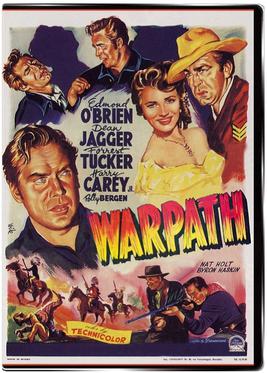
Warpath (1951)

Coursing through one story after another, the concept of good, old-fashioned bloody revenge/vengeance seems quite at home in the western genre. Don't it? And sometimes, that's all you need for a good story. Take 1951's Warpath, a decent little western that could have been pretty good. If it had just stuck to its revenge-driven guns...

Riding into a dusty, wind-swept town in the west, a man named John Vickers (Edmond O'Brien) gets off a stagecoach and promptly runs into the man's he long been after. He prods him into drawing first and shoots him dead, but not before getting some information out of the dying man. Vickers is looking for two other men and has been doing so for the previous eight years, always on their trail, always one step too slow. Now, he's got to take it one step further. Those two men he's pursuing have joined the cavalry. What to do? Driven solely by revenge, Vickers joins up too, knowing the regiment the duo enlisted with. That outfit? The infamous Seventh Cavalry, commanded by General George Armstrong Custer. Vickers hopes he can finish his mission, but has he bitten off more than he can chew?

I'm always on the lookout for new westerns, especially harder-to-find B-westerns like this entry from director Byron Haskin. Nothing too fancy here, a pretty straightforward revenge story that's undone by some story choices. It brings together all sorts of genre conventions, throws them in a mixer and you get to watch the finished product, a western clocking in at about 100 minutes that has a somewhat disjointed feel. Not especially good, not especially bad, but worth a watch for genre fans.

Edmond O'Brien is criminally underrated. Westerns, film noirs, dramas, thrillers, this guy could and did do it all. His John Vickers manages to hold things together throughout all the bouncing balls. He's a Civil War veteran hellbent on revenge, looking to avenge the death of his fiance who was shot and paralyzed as an innocent bystander during a bank robbery. He watched her die slowly, wilt away, and intends to exact revenge no matter where it takes him. It's a good part for O'Brien, simmering with rage and intensity as he puts himself through all sorts of trials and tribulations to exact that revenge, often putting himself at great danger to do so. Or is that his plan and has been all along? Hmm, interesting. Something to think about, huh? :)

The cast has some familiar names and faces, helping smooth out the rough patches. Among the cavalry soldiers O'Brien's Vickers finds in the Seventh Cavalry, there's Forrest Tucker, Paul Fix, Wallace Ford, and the always welcome Harry Carey Jr. Also at the fort, Vickers meets the comely daughter (Polly Bergen) of the owner of the general store (Dean Jagger). Wouldn't you know it? She likes Vickers...but she also likes another soldier! Oh, no! Yeah, the story goes down that path. A story that already bounces around too much grinds to a halt in those oh so painful moments.  If you're a western fan, the solid supporting cast overall should pull you in. It did for me!

There's enough here to recommend. It's a solid B-western from the early 1950's, but it certainly has an edge to it. It's a kinda leisurely revenge-seeking trip -- how does it take 8 years to track 3 people down when you seemingly are always on their tail? -- and O'Brien's Vickers seems to take quite a risk enlisting in the army in the hopes of finding two men in an entire cavalry regiment. And as mentioned, the forced love interest never really takes off.

Still, 'Warpath' does take some risks that pay off. It's clearly made on the cheap, including an art insert of the fort walls as the cavalry troops ride in and out. Helping cancel things out are a combination of some western notables. A midway action scene has a twist on the Battle of Beecher's Island, one of the more fascinating, little-known battles in the wild west. Then, the finale is set against the backdrop of Custer's Last Stand, maybe the most iconic moment in American history in the wild west. So yeah, if the ending is a little abrupt -- oh, right, Custer and the whole regiment are dead! -- so be it. It's a fun little western.
Warpath (1951): ** 1/2 /****

Tuesday, November 18, 2014

Rawhide

Is there a such thing as a situational western? No, not a large scale story of cavalry vs. Indians or a bandit gang organizing a huge heist. Instead, a story that takes place in a specific amount of time in a semi-confined setting. The big example I can think of is 1952's High Noon. It's a good one but not necessarily my favorite. Well, here's another one, a western I enjoyed a lot, 1951's Rawhide.

At an isolated way station for the Overland Mail and stagecoach line in the Arizona desert, Tom Owens (Tyrone Power) is a week away from moving back east away from his job as the assistant to the grizzled stationmaster, Sam Todd (Edgar Buchanan). News of a stagecoach robbery is making its way up and down the line, forcing one stagecoach passenger, Vinnie Holt (Susan Hayward) and a toddler, to hole up at the station due to company policy. It's only a few hours later when the outlaws behind the robbery arrive, led by escaped convict Rafe Zimmerman (Hugh Marlowe). They put the station in a hostage situation, Zimmerman revealing what his plan is. A stagecoach packed with gold bars is due in the next day, and he intends to get away with all of it. Can the hostages do something in time to stop the robbery and ensure their safety?

Here's a good example of why I love the western so much. From director Henry Hathaway, 'Rawhide' is neither a classic nor it is a dud. To say it's somewhere in between isn't even fair. It's a really good western that I enjoyed throughout and will gladly revisit it in the future. This 1951 small scale western has little to no reputation, but it came along at a different time. The late 1940s and early 1950s were an underrated time for the entire genre before the glossy widescreen (and often white-washed) examples of much of the 1950s. It's just 89 minutes long, was filmed in beautiful black and white and deserves a far more well-known reputation. Western fans will definitely get a kick out of this one.

There is something appealing and charming about the generally confined setting here for this 1951 western. Written by Dudley Nichols, 'Rawhide' has the feel of a stage-based play getting a big screen adaptation. Do you recognize Nichols? I didn't, but I should have. He wrote the screenplay for John Ford's 1939 classic Stagecoach, and 'Rawhide' has a similar feel. The entire story is set at the stagecoach station whether it's in the main building or the barn/corrals out in the middle of the desert. With the Alabama Hills used as a stunning backdrop, the black and white, sparse look of the story is a gem. The entire story takes place over about a 24-hour time period. We spend a lot of time in the expansive main room of the station, the claustrophobic room used as a prison cell or sorts, and then things open up in a big way outside with the mountains in the background. It's a not so flashy but perfectly set little story.

I'm guessing a big reason why 'Rawhide' doesn't have a huge reputation or following is because of the star power, or lack of it. It's a very solid cast (VERY) but there aren't any John Wayne or Henry Fonda waiting in the wings. Power and Hayward are excellent together, strangers forced to pretend they're married for safety reasons. Their kinda Odd Couple dynamic works in a hectic, tense situation. Marlowe is the nasty villain who's cold and calculating with Jack Elam (the psycho), Dean Jagger (the over his head horse thief) and George Tobias (the oafish/loyal enforcer) rounding out his gang. Buchanan is underused as the grizzled stationmaster who could use a bath while Jeff Corey, James Millican, Louis Jean Heydt and Kenneth Tobey make some quick appearances.

'Rawhide' is never slow but does have some relative struggles in getting to the third act. The threat is laid out and really there's only so much you can do before Marlowe's Zimmerman has to either gun somebody down or smack somebody. The ending though, it provides some good twists in dark fashion. The master of the psychotic, possibly unhinged 1950s western bad guy, Jack Elam even outdoes himself when he's in a desperate spot. And what's one of my main complaints about female characters in westerns? The damsel in distress. Not the case here as Hayward's Holt is front and center in the action. Who needs help? Give that woman a gun! An underrated western, one any genre fan should enjoy a lot. Track this one down!

Rawhide (1951): ***/****

Thursday, August 9, 2012

First to Fight

An interesting mess of a movie, 1967's First to Fight at first gave me the impression of being a recruitment film made by the United States Marines. Little research proved nothing of the sort, but go figure. I maintain my stance. Moral of the story? The movie's all over the place; B-movie with a very low budget, soap opera quality love scenes, vicious if somewhat overdone battles, and at times it actually utilizes a pretty solid cast. Unfortunately in the end, it never amounts to much as a finished product.

The lone survivor from his unit after a horrifically costly firefight with the Japanese on Guadalcanal in 1942, Sgt. Jack Connell (Chad Everett) is awarded the Congressional Medal of Honor and shipped back home to help the war effort by encouraging Americans to buy war bonds. He can't help but think of the friends he left behind though and starts to question if he is more valuable in the Pacific fighting. Connell meets Peggy Sanford (Marilyn Devin), his "guide" on the war bond tour, and quickly hits it off, the couple marrying. Connell gets orders to report to Camp Pendleton as a drill instructor, but the thought still lingers. Should he volunteer for combat or keep his promise to Peggy to avoid the war?

Where to start here? I can't completely rip this movie from director Christian Nyby because at different points there are positives to take away from it. The problem with that is simple; the positives get buried under mountains of the negative. A B-movie does not necessarily mean a movie is bad, not by a long shot. That rogue, renegade, cheap shooting from the hip style can be an attribute to a lot of movies. 'Fight' doesn't qualify there. That cheap quality actually hamstrings the story. Any indoor sets look like retread sets from 1960s TV shows, and the musical score -- battle scenes an exception, those work -- is that aggressive, blaring type that DEFIES you not to be emotionally moved. Here's some advice. If you're a B-movie (yes, I'm talking to an abstract idea), just embrace it. Don't convince and beg us to like you.

Those are the little things that bother you (okay, just me) as you're watching a movie. Not enough to ruin a movie, but it certainly can bring a movie down a notch or two. The bigger issue here is the story, one straight from the War Cliches Department. The opening intro -- the bloody firefight on Guadalcanal -- opens things with a punch to the jaw in a highly effective action sequence. Most of the next hour though is spent on Jack and Peggy's oh-so-lovely relationship. It is Dullsville for sure. Everett quotes Bogie in two different scenes after the couple goes and watches Casablanca, then using 'As Times Goes By' as "their song." Oh, free advertising for Warner Bros. in an odd, extended clip from the movie. One montage actually has Jack and Peggy walking in place pointing at things as super-imposed images show all the fun stuff they're doing. Thankfully you can fast forward through these parts, but that's never a good sign when you're hoping to enjoy a movie.

Playing the lead character, Everett is an okay if not particularly flashy actor. Mostly known for his parts on TV shows and TV movies, he does the best he can with a character that for all his interesting background just isn't that interesting. The lovey-dovey relationship with Devin's Peggy of course doesn't help either. The last 30 minutes let Everett do some heavy lifting, and to be fair, he's very good as his now-Lieutenant returns to combat. What caught my eye when this movie appeared on TCM was the rest of the cast, some used better than others. A pre-stardom Gene Hackman is the best thing going here as Sgt. Tweed, the tough as nails Marine sergeant, a familiar/cliched part, but a scene-stealing one just the same. Dean Jagger is also solid as Colonel Baseman, Connell's commanding officer. Unfortunately Claude Akins is wasted in his two-scene appearance (maybe 3 combined minutes on-screen), and James Best is underused as Sgt. Ed Carnavan, Connell's best friend, a key part that's not given it's due. Also look for Norm Alden as one of Jack's Marines.   

What will no doubt bring some viewers in is the WWII setting, and for the most part, that's why I can somewhat give this a recommendation. For all the unnecessary and repetitive Wilhelm screams (listen HERE) and "exploding" soldiers jumping and twirling off of trampolines, there is a bloody, chaotic realism to some of these scenes. The opening attack along a stream on Guadalcanal is a gem for all the right reasons. The same goes for Connell's return to combat on Saipan as his rifle platoon moves toward dug-in Japanese forces. Unfortunately there just isn't enough of that in a 92-minute movie. Too much time is spent on the generally unbelievable love story. When will movie studios learn? Make a love story or a war story. It's the rare combination that works.

First to Fight (1967): **/****

Thursday, June 28, 2012

Twelve O'Clock High

Right there with the stories of the soldiers on the front lines and the efforts on the home front, war movies can usually take solace in another genre staple; the trials of command. How does it wear on one individual to continually send their men into battle knowing that some -- if not many -- won't make it back? It has to be a emotionally draining, even destructive process, like it shows in 1949's Twelve O'Clock High.

It is still early in WWII in 1942, and Allied forces have turned to daylight precision bombing raids to help slow down the German war machine. The casualties are high though, and the effect on morale is easily seen, the men struggling to get from day-to-day. In the 918th Bomber Group, Colonel Keith Davenport (Gary Merrill), is being replaced by General Frank Savage (Gregory Peck), a squadron commander with plenty of flying experience. The men are weary, suspicious and not excited at the prospect of a driving commanding officer. Can Savage whip them into some sort of shape? Can the men realize he has their best interest -- survival -- at heart?

From director Henry King, 'Twelve' makes an interesting choice, one that ends up making this movie particularly memorable. This is a war story, but it isn't a front line war story. Almost the entire 132-minute movie takes place at the 918th's base in England. Even their bombing missions are kept in the background. The mission is presented, and then we see the aftermath; the surviving pilots returning to base. It is a surprisingly simple device, one that makes the final 30 minutes that much better when we actually go along with the B-17s on a daylight raid over Germany. We see the effect on the men from their commander, Savage, to his command staff, to the support crews on the ground.  What pilot and crew will return? Will any?

Nowhere is that more evident and in some cases, more powerful, than the performance delivered by Gregory Peck. I've long been a fan of Mr. Peck, but he continues to impress me. He received an Oscar nomination for Best Actor (losing to the showier, more obvious Broderick Crawford for All the King's Men), and it's easy to see why. As a commanding officer, he's forced to do things that are naturally unpleasant. He's replacing an officer who became too worried about his men, getting close to them, becoming friends and ultimately respecting them. To make them the best pilots and crews they can be, Peck's Savage has to keep pushing and pushing. Peck does a great job humanizing this part. We see what his men don't see. He's doing this for their benefit but at expense to himself.

Joining Peck in the 918th Bomber Group are familiar stock characters but tweaked to make them far from too familiar. Dean Jagger won a Best Supporting Actor Oscar for his part as Major Stovall, Savage's aide and a former lawyer, working hand in hand with his commander to strengthen the bomber group. Merrill is also very good as Davenport, a very capable pilot who becomes too emotionally involved to command. Some other pilots/crew include Gately (Hugh Marlowe), an effective pilot Savage is forced to call out, McIllhenny (Robert Arthur), the oft-promoted and disciplined assistant to Savage, Kaiser (Paul Stewart), the group physician, Cobb (John Kellogg), a hard-nosed pilot Savage appoints executive officer, and Bishop (Robert Patten), the youngest and best pilot in the group, one all the other pilots look to. We're given little to no information about them, but even then, these actors do a great job making them feel real. These characters resonate in a way that honestly surprised me.

Making this movie a classic as opposed to just a really good movie are a handful of scenes that strike all the right emotional chords. In bookends at the beginning and end, Jagger's Maj. Stovall walks around the deserted base some four years since the end of the war. The scenes are perfect, the soft echoes of the men singing hanging in the air. Peck's Savage has an early run-in with Marlowe's Gately, accusing him of cowardice. Gately takes it to heart, making a later scene between the two men heart-breaking in its honesty, Savage seeing Gately as he really is. Peck earns his nomination for me in that scene alone. The most moving parts are saved for the end as we see a daylight raid over Germany. The violence is startling and quick, the emotions as real as any war movie I can think of.

This doesn't feel like a 1949 WWII movie. It doesn't pull any punches, instead opting for realism and honesty. The intro to the squadron -- a bloody aftermath of a raid -- doesn't show the violence and gore. It hints at it off-screen as we hear about the debacle that took place up in the air. It's one of many moments that help make this WWII movie a classic. By the way, the above poster makes no sense. What 12 men? Eh, overthinking it. It looks cool.

Twelve O'Clock High <----trailer (1949): ****/****

Friday, June 8, 2012

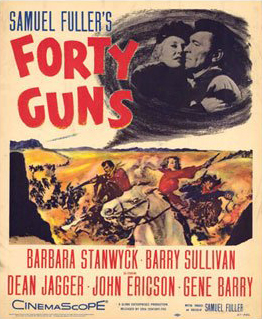
Forty Guns

As many westerns as I've watched over the years, I'm drawing a complete blank as to how to describe 1957's Forty Guns. It is truly odd, weird, bizarre, unintentionally funny at times, surprisingly dark and cynical at others, and in spots, really, really entertaining. And at 79 minutes, it packs more into its short running time than movies that are much, much longer. What an odd mess of a movie.

A federal peace officer with a well-known reputation, Griff Bonnell (Barry Sullivan) rides into Cochise County, Arizona with his two brothers, experienced gunhand, Wes (Gene Barry), and inexperienced but motivated Chico (Robert Dix). Griff is holding an arrest warrant on a cowboy accused of robbing a mail stagecoach, and then he finds out the man is working for Jessica Drummond (Barbara Stanwyck), a cattle queen in the area who has money, power and the guns -- some 40 gunslingers -- to back her up. The arrest warrant is just the start of problems as Jessica's younger brother, Brockie (John Ericson), doesn't like Griff's arrival and intends to do something about it.

Nothing too out of the ordinary for a western, is it? I didn't think so reading the plot description over at Netflix. From director Sam Fuller (who also wrote and produced), 'Forty' is just a mess of a movie. The positives are great, showing that at some point there was a chance this could have been a good to great western. The negatives though are epic, bordering on movie-killers. Some of the positives? It is a beautiful black and white movie, the camera work impressive, featuring long tracking shots, plenty of interesting angles, and basically a feeling of seeing something different. It is also surprisingly brutal and in its message. As far as westerns went in the 1950s, this is far ahead of its time, especially considering the cynicism that developed in 1960s westerns.

Besides Stanwyck in the lead, I didn't recognize much of the cast by name alone, but that ends up being a good thing. The Bonnells -- a thinly veiled take on the Earp brothers -- are great leads, especially Sullivan and Barry. Griff is the sure-handed lawman, so confident in his ability that he hasn't had to fire his gun in almost 10 years. Wes is his right-hand man, always backing him up like a guardian angel hovering over the situation. Chico wants to be like his brothers having seen the "glory" and "romance" of being a gunslinger. Stanwyck too is a bright spot, playing a strong female character, something that is lacking in so many westerns. She's no damsel in distress for sure, even doing her own stunt as she's dragged by her horse. Both the Bonnells and the Drummond characters are strong characters, able to carry a movie on their own. Instead of that, we get a jam-packed, even rushed 79 minute movie.

For all the positives, there's just too much going on for 'Forty' to be truly effective. Another 30 minutes would have been perfect to flesh things out. Barry's Wes is wasted in what was potentially a very cool character, "wooing" gunsmith's daughter, Louvenia (Eve Brent), and disappearing for long stretches of a short movie. Dean Jagger appears as necessary as corrupt and bought Sheriff Ned Logan, a possibly interesting backstory kept in the shadows. Oh, and did I mention that Stanwyck and Sullivan have a tortured love affair, two strong-willed individuals falling for each other for all the wrong reasons? Yeah, that's sort of a major plot, but like anything and everything else.....yeah, you guessed it. Rushed.

Rushed is one thing because it at least implies some sort of wasted potential. It was there, just never taken advantage of. On the other hand, there's just some badness. Ericson's terribly hammy performance as Brockie is so ridiculous it comes across as laughable. Some not so subtle sexual references -- a gun "going off in a woman's face" or "caring for one's gun with care and daily attention" -- are so heavy-handed they're hilarious in their badness.

A lot of these issues I had were almost thrown by the wayside in the finale, Sullivan's Griff delivering a truly surprising, brutal surprise, especially considering this was made in 1957. It's a mess of a movie overall -- both really good and epically bad -- but there's just enough....jjjjjjjjjjust....to recommend this one.

Forty Guns <---Youtube clip (1957): ** 1/2 /****

Wednesday, August 18, 2010

The Honeymoon Machine

In a career shortened by cancer, Steve McQueen earned himself the nickname 'the King of Cool.' Some of his best roles are those where he is the anti-establishment loner, the guy who does what he wants and isn't always popular for it, but he refuses to be tied down.  That's why I love his movies from The Great Escape to Bullitt and everything else in between and after. So imagine my surprise several years back when I was reading his filmography and found out he had done...wait for it...a zany 1960s romantic comedy!  More surprising? 1961's The Honeymoon Machine is actually pretty good. 

The humor is fairly typical of the comedies studios were producing in the 1950s and 1960s before America got all cynical.  The stories are ridiculous, the humor often pretty obvious, and they typically remind of some crazy scheme that Lucy and Ethel would have gotten into on I Love Lucy.  There is an innocence to these type of movies that just wouldn't have worked 10 years before or after their initial release, and that's part of the appeal.  They're sugary sweet and about as harmless as a comedy can be.  Starting off, a theme titled "Love Is Crazy." It's so awful, I defy you to not have it stuck in your head, and I do apologize for introducing it.

On board a Navy destroyer outfitted with a highly intelligent, analytical computer named 'Max,' Lt. Fergie Howard (McQueen) and Ensign Beau Gilliam (Jack Mullaney) have concocted a plan that could net them more riches than they ever planned with the help of Max's scientist keeper, Jason Eldridge (Jim Hutton). The Navy headed to Venice, Fergie and Co. hope to input data from a roulette wheel in a casino and let Max figure out a formula where they can deduce where the roulette ball will drop every turn. It's a plan that seems perfect, but nothing goes smoothly from the start.  Fergie meets Julie Fitch (Brigid Bazlen), the daughter of Adrmiral Fitch (Dean Jagger), and in trying to cover up their plan actually ends up explaining the whole thing.  But that's just the start as the money starts to flow in, and Admiral Fitch begins to suspect something fishy going on, including a possible martian invasion of Venice.

Ridiculous enough for you?  It sure sounds stupid.  A sucker for heist movies like I am, I was drawn in by the early premise of using a computer to analyze a roulette wheel and make millions.  Handled seriously, it could have been a doozy of a caper movie, but any element of seriousness is thrown out the window early here.  Director Richard Thorpe specialized in these type of romantic comedies and handles this one very well.  It's just 87 minutes long and doesn't waste any time getting where it wants to go.  Fergie's perfect plan deteriorates thanks to a drunken watchmen (a cringe-worthy Jack Weston), some Russian interference with the Russkies believing the U.S. is trying to bankrupt Italy, a possible martian invasion, and so much more.  But remember, it's madcap comedy so nothing ever gets to serious.  Were they really going to court martial Steve McQueen? I think not.

Frank Bullitt.  Henrie Charriere. Virgil Hilts. Pvt. Reese. Vin. I could name a lot of McQueen's characters who are some of my favorites.  Fergie Howard? Like no one he ever played.  For one thing, McQueen was a talented actor no matter the criticisms he's taken, and more than that he is an impressive physical actor.  He handles himself so well that he looks incredibly natural in his parts.  Throw all those elements into a comedic part, and you're going to have a lot of fun.  His mannerisms, his pronunciation of certain words, an inspired English accent, it all made me think McQueen should have done more comedy. It's almost like watching a different actor, but enjoy it.  Even a year or two later, I'm not sure he would have done this part.  Just sit back and watch the King of Cool in a part unlike any other he did.

McQueen is the scene-stealer in 'Honeymoon,' but that's not to say the rest of the cast disappoints.  If the story is as ridiculous as this one, every one has to commit to the badness.  Just embrace the goofiness and go along for a ride.  Hutton is the straight man to McQueen's antics, and gets a romance with Paula Prentiss, who he would team with in a handful of other MGM comedies in the early 1960s. Hutton and Prentiss have a good chemistry together, and Prentiss gets a lot of laughs as a heiress who insists on not wearing glasses even though she's blind without them.  Bazlen was just 17 years old when she made and is a good counter to McQueen.  She only made 3 movies in her career, a real shame because she's got a lot of ability.  Jagger too gets his fair share of laughs just because of the sheer lunacy of what's happening.  All in all a really solid cast.

Not much more to say about this one.  If you're wary about giving this one a try, I wouldn't be.  It's typical of a 1960s comedy that never takes itself too seriously but in the end is a polished, surprisingly funny finished product.  If nothing else, McQueen fans should see it just to see something different.  He always had great timing in his dramatic roles, and he doesn't disappoint in a comedy.  A change of pace for sure and a good one at that.

The Honeymoon Machine <---TCM trailer (1961): ***/****   

Saturday, January 23, 2010

The Kremlin Letter

Sometimes I get fed up with movies spoon-feeding their stories, their twists and turns with supposedly shocking revelations. They are the type of movies where you don't even have to be fully conscious to follow the story. Call it attention deficit disorder in younger viewers -- I'm 24 and resent people saying 'younger audiences' can't sit still for more than 10 minutes -- but for whatever reason movies more and more go down the road where original stories are dummied down so the average chimp can keep up.

So when I stumble across a movie that requires your attention for every second of screen time I jump at the chance. Movies with lots of information thrown your way in a short period of time can be frustrating and enjoyable at the same time. And where would this all work better because the genre framework is already established? Spy movies where betrayals, deceptions and double crosses are part of the landscape. Virtually forgotten 40 years since its release -- thanks to no DVD or VHS release -- 1970's The Kremlin Letter, directed by John Huston, is a nice little twist on the spy movie.

Released in the midst of the James Bond craze, The Kremlin Letter is basically the anti-007 in terms of action and storytelling. Huston's take is heavy on dialogue with almost no action from start to finish. Instead of action, there's tension to spare as a team of American and British agents go undercover in Moscow to accomplish a perilous mission. Countless bits of information and explanations about the setting and the characters are thrown your way without warning, forcing you to file away little bits of information in your head so a scene or a line makes sense later in the movie. With all that said, the "twist" revealed late isn't that much of a surprise -- if you're paying attention or have seen even a couple spy movie or two you'll spot it early -- but it does work because of how the twist affects the story.

In the midst of the Cold War, a single letter could tear apart the world if it falls into the wrong hands. A high-ranking American official has written a letter saying the U.S. would help the USSR in taking out China's nuclear weapons program, and the agent holding the letter turns up dead...without the letter. A new agent, Charles Rone (Patrick O'Neal), is assigned to assemble a team with the help of agents who have experience dating back to WWII. This group of American and British agents will be headed by Ward (Richard Boone) who will lead a group of specialists (Nigel Green, Dean Jagger, George Sanders, and Barbara Parkins) in hopes of getting the letter back before all-out war breaks out. Getting that letter won't be so easy though with two Russian agents, Kosnov (Max von Sydow) and Bresnavitch (Orson Welles) also involved.

Reading through that cast listing when I saw this movie on TCM's schedule, I'm not going to lie; I was a little disappointed in myself I'd never even heard of this movie...not even in passing, even a little bit. It's not a classic spy movie, but it is an above average entry. Most of that credit goes to Huston's directing and the performances he gets from this very impressive grouping of actors and actresses. With very little action, the spotlight is squarely on the cast to carry the movie. Some are in it more than others -- Jagger, Green and Sanders are criminally underused with some great eccentric characters -- but even the smaller performances leave an impression.

Never a huge star but always a reliable lead, O'Neal is the anti-007 in his portrayal of a spy. His Rone doesn't carry a gun, is a last-minute replacement for his position, and with his photographic memory and ability to remember everything told to him is a valuable member of the team. Instead of fighting his way out of a situation, Rone thinks things out before putting his life on the line, especially in a key subplot that sees him develop a relationship with von Sydow's Kosnov's wife, Erika (Bibi Andersson). As the veteran agent working with Rone, Richard Boone makes the biggest impression, and that's saying something considering the cast. His Ward is a scene-stealer, always addressing Rone as 'Nephew' with his Texan drawl, and demanding your attention every minute he's on-screen.

Their counterparts, von Sydow and Welles, have less time and development but don't waste a second. And really can you think of two better actors to play imposing, always intimidating Russian agents? Much like his role in 3 Days of the Condor, von Sydow is frightening with his steely glare, and when wasn't Welles an intimidating presence? The whole cast seems to be enjoying themselves with Green as a pimp/drug dealer, Sanders as a transvestite, and Parkins as a wet behind the ears safecracker. Raf Vallone even makes a quick appearance as an espionage teacher. They play the type of characters that could probably carry a movie on their own, but instead play supporting roles here. If I can find a copy of Noel Behn's source novel, I'll be sure to pick it up just to see if how much had to be cut for a feature film.

An interesting movie for any number of reasons, especially considering the year and time it was released in. It's hard to figure out why this little gem has been forgotten over the years (maybe it was too different from what audiences were seeing with the Bond series), but it is worth tracking down just to watch this great cast go to town with an interesting spy story. Convoluted at times but everything clears up in the end, including one last twist in the final scene.

The Kremlin Letter <----TCM clips (1970): ***/****

Thursday, December 24, 2009

White Christmas

Ah, the Christmas movie. Everyone's got a favorite, and if they don't, well they're just lying. It's hard for me to pick just one, It's a Wonderful Life is surely top 2 (review to come in the next day or so), but then there's also A Christmas Story, Christmas Vacation, Jingle All the Way, and even Bad Santa. But right up there with 'Wonderful Life' is Irving Berlin's 1954 musical White Christmas.

This is one of the few musicals I can actually watch, partially because it's a Christmas musical (and what could possibly go wrong with that?) and also because Christmas crooner Bing Crosby is the star. Just like everyone has their favorite Christmas movie, usually anyone you ask can quickly identify their favorite Xmas song too, and for me, it's just about anything Crosby sings. His version of Berlin's White Christmas is the quintessential holiday song and serves as a nice jumping off point for this 50s musical.

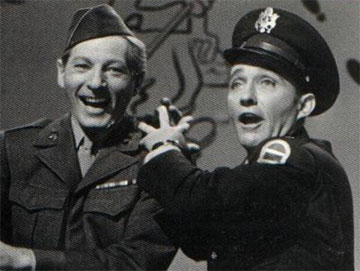
Two song and dance men, Bob Wallace (Crosby) and Phil Davis (Danny Kaye), have hit it big since teaming up after WWII (Davis saved Wallace's life and basically guilts Bob into working with him). Their shows tour the country, filling theaters with their unique performances. While touring in Florida, they get a message from an old war buddy asking them to go check out his sisters' show. So Bob and Phil head to a club and see Betty (Rosemary Clooney) and Judy (Vera Ellen) Haynes put on their show. Through some shenanigans with a hotel owner, a sheriff and a burnt rug (it's not worth it to explain it all), all four end up on a train bound for Vermont where the Haynes sisters have been hired at the Pine Tree Inn, a ski lodge.

Arriving in Vermont, the quartet find there's no snow for skiing during the holidays and to top it off, their old commanding general, Thomas Waverly (Dean Jagger) owns the struggling inn. Quick thinkers that they are, Bob and Phil decide to bring their hugely popular show up and get some business going for Gen. Waverly. Whatever acts they can't get, they'll have the Haynes sisters fill in. As the plan snowballs though, Bob has one more surprise up his sleeve with noisy housekeeper and all-around busybody Emma (Mary Wickes in a very funny supporting part) always trying to figure out what's going on

At 120 minutes, it might seem somewhat long for a musical but the story never goes more than a few minutes without a musical number of some sort, whether it be Ellen and Kaye dancing, the whole cast doing a minstrel number (my personal favorite), the foursome spontaneously bursting into song about snow (another gem), or Clooney singing a love song. The point is the whole movie is an excuse for a very talented cast to show off their talents. The actual story while highly enjoyable and sometimes heartbreaking -- poor General Waverly -- is completely lost in the ongoing musical numbers. Ellen was a highly respected dancer in Hollywood, Clooney can sing with the best of them, and Crosby and Kaye are equally adept at song, dance or comedy. Composer Irving Berlin pulls out all the stops in delivering a long list of quality musical numbers.

This is a movie that's obvious as you watch it that the cast and crew had fun making it. Fred Astaire was originally supposed to star only to be replaced by Danny Kaye. Sure, it would have been great to see Crosby and Astaire in another holiday classic -- think Holiday Inn 2 -- but Crosby and Kaye are perfect together with on-screen chemistry to spare, including one hilarious bit as they perform as the Haynes sisters. Here's the girls' version, and then here's the gents' spin on it. Of course, it is a musical so there does have to be some romantic fireworks as Crosby ends up with Clooney and Kaye with Ellen. All four actors work together so effortlessly in making this Christmas classic. Clooney didn't act in many movies, but I've always had a crush on her because of this part. She can sing, do comedy and is the definition of a classic beauty.

A fun movie all around, and what would you expect from director Michael Curtiz, who also made a little film called Casablanca, maybe you've heard of it? Filmed in Vistavision with tons of bright colors and great visuals, this isn't just a typical musical but a great movie overall with dead-on casting, plenty of humor to spread around, and of course, some great musical numbers. Remember, that's coming from a musical-phobe who usually avoids them like the plague. A perfect Christmas movie and one I look forward to watching every year. Check it out on Youtube starting here, although I'd highly recommend the DVD.

White Christmas <----trailer (1954): ****/****