The Sons of Katie Elder

The Sons of Katie Elder
"First, we reunite, then find Ma and Pa's killer...then read some reviews."
Showing posts with label Forrest Tucker. Show all posts

Thursday, April 14, 2016

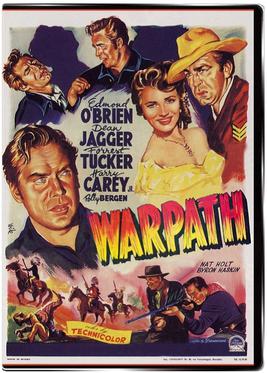
Warpath (1951)

Coursing through one story after another, the concept of good, old-fashioned bloody revenge/vengeance seems quite at home in the western genre. Don't it? And sometimes, that's all you need for a good story. Take 1951's Warpath, a decent little western that could have been pretty good. If it had just stuck to its revenge-driven guns...

Riding into a dusty, wind-swept town in the west, a man named John Vickers (Edmond O'Brien) gets off a stagecoach and promptly runs into the man's he long been after. He prods him into drawing first and shoots him dead, but not before getting some information out of the dying man. Vickers is looking for two other men and has been doing so for the previous eight years, always on their trail, always one step too slow. Now, he's got to take it one step further. Those two men he's pursuing have joined the cavalry. What to do? Driven solely by revenge, Vickers joins up too, knowing the regiment the duo enlisted with. That outfit? The infamous Seventh Cavalry, commanded by General George Armstrong Custer. Vickers hopes he can finish his mission, but has he bitten off more than he can chew?

I'm always on the lookout for new westerns, especially harder-to-find B-westerns like this entry from director Byron Haskin. Nothing too fancy here, a pretty straightforward revenge story that's undone by some story choices. It brings together all sorts of genre conventions, throws them in a mixer and you get to watch the finished product, a western clocking in at about 100 minutes that has a somewhat disjointed feel. Not especially good, not especially bad, but worth a watch for genre fans.

Edmond O'Brien is criminally underrated. Westerns, film noirs, dramas, thrillers, this guy could and did do it all. His John Vickers manages to hold things together throughout all the bouncing balls. He's a Civil War veteran hellbent on revenge, looking to avenge the death of his fiance who was shot and paralyzed as an innocent bystander during a bank robbery. He watched her die slowly, wilt away, and intends to exact revenge no matter where it takes him. It's a good part for O'Brien, simmering with rage and intensity as he puts himself through all sorts of trials and tribulations to exact that revenge, often putting himself at great danger to do so. Or is that his plan and has been all along? Hmm, interesting. Something to think about, huh? :)

The cast has some familiar names and faces, helping smooth out the rough patches. Among the cavalry soldiers O'Brien's Vickers finds in the Seventh Cavalry, there's Forrest Tucker, Paul Fix, Wallace Ford, and the always welcome Harry Carey Jr. Also at the fort, Vickers meets the comely daughter (Polly Bergen) of the owner of the general store (Dean Jagger). Wouldn't you know it? She likes Vickers...but she also likes another soldier! Oh, no! Yeah, the story goes down that path. A story that already bounces around too much grinds to a halt in those oh so painful moments.  If you're a western fan, the solid supporting cast overall should pull you in. It did for me!

There's enough here to recommend. It's a solid B-western from the early 1950's, but it certainly has an edge to it. It's a kinda leisurely revenge-seeking trip -- how does it take 8 years to track 3 people down when you seemingly are always on their tail? -- and O'Brien's Vickers seems to take quite a risk enlisting in the army in the hopes of finding two men in an entire cavalry regiment. And as mentioned, the forced love interest never really takes off.

Still, 'Warpath' does take some risks that pay off. It's clearly made on the cheap, including an art insert of the fort walls as the cavalry troops ride in and out. Helping cancel things out are a combination of some western notables. A midway action scene has a twist on the Battle of Beecher's Island, one of the more fascinating, little-known battles in the wild west. Then, the finale is set against the backdrop of Custer's Last Stand, maybe the most iconic moment in American history in the wild west. So yeah, if the ending is a little abrupt -- oh, right, Custer and the whole regiment are dead! -- so be it. It's a fun little western.
Warpath (1951): ** 1/2 /****

Wednesday, May 6, 2015

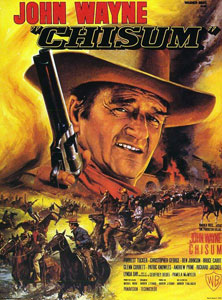
Chisum

By the late 1960s and into the 1970s, John Wayne's movies became more familiar, more safe. You know what though? There's a comfort in familiarity, and there's some genuinely good movies in the bunch. Today's review is one of those efforts, telling one of the more famous stories of the wild west that ranks up there with the gunfight at the O.K. Corral or the Battle of the Little Big Horn. That story? The Lincoln County War. That movie? 1970's Chisum.

It's 1878 in the New Mexico territory, and aging rancher John Chisum (Wayne) has carved an immense cattle ranch out of the wilderness, made it all into something to behold. He's preparing for his niece, Sallie (Pamela McMyler), to come and visit the ranch, but there's some serious issues to be dealt with. An equally powerful man with some serious financial backing, Lawrence Murphy (Forrest Tucker), has moved into Lincoln County and is looking to take over. Take over EVERYTHING. First up on his list? Buying the sheriff, the bank, and scooping up all the land he can and drive Chisum out as quick as he can. Chisum is well-rooted though, and nothing is going to come easy for the despicably vicious, greedy Murphy. There's a wild card in the entire situation though, a young, fiery gunfighter with a fast-growing reputation and a fast draw with his pistol, William Bonney (Geoffrey Deuel), better known as Billy the Kid.

I've loved John Wayne and his movies since I was a little kid. Hopefully, I always will! I hadn't seen this 1970 western from director Andrew McLaglen in years until a recent showing on Turner Classic Movies gave me the opportunity to revisit it. Am I glad I did! It is different, telling the mostly true story of the Lincoln County War with some artistic license thrown in here and there. A lot of familiar faces, filming locations in Durango, Mexico where other Wayne ventures (The War Wagon, Sons of Katie Elder, The Undefeated, The Train Robbers) were filmed, a memorable score from Dominic Frontiere, and cinematographer William Clothier bringing the Mexican locations to life, yeah, it IS familiar. That's not a bad thing. I loved catching up with the movie and liked it much more than I remember. There's just enough different here to keep things interesting. And let's face it, the story and recognizable historical characters are a great backdrop for that mostly true story.

Okay, one of the most famous stories of the wild west. What do we need? How about a movie star capable of leading the way? In 1970, Wayne was still at the top of his game. He had the tough guy hero part down to an art with decades of practice. That is most definitely a compliment. Wayne was always at home in the western, and that's the case here. His Chisum -- based on the real-life John Chisum -- becomes a figurehead of the west. Years before, Chisum moved west into New Mexico and carved out a cattle ranch out of the land. Now, he's learning to slowly, begrudgingly changing with the times to survive. A testament to Wayne here is that he's not on-screen a ton. Yes, he's the star, but the Hollywood legend is content to let other members of a solid ensemble step into the limelight. When he is in the limelight? It's Duke at his tough as nails best, playing straight man to a bunch of antics while also stealing the camera, especially in a late confrontation with Tucker's Murphy. Nothing flashy, just a western professional.

Part of the fun here is the familiar names and characters popping up. The Billy the Kid story has been told in the Young Guns movies, The Left-Handed Gun, Pat Garrett and Billy the Kid, The Outlaw and many more I'm probably forgetting. I liked the spin Deuel puts on young William Bonney, a brash kid trying to put a checkered past behind him. He may be too good with a gun to let it happen though. Deuel's scenes with Glenn Corbett's Pat Garrett are a highlight, especially knowing where these two men end up. Also look for peaceful, second-chance rancher John Tunstall (Patric Knowles), Alex McSween (Andrew Prine, with his wife Lynda Day George), corrupt Sheriff Brady (Bruce Cabot), and more than a few familiar faces in the background.

The cast is one of Chisum's best features. Tucker is a slimy, nasty, slithery villain, with both Christopher George and Richard Jaeckel as his brutal enforcers. Another Just Hit Play favorite, Ben Johnson is Pepper, Wayne's right-hand man, a mumbling cowboy who'd rather solve a problem with his gun than his words, a part similar to the one he played in both The Undefeated and The Train Robbers. You ready though for some other names? Take a deep breath with me. Also look for John Agar, Robert Donner, Ray Teal, Hank Worden, Pedro Armendariz Jr., Edward Faulkner, Christopher Mitchum and plenty of faces from the John Wayne stock company. Quite the cast. QUITE a group of tough guys, a McLaglen specialty. 

About as good as a traditional western can get. There's good guys, dastardly bad guys, shootouts to be had, and set against the backdrop against one of the wild west's most famous/infamous incidents ever. Something really hit me with this most recent watch, and I came away more impressed than I'd been with previous viewings. Hopefully, you'll like it just as much!

Chisum (1970): *** 1/2 /****

Friday, January 16, 2015

The Abominable Snowman of the Himalayas

Growing up, I was a huge Looney Tunes fan. I still am to be fair. One cartoon short that always cracked me up was The Abominable Snow Rabbit where Bugs Bunny and Daffy Duck -- on vacation -- actually run into the abominable snowman (appropriately named Hugo). Then there's the lovable bad guy the abominable snowman from the Christmas special Rudolph the Red-Nose Reindeer. How about a slightly darker version? Let's go with 1957's The Abominable Snowman of the Himalayas.

Working with his wife and his assistant, Dr. John Rollason (Peter Cushing) is high up in the Himalayas at a remote monastery on a botanical/nature expedition. He's making all sorts of discoveries when news reaches the monastery that a second expedition is on the way to their location. It is a small group headed by Tom Friend (Forrest Tucker), and their intentions are completely different from those of Rollason. Their goal is to track down and hopefully find evidence of the existence of the legendary Yeti. Both his wife and his assistant don't want to him be a part of the search high up in the mountains, but with Friend boasting evidence and sightings on his side, Rollason is hard-pressed to pass up the opportunity to be a part of something so big. He agrees to join the expedition, joining with Friend and three other men as they head up into the Himalayas. What awaits them?

I don't always like horror films, but when I do, they're often from Hammer Films Productions. A British production company, 'Hammer' turned into one of the best backers of generally low-budget but well-done horror flicks in the 1950s and into the 1960s and 1970s. This 1957 entry from director Val Guest has popped up recently on TV a lot recently so I thought I'd check it out. It's actually based off a stage play, a setting that ends up working quite well in the film. Though mountain footage was actually shot, the scenes with the cast actually on-screen was shot on claustrophobic, rocky, snow-covered sets. It is small scale, small cast and never seems affected in the least by any budget limitations.

Working off a script by Nigel Kneale and an uncredited Guest, 'Snowman' borrows from the Jaws school of how to show or not show your movie monster. Translation? The appearance of the Abominable Snowman is kept hidden for the most part as we see an immense footprint, a shadow, a distant roar, and in his first appearance, his giant hand. That certainly helps build the tension and mystery as we start to see the creature as some sort of ethereal being hovering over the action. Unfortunately, we never actually see the creature fully in frame. The closest we get is a close-up on the creature's eyes late in the movie in a key scene that does deliver quite a twist in the final act. It's good and bad in that sense. There's some great tension but if it never gets a payoff then is it worth it? The beauty of Jaws is that we don't see the great white shark a lot...and then WE DO! That's probably the biggest indictment of the smaller budget, a lack of a payoff with the Yeti.

Who else to look for? Cushing and Tucker were the names that caught my eye originally. An instantly recognizable face in the horror and sci-fi genre (and frequent Hammer star), Cushing is the intellectual, the driven scientist trying to find something previously believed to be a myth, a legend. The possibilities are just too much for him to pass up. Tucker is his opposite, a showman, a businessman looking to make some serious cash by capturing the Yeti and bringing him back to civilization in a nod to King Kong. The other members of the Yeti expedition include Shelley (Robert Brown), the greedy trapper, McNee (Michael Brill), a photographer who's seen the Yeti before, and Kusang (Wolfe Morris), the superstitious local guide. Maureen Connell plays Rollason's worrying wife, Helen, while Richard Wattis plays Fox, Rollason's bookish assistant.

If there's an accurate description of this Hammer horror flick, it's moody, subtle and unsettling...but it's not always in a good way. I think it is a little too subtle. It never quite builds to anything too satisfying. The story becomes less about the Yeti, the abominable snowman, and more about how the expedition begins to fall apart and disintegrate. The Yeti is just what sets the match off to the explosion amongst the men traveling up through the mountains to find something dark and mysterious. It's good and potentially very good but never quite jells how you want it to. For me at least.

The Abominable Snowman of the Himalayas (1957): ** 1/2 /****

Monday, December 22, 2014

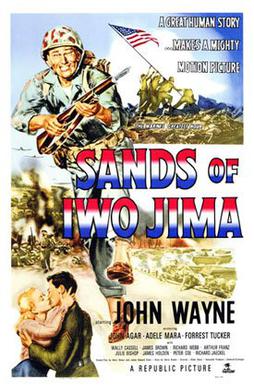
Sands of Iwo Jima

You know what's crazy? In a career that spanned five decades with almost 200 roles to his name, John Wayne only picked up two Oscar nominations for acting. Yeah, a lot of his movies weren't going to win an Oscar to begin with. Yeah, many were 1930s serials barely clocking in at an hour. Others were more fan-friendly, not meant to create Oscar buzz. But in one of his best extended spans of pure acting power, the late 1940s, Wayne picked up his first nomination for 1949's Sands of Iwo Jima.

Following the horrific, costly fighting on Guadalcanal, Marine units all over the Pacific are being sent to the rear to rest up, recoup and get replacements as the war moves closer to Japan. One specific rifle squad, with just two surviving members and a wave of inexperienced replacements, is getting a new drill sergeant, Sergeant John Stryker (Wayne), a tough as nails instructor with plenty of combat under his belt. His methods for training are rough and to the point -- some would say brutal -- but he has one goal as the war continues. Stryker doesn't want to be friends with his men. He wants them to respect him if nothing else and mostly take his training to heart. If they hate him for it...so be it, but he intends to get him through the war unscathed if possible. The island-hopping fighting all across the Pacific continues on, the U.S. Marines ready to get back to the action.

Recently released on Blu-Ray courtesy of Olive Films, 'Sands' is an above average if not great World War II film. From director Allan Dwan, it has a reputation as a bit of a flag-waving patriotic movie, but that's a description that's incredibly limiting. Considering it was released just four years since the end of the war, it's pretty spot-on. The actual war segments are rough and violent without being graphic. It can be startling at times as it follows a war movie formula that would become tried and true in the coming years. Filmed in black and white, 'Sands' benefits from a memorable score from composer Victor Young and is at its strongest when focusing on the Marines in combat, specifically the fighting at Tarawa and Iwo Jima.

Now that John Wayne guy. He's halfway decent. This isn't his best performance -- I say that's from a choice of The Searchers, She Wore a Yellow Ribbon or The Shootist -- but it certainly belongs in the conversation. His tough as nails drill sergeant helped inspire countless movie roles in the years to come, and the Duke dives into the part headfirst. Stryker pushes and pushes his men, knowing that no matter how tough training is, it won't be as tough, as terrifying as combat. The better his men are prepared, maybe the more likely they'll make it through unscathed. It is a man's man type of role (one he deserved a nomination for), but it isn't this cold facade. It isn't one big stereotype. In a couple conversations, a couple quick scenes, we get to learn something about Stryker and his personal life, his background.

That goes a long way with the character. He isn't a heartless, emotionless drill sergeant with ice water in his veins. He pushes his men because he knows what's best for them. It's a varied character. We learn Stryker's wife left him five years before, taking their five-year old son with her. He's left to wonder where they're at, what his son has grown up to. Later on Tarawa, he threatens to shoot one of his own men if they expose the unit's position to go rescue a wounded soldier who's crying out to Stryker for help. In one instant, he's a wall of discipline. In the next, you see the extreme pain in his eyes as one of his men cries out for help from him specifically. The same later as the Marines are called back, Stryker standing on the transport ship looking back at Tarawa with just palpable sorrow in his eyes. As well, there's some humor, including my favorite as Stryker helps a clumsy recruit (Hal Baylor) how to do bayonet drills...by dancing. It's played straight but is a great visual.

Just an excellent performance from the Duke. The rest of the cast relies on the unit picture formula, a bunch of disparate guys thrown together and forced to fight as a cohesive group. John Agar plays Conway, a Marine with the corps in his blood...and he hates it, especially Stryker and all he represents. Forrest Tucker is very good as Thomas, a Marine who's been in Stryker's unit before and holds some serious resentment toward his former sarge. The rest of the squad includes Wally Cassell (the joker), James Brown and Arthur Franz (the vets), Richard Webb (the lovable teddy bear), James Holden (the affable farmer), Peter Coe (the Greek), Richard Jaeckel and William Murphy (the bickering Philadelphia brothers), George Tyne (the married man always ready with a joke), and Martin Milner (the youngster). A solid group of supporting parts from some always reliable character actors.

'Sands' is at its most comfortable and strongest in the training sequences and montages and when Stryker's Marines hit the beaches at Tarawa and Iwo Jima. The hitting the beaches at Tarawa scene is especially effective, the Marines pinned down in a lagoon against a log embankment. Their only way out? Up and over the logs to take out a fortified Japanese pillbox built into a dune. The battle for Iwo Jima is equally effective as Japanese forces absolutely rain down hell on the Marines moving inland. The casualties come fast and furious as the squad is especially hit hard as they approach Mount Suribachi. It all builds to the squad taking part in the patrol that takes Suribachi's summit and ultimately raises the flag. It is a surprising, moving finale as we see the basis for one of the most iconic, instantly recognizable pictures in American history.

It ain't a perfect movie with some parts of the story not working as well. Agar's Conway (a very unlikable character) meets, falls for and gets married to Adele Mara's Allison in scenes that drag the pacing down to a snail-like quality. The Marines getting their leave too is meant to humanize them but the efforts fall short. We learn more in the training and combat sequences. Still, it's an excellent movie courtesy of Wayne's Academy Award-nominated performance and a story of the Marines that doesn't shy away from the nastiness of the fighting in the Pacific. That's not something you can say for a lot of World War II movies released in the late 1940s.

Sands of Iwo Jima (1949): ***/**** 

Tuesday, June 4, 2013

Three Violent People

While the Civil War officially ended when Robert E. Lee surrendered to Ulysses Grant at Appomattox Courthouse in April 1865, the fighting continued for several months throughout the country as the news spread. Beyond the fighting though, the nation had to deal, and it came in one of U.S. history's nastiest periods, the Reconstruction Era. It's a touchy suspect and not surprisingly hasn't been dealt much via film. Released in 1956, Three Violent People kinda deals with the time period. Kinda.

It's been a few months since the end of the Civil War, and decorated Confederate cavalry officer Capt. Colt Saunders (Charlton Heston) is trying to return home to his cattle ranch in Texas. Making one last stop, he's knocked out in a fight as he tries to rescue a beautiful woman from some drunken carpetbaggers. The woman's name is Lorna (Anne Baxter), and she's a former dance hall girl but doesn't tell Colt that. They marry within hours of meeting and head to the ranch, but problems galore await. The provisional government, including Commissioner Harrison (Bruce Bennett), is scooping up land, cattle and horses with little in return for the owners. Looking to keep his ranch going, Colt has no intention of just handing over everything he owns. As Lorna holds out on her secret, Colt readies for a fight to protect what's his own.

Telling the story of the Reconstruction era via a Texas ranch is a pretty cool idea for director Rudolph Mate's western. The opening scene does a solid job of setting the stage. Carpetbaggers have descended on towns all across the war-torn south, scooping up businesses and failed ranches for rock bottom prices. A Confederate vet and a native Texan, Colt obviously doesn't abide by this new development. It's cool to see a western deal with this subject, especially the corruption that riddled the government. In hopes of rebuilding the country, some rather nasty decisions had to be made.

Unfortunately though, that's probably the best thing going for Mate's film; the story. Basically everything else falls short, starting with the leads. Heston was always at home in historical flicks whether they be westerns, biblical stories, or period pieces. It's odd then saying that he's miscast here as Capt. Colt Saunders a fiery, short-tempered rancher who does what he needs/wants and everything else can be damn. Heston could be all of those things depending on the role, but he looks to be sleepwalking here. It obviously doesn't help then when Heston and Baxter have little to no chemistry together. The whole relationship seems forced and goofy, the duo exchanging lots of passionate embraces and even....GASP!....a few kisses. And fade to black!

The rest of the cast is slightly better if still misused or underused. Gilbert Roland is not surprisingly a scene-stealer as Innocencio, Colt's top hand and longtime worker at the ranch. We've seen the part before as Roland uses a mix of Spanglish and 'Ay Chihuahua!' moments. Still, he's good at it so be it. Even look for some familiar faces among his five sons, the very Mexican-looking Robert Blake and a pre-MASH Jamie Farr. Tom Tryon has a cool character as Cinch, Colt's one-armed younger brother who holds a ton of resentment for his brother, but Tryon's not the most personable actor. Bennett is slimy as Harrison with Forrest Tucker wasted as his main henchman, Cable.

With a slow-moving, sappy story, I really disliked the first hour-plus of this 99-minute flick. The final half hour or so saves it from being a complete waste of time thankfully. All these different characters and rivalries finally step up to the plate and embrace some of their Greek mythology roots. Brother hates brother? Wife with secret hates husband? Betrayals, greed and redemption? Yes, it must be Greek mythology! The ending is a little too tidy, but it is significantly more enjoyable than the first hour. Still not a great movie, but not awful. If that's not a ringing endorsement, I don't know what is.

Three Violent People (1956): **/****

Friday, April 12, 2013

The Westerner

Just over two years ago -- good lord, I'm getting old -- I wrote a review of the 1972 revisionist western The Life and Times of Judge Roy Bean. Based ever so loosely on the life of Judge Roy Bean, it's a mess of a movie if a quasi-interesting one. Some 30 years earlier though, an earlier film delved into the life of the infamous western figure. Interesting, but like its predecessor, still flawed. And away we go with 1940's The Westerner.

As settlers and homesteaders move into the wilds of Texas in the years following the Civil War, one man maintains his iron rule on his own territory. That man is Judge Roy Bean (Walter Brennan), a self-appointed judge who lives and rules by a very strict set of rules and laws. His typical verdict is simple no matter the crime; hanging. One day, the Judge meets a prisoner that he can't quite bring to send to the hanging tree. That man is Cole Harden (Gary Cooper), an amiable enough, fast talking cowboy making his way from job to job. Cole is accused of stealing a man's horse, and if there was ever a crime worthy of hanging in the old west, it would be horse thieving. The drifting cowboy is able to save himself from the noose, and he makes a fast friend in Judge Roy Bean. Their friendship though is threatened by an escalating range war, the cowboys readying to fight the homesteaders.

I liked a lot about this 1940 western from director William Wyler. For starters, the black and white look is perfect from the start. The outdoor scenes were filmed in the desert around Tucson, Arizona, adding a sense of realism to the story. The indoor scenes are mostly relegated to Bean's saloon-turned-courthouse in the Texas border country, almost like a play. I won't mention each of the names involved with the script -- there's 6 different names according to IMDB -- but the final product is full of darkly funny scenes that mix well with some great dialogue between Brennan and Cooper. A very natural back and forth makes any scene the duo is in that much more entertaining.

Having already won two Best Supporting Actor awards (1936 and 1938), Brennan made it a third win with his performance here as Judge Roy Bean. It is by far the best thing going for this Wyler-directed western. He makes a pretty nasty character always interesting to watch, if not particularly likable. He lives and rules by his own special laws which are steadfast....until they don't benefit him, in which case he tweaks the rules. Bean is stringent in that once he's ruled, the ruling is done. At one point, the Judge even hangs a man....a man who's already dead. Bean also has one obsession; his love for stage actress Lilly Langtry (Lilian Bond). His saloon is decorated with posters and cards and postcards of the lovely actress. He's never seen her, never met her, but he's desperately and madly in love. It's an oddly human (if not quite endearing) trait to one nasty dude.

For about 45 minutes, I loved this movie. We're introduced to Bean, his town and his posse of 'Yes Men' gunfighters (Paul Hurst and Chill Wills among them), and then Cooper's Cole (no relation to the real-life Cole Hardin) appears on the scene seemingly a sure thing for the hangman's noose. It is an extended scene with its intro and fallout that lasts more than 30 minutes. Bean in all his self-righteous judgment and Cole in his desperation to save his own skin are perfect with some surprisingly funny exchanges. Cooper was worried heading into the movie that Brennan would overshadow his secondary part, and he's right to a point, but he does a solid job (as expected) as the laconic but quick-thinking Cole. The running scene has several sight gags, some interesting twists and a great payoff. If only the rest of the movie could have kept up that energy, but unfortunately, it just doesn't.

The last half of the movie follows Cole and the Judge on opposite sides of a range war. No one seems to be able to convince Bean of anything, but he respects Cole (while also wanting one of the cowboy's prize possessions) enough to listen to him. Well, sort of. The range war feels forced, especially the slamming of a love interest -- Doris Davenport as Jane Ellen, the daughter of a farmer (Fred Stone) --  smack dab right into a story that just didn't need it. The range war offers a couple surprising twists, but the second half just never maintains the energy or momentum of the first half of the movie. Still a worthwhile movie for Brennan and Cooper throughout, but it's a mixed bag in the end because of the disappointing second half. Also look for Forrest Tucker and Dana Andrews.

The Westerner (1940): ** 1/2 /****

Sunday, February 19, 2012

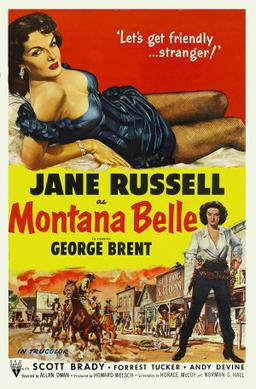
Montana Belle

Operating for over a decade in the last half of the 19th Century, the Dalton gang specialized in bank and train robberies before ultimately meeting their maker in a bloody shootout. Belle Starr was a female outlaw in the old west who rose to notoriety late in life. By all accounts, the two never crossed paths, but what's the fun in that? In a Abbot and Costello-like pairing, they do team up in 1952's Montana Belle.

Rescued from a lynch mob by Bob Dalton (Scott Brady), infamous outlaw Belle Starr (Jane Russell) joins up with the Dalton gang at their hideout in the hills. Bob quickly sets his sights on Belle, but it will have to wait. His brothers, especially Emmett (Ray Teal), want nothing to do with her, especially as they're planning their next robbery. Belle is left behind with two other members of the gang and when a posse shows up soon after, they draw their own conclusions. The Daltons set them up to take a fall, but Belle and Co. escape, vowing to start their own gang and go up against the brothers. The two are on a collision course, and with the law after them, nothing will come easily.

A no frills western from RKO studios, this is one of many B-movies that the studio became famous for. It lacks the scale of much bigger, more epic movies of the time, and in general has that quasi-cheap feel to it. The outdoor scenes are clearly filmed inside on sound stages, and the indoor sets are stylish and clean within an inch of their lives. In other words, like no wild west that ever existed. Now whether it's because it is 59 years later or just the look of the film, even the colors are washed out where everything looks faded now.  A big budget isn't a must for a successful movie though, and 'Montana' has enough going for it to recommend.

For starters, the stable of RKO character actors is turned out here. Russell rose to fame with the then-scandalous The Outlaw in 1943, but never became a huge star in the late 1940s or 1950s. She was relegated to quick, entertaining movies like this. Without the greatest range as an actress, Russell holds her own though as a tough female character until the story requires her not to be. More on that later. Brady and Teal are the more visible of the Daltons, including background parts for Rory Mallinson (Grat) and Holly Bane (Ben). Forrest Tucker and Jack Lambert are bright spots as Mac and Ringo, Belle's partners in crime. Even look for Andy Devine in a supporting part that doesn't have him as shrill as he usually was.  I guess that's a positive.

The story for this 82-minute western is more than a little schizophrenic with far too much going on in such a short movie. At different points, Russell is in love with or at least being pursued by Brady's Bob, Tucker's Mac, and George Brent as Tom Bradfield, the owner of a gambling house Belle intends to knock over. The story takes quick and surprising detours, bouncing back and forth between a more typical western story with its shootouts and betrayals with a less successful love story(ies). The pacing isn't a huge problem, but basically any scene with Russell's Belle and Brent's Tom lag a bit. Quite a singer when she wasn't acting, Russell also gets to sing two songs, including the Gilded Lily and The Man in the Moon. She's a good singer and seeing her dressed up as a saloon girl is never a bad thing, but both numbers bring the already drifting story to a screeching halt.

But just when it looks like things are going nowhere fast, 'Montana' redeems itself in the end. Belle's gang and the Daltons end up putting their differences aside and work together to rob a bank holding $1 million bucks waiting to be issued to cattle sellers. As harmless and even generic as the story has been up to this point, things change in a big way. Somewhat similar to the Dalton's Coffeyville raid, the robbery doesn't go off anywhere near as planned. There is a realism and darkness to this ending that the rest of the movie was lacking. A more pointed story in this vein certainly would have boosted the rating a bit. It also has one of the all-time great western lines ever, Bob Dalton telling Mac, "Let's walk out of this town." I don't want to give it away so see it in context!

Not a particularly memorable western, but fans of the genre should find enough to enjoy it. Make sure to stay through the end too, or at least the shootout in town. A last scene between Belle and Tom is sappy beyond belief, but the failed robbery makes some of the slower moments throughout worth the wait.

Montana Belle <---TCM trailer (1952): ** 1/2 /****