So there seems to be a go-to move when a comedy wants to delve into that whole marriage thing. What to do? Hen-pecked husbands, evil and manipulative wives. It paints quite a picture for marriage, don't it? Well, I caught one I'd never seen before courtesy of MGM-HD. I'd heard about it but was never able to track it down, 1965's How to Murder Your Wife. Yes, it is a comedy.
Living in an epic townhouse in New York City, Stanley Ford (Jack Lemmon) is a well to-do cartoonist without a care in the world. He tries to enact his own strip, Bash Brannigan, a James Bond-like secret agent, while living the ultimate bachelor's life. At his side is his butler and friend, Charles (Terry-Thomas), who helps him at every step. It's a perfect, unmarried, bachelor life...or at least it was. At a friend's bachelor party gone awry, Stanley drinks far too much and in an absolute state of feeling no pain, marries the dancer/stripper, (Virna Lisi). He of course doesn't remember any of this until the next morning when a hungover Stanley wakes up next to his new bride. His bachelor life is about to be thrown for a loop, especially when his wife absolutely refuses to get a divorce. Okay, so what now? Well, Stanley may only have one option left.
Well, this was an interesting one for both good and bad reasons. From director Richard Quine, it is a polished, funny, stylish comedy with an obviously pretty dark story basis. I think the biggest thing going for 'Murder' is that it is different. It tries to be different, and that's more than you can say for a lot of 1960s screwball comedies. Now that attempt at being unique does provide some uneven moments and some plot holes, but the end result is worth it. Quine films in New York City for some cool backdrop shots with Stanley's man cave of all man caves -- his posh NYC townhouse -- providing the main set. The camera zips in and around the maze-like rooms and floors, giving 'Murder' a unique visual look. This is no one camera set-up. The comedy is there, but that's not all. It's the rare comedy that's fun to actually just look at and watch.
Quine's dark comedy sets the tone early with a great opening sequence that keeps you guessing as to what exactly is going on. Thomas' Charles -- ever the English gentleman -- wakes up Stanley and they whisk off to another "crazy caper." What follows is Stanley enacting all the future adventures of Bash Brannigan with hired actors filling out all the parts from the damsel in distress to the dastardly villains, Stanley playing Bash with Charles taking pictures so Stanley can use them later for inspiration to draw the strips. It's a great opening sequence, one that is equal parts fun and mysterious while also showing off the close friendship Stanley and Charles have. Things are off and running from there with a story that covers a lot of ground, some sequences working better than others but always seemingly getting back on track.
With each passing movie, Jack Lemmon climbs higher and higher on my favorite actors list. Comedy, drama, he does it all. With parts that could easily be overdone, he finds ways to keep it funny without trying too hard. His Stanley (and his quasi-Bash alter-ego) finds himself in quite the predicament but because it's Lemmon you never completely turn on him. He has some great laughs with Thomas' Charles and his chemistry with the very beautiful Virna Lisi is spot-on too, especially as his unnamed wife -- only Mrs. Rogers -- reveals she only speaks Italian. Now that's a morning wake-up call! Also look for Eddie Mayehoff as Stanley's lawyer who's shrill wife, Edna (Claire Trevor), has quite the impact on the new to marriage Mrs. Ford in the manipulation department. Sidney Blackmer and Max Showalter also have key supporting parts.
If there is a weakness in the 1965 dark comedy, it's in the last 30 minutes (a 118-minute total running time). When Stanley finally brings up the idea that maybe murder is his best option, I thought things were heading in the right direction. There are some laughs as his plan is put into play, but we're never quite sure what he's up to. Does he really intend to kill Mrs. Rogers? Is it a plan for something else? It all plays out in a goofy, over the top courtroom sequence that feels forced and too gimmicky. Basically, all the things you'd expect out of lesser screwball comedies.
Still, as a whole, it's definitely worth a watch, especially for Jack Lemmon, Virna Lisi and Terry-Thomas.
How to Murder Your Wife (1965): ***/****
The Sons of Katie Elder
"First, we reunite, then find Ma and Pa's killer...then read some reviews."
Showing posts with label Claire Trevor. Show all posts
Friday, December 26, 2014
Tuesday, June 24, 2014
Stagecoach
The western genre is all but dead, it has been for most of 30-plus years if not more. It is the genre I've always been drawn to, making it that much harder to say that it is in fact, dead. Over three decades though, the 1940s, 1950s and 1960s though, the success of the western was astronomical, both in film and later on television. What was the first truly great western though? From one of Hollywood's strongest years as a whole, here's 1939's Stagecoach.
In Tonto, Arizona in 1880, a stagecoach is preparing to hit the trail, making several stops along the way before reaching its ultimate destination, the town of Lordsburg in the New Mexico territory. The trip will be anything but easy though, rumors of Apache chief Geronimo on the warpath burning ranches and killing everyone they ride across. With a full load of passengers, including a prostitute, Dallas (Claire Trevor), being kicked out of town, as well as a drunken doctor, Doc Boone (Thomas Mitchell), in a similar situation, the stagecoach leaves the town into the wilderness. Before they can even reach their first stop, they pick up another passenger, the Ringo Kid (John Wayne), an outlaw who's escaped from prison and is looking for some revenge on certain people in Lordsburg. Can Ringo make it? Can the stagecoach make it through or will they run into an Apache war party?
In Hollywood history, it's hard to dispute a stronger year than 1939 with Gone With the Wind, The Wizard of Oz, Wuthering Heights, Mr. Smith Goes to Washington and today's review, Stagecoach just some of the classics released that year. From director John Ford (a man with a few decent movies to his name), this is the first true classic western. What sets this western apart? Well, for starters, it is a straightforward, brutally well-told story. It is crisp, fast-moving without being rushed, and packs a whole lot of excitement, development and action in a quick 96-minute running time. You take for granted what a movie like this can be. It won't blow you away, and the formula has been attempted countless times in the years since, but the original is still the best. From the debut of Monument Valley as the backdrop for more than a few Ford/Wayne westerns to the story and the characters, we've got a real classic on our hands.
Above all else -- including its status as a great western -- is that this Ford-directed western helped propel John Wayne, the Duke himself, into stardom. Relegated to B-westerns/serials for almost 10 years after The Big Trail bombed, Wayne does not disappoint here. In his first starring role in a so-called 'A-film' in almost a decade, he shows off that natural, easygoing charm that audiences would come to love about Wayne. He never looked like he was forcing anything, just going with it. His entrance is a classic in itself, a sequence that screams "Look at me, big things are on the horizon!" as Ford's camera zooms in on the Ringo Kid as the stagecoach approaches. Wayne would deliver better performances but the 31-year old actor is a scene-stealer here. Hollywood, say hello again to John Wayne. He isn't going anywhere for quite awhile.
Trivia time. Wayne actually wasn't the top-credited actor in Stagecoach, that honor going to Claire Trevor at the head of a very solid ensemble cast. Ford is very subtle in giving Trevor's Dallas' background, i.e. that she's a prostitute. It was 1939, and that sorta thing was frowned upon in film. I love the character and more than that, I love her chemistry with Wayne's Ringo. These are two people living almost as outcasts, drawn together in a hellish situation. Just two solid performances as is Mitchell -- who won Best Supporting Actor -- in a part that treads that fine line between overacting and just chewing the scenery some. As for the rest of the passengers look for Buck (Andy Devine), the worrisome driver, Hatfield (John Carradine), a gambler with a reputation, traveling to look out for the very pregnant Lucy Mallory (Louise Platt) who's traveling west to meet her husband, Curley (George Bancroft), the sheriff riding shotgun for Buck, Peacock (Donald Meek), a whiskey salesman, and Gatewood (Berton Churchill), a banker running away with his own money.
Ford was a director of characters, visuals and straightforward stories (for the most part). His films aren't necessarily known for their action scenes. If anything, his bigger set pieces are often underplayed. That's the case here showcasing a shootout between the Ringo Kid and three rivals. Ford actually cuts away from the action right as the guns go off, and instead we see other characters' reactions around town to the shootout. It's an inspired, gutsy choice that is frustrating but stylistically, it works. As for the more visual aspect, an Indian war party roaring after the stagecoach across the smooth desert sand is amazing to watch, featuring some of the most impressive stunts I've ever seen. It's the both of best worlds.
Just a great movie. Monument Valley is absolutely stunning, visually setting the rhythm of the film as a tiny stagecoach travels across the wide expanses of the American west. What awaits them? In that wilderness, anything could. An uncredited musical score from Gerard Carbonara is perfectly suited to the story as well in a film that doesn't have a weakness. It influenced just about every western that came along after it, not to mention other films from countless other genres. It is a classic for a reason for any number of reasons to Ford's directing to the appearance of Monument Valley to the iconic, star-making performance from star John Wayne. All movie fans should see this one.
Stagecoach (1939): ****/****
In Tonto, Arizona in 1880, a stagecoach is preparing to hit the trail, making several stops along the way before reaching its ultimate destination, the town of Lordsburg in the New Mexico territory. The trip will be anything but easy though, rumors of Apache chief Geronimo on the warpath burning ranches and killing everyone they ride across. With a full load of passengers, including a prostitute, Dallas (Claire Trevor), being kicked out of town, as well as a drunken doctor, Doc Boone (Thomas Mitchell), in a similar situation, the stagecoach leaves the town into the wilderness. Before they can even reach their first stop, they pick up another passenger, the Ringo Kid (John Wayne), an outlaw who's escaped from prison and is looking for some revenge on certain people in Lordsburg. Can Ringo make it? Can the stagecoach make it through or will they run into an Apache war party?
In Hollywood history, it's hard to dispute a stronger year than 1939 with Gone With the Wind, The Wizard of Oz, Wuthering Heights, Mr. Smith Goes to Washington and today's review, Stagecoach just some of the classics released that year. From director John Ford (a man with a few decent movies to his name), this is the first true classic western. What sets this western apart? Well, for starters, it is a straightforward, brutally well-told story. It is crisp, fast-moving without being rushed, and packs a whole lot of excitement, development and action in a quick 96-minute running time. You take for granted what a movie like this can be. It won't blow you away, and the formula has been attempted countless times in the years since, but the original is still the best. From the debut of Monument Valley as the backdrop for more than a few Ford/Wayne westerns to the story and the characters, we've got a real classic on our hands.
Above all else -- including its status as a great western -- is that this Ford-directed western helped propel John Wayne, the Duke himself, into stardom. Relegated to B-westerns/serials for almost 10 years after The Big Trail bombed, Wayne does not disappoint here. In his first starring role in a so-called 'A-film' in almost a decade, he shows off that natural, easygoing charm that audiences would come to love about Wayne. He never looked like he was forcing anything, just going with it. His entrance is a classic in itself, a sequence that screams "Look at me, big things are on the horizon!" as Ford's camera zooms in on the Ringo Kid as the stagecoach approaches. Wayne would deliver better performances but the 31-year old actor is a scene-stealer here. Hollywood, say hello again to John Wayne. He isn't going anywhere for quite awhile.
Trivia time. Wayne actually wasn't the top-credited actor in Stagecoach, that honor going to Claire Trevor at the head of a very solid ensemble cast. Ford is very subtle in giving Trevor's Dallas' background, i.e. that she's a prostitute. It was 1939, and that sorta thing was frowned upon in film. I love the character and more than that, I love her chemistry with Wayne's Ringo. These are two people living almost as outcasts, drawn together in a hellish situation. Just two solid performances as is Mitchell -- who won Best Supporting Actor -- in a part that treads that fine line between overacting and just chewing the scenery some. As for the rest of the passengers look for Buck (Andy Devine), the worrisome driver, Hatfield (John Carradine), a gambler with a reputation, traveling to look out for the very pregnant Lucy Mallory (Louise Platt) who's traveling west to meet her husband, Curley (George Bancroft), the sheriff riding shotgun for Buck, Peacock (Donald Meek), a whiskey salesman, and Gatewood (Berton Churchill), a banker running away with his own money.
Ford was a director of characters, visuals and straightforward stories (for the most part). His films aren't necessarily known for their action scenes. If anything, his bigger set pieces are often underplayed. That's the case here showcasing a shootout between the Ringo Kid and three rivals. Ford actually cuts away from the action right as the guns go off, and instead we see other characters' reactions around town to the shootout. It's an inspired, gutsy choice that is frustrating but stylistically, it works. As for the more visual aspect, an Indian war party roaring after the stagecoach across the smooth desert sand is amazing to watch, featuring some of the most impressive stunts I've ever seen. It's the both of best worlds.
Just a great movie. Monument Valley is absolutely stunning, visually setting the rhythm of the film as a tiny stagecoach travels across the wide expanses of the American west. What awaits them? In that wilderness, anything could. An uncredited musical score from Gerard Carbonara is perfectly suited to the story as well in a film that doesn't have a weakness. It influenced just about every western that came along after it, not to mention other films from countless other genres. It is a classic for a reason for any number of reasons to Ford's directing to the appearance of Monument Valley to the iconic, star-making performance from star John Wayne. All movie fans should see this one.
Stagecoach (1939): ****/****
Labels:
1930s,
Andy Devine,
Claire Trevor,
John Carradine,
John Ford,
John Wayne,
Thomas Mitchell,
westerns
Sunday, March 18, 2012
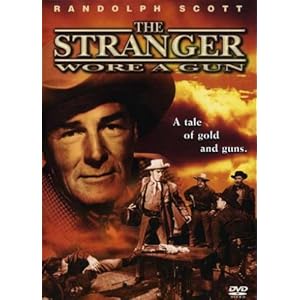
The Stranger Wore a Gun
While many movies in the 1950s tried to offer something that television simply couldn't match, many westerns dug their heels in and refused to change/adjust. The result? A lot of straightforward, traditional efforts that were like most westerns released over the previous 20-plus years. If you haven't figured it out, none of this is particularly positive, like 1953's The Stranger Wore a Gun, a B-western in every regard.
After the bloody raid on Lawrence, Kansas by William Quantrill, Confederate rider Jeff Travis (Randolph Scott) leaves Quantrill's raiders and heads west. But even after the end of the Civil War, the memory persists in his head, and more importantly, so does the stigma of being one of Quantrill's guerrilla riders. Wanted for a murder he didn't commit, Travis heads to Prescott, Arizona on the advice of long-time friend, Josie (Claire Trevor). He finds a job with a former Confederate soldier who wants the Confederacy to live on, Jules Mourret (George Macready), but finds out quickly that Jules is willing to go to some dark places to accomplish his goal. For Travis though, it could be too late to make a change.
With so many 1950s westerns, I feel like my reviews lean toward cookie-cutter. They're the same thing over and over again, just changing the names and places. Like so many 1950s westerns, 'Stranger' has its good and bad, but the biggest thing is that nothing at all is particularly memorable. Director Andre De Toth goes about his job with workmanlike precision, telling a familiar story that doesn't throw anything new at the viewer. The stories are forgettable, the characters interchangeable, and if you've got more than two or three functioning brain cells, you know how it's going to end before it started. Some of the California locations look very nice here, but it does absolutely nothing to distinguish it from the thousands of other westerns you could watch. Not bad, not good, and not memorable in the least.
Starring in many of these westerns was Randolph Scott, a stout, resolute western hero in that second rung of western stars. His biggest problem? Unless he was working with directors like Budd Boetticher and Sam Peckinpah, his typically solid lead parts were lost in a sea of bad B-movies. Playing Jeff Travis, he's one of the better things going for 'Stranger.' His motivations aren't always explained -- he's running from his Confederate past by working for a Confederate trying to revive the Confederacy?....right -- but in a sea of mediocrity, his performance stands out. Trevor does what she does best, playing the damaged society woman, Macready is an average at best villain, and Joan Weldon plays a wooden requisite pretty girl (another trademark of a low budget 1950s western) that Scott's Travis must decide if he really loves, with Pierre Watkin playing her father.
Enough beating around the bush, let's get to some negatives! Anyone who's seen Treasure of the Sierra Madre is familiar with the infamous 'We don't need no stinking badges!' line delivered by bandit chief Rodolfo Bedoya. Instead of one well-handled scene, he gets a much bigger role here with a similar character, the stereotypes amped up....a lot. His "portrayal" of Degas, a Mexican bandit and gang leader, is laughable and painful to watch. He laughs hysterically for no apparent reason at least three different times, and speaks in an odd variation of Spanglish. His sidekick, Shorty (Joseph Vitale), is just as bad, speaking in halted, quasi-threatening tones. Way, way too much of a good thing here. Also worth mentioning -- I suppose -- is the 3-D filming technique. We get guns "fired at" the camera, not to mention torches, punches, vases, you name it, thrown at us. Oooohhhh, startling! There's also a bizarre technique where rocks/brush are placed in front of stock footage, apparently to make it look more realistic? I guess. I can't come up with anything else. It's bad. That's what I'm going for.
One positive -- however small -- with many of these 1950s westerns is that future stars who shot to fame in the 1960s got their start with supporting roles. Here in 'Stranger' there's Lee Marvin and Ernest Borgnine as Kurth and Slager, two of Jules' henchmen. Hindsight is 20-20, but it's clear the talent they're working with even in supporting roles. Not a ton to recommend overall, and maybe I'm reaching for straws, but something's got to get you through these B-movies.
The Stranger Wore a Gun <---TCM trailer (1958): **/****
After the bloody raid on Lawrence, Kansas by William Quantrill, Confederate rider Jeff Travis (Randolph Scott) leaves Quantrill's raiders and heads west. But even after the end of the Civil War, the memory persists in his head, and more importantly, so does the stigma of being one of Quantrill's guerrilla riders. Wanted for a murder he didn't commit, Travis heads to Prescott, Arizona on the advice of long-time friend, Josie (Claire Trevor). He finds a job with a former Confederate soldier who wants the Confederacy to live on, Jules Mourret (George Macready), but finds out quickly that Jules is willing to go to some dark places to accomplish his goal. For Travis though, it could be too late to make a change.
With so many 1950s westerns, I feel like my reviews lean toward cookie-cutter. They're the same thing over and over again, just changing the names and places. Like so many 1950s westerns, 'Stranger' has its good and bad, but the biggest thing is that nothing at all is particularly memorable. Director Andre De Toth goes about his job with workmanlike precision, telling a familiar story that doesn't throw anything new at the viewer. The stories are forgettable, the characters interchangeable, and if you've got more than two or three functioning brain cells, you know how it's going to end before it started. Some of the California locations look very nice here, but it does absolutely nothing to distinguish it from the thousands of other westerns you could watch. Not bad, not good, and not memorable in the least.
Starring in many of these westerns was Randolph Scott, a stout, resolute western hero in that second rung of western stars. His biggest problem? Unless he was working with directors like Budd Boetticher and Sam Peckinpah, his typically solid lead parts were lost in a sea of bad B-movies. Playing Jeff Travis, he's one of the better things going for 'Stranger.' His motivations aren't always explained -- he's running from his Confederate past by working for a Confederate trying to revive the Confederacy?....right -- but in a sea of mediocrity, his performance stands out. Trevor does what she does best, playing the damaged society woman, Macready is an average at best villain, and Joan Weldon plays a wooden requisite pretty girl (another trademark of a low budget 1950s western) that Scott's Travis must decide if he really loves, with Pierre Watkin playing her father.
Enough beating around the bush, let's get to some negatives! Anyone who's seen Treasure of the Sierra Madre is familiar with the infamous 'We don't need no stinking badges!' line delivered by bandit chief Rodolfo Bedoya. Instead of one well-handled scene, he gets a much bigger role here with a similar character, the stereotypes amped up....a lot. His "portrayal" of Degas, a Mexican bandit and gang leader, is laughable and painful to watch. He laughs hysterically for no apparent reason at least three different times, and speaks in an odd variation of Spanglish. His sidekick, Shorty (Joseph Vitale), is just as bad, speaking in halted, quasi-threatening tones. Way, way too much of a good thing here. Also worth mentioning -- I suppose -- is the 3-D filming technique. We get guns "fired at" the camera, not to mention torches, punches, vases, you name it, thrown at us. Oooohhhh, startling! There's also a bizarre technique where rocks/brush are placed in front of stock footage, apparently to make it look more realistic? I guess. I can't come up with anything else. It's bad. That's what I'm going for.
One positive -- however small -- with many of these 1950s westerns is that future stars who shot to fame in the 1960s got their start with supporting roles. Here in 'Stranger' there's Lee Marvin and Ernest Borgnine as Kurth and Slager, two of Jules' henchmen. Hindsight is 20-20, but it's clear the talent they're working with even in supporting roles. Not a ton to recommend overall, and maybe I'm reaching for straws, but something's got to get you through these B-movies.
The Stranger Wore a Gun <---TCM trailer (1958): **/****
Labels:
1950s,
Andre De Toth,
Claire Trevor,
Ernest Borgnine,
Lee Marvin,
Randolph Scott,
westerns
Wednesday, March 16, 2011
The Desperadoes
One of my biggest pet peeves with westerns is female characters added to the story for the sake of having a female character. Beyond just being eye candy and something nice to look at (I didn't intend that as sexist as it sounds), the character serves no real purpose. Yes, they might provide a secondary storyline that has them falling for one of the heroes, but generally, they are there to be saved, the damsel in distress. One of the few actresses to make a positive impression in a western for me is Claire Trevor. She's beautiful but tough and always held her own with the guys.
Unfortunately the timing of me watching 1943's The Desperadoes wasn't that great with Trevor playing a key supporting role. The casting isn't the question, and the western itself isn't that bad. Basically though, it just has too many similarities with 1941's Texas which I reviewed yesterday. I felt like I was watching the same movie for a second time. Similar cast, similar backstory, and overall a feeling of been there, done that. It's not awful by any means, but it's not that good either.
It's 1863 in Red Valley, Utah when the bank is robbed by a gang that murders three people in the process. The bank owner, Clanton (Porter Hall) and the local mailman, Uncle Willie (Edgar Buchanan), pulled an inside job, netting almost $80,000 in the process. The plan though was altered because the man originally hired to do it, Cheyenne Rogers (Glenn Ford), couldn't make it in time. Now, he's arrived in town only to find that an old friend is the town sheriff, Steve Upton (Randolph Scott), is searching for the actual robbers. Worried that they will be exposed for stealing money from the townspeople, Clanton and Willie go about setting up another plan that will pit Cheyenne against Steve in hopes of covering up everything.
It is the rare western I won't be able to find something to recommend. Some are just harder than others finding that positive aspect. The Desperadoes is somewhere in between. Ford and Scott working together is a pleasure to watch even if the script puts them in the stupidest, most implausible situations around. This was Columbia Pictures' first color feature, and it looks great with the Utah locations really coming to life. Trevor does what she does best, the somewhat scandalized woman (think a higher class Dallas from Stagecoach) caught in a tricky situation. Her character isn't essential to the story, but she makes her presence known immediately. Her scenes with Ford and Guinn Williams are a high point, the few scenes that use both drama and comedy effectively.
As I watched this movie, I thought of another pet peeve that isn't exclusive to westerns. It's just laziness on the part of someone involved in the production whether that be the screenwriter, the producer or the director. A title card introduces the situation, explaining that 1863 Utah is struggling with little money available in the territory. For some reason, the setting is key, but I can't figure out why. If it's 1863, why is the Union army driving a herd of horses west away from the fighting with the Confederacy? Wouldn't it make sense to go the other way? Then later, a character says a horse stampede will make this town feel like Custer's Last Stand. So a throwaway line ends up predicting the future? If it is 1863, why is this town yokel aware that Custer is going to be massacred some 13 years later? Yes, these are little things, but they're all something that easily could have been fixed. Make a movie, and make sure you get the details right. Lazy when it comes to spending millions of dollars is inexcusable.
Maybe I've just been ruined by the cynicism of spaghetti westerns and American westerns from the 1960s, but westerns from the 1930s and 1940s drive me nuts more and more of late. They walk that middle line that tries to please everyone. Comedy, drama, and romance are all there. Ford and Scott vie for the affections of Buchanan's daughter, Allison (Evelyn Keyes), always keeping it fair with an 'Aw, shucks, you take her!' mentality. Williams is painful to watch as dimwitted sidekick Nitro, the attempts at humor falling far short of succeeding. Then there's the story with Ford's Cheyenne wanted with a $10,000 bounty on his head. We never find out what he did, but he's wanted nonetheless. Scott's sheriff seems less than interested that his old friend may be a crook so I guess we're supposed to look past it in the end too.
Not much else to say here. The story winds around a lot without ever getting anyplace interesting. The talent of Scott, Trevor, and Ford only takes the movie so far. I've seen much, much worse westerns, but I can't give this a positive review. It's just not good enough.
The Desperadoes (1943): **/****
Unfortunately the timing of me watching 1943's The Desperadoes wasn't that great with Trevor playing a key supporting role. The casting isn't the question, and the western itself isn't that bad. Basically though, it just has too many similarities with 1941's Texas which I reviewed yesterday. I felt like I was watching the same movie for a second time. Similar cast, similar backstory, and overall a feeling of been there, done that. It's not awful by any means, but it's not that good either.
It's 1863 in Red Valley, Utah when the bank is robbed by a gang that murders three people in the process. The bank owner, Clanton (Porter Hall) and the local mailman, Uncle Willie (Edgar Buchanan), pulled an inside job, netting almost $80,000 in the process. The plan though was altered because the man originally hired to do it, Cheyenne Rogers (Glenn Ford), couldn't make it in time. Now, he's arrived in town only to find that an old friend is the town sheriff, Steve Upton (Randolph Scott), is searching for the actual robbers. Worried that they will be exposed for stealing money from the townspeople, Clanton and Willie go about setting up another plan that will pit Cheyenne against Steve in hopes of covering up everything.
It is the rare western I won't be able to find something to recommend. Some are just harder than others finding that positive aspect. The Desperadoes is somewhere in between. Ford and Scott working together is a pleasure to watch even if the script puts them in the stupidest, most implausible situations around. This was Columbia Pictures' first color feature, and it looks great with the Utah locations really coming to life. Trevor does what she does best, the somewhat scandalized woman (think a higher class Dallas from Stagecoach) caught in a tricky situation. Her character isn't essential to the story, but she makes her presence known immediately. Her scenes with Ford and Guinn Williams are a high point, the few scenes that use both drama and comedy effectively.
As I watched this movie, I thought of another pet peeve that isn't exclusive to westerns. It's just laziness on the part of someone involved in the production whether that be the screenwriter, the producer or the director. A title card introduces the situation, explaining that 1863 Utah is struggling with little money available in the territory. For some reason, the setting is key, but I can't figure out why. If it's 1863, why is the Union army driving a herd of horses west away from the fighting with the Confederacy? Wouldn't it make sense to go the other way? Then later, a character says a horse stampede will make this town feel like Custer's Last Stand. So a throwaway line ends up predicting the future? If it is 1863, why is this town yokel aware that Custer is going to be massacred some 13 years later? Yes, these are little things, but they're all something that easily could have been fixed. Make a movie, and make sure you get the details right. Lazy when it comes to spending millions of dollars is inexcusable.
Maybe I've just been ruined by the cynicism of spaghetti westerns and American westerns from the 1960s, but westerns from the 1930s and 1940s drive me nuts more and more of late. They walk that middle line that tries to please everyone. Comedy, drama, and romance are all there. Ford and Scott vie for the affections of Buchanan's daughter, Allison (Evelyn Keyes), always keeping it fair with an 'Aw, shucks, you take her!' mentality. Williams is painful to watch as dimwitted sidekick Nitro, the attempts at humor falling far short of succeeding. Then there's the story with Ford's Cheyenne wanted with a $10,000 bounty on his head. We never find out what he did, but he's wanted nonetheless. Scott's sheriff seems less than interested that his old friend may be a crook so I guess we're supposed to look past it in the end too.
Not much else to say here. The story winds around a lot without ever getting anyplace interesting. The talent of Scott, Trevor, and Ford only takes the movie so far. I've seen much, much worse westerns, but I can't give this a positive review. It's just not good enough.
The Desperadoes (1943): **/****
Labels:
1940s,
Claire Trevor,
Glenn Ford,
Guinn Williams,
Randolph Scott,
westerns
Tuesday, March 15, 2011
Texas (1941)
Through the late 1940s and into the 1950s and 1960s, two of the most reliable, bankable stars in Hollywood were William Holden and Glenn Ford. But everyone has got to start somewhere, right? I've seen movies with both actors, but a majority of them were from the 1950s and 1960s when they were already established stars. As very young-looking youngsters in 1941, they worked together on an odd but entertaining western simply titled Texas.
It can be fun with movies like this seeing stars before they were stars. For one here with Texas, both Holden and Ford look like they're fresh out of high school. Holden was just 23 years old, and Ford not too much older at 25 when the movie was made. Through all the exaggerated comedy, rambling story and over-reliance on stock footage, that is what makes Texas bearable. Long before either man was a household name, the young acting duo shows off the talent that audiences would come to love and expect in future roles.
The Civil War has ended and two cavalry troopers from Jeb Stuart's forces, Dan Thomas (Holden) and Tod Ramsey (Ford), are drifting west. They find themselves in Abilene on their way further south to Texas and all its riches when they see a stagecoach being robbed. They turn the tables and rob the robbers, but through a miscommunication end up being chased by a posse. With little hope of getting away, they separate and make a getaway on their own. Time passes as Dan latches on with a group of rustlers harassing every herd that heads north while Tod signs on as a foreman at a well-to-do cattle ranch. Their paths seem destined to cross again, especially when both men have an interest in a beautiful rancher's daughter, Mike (Claire Trevor). Is their friendship going to last or will it be torn apart?
Director George Marshall turns in an odd, all over the place finished product with this 1941 western. At just 93 minutes, a ton of story is packed into a relatively quick running time. That description above doesn't quite do it justice because there is much, much more going on. It is an odd mix of a brotherly relationship in the west, slapstick comedy that is painful to watch at times, the always excruciating love triangle, way too much stock footage, and a story that is far too choppy at times, ending up playing like an hour-long serial instead of a feature length movie. I don't know if a longer movie would have helped to flesh things out, but it couldn't have hurt.
I've never been much for comedic westerns with the exceptions of spoofs like Blazing Saddles that pull out all the stops. If you're going to make it funny, go all the way. Don't make a comedic drama (if that makes any sense). An early scene introduces us to Dan and Tod which is fine. A departure from the set-up or a jumping off point for what's to come is fine if it helps us get to know the characters. An old school boxing match has Dan getting whaled on for 50 or 60 rounds that feels like it actually goes on that long. With a short 93-minute movie like this, it's too much. Also in the comedy department, Edgar Buchanan (usually one of my favorite character actors) hams it up as a conniving dentist who happens to be the villain too, making evil, despicable decisions one after another. He is funny with that quiet, raspy stream of conscious talking, but next thing you know he's planning to shoot everyone around him. Separately it could have worked, but together it never fits.
While it may not seem like it, I did enjoy Texas. Holden and Ford are always watchable even in their weakest efforts, and this isn't one of them. The brother relationship in movies is as old as westerns themselves. They're close and have bonded through the hellacious situations they've survived together. Eventually, something is going to tear them apart, forcing them to either fight it out or knuckle under and run. Holden especially has some fun with the Dan Thomas part, the cowboy who will turn wherever there's money available. It's the part that Holden would make his bread and butter, the lovable rogue. Ford's part is more vanilla, the generic good guy who always makes the right decision no matter the consequences. Still, the movie is at its best when they duo is on-screen together.
Filmed in black and white, Marshall relies too much on stock footage, especially late with an epic cattle drive heading to Abilene. As for the love triangle, it doesn't make a ton of sense how it develops, but with Trevor working with Holden and Ford, it isn't as bad as so many other love triangles are. For a story that rambles as much as it does from one place to another with no real end in sight, the finale comes together quite quickly. I would have liked this story much more with a few slight changes. Add maybe 15 minutes, take out the comedy, and thin out the stock footage. The talent in the acting department and the story has potential to be something better. Even then, I still liked the movie, but I didn't love it.
Texas (1941): ** 1/2 /****
It can be fun with movies like this seeing stars before they were stars. For one here with Texas, both Holden and Ford look like they're fresh out of high school. Holden was just 23 years old, and Ford not too much older at 25 when the movie was made. Through all the exaggerated comedy, rambling story and over-reliance on stock footage, that is what makes Texas bearable. Long before either man was a household name, the young acting duo shows off the talent that audiences would come to love and expect in future roles.
The Civil War has ended and two cavalry troopers from Jeb Stuart's forces, Dan Thomas (Holden) and Tod Ramsey (Ford), are drifting west. They find themselves in Abilene on their way further south to Texas and all its riches when they see a stagecoach being robbed. They turn the tables and rob the robbers, but through a miscommunication end up being chased by a posse. With little hope of getting away, they separate and make a getaway on their own. Time passes as Dan latches on with a group of rustlers harassing every herd that heads north while Tod signs on as a foreman at a well-to-do cattle ranch. Their paths seem destined to cross again, especially when both men have an interest in a beautiful rancher's daughter, Mike (Claire Trevor). Is their friendship going to last or will it be torn apart?
Director George Marshall turns in an odd, all over the place finished product with this 1941 western. At just 93 minutes, a ton of story is packed into a relatively quick running time. That description above doesn't quite do it justice because there is much, much more going on. It is an odd mix of a brotherly relationship in the west, slapstick comedy that is painful to watch at times, the always excruciating love triangle, way too much stock footage, and a story that is far too choppy at times, ending up playing like an hour-long serial instead of a feature length movie. I don't know if a longer movie would have helped to flesh things out, but it couldn't have hurt.
I've never been much for comedic westerns with the exceptions of spoofs like Blazing Saddles that pull out all the stops. If you're going to make it funny, go all the way. Don't make a comedic drama (if that makes any sense). An early scene introduces us to Dan and Tod which is fine. A departure from the set-up or a jumping off point for what's to come is fine if it helps us get to know the characters. An old school boxing match has Dan getting whaled on for 50 or 60 rounds that feels like it actually goes on that long. With a short 93-minute movie like this, it's too much. Also in the comedy department, Edgar Buchanan (usually one of my favorite character actors) hams it up as a conniving dentist who happens to be the villain too, making evil, despicable decisions one after another. He is funny with that quiet, raspy stream of conscious talking, but next thing you know he's planning to shoot everyone around him. Separately it could have worked, but together it never fits.
While it may not seem like it, I did enjoy Texas. Holden and Ford are always watchable even in their weakest efforts, and this isn't one of them. The brother relationship in movies is as old as westerns themselves. They're close and have bonded through the hellacious situations they've survived together. Eventually, something is going to tear them apart, forcing them to either fight it out or knuckle under and run. Holden especially has some fun with the Dan Thomas part, the cowboy who will turn wherever there's money available. It's the part that Holden would make his bread and butter, the lovable rogue. Ford's part is more vanilla, the generic good guy who always makes the right decision no matter the consequences. Still, the movie is at its best when they duo is on-screen together.
Filmed in black and white, Marshall relies too much on stock footage, especially late with an epic cattle drive heading to Abilene. As for the love triangle, it doesn't make a ton of sense how it develops, but with Trevor working with Holden and Ford, it isn't as bad as so many other love triangles are. For a story that rambles as much as it does from one place to another with no real end in sight, the finale comes together quite quickly. I would have liked this story much more with a few slight changes. Add maybe 15 minutes, take out the comedy, and thin out the stock footage. The talent in the acting department and the story has potential to be something better. Even then, I still liked the movie, but I didn't love it.
Texas (1941): ** 1/2 /****
Labels:
1940s,
Claire Trevor,
George Marshall,
Glenn Ford,
westerns,
William Holden
Sunday, March 6, 2011
Dead End
I knew them only by name for years, seeing them pop up in the TCM schedule occasionally on Saturday mornings. I had little interest in seeing any of the movies mostly because they sounded pretty awful, but also because movies from the 1930s are so hit or miss. It's that in between stage where feature films too often felt like larger scale plays as studios dealt with how to make silent movies into sound pictures. Dubbed the Dead End Kids, this "tough" group of child/teenage actors became huge stars under a couple different names, but if 1937's Dead End is any indication of their stardom, I'm going to continue to steer clear of them.
This is a movie based on a successful stage-based play that has the potential to make the jump from stage to film, but it was a painful movie for me to get through. There are three different storylines all working against one another -- including the most painful, the Dead End kids -- and never really giving any reason for any one of them to be interesting. It's a story that follows the goings and happenings on a warm summer day in New York City, a street at a junction where the rich live on one side in their posh, high-rise apartments and the poor in their ratty, decrepit apartments. Oh, the rich and the poor, prepare yourself for a pretentious message on the classes! Eh, maybe not. I don't think this movie could have managed a message if it wanted.
It's a humid, nasty NYC summer day when a man returns to the street he grew up on. He's gone on to other things, earning the nickname Baby Face Martin (Humphrey Bogart). As a gangster/killer out west, Martin's supposedly killed eight people, but he's back now and he wants to see his mother (Marjorie Main) and his old girlfriend, Francie (Claire Trevor). An out of work architect, Dave (Joel McCrea), grew up with Martin and recognizes him, encouraging him to move along before any trouble arises. Then down at the end of the street near the river, a gang of kids and teenagers, the Dead End Kids, harass a doorman to a posh apartment and generally cause mayhem whenever they can because...well, they're idiots.
Let's get the positive (yes, singular) out of the way first because it won't take long. This is Humphrey Bogart before he was a big star, before he was a household name. In the 1930s, he often played tough guy supporting roles, similar to the ones he would play later but from a leading role. His talent though is obvious whether it be in a starring role or from a supporting part. It's too bad his part is smaller here, not requiring much of him other than wearing a suit, smoking an occasional cigarette and generally looking tough. He goes 3-for-3 in that department by the way. Unfortunately, much of the focus is on the other two plots that do end up crossing paths with Bogie's, but not enough.
Instead, we get lots of interaction with the Dead End Kids, a "tough" street gang of kids/teenagers who like to cause havoc wherever they go. I'm not going to break each character down one by one because they're all interchangeable. They've got tough street names like Tommy, Spit, T.B. (because he's got tuberculosis...haha that's hilarious), and Milty. A typical conversation goes something like this. "Oh, yeah?!?"...."Yeah!"....."Yeah?!?"...."Well say that again!"...."Oh yeah," and then they push and shove for awhile before running away from a doorman or a cop or an adult. Listening to these teen actors attempt their awful New York accents is like nails on a chalkboard. Any time they come on screen is nauseating and quickly had me reaching for the fast forward. Awful, awful stuff. How this act appealed to audiences I'll never know.
So on to our intrepid hero, Joel McCrea playing Dave, an out of work architect who now takes odd jobs around town for some cash. As we meet him, he's painting a sign for a faux-Italian restaurant, and getting a good chuckle out of it at that. He's currently going out with rich babe, Kay (Wendy Barrie), but also knows that regular girl, Drina (Sylvia Sidney), has a crush on him. Oh, also, Drina's little brother is one of the Dead End Kids....oh no! More drama! Basically, Dave has nothing going for him, and he has this pretentious air about him that makes him the guardian of this street. He's the most milquetoast main character/hero I can think of, and because of that, I ended up liking Bogie's killer more than McCrea. None of this is a criticism of McCrea who I think is a fine actor, but this is not his best part.
Okay, there were a couple more positives to take away, however small they may have been. Playing the doorman to the swanky rich person apartment is Ward Bond, future member of the John Ford stock company and all around good tough guy actor. He's one of my all-time favorite character actors, and even seeing him for a few scenes here and there made this movie more memorable. Also, the studio set is pretty cool, claustrophobic and cluttered, making the setting interesting at least if not the goings-on. A pretty bad movie overall, and one I won't be revisiting anytime soon.
Dead End <---trailer (1937): */****
This is a movie based on a successful stage-based play that has the potential to make the jump from stage to film, but it was a painful movie for me to get through. There are three different storylines all working against one another -- including the most painful, the Dead End kids -- and never really giving any reason for any one of them to be interesting. It's a story that follows the goings and happenings on a warm summer day in New York City, a street at a junction where the rich live on one side in their posh, high-rise apartments and the poor in their ratty, decrepit apartments. Oh, the rich and the poor, prepare yourself for a pretentious message on the classes! Eh, maybe not. I don't think this movie could have managed a message if it wanted.
It's a humid, nasty NYC summer day when a man returns to the street he grew up on. He's gone on to other things, earning the nickname Baby Face Martin (Humphrey Bogart). As a gangster/killer out west, Martin's supposedly killed eight people, but he's back now and he wants to see his mother (Marjorie Main) and his old girlfriend, Francie (Claire Trevor). An out of work architect, Dave (Joel McCrea), grew up with Martin and recognizes him, encouraging him to move along before any trouble arises. Then down at the end of the street near the river, a gang of kids and teenagers, the Dead End Kids, harass a doorman to a posh apartment and generally cause mayhem whenever they can because...well, they're idiots.
Let's get the positive (yes, singular) out of the way first because it won't take long. This is Humphrey Bogart before he was a big star, before he was a household name. In the 1930s, he often played tough guy supporting roles, similar to the ones he would play later but from a leading role. His talent though is obvious whether it be in a starring role or from a supporting part. It's too bad his part is smaller here, not requiring much of him other than wearing a suit, smoking an occasional cigarette and generally looking tough. He goes 3-for-3 in that department by the way. Unfortunately, much of the focus is on the other two plots that do end up crossing paths with Bogie's, but not enough.
Instead, we get lots of interaction with the Dead End Kids, a "tough" street gang of kids/teenagers who like to cause havoc wherever they go. I'm not going to break each character down one by one because they're all interchangeable. They've got tough street names like Tommy, Spit, T.B. (because he's got tuberculosis...haha that's hilarious), and Milty. A typical conversation goes something like this. "Oh, yeah?!?"...."Yeah!"....."Yeah?!?"...."Well say that again!"...."Oh yeah," and then they push and shove for awhile before running away from a doorman or a cop or an adult. Listening to these teen actors attempt their awful New York accents is like nails on a chalkboard. Any time they come on screen is nauseating and quickly had me reaching for the fast forward. Awful, awful stuff. How this act appealed to audiences I'll never know.
So on to our intrepid hero, Joel McCrea playing Dave, an out of work architect who now takes odd jobs around town for some cash. As we meet him, he's painting a sign for a faux-Italian restaurant, and getting a good chuckle out of it at that. He's currently going out with rich babe, Kay (Wendy Barrie), but also knows that regular girl, Drina (Sylvia Sidney), has a crush on him. Oh, also, Drina's little brother is one of the Dead End Kids....oh no! More drama! Basically, Dave has nothing going for him, and he has this pretentious air about him that makes him the guardian of this street. He's the most milquetoast main character/hero I can think of, and because of that, I ended up liking Bogie's killer more than McCrea. None of this is a criticism of McCrea who I think is a fine actor, but this is not his best part.
Okay, there were a couple more positives to take away, however small they may have been. Playing the doorman to the swanky rich person apartment is Ward Bond, future member of the John Ford stock company and all around good tough guy actor. He's one of my all-time favorite character actors, and even seeing him for a few scenes here and there made this movie more memorable. Also, the studio set is pretty cool, claustrophobic and cluttered, making the setting interesting at least if not the goings-on. A pretty bad movie overall, and one I won't be revisiting anytime soon.
Dead End <---trailer (1937): */****
Labels:
1930s,
Claire Trevor,
Humphrey Bogart,
Joel McCrea,
Ward Bond
Subscribe to:
Posts (Atom)