Some movies should just have been better. That's all. Good cast, cool story, lots of potential....and then they're not very good. That's what I thought with 1955's Bengazi. It starts off strong and then it just fizzles....quickly.
A World War II veteran who served in Africa, John Gillmore (Richard Conte) owns half of a bar in Bengazi co-owned by an aging Irishman, Robert Donovan (Victor McLaglen). Gillmore is involved in all sorts of black market deals, especially running guns, and consistently stays ahead of the local police detective, Inspector Levering (Richard Carlson). His most recent crime? He stole a jeep mounted with a machine gun from the British motor pool. He has a plan in place, working with a recently released convict, Selby (Richard Erdman), who knows the location of a hidden gold treasure at an abandoned mosque in the desert. Gillmore enlists Donovan's help with the promise of a huge payday in the end -- dangerous road aside -- but their plan has a wrench thrown in it when Donovan's daughter (Mala Powers) arrives in Bengazi to visit her father she hasn't seen in over 15 years.
A B-movie from director John Brahm, 'Bengazi' clocks in at 79 minutes, seemingly a perfect length for a relatively cheap flick. Well, that's what I figured at least. After some early potential, this movie derailed quickly and never recovers. As I've said, cheap/low budget doesn't mean bad....but, yeah, the cheap ends up impacting this one in the end. The disparate quasi-refugees and crooks working together in a crime-ridden foreign city, a suicidal mission with touches of countless westerns and war movies -- including The Lost Patrol, which McLaglen starred in -- are all archetypal stories and situations that never amount to much in the end. By the end, things are just thrown at the wall hoping some of them stick. Most don't.
If there's the remotest semblance of a positive here it comes from the cast. That doesn't mean it's good, but there's certainly some interesting casting. I like Conte, a solid character actor who never became a star so it's cool to see him in a leading role. The script does him no favors in a painfully forced subplot with Powers as Donovan's daughter, Aileen, falls madly in love with him and vice versa. They have no chemistry but are instantly in love in a dangerous situation. Gag. Late in his career, McLaglen hams it up like his life depends on it, but it's Victor McLaglen so that can be fun even when it's bad. Carlson inexplicably has a brutal Scottish accent, his Levering just an odd character in the end. Erdman is underused as the slithery Selby while Pedro Gonzalez Gonzalez, Jay Novello and Maurice Hill have small supporting parts.
I wanted to like this one. The cast is pretty cool and that premise was interesting if somewhat familiar. After traveling across the desert, Gillmore, Donovan and Selby find the abandoned mosque near a desert oasis, but they're not alone, Bedouin tribesmen hovering just beyond the horizon in an effort to protect their hidden gold. Gillmore reveals a machine gun as protection and the trio wait for help. Wouldn't you know it? Levering shows up with his assistant and Aileen...because, well, we need some love tension, not because that move makes any sense in the real world. From there, it's a matter of who will survive, if anyone. We never see the Bedouin tribesmen other than a late reveal -- budget restrictions I'm assuming -- but that sense of danger never permeates the story. Yeah, they're there in the dunes, but when there's no interest in the characters, who cares who makes it?
By the end, the bodies pile up -- Conte calling his machine gun "Baby" -- but things degenerate into painfully slow, downright dull dialogue scenes and the always unbearable love triangle. Who will Aileen pick?!? The roguish Gillmore or the reliable Levering?!? Bleck. Just steer clear of this dud, solid cast and premise aside.
Bengazi (1955): */****
The Sons of Katie Elder
"First, we reunite, then find Ma and Pa's killer...then read some reviews."
Showing posts with label Richard Conte. Show all posts
Tuesday, April 15, 2014
Saturday, April 13, 2013
Ocean's Eleven (1960)
One of my favorite movies from the 2000s, I love 2001's Ocean's Eleven. I'm no dummy though, and I remember stating that the 2001 remake was better than the original. Well, it took me a little while -- okay, well over a year, but who's counting? -- but I'm revisiting that statement. Was I right or wrong? Maybe somewhere in between? Let's get started with the Rat Pack original, 1960's Ocean's Eleven.
A former paratrooper with countless daring, behind the lines missions under his belt during World War II, Danny Ocean (Frank Sinatra) has moved on with his life, but some 15 years since the end of the war, he's got a plan. The catch? He needs help from his old army buddies to pull off a daring heist. Ocean gets the group together, including Sam Harmon (Dean Martin), Jimmy Foster (Peter Lawford), and Josh Howard (Sammy Davis Jr.) among others, and lays out the plan for them. Just a few days away, Ocean and Co. plan on hitting five of Las Vegas's biggest casinos on New Year's Eve when the vaults are packed to the gills with money. Could it work? The plan depends on to-the-second timing, teamwork and countless little details, maybe even a little luck. It sounds like an impossible plan, but Ocean's crew might be crazy enough to pull it off.
Starting in the mid 1950s, Sinatra, Martin, Davis Jr., Lawford and Joey Bishop teamed up to star in movies that are simply known as....Rat Pack movies. Classic cinema they are not, but they are basically the definition of a good popcorn flick. Just sit back and enjoy them. Of all the Rat Pack movies though, this one is the best by far. Lewis Milestone directs, but his job is basically to get Sinatra and the boys on the right track and let them go. In that sense, he hits it out of the park. It is a vastly different movie than the 2001 remake which is really a remake in name and basic premise alone. The script, the heist, and the Vegas setting are all a means to an end. If you like Sinatra, Martin or any of the Rat Pack, you will enjoy this movie.
Singing or performing on stage, starring in movies, the Rat Pack had an innate chemistry that most entertainers dream of having. So cutting away a lot of other things, this movie is about the Packers hanging out, drinking some liquor, smoking a lot of cigarettes and wearing impeccably cool suits. Is it self-indulgent? Yes, basically the definition of self-indulgent. If you're a fan of Sinatra, Martin or any of the guys, this is the movie for you. It's genuinely funny with plenty of quick, snappy dialogue, lots of one-liners that don't feel like a script. It feels like it is a bunch of friends hanging out busting each other. Oh, and they happen to be planning an epic casino robbery too so they've got that going for them.
One of the biggest differences between the 1960 original and the 2001 remake is the background. Made 15 years after the end of WWII, the paratroopers angle is pretty cool. Sinatra's Danny is the sergeant, Lawford the entitled officer, Martin's Sam the soldier who saved Danny's life and best friend, and so on. Along with Davis. Jr as Josh and Bishop as Mushy, Danny's crew includes Richard Conte as Tony, just out of prison and looking to provide for his son, Henry Silva as smooth, quick-talking Roger, Buddy Lester as Vince, the former club bouncer with an in, Richard Benedict as Curly, Norman Fell as Peter, the explosives specialist, and Clem Harvey as Jackson, the drawling cowboy. Like the best men-on-a-mission movies, there's something inherently cool about a group of specialists working together to pull of an impossible job. When you actually like some of the group? That's even better, like a fastball down the middle.
Not surprisingly, the focus here is on Danny's crew, but the rest of the cast is pretty solid. Angie Dickinson plays Beatrice, Danny's wife who's working through some issues with her always moving husband. Cesar Romero is Duke Santos, a well-connected former gangster who stumbles into Ocean's plan and who happens to be engaged to Jimmy's mother (Ilka Chase). Akim Tamiroff gets a lot of laughs as Spyros, the ex-con who concocted the casino heist but can't come up with the details, turning to Danny for that part. Also look for Red Skelton playing himself in a casino scene, frustrated and wanting more money, and George Raft as a casino head in a strategy session. Even look for an uncredited Shirley MacLaine as a drunken New Year's Eve partygoer who meets Martin's Sam during the heist. And lastly, listen for Richard Boone providing his voice talents in a key scene late, even if he never appears on-screen.
I loved the style from this 1960 heist movie, and that doesn't come as a surprise considering the talent involved. The credits sequence from Saul Bass gets things going nicely. Watch it HERE, composer Nelson Riddle's score playing as accompaniment. Much of the film was shot on location in Las Vegas, and who would have thought? 1960 Vegas looks amazingly fun, like a time capsule into a smooth, cool era. Even the indoor sets look cheesy, but they're cool cheesy. The heist itself is pretty cool if a little more simplistic than the 2001 remake (Damn technology!). As most heist films will tell you though, it's the post-robbery stuff that's the issue. It's Vegas in the middle of the desert. How do you escape or hide the money? The ending delivers a couple great twists, especially the final one that sets up a very cool, very stylish final scene as Ocean's Eleven walk along the Vegas strip.
There is a simple, stylish elegance to this movie. Is it a classic film, an example of great cinema? No, but in terms of pure entertainment value, it's hard to beat. The scene where the crew discuss the upcoming heist in Spyros' well-decorated man cave is epically cool, Ocean's Eleven huddled around the pool table discussing the ins and outs of the heist. It's a fun, cool and entertaining movie that's a prime example of the style of a past era in Hollywood. The Rat Pack is cool. If you agree, you'll like this movie.
Ocean's Eleven (1960): ****/****
A former paratrooper with countless daring, behind the lines missions under his belt during World War II, Danny Ocean (Frank Sinatra) has moved on with his life, but some 15 years since the end of the war, he's got a plan. The catch? He needs help from his old army buddies to pull off a daring heist. Ocean gets the group together, including Sam Harmon (Dean Martin), Jimmy Foster (Peter Lawford), and Josh Howard (Sammy Davis Jr.) among others, and lays out the plan for them. Just a few days away, Ocean and Co. plan on hitting five of Las Vegas's biggest casinos on New Year's Eve when the vaults are packed to the gills with money. Could it work? The plan depends on to-the-second timing, teamwork and countless little details, maybe even a little luck. It sounds like an impossible plan, but Ocean's crew might be crazy enough to pull it off.
Starting in the mid 1950s, Sinatra, Martin, Davis Jr., Lawford and Joey Bishop teamed up to star in movies that are simply known as....Rat Pack movies. Classic cinema they are not, but they are basically the definition of a good popcorn flick. Just sit back and enjoy them. Of all the Rat Pack movies though, this one is the best by far. Lewis Milestone directs, but his job is basically to get Sinatra and the boys on the right track and let them go. In that sense, he hits it out of the park. It is a vastly different movie than the 2001 remake which is really a remake in name and basic premise alone. The script, the heist, and the Vegas setting are all a means to an end. If you like Sinatra, Martin or any of the Rat Pack, you will enjoy this movie.
Singing or performing on stage, starring in movies, the Rat Pack had an innate chemistry that most entertainers dream of having. So cutting away a lot of other things, this movie is about the Packers hanging out, drinking some liquor, smoking a lot of cigarettes and wearing impeccably cool suits. Is it self-indulgent? Yes, basically the definition of self-indulgent. If you're a fan of Sinatra, Martin or any of the guys, this is the movie for you. It's genuinely funny with plenty of quick, snappy dialogue, lots of one-liners that don't feel like a script. It feels like it is a bunch of friends hanging out busting each other. Oh, and they happen to be planning an epic casino robbery too so they've got that going for them.
One of the biggest differences between the 1960 original and the 2001 remake is the background. Made 15 years after the end of WWII, the paratroopers angle is pretty cool. Sinatra's Danny is the sergeant, Lawford the entitled officer, Martin's Sam the soldier who saved Danny's life and best friend, and so on. Along with Davis. Jr as Josh and Bishop as Mushy, Danny's crew includes Richard Conte as Tony, just out of prison and looking to provide for his son, Henry Silva as smooth, quick-talking Roger, Buddy Lester as Vince, the former club bouncer with an in, Richard Benedict as Curly, Norman Fell as Peter, the explosives specialist, and Clem Harvey as Jackson, the drawling cowboy. Like the best men-on-a-mission movies, there's something inherently cool about a group of specialists working together to pull of an impossible job. When you actually like some of the group? That's even better, like a fastball down the middle.
Not surprisingly, the focus here is on Danny's crew, but the rest of the cast is pretty solid. Angie Dickinson plays Beatrice, Danny's wife who's working through some issues with her always moving husband. Cesar Romero is Duke Santos, a well-connected former gangster who stumbles into Ocean's plan and who happens to be engaged to Jimmy's mother (Ilka Chase). Akim Tamiroff gets a lot of laughs as Spyros, the ex-con who concocted the casino heist but can't come up with the details, turning to Danny for that part. Also look for Red Skelton playing himself in a casino scene, frustrated and wanting more money, and George Raft as a casino head in a strategy session. Even look for an uncredited Shirley MacLaine as a drunken New Year's Eve partygoer who meets Martin's Sam during the heist. And lastly, listen for Richard Boone providing his voice talents in a key scene late, even if he never appears on-screen.
I loved the style from this 1960 heist movie, and that doesn't come as a surprise considering the talent involved. The credits sequence from Saul Bass gets things going nicely. Watch it HERE, composer Nelson Riddle's score playing as accompaniment. Much of the film was shot on location in Las Vegas, and who would have thought? 1960 Vegas looks amazingly fun, like a time capsule into a smooth, cool era. Even the indoor sets look cheesy, but they're cool cheesy. The heist itself is pretty cool if a little more simplistic than the 2001 remake (Damn technology!). As most heist films will tell you though, it's the post-robbery stuff that's the issue. It's Vegas in the middle of the desert. How do you escape or hide the money? The ending delivers a couple great twists, especially the final one that sets up a very cool, very stylish final scene as Ocean's Eleven walk along the Vegas strip.
There is a simple, stylish elegance to this movie. Is it a classic film, an example of great cinema? No, but in terms of pure entertainment value, it's hard to beat. The scene where the crew discuss the upcoming heist in Spyros' well-decorated man cave is epically cool, Ocean's Eleven huddled around the pool table discussing the ins and outs of the heist. It's a fun, cool and entertaining movie that's a prime example of the style of a past era in Hollywood. The Rat Pack is cool. If you agree, you'll like this movie.
Ocean's Eleven (1960): ****/****
Monday, January 21, 2013
The Godfather
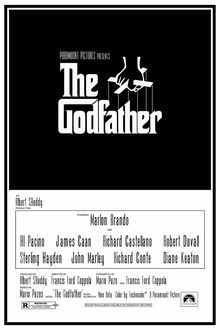
Some movies are just better than others, plain and simple. They're the ones that even the most casual movie fans among us are aware of, films like Gone With the Wind, Casablanca, Lawrence of Arabia, and one of my favorite movies, and maybe the greatest movie ever made, 1972's The Godfather.
It's just a few months since the end of WWII, and Vito Corleone (Marlon Brando), the head of the Corleone crime family in New York City and dubbed the Godfather, is at the height of his power. He has an epically successful business, running the unions and all the gambling in the city, and he's able to do it because he has countless politicians and judges in his back pocket. Things are changing though all around him, especially the underworld and the business he helped create. Vito is approached about a deal he could bankroll, but it involves drugs, and he chooses to ignore it. The decision is one that drastically affects the family, one that will incorporate all his family members, especially fiery firstborn Santino (James Caan), adopted Irish son, Tom Hagen (Robert Duvall), and his youngest and smartest son, Michael (Al Pacino). What does the future hold? Who will rise up to help their father?
Based off a novel of the same name by author Mario Puzo, 'Godfather' is one of those rarest films; it's perfect. In that sense, director Francis Ford Coppola improves on Puzo's novel, the rare film that is better than its source novel. None of that is a dig at Puzo -- the novel is one of my favorites, a well-written gem -- but the film takes the idea, premise and characters and runs with it. Clocking in at 175 minutes, it never slows down, never feels dull. The dialogue and script provide countless engrossing talking scenes. The look of the movie with its authentic wardrobe, cars and sets is incredible, Coppola filming in an earthy fashion where things always look dark and burned-out to a point. Oh, and composer Nino Rota's score is halfway decent (that's sarcasm by the way), one of the great, classic scores in Hollywood history. You know it already, but listen to the theme HERE.
What sets Coppola's film apart from countless other films about the Mafia, mobsters and organized crime is the impeccably written story. Puzo's novel introduces countless characters, relationships, history at the reader with all sorts of backstory, and the film assembles it into an expertly told, very coherent (sounds simple, but you'd be surprised) story that develops nicely. It covers over 10 years of time, but at no point does it feel even slightly rushed. Puzo's novel (he also worked with Coppola on the script) introduces characters and within minutes we feel like we've got a good idea of who they are as an individual. Imagine that with over 10 characters that get a fair share of screentime. There is a comfort level with the characters -- the good guys and the bad guys -- that makes the movie more enjoyable the second it begins. Does it all fall into place right away? No, it takes some time, but getting there is half the fun.
As far as true acting movies go, this 1972 classic is hard to beat. There isn't a performance that falls short or feels fake, but two rise above the rest; Brando as Vito Corleone and Pacino as his son, Michael. Playing one of the most iconic characters in film history, Brando's performance has opened the doors for all sorts of impressions, caricatures and stereotypes, but it is a career-best performance (and that's saying something considering Brando's career). It is a layered, nuanced performance, a man in the second half of his life who is highly intelligent, kind and ruthless at the same time, and a man who will stop at nothing to care for his family. Pacino's Michael goes through the film's biggest transition, a young man and WWII hero who wants nothing to do with his family's shady background but finds himself thrust into the family business when outside forces descend on the Corleones. Brando won an Oscar -- fully deserved -- and Pacino was nominated, but whatever the award nominations out there, it's two amazing performances.
Coppola's film earned plenty of acting nominations, three alone for Best Supporting Actor with Pacino, Duvall and Caan all earning a nod. The coolest part? All three deserved it for one reason or another. Caan and Duvall get less screentime, but they make the most of it. Caan is a scene-stealer as the fiery, hot-tempered Santino, known to friends and family as Sonny, the oldest Corleone son. The same for Duvall as Tom Hagen, but in a different way. Where Caan is more aggressive, Duvall underplays his part as Tom, the unofficial Irish Corleone brother, a childhood friend of Sonny's who Vito welcomed into the house. Other members of the Corleone family and operation? Richard Castellano and Abe Vigoda as Clemenza and Tessio, the Corleone caporegimes (think right-hand men, enforcers), John Cazale as Fredo, the Corleone brother and screw-up, Talia Shire as Connie, the lone Corleone sister and her similarly fiery husband, Carlo (Gianni Russo), and Diane Keaton as Kay, young Michael's love who must decide how much she's willing to put up with.
And then there's the opposition, the all-around nice individuals who are trying to take down the Corleones. For starters there's Richard Conte as Barzini, a head of another NYC crime family, Sterling Hayden as Capt. McCluskey, an NYC cop on a rival's payroll, John Marley as a film studio head who incurs the wrath of the Corleones, Al Lettieri as Sollozzo, a drug supplier looking for funding and backing, and Alex Rocco as a casino owner dealing with a buy-out of his casino.
On repeated viewings, I've noticed different features about the film, different layers that can affect how I view it. The biggest is simple; family. Yes, it's a pretty hardcore, violent story about a crime family with its hand in illegal happenings, but it's still family. If you can look past that whole criminal aspect, the biggest focus is the family and the dynamics and relationships among family members. Through the rather vicious, violent ups and downs, love and hate, they're there for each other (for this movie at least). I love how Vito dotes on his kids and grandchildren but can balance that out with a brutal mindset -- it's business, not personal -- at the same time. The relationship between Vito and Michael is the most heartfelt, including one of my all-time favorite scenes as father and son discuss what could have been, maybe what should have been. A worrying Vito wanted more for his son, but a firmly entrenched Michael (very much looking out for the family) calmly states "We'll get there, Pop." It's an endearing, heartfelt moment, one of many.
There are far too many memorable, iconic, and all-time great scenes to discuss one by one. Big picture, that's probably what viewers will remember the most on initial viewing. The infamous horse head scene, the introduction of Vito, his loyal enforcer, Luca Brasi (Lenny Montana), and his "offer he can't refuse," the perfect simplicity and natural quality of the opening wedding, a slight detour to Sicily and its beautiful hills, a meeting among Michael, Sollozzo, and McCluskey in a traditional Italian restaurant, and maybe the most memorable, the baptism scene, almost entirely silent other than Rota's score playing over the developing scenes. Each of the above scenes could be analyzed in a review unto itself, but this review is already getting long-winded. Long story short? It's maybe the greatest movie in Hollywood history without a flaw in sight. Shame on you if you haven't seen it by the way. What are you waiting for?
The Godfather (1972): ****/****
It's just a few months since the end of WWII, and Vito Corleone (Marlon Brando), the head of the Corleone crime family in New York City and dubbed the Godfather, is at the height of his power. He has an epically successful business, running the unions and all the gambling in the city, and he's able to do it because he has countless politicians and judges in his back pocket. Things are changing though all around him, especially the underworld and the business he helped create. Vito is approached about a deal he could bankroll, but it involves drugs, and he chooses to ignore it. The decision is one that drastically affects the family, one that will incorporate all his family members, especially fiery firstborn Santino (James Caan), adopted Irish son, Tom Hagen (Robert Duvall), and his youngest and smartest son, Michael (Al Pacino). What does the future hold? Who will rise up to help their father?
Based off a novel of the same name by author Mario Puzo, 'Godfather' is one of those rarest films; it's perfect. In that sense, director Francis Ford Coppola improves on Puzo's novel, the rare film that is better than its source novel. None of that is a dig at Puzo -- the novel is one of my favorites, a well-written gem -- but the film takes the idea, premise and characters and runs with it. Clocking in at 175 minutes, it never slows down, never feels dull. The dialogue and script provide countless engrossing talking scenes. The look of the movie with its authentic wardrobe, cars and sets is incredible, Coppola filming in an earthy fashion where things always look dark and burned-out to a point. Oh, and composer Nino Rota's score is halfway decent (that's sarcasm by the way), one of the great, classic scores in Hollywood history. You know it already, but listen to the theme HERE.
What sets Coppola's film apart from countless other films about the Mafia, mobsters and organized crime is the impeccably written story. Puzo's novel introduces countless characters, relationships, history at the reader with all sorts of backstory, and the film assembles it into an expertly told, very coherent (sounds simple, but you'd be surprised) story that develops nicely. It covers over 10 years of time, but at no point does it feel even slightly rushed. Puzo's novel (he also worked with Coppola on the script) introduces characters and within minutes we feel like we've got a good idea of who they are as an individual. Imagine that with over 10 characters that get a fair share of screentime. There is a comfort level with the characters -- the good guys and the bad guys -- that makes the movie more enjoyable the second it begins. Does it all fall into place right away? No, it takes some time, but getting there is half the fun.
As far as true acting movies go, this 1972 classic is hard to beat. There isn't a performance that falls short or feels fake, but two rise above the rest; Brando as Vito Corleone and Pacino as his son, Michael. Playing one of the most iconic characters in film history, Brando's performance has opened the doors for all sorts of impressions, caricatures and stereotypes, but it is a career-best performance (and that's saying something considering Brando's career). It is a layered, nuanced performance, a man in the second half of his life who is highly intelligent, kind and ruthless at the same time, and a man who will stop at nothing to care for his family. Pacino's Michael goes through the film's biggest transition, a young man and WWII hero who wants nothing to do with his family's shady background but finds himself thrust into the family business when outside forces descend on the Corleones. Brando won an Oscar -- fully deserved -- and Pacino was nominated, but whatever the award nominations out there, it's two amazing performances.
Coppola's film earned plenty of acting nominations, three alone for Best Supporting Actor with Pacino, Duvall and Caan all earning a nod. The coolest part? All three deserved it for one reason or another. Caan and Duvall get less screentime, but they make the most of it. Caan is a scene-stealer as the fiery, hot-tempered Santino, known to friends and family as Sonny, the oldest Corleone son. The same for Duvall as Tom Hagen, but in a different way. Where Caan is more aggressive, Duvall underplays his part as Tom, the unofficial Irish Corleone brother, a childhood friend of Sonny's who Vito welcomed into the house. Other members of the Corleone family and operation? Richard Castellano and Abe Vigoda as Clemenza and Tessio, the Corleone caporegimes (think right-hand men, enforcers), John Cazale as Fredo, the Corleone brother and screw-up, Talia Shire as Connie, the lone Corleone sister and her similarly fiery husband, Carlo (Gianni Russo), and Diane Keaton as Kay, young Michael's love who must decide how much she's willing to put up with.
And then there's the opposition, the all-around nice individuals who are trying to take down the Corleones. For starters there's Richard Conte as Barzini, a head of another NYC crime family, Sterling Hayden as Capt. McCluskey, an NYC cop on a rival's payroll, John Marley as a film studio head who incurs the wrath of the Corleones, Al Lettieri as Sollozzo, a drug supplier looking for funding and backing, and Alex Rocco as a casino owner dealing with a buy-out of his casino.
On repeated viewings, I've noticed different features about the film, different layers that can affect how I view it. The biggest is simple; family. Yes, it's a pretty hardcore, violent story about a crime family with its hand in illegal happenings, but it's still family. If you can look past that whole criminal aspect, the biggest focus is the family and the dynamics and relationships among family members. Through the rather vicious, violent ups and downs, love and hate, they're there for each other (for this movie at least). I love how Vito dotes on his kids and grandchildren but can balance that out with a brutal mindset -- it's business, not personal -- at the same time. The relationship between Vito and Michael is the most heartfelt, including one of my all-time favorite scenes as father and son discuss what could have been, maybe what should have been. A worrying Vito wanted more for his son, but a firmly entrenched Michael (very much looking out for the family) calmly states "We'll get there, Pop." It's an endearing, heartfelt moment, one of many.
There are far too many memorable, iconic, and all-time great scenes to discuss one by one. Big picture, that's probably what viewers will remember the most on initial viewing. The infamous horse head scene, the introduction of Vito, his loyal enforcer, Luca Brasi (Lenny Montana), and his "offer he can't refuse," the perfect simplicity and natural quality of the opening wedding, a slight detour to Sicily and its beautiful hills, a meeting among Michael, Sollozzo, and McCluskey in a traditional Italian restaurant, and maybe the most memorable, the baptism scene, almost entirely silent other than Rota's score playing over the developing scenes. Each of the above scenes could be analyzed in a review unto itself, but this review is already getting long-winded. Long story short? It's maybe the greatest movie in Hollywood history without a flaw in sight. Shame on you if you haven't seen it by the way. What are you waiting for?
The Godfather (1972): ****/****
Thursday, October 25, 2012
Call Northside 777
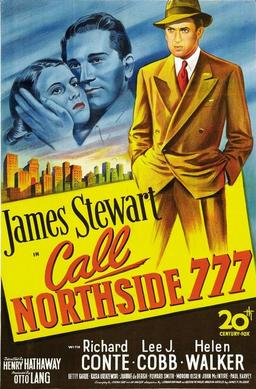
This is going to sound simple, but certain movies make me think of the message. Watching old films from basically any Hollywood film is one of my favorite things to do. It can give a window into times long since past. We see towns and cities as they were, not as they are. An all-around solid quasi-documentary, film noir-ish mystery, 1948's Call Northside 777 is a gem.
A reporter for the Chicago Times newspaper, reporter P.J. McNeal (James Stewart) is given a new assignment. An 11-year old murder case from 1932 is in the news, both Frank Wiciek (Richard Conte) and Tomek Zaleska (an uncredited George Tyne) serving 99-year prison sentences for the murder of a Chicago police officer. Wiciek's mother, Tillie (Kasia Orzazewski), a blue collar worker if there ever was, has offered a $5,000 reward for finding the real murder, exonerating her son. McNeal writes the mother's story, but it grabs attention of readers who want more of this story leaving McNeal to explore the long-retired murder case. Ever the suspicious reporter, McNeal goes along but questions the case. Could Frank actually be guilty?
Based on a true story involving the murder of a Chicago police officer (read about it HERE, SPOILERS obviously), 'Call' is an interesting movie for all the right reasons. From director Henry Hathaway, it is part documentary, part investigative procedural, part film noir. The good thing? It moves among those three different genres effortlessly. Clocking in at 112 minutes, it isn't always the quickest-paced flick, but it moves around a lot so that's excusable. A story in the shadows, taking advantage of the black and white photography, it's a great movie to watch.
For me though, this movie is worthwhile for two reasons. One, Hathaway filmed on location in Chicago. This is a great window into late 1940s Chicago. Trivia question and answer for you, but this was the first Hollywood feature film to film on location in Chicago. Where so many films from the 1940s would limit themselves to Hollywood sets, 'Call' gets a whole lot of points for filming in downtown Chicago, but the suburbs as well. Curious what the Windy City looked like 60-plus years ago? This is your movie. The other reason; as a writer who's written for the Chicago Sun-Times, it's a great precursor for All the President's Men. We see how journalists and investigators worked in a pre-Internet age, doing their investigating the old-fashioned way. It's the little things, ain't it?
Already an established star by 1947, Stewart does a solid, workmanlike job as reporter P.J. McNeal. Cynical to a point because the job requires it, McNeal is skeptical of the whole case but takes it on because it's a decent story that readers are curious about it. As the real story comes out though, he starts to question even more, giving Stewart a good chance to flex a little dramatically. Go crusading journalist! Conte is solid in a supporting role as the possibly falsely-convicted Frank while Orzazewski is a scene-stealer as his mother, Tillie. Usually a tough guy actor, Lee J. Cobb plays Kelly, McNeal's editor at the Chicago Times. Joanne De Bergh has a small but essential part as Helen, Frank's wife who supports his innocence. Also look for John McIntire as a former state's attorney trying to cover his butt and an uncredited E.G. Marshall in a small part.
There are some oddities here I feel I have to point out. For a story that's built on the small details, the little pieces of evidence, the movie itself.....isn't. Several rather key questions go unanswered in the end. We find out what happens to Conte's Frank, but what about his supposed partner, Tyne's Tomek? Why is Cobb's editor so dead-set on following this story up? A backstory is hinted at, but never dealt with. The ending is effective, but with a 112-minute movie, it comes together a little quickly, almost like Hathaway ran out of time or money. Still, these are problems but not ones that can ruin a movie. Highly recommend checking this one out.
Call Northside 777 <---trailer (1948): ***/****
A reporter for the Chicago Times newspaper, reporter P.J. McNeal (James Stewart) is given a new assignment. An 11-year old murder case from 1932 is in the news, both Frank Wiciek (Richard Conte) and Tomek Zaleska (an uncredited George Tyne) serving 99-year prison sentences for the murder of a Chicago police officer. Wiciek's mother, Tillie (Kasia Orzazewski), a blue collar worker if there ever was, has offered a $5,000 reward for finding the real murder, exonerating her son. McNeal writes the mother's story, but it grabs attention of readers who want more of this story leaving McNeal to explore the long-retired murder case. Ever the suspicious reporter, McNeal goes along but questions the case. Could Frank actually be guilty?
Based on a true story involving the murder of a Chicago police officer (read about it HERE, SPOILERS obviously), 'Call' is an interesting movie for all the right reasons. From director Henry Hathaway, it is part documentary, part investigative procedural, part film noir. The good thing? It moves among those three different genres effortlessly. Clocking in at 112 minutes, it isn't always the quickest-paced flick, but it moves around a lot so that's excusable. A story in the shadows, taking advantage of the black and white photography, it's a great movie to watch.
For me though, this movie is worthwhile for two reasons. One, Hathaway filmed on location in Chicago. This is a great window into late 1940s Chicago. Trivia question and answer for you, but this was the first Hollywood feature film to film on location in Chicago. Where so many films from the 1940s would limit themselves to Hollywood sets, 'Call' gets a whole lot of points for filming in downtown Chicago, but the suburbs as well. Curious what the Windy City looked like 60-plus years ago? This is your movie. The other reason; as a writer who's written for the Chicago Sun-Times, it's a great precursor for All the President's Men. We see how journalists and investigators worked in a pre-Internet age, doing their investigating the old-fashioned way. It's the little things, ain't it?
Already an established star by 1947, Stewart does a solid, workmanlike job as reporter P.J. McNeal. Cynical to a point because the job requires it, McNeal is skeptical of the whole case but takes it on because it's a decent story that readers are curious about it. As the real story comes out though, he starts to question even more, giving Stewart a good chance to flex a little dramatically. Go crusading journalist! Conte is solid in a supporting role as the possibly falsely-convicted Frank while Orzazewski is a scene-stealer as his mother, Tillie. Usually a tough guy actor, Lee J. Cobb plays Kelly, McNeal's editor at the Chicago Times. Joanne De Bergh has a small but essential part as Helen, Frank's wife who supports his innocence. Also look for John McIntire as a former state's attorney trying to cover his butt and an uncredited E.G. Marshall in a small part.
There are some oddities here I feel I have to point out. For a story that's built on the small details, the little pieces of evidence, the movie itself.....isn't. Several rather key questions go unanswered in the end. We find out what happens to Conte's Frank, but what about his supposed partner, Tyne's Tomek? Why is Cobb's editor so dead-set on following this story up? A backstory is hinted at, but never dealt with. The ending is effective, but with a 112-minute movie, it comes together a little quickly, almost like Hathaway ran out of time or money. Still, these are problems but not ones that can ruin a movie. Highly recommend checking this one out.
Call Northside 777 <---trailer (1948): ***/****
Labels:
1940s,
E.G. Marshall,
Film Noir,
Henry Hathaway,
James Stewart,
Lee J. Cobb,
Richard Conte
Friday, August 31, 2012
Thieves' Highway
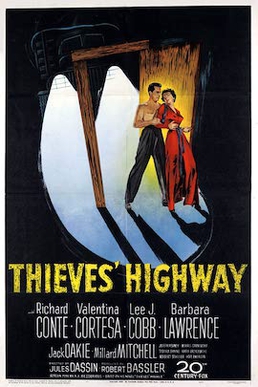
I hate it when that happens. You know what I mean. A movie comes highly recommended in one way or another -- a friend, a movie review, an IMDB rating, a Netflix recommendation -- and you assume you're really going to enjoy it a lot...only to, well, come away somewhat empty. That was my biggest reaction from 1949's Thieves' Highway, a highly recommended if not hugely well-known film noir.
A war veteran returning home to his family and girlfriend, Polly (Barbara Lawrence) in Fresno, Nico Garcos (Richard Conte) is stunned by what he finds. His father has been crippled in a driving accident, but it's more than that. The circumstances were shady at best as conniving businessman Mike Figlia (Lee J. Cobb) also robbed him of $1,900 that he owed him in the process. Nico is enraged, wanting to exact revenge, and he concocts a plan with a down-on-his-luck truck driver, Kinney (Millard Mitchell), to buy and ship a truck-full of apples that Figlia would be interested in purchasing. Nico has his plan, but even he can't be too sure of what is in store for all involved.
From director Jules Dassin, 'Thieves' has a lot going for it. As a film noir, it is highly effective in its amoral portrayal of that seedy underbelly of the criminal black market. Conte is the anti-hero, revenge on his mind and little else. Cobb is the conniving, slimy Figlia, a villain without anything even remotely close to being a redeeming quality. The look of the movie -- much of it shot on location in Fresno and its markets -- is perfect; that blend of shadowy, smoky doom that film noirs specialized in. You just know nothing good is going to come out of that shadowy alleyway, don't you? It is a particularly nasty world, one of manipulation, greed, bribery, and a me-first and screw the rest sort of attitude.
So as a fan of incredibly dark stories, why then didn't I like this one? I can't quite put my finger on it. Maybe I've seen the darkness of such stories and it doesn't hit me as much as it might have audiences in 1949. Mostly though, I never felt a connection to any of the proceedings, whether it be the characters or the developing story. There was a little part of me that was incredibly amused by the portrayal of the seedy underworld of.....produce???? Yeah, I suppose the apple business is pretty cutthroat. I don't mean to minimize the movie like that, but it never felt quite as sinister as it could have. Yes, everyone is in it for themselves, and Conte's Nico wants to right a wrong and exact revenge on the man who crippled his father, but it's never truly an interesting story, for me at least.
The reviews I've read are almost uniformly positive about the casting, and I agree to a point. Many though tout Conte as delivering a career-best performance. I'm not seeing it. I'm a fan -- if not a huge one -- but I always think of Conte at his best in a key supporting role. When he has to carry a movie on his own, I've never thought too highly of those movies. Mostly, he doesn't look too interested in the revenge angle. His easy-going delivery is broken up by these quick outbursts of rage/anger, but they never felt even close to being realistic. On the other hand, Lee J. Cobb is at his best, a villain you love to hate. He has eyes for making as much of a profit as he can with no regard for anything else. If lives are destroyed in the process, so be it. He doesn't care as long as he's making some money.
The rest of the cast are familiar members from the Film Noir Stock Characters list. Valentina Cortese plays Rica, the subtly played hooker with a heart of gold. She takes some money from Cobb's Figlia to keep Nico busy, but quickly realizes the error of her ways (good timing, huh?). I didn't really see much in the way of chemistry between Cobb and Cortese either. Mitchell is solid if unspectacular as the equally ambitious truck driver, Kinney, while Joseph Pevney and Jack Oakie are underused as Pete and Slob, two rival truck drivers trying to move in on Nico's plan. Their bumbling partner act is played for laughs early, but thankfully, the duo takes a turn for the serious as things escalate.
Who knows? Maybe I'm missing something here. I've been guilty of that before. As a fan of dark, realistic stories, I thought this one sounded like a sure thing. The dog eat dog world portrayed in 'Thieves' is interesting on a small level, but it never amounted to much for me. Making it worse, the happy ending comes completely out of left field. At least stick to your guns. If you're going for dark, stay dark.
Thieves' Highway <---trailer (1949): **/****
A war veteran returning home to his family and girlfriend, Polly (Barbara Lawrence) in Fresno, Nico Garcos (Richard Conte) is stunned by what he finds. His father has been crippled in a driving accident, but it's more than that. The circumstances were shady at best as conniving businessman Mike Figlia (Lee J. Cobb) also robbed him of $1,900 that he owed him in the process. Nico is enraged, wanting to exact revenge, and he concocts a plan with a down-on-his-luck truck driver, Kinney (Millard Mitchell), to buy and ship a truck-full of apples that Figlia would be interested in purchasing. Nico has his plan, but even he can't be too sure of what is in store for all involved.
From director Jules Dassin, 'Thieves' has a lot going for it. As a film noir, it is highly effective in its amoral portrayal of that seedy underbelly of the criminal black market. Conte is the anti-hero, revenge on his mind and little else. Cobb is the conniving, slimy Figlia, a villain without anything even remotely close to being a redeeming quality. The look of the movie -- much of it shot on location in Fresno and its markets -- is perfect; that blend of shadowy, smoky doom that film noirs specialized in. You just know nothing good is going to come out of that shadowy alleyway, don't you? It is a particularly nasty world, one of manipulation, greed, bribery, and a me-first and screw the rest sort of attitude.
So as a fan of incredibly dark stories, why then didn't I like this one? I can't quite put my finger on it. Maybe I've seen the darkness of such stories and it doesn't hit me as much as it might have audiences in 1949. Mostly though, I never felt a connection to any of the proceedings, whether it be the characters or the developing story. There was a little part of me that was incredibly amused by the portrayal of the seedy underworld of.....produce???? Yeah, I suppose the apple business is pretty cutthroat. I don't mean to minimize the movie like that, but it never felt quite as sinister as it could have. Yes, everyone is in it for themselves, and Conte's Nico wants to right a wrong and exact revenge on the man who crippled his father, but it's never truly an interesting story, for me at least.
The reviews I've read are almost uniformly positive about the casting, and I agree to a point. Many though tout Conte as delivering a career-best performance. I'm not seeing it. I'm a fan -- if not a huge one -- but I always think of Conte at his best in a key supporting role. When he has to carry a movie on his own, I've never thought too highly of those movies. Mostly, he doesn't look too interested in the revenge angle. His easy-going delivery is broken up by these quick outbursts of rage/anger, but they never felt even close to being realistic. On the other hand, Lee J. Cobb is at his best, a villain you love to hate. He has eyes for making as much of a profit as he can with no regard for anything else. If lives are destroyed in the process, so be it. He doesn't care as long as he's making some money.
The rest of the cast are familiar members from the Film Noir Stock Characters list. Valentina Cortese plays Rica, the subtly played hooker with a heart of gold. She takes some money from Cobb's Figlia to keep Nico busy, but quickly realizes the error of her ways (good timing, huh?). I didn't really see much in the way of chemistry between Cobb and Cortese either. Mitchell is solid if unspectacular as the equally ambitious truck driver, Kinney, while Joseph Pevney and Jack Oakie are underused as Pete and Slob, two rival truck drivers trying to move in on Nico's plan. Their bumbling partner act is played for laughs early, but thankfully, the duo takes a turn for the serious as things escalate.
Who knows? Maybe I'm missing something here. I've been guilty of that before. As a fan of dark, realistic stories, I thought this one sounded like a sure thing. The dog eat dog world portrayed in 'Thieves' is interesting on a small level, but it never amounted to much for me. Making it worse, the happy ending comes completely out of left field. At least stick to your guns. If you're going for dark, stay dark.
Thieves' Highway <---trailer (1949): **/****
Labels:
1940s,
Film Noir,
Jules Dassin,
Lee J. Cobb,
Richard Conte
Thursday, July 12, 2012
The Boss
And now for those readers who have made it through two reviews of sleazy B-movie Italian crime thrillers, here's a third! Wrapping up director Fernando Di Leo's loosely linked Italian crime trilogy comes 1973's The Boss, the weakest of the three but with enough positive to mildly recommend. Fans of both The Godfather and Scarface should get some enjoyment/entertainment out of it for sure.
Having worked as a trusted enforcer for Don Giuseppe (Claudio Nicastro), a powerful mob boss, stoic Nick Lanzetta (Henry Silva) has been put in a spot with no easy out. With a mob war brewing because of successful hit he pulled off, Lanzetta is caught in the middle. He's loyal to Don Giuseppe, but he also sees more of a chance for advancement if he listens to the big boss in town, Don Corrasco (Richard Conte), Giuseppe's superior. As the bodies continue to pile up, Lanzetta must make a decision. Does he stick with what he knows or try to rise up in the aftermath of the bloody mob war?
Having watched all three of Di Leo's crime trilogy in less than a week, I came away impressed with a couple things. Through all three movies, I was entertained even if there were some sluggish parts (more on that). Mostly though is the downright brutality and cynicism of these worlds. Maybe it's the European audience and market wanting a more reality-based crime story, but everyone....everyone...is a bad guy. It's just shades of bad. When someone gets beaten, it looks, sounds and feels like they're actually getting beaten. Kids, women, pets? Not exempt from some rather graphic deaths. Like I mentioned in The Italian Connection review, Di Leo just don't give a damn. He doesn't care if he offends some. He just wants to entertain a lot of folks and for the most part, accomplishes that.
'Boss' does differ from the previous two movies in the Di Leo trilogy in that it isn't exclusively on the small-scale, low-level hoods. There's a bigger picture here, crime families duking it out for supremacy in the underworld. We hear a lot about 'The Family needs...' and 'The Family must...' when talking about a lot of people making a difficult decision. The Godfather was an obvious influence here -- down to the Conte casting, a role similar to his Barzini -- with 'Boss' hitting theaters just a year after the 1972 American classic. Everyone is betraying everyone, and no one is safe.
A definite bright spot in 1972's The Italian Connection, Silva one-ups himself here. He's the best thing going for 'Boss' by a long shot as Lanzetta, the steely-eyed, ice water in his veins hit man. Silva was a huge presence with a truly intimidating glare when he stared someone down. The hit man is business-like about his job and brutally efficient. To me, it seems like an obvious influence on the Skull, Tony Montana's killer in Scarface. He wears almost exclusively black clothes and rarely shows an ounce of human emotion. He's cold-blooded but highly intelligent and calculating, able to see two or three steps ahead, knowing when trouble will arise. Conte is all right, Gianni Garko is wasted in a supporting part as a police officer on the hunt, Pier Paolo Capponi hams it up as Cocchi, the mob rival, and Marino Mase plays Pignatoro, a former partner of Lanzetta's.
What's disappointing is that for lack of a better description, 'Boss' is boring. If Silva isn't on-screen, the story grinds to a halt. Garko's scenes with his condescending superior (Vittorio Caprioli) serve no purpose and drag on endlessly. Whole scenes are just characters talking back and forth, the camera stationary as if its trying to make us fall asleep. Other times, 'Boss' is just trying too hard, like Giuseppe's daughter (Antonia Santilli) being kidnapped and joining in orgies with her captors just for the movie to have an excuse to have her naked. A nympho hippie? Yeah, right, especially when she jumps into bed for a week with Lanzetta. I liked the movie, but the parts that didn't work truly flopped. Mostly worthwhile for Silva's lead performance.
The Boss <---Opening scene (1973): **/****
Having worked as a trusted enforcer for Don Giuseppe (Claudio Nicastro), a powerful mob boss, stoic Nick Lanzetta (Henry Silva) has been put in a spot with no easy out. With a mob war brewing because of successful hit he pulled off, Lanzetta is caught in the middle. He's loyal to Don Giuseppe, but he also sees more of a chance for advancement if he listens to the big boss in town, Don Corrasco (Richard Conte), Giuseppe's superior. As the bodies continue to pile up, Lanzetta must make a decision. Does he stick with what he knows or try to rise up in the aftermath of the bloody mob war?
Having watched all three of Di Leo's crime trilogy in less than a week, I came away impressed with a couple things. Through all three movies, I was entertained even if there were some sluggish parts (more on that). Mostly though is the downright brutality and cynicism of these worlds. Maybe it's the European audience and market wanting a more reality-based crime story, but everyone....everyone...is a bad guy. It's just shades of bad. When someone gets beaten, it looks, sounds and feels like they're actually getting beaten. Kids, women, pets? Not exempt from some rather graphic deaths. Like I mentioned in The Italian Connection review, Di Leo just don't give a damn. He doesn't care if he offends some. He just wants to entertain a lot of folks and for the most part, accomplishes that.
'Boss' does differ from the previous two movies in the Di Leo trilogy in that it isn't exclusively on the small-scale, low-level hoods. There's a bigger picture here, crime families duking it out for supremacy in the underworld. We hear a lot about 'The Family needs...' and 'The Family must...' when talking about a lot of people making a difficult decision. The Godfather was an obvious influence here -- down to the Conte casting, a role similar to his Barzini -- with 'Boss' hitting theaters just a year after the 1972 American classic. Everyone is betraying everyone, and no one is safe.
A definite bright spot in 1972's The Italian Connection, Silva one-ups himself here. He's the best thing going for 'Boss' by a long shot as Lanzetta, the steely-eyed, ice water in his veins hit man. Silva was a huge presence with a truly intimidating glare when he stared someone down. The hit man is business-like about his job and brutally efficient. To me, it seems like an obvious influence on the Skull, Tony Montana's killer in Scarface. He wears almost exclusively black clothes and rarely shows an ounce of human emotion. He's cold-blooded but highly intelligent and calculating, able to see two or three steps ahead, knowing when trouble will arise. Conte is all right, Gianni Garko is wasted in a supporting part as a police officer on the hunt, Pier Paolo Capponi hams it up as Cocchi, the mob rival, and Marino Mase plays Pignatoro, a former partner of Lanzetta's.
What's disappointing is that for lack of a better description, 'Boss' is boring. If Silva isn't on-screen, the story grinds to a halt. Garko's scenes with his condescending superior (Vittorio Caprioli) serve no purpose and drag on endlessly. Whole scenes are just characters talking back and forth, the camera stationary as if its trying to make us fall asleep. Other times, 'Boss' is just trying too hard, like Giuseppe's daughter (Antonia Santilli) being kidnapped and joining in orgies with her captors just for the movie to have an excuse to have her naked. A nympho hippie? Yeah, right, especially when she jumps into bed for a week with Lanzetta. I liked the movie, but the parts that didn't work truly flopped. Mostly worthwhile for Silva's lead performance.
The Boss <---Opening scene (1973): **/****
Labels:
1970s,
Fernando Di Leo,
Gianni Garko,
Henry Silva,
Richard Conte
Thursday, December 1, 2011
Target Zero
Cliched, familiar, flawed, been there and seen that, all things that came to mind while watching 1955's Target Zero, a Korean War story of a lost patrol trying to make it back to their own lines. I've seen this movie before with a different title, and typically I always like them. With a fun couple tweaks here, I liked this one too even if it could have been a B-movie classic.
After a day of heavy fighting, U.N. staffer/nurse Ann Galloway (Peggie Castle) finds herself behind enemy lines with no way to get back to safety. A British tank crew (commanded by Richard Wyler) stumbles upon her and picks her up, the battle-scarred tank running across the remnants of an American patrol, commanded by Lt. Flagler (Richard Conte). Working together, the ragtag group hopes to make it back to American lines, Flagler insisting they head for a strategic hill position. Can they make it through a gauntlet of North Korean soldiers? Will anyone even be at the hill if they make it?
The Lost Patrol, The Steel Helmet, Anzio, this story has been done before and will most likely be done again. The story of a small group of survivors banding together to make it through enemy-infested territory is nothing new to any war movie, Korean or not. But as is the case here, it's just familiar enough to be a fun ride to go along with. Flagler's patrol unknowingly walks into a minefield, hides out as a North Korean patrol walks by, fights among themselves. You name it. You've seen the stereotypes elsewhere if you've even seen a couple war movies. If you can get past the cliches -- or at least go along with them -- you'll most likely enjoy this movie at least a little bit.
Filling out the unit, I had trouble going along with Conte as Lt. Flagler, the idealistic officer who lives for his company and nothing else. Conte's a better villain than a leading man, and I don't see the appeal or respect his men have for him in 'Target.' His patrol includes Charles Bronson as the loyal sergeant, Chuck Connors as Moose, the radioman, L.Q. Jones as O'Hara, the fast-talking Southerner, Strother Martin, Abel Fernandez as Geronimo, an Apache, Don Oreck as Della Nueva, a Latino boxer, and an uncredited and unlisted Richard Park as Pvt. Man Koo, a South Korean soldier. The British tankers include John Alderson and Terence Marney while John Dennis and Aaron Spelling play two American soldiers picked up carrying a mortar tube and little else. Cool little group, Bronson standing out along with Connors and Jones.
Early on, I was more than pleased to see Castle's Ann introduced into the story. A female nurse along for the trip was certainly a unique addition to the story. It takes about 30 minutes before she falls madly in love with Conte's Flagler. She loves him because he's good to his men, because he's driven, because he's a good leader. Yeah, that's awesome. Their scenes together try to explain war, figure it all out, talking about death and moving on, finding a way to cope. Someone picked up War Movie Dialogue Cliches 101 and turned it into a script. Castle's performance is fine -- nothing against her -- but these scenes are painful to watch.
At times playing like an episode of Combat (that's a compliment, I love that show), 'Target' is at its best dealing with the action. It was filmed at Fort Carson, an Army base in Colorado, and it has a great look of a stark land -- in black and white at that -- where anything could happen and anyone could be hiding. Thanks to the filming location, there's also some great aerial footage of fighter jets helping the patrol. The ending certainly influenced 1962's Hell is For Heroes, the patrol stranded on a lonely hilltop ready to face an attack from the North Koreans.
The set-up and intro to that action finale is impressive, but the execution -- or lack of -- is a little disappointing. With a unit picture, usually some men in said unit get picked off, dying in battle. Not here (that page of War Movie Cliches must have fallen out). Everyone makes it. A darker ending is hinted at, including killing Castle's Ann before the North Koreans can get her, but 'Target' doesn't go that far. It's still an entertaining if flawed movie, worth a watch.
Target Zero (1955): ** 1/2 /****
After a day of heavy fighting, U.N. staffer/nurse Ann Galloway (Peggie Castle) finds herself behind enemy lines with no way to get back to safety. A British tank crew (commanded by Richard Wyler) stumbles upon her and picks her up, the battle-scarred tank running across the remnants of an American patrol, commanded by Lt. Flagler (Richard Conte). Working together, the ragtag group hopes to make it back to American lines, Flagler insisting they head for a strategic hill position. Can they make it through a gauntlet of North Korean soldiers? Will anyone even be at the hill if they make it?
The Lost Patrol, The Steel Helmet, Anzio, this story has been done before and will most likely be done again. The story of a small group of survivors banding together to make it through enemy-infested territory is nothing new to any war movie, Korean or not. But as is the case here, it's just familiar enough to be a fun ride to go along with. Flagler's patrol unknowingly walks into a minefield, hides out as a North Korean patrol walks by, fights among themselves. You name it. You've seen the stereotypes elsewhere if you've even seen a couple war movies. If you can get past the cliches -- or at least go along with them -- you'll most likely enjoy this movie at least a little bit.
Filling out the unit, I had trouble going along with Conte as Lt. Flagler, the idealistic officer who lives for his company and nothing else. Conte's a better villain than a leading man, and I don't see the appeal or respect his men have for him in 'Target.' His patrol includes Charles Bronson as the loyal sergeant, Chuck Connors as Moose, the radioman, L.Q. Jones as O'Hara, the fast-talking Southerner, Strother Martin, Abel Fernandez as Geronimo, an Apache, Don Oreck as Della Nueva, a Latino boxer, and an uncredited and unlisted Richard Park as Pvt. Man Koo, a South Korean soldier. The British tankers include John Alderson and Terence Marney while John Dennis and Aaron Spelling play two American soldiers picked up carrying a mortar tube and little else. Cool little group, Bronson standing out along with Connors and Jones.
Early on, I was more than pleased to see Castle's Ann introduced into the story. A female nurse along for the trip was certainly a unique addition to the story. It takes about 30 minutes before she falls madly in love with Conte's Flagler. She loves him because he's good to his men, because he's driven, because he's a good leader. Yeah, that's awesome. Their scenes together try to explain war, figure it all out, talking about death and moving on, finding a way to cope. Someone picked up War Movie Dialogue Cliches 101 and turned it into a script. Castle's performance is fine -- nothing against her -- but these scenes are painful to watch.
At times playing like an episode of Combat (that's a compliment, I love that show), 'Target' is at its best dealing with the action. It was filmed at Fort Carson, an Army base in Colorado, and it has a great look of a stark land -- in black and white at that -- where anything could happen and anyone could be hiding. Thanks to the filming location, there's also some great aerial footage of fighter jets helping the patrol. The ending certainly influenced 1962's Hell is For Heroes, the patrol stranded on a lonely hilltop ready to face an attack from the North Koreans.
The set-up and intro to that action finale is impressive, but the execution -- or lack of -- is a little disappointing. With a unit picture, usually some men in said unit get picked off, dying in battle. Not here (that page of War Movie Cliches must have fallen out). Everyone makes it. A darker ending is hinted at, including killing Castle's Ann before the North Koreans can get her, but 'Target' doesn't go that far. It's still an entertaining if flawed movie, worth a watch.
Target Zero (1955): ** 1/2 /****
Wednesday, September 14, 2011
Guadalcanal Diary
First seen in theaters just ten months since the end of the actual Guadalcanal campaign, 'Diary' at the time must have been an eye-opener for audiences. As much as a movie in 1943 could, it tried to show what the day-to-day life of a Marine fighting on an enemy-held island was really like. With an almost documentary feel to the movie, it shows the relationships that develop, the bond having fought and survived combat, the fears and desires of the soldiers who just want to go home. Anything original in there as pertaining to war movies, specifically WWII movies? Nope, not at all, but in 1943 I bet it was a hit for audiences. Even now, having seen the same formula done repeatedly since, I can still see the appeal.
It's late summer 1942 in the South Pacific and on-board a troop transport is a battalion of Marines waiting to receive their orders. The men wait anxiously and excitedly, wanting to get the fighting going but also scared of what it possibly represents. Among these men is Capt. Davis (Richard Conte) and his company, a melting pot of Americans serving together to help defeat the Axis powers. Finally the orders come through with an objective, the island of Guadalcanal in the Solomons. The Marines will hit the beaches first, hoping to drive inland and capture a recently built Japanese airfield. The beach landing goes smooth, but that will be the easiest part of the campaign. Waiting for more supplies and reinforcements to arrive, the Marines go to work, clearing the island inch by inch and cave by cave of Japanese defenders.
This is one of the first examples I can think of for a well-worn and familiar war sub-genre, the "unit picture," a story told from the perspective of a squad, platoon, company, battalion and so on. Here the group is a little smaller, but they mostly manage to rise above their cardboard cutouts of characters. William Bendix plays Taxi Potts, a Brooklyn native always wondering what's going on back home. Preston Foster is Father Donnelly, the stoic, calm and trustworthy priest, Lloyd Nolan is Sgt. Hook Malone, the reliable and tough platoon sergeant, Anthony Quinn is Suarez, the Latino ladies man, and Richard Jaeckel -- just 17 at the time -- plays Pvt. Chicken Anderson, the youngster of the group. Conte is solid as the company commander, rivals and friends with a fellow commander, Capt. Cross (Roy Roberts). Of the group, Nolan especially stands out as does Jaeckel in his film debut. I also could have sworn I saw John Hodiak briefly, but I can't find info on it anywhere.
From director Lewis Seiler, this is a movie based off a book from war correspondent Richard Tregaskis and his experiences during the Guadalcanal campaign. Because it is based off what he actually saw, the depiction of the Marines is realistic without too many exaggerations. Some five months of fighting has to be crammed into a 93-minute movie so some jumps are made but nothing major is cut. My one complaint comes from transitioning Tregaskis' book to the big screen. In an effort to stay true to his book, a fair share of narration rolls over the movie, moving the story along with some wordy passages that don't always fit. They're very stiff and reminded me of a pretentious student reading his paper, incredibly proud of how good it is. The narration tries too hard to impress us with its intelligence and depth but never quite gets there.
What separates 'Guadalcanal' from some other WWII movies actually released in the war is the reality of it, the believable nature of the whole thing. Certain scenes ring true because it's easy to believe a soldier doing this action or having this thought. Before the battle, HQ discusses burial details for the upcoming fight, putting a dark cloud on the horizon right away. It is a quick scene (maybe 15 seconds tops), but in its simplicity and powerful message, it stands out. The night before the Marines hit the beach, Bendix's Taxi is dancing like a Hawaiian hula girl, stopping when he sees Foster's Father Donnelly watching. Donnelly senses the nerves, the fear, the terror in the room and joins Taxi in an Irish dance much to the delight of the rest of the men.
There's more though that keep coming to mind. Baby-faced Jaeckel's Chicken claims to have a girlfriend back home but it's really just his mother. We get a quick glimpse of one of her letters to her son, a perfect little moment as she tells what's going on back home. His response back is equally moving as he tries to comfort his parents, convincing them that he's okay and doing well. By far though, the best scene has the platoon waiting out a bombing raid in a small, cramped dugout. Bendix's Taxi Potts explains his feelings on prayer, God, and the hell of their situation. Bendix often got typecast as the lovable galoot, but he shows his skill here, delivering an incredible montage about soldiering, dying and hopefully, surviving. It's a powerful moment, one of many in this underrated WWII movie.
Guadalcanal Diary <---trailer (1943): ***/****
Labels:
1940s,
Anthony Quinn,
Lloyd Nolan,
Richard Conte,
Richard Jaeckel,
William Bendix,
WWII
Sunday, April 10, 2011
Synanon
The Synanon organization was devoted to drug rehabilitation, helping junkies and addicts kick the habit they'd developed. Founded in 1958 in Santa Monica, California by Charles Dederich, the organization existed until the late 1980s before finally going under. They were obviously doing something right to last over 30 years. Their success in the early 1960s was even parlayed into a feature film, 1965's appropriately titled Synanon. Made on location in Santa Monica at the Synanon Home where its patients went through treatment, the movie was made with the support of the organization, which made me wonder. Why didn't they insist on a more positive story, or if nothing else, at least a better written script?
Coming off a heroin high one night on the boardwalk, ex-con and thug Zankie Albo (Alex Cord) finds himself in front of the Synanon House on the beach and checks himself in. At the lowest of lows though, being sober sounds like a good thing. When you're off your high, not so much, and Zankie has to convince the Synanon administration (Edmond O'Brien as Dederich, along with Richard Conte and singer Eartha Kitt) that he's on the up and up. Zankie goes back and forth but decides to stick around, partially because he's got an eye for another patient, Joaney (Stella Stevens), while also dealing with a fellow patient and person from his past, Ben (Chuck Connors). Going along with the program though and genuinely trying to get better, it seems only a matter of time before his demons get the best of him.
The biggest reason I watched this flick was the cast, no huge stars but actors who I'm always glad to see. The performances though are more hit or miss. O'Brien is a one-note character, the tough-talking administrative leader of the house, always glowering down at its patients with his tough love mentality. Conte plays a variation of so many of his performances, a condescending guy who thinks he knows everything. Basically, that asshole everyone knows. Kitt is okay but isn't given a ton to do. Cord, Stevens, and Connors are the best thing going for the movie. All three characters are deeply flawed individuals with their pasts looming over them. What clicks together is that individually or as a group, there's nothing very redeeming about them, but they're still interesting to watch. In the end, one character does get a chance to redeem themselves and move on to something better.
Now if I'm supporting a Hollywood feature film about my organization, I'm making certain demands about how things are going to be portrayed. With an organization like Synanon, that can be trouble because you're dealing with drug rehab (albeit a seemingly white-washed version). If you show it as it is, this is going to be one of the darkest movies ever. If you censor it as it feels like in the film at times, you're not doing the story justice. Director Richard Quine is trapped somewhere in the middle with moments of incredible darkness followed by moments of adoring adulation of the organization. Going back and forth like the story does, that's not the biggest concern. It's a reliance on story conventions that soap operas would be jealous of. Maybe it seemed innovative or ahead of its time in 1965, but now in 2011, it's all been done and seen. Shocking then, but not so much now.
What aids the movie through its ups and downs has little to do with the actual story of this organization trying to aid patients in their drug rehab. It's a very stylish, well-made look at Santa Monica, California, providing a bit of a time capsule for a really cool time period. Filming was done at the original Synanon house on the Santa Monica beach although I'm guessing indoor scenes were filmed on a studio. Other than though, as a viewer we feel like we're there at the house with the patients. Quine shoots on the streets surrounding the house, in and around the seedy bars nearby, and uses some unique angles that take you out of a typical comfort zone. It's not an aggressive style, but it doesn't just settle to put the camera in front of the cast and let them go. With a soft jazz score by Neal Hefti, 'Synanon' gives a window into 1960s California that transports you into the story.
Trying to look past the cliches and stereotypes the script relies on far too much, I was genuinely impressed with the performances by Cord, Stevens and Connors. I've only seen Alex Cord in a handful of really average movies, but I've always liked him as an actor. Besides the ridiculously odd but still cool name -- Zankie Albo -- the character is interesting even if I would have liked a little more background. Stevens plays up her sex kitten image and then throws you for a twist the same way Connors does, shedding his Lucas McCain image from The Rifleman. So overall, while the movie wasn't that good, some of the performances were good enough to give this a slight recommendation.
Synanon <--- TCM clips (1965): ** 1/2 /****
Tuesday, March 22, 2011
A Walk in the Sun
Somewhat out of necessity and somewhat because of audience demand, Hollywood studios during World War II often turned to patriotic, flag-waving war stories for their movies as opposed to more realistic, balanced looks at the war. Some examples like John Ford’s They Were Expendable peg the Americans as courageous, infallible heroes while the Japanese are the vicious, murdering enemy, but the movie still manages to be an above average entry into the WWII movie genre.
Now of course, all of them weren’t propaganda pictures meant to influence public thought and sentiment about the direction the war was taking or how despicably evil the enemy was. Released in 1945 at the tail end of the war, A Walk in the Sun could easily be pegged as one of those movies, but it rises above that stigma. It doesn’t try to portray the American soldiers in Europe as supermen who can’t be taken down by a whole army of German infantry. On the other side, the Germans are a faceless enemy, but never a demonic one. This is war, and everyone is affected. Just like my previous few of All Quiet on the Western Front, these are soldiers interested in survival, not some higher meaning or purpose in war.
Huddled in a landing craft headed for an Italian beach in the dead of night, an American infantry platoon prepares for the mission ahead of them. Problems start immediately though when the platoon commander and the second-ranking officer are both killed in the landing. Taking over, Sergeant Porter (Herbert Rudley, looking like a dead ringer for Frank Lovejoy) and Sergeant Tyne (Dana Andrews) must now figure out what to do. Their mission was described only vaguely to them; march six miles inland and knock out a key farmhouse along the main road. Little is known what awaits them along the road or the enemy strength at the farmhouse, but they head out into the unknown hoping to accomplish their mission, and hopefully make it back alive.
Any similarities or comparisons to ‘Western Front’ are fair for two reasons. One, director Lewis Milestone directed both movies. Two, they are both based on strong source novels that provide a great blueprint for the story. The reasons ‘Walk’ works is because of similar reasons. This is not an action-heavy story, instead portraying the life of a soldier as it more likely is; long stretches of boredom balanced with extreme fear/terror broken up by seconds of violent chaos. What do the soldiers do in between engagements? They talk. They talk about their worries, their lives back home, their thoughts on the patrol. You name it, it gets covered. A story that puts you right there on the dusty road with the soldiers and gives you an authentic feel for what they’re going through always gets points in my book.
This has to be one of the earlier examples of a ‘unit picture,’ a story that focuses on a specific group of soldiers, sometimes as large as a division or a brigade on down the ladder to a group like a squad or a platoon. Dana Andrews is the star here, the sergeant thrust into a position of power, leading his men on a mission where he knows little to nothing about what they’re supposed to accomplish. Along with Rudley as Porter, the NCO about to crack, the platoon includes Lloyd Bridges as Ward, a sergeant and a farmer back home with a craving for an apple, John Ireland as Windy, an intelligent soldier who is constantly writing letters back home in a unique way, Richard Conte as Rivera, the motor-mouth machine gunner, George Tyne as Friedman, Rivera’s ammunition carrier and sounding board, and Norman Lloyd as Archimbeau, a private convinced the war is destined to go on for years, among many others who make a quick appearance, but never really rise above being a sea of infantry faces. Burgess Meredith narrates.
Every so often at the IMDB, you run across a description so perfect it makes it worthwhile to continue to peruse all the other garbage people post there. One very accurate poster said this 1945 WWII story could easily have been renamed ‘A Talk in the Sun.’ It’s a fair assessment. Of a story that clocks in at 117 minutes, this is a dialogue heavy movie so if you’re looking for action packed excitement, keep looking. I’m all for dialogue in a movie (good, well-written dialogue that is), and for the most part, the conversation is good here. Eventually though, it gets tedious. How many times can we hear Rivera and Friedman argue like an old married couple? How many times will Archimbeau talk about the coming battle in 1955 for Tibet? Some scenes drag more than others, but late in the movie, I started to feel like I was watching the same scenes over and over again. Is that what a soldier’s life is like? Probably, but realism only takes a movie so far.
Balancing the long stretches of boredom here are those chaotic, brief moments of terror where your life can be snatched away from you in the blink of an eye. The patrol is constantly under bombardment while also dealing with patrolling German fighters overhead and tank and armored car patrols. The farmhouse (Semi SPOILERS I guess, yes, they make it to the farmhouse) is heavily guarded, and a suicidal charge across an open field feels like the only solution. Like the best parts of the movie, the battle scenes are well-executed (similar to Milestone’s action in Western Front with some great camerawork) and always keeping you on edge as to what will happen. It’s not a perfect war story, but for a movie released in 1945, the realism and honest look at the life of a soldier help make up for any shortcomings the movie might have. A public domain movie, it is available to watch at Youtube HERE in a somewhat washed out but tolerable print.
A Walk in the Sun <---TCM clips (1945): ***/****
Now of course, all of them weren’t propaganda pictures meant to influence public thought and sentiment about the direction the war was taking or how despicably evil the enemy was. Released in 1945 at the tail end of the war, A Walk in the Sun could easily be pegged as one of those movies, but it rises above that stigma. It doesn’t try to portray the American soldiers in Europe as supermen who can’t be taken down by a whole army of German infantry. On the other side, the Germans are a faceless enemy, but never a demonic one. This is war, and everyone is affected. Just like my previous few of All Quiet on the Western Front, these are soldiers interested in survival, not some higher meaning or purpose in war.
Huddled in a landing craft headed for an Italian beach in the dead of night, an American infantry platoon prepares for the mission ahead of them. Problems start immediately though when the platoon commander and the second-ranking officer are both killed in the landing. Taking over, Sergeant Porter (Herbert Rudley, looking like a dead ringer for Frank Lovejoy) and Sergeant Tyne (Dana Andrews) must now figure out what to do. Their mission was described only vaguely to them; march six miles inland and knock out a key farmhouse along the main road. Little is known what awaits them along the road or the enemy strength at the farmhouse, but they head out into the unknown hoping to accomplish their mission, and hopefully make it back alive.
Any similarities or comparisons to ‘Western Front’ are fair for two reasons. One, director Lewis Milestone directed both movies. Two, they are both based on strong source novels that provide a great blueprint for the story. The reasons ‘Walk’ works is because of similar reasons. This is not an action-heavy story, instead portraying the life of a soldier as it more likely is; long stretches of boredom balanced with extreme fear/terror broken up by seconds of violent chaos. What do the soldiers do in between engagements? They talk. They talk about their worries, their lives back home, their thoughts on the patrol. You name it, it gets covered. A story that puts you right there on the dusty road with the soldiers and gives you an authentic feel for what they’re going through always gets points in my book.
This has to be one of the earlier examples of a ‘unit picture,’ a story that focuses on a specific group of soldiers, sometimes as large as a division or a brigade on down the ladder to a group like a squad or a platoon. Dana Andrews is the star here, the sergeant thrust into a position of power, leading his men on a mission where he knows little to nothing about what they’re supposed to accomplish. Along with Rudley as Porter, the NCO about to crack, the platoon includes Lloyd Bridges as Ward, a sergeant and a farmer back home with a craving for an apple, John Ireland as Windy, an intelligent soldier who is constantly writing letters back home in a unique way, Richard Conte as Rivera, the motor-mouth machine gunner, George Tyne as Friedman, Rivera’s ammunition carrier and sounding board, and Norman Lloyd as Archimbeau, a private convinced the war is destined to go on for years, among many others who make a quick appearance, but never really rise above being a sea of infantry faces. Burgess Meredith narrates.
Every so often at the IMDB, you run across a description so perfect it makes it worthwhile to continue to peruse all the other garbage people post there. One very accurate poster said this 1945 WWII story could easily have been renamed ‘A Talk in the Sun.’ It’s a fair assessment. Of a story that clocks in at 117 minutes, this is a dialogue heavy movie so if you’re looking for action packed excitement, keep looking. I’m all for dialogue in a movie (good, well-written dialogue that is), and for the most part, the conversation is good here. Eventually though, it gets tedious. How many times can we hear Rivera and Friedman argue like an old married couple? How many times will Archimbeau talk about the coming battle in 1955 for Tibet? Some scenes drag more than others, but late in the movie, I started to feel like I was watching the same scenes over and over again. Is that what a soldier’s life is like? Probably, but realism only takes a movie so far.
Balancing the long stretches of boredom here are those chaotic, brief moments of terror where your life can be snatched away from you in the blink of an eye. The patrol is constantly under bombardment while also dealing with patrolling German fighters overhead and tank and armored car patrols. The farmhouse (Semi SPOILERS I guess, yes, they make it to the farmhouse) is heavily guarded, and a suicidal charge across an open field feels like the only solution. Like the best parts of the movie, the battle scenes are well-executed (similar to Milestone’s action in Western Front with some great camerawork) and always keeping you on edge as to what will happen. It’s not a perfect war story, but for a movie released in 1945, the realism and honest look at the life of a soldier help make up for any shortcomings the movie might have. A public domain movie, it is available to watch at Youtube HERE in a somewhat washed out but tolerable print.
A Walk in the Sun <---TCM clips (1945): ***/****
Labels:
1940s,
Burgess Meredith,
Dana Andrews,
John Ireland,
Lewis Milestone,
Richard Conte,
WWII
Tuesday, February 8, 2011
Assault on a Queen
That's exactly what 1966's Assault on a Queen felt like to me. A heist movie with a handful of other elements thrown in, this felt like a rehash of other better movies while still maintaining some level of interest and entertainment. Sinatra would only make a handful of more movies after 1966, and this clearly isn't his best acting performance. Some reviews complain that he's sleepwalking through the part, and it's hard to prove otherwise. Laid back and playing a variation on many characters he played in his career, Sinatra is as always still very watchable. The movie is average in every way with a ludicrous heist involved, but that's part of the fun. Just how stupidly entertaining can it get?
Operating a small fishing boat with his partner and drinking buddy, Linc (Errol John), former submarine officer Mark Brittain (Sinatra) is content to take tourists out fishing so he has enough money for food and booze (not necessarily in that order). Hard up for money though, Mark signs on with a mysterious couple, Vic Rossiter (Tony Franciosa) and Rosa Lucchesi (Italian beauty Virna Lisi), who are looking for sunken treasure in the Caribbean. During a dive, Mark doesn't find buried treasure, instead stumbling across a sunken WWII German sub. One of Vic's partners, a former U-boat commander, Eric (Alf Kjellin), comes up with a crazy idea. What if they were able to raise the sunken ship which seems to be in good condition, and use it as a pirating vessel? Vic has the perfect target, the Queen Mary and its on-board safe that almost certainly has millions of dollars and gold bars. It seems ridiculous, but could it somehow work?
I fancy myself a fan of heist movies, and like to think I know a few things here and there about them, but the premise here is beyond ridiculous. A WWII German sub that's been sitting on the bottom of the ocean for 20 years is not only going to be raised to the surface, but then outfitted and rehabbed so it can be taken on the open sea and pull a con job on a huge ocean liner packed with tourists? I couldn't help but get a chuckle out of the premise. That's what you're going with? Working off a Rod Serling screenplay, director Jack Donahue certainly has some guts. I'll give credit when it's due though. Donahue, Serling, and the cast commit to this ridiculous story and take it seriously. It's never campy, never a spoof of heist movies. If it had gone that direction, the movie would have gone downhill quickly.
The movie is limited by an obvious lack of any sort of budget. Any of the diving scenes are clearly not Sinatra with some awful uses of a stunt double with a fuller head of hair stepping in for him. Any scenes on the sub that contain a close-up of any of the principals is a green screen shot filmed on a set/stage somewhere, and then cut to look like they're sailing the high seas. The whole movie has that look of being an indoors movie, like the cast and crew never saw the light of day during filming. Any outdoor shots are second unit shots with no recognizable faces involved. Low budget doesn't necessarily mean bad, but the effort here is severely hampered by lack of funds.
Here we are again, a motley crew of thieves and specialists working together to pull off the impossible job. Yes, it's a men (and a woman) on a mission movie. Sinatra is Sinatra in the lead, a part that gives little background information other than his sole interest in the mission seems tied to winning Lisi's hand. Italian beauty Virna Lisi is quite the looker and is given any number of excuses to be in slinky, tight-fitting outfits. I've never heard a mangling of English quite as nice sounding as Lisi's attempt. Franciosa is a bright spot, trying his best to make the most of the material. I can't think of Franciosa as anything but a smooth, suave baddie, and he's solid here in that part. Kjellin is the wild card, we're not always sure of his intentions, with Richard Conte playing Tony, his weaselly mechanic. John gets a couple chances to shine in a solid supporting part.
So while the heist premise is ridiculous, you can't help but wonder how they'll actually attempt to pull this job off. The heist execution makes up for a slow-moving first hour-plus because we have a general sense of how this plan will work, but nothing in detail. Not surprisingly, it doesn't go as planned, forcing Mark, Vic, Eric and the team to improvise. As a movie overall, it lacks a certain energy -- thanks to a dull but still underused musical score -- and any feeling of urgency of getting somewhere interesting. Worthwhile mostly because of the cast, for die hard heist fans only.
Assault on a Queen <--- opening titles (1966): **/****
Labels:
1960s,
Anthony Franciosa,
Frank Sinatra,
Heist movies,
Richard Conte
Thursday, July 1, 2010
13 Rue Madeleine
A week or so ago I reviewed my first James Cagney movie, a story of IRA fighters in Ireland struggling to fight for their freedom. I always thought of Cagney as too cartoonish, almost a caricature of well...himself. So as I look through the rest of his filmography, I'll just have to look for characters that were a little more peaceful, little more calm instead of the stick of dynamite one good shake away from blowing up. Years ago I saw part of 1947's 13 Rue Madeleine, and now I finally caught up and saw the whole movie. Well worth the wait, mostly because of Cagney's performance.
Released two years after the conclusion of WWII, 'Rue' picks a good time to tell a story of Allied agents and their efforts to help the war effort. The war was obviously fresh on people's minds, but because the war had been won stories of heroism and bravery had started to filter out. During the war, lives would have been put at risk if anyone knew what these Allied agents were up to, but with the war behind them it became more acceptable to finally give them the attention and credit they fully deserved. Director Henry Hathaway films his movie with a distinct feel of a documentary, a wise decision that doesn't allow too much wasted effort in a slick spy movie.
As the U.S. is thrust into WWII following the attack on Pearl Harbor, the government is forced to build an intelligence agency from the ground up. Leading that charge is Charles Gibson (Walter Abel) who begins to assemble groups of agents who will learn the ins and outs of surviving working behind enemy lines. One of those groups, 077, is led by a veteran agent and former soldier, Bob Sharkey (Cagney), who goes about teaching his 20 trainees all he knows. Gibson approaches Bob though with a warning, they think one of his agents is a German agent. Can they utilize this though to have the agent send false information to the German High Command? It's a risky move, but one that could help convince the Germans of a second front away from the upcoming D-Day invasion. It could work, but at what cost?
With voiceover narration moving the action along, the first 45 minutes -- maybe even the 1st hour -- do feel like a documentary about the forming of the intelligence system designed to advance the Allied war effort. We meet three agents in Sharkey's team, Suzanna de Beaumont (French actress Annabella), a French widow, Bill O'Connell (Richard Conte), a card shark and cocky son of a gun, and Jeff Lassiter (Frank Latimore), a naive but headstrong American. Their training sequences are handled well, always at a quick pace as they learn how to handle weapons and radios while also improving their skills of observation, cunning and deception -- including several in the field experiments. Some of these scenes might seem old-hat because they've been used in countless movies since, but a certain energy keeps them interesting.
About the halfway point though, 'Rue' becomes Cagney's movie. After serving as a stern but fair instructor to his agents, Sharkey is forced to parachute into France when a mission goes under. No one else can be brought in to fix the problem and continue to trick the Germans so Sharkey steps up and volunteers to undertake the mission. Now, Cagney doesn't exactly make the most believable Frenchman, but would you question someone who glared back at you like Cagney does? This is the star at his best; tough, driven and motivated to do whatever it takes to get the job done. Overall, the ending shows what some of his agents had to sacrifice to accomplish their missions so it doesn't qualify as a happy ending per se, but it's a good one nonetheless.
My question through the second half of the movie goes toward the choice to reveal the German agent disguised as an American. Could Hathaway have kept us guessing a little longer? Probably. But with the reveal, all the mystery goes out the window. Granted, it puts a face on the enemy and gives the viewer someone to root against, but that's just me if I'm making the movie. I won't spoil it here as to who it is, but toward the end you're rooting for Cagney's Sharkey to get a moment alone with the German agent. It never really comes, but the solution is beyond perfect and should remind you of another ending to a Cagney movie.
Cagney and the actor/actress playing the German agent are the only ones that really register as strong characters among the agents, but Cagney's star power is more than enough. Sam Jaffe has a good part as a French mayor working with the resistance, and Melville Cooper is solid as 077's handler. Handling his directing duties, Hathaway always keeps the movie on the point and turns in a quick-paced 95-minute finished product. He filmed in Canada for some 'German locations' and shoots in black and white to add one more hard-edge to the movie. You can watch it at Youtbe starting with Part 1 of 10.
13 Rue Madeleine <----trailer (1947): ***/****
Released two years after the conclusion of WWII, 'Rue' picks a good time to tell a story of Allied agents and their efforts to help the war effort. The war was obviously fresh on people's minds, but because the war had been won stories of heroism and bravery had started to filter out. During the war, lives would have been put at risk if anyone knew what these Allied agents were up to, but with the war behind them it became more acceptable to finally give them the attention and credit they fully deserved. Director Henry Hathaway films his movie with a distinct feel of a documentary, a wise decision that doesn't allow too much wasted effort in a slick spy movie.
As the U.S. is thrust into WWII following the attack on Pearl Harbor, the government is forced to build an intelligence agency from the ground up. Leading that charge is Charles Gibson (Walter Abel) who begins to assemble groups of agents who will learn the ins and outs of surviving working behind enemy lines. One of those groups, 077, is led by a veteran agent and former soldier, Bob Sharkey (Cagney), who goes about teaching his 20 trainees all he knows. Gibson approaches Bob though with a warning, they think one of his agents is a German agent. Can they utilize this though to have the agent send false information to the German High Command? It's a risky move, but one that could help convince the Germans of a second front away from the upcoming D-Day invasion. It could work, but at what cost?
With voiceover narration moving the action along, the first 45 minutes -- maybe even the 1st hour -- do feel like a documentary about the forming of the intelligence system designed to advance the Allied war effort. We meet three agents in Sharkey's team, Suzanna de Beaumont (French actress Annabella), a French widow, Bill O'Connell (Richard Conte), a card shark and cocky son of a gun, and Jeff Lassiter (Frank Latimore), a naive but headstrong American. Their training sequences are handled well, always at a quick pace as they learn how to handle weapons and radios while also improving their skills of observation, cunning and deception -- including several in the field experiments. Some of these scenes might seem old-hat because they've been used in countless movies since, but a certain energy keeps them interesting.
About the halfway point though, 'Rue' becomes Cagney's movie. After serving as a stern but fair instructor to his agents, Sharkey is forced to parachute into France when a mission goes under. No one else can be brought in to fix the problem and continue to trick the Germans so Sharkey steps up and volunteers to undertake the mission. Now, Cagney doesn't exactly make the most believable Frenchman, but would you question someone who glared back at you like Cagney does? This is the star at his best; tough, driven and motivated to do whatever it takes to get the job done. Overall, the ending shows what some of his agents had to sacrifice to accomplish their missions so it doesn't qualify as a happy ending per se, but it's a good one nonetheless.
My question through the second half of the movie goes toward the choice to reveal the German agent disguised as an American. Could Hathaway have kept us guessing a little longer? Probably. But with the reveal, all the mystery goes out the window. Granted, it puts a face on the enemy and gives the viewer someone to root against, but that's just me if I'm making the movie. I won't spoil it here as to who it is, but toward the end you're rooting for Cagney's Sharkey to get a moment alone with the German agent. It never really comes, but the solution is beyond perfect and should remind you of another ending to a Cagney movie.
Cagney and the actor/actress playing the German agent are the only ones that really register as strong characters among the agents, but Cagney's star power is more than enough. Sam Jaffe has a good part as a French mayor working with the resistance, and Melville Cooper is solid as 077's handler. Handling his directing duties, Hathaway always keeps the movie on the point and turns in a quick-paced 95-minute finished product. He filmed in Canada for some 'German locations' and shoots in black and white to add one more hard-edge to the movie. You can watch it at Youtbe starting with Part 1 of 10.
13 Rue Madeleine <----trailer (1947): ***/****
Labels:
1940s,
Henry Hathaway,
James Cagney,
Richard Conte,
WWII
Subscribe to:
Posts (Atom)