In this day and age, it seems the world is tearing itself apart from the inside. The killing, the hate, the violence, it seems worse than ever, especially when it comes to race relations. Where am I heading with this with a movie review? As bad as race relations may have been in the past in the United States, movies were still able to have some fun (in some instances, much, much harsher views) with cliches and stereotypes. Take 1974's Three the Hard Way. It's a movie that instantly gained a cult following, but my goodness, I can't see a like-minded movie hitting theaters in 2015.
Living in Los Angeles, Jimmy Lait (Jim Brown) is a successful music producer who's thrown a curve when an old friend shows up dying on his doorstep, all the while mumbling something about someone promising to "kill them all." Jimmy doesn't make much of it until the friend is murdered while recovering in a hospital. He turns to two friends, Jagger Daniels (Fred Williamson) and Mister Keyes (Jim Kelly), a karate expert, for help, and the three follow the evidence to a startling conclusion. A white supremacist group has developed a serum that when placed in waterwill kill any black person who drinks that water, all within 72 hours. The whites? They remain untouched, an ethnic cleansing just waiting to be unleashed. Time is running out, and with three release points -- Washington D.C., Detroit and Los Angeles -- Jimmy, Jagger and Mister are racing the clock.
Wow. Just wow. What an amazing mess of a movie. I'm all for cult favorites, whole cult genres, and count spaghetti westerns as one of my all-time favorites. 'Three' comes from the blaxploitation genre, well, sorta according to director Gordon Parks Jr. This was a genre aimed at African-American audiences, focusing on the black culture, the black hero and for better or worse....how dumb, stupid and/or evil us white folks are. There's a style, a cool factor to these movies that permeates itself through the stories regardless of how goofy (and/or dumb) the stories might get. And let me tell you, this one is D-U-M-B. Thankfully, the cast is pretty cool and there's basically non-stop action through the second half of this flick.
Sometimes, a cool cast can cancel out a whole lot of badness, and that's at least partially the case here. It's really, really cool to see Jim Brown, Fred Williamson and Jim Kelly working together. The trio is having a ton of fun to the point the script....well, gets thrown by the wayside. It's three guys B.S.'ing each other, shooting the breeze, with lots of cool "jive" talk. Am I using that word correctly? Huh? Anyone? Okay, moving on. These are three actors capable of carrying an action-driven movie on their own so when you combine them you create UNSTOPPABLE AMOUNTS OF AWESOME. The trio kicks a lot of ass, gets a lot of action in the bedroom and assorted other places and yes, saves the entire African-American community from a dastardly fate that sounds like something ripped out of a D-level James Bond movie or the worst kind of 1960s espionage/intrigue. Blah blah blah cool heroes kicking ass!!!
Seriously though, that story. It's amazing. The villain's name is Monroe Feather (Jay Robinson), and he's obsessed with wiping out all black people in America. There's Doctor Fortrero (Richard Angarola), a brilliant physician who's developed the concoction that can only kill blacks while leaving whites and other races unharmed. And yeah, he looks unkempt and crazy. Too many scenes to count where they talk about their evil, master plan, too many hilarious scenes in general. Obviously, it's meant to be stereotyped and over-the-top and goofy, but this is just great stuff. None of it is to be taken even remotely seriously. Just sit back and laugh. Also look for Sheila Frazier as Jimmy's loving girlfriend, captured and taken as a hostage by Feather and his small army of inept enforcers. Even 1970's thug Alex Rocco comes around to act tough but really do nothing.
Where 'Three' differentiates itself is its action. Things are a little slow-going through the first 40 minutes or so as things are laid out, but once our triumvirate of heroes are introduced and assembled....it's ass-kicking time!!! They split up and head to our three choke points (D.C., L.A., and Detroit) where they stumble into a world where only action cliches can survive. Our heroes hit everything they aim at while whole squads of bad guys can't hit a the broadside of a barn if their life depended on it (and it does). When it comes to hand-to-hand combat, the bad guys attack one at a time rather than rushing and overpowering their opponent. In the process, an impressive body count is racked up. It ends up being pretty fun along the way.
Overall, things are pretty disjointed, brief scenes of dialogue holding the action together. We get some male bonding in between mixed in with some horrifically odd. Case in point? Three topless women -- three dominatrix -- torture a suspect until he can't handle anymore...and dies. From what though? Seriously, from what? Fear of holding off sexual release? It's a baffling, hilarious scene. There's a whole lot of that mixed in with some very cool location shooting, including some great shots of 1970's Chicago. Fun soundtrack from The Impressions and generally a sense of "Screw you" if you're not on-board. It's not good -- not by a long shot -- but it is mindlessly entertaining because it is so freakishly bad. And seriously, how does Jim Kelly dispatch villains so easily while wearing whole outfits made entirely of leather? One of those mysteries we'll never know the answer to I guess. Too bad...
Three the Hard Way (1974): ** 1/2 /****
The Sons of Katie Elder
"First, we reunite, then find Ma and Pa's killer...then read some reviews."
Showing posts with label Alex Rocco. Show all posts
Saturday, November 28, 2015
Wednesday, September 16, 2015
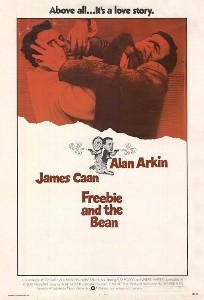
Freebie and the Bean
Let's get down to business. And I mean business. The buddy cop genre is the greatest genre in the history of cinema. Go ahead. I dare you to identify one that is better. See? You simply can-not. There were sprinklings before here and there, but the genre took off in the 1980's. One of those early sprinklings? An oddball, off-the-wall, politically incorrect comedy from 1974's Freebie and the Bean.
Longtime partners working the Intelligence Unit in San Francisco, Bean (Alan Arkin) and Freebie (James Caan) usually get the job done, sometimes in spite of themselves with their constant bickering. Their latest target? The duo has long sought to put well-known and long successful racketeer Red Meyers (Jack Kruschen) behind bars. After most of a year investigating, they've got the evidence -- finally -- but the key witness can't be put into custody for three more days. The solution? Freebie and Bean must shadow Meyers and make sure nothing goes wrong before they can officially arrest him. There are problems of course. Many people would be in trouble should Meyers testify so a hit man from Detroit (maybe more) has been dispatched to finish him. Oh, and it's Super Bowl week. Oh, and Freebie and Bean might kill each other in the process. What could possibly go wrong?
Reading some reviews and message boards about this 1974 buddy cop flick, I saw a lot of people questioning why this is a movie just about completely forgotten over the years. I'm glad I wasn't the only one to think of that issue. I love James Caan and Alan Arkin, and I'd never even vaguely, remotely even kinda heard of it. Why is that? Well, it's not a classic, but it's pretty good. It is kooky, completely without a story, has tonal shifts left and right, is especially goofy and is incredibly politically incorrect. There are flaws, but my goodness, is it a fun ride.
Arkin and Caan. Caan and Arkin. How can you possibly go wrong? You can't here. Two of my favorite actors working together make it look effortless. As you expect from any buddy cop pairing, the duo has to bitch and moan and criticize and ridicule...even though they're the best of friends. Arkin is Bean, a Mexican officer, all business, no nonsense. Caan is Freebie, wild and all over the place and not one to turn down a free gift here and there (hence the nickname). The story drifts as needed, and you get a sense the script was a couple set pieces, an outline of a story, and just blank sports for Arkin and Caan to improvise, to fire lightning fast insults and jokes and one-liners for as long as they could. Too many classic lines to mention -- most of them foul-mouthed, racist, sexist and generally inappropriate -- but quite the Batman and Batman (no Robin here) to lead the way.
'Freebie/Bean' comes from director Richard Rush and comes as a bit of fresh air considering the time it was released. We're talking cynical cop flicks like French Connection, Bullitt, the Dirty Harry movies and plenty others. It's just a funny movie. That's all and that's it. That's not a bad thing. You sit back and enjoy it because there isn't any messages in sight or anything dark or hard-hitting. These are two cops who are friends and fight like an old married couple bombing their way through San Francisco who stop at nothing to put their case together. If half the city should be destroyed in the process....well, so be it. We had a good time. San Francisco looks great as a backdrop as well, an interesting choice considering so many cop movies were shot on-location there. Moral of the story? As much as I love those previously mentioned flicks, it's cool to see a cop movie do a complete 180.
Who else to look for? Some fun, familiar faces. Kruschen has a ton of fun as Meyers, the racketeer who can't believe how stupid the cops pursuing him really are. Loretta Swit of MASH fame plays his pretty young wife. Also look for Alex Rocco as the conviction rate-minded district attorney, Mike Kellin as the boys' lieutenant, Paul Koslo and Christopher Morley as a couple witnesses, and a scene-stealing Valerie Harper as Bean's possibly cheating wife, Consuelo.
So there's gotta be something wrong...right? It's the bizarre, often out of left field shifts in tone. It's dark and funny and politically incorrect, and then a complete direction change into a never-ending car and motorcycle chase (had...HAD to be an influence on The Blues Brothers) that relies on sight gags and Keystone Cops-esque humor. There's little warning too as things shift, especially toward the end with more than a few crazy twists, some that work, some that are shocking, and one that almost had me questioning the whole movie. Thankfully, it was a twist within a twist in a mystery surrounded by a paradox. Anyhoo, this is all complaining to complain. The movie is a ton of fun with one laugh after another. It's James Caan and Alan Arkin basically spending 2 hours causing collateral damage and bitching at each other in their downtime. If that's not a recipe for success, I don't know what is.
Freebie and the Bean (1974): ***/****
Longtime partners working the Intelligence Unit in San Francisco, Bean (Alan Arkin) and Freebie (James Caan) usually get the job done, sometimes in spite of themselves with their constant bickering. Their latest target? The duo has long sought to put well-known and long successful racketeer Red Meyers (Jack Kruschen) behind bars. After most of a year investigating, they've got the evidence -- finally -- but the key witness can't be put into custody for three more days. The solution? Freebie and Bean must shadow Meyers and make sure nothing goes wrong before they can officially arrest him. There are problems of course. Many people would be in trouble should Meyers testify so a hit man from Detroit (maybe more) has been dispatched to finish him. Oh, and it's Super Bowl week. Oh, and Freebie and Bean might kill each other in the process. What could possibly go wrong?
Reading some reviews and message boards about this 1974 buddy cop flick, I saw a lot of people questioning why this is a movie just about completely forgotten over the years. I'm glad I wasn't the only one to think of that issue. I love James Caan and Alan Arkin, and I'd never even vaguely, remotely even kinda heard of it. Why is that? Well, it's not a classic, but it's pretty good. It is kooky, completely without a story, has tonal shifts left and right, is especially goofy and is incredibly politically incorrect. There are flaws, but my goodness, is it a fun ride.
Arkin and Caan. Caan and Arkin. How can you possibly go wrong? You can't here. Two of my favorite actors working together make it look effortless. As you expect from any buddy cop pairing, the duo has to bitch and moan and criticize and ridicule...even though they're the best of friends. Arkin is Bean, a Mexican officer, all business, no nonsense. Caan is Freebie, wild and all over the place and not one to turn down a free gift here and there (hence the nickname). The story drifts as needed, and you get a sense the script was a couple set pieces, an outline of a story, and just blank sports for Arkin and Caan to improvise, to fire lightning fast insults and jokes and one-liners for as long as they could. Too many classic lines to mention -- most of them foul-mouthed, racist, sexist and generally inappropriate -- but quite the Batman and Batman (no Robin here) to lead the way.
'Freebie/Bean' comes from director Richard Rush and comes as a bit of fresh air considering the time it was released. We're talking cynical cop flicks like French Connection, Bullitt, the Dirty Harry movies and plenty others. It's just a funny movie. That's all and that's it. That's not a bad thing. You sit back and enjoy it because there isn't any messages in sight or anything dark or hard-hitting. These are two cops who are friends and fight like an old married couple bombing their way through San Francisco who stop at nothing to put their case together. If half the city should be destroyed in the process....well, so be it. We had a good time. San Francisco looks great as a backdrop as well, an interesting choice considering so many cop movies were shot on-location there. Moral of the story? As much as I love those previously mentioned flicks, it's cool to see a cop movie do a complete 180.
Who else to look for? Some fun, familiar faces. Kruschen has a ton of fun as Meyers, the racketeer who can't believe how stupid the cops pursuing him really are. Loretta Swit of MASH fame plays his pretty young wife. Also look for Alex Rocco as the conviction rate-minded district attorney, Mike Kellin as the boys' lieutenant, Paul Koslo and Christopher Morley as a couple witnesses, and a scene-stealing Valerie Harper as Bean's possibly cheating wife, Consuelo.
So there's gotta be something wrong...right? It's the bizarre, often out of left field shifts in tone. It's dark and funny and politically incorrect, and then a complete direction change into a never-ending car and motorcycle chase (had...HAD to be an influence on The Blues Brothers) that relies on sight gags and Keystone Cops-esque humor. There's little warning too as things shift, especially toward the end with more than a few crazy twists, some that work, some that are shocking, and one that almost had me questioning the whole movie. Thankfully, it was a twist within a twist in a mystery surrounded by a paradox. Anyhoo, this is all complaining to complain. The movie is a ton of fun with one laugh after another. It's James Caan and Alan Arkin basically spending 2 hours causing collateral damage and bitching at each other in their downtime. If that's not a recipe for success, I don't know what is.
Freebie and the Bean (1974): ***/****
Labels:
1970s,
Alan Arkin,
Alex Rocco,
Comedy,
Cops,
Jack Kruschen,
James Caan,
Mike Kellin,
Paul Koslo
Thursday, November 6, 2014
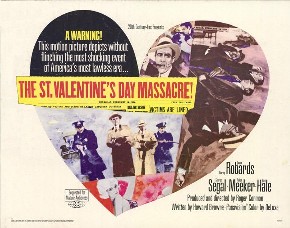
The St. Valentine's Day Massacre
I grew up in Chicago so I love just about everything in the Windy City, all the sports teams, the downtown area, all that great food from Chicago style hot dogs to Chicago style pizza. But that Chicago history? My goodness, there are some dark moments from the Black Sox scandal to the Chicago Fire, the riots at the 1968 Democratic convention and generally all sorts of political corruption and deception. One of the most violent incidents in the city's history? That's told in a 1967 B-movie, The St. Valentine's Day Massacre.
It's early 1929 and the streets of Chicago are filled with warring gangsters from two rival gangs. On one side is Al Capone (Jason Robards), a brutal, possibly maniacal Italian gangster with Mafia ties, who rules Chicago's South Side with an iron fist. Running the city's North side is George 'Bugs' Moran (Ralph Meeker), his Irish gang trying to hold onto their territory. Things across the city are building to an unavoidable confrontation as both sides fight for control of thousands of speakeasies, Prohibition still raging. Capone has grown tired of Moran's gang trying to build up their power and has put into work a plan to execute his rival gang leader. Can one gang win out over the other? Can anyone win with the city's streets riddled with bullets and blood?
Everyone's heard of producer/director extraordinaire Roger Corman? He's one of Hollywood's all-time greats at getting movies made on the cheap so basically the King of B-Movies. That's not a bad thing, and I say it as a compliment. This generally forgotten 1967 gangster flick is one of his best, telling the true story of one of Chicago's darkest moments. It was filmed on studio streets -- cheaper than Chicago's downtown area -- but it works, giving the city a closed in, wintery and claustrophobic effect. This is a flick that works almost like a quasi-documentary, like something you'd see on The History Channel...but darker, much darker. With narrator Paul Frees and his perfectly gravelly voice laying things out, introducing dates, people and times, it all fits together like puzzle pieces.
Where 'Massacre' separates itself from the quasi-documentary feel is that darkness, that gangster world we're thrust into. Low budget though it may be, the movie looks great with countless gangsters wearing impeccably cool suits with fedoras, rocking vicious tommy guns and 1920s boats of cars that look as cool as ever now in 2014 as they would have in 1929. As for the real life gangsters, this isn't The Godfather where you kinda sorta maybe sympathize with the Corleones, however vicious and murdery they are. There ain't a single sympathetic character anywhere in sight. These are nasty, brutal, violent folks interested in making money and killing some rival gangsters in the process. You're not rooting for anybody. You're not hoping these guys come out unscathed. You just wanna see how it all shakes out and who's gonna make it. Let me tell you...not many do.
One of the coolest aspects of 'Massacre' is its ridiculously deep cast. We're not talking a disaster flick type of cast full of aging A-list stars. We're talking a couple very solid movie stars/actors at the top and a cast backing them up absolutely packed to the guts with familiar, recognizable character actors. As for the leads, Robards is terrifyingly hammy as everyone's favorite Chicago gangster, Al Capone. He's got that look in his eye, you just never know what he's going to do next. Meeker is excellent too in a more understated but just as sinister part, Bugs Moran, an Irish gangster and Capone's main rival for power. Also look for a young George Segal in one of his best early roles, playing Peter Gusenberg, one of Moran's enforcers/lieutenants working closely with his brother, another enforcer, Frank (David Canary) while constantly fighting with live-in girlfriend (Jean Hale).
Okay, brace yourself because you're about to get hit with a whole lot of links to actor's IMDB pages. These are all the real-life people involved in the 1920s world of Chicago gang wars, an extremely interesting historical time if you're interested in the subject matter. On the Capone side keep an eye out for Clint Ritchie as the massacre's mastermind, Frank Silvera, Harold J. Stone, Paul Richards, Joe Turkel, Alex Rocco, Leo Gordon, John Agar, and Richard Bakalyan and Jack Nicholson (Yes, that Jack Nicholson) as two hired mafia killers. On the Moran side of things, watch for Bruce Dern, Kurt Kreuger, Tom Reese. Some appearances are quicker than others, but it's cool to see so many people in one movie, even if it is only for a scene or two.
Just an entertaining dark and dirty movie. If you're a fan of history whether it be Chicago or gangsters or anything in between, this gritty, cynical, particularly vicious flick is for you. I loved it.
The St. Valentine's Day Massacre (1967): *** 1/2 /****
It's early 1929 and the streets of Chicago are filled with warring gangsters from two rival gangs. On one side is Al Capone (Jason Robards), a brutal, possibly maniacal Italian gangster with Mafia ties, who rules Chicago's South Side with an iron fist. Running the city's North side is George 'Bugs' Moran (Ralph Meeker), his Irish gang trying to hold onto their territory. Things across the city are building to an unavoidable confrontation as both sides fight for control of thousands of speakeasies, Prohibition still raging. Capone has grown tired of Moran's gang trying to build up their power and has put into work a plan to execute his rival gang leader. Can one gang win out over the other? Can anyone win with the city's streets riddled with bullets and blood?
Everyone's heard of producer/director extraordinaire Roger Corman? He's one of Hollywood's all-time greats at getting movies made on the cheap so basically the King of B-Movies. That's not a bad thing, and I say it as a compliment. This generally forgotten 1967 gangster flick is one of his best, telling the true story of one of Chicago's darkest moments. It was filmed on studio streets -- cheaper than Chicago's downtown area -- but it works, giving the city a closed in, wintery and claustrophobic effect. This is a flick that works almost like a quasi-documentary, like something you'd see on The History Channel...but darker, much darker. With narrator Paul Frees and his perfectly gravelly voice laying things out, introducing dates, people and times, it all fits together like puzzle pieces.
Where 'Massacre' separates itself from the quasi-documentary feel is that darkness, that gangster world we're thrust into. Low budget though it may be, the movie looks great with countless gangsters wearing impeccably cool suits with fedoras, rocking vicious tommy guns and 1920s boats of cars that look as cool as ever now in 2014 as they would have in 1929. As for the real life gangsters, this isn't The Godfather where you kinda sorta maybe sympathize with the Corleones, however vicious and murdery they are. There ain't a single sympathetic character anywhere in sight. These are nasty, brutal, violent folks interested in making money and killing some rival gangsters in the process. You're not rooting for anybody. You're not hoping these guys come out unscathed. You just wanna see how it all shakes out and who's gonna make it. Let me tell you...not many do.
One of the coolest aspects of 'Massacre' is its ridiculously deep cast. We're not talking a disaster flick type of cast full of aging A-list stars. We're talking a couple very solid movie stars/actors at the top and a cast backing them up absolutely packed to the guts with familiar, recognizable character actors. As for the leads, Robards is terrifyingly hammy as everyone's favorite Chicago gangster, Al Capone. He's got that look in his eye, you just never know what he's going to do next. Meeker is excellent too in a more understated but just as sinister part, Bugs Moran, an Irish gangster and Capone's main rival for power. Also look for a young George Segal in one of his best early roles, playing Peter Gusenberg, one of Moran's enforcers/lieutenants working closely with his brother, another enforcer, Frank (David Canary) while constantly fighting with live-in girlfriend (Jean Hale).
Okay, brace yourself because you're about to get hit with a whole lot of links to actor's IMDB pages. These are all the real-life people involved in the 1920s world of Chicago gang wars, an extremely interesting historical time if you're interested in the subject matter. On the Capone side keep an eye out for Clint Ritchie as the massacre's mastermind, Frank Silvera, Harold J. Stone, Paul Richards, Joe Turkel, Alex Rocco, Leo Gordon, John Agar, and Richard Bakalyan and Jack Nicholson (Yes, that Jack Nicholson) as two hired mafia killers. On the Moran side of things, watch for Bruce Dern, Kurt Kreuger, Tom Reese. Some appearances are quicker than others, but it's cool to see so many people in one movie, even if it is only for a scene or two.
Just an entertaining dark and dirty movie. If you're a fan of history whether it be Chicago or gangsters or anything in between, this gritty, cynical, particularly vicious flick is for you. I loved it.
The St. Valentine's Day Massacre (1967): *** 1/2 /****
Monday, January 21, 2013
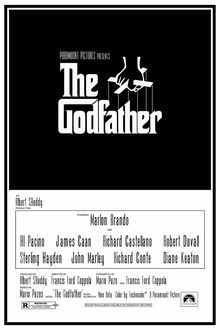
The Godfather
Some movies are just better than others, plain and simple. They're the ones that even the most casual movie fans among us are aware of, films like Gone With the Wind, Casablanca, Lawrence of Arabia, and one of my favorite movies, and maybe the greatest movie ever made, 1972's The Godfather.
It's just a few months since the end of WWII, and Vito Corleone (Marlon Brando), the head of the Corleone crime family in New York City and dubbed the Godfather, is at the height of his power. He has an epically successful business, running the unions and all the gambling in the city, and he's able to do it because he has countless politicians and judges in his back pocket. Things are changing though all around him, especially the underworld and the business he helped create. Vito is approached about a deal he could bankroll, but it involves drugs, and he chooses to ignore it. The decision is one that drastically affects the family, one that will incorporate all his family members, especially fiery firstborn Santino (James Caan), adopted Irish son, Tom Hagen (Robert Duvall), and his youngest and smartest son, Michael (Al Pacino). What does the future hold? Who will rise up to help their father?
Based off a novel of the same name by author Mario Puzo, 'Godfather' is one of those rarest films; it's perfect. In that sense, director Francis Ford Coppola improves on Puzo's novel, the rare film that is better than its source novel. None of that is a dig at Puzo -- the novel is one of my favorites, a well-written gem -- but the film takes the idea, premise and characters and runs with it. Clocking in at 175 minutes, it never slows down, never feels dull. The dialogue and script provide countless engrossing talking scenes. The look of the movie with its authentic wardrobe, cars and sets is incredible, Coppola filming in an earthy fashion where things always look dark and burned-out to a point. Oh, and composer Nino Rota's score is halfway decent (that's sarcasm by the way), one of the great, classic scores in Hollywood history. You know it already, but listen to the theme HERE.
What sets Coppola's film apart from countless other films about the Mafia, mobsters and organized crime is the impeccably written story. Puzo's novel introduces countless characters, relationships, history at the reader with all sorts of backstory, and the film assembles it into an expertly told, very coherent (sounds simple, but you'd be surprised) story that develops nicely. It covers over 10 years of time, but at no point does it feel even slightly rushed. Puzo's novel (he also worked with Coppola on the script) introduces characters and within minutes we feel like we've got a good idea of who they are as an individual. Imagine that with over 10 characters that get a fair share of screentime. There is a comfort level with the characters -- the good guys and the bad guys -- that makes the movie more enjoyable the second it begins. Does it all fall into place right away? No, it takes some time, but getting there is half the fun.
As far as true acting movies go, this 1972 classic is hard to beat. There isn't a performance that falls short or feels fake, but two rise above the rest; Brando as Vito Corleone and Pacino as his son, Michael. Playing one of the most iconic characters in film history, Brando's performance has opened the doors for all sorts of impressions, caricatures and stereotypes, but it is a career-best performance (and that's saying something considering Brando's career). It is a layered, nuanced performance, a man in the second half of his life who is highly intelligent, kind and ruthless at the same time, and a man who will stop at nothing to care for his family. Pacino's Michael goes through the film's biggest transition, a young man and WWII hero who wants nothing to do with his family's shady background but finds himself thrust into the family business when outside forces descend on the Corleones. Brando won an Oscar -- fully deserved -- and Pacino was nominated, but whatever the award nominations out there, it's two amazing performances.
Coppola's film earned plenty of acting nominations, three alone for Best Supporting Actor with Pacino, Duvall and Caan all earning a nod. The coolest part? All three deserved it for one reason or another. Caan and Duvall get less screentime, but they make the most of it. Caan is a scene-stealer as the fiery, hot-tempered Santino, known to friends and family as Sonny, the oldest Corleone son. The same for Duvall as Tom Hagen, but in a different way. Where Caan is more aggressive, Duvall underplays his part as Tom, the unofficial Irish Corleone brother, a childhood friend of Sonny's who Vito welcomed into the house. Other members of the Corleone family and operation? Richard Castellano and Abe Vigoda as Clemenza and Tessio, the Corleone caporegimes (think right-hand men, enforcers), John Cazale as Fredo, the Corleone brother and screw-up, Talia Shire as Connie, the lone Corleone sister and her similarly fiery husband, Carlo (Gianni Russo), and Diane Keaton as Kay, young Michael's love who must decide how much she's willing to put up with.
And then there's the opposition, the all-around nice individuals who are trying to take down the Corleones. For starters there's Richard Conte as Barzini, a head of another NYC crime family, Sterling Hayden as Capt. McCluskey, an NYC cop on a rival's payroll, John Marley as a film studio head who incurs the wrath of the Corleones, Al Lettieri as Sollozzo, a drug supplier looking for funding and backing, and Alex Rocco as a casino owner dealing with a buy-out of his casino.
On repeated viewings, I've noticed different features about the film, different layers that can affect how I view it. The biggest is simple; family. Yes, it's a pretty hardcore, violent story about a crime family with its hand in illegal happenings, but it's still family. If you can look past that whole criminal aspect, the biggest focus is the family and the dynamics and relationships among family members. Through the rather vicious, violent ups and downs, love and hate, they're there for each other (for this movie at least). I love how Vito dotes on his kids and grandchildren but can balance that out with a brutal mindset -- it's business, not personal -- at the same time. The relationship between Vito and Michael is the most heartfelt, including one of my all-time favorite scenes as father and son discuss what could have been, maybe what should have been. A worrying Vito wanted more for his son, but a firmly entrenched Michael (very much looking out for the family) calmly states "We'll get there, Pop." It's an endearing, heartfelt moment, one of many.
There are far too many memorable, iconic, and all-time great scenes to discuss one by one. Big picture, that's probably what viewers will remember the most on initial viewing. The infamous horse head scene, the introduction of Vito, his loyal enforcer, Luca Brasi (Lenny Montana), and his "offer he can't refuse," the perfect simplicity and natural quality of the opening wedding, a slight detour to Sicily and its beautiful hills, a meeting among Michael, Sollozzo, and McCluskey in a traditional Italian restaurant, and maybe the most memorable, the baptism scene, almost entirely silent other than Rota's score playing over the developing scenes. Each of the above scenes could be analyzed in a review unto itself, but this review is already getting long-winded. Long story short? It's maybe the greatest movie in Hollywood history without a flaw in sight. Shame on you if you haven't seen it by the way. What are you waiting for?
The Godfather (1972): ****/****
It's just a few months since the end of WWII, and Vito Corleone (Marlon Brando), the head of the Corleone crime family in New York City and dubbed the Godfather, is at the height of his power. He has an epically successful business, running the unions and all the gambling in the city, and he's able to do it because he has countless politicians and judges in his back pocket. Things are changing though all around him, especially the underworld and the business he helped create. Vito is approached about a deal he could bankroll, but it involves drugs, and he chooses to ignore it. The decision is one that drastically affects the family, one that will incorporate all his family members, especially fiery firstborn Santino (James Caan), adopted Irish son, Tom Hagen (Robert Duvall), and his youngest and smartest son, Michael (Al Pacino). What does the future hold? Who will rise up to help their father?
Based off a novel of the same name by author Mario Puzo, 'Godfather' is one of those rarest films; it's perfect. In that sense, director Francis Ford Coppola improves on Puzo's novel, the rare film that is better than its source novel. None of that is a dig at Puzo -- the novel is one of my favorites, a well-written gem -- but the film takes the idea, premise and characters and runs with it. Clocking in at 175 minutes, it never slows down, never feels dull. The dialogue and script provide countless engrossing talking scenes. The look of the movie with its authentic wardrobe, cars and sets is incredible, Coppola filming in an earthy fashion where things always look dark and burned-out to a point. Oh, and composer Nino Rota's score is halfway decent (that's sarcasm by the way), one of the great, classic scores in Hollywood history. You know it already, but listen to the theme HERE.
What sets Coppola's film apart from countless other films about the Mafia, mobsters and organized crime is the impeccably written story. Puzo's novel introduces countless characters, relationships, history at the reader with all sorts of backstory, and the film assembles it into an expertly told, very coherent (sounds simple, but you'd be surprised) story that develops nicely. It covers over 10 years of time, but at no point does it feel even slightly rushed. Puzo's novel (he also worked with Coppola on the script) introduces characters and within minutes we feel like we've got a good idea of who they are as an individual. Imagine that with over 10 characters that get a fair share of screentime. There is a comfort level with the characters -- the good guys and the bad guys -- that makes the movie more enjoyable the second it begins. Does it all fall into place right away? No, it takes some time, but getting there is half the fun.
As far as true acting movies go, this 1972 classic is hard to beat. There isn't a performance that falls short or feels fake, but two rise above the rest; Brando as Vito Corleone and Pacino as his son, Michael. Playing one of the most iconic characters in film history, Brando's performance has opened the doors for all sorts of impressions, caricatures and stereotypes, but it is a career-best performance (and that's saying something considering Brando's career). It is a layered, nuanced performance, a man in the second half of his life who is highly intelligent, kind and ruthless at the same time, and a man who will stop at nothing to care for his family. Pacino's Michael goes through the film's biggest transition, a young man and WWII hero who wants nothing to do with his family's shady background but finds himself thrust into the family business when outside forces descend on the Corleones. Brando won an Oscar -- fully deserved -- and Pacino was nominated, but whatever the award nominations out there, it's two amazing performances.
Coppola's film earned plenty of acting nominations, three alone for Best Supporting Actor with Pacino, Duvall and Caan all earning a nod. The coolest part? All three deserved it for one reason or another. Caan and Duvall get less screentime, but they make the most of it. Caan is a scene-stealer as the fiery, hot-tempered Santino, known to friends and family as Sonny, the oldest Corleone son. The same for Duvall as Tom Hagen, but in a different way. Where Caan is more aggressive, Duvall underplays his part as Tom, the unofficial Irish Corleone brother, a childhood friend of Sonny's who Vito welcomed into the house. Other members of the Corleone family and operation? Richard Castellano and Abe Vigoda as Clemenza and Tessio, the Corleone caporegimes (think right-hand men, enforcers), John Cazale as Fredo, the Corleone brother and screw-up, Talia Shire as Connie, the lone Corleone sister and her similarly fiery husband, Carlo (Gianni Russo), and Diane Keaton as Kay, young Michael's love who must decide how much she's willing to put up with.
And then there's the opposition, the all-around nice individuals who are trying to take down the Corleones. For starters there's Richard Conte as Barzini, a head of another NYC crime family, Sterling Hayden as Capt. McCluskey, an NYC cop on a rival's payroll, John Marley as a film studio head who incurs the wrath of the Corleones, Al Lettieri as Sollozzo, a drug supplier looking for funding and backing, and Alex Rocco as a casino owner dealing with a buy-out of his casino.
On repeated viewings, I've noticed different features about the film, different layers that can affect how I view it. The biggest is simple; family. Yes, it's a pretty hardcore, violent story about a crime family with its hand in illegal happenings, but it's still family. If you can look past that whole criminal aspect, the biggest focus is the family and the dynamics and relationships among family members. Through the rather vicious, violent ups and downs, love and hate, they're there for each other (for this movie at least). I love how Vito dotes on his kids and grandchildren but can balance that out with a brutal mindset -- it's business, not personal -- at the same time. The relationship between Vito and Michael is the most heartfelt, including one of my all-time favorite scenes as father and son discuss what could have been, maybe what should have been. A worrying Vito wanted more for his son, but a firmly entrenched Michael (very much looking out for the family) calmly states "We'll get there, Pop." It's an endearing, heartfelt moment, one of many.
There are far too many memorable, iconic, and all-time great scenes to discuss one by one. Big picture, that's probably what viewers will remember the most on initial viewing. The infamous horse head scene, the introduction of Vito, his loyal enforcer, Luca Brasi (Lenny Montana), and his "offer he can't refuse," the perfect simplicity and natural quality of the opening wedding, a slight detour to Sicily and its beautiful hills, a meeting among Michael, Sollozzo, and McCluskey in a traditional Italian restaurant, and maybe the most memorable, the baptism scene, almost entirely silent other than Rota's score playing over the developing scenes. Each of the above scenes could be analyzed in a review unto itself, but this review is already getting long-winded. Long story short? It's maybe the greatest movie in Hollywood history without a flaw in sight. Shame on you if you haven't seen it by the way. What are you waiting for?
The Godfather (1972): ****/****
Saturday, October 20, 2012
Slither (1973)
James Caan is cool. He's Santino Corleone. That's basically the only reason I checked out 1973's Slither
during a recent Caan marathon on Turner Classic Movies. I should have
steered clear of this one because Caan-cool factor aside, this is one
bad movie.
Fresh out of prison having served part of a sentence for grand theft auto, Dick Kanipsia (Caan) is dealt a strange hand when an old friend is killed after picking him up. Before he dies though, the friend mysteriously tells him two names, and that he should seek them out. With no other options or opportunities in front of him, Dick seeks out one of the names, Barry Fenaka (Peter Boyle), who lets him in on a plan. Years prior, Barry and the since-dead friend embezzled some $312,000 and now know where they can get it. Dick signs on as Barry's partner, traveling all over California in hopes of finally getting their hands on the money. Who knows what kooky, crazy antics await them on the open road.
In previous reviews of 1970s films, I've mentioned that there is a distinct quality of watching a movie from that decade. It was a major turning point in the darkness/reality of how films were portrayed, and much of the time it was for the better. There's a different pacing to so many 1970s movies with more of a focus on the people and stories rather than the scope and scale. From director Howard Zieff, 'Slither' unfortunately tries to do just that. It aims to be a quirky, off-beat story with quirky, off-beat characters, but never ultimately gets to that point. At 97 minutes, it drifts aimlessly without even a semblance of even a drifting story. Characters come along, disappear and then return as necessary.
This flick is listed at IMDB as a comedy-crime thriller, and I'm thinking "That was a comedy?" I must have missed all those really funny parts. It is neither a comedy nor a thriller, and any drama seems to be an accident more than anything. Caan's ex-con is an amiable enough guy, sort of drifting along with a plan that could net him some easy money. He meets all sorts of eccentrics along the road, but none of them are truly funny. The twist is that Dick and Barry are being followed by a menacing black van (Alex Rocco, Len Lesser, Allen Garfield, and Alex Henteloff are the "baddies" inside) with some sinister objective. The actual twist? Incredibly disappointing, and actually, mindlessly stupid that doesn't make a whole lot of sense. But then again, that's kind of the whole movie.
Even as a fan, I can admit Caan looks like he's sleepwalking. He doesn't look too interested in any of the proceedings going on, maybe realizing what a mess he got caught up in. I think there's some jokes meant with his name (13-year old's giggle), but even that is mishandled. Boyle is a little better as Barry, but his background is kept so much in the dark that he's wasted. The character even disappears midway through the movie, apparently that's the thriller aspect, but another twist there falls short. Sally Kellerman starts off as the sexy chick Dick meets on the road, Kitty Kopetzky, then degenerates into a complete nut-bag. Louise Lasser plays Mary, Barry's wife who spends much of the movie being worried in the couple's RV motorhome.
I struggle with what else to rip about this mess. The end turns into a big chase scene with the intimidating black van gunning it after a station wagon hauling an RV. I don't even know. It's bad, and the more I think about it, the badder it gets.
Slither <---TCM trailer/clips (1973): */****
Fresh out of prison having served part of a sentence for grand theft auto, Dick Kanipsia (Caan) is dealt a strange hand when an old friend is killed after picking him up. Before he dies though, the friend mysteriously tells him two names, and that he should seek them out. With no other options or opportunities in front of him, Dick seeks out one of the names, Barry Fenaka (Peter Boyle), who lets him in on a plan. Years prior, Barry and the since-dead friend embezzled some $312,000 and now know where they can get it. Dick signs on as Barry's partner, traveling all over California in hopes of finally getting their hands on the money. Who knows what kooky, crazy antics await them on the open road.
In previous reviews of 1970s films, I've mentioned that there is a distinct quality of watching a movie from that decade. It was a major turning point in the darkness/reality of how films were portrayed, and much of the time it was for the better. There's a different pacing to so many 1970s movies with more of a focus on the people and stories rather than the scope and scale. From director Howard Zieff, 'Slither' unfortunately tries to do just that. It aims to be a quirky, off-beat story with quirky, off-beat characters, but never ultimately gets to that point. At 97 minutes, it drifts aimlessly without even a semblance of even a drifting story. Characters come along, disappear and then return as necessary.
This flick is listed at IMDB as a comedy-crime thriller, and I'm thinking "That was a comedy?" I must have missed all those really funny parts. It is neither a comedy nor a thriller, and any drama seems to be an accident more than anything. Caan's ex-con is an amiable enough guy, sort of drifting along with a plan that could net him some easy money. He meets all sorts of eccentrics along the road, but none of them are truly funny. The twist is that Dick and Barry are being followed by a menacing black van (Alex Rocco, Len Lesser, Allen Garfield, and Alex Henteloff are the "baddies" inside) with some sinister objective. The actual twist? Incredibly disappointing, and actually, mindlessly stupid that doesn't make a whole lot of sense. But then again, that's kind of the whole movie.
Even as a fan, I can admit Caan looks like he's sleepwalking. He doesn't look too interested in any of the proceedings going on, maybe realizing what a mess he got caught up in. I think there's some jokes meant with his name (13-year old's giggle), but even that is mishandled. Boyle is a little better as Barry, but his background is kept so much in the dark that he's wasted. The character even disappears midway through the movie, apparently that's the thriller aspect, but another twist there falls short. Sally Kellerman starts off as the sexy chick Dick meets on the road, Kitty Kopetzky, then degenerates into a complete nut-bag. Louise Lasser plays Mary, Barry's wife who spends much of the movie being worried in the couple's RV motorhome.
I struggle with what else to rip about this mess. The end turns into a big chase scene with the intimidating black van gunning it after a station wagon hauling an RV. I don't even know. It's bad, and the more I think about it, the badder it gets.
Slither <---TCM trailer/clips (1973): */****
Monday, November 21, 2011
Hearts of the West
Who among us at some point hasn't wanted to be a movie star? Even if it was just for a second, the glamour of the big screen looks awfully inviting. So how about a young country bumpkin getting started in the movies and finding out it isn't quite as glamorous as it looks? In steps 1975's Hearts of the West.
Hoping to become a western novel writer, young Lewis Tater (Jeff Bridges) heads west to what he believes is a writing school only to find it is a correspondence school and a con job at that. Still wanting to pursue his dream, Lewis runs afoul of the con men (Anthony James and Richard B. Shull) and ends up with some of their money. On the run, Lewis stumbles onto the set of a western being filmed in the desert and quickly finds work. He wants to be a writer above all else but starts off as a background player and stuntman, meeting Howard Pike (Andy Griffith) and a handful of other vets of the business. Somewhat naive and a little idealistic though, Lewis finds out everything isn't quite what it's made out to be.
Following your dreams and coming of age stories are pretty familiar story-lines, but that's not a bad thing. Bridges at 26 years old is probably a little old for the Lewis character, but he makes it work. A tad pretentious at times because he's so assured of his writing abilities, Bridges gives Lewis that solid mix of naive youngster and over the top, energetic where you can't help but like him. He meets people both good and bad, finding out that trusting others isn't always the easiest or best thing to do to advance yourself. Bridges is one of my favorites, and his performance here -- while not one of his most well known -- is a very strong role to lead the movie.
What works so well with director Howard Zieff's movie is the portrayal of an ever-growing business, movies. Set in the early 1930s, 'Hearts' is right in that time when studios were still trying to figure out how to make the transition from silent films to sound films, the focus here on the cheap western serials made with a quick turnaround. The good guys were very good, the bad guys very bad, and the stunt guys? Well, they just want to get paid. It is the little scenes and moments that made me laugh. Alan Arkin plays Kessler, a director who can manipulate like nobody's business, "motivating" Lewis by telling him the money they'll lose if a scene doesn't work. Bridges' ridiculously theatrical "death scene" has him twisting and turning, moaning and groaning before finally falling to the ground with a thud. A little window into one of Hollywood's most interesting eras, and a good window at that.
In an impressive supporting cast, Arkin and Griffith both stand out for all the right reasons. Arkin's Kessler is a supporting player to the story and not a necessarily important one, but Arkin makes the best of it. He isn't chewing the scenery, but it's close. He gets to ham it up a bit working with his cast, stunt men, script supervisors and film crew. Kessler goes from zero to 60 like nothing, providing some truly funny outbursts. In between The Andy Griffith Show but before Matlock, Griffith gets to show off his range, a fun character who's had years of experience in the business who also has a darker side. Bridges' Lewis clearly looks up to him, something that could come back to bite him. It's a great performance, both of them are, the strong parts that can bring a movie up a notch or two overall.
That's not all though with a very deep cast assembled for this movie-making film. Blythe Danner plays Miss Trout, a script supervisor who Lewis meets on-set. She similarly feels sympathy for him while also liking him and his genuine willingness to make something of himself. Donald Pleasence makes a quick appearance as A.J. Neitz, a movie producer with lots of pull all around Hollywood. Alex Rocco is underused as Earl, one of Arkin's assistants. Matt Clark and Burton Gilliam are two of the stunt crew who work with Lewis and Howard, putting themselves in harm's way for a small payday. Good cast from top to bottom.
Not much else to say here. Just a good movie, funny, sweet and a great look into the movies from behind the camera.
Hearts of the West <---TCM clips (1975): ***/****
Hoping to become a western novel writer, young Lewis Tater (Jeff Bridges) heads west to what he believes is a writing school only to find it is a correspondence school and a con job at that. Still wanting to pursue his dream, Lewis runs afoul of the con men (Anthony James and Richard B. Shull) and ends up with some of their money. On the run, Lewis stumbles onto the set of a western being filmed in the desert and quickly finds work. He wants to be a writer above all else but starts off as a background player and stuntman, meeting Howard Pike (Andy Griffith) and a handful of other vets of the business. Somewhat naive and a little idealistic though, Lewis finds out everything isn't quite what it's made out to be.
Following your dreams and coming of age stories are pretty familiar story-lines, but that's not a bad thing. Bridges at 26 years old is probably a little old for the Lewis character, but he makes it work. A tad pretentious at times because he's so assured of his writing abilities, Bridges gives Lewis that solid mix of naive youngster and over the top, energetic where you can't help but like him. He meets people both good and bad, finding out that trusting others isn't always the easiest or best thing to do to advance yourself. Bridges is one of my favorites, and his performance here -- while not one of his most well known -- is a very strong role to lead the movie.
What works so well with director Howard Zieff's movie is the portrayal of an ever-growing business, movies. Set in the early 1930s, 'Hearts' is right in that time when studios were still trying to figure out how to make the transition from silent films to sound films, the focus here on the cheap western serials made with a quick turnaround. The good guys were very good, the bad guys very bad, and the stunt guys? Well, they just want to get paid. It is the little scenes and moments that made me laugh. Alan Arkin plays Kessler, a director who can manipulate like nobody's business, "motivating" Lewis by telling him the money they'll lose if a scene doesn't work. Bridges' ridiculously theatrical "death scene" has him twisting and turning, moaning and groaning before finally falling to the ground with a thud. A little window into one of Hollywood's most interesting eras, and a good window at that.
In an impressive supporting cast, Arkin and Griffith both stand out for all the right reasons. Arkin's Kessler is a supporting player to the story and not a necessarily important one, but Arkin makes the best of it. He isn't chewing the scenery, but it's close. He gets to ham it up a bit working with his cast, stunt men, script supervisors and film crew. Kessler goes from zero to 60 like nothing, providing some truly funny outbursts. In between The Andy Griffith Show but before Matlock, Griffith gets to show off his range, a fun character who's had years of experience in the business who also has a darker side. Bridges' Lewis clearly looks up to him, something that could come back to bite him. It's a great performance, both of them are, the strong parts that can bring a movie up a notch or two overall.
That's not all though with a very deep cast assembled for this movie-making film. Blythe Danner plays Miss Trout, a script supervisor who Lewis meets on-set. She similarly feels sympathy for him while also liking him and his genuine willingness to make something of himself. Donald Pleasence makes a quick appearance as A.J. Neitz, a movie producer with lots of pull all around Hollywood. Alex Rocco is underused as Earl, one of Arkin's assistants. Matt Clark and Burton Gilliam are two of the stunt crew who work with Lewis and Howard, putting themselves in harm's way for a small payday. Good cast from top to bottom.
Not much else to say here. Just a good movie, funny, sweet and a great look into the movies from behind the camera.
Hearts of the West <---TCM clips (1975): ***/****
Labels:
1970s,
Alan Arkin,
Alex Rocco,
Andy Griffith,
Donald Pleasence,
Jeff Bridges
Thursday, March 3, 2011
The Stunt Man
There is plenty of talent involved, and a story about a legendary mess of a movie being made sounded appealing. O'Toole is watchable in every movie I've ever seen him in, and this Oscar-nominated part is no different. But actually sitting down and watching this movie, it took me at least six sittings to make it through a mind-bogglingly slow 131-minute movie. By the last 45 minutes (how I made it that far into the movie I don't know), I was fast-forwarding through scenes as quick as I could. It's that rare movie I truly hate, but this one was pretty awful. It's not because it's a bad movie in itself. Anything but. It tries to be something else, a movie with a message, and fails miserably.
Spotted by two police officers at a highway diner, fugitive Cameron (Steve Railsback) flees through the woods and stumbles onto a movie set where a car crashes off a bridge into a river below, the stunt driver drowning inside accidentally. He continues running and ends up in a different scene being filmed, meeting possibly insane director of the film, Eli Cross (O'Toole). Incurring the wrath of the local sheriff (Alex Rocco) for the possible murder of the stunt man, Eli convinces him that Cameron is said stunt man and nothing's wrong. On the run, Cameron agrees and sticks around, learning how to be a stunt man. He has a love-hate relationship with the eccentric Eli and even falls for leading lady, Nina Franklin (Barbara Hershey). But when everything seems ideal, Cameron finds out Eli has a past with Nina, and now he has to attempt the dangerous driving stunt that killed his predecessor.
Where to start, where to start? I wasn't incredibly familiar with this movie going in and was only aware that O'Toole was the star. He's one of those few actors I will watch in anything, but more on that later. About 30 minutes into this movie, I wasn't quite sure what I was watching. Was it a dark comedy lampooning the movie-making industry? Was it a drama with some existential message about the bizarre nature of acting and making films? I didn't know, and I couldn't decide. That's never a good sign that far into the movie. What's worse is that it never resolves itself. The IMDB description says 'Action/Comedy/Drama.' I'm not quite sure what to call it even now.
The movie inside the movie is that O'Toole is directing a historical epic about a WWI hero on the run somewhere in Europe, running from German soldiers and fighters doing their damnedest to pick him off. As near as I can figure, it's supposed to be a trainwreck of a movie, one with the highest aspirations that you just know will fail. So is it an intentional dig that the movie we're watching seems as equally bad? The opening feels like a bizarre dream sequence, but the story never rights itself after that. Huge jumps in the story make it nearly impossible to follow or even keep up, and nothing is ever rightfully explained. Is Eli actually trying to kill Cameron? Why does the director embrace this admitted escaped convict so readily?
With 75 acting credits to his name, O'Toole worked with the gamut of directors, maybe the most famous being David Lean in Lawrence of Arabia. He had to see the good and bad, the calm and the agitated, the friendly and the enemies. He channels them all for this performance, rolling everything into one crazy, always entertaining, always mysterious director leading this mess of a movie. I was never sure of Eli's true intentions because he shows right away he is more interested in the safety of his movie than the actual people working on the movie. One outburst (watch HERE) is perfectly insane, one Christian Bale must have watched before his own blow-up. The movie is difficult to get through, but O'Toole's performance makes it somewhat bearable.
When O'Toole isn't on-screen though, the movie drops off in a big way. I don't know if Railsback is just a bad actor, or the character is poorly written, but there is nothing appealing about the Cameron character at all. His past and his breaking the law is left in the background for the most part, the revelation coming later in the proceedings thankfully. We're never rooting for him though, and his paranoia gets tedious quickly. Hershey is the same way, a cardboard cutout of a character who never becomes interesting. Allen Garfield's screenwriter and Charles Bail's veteran stunt man are underused in supporting parts that show this movie did have some potential. That's the whole problem. There's potential all over the place that never amounts to anything.
The Stunt Man <---trailer (1980): */****
Sunday, July 19, 2009
Netflix review #26: The Friends of Eddie Coyle
After years of not being available in any format, The Friends of Eddie Coyle was released on DVD late this spring by the Criterion Collection. I'd never heard of it prior to a Criterion email but reading about the casting, the director, the story, I couldn't pass it up. Of course, I wasn't the only one itching to see it, the movie status on Netflix for most of 2 months was 'Very Long Wait' which never sounds too good. So after most of three months of waiting on and off, Eddie Coyle came in the mail this week.
Everything about this movie is underplayed from the characters to the shooting style to the dialogue. It is what it is. There are no huge theatrics as the story unfolds. Stuff happens sometimes, and you have to roll with the punches. A lot of the credit goes to director Peter Yates of Bullitt fame among other movies. Yates doesn't call much attention to himself and knows from the start that the attention should be on the actors. Novel concept, isn't it? 'Eddie Coyle' looks like a documentary film, just following characters around as they live their lives. It's gritty and realistic, giving you the sensation of a fly on the wall as several seemingly unrelated storylines converge on each other.
With those unrelated stories, the movie can be hard to follow because it's not always easily apparent where it's going or how all these different things will come together. Looking back, it all comes together and makes sense. While a lot is going on, the main attention is paid to Eddie 'Fingers' Coyle, maybe a career-best performance for Robert Mitchum. Eddie is a small-time crook, as low level as they get, but who still has a way of being involved in every little thing. He's a gunrunner and puts people where they need to be to pull off a job. But Eddie's in trouble, he got arrested for transporting liquor and is facing a jail sentence of at least a couple years. With nowhere to turn and a wife and three kids to look after, Eddie goes to his last resort, becoming a snitch for Foley (Richard Jordan), a cop you're never quite sure of his motives.
Also involved is Jackie Brown (Steven Keats), Eddie's supplier who sells/transports the guns out of his souped-up muscle car. He plays dumb at times but when it comes down to it, he knows how to handle himself and stay alive when trouble arises. Then, there's Dillon (Peter Boyle), an ex-con working as a bartender who is similarly in trouble and looking for a way out. And all the while as Eddie works to save himself, Jimmy Scalise (Alex Rocco) is leading a crew who have their routine down pat for pulling off bank jobs. The stories are introduced and develop without much background or anything to go on, and that's what makes it hard to follow at some points.
But there is a connection and it all comes together nicely in the last 30 minutes. What sets this apart though from other difficult movies to follow is that I barely noticed it at all. The dialogue, the exchanges between this group of people are so perfect, so natural that it's just a pleasure to watch them do it. None of the characters are even particularly likable, they're all low-level hoods and thugs, even Jordan's Foley gives off a bad vibe, but I was drawn in nonetheless.
Often playing the anti-hero who when it came down to it was a good guy, Mitchum plays Eddie differently. He's looking out for his family, but as he's told, he put himself in this predicament. He's never rose in the ranks, but Eddie's got experience. Check these scenes with Jackie Brown and a meeting with Foley about his situation and one more with Jackie negotiating for the guns. Pulling off a tough Boston accent, Mitchum portrays Eddie as worldweary man who has backed himself into a corner and must now respond. It's scenes like this that are a pleasure to watch. No big over the top acting, no calling attention to themselves, just good old fashioned acting.
It's Mitchum's movie, but the rest of the cast is just as strong. Boyle is only in a few scenes but his actions help put the final scenes into motion, including a frustrating ending that works for the story but isn't the typical easy ending. Jordan stands out, again, as Foley, the cop trying to pull off any number of cases who just as easily could have been on the other side of the law. Having seen a handful of movies with Jordan from early in his career, it's hard to believe he never became a big star. His parts are always picture perfect, and he's becoming one of my favorite character actors. Along with Joe Santos, Rocco gets the less glamorous part as Eddie's associates but both actors make the most of it.
Not a typical crime movie, it's more low-key with little action and less gunplay/violence. The movie suceeds and fails on the performances of the cast so for my money, The Friends of Eddie Coyle is a huge success. It's not a movie you watch for the huge twists, the big gun fights, the exciting car chases. 'Eddie Coyle' you watch for the characters and the dialogue. It hasn't been available for years so take advantage of the Criterion Collection DVD, don't let this one slip by.
The Friends of Eddie Coyle <----trailer (1973): ***/****
Everything about this movie is underplayed from the characters to the shooting style to the dialogue. It is what it is. There are no huge theatrics as the story unfolds. Stuff happens sometimes, and you have to roll with the punches. A lot of the credit goes to director Peter Yates of Bullitt fame among other movies. Yates doesn't call much attention to himself and knows from the start that the attention should be on the actors. Novel concept, isn't it? 'Eddie Coyle' looks like a documentary film, just following characters around as they live their lives. It's gritty and realistic, giving you the sensation of a fly on the wall as several seemingly unrelated storylines converge on each other.
With those unrelated stories, the movie can be hard to follow because it's not always easily apparent where it's going or how all these different things will come together. Looking back, it all comes together and makes sense. While a lot is going on, the main attention is paid to Eddie 'Fingers' Coyle, maybe a career-best performance for Robert Mitchum. Eddie is a small-time crook, as low level as they get, but who still has a way of being involved in every little thing. He's a gunrunner and puts people where they need to be to pull off a job. But Eddie's in trouble, he got arrested for transporting liquor and is facing a jail sentence of at least a couple years. With nowhere to turn and a wife and three kids to look after, Eddie goes to his last resort, becoming a snitch for Foley (Richard Jordan), a cop you're never quite sure of his motives.
Also involved is Jackie Brown (Steven Keats), Eddie's supplier who sells/transports the guns out of his souped-up muscle car. He plays dumb at times but when it comes down to it, he knows how to handle himself and stay alive when trouble arises. Then, there's Dillon (Peter Boyle), an ex-con working as a bartender who is similarly in trouble and looking for a way out. And all the while as Eddie works to save himself, Jimmy Scalise (Alex Rocco) is leading a crew who have their routine down pat for pulling off bank jobs. The stories are introduced and develop without much background or anything to go on, and that's what makes it hard to follow at some points.
But there is a connection and it all comes together nicely in the last 30 minutes. What sets this apart though from other difficult movies to follow is that I barely noticed it at all. The dialogue, the exchanges between this group of people are so perfect, so natural that it's just a pleasure to watch them do it. None of the characters are even particularly likable, they're all low-level hoods and thugs, even Jordan's Foley gives off a bad vibe, but I was drawn in nonetheless.
Often playing the anti-hero who when it came down to it was a good guy, Mitchum plays Eddie differently. He's looking out for his family, but as he's told, he put himself in this predicament. He's never rose in the ranks, but Eddie's got experience. Check these scenes with Jackie Brown and a meeting with Foley about his situation and one more with Jackie negotiating for the guns. Pulling off a tough Boston accent, Mitchum portrays Eddie as worldweary man who has backed himself into a corner and must now respond. It's scenes like this that are a pleasure to watch. No big over the top acting, no calling attention to themselves, just good old fashioned acting.
It's Mitchum's movie, but the rest of the cast is just as strong. Boyle is only in a few scenes but his actions help put the final scenes into motion, including a frustrating ending that works for the story but isn't the typical easy ending. Jordan stands out, again, as Foley, the cop trying to pull off any number of cases who just as easily could have been on the other side of the law. Having seen a handful of movies with Jordan from early in his career, it's hard to believe he never became a big star. His parts are always picture perfect, and he's becoming one of my favorite character actors. Along with Joe Santos, Rocco gets the less glamorous part as Eddie's associates but both actors make the most of it.
Not a typical crime movie, it's more low-key with little action and less gunplay/violence. The movie suceeds and fails on the performances of the cast so for my money, The Friends of Eddie Coyle is a huge success. It's not a movie you watch for the huge twists, the big gun fights, the exciting car chases. 'Eddie Coyle' you watch for the characters and the dialogue. It hasn't been available for years so take advantage of the Criterion Collection DVD, don't let this one slip by.
The Friends of Eddie Coyle <----trailer (1973): ***/****
Labels:
1970s,
Alex Rocco,
Peter Yates,
Richard Jordan,
Robert Mitchum
Subscribe to:
Posts (Atom)
.jpg)