The Sons of Katie Elder

The Sons of Katie Elder
"First, we reunite, then find Ma and Pa's killer...then read some reviews."
Showing posts with label Alec Guinness. Show all posts

Wednesday, November 26, 2014

The Bridge on the River Kwai

When you're talking about great prisoner of war movies, that conversation is inevitably going to come down to two movies. For me, it's an easy distinction, an easy pick for which one is the best. That's one of my two favorite movies ever, 1963's The Great Escape. What's the other classic P.O.W. film? One of Hollywood's all-time greats, 1957's The Bridge on the River Kwai.

It's 1943 in western Burma and a battalion of British prisoners has arrived at Camp 16 along the Burma Railway. Allied prisoners are being used all along the railway to help build the tracks and bridges it needs to move supplies up and down the country. The commandant of the camp, Colonel Saito (Sessue Hayakawa), has been given a quick deadline in order to build a bridge over the river Kwai, but he quickly hits a roadblock in the form of the ranking officer among the Brits, Colonel Nicholson (Alec Guinness). Both men are career officers, both of them stubborn and strong-willed that they know what is right and how to do it. What follows is a battle of wills as the two commanders see who will crack first with the deadline fast approaching. Unbeknownst to both of them, Allied intelligence has caught wind of the bridge across the river. A former prisoner, Shears (William Holden), of the camp is working with an experienced commando, Warden (Jack Hawkins), to lead a team back into Burma and take out the bridge. 

That David Lean, he was a halfway decent director, winning two Best Picture Oscars in his storied career. One win was for Lawrence of Arabia. One was for River Kwai. My favorite? You're reading that movie's review right now. It is a film remembered as one of the all-time greats, and it deserves that status. The portrayal of war, its message about war, the instantly recognizable Colonel Bogey March (listen HERE), the phenomenal casting, the on-location shooting in Ceylon (Sri Lanka), the gorgeous filmography, and a great musical score overall from Malcolm Arnold. The scale is gigantic, but the story remains personal. It is a giant movie with an ability to never lose its focus or get too far away from where it wants to go. On my most recent viewing, I thought (more than I remember) there were some slow/sluggish portions in the 161-minute movie but not nearly enough to fault an otherwise pretty perfect movie.

The name evades me, but I remember seeing another British actor say in an interview "I didn't understand the Nicholson part until I saw Guinness' performance." That's how good Alec Guinness is in his Oscar-winning performance. This is an incredible acting job, a layered character that is baffling at times to understand. Colonel Nicholson is a fascinating character because his word, his beliefs and his stubborn make-up are everything to him. If he believes he is right, he IS right. This is a career soldier willing to put his life on the line to stand by his beliefs. A career officer, he knows nothing else other than the army. His dynamic with Hayakawa's Col. Saito is the guts of the movie, two officers believing they're right and seeing who will blink first. Who needs the other more to accomplish their goal? A late scene where Guinness' Nicholson discussing his career illuminates what drives the man. He wants to leave something that will be remembered. He does, but what if it helps the Japanese war effort?

What a cast! Guinness rightfully deserves first mention, but that's only the start. William Holden's character, Shears, is underwritten some, but it is a necessary, still very interesting character to move the action along. Holden is one of my favorites, and I liked his Shears, especially when a big twist is revealed near the halfway point. Jack Hawkins is just solid as Warden, the unlikely commando officer, an interesting similarity to Nicholson in the very, very British officer category. Hayakawa at times gets lost in the conversation, but he too is highly memorable as Saito, rough facade, terrified/worried inside at a possible failure. James Donald (also starring in The Great Escape) is the viewer, playing Major Clipton, the medical officer, trying to figure things out, to understand what's going on. Also worth mentioning is Geoffrey Horne as Joyce, the young, inexperienced commando trying to prove he can handle the job.

Also look for Andre Morell as Colonel Green, a key officer in Force 316, and Percy Herbert and Harold Goodwin as two British soldiers in the camp, Grogan and Baker.

Without resorting to hitting us over the head with a message, Lean does an understated job of delivering an anti-war message. What is it? Well....war is crazy. This isn't a horrifically violent movie, and the portrayals of a Japanese P.O.W. camp are pretty tame, but 'Kwai' effortlessly lays out all these different responses to war. Shears = Survival. Warden = A job. Clipton = Chaos and confusion. And Nicholson? A career. There are some moments of humor, usually pretty dark, mostly cynical, but Lean's movie (working off a novel by Pierre Boulle) presents the lunacy of war and simply lets it breathe. Decide for yourself who is right, if anyone.

So let's talk about that ending. No real SPOILERS here, but still, I'm talking (hopefully vaguely) about the finale. Great movie overall, one of the best ever. The ending to 'Kwai' is maybe top 5 finales to a movie ever as Force 316 (Warden, Shears, Joyce, a Siamese guerrilla and several Siamese girls) attempts to destroy the bridge at its grand opening. With nothing given away, there's a twist that is too perfect to describe. The last 35-40 minutes are phenomenal, and it only gets stronger in the final 15 minutes when the twist is revealed. Talk about tension built to an almost unbearable level. You can't believe what you're seeing, especially when Nicholson makes an amazing decision. It is a finale that leaves you drained and hammers home Lean's anti-war message. In the end, what is accomplished and at what cost? Boulle's finale is a doozy, a true whopper, if you read the novel.

Sometimes movies just work, a synergy of everything assembled clicking together. It is a beautiful movie, and Arnold's score works in unison with that visual, especially when Warden, Shears, Joyce and Co. finally arrive deep in the jungle at the bridge site. It is the first time we're seeing the completed bridge, and there's something simple and beautiful about the structure. Arnold's score soars, and all the pieces fit together. I think that's the beauty of it. This is my favorite David Lean movie overall, and it deserves its status as an all-time classic.

The Bridge on the River Kwai (1957): ****/****

Wednesday, September 25, 2013

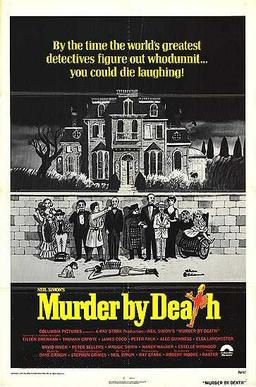
Murder by Death

What's more fun than a murder mystery in film and on TV? The people who solve the murder mysteries!!! And no, I'm not talking about police procedurals where police officers follow the clues and catch the crooks. We're talking the out of this world observant and intelligent sleuths and detectives who follow all the minute, excruciating little details and pull theories out of thin air. They certainly get their due in a great spoof from 1976, Murder by Death.

Coming from all around the world, five world-class detectives have been brought together at an isolated country mansion by eccentric recluse Lionel Twain (writer Truman Capote). His goal? Present a murder with little evidence and let his five detectives piece things together. Whoever figures things out and fingers the murderer by dawn will receive a $1 million reward. Who are his contestants of sorts? They include Milo Perrier (James Coco), the whiny Belgian, Sam Diamond (Peter Falk), the tough guy detective, Jessica Marbles (Elsa Lanchester), the very English middle-aged woman, Dick Charleston (David Niven), the gentlemanly, smooth aging detective, and Sidney Wang (Peter Sellers), the pronunciation challenged Chinese detective. Each detective has brought a partner/sidekick/spouse but can any of the manage to solve a seemingly impossible murder mystery?

From director Robert Moore and screenwriter Neil Simon, 'Murder' is a gem in the Whodunnit genre. Throw a bunch of characters together, add in a mystery/murder or something that needs to be solved, and let the fun begin. This is a spoof of the Whodunnit genre, but it's not a stupid spoof, far from it. While the humor is far from high brow laughs, it's snappy, smart and quick. This is a very talented cast assembled here, the actors and actresses playing off each with remarkable ease. It's a quick movie at just 94 minutes, but there are laughs throughout. It was filmed on a mansion set in Burbank Studios, a closed-in, claustrophobic feel to the ever twisting and turning story. Self-contained and the better for it.

You really just can't go wrong with the sick amount of talent brought together here in the cast. Each detective is based off a classic literature character (Perrior = Hercules Poirot, Diamond = Sam Spade, Marbles = Miss Marple, Charleston = Nick Charles/The Thin Man, and Wang = Charlie Chan), each given their quirky personality traits that bring it all together nicely. Coco's Perrier is dying of starvation -- or so he believes -- as the mystery develops, Diamond does his best Humphrey Bogart impression throughout, Marbles quirky, mousy and excited, Charleston the upper class, smooth-talking Englishman, and Wang the master of logic and observation (with a touch of political incorrectness thrown in for good measure). It would be easy to see any/all of these characters getting their own movie, but when assembled together, we're talking impeccable chemistry with some sublimely perfect laughs.

Improving on the talent brought together is that each character is given a sidekick of some sort, a spouse, child, whatever. More cast listing!!! The recently departed Eileen Brennan plays Tess Skeffington, Sam's secretary and mistress, Maggie Smith plays Nora Charleston, Dick's longtime and loving wife, Estelle Windood as Miss Marple's wheelchair bound and ancient nurse, James Cromwell as Marcel, Perrier's very French chauffeur and Richard Narita as Willy, Wang's adopted Japanese son.

Oh, there's more. One of the movie's most perfectly executed running bits has Alec Guinness as Bensonmum, Twain's personal assistant and butler.....who's blind. It's almost inappropriate, a little politically incorrect when you hear about it, but like so much else going on in Simon's script, it just works. He answers the door, never realizing if anyone entered but speaking as if they're standing in front of him. He serves dinner with poor results, guides the guests to their rooms, and has a great running gag with the new cook, Yetta (Nancy Walker), a Hungarian woman who's deaf, can't talk and doesn't understand English in any way, but Guinness' Bensonmum can't see that she's holding up notes explaining herself. It's stupid almost as an idea, almost infantile in its humor, but oh goodness, it works so well. Here's a montage of so many of those great lines, watch it HERE.

Director Moore's film runs just 94 minutes, flying by at a breakneck speed. The first 60 minutes are about as perfect as a comedy can be, smart and stupid but balanced out between the two. It's beyond funny on all levels. The last 30 minutes or so come up a little short, the goofiness becoming a little too much. Capote -- an obvious scene-stealer -- delivers a great monologue ripping all these great detectives apart. He criticizes their storytelling techniques, their introduction of characters out of nowhere, ridiculous twists that come out of nowhere, and basically making it impossible to solve the mystery, whatever it should be. The ending is flat out stupid, but it's supposed to be. If you can decipher it in any way, you let me know. The struggles of the last 30 minutes prevent it from being an all-time great comedy, but flaws and all, it is still a gem.

Murder by Death (1976): *** 1/2 /****

Thursday, April 18, 2013

The Man in the White Suit

There are some actors I'll watch just about anything they're in on name recognition alone. One of the few is Alec Guinness, an acting chameleon if there ever was one. He makes a movie better just by being there, and that's why I dove into 1951's The Man in the White Suit, a British comedy I'd never heard of with a story that certainly didn't jump off the page at me.

Having worked in clothing and textile manufacturing for several years and moving from one job to another, quiet research assistant Sidney Stratton (Guinness) has his goals set as high as possible. He is currently working for the Birnley Mill, owned by gentlemanly Alan Birnley (Cecil Parker), and Sidney is getting close to a breakthrough. His ultimate goal? He wants to create a fabric that is indestructible, unable to be tarnished by dirt, grime and filth. Sounds ludicrous, doesn't it? When Birnley finds out what his young technician is up to, he gives him all the support he can, and finally Sidney is able to put all his experimentation and hard work into a final product, an immaculate white suit that will never fall apart. Both the technician and the mill owner are beyond pleased, but will the rest of the industry? Not so fast.

You know what's not interesting to watch? The making of clothes. That's it. Simple as that, my biggest problem with the movie. Juvenile? Maybe, but I struggled at times to get through this Ealing Studios comedy from director Alexander Mackendrick. Some of my struggles came from the pacing, something you wouldn't think to be an issue in a movie that runs just 85 minutes. Early on, I couldn't get into the movie, its story or its characters. Those issues early come from that focus on the textile aspect, taking a little too much time to get things going. The comedy is more satirical, leaning toward downright smart, but other than a few exceptions, I didn't laugh much. It's drama, it's comedy (rather dark), and I never felt truly connected to the developing story.

Not surprisingly, Mr. Guinness is the best thing going for 'White.' Still a rising star (he made The Lavender Hill Mob the same year), he again shows a knack for making a quirky character pretty likable. His intentions are pure in creating a perfect fabric that no damage can be done to. He doesn't want any money, riches or fame for his invention. His Sidney wants to do something pure. It's the little mannerisms that Guinness brings to the part that help make the character memorable. It's the twinkle in his eye when he's stumbled onto something. It's his quick walk-run when he's trying to get something done. It's his panicked cries when someone tries to stop him from doing something. The little things go a long way, a credit to Guinness' ability as an actor. In a weird way, his Sidney reminds me of his Bridge on the River Kwai character, blinded by what he does with really seeing the repercussions of his actions.

Beyond Alec Guinness though, I didn't find much of the rest of the cast leaving a lasting impression. Parker is decent as Birnley, the mill owner who backs Sidney....until he doesn't back him when the powers that be turn on him. Joan Greenwood plays Birnley's daughter, Daphne, who meets Sidney early on his experimenting and becomes his close friend as he draws closer to his final product. Michael Gough plays Michael Corland, a rival of Sidney's and superior within the textile industry who was also previously engaged to Daphne. Ernest Thesiger is creepy as Sir John Kierlaw, the powerful head and face of the textile industry who sees the danger that Sidney's new fabric presents. I don't recognize much of the rest of the cast, and I simply didn't hear any other character names as they back up Sidney.

There were parts of this movie I really liked. I loved Sidney and his assistant, Wilson (John Rudling), forting up in the laboratory -- sandbags, air raid helmets and all -- trying to perfect his formula. I loved the sound effect his expansive, elaborate apparatus makes (a combination of tuba and bassoon). Watching Sidney defend his invention is surprisingly funny too. His immaculate white suit doesn't take any dyes and featuring some radioactive elements stands out like a sore thumb just about anywhere he goes to the point it looks like a glow-in-the-dark suit. When anyone and everyone starts chasing him to get him -- and his rights -- under contract, it results in an oddly funny madcap series of chases. Sidney becomes obsessed with defending his invention, even though everyone around him tries to convince him otherwise.

In that sense, I thought 'White' becomes a little predictable. Is a company (any company for that matter) going to allow a suit to be made that is indestructible? How did Birnley not think this through? If people only need to buy one suit, that means the clothing companies will eventually go out of business. In the end, both the manufacturers and the factory workers turn on Sidney, both sides seeing their future wiped away in a second. It just seemed dumb and far too obvious, a necessary twist but not a well-written one. At least Sidney is blinded by it and refuses to even think about it. There is a surprisingly dark scene late with a twist as to the fabric, but I did appreciate the final scene throwing a bone and ending on a positive note. A mixed bag in the end, mostly worthwhile for Alec Guinness.

The Man in the White Suit (1951): ** 1/2 /****

Monday, September 24, 2012

Doctor Zhivago

By 1965, director David Lean had already completed two of his most highly regarded and well-respected movies of his prestigious career. With 1957's The Bridge on the River Kwai and 1962's Lawrence of Arabia, Lean basically defined how a director should make a gigantic film epic. So some three years later, he followed up with 1965's Doctor Zhivago, a film I'm still digesting -- for good and bad -- some three days later.

A doctoral student who grew up with an adopted family of sorts, Yuri Zhivago (Omar Sharif) is an aspiring poet in the early 1910s in Russia. He marries childhood friend and longtime love, Tonya (Geraldine Chaplin), and starts a family. Growing up with a single mother, Lara (Julie Christie) goes through some harsh teenage years as she deals with a troubled single mother. As Russia is thrust into World War I -- the fighting eventually turning into the Russian Revolution -- Yuri (working as a doctor) and Lara (as a nurse) meet amongst the aftermath of a battle. They are instantly drawn to each other as they work side-by-side, but as the conflict escalates, this is a relationship that seems doomed to failure.

Wow, I'm not proud of that plot synopsis. It sounds like I'm reading a cheesy romance novel. Anyways, onto bigger, better and more on-point things. This is a GIGANTIC movie as one would come to expect from a David Lean epic. With locations in Spain, Canada and Finland, the scale is a pleasure to watch. Lean and cinematographer Freddie Young shoot each scene -- the snow-capped mountains, the desolate wastelands, the flower-covered plains -- like a Renaissance painting. It is a stunningly gorgeous film, one you can just sit back and experience. Composer Maurice Jarre's score won the Oscar -- rightfully so -- with Lara's Theme (listen HERE) an instantly recognizable, beautiful tune, one that you'll be humming for days. The sets are expansive, the cast numbering in the thousands with extras, and the story covers a time in history (Russia in the 1910s/1920s) that is rich with depth.

So what happens then? Why do I feel conflicted about this Lean-directed epic? In a 200-minute movie, there exists little to no story. It moves from location to location and time to time with transitions that can be jarring at times. My lack of knowledge about Russian history certainly did NOT help my enjoyment and/or appreciation of what was going on. I don't think lyrical is the right description, but it's all I'm coming up with. Story is also a word I use lightly. It isn't really a story so much as a budding relationship that develops over many years and all the people caught up and effected by it. We see snippets of a time/conflict/place, and then zip to another spot. Because of that, I never felt in tune with what was going on, feeling at times very disconnected from the plot.

And onto the cast, much easier to decipher. For one of the all-time great love stories, I didn't think much of the chemistry (or lack of) between Sharif and Christie. Omar Sharif is a very talented actor, and he does a fine job as Yuri Zhivago showing a man's flaws, imperfections and talents. Christie too as Lara is an interesting character, neither individual perfect by any means. I appreciated that. We're watching human beings, not immaculate individuals, but in terms of on-screen chemistry I was not buying Sharif and Christie as a couple that is drawn to each other in an unexplained way, not letting time or circumstances tear them apart. Christie is stunningly beautiful as Lara with Lean electing to photograph her like an angel, especially her blue, blue, BLUE eyes.

The name recognition from the supporting cast will draw in many film fans and understandably so. You don't put a cast together with the likes of Rod Steiger, Alec Guinness, Tom Courtenay, Chaplin, Klaus Kinski and Ralph Richardson together without causing a stir in the acting department. Among that group, there isn't a weak link in the bunch. Some are more impressive than others -- Steiger, Guinness, Chaplin and Kinski -- but the lack of a true, developing story hurts all of the performances. Steiger and Courtenay disappear for long stretches, only to reappear as the story requires. I just don't know how to describe this. I enjoyed the actors, enjoyed seeing their performances, but something just didn't click.

There are moments of near perfection amidst some of the rather leisurely 200-minute running time. After a sluggish first 45-60 minutes, things get flowing at a quicker, more enjoyable pace. Not surprisingly, the high points are several chaotic, impressively staged action sequences. One especially, Bolshevik cavalry charging across an ice-covered lake, stands out. An encounter between Russian replacements and Russian deserters on a wayward, desolate plain is simple in its brutality. Much of the success in these moments come from the visual that Lean and Young created. A framing device at the beginning and end with Guinness (a veteran Communist officer) interviewing a young woman (Rita Tushingham) who could be Yuri and Lara's daughter too is especially effective. The ending too goes right for the jugular, a heart-breaking ending for Yuri and Lara.

I'm torn on what to do here. I can appreciate why so many film fans adore this movie. I can also easily appreciate why some struggle to go along for the ride. Not to use a cop out, but I fall somewhere in between. I loved parts of it, liked others and struggled to go along for other portions. I love both 'River Kwai' and 'Lawrence' so Zhivago had some big shoes to fill in the expectations department, but it never quite lived up to them. Still a must-see film just for the scale and talent involved, but not the classic I was hoping it to be.

Doctor Zhivago <---trailer (1965): ** 1/2 /****

Friday, January 14, 2011

The Quiller Memorandum

By 1966, the James Bond phenomenon had taken over the world with the huge successes of Dr. No, From Russia With Love, Goldfinger and Thunderball.  Audiences wanted more spy movies, and studios obliged them whenever they could.  A wall of international intrigue movies hit theaters ranging from Bond knockoffs to spoofs like the Matt Helm and Derek Flint series to attempts that took a more serious approach to the spy genre, including 1966's The Quiller Memorandum.

This is the anti James Bond movie, a spy story focusing on the more subtle but still very dangerous life of a espionage agent.  There is no globe-trotting heroics, no ridiculously over the top shootouts and chases, no bedding down of countless women, just a good old-fashioned story of a spy with a dangerous mission that could easily cost him his life.  You know what though? All those things about the Bond series that viewers typically either hate or love...they were fun to watch.  That's missing here.  It's a dull transition to the screen from a novel by Trevor Dudley Smith that lacks anything in the way of excitement or thrills.  I'm all for more realistic spy movies, but at least make them enjoyable to sit through.

Two British agents in post-WWII Berlin have been murdered so a new American agent, Quiller (George Segal), is brought in to pick up the investigation where his predecessors left off. His superior, Pol (Alec Guinness), tells him something else about the mission that could put him in even more danger.  Both murdered agents were investigating the possible reemergence of an extremist Nazi group that wants to again claim power in Germany. If possible, Quiller must infiltrate this Nazi group (headed by Max von Sydow) and find their hideout before any of their plan can take effect. One of the few clues Quiller has though to get close to the group is a schoolteacher, Inge (Senta Berger), who may or may not know more than she's letting on.

There was a lot about this movie that appealed to me.  The setting of post-World War II Berlin is a really unique to tell this hard-boiled story that remains rooted in a believable plot, not a plan to take over the world.  Director Michael Anderson is a visual director, using some great on-location shoots as Segal's Quiller explores Berlin looking for clues.  I've never thought of Berlin as a particularly pretty city, but the locations here are a great scene-setter and background.  It's refreshing also to see a spy movie so heavy on dialogue -- and good, snappy dialogue at that -- instead of relying so heavily on babes and action.  Visually, a great movie to watch and listen to when it's 'on' but not always an exciting movie to watch.

That last part surprised me because with the cast involved and the basic premise, it sounded like a real winner.  A second Nazi party looking to regain power? Now that's a prime villain if there ever was one.  Maybe the movie's best scene are these Nazis including von Sydow interrogating Segal in a great, very unique scene unlike any other interrogation I've seen in a movie.  Watch it HERE. That's the whole movie though, great moments broken up by long periods of nothing.  There is no real plot to begin with, and Segal's Quiller makes some unbelievably stupid decisions for someone who is considered such a top spy.  His character drifts along and stumbles into clues rather than deducing anything for himself.  Add in an oddly out of place and overbearing John Barry score, and the plotline is cartoonish with this blaring music being played over it.   

I don't fault Segal for bad acting here because it's the writing, not his acting.  His Quiller is just not a very strong main character.  A very capable spy by reputation, he makes decision after decision that should have ended with him getting a bullet in the head yet somehow he survives time and time again.  I have always liked Segal as an actor, but this wasn't his best part.  His romance with the lovely Senta Berger never goes anywhere and has a forced feeling to it.  They've got a decent chemistry together, but the story gets bogged down in their romantic interludes.  Worst of all, a somewhat coherent twist late in the movie between the two characters is so poorly handled that it misses having any impact.  The movie just ends with no resolution, or not one I was satisfied with.

Now I can't say I was surprised by the positives in this movie, both of them..Guinness and von Sydow.  Guinness' part as Pol is nothing more than three or four scenes that probably total 10-15 minutes on-screen, and he steals every scene he is in, especially an explanation of the trials Quiller will face from both sides.  Underused, sure, but what's there is choice.  Playing a steely-eyed, blonde and blue eye Nazi villain, who is better than von Sydow? His character is pretty one-note with no surprises, but he brings such a feeling of menace and intensity to it you can't help but remember his smallish part. Also watch for George Sanders in a humorous cameo as a higher-up agent in London. 

The Quiller Memorandum <---trailer (1966): **/****

Saturday, September 11, 2010

Our Man in Havana

I think the best description I ever heard of British actor Alec Guinness was that he was a chameleon.  There wasn't a role he couldn't get into and really flesh it out.  Countless actors were asked to play the part that he may be most known for in The Bridge on the River Kwai, Charles Laughton even admitting "I didn't know how to play that part until I saw Guinness perform."  That's him.  Comedy, drama, sci-fi, action, he could do it all.  His comedy is often a perfect blend of physical and subtle, like 1959's Our Man in Havana

Based on a novel by the typically dark but never dull Graham Greene, 'Havana' gives Guinness a chance to show off his impressive acting chops.  You look at him and think he just doesn't look like a comedic actor.  He's too stiff upper-lip British, too gentlemanly, and then you see him do his thing.  It is a story based in the months leading up to the Fidel Castro takeover in 1959, and more interesting than that, the movie was filmed in Havana after Castro took over...with some serious restrictions of course.

Running a small vacuum cleaner store in Havana, 40-something salesman Jim Wormold (Guinness) is one day approached in his shop by another British national, Hawthorne (Noel Coward). An agent for British intelligence, Hawthorne wants Wormold to set up his own ring in Cuba, keep tabs on all the goings on.  The salesman laughs off the offer and moves on.  That is until his daughter (Jo Morrow) is growing up and needs all sorts of things. Wormold agrees to become an agent, but when he attempts to recruit his own sources he draws blanks left and right.  So instead, he starts to report he has countless agents who have stumbled upon a major Cuban military venture, possibly a missile? Apparently not thinking things through, trouble is about to hit the fan when British intelligence investigates, wanting to know more about all these things Wormold has fabricated.  In trouble much?

This is the darkest of comedies mostly because of that trouble that arises.  For the early parts of the story, Wormold's deception is played for laughs, including a great montage as he "reports" how he came to recruit his throng of agents compared with what actually happened upon meeting them.  Then his codes are broken by other rival intelligence agents -- who we never find out -- so when a support team (including secretary/assistant Maureen O'Hara) comes to help coordinate everything, the jig is up.  It's only a matter of time before everything and everyone gets figured out.  As for that dark humor, some of Wormold's "agents" start showing up dead.  Oops, didn't mean for that to happen.

Guinness might not be considered a great comedic actor, but you can chalk that up to how dry he was on screen.  He's never over-performing.  He's subtle and sells lines with a quick look or a blink and you'll miss it reflex.  The best part of this performance is when Wormold is forced to improvise, convincing O'Hara's Beatrice that he's on the up and up.  She believes him, but his actions are played so off the cuff like he's calm and suave, not bothered that his "agents" are ignoring him and in some cases upset he's anywhere near them.  I love Guinness in his dramatic parts, but he's no slouch when it comes to comedy.

Basically playing straight men/women to Guinness's predicament is a great supporting cast.  O'Hara plays a different part than usual, a career woman in an intelligence agency that has her moving around constantly.  She has a good patter with Guinness who wants to tell her the truth but never seems to be able to get around to it.  Burl Ives plays Dr. Hasselbacher, a German doctor and friend of Wormold's who thinks he's gotten too far into something he can't possibly control. Ernie Kovacs takes a stab at the slimy villain, Captain Segura, a Bautista enforcer curious as to what's going on while also showing interest in Milly, Wormold's daughter. Coward is perfectly British as agent Hawthorne, and Ralph Richardson as 'C,' the supervisor trying to piece it all together, get laughs just by playing it all straight.

Stories and impressive casting aside, the coolest part of this movie is a look into 1959 Havana, Cuba just months after Castro and his army overthrew the Bautista regime.  Director Carol Reed received permission to shoot in Havana, choosing to film in black and white. Reed's camera is right there in the street with his actors, giving the proceedings a real sense of what's going on.  The indoor scenes were filmed in studios in England, but they can't all be winners.  An interesting, often very funny movie with Guinness at his comedic best.

Our Man in Havana <---trailer (1959): ***/****

Tuesday, March 23, 2010

The Lavender Hill Mob

In the years following the end of WWII, British film company Ealing Studios became known for one thing above all else, comedies.  These were often smaller budget, smaller scale pictures that featured a long list of actors who would go on to become some of the most well-known British actors to ever work in the movies.  At the top of that list is Alec Guinness, later more well known for serious roles like Bridge on the River Kwai, the Star War series, and his teamings with super-director David Lean.  But before he made those dramatic classics, Guinness was quite the comedic actor with great parts in The Ladykillers and 1951's The Lavender Hill Mob.

This 1951 British comedy is everything that's good in a light-hearted heist movie.  It's a story of amateur crooks who take advantage of a situation presented in front of them.  Where so many heist movies have twists and turns and betrayals left and right, 'Lavender' is content to tell a story featuring the ever-present idea of honor among thieves.  At just 81 minutes, there's no worries about any downtime or even any scenes that slow the pace down.  It's a funny story that gets funnier as these amateurs go to work on a seemingly perfectly executed plan.  But if we've learned anything from other movies, there's no such thing as a perfect plan.

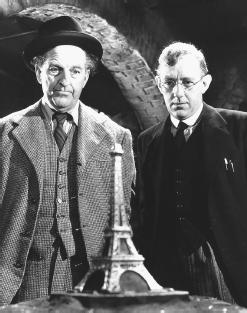
After 19 years of working the same post as a bank clerk supervising gold bullion shipments, Henry Holland (Guinness) decides he's had enough.  There's no hope for promotion or advancement in his job so he decides to rob his employers of a gold shipment.  How can he do it though?  Exporting a large supply of gold bars is nearly impossible.  But one day, a new tenant moves into Holland's apartment building and gives him an idea.  Pendlebury (Stanley Holloway) is an artist who owns a foundry so after some beating around the bush Holland asks if he would be interested in joining in on the caper.  He agrees and a plan is developed where the stolen gold will be melting the gold into Eiffel Tower statues and shipped out to Paris without causing the least bit of suspicion.

With some help from two petty crooks (Sid James and Alfie Bass), they lay out a plan to take out the gold shipment without harming anyone involved.  Little do they know, the actual robbery may be the easiest part of the plan.  I'm not giving anything away when I say that most movies pre-1960s tend to believe (as studios forced them to) that crime doesn't pay.  Take that for what it's worth when considering how this story will play out.  The fun though is how the Lavender Hill mob (the gang is named after the street Holland lives on) get to that point.  Holland's plan is ingenious from the start, but it's a comedy about a heist.  It's obvious this is not going to go as smoothly as hoped.

For the most part, the humor that comes out of this situation is saved for the post-robbery half of the movie.  Up until then, the laughs were chuckles here and there that put a smile on your face.  The second half produces more of the laugh out loud variety.  SPOILERS  The plan works and the golden Eiffel Towers are sent to Paris but six of them are accidentally sold to English schoolgirls on vacation.  Holland and Pendlebury must track them down so stumped Scotland Yard can't connect them in any way.  Of course, even convincing six young girls to trade their souvenirs is easier said than done.  This little twist is a great extended sequence that turns into a chaotic car chase leading up to the ending.  Some physical humor blends well with some of the more subtle laughs to cap off a great story.

As a dramatic actor, I love Guinness, but seeing him in roles like this and The Ladykillers makes me wish he had done more comedy.  It's hard to explain, but he does things with his face -- little mannerisms and quirks -- that are hilarious on their own.  His Holland is a quiet, mild-mannered middle aged man who does his job and does it well, then comes home and reads mystery novels to an old woman living in the building.  He's the butt of jokes where he works because of his cautiousness, but nothing really gets to him.  He's a lovable crook because it's easy to root for him.  I wanted him to get away with his plan.  The same for Holloway's Pendlebury, an older man cut from the same cloth as Holland.

These amateur, bumbling crooks are exceptionally intelligent in every day life, but when problems arise in their plan, they just aren't as smooth.  One great scene has them trying to get on-board a ship about to leave with detours continually slowing them down.  It's a scene that is funny because of its awkwardness and tension working together, not to mention the looks on Guinness and Holloway's faces.  The script won the Oscar that year, and Guinness was nominated for best actor (which he unfortunately did not win, losing to Gary Cooper and High Noon).  This is a comedy that isn't trying to be anything else, just a very funny, entertaining story with two great characters.  Also look for a quick appearance by Audrey Hepburn, making just her fourth movie appearance.

The Lavender Hill Mob <----trailer (1951): *** 1/2 /****

Saturday, February 6, 2010

Tunes of Glory

Sometimes I can't help but think that British movies -- compared to Hollywood movies -- just get it. No over the top action, no fancy CGI or special effects, just that old reliable...acting. All it can take to pull a viewer in is a tour-de-force performance from an actor or actress, and you're hooked. Production values can be slim to none, but as long as the acting is on target chances are the movie will be a winner.

There I go again with vague, sweeping generalities, but British movies seem to rely more on acting above all else, with actors like Peter O'Toole, Richard Burton, Richard Attenborough, and of course, Alec Guinness. The English actor was a chameleon when it came to his roles, and I can't help but wonder if he'd be more well-known for his overall ability if he hadn't been in Star Wars. So many people associate him with Obi-Wan Kenobi that the rest of his movies have been somewhat forgotten. But in 1960's Tunes of Glory, Guinness once again shows how strong an actor he really was.

In command of a Highlands battalion in the years following WWII, Major Jock Sinclair (Guinness) is loved by his men. He led them through WWII in Europe and is really just one of the men...albeit with a higher rank. Sinclair is not the strictest of commanders and lets smaller things go in lieu of the bigger picture, and for that reason he's loved by his men. The battalion receives a new commander, Colonel Barrow (John Mills), an officer who spent much of the war in a German POW camp with years of desk duty prior to that. Barrow is a stickler for details, doing everything by the book. His command style clashes with Sinclair and what the battalion is used to. A division forms and the conflict comes to a rise when Sinclair strikes a corporal (John Fraser) who has been seeing his daughter (Susannah York).

Should Barrow bring his second-in-command up on charges? He's had prior issues with Sinclair so a court martial might seem like personal revenge. As well, a trial would bring disgrace to the battalion. But if he doesn't, Barrow is going up against everything he believes in. Whatever the Colonel decides to do could very well tear apart the unit from the inside out. This is a story definitely characteristic of a slow-burn, a plot that keeps on building and piling on. As a viewer, you know there will be some sort of confrontation but in what sense? I for one was completely caught off guard by the ending, a downer in every sense of the idea, but one that works and the most appropriate one too. A happy ending would seem out of place here.

This is a movie dominated by two men, Guinness and Mills, and dominated in a good way. Guinness' Sinclair is built up as the man to side with; he's loved by every one from family to fellow officers to his soldiers. There's a vibe off the character though, a little full of himself and quick-tempered. Mills is the toy soldier, the desk jockey who's never seen combat but is tortured still by his time spent in a German POW camp. He doesn't interact well with the men and gives off a sense of superiority to soldier and officer alike. What's interesting in the execution is how the story develops and how our perceptions change -- or at least mine did -- as we learn more about these two men.

With basically the whole story set in this extravagant barracks the battalion lives in and only a few venture outside the wall, the conflict drives things along thanks to the supporting cast. Some of the other battalion's officers include Dennis Price, Allan Cuthbertson, Duncan Macrae, and Paul Whitsun-Jones, some siding with Sinclair and others Barrow. Gordon Jackson especially rises above the rest as Capt. Jimmy Cairns, the battalion adjutant and a man loyal to his commander to a fault. It's one of those supporting roles that doesn't have much in the way of lines but ends up being memorable nonetheless.

No frills moviemaking at its finest. There is nothing flashy about the proceedings, but the story makes this movie special and really worth checking out. Two very different men, but both are strong-willed and even pigheaded when it comes to getting what they want. A Youtube user was kind enough to post the movie into segments, starting here with Part 1 of 10. Well worth your time if you don't mind sitting down at the computer for 105 minutes. Guinness, Mills, and a fine supporting cast don't disappoint.

Tunes of Glory <----trailer (1960): ***/****