Fully content to direct films as he likes and sees fit while also staying in the background of the Sundance Film Festival, it's easy to forget what a legend Robert Redford really is. He's one of the few remaining legitimate screen legends from the 1960s and 1970s. When he does make a film -- directing/acting -- moviegoers and fans should jump. Or as the case with 2012's The Company You Keep, he does both, directing and acting.
A single dad with an 11-year old daughter and his own private law practice, Jim Grant (Redford) is still adjusting to a new life since his wife died over the last few years. He's approached one day in his office by a young journalist, Ben Shepard (Shia LaBeouf), investigating a story about the recent arrest of a woman who was part of a murder/bank robbery in the late 1970s, the woman a member of an underground peace movement. Jim is less than interested in helping, making Ben that much more curious. He investigates further and finds out why. Jim Grant is not who he's saying. In fact, he may have been a part of the underground movement and one of three suspects at the bank robbery turned murder. The FBI is quick to pounce, but it's already too late. Jim is on the run and looking for someone from his past. Ben meanwhile is continuing his investigation and starts to question if maybe he's stumbled upon something else.
Not surprisingly, I think the best thing going for this film was that Redford and his talents are associated with it. While it received mixed reviews -- 56% at Rotten Tomatoes, 6.3 at IMDB -- and wasn't given much of a chance in theaters, 'Company' is successful because it is content being exactly what it is. No explosions, no gunfights, no real chases, just a smart political thriller that for the most part kept me interested throughout. I think at times it is a little sluggish, lacking a certain energy. On the other hand, it is always refreshing to watch a well-made thriller that doesn't resort to any common denominators. As many other reviews point out, it may be most successful because it shows what happened to the 1960s/1970s revolutionaries. Full of fire and brimstone 30 and 40 years ago, what did they do after their revolutionary times had passed? It's an interesting premise and jumping off point.
So hold the gunfights, explosions, chases and ultra-quick editing, and what is Robert Redford's character? It reminded me slightly of Jason Bourne, a man on the run and desperately trying to evade his pursuers until he can prove what he needs to prove. In his first acting role since 2007's Lions for Lambs, Redford doesn't disappoint, bringing a character to life we think we know all about only to learn more and more. We see him with his second life of sorts, caring for his 11-year old daughter, Isabel (singer Jackie Evancho). We learn he regrets certain incidents from his past and is desperately working to right wrongs. Like few others, Redford does it with relative ease, a cool factor on display like few others working in film or in any other era. Now 77 years old, Redford is as cool as ever. His acting roles are fewer and far between of late so appreciate them when they come along.
Oh, by the way, most of Hollywood is also in this movie. Apparently a whole lot of very talented individuals wanted to work with Redford because he assembles a cast that is ridiculous top to bottom. I'm coming around a bit on Shia LaBeouf who does a fine job here as an investigative journalist, Ben, who finds out a story needs to be fully investigated before reporting on it. It's an interesting character arc. Who else? How about Stanley Tucci basically making a cameo as Ben's hard-edged, tough editor. How about Terrence Howard as the lead FBI agent pursuing Redford's Jim with Anna Kendrick as a young agent on his team? Oh, and there's also Chris Cooper as Jim's younger brother, Brendan Gleeson as a former police chief with lots of info, Stephen Root as a friend seeking Jim's help and Brit Marling as a college student Ben meets in the course of his investigation.
Wow, that's a pretty impressive cast. Huh? Oh, there's more? Yes, it continues. There are other key parts with Julie Christie playing a woman from Jim's past who he desperately needs to talk to with Sam Elliott, Nick Nolte and Richard Jenkins all playing key figures from Jim's revolutionary underground past. And yes, Susan Sarandon plays an accomplice of sorts to the murder that sets the ball in motion. With this much talent, some of the parts are really just extended cameos, but the pure acting depth here is amazing to watch. Yes, maybe it is only a scene or two, but it's fun to watch all these very talented actors and actresses do their thing.
If there is a weakness here, it's in the final 30 minutes of a 122-minute long movie. The build-up can be slow at times, but the mystery and all the unanswered questions pick things up as needed. Unfortunately in the final half hour, the script resorts to too many past ideologies and principles that drove these characters back in the 60s and 70s. It doesn't quite limp to the finish line, but it's not quite the snappy ending I was hoping for. Things are wrapped up a little too nicely, a little too tidy. That said, I still feel very comfortable recommending this film for any number of reasons, ranging anywhere from the very impressive cast to the general throwback feel of a good, old-fashioned political thriller. A good movie, and that ain't a bad thing.
The Company You Keep (2012): ***/****
The Sons of Katie Elder
"First, we reunite, then find Ma and Pa's killer...then read some reviews."
Showing posts with label Julie Christie. Show all posts
Thursday, October 3, 2013
Monday, September 24, 2012
Doctor Zhivago
By 1965, director David Lean had already completed two of his most highly regarded and well-respected movies of his prestigious career. With 1957's The Bridge on the River Kwai and 1962's Lawrence of Arabia, Lean basically defined how a director should make a gigantic film epic. So some three years later, he followed up with 1965's Doctor Zhivago, a film I'm still digesting -- for good and bad -- some three days later.
A doctoral student who grew up with an adopted family of sorts, Yuri Zhivago (Omar Sharif) is an aspiring poet in the early 1910s in Russia. He marries childhood friend and longtime love, Tonya (Geraldine Chaplin), and starts a family. Growing up with a single mother, Lara (Julie Christie) goes through some harsh teenage years as she deals with a troubled single mother. As Russia is thrust into World War I -- the fighting eventually turning into the Russian Revolution -- Yuri (working as a doctor) and Lara (as a nurse) meet amongst the aftermath of a battle. They are instantly drawn to each other as they work side-by-side, but as the conflict escalates, this is a relationship that seems doomed to failure.
Wow, I'm not proud of that plot synopsis. It sounds like I'm reading a cheesy romance novel. Anyways, onto bigger, better and more on-point things. This is a GIGANTIC movie as one would come to expect from a David Lean epic. With locations in Spain, Canada and Finland, the scale is a pleasure to watch. Lean and cinematographer Freddie Young shoot each scene -- the snow-capped mountains, the desolate wastelands, the flower-covered plains -- like a Renaissance painting. It is a stunningly gorgeous film, one you can just sit back and experience. Composer Maurice Jarre's score won the Oscar -- rightfully so -- with Lara's Theme (listen HERE) an instantly recognizable, beautiful tune, one that you'll be humming for days. The sets are expansive, the cast numbering in the thousands with extras, and the story covers a time in history (Russia in the 1910s/1920s) that is rich with depth.
So what happens then? Why do I feel conflicted about this Lean-directed epic? In a 200-minute movie, there exists little to no story. It moves from location to location and time to time with transitions that can be jarring at times. My lack of knowledge about Russian history certainly did NOT help my enjoyment and/or appreciation of what was going on. I don't think lyrical is the right description, but it's all I'm coming up with. Story is also a word I use lightly. It isn't really a story so much as a budding relationship that develops over many years and all the people caught up and effected by it. We see snippets of a time/conflict/place, and then zip to another spot. Because of that, I never felt in tune with what was going on, feeling at times very disconnected from the plot.
And onto the cast, much easier to decipher. For one of the all-time great love stories, I didn't think much of the chemistry (or lack of) between Sharif and Christie. Omar Sharif is a very talented actor, and he does a fine job as Yuri Zhivago showing a man's flaws, imperfections and talents. Christie too as Lara is an interesting character, neither individual perfect by any means. I appreciated that. We're watching human beings, not immaculate individuals, but in terms of on-screen chemistry I was not buying Sharif and Christie as a couple that is drawn to each other in an unexplained way, not letting time or circumstances tear them apart. Christie is stunningly beautiful as Lara with Lean electing to photograph her like an angel, especially her blue, blue, BLUE eyes.
The name recognition from the supporting cast will draw in many film fans and understandably so. You don't put a cast together with the likes of Rod Steiger, Alec Guinness, Tom Courtenay, Chaplin, Klaus Kinski and Ralph Richardson together without causing a stir in the acting department. Among that group, there isn't a weak link in the bunch. Some are more impressive than others -- Steiger, Guinness, Chaplin and Kinski -- but the lack of a true, developing story hurts all of the performances. Steiger and Courtenay disappear for long stretches, only to reappear as the story requires. I just don't know how to describe this. I enjoyed the actors, enjoyed seeing their performances, but something just didn't click.
There are moments of near perfection amidst some of the rather leisurely 200-minute running time. After a sluggish first 45-60 minutes, things get flowing at a quicker, more enjoyable pace. Not surprisingly, the high points are several chaotic, impressively staged action sequences. One especially, Bolshevik cavalry charging across an ice-covered lake, stands out. An encounter between Russian replacements and Russian deserters on a wayward, desolate plain is simple in its brutality. Much of the success in these moments come from the visual that Lean and Young created. A framing device at the beginning and end with Guinness (a veteran Communist officer) interviewing a young woman (Rita Tushingham) who could be Yuri and Lara's daughter too is especially effective. The ending too goes right for the jugular, a heart-breaking ending for Yuri and Lara.
I'm torn on what to do here. I can appreciate why so many film fans adore this movie. I can also easily appreciate why some struggle to go along for the ride. Not to use a cop out, but I fall somewhere in between. I loved parts of it, liked others and struggled to go along for other portions. I love both 'River Kwai' and 'Lawrence' so Zhivago had some big shoes to fill in the expectations department, but it never quite lived up to them. Still a must-see film just for the scale and talent involved, but not the classic I was hoping it to be.
Doctor Zhivago <---trailer (1965): ** 1/2 /****
A doctoral student who grew up with an adopted family of sorts, Yuri Zhivago (Omar Sharif) is an aspiring poet in the early 1910s in Russia. He marries childhood friend and longtime love, Tonya (Geraldine Chaplin), and starts a family. Growing up with a single mother, Lara (Julie Christie) goes through some harsh teenage years as she deals with a troubled single mother. As Russia is thrust into World War I -- the fighting eventually turning into the Russian Revolution -- Yuri (working as a doctor) and Lara (as a nurse) meet amongst the aftermath of a battle. They are instantly drawn to each other as they work side-by-side, but as the conflict escalates, this is a relationship that seems doomed to failure.
Wow, I'm not proud of that plot synopsis. It sounds like I'm reading a cheesy romance novel. Anyways, onto bigger, better and more on-point things. This is a GIGANTIC movie as one would come to expect from a David Lean epic. With locations in Spain, Canada and Finland, the scale is a pleasure to watch. Lean and cinematographer Freddie Young shoot each scene -- the snow-capped mountains, the desolate wastelands, the flower-covered plains -- like a Renaissance painting. It is a stunningly gorgeous film, one you can just sit back and experience. Composer Maurice Jarre's score won the Oscar -- rightfully so -- with Lara's Theme (listen HERE) an instantly recognizable, beautiful tune, one that you'll be humming for days. The sets are expansive, the cast numbering in the thousands with extras, and the story covers a time in history (Russia in the 1910s/1920s) that is rich with depth.
So what happens then? Why do I feel conflicted about this Lean-directed epic? In a 200-minute movie, there exists little to no story. It moves from location to location and time to time with transitions that can be jarring at times. My lack of knowledge about Russian history certainly did NOT help my enjoyment and/or appreciation of what was going on. I don't think lyrical is the right description, but it's all I'm coming up with. Story is also a word I use lightly. It isn't really a story so much as a budding relationship that develops over many years and all the people caught up and effected by it. We see snippets of a time/conflict/place, and then zip to another spot. Because of that, I never felt in tune with what was going on, feeling at times very disconnected from the plot.
And onto the cast, much easier to decipher. For one of the all-time great love stories, I didn't think much of the chemistry (or lack of) between Sharif and Christie. Omar Sharif is a very talented actor, and he does a fine job as Yuri Zhivago showing a man's flaws, imperfections and talents. Christie too as Lara is an interesting character, neither individual perfect by any means. I appreciated that. We're watching human beings, not immaculate individuals, but in terms of on-screen chemistry I was not buying Sharif and Christie as a couple that is drawn to each other in an unexplained way, not letting time or circumstances tear them apart. Christie is stunningly beautiful as Lara with Lean electing to photograph her like an angel, especially her blue, blue, BLUE eyes.
The name recognition from the supporting cast will draw in many film fans and understandably so. You don't put a cast together with the likes of Rod Steiger, Alec Guinness, Tom Courtenay, Chaplin, Klaus Kinski and Ralph Richardson together without causing a stir in the acting department. Among that group, there isn't a weak link in the bunch. Some are more impressive than others -- Steiger, Guinness, Chaplin and Kinski -- but the lack of a true, developing story hurts all of the performances. Steiger and Courtenay disappear for long stretches, only to reappear as the story requires. I just don't know how to describe this. I enjoyed the actors, enjoyed seeing their performances, but something just didn't click.
There are moments of near perfection amidst some of the rather leisurely 200-minute running time. After a sluggish first 45-60 minutes, things get flowing at a quicker, more enjoyable pace. Not surprisingly, the high points are several chaotic, impressively staged action sequences. One especially, Bolshevik cavalry charging across an ice-covered lake, stands out. An encounter between Russian replacements and Russian deserters on a wayward, desolate plain is simple in its brutality. Much of the success in these moments come from the visual that Lean and Young created. A framing device at the beginning and end with Guinness (a veteran Communist officer) interviewing a young woman (Rita Tushingham) who could be Yuri and Lara's daughter too is especially effective. The ending too goes right for the jugular, a heart-breaking ending for Yuri and Lara.
I'm torn on what to do here. I can appreciate why so many film fans adore this movie. I can also easily appreciate why some struggle to go along for the ride. Not to use a cop out, but I fall somewhere in between. I loved parts of it, liked others and struggled to go along for other portions. I love both 'River Kwai' and 'Lawrence' so Zhivago had some big shoes to fill in the expectations department, but it never quite lived up to them. Still a must-see film just for the scale and talent involved, but not the classic I was hoping it to be.
Doctor Zhivago <---trailer (1965): ** 1/2 /****
Tuesday, May 1, 2012
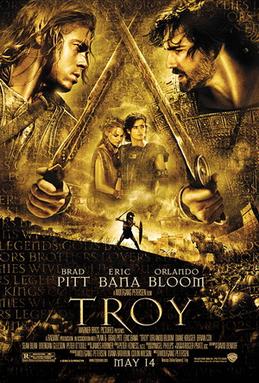
Troy
Made by a respected director with a strong ensemble cast and using the original epic story as its source, 2004's Troy certainly has a lot going for it. So what happened in theaters? I guess it's a shame to call a movie that made over $130 million a failure, but when that movie cost $175 to make....yeah, that's a failure. Too bad because the end result -- no matter the money -- is a huge, well-made and entertaining epic, a throwback to the 1950s and 1960s in terms of scale.
Sometime around 1,000 B.C., Trojan princes Hector (Eric Bana) and Paris (Orlando Bloom) are visiting Sparta and its king, Menelaus (Brendan Gleeson). Paris falls madly in love with the king's wife, Helen (Diane Kruger), secretly taking her with them as they return to Troy. Finding his wife gone, Menelaus goes to his brother, Agamemnon (Brian Cox), seeking help in getting her back. The Greek king has amassed quite an empire and sees an opportunity for it to grow bigger. He assembles an army of thousands of ships and over 50,000 men, sailing across the Aegean Sea to attack Troy. The fortified and high-walled city awaits what the Greeks can throw at them, including the most powerful warrior of his time, the legendary if moody Achilles (Brad Pitt). The coming battle will be unlike anything the world has ever seen.
Based on the original literature epic, Homer's Iliad, Troy is a movie made on a massive scale. Director Wolfgang Petersen assembles quite the cast, built lavish sets with even more lavish costuming, and for lack of a better description, makes everything BIG. That's good and bad. It is an impressive movie to watch at times, but in its scale, it loses some of its heart. Troy keeps you at arm's length. At times, far too much is going on. Even at 162 minutes, some subplots feel disjointed and rushed, others completely pushed to the side. Composer James Horner's score is all right, but it pales in comparison to some of his best works. Josh Groban's song 'Remember' is played over the credits too, listen HERE. Positive and/or negative, Troy is missing that special something. It is a good movie, but that missing ingredient isn't there to make it a classic.
It would be hard to have a better jumping off point than Homer's Iliad in turning any form of literature into a feature film. For starters, there's a reason it's called Greek tragedy. No matter if you're good or bad, in the end it likely won't end well for you. No time is wasted on petty arguments. Greek tragedies and epics are interested in the big picture. We're talking power and glory, love and betrayal, murder and backstabbing. Petersen faces a monumental task in bringing the story to theaters though. The Iliad takes place over a decade. The movie? Seems like the siege of Troy takes place over a long weekend. With so many characters and so many stories bouncing around, some can't help but be left behind. This is a story that would be suited to a four or five part miniseries...at the least. On the positive side, Troy is about the people, not the people and the Greek gods. Wise choice there, Mr. Petersen, wise choice.
The best dynamic in the movie is between Brad Pitt and Eric Bana, warriors on opposite sides of the war who are on a collision course to face each other. Buffed up with about 30-40 pounds of extra muscle, Pitt went through quite a transformation to look like half-man, half-god Achilles. In the acting department though, this is far from his best work. It's a despicable character, but Pitt doesn't bring a ton of energy to the screen until about the halfway point. Bana is the main reason to see Troy as Hector, the honor-bound prince of Troy who sticks by his family when it would be incredibly easy to leave. Both men live by a personal code and principle, holding some similarities while also being vastly different. Those differences make for an interesting rivalry to watch unfold.
And then there's the rest of the cast, apparently everyone in Hollywood getting a part here and there. Playing Greek king Agamemnon, Cox is the most villainous of all the characters, a power-obsessed ruler willing to sacrifice anything as needed to achieve his goal. In this case, that's pouncing on his brother's request for help. Gleeson as the spurned and scorned Menelaus is surprisingly sympathetic in an underused part. Bloom and Kruger are pretty together, basically a means to get the story moving before being dumped in the trash. Bloom does a fine job turning Paris into a whiny weakling capable of doing anything right. Yes, that's sarcasm. Also look for screen legend Peter O'Toole as Priam, the aging Trojan king, Sean Bean as Odysseus, another Greek king and close friend of Achilles, Garrett Hedlund as Patroclus, Achilles' young nephew and warrior-to-be, Julie Christie in a one-scene cameo as Thetis, Achilles' mother, Saffron Burrows as Andromache, Hector's loving wife, Rose Byrne as Briseis, the Trojan girl who catches Achilles' eye, and Vincent Regan as Eudorus, Achilles' right-hand man in his unit of Myrmidons.
Part of the fun of these ancient/biblical epics was the spectacle in watching them, a cast of thousands filling the screen. That fun element is robbed some with an overabundance of CGI throughout, thousands of CGI creations filling out the Greek and Trojan armies. Battle scenes are still a sight to behold, immense scale as the two warring sides throw charge after charge at one another. Like the movie on the whole, it's just missing something. What is it? I can't quite figure it out yet, but I'll get there. In the meantime, I'll like the movie, but not love it.
Troy <----trailer (2004): ***/****
Sometime around 1,000 B.C., Trojan princes Hector (Eric Bana) and Paris (Orlando Bloom) are visiting Sparta and its king, Menelaus (Brendan Gleeson). Paris falls madly in love with the king's wife, Helen (Diane Kruger), secretly taking her with them as they return to Troy. Finding his wife gone, Menelaus goes to his brother, Agamemnon (Brian Cox), seeking help in getting her back. The Greek king has amassed quite an empire and sees an opportunity for it to grow bigger. He assembles an army of thousands of ships and over 50,000 men, sailing across the Aegean Sea to attack Troy. The fortified and high-walled city awaits what the Greeks can throw at them, including the most powerful warrior of his time, the legendary if moody Achilles (Brad Pitt). The coming battle will be unlike anything the world has ever seen.
Based on the original literature epic, Homer's Iliad, Troy is a movie made on a massive scale. Director Wolfgang Petersen assembles quite the cast, built lavish sets with even more lavish costuming, and for lack of a better description, makes everything BIG. That's good and bad. It is an impressive movie to watch at times, but in its scale, it loses some of its heart. Troy keeps you at arm's length. At times, far too much is going on. Even at 162 minutes, some subplots feel disjointed and rushed, others completely pushed to the side. Composer James Horner's score is all right, but it pales in comparison to some of his best works. Josh Groban's song 'Remember' is played over the credits too, listen HERE. Positive and/or negative, Troy is missing that special something. It is a good movie, but that missing ingredient isn't there to make it a classic.
It would be hard to have a better jumping off point than Homer's Iliad in turning any form of literature into a feature film. For starters, there's a reason it's called Greek tragedy. No matter if you're good or bad, in the end it likely won't end well for you. No time is wasted on petty arguments. Greek tragedies and epics are interested in the big picture. We're talking power and glory, love and betrayal, murder and backstabbing. Petersen faces a monumental task in bringing the story to theaters though. The Iliad takes place over a decade. The movie? Seems like the siege of Troy takes place over a long weekend. With so many characters and so many stories bouncing around, some can't help but be left behind. This is a story that would be suited to a four or five part miniseries...at the least. On the positive side, Troy is about the people, not the people and the Greek gods. Wise choice there, Mr. Petersen, wise choice.
The best dynamic in the movie is between Brad Pitt and Eric Bana, warriors on opposite sides of the war who are on a collision course to face each other. Buffed up with about 30-40 pounds of extra muscle, Pitt went through quite a transformation to look like half-man, half-god Achilles. In the acting department though, this is far from his best work. It's a despicable character, but Pitt doesn't bring a ton of energy to the screen until about the halfway point. Bana is the main reason to see Troy as Hector, the honor-bound prince of Troy who sticks by his family when it would be incredibly easy to leave. Both men live by a personal code and principle, holding some similarities while also being vastly different. Those differences make for an interesting rivalry to watch unfold.
And then there's the rest of the cast, apparently everyone in Hollywood getting a part here and there. Playing Greek king Agamemnon, Cox is the most villainous of all the characters, a power-obsessed ruler willing to sacrifice anything as needed to achieve his goal. In this case, that's pouncing on his brother's request for help. Gleeson as the spurned and scorned Menelaus is surprisingly sympathetic in an underused part. Bloom and Kruger are pretty together, basically a means to get the story moving before being dumped in the trash. Bloom does a fine job turning Paris into a whiny weakling capable of doing anything right. Yes, that's sarcasm. Also look for screen legend Peter O'Toole as Priam, the aging Trojan king, Sean Bean as Odysseus, another Greek king and close friend of Achilles, Garrett Hedlund as Patroclus, Achilles' young nephew and warrior-to-be, Julie Christie in a one-scene cameo as Thetis, Achilles' mother, Saffron Burrows as Andromache, Hector's loving wife, Rose Byrne as Briseis, the Trojan girl who catches Achilles' eye, and Vincent Regan as Eudorus, Achilles' right-hand man in his unit of Myrmidons.
Part of the fun of these ancient/biblical epics was the spectacle in watching them, a cast of thousands filling the screen. That fun element is robbed some with an overabundance of CGI throughout, thousands of CGI creations filling out the Greek and Trojan armies. Battle scenes are still a sight to behold, immense scale as the two warring sides throw charge after charge at one another. Like the movie on the whole, it's just missing something. What is it? I can't quite figure it out yet, but I'll get there. In the meantime, I'll like the movie, but not love it.
Troy <----trailer (2004): ***/****
Wednesday, March 30, 2011
Young Cassidy
Born in 1880 in Dublin, Ireland, Irish playwright/dramatist/memoirist Sean O'Casey would go on to become one of Ireland's most famous writers. So I've read at least, I've never heard of him. Apparently, O'Casey thought fairly highly of himself too, publishing a 6-volume autobiography while also completing over 20 other works during his career. Not having heard of him, I stumbled across the movie of his life, 1965's Young Cassidy, and tuned in mostly because of the star.
In his personal life, O'Casey was a noted socialist, but that's not going to work in an America-made movie about his life now, is it? An Irish writer in the first 20 years of the 20th Century is ripe pickings for a story fraught with conflict and issues as Ireland went through violent conflict after violent conflict in the 1910s. I was somewhat worried to read that John Ford shot part of the movie before being forced to leave the production after falling ill. I love Ford and all of his quirks, but I didn't want to watch The Quiet Man 2. Instead, director Jack Cardiff replaced him and probably for the better.
It's 1910 in the slums in Dublin and John Cassidy (Rod Taylor) is searching for work to care for his extended family and his aging mother (Flora Robson). Ireland is struggling with poverty and violence as the people fight back, upset with the lives they've almost been forced to live. Cassidy among them doesn't know what to make of the situation but ends up joining the Irish revolutionary forces. A treaty is signed with England for peace, and a young Johhny doesn't know what to do with his life. With help from a young, pretty bookstore owner, Nora (Maggie Smith), he turns to writing, something he's always enjoyed and been good at but never saw any future in it. He begins to write about the things he knows, the life he's led, and he once again is good at it. But in the process, he begins to drive everyone close to him further away.
So often stereotyped or pigeon-holed as a tough guy actor, Rod Taylor didn't always get a ton of chances to show off his acting ability. While I like other Taylor movies better than 'Young,' I can't think of a better performance delivered by the Australian actor. John Cassidy (changed from Sean O'Casey for some reason) has been toned down some from the real O'Casey, but there's still some chinks in the armor that help make him a full-fledged character. He's a family man but a fiery individual too, his temper often getting the better of him. He gets around town a fair share, typically getting involved where he shouldn't be. Seeing the strife and struggle around him, Cassidy just wants something better for himself and the Irish people. He loves everything about his roots, his background, and he uses it as a source in his writings.
The darker, tragic Irish history apparently creates many dark, tragic writers (James Joyce also comes to mind). What makes a great writer great? If you read enough and believe what classical critics say, it's that the most successful writers write about what they know. It's the people they meet, the streets and businesses in the cities and towns they grew up in, their relationships with friends, families, enemies and strangers. Irish poverty then comes easy to Cassidy in his writing. It is all he knows. The story reminded me in a lot of ways of Angela's Ashes, painting Ireland and its culture in a positive and negative light. Through all the struggles though, Ireland still manages to get across the impression of a classically romantic country, partially due to all its struggles. Cardiff takes advantage, filming his story in Ireland to give it that authentic feel without going down that cutesy, too sweet way that Ford did in The Quiet Man.
The supporting characters cover the gamut, all given a chance to play off of Taylor's Johnny. The story covers years so some characters stick around longer than others, and for the most part they make the most of it. Late in her career, Robson is a quiet scene-stealer as Johnny's mother, doting on her son who seems to always have been her favorite, the one child who has a chance to amount to something. Philip O'Flynn plays Mick Mullen, a close friend and co-worker of Johnny's who sticks with him through the ups and downs. In one of her first film roles, Julie Christie plays Daisy Battles, a possible love interest for Johnny. Edith Evans and Michael Redgrave are also scene-stealers as Lady Gregory and W.B. Yeats, owners of the Abbey Playhouse who see the potential Johnny has in his writings.
For a movie that clocks in at 110 minutes, I'm struggling to remember a lot of what happened. The story has an episodic feel to it as the years pass, Johnny growing and developing into a writer. It certainly picks up the pace when the story focuses on his writing after all the struggles he's been through. What I liked was the ending. Irish history isn't going to have a lot of happy endings -- especially when it comes to movies -- and Cardiff picks the perfect place to end the story. It's by no means a downer ending because that's not a fair description. It's a real ending, one that makes sense regardless of it is qualifies as a Hollywood happy ending. I'm not sure if I did enjoy the movie or just moderately enjoy it, but as I right this now, I'll say give it a try.
Young Cassidy <---TCM trailer (1965): ***/****
In his personal life, O'Casey was a noted socialist, but that's not going to work in an America-made movie about his life now, is it? An Irish writer in the first 20 years of the 20th Century is ripe pickings for a story fraught with conflict and issues as Ireland went through violent conflict after violent conflict in the 1910s. I was somewhat worried to read that John Ford shot part of the movie before being forced to leave the production after falling ill. I love Ford and all of his quirks, but I didn't want to watch The Quiet Man 2. Instead, director Jack Cardiff replaced him and probably for the better.
It's 1910 in the slums in Dublin and John Cassidy (Rod Taylor) is searching for work to care for his extended family and his aging mother (Flora Robson). Ireland is struggling with poverty and violence as the people fight back, upset with the lives they've almost been forced to live. Cassidy among them doesn't know what to make of the situation but ends up joining the Irish revolutionary forces. A treaty is signed with England for peace, and a young Johhny doesn't know what to do with his life. With help from a young, pretty bookstore owner, Nora (Maggie Smith), he turns to writing, something he's always enjoyed and been good at but never saw any future in it. He begins to write about the things he knows, the life he's led, and he once again is good at it. But in the process, he begins to drive everyone close to him further away.
So often stereotyped or pigeon-holed as a tough guy actor, Rod Taylor didn't always get a ton of chances to show off his acting ability. While I like other Taylor movies better than 'Young,' I can't think of a better performance delivered by the Australian actor. John Cassidy (changed from Sean O'Casey for some reason) has been toned down some from the real O'Casey, but there's still some chinks in the armor that help make him a full-fledged character. He's a family man but a fiery individual too, his temper often getting the better of him. He gets around town a fair share, typically getting involved where he shouldn't be. Seeing the strife and struggle around him, Cassidy just wants something better for himself and the Irish people. He loves everything about his roots, his background, and he uses it as a source in his writings.
The darker, tragic Irish history apparently creates many dark, tragic writers (James Joyce also comes to mind). What makes a great writer great? If you read enough and believe what classical critics say, it's that the most successful writers write about what they know. It's the people they meet, the streets and businesses in the cities and towns they grew up in, their relationships with friends, families, enemies and strangers. Irish poverty then comes easy to Cassidy in his writing. It is all he knows. The story reminded me in a lot of ways of Angela's Ashes, painting Ireland and its culture in a positive and negative light. Through all the struggles though, Ireland still manages to get across the impression of a classically romantic country, partially due to all its struggles. Cardiff takes advantage, filming his story in Ireland to give it that authentic feel without going down that cutesy, too sweet way that Ford did in The Quiet Man.
The supporting characters cover the gamut, all given a chance to play off of Taylor's Johnny. The story covers years so some characters stick around longer than others, and for the most part they make the most of it. Late in her career, Robson is a quiet scene-stealer as Johnny's mother, doting on her son who seems to always have been her favorite, the one child who has a chance to amount to something. Philip O'Flynn plays Mick Mullen, a close friend and co-worker of Johnny's who sticks with him through the ups and downs. In one of her first film roles, Julie Christie plays Daisy Battles, a possible love interest for Johnny. Edith Evans and Michael Redgrave are also scene-stealers as Lady Gregory and W.B. Yeats, owners of the Abbey Playhouse who see the potential Johnny has in his writings.
For a movie that clocks in at 110 minutes, I'm struggling to remember a lot of what happened. The story has an episodic feel to it as the years pass, Johnny growing and developing into a writer. It certainly picks up the pace when the story focuses on his writing after all the struggles he's been through. What I liked was the ending. Irish history isn't going to have a lot of happy endings -- especially when it comes to movies -- and Cardiff picks the perfect place to end the story. It's by no means a downer ending because that's not a fair description. It's a real ending, one that makes sense regardless of it is qualifies as a Hollywood happy ending. I'm not sure if I did enjoy the movie or just moderately enjoy it, but as I right this now, I'll say give it a try.
Young Cassidy <---TCM trailer (1965): ***/****
Labels:
1960s,
Julie Christie,
Maggie Smith,
Michael Redgrave,
Rod Taylor
Thursday, February 3, 2011
McCabe and Mrs. Miller
Revisionist westerns are completely hit or miss with me. Made mostly in the 1960s and early 1970s as Americans and people around the world undoubtedly became a little more skeptical, a little more cynical, these westerns tried to show what the wild west was really like. I go back and forth because I can appreciate the west was not the one so often portrayed in John Wayne movies. It just wasn't a romantic place where everything ended with the good guys winning out. Some revisionist westerns just go too far though. There's a middle ground between the romantic and just ripping apart a myth or a legend for the sake of doing it. One of the best I've come across though, proof that a revisionist look at the old west can be a classic, 1971's McCabe and Mrs. Miller.
Sometimes these westerns are prime examples of the period they were made in. Director Robert Altman is certainly guilty of that here with his folk music soundtrack coming across as too lyrical and just trying too hard overall. But other than the poor choice in music, I feel safe saying Altman makes a nearly perfect western...if you can call this a western. It is one of the most realistic looks a movie has ever given about what frontier life was really like. It was a lawless place where one must fend for themselves. Death lurked around any corner waiting to strike. Maybe it's an anti-western, I really don't know. But just on pure emotion with an ability to tell the simplest, darkest of stories, Altman delivers a winner.
Its the Pacific Northwest in the 1890s, and a man named John McCabe (Warren Beatty) rides into a small, muddy one-road mining town high up in the mountains. He has his sights set on building a successful business for himself and letting the money roll in. The plan goes perfectly as he brings three prostitutes in and goes about building a saloon for all the miners living nearby. McCabe is quickly approached by a madam, Mrs. Constance Miller (Julie Christie), who wants to help him improve his business. Not quite sure if he wants to go into business with a woman as a partner, McCabe wavers before ultimately deciding to do it. It's the right choice, and his business thrives. If anything, it thrives too much though. The company that owns the nearby mines is very aware of his success and wants their fair share of the profits.
At the heart of this movie is Beatty and Christie as these two very similar flawed characters who find a common link between them through their arguments and disagreements. This is the type of relationship that so many westerns attempt to show between a man and woman. It's just natural, never forced. The duo was actually dating in real life apart from the movie, and their chemistry certainly shows. They have an easy-going back and forth in their conversations, whether it be an argument or a quiet discussion as they discuss what to do next. It's also a plus that in two actors like Beatty and Christie, neither made a long list of movies during their careers. They clearly chose quality projects to do, and this is a perfect example.
Altman has that rare knack that few directors have, an artsy reputation who still appeals to a mainstream audience. I like his directing style because it's never in your face. He places his camera there for a scene and lets things develop. He filmed in West Vancouver in the mountains, giving a palatable feel of being separated from humanity in this mountaintop town. It is a gorgeous movie, one that earned cinematographer Vilmos Zsigmond a British Oscar nomination for his camerawork. It is a movie that feels authentic down to its very roots and the muddy streets these characters walk through. The dialogue, the period dress, the sets, the guns, all authentic as possible.
Now I've made no qualms about my preference for darker, cynical movies that shy away from generic happy endings, but this one bugged me to the point where I felt sick as the ending neared. The whole tone of the movie led me to figure out how the story was going to end up, but even seeing it feels like a train just rolled over you. This was 1971, and Altman pulls out all the stops. No one is immune from his wrath, including big and small businesses, lawyers (William Devane in a great one-scene cameo), the church and organized religion, and just about anything else you care to think of in between. Altman comes out firing with both barrels and isn't afraid who gets caught in the crossfire. That said, the ending (as much as I hated it) is the perfect, appropriate finale for this movie. Anything else would have felt inauthentic. The American dream, my ass, Altman is beyond pessimistic here.
Depending on the viewer, certain scenes in a given movie are going to have a different impact or leave an impression. This had several -- the ending obviously -- but one just minutes before that shows how fragile life on the frontier really was. Keith Carradine plays a young man known simply as the Cowboy who stops by McCabe and Miller's whorehouse, enjoys himself, and then prepares to ride out. He's confronted by one of three killers sent to dispatch McCabe and callously gunned down by the man. It is an uncomfortable scene to watch because it's clear where it's building to, and when the gunshot roars to life, you wince at the noise. With the snap of a finger, one unlucky young man is dead as quick as that. Without any pandering to the audience or a big speech explaining what just happened, Altman gets his message across.
More on the ending so SPOILERS from here on in. Three hired guns are sent to this mountain town to force McCabe into a deal or kill him in the process. All three actors are virtual unknowns, making their appearance more ominous. Who are they, and what are they capable of? McCabe has a reputation as a gunfighter, but he really isn't so when push comes to shove he loads his pistol and confronts them, not unlike the showdown at the end of High Noon. He kills them all, but at a price. He's mortally wounded and dies in the snow as a storm rages all around him. Altman films this almost 30-minute sequence with no music and little dialogue to distract from what's happening on screen. Heartbreaking, incredibly moving, however you want to describe it. It's an upsetting but perfect ending for the story.
McCabe and Mrs. Miller <---trailer (1971): ****/****
Sometimes these westerns are prime examples of the period they were made in. Director Robert Altman is certainly guilty of that here with his folk music soundtrack coming across as too lyrical and just trying too hard overall. But other than the poor choice in music, I feel safe saying Altman makes a nearly perfect western...if you can call this a western. It is one of the most realistic looks a movie has ever given about what frontier life was really like. It was a lawless place where one must fend for themselves. Death lurked around any corner waiting to strike. Maybe it's an anti-western, I really don't know. But just on pure emotion with an ability to tell the simplest, darkest of stories, Altman delivers a winner.
Its the Pacific Northwest in the 1890s, and a man named John McCabe (Warren Beatty) rides into a small, muddy one-road mining town high up in the mountains. He has his sights set on building a successful business for himself and letting the money roll in. The plan goes perfectly as he brings three prostitutes in and goes about building a saloon for all the miners living nearby. McCabe is quickly approached by a madam, Mrs. Constance Miller (Julie Christie), who wants to help him improve his business. Not quite sure if he wants to go into business with a woman as a partner, McCabe wavers before ultimately deciding to do it. It's the right choice, and his business thrives. If anything, it thrives too much though. The company that owns the nearby mines is very aware of his success and wants their fair share of the profits.
At the heart of this movie is Beatty and Christie as these two very similar flawed characters who find a common link between them through their arguments and disagreements. This is the type of relationship that so many westerns attempt to show between a man and woman. It's just natural, never forced. The duo was actually dating in real life apart from the movie, and their chemistry certainly shows. They have an easy-going back and forth in their conversations, whether it be an argument or a quiet discussion as they discuss what to do next. It's also a plus that in two actors like Beatty and Christie, neither made a long list of movies during their careers. They clearly chose quality projects to do, and this is a perfect example.
Altman has that rare knack that few directors have, an artsy reputation who still appeals to a mainstream audience. I like his directing style because it's never in your face. He places his camera there for a scene and lets things develop. He filmed in West Vancouver in the mountains, giving a palatable feel of being separated from humanity in this mountaintop town. It is a gorgeous movie, one that earned cinematographer Vilmos Zsigmond a British Oscar nomination for his camerawork. It is a movie that feels authentic down to its very roots and the muddy streets these characters walk through. The dialogue, the period dress, the sets, the guns, all authentic as possible.
Now I've made no qualms about my preference for darker, cynical movies that shy away from generic happy endings, but this one bugged me to the point where I felt sick as the ending neared. The whole tone of the movie led me to figure out how the story was going to end up, but even seeing it feels like a train just rolled over you. This was 1971, and Altman pulls out all the stops. No one is immune from his wrath, including big and small businesses, lawyers (William Devane in a great one-scene cameo), the church and organized religion, and just about anything else you care to think of in between. Altman comes out firing with both barrels and isn't afraid who gets caught in the crossfire. That said, the ending (as much as I hated it) is the perfect, appropriate finale for this movie. Anything else would have felt inauthentic. The American dream, my ass, Altman is beyond pessimistic here.
Depending on the viewer, certain scenes in a given movie are going to have a different impact or leave an impression. This had several -- the ending obviously -- but one just minutes before that shows how fragile life on the frontier really was. Keith Carradine plays a young man known simply as the Cowboy who stops by McCabe and Miller's whorehouse, enjoys himself, and then prepares to ride out. He's confronted by one of three killers sent to dispatch McCabe and callously gunned down by the man. It is an uncomfortable scene to watch because it's clear where it's building to, and when the gunshot roars to life, you wince at the noise. With the snap of a finger, one unlucky young man is dead as quick as that. Without any pandering to the audience or a big speech explaining what just happened, Altman gets his message across.
More on the ending so SPOILERS from here on in. Three hired guns are sent to this mountain town to force McCabe into a deal or kill him in the process. All three actors are virtual unknowns, making their appearance more ominous. Who are they, and what are they capable of? McCabe has a reputation as a gunfighter, but he really isn't so when push comes to shove he loads his pistol and confronts them, not unlike the showdown at the end of High Noon. He kills them all, but at a price. He's mortally wounded and dies in the snow as a storm rages all around him. Altman films this almost 30-minute sequence with no music and little dialogue to distract from what's happening on screen. Heartbreaking, incredibly moving, however you want to describe it. It's an upsetting but perfect ending for the story.
McCabe and Mrs. Miller <---trailer (1971): ****/****
Subscribe to:
Posts (Atom)