One of my favorite movies growing up -- and still is -- is the 1966 western Nevada Smith starring Steve McQueen. Wouldn't you know it? It's a prequel to a novel by Harold Robbins called The Carpetbaggers. How's that work? Well, it does and it doesn't. I'm still looking for the book, but I can check the film adaptation off the list. That's 1964's The Carpetbaggers.
It's the early 1920s and Jonas Cord Jr. (George Peppard) is a young man without a care in the world. Any problems he has, his rich father will solve or give him money or turn a blind eye to his antics. When Jonas' father suddenly dies from an aneurysm, a whole business empire is thrust upon Jonas. Will it crumble with the irresponsible Jonas at its helm? Far from it if he has anything to do with it. Young Cord wants to expand and grow and dominate the world. He starts the steady climb up, parlaying one factory into another and there's no market anywhere that Jonas doesn't want his hand in. He wants the power, the money, the prestige and nothing is going to stop him. But in the 1920s and 1930s, can anything actually slow Jonas down? Maybe only himself.
This was a movie I've long been aware of, one that I was vaguely familiar with because of 1966's Nevada Smith. For quite awhile it lingered on my Netflix Saved queue and lingered and lingered. Seriously....do people just hold onto the movies for months at a time?!? 'Carpetbaggers' finally popped up on the Retro Movie Channel, and I had to jump. I'm glad I did. From director Edward Dmytryk, it is a well-told story about business, ego, power, corruption and all that good, dark, sexy stuff that audiences can't turn away from. It clocks in at 150 minutes which might seem long, but the story moves at a lightning pace throughout. The timeline covers around 20 years but never feels rushed. We see the important moments from the good to the mostly bad to the really bad and often painful.
There's something simple and appealing about rise to power stories. How do they climb up? How do they stay there? What, if anything, will ultimately prove to be their downfall? This is a dark movie. There aren't good guys, just less bad guys. Everyone is out for themselves and willing to screw anyone over to get what they want with Peppard's Jonas leading the way. 'Carpetbaggers' takes place in posh hotel suites, busy movie sets, on new-model airplanes, in factories and follows Jonas with every decision he makes. It's nothing crazy original -- sure seems like a Howard Hughes-esque main character -- but there's something enjoyable, entertaining and appealing about this flick. I especially liked composer Elmer Bernstein's musical score with some familiar touches from other scores but forming its own identity. Listen HERE to the main theme.
Look at George Peppard's 1960s filmography, and you only see a couple classic movies, Breakfast at Tiffany's and How the West Was Won. But there's more there to appreciate, but he's got a handful or two of really solid movies worth seeking out. This film definitely counts. Peppard specialized in playing the anti-hero, that a-hole lead you just hate but can't look away from.This is a character who's icy, calculating, brutally efficient and with some deep-seeded personal issues. Obviously this isn't a character you're rooting for, but he's perfectly fascinating. We want to see what makes him tick. We want to see his next brutal takeover, whether it's on a personal basis or putting together a corporate buyout. An excellent performance from one of my favorites, Mr. Peppard. Nice work all around.
Peppard's Cord is the lightning rod for the story, but we meet a whole lot of other folks, most of them just as egotistical, greedy and downright lousy. Some good performances in a deep cast, starting with Alan Ladd in one of his all-time best parts as aging cowboy Nevada Smith. A checkered past to his name, Nevada tries to help Jonas knowing it can never really work. There's also Carroll Baker as Rina, Jonas' stepmother who's the same age as him and looking to make a name for herself. Slinking it up and quite sexy, Baker delivers an excellent part. There's also key supporting parts for Elizabeth Ashley (Jonas' wife), Robert Cummings (an agent turned producer), Martha Hyer (another femme fatale), Lew Ayres (Jonas' much-maligned yet capable accountant), Martin Balsam (a rival movie studio owner), Ralph Taeger (a pilot and business part of Jonas'), Archie Moore (the house servant who knows all) and Leif Erickson (Jonas' tough-love father).
If there's a weak point, it comes in the ending. I was looking for something better, something more appropriate and something DARKER. This is a tidy ending. An easy ending. The build-up makes up for it though to the point the last five minutes can't and won't ruin things. As for the connection to 1966's prequel, Nevada Smith, I think it is best to consider it two unrelated movies. Things don't jive just right, especially Brian Keith's Jonas turning into manipulative, evil Leif Erickson. One produced the other so that's cool, but that's about it. Both excellent movies, and let's leave it at that.
The Carpetbaggers (1964): ***/****
The Sons of Katie Elder
"First, we reunite, then find Ma and Pa's killer...then read some reviews."
Showing posts with label Alan Ladd. Show all posts
Tuesday, October 7, 2014
Thursday, September 11, 2014
Santiago
I can think of exactly one movie made about the Spanish-American War. Okay, there I go again lying. It's actually a miniseries, 1997's Rough Riders, that's pretty good if not so well known. Well, I can kinda add a second movie to the list although it involves the years leading up to the war before the U.S. officially got involved. Here we go with 1956's Santiago.
Riding through the swamps of Florida, Cash Adams (Alan Ladd) arrives in Tampa with wagons loaded with guns, ammunition and dynamite ready to close a deal and make some money for himself and his men. Not so fast though, Mr. Adams. The deal he cut with Cuban revolutionaries fighting the Spanish is okay, but now he has to get all his materiel to Cuba himself. Adams finds an old steamboat captain and Civil War veteran, Sidewheel Jones (Chill Wills), to transport his supplies but it's not that simple. On board the boat is another gunrunner, Clay Pike (Lloyd Nolan), who has cut a similar deal with the Cubans. Adams has a rivalry with Pike dating back 10-plus years and the voyage across the Gulf of Mexico will be anything but easy. Spanish ships are waiting to stop them, if the ship can even get there before Adams and Pike tear each other apart.
Airing recently on Turner Classic Movies, 'Santiago' is from director Gordon Douglas. Not necessarily a well-known name, Douglas still has quite a few really solid movies to his name including Rio Conchos, Chuka, In Like Flint, Up Periscope and Golf of the Seven Saints among others. He specialized in tough movies, action and western and war flicks full of tough guy actors doing tough guy stuff. Douglas didn't have a huge visual style or anything that truly set him apart from the rest, but he was a solid, workmanlike director, and I have very much enjoyed a lot of his movies. This one? It's pretty decent, ahead of its time in certain moments with its use of on-screen violence and unfortunately too familiar in other scenes. It doesn't rewrite the genre, but I enjoyed it, 94 minutes of exciting action with a pretty cool cast and a different background, the Cuban War of Independence. Spanish-American War still to come!
The best comparison I can make is the similarities here with Robert Aldrich's 1954 classic western Vera Cruz, one of the most influential westerns of all-time. Here with 'Santiago,' Alan Ladd and Lloyd Nolan channel Gary Cooper and Burt Lancaster, two rivals who are forced to work together to battle a common enemy. All the while, they know a showdown is looming. Ladd is pretty decent as Cash Adams, his backstory providing most of the interest. A cavalry officer fighting the Apaches, he was dishonorably discharged when a captive Apache chief escaped because one of his men got drunk on guard duty. And who was providing those Apaches with repeating rifles? Why Nolan's Clay Pike of course! The rivalry is a little tame, little lacking in energy, but it seems Adams and Pike are never too far away from throwing down and having it out.
I wish there was more of that darker story material, and that becomes the issue. Yeah, it's a rivalry....but not really. Ladd's Adams is a good gunrunner (if there is such a thing), supplying materiel for the right side. Nolan's Pike doesn't care who gets the guns as long as he gets paid. And because that wasn't enough, we get a love interest with Rossana Podesta playing Dona Isabella, a beautiful Cuban revolutionary who works as the middleman for shipment of the guns. Who do you think she'll end up with?!? You won't need two guesses. There's also an adorable little Cuban boy who bonds with Adams, but you just know things aren't going to end well for the little stinker. At times, things are a tad too clean, a little slow-moving, but for the most part I was entertained throughout. Also, kudos to Ladd who in muggy Florida and Cuba manages to keep his tailored white shirts immaculate no matter what's going on. Now, THAT is talent.
Who else to look for? Wills is excellent, toning down his over the top act that could be a little hammy when overdone, Don Blackman playing Sam, his former slave and current right-hand man. Paul Fix is similarly very good as Trasker, Adams' loyal right-hand man with an interesting background that explain his loyalty. Some of the other tough guys on hand include Royal Dano, L.Q. Jones, and Frank DeKova. The movie is at its strongest when it leans on Ladd, Nolan and the familiar faces all around them. Romance? Motivations for independence? Meh, no thanks. The action and violence can be pretty startling -- even bloody -- and the finale especially is memorable. It even reminded me of the final battle in Major Dundee, a chaotic, quick-cut bloody mess where characters are dispatched without warning.
A decent movie that could have been better, but still worth a watch.
Santiago (1956): ** 1/2 /****
Riding through the swamps of Florida, Cash Adams (Alan Ladd) arrives in Tampa with wagons loaded with guns, ammunition and dynamite ready to close a deal and make some money for himself and his men. Not so fast though, Mr. Adams. The deal he cut with Cuban revolutionaries fighting the Spanish is okay, but now he has to get all his materiel to Cuba himself. Adams finds an old steamboat captain and Civil War veteran, Sidewheel Jones (Chill Wills), to transport his supplies but it's not that simple. On board the boat is another gunrunner, Clay Pike (Lloyd Nolan), who has cut a similar deal with the Cubans. Adams has a rivalry with Pike dating back 10-plus years and the voyage across the Gulf of Mexico will be anything but easy. Spanish ships are waiting to stop them, if the ship can even get there before Adams and Pike tear each other apart.
Airing recently on Turner Classic Movies, 'Santiago' is from director Gordon Douglas. Not necessarily a well-known name, Douglas still has quite a few really solid movies to his name including Rio Conchos, Chuka, In Like Flint, Up Periscope and Golf of the Seven Saints among others. He specialized in tough movies, action and western and war flicks full of tough guy actors doing tough guy stuff. Douglas didn't have a huge visual style or anything that truly set him apart from the rest, but he was a solid, workmanlike director, and I have very much enjoyed a lot of his movies. This one? It's pretty decent, ahead of its time in certain moments with its use of on-screen violence and unfortunately too familiar in other scenes. It doesn't rewrite the genre, but I enjoyed it, 94 minutes of exciting action with a pretty cool cast and a different background, the Cuban War of Independence. Spanish-American War still to come!
The best comparison I can make is the similarities here with Robert Aldrich's 1954 classic western Vera Cruz, one of the most influential westerns of all-time. Here with 'Santiago,' Alan Ladd and Lloyd Nolan channel Gary Cooper and Burt Lancaster, two rivals who are forced to work together to battle a common enemy. All the while, they know a showdown is looming. Ladd is pretty decent as Cash Adams, his backstory providing most of the interest. A cavalry officer fighting the Apaches, he was dishonorably discharged when a captive Apache chief escaped because one of his men got drunk on guard duty. And who was providing those Apaches with repeating rifles? Why Nolan's Clay Pike of course! The rivalry is a little tame, little lacking in energy, but it seems Adams and Pike are never too far away from throwing down and having it out.
I wish there was more of that darker story material, and that becomes the issue. Yeah, it's a rivalry....but not really. Ladd's Adams is a good gunrunner (if there is such a thing), supplying materiel for the right side. Nolan's Pike doesn't care who gets the guns as long as he gets paid. And because that wasn't enough, we get a love interest with Rossana Podesta playing Dona Isabella, a beautiful Cuban revolutionary who works as the middleman for shipment of the guns. Who do you think she'll end up with?!? You won't need two guesses. There's also an adorable little Cuban boy who bonds with Adams, but you just know things aren't going to end well for the little stinker. At times, things are a tad too clean, a little slow-moving, but for the most part I was entertained throughout. Also, kudos to Ladd who in muggy Florida and Cuba manages to keep his tailored white shirts immaculate no matter what's going on. Now, THAT is talent.
Who else to look for? Wills is excellent, toning down his over the top act that could be a little hammy when overdone, Don Blackman playing Sam, his former slave and current right-hand man. Paul Fix is similarly very good as Trasker, Adams' loyal right-hand man with an interesting background that explain his loyalty. Some of the other tough guys on hand include Royal Dano, L.Q. Jones, and Frank DeKova. The movie is at its strongest when it leans on Ladd, Nolan and the familiar faces all around them. Romance? Motivations for independence? Meh, no thanks. The action and violence can be pretty startling -- even bloody -- and the finale especially is memorable. It even reminded me of the final battle in Major Dundee, a chaotic, quick-cut bloody mess where characters are dispatched without warning.
A decent movie that could have been better, but still worth a watch.
Santiago (1956): ** 1/2 /****
Labels:
1950s,
Alan Ladd,
Chill Wills,
Gordon Douglas,
L.Q. Jones,
Lloyd Nolan,
Paul Fix,
Royal Dano
Monday, February 24, 2014
One Foot in Hell
The end of the Civil War is a recent memory as former Confederate soldier Mitch Barrett (Ladd) moves west with his wife, Ellie (Rachel Stephens), hoping to start a new life. Ellie is pregnant though and goes into labor as they ride into the town of Blue Springs, Arizona. Mitch tries to get a hotel room, get a doctor, get medicine, but before he can get back to Ellie, she passes away. He holds certain townspeople to blame for his wife's death, but looking to move on, he takes a job as a deputy in town and settles into a new life. Months go by, Mitch becoming a trusted member of the community, forming friendships and relationships with the townspeople. One day, he approaches a drunken prisoner, Dan Keats (Don Murray), with an offer to cripple the town, but he needs help. As Dan quickly figures out, Mitch hasn't let his feelings of revenge go at all, and he's going to do everything he can to cripple this town.
This western from director James B. Clark actually has its root in television. It's based off a screenplay from Aaron Spelling (later of Beverly Hills 90210, Charlie's Angels, 7th Heaven fame and many others). Spelling had written it originally for Playhouse 90, a TV show that aired in the late 1950s, then adapting it for the big screen in this B-western that clearly didn't have a big budget but also doesn't let that be a huge detriment. It has been almost completely forgotten within the western genre, lost in waves of B-westerns that bombarded audiences in the 1950s and 1960s. Why shouldn't it be forgotten? Well, for starters, it is dark. Very dark. Most 1960 westerns, I still have this picture of white hat good guys vs. black hat bad guys. That trend was starting to change by 1960, especially here in this generally forgotten genre entry.
Where to start? With Ladd as revenge-seeking Mitch. In all my reviews of Ladd films, I feel like I've brought up his general stiffness on-screen, only certain parts rising above that wooden delivery. This actually isn't that part, but the wooden acting actually pays off here. Until Ladd's Mitch approaches Murray's Keats in his jail cell, I wasn't sure where the movie was heading, thinking maybe I was watching a pretty straightforward western hero gets second chance story. Nope, not at all. This is a man who wants revenge, and he's willing to wait for it to make it more painful for all those involved. By 1960, alcoholism was ravaging Ladd, and it shows. He doesn't look good at all. But that wooden delivery? It plays well with a man driven to obsession about gaining that revenge. It's hard to read his intentions at almost all times. How far is he willing to go? What is he willing to sacrifice? If it sounds like a backhanded compliment, so be it. Ladd's performance works, and it's definitely cool to see him play such a dark, villainous role.
Ladd is the biggest name here, but the supporting cast is pretty good, adding to that darkness started off by Ladd's Mitch. Hamming it up a bit at times, Murray is good as Keats, the former Confederate soldier who's turned to the bottle rather than deal with his tragic losses from the war. He's also a talented artist and an artillery specialist, giving Mitch a versatile assistant in his revenge plan. Mitch also assembles a small crew to work with including Sir Harry Ivers (Dan O'Herlihy), an English gentleman and a master thief, Julie (Dolores Michaels), a prostitute posing as Mitch's new wife, and Stu Christian (Barry Coe), a fast draw and gunman with no scruples about killing innocents. It's an interesting group to watch, one that threatens to tear itself apart before it can even unleash its plan. Star power? Nope, but some cool characters. It would have been nice to get some more background, more development, but cool just the same. Also, look for Larry Gates as the town doctor who convinces Mitch to stick around.
But again, that darkness, it's hard to shake it. The opening scene is uncomfortable to watch, Mitch meeting a slow-moving hotel desk clerk (Henry Norell) with lots of questions, a store owner (John Alexander) who holds Mitch up over $1.87 he owes for medicine his wife desperately needs, not allowing it on credit, and the sheriff (Karl Swenson) who arrests Mitch when he's forced to pull a gun to get the medicine. It just caught me by surprise, but for the good. The ending taps the brakes some unfortunately, an out of left field storyline that feels forced and far more typical of a 1960 American western. Also -- and I could have been watching an edited version of the film -- one key character's death isn't shown. Hhhmmm, interesting, but not for the better.
Still, getting to the finale is very interesting. It's a cool change of pace for any number of reasons, especially Alan Ladd in a bad guy role. If you can track down a copy, definitely give it a shot.
One Foot in Hell (1960): ***/****
Labels:
1960s,
Alan Ladd,
Dan O'Herlihy,
Don Murray,
westerns
Friday, October 25, 2013
Guns of the Timberland
I guess I only have myself to blame. I should have learned with 1952's The Big Trees that logging and cutting down trees just isn't exciting as it sounds. Just the same, when 1960's Guns of the Timberland popped up on Turner Classic Movie's schedule, I wanted to give it a shot. It comes from a novel by an author I like a lot, and the cast sounded pretty capable. Yeah, I was wrong. It's now 0-for-2 when it comes to logging movies.
Traveling by train, Jim Hadley (Alan Ladd) and Monty Walker (Gilbert Roland) are heading into the mountains to finish out a contract they've signed. It's 1895 somewhere in the Pacific Northwest, and Jim, Monty and their crew of lumberjacks have been contracted to provide limber for a new railroad line. They've invested much of their own money to help get the job and desperately need it to come through for them. They think the job will be easy...until they get there. The area they're supposed to clear is dominated by ranches that need the trees to provide a watershed for the land. No trees, no ability to hold water in the land. One ranchowner, Laura Rileyy (Jeanne Crain), is at the forefront of the effort to stop them, and the whole town is behind her. Both sides stand to lose everything should the other side succeed. Who will cave and buckle first?
When I see based on a story/novel from western writer Louis L'Amour, I'm always psyched. I grew up reading his stories and still read them today. I haven't read this source story, but it sounds like the movie script switched up the focus of the novel. In the movie, we follow Jim and Monty in their efforts to clear the land. In the book, it sure sounds like it's the other way around as we see from the rancher's perspective. Ultimately, I felt like that went a long way toward dooming the picture. It's hard to support and/or hate either side here. Both sides are doing what they need to do to survive. Yes, it's at the expense of the other side. So really....are there good guys and bad guys? It's hard to judge either side too harshly. Too bad because with that said, all the natural conflict goes out the window. We don't really want either side to win if that makes sense.
I did like the cast even if they are given little to do. I like Ladd depending on the role, and he's decent here because he's paired with the fiery, always fun Roland. Thankfully, Roland avoids the stereotypical 'Ay, chihuahua!' moments he so often resorted to. Ladd seems a little off, some of his lines stepping on other actor's lines, maybe off a second or two as to when he should have said something. I don't know what was going on, but Ladd even looks a little uncomfortable in most of his scenes. Also joining the crew of boisterous, roughneck, fun-loving lumberjacks is Noah Beery Jr., Henry Kulky, and Johnny Seven, some there for comic relief, others for intimidation factors.
On the other side of the line is a really dull crew of quasi-bad guys who aren't so bad. Crain is okay as tough female rancher Riley, but even she falls for Ladd's Jim at the drop of a hat. The most villainous is Lyle Bettger as Clay Bell, Riley's foreman who isn't below some rather nasty methods to get the lumberjacks out of town. Frankie Avalon plays Bert, a young man working on the Riley ranch who finds himself caught between the ranch and the appealing freedom of the lumberjacks. It's actually a pretty good part for Avalon, even if the script finds two opportunities to let him sing. The rest of the townspeople don't make much of an impression, just a sea of passive-aggressive, cackling maroons who revel in all the stunts pulled against the lumberjacks. Mostly, you just want to see them get punched in the face a couple times.
If there is a positive to take away here, it's the on-location shooting. Director Robert D. Webb filmed his movie in Blairsden and Graeagle, California up in the mountains. It may be one big old dull story, but it's nice to look at while you're being bored. That's the biggest issue. The tension is there, but it's just never that interesting. You don't care how things end up, and the finale is a big old cop-out. I didn't have high expectations to begin with, but even those weren't worth it.
Guns of the Timberland (1960): * 1/2 /****
Traveling by train, Jim Hadley (Alan Ladd) and Monty Walker (Gilbert Roland) are heading into the mountains to finish out a contract they've signed. It's 1895 somewhere in the Pacific Northwest, and Jim, Monty and their crew of lumberjacks have been contracted to provide limber for a new railroad line. They've invested much of their own money to help get the job and desperately need it to come through for them. They think the job will be easy...until they get there. The area they're supposed to clear is dominated by ranches that need the trees to provide a watershed for the land. No trees, no ability to hold water in the land. One ranchowner, Laura Rileyy (Jeanne Crain), is at the forefront of the effort to stop them, and the whole town is behind her. Both sides stand to lose everything should the other side succeed. Who will cave and buckle first?
When I see based on a story/novel from western writer Louis L'Amour, I'm always psyched. I grew up reading his stories and still read them today. I haven't read this source story, but it sounds like the movie script switched up the focus of the novel. In the movie, we follow Jim and Monty in their efforts to clear the land. In the book, it sure sounds like it's the other way around as we see from the rancher's perspective. Ultimately, I felt like that went a long way toward dooming the picture. It's hard to support and/or hate either side here. Both sides are doing what they need to do to survive. Yes, it's at the expense of the other side. So really....are there good guys and bad guys? It's hard to judge either side too harshly. Too bad because with that said, all the natural conflict goes out the window. We don't really want either side to win if that makes sense.
I did like the cast even if they are given little to do. I like Ladd depending on the role, and he's decent here because he's paired with the fiery, always fun Roland. Thankfully, Roland avoids the stereotypical 'Ay, chihuahua!' moments he so often resorted to. Ladd seems a little off, some of his lines stepping on other actor's lines, maybe off a second or two as to when he should have said something. I don't know what was going on, but Ladd even looks a little uncomfortable in most of his scenes. Also joining the crew of boisterous, roughneck, fun-loving lumberjacks is Noah Beery Jr., Henry Kulky, and Johnny Seven, some there for comic relief, others for intimidation factors.
On the other side of the line is a really dull crew of quasi-bad guys who aren't so bad. Crain is okay as tough female rancher Riley, but even she falls for Ladd's Jim at the drop of a hat. The most villainous is Lyle Bettger as Clay Bell, Riley's foreman who isn't below some rather nasty methods to get the lumberjacks out of town. Frankie Avalon plays Bert, a young man working on the Riley ranch who finds himself caught between the ranch and the appealing freedom of the lumberjacks. It's actually a pretty good part for Avalon, even if the script finds two opportunities to let him sing. The rest of the townspeople don't make much of an impression, just a sea of passive-aggressive, cackling maroons who revel in all the stunts pulled against the lumberjacks. Mostly, you just want to see them get punched in the face a couple times.
If there is a positive to take away here, it's the on-location shooting. Director Robert D. Webb filmed his movie in Blairsden and Graeagle, California up in the mountains. It may be one big old dull story, but it's nice to look at while you're being bored. That's the biggest issue. The tension is there, but it's just never that interesting. You don't care how things end up, and the finale is a big old cop-out. I didn't have high expectations to begin with, but even those weren't worth it.
Guns of the Timberland (1960): * 1/2 /****
Labels:
1960s,
Alan Ladd,
Gilbert Roland,
Louis L'Amour,
Lyle Bettger,
Noah Beery Jr,
westerns
Tuesday, April 17, 2012
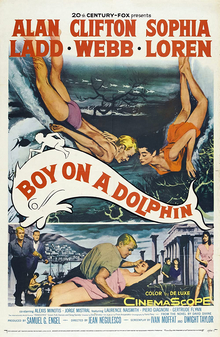
Boy on a Dolphin
An Italian actress who came to fame in the mid 1950s, Sophia Loren finally made her debut in an American movie with 1957's Boy on a Dolphin. It's a good thing Miss Loren is around because other than her? The movie has some potential but never really amounts to much.
Diving with her boyfriend/fiance Rhif (Jorge Mistral) on the Greek island of Hydros, Phaedra (Loren) stumbles across an amazing find in reachable waters for divers; a treasure from over 2,000 years ago, a statue of a boy on a dolphin that was part of a pair. The other has been found, but this one is completely intact. Looking for a payday to support herself and her brother, Phaedra heads to Athens to look for a buyer for the statue, finding Jim Calder (Alan Ladd), an American who wants to preserve Greek history. She also meets Parmalee (Clifton Webb), a black market dealer who also wants to get his hands on the statue and to pay well for it. Now Phaedra must decide who to help guide to the long-lost statue.
What stands out the most in this otherwise pretty dull flick from 1957 is the on-location shooting in Greece and around the Greek Isles. Director Jean Negulesco shot 'Dolphin' on the island of Hydra but also filmed in and around Athens, Rhodes and Delos. Filmed in CinemaScope, this is a stunningly gorgeous film to watch. Scenes of a car driving along a scenic highway, or a way through the countryside with the rolling hills and mountains in the distance could destroy a lot of other movies as it slows down the story to a snail's pace. Sadly for 'Dolphin,' it's the best thing going here. As a viewer, you feel like you are actually getting the scope and beauty of these locations. I guess it's debatable then whether it is worth it to pursue the film. You would probably be safe finding a 'Tour the Greek Islands' DVD and skipping over the movie.
I was disappointed with the end result because between 45-60 minutes into the movie I was enjoying it. The long-lost, supposedly lost treasure, the poor village girl with a chance to make millions, her seedy partners, the idealistic American, the greedy black market dealer. Throw in the Greek locations, and you've got all the makings of a solid action thriller. Any suspense or tension is lost at about the hour-mark as Loren's Phaedra goes along with Webb's Parmalee and starts to dupe Ladd's Calder. The final 45 minutes are tedious to the point I found myself fast-forwarding through scenes of dialogue. The other scenes? How many times can you watch underwater divers swimming through coral and wreckage on the floor of the Aegean Sea before you get bored? I lost track fairly quickly, but let's say five or so.
Making her American film debut, Loren is a bright spot in this 1957 flick. For starters, her voice isn't dubbed so it's actually her talking in that heavily-accent Italian trying to sound Greek. Her Phaedra character in general comes across as more of a fiery Italian than anything, but minor details. She's funny, she's tough, and she's beautiful. Most of all, she can act though. 'Dolphin' certainly flaunts her physical talents -- like THIS diving scene -- and she always seems to be lifting her skirt up or wearing a shirt that's a size too small. Beautiful she is, but in a fun role, she doesn't let her looks take over on their own. Another bright spot is Ladd as Calder. It's a fun part for him as well, one that allows him to just goof around and be himself. A tad on the wooden side, he still has a decent chemistry with Loren in their scenes together.
That chemistry came at a price though. Ladd stood only 5-foot-6 while Loren was 5-foot-8. Makes for some interesting set-ups when the leading man has to look up to his leading lady. To even things out of sorts, Negulesco went to all sorts of different plans so it wouldn't be an issue, Loren towering over Ladd. In certain scenes together, Ladd was forced to stand on a box so the two stars would be eye to eye. In one particular scene where they're walking on the beach, a trench was dug so Loren could walk alongside of him while filming. Just some interesting trivia. Height differences aside, I thought they worked very well together.
With the rest of the cast, Webb is a villain of sorts, but a gentlemanly kind who isn't particularly interesting. He's up to no good, but he's not menacing in the least. Mistral is solid as the conniving Rhif, Phaedra's boyfriend and future husband, who seems more interested in a big payday than preserving Greek history. Also joining their motley crew is Laurence Naismith as Dr. Hawkins and Piero Giagnoni as Niko, Phaedra's little brother who forms a quick friendship with Ladd's Calder. Singing the title song is actress/singer Julie London which you can listen to HERE. A disappointing movie in the end. It has its positives, but not enough to revisit this one anytime soon.
Boy on a Dolphin <---trailer (1957): **/****
Diving with her boyfriend/fiance Rhif (Jorge Mistral) on the Greek island of Hydros, Phaedra (Loren) stumbles across an amazing find in reachable waters for divers; a treasure from over 2,000 years ago, a statue of a boy on a dolphin that was part of a pair. The other has been found, but this one is completely intact. Looking for a payday to support herself and her brother, Phaedra heads to Athens to look for a buyer for the statue, finding Jim Calder (Alan Ladd), an American who wants to preserve Greek history. She also meets Parmalee (Clifton Webb), a black market dealer who also wants to get his hands on the statue and to pay well for it. Now Phaedra must decide who to help guide to the long-lost statue.
What stands out the most in this otherwise pretty dull flick from 1957 is the on-location shooting in Greece and around the Greek Isles. Director Jean Negulesco shot 'Dolphin' on the island of Hydra but also filmed in and around Athens, Rhodes and Delos. Filmed in CinemaScope, this is a stunningly gorgeous film to watch. Scenes of a car driving along a scenic highway, or a way through the countryside with the rolling hills and mountains in the distance could destroy a lot of other movies as it slows down the story to a snail's pace. Sadly for 'Dolphin,' it's the best thing going here. As a viewer, you feel like you are actually getting the scope and beauty of these locations. I guess it's debatable then whether it is worth it to pursue the film. You would probably be safe finding a 'Tour the Greek Islands' DVD and skipping over the movie.
I was disappointed with the end result because between 45-60 minutes into the movie I was enjoying it. The long-lost, supposedly lost treasure, the poor village girl with a chance to make millions, her seedy partners, the idealistic American, the greedy black market dealer. Throw in the Greek locations, and you've got all the makings of a solid action thriller. Any suspense or tension is lost at about the hour-mark as Loren's Phaedra goes along with Webb's Parmalee and starts to dupe Ladd's Calder. The final 45 minutes are tedious to the point I found myself fast-forwarding through scenes of dialogue. The other scenes? How many times can you watch underwater divers swimming through coral and wreckage on the floor of the Aegean Sea before you get bored? I lost track fairly quickly, but let's say five or so.
Making her American film debut, Loren is a bright spot in this 1957 flick. For starters, her voice isn't dubbed so it's actually her talking in that heavily-accent Italian trying to sound Greek. Her Phaedra character in general comes across as more of a fiery Italian than anything, but minor details. She's funny, she's tough, and she's beautiful. Most of all, she can act though. 'Dolphin' certainly flaunts her physical talents -- like THIS diving scene -- and she always seems to be lifting her skirt up or wearing a shirt that's a size too small. Beautiful she is, but in a fun role, she doesn't let her looks take over on their own. Another bright spot is Ladd as Calder. It's a fun part for him as well, one that allows him to just goof around and be himself. A tad on the wooden side, he still has a decent chemistry with Loren in their scenes together.
That chemistry came at a price though. Ladd stood only 5-foot-6 while Loren was 5-foot-8. Makes for some interesting set-ups when the leading man has to look up to his leading lady. To even things out of sorts, Negulesco went to all sorts of different plans so it wouldn't be an issue, Loren towering over Ladd. In certain scenes together, Ladd was forced to stand on a box so the two stars would be eye to eye. In one particular scene where they're walking on the beach, a trench was dug so Loren could walk alongside of him while filming. Just some interesting trivia. Height differences aside, I thought they worked very well together.
With the rest of the cast, Webb is a villain of sorts, but a gentlemanly kind who isn't particularly interesting. He's up to no good, but he's not menacing in the least. Mistral is solid as the conniving Rhif, Phaedra's boyfriend and future husband, who seems more interested in a big payday than preserving Greek history. Also joining their motley crew is Laurence Naismith as Dr. Hawkins and Piero Giagnoni as Niko, Phaedra's little brother who forms a quick friendship with Ladd's Calder. Singing the title song is actress/singer Julie London which you can listen to HERE. A disappointing movie in the end. It has its positives, but not enough to revisit this one anytime soon.
Boy on a Dolphin <---trailer (1957): **/****
Wednesday, March 21, 2012
The Badlanders
Released in 1950 and based off a novel by writer W.R. Burnett, The Asphalt Jungle has withstood the test of time and still remains one of the best examples of a film noir ever released. It is a classic that deserves its reputation built up over the years. Just eight years later, the successful noir was back in theaters with a little twist, it was now a western, the movie 1958's The Badlanders.
Having served a majority of his sentence, Peter van Hoek (Alan Ladd), better known as 'the Dutchman,' is released early from the Yuma territorial prison. A mining engineer, Dutchman maintains that he was framed for a robbery of a gold shipment, still claiming his innocence. He's got a plan to get back at those who set him up, robbing a supposedly useless mine that never produced any gold, or so it seemed. Dutchman enlists the help of McBain (Ernest Borgnine), another recently released prisoner, and Vincente (Nehemiah Persoff), a dynamite specialist, to help in the plan which will require split second timing. The plan seems perfect, but one never knows what might come up when so much gold is involved.
I've never hidden the fact that I'm not a fan of remakes, especially remakes of movies like The Asphalt Jungle that didn't need to be touched. On the other hand, if you're going to do a remake, add something new, a unique feature or departure from the original, much like director Delmer Daves did here. Transplanting the team of crooks, robbers and specialists to the dusty desert of the wild west is an inspired choice. 'Badlanders' was filmed in Old Tucson, Arizona, a filming location western fans will be especially familiar with. The lonely western town surrounded by mountains is a great backdrop to the heist story. As a fan of both westerns and heist flicks, I couldn't help but like this one. How often do we actually see western heists? Few and far between.
The cast is streamlined some, certain characters tweaked or completely dropped from 'Asphalt.' The focus is on Ladd's Dutchman and Borgnine's McBain. Ladd's quiet, easy-going and understated acting style works here, even if a little more visible revenge-seeking would have helped. His background is never fully explained, but we know he wants some revenge, and he's had years to think about it. Playing his partner in crime, Borgnine shows a different side of his acting ability. He isn't the loud, aggressive thug he played so often in the 1950s as he built up a name for himself. His McBain was sent to prison on a manslaughter charge and then saw his land and home pulled out from under him. He too wants revenge but doesn't know where to start until the Dutchman approaches him with a plan. A subplot with McBain and Anita (Katy Jurado), a prostitute in town, helps develop the character as well.
Having two very solid leads in those roles is both good and bad. The good is obvious; it's fun to see Ladd and Borgnine working together on this heist. The bad in an 85-minute movie? The focus is on them, but little else gets dealt with. We hear about both Dutchman and McBain's predicament, their background in getting sent to the Yuma prison, but that's all. We hear, but there's little in the way of details. When Dutchman sets up the plan, are the higher-ups in town the ones who set him up? Does he intend to get them back or just earn himself some money? Not even breaking the 90-minute mark, things feel rushed, like key scenes and explanations were left in the editing room. The villains aren't developed, subplots that are there feel forced and/or pointless, and all the sudden the movie's over. It's an enjoyable ride along the way, but it could have been much better.
Throwing so many different elements into an 85-minute long movie is unfortunate because there's just too much going on. Jurado's Anita is a bright spot, making the most of her time with Borgnine's McBain as the heist plan comes together, but Persoff doesn't come across as well as the Mexican dynamite expert. As mentioned though, the villains are weak and poorly developed. Kent Smith is Lounsberry, the town hot-shot who will serve as a fence for the stolen gold, Robert Emhardt playing Sample, a partner in the coming double-cross. Claire Kelly is Ada (sexy name, huh?), Lounsberry's girlfriend literally locked away in a hotel room until she's needed, there because Ladd's Dutchman needs a love interest. Supporting player in the original 'Asphalt,' Anthony Caruso is Comanche, one of Sample's gunhands while Adam Williams does what he did best, playing a possibly unhinged, highly dangerous gunfighter, albeit a deputy named Leslie.
Like a lot of movies, this one had the potential to be an above average, pretty memorable western, but it never quite gets there. Where 'Asphalt' reveled in its darkness and cynicism, 'Badlanders' refuses to go there, especially in its ending which is just too nice and tidy when it could have been incredibly dark and surprising. It's still a good movie with some solid performances, but it isn't as good as it could have been.
The Badlanders <---TCM trailer (1958): ** 1/2 /****
Having served a majority of his sentence, Peter van Hoek (Alan Ladd), better known as 'the Dutchman,' is released early from the Yuma territorial prison. A mining engineer, Dutchman maintains that he was framed for a robbery of a gold shipment, still claiming his innocence. He's got a plan to get back at those who set him up, robbing a supposedly useless mine that never produced any gold, or so it seemed. Dutchman enlists the help of McBain (Ernest Borgnine), another recently released prisoner, and Vincente (Nehemiah Persoff), a dynamite specialist, to help in the plan which will require split second timing. The plan seems perfect, but one never knows what might come up when so much gold is involved.
I've never hidden the fact that I'm not a fan of remakes, especially remakes of movies like The Asphalt Jungle that didn't need to be touched. On the other hand, if you're going to do a remake, add something new, a unique feature or departure from the original, much like director Delmer Daves did here. Transplanting the team of crooks, robbers and specialists to the dusty desert of the wild west is an inspired choice. 'Badlanders' was filmed in Old Tucson, Arizona, a filming location western fans will be especially familiar with. The lonely western town surrounded by mountains is a great backdrop to the heist story. As a fan of both westerns and heist flicks, I couldn't help but like this one. How often do we actually see western heists? Few and far between.
The cast is streamlined some, certain characters tweaked or completely dropped from 'Asphalt.' The focus is on Ladd's Dutchman and Borgnine's McBain. Ladd's quiet, easy-going and understated acting style works here, even if a little more visible revenge-seeking would have helped. His background is never fully explained, but we know he wants some revenge, and he's had years to think about it. Playing his partner in crime, Borgnine shows a different side of his acting ability. He isn't the loud, aggressive thug he played so often in the 1950s as he built up a name for himself. His McBain was sent to prison on a manslaughter charge and then saw his land and home pulled out from under him. He too wants revenge but doesn't know where to start until the Dutchman approaches him with a plan. A subplot with McBain and Anita (Katy Jurado), a prostitute in town, helps develop the character as well.
Having two very solid leads in those roles is both good and bad. The good is obvious; it's fun to see Ladd and Borgnine working together on this heist. The bad in an 85-minute movie? The focus is on them, but little else gets dealt with. We hear about both Dutchman and McBain's predicament, their background in getting sent to the Yuma prison, but that's all. We hear, but there's little in the way of details. When Dutchman sets up the plan, are the higher-ups in town the ones who set him up? Does he intend to get them back or just earn himself some money? Not even breaking the 90-minute mark, things feel rushed, like key scenes and explanations were left in the editing room. The villains aren't developed, subplots that are there feel forced and/or pointless, and all the sudden the movie's over. It's an enjoyable ride along the way, but it could have been much better.
Throwing so many different elements into an 85-minute long movie is unfortunate because there's just too much going on. Jurado's Anita is a bright spot, making the most of her time with Borgnine's McBain as the heist plan comes together, but Persoff doesn't come across as well as the Mexican dynamite expert. As mentioned though, the villains are weak and poorly developed. Kent Smith is Lounsberry, the town hot-shot who will serve as a fence for the stolen gold, Robert Emhardt playing Sample, a partner in the coming double-cross. Claire Kelly is Ada (sexy name, huh?), Lounsberry's girlfriend literally locked away in a hotel room until she's needed, there because Ladd's Dutchman needs a love interest. Supporting player in the original 'Asphalt,' Anthony Caruso is Comanche, one of Sample's gunhands while Adam Williams does what he did best, playing a possibly unhinged, highly dangerous gunfighter, albeit a deputy named Leslie.
Like a lot of movies, this one had the potential to be an above average, pretty memorable western, but it never quite gets there. Where 'Asphalt' reveled in its darkness and cynicism, 'Badlanders' refuses to go there, especially in its ending which is just too nice and tidy when it could have been incredibly dark and surprising. It's still a good movie with some solid performances, but it isn't as good as it could have been.
The Badlanders <---TCM trailer (1958): ** 1/2 /****
Saturday, February 25, 2012
Drum Beat
History provides all sorts of little tidbits, small, little-known stories that are often enough lost in the history books. The development of the American west had countless examples of this in the 19th Century, small-scale incidents that were major at the time, but were generally forgotten. Made in 1954, Drum Beat is a solid and generally forgotten western telling the story of the Modoc War in 1872 and 1873.
A well-known and respected Indian fighter, Johnny MacKay (Alan Ladd) has been tasked with a mission from President Grant (Hayden Rorke). In the Oregon territory, the Modoc tribe has left the reservation and causing problems for the white settlers. Johnny is hired as a peace commissioner with the hopes of both the white settlers and and Modoc Indians signing a treaty that will bring a halt to all the violence. He is skeptical of the two sides working together, but Johnny travels back west hoping to meet with Captain Jack (Charles Bronson), the chief of this group of Modocs. The Indians are less than cooperative though, and peace won't come easily.
From director Delmer Daves, this is a BIG western. It isn't an epic that runs 3-hours with intermission and a cast of thousands, but it is nonetheless big. It was filmed in Cinerama and takes full advantage of the on-location shooting in Sonora. You can see and feel the immensity of the frontier as the settlers tangle with the warring Indians. The developing story is somewhat familiar in that sense, but it never feels dull. Yes, there are scenes that rely solely on the natural background, long, uninterrupted scenes of riders moving across a horizon. At 111 minutes, it is a tad long in the tooth, but it's not a deal breaker. Victor Young's score is appropriately sweeping without overpowering anything on-screen, and thankfully the Ballad of Drum Beat is only played over the opening credits.
With Daves at the helm, the story is just solid. He's an underrated, underappreciated director who was consistent throughout his career, directing one excellent movie after another. The story is familiar here -- settlers/whites vs. Indians -- but it doesn't feel familiar. Credit to Ladd and Bronson there. I really liked Ladd's performance as Johnny MacKay, an Indian fighter who's good at what he does but doesn't necessarily enjoy it. Bronson as an Indian seems like a bad choice, but that too works. It borders on a caricature but never goes too far. He looks out for the best interest of his tribe...at first...only to get swept up in the glory of fighting. Their scenes together are surprisingly good, especially their final scene in the closing minutes. The fight leading up to that scene ain't too shabby either.
An ensemble cast of familiar faces backs up Ladd and Bronson, Audrey Dalton leading the way as Nancy, an Easterner who's moved west to help the cause and surprise, surprise...falls for Ladd's Johnny! Who saw that coming?!? Oh, everybody? My bad. Marisa Pavan and Anthony Caruso rise above stereotypes as Toby and Mannock, two peaceful Modocs working with Johnny and not against him. Robert Keith plays Bill, an older frontiersman with a grudge while Rodolfo Acosta and Perry Lopez play two of Bronson's warriors. Look for recognizable character actors Willis Bouchey, Elisha Cook Jr., Strother Martin and Denver Pyle in small parts.
As a quasi-western buff, I do have to poke some holes in this story. A title card starts with 'This is true except for the fictional characters and storylines needed to dramatize the truth.' So basically a cop-out. A true story until the truth isn't entertaining enough. Sonora, Arizona does not look like Oregon in the least, and the Modocs look and are portrayed more like Apaches than any other tribe. Just weird observations that ran through my head. Still a good movie, especially a large-scale battle on a Modoc fortress on an impenetrable rock formation, with an interesting cast.
Drum Beat <---credits/opening (1954): ***/****
A well-known and respected Indian fighter, Johnny MacKay (Alan Ladd) has been tasked with a mission from President Grant (Hayden Rorke). In the Oregon territory, the Modoc tribe has left the reservation and causing problems for the white settlers. Johnny is hired as a peace commissioner with the hopes of both the white settlers and and Modoc Indians signing a treaty that will bring a halt to all the violence. He is skeptical of the two sides working together, but Johnny travels back west hoping to meet with Captain Jack (Charles Bronson), the chief of this group of Modocs. The Indians are less than cooperative though, and peace won't come easily.
From director Delmer Daves, this is a BIG western. It isn't an epic that runs 3-hours with intermission and a cast of thousands, but it is nonetheless big. It was filmed in Cinerama and takes full advantage of the on-location shooting in Sonora. You can see and feel the immensity of the frontier as the settlers tangle with the warring Indians. The developing story is somewhat familiar in that sense, but it never feels dull. Yes, there are scenes that rely solely on the natural background, long, uninterrupted scenes of riders moving across a horizon. At 111 minutes, it is a tad long in the tooth, but it's not a deal breaker. Victor Young's score is appropriately sweeping without overpowering anything on-screen, and thankfully the Ballad of Drum Beat is only played over the opening credits.
With Daves at the helm, the story is just solid. He's an underrated, underappreciated director who was consistent throughout his career, directing one excellent movie after another. The story is familiar here -- settlers/whites vs. Indians -- but it doesn't feel familiar. Credit to Ladd and Bronson there. I really liked Ladd's performance as Johnny MacKay, an Indian fighter who's good at what he does but doesn't necessarily enjoy it. Bronson as an Indian seems like a bad choice, but that too works. It borders on a caricature but never goes too far. He looks out for the best interest of his tribe...at first...only to get swept up in the glory of fighting. Their scenes together are surprisingly good, especially their final scene in the closing minutes. The fight leading up to that scene ain't too shabby either.
An ensemble cast of familiar faces backs up Ladd and Bronson, Audrey Dalton leading the way as Nancy, an Easterner who's moved west to help the cause and surprise, surprise...falls for Ladd's Johnny! Who saw that coming?!? Oh, everybody? My bad. Marisa Pavan and Anthony Caruso rise above stereotypes as Toby and Mannock, two peaceful Modocs working with Johnny and not against him. Robert Keith plays Bill, an older frontiersman with a grudge while Rodolfo Acosta and Perry Lopez play two of Bronson's warriors. Look for recognizable character actors Willis Bouchey, Elisha Cook Jr., Strother Martin and Denver Pyle in small parts.
As a quasi-western buff, I do have to poke some holes in this story. A title card starts with 'This is true except for the fictional characters and storylines needed to dramatize the truth.' So basically a cop-out. A true story until the truth isn't entertaining enough. Sonora, Arizona does not look like Oregon in the least, and the Modocs look and are portrayed more like Apaches than any other tribe. Just weird observations that ran through my head. Still a good movie, especially a large-scale battle on a Modoc fortress on an impenetrable rock formation, with an interesting cast.
Drum Beat <---credits/opening (1954): ***/****
Wednesday, December 7, 2011
The Iron Mistress
Born in 1796, Jim Bowie packed a hell of a lot of living into his 40 years. An adventurer, a frontiersman, a slave trader, land owner, and knife fighter, Bowie did it all before his death at the Alamo in 1836. Most famously, he's known for inventing a particularly nasty-looking knife that was named after him, the Bowie knife. Why then with a life as adventurous and exciting as his is the 1952 bio-pic The Iron Mistress so dull?
Traveling to New Orleans in 1825, Jim Bowie (Alan Ladd) is looking to sell lumber from his family's mill. A backwoodsman more comfortable in the bayou, Jim is more than a little uncomfortable in the big city. He meets Narcisse (Douglas Dick), a well-to-do French land owner, and is then introduced to his sister, the very pretty Judalon (Virginia Mayo). Jim is drawn to her instantly but quickly discovers trouble surrounds her wherever she goes. The young knife fighter wants bigger and better things though, wants riches of his own. Land, cotton, slaves, it doesn't matter. Young Mr. Bowie intends to take the world by storm.
To say that this 1952 biography plays fast and loose with the history is a generous statement. What's true? There was a man named Jim Bowie, he had a wicked-looking knife created for him, and he was in Louisiana and Texas in the 1820s and 1830s. Other than that? This could be any movie about an enterprising young businessman. I'm a fan of Bowie historically and anything remotely connected to the Alamo, but even I can find little redeeming in this story. It drags along at 109 minutes -- but feels much, much longer -- and is bogged down in the period look from the costumes down to the sets. The story simply tries to do too much, never focusing on anything specific, or for that matter....interesting.
The movie's fatal flaw comes in the casting. I'm not a huge fan of the typically wooden Alan Ladd to begin with, but he is a poor choice to play Bowie. The real-life Bowie was a particularly nasty guy so right off the bat Ladd is backed into a corner with this 1950s whitewashing of the historical, real life person. But whitewashing or not, Ladd appears to be sleepwalking. He gives Bowie little to no personality through his adventures. Even Sterling Hayden in The Last Command was better than Ladd. Of a big cast that leaves little positive impressions, Mayo is all right as the manipulative Judalon, Joseph Calleia plays Moreno, Bowie's opposition (later starring in John Wayne's The Alamo), Anthony Caruso the treacherous Sturdivant, and George Voskovec as a Quaker friend of Bowie's.
A movie about a famous knife and its creator doesn't disappoint in that regard. Several knife fights highlight the otherwise slow-moving and dull story. One has Bowie strapped at the wrist to Caruso, fighting in a ring surrounded by a mob. Another has Bowie running from armed riders trying to kill him, and even the infamous Sandbar Fight is dealt with in surprisingly gruesome fashion. The best scene by far has Bowie -- armed with his knife -- fighting a man armed with a sword in a darkened room. A beautifully put together, tension-packed sequence, great to look at and exciting on top of it. Also a plus, the scene where blacksmith James Black (David Wolfe) creates the original Bowie knife.
Returning to the actual history, the story picks up in the last half hour as Bowie heads to Texas where he meets future wife Ursula De Veramendi (Phyllis Kirk), the daughter of the governor. This last half hour has solid pacing and actually picks up some momentum heading into the finale. The ending itself is ridiculous, basically setting up the last few years of Bowie's life without his knife. It is a deeply flawed biography of a very interesting historical figure with just enough going for it to mildly recommend.
The Iron Mistress <---TCM trailer (1952): **/****
Traveling to New Orleans in 1825, Jim Bowie (Alan Ladd) is looking to sell lumber from his family's mill. A backwoodsman more comfortable in the bayou, Jim is more than a little uncomfortable in the big city. He meets Narcisse (Douglas Dick), a well-to-do French land owner, and is then introduced to his sister, the very pretty Judalon (Virginia Mayo). Jim is drawn to her instantly but quickly discovers trouble surrounds her wherever she goes. The young knife fighter wants bigger and better things though, wants riches of his own. Land, cotton, slaves, it doesn't matter. Young Mr. Bowie intends to take the world by storm.
To say that this 1952 biography plays fast and loose with the history is a generous statement. What's true? There was a man named Jim Bowie, he had a wicked-looking knife created for him, and he was in Louisiana and Texas in the 1820s and 1830s. Other than that? This could be any movie about an enterprising young businessman. I'm a fan of Bowie historically and anything remotely connected to the Alamo, but even I can find little redeeming in this story. It drags along at 109 minutes -- but feels much, much longer -- and is bogged down in the period look from the costumes down to the sets. The story simply tries to do too much, never focusing on anything specific, or for that matter....interesting.
The movie's fatal flaw comes in the casting. I'm not a huge fan of the typically wooden Alan Ladd to begin with, but he is a poor choice to play Bowie. The real-life Bowie was a particularly nasty guy so right off the bat Ladd is backed into a corner with this 1950s whitewashing of the historical, real life person. But whitewashing or not, Ladd appears to be sleepwalking. He gives Bowie little to no personality through his adventures. Even Sterling Hayden in The Last Command was better than Ladd. Of a big cast that leaves little positive impressions, Mayo is all right as the manipulative Judalon, Joseph Calleia plays Moreno, Bowie's opposition (later starring in John Wayne's The Alamo), Anthony Caruso the treacherous Sturdivant, and George Voskovec as a Quaker friend of Bowie's.
A movie about a famous knife and its creator doesn't disappoint in that regard. Several knife fights highlight the otherwise slow-moving and dull story. One has Bowie strapped at the wrist to Caruso, fighting in a ring surrounded by a mob. Another has Bowie running from armed riders trying to kill him, and even the infamous Sandbar Fight is dealt with in surprisingly gruesome fashion. The best scene by far has Bowie -- armed with his knife -- fighting a man armed with a sword in a darkened room. A beautifully put together, tension-packed sequence, great to look at and exciting on top of it. Also a plus, the scene where blacksmith James Black (David Wolfe) creates the original Bowie knife.
Returning to the actual history, the story picks up in the last half hour as Bowie heads to Texas where he meets future wife Ursula De Veramendi (Phyllis Kirk), the daughter of the governor. This last half hour has solid pacing and actually picks up some momentum heading into the finale. The ending itself is ridiculous, basically setting up the last few years of Bowie's life without his knife. It is a deeply flawed biography of a very interesting historical figure with just enough going for it to mildly recommend.
The Iron Mistress <---TCM trailer (1952): **/****
Monday, June 20, 2011
Paratrooper
Is there anything more ridiculous that a person can do than jump out of a plane with a parachute? I say this as someone who would like to sky-dive at some point in my life, knowing the inherent and fairly obvious consequences that could result from said experience. Now let's add something to the equation. What about jumping out of a plane and landing somewhere where thousands of men with guns would like nothing more than to kill you? Okay, so maybe not my best lead ever, but I thought it was good enough for a movie appropriately titled Paratrooper, released in 1953.
This British war flick was aired recently as part of TCM's Memorial Day programming (like many of my recent reviews), and was one I'd never heard of before stumbling across it on their website. The story sounded a lot like a book I was given as a little kid by my Dad, a book he had read as a kid about a commando raid in France trying to knock out a German radar station. As is the case with this movie, it was appropriately named 'Radar Commandos.' The story sounded interesting enough, the talent behind the camera impressive, and the cast had a couple names I'll always check out.
It's 1940 in England, and American volunteer via Canada, McKendrick (Alan Ladd) volunteers to be part of a newly formed unit of paratroopers. He doesn't tell anyone, but he has an aviation background, and more than that, experience with parachuting out of a plane. Joining the completely volunteer unit, McKendrick just wants to blend in and do his job like all the other volunteers. His superiors quickly see his talent and his ability to lead, but he wants nothing to do with a promotion. The training revs up as the paratroopers practice jumping out of planes. Their orders are coming though as the fighting intensifies against the Germans. First up on their list is a German radar station in France, but that's just the start. A heavily guarded German airfield also awaits them.
This is a lot like so many movies I've seen over the years. It's not bad mostly because the talent involved on both sides of the camera just wouldn't allow a truly bad movie. On the other hand, it's not very good either. It is dull at times -- surprising considering the subject matter -- and so cliche-ridden in other segments that the story struggles to get off the ground. Director Terence Young would go on to direct three of the best James Bond films (Dr. No, From Russia With Love, and Thunderball), but this WWII venture doesn't have the same urgency or even a fraction of the entertainment value. Cliches are one thing though -- I love cliches, just about all of them -- but Paratrooper is undone by some just bizarre moments that seem out of place, some things I may be reading too much into and others that are just bad.
In an effort to save some money (I'm assuming), some green screen shots are used so painfully obvious and out of place that they're laughable. Ladd and fellow cast members stand close to the camera while footage of paratroopers training or tanks driving by is shown behind them. Ladd's McKendrick is also given a love interest...sort of... who really wants nothing to do with him but ends up falling for him because gosh darnit, he's just a good guy. Ladd has little chemistry with 22-year old Susan Stephen who was 18 years younger than him so that's always nice. Then there's Stanley Baker, typically a sure thing, playing a jump instructor. His acting isn't in question here...just his voice. He is dubbed so bizarrely that every time he speaks it just sounds odd. Just weird little things that pepper throughout the movie.
A saving grace in even a bad movie can be the casting, and above all else that's what drew me into Paratrooper. I was disappointed then because the script doesn't allow for much in the way of actualy character development. The more I see of Alan Ladd I lean toward thinking of him as a one-note actor. He's so calm, so even-keeled that his characters could be accused of being asleep. Ladd rarely shows emotion, and here his character's internal struggles and demons come across as a minor problem as opposed to something that's tearing him up. Leo Genn is your prototypical cold British officer, calculating and good at what he does but not particulary interesting. Harry Andrews gets to yell and scream as the unit's platoon sergeant, and Baker makes a quick appearance as the jump instructor. I recognize a bunch of other faces, English actors who always dotted these movies as background players, but like the leads, they don't make much of an impression.
Through all the tedium in the story, there are some solid moments. The attack on the radar station is well-handled if a little chaotic. I can't decide if that was the intention or just a by-product of some lazy filmmaking, but it's a cool sequence. The same goes for the raid at the German airfield in North Africa. The violence isn't gratuitious, but it is pretty graphic for a movie released in 1953 including a couple uses of blood squibs. Unfortunately by the time these action sequences come around, I was bored with the movie, its story and its characters. Average in every way, but there are worse options to kill 90 minutes.
Paratrooper (1953): **/****
This British war flick was aired recently as part of TCM's Memorial Day programming (like many of my recent reviews), and was one I'd never heard of before stumbling across it on their website. The story sounded a lot like a book I was given as a little kid by my Dad, a book he had read as a kid about a commando raid in France trying to knock out a German radar station. As is the case with this movie, it was appropriately named 'Radar Commandos.' The story sounded interesting enough, the talent behind the camera impressive, and the cast had a couple names I'll always check out.
It's 1940 in England, and American volunteer via Canada, McKendrick (Alan Ladd) volunteers to be part of a newly formed unit of paratroopers. He doesn't tell anyone, but he has an aviation background, and more than that, experience with parachuting out of a plane. Joining the completely volunteer unit, McKendrick just wants to blend in and do his job like all the other volunteers. His superiors quickly see his talent and his ability to lead, but he wants nothing to do with a promotion. The training revs up as the paratroopers practice jumping out of planes. Their orders are coming though as the fighting intensifies against the Germans. First up on their list is a German radar station in France, but that's just the start. A heavily guarded German airfield also awaits them.
This is a lot like so many movies I've seen over the years. It's not bad mostly because the talent involved on both sides of the camera just wouldn't allow a truly bad movie. On the other hand, it's not very good either. It is dull at times -- surprising considering the subject matter -- and so cliche-ridden in other segments that the story struggles to get off the ground. Director Terence Young would go on to direct three of the best James Bond films (Dr. No, From Russia With Love, and Thunderball), but this WWII venture doesn't have the same urgency or even a fraction of the entertainment value. Cliches are one thing though -- I love cliches, just about all of them -- but Paratrooper is undone by some just bizarre moments that seem out of place, some things I may be reading too much into and others that are just bad.
In an effort to save some money (I'm assuming), some green screen shots are used so painfully obvious and out of place that they're laughable. Ladd and fellow cast members stand close to the camera while footage of paratroopers training or tanks driving by is shown behind them. Ladd's McKendrick is also given a love interest...sort of... who really wants nothing to do with him but ends up falling for him because gosh darnit, he's just a good guy. Ladd has little chemistry with 22-year old Susan Stephen who was 18 years younger than him so that's always nice. Then there's Stanley Baker, typically a sure thing, playing a jump instructor. His acting isn't in question here...just his voice. He is dubbed so bizarrely that every time he speaks it just sounds odd. Just weird little things that pepper throughout the movie.
A saving grace in even a bad movie can be the casting, and above all else that's what drew me into Paratrooper. I was disappointed then because the script doesn't allow for much in the way of actualy character development. The more I see of Alan Ladd I lean toward thinking of him as a one-note actor. He's so calm, so even-keeled that his characters could be accused of being asleep. Ladd rarely shows emotion, and here his character's internal struggles and demons come across as a minor problem as opposed to something that's tearing him up. Leo Genn is your prototypical cold British officer, calculating and good at what he does but not particulary interesting. Harry Andrews gets to yell and scream as the unit's platoon sergeant, and Baker makes a quick appearance as the jump instructor. I recognize a bunch of other faces, English actors who always dotted these movies as background players, but like the leads, they don't make much of an impression.
Through all the tedium in the story, there are some solid moments. The attack on the radar station is well-handled if a little chaotic. I can't decide if that was the intention or just a by-product of some lazy filmmaking, but it's a cool sequence. The same goes for the raid at the German airfield in North Africa. The violence isn't gratuitious, but it is pretty graphic for a movie released in 1953 including a couple uses of blood squibs. Unfortunately by the time these action sequences come around, I was bored with the movie, its story and its characters. Average in every way, but there are worse options to kill 90 minutes.
Paratrooper (1953): **/****
Labels:
1950s,
Alan Ladd,
Harry Andrews,
Leo Genn,
Stanley Baker,
Terence Young,
WWII
Thursday, January 27, 2011
The Deep Six
The idea of a conscientious objector is a sticky one because it has to be hard to read a man's true intentions. Combat and war are a terrifying premise, and most would do anything possible to avoid it. But regardless of personal or religious beliefs, some men slip through the cracks and make it into combat on a front-line position. That's 1958's The Deep Six, the story of a man raised as a Quaker who outgrew his childhood beliefs as he grew into an adult. Now when his draft summons arrives in the mail, his beliefs come up again. If it came down to it, could he kill?
A successful advertising artist in Los Angeles, Alec Austen (Alan Ladd), is riding high. His job pays well, he owns a beautiful seaside home, and he's in love and about to be engaged to his boss, beautiful Susan Cahill (Dianne Foster). When it seems everything is lining up into place, Alec relieves a draft summons for the U.S. Navy because he took an ROTC program in college and is still part of the Naval Reserves. Raised as a Quaker, he wavers over what to do but ultimately reports for duty where he's assigned to the USS Poe, a destroyer in the Pacific captained by Commander Meredith (James Whitmore). As the Poe sails toward the Japanese and the conflict awaits, Alec begins to question if his childhood beliefs of pacifism are really gone. When the time comes will he be able to give the order to fire, an order that will almost certainly end in the death of a human being?
Movies about war -- especially in the 1950s -- are a dime a dozen. Doing the norm and making a flick about combat is fine by me, I love that type of story and own a fair share of those on DVD, but it's always refreshing to see a war story with a fresh spin. This story is effective because it's hard not to feel for Ladd's Alec character. It's only natural to be scared about how you'll respond in a situation like he is in regardless of your beliefs or ideologies. Alec must not only worry about his own concerns, and how he'll respond, but if the choices he makes will end up taking the lives of his crew, the men he bunks and eats with on board the Poe. Throw in that the crew (including nasty executive officer Keenan Wynn) finds out about his Quakerism and ostracizes him, and you've got a whole bucket of worms.
In a career that was cut short because of his personal demons, Ladd still made his mark on Hollywood. He always had an easy-going way about him that played on his character's vulnerabilities and made him a likable leading man. His Alec is quiet and unassuming, a good man pressed into a difficult choice. He doesn't whine or moan about his predicament, doing his best to deal with it himself. For the most part, Alec bonds well with his men because he has their best interest at heart. In helping us to get to know his main character, director Rudolph Mate adds in the subplot with Alec's fiance Susan. Where some movies use this technique and it fails miserably, it works here, and I can't explain why the subplot didn't send me up the wall. It just works, and it certainly makes Alec more human. He's worried about marrying Susan because of the very real possibility that he may die at sea, sacrificing his feelings and needs/wants for his concerns on how that event that might not even happen would affect her.
Still, The Deep Six is a war movie, and the heart of the story is Alec and the USS Poe's involvement in the war in the Pacific against the Japanese. The combat is held to a minimum with an occasional strike by a patrolling Japanese plane and saved for the end when Alec must lead a small patrol onto a Japanese-held island where five downed fliers await rescue. The finale -- as was the case with much of the movie -- is limited by a smaller budget, but it makes up for any epic battle with the impact the fighting makes. Filming much of his film at sea, Mate give viewers quite a look at life on a U.S. destroyer, providing some great footage with his cast (not stock footage) on board the ship. The supporting cast includes JHP favorite Whitmore as the veteran commander, Wynn as the bloodthirsty XO, Efram Zimbalist Jr. as on-ship physician/doctor, Lt. Blanchard, and a scene-stealing William Bendix as Frenchy Shapiro, Alec's close friend and Chief officer.
Reminding me of the somewhat out of place humor in John Ford's Mister Roberts, too much time is spent with the crazy antics of the crew, including a pre-Rat Pack Joey Bishop, Perry Lopez, and voice of Alvin and the Chipmunks Ross Bagdasarian (among other cast members). The humor is unnecessary, and if it is an attempt to lighten the mood, it fails badly. It's just not funny and takes away from the more interesting aspects of the story. By no means enough to detract overall from the movie, but worth mentioning.
The Deep Six (1958): ***/****
Labels:
1950s,
Alan Ladd,
James Whitmore,
Joey Bishop,
Keenan Wynn,
Perry Lopez,
Rudolph Mate,
William Bendix,
WWII
Tuesday, December 21, 2010
The Blue Dahlia
Many movies made about the Vietnam War don’t focus in on the actual conflict that went on in Vietnam in the 1960s and 1970s, but instead key in on what happens to the soldiers when they return home, how the war has affected them in ways not previously thought of. War has an impact on the soldiers involved no matter the conflict or what century it took place, but Vietnam was the first where the public was aware of these issues. A WWII movie, The Best Years of Our Lives, dealt with this pertaining to World War II veterans returning home. A film noir released in 1946, The Blue Dahlia, has three main characters returning to the United States, all dealing with the return in their own way.
When I first read about this movie at Turner Classic Movie’s website, I assumed it was related to ‘The Black Dahlia,’ the Hollywood flop from five or six years ago that was forgotten almost as soon as it was released in theaters to critical panning. Well, other than the use of ‘Dahlia’ in the title, there is no common link. Blue Dahlia is a solid, well-made film noir about a murder mystery in the Los Angeles club scene where everyone is shady and willing to backstab anyone else for their own gain. It isn’t held in as high regard as many other noir classics, but it is a very solid entry into a very deep genre of movies in film noir.
Returning to the States after receiving a medical discharge, former Navy pilot John Morrison (Alan Ladd) can’t wait to get home and see his wife, Helen (Doris Dowling). He finds something else though waiting for him as his wife has adopted a new partying lifestyle, including starting a relationship with slippery club owner, Eddie Harwood (Howard Da Silva). Morrison’s wife has a dark secret she reveals to John, sending him into a fit of rage that even has him thinking about killing her. Instead, he walks out on her, leaving his past life behind. The next morning though John hears radio reports that his wife has been murdered, and he’s wanted for questioning. With help from his former Navy buddies (William Bendix and Hugh Beaumont), Morrison goes about proving his innocence and finding his wife’s actual murderer.
The post subplot (soldier condition) is centered around William Bendix’s Buzz character, a tail gunner on Morrison’s bomber in the Pacific. Along with John and Beaumont’s George, Buzz received a medical discharge after sustaining a serious wound that tore away part of his skull. He now has a metal plate on the back of his head and is struggling with his readjustment to a more normal life. He freaks out at loud noises and any sort of music playing and has a temper that’s ready to snap at the drop of a hat. For a movie released in the years since the end of World War II, it’s refreshing to see such honesty in dealing with an issue that would have been affecting thousands of similar-minded soldiers all over the U.S.
As for the main plot with the murder mystery, director George Marshall knows what he’s doing. First off, if you think Alan Ladd’s character is the guilty party, shame on you. It’s Shane for goodness sake! He isn’t going to kill his wife! Several possible suspects are presented ranging from the obvious to the dark horse that most viewers will think did it to the actual murderer. I thought I had this one figured out, but the joke was on me. ‘Dahlia’ certainly does its best to keep you guessing, a nice touch amidst the typical noir conventions that viewers have come to expect.
Of the few movies I’ve seen Ladd in other than Shane, I’ve always been a fan of this underrated actor. He apparently did all sorts of things to take away attention from his lack of height (he was only 5’6), but his on-screen presence makes up for it. Ladd has this quiet intensity in his characters that give a feel of not knowing quite what the man is capable of. Here, he is pushed too far by his wife, and even though she is at fault for something horrific in her past, Ladd’s Morrison knows she deserved better than the fate she met. A worthy leading part for Ladd as he carries the movie.
The supporting cast is not made up entirely of home runs, but for the most part the casting works. Bendix especially shines as Buzz while Beaumont (later Mr. Cleaver in Leave it to Beaver) isn’t given as much to do. Da Silva is a great villain, a man with his hand in all sorts of shady dealings. Veronica Lake plays a less essential character early on who ends up playing a key role in the murder investigation as it develops. Ladd and Lake end up in a somewhat forced romantic relationship that ends up wrapping all the separate subplots together nicely in the end.
The Blue Dahlia <---trailer (1946): ** ½ /****
Labels:
1940s,
Alan Ladd,
Film Noir,
George Marshall,
William Bendix
Thursday, July 15, 2010
All the Young Men
In the last few days, I've written a handful of movies about the Korean War, dubbed the Forgotten War in the years since. Along with the actual war, the movies set in the Korean War have been forgotten for the most part. Some for good reason like the B-movies I've reviewed. Others unjustly so as WWII and Vietnam movies are more well remembered. Korea had its fair share though, like The Steel Helmet, Pork Chop Hill, The Bridges at Toko-Ri and several others I'm probably forgetting. One I'd seen parts of and finally caught up include 1960's All the Young Men.
This war movie comes from one of our favorite genre's here at Just Hit Play; the unit picture. Instead of focusing on an epic battle or behind the scenes action at HQ, the unit picture focuses on one specific group, anywhere from a squad or patrol to a regiment or brigade. When handled well, they work so well because story-wise there is going to be a large cast full of multi-dimensional characters in some precarious position, usually forced to work together to get out alive. More than most unit pictures, 'Young Men' reminded me a lot of 1934's The Lost Patrol. But more than just a unit picture, an added dimension has been added, racism among soldiers.
After a successful landing in Korea, an advanced Marine recon platoon is sent out on patrol to take control of a Korean farmhouse controlling a key pass. The pass needs to be held until reinforcements can arrive because a battalion of Marines has been cut off, and the pass provides their only way to safety and rescue. But on the march, the patrol is ambushed with heavy casualties. Dying of his wounds, the lieutenant commanding the platoon must pass command to one of two men. First, there's Kincaid (Alan Ladd), a former sergeant busted for behavior with years of combat experience, and two, Sgt. Towler (Sidney Poitier), a new transfer who's never led men in combat. Towler is picked so he must lead the survivors to the pass and hope to hold out so the Marine battalion can get through safely.
The Korean War was the first conflict where the army units were integrated so here is one of the first examples of a movie showing black and white soldiers fighting alongside each other. Kincaid objects to Towler's in-field promotion because of his lack of experience, not his skin color, while others like Paul Richards' Bracken is a bigoted Southerner who wants nothing to do with Towler. Poitier must have been used to doing racially charged roles by 1960, but he does a great job as the sergeant with the target on his back. As the man in charge, he's tasked with deciding what's best for his men and what's best for the war effort. Not his best performance, but one definitely worth recommending.
It might come across as cliched or stereotypical, but the way director Hall Bartlett handles the soldiers and their interactions seem to ring true to me. The life of a soldier are these lightning quick moments of fear and terror broken up by long stretches of boredom with nothing to do. Bartlett directed, produced and wrote this war flick that isn't heavy on action, instead letting the soldiers breathe a little, have conversations, let us find out who they are, what they think about, what they're afraid of. The combat sequences are somewhat repetitive and reminded me of scenes from 1949's Battleground -- also filmed on an indoor set -- with their claustrophobic feel of being surrounded, being closed in by an unseen enemy.
Telling the story of this small group of soldiers, we see all sorts of backgrounds, all sorts of different walks of life as Bartlett assembles quite a unique group for his Marine squad. A very old-looking Ladd is rather wooden here as Kincaid, the soldier the others trust most. He comes to life during his intense confrontations with Poitier, but other than those scenes it is not his strongest role. Filling out the rest of the group is former teen idol James Darren as Cotton, Glenn Corbett as Wade, the medic (same name as Saving Private Ryan's medic), comedian Mort Sahl as Cpl. Crane (given a chance to even do some of his act), and Swedish boxer Ingemar Johansson as Pvt. Torgil. Filling out the ranks there's also a wounded soldier (Dick Davalos), a Navajo Indian, the youngster, and the tired vet.
Besides the ahead of its time decision about integrated units, 'Young Men' also pushes the envelope with its handling of violence whether it be blood squibs or just what and how things are shown, including a hand attached to a bloody rifle, no body in sight. It's not particularly gory or graphic, but it is noticeable. Filmed in black and white with a mix of indoor sets and outdoor (Glacier National Park in Montana), this is a solid Korean War movie that is well worth looking up.
All the Young Men (1960): ***/****
This war movie comes from one of our favorite genre's here at Just Hit Play; the unit picture. Instead of focusing on an epic battle or behind the scenes action at HQ, the unit picture focuses on one specific group, anywhere from a squad or patrol to a regiment or brigade. When handled well, they work so well because story-wise there is going to be a large cast full of multi-dimensional characters in some precarious position, usually forced to work together to get out alive. More than most unit pictures, 'Young Men' reminded me a lot of 1934's The Lost Patrol. But more than just a unit picture, an added dimension has been added, racism among soldiers.
After a successful landing in Korea, an advanced Marine recon platoon is sent out on patrol to take control of a Korean farmhouse controlling a key pass. The pass needs to be held until reinforcements can arrive because a battalion of Marines has been cut off, and the pass provides their only way to safety and rescue. But on the march, the patrol is ambushed with heavy casualties. Dying of his wounds, the lieutenant commanding the platoon must pass command to one of two men. First, there's Kincaid (Alan Ladd), a former sergeant busted for behavior with years of combat experience, and two, Sgt. Towler (Sidney Poitier), a new transfer who's never led men in combat. Towler is picked so he must lead the survivors to the pass and hope to hold out so the Marine battalion can get through safely.
The Korean War was the first conflict where the army units were integrated so here is one of the first examples of a movie showing black and white soldiers fighting alongside each other. Kincaid objects to Towler's in-field promotion because of his lack of experience, not his skin color, while others like Paul Richards' Bracken is a bigoted Southerner who wants nothing to do with Towler. Poitier must have been used to doing racially charged roles by 1960, but he does a great job as the sergeant with the target on his back. As the man in charge, he's tasked with deciding what's best for his men and what's best for the war effort. Not his best performance, but one definitely worth recommending.
It might come across as cliched or stereotypical, but the way director Hall Bartlett handles the soldiers and their interactions seem to ring true to me. The life of a soldier are these lightning quick moments of fear and terror broken up by long stretches of boredom with nothing to do. Bartlett directed, produced and wrote this war flick that isn't heavy on action, instead letting the soldiers breathe a little, have conversations, let us find out who they are, what they think about, what they're afraid of. The combat sequences are somewhat repetitive and reminded me of scenes from 1949's Battleground -- also filmed on an indoor set -- with their claustrophobic feel of being surrounded, being closed in by an unseen enemy.
Telling the story of this small group of soldiers, we see all sorts of backgrounds, all sorts of different walks of life as Bartlett assembles quite a unique group for his Marine squad. A very old-looking Ladd is rather wooden here as Kincaid, the soldier the others trust most. He comes to life during his intense confrontations with Poitier, but other than those scenes it is not his strongest role. Filling out the rest of the group is former teen idol James Darren as Cotton, Glenn Corbett as Wade, the medic (same name as Saving Private Ryan's medic), comedian Mort Sahl as Cpl. Crane (given a chance to even do some of his act), and Swedish boxer Ingemar Johansson as Pvt. Torgil. Filling out the ranks there's also a wounded soldier (Dick Davalos), a Navajo Indian, the youngster, and the tired vet.
Besides the ahead of its time decision about integrated units, 'Young Men' also pushes the envelope with its handling of violence whether it be blood squibs or just what and how things are shown, including a hand attached to a bloody rifle, no body in sight. It's not particularly gory or graphic, but it is noticeable. Filmed in black and white with a mix of indoor sets and outdoor (Glacier National Park in Montana), this is a solid Korean War movie that is well worth looking up.
All the Young Men (1960): ***/****
Labels:
1960s,
Alan Ladd,
Glenn Corbett,
James Darren,
Korean War,
Sidney Poitier
Subscribe to:
Posts (Atom)
.jpg)