The Sons of Katie Elder

The Sons of Katie Elder
"First, we reunite, then find Ma and Pa's killer...then read some reviews."
Showing posts with label Richard Attenborough. Show all posts

Friday, August 14, 2015

Brannigan

Let's give him points. John Wayne could admit a mistake when he made one. Offered the part of San Francisco detective Harry Callahan -- better known as Dirty Harry -- in the late 1960's, Wayne turned down the part only to see the cop series blow up in a big way for star Clint Eastwood. It took him a couple years to answer, but Wayne turned to the cop genre himself, first with 1974's McQ, and a year later with 1975's Brannigan.

A longtime Chicago cop, Lt. Jim Brannigan (Wayne) has built up quite a reputation for himself over the years, both for good and bad. He's always done his job well but built up quite a list of enemies in the process, especially Ben Larkin (John Vernon), a gangster with a whole lot of knowledge about a whole lot of mob money. With the district attorney's case against Larkin finally coming together, the mobster bails and heads for London on the run. The Chicago police are well aware of the move and with Scotland Yard have Larkin under full surveillance. The catch? They need somebody tough to bring him back. Who better than the man who's been on his case for years, Brannigan himself. The veteran cop heads to England, but what starts as a simple pick-up is quickly thrown out the window when Larkin is kidnapped and ransomed off. Can Brannigan and London police track him down before someone else finishes him off?

As Wikipedia is quick to point out, this 1975 cop drama/thriller follows in the footsteps of Coogan's Bluff (also starring Mr. Eastwood) in terms of the cop as the fish out of water. This isn't fast, brutal Chicago where police work doesn't always play by the rules. This is London, an almost gentlemanly situation where guns are forbidden and rules are made to be followed. Who better than John Wayne to mess that world up? I submit that NO ONE would have been more suited to it. From director Douglas Hickox, 'Brannigan' is a solid if unspectacular cop story, benefiting from Wayne's presence, some solid supporting cast members and very cool on-location shooting in both Chicago (too briefly) and London. Like McQ, it's no classic, but there's enough to recommend.

If you've poked around my reviews these past years, you can tell I kinda like John Wayne. Through good and bad, I'll give his movies a watch. By the 1970's as his health took a turn for the worse (again), he made movies that weren't ground-breaking or world-shattering. Instead, these are movies and roles that are fun. That are entertaining, and in a way, serve as a sort of comfort food. In a way, they were almost a Farewell Tour for one of Hollywood's all-time greats. Much like McQ, Wayne is able to fill the screen with his larger-than-life persona, a gruff, aging cop while still allowing the script to have some fun with his senior citizen status. I've lived in Chicago my whole life, and let me tell you, there's no 68-year old cops running around. From what I've read, Wayne was very much struggling with health concerns during filming, but it doesn't show.

He brings that John Wayne energy in all his scenes, whether he's interrogating a suspect, working with his appointed British partner (Judy Geeson), or going toe-to-toe with his British Scotland Yard counterpart, the very Commander Swann (Richard Attenborough). Health concerns or not (the Duke would only make two more films), Wayne brings that familiar energy to the screen. He has some great chemistry with Geeson in some flirty scenes that aren't pushed too far or too cheesy. The same for his alpha male showdowns with Attenborough's Swann. These are two guys used to doing things their way and getting things done their way. It was very cool to see two pros like Wayne and Attenborough play off each other so effortlessly, one scene ready to murder each other, the next cops doing whatever it takes to get the job done. Some fun parts for surely.

Three years away from his most famous, iconic role in Animal House, Vernon is excellent -- as always -- as the slimy, smooth villain, although he's underused as his characters gets twisted and turned around. Still, it's John Vernon as a bad guy. Hard to pass that up. Mel Ferrer gets to have some fun as Larkin's equally slimy lawyer, forced to work with the cops when the ransom negotiation begins. Also look for Ralph Meeker as Brannigan's commanding officer (a very quick part), Daniel Pilon as a hired killer tasked with offing Brannigan, John Stride as Traven, one of Swann's officers, and James Booth (of Zulu fame) as one of Larkin's sneering kidnappers.

'McQ' had its fair share of flaws, but overall, it was a pretty decent cop flick. I put Brannigan a touch below it. The story and running time feels a little bloated, like 10 or 15 minutes could have been edited here and there. The action is solid -- especially a car chase through London -- and packs quite a punch. It's fun especially seeing Wayne when he does get to unleash all his fury in some interrogation scenes. There are too many times though the story simply drifts. Even the ending disappoints a little, a pretty decent twist livening things up thankfully. It's not a classic and maybe it's not very good at all, but I enjoyed it for what it is.

You only get so many flicks from your favorite actors so enjoy them and focus on the positive. It ain't a classic, but it's entertaining.

Brannigan (1975): ** 1/2 /****

Monday, July 13, 2015

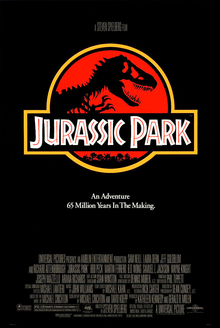
Jurassic Park

I couldn't remember the last time I sat down and watched 1993's Jurassic Park. In my teenage years -- better known as the late 90s -- this movie was on TV seemingly every day on countless channels....and I watched it a ton. But that whole mildly successful sequel, 2015's Jurassic World, threw me right back into the franchise. Sure, the sequel was a lot of mindless, stupid fun, but the original is almost always better. A true classic. A gem. A must-see. Jurassic Park.

Working at a fossil/dig site in Montana, paleontologist Dr. Alan Grant (Sam Neill) and paleobotanist Dr. Ellie Sattler (Laura Dern) are in the midst of unearthing a huge find...when they're interrupted by a helicopter carrying a bazillionaire philanthropist, John Hammond (Richard Attenborough), who has an odd request for them. He's asking them to come examine, experience and see a new theme park he's spent years building, promising quite the paycheck if they come along. They do, flying out to Isla Nubar, an island in the Pacific off the coast of Costa Rica, not sure what they've gotten themselves in to. Along with them is a brilliant mathematician, Dr. Ian Malcolm (Jeff Goldblum), who's equally curious. What exactly is Hammond behind? The entire group is stunned to find that somehow, some way, Hammond and his bioengineering company, InGen, has managed to create real-life dinosaurs and not just one, but many different species. The plan to open the theme park to the public couldn't possibly work, could it? There are just too many things that could go wrong....right?

My goodness. What a freaking movie. It's hard to believe it has been 22 years since the original and by far still the best of the series hit theaters way back in 1993. It's hard to believe for so many reasons. One, it impacted countless movies after. The technology on display here helped rewrite Hollywood with big, broad strokes. What 'Park' did with its computer-generated effects is nothing short of extraordinary, and almost every movie released since featuring any CGI owes a tip of the cap in this direction. The premise itself? Both inventively genius and criminally simplistic in its entertainment value. You can't say that for too many movies now, can you? Twenty-plus years later, it hasn't lost any of its edge, shock value or entertainment, director Steven Spielberg turning in a true classic, and a profoundly important movie in film history.

This 1993 scientifically-charged thriller is based off a novel from author Michael Crichton. The book is a gem, one of those great examples of what a perfect thriller can be. It's by no means a criticism to say that Spielberg's film is one of the few books as good as its source novel. Instead, it is a compliment to both film and novel. It will come as no shock that Hammond's idealistic park has its faults, resulting in an ever-growing body count, but 'Jurassic' does bring together intelligence and creativity with a straightforward survival story. Doesn't get any simpler than that. Run and get away or get eaten by a prehistoric dinosaur brought back from extinction. Oh, the movie looks great, what's real and what's CGI, and a little musical score from composer John Williams is pretty decent too. Maybe you've heard it? Listen HERE, a score and theme that becomes another character in a generally flawless movie.

Who doesn't love dinosaurs? Anyone? Bueller? Exactly. From kids to senior citizens and everyone in between, DINOSAURS ARE AWESOME. AWESOME I TELLS YA! Spielberg, Crichton and a heck of a crew from Industrial Light & Magic bring the dinosaurs to life, most notably the tyrannosaurus rex and the velociraptor, two of nature and history's most terrifying killing machines. The characters are excellent (more on the cast later), but it is the dinosaurs who steal the show. The T-Rex chasing down a fleeing jeep, the raptors hunting in packs, an attack always a blink away, these scenes of dinosaurs on the bloody hunt are scenes to behold, like Jaws on steroids. Spielberg builds the tension up to unbearable levels, water in a plastic cup shaking as a T-Rex approaches from the jungle. The horrifying realization that a raptor can open a door. These quiet, terrifying moments balance out with the hold onto your seat moments in impeccable fashion. Even knowing where these scenes are going, it....is....damn...frightening.

The best movies bring their stories to life, and that's where Jurassic Park succeeds at the highest levels. Whether it's the hint of the power and vicious hunting of a raptor or a chase across a grassy plain with a herd of gallimimus being chased down a T-Rex, these moments are exhilarating to watch as a moviegoer. All those creatures you saw in books, there they are, big as life, on the screen in front of you. Yeah, it produces some freaking scary moments once the dinos are loose, but from the moment we first see the dinosaurs, there is that feeling of being transported back to your childhood reading those books. We're seeing something that has been extinct for at least 65 million years. It sounds so simple to say that, but that is the simple, elegant beauty of this classic movie and its lasting impression, impact and quality. Just a gem.

The stars are the dinosaurs, but the human actors aren't too shabby either. I've always been a Neill fan, mostly because of this part as the pragmatic, highly intelligent Dr. Grant, amazed by what he sees but wary of these scientific developments. His chemistry with Dern's Ellie is spot-on, and the questioning trio is complete with a scene-stealing, never better Jeff Goldblum as questioning mathematician, Ian Malcolm. Throw in Attenborough (in his first acting role) since 1979, and you've got some thump at the top of the order. Also look for Samuel L. Jackson and Wayne Knight as park employees, BD Wong the bioengineer who helped create them, Bob Peck as Muldoon, the game hunter and park's game warden, Martin Ferrero as the $-for-eyes lawyer, and Joseph Mazzello and Ariana Richards as Tim and Lex, Hammond's grandkids visiting the island.

As an old man of 29 watching this -- as opposed to a know it all 12 year old -- I was able to appreciate the kick-ass dinosaurs, but also the intelligence, creativity and general smarts of the movie. I loved Malcolm's non-stop criticism, the destructive nature of the park no matter what it was intended for, leading to his immortal line 'Nature finds a way' in a phenomenal monologue. His chaos theory says that in the end, well, chaos will reign. You can't truly control what doesn't want to be controlled, especially dinosaurs. Creatures from literally millions of years ago, recreated and controlled? No way. As well, the way the dinosaurs are created is beyond ingenious, a credit to Crichton's writing ability and Spielberg's ability to flesh it out (and with some twists along the way about dinosaurs that are supposedly unable to reproduce). Yes, this is a huge action/thriller blockbuster, but it is also an incredibly intelligent and creative film. It works pretty effortlessly on basically every level possible.

Spielberg is an all-time great, a director with classics Jaws, Schindler's List, Saving Private Ryan, and the Indiana Jones movies to his name (among others). This is a film that definitely belongs on that list. A true classic on all levels. This will be a movie that down the road people still look back and marvel at it. Can't say enough about this classic. A gem, and a movie you most definitely should have seen by now.

Jurassic Park (1993): ****/****

Friday, September 14, 2012

Morning Departure

To quote Seinfeld's George Costanza, "Can't I be a shore guy?" I watch movies about the Navy or the Coast Guard and give those gents a lot of credit. Big bodies of open water and me just don't agree, but silly me, I keep watching those movies. So as an individual who just don't like bodies of water, movies that show maritime disasters? Yeah, I'm fairly uncomfortable watching them, like the underrated 1950 movie, Morning Departure.

Several years removed from the end of WWII, Lt. Commander Armstrong (John Mills) has remained in command of the Trojan, a British sub crewed by veterans and youngsters alike. A 12-year veteran of the Navy, Armstrong is feeling pressure from his wife to leave that life behind and settle down with a not so dangerous job, but first he make take the Trojan out on an annual exercise. So with his first officer, Lt. Manson (Nigel Patrick), and crew, Armstrong takes the Trojan out only to strike disaster. The sub accidentally collides with a mine that's been drifting at sea for years and sinks to the ocean floor with 12 survivors. Armstrong holds out hope they will be found, but can he hold his crew together until then?

Based off a stage play, 'Departure' is a prime example of the quality British war movies made in the 15-20 years following the end of World War II. They typically lacked the immense scale and sheer size of many American movies, but they equaled that out with an emotional link. It isn't always impressive to the eye, but more on the personal level. We feel what these survivors are going through. Lt. Cmdr. Armstrong can send four men through one chute to the surface, four men through another, leaving four to sit on the ocean floor waiting to be salvaged in a process that could take a week. Uncomfortable much? The situation on its own is completely uncomfortable. When you're invested in the characters, it is that much worse.

Those individuals are somewhat borrowed from the War Movies Stock Characters list, but that's not necessarily a bad thing. Familiar can be okay when handled right. Mills is one of my favorite actors, and his lead performance as Armstrong -- solid, resolute, a calming effect on his men -- is perfect for the role. Patrick's Lt. Manson is the ladies man, but more importantly, he's a good officer standing at Armstrong's side. A past incident from WWII lingers on his mind, making an impact on their waiting rescue. A young 27-year old Richard Attenborough is given a chance to do his thing and doesn't disappoint playing Snipe, a young seaman with a wandering wife back home. Faced with a perilous situation in the definition of a claustrophobic situation, he finds out who he really is. Also look for Bernard Lee as Commander Gates, the high-ranking officer leading the rescue effort for his possibly lost ship, Kenneth More as his adjutant, Lt. James, and James Hayter as Higgins, the veteran submariner and cook for the Trojan.

Director Roy Ward Baker does a great job here not only setting up the story but also executing it successfully. It's clear early on that this "routine afternoon exercise" will no go smoothly (thanks for making me cynical, Gilligan's Island.), but seeing it happen is no less troubling to watch. Stories of survivors waiting to be rescued can be tricky then because basically we're watching people sit around waiting. It's here though we get to know some of these characters on a more personal level, making their struggles more personal to watch. The rescue effort on the high seas with weather and tides a factor is interesting to watch, building to an ending that I certainly didn't see coming. Moving, highly effective surprise ending at that.

One other thing worth mentioning, 'Departure' was made just months prior to an accident with a British submarine -- the HMS Truculent -- that cost the lives of some 60 people. The film had been made with Navy backing but was still almost withdrawn because of its similarities to the real-life incident. The movie was released though and was the better for it. There's some great footage of the Trojan and all the rescue ships, not to mention some cool underwater footage as some survivors make it to the surface and another scene where a diver heads down to get in contact with the Trojan. Underrated, not hugely well known movie, but an above average one worth seeking out.

Morning Departure <---Movie @ Youtube (1950): ***/****

Saturday, August 4, 2012

The Ship That Died of Shame

The first and most lasting impression I have of British actor/director Richard Attenborough was his part in 1963's The Great Escape. He played a driven, almost obsessed P.O.W. leading a mass escape from a prison camp deep in Germany. A flawed character, but a heroic one nonetheless. As I discover more of Attenborough's parts though, I'm seeing he played far more sinister, much more flawed, and much darker characters, like in 1955's The Ship That Died of Shame.

Having lost his wife during WWII to a bombing raid and struggling to adjust to a post-war life, Bill Randall (George Baker) is waffling along through his day-to-day life. One day at a reunion of former sailors, Bill meets George Hoskins (Attenborough), a former member of his crew on a motorized and heavily armored patrol boat. Hoskins seems to be very well off, and Bill quickly finds out why. He's involved in smuggling actives through the English Channel, and Hoskins is offering him a job. He's even managed to track down their patrol boat -- the 1087 -- so they can use that in their activities. Smuggling some generally innocent items, Bill agrees, but the items start to change, and the boat starts to malfunction. What exactly is going on?

Another case of stumbling across a movie on Netflix, I wasn't sure what to expect of this 1955 British war film from director Basil Dearden. The plot synopsis sounded like a zany story of a boat with a heart who starts to act up against its owners and their actions. As a Disney fan, my first thought was that I stumbled into a prequel of sorts to The Love Bug. How could Herbie the VW Bug in a post-WWII story not be good?!? Well, I either misread it, misinterpreted it, or it was just a crappily written synopsis. It's straight drama, the boat's "objections" to the smuggling kept generally low-key (i.e.; the engine dying, the wheel refusing to turn) while avoiding too much in the way of heavy-handed symbolism or message.

On the whole, 'Ship' is surprisingly good because it manages to stay low-key. The World War II backdrop is a good jumping off point -- including an opening daring raid that introduces the crew of the 1087 -- but the focus is more on how the sailors and soldiers respond after the war and the fighting is done. We see through Bill's eyes that he's floundering along, unsure what to do with himself. Reunited with his old ship and part of its crew, Bill is rejuvenated, given a new lease on life. Hoskins is just the opposite, reveling in the black market business of smuggling. A third crew member, Bertie (Bill Owen), also jumps at the chance to get back to work in any way possible, only starting to question what they're actually doing when the cargo on-board gets far more sinister.

Playing George Hoskins, Attenborough does a great job in one of two starring parts. He isn't an out and out bad guy -- always the shades of gray -- but at the same time, you can't call him a hero either. His intentions are money as he undertakes the smuggling business. The cargo changes, and George, Bill and Bertie all begin to question what exactly all this trouble is worth. Attenborough does a great job portraying him down the middle. We're not always sure of his intentions, and the ride getting there is more fun because of it. Randall  is okay as Bill, a one-note downer performance, while Owen as Bertie is similarly solid if not so memorable as Bertie. The dynamic among the three is more important than the individual here. Bernard Lee is a scene-stealer as a customs officer who cuts across the path of the refurbished 1087 a few times with Roland Culver playing the villainous Major Fordyce, Hoskins' source for jobs. Virginia McKenna has a small part as Helen, Bill's wife.  

There isn't anything particularly new or innovative about 'Ship,' but there's something different I can't quite put my finger on. It is very British in its tension -- underplayed, low key and incredibly subtle whenever possible -- but that not so abrasive, not in your face style works for the better. I wasn't always sure where this one was going, but I ended up liking it after some early struggles. Worth a watch.

The Ship That Died of Shame (1955): ***/****

Friday, September 30, 2011

The League of Gentlemen

One of the many positives I can take away from my Netflix membership is a feature available to me right up there with the DVD queue.  There is an option to 'Save' DVDs, those that are not available currently, the disc has been lost, or Netflix hasn't acquired said DVD yet.  Spending far too many hours cruising through available movies, I've stumbled across my fair share of hidden gems (or so I hope), just waiting for them to become available.  The most recent to make the jump from Saved to Queue was 1960's The League of Gentlemen.

As a sucker for heist films, I fell hook, line and sinker for this British heist flick. Add in the element of a team of specialists working together to pull off an impossible job, and I was officially done for. 'League' was released this summer through the Criterion Collection as part of the Basil Dearden's London Underground Collection, featuring three other movies. The cover art grabbed my attention right away, and once I read who starred in the movie, I couldn't wait to see this one. One of the earlier heist films I've seen, it's an obvious influence on countless movies since, all the while maintaining its own unique British style.

After 25 years serving in the military, Colonel Norman Hyde (Jack Hawkins) is being forcibly retired.  He's devoted his life to the army, and being separated from his wife has little to occupy his time. With nothing but time to spare, he goes about preparing a heist, a bank robbery, an intricate job that will need to be planned down to the tiniest detail.  To help him pull off the robbery, Hyde assembles a group of seven fellow ex-soldiers, including right hand man and wheeler dealer Race (Nigel Patrick). As they plan for the robbery, Hyde insists his crew live by military standards and rules, instilling a mindset in them of efficiency and effectiveness.  With a huge payday almost in their laps, he reasons that nothing can stop an organized, brutally efficient group of highly trained soldiers. But with a job like this, there's always something you can't plan for.  

There is something that's hard to explain about the appeal of a movie like this. It is easy to see its influence on future heist movies from the characters to the set-up to the actual heist to the aftermath. Dearden is calm behind the camera, and it rubs off on the movie. It runs 116 minutes and is a patient -- some critics say boring -- story that slowly builds tension. It is filmed in black and white, reflecting a general darkness and cynicism in the story. There are some odd moments of attempted humor that fall short, but some lines work because they do come out of left field. When asked if his wife is dead, Hawkins' Hyde replies "No, I regret to say the bitch is still going strong." It's 1960. How great a line is that?  An easy-going confidence is an inherent part of the story, helping out the slower parts because you know it's heading in the right direction.

That general darkness and cynicism comes across best in the casting and the characters. Would it have been nice to get some more personal development, some background on these men? Yes, but the importance is the team aspect, all of them working together, not individually.  Hawkins and Patrick just work smoothly together, their scenes together flowing with an equal give and take. The catch with Hawkins' team is that they're all ex-soldiers cashiered out of the army for one thing or another. The group includes Richard Attenborough as Levy, the radio expert, Roger Livesey as Mycroft, a con man who works as a priest, Bryan Forbes as Porthill, a possible executioner of prisoners, Kieron Moore as Stevens, a Fascist, Terence Alexander as Rupert, a money launderer, and Norman Bird as Weaver, the former alcoholic and demolitions expert. With the exception of Hawkins, none of the characters are particularly likable, but I still found myself hoping they pull off the job. Go figure.

Like so many quality heist movies before and since, 'League' succeeds because other than a few vague details we don't know how the actual robbery is going to be pulled off.  Relative to some more modern heist flicks, this one is pretty simple, although it does depend on split second timing, and a lot of things going right.  The sequence is Rififi-esque, around 15 minutes in length where little is said, just the action and build-up and musical score moving things along.  You're waiting for something to go wrong, anything at all, especially after almost 90 minutes of that slow-burning adrenaline.

Where the movie fails somewhat is the end. It is still 1960, and the whole 'crime doesn't pay' angle is one that movies often played up. It's not how something will get messed up, but when it will get messed up. If you can call it one, the twist is somewhat disappointing, partially because it was hinted at earlier, and also because it wastes a ton of potential. It could have been a classic ending, one that would have been true to the movie's dark roots.  As is now, it is still far from a happy ending, but the movie ends on a bit of a whimper if you ask me.  That said, I still very much enjoyed the movie. Little known but worth seeking out.

Also, keep your eye out for Patrick Wymark as a sugar daddy, Nigel Green as angry man on a date, David Lodge in a quick but funny supporting part, and Oliver Reed as a gay actor. Three odd, but funny parts considering the caliber of actor and the stars they would become. 

The League of Gentlemen <---trailer (1960): ***/****

Saturday, September 17, 2011

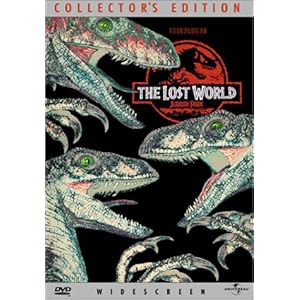
The Lost World: Jurassic Park

In a career that has spanned five decades since he shot to stardom in the 1970s, director Steven Spielberg has quite the impressive filmography under his belt with a handful of classics and a few more not quite but close classics. Easily one of his best is 1993's Jurassic Park, a great film that is as good now in 2011 as it was 18 years ago. It opened the door for all sorts of new movies with new technology.  It's exciting, action-packed, and unique.

Of course, then there's the 1997 sequel, The Lost World: Jurassic Park which isn't as bad as some critics out to be but at the same time is nowhere near as good as it could/should have been. It's unfair to peg this movie as the one that opened the floodgates, but it's certainly one of the first series/franchises that turned a great stand-alone movie into unnecessary sequel one after another. That's my biggest issue with so many franchises. Harry Potter? Those sequels needed to be made to finish out the story. Jurassic Park? The first film is pretty much perfect as it is, and didn't need sequels.  But you wouldn't be reading this is someone didn't want to make piles of money so here we go.

It's been four years since the disaster at Isla Nuba and mathematician Dr. Ian Malcolm (Jeff Goldblum) is still trying to put the experience behind him. He is approached by InGen head and creator of Jurassic Park John Hammond (Richard Attenborough) with a proposition. There were actually two islands where dinosaurs lived, and he wants Malcolm and a small team to go to the second island and investigate, see how the creatures are living without human interference. Malcolm refuses...briefly, until he finds out his girlfriend, Sarah (Julianne Moore), a geologist, is already on the island so he agrees to go along. Finding Sarah proves to be the easy part as a financially struggling InGen sends an expedition to the island at the same time. Their objective? Capture dinosaurs so they can be exhibited for a world-wide audience. Malcolm, Sarah and the little team are caught in the middle as T-Rex, velociraptors and more are on the hunt.

I've long been a fan of Michael Crichton's novels, but this is one of the few I haven't read, mostly because I'm not a huge fan of the movie to begin with. If I didn't like the movie much, could the book save it at all? Eh, maybe down the road I'll get to it. My main issue with the movie though is that it is basically a carbon copy of the first movie, but without the energy or excitement. It is the definition of an unnecessary sequel. The script is bad, full of laughable one-liners and equally laughable scenarios, and the action/chases don't know when to stop, an orgy of adrenaline and drama that goes overboard whenever it gets the chance. If you're trying to repeat success, add something to it, don't just settle for the status quo.

What saves this from being a complete waste of time is what else? Surprise, surprise...the dinosaurs, and more specifically the dinosaurs eating people.  You really just can't go wrong with that formula.  The surprise factor of the first movie -- seeing dinosaurs, even if they are CGI -- has worn off some, but the little kid in you can't help but smile when a dinosaur (check that, any dinosaur) comes on-screen. Then think of a T-Rex and its awesomeness, and then a pack of raptors working together...yeah, definitely can't go wrong there. There are characters around who are meant to be dino-bait, and Spielberg certainly finds some unique ways to kill the baddies.  So throw out the action scenes that drag on end into tedium, you've still got a whole lot of badass dinosaurs killing people. Good stuff. Oh, and throw in John Williams' epic, sweeping and iconic score for good measure.

The more I see of Goldblum, the more I suspect he's not acting. He's just playing himself. His Dr. Malcolm isn't an ideal choice to lead a movie, but his character is still pretty cool.  Moore plays Sarah, the girlfriend who -- no disrespect to Moore, just the character -- could have been played by anyone.  She has to run around with Malcolm and look worried.  Oh wait, that's everyone, cardboard cutouts of characters. My bad.  Vince Vaughn and Richard Schiff are good as the other member of Ian and Sarah's team while screen veteran Pete Postlethwaite is a scene-stealer as Roland Tembo, a big game hunter leading InGen's expedition, his desire to bag a T-rex driving him into danger. Look for Arliss Howard and Peter Stormare as two bad guys you just know will meet a nasty fate as well with Attenborough briefly making an appearance as Hammond, still cool and clueless as ever.

There are just elements of unexplained weirdness here that make you question 'Really? That's the best you got?' The biggie for me has always been Malcolm's daughter, Kelly (Vanessa Lee Chester), who secretly travels with dear old Dad to the island, not realizing the danger she's put herself in. You'll notice if you look at her IMDB page that she is an African American actress. Not a racist comment, just a comment because the movie never addresses this. Is she adopted? Did Malcolm steal her from a black family? Mostly though beyond just a weird race angle is that her character is annoying and doesn't serve a purpose. Malcolm's already worried about Sarah, and then you throw in another reason. That's great. She also takes out a raptor via a gymnastics act. That ranks high on the list of all-time stupidest movie scenes ever.

The movie on the whole is a mixed bag. Certain scenes are just bad, and action scenes -- like two T-rex's attacking a camper -- just go on too long, not knowing when to pull the plug. If this was any old dinosaur movie, it'd be pretty good in a 'so bad it's good' fashion. But it isn't, following one of the all-time greats, Jurassic Park. Very watchable and generally a pretty dumb movie, but you can do worse.

The Lost World: Jurassic Park <---trailer (1997): ** 1/2 /****   

Wednesday, August 17, 2011

The Flight of the Phoenix (1965)

In the age of unnecessary remakes, I'm usually first in line opposing the new movies. If a movie in its original form was lacking something and with a remake could be significantly improved, then so be it.  Really though, how rarely does that happen?  A little less than two years ago, I reviewed the 2004 version of Flight of the Phoenix (a guilty pleasure that I love), a remake of the original, 1965's The Flight of the Phoenix. Even as I wrote that first review, I couldn't believe I was writing I enjoyed the new version more...but it's still true.

It is impossible to review a movie combination of an original and a remake without comparing the two so let's get that out of the way early.  The 1965 original is held in high regard thanks to its directing, survival story, and all-star cast.  As for the 2004 remake, well....it's more fun.  It is the most unnecessary of remakes, dumbing down the original with a thinner story that revolves more around action and adventure than pure survival.  I still liked it though a lot.  The problem with the original is that it just isn't as fun.  A better movie? Oh, definitely, but it does not have that re-watchable aspect that I'm always looking for in movies.

Flying a cargo plane headed to Bhengazi loaded with passengers and cargo, veteran pilot Frank Towns (James Stewart) and navigator Lew Moran (Richard Attenborough) are forced to detour when they fly into an epic sandstorm. The storm eventually knocks out both their engines, forcing them to crash land in the desert. With about a dozen survivors, survival mode kicks in with a dwindling supply of water and pressed dates as the only food around. Towns, Moran and the survivors sit back and wait, hoping a search plane or some form of rescue will save them. As the days go by though, all the men question what their fates will be. That is until a German passenger, Heinrich Dorfman (Hardy Kruger), steps forward with an idea. Why not use the wreckage from the downed plane to build a new smaller plane? Could it somehow work?

From director Robert Aldrich comes a tough, hard-edged and well-told story with no frills or distractions. This is a story about surviving in the harshest of conditions with nothing else to focus on.  These survivors of the plane crash can either sit back and die waiting to be rescued, or they can work together and try to pull off this seemingly impossible scheme. Aldrich films in the California desert (a decent stand-in for the Sahara), giving his movie a wide open, vacant feel to it.  Over the course of the movie (a sometimes long 141 minutes), we see the effects of the desert on the survivors, their skin looking like it is being torn apart by the winds and lack of water. You feel like you're there with them, going through the same things they are in a struggle to survive.

The best thing going for Aldrich's survival story is the chemistry among the cast.  Nowhere is that more evident than between James Stewart and Hardy Kruger.  Stewart's Frank Towns has been flying for decades, thousands and maybe millions of miles under his belt.  He's struggling with the guilt of knowing that some of his passengers died in the crash -- he blames himself -- and now has to deal with a primadonna in Kruger's Dorfman who wants everything done exactly as he has stated. A battle of wills ensues, both men fighting for control, their pride and vanity getting in the way of working together and surviving another day. Their scenes together bristle with tension and intensity, providing some much needed outside drama as opposed to just battling the conditions.

It is an Aldrich movie, and one of his trademarks as a director was being able to work with all-star ensemble casts.  In a career of movies with impressive casts, this might be his best.  Stewart and Kruger are great as the opposing forces with Attenborough delivering one of his all-time best performances as Moran, the second-rate navigator who's always struggled with drinking too much. The survivors of the crash include Captain Harris (Peter Finch), a long-time prim and proper, very British officer, and his not so loyal sergeant, Watson (Ronald Fraser), Dr. Renaud (Christian Marquand), Standish (Dan Duryea), a company accountant, and a group of recently relieved oil drillers including Ernest Borgnine, Ian Bannen, and George Kennedy. Star power much? Like any ensemble, all involved get a chance to shine, none disappointing here at all. Finch stands out as does Marquand, Borgnine and Bannen.

Now as a 26-year old moviegoer and film fan, I often get lumped in with a lowest common denominator crowd. I don't like reading subtitles, hate foreign movies, and only go to see new movies with nudity and/or explosions.  I resent the judgment most times, but I say that as a forewarning. It takes a lot for me to say this, but 'Phoenix' is a downright boring movie at times. The focus is on survival and the interactions among these men, but watching the survivors put together a plane out of wreckage is just not a visually stimulating thing to watch. In the night, they work. During the day, they sleep. It doesn't ruin the movie. It just slows it down at times to an incredibly slow pace.

By all means, see both movies and compare. The original is the better made, more professional and well-handled movie, but I still enjoy the dumber, more action-packed remake more.

The Flight of the Phoenix <---trailer (1965): ** 1/2 /****

Wednesday, June 1, 2011

The Great Escape

I have two favorite movies, neither of which I'm able to pick one over the other.  I love them both, and all other movies come after it, first is 1960's The Alamo which I've reviewed before and then there's 1963's The Great Escape. Introduced to it at a young age when I showed an interest in history, I've probably seen it 25 or 30 times straight through, and another 75 or 100 catching bits and pieces. For me, it is that rare perfect movie. Great story, impressive cast, exciting action, and one of the best soundtracks ever. You can't ask for much more.

In World War II, both the Allies and Axis forces had to deal with how to handle prisoners of wars. In Germany, the Luftwaffe, the German Air Force, was placed in charge of these Allied prisoners, placing them in P.O.W. camps all over their occupied territory. These prisoners -- as was their sworn duty -- tried countless escapes over the length of the war in typically small groups, sometimes getting as many as a dozen out. But one true story set the bar for heroism and courage among the prisoners, the true story of 76 prisoners escaping Stalag Luft III in March 1944. Literally hundreds of prisoners were involved in the effort as the escape even had an impact on D-Day some three months later.

It's 1943, and a new prison camp has been built. The German Luftwaffe has taken the worst prisoners from all their camps and thrown them in this new camp that features all the security aspects they've learned from previous camps.  In this "perfect" camp, the Germans (Hannes Messemer is the commandant) intend to watch these men very carefully. Leading the prisoners is Roger Bartlett (Richard Attenborough), dubbed 'Big X' for his leadership at the top of the 'X Organization,' a team of prisoners working together to bust out as many captured soldiers as they can. Bartlett has bigger plans though this time around. Instead of just getting two or three prisoners out, he intends to get 250 out of the camp with a large-scale plan that includes three extremely long tunnels under the barbed-wire fence. The plan seems impossible, but the prisoners go to work, slowly working their way toward escape.

Do you know the line 'They don't make them like they used to?' This movie applies. Director John Sturges (one of my favorites and an underrated filmmaker overall) turns in his all-time best film, one that stands at or near the top in the lexicon of World War II movies. It is based in fact, sticking to the details and truths in the story, without getting bogged down.  There is action, humor (never overplayed, just natural humor arising from the situation), and characters you love and are generally rooting for. Composer Elmer Bernstein turns in a score that is one of the greats, especially the main theme, listen HERE. Bernstein's score both drives the story as needed and keeps it grounded in the quieter, emotional scenes (including one where a tunnel is discovered and its tragic consequences).  Sturges filmed in Germany -- as his assistant said, 'Germany looks like Germany.' An entire camp was built, an exact duplicate of the actual camp, bringing this 1963 epic up another notch in terms of realism and authenticity.

Sturges' movies were famous for their male-dominated ensemble casts, but this may be his most impressive. Start with Steve McQueen as Hilts, the motorcycle-riding 'Cooler King,' the role that shot him to international stardom. Then there's James Garner as Hendley, the scrounger, and Attenborough as Bartlett, the prisoner's top man, a brilliant mind who comes up with this improbable plan. Not bad, huh? Oh yeah, there's also James Donald as Ramsey, the senior British officer, Charles Bronson and John Leyton as Danny and Willie, the tunnel kings, James Coburn as Sedgwick, the manufacturer, Donald Pleasence as Blythe, the forger, David McCallum as Ashley-Pitt, "dispersal," and Gordon Jackson as MacDonald, the intelligence officer. Other prisoners include Nigel Stock, Jud Taylor and Angus Lennie in a small but essential part as Ives, Hilt's progressively wire-happy partner. A more impressive cast could be impossible to assemble.

What is amazing is that even with all those stars -- some on the rise, some already established -- is that they all register, they all make a lasting impression in a positive way. More on McQueen later, but Attenborough delivers a career-best as Big X, the driven even obsessed leader who wants to take the war back to the Germans, not sitting out the war comfortably as his captors intend. Garner's Hendley bonds with Pleasence's Blythe in some of the movie's most touching scenes, two very different people forming a friendship. Bronson and Leyton as the tunnel kings certainly make an impression, carving three tunnels out of the Earth 30 feet below the surface. Bronson is at his best, a Polish flyer with claustrophobia who hides his fear of small, enclosed spaces and digs. Coburn doesn't get a ton to do compared to the others, but is his usual, laconic self. There is not a weakness in the cast from top to bottom.

When movie fans think of The Great Escape, they usually go right to Steve McQueen, a rising star who got his crack at the big time here and didn't disappoint.  His Capt. Virgil Hilts is one of his most iconic roles, the loner, trouble-making American prisoner who attempts escape attempt after attempt.  What's funny is that his character basically disappears for vast stretches of the movie, only to reappear after a stint in the cooler and steal every scene he is in. This is McQueen at his laid back, scene-stealing best. With all the notable actor's actors around him, he is the unquestioned star thanks in great part to the finale, a motorcycle chase across Germany with his captors in hot pursuit. It is one of the greatest chases sequences ever, caped with one of the most impressive stunts ever, a 7-foot jump by stunt man Bud Ekins over a high-strung barbed-wire fence. McQueen is my favorite, but this is always his best to me.

With a final run-time of 2 hours and 53 minutes, Sturges' true story doesn't have to rush along at a lightning pace...but does anyway. The first 105 minutes or so focus exclusively on the escape attempt, putting all the little details together that need to happen. The first and biggest of course is the digging of the tunnels, 30 feet down and over 300 feet straight out. A track is built to transport prisoners/diggers, and wooden boards are needed to shore up the entire length of the tunnel. Up above, forgers create documents, tailors make clothes, Intelligence gathers information, all part of an elaborate system of security and watchmen to make sure nothing is discovered by their ever-vigilant German guards. It would have been easy for this movie to get bogged down in these details, but The Great Escape revels in them, making the mundane and possibly boring, exciting at a breakneck pace.

It is a movie called 'The Great Escape' though, and it is at its most exciting once the prisoners do escape, 76 of them in the dead of night spread out all over the German countryside. The escape attempt covers the last hour of the movie, an incredible extended sequence that is hard to top. It is almost entirely dialogue free, Bernstein's score playing over the action the whole way. Finally free of their camp, the prisoners make their efforts to hopefully reach freedom, some by train, some by bikes, others by planes, and in Hilts' case, a stolen German motorcycle.  Sturges was an action master, and this may be his tour de force sequence.

I could go on and on with this movie, and I've already sort of done so. My head is full of little tidbits of information that I've picked up over the course of repeated viewings.  Above all else through the drama, the facts, and the action is that Sturges gets the tone right from Paul Brickhill's source novel, and most importantly, the true story it is based on. These men did the impossible in an impossible situation. Knowing their chances of escape back to freedom were slim, they plodded on when they could have just as easily quit. If you didn't know and just read the details -- check out the Wikipedia entry HERE for more details -- you would say there's no way this happened, but somehow, some way, it did. The ending hits you square in the stomach as it should, but the movie ends on a positive note; McQueen's Hilts once again in the cooler, bouncing his baseball off the wall.  You may capture him again, but you'll never stop him from trying.

A perfect movie, one of the best around, and one of my two favorite movies.

The Great Escape <---trailer (1963): ****/****

Sunday, April 17, 2011

In Which We Serve

When I hear British director David Lean's name, I typically think of one thing and one thing only; epics.  Huge, monstrous movies like Lawrence of Arabia, Doctor Zhivago, The Bridge on the River Kwai. Basically, everything that is good and right about movies when handled correctly with the right crew, cast and story. Even one of the most respected directors of all-time has to start somewhere though, right? You don't jump right in and get an epic movie handed to you. Still, for a first movie, 1942's In Which We Serve is quite the first impression.

Making his directorial debut, Lean shares the director's chair with British writer/actor Noel Coward who also stars in the movie. I try my best to keep my reviews as different as possible without repeating topics, but I can't help it with this one. It pertains to the time the movie was released, in this case a WWII movie hitting theaters during WWII. We're not talking late in the war either when the end result had all but been decided. We're talking 1942 when the war was very much still up in the balance. We never actually see any German soldiers/sailors/pilots as the story focuses exclusively on the British armed forces, specifically the Navy. The tone though is certainly one meant to inspire although to Lean and Coward's credit, it isn't straight propaganda. Instead, it's a story of people rising up and working together in one of history's darkest chapters.

It's the middle of WWII and a British destroyer, the HMS Torrin, is sailing through the Mediterranean in support of the invasion of Crete. Commanded by Captain Kinross (Coward), the Torrin is attacked by German dive bombers and the crew is forced to abandon ship. In all the chaos, a small group of survivors manage to get off the ship -- including Kinross -- and cling together on a small life raft, hoping that a rescue effort is coming to save them. As they await their hopeful rescue, they look back on how they got to this point, reflecting on the ship being made and the coming years as WWII broke out. They think back, remembering their families, their friends, and their stories, all the while hoping time won't run out on them.

Telling the story of an HMS destroyer and her 300-man crew, 'Serve' has a cross-section of actors filling out the ranks so we get to know all sides of the story, not just the captain and the officers or the lowly sailors.  Coward's Captain is the stiff upper lip commander, unshakable in battle and a courageous leader. He addresses his men three different times, the third and final time being the most moving. Then there's Seaman Shorty Blake (John Mills), a young sailor with an expecting wife back home.  He's the lower/middle class sailor, the representative of the crew more or less. There's also Chief Petty Officer Hardy (Bernard Miles), an intelligent if somewhat clueless officer who you nonetheless come to like. Also look for Richard Attenborough in his first film, an uncredited but worthwhile role, and James Donald as the Torrin's on-board doctor.

It's best to think of this as two movies. First, the plight of the survivors which is handled briefly but fairly. How much can you show of 10 or 11 men clinging to a life raft without the proceedings getting tedious?  Second, the flashbacks of Coward, Mills, Miles, and even Attenborough briefly. While those too are tedious at times (how many times can we see sailors say goodbye to their wives and still have it mean something?), they end up being worthwhile. Stories that deal with the home front are few and far between, especially anything documenting London and England during the massive German bombings.  Getting to these scenes can be a slow-go at times, but the wait is worth it. Worthwhile parts for the women left behind include Celia Johnson as Mrs. Kinross, the captain's wife, Joyce Carey as Kath Hardy, the doting but tough wife of the petty officer, Kay Walsh as Freda, Blake's fiance and eventually his wife, and Kathleen Harrison as Mrs. Blake, Shorty's always-worrying mother.

Whether it was released in the 1940s when audiences needed a positive jolt or 30 years later in the 1970s when audiences were more cynical, a war movie has to leave some impression on you to be truly effective. Coward's last address of his men is well-handled, but two other scenes hit me. SPOILERS STOP READING SPOILERS Blake finds out that Hardy's wife and mother-in-law were killed in a bombing and has to deliver the news, a poignant scene showing two men struggling with how exactly to handle the situation. Second, after the Torrin sinks, Blake's mother receives a telegram saying her son is alive. Her genuine relief, her screaming to tell his wife hit me right in the gut in terms of emotional impact. So that's what I'll take away from this movie which does have its dry spots. A moving story that could have been better, but still worthwhile.

In Which We Serve <---full movie (1942): ***/****

Sunday, September 12, 2010

Dunkirk

Nothing personal here, but just in case, I'm sorry to any Brits reading this.  I didn't intend to do multiple reviews so closely about British military disasters, but here goes.  After reviewing Zulu Dawn a few weeks back, we jump ahead in time to the early part of WWII when those cocky Brits were up to it again.  There really needs to be a sarcasm font is all I can think of as I write this.  One part epic disaster and one part heroism to the nth degree, the battle of Dunkirk was a history changer and if it had ended differently, could have been the final straw in Adolf Hitler completely taking over Europe.  In movie form, the focus is more on the heroism in 1958's aptly titled Dunkirk.

It's late spring in 1940, and English and French forces are perched on the Belgium border across from the waiting German armies.  No one seems overly concerned at the build-up of German troops, and then the attack comes, waves of soldiers pushing the English and French back across France.  The troops in mass retreat are just trying to stay one step ahead of the Germans on their heels.  As the attack continues and the lines continue to collapse, a small sector near the port city of Dunkirk is all that remains for the Allied forces.  Their backs against the sea, hundreds of thousands of troops wait for their ultimate destruction while back in England the home front attempts to organize a rescue.  Hundreds of non-military boat and ship owners sail across the English Channel hoping to rescue as many troops as possible, but can they be rescued in time before the Germans overwhelm them?

Just on pure bravery and heroism, this is one of the most amazing stories to come out of WWII.  Thousands of Allied soldiers were on the verge of being wiped out, and the home front organized this massive effort to save those troops.  The beaches around Dunkirk were packed with troops and therefore wide open to air attacks by the German Luftwaffe.  The ships coming to save them?  Even more wide open and completely exposed to attack.  Casualties were enormous among these heroic Englishmen and over 70 years later it is a story that is hard to comprehend in the simplicity of the bravery involved.  Odds against them, these men and women risked it all to save others.  If there's a better way to put it, I can't think of it.

This disastrous WWII campaign is told from two different perspectives.  One is a British corporal, Cpl. Tubby Bins (John Mills), who finds himself in charge of a motley squad of British soldiers after the highest ranking officer around is killed.  Two is the effort from private British citizens back in England organizing the rescue effort, seen through the eyes of a British newspaper reporter (Bernard Lee) and a factory owner (Richard Attenborough) who must balance out his fears with his desire to do what's right.  It's a great balance because one or the other would have been effective, but combining the two gives a much bigger perspective of the scale involved.  Thousands of soldiers were lost in the shuffle of the retreat, but seeing one man and a handful of soldiers puts it all in a very personal light.

I grew up watching John Mills as Father Robinson in Swiss Family Robinson so I've always been a fan.  But the more I see him in dramatic roles, the more I like him as an actor, not just a great memory from growing up.  His Corporal Bins is another great character for him.  Slight in stature, Mills is no super-soldier gunning down legions of German troops.  He's a regular guy thrust into an unlikely leadership position.  Robert Urquhart plays Pvt. Mike along with Ray Jackson and Meredith Edwards as some of the soldiers under Bin's command.  The 'lost patrol' aspect of the story was my favorite part as Bins' squad makes their way back across France dodging Luftwaffe strafes and roaming German patrols.

Still strong but not quite as strong is the build-up to the sea rescue.  Lee and Attenborough balance each other out, Lee willingly to volunteer to commit his small boat to the effort, Attenborough not so sure about committing so much.  Now this is a British-made movie about a British disaster so you can figure out that in the end everyone gets a chance to redeem themselves.  That said, the performances from these two class-act actors are top notch.  Subtle in their effectiveness without any big theatrics, both characters let their actions speak louder than any words could.

What was most impressive was the depiction of the Dunkirk beaches packed to the gills with waiting British troops.  Thousands of extras were used to show just how crowded this long stretch of beach really was.  The problem is that the last 30 or 40 minutes get a little tedious in showing how hopeless the situation is.  At a certain point it's just beating us over the head.  The end is an uplifting one though, especially knowing that the heroism displayed by soldier and civilian alike ends up helping turn the tide of war.  Also worth pointing out, Malcolm Arnold's musical score seems like a rehash of his 'River Kwai' score.  Minor complaint in an above average look at a military disaster that could have been a debacle.

Dunkirk <---trailer (1958): ***/****

Friday, July 9, 2010

10 Rillington Place

Growing up, I was introduced to a lot of movies that I love to this day.  One of those is The Great Escape -- I'll get around to reviewing it sooner or later -- and it remains my favorite movie some years later.  In a cast full of stars, one of the best was Richard Attenborough as Big X, the leader of the POW escape.  So from there on in, any movie with Attenborough in it, I can't help but see him as that character.  Usually it wears off at some point during the movie because he was too good an actor to be typecast, but it's always there in the back of my head.

So heroic British prisoner of war as the base, and how about a British serial killer as an adjustment?  That's 1971's 10 Rillington Place, a drama based on the life of British serial killer John Reginald Christie with Attenborough playing Christie.  It's a remarkable part for the British actor that earned him tons of critical praise.  Playing a historical figure is one thing on the intimidation meter as an actor because there's little room for personal interpretation. But what about playing a killer?  There's a certain amount of respect for playing an Abe Lincoln or George Patton.  But a killer?  Directed by Richard Fleischer, 'Place' doesn't try to present Christie in any sort of positive light -- thankfully -- and just tells the story as accurately as possible.

It's 1944 London and John Reginald Christie (Attenborough) welcomes a woman into his house to treat her for an ailment.  He kills her and buries her in the backyard of his home, an apartment building at 10 Rillington Place.  Fast forward five years to 1949 and  Christie welcomes a young couple who are moving into the building.  Timothy Evans (John Hurt) and his wife Beryl (Judy Geeson) have an infant daughter and are struggling to make ends meet. Worse news for Beryl, she's pregnant and there's no way the young couple can afford a second child.  With some medical background, Christie offers to help perform an abortion, but the Evans' have no idea what the landlord is up to.

Beyond the acting, Fleischer films a movie light on style and heavy on characterization and doom and gloom.  The movie was actually filmed at 10 Rillington Place -- where Christie is believed to have murdered as many as six women -- and gives the story a real sense of macabre and death.  Plainly put, it's creepy knowing these things actually happened in the locations we're watching.  The London as presented is dark, gloomy and plain with no sense of life or color at all on the streets or in the dank, little apartments.  All smart choices in putting this together to make a stark, depressing and unsettling movie.

On pure acting skill, this has to be one of Attenborough's best parts.  Reading through some Christie bio information, it looks like he clearly did his homework on the man's behaviors, speech patterns and mannerisms to bring this serial killer to life.  He kills his victims with a variety of carbon monoxide that basically knocks them unconscious and then strangles them.  We only see this in any sort of detail once, but that's plenty. Bringing this character to life though, we're not taking Jason or Freddy Krueger.  He's quiet, keeps to himself, typically very polite, but all these things hide moments where his true self comes out.  Those scenes are incredibly unsettling to watch, especially a prolonged abortion procedure.  On top of that, it doesn't hurt that he physically resembles the real-life Christie. Safe to say, this is unlike any other Attenborough role I've come across.

Along with Attenborough, the screen is dominated by Hurt and Geeson in a smaller cast.  Hurt's Timothy Evans is an illiterate factory worker prone to exaggeration in his stories and a little too much drinking.  His character isn't exactly sympathetic, but compared to Christie, this guy's a lamb.  His stupidity in not seeing what's happening around him is frustrating because you want him to figure it all out, but Christie just keeps pulling the strings and pushing his buttons to get him to do what he wants.  Geeson is the sweet young wife trying to make the best of an awkward situation.  She takes the best possible alternative -- which isn't all that great to begin with.  Both parts are well-acted and could have easily been overshadowed by Attenborough's performance, but Hurt and Geeson hold their own.

There's something about the movie I'm struggling to put my finger on, but it's definitely a positive.  As near as I can figure, it's the honesty in which the true story is told.  A majority of the story focuses on this one specific incident between Christie and the Evans with the aftermath rushed to a certain extent.  It's not bad rushed though, just fast paced.  The ending is a blink and you'll miss it.  Overall, the storytelling is a highpoint just in terms of its pacing, honesty and briskness.  It doesn't try to whitewash anything, and the movie is that much better for it.

10 Rillington Place <---TCM clips (1971): ***/****