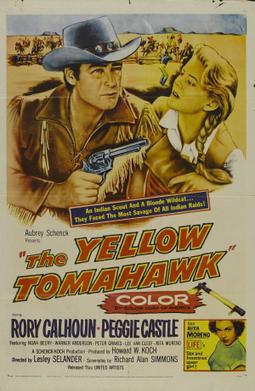
Every so often, I just need a good, old-fashioned B-western. It doesn't have to be great or even particularly good, but I need that dose of WESTERN. So while 1954's The Yellow Tomahawk is pretty run-of-the-mill, I liked it. Entertaining, surprisingly violent and with a cool cast, it's a solid western that's worth a watch.
Riding out of the wilderness, frontiersman Adam Reed (Rory Calhoun) finds himself being chased by Cheyenne warriors. He's cornered and looks to be in trouble until his blood brother, Cheyenne warrior Fire Knife (Lee Van Cleef), steps in, all of it a show to arrange a meeting. Fire Knife has a warning and a message he would like delivered. The U.S. cavalry is building a new fort nearby with a commander, Major Ives (Warner Anderson), who lead a bloody massacre months prior against a peaceful Indian camp. His reputation has preceded him with Fire Knife passing his message along to Reed. What is it? Tell Ives to stop building the fort and risk an attack that will wipe out the partially-assembled fort. Reed rides down to the fort and passes it along but Ives isn't having it, doubting the truth of the threat. What awaits for the small garrison and the soldiers' families who have traveled west? Reed sees the writing on the wall but no one else seems to believe what's coming.
Nothing flashy here, nothing too crazy. From director Lesley Selander, 'Tomahawk' is nonetheless an entertaining, pretty solid western that isn't limited by its budget or limitations. A longtime director in film and television, Selander is a pro at spinning a movie like this. So often, westerns are town-bound. limited by a fake-looking set that never allows the story to breathe. This particular entry does not have that problem with virtually no sets! The cavalry building a fort allows for no sets other than a couple half-assembled walls. It was shot on-location at the Kanab Movie Ranch and Fort, giving the story a cool, intimidating, scary sense of the openness of the desert and wilderness. You're all alone out there, and with the threat of an imminent Indian attack, there's no place to hide.
A star of B-westerns who often played supporting roles in bigger budget pictures, Calhoun is a favorite of mine. He plays a memorable, roguish good guy, a solid anti-hero with an edge who is quite comfortable in the western and in the saddle. His Adam Reed character, a frontiersman and scout of sorts, is interesting because of his hinted-at backstory. It's never told in detail, but it appears he lived with the Cheyenne at some point, his brotherhood and family connection with a young Lee Van Cleef as warrior Fire Knife. If there was a little more time to breathe ('Tomahawk' is a very pleasant 82 minutes), maybe we could have learned some more about out hero. Still, what's there is pretty cool.
No A-listers on-hand here, but that doesn't detract from an overall good cast. Peggie Castle (Lily Merrill on TV's Lawman) is the necessary love interest, a beautiful woman visiting her fiance, a cavalry officer, at the budding fort. She's no damsel in distress either, a welcome addition to the genre. Noah Beery Jr. has some stereotypical fun as Tonio, an ay-ay-ay Mexican horse wrangler with a beautiful Indian girl, Honey Bear (Rita Moreno), who follows him around. As the stupidly blind officer, Major Ives, Warner Anderson is frighteningly uncomfortable, portraying an officer that was probably all too familiar in the wild west. Also look for Peter Graves (gold prospector) and Adam Williams and James Best (cavalry troopers) in key supporting parts.
One good western after another followed a simple formula. Introduce a disparate group of survivors and individuals, throw them into a survival situation with an ever-present Indian war party, and see who makes it out. After an intense, tension-building first 30 minutes or so, that's what 'Tomahawk' uses as a base. We follow a small group of survivors of an Indian attack trying to get across the desert to safety. The action itself is pretty intense in itself, especially the Cheyenne attack on the hastily-built and poorly-defended fort. It's not hugely graphic -- it is still 1954 after all -- but the violence is incredibly rough and if it had been shown on-screen, whoo, we're talking one nasty picture. The ending too is pretty honest for a mid-1950's western, something that surprised me, caught me off-guard a little bit.
A solid western overall. Worth checking out.
The Yellow Tomahawk (1954): ** 1/2 /****
The Sons of Katie Elder
"First, we reunite, then find Ma and Pa's killer...then read some reviews."
Showing posts with label Rory Calhoun. Show all posts
Tuesday, January 12, 2016
Sunday, April 28, 2013
Raw Edge
When I think of westerns, I think of isolated windswept towns, lonely deserts, and far-off mountain ranges. Thank the spaghetti western genre for that one. It's always nice to see a change of pace though, like 1956's Raw Edge, a quasi-western based in 1840s Oregon.
It's 1842 in the wild Oregon territory, and Tex Kirby (Rory Calhoun) is looking to meet up with his brother (John Gavin) and work his ranch together. Upon arriving though, Tex finds his brother hung by a lynch mob, his Indian wife, Paca (Mara Corday), missing, and the ranch in ruins. Who's behind it? A local ranch owner, Montgomery (Herbert Rudley), rules the territory with an iron fist including a bizarre rule concerning any single women in the area. Supposedly Tex's brother was in his way, but now he's looking for answers. Tex finds himself in a situation deeper and darker than he expected, especially with Montgomery's wife, Hannah (Yvonne De Carlo), becoming an issue too. All around the valley though, an Indian war party threatens to attack, smoke signals hanging in the air.
This is not the typical desert western, that's a good thing. Not only is it set in Oregon, it is based in 1840s Oregon long before the typical wild west movie (usually after the Civil War). It was actually filmed in the San Bernardino National Forest, a more than worthy stand-in as a location shoot. Similar to the desert westerns, there's an isolated claustrophobia to the story. One town dots the territory, then there's Montgomery's forted-up, walled ranch, and last his mountain camp. The forest and woods hide all sorts of trouble, and the San Bernardino forest is a beautiful backdrop to the 1840s story.
From director John Sherwood, 'Raw' has a surprisingly dark story. It starts with a truly odd opening monologue that claims to be historically accurate, but who knows for sure? It says that in 1840s Oregon a man -- supposedly Montgomery -- ruled the region and mandated that single women -- A-N-Y single woman -- can be scooped up by any man who wants to take her as his wife. It provides an interesting subplot with Corday's Paca, a young Indian woman who married Tex's brother. The scene where the lynch mob hangs her husband is spooky and unsettling, certain members of the lynch mob leaving the hanging and turning their attention to the beautiful Paca. It develops later with Hannah, Montgomery's wife, as some of his men plan what to do with her should Montgomery not be in the picture anymore.
I liked that darkness that 'Raw' offers. Calhoun is the heroic lead, but his Tex is gunning for revenge and little else. Again, I liked Calhoun a lot, a prime example of a worthy lead in countless B-westerns in the 1950s who never became a huge star. De Carlo is very good too as Hannah, a beautiful wife who looks out for herself when she realizes her situation is not as ideal as she would have liked. Rudley is a good if underused villain with his henchmen leaving more of an impression, including Tarp (Neville Brand), Pop (Emile Meyer), Tarp's equally sinister father, and Sile (Robert J. Wilke), who takes Paca as his own wife. There's also Randolph (Rex Reason), a gentlemanly gambler who pits everyone against each other for his own betting profit, only to have a change of heart late. There are no real heroes here, just less bad heroes, and that's pretty cool to see in a 1956 western.
Seeing all these characters working toward their own greedy/selfish motives provides plenty of fireworks, but it takes a little too long getting there. With a 75-minute movie, that's not a good thing. While I enjoyed the entire movie, the first 45 minutes are too slow with too much talking and not enough action. The last 30 minutes pick up the pace as the Indian attack looms closer and closer. Good B-western, nothing great with solid casting and a change of pace location. Check out the movie at the link below.
Raw Edge (1956): ** 1/2 /****
It's 1842 in the wild Oregon territory, and Tex Kirby (Rory Calhoun) is looking to meet up with his brother (John Gavin) and work his ranch together. Upon arriving though, Tex finds his brother hung by a lynch mob, his Indian wife, Paca (Mara Corday), missing, and the ranch in ruins. Who's behind it? A local ranch owner, Montgomery (Herbert Rudley), rules the territory with an iron fist including a bizarre rule concerning any single women in the area. Supposedly Tex's brother was in his way, but now he's looking for answers. Tex finds himself in a situation deeper and darker than he expected, especially with Montgomery's wife, Hannah (Yvonne De Carlo), becoming an issue too. All around the valley though, an Indian war party threatens to attack, smoke signals hanging in the air.
This is not the typical desert western, that's a good thing. Not only is it set in Oregon, it is based in 1840s Oregon long before the typical wild west movie (usually after the Civil War). It was actually filmed in the San Bernardino National Forest, a more than worthy stand-in as a location shoot. Similar to the desert westerns, there's an isolated claustrophobia to the story. One town dots the territory, then there's Montgomery's forted-up, walled ranch, and last his mountain camp. The forest and woods hide all sorts of trouble, and the San Bernardino forest is a beautiful backdrop to the 1840s story.
From director John Sherwood, 'Raw' has a surprisingly dark story. It starts with a truly odd opening monologue that claims to be historically accurate, but who knows for sure? It says that in 1840s Oregon a man -- supposedly Montgomery -- ruled the region and mandated that single women -- A-N-Y single woman -- can be scooped up by any man who wants to take her as his wife. It provides an interesting subplot with Corday's Paca, a young Indian woman who married Tex's brother. The scene where the lynch mob hangs her husband is spooky and unsettling, certain members of the lynch mob leaving the hanging and turning their attention to the beautiful Paca. It develops later with Hannah, Montgomery's wife, as some of his men plan what to do with her should Montgomery not be in the picture anymore.
I liked that darkness that 'Raw' offers. Calhoun is the heroic lead, but his Tex is gunning for revenge and little else. Again, I liked Calhoun a lot, a prime example of a worthy lead in countless B-westerns in the 1950s who never became a huge star. De Carlo is very good too as Hannah, a beautiful wife who looks out for herself when she realizes her situation is not as ideal as she would have liked. Rudley is a good if underused villain with his henchmen leaving more of an impression, including Tarp (Neville Brand), Pop (Emile Meyer), Tarp's equally sinister father, and Sile (Robert J. Wilke), who takes Paca as his own wife. There's also Randolph (Rex Reason), a gentlemanly gambler who pits everyone against each other for his own betting profit, only to have a change of heart late. There are no real heroes here, just less bad heroes, and that's pretty cool to see in a 1956 western.
Seeing all these characters working toward their own greedy/selfish motives provides plenty of fireworks, but it takes a little too long getting there. With a 75-minute movie, that's not a good thing. While I enjoyed the entire movie, the first 45 minutes are too slow with too much talking and not enough action. The last 30 minutes pick up the pace as the Indian attack looms closer and closer. Good B-western, nothing great with solid casting and a change of pace location. Check out the movie at the link below.
Raw Edge (1956): ** 1/2 /****
Labels:
1950s,
Neville Brand,
Robert J. Wilke,
Rory Calhoun,
westerns,
Yvonne De Carlo
Saturday, January 5, 2013
Apache Territory
Playing the lead role in 1954's Four Guns to the Border, actor Rory Calhoun had already starred in one western based off a novel by famed western author Louis L'Amour. Working with his own production company four years later, Calhoun returned to the well again, this time with 1958's Apache Territory.
Riding through the desert on the way to Fort Yuma, drifting gunfighter Logan Cates (Calhoun) stumbles across several dead bodies and a young woman, Junie (Carolyn Craig), who was the lone survivor of an Apache attack. It seems that Apache chief Churupati is leading his warriors on a rampage, killing everyone in their path. Logan heads to the nearest water hole, hoping to stock up on as much water as he can, but he's not the only one thinking like that. Other desert travelers have found their way to the water -- including a soon to be married couple, the remnants of a cavalry troop, a young man who survived an Apache attack -- and find themselves trapped by Churupati's Apache warriors. Can they hold the Apaches off until help arrives?
From L'Amour's novel Last Stand at Papago Wells, 'Territory' translates well to the big screen. L'Amour's writing style as an author generally translated well in that sense. His stories were straightforward with plenty of action and excitement featuring tough, loner heroes, beautiful women waiting to be wooed and villains who almost always meet a nasty end in the finale. These are far from flashy westerns, but they get the job done. This one isn't around long enough to leave too much of an impression -- positive or negative -- at just 72 minutes long. There's nothing wrong with that though. Just sit back and enjoy it.
So with a small, desperate group of survivors trapped at an isolated water hole, we follow the action as the mostly off-screen Apaches lay siege. And other than the opening as we see how Logan ends up at the water hole, the entire story is set around this water hole. It ends up being a cool addition to the story. Lying in the shade of a cliff face, the water hole is ringed by rocks and boulders that are perfect for defense. The water hole becomes a mini-fort of sorts as the survivors try not to lose their minds, stay sane as arrows rain down and ultimately survive. It's a pretty simple formula, but it works well. Kudos to director Ray Nazarro for keeping that action and drama contained in this one specific spot.
Never a huge star, Calhoun just the same was able to carve out a niche for himself as an actor. Much of that niche came in 1950s B-westerns like this one. His Logan Cates is a pretty typical L'Amour hero; strong, silent, tough and not one to let anyone else control what he does. He also gets the scorned love interest in Barbara Bates' Jennifer, a former love who is now engaged to John Dehner's Grant Kimbrough, a gambler. Who else ends up at this water hole? Why, lots o' people! Along with Craig's Junie, there's Lonnie (Tom Pittman), an 18-year old on his way to California, Lugo (Frank DeKova), a peaceful Pima warrior, and the remnants of a cavalry patrol (Leo Gordon, Myron Healey, Regis Parton) commanded by desk sergeant, Sheehan (Francis De Sales).
It's odd that with a movie that doesn't even break the 80-minute mark the pacing can be a little off. The negative part of a story surrounding a siege is that a whole lot doesn't happen. There's a lot of talking, a lot of worrying, and then an occasional arrow picking off one of our survivors. A few ventures away from the water hole provide some excitement, and the finale doesn't disappoint either as Calhoun's Logan comes up with a unique way to dispatch the waiting Apaches. Enjoyable, solid western, but nothing more.
Apache Territory (1958): ** 1/2 /****
Riding through the desert on the way to Fort Yuma, drifting gunfighter Logan Cates (Calhoun) stumbles across several dead bodies and a young woman, Junie (Carolyn Craig), who was the lone survivor of an Apache attack. It seems that Apache chief Churupati is leading his warriors on a rampage, killing everyone in their path. Logan heads to the nearest water hole, hoping to stock up on as much water as he can, but he's not the only one thinking like that. Other desert travelers have found their way to the water -- including a soon to be married couple, the remnants of a cavalry troop, a young man who survived an Apache attack -- and find themselves trapped by Churupati's Apache warriors. Can they hold the Apaches off until help arrives?
From L'Amour's novel Last Stand at Papago Wells, 'Territory' translates well to the big screen. L'Amour's writing style as an author generally translated well in that sense. His stories were straightforward with plenty of action and excitement featuring tough, loner heroes, beautiful women waiting to be wooed and villains who almost always meet a nasty end in the finale. These are far from flashy westerns, but they get the job done. This one isn't around long enough to leave too much of an impression -- positive or negative -- at just 72 minutes long. There's nothing wrong with that though. Just sit back and enjoy it.
So with a small, desperate group of survivors trapped at an isolated water hole, we follow the action as the mostly off-screen Apaches lay siege. And other than the opening as we see how Logan ends up at the water hole, the entire story is set around this water hole. It ends up being a cool addition to the story. Lying in the shade of a cliff face, the water hole is ringed by rocks and boulders that are perfect for defense. The water hole becomes a mini-fort of sorts as the survivors try not to lose their minds, stay sane as arrows rain down and ultimately survive. It's a pretty simple formula, but it works well. Kudos to director Ray Nazarro for keeping that action and drama contained in this one specific spot.
Never a huge star, Calhoun just the same was able to carve out a niche for himself as an actor. Much of that niche came in 1950s B-westerns like this one. His Logan Cates is a pretty typical L'Amour hero; strong, silent, tough and not one to let anyone else control what he does. He also gets the scorned love interest in Barbara Bates' Jennifer, a former love who is now engaged to John Dehner's Grant Kimbrough, a gambler. Who else ends up at this water hole? Why, lots o' people! Along with Craig's Junie, there's Lonnie (Tom Pittman), an 18-year old on his way to California, Lugo (Frank DeKova), a peaceful Pima warrior, and the remnants of a cavalry patrol (Leo Gordon, Myron Healey, Regis Parton) commanded by desk sergeant, Sheehan (Francis De Sales).
It's odd that with a movie that doesn't even break the 80-minute mark the pacing can be a little off. The negative part of a story surrounding a siege is that a whole lot doesn't happen. There's a lot of talking, a lot of worrying, and then an occasional arrow picking off one of our survivors. A few ventures away from the water hole provide some excitement, and the finale doesn't disappoint either as Calhoun's Logan comes up with a unique way to dispatch the waiting Apaches. Enjoyable, solid western, but nothing more.
Apache Territory (1958): ** 1/2 /****
Labels:
1950s,
John Dehner,
Leo Gordon,
Louis L'Amour,
Rory Calhoun,
westerns
Saturday, November 19, 2011
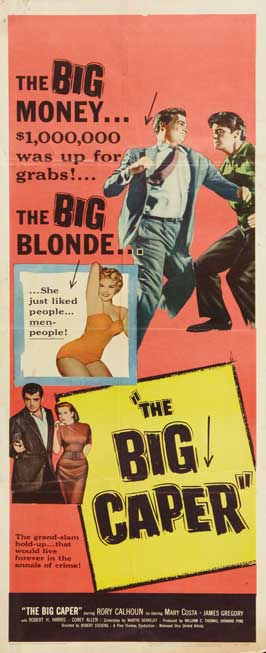
The Big Caper
Nothing flashy, nothing new to the genre, I still very much liked 1957's The Big Caper. Solid cast, interesting B-movie characters, and some bad guys as part of a heist crew that are just too much to believe. A classic? Nope, but it's pretty good for what it is, an entertaining heist movie that doesn't try to be anything that it isn't.
Several months removed from his last successful job, Frank Harper (Rory Calhoun) has ran out of money and has found a new job, one that he could retire on if it goes through. A poorly guarded bank with minimal security twice a month holds the payroll for the Marine base and Camp Pendleton, and to Frank, the money is begging to be taken. He approaches partner and bankroll, Flood (James Gregory), who agrees to go along with the plan. As a set-up, Frank and Flood's girl, Kay (Mary Costa), move into town, buy a gas station and a house, setting up shop as a young, married couple. Creating an alibi, they live there several months in preparation for the job, and then Flood's crew shows up. Let the trouble begin.
The one twist on the familiar noir-heist thriller was the 'what if?' concept added into the story. Setting up a nice, little life for themselves, Frank and Kay become a part of suburban life. Frank makes a profit at his gas station, Kay creates a home for the "couple" and things are looking all around pretty good for them. Kay wants nothing more than to get away from the menacing Flood while Frank's tortured past and childhood seemingly won't let him appreciate what he has. Kay tries like crazy to convince him otherwise. We're not talking Shakespeare here, but it was nice to see at least some effort by a movie made to bring something new to the heist flick. The effort is very much appreciated.
A Just Hit Play favorite, Calhoun does what he does best here, the bad guy who maybe isn't so bad. He does the tough guy like nobody's business, treading that fine line between straight villain and flawed hero. It's good to see him in a non-western too where he got pigeon-holed throughout the 1950s. There's a definite chemistry with Costa, bringing some heart to their scenes together in idyllic suburban life. For you trivia fans, Costa was the voice of Princess Aurora in Disney's Sleeping Beauty so there you go. Being the more obvious sinister villain that he was born to play, Gregory is a scene-stealer, the crime kingpin who puts everything in motion. He doesn't seem like that bad of a guy until some problems arise pre-heist, and well, things go downhill from there. Not big names leading the way, but all strong performances.
This is a 1957 B-movie noirish heist story, and the bad guys have to be very bad to make Calhoun's Frank be sympathetic. Mission accomplished in that department. Let's start with some of Flood's crew, beginning with Zimmer (Robert H. Harris), an explosives expert who will create several diversions during the robbery. His flaw? He's an alcoholic pyromaniac who can never have too much gin. Next, there's Roy (Corey Allen), a fitness freak with some rapist tendencies, or at least some sexual issues that Flood plays up. There's also Harry (Paul Picerni), a ladies man and all-around dope, and Dutch (Florenz Ames), the safecracker who wants nothing to do with the crew or the take, just a flat rate for his services. Quite a crew to say the least, one of the more eccentric, eclectic heist crews I can think of.
So has any heist in a movie ever gone smoothly, including the getaway? Okay, the Ocean's 11 remake doesn't count. Of course George Clooney and Co. are going to pull off the job. It's pretty clear that this heist won't go smoothly. For starters, it's a supposed "easy" job, and we all know how that goes. Translation = Epic fail. The heist sequence -- about 20 minutes long -- is solid, ratcheting up the tension, but it is in the aftermath where 'Caper' falls short a bit. Yes, it's Doom and Gloom time. I wanted an epically downer ending, but the story and/or script just doesn't have the guts. It is far from a happy ending, but more could have been done. Still good, but it could have been great.
This movie across the board has a lot going for it. Director Robert Stevens keeps things moving with an 84-minute movie that is aided by some California locations and a jazzy score from Albert Glasser that is good in that really obvious way, music blaring to tell you what's coming next. Basically a completely forgotten flick, well worth checking out if you stumble across it.
The Big Caper (1957): ***/****
Several months removed from his last successful job, Frank Harper (Rory Calhoun) has ran out of money and has found a new job, one that he could retire on if it goes through. A poorly guarded bank with minimal security twice a month holds the payroll for the Marine base and Camp Pendleton, and to Frank, the money is begging to be taken. He approaches partner and bankroll, Flood (James Gregory), who agrees to go along with the plan. As a set-up, Frank and Flood's girl, Kay (Mary Costa), move into town, buy a gas station and a house, setting up shop as a young, married couple. Creating an alibi, they live there several months in preparation for the job, and then Flood's crew shows up. Let the trouble begin.
The one twist on the familiar noir-heist thriller was the 'what if?' concept added into the story. Setting up a nice, little life for themselves, Frank and Kay become a part of suburban life. Frank makes a profit at his gas station, Kay creates a home for the "couple" and things are looking all around pretty good for them. Kay wants nothing more than to get away from the menacing Flood while Frank's tortured past and childhood seemingly won't let him appreciate what he has. Kay tries like crazy to convince him otherwise. We're not talking Shakespeare here, but it was nice to see at least some effort by a movie made to bring something new to the heist flick. The effort is very much appreciated.
A Just Hit Play favorite, Calhoun does what he does best here, the bad guy who maybe isn't so bad. He does the tough guy like nobody's business, treading that fine line between straight villain and flawed hero. It's good to see him in a non-western too where he got pigeon-holed throughout the 1950s. There's a definite chemistry with Costa, bringing some heart to their scenes together in idyllic suburban life. For you trivia fans, Costa was the voice of Princess Aurora in Disney's Sleeping Beauty so there you go. Being the more obvious sinister villain that he was born to play, Gregory is a scene-stealer, the crime kingpin who puts everything in motion. He doesn't seem like that bad of a guy until some problems arise pre-heist, and well, things go downhill from there. Not big names leading the way, but all strong performances.
This is a 1957 B-movie noirish heist story, and the bad guys have to be very bad to make Calhoun's Frank be sympathetic. Mission accomplished in that department. Let's start with some of Flood's crew, beginning with Zimmer (Robert H. Harris), an explosives expert who will create several diversions during the robbery. His flaw? He's an alcoholic pyromaniac who can never have too much gin. Next, there's Roy (Corey Allen), a fitness freak with some rapist tendencies, or at least some sexual issues that Flood plays up. There's also Harry (Paul Picerni), a ladies man and all-around dope, and Dutch (Florenz Ames), the safecracker who wants nothing to do with the crew or the take, just a flat rate for his services. Quite a crew to say the least, one of the more eccentric, eclectic heist crews I can think of.
So has any heist in a movie ever gone smoothly, including the getaway? Okay, the Ocean's 11 remake doesn't count. Of course George Clooney and Co. are going to pull off the job. It's pretty clear that this heist won't go smoothly. For starters, it's a supposed "easy" job, and we all know how that goes. Translation = Epic fail. The heist sequence -- about 20 minutes long -- is solid, ratcheting up the tension, but it is in the aftermath where 'Caper' falls short a bit. Yes, it's Doom and Gloom time. I wanted an epically downer ending, but the story and/or script just doesn't have the guts. It is far from a happy ending, but more could have been done. Still good, but it could have been great.
This movie across the board has a lot going for it. Director Robert Stevens keeps things moving with an 84-minute movie that is aided by some California locations and a jazzy score from Albert Glasser that is good in that really obvious way, music blaring to tell you what's coming next. Basically a completely forgotten flick, well worth checking out if you stumble across it.
The Big Caper (1957): ***/****
Labels:
1950s,
Film Noir,
Heist movies,
James Gregory,
Paul Picerni,
Rory Calhoun
Friday, July 22, 2011
A Bullet is Waiting
The plot description at Turner Classic Movie's website sounded promising enough for 1954's A Bullet is Waiting, aired as part of star of the month Jean Simmons' movie marathon. It read 'A plane crash strands a policeman and his prisoner in the wilderness' so I went in anticipating a film noir set in the west somewhere with a tense battle of nerves as policeman goes mano-a-mano with his prisoner. I was sorely disappointed then when I actually watched it, finding that while the description was accurate, it wasn't completely accurate.
Transporting his prisoner wanted for murder, Ed Stone (Rory Calhoun), back to Los Angeles, Sheriff Munson (Stephen McNally) is instead dealt a new problem when the plane they're flying in crashes somewhere in the mountains and hills of Utah. The pilot is killed, but both sheriff and prisoner survive and are met soon after by a young woman, Cally (Simmons), armed with a rifle who lives on an isolated sheep farm deep in the hills. With Munson's ankle possibly broken, the trio hole up at the small farm, waiting for Cally's father, David (Brian Aherne), to return from a lengthy trip to town while the ankle heals. Seeing the beautiful young Cally, Ed goes to work, wooing her in hopes of somehow escaping. Munson though is not telling the whole story, and it is only a matter of time before his secret comes out in the wash.
My first thought was that this story sounded similar to an Anthony Mann western, The Naked Spur, released a year before in 1953. The basic premise is similar; prisoner being transported to jail/trial, starts to play mind games. Even the small cast seemed alike. Instead of getting that in the form of a film noir though, this movie delves quickly into some philosophical metaphor for something bigger. Cally's father is a former Oxford professor writing a book about philosophy which at one point she reads to the two men. The characters go in depth of their own personal philosophy, beliefs and principles, at one point Calhoun's Ed alluding to the story of the Garden of Eden.
Now bear with me because I can overthink a movie like nobody's business. The Garden of Eden, you say, hhmm? We've got Adam -- that'd be Calhoun -- and Eve (Simmons, that one's easy), the devil/snake (McNally's suspicious Sheriff), and God (the father), all out in this isolated world where no outside contact is easily or readily made. Director John Farrow uses long, slow shots of nature to set scenes up; the sun poking up over the horizon, sheep running around the farm, storm clouds unleashing torrents of rain, drops of water dripping off the roof of the house. It all seems to point -- to my mind at least -- to be some metaphor to the story of the Garden of Eden. Thrown in with far too much philosophizing and delivering of a message, and the seemingly simple story gets over complicated quickly.
None of this is aided by some casting that just doesn't work. Jean Simmons was Turner Classic Movies June star of the month with this movie aired as part of the festival. One of the most classically beautiful actresses to ever hit the silver screen, she was also one of the best actresses around in the 1940s, 1950s and 1960s. She will be eternally watchable with an easy-going way about her, and while it isn't her performance that cripples the movie, she is miscast. Simmons has the look of a delicate flower out in the wilderness that just doesn't belong. Hair cut short but styled nonetheless, make-up always immaculate, she looks out of place. It doesn't help that her character has the potential to be a strong-willed, intelligent woman, only to be a defenseless, crying little girl by the end worried about the man she's fallen in love with.
As for the three male members of the cast, I'm thinking a batting average of .333 overall. Calhoun works to a point, but McNally and Aherne are a swing and a miss. Playing a prisoner supposedly wanted for murder, Calhoun is his typical smooth rogue who will prove validated in the end. He doesn't have the greatest chemistry with Simmons though, towering over the diminutive actress in their scenes. McNally is just a bizarre character, especially as we find out more about his Sheriff Munson and his motivations. Aherne does not make an appearance until very late in the movie just in time to iron everything out and put all the pieces where they belong.
It is the little things that throw me off as is so often the case. Simmons hides the rifle, and McNally somehow can't find it even though it's not that well-hidden. Calhoun carries a knife in his belt at all times, but nothing comes of it, the Sheriff never even demanding he give it back. If anything, McNally's Munson just sits around moping much of the movie. The best is saved for last though in one of those really bizarre moments that I really don't want to spoil here. I sat the movie out thinking there might be some redeeming quality in the end, but I was wrong again. The movie ends on a laugh -- okay, an attempted laugh -- as the characters literally ride off into the sunset. Pass on this one.
A Bullet is Waiting <---TCM trailer (1954): * 1/2 /****
Transporting his prisoner wanted for murder, Ed Stone (Rory Calhoun), back to Los Angeles, Sheriff Munson (Stephen McNally) is instead dealt a new problem when the plane they're flying in crashes somewhere in the mountains and hills of Utah. The pilot is killed, but both sheriff and prisoner survive and are met soon after by a young woman, Cally (Simmons), armed with a rifle who lives on an isolated sheep farm deep in the hills. With Munson's ankle possibly broken, the trio hole up at the small farm, waiting for Cally's father, David (Brian Aherne), to return from a lengthy trip to town while the ankle heals. Seeing the beautiful young Cally, Ed goes to work, wooing her in hopes of somehow escaping. Munson though is not telling the whole story, and it is only a matter of time before his secret comes out in the wash.
My first thought was that this story sounded similar to an Anthony Mann western, The Naked Spur, released a year before in 1953. The basic premise is similar; prisoner being transported to jail/trial, starts to play mind games. Even the small cast seemed alike. Instead of getting that in the form of a film noir though, this movie delves quickly into some philosophical metaphor for something bigger. Cally's father is a former Oxford professor writing a book about philosophy which at one point she reads to the two men. The characters go in depth of their own personal philosophy, beliefs and principles, at one point Calhoun's Ed alluding to the story of the Garden of Eden.
Now bear with me because I can overthink a movie like nobody's business. The Garden of Eden, you say, hhmm? We've got Adam -- that'd be Calhoun -- and Eve (Simmons, that one's easy), the devil/snake (McNally's suspicious Sheriff), and God (the father), all out in this isolated world where no outside contact is easily or readily made. Director John Farrow uses long, slow shots of nature to set scenes up; the sun poking up over the horizon, sheep running around the farm, storm clouds unleashing torrents of rain, drops of water dripping off the roof of the house. It all seems to point -- to my mind at least -- to be some metaphor to the story of the Garden of Eden. Thrown in with far too much philosophizing and delivering of a message, and the seemingly simple story gets over complicated quickly.
None of this is aided by some casting that just doesn't work. Jean Simmons was Turner Classic Movies June star of the month with this movie aired as part of the festival. One of the most classically beautiful actresses to ever hit the silver screen, she was also one of the best actresses around in the 1940s, 1950s and 1960s. She will be eternally watchable with an easy-going way about her, and while it isn't her performance that cripples the movie, she is miscast. Simmons has the look of a delicate flower out in the wilderness that just doesn't belong. Hair cut short but styled nonetheless, make-up always immaculate, she looks out of place. It doesn't help that her character has the potential to be a strong-willed, intelligent woman, only to be a defenseless, crying little girl by the end worried about the man she's fallen in love with.
As for the three male members of the cast, I'm thinking a batting average of .333 overall. Calhoun works to a point, but McNally and Aherne are a swing and a miss. Playing a prisoner supposedly wanted for murder, Calhoun is his typical smooth rogue who will prove validated in the end. He doesn't have the greatest chemistry with Simmons though, towering over the diminutive actress in their scenes. McNally is just a bizarre character, especially as we find out more about his Sheriff Munson and his motivations. Aherne does not make an appearance until very late in the movie just in time to iron everything out and put all the pieces where they belong.
It is the little things that throw me off as is so often the case. Simmons hides the rifle, and McNally somehow can't find it even though it's not that well-hidden. Calhoun carries a knife in his belt at all times, but nothing comes of it, the Sheriff never even demanding he give it back. If anything, McNally's Munson just sits around moping much of the movie. The best is saved for last though in one of those really bizarre moments that I really don't want to spoil here. I sat the movie out thinking there might be some redeeming quality in the end, but I was wrong again. The movie ends on a laugh -- okay, an attempted laugh -- as the characters literally ride off into the sunset. Pass on this one.
A Bullet is Waiting <---TCM trailer (1954): * 1/2 /****
Friday, March 25, 2011
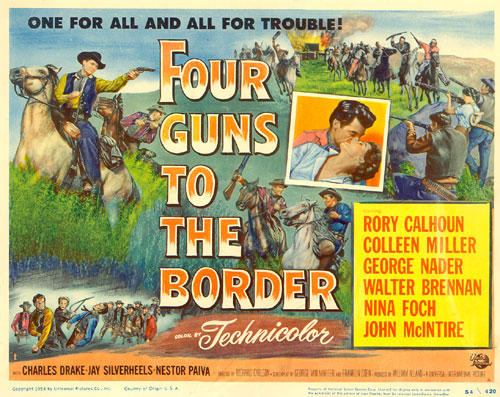
Four Guns to the Border
If I hadn't seen the credits at the opening of the movie, I'm pretty sure I would have been able to figure out that 1954's Four Guns to the Border was based on a Louis L'Amour story. Now it must have been a short story because eight years after this movie the fleshed-out version was released in its novel form, called High Lonesome. But short story or novel, the main characters come right out of L'Amour's rotation of stock characters. None of this is meant as a criticism -- I love his western novels -- but instead as a positive, another western that's the movie equivalent of comfort food.
All the old reliable characters I've come to expect were there, and it doesn't take long to establish who everyone is. 'Border' reminded me in a lot of ways of Catlow, another L'Amour western that was later turned into a feature film. Let's start with the lead, a sullen gunfighter at the head of a gang that isn't so bad all things considered. He's just looking for something else in life. Two, the older, grizzled right hand man. Three, the younger gunfighter who is the wild card, and four, the minority, a gunfighter with Indian/Mexican backgrounds. For good measure, throw in a father and daughter traveling across the desert who need help and maybe....just maybe...the daughter will fall for our sullen, glum leader. Ooops, I think I gave away the whole movie.
After robbing a saloon that nets his gang nothing when the safe is empty, outlaw gunslinger Cully (Rory Calhoun) decides to pull a bank job that has long been on his mind. The bank in nearby Cholla holds a monthly deposit from local cattle ranchers, but the bank is well-guarded and the townspeople very protective of their holdings. Cully's gang is up to the task, especially considering their past with Cholla sheriff, Dan Flaherty (Charles Drake). But a big payday seems a long way off as they plan for the job. On the trail, the gang comes across small ranch owner, Simon Bhumer (Walter Brennan) and his young daughter, Lolly (Colleen Miller). Even more trouble is the rumors that an Apache war party has jumped the reservation and is terrorizing the territory, all the while Cully's gang preparing for the dangerous job in front of them.
A B-western released at the height of western popularity in the mid 1950s, 'Border' doesn't do much to distinguish itself from so many other westerns of the time, but I found myself very much enjoying it still. Some of that can be attributed to L'Amour's comfort and ease writing about the American west, but it's more than that. Even when the story starts bouncing off the walls in a hundred different directions, it's still entertaining. That's my one complaint, just too much going on. Almost 30 minutes is spent setting everything up before Sheriff Flaherty and his wife (Nina Foch) and their past with Cully are brought up. In the meantime, Simon and Lolly fade into the background right when their story was getting interesting. All the different stories of course end up together, but the route getting there could have been smoother.
Most of my enjoyment from 'Border' comes from the casting. Calhoun was never a huge star, but he was always a reliable lead with the right part. Cully is a prototypical L'Amour hero, a bad guy who isn't that bad. He just needs a reason to turn to the light, in this case Miller's Lolly character. His gang includes Dutch (John McIntire), the grizzled gunslinger, Bronco (George Nader), the cocky but likable gunfighter, and Yaqui (Jay Silverheels, the Lone Ranger's Tonto), a knife-throwing, affable Indian. Like Cully, they're not so bad compared to most wild west outlaws. Given the chance, they redeem themselves in the eyes of the audience. Brennan is Brennan, playing the crotchety old rancher looking out for his daughter's best interests.
Discovered by a movie scout that saw a picture of her on vacation, Colleen Miller plays Lolly in one of her few film roles, and the only one I've seen of hers. The slim brunette is gorgeous, America's girl next door, and the studio apparently wanted to make her a sexpot with this part. Their efforts though are so incredibly not subtle that it comes across as a 1950s version of softcore porn. Upon being introduced, here are just some of the things thrown at Lolly. She's knocked out so Brennan pours a canteen over her, strategically wetting her shirt, continuing to pour even after she's awake. Later in a storm at night, Lolly heads outdoors in a white nightie to care for the horses. White nightie and water? Oh, I get it. She also undresses several times, needlessly but entertainingly hikes up her dress, and even enjoys some candy. Cully's gang stands around while she licks a candy cane. Are they kidding? It's so ridiculous it is actually funny at times.
B-movie actor himself turned director, Richard Carlson does a solid, workmanlike job with this B-western. Balancing all these different plates at one time, he manages to get all the characters and storylines where they need to be in the end. The finale had a chance to go for a whopper of an ending, spaghetti western-eque in terms of who makes it and who doesn't, but unfortunately this is 1954 Hollywood, not 1966 Italy. Still, I liked this movie. Nothing special, but always entertaining.
Four Guns to the Border (1954): ***/****
All the old reliable characters I've come to expect were there, and it doesn't take long to establish who everyone is. 'Border' reminded me in a lot of ways of Catlow, another L'Amour western that was later turned into a feature film. Let's start with the lead, a sullen gunfighter at the head of a gang that isn't so bad all things considered. He's just looking for something else in life. Two, the older, grizzled right hand man. Three, the younger gunfighter who is the wild card, and four, the minority, a gunfighter with Indian/Mexican backgrounds. For good measure, throw in a father and daughter traveling across the desert who need help and maybe....just maybe...the daughter will fall for our sullen, glum leader. Ooops, I think I gave away the whole movie.
After robbing a saloon that nets his gang nothing when the safe is empty, outlaw gunslinger Cully (Rory Calhoun) decides to pull a bank job that has long been on his mind. The bank in nearby Cholla holds a monthly deposit from local cattle ranchers, but the bank is well-guarded and the townspeople very protective of their holdings. Cully's gang is up to the task, especially considering their past with Cholla sheriff, Dan Flaherty (Charles Drake). But a big payday seems a long way off as they plan for the job. On the trail, the gang comes across small ranch owner, Simon Bhumer (Walter Brennan) and his young daughter, Lolly (Colleen Miller). Even more trouble is the rumors that an Apache war party has jumped the reservation and is terrorizing the territory, all the while Cully's gang preparing for the dangerous job in front of them.
A B-western released at the height of western popularity in the mid 1950s, 'Border' doesn't do much to distinguish itself from so many other westerns of the time, but I found myself very much enjoying it still. Some of that can be attributed to L'Amour's comfort and ease writing about the American west, but it's more than that. Even when the story starts bouncing off the walls in a hundred different directions, it's still entertaining. That's my one complaint, just too much going on. Almost 30 minutes is spent setting everything up before Sheriff Flaherty and his wife (Nina Foch) and their past with Cully are brought up. In the meantime, Simon and Lolly fade into the background right when their story was getting interesting. All the different stories of course end up together, but the route getting there could have been smoother.
Most of my enjoyment from 'Border' comes from the casting. Calhoun was never a huge star, but he was always a reliable lead with the right part. Cully is a prototypical L'Amour hero, a bad guy who isn't that bad. He just needs a reason to turn to the light, in this case Miller's Lolly character. His gang includes Dutch (John McIntire), the grizzled gunslinger, Bronco (George Nader), the cocky but likable gunfighter, and Yaqui (Jay Silverheels, the Lone Ranger's Tonto), a knife-throwing, affable Indian. Like Cully, they're not so bad compared to most wild west outlaws. Given the chance, they redeem themselves in the eyes of the audience. Brennan is Brennan, playing the crotchety old rancher looking out for his daughter's best interests.
Discovered by a movie scout that saw a picture of her on vacation, Colleen Miller plays Lolly in one of her few film roles, and the only one I've seen of hers. The slim brunette is gorgeous, America's girl next door, and the studio apparently wanted to make her a sexpot with this part. Their efforts though are so incredibly not subtle that it comes across as a 1950s version of softcore porn. Upon being introduced, here are just some of the things thrown at Lolly. She's knocked out so Brennan pours a canteen over her, strategically wetting her shirt, continuing to pour even after she's awake. Later in a storm at night, Lolly heads outdoors in a white nightie to care for the horses. White nightie and water? Oh, I get it. She also undresses several times, needlessly but entertainingly hikes up her dress, and even enjoys some candy. Cully's gang stands around while she licks a candy cane. Are they kidding? It's so ridiculous it is actually funny at times.
B-movie actor himself turned director, Richard Carlson does a solid, workmanlike job with this B-western. Balancing all these different plates at one time, he manages to get all the characters and storylines where they need to be in the end. The finale had a chance to go for a whopper of an ending, spaghetti western-eque in terms of who makes it and who doesn't, but unfortunately this is 1954 Hollywood, not 1966 Italy. Still, I liked this movie. Nothing special, but always entertaining.
Four Guns to the Border (1954): ***/****
Labels:
1950s,
Louis L'Amour,
Richard Carlson,
Rory Calhoun,
Walter Brennan,
westerns
Saturday, February 12, 2011
Night of the Lepus
One of my all-time favorite quotes from Michael Caine in an interview he did about the many movies he's made during his career. When asked what he remembered about the classic Jaws IV, he said "Not much, but I remember the house I bought because I made that movie." That says it all. An actor/actress doesn't need to make a classic every time they make a movie, and who blames them? It's the rare Laurence Olivier or Peter O'Toole that makes an above average, high quality finished product with each movie. And as a movie watcher, you're going to see your share of duds with some still deep, impressive casts. You know going in that the movie is going to be awful, but you watch anyways.
I couldn't help myself and watched 1972's Night of the Lepus, one of the worst movies ever made without a doubt, no question about it. The cast isn't full of A-list, big name stars, but there were a bunch of names I recognized -- and have enjoyed seeing in other movies -- but by the time I finished the movie all I could think was that each and every one of these stars must have been in massive amounts of debt. To be fair, this is supposed to be a bad movie, a B-movie of epic proportions. Cheesy special effects, a ridiculous story, and overacting around every corner. This is a flick that might have been better if it wasn't played so seriously (add a little camp value), but it is what it is. It's an awful movie that did give me a couple chuckles here and there. Now was it intended that way? Who knows for sure.
Working his ranch in the Arizona desert, grizzled rancher Cole Hillman (Rory Calhoun) is seeing a takeover of rabbits on his range to the point where his cattle can't graze because the land has been stripped down. He seeks help from a friend working at a local university in the medical/science department, Elgin Clark (DeForest Kelly), who recommends contacting a researcher couple working in the area, Roy (Stuart Whitman) and Gerry (Janet Leigh) Bennett. They decide to start testing on the rabbits in hopes of stopping them from reproducing, using a new hormone on a small test group. But in the testing process, their daughter lets one of the rabbits go where he rejoins the thousands of rabbits already on the range. The local sheriff (Paul Fix) quickly starts getting calls about bizarre attacks by an unknown animal. Roy and Gerry's worst fears come true, the hormone had the wrong affect on the animals. Rabid, murdering rabbits the size of mountain lions are reproducing in huge numbers, and they're on the rampage. NO ONE is safe!
That was a fun plot description to write, not going to lie. Rabid, murdering rabbits on the rampage? How could that not be amazing? As long as there have been creature movies, there have been bigger than they're supposed to be creature movies. Honestly, how do you make furry, little bunny rabbits terrifying? Well, first, you can't really. Look at them. But if you're going to try...make them gigantic with a taste for human flesh. Another similarly awful movie, The Killer Shrews, dealt with the same "issue." Tiny, little shrews tested on and turn into creatures the size of dogs. Equally ridiculous, and equally not scary. It's all mindlessly stupid almost from the start, and it just gets stupider as the "story" moves along.
The technique for making gigantic rabbits is laughable and hilarious at the same time. I only noticed two instances of green screen filming where the cast is edited into a shot of the big bunnies (from a distance of course). I suppose it was a good thing that this technique wasn't used too much because the end result is pretty bad in the effects department. The solution on the other hand isn't much better. Very small sets were built to match the sets that the actual human cast used, and then rabbits were released onto these sets with cameras filming. Even better, the cameras are almost underneath the animals to give the impression of their IMMENSITY! Nothing like slow-motion, running rabbits to send a shiver up your spine. My favorite technique though (okay, there were two) was the close-up of a pissed off rabbit with his tooth (yes, singular) dripping with blood with growling heard in the background. Rabbits gotta eat, huh? Capping all this off is the "soundtrack" for the rabbits attacking. Imagine a low, consistent roar like the sound of a cattle drive added in with the sound of slobbering animals. Scary it is not, but funny, very much so.
For the cast, I have seen and enjoyed watching movies with all five of the names mentioned. I go back and forth wondering what the process was like getting involved with a movie like this. At some point, they actually decided "Yes, I'm going to do this movie. I think it has potential." Okay, maybe not, but they must have been pretty hard-up for any sort of work, any sort of cash at all. What makes this movie better/worse depending on how you look at it is that the cast -- which was a talented one -- plays it all so ridiculously straight that you can't help but give them credit for it. Stick to your guns! Whitman, Calhoun, Kelly and Fix were all known commodities for me. Solid supporting actors who were never stars but were always fun seeing them in any number of movies. And then there's Janet Leigh. Did someone have some scandalous information on her and forced her to do this movie? Kudos to her for sticking with it though. She plays the part of the tough but loving wife as well as humanly possible.
One of my favorites with movies like this is how do you wrap it up? How do you kill hundreds and maybe thousands of giant, murdering rabbits? Whitman's plan is unique but I'm still not sure it actually makes sense. The massing of rabbits is herded toward a stretch of electrified train tracks and then slaughtered with nowhere to go but on those tracks. It's hysterical (I feel bad for saying that electrocuting bunnies is hysterical by the way) and ridiculous just like the rest of the movie. If you're looking for a good laugh, this creature feature is a winner. It's available to watch at Youtube starting HERE with Part 1 of 9.
The Night of the Lepus <---trailer (1972): */****
I couldn't help myself and watched 1972's Night of the Lepus, one of the worst movies ever made without a doubt, no question about it. The cast isn't full of A-list, big name stars, but there were a bunch of names I recognized -- and have enjoyed seeing in other movies -- but by the time I finished the movie all I could think was that each and every one of these stars must have been in massive amounts of debt. To be fair, this is supposed to be a bad movie, a B-movie of epic proportions. Cheesy special effects, a ridiculous story, and overacting around every corner. This is a flick that might have been better if it wasn't played so seriously (add a little camp value), but it is what it is. It's an awful movie that did give me a couple chuckles here and there. Now was it intended that way? Who knows for sure.
Working his ranch in the Arizona desert, grizzled rancher Cole Hillman (Rory Calhoun) is seeing a takeover of rabbits on his range to the point where his cattle can't graze because the land has been stripped down. He seeks help from a friend working at a local university in the medical/science department, Elgin Clark (DeForest Kelly), who recommends contacting a researcher couple working in the area, Roy (Stuart Whitman) and Gerry (Janet Leigh) Bennett. They decide to start testing on the rabbits in hopes of stopping them from reproducing, using a new hormone on a small test group. But in the testing process, their daughter lets one of the rabbits go where he rejoins the thousands of rabbits already on the range. The local sheriff (Paul Fix) quickly starts getting calls about bizarre attacks by an unknown animal. Roy and Gerry's worst fears come true, the hormone had the wrong affect on the animals. Rabid, murdering rabbits the size of mountain lions are reproducing in huge numbers, and they're on the rampage. NO ONE is safe!
That was a fun plot description to write, not going to lie. Rabid, murdering rabbits on the rampage? How could that not be amazing? As long as there have been creature movies, there have been bigger than they're supposed to be creature movies. Honestly, how do you make furry, little bunny rabbits terrifying? Well, first, you can't really. Look at them. But if you're going to try...make them gigantic with a taste for human flesh. Another similarly awful movie, The Killer Shrews, dealt with the same "issue." Tiny, little shrews tested on and turn into creatures the size of dogs. Equally ridiculous, and equally not scary. It's all mindlessly stupid almost from the start, and it just gets stupider as the "story" moves along.
The technique for making gigantic rabbits is laughable and hilarious at the same time. I only noticed two instances of green screen filming where the cast is edited into a shot of the big bunnies (from a distance of course). I suppose it was a good thing that this technique wasn't used too much because the end result is pretty bad in the effects department. The solution on the other hand isn't much better. Very small sets were built to match the sets that the actual human cast used, and then rabbits were released onto these sets with cameras filming. Even better, the cameras are almost underneath the animals to give the impression of their IMMENSITY! Nothing like slow-motion, running rabbits to send a shiver up your spine. My favorite technique though (okay, there were two) was the close-up of a pissed off rabbit with his tooth (yes, singular) dripping with blood with growling heard in the background. Rabbits gotta eat, huh? Capping all this off is the "soundtrack" for the rabbits attacking. Imagine a low, consistent roar like the sound of a cattle drive added in with the sound of slobbering animals. Scary it is not, but funny, very much so.
For the cast, I have seen and enjoyed watching movies with all five of the names mentioned. I go back and forth wondering what the process was like getting involved with a movie like this. At some point, they actually decided "Yes, I'm going to do this movie. I think it has potential." Okay, maybe not, but they must have been pretty hard-up for any sort of work, any sort of cash at all. What makes this movie better/worse depending on how you look at it is that the cast -- which was a talented one -- plays it all so ridiculously straight that you can't help but give them credit for it. Stick to your guns! Whitman, Calhoun, Kelly and Fix were all known commodities for me. Solid supporting actors who were never stars but were always fun seeing them in any number of movies. And then there's Janet Leigh. Did someone have some scandalous information on her and forced her to do this movie? Kudos to her for sticking with it though. She plays the part of the tough but loving wife as well as humanly possible.
One of my favorites with movies like this is how do you wrap it up? How do you kill hundreds and maybe thousands of giant, murdering rabbits? Whitman's plan is unique but I'm still not sure it actually makes sense. The massing of rabbits is herded toward a stretch of electrified train tracks and then slaughtered with nowhere to go but on those tracks. It's hysterical (I feel bad for saying that electrocuting bunnies is hysterical by the way) and ridiculous just like the rest of the movie. If you're looking for a good laugh, this creature feature is a winner. It's available to watch at Youtube starting HERE with Part 1 of 9.
The Night of the Lepus <---trailer (1972): */****
Labels:
1970s,
Horror,
Janet Leigh,
Paul Fix,
Rory Calhoun,
Stuart Whitman
Wednesday, October 13, 2010
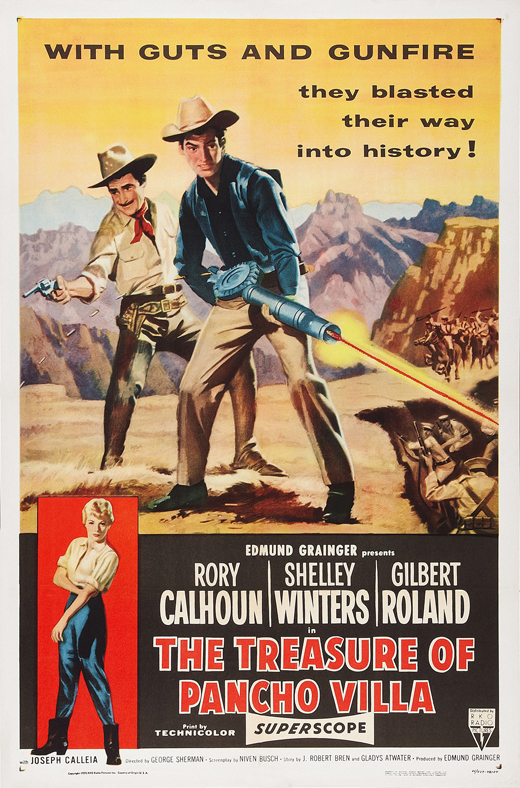
The Treasure of Pancho Villa
Countless westerns set in the years following the Civil War showed gunslingers, cowboys, crooks, horse thieves, commoners and businessmen searching for riches in the American West. But if there was ever a place where making money was easiest when it comes to movies, that place would be Mexico, the country where American gunfighters and mercenaries head south to join in on any number of revolutions and Civil War. The Magnificent Seven, Vera Cruz, and The Wild Bunch stand out from the rest, but one forgotten gem is 1955's The Treasure of Pancho Villa.
Dealing with a story not so different from the previous year's Vera Cruz, 'Treasure' is one of those hidden gems that I'll always watch when I stumble across it on TV. And because there's no VHS or DVD readily available, you've got to enjoy it while you can. It's a B-western that isn't held back by flaws that brought down so many other 1950s westerns. Again a lot like Vera Cruz, Treasure was a pretty good look into the future of what westerns would turn into in the mid to late 1960s when Sergio Leone and the spaghetti westerns put their own unique spin on what the American west was like. Dark, cynical, double crosses, betrayals and plenty of action rule in this underrated western.
Looking to take one more big job that will allow him to retire for good, American gunman Tom Bryan (Rory Calhoun) teams up with a former alley and idealistic officer in Pancho Villa's army, Juan Castro (Gilbert Roland). With some help from Villa's revolutionaries, Tom and Juan knock off a heavily guarded and fortified train heading north with almost a million dollars in gold. Now comes the hard part as they are forced to transport the gold by mule train to a prearranged meeting point with Villa's forces. Mexican forces are following close behind hoping to get the gold back, but there's also a treacherous trail guide (Joseph Calleia) among their group who may pose a bigger problem. Time is running out though, and almost everyone starts looking out for themselves when the chips are down.
From the time I saw Clint Eastwood in Leone's spaghetti westerns, I was hooked. So going back and seeing a movie made 10 years prior when so many American westerns presented this dull, whitewashed version of the west and seeing a movie as good and as enjoyable as this is a treat. There are no real good guys, just different shades of bad, good and somewhere in between. Calhoun's Tom is a cynical mercenary who goes wherever he can get the most money, principles or ideals thrown out the window long ago. His weapon of choice is a Lewis gun, a light machine gun he uses to get out of trouble as quick as he gets into it. Just one of many influences a low-budget B-western would have on one of my favorite genres, the spaghetti western.
One of the best things to come out of 'Treasure' is the pairing of star -- but not superstars -- Calhoun and Roland. Neither actor was ever a huge star in Hollywood, but they were both solid actors who rarely disappointed on screen. Both had a knack for playing characters not quite good and not quite bad, just somewhere floating in between. They're introduced early as two similar men, a fighting man who is good at something that is extremely dangerous. They fight for different reasons -- Tom for money, Juan for beliefs and Mexican freedom -- but when the time comes they can put aside their differences and fight alongside each other. There are some great dialogue exchanges between them as each man begins to wonder if the other is trying to double cross him.
Filming in Mexico (it looks like some familiar locations in Durango), director George Sherman makes an exciting, fast-paced story that clocks in at just over 95 minutes. After the train robbery, the movie mostly settles in as a long chase movie, Tom, Juan and Co. hightailing it across the Mexican frontier chased by Mexican cavalry. It's never long in between action scenes (surprisingly graphic and callous for 1955), including one of the more original final showdowns I've seen in awhile. The opening scene actually partially reveals the ending only to flashback to how all the characters got to that spot. It's a simple technique used to death in the years since on TV and in movies, but when handled right as it is here, it works in a big way.
My only real complaint from this otherwise very solid western is the addition of Shelley Winters to the cast as an American schoolteacher along for the ride after being caught up in the revolution. Her character quickly falls for the roguish mercenary, Tom, and we're "treated" to a series of scenes as they talk about personal convictions and beliefs, what drives them and what their dreams are. The pacing slows down, and I found myself fast-forwarding through most of their scenes. Other than that, nothing to complain about. It's a hidden gem, and a western ahead of its time in terms of storytelling, realism, and cynicism. A 3-fer if there ever was.
The Treasure of Pancho Villa <---TCM trailer (1955): ***/****
Dealing with a story not so different from the previous year's Vera Cruz, 'Treasure' is one of those hidden gems that I'll always watch when I stumble across it on TV. And because there's no VHS or DVD readily available, you've got to enjoy it while you can. It's a B-western that isn't held back by flaws that brought down so many other 1950s westerns. Again a lot like Vera Cruz, Treasure was a pretty good look into the future of what westerns would turn into in the mid to late 1960s when Sergio Leone and the spaghetti westerns put their own unique spin on what the American west was like. Dark, cynical, double crosses, betrayals and plenty of action rule in this underrated western.
Looking to take one more big job that will allow him to retire for good, American gunman Tom Bryan (Rory Calhoun) teams up with a former alley and idealistic officer in Pancho Villa's army, Juan Castro (Gilbert Roland). With some help from Villa's revolutionaries, Tom and Juan knock off a heavily guarded and fortified train heading north with almost a million dollars in gold. Now comes the hard part as they are forced to transport the gold by mule train to a prearranged meeting point with Villa's forces. Mexican forces are following close behind hoping to get the gold back, but there's also a treacherous trail guide (Joseph Calleia) among their group who may pose a bigger problem. Time is running out though, and almost everyone starts looking out for themselves when the chips are down.
From the time I saw Clint Eastwood in Leone's spaghetti westerns, I was hooked. So going back and seeing a movie made 10 years prior when so many American westerns presented this dull, whitewashed version of the west and seeing a movie as good and as enjoyable as this is a treat. There are no real good guys, just different shades of bad, good and somewhere in between. Calhoun's Tom is a cynical mercenary who goes wherever he can get the most money, principles or ideals thrown out the window long ago. His weapon of choice is a Lewis gun, a light machine gun he uses to get out of trouble as quick as he gets into it. Just one of many influences a low-budget B-western would have on one of my favorite genres, the spaghetti western.
One of the best things to come out of 'Treasure' is the pairing of star -- but not superstars -- Calhoun and Roland. Neither actor was ever a huge star in Hollywood, but they were both solid actors who rarely disappointed on screen. Both had a knack for playing characters not quite good and not quite bad, just somewhere floating in between. They're introduced early as two similar men, a fighting man who is good at something that is extremely dangerous. They fight for different reasons -- Tom for money, Juan for beliefs and Mexican freedom -- but when the time comes they can put aside their differences and fight alongside each other. There are some great dialogue exchanges between them as each man begins to wonder if the other is trying to double cross him.
Filming in Mexico (it looks like some familiar locations in Durango), director George Sherman makes an exciting, fast-paced story that clocks in at just over 95 minutes. After the train robbery, the movie mostly settles in as a long chase movie, Tom, Juan and Co. hightailing it across the Mexican frontier chased by Mexican cavalry. It's never long in between action scenes (surprisingly graphic and callous for 1955), including one of the more original final showdowns I've seen in awhile. The opening scene actually partially reveals the ending only to flashback to how all the characters got to that spot. It's a simple technique used to death in the years since on TV and in movies, but when handled right as it is here, it works in a big way.
My only real complaint from this otherwise very solid western is the addition of Shelley Winters to the cast as an American schoolteacher along for the ride after being caught up in the revolution. Her character quickly falls for the roguish mercenary, Tom, and we're "treated" to a series of scenes as they talk about personal convictions and beliefs, what drives them and what their dreams are. The pacing slows down, and I found myself fast-forwarding through most of their scenes. Other than that, nothing to complain about. It's a hidden gem, and a western ahead of its time in terms of storytelling, realism, and cynicism. A 3-fer if there ever was.
The Treasure of Pancho Villa <---TCM trailer (1955): ***/****
Labels:
1950s,
Gilbert Roland,
Rory Calhoun,
Shelley Winters,
westerns
Wednesday, October 6, 2010
River of No Return
I've written before about my general dislike for movies from the 1950s, but as I watched 1954's River of No Return I couldn't come up with a thing to write about. The cast, the director, the premise, the setting, all sounded positive and at least worth giving it a try. All those things mentioned were worthwhile too, but like so many 50s westerns this oater lacked any heart, any reason for us as viewers getting really involved in it. Good in a lot of ways, above average in some others, but overall just a boring western.
Because the movie didn't leave much of an impression on me as a whole, I debated just ending the review there with that first paragraph. But then I'd feel bad for not giving it a fair shake if nothing else so here goes. Like so many other 50s westerns, 'River' tries to dazzle the viewer with the spectacle of what's going on in the story from the widescreen filmmaking to the Cinemascope camerawork to the breathtaking locations. Try and keep up with that, Television! But that's where it stops. Characters aren't that interesting, the premise is promising but never goes anywhere, and in the end lands with a clunk despite the talent involved.
Working a small farm amidst a raging gold rush, farmer Matt Calder (Robert Mitchum) sends for his son, Mark (Tommy Rettig) when he discovers his estranged wife has passed away. Everything goes smoothly as the two Calder men cut out a new life for themselves in the wilderness. One day though, Matt saves a runaway raft on the river, rescuing a gambler named Weston (Rory Calhoun) and his fiancee, Kay (Marilyn Monroe), from almost certain death. Weston has to file a gold claim and steals Matt's horse and rifle, leaving the trio on their own with no protection. Matt sets out after the gambler with Mark and Kay in tow, navigating the treacherous river in hopes of catching up to the man who shanghaied them.
I can't say I intentionally avoided this flick over the years, but I never actively sought it out either. But reading through filmographies lately, I stumbled upon it again and saw Mitchum and Monroe's names and then director Otto Preminger too and finally caved and gave it a try. I didn't hate it, and I didn't love it. It's one of those instantly forgettable movies that has some positives going for it but never amounts to anything bigger and better. The filming locations in Banff National Park in Alberta, Canada are drop-dead gorgeous and Preminger knows it, shooting the green mountains like they're leading up to heaven. The location shooting is one of the high points of the movie, but I struggle to recommend a movie based solely on how it looks.
Mitchum is one of my favorites, and even in schlock movies usually makes the most he can out of the badness. His Matt Carlen is a typically Mitchum western hero, stout, strong, and honest as a man who says few words and doesn't like to be pushed. It's not his best work, but he was always very watchable and doesn't disappoint here. At the height of her popularity, Monroe never looked better and also shows she was more than just a ditzy blonde. The girl could act and even gets a chance to sing -- 5 chances actually -- to show off her voice. Mitchum and Monroe have some chemistry together, but a forced love scene late puts a damper on any fireworks that might have been possible. Calhoun as always is a worthy villain, slimy and backstabbing to the end, and Rettig handles himself well, avoiding any annoying child actor comparisons.
Filming a story that requires the cast to navigate down a dangerous river puts Preminger in an awkward spot right from the start. A studio isn't going to allow big names like Mitchum and Monroe to go anywhere near river rapids so you're forced to improvise. We do get certain shots of them on an actual river in some ridiculously calm water. But then when the raft reaches rapids, we get the super-imposed shots of Mitchum/Monroe/Rettig in a studio on a "raft" with the green screen nature shots behind them. I don't know an alternative other than to not use any close-ups, but then I'd complain about that too. Sorry, Mr. Preminger, looks like you were fighting a losing, can't win battle. Damn studios and their worries.
Little else to add here. Mitchum solid, Monroe shows she can act and looks good doing it, and Banff National Park is gorgeous. An unexciting western that does little to distinguish itself from the pack, and even at just 90 minutes feels like a half hour or so could have been edited cleanly.
River of No Return <---trailer (1954): **/****
Because the movie didn't leave much of an impression on me as a whole, I debated just ending the review there with that first paragraph. But then I'd feel bad for not giving it a fair shake if nothing else so here goes. Like so many other 50s westerns, 'River' tries to dazzle the viewer with the spectacle of what's going on in the story from the widescreen filmmaking to the Cinemascope camerawork to the breathtaking locations. Try and keep up with that, Television! But that's where it stops. Characters aren't that interesting, the premise is promising but never goes anywhere, and in the end lands with a clunk despite the talent involved.
Working a small farm amidst a raging gold rush, farmer Matt Calder (Robert Mitchum) sends for his son, Mark (Tommy Rettig) when he discovers his estranged wife has passed away. Everything goes smoothly as the two Calder men cut out a new life for themselves in the wilderness. One day though, Matt saves a runaway raft on the river, rescuing a gambler named Weston (Rory Calhoun) and his fiancee, Kay (Marilyn Monroe), from almost certain death. Weston has to file a gold claim and steals Matt's horse and rifle, leaving the trio on their own with no protection. Matt sets out after the gambler with Mark and Kay in tow, navigating the treacherous river in hopes of catching up to the man who shanghaied them.
I can't say I intentionally avoided this flick over the years, but I never actively sought it out either. But reading through filmographies lately, I stumbled upon it again and saw Mitchum and Monroe's names and then director Otto Preminger too and finally caved and gave it a try. I didn't hate it, and I didn't love it. It's one of those instantly forgettable movies that has some positives going for it but never amounts to anything bigger and better. The filming locations in Banff National Park in Alberta, Canada are drop-dead gorgeous and Preminger knows it, shooting the green mountains like they're leading up to heaven. The location shooting is one of the high points of the movie, but I struggle to recommend a movie based solely on how it looks.
Mitchum is one of my favorites, and even in schlock movies usually makes the most he can out of the badness. His Matt Carlen is a typically Mitchum western hero, stout, strong, and honest as a man who says few words and doesn't like to be pushed. It's not his best work, but he was always very watchable and doesn't disappoint here. At the height of her popularity, Monroe never looked better and also shows she was more than just a ditzy blonde. The girl could act and even gets a chance to sing -- 5 chances actually -- to show off her voice. Mitchum and Monroe have some chemistry together, but a forced love scene late puts a damper on any fireworks that might have been possible. Calhoun as always is a worthy villain, slimy and backstabbing to the end, and Rettig handles himself well, avoiding any annoying child actor comparisons.
Filming a story that requires the cast to navigate down a dangerous river puts Preminger in an awkward spot right from the start. A studio isn't going to allow big names like Mitchum and Monroe to go anywhere near river rapids so you're forced to improvise. We do get certain shots of them on an actual river in some ridiculously calm water. But then when the raft reaches rapids, we get the super-imposed shots of Mitchum/Monroe/Rettig in a studio on a "raft" with the green screen nature shots behind them. I don't know an alternative other than to not use any close-ups, but then I'd complain about that too. Sorry, Mr. Preminger, looks like you were fighting a losing, can't win battle. Damn studios and their worries.
Little else to add here. Mitchum solid, Monroe shows she can act and looks good doing it, and Banff National Park is gorgeous. An unexciting western that does little to distinguish itself from the pack, and even at just 90 minutes feels like a half hour or so could have been edited cleanly.
River of No Return <---trailer (1954): **/****
Labels:
1950s,
Marilyn Monroe,
Otto Preminger,
Robert Mitchum,
Rory Calhoun,
westerns
Friday, May 28, 2010
The Hired Gun
I've written at least two reviews of TV shows edited into feature length movies since I started the blog. Typically they're pretty easy to spot, but that doesn't mean they have to be bad. The pacing or editing might seem a little off, but what do you really expect from a TV show turned movie? Usually my radar is pretty decent trying to figure out if the movie I'm watching is from some short-lived 50s or 60s TV show. As for 1957's The Hired Gun, I never really thought it was from a TV show, but it sure felt like it.
For starters, 'Gun' clocks in at a whopping 63 minutes, many of which are just shots of the main characters riding across the desert. Visually stunning, agreed, but giving us any reason, any reason at all to be interested? Not really. Even at just over an hour, director Ray Nazarro (typically a TV director, appropriately enough) has two vastly different storylines, one covered over the first 30 minutes and then wham! Story change! New story up until the end. Too bad because with the talent involved, the movie had some potential but never amounts to much.
Waiting to be hanged in a few hours, Ellen Belden (Anne Francis) sits in her jail cell in a dusty Texas town. She claims innocence, but a judge sentenced her to death for the murder of her husband. When she steps up to the noose, she'll be the first woman ever hung in Texas. But the morning of the hanging, Judd Farrow (Chuck Connors), her uncle's ranch foreman, busts her out and helps her escape to the ranch in New Mexico. Ellen's dead husband's family, especially father Mace (John Litel) and brother Kell (Vince Edwards), want her back to answer for the murder. With no other options, they hire gunfighter Gil McCord (Rory Calhoun) to go get her back for $5,000.
One of the big problems here is that within 30 seconds of being introduced to Francis' character, she's spilling her guts claiming innocence in the opening narration. If it's me, I try and keep you guessing for at least a little while whether she killed her husband or not. Second on the problem list, Francis with her angelic blond hair and innocent face clearly isn't going to lie about her actions. From there on, it's just a matter of who did it, and looking at the supporting cast, it's a pretty easy guess.
As for the two stories, it just caught me off-guard. The first 30 minutes or so is the prison break and McCord's pursuit of Ellen as she flees into New Mexico. The last half is Gil and Ellen trying to prove who really killed her husband with a mysterious horse thief named Kirby (Guinn Williams) holding the key to proving her innocence. The problem isn't that the story takes a quick right turn midway through the movie, it's that the first half is pushed to the side in the blink of an eye. Connors' Judd helps Ellen escape and then assumes some reciprocity in the feelings department. He chases after Gil and Ellen, gets shot in the arm and disappears the rest of the story.
Of course, that's just one problem with the main characters. Calhoun is supposed to be a badass gunfighter but he only gets one chance to prove this in the movie. Other than people cowering when they hear his name, we're given no reason to think this guy is the ultimate bad hombre with a six-shooter. From the minute he's introduced to Ellen, it's only a matter of time before he figures out the truth and of course, falls in love with her. Oh, no, I certainly hope they can make it through this harrowing journey together! Calhoun and Francis are decent enough with their parts, but they're just not given enough to do.
SPOILERS STOP READING, HERE COMES THE KILLER REVELATION SPOILER From the start, it's pretty obvious the real killer is either Chuck Connors or Vince Edwards. And the winner for husband killer is....Vince Edwards, seeking his father's love, approval, and most importantly, his money! Both actors are capable of being strong bad guys, and here they both get a shot at being the brooding, intimidating villains. Like the main characters though, they're not given much to do until the story needs them to be shot so Gil and Ellen can end up together. END OF SPOILERS
That's my idea, make this into a half-hour episode of The Rifleman and you might have a halfway decent show. But as a 63-minute feature with about 30 minutes of storyline, this western falls woefully short of being halfway decent. The cast might make it seem more appealing, but this is just not a good movie from start to finish. Pass in a big way.
The Hired Gun (1957): */****
For starters, 'Gun' clocks in at a whopping 63 minutes, many of which are just shots of the main characters riding across the desert. Visually stunning, agreed, but giving us any reason, any reason at all to be interested? Not really. Even at just over an hour, director Ray Nazarro (typically a TV director, appropriately enough) has two vastly different storylines, one covered over the first 30 minutes and then wham! Story change! New story up until the end. Too bad because with the talent involved, the movie had some potential but never amounts to much.
Waiting to be hanged in a few hours, Ellen Belden (Anne Francis) sits in her jail cell in a dusty Texas town. She claims innocence, but a judge sentenced her to death for the murder of her husband. When she steps up to the noose, she'll be the first woman ever hung in Texas. But the morning of the hanging, Judd Farrow (Chuck Connors), her uncle's ranch foreman, busts her out and helps her escape to the ranch in New Mexico. Ellen's dead husband's family, especially father Mace (John Litel) and brother Kell (Vince Edwards), want her back to answer for the murder. With no other options, they hire gunfighter Gil McCord (Rory Calhoun) to go get her back for $5,000.
One of the big problems here is that within 30 seconds of being introduced to Francis' character, she's spilling her guts claiming innocence in the opening narration. If it's me, I try and keep you guessing for at least a little while whether she killed her husband or not. Second on the problem list, Francis with her angelic blond hair and innocent face clearly isn't going to lie about her actions. From there on, it's just a matter of who did it, and looking at the supporting cast, it's a pretty easy guess.
As for the two stories, it just caught me off-guard. The first 30 minutes or so is the prison break and McCord's pursuit of Ellen as she flees into New Mexico. The last half is Gil and Ellen trying to prove who really killed her husband with a mysterious horse thief named Kirby (Guinn Williams) holding the key to proving her innocence. The problem isn't that the story takes a quick right turn midway through the movie, it's that the first half is pushed to the side in the blink of an eye. Connors' Judd helps Ellen escape and then assumes some reciprocity in the feelings department. He chases after Gil and Ellen, gets shot in the arm and disappears the rest of the story.
Of course, that's just one problem with the main characters. Calhoun is supposed to be a badass gunfighter but he only gets one chance to prove this in the movie. Other than people cowering when they hear his name, we're given no reason to think this guy is the ultimate bad hombre with a six-shooter. From the minute he's introduced to Ellen, it's only a matter of time before he figures out the truth and of course, falls in love with her. Oh, no, I certainly hope they can make it through this harrowing journey together! Calhoun and Francis are decent enough with their parts, but they're just not given enough to do.
SPOILERS STOP READING, HERE COMES THE KILLER REVELATION SPOILER From the start, it's pretty obvious the real killer is either Chuck Connors or Vince Edwards. And the winner for husband killer is....Vince Edwards, seeking his father's love, approval, and most importantly, his money! Both actors are capable of being strong bad guys, and here they both get a shot at being the brooding, intimidating villains. Like the main characters though, they're not given much to do until the story needs them to be shot so Gil and Ellen can end up together. END OF SPOILERS
That's my idea, make this into a half-hour episode of The Rifleman and you might have a halfway decent show. But as a 63-minute feature with about 30 minutes of storyline, this western falls woefully short of being halfway decent. The cast might make it seem more appealing, but this is just not a good movie from start to finish. Pass in a big way.
The Hired Gun (1957): */****
Labels:
1950s,
Chuck Connors,
Guinn Williams,
Rory Calhoun,
Vince Edwards,
westerns
Tuesday, October 6, 2009
The Young and the Brave
Sounds kind of ridiculous, doesn't it? The story of three men, typically not the cream of society, saving a young child in a perilous situation worked in the western context. I was skeptical of moving that context to the Korean War, but what do I know? The 1963 war movie completely works on any number of levels.
Weeks after their patrol was ambushed, three U.S. soldiers (Rory Calhoun, William Bendix, and Robert Ivers) escape from a North Korean prisoner of war camp. Heading south toward American lines, the trio is helped by a Korean family but a North Korean patrol attacks the family's farm and kills everyone except 7-year old Han (Manuel Padilla Jr.). The little boy not only witnesses the brutal massacre but also sees the fleeing American soldiers and blames them for not helping. Han sets out on his own, coming across a U.S. army dog separated from his owner who he names Lobo (why a North Korean boy would name a dog 'lobo,' the Spanish word for wolf, escapes me).
It's not long before the trio of soldiers crosses paths with Han, and the group travels together toward American lines. Along the way, they pick up another soldier, Estway (Richard Jaeckel), who also escaped but drew the wrath of his fellow prisoners when he collaborated with his North Korean captors. More importantly though, Estway has a rifle and a radio. So this odd group of individuals tries to reach safety as they outrun a North Korean patrol while also dealing with dwindling supplies of food and water.
Clearly shot on a small budget, this movie takes advantage of its simple story of a foursome of American soldiers and a young Korean boy and his dog trying to reach safety. They're not followed by a regiment or a division of North Korean soldiers, it's just a patrol of eight or nine men. The issue doesn't need that
What appealed to me going into the movie was the casting. No big stars here, just well-known, recognizable character actors given a chance to step into the spotlight. Calhoun plays Master Sgt. Brent, a rear echelon soldier thrust to the front who finds himself in an unlikely leadership position. Bendix is Sgt. Kane, a role the tough New York actor played countless times during his career, the rough and tumble NCO always ready for a fight. Jaeckel gets one of those roles where you're not quite sure if he's on the up and up, not quite a good guy but also not a bad guy. The revelation of his true colors provides one of the movie's better moments. And in the child actor department, Padilla is surprisingly good as Han, a young boy holding resentment of the men trying to save him. Small supporting parts go to John Agar and Richard Arlen.
If I hadn't known going in, I would have said this movie was made in the 1950s and was released as a not so su
Filmed in black and white, the feel of the movie is pretty dark, very moody and gritty from start to finish. The actors have stubble on their faces, and sweat through their uniforms as they run. It felt like they were actually in the situation whereas many movies have the stars immaculately dressed and looking like they just stepped out of the makeup chair. A low budget war movie that completely surprised me. I loved it all from the story to the casting to the action, and I'm hoping a DVD is somewhere down the line. Until then, look for it on TCM.
The Young and The Brave <----trailer (1963): *** 1/2 /****
Labels:
1960s,
John Agar,
Korean War,
Richard Jaeckel,
Rory Calhoun,
William Bendix
Subscribe to:
Posts (Atom)