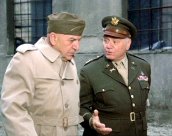
Guerrilla warfare has been around....well, probably as long as war itself has. In American history, guerrilla warfare goes back into the French and Indian war, especially the American revolution, but in my goofy head, I always think of the Civil War as when the guerrilla fighting took a particularly nasty turn. Because it was so vicious -- Bleeding Kansas, Quantill's raiders -- not as many films explore the topic. Unfortunately, the ones that I've seen that do jump in...they're not very good. As for 1969's The Desperados, it isn't very good, but it is badly entertaining.
It's late in the Civil War, a group of Confederate guerrillas led by Josiah Galt (Jack Palance), a former parson, is doing its best to terrorize Union forces in the western theater. Among his men are three of his sons, including David (Vince Edwards), who's grown disgusted with their tactics. Following one attack on a peaceful town that degenerates into a massacre, David decides to leave his father's group. He's caught though and sentenced to death by his own father, only managing to escape at the last minute. David manages to start a new life, marrying his sweetheart, Laura (Sylvia Syms), and with the end of the Civil War thinks he may be safe. Years pass, but Josiah is still at the head of his gang of guerrillas turned bandits, terrorizing Texas and the southwest. David hopes he can steer clear, but the Galt gang may be heading his way.
I had never heard of this western -- at all -- before finding it on the Movie Channel (original name, huh?). I'm always curious to see little known westerns like this so I recorded it, and here we sit. From director Henry Levin (with backing from producer Irving Allen), 'Desperados' has the distinct feel of an American western posing as a spaghetti western. Maybe it was cheaper, but it was definitely filmed in Spain and not the American west. The look of the film -- in La Pedriza and Colmenar Viejo, Spain -- is definitely one of the most positive aspects of the game. The cynical/dark nature of the story with some Greek/Roman mythological undertones combined with some surprisingly bloody violence all leans toward the spaghetti western genre. It isn't though, just a decent American impression.
The biggest part of the Greek tragedy from mythology comes in the story's focus on the Galt family. Who better to play a nutso family patriarch with some bizarre religious beliefs than Jack Palance? The answer you're looking for is No One. Given a second career in Europe with spaghetti westerns, Palance hams it up like only he could. He's big and loud and all over the place in a part that -- as usual -- borders on being too much. Edwards is okay as the do-good David, but he gets lost in the shuffle too much as the heroic brother who wants to do the right thing. He does rock some awesomely big hair so he's got that going for him. Also starring as the Galt brothers are George Maharis as Jacob, the loyal brother who sticks with his father through thick and thin, while Adam (Christian Roberts) is nuts, the youngest and possibly unhinged brother.
Having some fun in a key supporting part is Neville Brand as Marshal Kilpatrick, the peace officer who knows David's true identity and wants to help him lead his new life. Kate O'Mara plays Adah, a dance hall girl/prostitute who worries about David's well-being and that of his family. John Paul plays Sheriff Lacey, another peace officer who questions David's intentions.
Basically across the board, this is a pretty weird western. It is at its strongest early on when the Civil War is raging, the pace slowing down some once the war ends and David settles down to a new life. The finale makes up for some of the goofiness in the middle, including a final twist that definitely caught me by surprise. On top of the surprising violence -- lots of blood post-shooting -- is some really funny and bizarre nudity. At one point, a pimp/saloon owner stands over his girls who are topless wrestling (strategic places are covered up). All very tasteful. There's also some concealed nudity with Syms swimming, Edwards dangling her clothes just out of reach. It's just that kind of western. Pretty odd, at times really bad, but mostly entertaining. Where else can you see a preening Jack Palance screaming and taunting his grandson who he intends to kill? The answer is nowhere.
The Desperados (1969): ** 1/2 /****
The Sons of Katie Elder
"First, we reunite, then find Ma and Pa's killer...then read some reviews."
Showing posts with label Vince Edwards. Show all posts
Monday, November 25, 2013
Monday, May 27, 2013
The Devil's Brigade
It's 1942 and with World War II very much yet to be decided, Lt. Colonel Robert Frederick (William Holden) has been summoned to a staff meeting in England. Even though he has no combat experience, Frederick is being given command of a new unit, the First Special Service Force. Their ultimate mission is still to be decided but the Colonel prepares for the training that awaits his brigade that consists of a crack unit of well-trained Canadian troops commanded by Dunkirk veteran Maj. Alan Crown (Cliff Robertson) and an unruly, misfit group of American troops headed by the similarly unruly Maj. Cliff Bricker (Vince Edwards). The two sides bristle immediately, but training continues. If Frederick can manage to keep his men together, their services are very much needed, including a dangerous mission on the Italian front.
From veteran director Andrew McLaglen, 'Brigade' is based on a real-life military unit, the First Special Service Force. Released just a year after The Dirty Dozen, it bears some striking similarities, but it more than capably carves out its own niche in war movie department. It is one of the great men-on-a-mission movies, and that's saying something considering the late 1960s were rampant with them. McLaglen filmed on location in Italy for much of the second half of the movie, giving an authentic look and feel to the proceedings as the Brigade goes into battle. Composer Alex North turns in a gem of a soundtrack, his theme for the Brigade (listen HERE) one that you'll be whistling for days. The main theme is a highlight, but North specializes in the quieter, darker and more sinister moments leading up to the battle in the finale.
More of a workmanlike director than an auteur, McLaglen specialized in movies like this with impressive casts of male stars. This 1968 WWII flick is loaded with star power. As Colonel Frederick, Holden doesn't get a flashy part, but he leads the way just the same. His officer wants to prove himself while also proving how capable his men are too. The best part in the film goes to Robertson as Maj. Crown, an intelligent, well-spoken and brutally capable officer who survived the Dunkirk disaster. It is a smart, underplayed role, and he steals every scene he's in. As his American counterpart, Edwards too is very solid. His Maj. Bricker is blunt and without a filter, a scrounger and hustler with the best of them. Also look for Dana Andrews, Michael Rennie and Carroll O'Connor as American generals, all making cameo appearances.
Ah, yes, and then there's the rest of the cast. If the star power above wasn't enough, McLaglen assembles a deep, talented cast of tough guys to fill out the ranks of the brigade. Leading the American contingent, look for Claude Akins, Andrew Prine, Richard Jaeckel, Luke Askew, Tom Troupe, Bill Fletcher and Tom Stern. For the Canadian half of the Brigade, watch out for Jack Watson, Harry Carey Jr., Jeremy Slate, Richard Dawson and Jean-Paul Vignon. It's cool just seeing all these recognizable faces here together, some leaving more of an impression than others. Jaeckel as Omar Greco, an acrobat trying to escape but finding a home instead, especially stands out as does Akins as Rocky, the American bully, Prine as Ransom, a smart misfit, Watson as Peacock, the tough but gentlemanly Canadian and Slate as O'Neill, the hand-to-hand combat instructor.
I think it's the cast that separates the movie from so many other solid WWII movies. It's a familiar formula here; introduce everyone, train them, have them put their differences aside following some male bonding and then unleash them on the enemy. The male bonding comes courtesy of a barroom brawl (watch HERE) with some rowdy lumberjacks, a great scene. The script is ideal in its ability to let these tough guys be tough guys. It's fun, natural with chemistry and features some great one-liners. Other highlights include Slate's introduction in a showdown with Akins (watch HERE), a 30-mile hike where the rivalry develops further, and many others. Moral of the story is this, we need these parts to be effective for the second half of the movie to truly work. And you bet it does.
The last hour follows the Brigade as it enters combat. Required to prove themselves and their ability, Frederick leads a patrol behind the lines to a heavily guarded Italian town crawling with Germans. It's a lighter action scene, but memorable just the same. The best part though is in the finale, the Brigade ordered to attack the apparently impenetrable Mount la Difensa (where the Service Force really made a name for themselves), a mountain garrisoned by German infantry and heavy armor. First, they must scale a sheer cliff-face to mount a surprise attack on the garrison. It is a great action sequence, McLaglen filming in the trenches and dugouts as the Brigade begins their assault. We always know where the battle is, where it's going, and the sheer scale of it. When the casualties do come (and they do, quickly and with some surprises), it makes this extended battle sequence that much more effective emotionally.
This has always been one of my favorites, and I seem to pick something new up with each passing viewing (I'm guessing I'm somewhere between 20 and 30). This time? The darkness late, Frederick greeting his men as they prepare for battle. North's score goes dark, Dawson explaining "Haven't you ever heard a man say goodbye?" It's an eerie, uncomfortable moment. Spot-on too, considering the Brigade sustained 77% casualties in the coming battle. 'Brigade' doesn't have the reputation of so many other WWII movies of the time, but it deserves some attention. A hidden gem.
The Devil's Brigade (1968): ****/****
* Rewrite of June 2010 review
Saturday, July 10, 2010
The Dirty Dozen: The Deadly Mission
Released in 1967, The Dirty Dozen featured a long list of stars, tough guys who worked perfectly together to make a WWII classic. Almost 20 years later in the era of TV movies and miniseries, Lee Marvin reprised his role as Major Reisman for The Dirty Dozen: The Next Mission, and was all set to play the character again before he passed away from a heart attack in 1987. Someone had to step into the role though, and producers turned to one of the stars of the original Dozen, Telly Savalas.
Now 65 years old and on the downside of his career, Savalas plays Major Wright in 1987's The Dirty Dozen: The Deadly Mission. It's not so much a sequel as a reworking, just like Marvin's 1985 movie, with whole scenes duplicated albeit with a new cast and some slightly older returnees from the original. As stand alones, these sequels might be better -- there would be one more in 1988, review to come -- if you haven't seen the original. On the other hand, it's a good guilty pleasure seeing all the low-budget, scene for scene repeats of the original classic. A bad TV movie if there ever was one, but an entertaining bad movie.
It's 1944 and Major Wright (Savalas) has been recalled from a behind the lines mission in Italy to undertake a new, more important mission. General Warden (Ernest Borgnine) orders Wright to assemble a squad of 12 men sentenced to death or long terms of imprisonment and train them until they're an effective fighting force. Intelligence reports have the Germans making a new nerve gas in a rocket with the capability to reach the U.S.. The Germans are doing this work hidden away in a heavily guarded French monastery. Wright's more than a little suicidal mission is to lead his squad in -- with some help from loyal Sgt. Holt (Vince Edwards) -- and not only destroy the nerve gas but also rescue six scientists commissioned to work on the experiments.
Even with the original, the problem with a squad of 12 soldiers is that all of them can't receive equal screentime. The 1967 original at least tried to introduce all 12 convicts turned commandos. That way when they do inevitably start getting picked off, we know who it was. Well, the TV versions lose about an hour of actual movie time and a significant amount of the budget. Five or six of the 12 are even identified, the rest mostly serving as cannon fodder who are typically identified after they get killed. Of those that do stand out there's Bo Svenson channeling Savalas' Maggott character, Randall 'Tex' Cobb as Swede Wallan, Gary Graham as Stern, Paul Picerni as Pops Ferucci, and two van Patten brothers as two convict brothers (quite a stretch). Rounding out the new dozen were a handful of Yugoslavian actors who don't have more than a line or two combined.
As for the returning cast members, Savalas as Major Wright is a similar feeling to watching Marvin in 'Next Mission.' They're clearly too old to play the parts, but because it's Telly freaking Savalas you let it pass. He's Big Joe, he's Kojak! He looks like he's having some fun with the part, and some of his line deliveries provide some funny moments in an otherwise slow script. Borgnine really makes nothing more than a two-scene appearance as General Warden, the staff officer tasked with keeping tabs on Wright and coming up with these missions that will save the war. Vince Edwards steps in for Richard Jaeckel as the tough but loyal sergeant. His part requires him to squint, growl and throw a grenade now and then. Wolf Kahler plays the SS commander in the area trying to stop Wright's commando squad.
After the requisite in-fighting and then bonding as a fighting unit, the new Dozen are unleashed in France. Even with a small TV budget, director Lee Katzin handles the action-packed finale nicely. It's heavy on gunfire and short on actual blood, but it is entertaining. It is an action sequence that is aided by the monastery location and has that right blend of chaos and explosions. As with the other Dozen movies, it's only a matter of time and who will get picked off against the overwhelming odds. The ending did surprise me -- one character gets to redeem himself with a big sacrifice -- in how many of the squad survive the mission. See if you can guess which ones make it.
A made for TV movie that's probably only recommended for fans of the original Dirty Dozen or at least WWII movies. It's the type of unpretentious, cheap action flick that is best when you don't take it too seriously. Sit back and enjoy this one, watch Savalas and Co. gun down German and SS soldiers by the busload. If that fails, there's always the original. Just interested in the action? Watch THIS fan video (SPOILERS obviously) with every kill from the movie.
The Dirty Dozen: The Deadly Mission <----trailer (1987): ** 1/2 /****
Now 65 years old and on the downside of his career, Savalas plays Major Wright in 1987's The Dirty Dozen: The Deadly Mission. It's not so much a sequel as a reworking, just like Marvin's 1985 movie, with whole scenes duplicated albeit with a new cast and some slightly older returnees from the original. As stand alones, these sequels might be better -- there would be one more in 1988, review to come -- if you haven't seen the original. On the other hand, it's a good guilty pleasure seeing all the low-budget, scene for scene repeats of the original classic. A bad TV movie if there ever was one, but an entertaining bad movie.
It's 1944 and Major Wright (Savalas) has been recalled from a behind the lines mission in Italy to undertake a new, more important mission. General Warden (Ernest Borgnine) orders Wright to assemble a squad of 12 men sentenced to death or long terms of imprisonment and train them until they're an effective fighting force. Intelligence reports have the Germans making a new nerve gas in a rocket with the capability to reach the U.S.. The Germans are doing this work hidden away in a heavily guarded French monastery. Wright's more than a little suicidal mission is to lead his squad in -- with some help from loyal Sgt. Holt (Vince Edwards) -- and not only destroy the nerve gas but also rescue six scientists commissioned to work on the experiments.
Even with the original, the problem with a squad of 12 soldiers is that all of them can't receive equal screentime. The 1967 original at least tried to introduce all 12 convicts turned commandos. That way when they do inevitably start getting picked off, we know who it was. Well, the TV versions lose about an hour of actual movie time and a significant amount of the budget. Five or six of the 12 are even identified, the rest mostly serving as cannon fodder who are typically identified after they get killed. Of those that do stand out there's Bo Svenson channeling Savalas' Maggott character, Randall 'Tex' Cobb as Swede Wallan, Gary Graham as Stern, Paul Picerni as Pops Ferucci, and two van Patten brothers as two convict brothers (quite a stretch). Rounding out the new dozen were a handful of Yugoslavian actors who don't have more than a line or two combined.
As for the returning cast members, Savalas as Major Wright is a similar feeling to watching Marvin in 'Next Mission.' They're clearly too old to play the parts, but because it's Telly freaking Savalas you let it pass. He's Big Joe, he's Kojak! He looks like he's having some fun with the part, and some of his line deliveries provide some funny moments in an otherwise slow script. Borgnine really makes nothing more than a two-scene appearance as General Warden, the staff officer tasked with keeping tabs on Wright and coming up with these missions that will save the war. Vince Edwards steps in for Richard Jaeckel as the tough but loyal sergeant. His part requires him to squint, growl and throw a grenade now and then. Wolf Kahler plays the SS commander in the area trying to stop Wright's commando squad.
After the requisite in-fighting and then bonding as a fighting unit, the new Dozen are unleashed in France. Even with a small TV budget, director Lee Katzin handles the action-packed finale nicely. It's heavy on gunfire and short on actual blood, but it is entertaining. It is an action sequence that is aided by the monastery location and has that right blend of chaos and explosions. As with the other Dozen movies, it's only a matter of time and who will get picked off against the overwhelming odds. The ending did surprise me -- one character gets to redeem himself with a big sacrifice -- in how many of the squad survive the mission. See if you can guess which ones make it.
A made for TV movie that's probably only recommended for fans of the original Dirty Dozen or at least WWII movies. It's the type of unpretentious, cheap action flick that is best when you don't take it too seriously. Sit back and enjoy this one, watch Savalas and Co. gun down German and SS soldiers by the busload. If that fails, there's always the original. Just interested in the action? Watch THIS fan video (SPOILERS obviously) with every kill from the movie.
The Dirty Dozen: The Deadly Mission <----trailer (1987): ** 1/2 /****
Labels:
1980s,
Bo Svenson,
Ernest Borgnine,
Paul Picerni,
Telly Savalas,
Vince Edwards,
WWII
Friday, May 28, 2010
The Hired Gun
I've written at least two reviews of TV shows edited into feature length movies since I started the blog. Typically they're pretty easy to spot, but that doesn't mean they have to be bad. The pacing or editing might seem a little off, but what do you really expect from a TV show turned movie? Usually my radar is pretty decent trying to figure out if the movie I'm watching is from some short-lived 50s or 60s TV show. As for 1957's The Hired Gun, I never really thought it was from a TV show, but it sure felt like it.
For starters, 'Gun' clocks in at a whopping 63 minutes, many of which are just shots of the main characters riding across the desert. Visually stunning, agreed, but giving us any reason, any reason at all to be interested? Not really. Even at just over an hour, director Ray Nazarro (typically a TV director, appropriately enough) has two vastly different storylines, one covered over the first 30 minutes and then wham! Story change! New story up until the end. Too bad because with the talent involved, the movie had some potential but never amounts to much.
Waiting to be hanged in a few hours, Ellen Belden (Anne Francis) sits in her jail cell in a dusty Texas town. She claims innocence, but a judge sentenced her to death for the murder of her husband. When she steps up to the noose, she'll be the first woman ever hung in Texas. But the morning of the hanging, Judd Farrow (Chuck Connors), her uncle's ranch foreman, busts her out and helps her escape to the ranch in New Mexico. Ellen's dead husband's family, especially father Mace (John Litel) and brother Kell (Vince Edwards), want her back to answer for the murder. With no other options, they hire gunfighter Gil McCord (Rory Calhoun) to go get her back for $5,000.
One of the big problems here is that within 30 seconds of being introduced to Francis' character, she's spilling her guts claiming innocence in the opening narration. If it's me, I try and keep you guessing for at least a little while whether she killed her husband or not. Second on the problem list, Francis with her angelic blond hair and innocent face clearly isn't going to lie about her actions. From there on, it's just a matter of who did it, and looking at the supporting cast, it's a pretty easy guess.
As for the two stories, it just caught me off-guard. The first 30 minutes or so is the prison break and McCord's pursuit of Ellen as she flees into New Mexico. The last half is Gil and Ellen trying to prove who really killed her husband with a mysterious horse thief named Kirby (Guinn Williams) holding the key to proving her innocence. The problem isn't that the story takes a quick right turn midway through the movie, it's that the first half is pushed to the side in the blink of an eye. Connors' Judd helps Ellen escape and then assumes some reciprocity in the feelings department. He chases after Gil and Ellen, gets shot in the arm and disappears the rest of the story.
Of course, that's just one problem with the main characters. Calhoun is supposed to be a badass gunfighter but he only gets one chance to prove this in the movie. Other than people cowering when they hear his name, we're given no reason to think this guy is the ultimate bad hombre with a six-shooter. From the minute he's introduced to Ellen, it's only a matter of time before he figures out the truth and of course, falls in love with her. Oh, no, I certainly hope they can make it through this harrowing journey together! Calhoun and Francis are decent enough with their parts, but they're just not given enough to do.
SPOILERS STOP READING, HERE COMES THE KILLER REVELATION SPOILER From the start, it's pretty obvious the real killer is either Chuck Connors or Vince Edwards. And the winner for husband killer is....Vince Edwards, seeking his father's love, approval, and most importantly, his money! Both actors are capable of being strong bad guys, and here they both get a shot at being the brooding, intimidating villains. Like the main characters though, they're not given much to do until the story needs them to be shot so Gil and Ellen can end up together. END OF SPOILERS
That's my idea, make this into a half-hour episode of The Rifleman and you might have a halfway decent show. But as a 63-minute feature with about 30 minutes of storyline, this western falls woefully short of being halfway decent. The cast might make it seem more appealing, but this is just not a good movie from start to finish. Pass in a big way.
The Hired Gun (1957): */****
For starters, 'Gun' clocks in at a whopping 63 minutes, many of which are just shots of the main characters riding across the desert. Visually stunning, agreed, but giving us any reason, any reason at all to be interested? Not really. Even at just over an hour, director Ray Nazarro (typically a TV director, appropriately enough) has two vastly different storylines, one covered over the first 30 minutes and then wham! Story change! New story up until the end. Too bad because with the talent involved, the movie had some potential but never amounts to much.
Waiting to be hanged in a few hours, Ellen Belden (Anne Francis) sits in her jail cell in a dusty Texas town. She claims innocence, but a judge sentenced her to death for the murder of her husband. When she steps up to the noose, she'll be the first woman ever hung in Texas. But the morning of the hanging, Judd Farrow (Chuck Connors), her uncle's ranch foreman, busts her out and helps her escape to the ranch in New Mexico. Ellen's dead husband's family, especially father Mace (John Litel) and brother Kell (Vince Edwards), want her back to answer for the murder. With no other options, they hire gunfighter Gil McCord (Rory Calhoun) to go get her back for $5,000.
One of the big problems here is that within 30 seconds of being introduced to Francis' character, she's spilling her guts claiming innocence in the opening narration. If it's me, I try and keep you guessing for at least a little while whether she killed her husband or not. Second on the problem list, Francis with her angelic blond hair and innocent face clearly isn't going to lie about her actions. From there on, it's just a matter of who did it, and looking at the supporting cast, it's a pretty easy guess.
As for the two stories, it just caught me off-guard. The first 30 minutes or so is the prison break and McCord's pursuit of Ellen as she flees into New Mexico. The last half is Gil and Ellen trying to prove who really killed her husband with a mysterious horse thief named Kirby (Guinn Williams) holding the key to proving her innocence. The problem isn't that the story takes a quick right turn midway through the movie, it's that the first half is pushed to the side in the blink of an eye. Connors' Judd helps Ellen escape and then assumes some reciprocity in the feelings department. He chases after Gil and Ellen, gets shot in the arm and disappears the rest of the story.
Of course, that's just one problem with the main characters. Calhoun is supposed to be a badass gunfighter but he only gets one chance to prove this in the movie. Other than people cowering when they hear his name, we're given no reason to think this guy is the ultimate bad hombre with a six-shooter. From the minute he's introduced to Ellen, it's only a matter of time before he figures out the truth and of course, falls in love with her. Oh, no, I certainly hope they can make it through this harrowing journey together! Calhoun and Francis are decent enough with their parts, but they're just not given enough to do.
SPOILERS STOP READING, HERE COMES THE KILLER REVELATION SPOILER From the start, it's pretty obvious the real killer is either Chuck Connors or Vince Edwards. And the winner for husband killer is....Vince Edwards, seeking his father's love, approval, and most importantly, his money! Both actors are capable of being strong bad guys, and here they both get a shot at being the brooding, intimidating villains. Like the main characters though, they're not given much to do until the story needs them to be shot so Gil and Ellen can end up together. END OF SPOILERS
That's my idea, make this into a half-hour episode of The Rifleman and you might have a halfway decent show. But as a 63-minute feature with about 30 minutes of storyline, this western falls woefully short of being halfway decent. The cast might make it seem more appealing, but this is just not a good movie from start to finish. Pass in a big way.
The Hired Gun (1957): */****
Labels:
1950s,
Chuck Connors,
Guinn Williams,
Rory Calhoun,
Vince Edwards,
westerns
Thursday, August 27, 2009
The Killing
So after watching two Sterling Hayden movies last week on his TCM day and a third thanks to Netflix, The Killling, I've decided I need to go in a different direction with my movies for a little while. To be fair, the two on TCM were B-movies, Ten Days to Tulara and Battle Taxi, but they weren't even good B-movies. I figured The Killing sounded pretty good, but something just didn't click for me in actually watching it.
The story is gritty and realistic especially when considering it was released in 1956. With director Stanley Kubrick at the helm, the movie takes on an almost documentary like feel to it. Fresh out of prison after serving a five-year sentence, Johnny Clay (Hayden) is putting his master plan into effect. With a small crew, Clay intends to knock off a racetrack cash room (not unlike The Split would do 10 years later) on a day when hundreds and thousands of bets will go to the tickettakers. Clay figures the take will be just over $2 million dollars.
Clay has developed a complicated plan that requires split-second timing with help from a handful of people, some who know what they're doing and others who will remain in the dark, as Clay himself will actually pull off the actual robbery in the chaos they cause. But when you bring so many different people together, personality conflicts come up that you can't plan for in advance. Even the most detailed, well thought out plan can go awry with something that comes out of left field. The aftermath of the robbery and the ending provides a nice, little twist with that thought in mind.
I can't throw Hayden under the bus here for his performance because he's an ideal choice for the quiet, hardened ex-con looking to get his life back on track with his wife (Coleen Gray). The whole cast is good in roles that don't require any background or backstory. This is who they are, and Kubrick presents them as that without any unnecessary clutter. Clay's team includes Jay C. Flippen as the bankroller, Ted de Corsia as a cop who'll play an important role in the getaway, Elisha Cook Jr as an attendant with some problems at home with his wife (Marie Windsor), and Joe Sawyer as a bartender at the racetrack.
Watching The Killing some 50 years after its release, my first thought was 'I've seen this before' because it's style and story have been reused and taken into the lexicon of heist and robbery movies. It's not fair to hold that against The Killing because they couldn't account for the impact it would have on the sub-genre, but it is hard not to notice it. Kubrick tells the story in non-linear fashion, showing one character's involvement and then bouncing back 3 hours to another character. The negative to come from this is a very cheesy sounding narrative that sounds like something plunked from a Dragnet episode.
With that type of storyline, the heist is well-handled because we see things before they always know what they mean in the context of the robbery. Two parts especially stand out as Clay hires two men, Timothy Carey as a marksman, Carey's scenes with MASSIVE SPOILERS, and Kola Kwariani as a strongman, Kola's introduction, to cause diversions during the robbery. I liked both subplots and would have liked to know more about them, but maybe that's not what Kubrick was going for. Also, the subplot which becomes a major turning point in the movie, whipped Cook Jr and wife Windsor, are difficult to watch because Windsor is such a nasty character. Her plan with boyfriend Vince Edwards ends up making quite an impact on the aftermath.
I'd like to give The Killing a higher ranking, but I just couldn't get into it. Like I said though, I can't blame the movie itself for that. It set the groundwork for future heist/robbery movies with its style and frankness in dealing with thieves turning on each other and the double and triple cross. Maybe I'll give this one a try down the road because I can appreciate that it is a good movie, just not one I necessarily liked.
The Killing <----trailer (1956): ** 1/2 /****
The story is gritty and realistic especially when considering it was released in 1956. With director Stanley Kubrick at the helm, the movie takes on an almost documentary like feel to it. Fresh out of prison after serving a five-year sentence, Johnny Clay (Hayden) is putting his master plan into effect. With a small crew, Clay intends to knock off a racetrack cash room (not unlike The Split would do 10 years later) on a day when hundreds and thousands of bets will go to the tickettakers. Clay figures the take will be just over $2 million dollars.
Clay has developed a complicated plan that requires split-second timing with help from a handful of people, some who know what they're doing and others who will remain in the dark, as Clay himself will actually pull off the actual robbery in the chaos they cause. But when you bring so many different people together, personality conflicts come up that you can't plan for in advance. Even the most detailed, well thought out plan can go awry with something that comes out of left field. The aftermath of the robbery and the ending provides a nice, little twist with that thought in mind.
I can't throw Hayden under the bus here for his performance because he's an ideal choice for the quiet, hardened ex-con looking to get his life back on track with his wife (Coleen Gray). The whole cast is good in roles that don't require any background or backstory. This is who they are, and Kubrick presents them as that without any unnecessary clutter. Clay's team includes Jay C. Flippen as the bankroller, Ted de Corsia as a cop who'll play an important role in the getaway, Elisha Cook Jr as an attendant with some problems at home with his wife (Marie Windsor), and Joe Sawyer as a bartender at the racetrack.
Watching The Killing some 50 years after its release, my first thought was 'I've seen this before' because it's style and story have been reused and taken into the lexicon of heist and robbery movies. It's not fair to hold that against The Killing because they couldn't account for the impact it would have on the sub-genre, but it is hard not to notice it. Kubrick tells the story in non-linear fashion, showing one character's involvement and then bouncing back 3 hours to another character. The negative to come from this is a very cheesy sounding narrative that sounds like something plunked from a Dragnet episode.
With that type of storyline, the heist is well-handled because we see things before they always know what they mean in the context of the robbery. Two parts especially stand out as Clay hires two men, Timothy Carey as a marksman, Carey's scenes with MASSIVE SPOILERS, and Kola Kwariani as a strongman, Kola's introduction, to cause diversions during the robbery. I liked both subplots and would have liked to know more about them, but maybe that's not what Kubrick was going for. Also, the subplot which becomes a major turning point in the movie, whipped Cook Jr and wife Windsor, are difficult to watch because Windsor is such a nasty character. Her plan with boyfriend Vince Edwards ends up making quite an impact on the aftermath.
I'd like to give The Killing a higher ranking, but I just couldn't get into it. Like I said though, I can't blame the movie itself for that. It set the groundwork for future heist/robbery movies with its style and frankness in dealing with thieves turning on each other and the double and triple cross. Maybe I'll give this one a try down the road because I can appreciate that it is a good movie, just not one I necessarily liked.
The Killing <----trailer (1956): ** 1/2 /****
Subscribe to:
Posts (Atom)