The Sons of Katie Elder

The Sons of Katie Elder
"First, we reunite, then find Ma and Pa's killer...then read some reviews."
Showing posts with label Bo Svenson. Show all posts

Monday, June 23, 2014

North Dallas Forty

Football at all levels, everything from the NFL to NCAA to high school and Pop Warner, is at an all-time high in terms of popularity. Over the last few years, football has been in the news for an ever-increasing amount of negative news, much of it related to the dangers of the sport. This isn't anything new, but the purely impressive numbers are mounting at dangerous levels. Years ahead of its time and based on a bestselling novel, here's 1979's North Dallas Forty.

A wide receiver for the North Dallas Bulls, Phil Elliott (Nick Nolte) is past but his prime but still a very reliable player who the team counts on in go-to situations seemingly week in and week out. He's coming off an especially strong performance, hauling in the game-winning catch, but football is a week to week sport. With his friend and the team's quarterback, Seth Maxwell (Mac Davis), Phil has come to rely on painkillers to survive from game to game, not to mention the recreational drugs, increasing drinking and meaningless sexual encounters. It's becoming a lot to handle for Elliott, the receiver questioning his career choice, the business behind it, and the possibility of that career coming to an end quicker than he would have liked. The next game is fast approaching, and the Bulls need a win more than ever. Can Phil pull it together again?

Yowza, what a good movie, a sports movie that isn't often mentioned as one of the genre's best. It certainly deserves to be mentioned in the conversation. Based off the bestselling novel from Peter Gent (a former wide receiver), 'North' is a not-so thinly veiled dig at the Dallas Cowboys of the late 1960s when Gent was with the team. It is a hell of a story, a damning, indicting look at something fans take for granted at times. What goes on in this 1979 could be shocking for audiences currently, much less 30-plus years ago. This is honest, uncomfortable, funny, depressing and one of those brutally underrated movies -- kudos director Ted Kotcheff -- that has an air of authenticity that could only come from someone who's been in the locker rooms, the practice fields, the training room and the postgame parties. You feel like you're getting a window into something dark and disturbing. It's not just something we watch as fans on the weekend, but a cutthroat business with money as the bottom line.

With Nolte leading a strong ensemble cast, 'North' offers more than a few memorable moments. The opener sets the tone immediately, Nolte's Elliott waking up and going through his morning routine. He can barely make it to the tub to soak in the water. Yeah, the game-winning catch is glamorous, but at what cost? I loved the excesses of the postgame party, the Bulls celebrating with a raucous, out of control blowout. As big and crazy as the party is, the pregame moments in the locker room are just as effective. We run the gamut of preparations, some quietly readying themselves, others psyching themselves up for the game. None of these moments feel overdone or forced, and it would have been easy for the story to take that extra step forward to over-the-top. In ways that just watching the games never do, you get a sense as a viewer what it means to survive as a professional football player through the ups and the downs.

Who better to play the gravely-voiced veteran wide receiver who's hanging on to what he loves -- playing football -- better than Nick Nolte? I submit that no one is better. Nolte delivers a great performance as Phil Elliott, a skilled receiver who doesn't have the most ability but works at it religiously, relying on some of the best hands in football. It's great seeing his development (the story takes place over a little week) as he weighs the pros and cons of what he does for a living. His friendship and working relationship with Davis' Seth provides some great human moments as well as some that just make you cringe. We see the difference too between the star quarterback (Davis, a singer, holding his own as a character if not a football player) who the team so desperately depends on, and the far-more replaceable wide receiver. This is a business, a lesson we learn all too harshly.

Who else to look for? A very strong ensemble as we see the players, coaching staff of the Bulls, the owner and management, anyone and everyone. Playing a variation on legendary Cowboys coach Tom Landry, G.D. Spradlin plays Bulls head coach B.A. Strothers, an authoritarian leader, with Charles Durning as his rah-rah, get in your face coordinator. Steve Forrest is slimy and smooth as Conrad Hunter, the Bulls' owner who wants a championship for Dallas, Dabney Coleman as his brother and general manager. Dayle Haddon plays Charlotte, a woman removed from the sport Phil falls for while Savannah Smith Boucher is a far-more casual sexual acquaintance. Bo Svenson and John Matuszak are terrifying as two of the Bulls offensive linemen, embodying the concept of football players as modern-day gladiators.

As the movie develops though, it's the business of the sport and football that takes the spotlight. We see snippets of a game, just a few plays on one drive in a key game between Dallas and Chicago, the plays shot almost in complete darkness so we can't see the stands (and fans, probably cheaper this way). It's quick and effective without overstaying its welcome. I was genuinely surprised by where the story went in the final 15 minutes, an appropriately dark finale that works on basically all levels to show how ridiculous the sport and the business can be. A classic sports movie that deserves far more of a reputation. Now if Nolte's Phil would just stop wearing that stupid cap....

North Dallas Forty (1979): ***/****

Thursday, May 22, 2014

The Delta Force

Here's a universal truth for you that just about everyone can agree about. Chuck Norris is in fact, an amazingly bad ass movie star. His movies aren't always that great -- sometimes they're not even good, sometimes they're truly bad -- but through it all, Chuck Norris and all his awesome facts, is one cool dude. I haven't seen many of his movies, but I do my best to catch up with them, like 1986's The Delta Force, loosely based on the true story of real-life 1985 hijacking of TWA Flight 847.

Flying out of Cairo with scheduled stops at Athens, Rome and New York City, ATW Flight 282 takes off with 100-plus passengers on-board. Not too long after takeoff, terrorists from the New World Revolutionary Organization led by a man named Abdul (Robert Forster) hijack the plane, starting a chain of events as the plane tries to find a landing site to deal with the terrorists and all their hostages. While the terrorists' demands are up in the air, an elite American special forces out, the Delta Force, led by Colonel Nick Alexander (Lee Marvin) and his second-in-command, Major Scott McCoy (Norris), is scrambled to help rescue the hostages. Can the Delta Force get their in time and rescue the hostages in time against nearly insurmountable odds as the terrorists prep to go out in a blaze of glory?

What an odd, weird movie. From director Menahem Golan (who co-wrote the script with James Bruner), 'Delta' was filmed on-location at a new studio in Jerusalem, the GG Israel Studios. The Israeli locations are pretty cool, adding an authentic look and feel to the story. Now with that said, it's a big old mess of a flick with some -- if not enough -- entertaining qualities. It mixes touches of disaster movies, action heavy shoot 'em ups and plenty of patriotic flag-waving, bouncing back and forth among the different angles. It's almost schizophrenic, never finding a rhythm. We go from on-board hostages to diplomatic and government situations, airport to Delta Force, hostages to terrorists. I felt like key parts of the story that explain what went on are completely missing. Title cards try and explain how and when and where, but there seems to be chunks completely cut away. Different segments with no real unifying link.

Instead of that focus on story and character and plot development, 'Delta' rides on one thing; Chuck Norris' awesomeness. That's it. That's all. Unfortunately, he's kept in the background for most of the first hour of the movie.When his McCoy is on-screen, Norris makes the most of it, his experienced Delta Force leader worn down by the horrors of fighting. That said, he sure embraces that whole fighting thing. The last 45 minutes (more on it later) are one scene after another where Norris' McCoy goes all America on some terrorist ass. He jumps off buildings, shoots, punches, and stabs countless terrorists while riding a motorcycle rigged with seemingly infinite rockets and missiles. In another way of showing how cool he is, McCoy typically likes to enter or leave a room by jumping through a window, opening the door for all sorts of badass entrances. Great drama it is not, but in the badass department, 'Delta' succeeds thanks to Norris.

In his last movie before his death a year later in 1987, Marvin is as cool as ever as Col. Alexander, the no-nonsense, smart-ass Delta Force leader, always ready with a quick shot from the hip or a snappy one-liner. Their scenes aren't too long, but Marvin and Norris are an excellent team together. Who else to look for? How about Robert Vaughn as the Delta Force commander back in Washington D.C. Oh, and some of the hostages? George Kennedy, Martin Balsam, Shelley Winters, Joey Bishop, Lainie Kazan, and a young Kim Delaney as a nun with Bo Svenson as the pilot of the hijacked jet airliner. Not a bad cast by any means, just the opposite, but the disjointed story doesn't give most of them a chance to do anything. George Kennedy manages to rise above the story, as do Balsam and Svenson.

If you can make it to the last 45 minutes, you'll be rewarded. It's almost non-stop from there until the final scene, making up for the slowish first 80 minutes and its schizophrenic nature that's all over the freaking place. In general, it's a pretty cheesy 1980s action movie with all sorts of good cliches and stereotypes. The Delta Force theme is unintentionally funny -- nice work from composer Alan Silvestri -- with an almost pleasant, light-hearted feel to it. Listen HERE if curious. You almost expect to be played over a sports movie montage.

Not a bad movie, not necessarily a good movie either, but entertaining enough. Cool cast that isn't used to its potential, but Marvin and Norris make it worthwhile.

The Delta Force (1986): ** 1/2 /****

Wednesday, February 12, 2014

The Great Waldo Pepper

Ever heard of barnstorming? Well, you should have so shame on you. In the 1920s, flying circuses traveled across America, pilots performing ridiculously dangerous (some would say suicidal) stunts and tricks to amuse and dazzle audiences. A movie I stumbled across on Netflix does a really good job giving a look at the dangerous world of barnstorming, 1975's The Great Waldo Pepper.

It's 1926 in Nebraska and Waldo Pepper (Robert Redford), a very talented pilot trying to create a reputation and name for himself, is scraping by. He flies all over the state, doing tricks and aerial stunts for anyone who will pay to see it, offering 5-minute rides for $5, all the money going toward the development of a new single-wing plane built by his friend and engineer, Ezra Stiles (Edward Hermann). Waldo has a bit of a rivalry with another pilot, Axel Olsson (Bo Svenson), especially when Axel moves into his territory, but seeing the business struggle and the money start to dry up, the pilot duo teams up. Their idea? Do something that audiences have never seen before, a stunt that will assure them a reputation and audiences wherever they go. Waldo and Axel intend to walk on their wings while flying thousands of feet up in the air.

I could be wrong -- and I often am -- but I believe this 1975 aviation flick sat in my Netflix queue for the last 10 months or so after I watched another aviation flick, 1965's Those Magnificent Men in Their Flying Machines. It's also the third pairing between director George Roy Hill and star Redford, having worked previously together in Butch Cassidy and the Sundance Kid and The Sting. This is a movie that loves its story, loves where it came from. It loves flying, aviation, the pilots, the history, any and all of it. If there's a surprise, it's that near the halfway point the story takes a surprising turn for the dark. The tone early on is light, a tad jokey, composer Henry Mancini's score adding to the fun, entertaining mood. The differences in tone work overall after the initial shock (and the scene that switches it up is a SHOCKER). Light and fun meets dark and surprising, I wouldn't think that would work, but it does.

Above all else, 'Waldo' is definitely worth seeking out because of some ridiculous aerial sequences. If this movie was released in the modern CGI (computer generated images) era, there would be no, NO, actual footage of the pilots, their planes and their tricks. But how about 1975? There weren't special effects like that. Everything had to be done for real or with some real cheesy-looking effects. The footage here is astounding. Hill and cinematographer Robert Surtees put their cameras up in the air with the planes and let the pilots do their thing. With the cameras mounted on the planes (or flying with them close by), it feels as a viewer that we're flying with them. Point of view shots really add to that sense of realism. Making it cooler? Redford, Svenson and the cast are up there too, one more authentic touch to an already authentic feel. We see pilots doing loops, some upside down -- one called an outside loop -- and others walking on the wings of their bi-planes. On a purely visual level, the film is a great experience.

Right in the midst of his acting heyday before he turned to directing more, Redford is at his best as Waldo Pepper, the pilot who wants more. He's able to do the drama, the comedy, all of it, playing a charming, likable rogue who becomes almost obsessed with making a name for himself. I wasn't quite sure what to expect out of the story going in -- only knowing it was about an early era in aviation -- so it caught me off guard when such an interesting character was leading the way. Much of that success comes from the dark twist the story takes near the halfway point, Redford's Waldo getting another layer or two to the character. If there's a weakness, it's the scenes with his former love, played by Margot Kidder, the scenes slowing the pace down with some attempts at drama. Mostly though, the character is great. He missed out on the dogfights in World War I and desperately wants to get a chance to be a hero, to be idolized no matter the inherent risks in a suicidal job. An underrated performance from Redford.

With an episodic story, we get plenty of other characters Waldo meets along the way. I really liked the rivalry turned friendship between Waldo and Svenson's Otto, two very talented pilots who are good on their own but may be better working together. The most dramatic part goes to Bo Brundin as Ernst Kessler, the famous German ace from WWI, a hero in Waldo's eyes who questions why he's been deemed a hero internationally by the public. Redford and Brundin have a couple great dialogue exchanges later, building to a surprising ending, slightly open-ended but it's easy to draw conclusions. A young Susan Sarandon has a supporting part as Mary Beth, a young woman Waldo meets and becomes part of the act with Waldo and Otto. Geoffrey Lewis makes the most of his smaller part as Newt, Waldo's former commander and a current Air Commerce inspector. And last, look for Philip Bruns as Dillhoefer, the owner of the air circus always looking for the next big thing in aerial stunts.

A very pleasant surprise for any number of reasons from Redford's lead performance as extremely talented pilot Waldo Pepper to the one impressive aerial sequence after another, one better than the last, especially in the final scene. Period correct planes, cool aerial stunts, it's a gem.

The Great Waldo Pepper (1975): ***/****

Friday, October 4, 2013

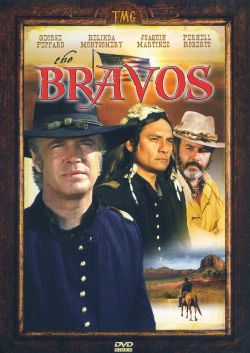
The Bravos

The TV movie is seemingly a thing of the past. In the 1970s and 1980s, TV movies and miniseries dominated the landscape, movie stars making the jump to television as roles presented themselves. Now with cable, dish and satellite, it's hard to consider what's even a TV movie and what isn't. Heading into the wayback machine, it's easy to identify them from the past, like 1972's The Bravos, a western with some potential that doesn't quite live up to it but is entertaining just the same.

It's just a year or two since the end of the Civil War, and the U.S. is focusing on expansion westward. At a remote outpost on the frontier, Major John Harkness (George Peppard) is doing his best to work himself out of quite the situation. His garrison is just 77 men and supplies and ammunition are running low. Those are problems enough, but reports are coming in from his patrols that the Navajo tribes seem to be joining up in the mountains. One report even has their numbers somewhere around 2,000. With so small a force though, Harkness has little options as to what he should do. The situation at the outpost is thrown for another loop when a small wagon train led by egotistical trail guide Jackson Buckley (Pernell Roberts) arrives seeking supplies for their coming trip. That's not all though. Buckley killed three young Kiowa warriors on the trail, Kiowas who were trying to join up with the gathering Navajo warriors. Can help arrive in time to stave off a brutal massacre?

It was pretty evident early-on that this was a TV western, a fact I wasn't aware of until after I started watching (clever Encore Westerns). From director Ted Post, 'Bravos' is a solid, entertaining western that is at times limited by its smallish budget. The 2,000 warrior war party is only mentioned as we never see more than 15 or 20 murdering Indians at a time. What does work though? It's a TV movie, but it was filmed on location in Sedona, Arizona, the sparse, windy and winter-bound desert providing quite the backdrop for the story. It's easy to understand the fear of living out there. Anything could be hiding in that desert just waiting to strike. As well, the set for the cavalry outpost is pretty cool, a crumbling little fort with obvious defensive deficiencies. Also worth mentioning is the musical score from composer Leonard Rosenman, similar to his score from 1962's Hell is For Heroes. 

One of my favorite tough guys stars, Peppard does a good job here leading a capable cast. His Maj. Harkness has been dealt the lousiest of hands, his garrison undermanned, under-supplied and waiting for an inevitable attack against horrific odds. Somehow, he's got to keep his command together even as his officers and enlisted men question what the point of it all is for. A weak subplot involves his son (Vincent Van Patten) who was kicked out of his Eastern school arriving at the outpost at the worst possible moment. Peppard has a knack for being a condescending tough guy, that ever-present smirk on his face, and it works here well. His officers include George Murdock as the questioning second-in-command, Dana Elcar as the fort surgeon, Ron Kelly as the cigar-chomping lieutenant, and John Kellogg as the loyal sergeant-major.

For a TV western, a pretty good cast has been assembled with some familiar faces. It's cool to see L.Q. Jones get a major role, playing the capable scout, Ben Lawler, who always seems to tangle with Harkness despite their long-standing friendship. Jones and Peppard sparkle in their scenes together. Roberts get to preen and yell as the overmatched trail guide, blustering his way through his "occupation" of which he knows little other than money. A young Bo Svenson players Bucholz, a former soldier on the run with Buckley's wagon train, playing a key part in a mission late. Clint Ritchie is solid too as Cpl. Love, the trusted enlisted man seemingly always leading another five-man patrol. Because a love story was needed (????), Belinda Montgomery plays Heller, a young woman traveling with her fiance, Garratt (Barry Brown). 

The biggest place the flick is hit by is in the action department. We're not talking any major battles, gunfights or chases across the desert. What we do get is a shootout here and there, the biggest being "an attack" on the fort by some sniping Navajo warriors. The best part though is a dangerous mission late as Harkness, Lawler and Bucholz head out into the wilderness to rescue Harkness' son from a raiding party. No spoilers here, but it's a cool premise and it is executed really well. You don't need a cast of thousands (hundreds, even tens I suppose) to be effective as is on display here.

Unfortunately though, then the movie just ends, almost like the TV movie just ran out of money or time to fit in a two-hour slot. One thing is resolved, but several other key things need to be dealt with. Nope, not here. Credits roll and the movie is over. I still liked the build-up, but it is a finale that feels forced in all sorts of ways. At 97 minutes, maybe it was getting too long. Maybe some resolution was cut out, but what we get is disappointing. Give it a try at Youtube HERE in its entirety. It's got enough going for it to recommend but know you'll most likely be disappointed with the finale.

The Bravos (1972): ** 1/2 /****

Saturday, July 10, 2010

The Dirty Dozen: The Deadly Mission

Released in 1967, The Dirty Dozen featured a long list of stars, tough guys who worked perfectly together to make a WWII classic.  Almost 20 years later in the era of TV movies and miniseries, Lee Marvin reprised his role as Major Reisman for The Dirty Dozen: The Next Mission, and was all set to play the character again before he passed away from a heart attack in 1987.  Someone had to step into the role though, and producers turned to one of the stars of the original Dozen, Telly Savalas. 

Now 65 years old and on the downside of his career, Savalas plays Major Wright in 1987's The Dirty Dozen: The Deadly Mission.  It's not so much a sequel as a reworking, just like Marvin's 1985 movie, with whole scenes duplicated albeit with a new cast and some slightly older returnees from the original.  As stand alones, these sequels might be better -- there would be one more in 1988, review to come -- if you haven't seen the original.  On the other hand, it's a good guilty pleasure seeing all the low-budget, scene for scene repeats of the original classic.  A bad TV movie if there ever was one, but an entertaining bad movie.

It's 1944 and Major Wright (Savalas) has been recalled from a behind the lines mission in Italy to undertake a new, more important mission.  General Warden (Ernest Borgnine) orders Wright to assemble a squad of 12 men sentenced to death or long terms of imprisonment and train them until they're an effective fighting force.  Intelligence reports have the Germans making a new nerve gas in a rocket with the capability to reach the U.S..  The Germans are doing this work hidden away in a heavily guarded French monastery.  Wright's more than a little suicidal mission is to lead his squad in -- with some help from loyal Sgt. Holt (Vince Edwards) -- and not only destroy the nerve gas but also rescue six scientists commissioned to work on the experiments.

Even with the original, the problem with a squad of 12 soldiers is that all of them can't receive equal screentime.  The 1967 original at least tried to introduce all 12 convicts turned commandos.  That way when they do inevitably start getting picked off, we know who it was.  Well, the TV versions lose about an hour of actual movie time and a significant amount of the budget.  Five or six of the 12 are even identified, the rest mostly serving as cannon fodder who are typically identified after they get killed.  Of those that do stand out there's Bo Svenson channeling Savalas' Maggott character, Randall 'Tex' Cobb as Swede Wallan, Gary Graham as Stern, Paul Picerni as Pops Ferucci, and two van Patten brothers as two convict brothers (quite a stretch).  Rounding out the new dozen were a handful of Yugoslavian actors who don't have more than a line or two combined.

As for the returning cast members, Savalas as Major Wright is a similar feeling to watching Marvin in 'Next Mission.'  They're clearly too old to play the parts, but because it's Telly freaking Savalas you let it pass.  He's Big Joe, he's Kojak!  He looks like he's having some fun with the part, and some of his line deliveries provide some funny moments in an otherwise slow script.  Borgnine really makes nothing more than a two-scene appearance as General Warden, the staff officer tasked with keeping tabs on Wright and coming up with these missions that will save the war.  Vince Edwards steps in for Richard Jaeckel as the tough but loyal sergeant.  His part requires him to squint, growl and throw a grenade now and then.  Wolf Kahler plays the SS commander in the area trying to stop Wright's commando squad.

After the requisite in-fighting and then bonding as a fighting unit, the new Dozen are unleashed in France.  Even with a small TV budget, director Lee Katzin handles the action-packed finale nicely. It's heavy on gunfire and short on actual blood, but it is entertaining.  It is an action sequence that is aided by the monastery location and has that right blend of chaos and explosions.  As with the other Dozen movies, it's only a matter of time and who will get picked off against the overwhelming odds.  The ending did surprise me -- one character gets to redeem himself with a big sacrifice -- in how many of the squad survive the mission.  See if you can guess which ones make it.

A made for TV movie that's probably only recommended for fans of the original Dirty Dozen or at least WWII movies.  It's the type of unpretentious, cheap action flick that is best when you don't take it too seriously.  Sit back and enjoy this one, watch Savalas and Co. gun down German and SS soldiers by the busload.  If that fails, there's always the original.  Just interested in the action? Watch THIS fan video (SPOILERS obviously) with every kill from the movie.

The Dirty Dozen: The Deadly Mission <----trailer (1987): ** 1/2 /****